
The Summer of Longing; Biking New England
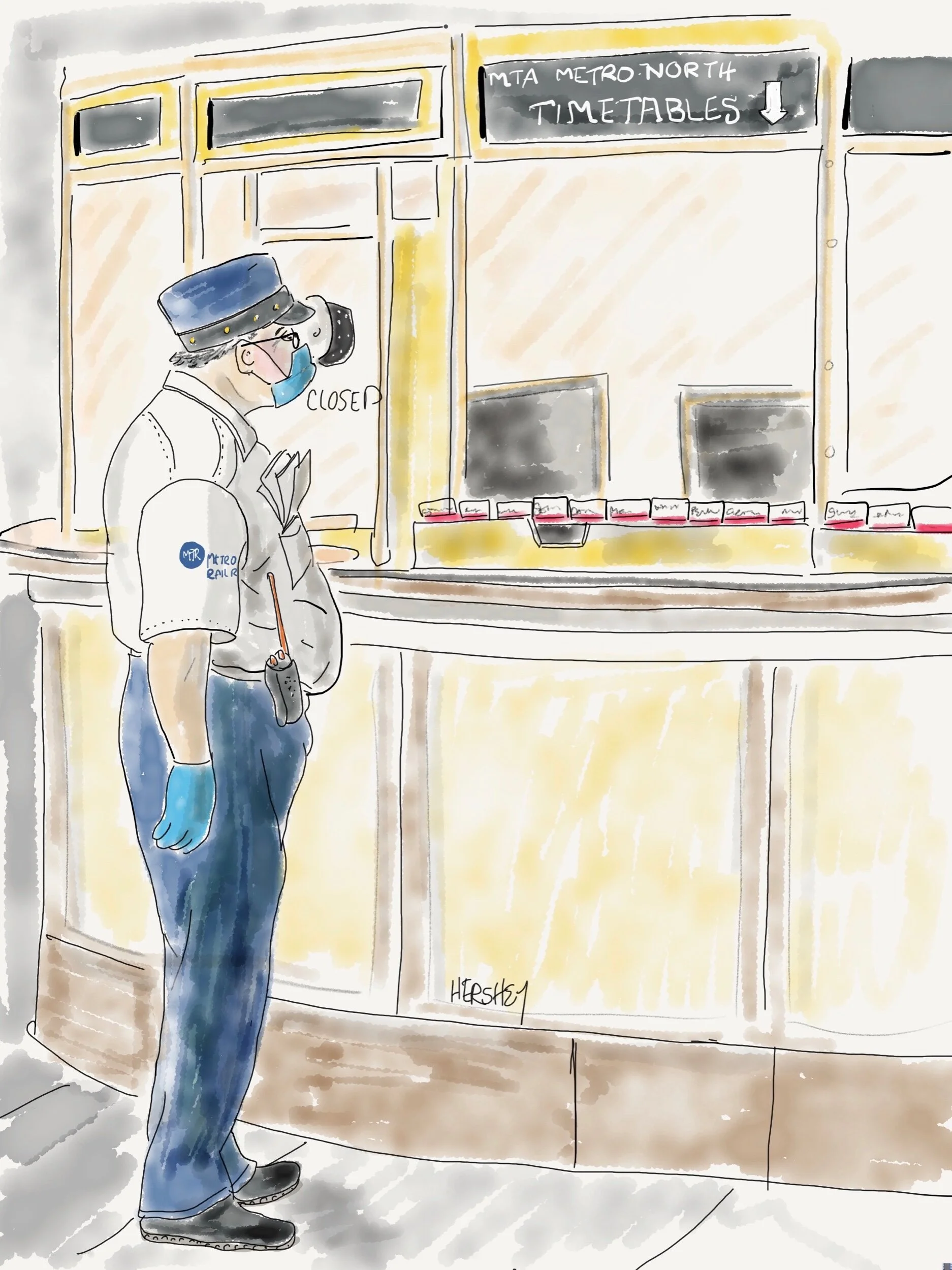
….”All Aboard”???… Drawing by Jennifer Hershey. Follow her work on Instagram at deeofo.
Nothing is so painful to the human mind as a great and sudden change.
Mary Shelley
It’s been over five months since you’ve seen a post from carbonstories.org. The most recent was published just before Jenny Hershey and I arrived into Pennsylvania Station, New York, from San Antonio in late February. Although we had read about Covid before we arrived back home, we weren’t at all prepared for what was about to happen to so many people in our beloved city, and across the globe (in other hot spots). And we didn’t know that over time so many other areas outside New York City would eventually become kindling for the same cruel virus fueled by poverty, indiscriminate and irresponsible behavior, and poor leadership.
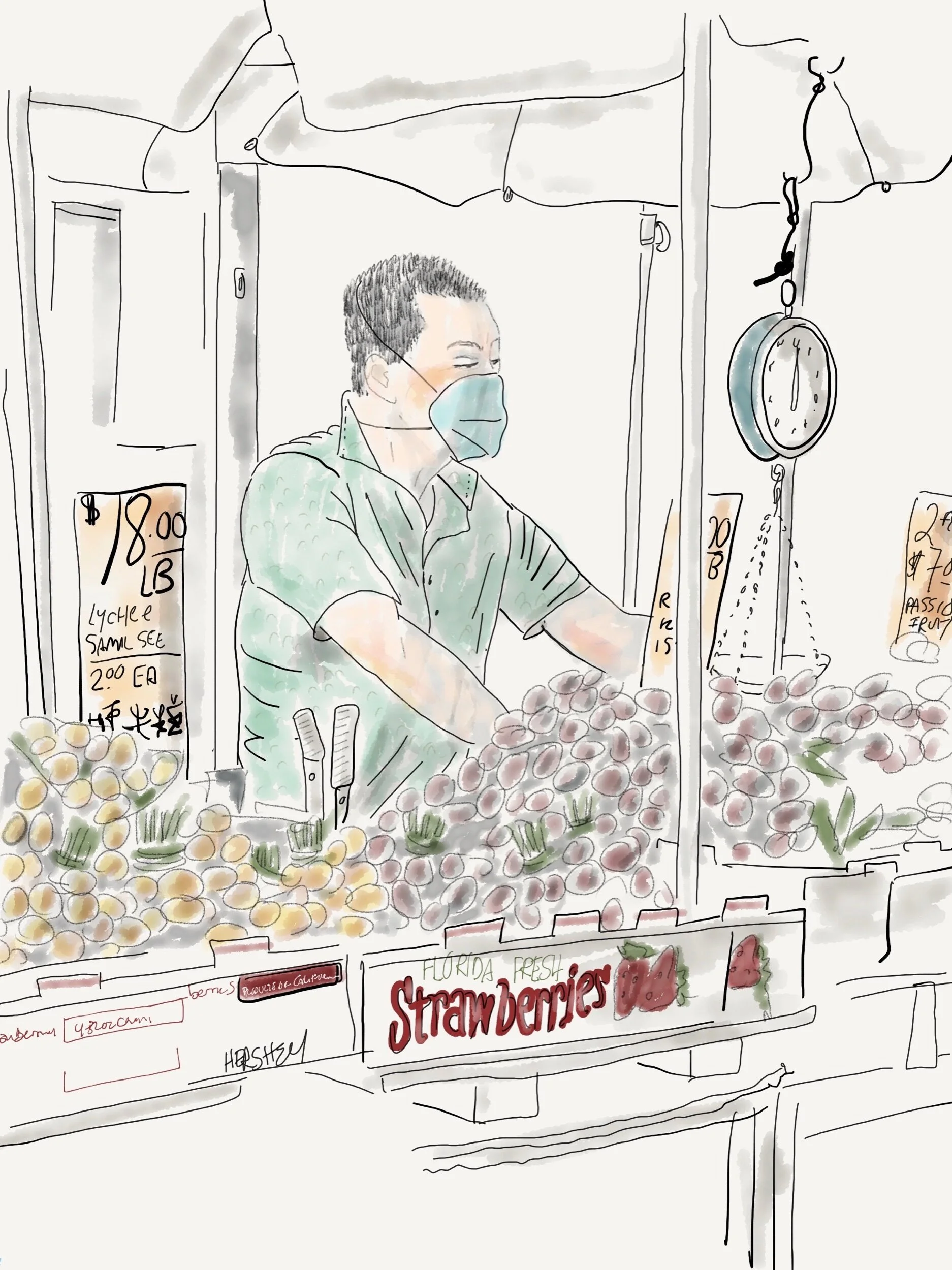
“No exotic “Kung Flu” here. Only fresh lychees and strawberries”! Drawing by Jennifer Hershey. Follow her work on Instagram at deeofo.
But you know the story only too well, since you are living it as well. I’m sure that no matter where you are, your life has been upended and you see only the smallest glimpses of light at the end of the tunnel. And all things come to an end, and this pandemic will eventually.
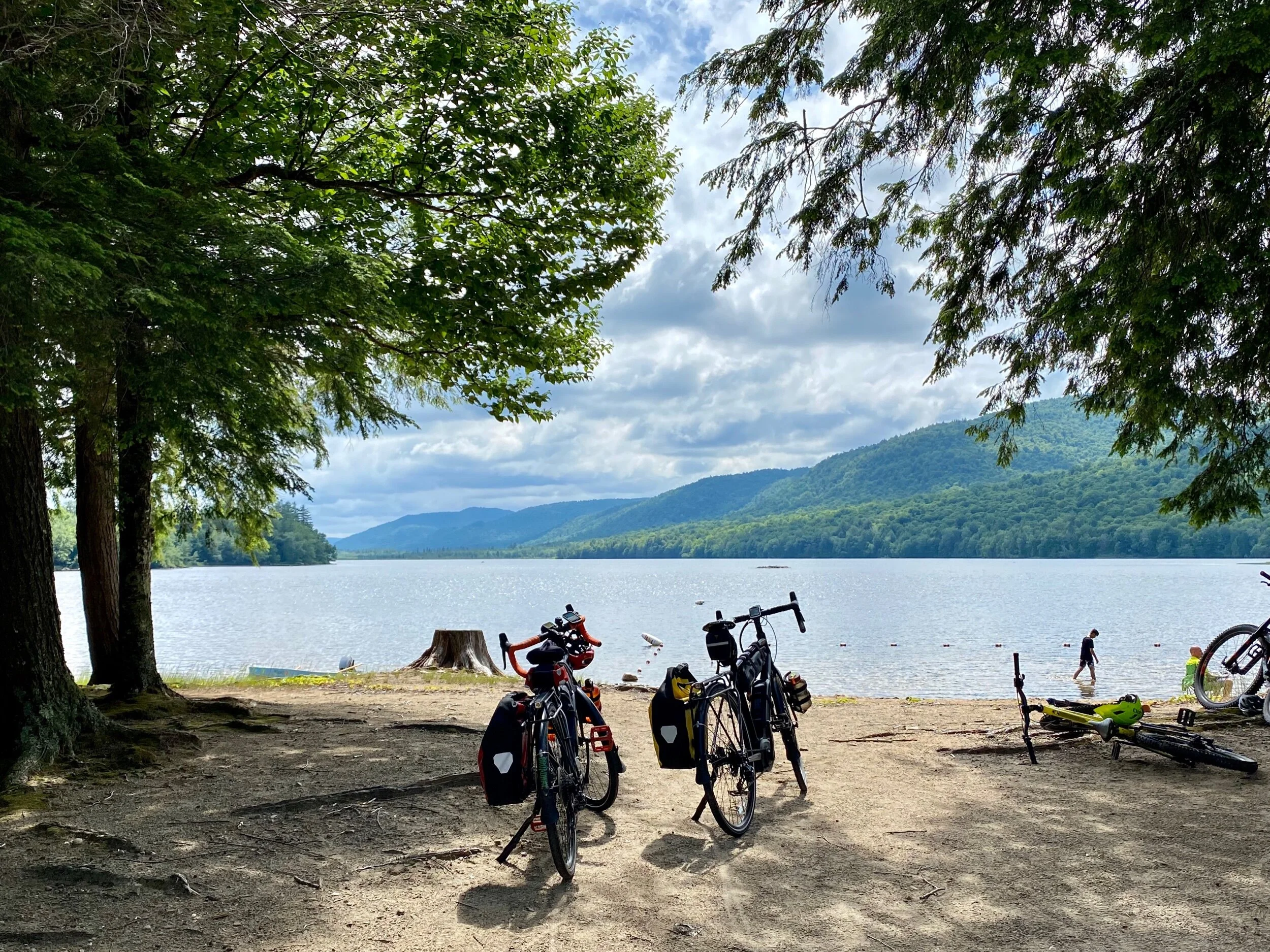
Bikes overlooking Lake Lewey in the Adirondacks.
The primary focus of this blog has been how different communities in America are dealing with, or failing to deal with climate change, as seen through the eyes and ears of several long distance cyclists. That’s still the case, although it's difficult to travel by bicycle when in lockdown, or when amenities are limited because of social distancing. But some weeks ago we ventured out, towing our bikes on a bike rack in the back of a car, thinking the car could be a shelter of last resort if we weren’t able to find an open motel or campground.
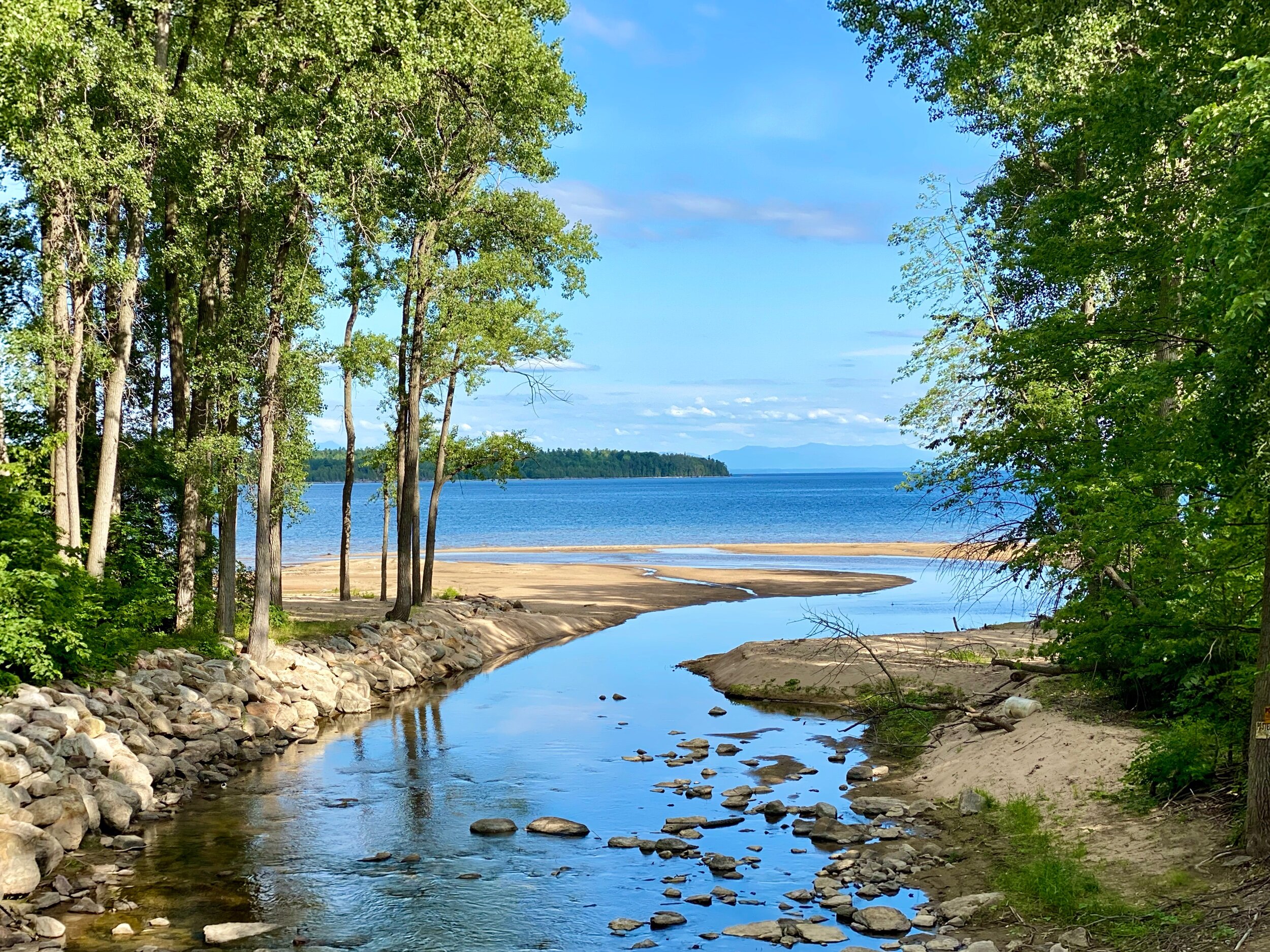
A view of Lake Champlain near Ausable Marsh, NY.
We got lucky in the Adirondacks and found one place operating on a cash only basis (the owner didn’t want to officially open because he didn’t want to follow state regulations regarding temperature testing and contact tracing). We stayed there anyway, since he and his wife wanted to keep their distance and run a very small operation. Later, near Indian Lake, we found a place that had officially opened several days before we showed up in late June. The proprietor, Mary, was just learning how to use a temperature gun. It took her several tries to get ours right, varying from 94 to 104 degrees…. but finally she “shot” us both at 98.6…
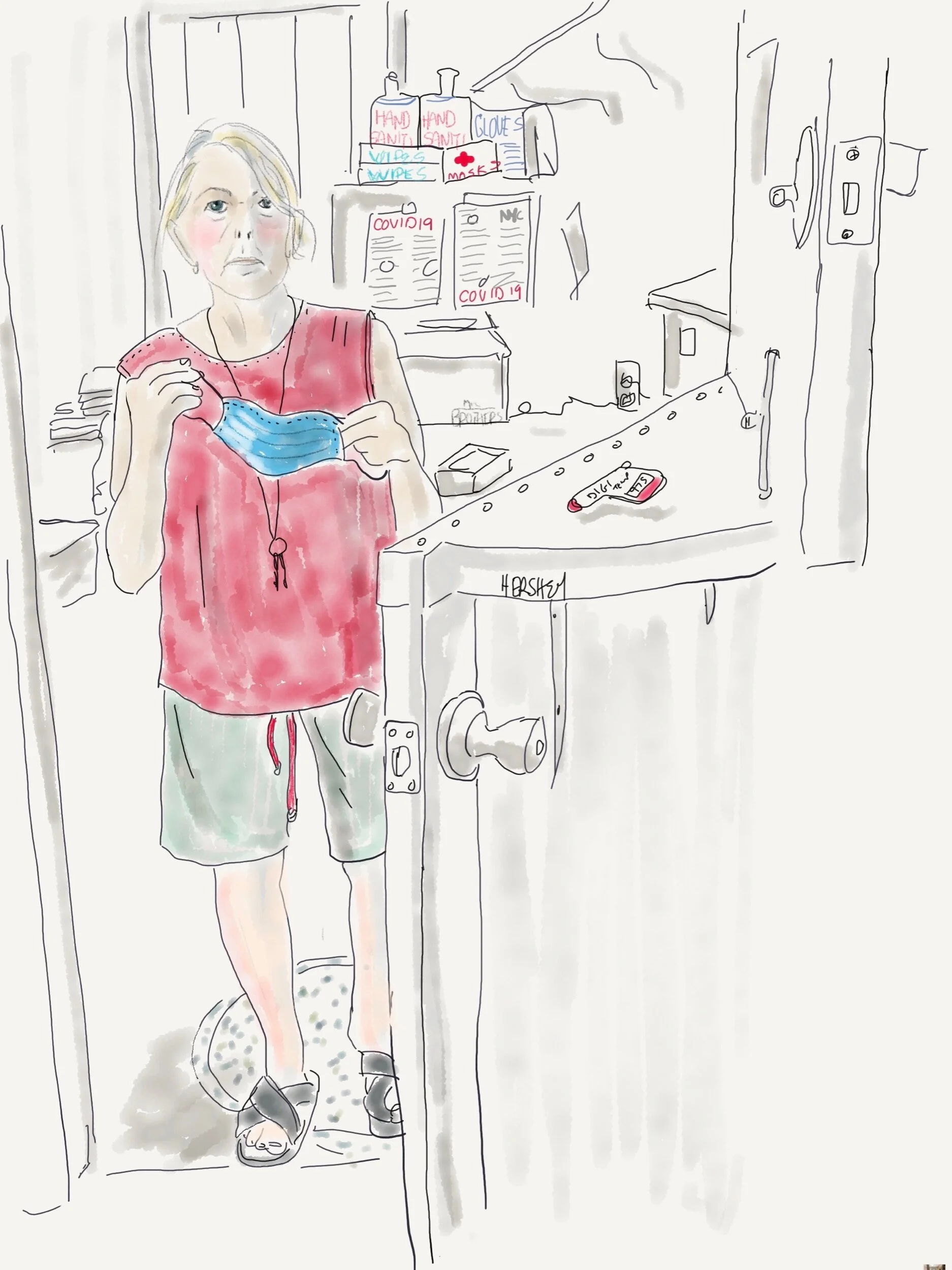
“Please stay back until I get my mask on. I’m 74. …I survived breast cancer. I just need to take your temperature and fill out these forms”. Drawing by Jennifer Hershey. Follow her work on Instagram at deeofo.
And that was only the beginning. We ventured out again in mid-July, and our travels this time have taken us to other places in the Adirondacks, Lake Champlain on both the New York and Vermont borders, up to Newport, Vermont, on the Canadian border, into the White Mountains in New Hampshire, and into western Maine. The Maine coast is next, and then back west across into the Green Mountains of Vermont before heading back home to New York City. Hopefully, that will cure our wanderlust for a short while. Unless things really fall apart across the US, the next time out we’ll leave the car behind. Even in these fragile times, we’ve learned it is possible to travel reasonably safely by bicycle if one is resilient and ingenuous.
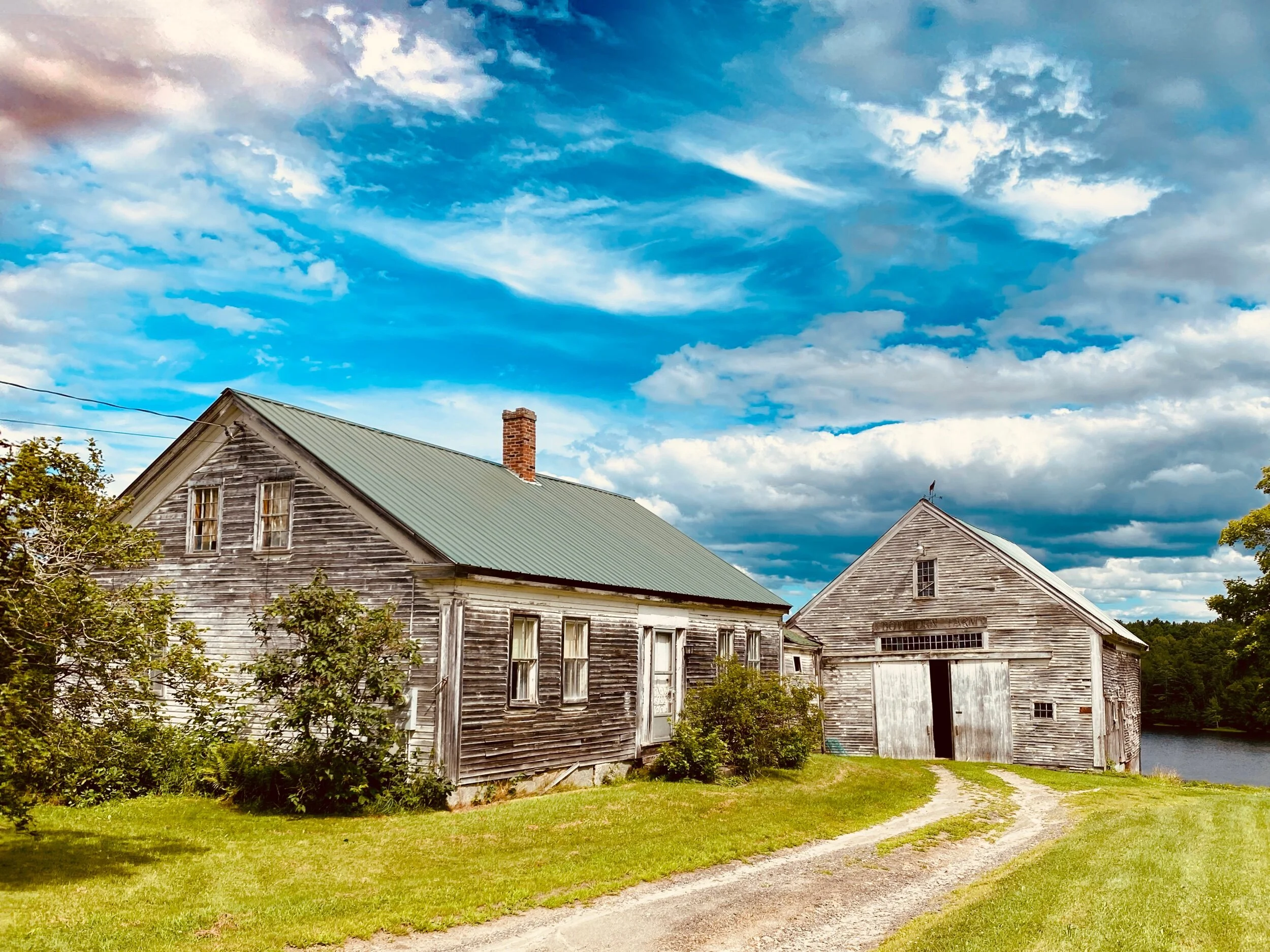
Near Farmington, Maine.
There is some comfort traveling in one of the least beleaguered parts of the US while Covid cases are rising so rapidly in many other communities. But we take nothing for granted. While Vermont requires masks in all public establishments by law, New Hampshire does not, and we have walked out of more than one gasmart where neither the proprietor nor customers bothered to wear them. Honestly, such dismissive behavior does little to inspire my acceptance toward people protecting their “freedom.” Have these folks not read about what is happening in Florida, Georgia, Texas or Arizona? Is it not apparent they could be next if they don’t use common sense? I find this adolescent reaction to jurisdictional “authority” quite a head scratcher.
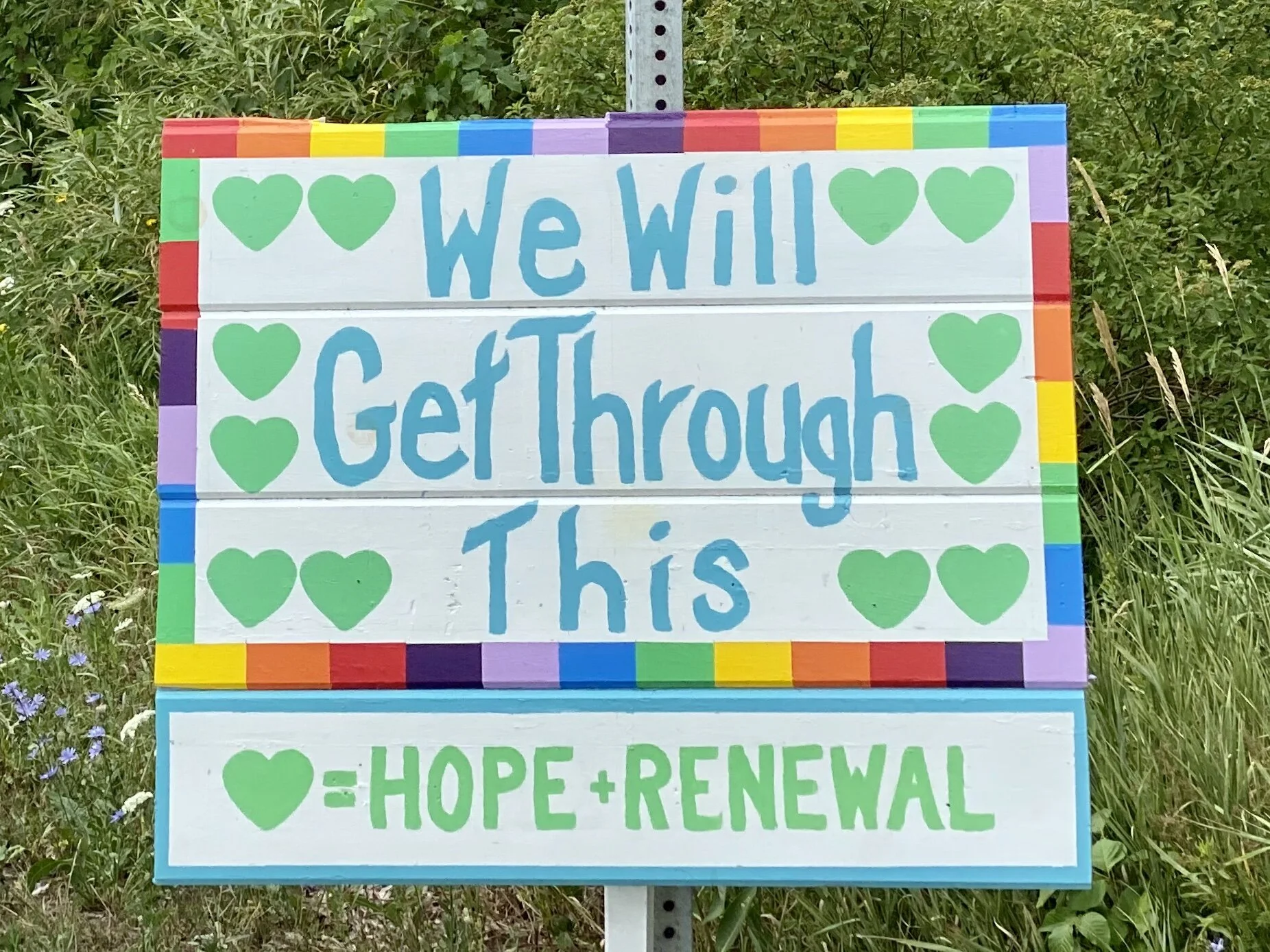
Seen by the roadside on Isle la Motte, Vermont.
Yet, the deeper structural issues that have been made more raw by the spread of Covid are much more truculent and long lasting. No matter where you are, you are living through several interrelated crises. If you're an American, you are seeing wildly varied, often lurching and highly politicized responses across the country to the threat of Covid transmission. You’ve watched some American citizens respond with caution and even terror, while others have been wildly cavalier and dismissive. And you’ve read about - or personally know about - people growing ill and dying on both sides of that behavioral divide.

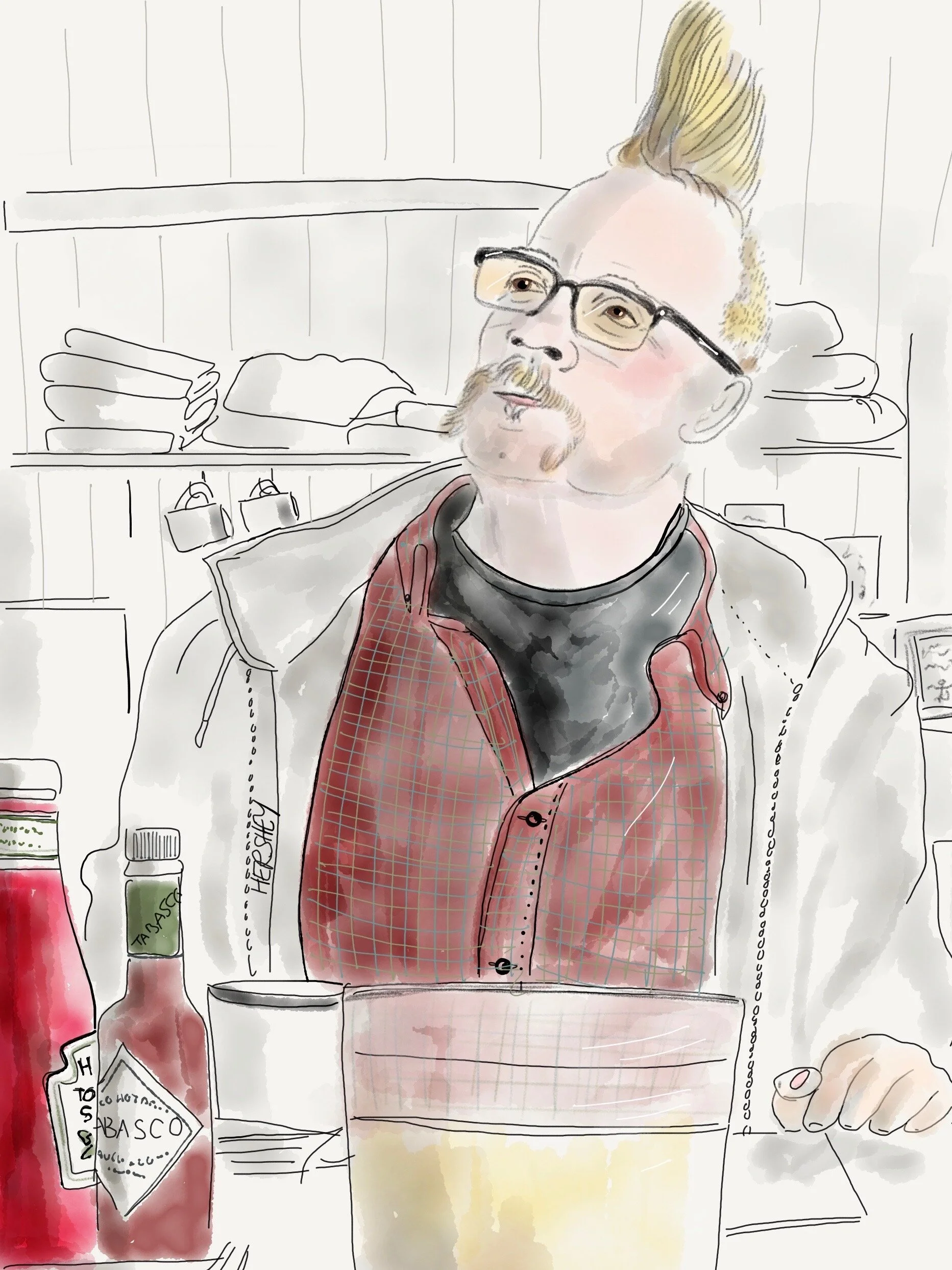
“I can’t deal with all these “Trumpies” around me. If New Hampshire doesn’t go blue, they’re gonna have to deal with me and my scissors!” Drawing by Jennifer Hershey. Follow her work on Instagram at deeofo.
Still, our front line responders remain characteristically heroic in the face of extraordinary unrelenting pressure and hardship. At the same time, I wish I felt more pride in our collective national response. It has been hard to watch other regions of the US make poor choices from the perspective of a devastated New York City. Frankly, I think we have shown the world that we are quite ordinary and unexceptional. I don’t think that’s who Americans are deep down, but it’s who we have have been of late. Our confusion is palpable.
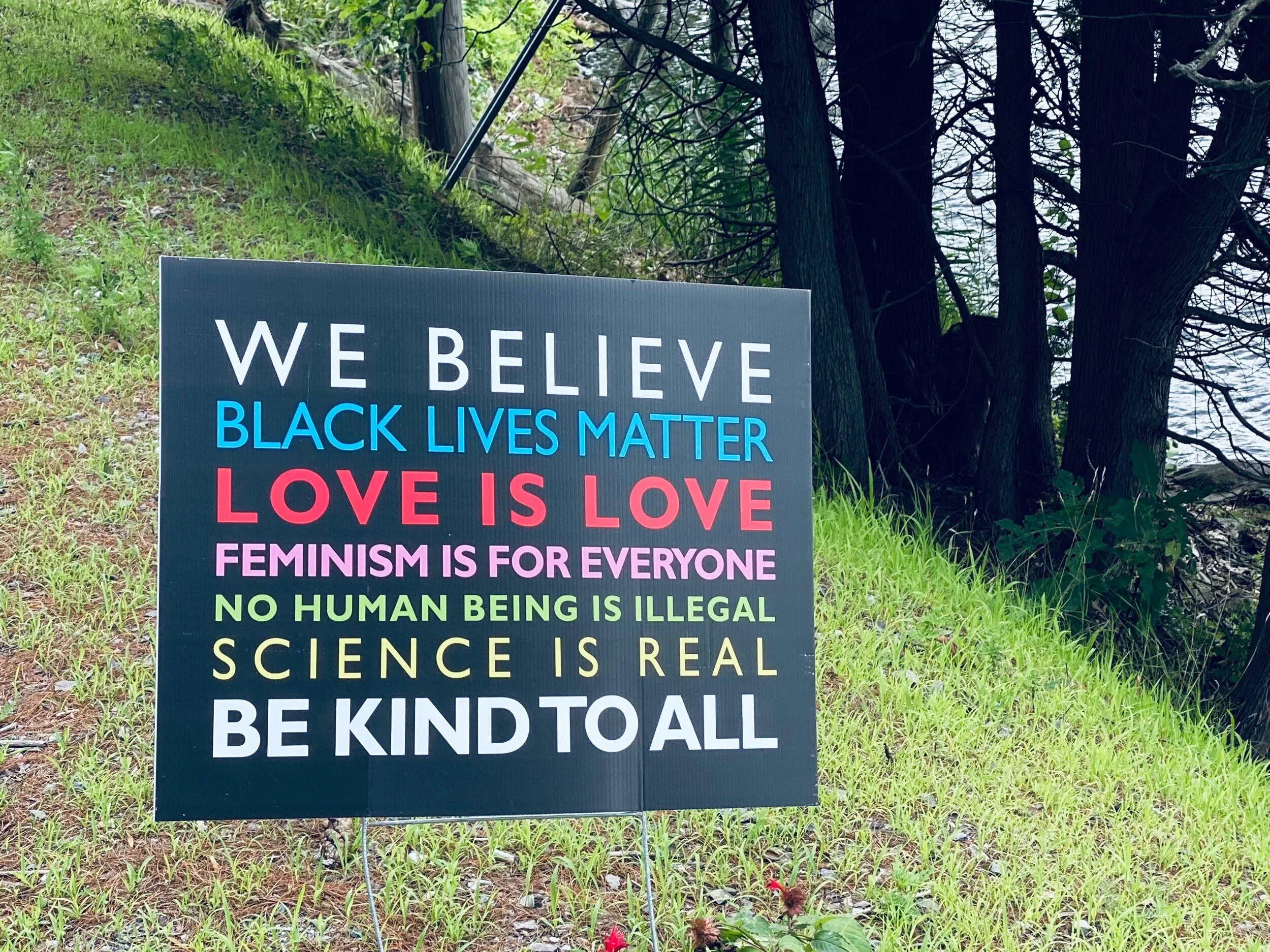
Seen in a rustic rural area near Mt Vernon, Maine.
Collectively, we’re witnessing an extraordinary resurgence of pushback against the inequities exposed by historically persistent structural racism, income inequality, and a public health system created out of those inequities. It’s more obvious than ever that things that didn’t work so well before Covid don’t work at all during Covid. There’s a takeaway in all this. An unreflective society that races along when things are “good” (aka, strong employment figures based on an unsustainable reliance on fossil fuels, low taxes (especially for the wealthy) and large public debt, and fails to create resilience for that inevitable time when things are “not good,” is a society that comes apart rapidly when difficulties show up.
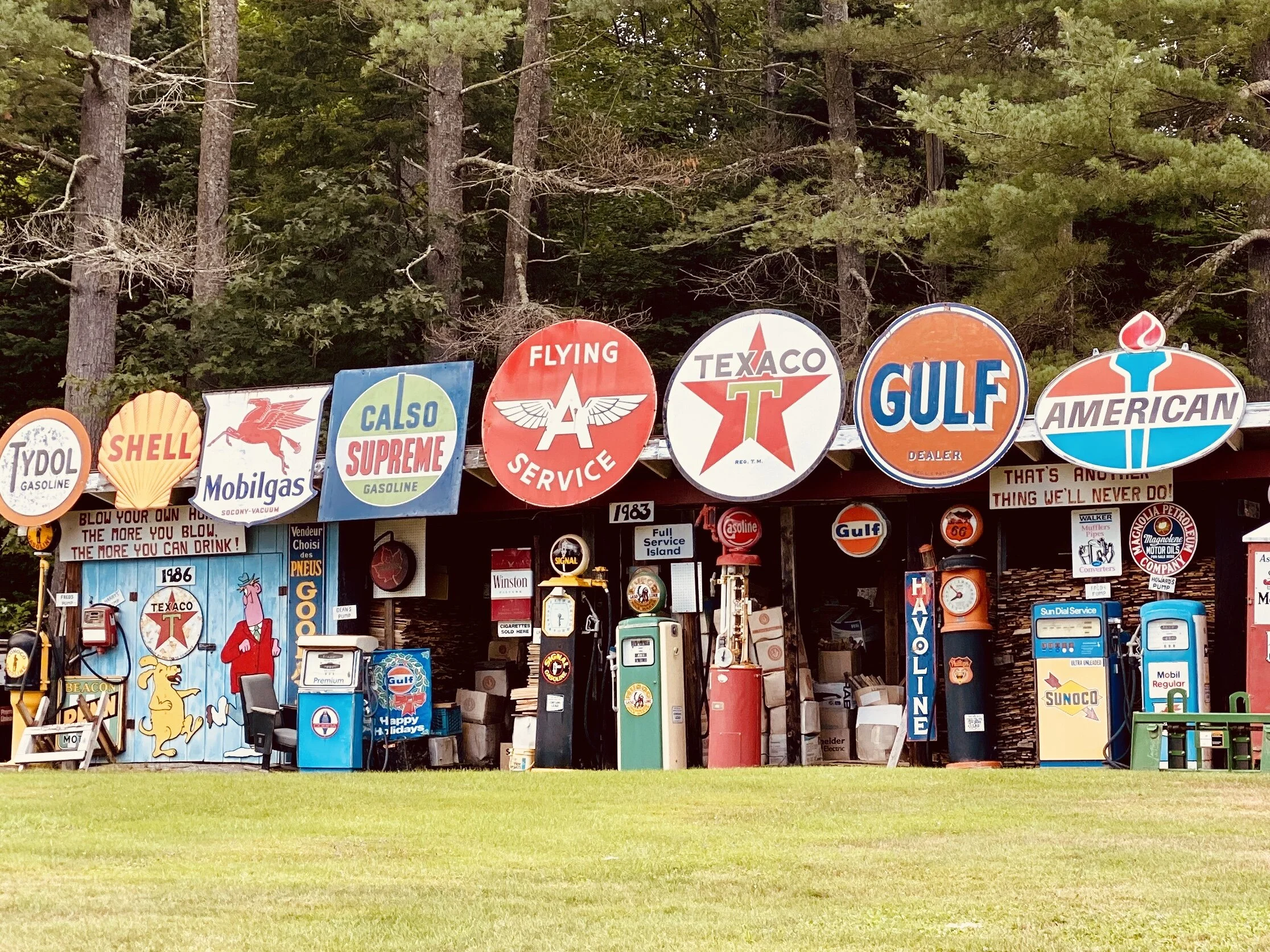
Seen outside Littleton, New Hampshire in the White Mountains. .
It’s time for a significant self-reckoning. And it’s time for an election. The choices of direction are stark. Make no mistake though. Reasonable people must not relax and assume common sense will win the day. The far right news bubble led by Fox and Breitbart News is hard at work discrediting the free press as “fake,” downplaying the truth about the dangers of Covid, subverting the righteous intent of those who resist structural racism, pushing back hard on our hard-won democratic right to free and fair elections (including using mail-in ballots during the pandemic; they can work - talk to the Republican party in Utah), and obfuscating the very credible science of climate change. They have no intention of letting up, and have already proven they can trick the more gullible among us.
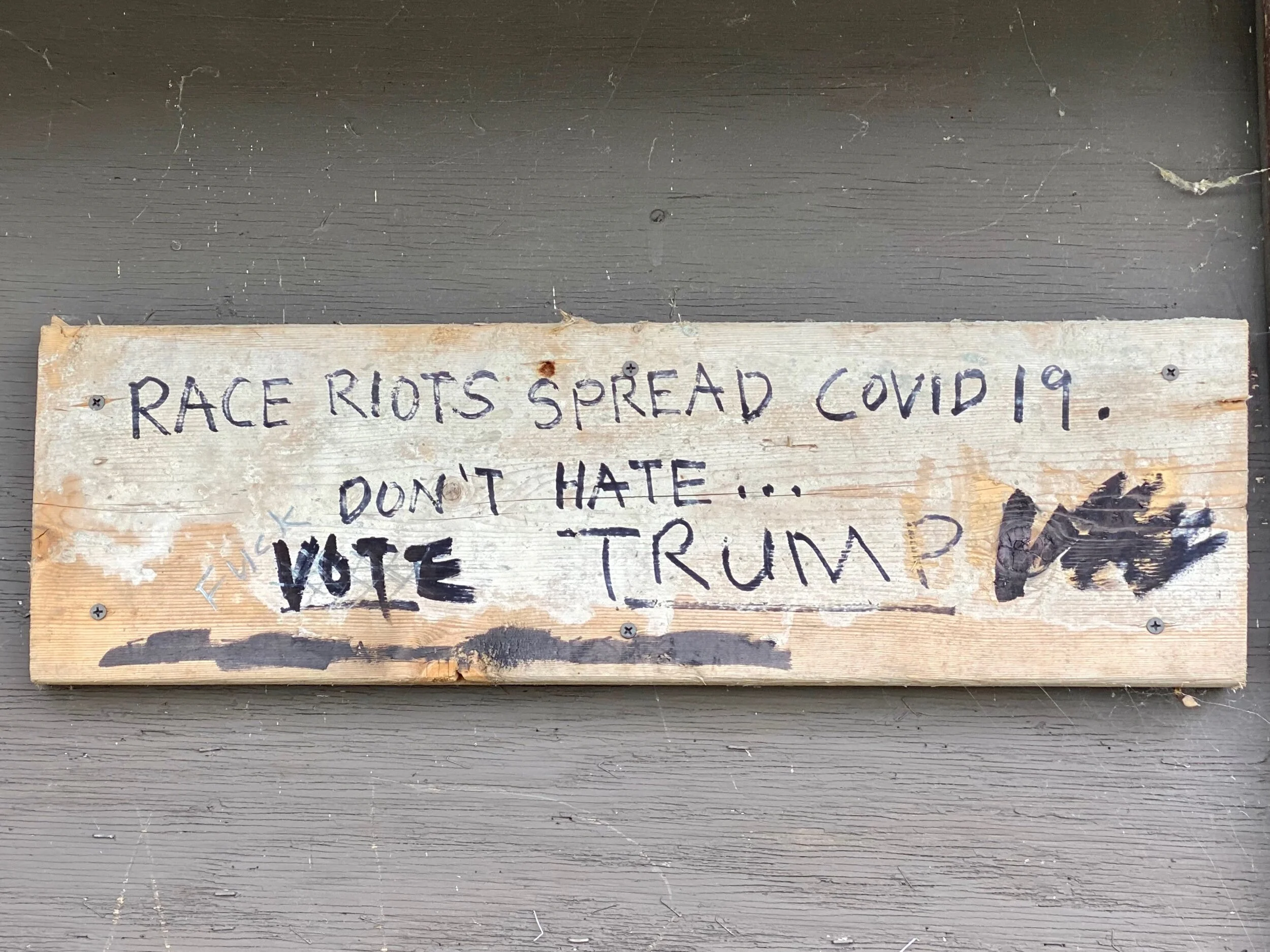
Seen by the roadside on Isle la Motte, Vermont.
Stay vigilant! Thanks for reading. More to come.
All photos, unless credited or otherwise noted, are copyrighted property of the blog post author.
Louisiana/Texas, Post 4
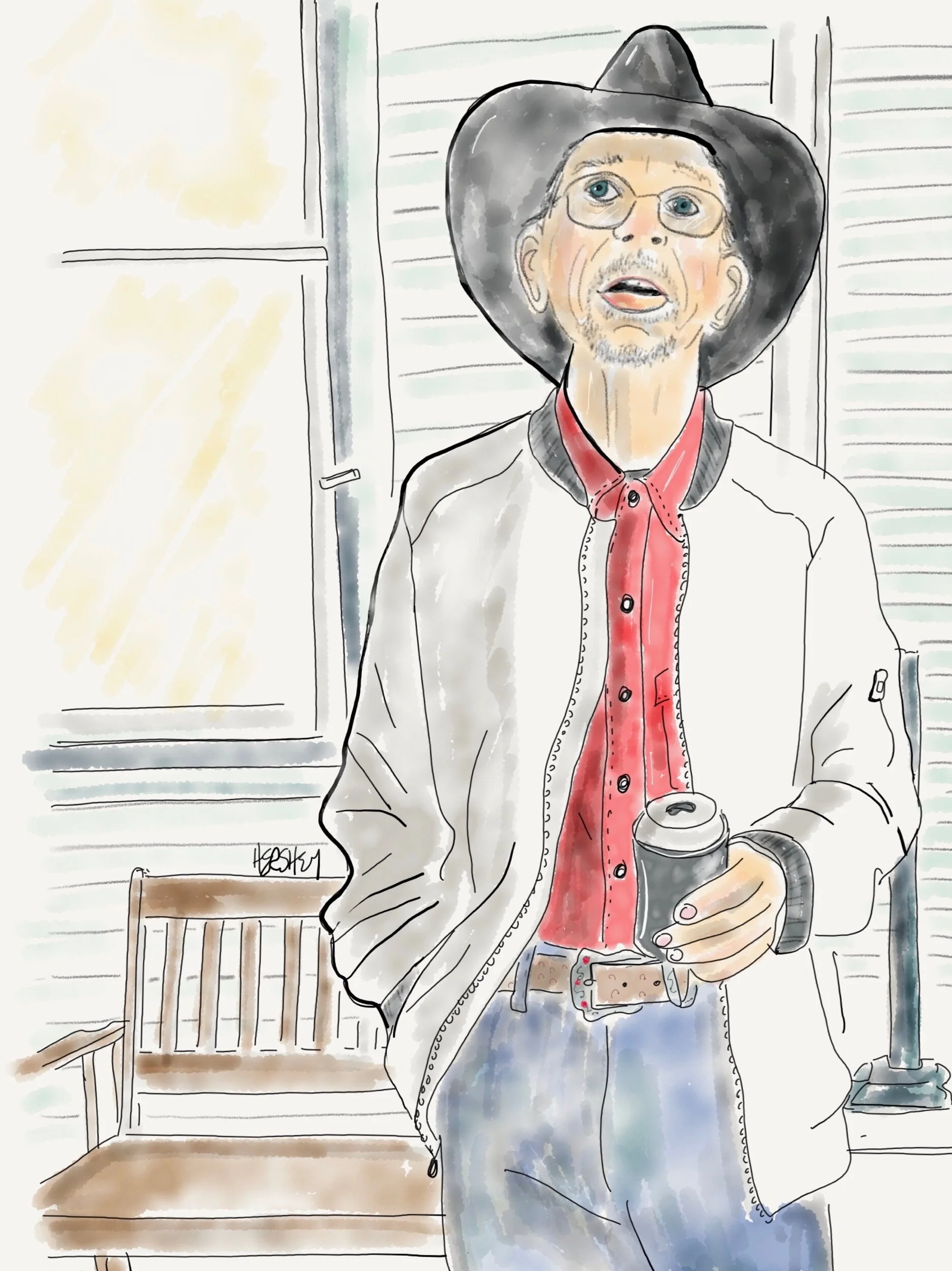
“I work up at United Ag in El Campo. I live at this hotel. Spend Sundays off in Bay City.” Drawing by Jennifer Hershey. Follow her work on Instagram at deeofo.
“Don’t go around saying the world owes you a living. The world owes you nothing. It was here first.” — Mark Twain
Most everywhere we’ve been in Louisiana and Texas, we’ve encountered people who believe deeply in the concept of hard work. I don't know if the importance of work is stronger in the south than elsewhere (it’s hard to imagine a more frenetic work environment than New York City), but its virtue came up repeatedly in our conversations with locals. Often the merits of working seem linked to another highly prized value in these parts - self-reliance - the pathway to the most exalted of American values, our freedom.
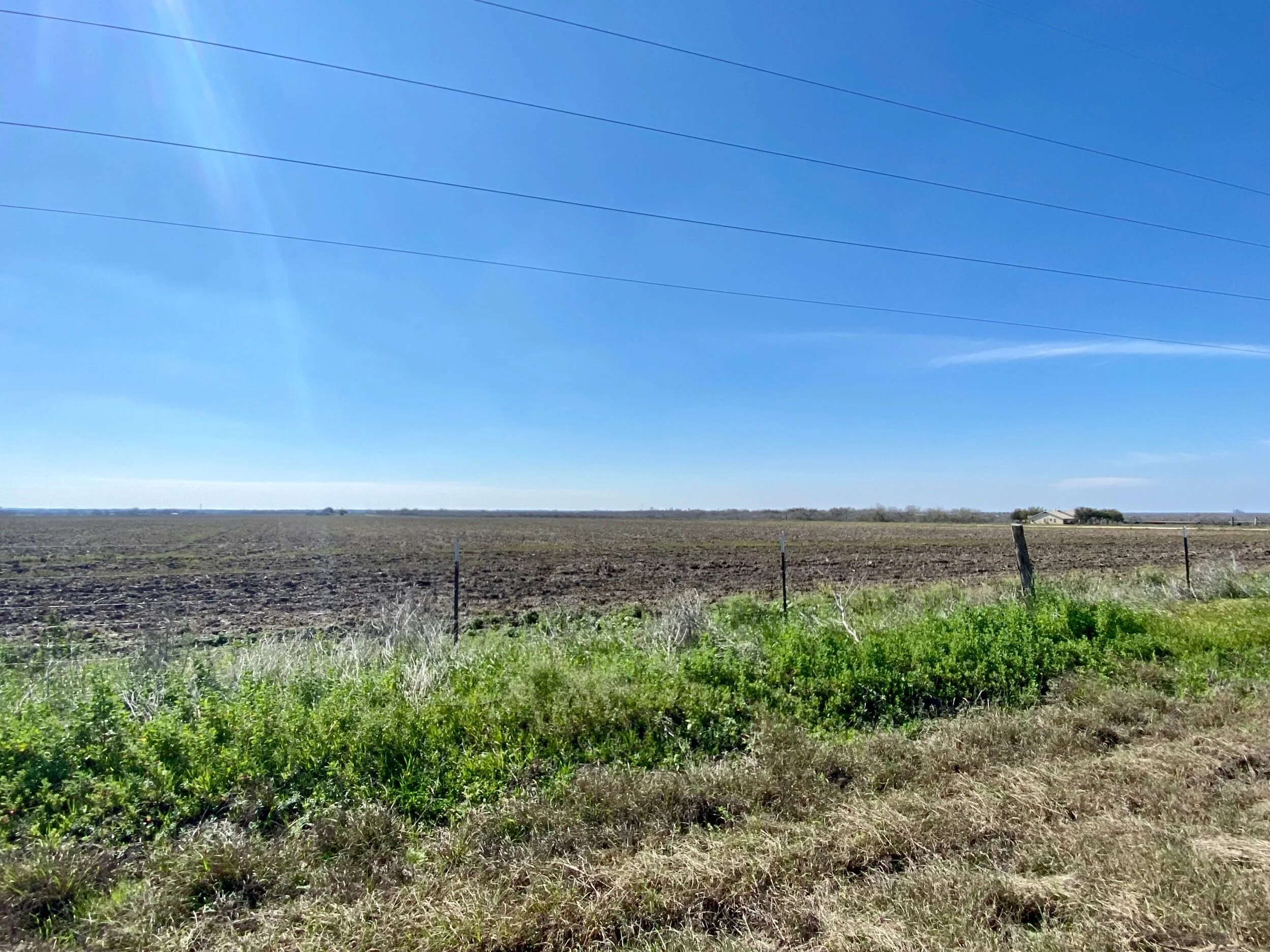
Big sky country in Texas between Corpus Christi and San Antonio.
One of our first conversations with a local in Louisiana centered around the concept of a strong “work ethic.” The man we were speaking to was a small businessman and boss of six employees. His perspective made a lot of sense. What boss wouldn't want productive workers? He went on to explain he wasn’t a fan of freeloaders - people too lazy to work, who wanted a handout from the government. I’m sure he’d fired his share of poor workers, but when it came to individuals wanting handouts, it seemed more like he was talking about an idea of what people are like than a reality. Maybe others know people who don’t seek the meaning that work brings us (even when they are unemployed or underemployed), but I do not. I can’t help but wonder if that experience is a reflection of my own cultural viewpoint, or an indication of a lack of exposure to reality seen through a cultural and political naivety.
One thing is certain to me: it is fundamentally human to seek meaningful activity. We all must live. And even in an age of extraordinary inequalities in wealth and income, the majority of us still must - and want to - work. So while there may be poor workers, are there really folks out there who think they deserve something for nothing?
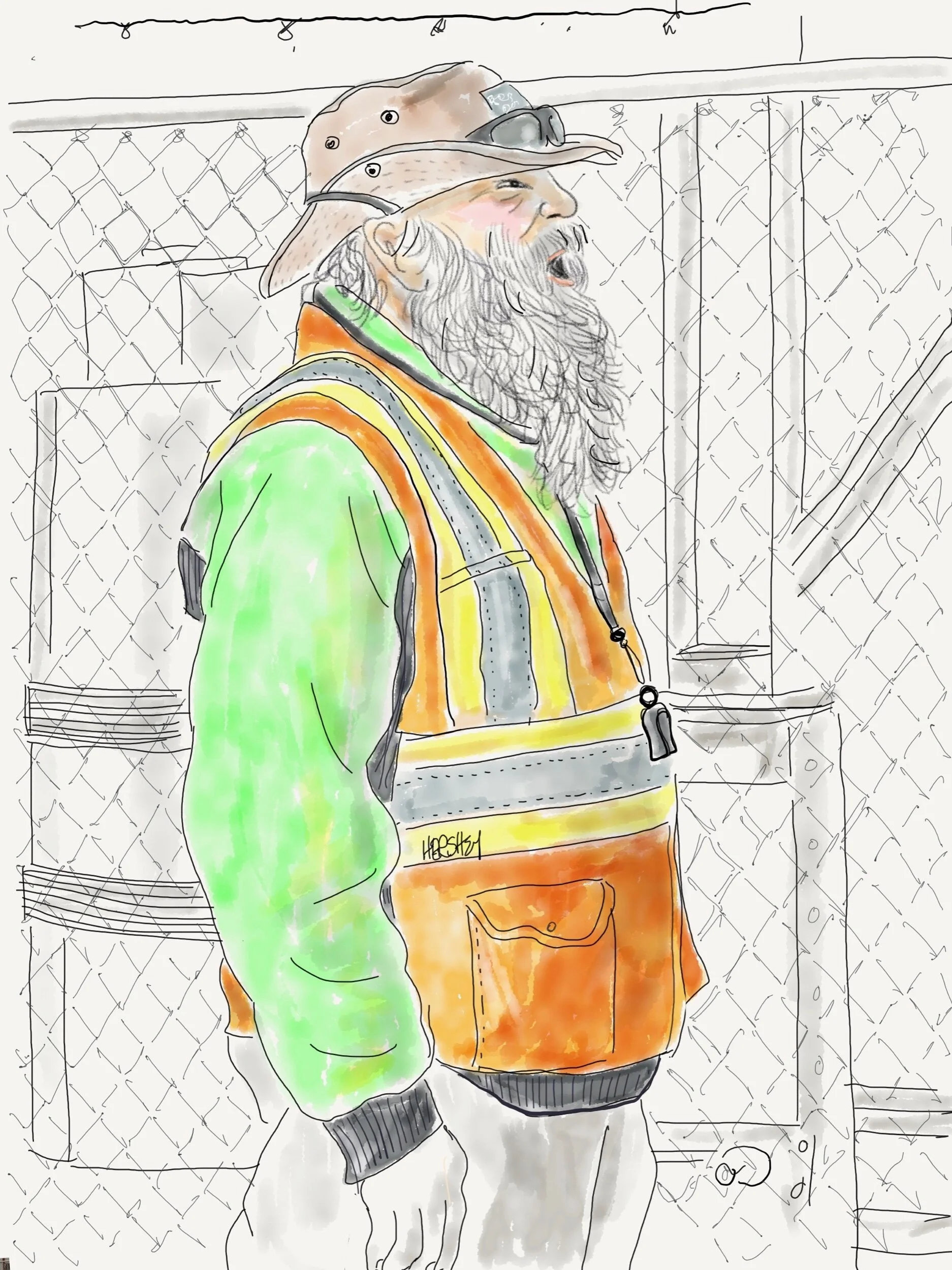
“We don’t get many bikes down here— just make sure you walk ‘em onto the ferry”! Drawing by Jennifer Hershey. Follow her work on Instagram at deeofo.
Although southwest Louisiana and southeast Texas are equally flat, the land between Corpus Christi and San Antonio seems especially vast. Perhaps it’s the steady 150 mile rise from the coast to San Antonio (which is 650 feet above sea level). Or perhaps it’s the unrelenting expanse of open, uninterrupted fields. Perhaps it’s the long, straight roads. Whatever the reason, it's BIG.
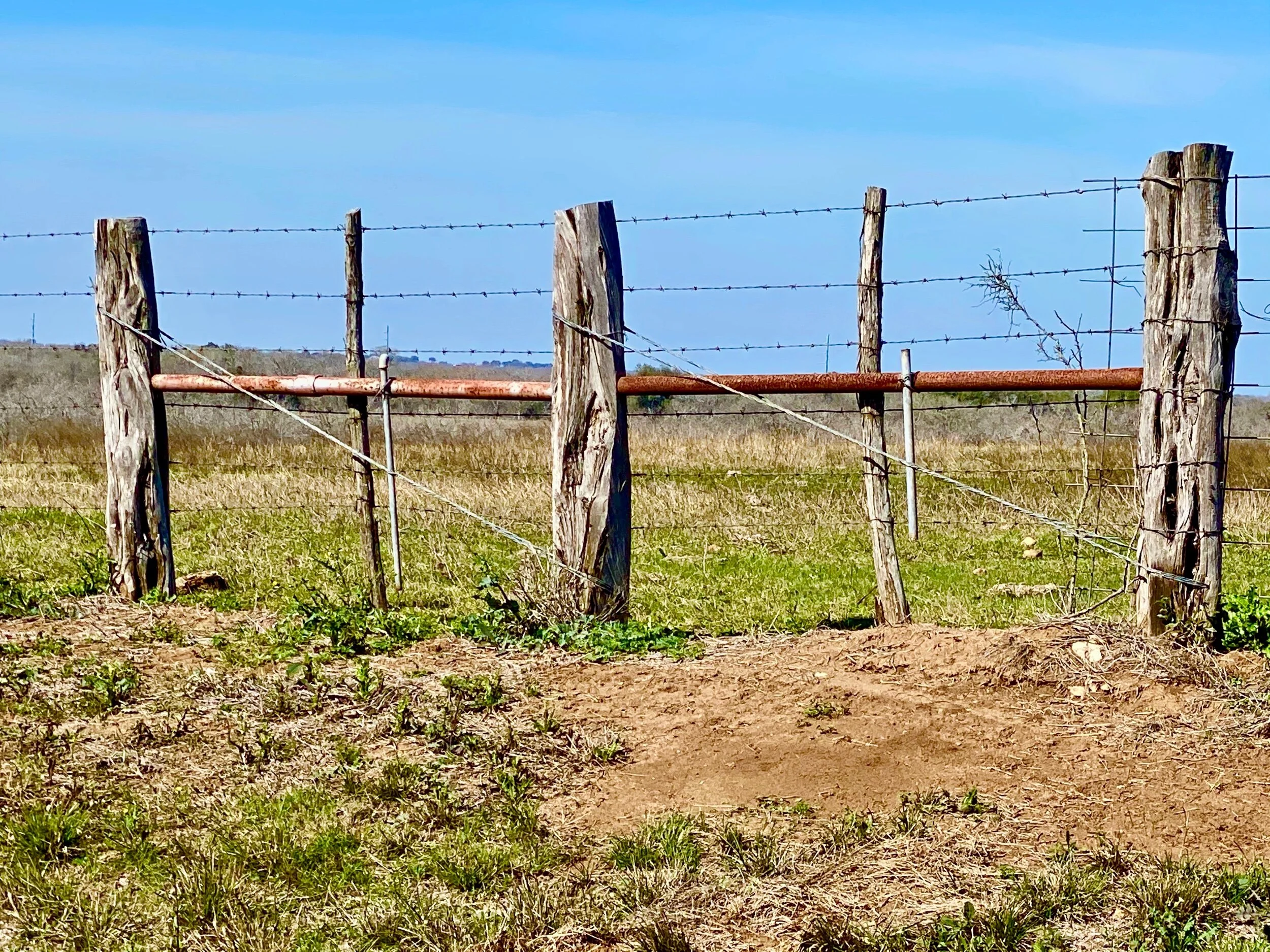
Taken on Texas State Highway 181 between Corpus Christi and San Antonio. Prior to the invention of barbed wire in the 1870’s, fences couldn't reliably contain cattle.
At the same time, both the land and people between Corpus Christi and San Antonio are hardscrabble. Pickups are normal, sedans are unusual. Regular folks are used to fishing and hunting. Although they don’t rely on their catches to stay alive, fish and animal wildlife seem to be part of the rural Texan diet, at least among the people we talked to. And the land is used in every way possible; for agriculture, farming, fishing, hunting, wind power, oil and gas extraction, compression stations, pipelines, home building, junkyards, storage sheds, telephone poles, auto graveyards, human graveyards… The Texas countryside is a hodgepodge of so many competing uses I often found it as overstimulating and confusing as a Wal-Mart Megastore.
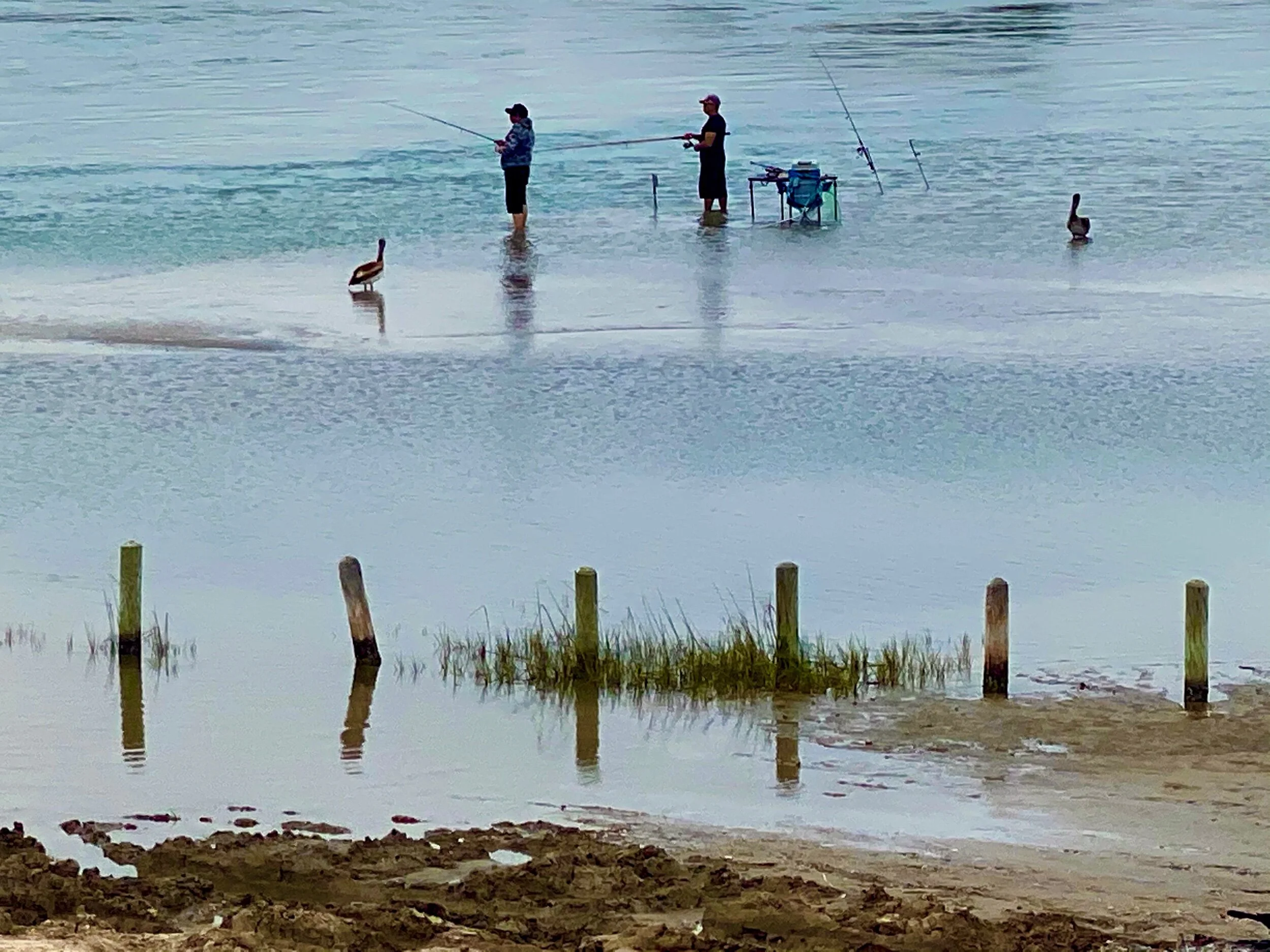
Texans fishing off the causeway between Aransas and Port Aransas, Texas. The birds nearby are Pelicans.
There's also a lot of workers. A surprising number of people work for wind farms and quite a few work in agriculture, but most of the people we met work for oil and gas or petrochemical companies. And there are a lot of companies. Thirty one new petrochemical plants have been approved for construction or reconstruction in hurricane prone areas on, or near, the Louisiana and Texas coasts since 2016. In our last post, we wrote about two large LNG exporting plants under construction in Cameron, Louisiana and nearby Port Arthur, Texas. These are among those 31 new plants.
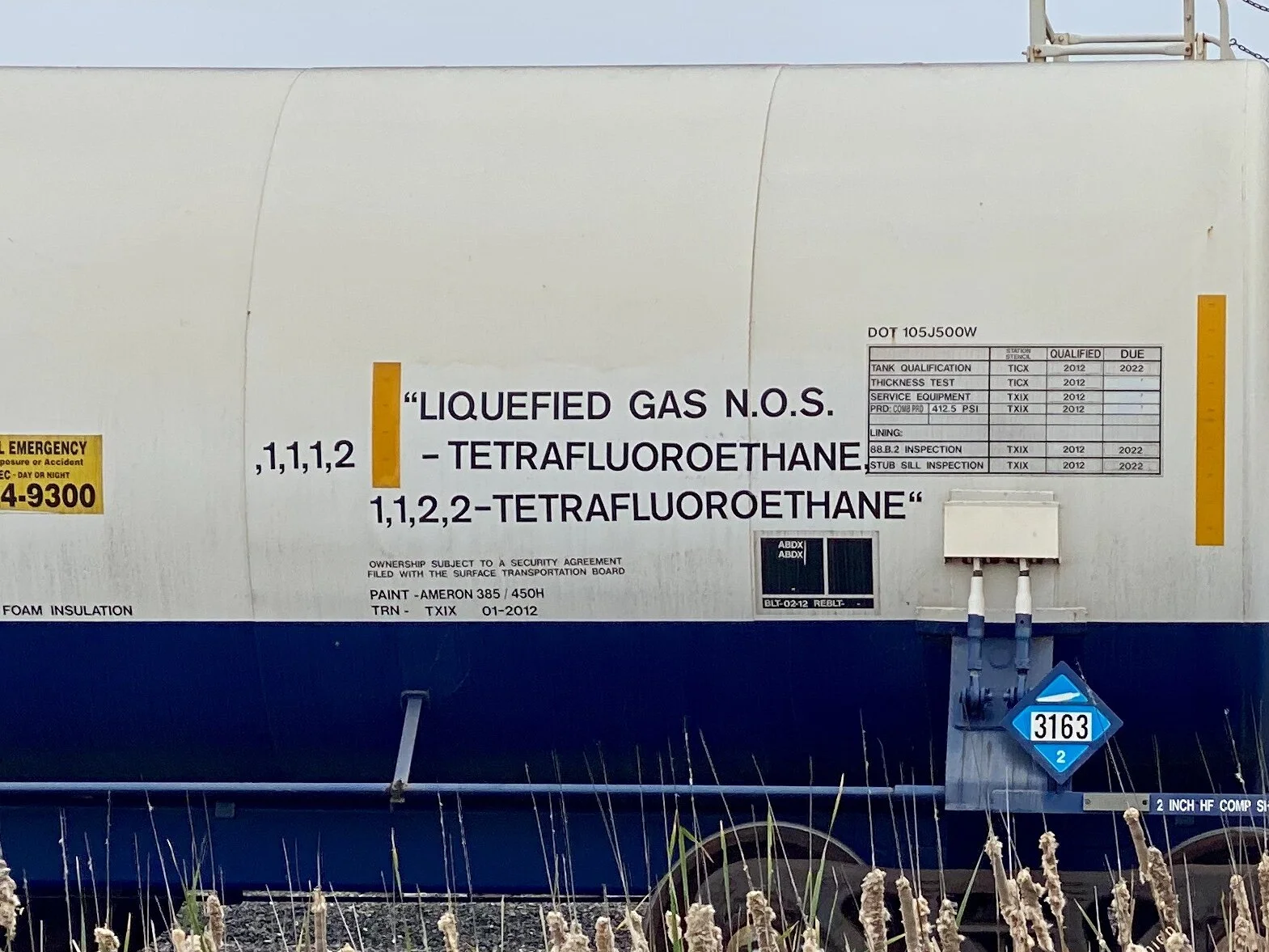
One of hundreds of refrigerant tank cars lined up near the Occidental Petroleum, Chemours, and Nashtec Plants at Gregory and Ingleside, Texas, not far from the Gulf Coast on the way inland to Beeville, Texas.
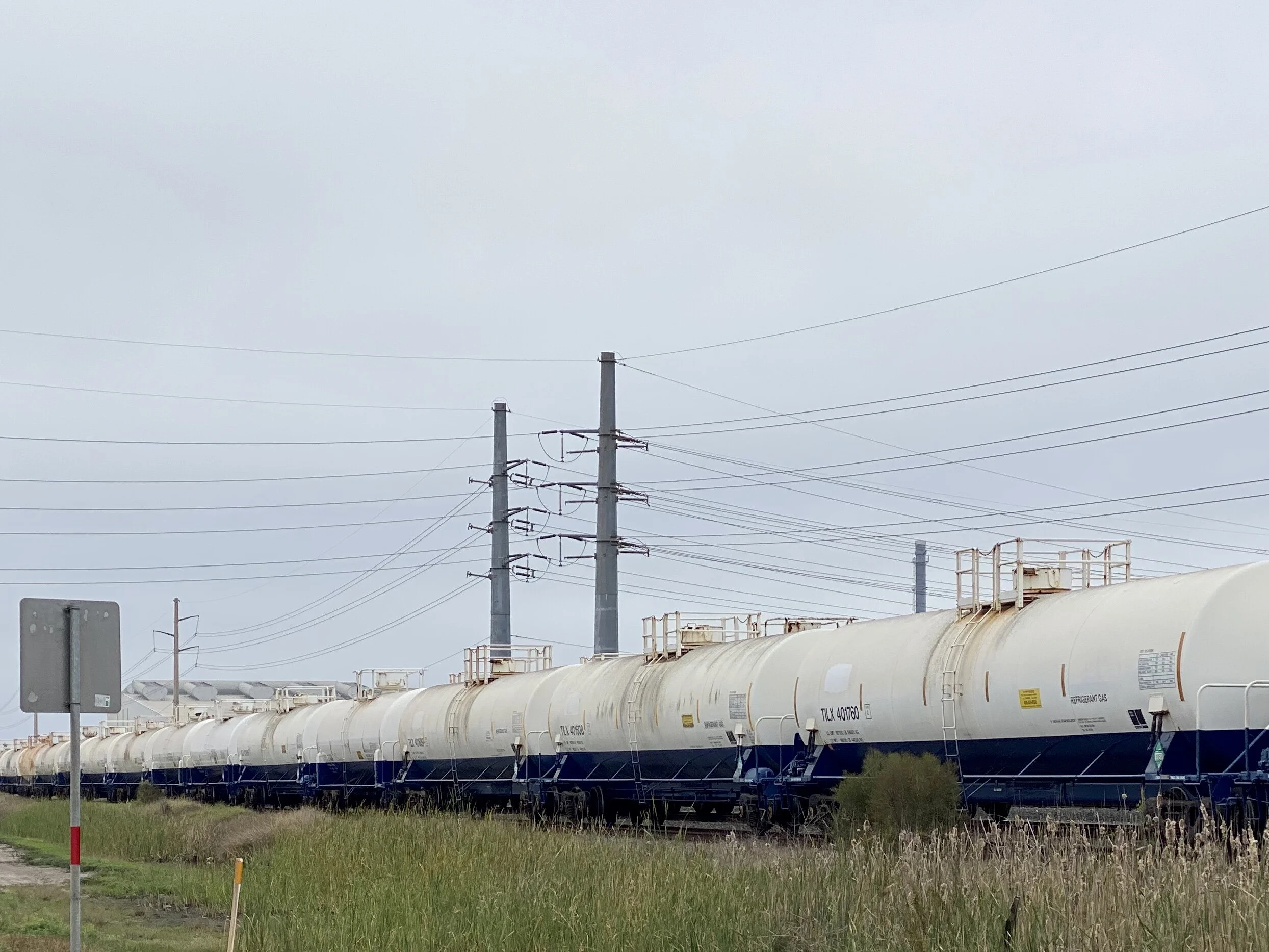
Tetrafluorethane is regarded as a “sustainable” refrigerant because it has lower carbon emissions than previous versions, and a minimal impact on ozone.
As much as we were profoundly charmed and cheered by the warmth of the people we met, the omnipresence of these facilities contributed to our uneasiness. In the face of climate change, does this boom really make sense? There’s something profoundly unsettling about the trend. I’m not so sure the locals feel any different. In Texas, even cognitive dissonance is BIG.
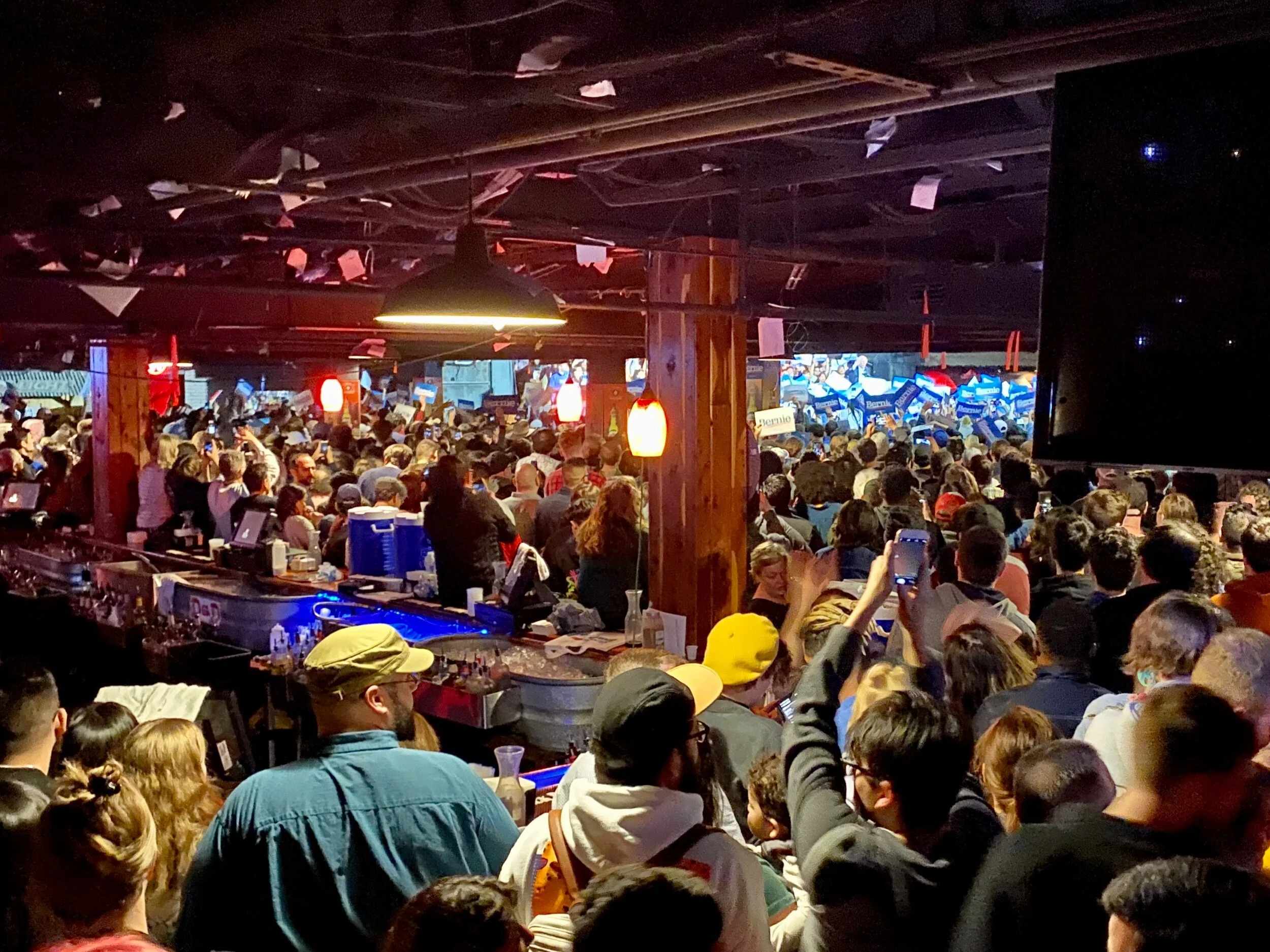
Interestingly, Jenny and I arrived in San Antonio on the night of the Nevada Democratic caucus, and we had the opportunity to drop into the famed Cowboy Dance Hall to catch a raucous, youthful and well-supported Bernie Sanders rally. Just for the record, we both appreciate Bernie’s concerns about climate change, but worry he is over-focused on what we need to achieve and under-focused on how to do it without causing a destructive backlash.
Northerners may not be aware that Texas is the leading U.S. producer of both crude oil and natural gas. In 2017, the state accounted for 37% of the nation's crude oil production and 24% of its marketed natural gas production. NPR.org reports that Texas currently supports a total of 163 natural gas production plants, and Texas has the largest processing capacity in the U.S. In addition, there are 29 petroleum refineries in Texas that process more than 5.7 million barrels of crude oil per day. These plants account for 31% of the nation's refining capacity.
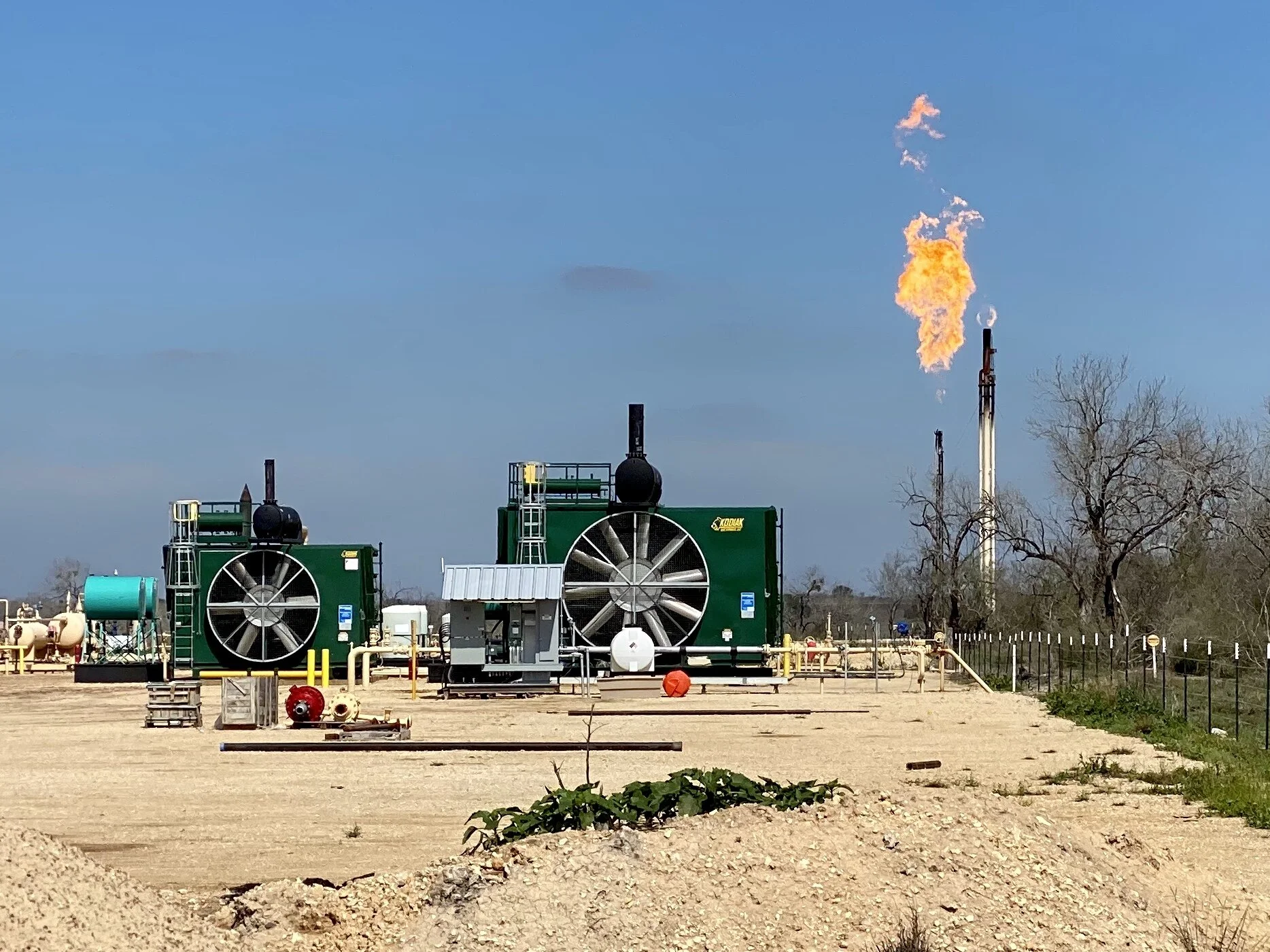
A hydrogen sulfide (H2S) flare near a gas pad. Flaring burns off gas that is deemed uneconomical to collect and sell. It is common to flare natural gas that contains hydrogen sulfide to convert the highly toxic hydrogen sulfide gas into less toxic compounds. Although the practice of flaring is decreasing as pipeline efficacy improves, the following air pollutants may be released from natural gas flares: benzene, formaldehyde, polycyclic aromatic hydrocarbons (PAHs, including naphthalene), acetaldehyde, acrolein, propylene, toluene, xylenes, ethyl benzene and hexane. Taken from this source.
On our next trip to the southwest, we hope to visit the fast growing, second most productive oil field in the world (as of 2018), located in the Permian Basin in western Texas and New Mexico.
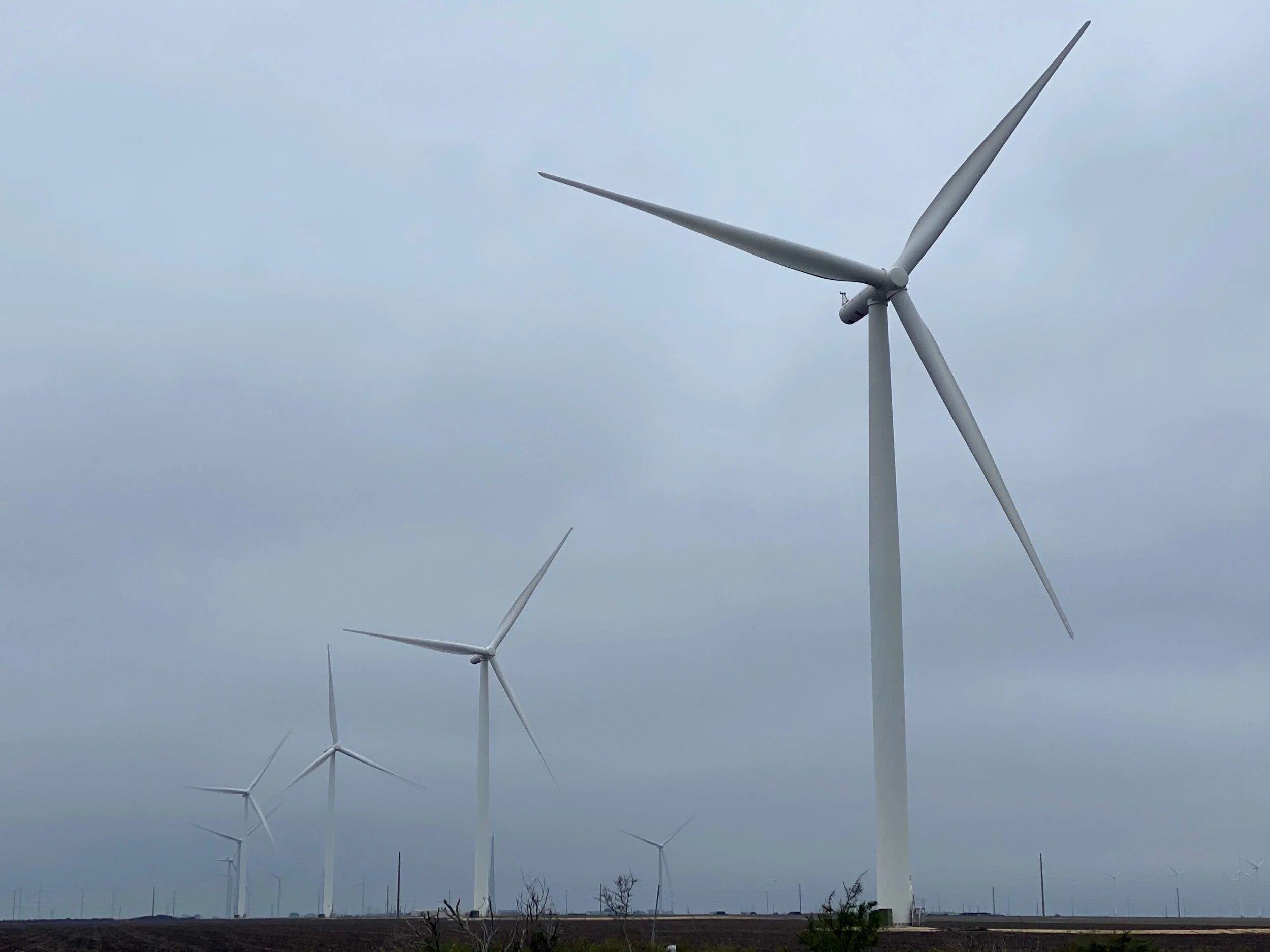
Just above Gregory we encountered a large wind farm on agricultural fields that spanned to the horizon on both sides of the road for almost 8 miles. Later we learned it is run by E.ON Climate and Renewables North America, one of the worlds largest developers, owners, and operators of renewable energy projects. EON owns and operates over 1,900 MW of wind farms in the United States. The wind on these flat plains are intense (we learned that the hard way), and there are quite a few more wind power companies in the area.
Perhaps more surprisingly, Texas leads the nation in wind-powered generation. The state produced one-fourth of all the U.S. wind powered electricity in 2017. Texas wind turbines have produced more electricity than both of the state's nuclear power plants since 2014. And equally interesting, Texas produces more electricity than any other state, generating almost twice as much as Florida, the second-highest electricity-producing state. All combined, Texas is the largest energy-producing state in the country. It’s also the largest energy-consuming state in the nation. In fact, the industrial sector, including its refineries and petrochemical plants, accounts for half of the energy consumed in the state.
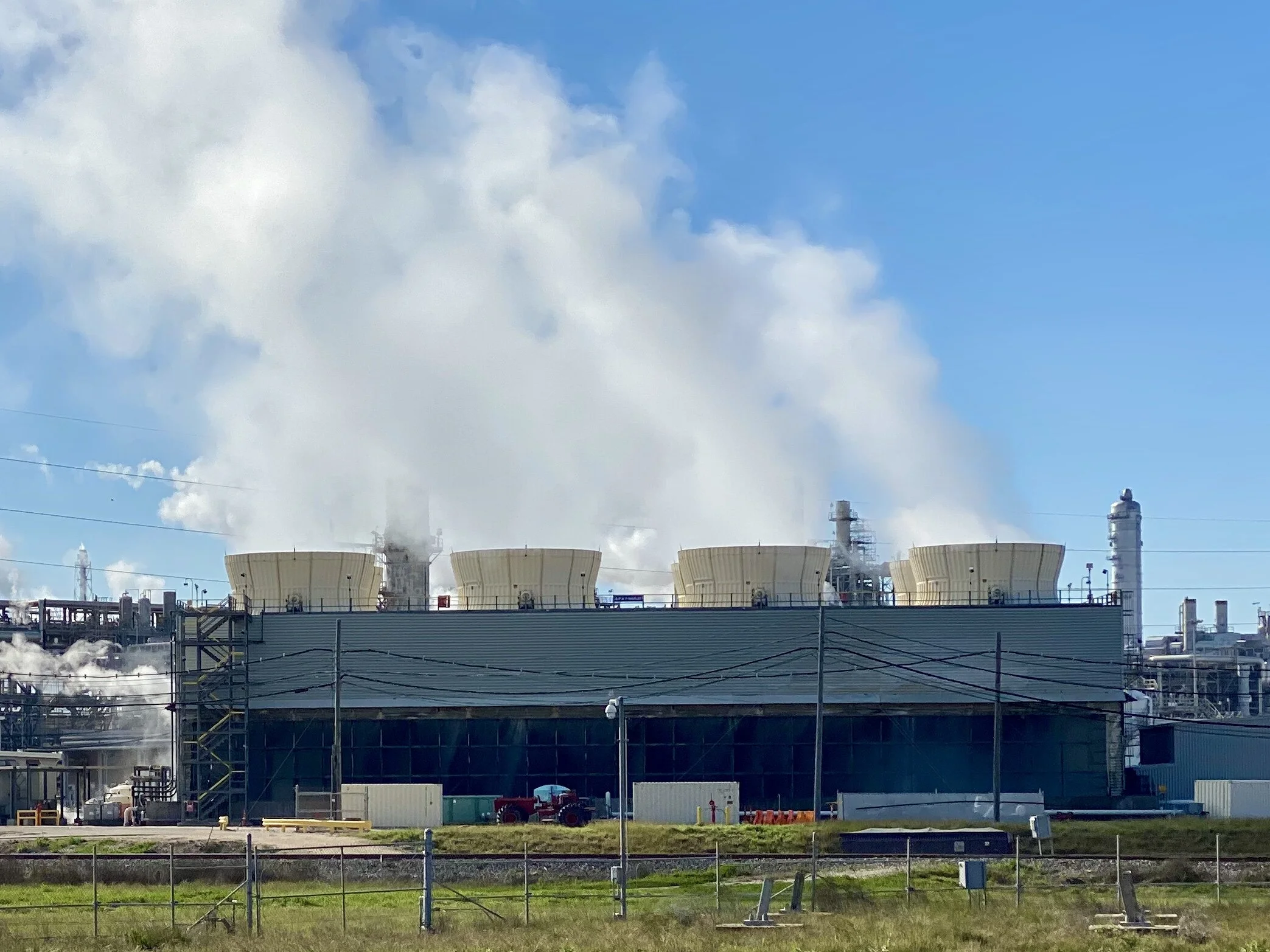
Cooling Towers on the Dow Chemical Plant in Freeport, Texas.
Given our lowbrow method of bicycle travel to offbeat roads and towns, we had lots of opportunities to speak with locals. We didn’t meet one person who spoke of his or her job in disparaging terms. We were often met with gratitude for the opportunities that seemed to be available. Truth is, Texas is humming. The unemployment rate is 3.4%, while the national average is 3.6%. Louisiana’s rate is slightly higher at 4.5%, although it was 6% in November of 2016. By most measures in both states, employment is looking up.
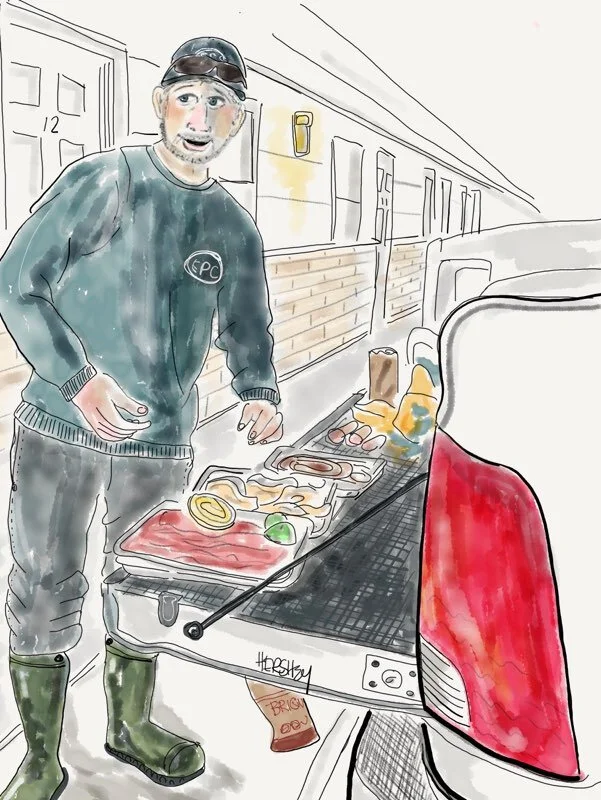
“Me?- I’m Norberto. Me an’ my brothers, Ivan and Freddy cook our meals for the week out here. We take our lunches to the plant.” Drawing by Jennifer Hershey. Follow her work on Instagram at deeofo.
Norberto and his brothers had traveled from their home near Brownsville to work at a plant near Kenedy, Texas. There’s a lot of available jobs there. We counted 9 oil and gas plants in this town of 3500 people.
The evening we hung out with Norberto and his brothers, I fell into a conversation with one of their friends, an oil worker named Jose. An Hispanic transplant from Indiana, Jose was happy to be finding so much work in a part of the country that he preferred. He educated me for awhile about H2S flaring and modern pipeline construction methods, which I appreciated. It was comforting to hear the industry was actually trying to lower methane emissions. After a while, I asked him about his politics. Jose was unabashedly straightforward about supporting Trump because Trump supported his industry. I turned the conversation to climate change. He hesitated a bit as I gently expressed my concern about carbon emissions and what might happen to the world my grandchildren will be inheriting. He didn’t have children, so I kept the conversation a few generations out. I could also tell Jose was aware lots of folks felt like I did, and I could feel him becoming defensive. So I changed tack. I told him I didn’t begrudge anyone working in any industry who was trying to achieve his or her fair share of the American Dream.
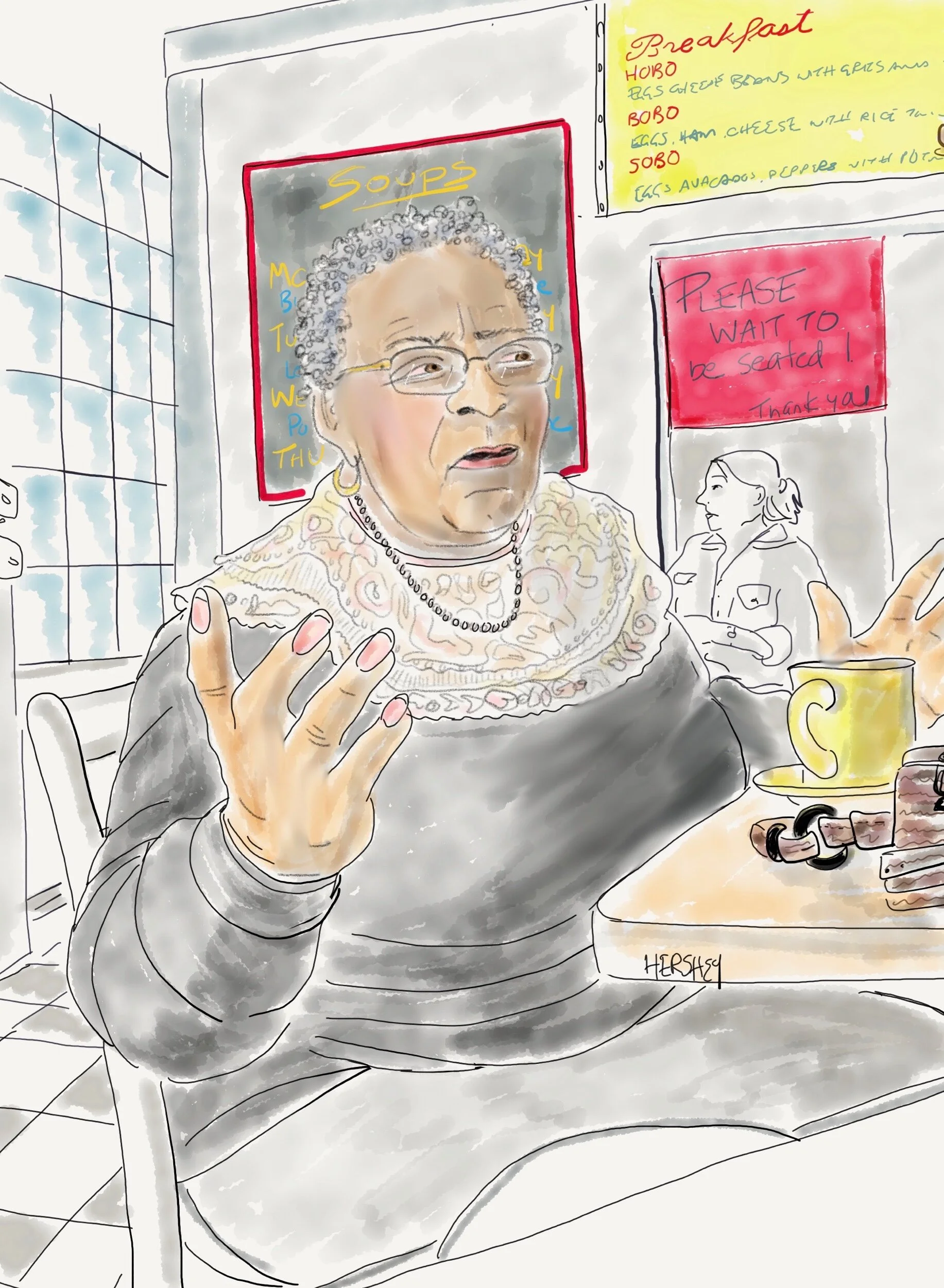
“I used to be an intelligence analyst for the army in Germany. I moved back here to be close to my military family. I pray everywhere and anywhere because God is always where I’m praying”. Drawing by Jennifer Hershey. Follow her on Instagram at deeofo.
I remember how isolated veterans felt when they returned from the Vietnam war many years ago. Coming back to a divided country after having served in an unpopular war was a miserable experience for so many veterans, and their shame and degradation cloyed deeply at those of us who opposed the war. Consequently, it was a relief when Americans did not do the same thing to vets when they returned from the second Gulf War - a war equally as unpopular as Vietnam. It seemed that Americans understood had that our vets were not the perpetrators of an unpopular and ill-advised conflict, but were instead brave men and women who had been asked to do something unpopular and counterproductive by their superior officers. In that case, the right people were held accountable for poor choices.
Just as those of us who are deeply worried about the growing climate emergency are realizing that meaningful change has little relevance to the consumer-based choices of the average middle class, we also need to avoid blaming our brothers and sisters who work at low and mid-level technical jobs in an industry that has brought us so much, but is also causing us great damage.
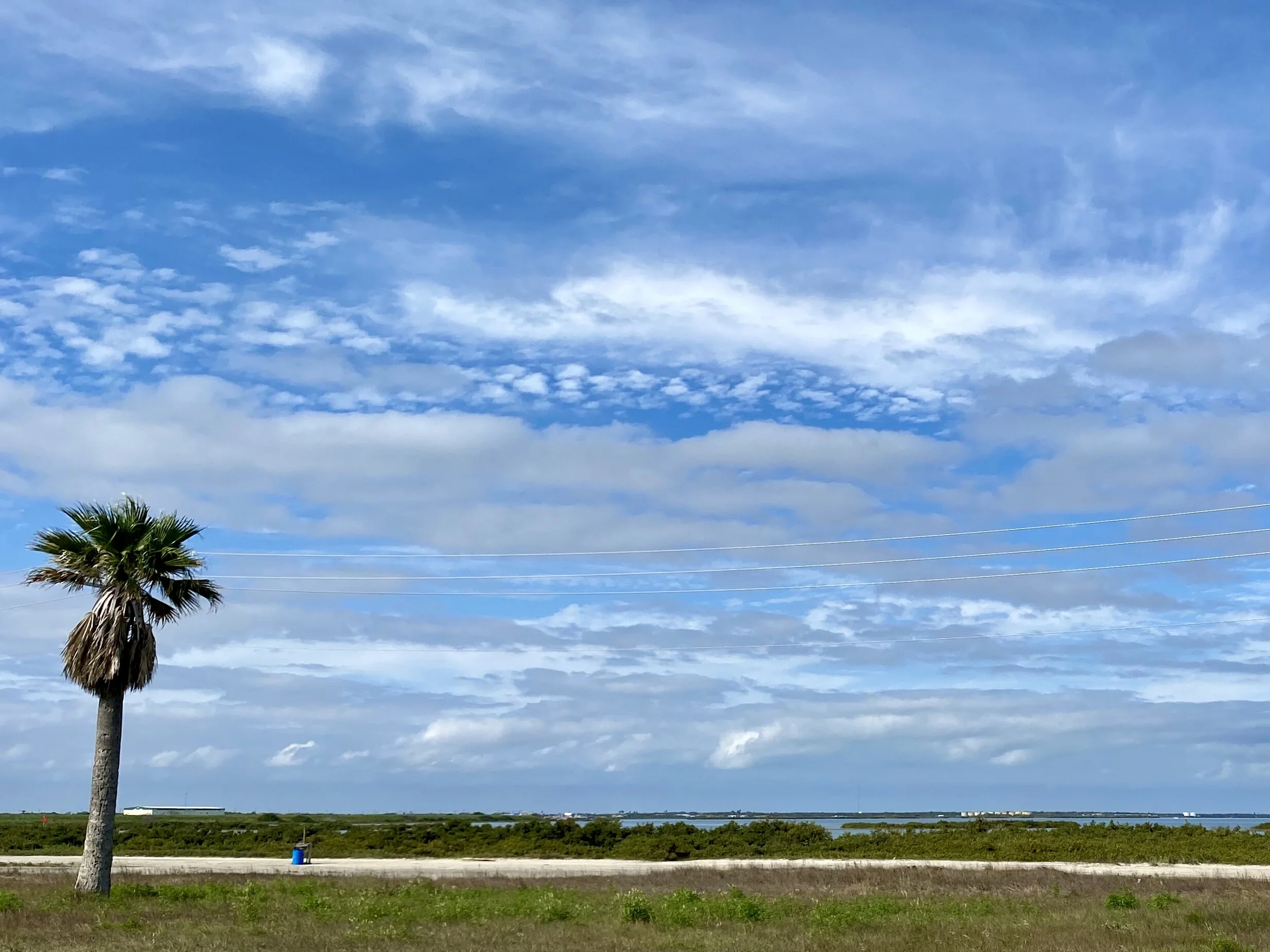
Looking south from the causeway between Aransas and Port Aransas, Texas.
Jobs matter. They are a necessity. At the same time, we need policies that will aggressively curb and eliminate carbon emissions. I've heard conservative Republicans say that it’s not fossil fuels that are the problem, it's emissions. In response, I say …. great! If one really trusts the free market, then put a price on those emissions (and return the proceeds as a dividend to taxpayers to mitigate additional costs), and trust the market to work its magic. And if that intervention doesn’t do the work fast enough (at the rate that science tells us we need) then let’s put our money where our mouth is and trust the market enough to increase the price of carbon until it’s enough. Let’s bring the emissions down! If we can use the market to stimulate innovation that will help us save a lot of our oil and gas jobs, that’s terrific! If not, then let’s accept the truth of our situation and create a different kind of economy.
As one of the people we met kept saying, “I'll tell you what” …Using the ridiculous excuse that the science isn’t settled isn’t acceptable. The science of climate change is as verified and verifiable as the concept of gravity (about 98% of scientists agree both are happening). Climate change isn’t convenient, that’s for sure. But just because we don’t like that it’s happening isn’t a reason for denial. Let’s deal with it.
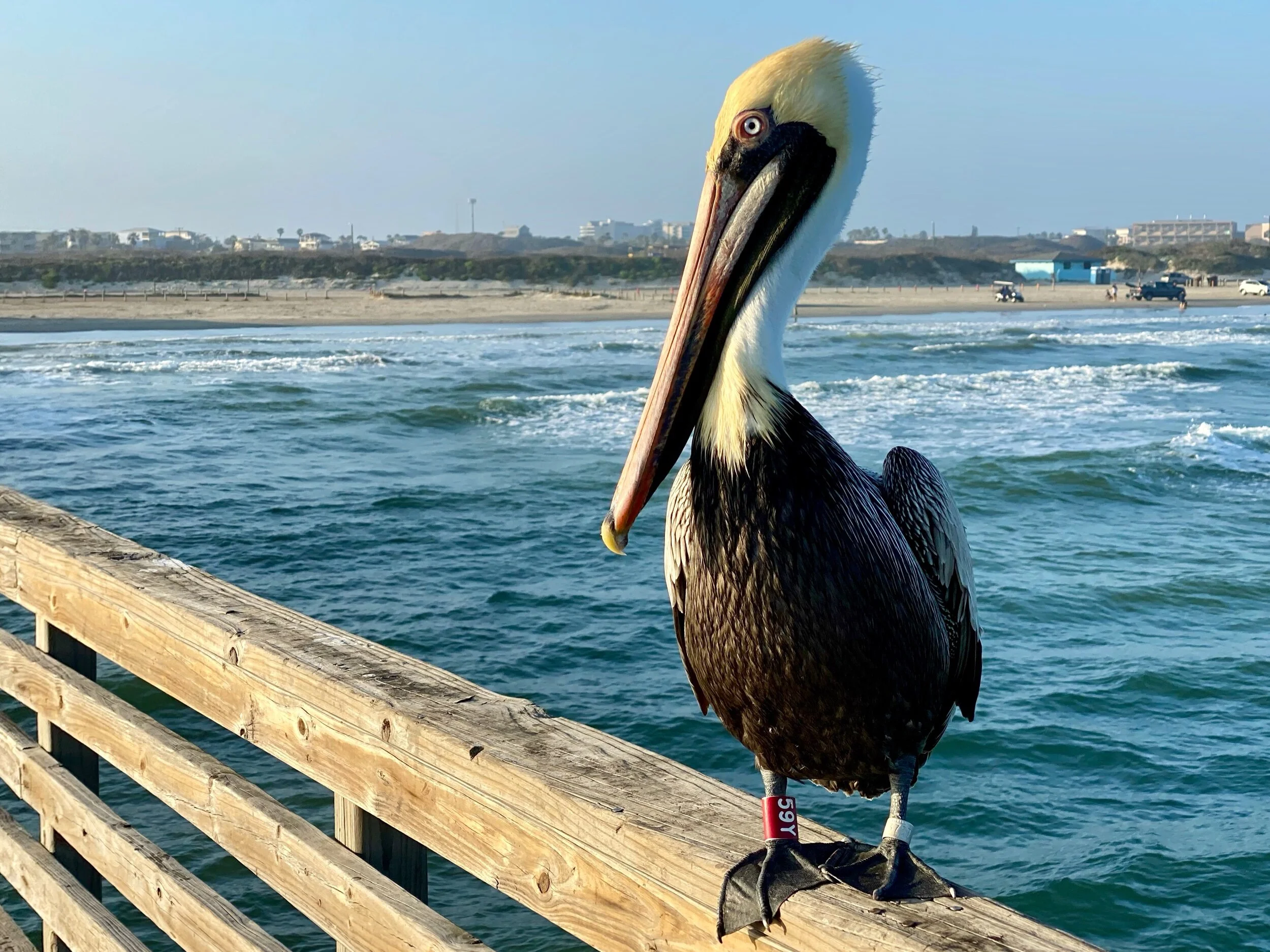
Yet another Pelican poses for us near Corpus Christi.
This blog post concludes our latest trip from New Orleans to San Antonio. I am writing this on an Amtrak train, with our bikes safely stowed in the baggage car. It’s been an extraordinary trip. If you haven’t visited the 4 missions on the San Antonio River, we enthusiastically recommend them, especially Mission San Juan. A few key pictures from there are posted below.
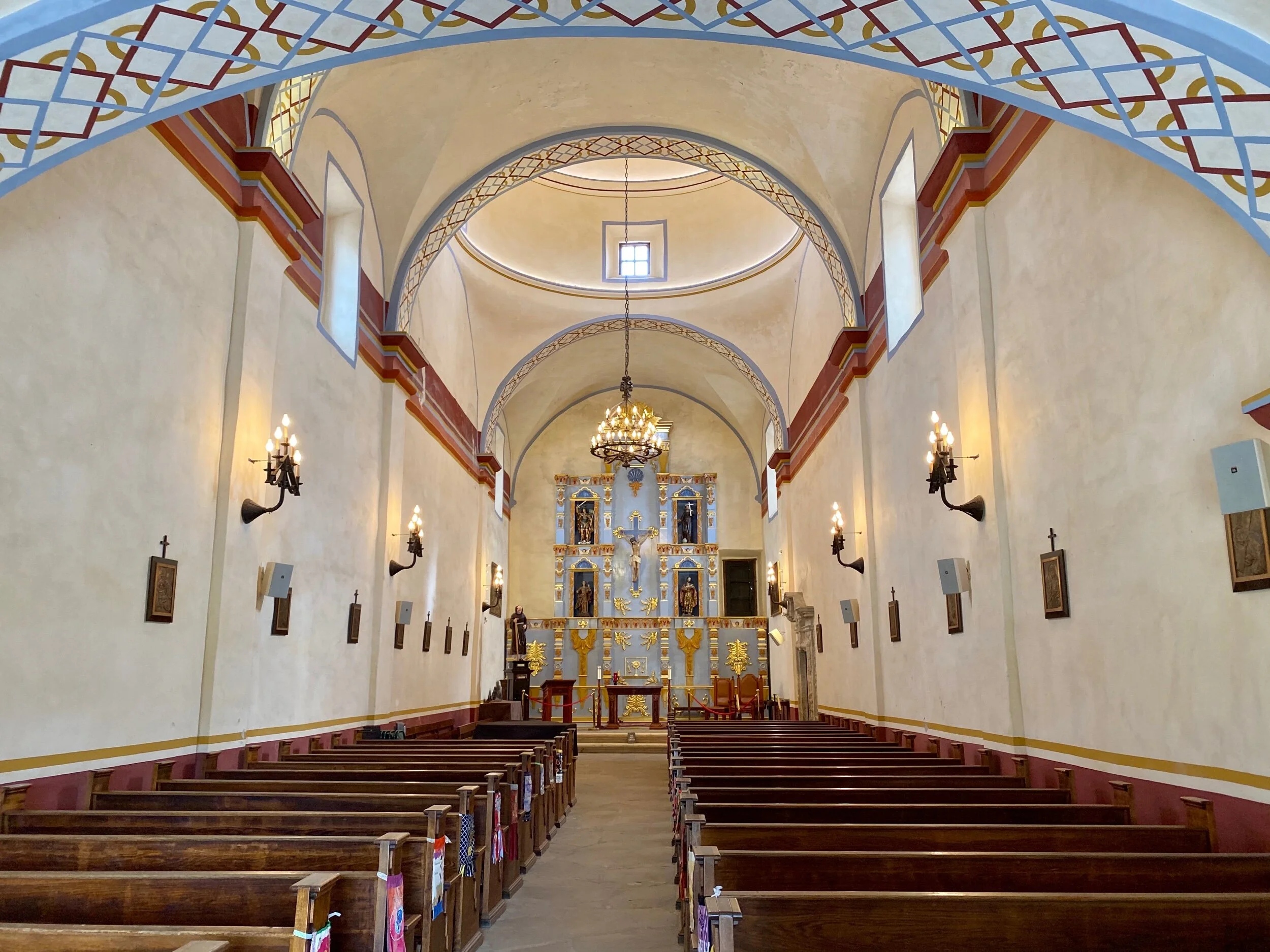
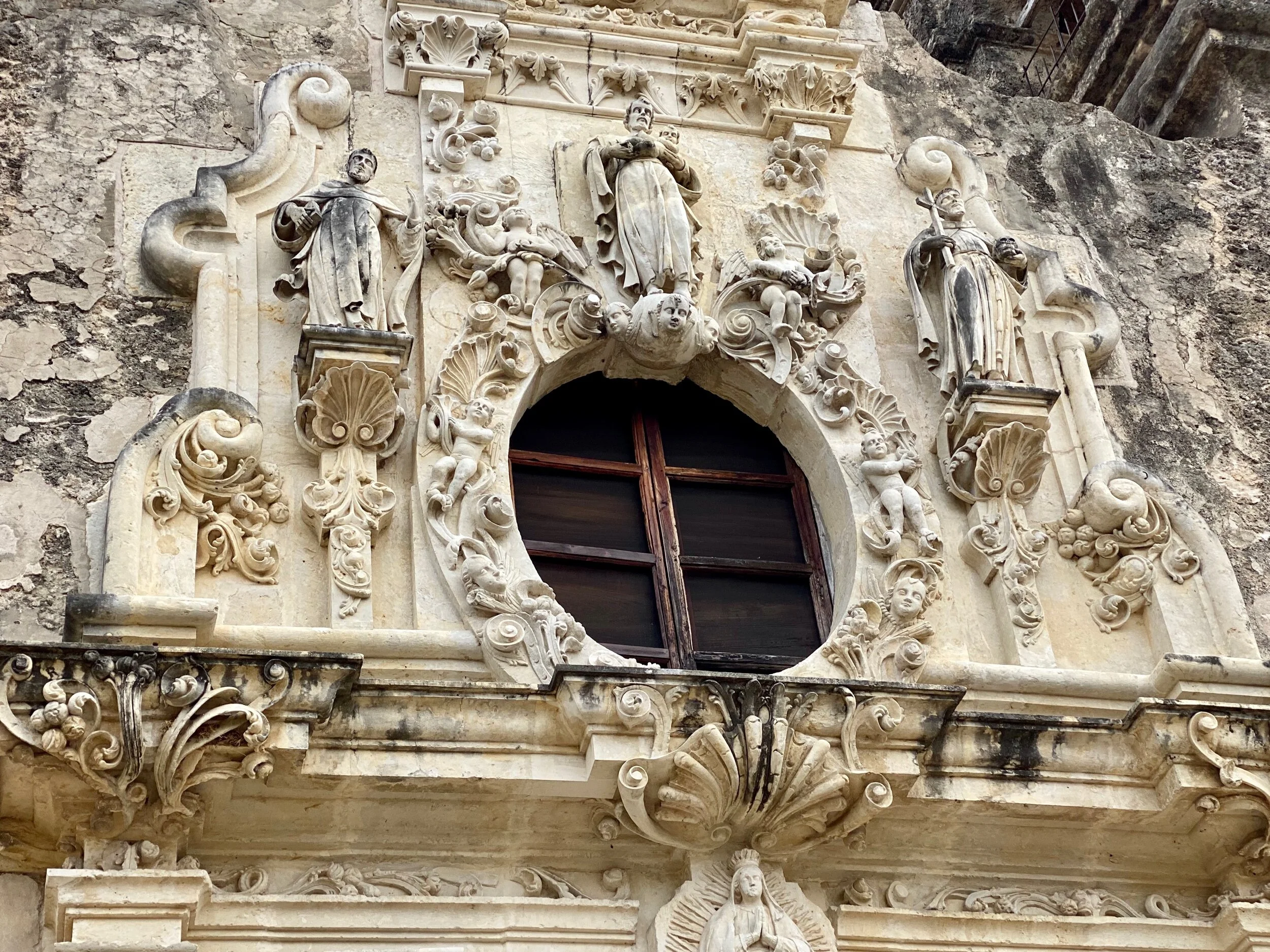
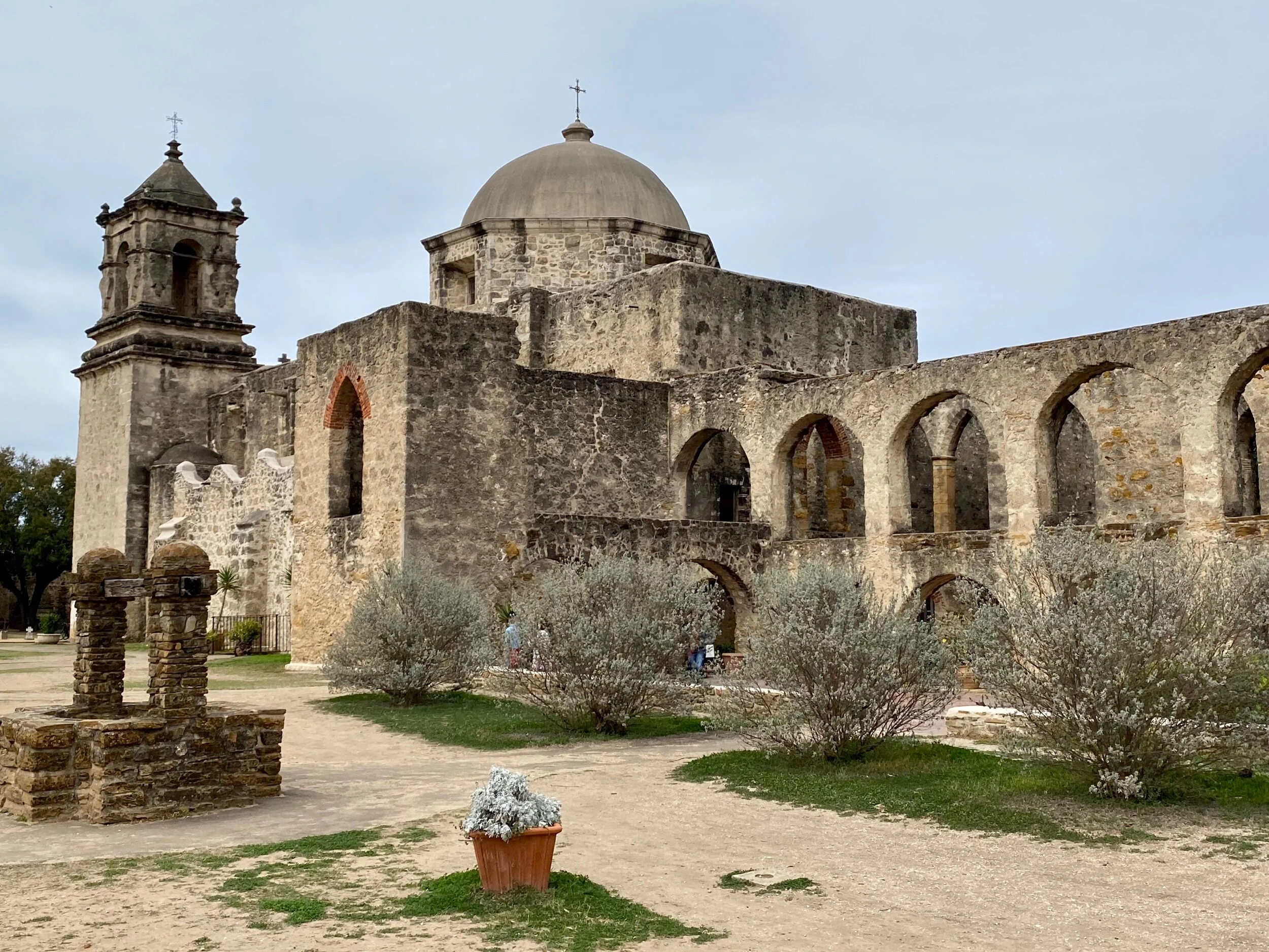
Below are links to this entire trip. If you don’t have a Garmin account you will have to create one to see them (it's worth it if you're a biking geek or map lover).
1) New Orleans Road Cycling, 2) New Orleans Road Cycling, 3) Donaldsonville Road Cycling, 4) Morgan City Road Cycling, 5) St Mary Parish Road Cycling, 6) Abbeville Road Cycling, 7) Lake Arthur Road Cycling, 8) Cameron Parish Road Cycling, 9) Port Arthur Road Cycling, 10) Galveston Road Cycling, 11) Freeport Road Cycling, 12) Matagorda County Road Cycling, 13) Refugio Road Cycling, 14) Port Aransas Road Cycling, 15) Bee County Road Cycling, 16) Kenedy Road Cycling, 17) Floresville Road Cycling, 18) San Antonio Road Cycling, 19) San Antonio Road Cycling, 20) San Antonio Road Cycling.
Thanks for reading! There’s always more to come, but this particular trip is complete.
All photos, unless credited or otherwise noted, are copyrighted property of the blog post author.
Louisiana/Texas, Post 3
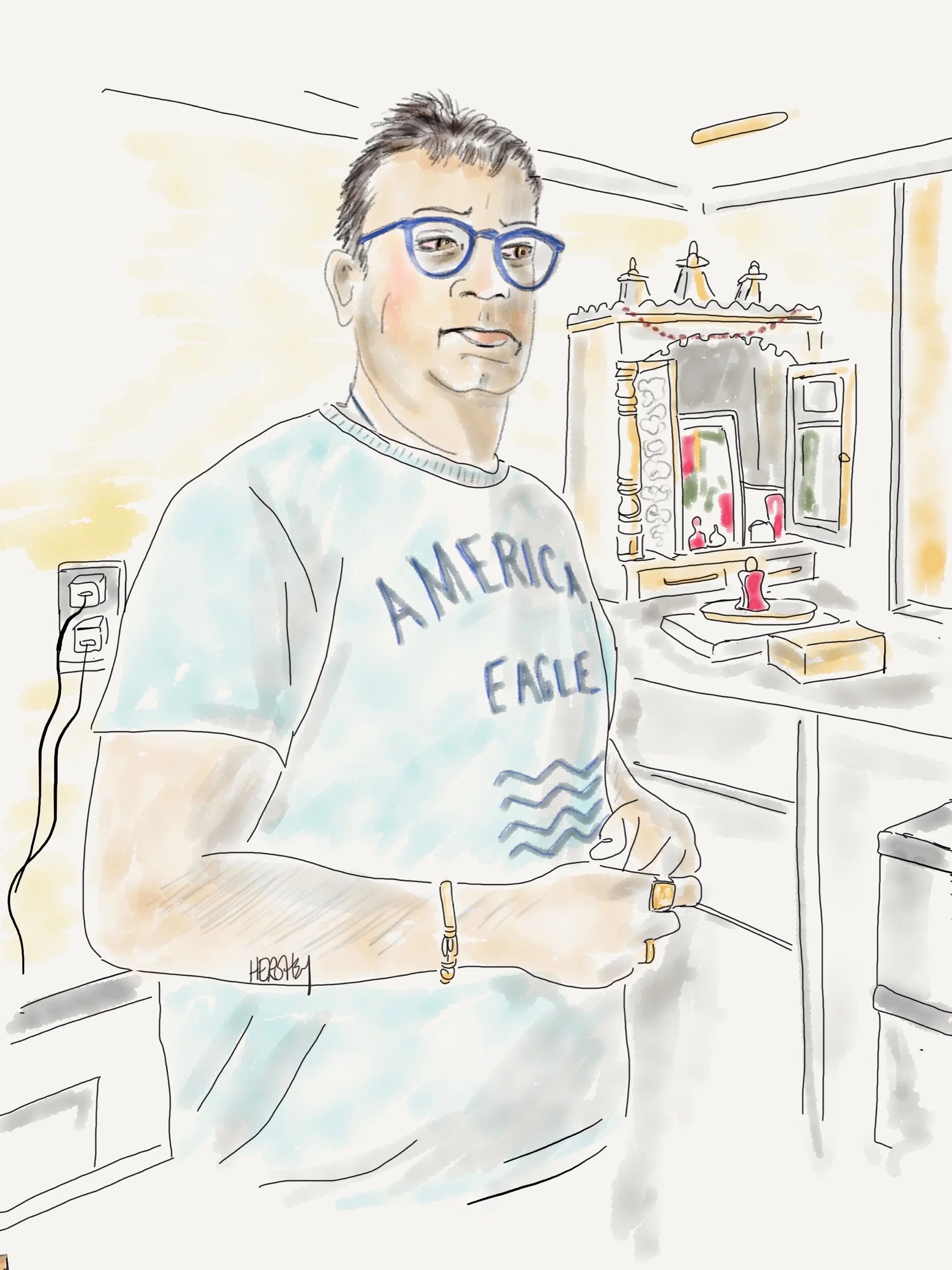
“My wife and I take turns praying at our altar. We are Hindus. But we love this motel. It’s all ours”. This drawing of a proprietor of a mid-century motel in Freeport, Texas was done by Jennifer Hershey. You can follow her work in Instagram at deeofo.
Welcome from Port Aransas, Texas, just slightly southeast of Corpus Christi, Texas.
—————
“It was the best of times, it was the worst of times, it was the age of wisdom, it was the age of foolishness, it was the epoch of belief, it was the epoch of incredulity, it was the season of light, it was the season of darkness, it was the spring of hope, it was the winter of despair.”
-from a A Tale of a Two Cities by Charles Dickens.
Such are the times we live in.
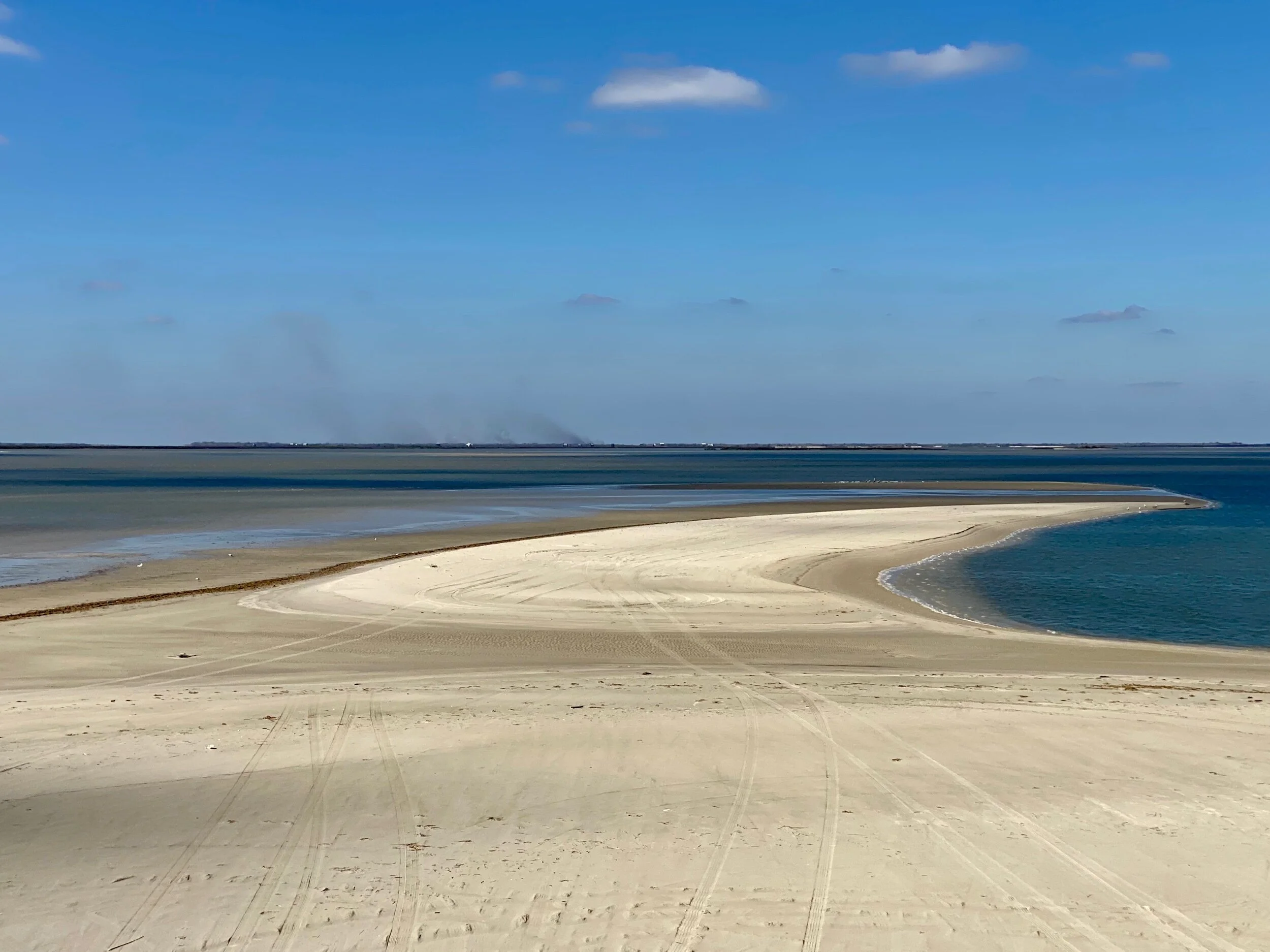
On the way to Freeport, Texas. We learned later the smoke in the background is from a Dow Chemical plant that removes magnesium from sea water.
Our trip continues to be an extraordinary exploration of exquisite natural landscapes, occasional encounters with wildlife (dead and alive), great conversations with diverse and friendly people, navigating delightful and terrifying roads, dealing with sublime and challenging weather, and periodic confrontations with seedy and startlingly ugly industrial landscapes.
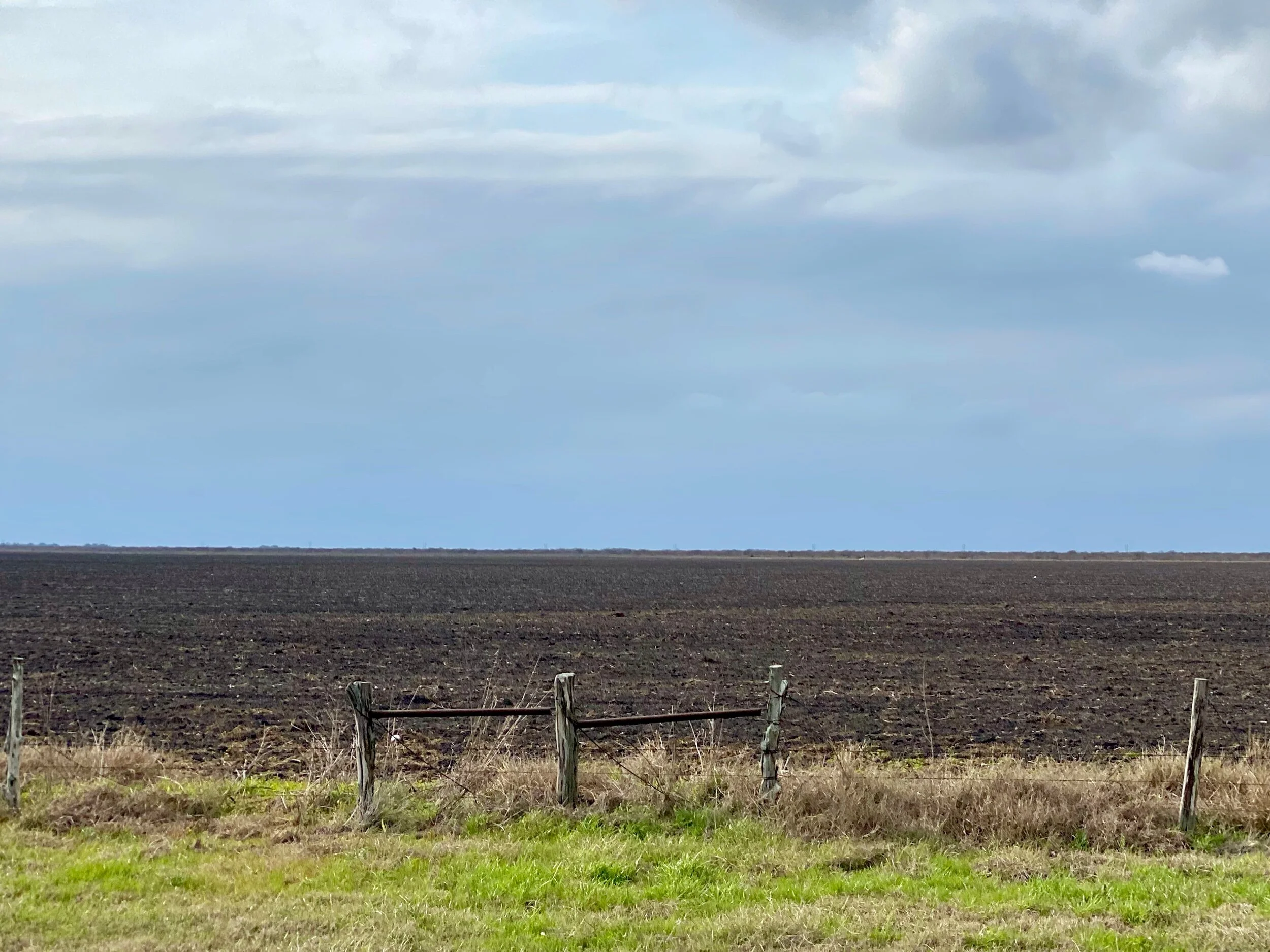
Texas is definitely big sky country, and southeastern Texas is as flat as a pancake on a hot griddle.
Perhaps we can borrow from Dickens, and instead of symbolic cities substitute citadels, or communities of people who live inside of self-imposed walls. Like any citadel that is protected from others, we can only see what’s inside, and have no idea of what’s on the outside.
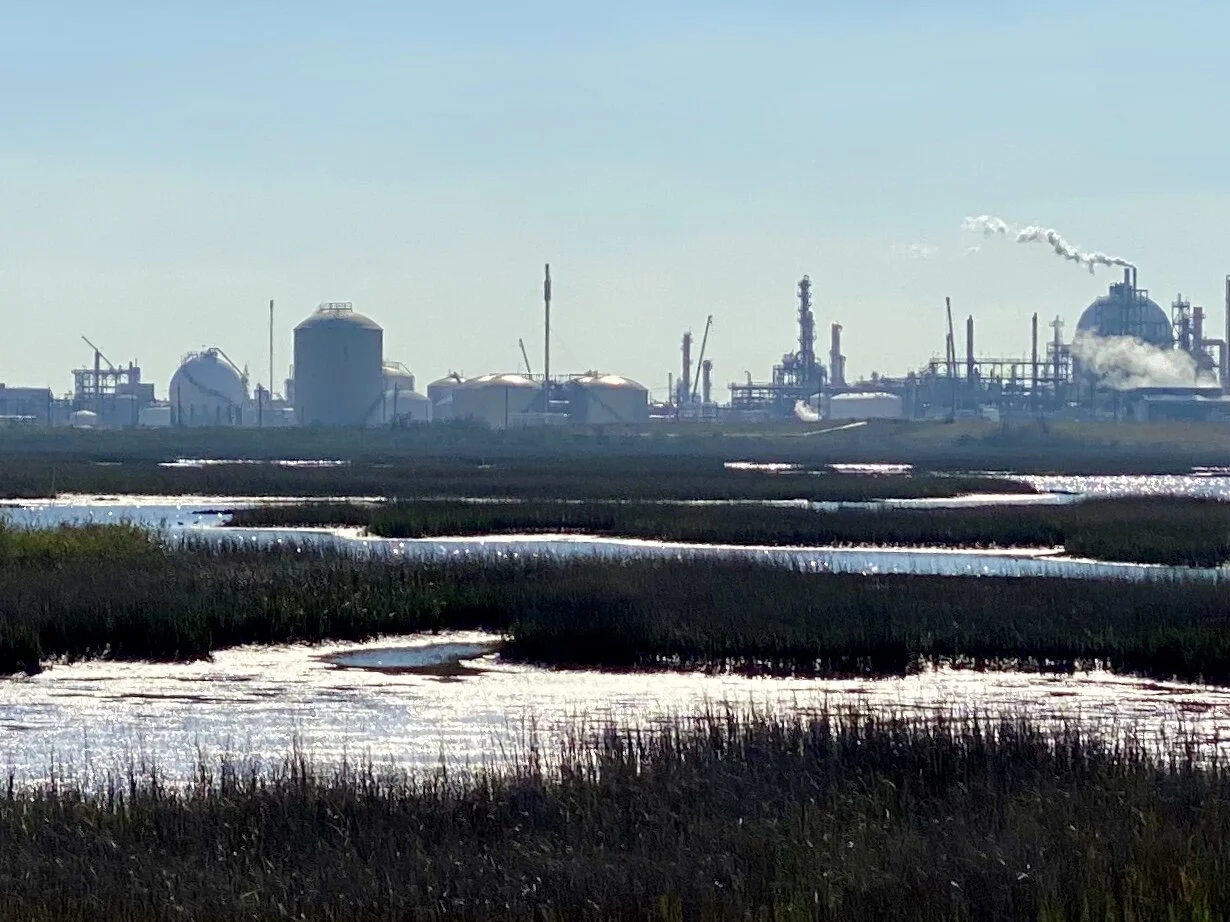
The Dow Chemical Plant near Freeport is situated just above the Intercoastal Waterway on a vast marsh.
In a way, Fox News and CNN are the storytellers for two distinct narratives that reflect two separate citadels: urban and rural America. Our cities are the center of our intellectual, artistic, entertainment and media capitals. Our rural areas - especially evident down here in southeastern Texas - provide access to our natural environments, produce our food (and also increasingly produce electricity through wind-power on the same land), and also extract and move our oil and gas providing our cities with both food and energy. Consequently, they also are the sites for some of our most polluting, dangerous and economically critical industries.
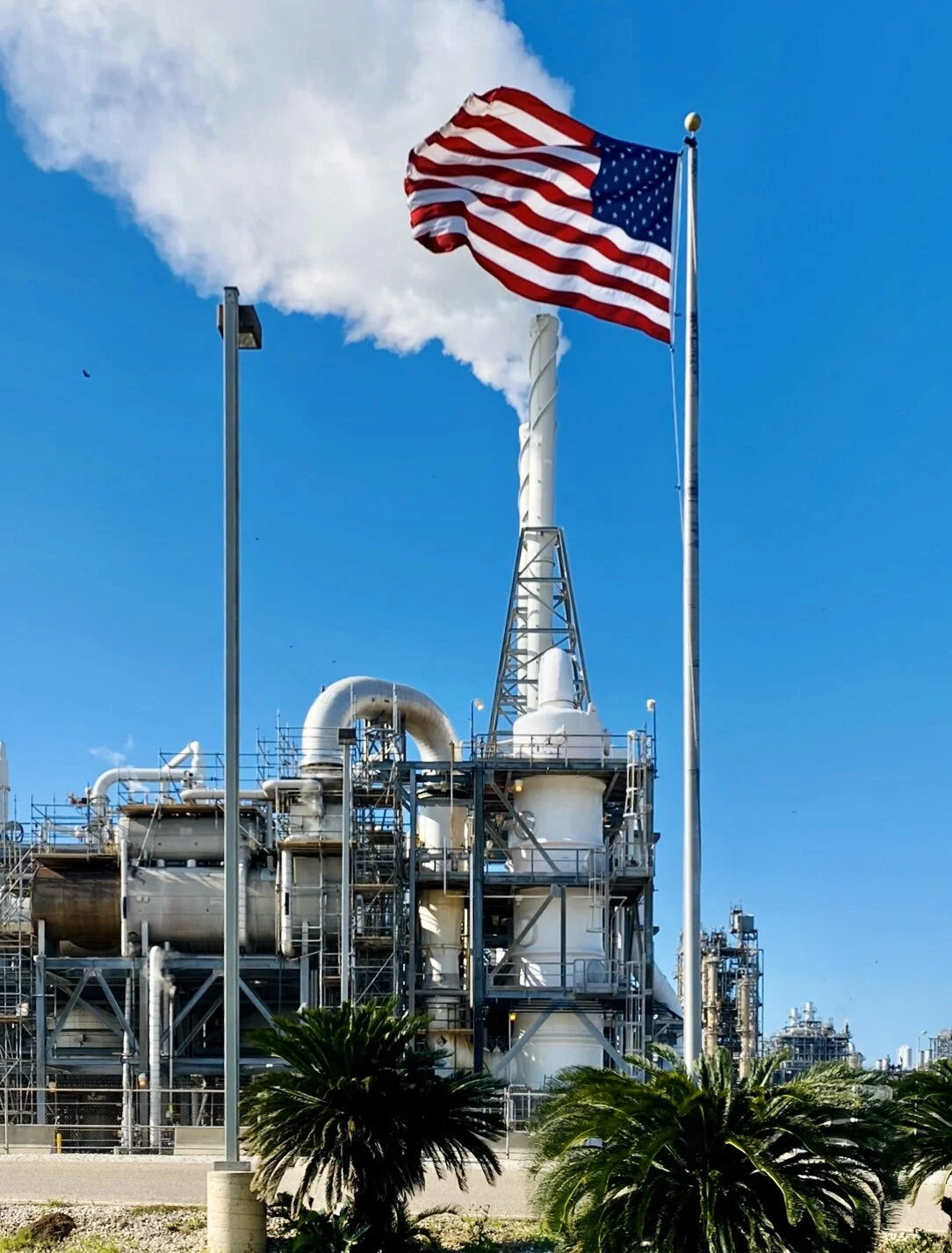
A close up shot of the Dow Chemical plant in Freeport. Locals say this is one of the largest chemical plants in the world.
As I mull over what we are encountering, I find myself thinking the challenges on the Louisiana and Texas coastlines result in a mixed landscape not unlike our home town of New York City. There’s an abundance of both beauty and squalor, and avoiding either one gives visitors an incomplete understanding.
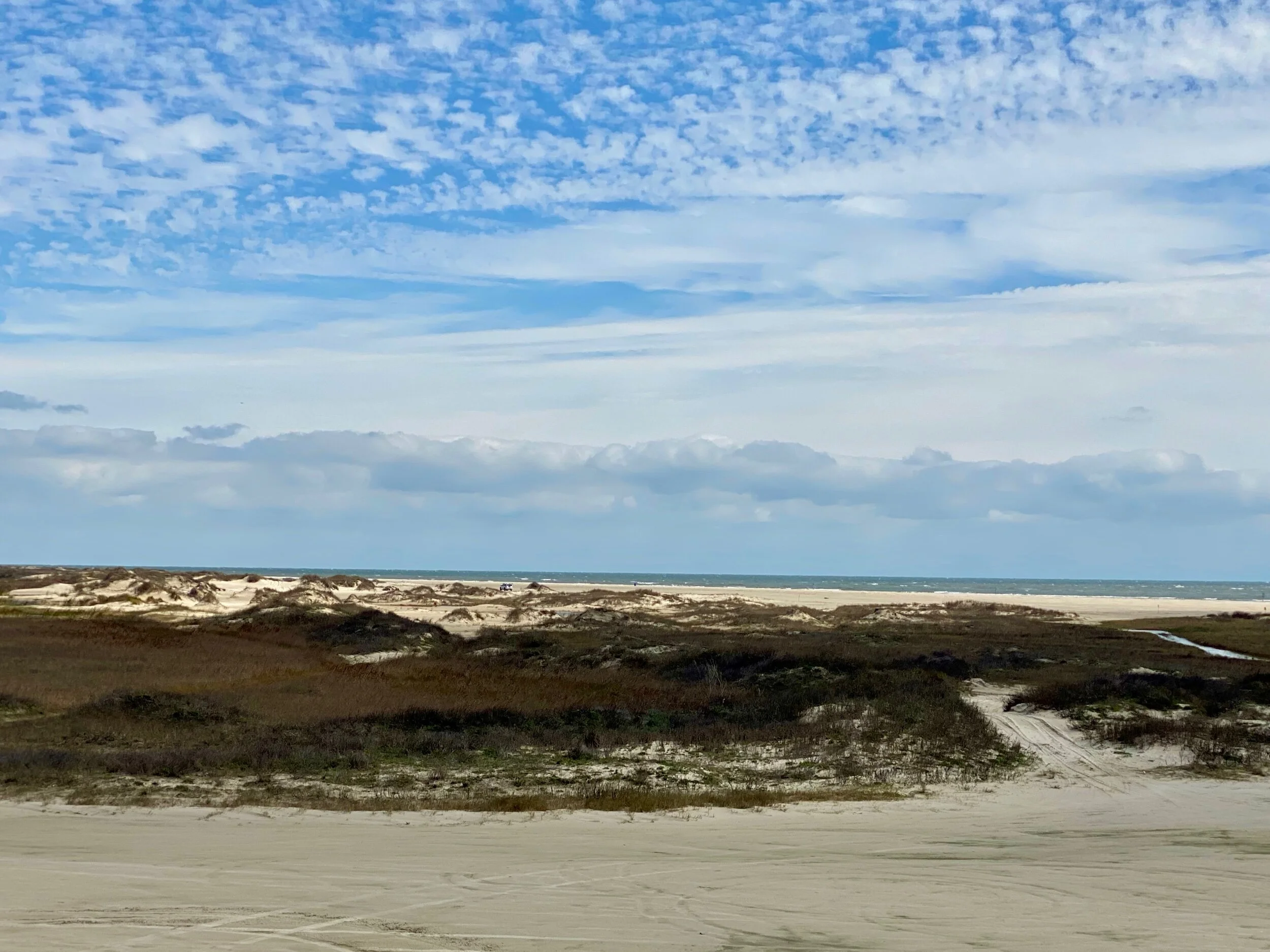
View from the San Luis Pass-Vacek Toll Bridge, which spans San Luis Pass into Brazoria County, Texas.
Clearly, I love the natural beauty of this coastline and its inland marshes, farms, and woodlands. But the story told through the industrialization of the Gulf Coast sticks in my craw. As a northerner, I’m struck by my own complicity in a type of NIMBY (Not in my Backyard) reality. I enjoy living in a city that has (with some exceptions in poorer neighborhoods in the outer boroughs) enjoyed increasingly cleaner air and water over the past several decades through stricter environmental regulations and a shift in focus from industrial production to digital technology.
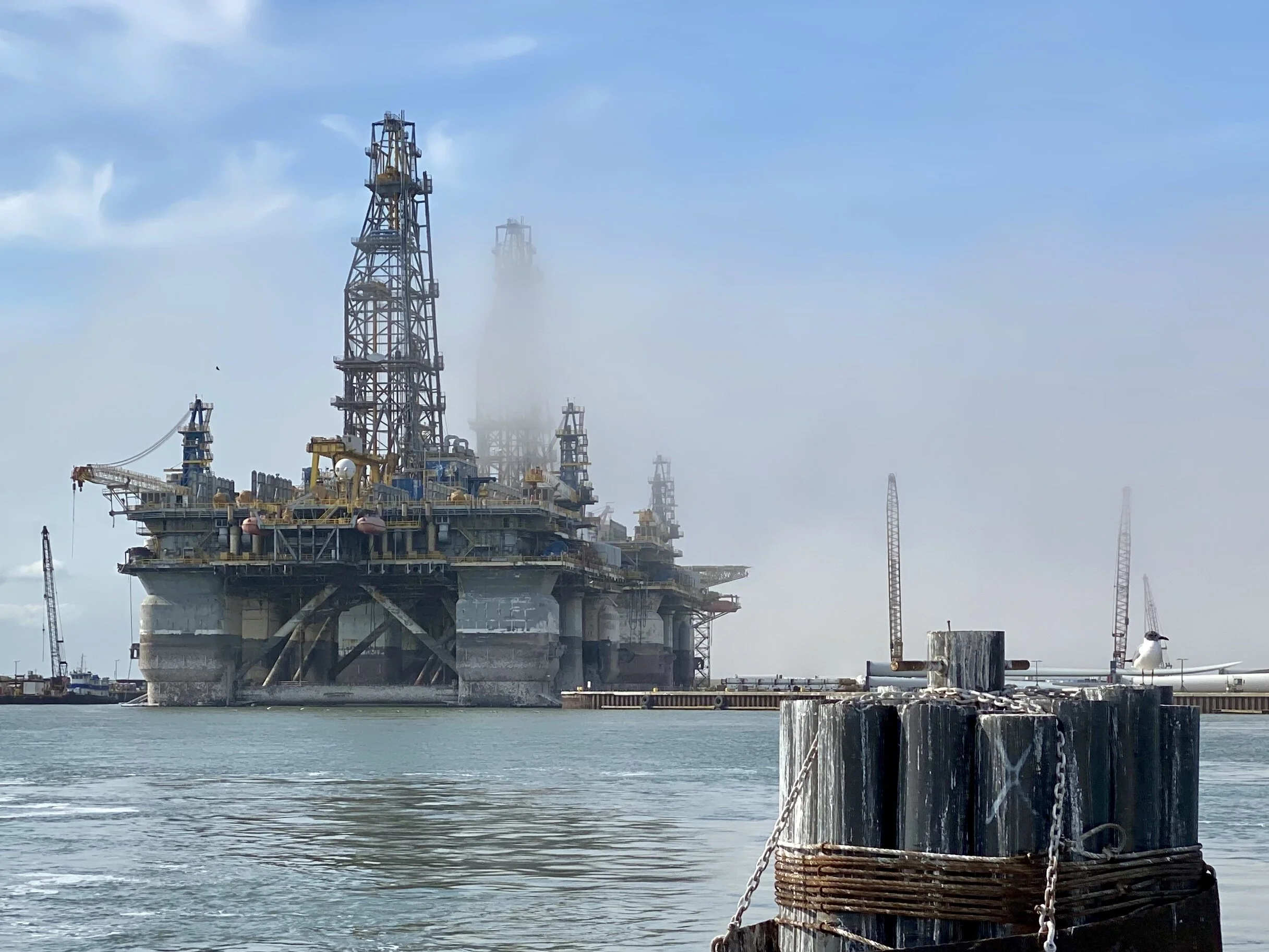
Temporary oil derricks next to the Corpus Christi shipping channel. The local community was told they would be there for six months, but are still there after almost 3 years. And it’s a big bone of contention in this community. Picture taken from the Port Aransas Ferry.
Yet, the nasty stuff used in so many of our industrial processes, plastics and household products has to be made somewhere (at least in our current economy), and some of those places are along the Louisiana and Texas coasts. And like all poor and moderately poor neighborhoods, when jobs are at stake the nature and consequences of those industries matter less than the jobs they bring.
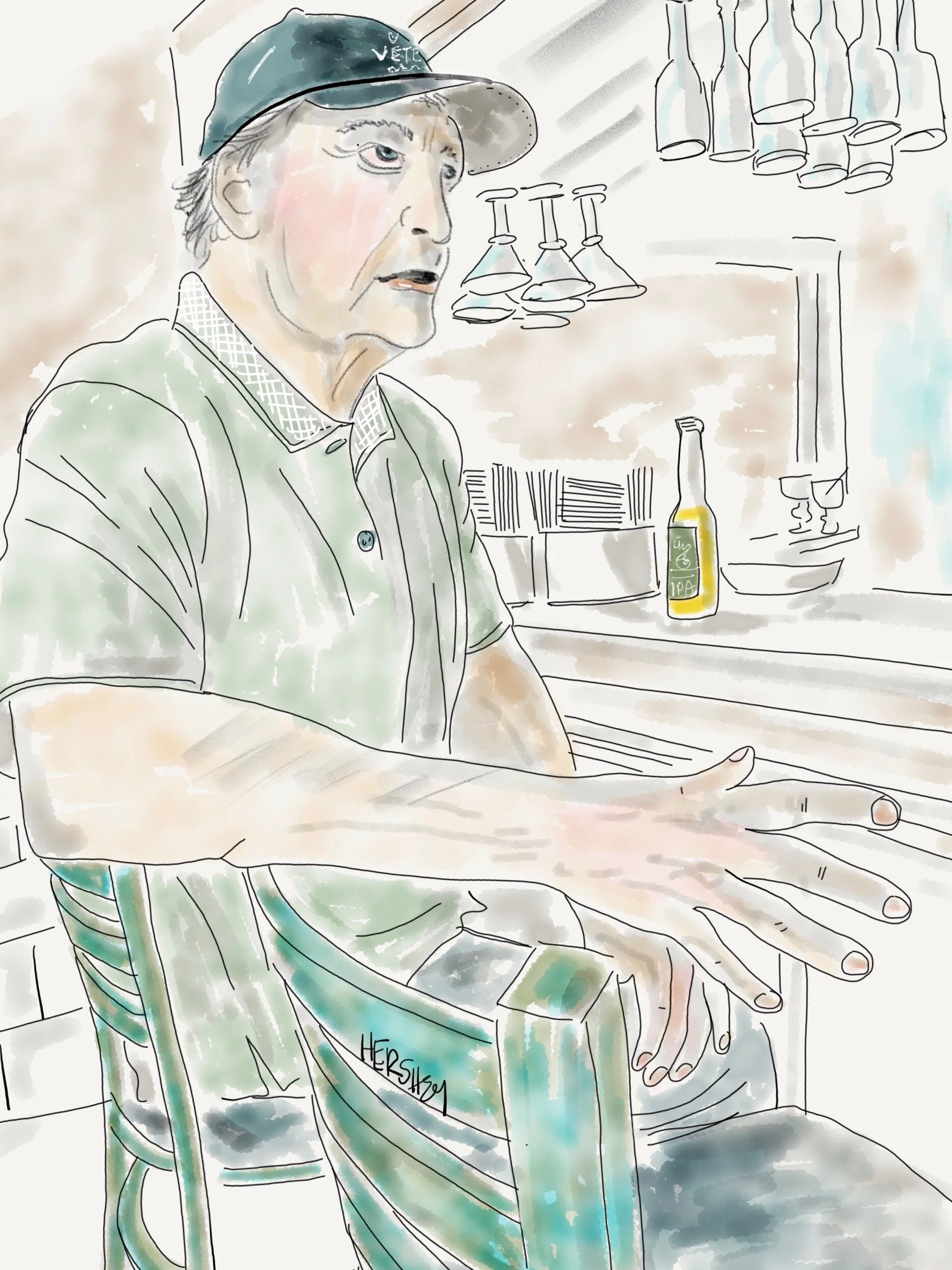
“Well I’ll tell you what—they got the best seafood right on that Seawall”. Drawing by Jennifer Hershey. Follow her on Instagram at deeofo.
Occasionally locals will resist. We met a local at a great Mexican restaurant in Freeport who had worked in most of the nearby plants over his decades long career (he was probably in his 60’s). He did a short stint at the nearby Dow Chemical plant, but didn’t stay long. The plant officials said it was safe, but he told us that it sure didn’t seem safe to him, so he moved on.
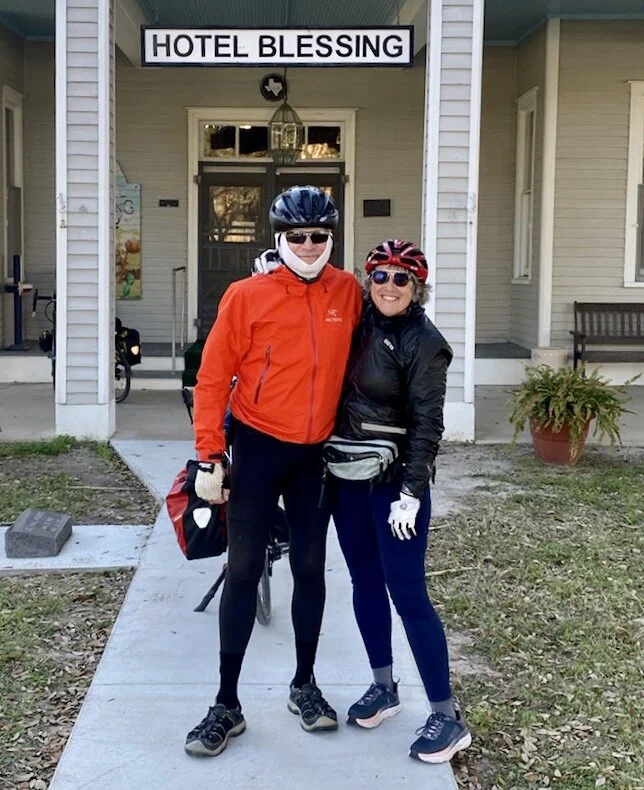
Jenny and I standing in front of the Hotel Blessing.
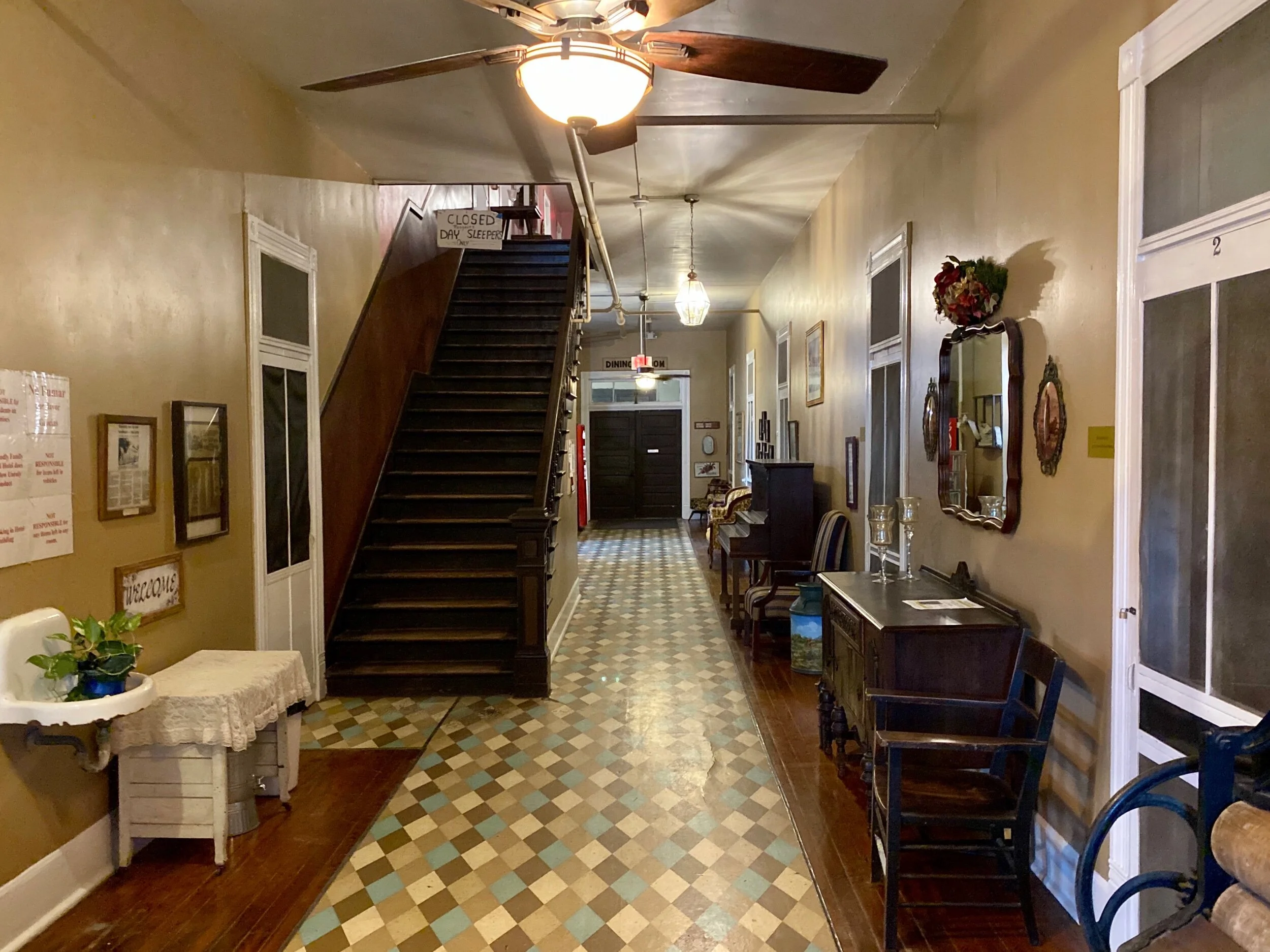
The downstairs interior of the Hotel Blessing in Blessing, Texas, population 861. Blessing was named in the early 1900’s out of the gratitude for local agriculture, railroad and coastal development.
Yet, lots of folks down here are glad for all that Texas has to offer. I’ve heard more than one person boast about being “Texas born and bred”. And even one town has named itself after its good fortune. By sheer coincidence, we found ourselves needing to stop at the one hotel about the right distance between Freeport and the Corpus Christi area (we couldn't stay on the coast because the old coast road was washed out by Hurricane Ike). It’s called Hotel Blessing, named after the town of Blessing.
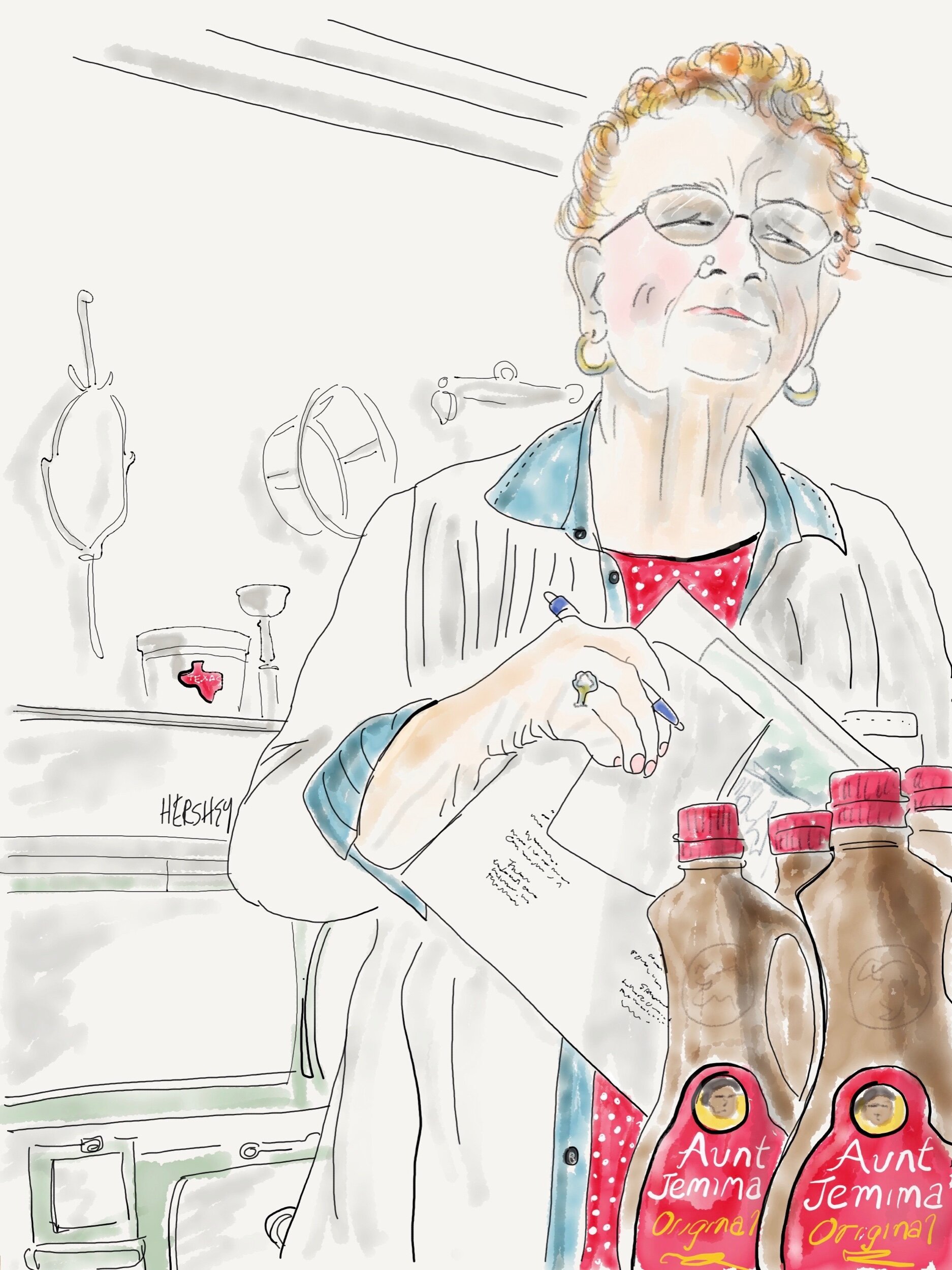
“Oh I’ve been doing this for years. If they keep coming....I’ll be here”. Drawing of Helen Feldhousen by Jennifer Hershey. Follow her on Instagram at deeofo.
We didn’t know what we were in for at the time, but after a restless night at the Hotel (we could hear everything - yep, everything - going on during a busy Valentines Day evening) we went to breakfast at the Hotel Blessing Coffee Shop. We were greeted by the intrepid Helen Feldhousen and a cast of other folks - some of whom who show up in the Texas “Bucket List” broadcast below.
I am thinking quite a bit about the concept of “the tragedy of the commons”. This is a situation where individual users, acting independently according to their own self-interest, behave contrary to the common good of all users by depleting or spoiling the shared resource through their collective action. “Not in my Backyard” (NIMBY) actions are related conceptually. For example, my own life is made better by situating so many large petroleum chemical and oil and gas plants so far away from large cities on either the west or the east coasts. At the same time, the people of southeastern Texas gain through employment opportunities where the only other options would be tourism or agriculture. Yet, their very livelihoods are put at risk by the significant carbon pollution of the industrial activity here, because it contributes to the extreme weather that may ultimately destroy those plants, along with their jobs.
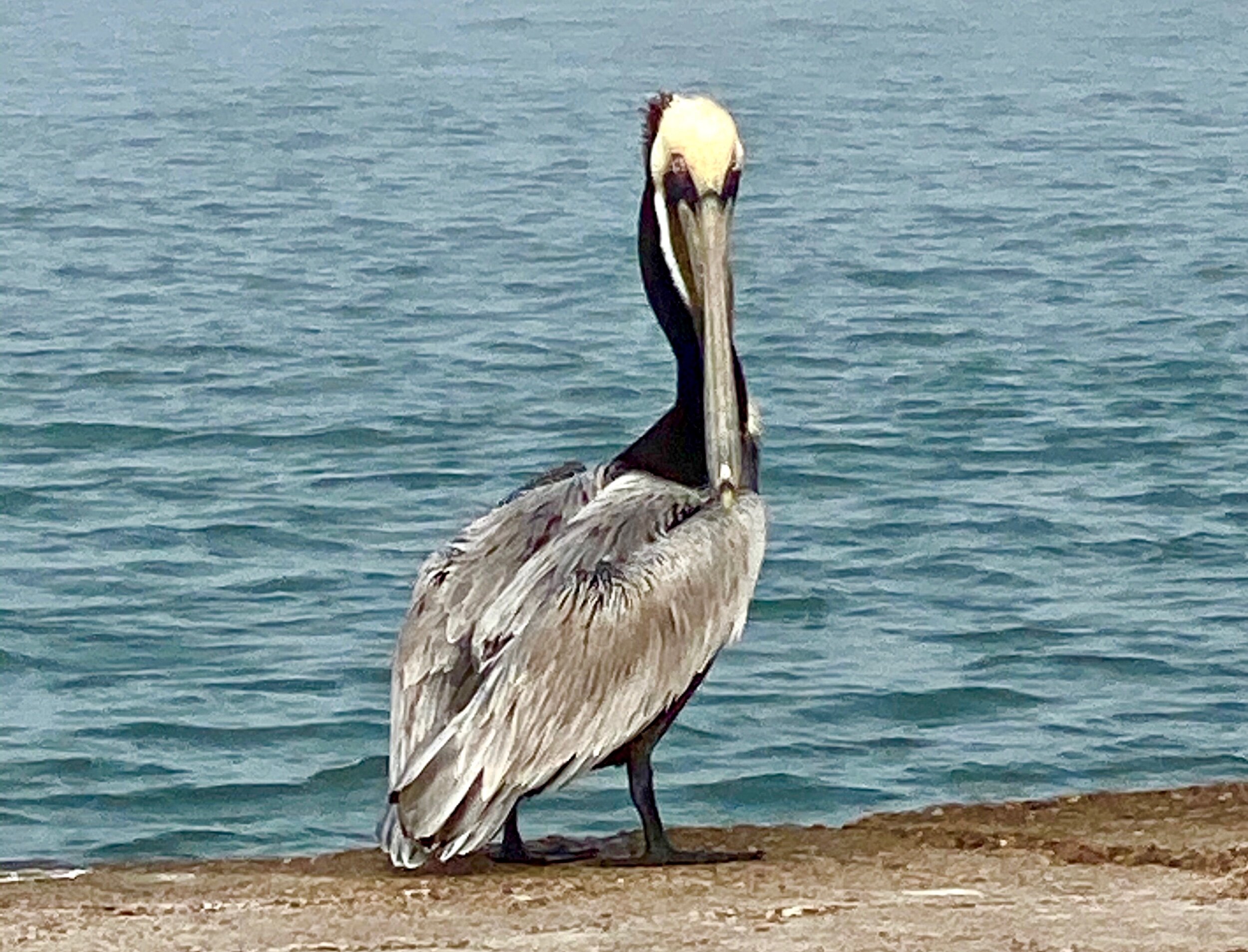
A very mellow Pelican stares us down on the beach at Port Aransas.
Additionally, citizens around the world gain nothing by the carbon these plants and their related industries have added to our atmosphere. It’s worth contemplating that although America contains 5% of the worlds population, we are responsible for 25% of the carbon put into the atmosphere since the dawn of the industrial revolution. And although China is now the world’s greatest carbon polluter, we remain the world’s greatest carbon emitter on a per capita and country basis combined. That fact alone suggests that our way of life is a big part of the tragedy of the commons that climate change is extracting. It's clear that staying with the status quo is the worst thing we can do. It’s time to step up to a different plate.
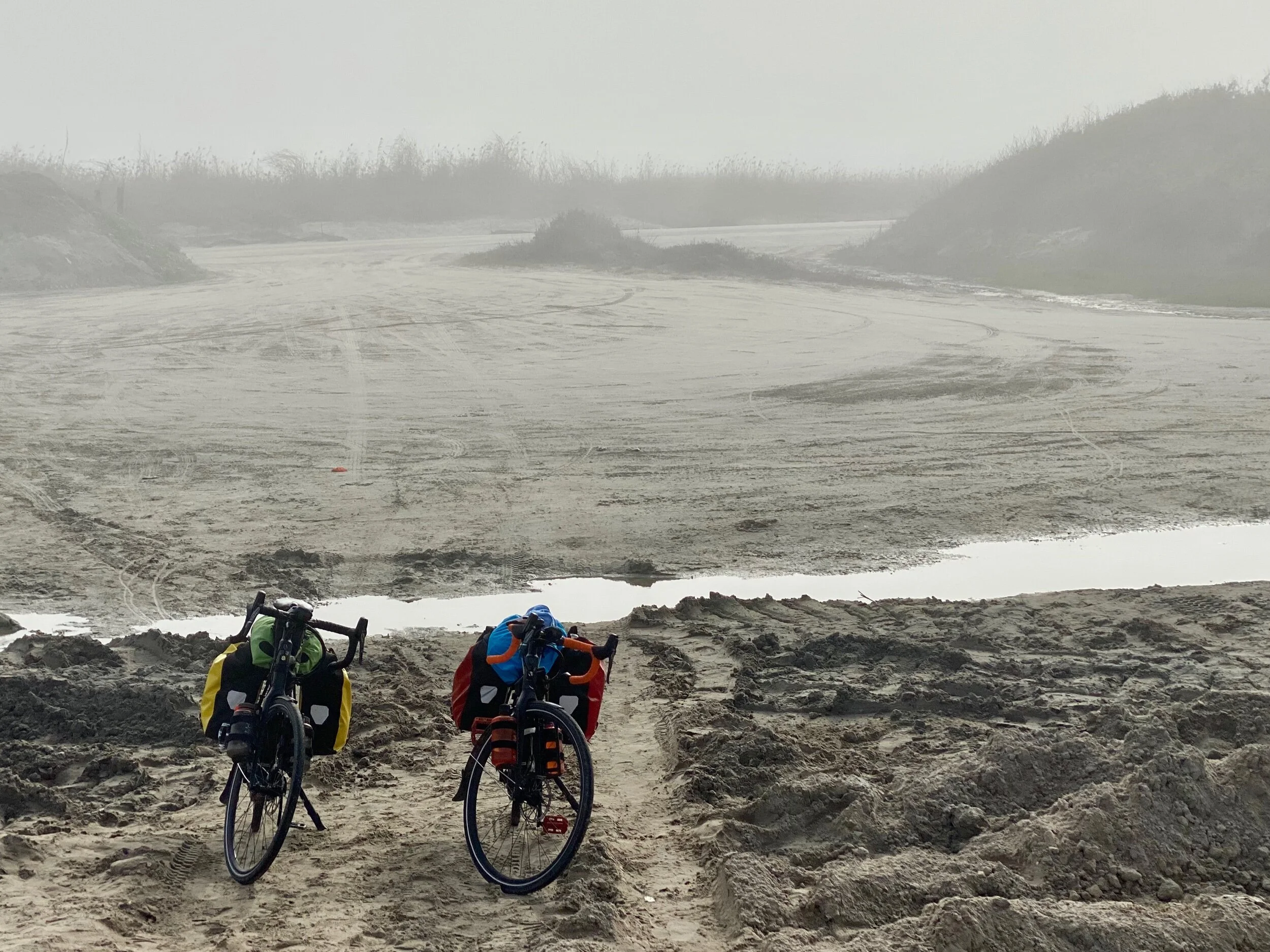
Our bikes in fog at the beach on Port Aransas Beach, Texas.
A few of you told me you missed the links to the Garmin maps showing our journey day by day, so I include links below to our entire trip to date. If you don’t have a Garmin account you will have to create one to see them (it's worth it if you're a biking geek or map lover).
1) New Orleans Road Cycling, 2) New Orleans Road Cycling, 3) Donaldsonville Road Cycling, 4) Morgan City Road Cycling, 5) St Mary Parish Road Cycling, 6) Abbeville Road Cycling, 7) Lake Arthur Road Cycling, 8) Cameron Parish Road Cycling, 9) Port Arthur Road Cycling, 10) Galveston Road Cycling, 11) Freeport Road Cycling, 12) Matagorda County Road Cycling, 13) Refugio Road Cycling, 14) Today we are in Port Aransas, Texas, just slightly southeast of Corpus Christi, Texas.
Thanks for reading! More to come…
All photos, unless credited or otherwise noted, are copyrighted property of the blog post author.
Louisiana/Texas, Post 2
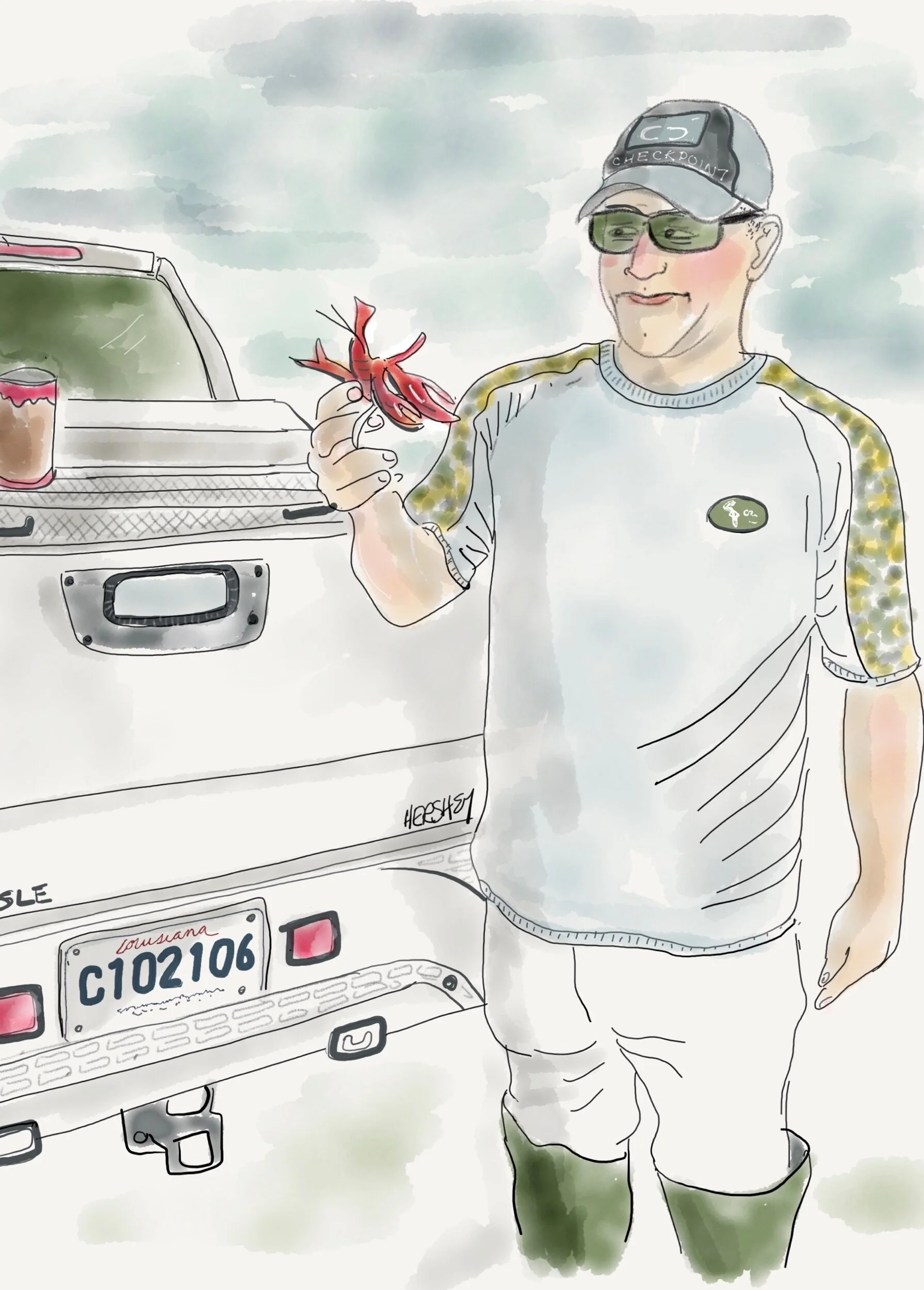
“Yes Ma’am...it’s alive. They be millions of them in pots out there in them rice fields”. Drawing by Jennifer Hershey. Follow her on Instagram at deeofo.
Welcome from Galveston, Texas, where we arrived from Louisiana by way of the coastal towns Cameron, Louisiana, and Port Arthur, Texas. Most of south central and southwestern Louisiana below the I-10 corridor from Houston to New Orleans is less than 20 feet above sea level. On both sides of the Intercoastal Waterway this land of marshy prairies, bayous, forests and intense wetlands supports many wildlife sanctuaries, cattle ranches, sugarcane and rice farms, and crawfish trapping. It was a pleasure to cycle through. People are friendly, and the inland towns are small and attractive.
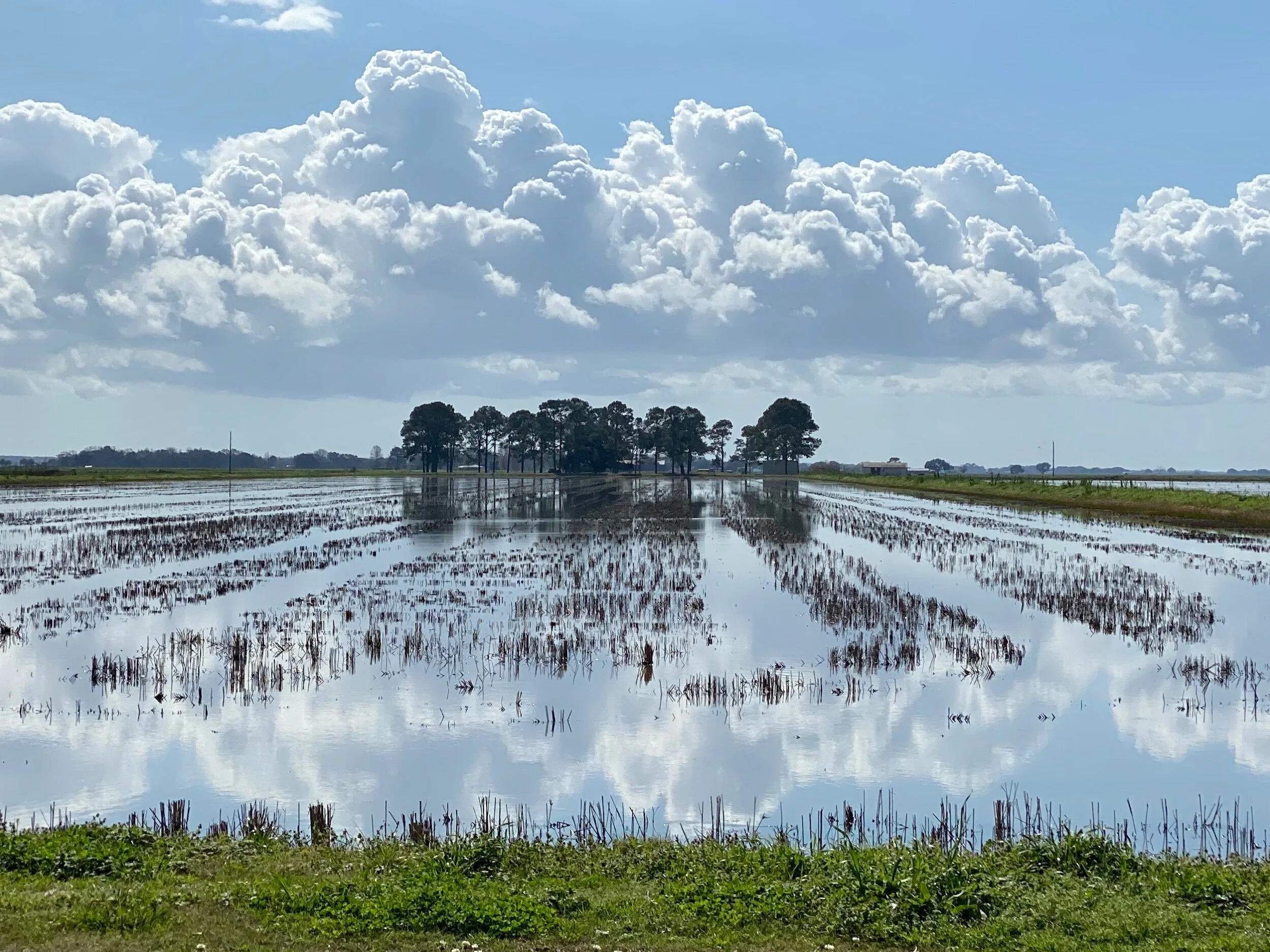
A rice field east of Lake Arthur, LA.
We had an interesting encounter with a very busy and successful woodworker named Mark near New Iberia, Louisiana, who showed us his shop, and introduced us to some of his workers. After we got settled into a motel in nearby Abbeville, he and his wife Dona picked us up and took us out for a sensational seafood dinner. We enjoyed Louisiana hospitality at its best, with good food and plenty of libation and conversation. Although we could sense we weren’t all likely to be on the same page politically (even though we shared a concern for rising sea level and the fate of the lowlands), a strong and jovial spirit of acceptance and friendship remained intact. Interestingly, the next day Mark read my recent blog post, and texted me “Great post. Observe more, judge less. Good way to live. Just remember, sometimes you have to step up to the plate”. Jenny drew his picture, and I thought about what exactly he meant.
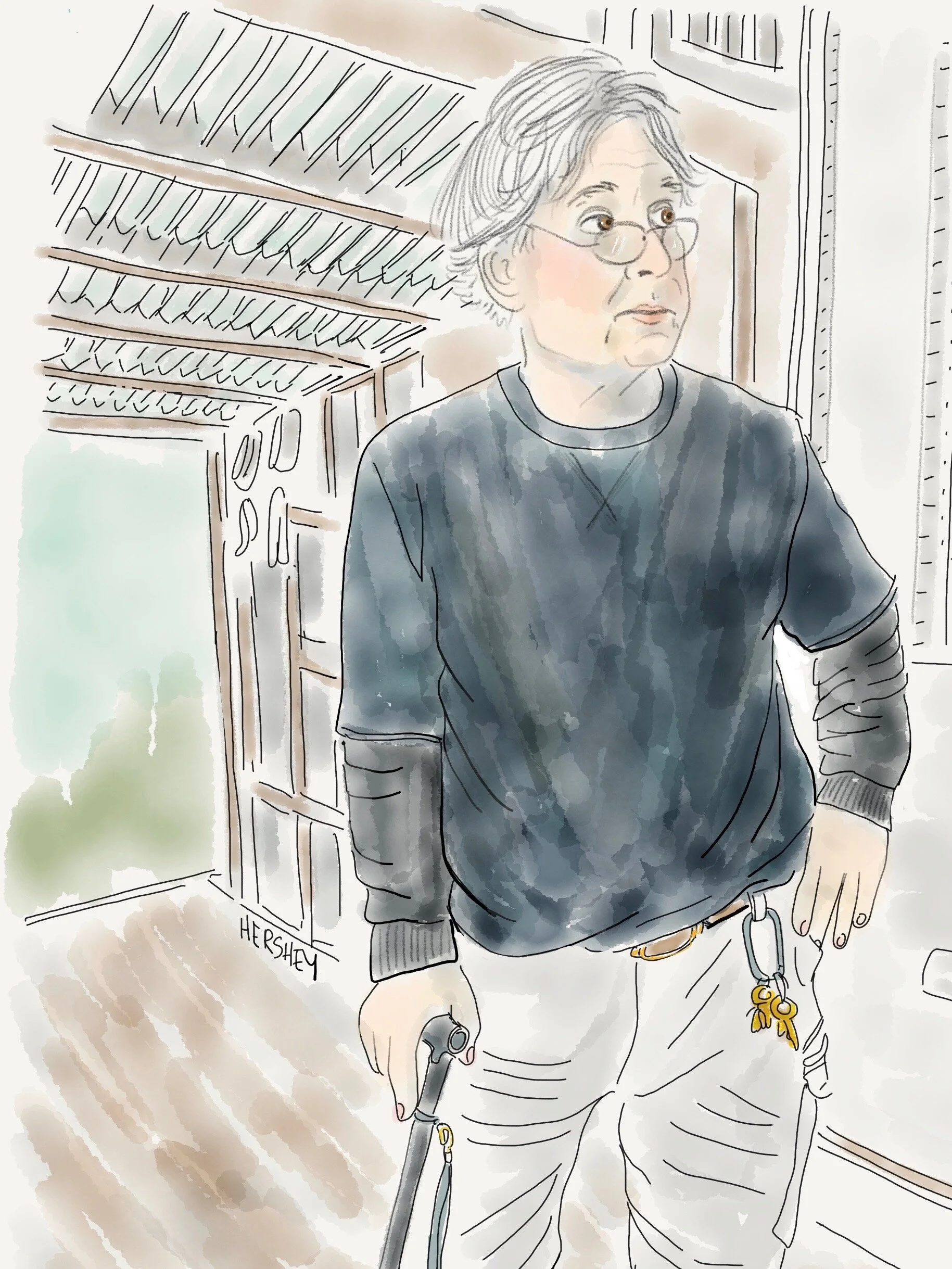
“I got three good sons in laws. I want my family to be healthy. But I worry that the land to the south of here is going to be under water”. Drawing by Jennifer Hershey. Follow her on Instagram at deeofo.
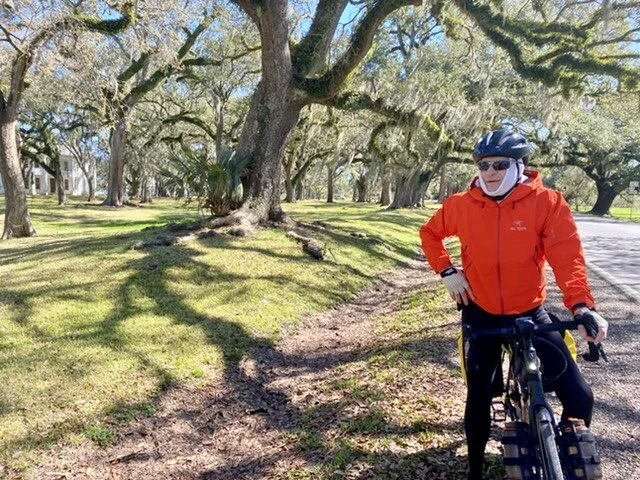
Michael biking through historic Jeanerette, LA.
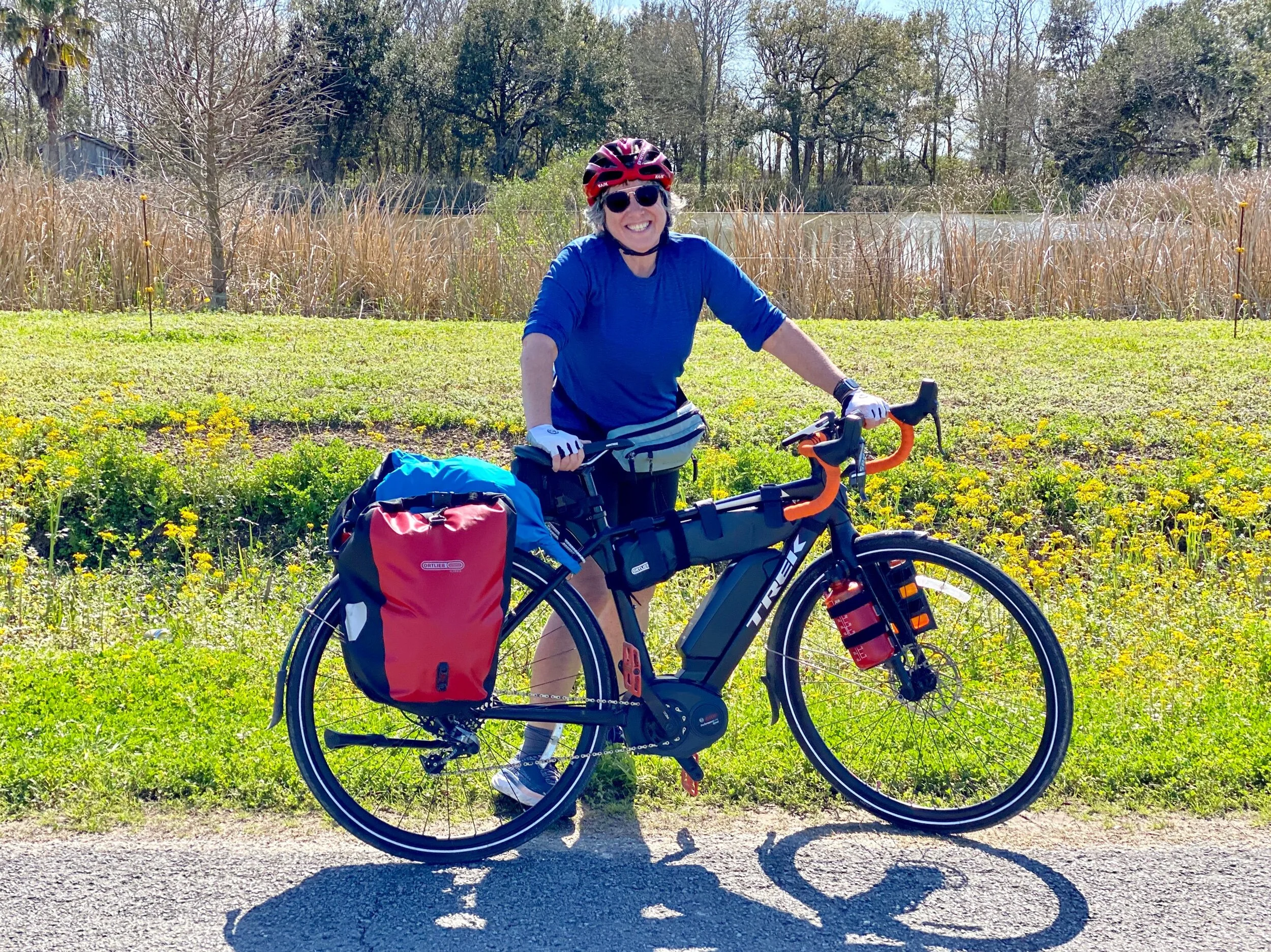
Jenny with her bike on the way to Lake Arthur, LA.
In addition to their beauty and the warmth of their inhabitants, southern Louisiana and Texas can also be disturbing places to bike through. This bucolic landscape is riddled with debris, machinery, abandoned oil wells and new fracked gas compressor stations. It’s crisscrossed by pipelines carrying oil and gas from conventional wells found underneath the marsh, and an abundance of fracked gas piped in from the north. Much of the fracked gas in western Louisiana originates from the nearby 9000 square mile Haynesville Shale, a large shale play in northwestern Louisiana.
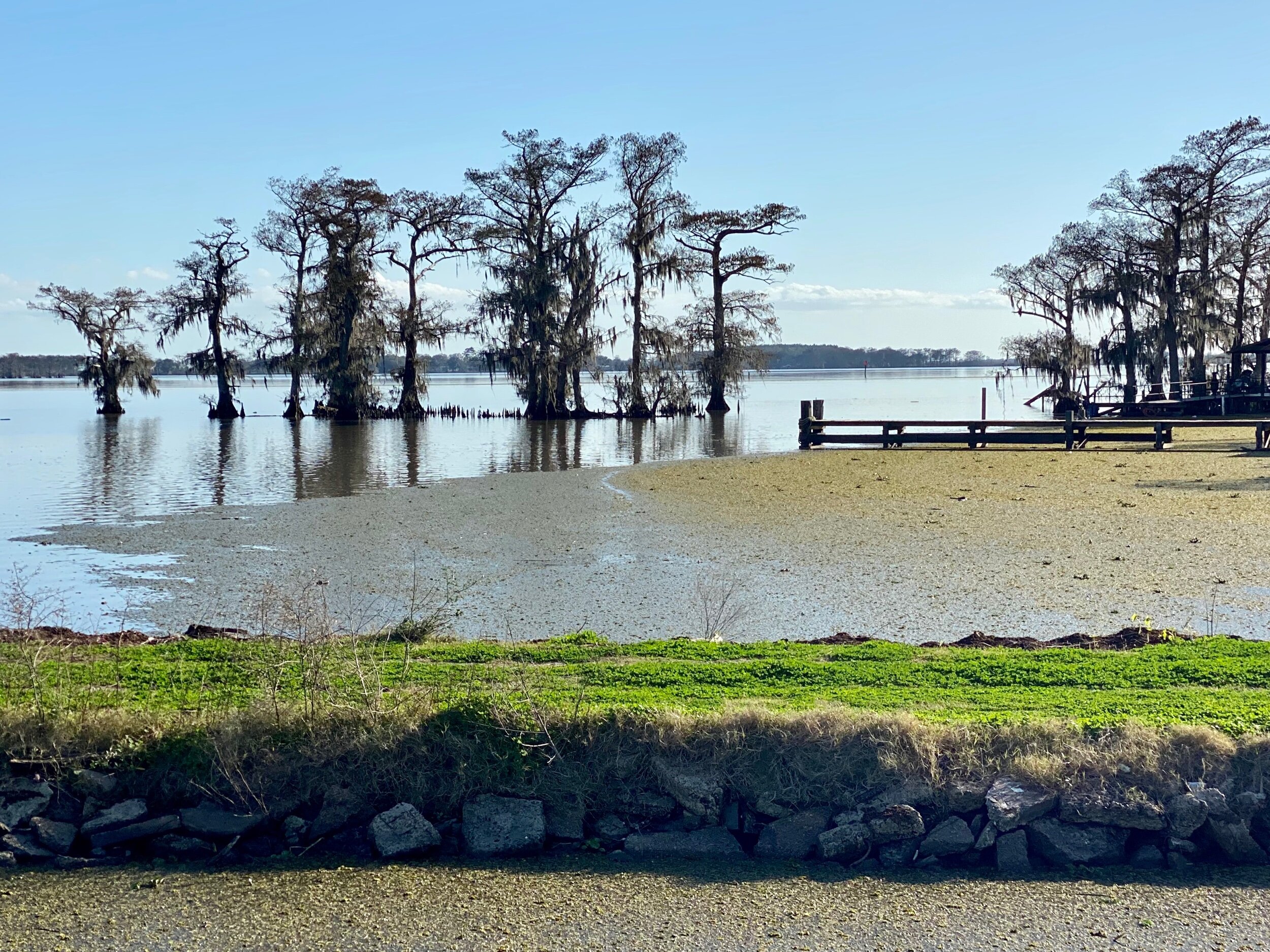
A view of Lake Arthur, LA.
Given the low elevation and the marshy characteristics of the land, it’s obvious that this area is very prone to coastal erosion, storm surges, tidal flooding, and extreme weather events such as hurricanes. A few days earlier, just west of New Orleans, we had contended with tornado warnings, which are quite unusual for the area. Locals agreed, although no one we spoke to suggested a changing climate as a possible cause.
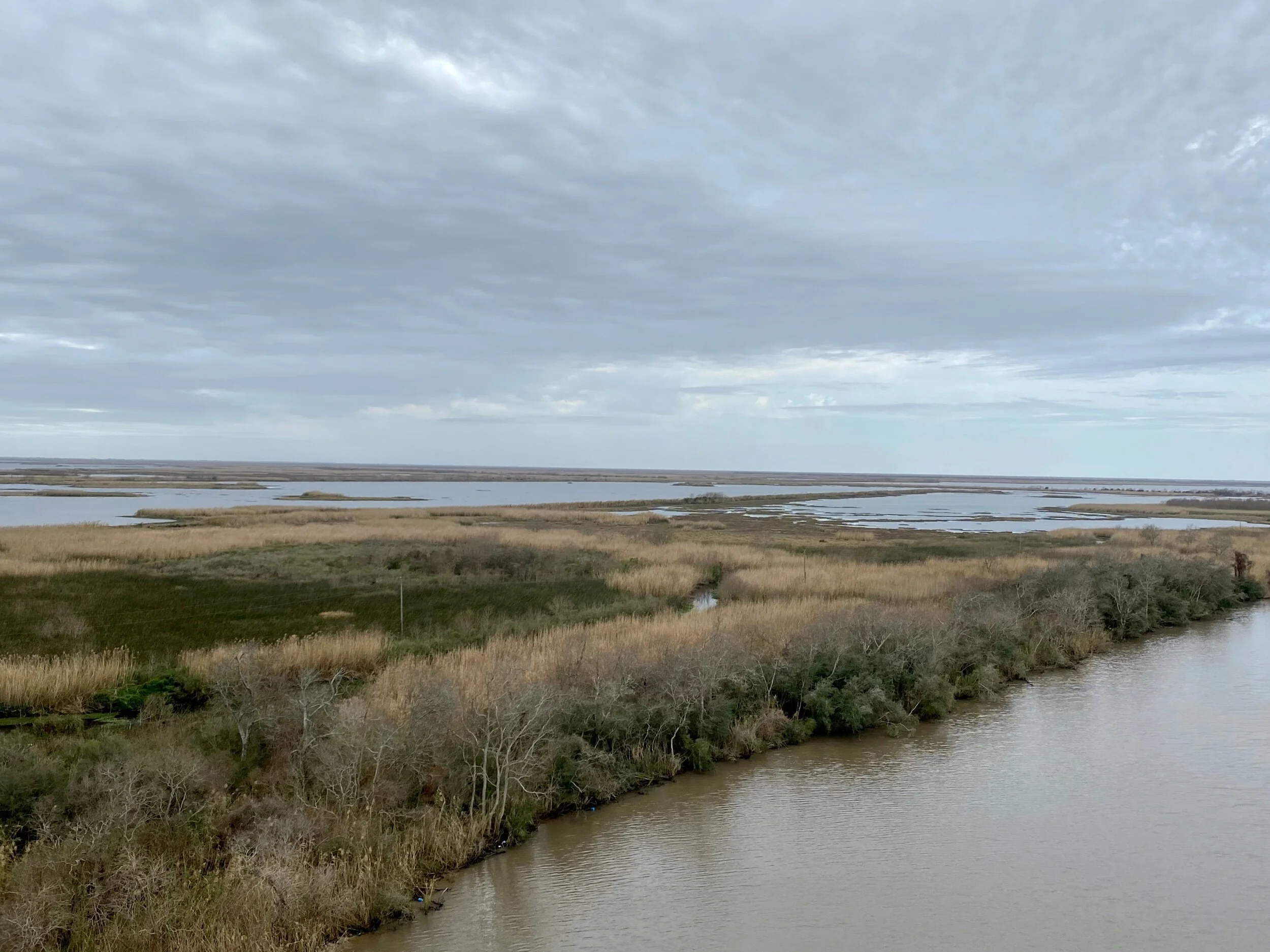
Just south of the Intercoastal Waterway on Highway 24 in southwestern Louisiana. Under these marshes lie a maze of pipelines carrying oil and gas from local deposits and the shale play in northwestern Louisiana.
The sheer vulnerability of the lowland coastal areas of the Gulf Coast seems hauntingly palpable. It’s clear to any thoughtful observer that Louisiana is deeply and complexly affected by our changing climate.
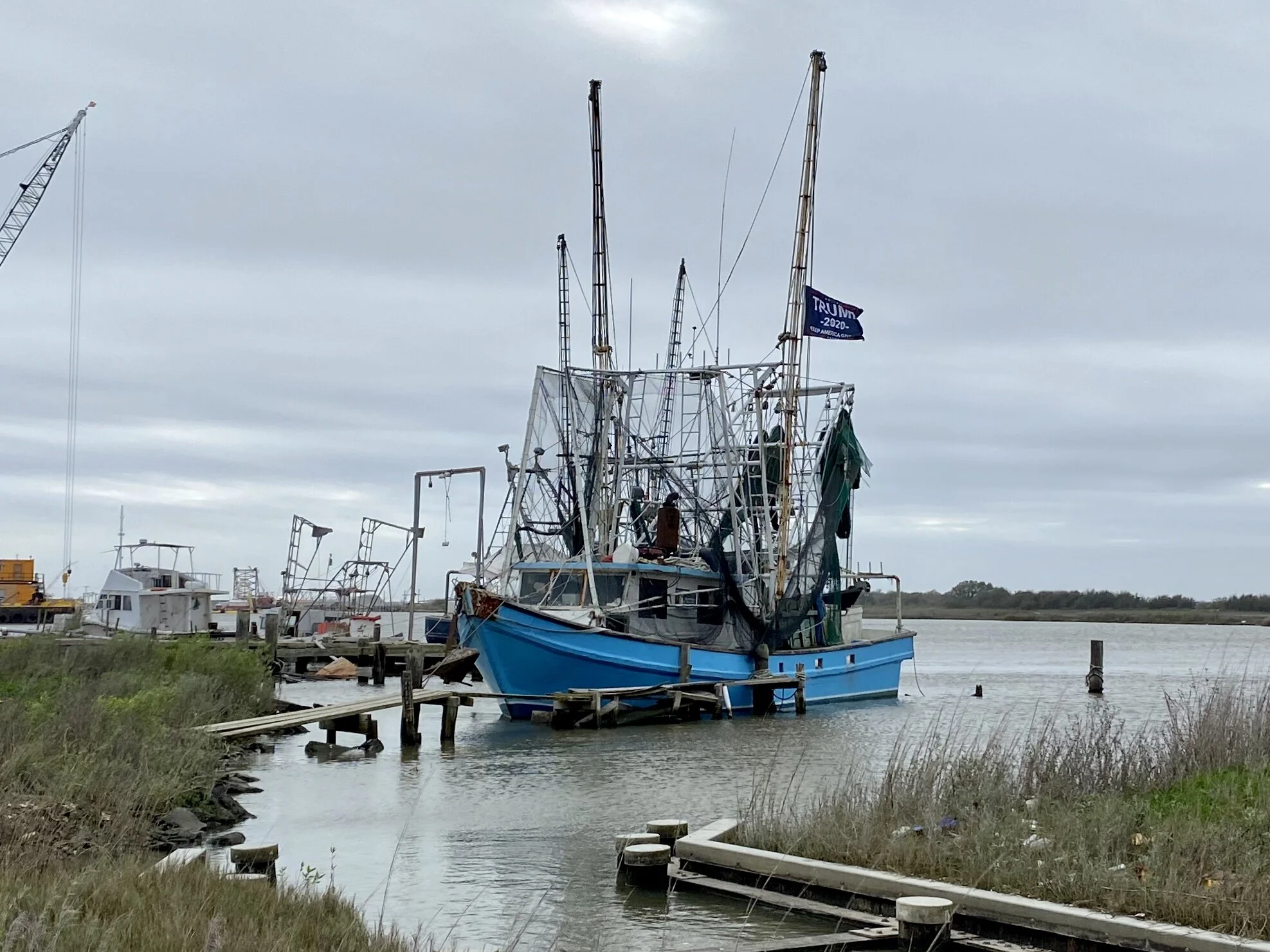
A fishing boat moored near the site of the new LNG global exporting plant at Cameron, LA. The flag on the boat says Trump/Pence 2020 . The entire port area just south of this boat (which used to be public land) is now privately owned by the company building the incoming plant. We weren’t allowed to see it.
The town of Cameron, LA, (once a bustling resort town of 3000 people that was devastated by Category 3 Hurricane Audrey about 60 years ago, and slammed again by Ike in 2008) now only has a few hundred permanent citizens. However, it is now a site for a large liquified natural gas (LNG) global exploring plant that will compete with an equally large LNG global exporting plant under construction in nearby Port Arthur, Texas. This much larger blue collar town lies just across Louisiana's southwestern border, where the Spindletop gusher was struck in 1901, setting off an oil rush that resulted in nearby Houston eclipsing Galveston as the primary port for southeastern Texas.
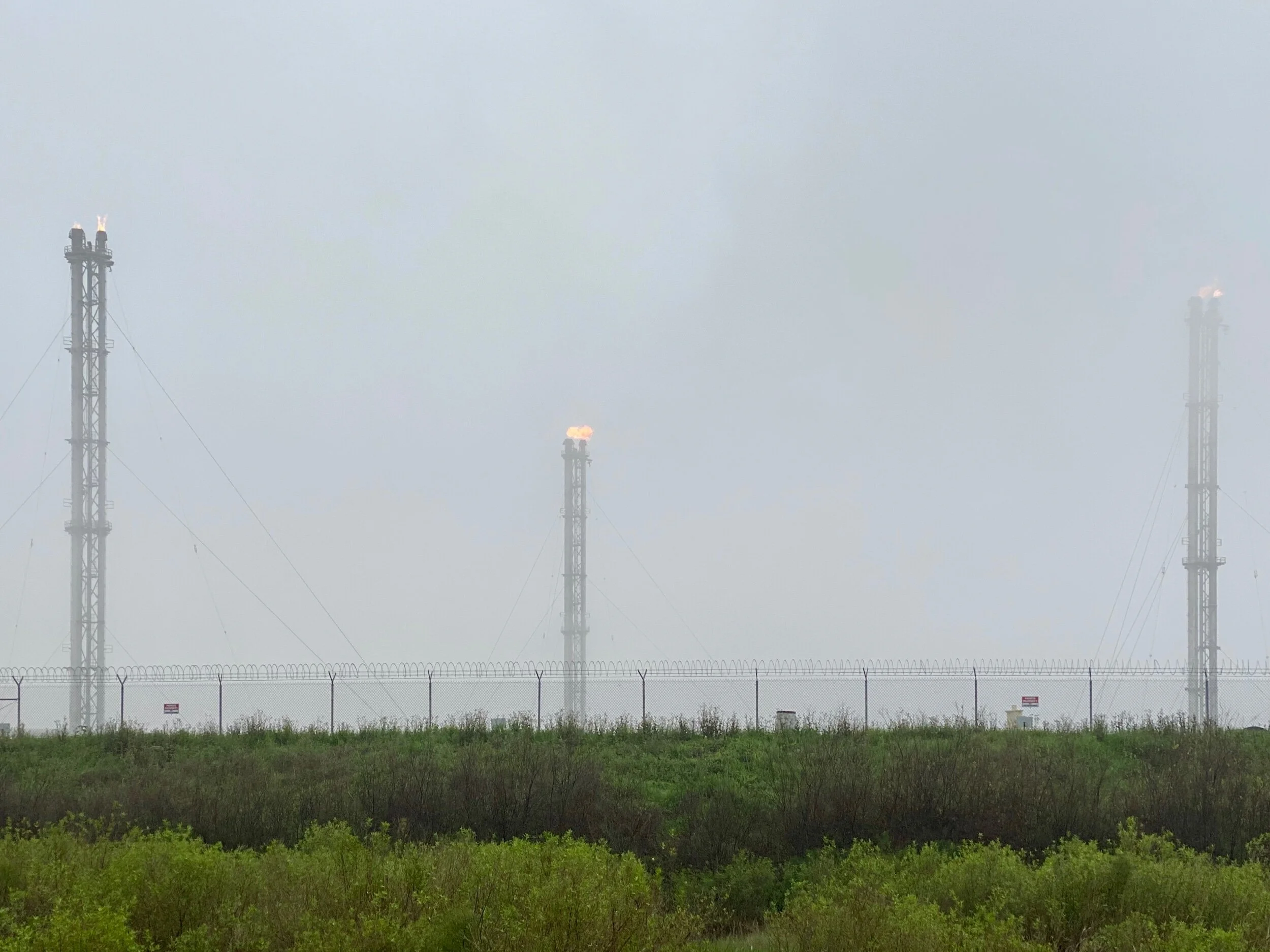
Gas flares in the marsh about a mile from the Liousiana Coast.
Each new plant currently employs about 3000 construction workers. When complete, the Cameron plant will support 160 permanent jobs, and the Port Arthur plant will support about 200 permanent jobs. That is, of course, unless a major hurricane hits this part of the Gulf Coast, in which case operations will either be temporarily or permanently interrupted.
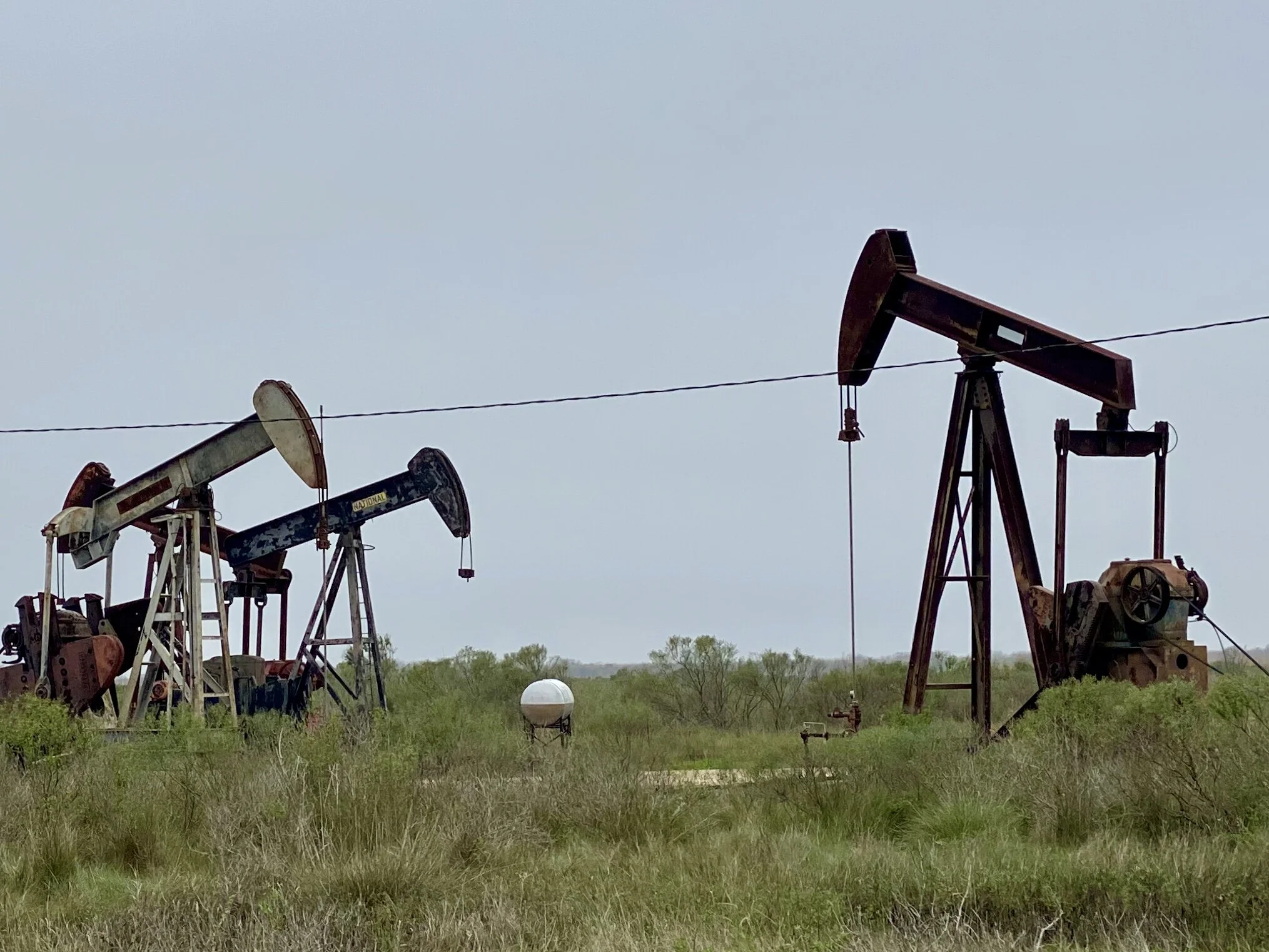
Abandoned oil wells in High Island, Texas, about a half mile from the Gulf Coast.
The reasons for this activity make economic sense in the short term. Cameron has been quite poor since Hurricane Audrey hit, and jobs are scarce. Consequently, the new plant is very popular among locals. Port Arthur is also poor, although it has more economic diversity than Cameron. However, the proximity of its site for a new receiving terminal will have additional benefit to Houston, so it’s popularity is even greater. Interestingly, in Houston, there is tacit, if not public, recognition among local officials that climate change is real. Based on a conversation we had with a local in Port Arthur, it seems there is hope that new sea walls east of Port Arthur across the Sabine River and further west across the Houston ship channel will mitigate storm surge issues for awhile, at least for southeastern Texas. …For how long, we wondered?
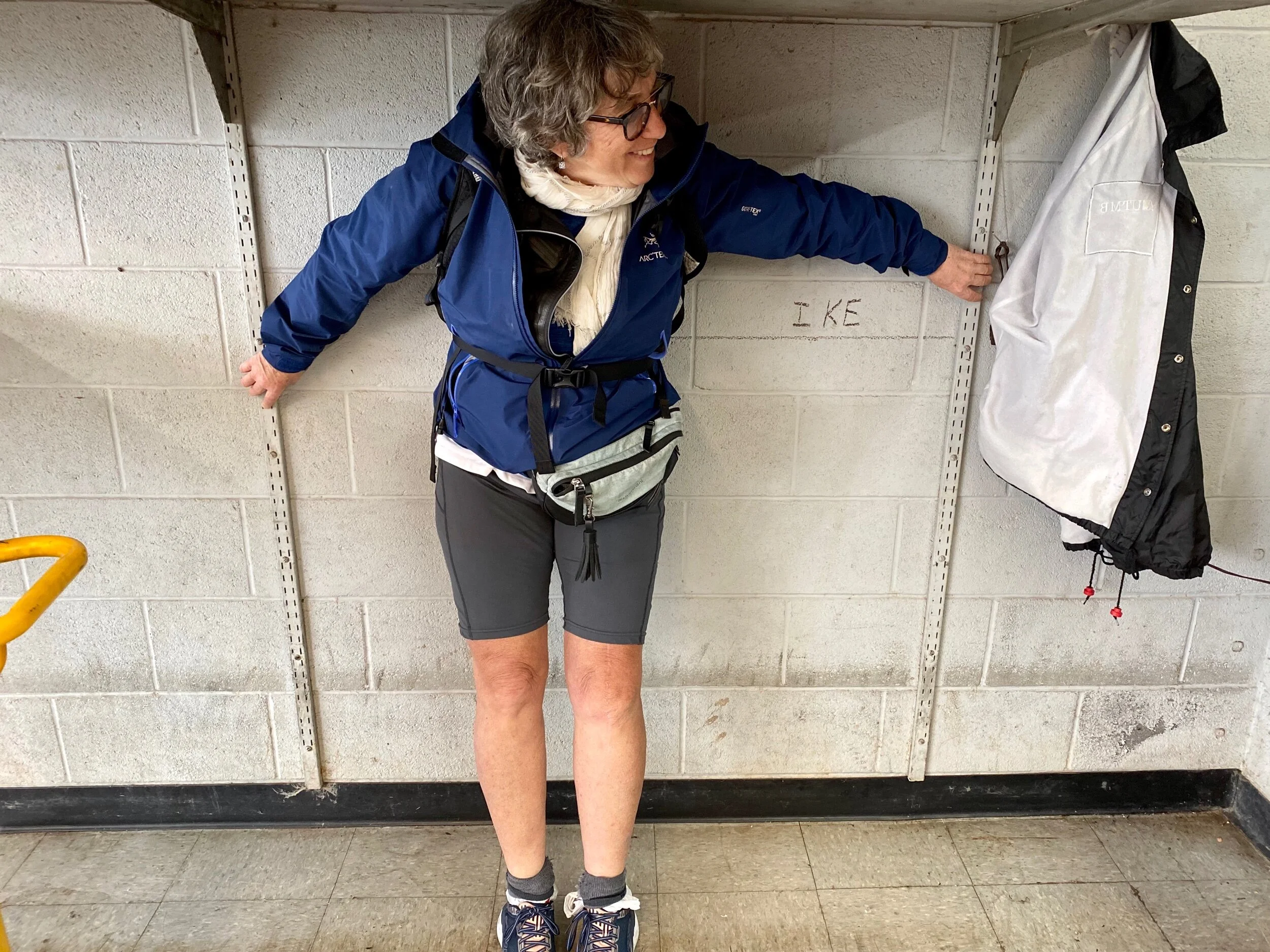
Jenny’s left arm marks the water line for Hurricane Ike in a bicycle shop we went to in Galveston. This 2008 hurricane holds the record for storm surge in Port Arthur, cresting at 22 feet.
So why do so many people in Louisiana and Texas embrace the very industry that may ultimately do them in? Isn't one definition of insanity, “doing the same thing over and over again and expecting different results?”
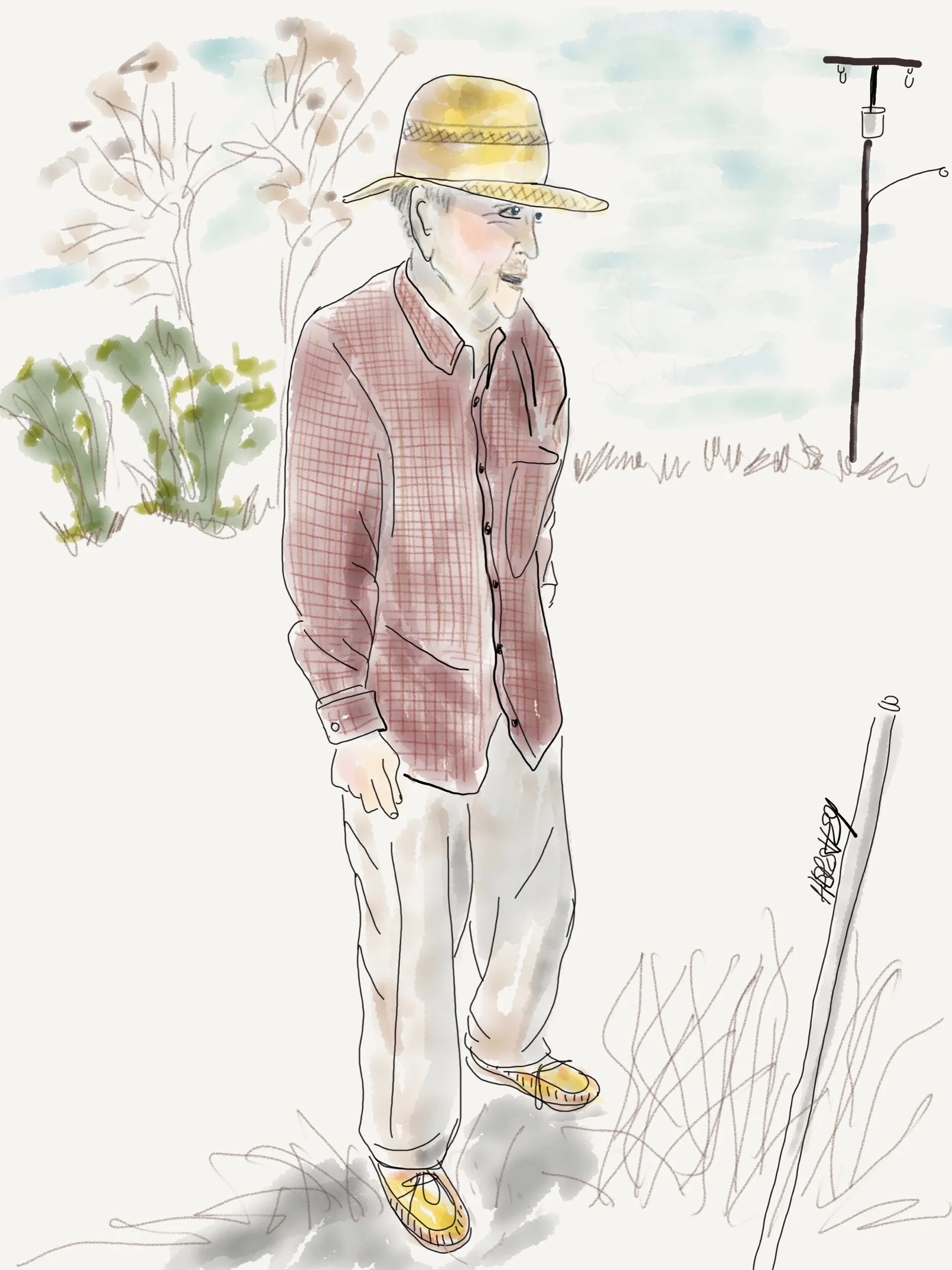
“I moved one time..in 1954...from next door to here.” Drawing by Jennifer Hershey. Follow her on Instagram at deeofo.
Jobs are important, and 460 permanent jobs might have lasting value for your communities. But at what cost? When your home is losing land to coastal erosion at alarming rates, when scientist are warning us that sea level rise is occurring faster than their previous conservative estimates indicated, when extreme weather events such as hurricanes and tornadoes are becoming more frequent with every passing year, when scientists are looking at establishing a Category 6 for hurricanes because they are growing so much more intense, …..when does that community cut its losses, and change its economic base?
Yes, life will be harder in the short term, but potentially much more livable and rewarding in the long term. Maybe that’s a plate that’s worth stepping up to…
For those of you who geek out on map routes, please email me and I will happily include links to the Garmin maps in this blog post. Frankly, I simply don’t know if they are very important to my readers. If I’m wrong, I’d love to know.
Thanks for reading! More to come…
All photos, unless credited or otherwise noted, are copyrighted property of the blog post author.
Louisiana/Texas, Post 1
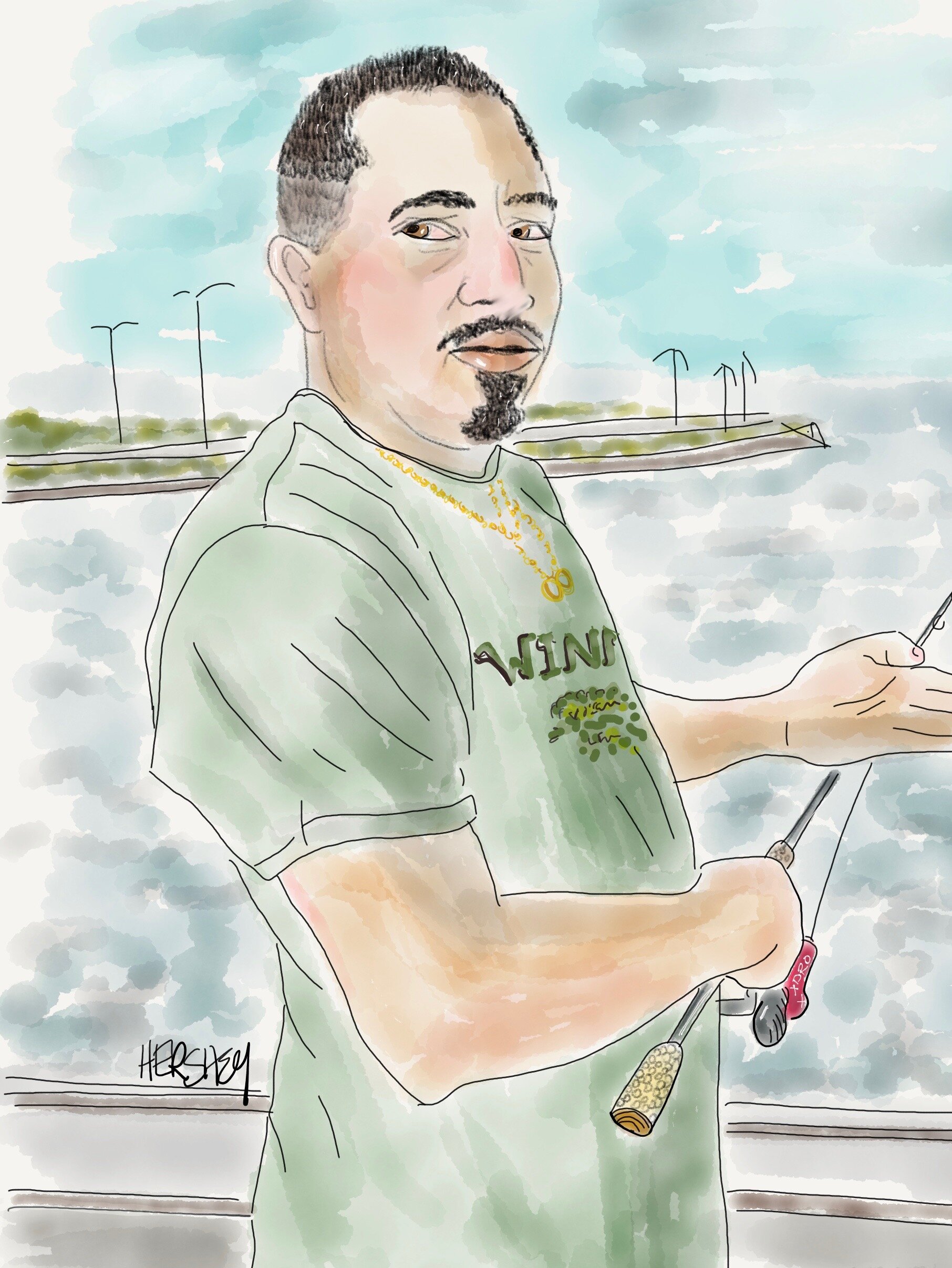
“I come after the grande hurricane...10 yrs ago.....from Guatemala . I fish for mi familia every day from aqui.” Drawing by Jennifer Hershey. Follow her on Instagram at deeofo.
The Amtrak Crescent from New York City to New Orleans is a small and somewhat understaffed train. Given their size and cultural stature, it seems like the Big Apple and the Big Easy deserve something more robust, if not all of America. Train travel is low carbon, pleasant, and offers so many other benefits to our transportation system. Apparently few people train between these cities (at least in the dead space of early February before Mardi Gras), so the train not only was small (9 cars total), it was challenging in its lack of basic amenities. Dining cars have been replaced by a limited option of previously prepared food that wears quite thin after a few meals. Bathrooms are few and poorly cleaned. There was no observation car. Yet - as always - I was appreciative of Amtrak’s efficient and inexpensive roll-on bike service. It is both easy and a joy to use. You roll your bike to a baggage car, remove your gear, and hand over your bike to an attendant. When you arrive at your destination, you do the same thing in reverse. Retrieving your bike takes minutes, and after restoring your gear, off you ride.
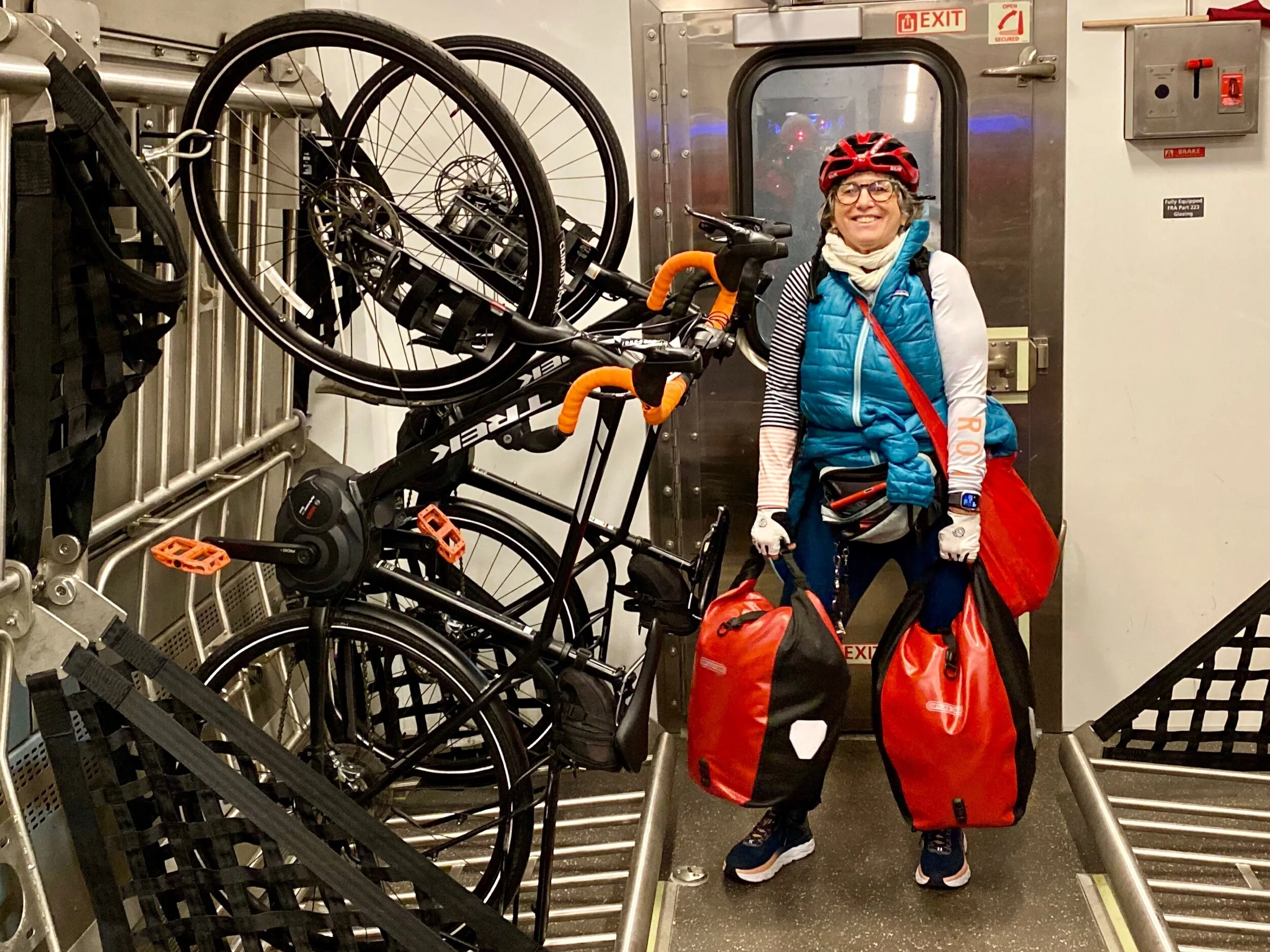
Jenny Hershey with her gear standing beside our bikes as we board in NYC.
I don't always make New Year’s resolutions, but this year I did: “Observe more, judge less”. It was simple once I said it out loud, although I had been struggling to articulate the thought to myself for quite a while. In addition to an unusual bout of self-reflection inspired by the quick and successive deaths of both my parents, I’d been reading the fascinating book “Why We Are Polarized” by Ezra Klein; a look behind the extreme politicized polarization plaguing America.
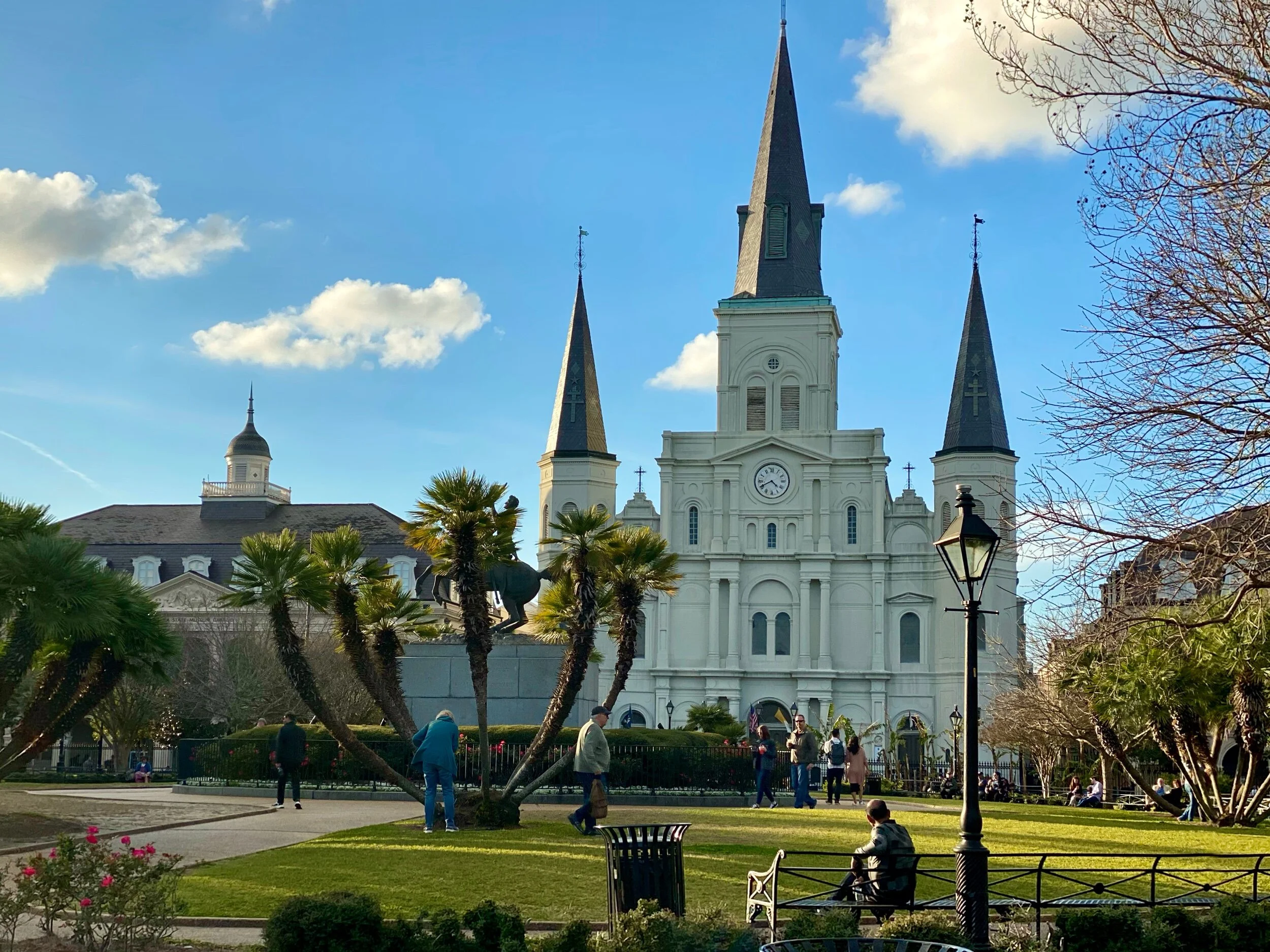
The Cathedral in Jackson Square, New Orleans, LA
I was coming to understand that just as we hide parts of ourselves from those we love, we are hidden from one another in a country we love, partly because we assume others should see the world as we do even if we cannot see the same world they do. I had been unsettled by several attacks on FaceBook about my apparent ignorance of the South based on a few inquisitive posts about life in North Carolina. Out of defensiveness, I found myself questioning how much conservative southerners understand, or care to understand, about my identity as a multicultural urban northern liberal. Conversely, I was forced to admit to myself that I knew, or cared, equally little about the identity of white rural southern conservatives.
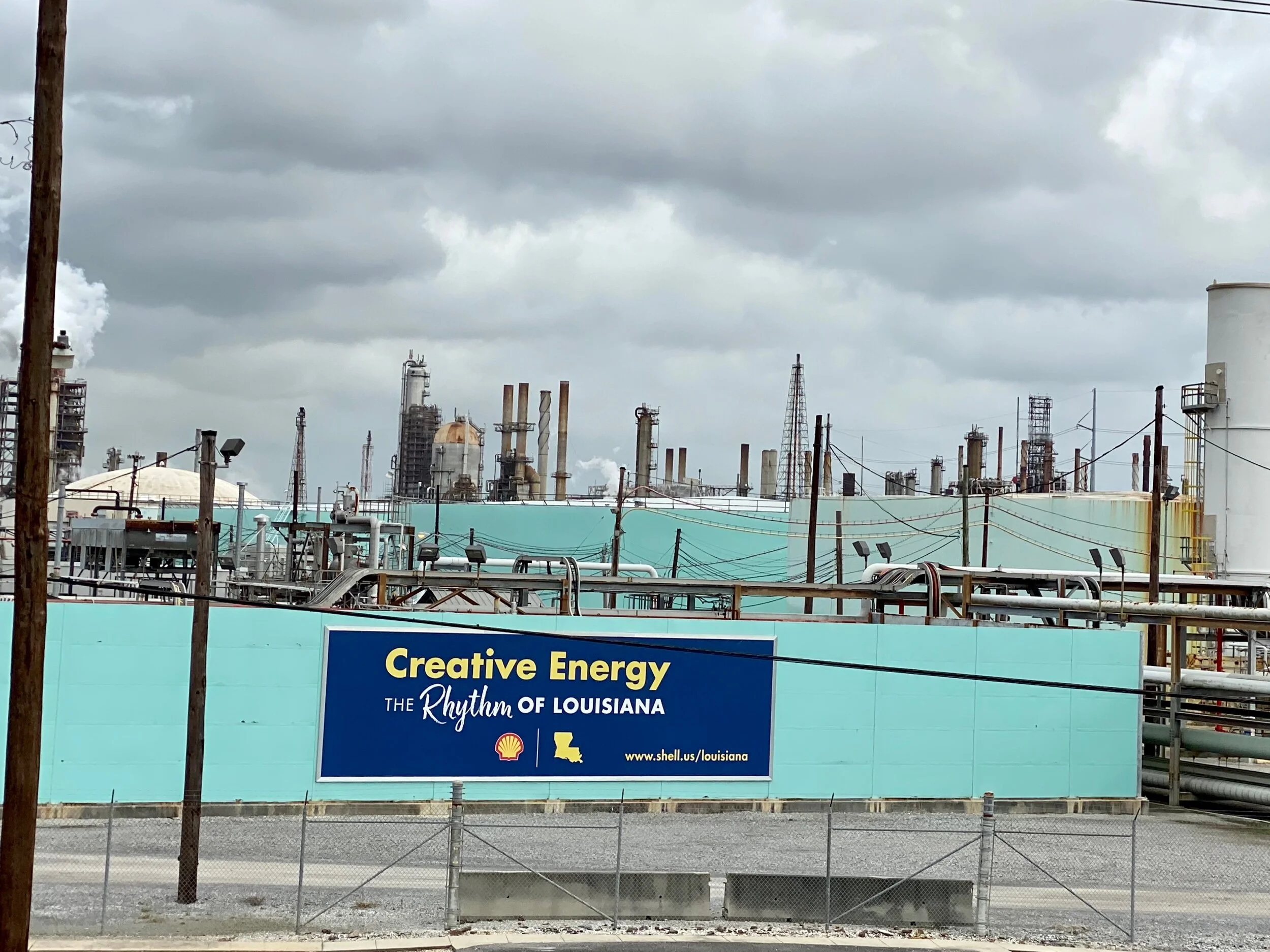
Oil plant just northeast of NOLA on the Mississippi River.
In anticipation of this trip, both my traveling partner Jenny and I felt trepidation about biking in the Deep South. I hoped Klein’s book would help me frame an approach that would go beyond my own self-perceived static and somewhat predictable liberal perspective. It has not disappointed me.
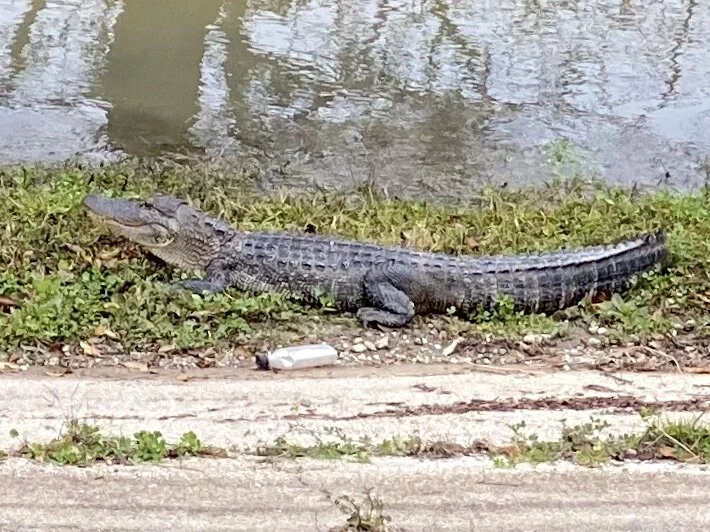
Just east of NOLA off the Mississippi River levee. Quite alive.
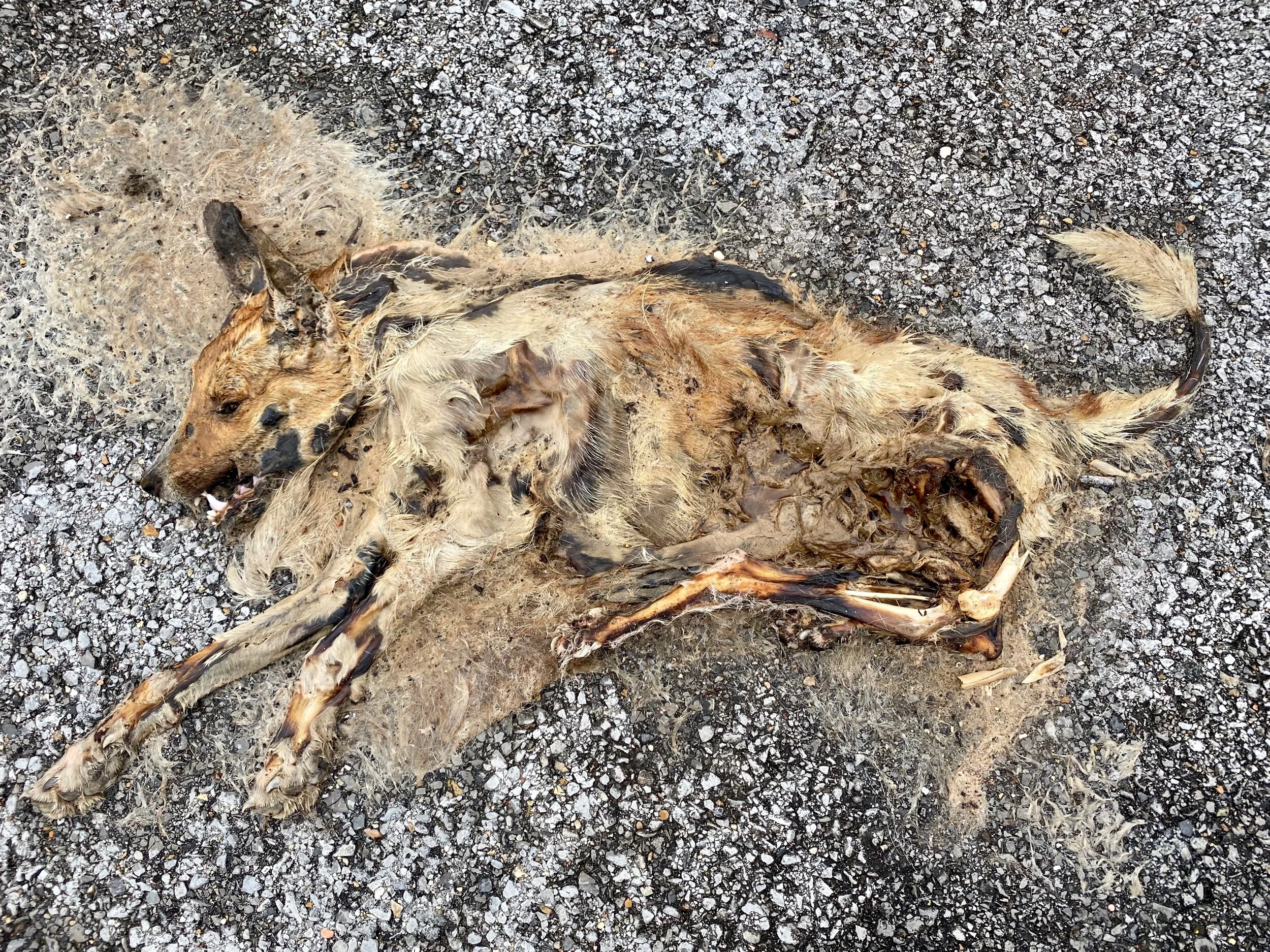
A dead fox. Roadkill.
I admit that we partly chose to explore Louisiana and Texas on bikes because it is a warm place to go in early February. In addition, it is accessible by train (we thought other choices would be more carbon intensive, and low carbon travel is part of our objective). But our country's current form of political polarization also begs for greater interaction between our vastly different political cultures. Interestingly, as a northerner, I often feel greater affinity with European countries and cultures than I do with the political and social cultures of the American south. But since the 2016 election, I’ve come to believe that America is in need of a giant reset (or “rebooting”) and that if I - and other people like me (i.e., members of my group) - don’t grapple with our entire American identity, we are very likely to misunderstand how we arrived at, and might get out of, such a highly polarized present moment.
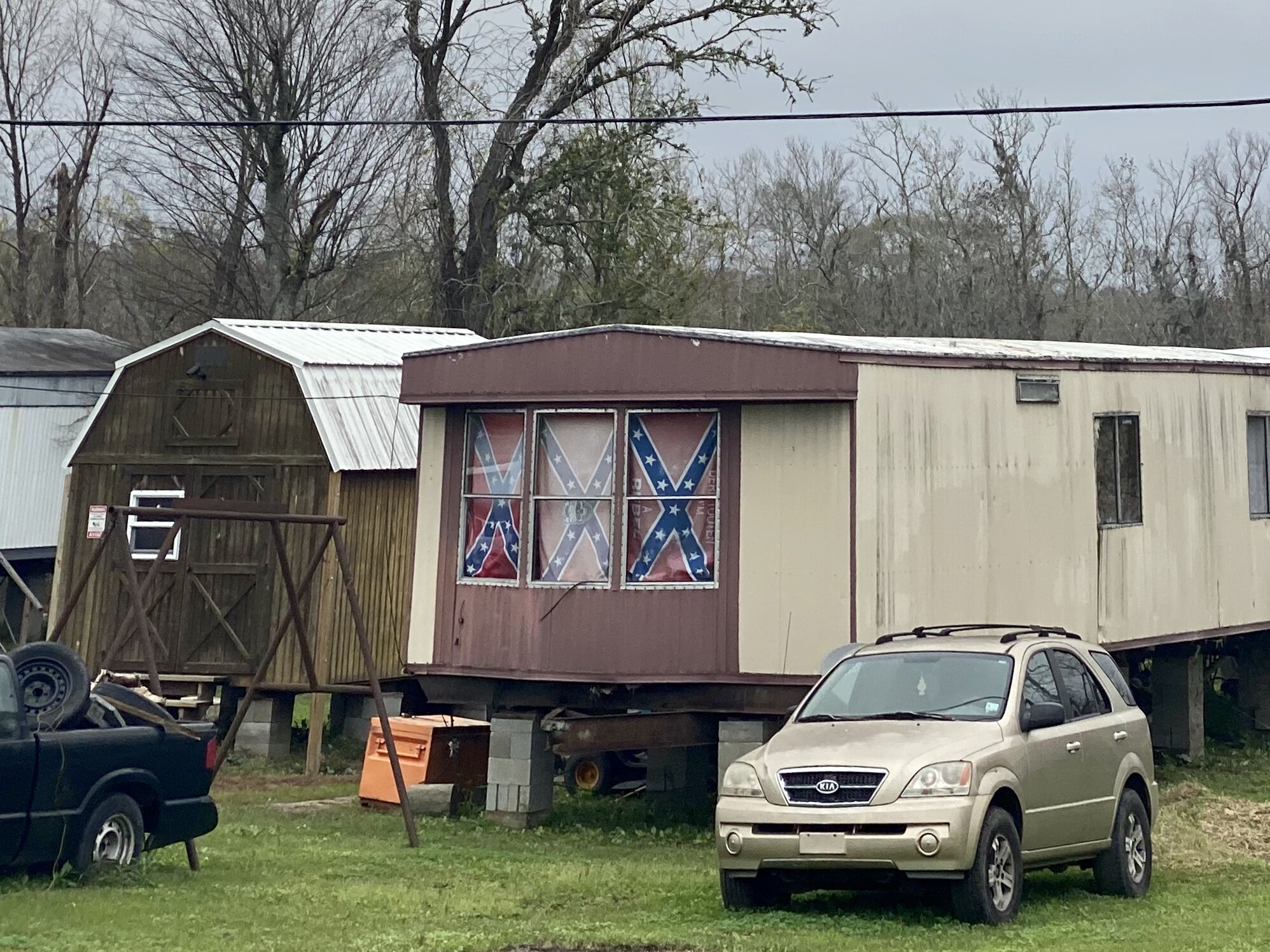
Near Donaldsville, LA.
My interest in climate change is a case in point. There’s so much about our changing climate that seems obvious to me that I simply cannot fathom the abyss in logic or understanding between me and climate deniers. While I’m very confident the science supports me, I’m learning that facts alone don’t change behavior. Even in an area devastated by Hurricane Katrina, and after numerous recent warnings that the sea level is especially troublesome on the Gulf Coast, plenty of locals remain willfully cavalier, if not downright defiant about taking action.

“I was 13....they took us out by boat. I slept on a bridge for a week with my Grandma. “ Drawing by Jennifer Hershey. Follow her on Instagram at deeofo.
Ezra Klein makes the same argument about rationalizing, or recasting, facts within political cultures. Essentially, his fundamental point is that identity is a far more important driver of political viewpoints than is logic or “facts”. In fact, logic may be the least important attribute of political identity - far less important than cultural, familial, socioeconomic and racial identity. I’m reminded of James Carville’s famous quip during the Clinton administration, “it’s the economy, stupid”. Maybe in the age of Trump, “it’s the tribe, stupid”.
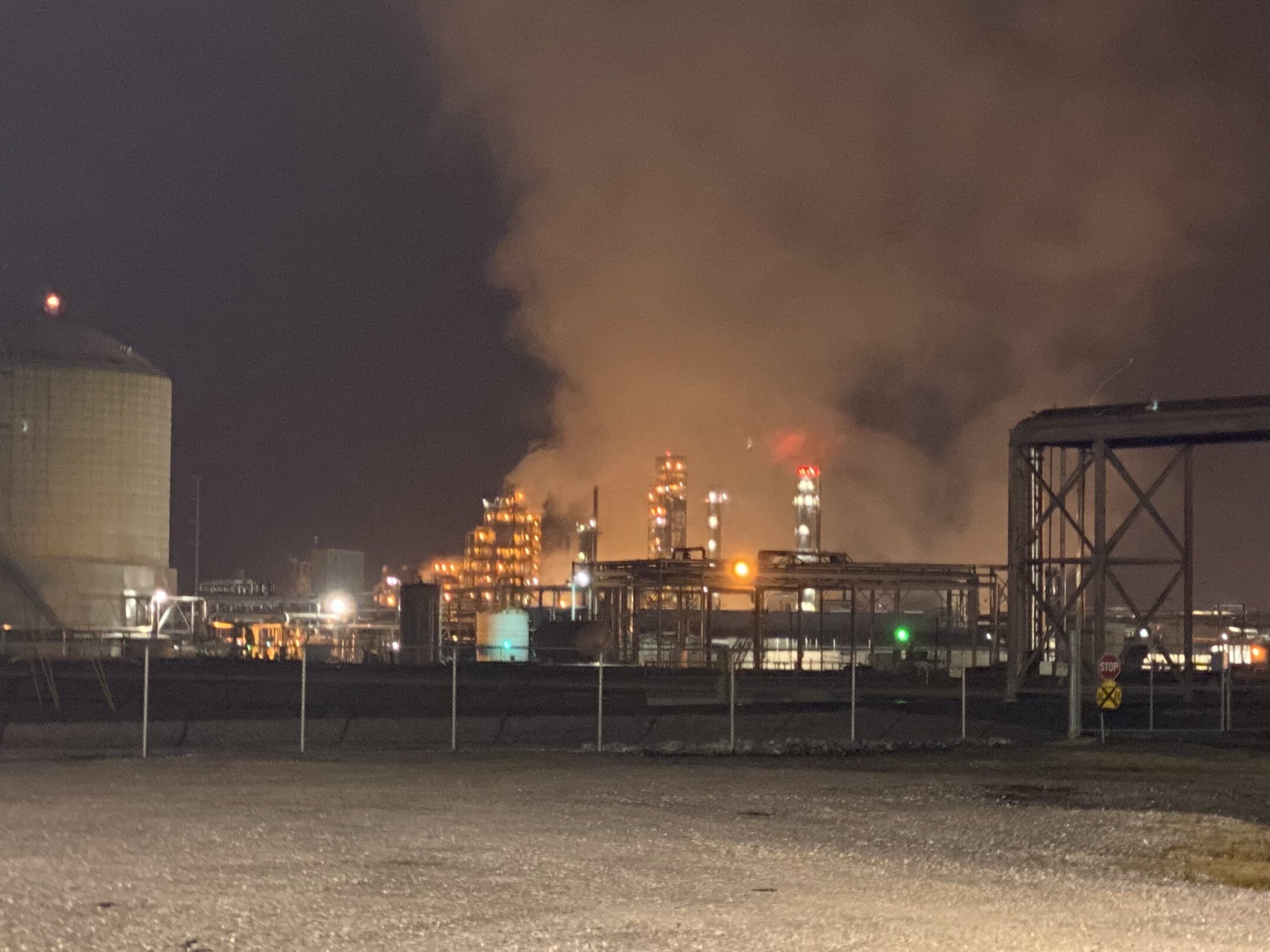
A petrochemical plant just outside the bayou town of Donaldsville, LA.
Stupid, perhaps, but true nonetheless. And so very, very human. So, I’ve decided - and Jenny agrees - that the most useful way to explore Louisiana and Texas right now is to observe more, and judge less. For readers who hope we will brightly burn the climate emergency torch with the message that the apocalypse is well upon us and our southern neighbors need to wake up lest they suffer sooner than their northern neighbors (even though we think that’s true), we may disappoint you. Our agenda right now is simply to understand.
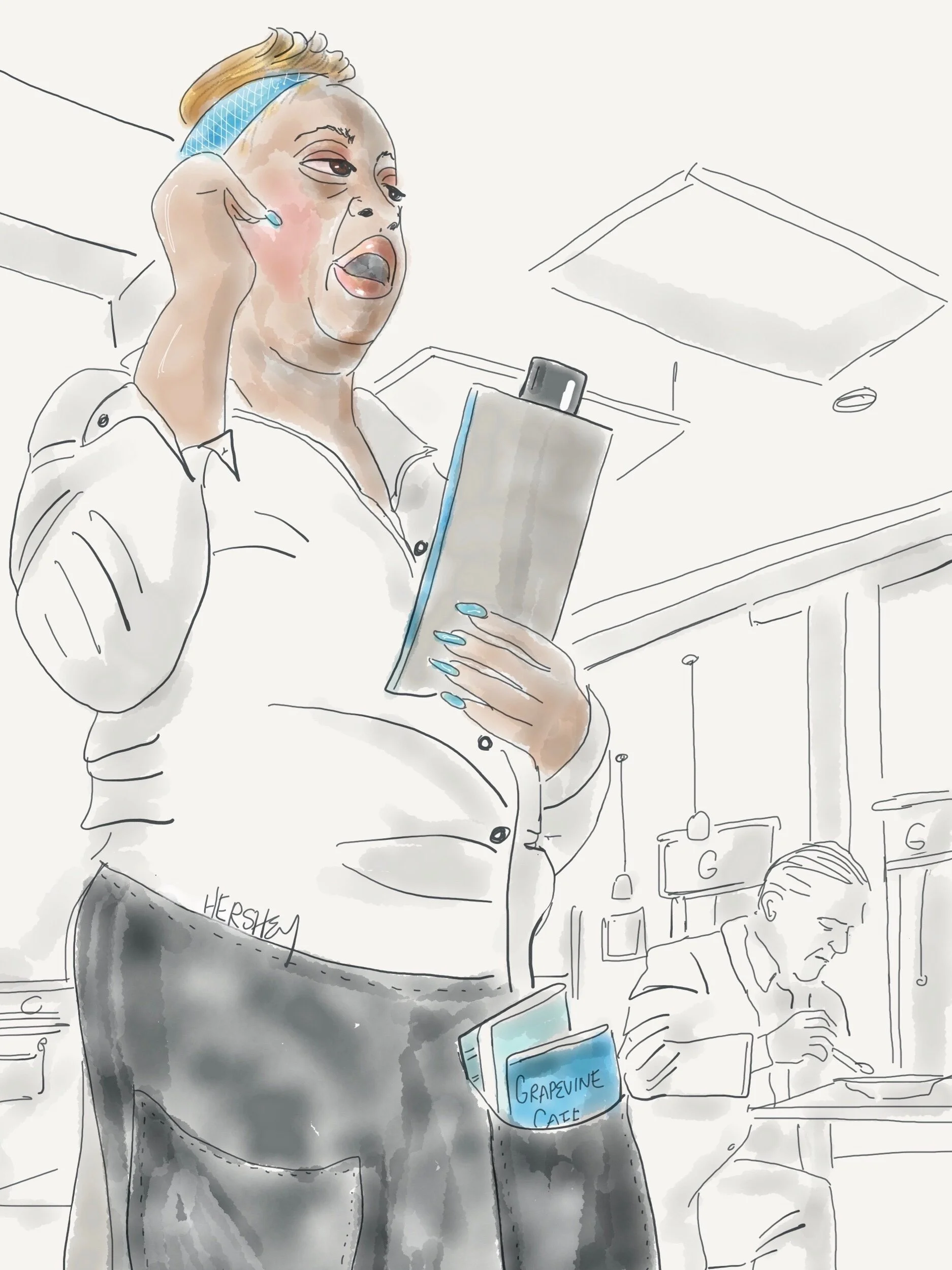
“Yes Ma’am...they got all kinds of plants here. Chemicals and oil and I don’t even know what they got. “ Drawing by Jennifer Hershey. Follow her on Instagram at deeofo.
Maybe a lot of folks just don’t believe that good jobs from a “green economy” will really show up when chemicals and oil companies have been the only big games in town for multiple generations. Or maybe they just don't feel like they can change anything anyway.
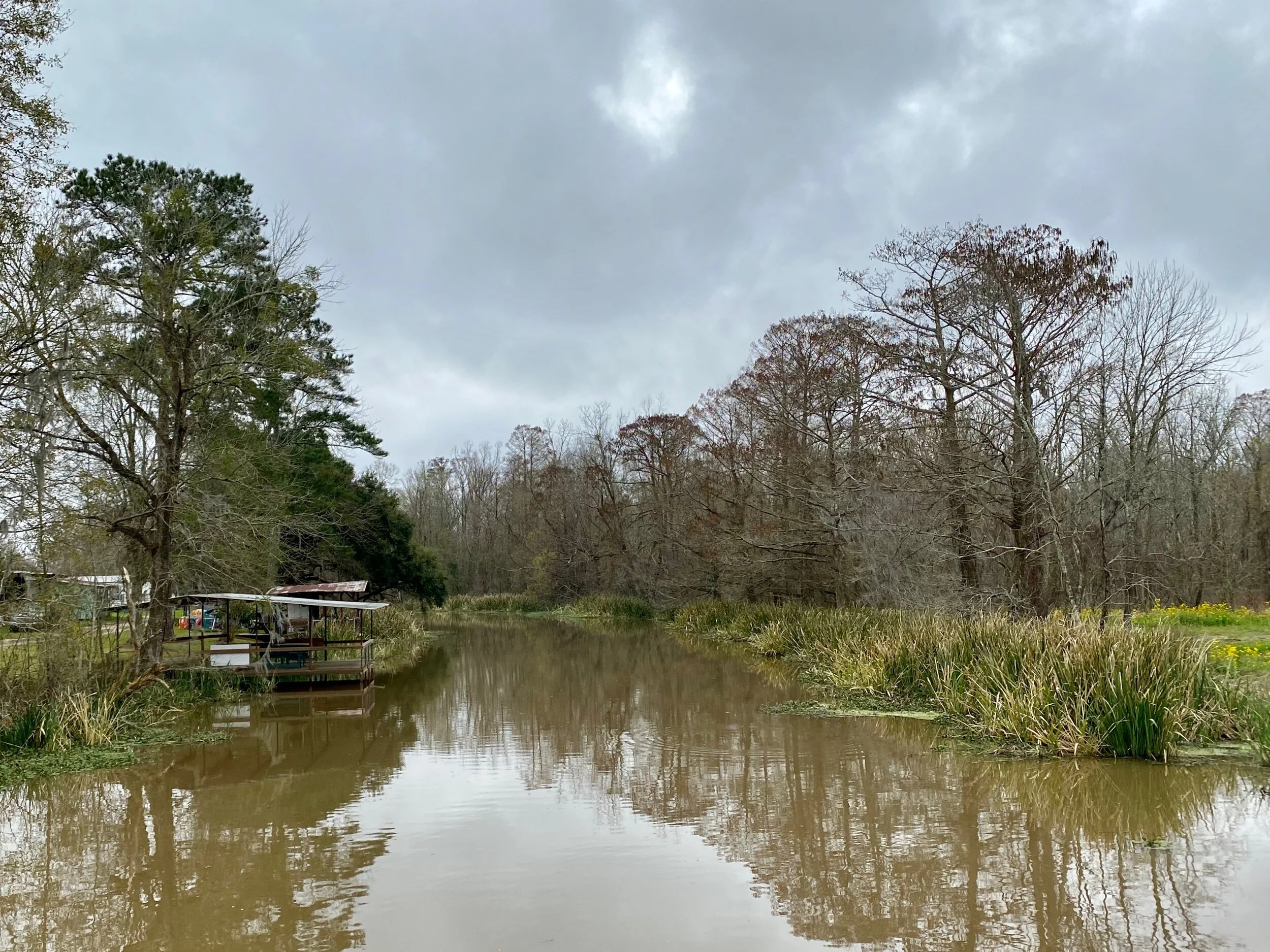
Bayou Country about 150 miles southwest of New Orleans.
We talked to a middle aged black man in White Castle, Louisiana, named Orville outside the local grocery store, who told us he had voted for Obama but didn't vote in 2016, and was probably not going to vote in the next election also, even though he thinks Trump is a crook. When we asked him why, he went silent. So we (thoughtful northerners that we are) explained “logically” why he should - since the federal voting power for a Democrat in Louisiana is arithmetically more powerful, given the Senate and the Electoral College, than a vote by a Democrat in New York. Orville looked dubious and replied, “them politician’s all gonna do what they want to anyway.” Jenny and I exchanged glances. We had failed to convince him. So, as we mounted our bikes and road off, Jenny yelled back at Orville, “If you don’t vote in the next election, I’ll come back here and kick your ass”! Orville laughed. Maybe he’ll remember that part of our conversation more then our logic.
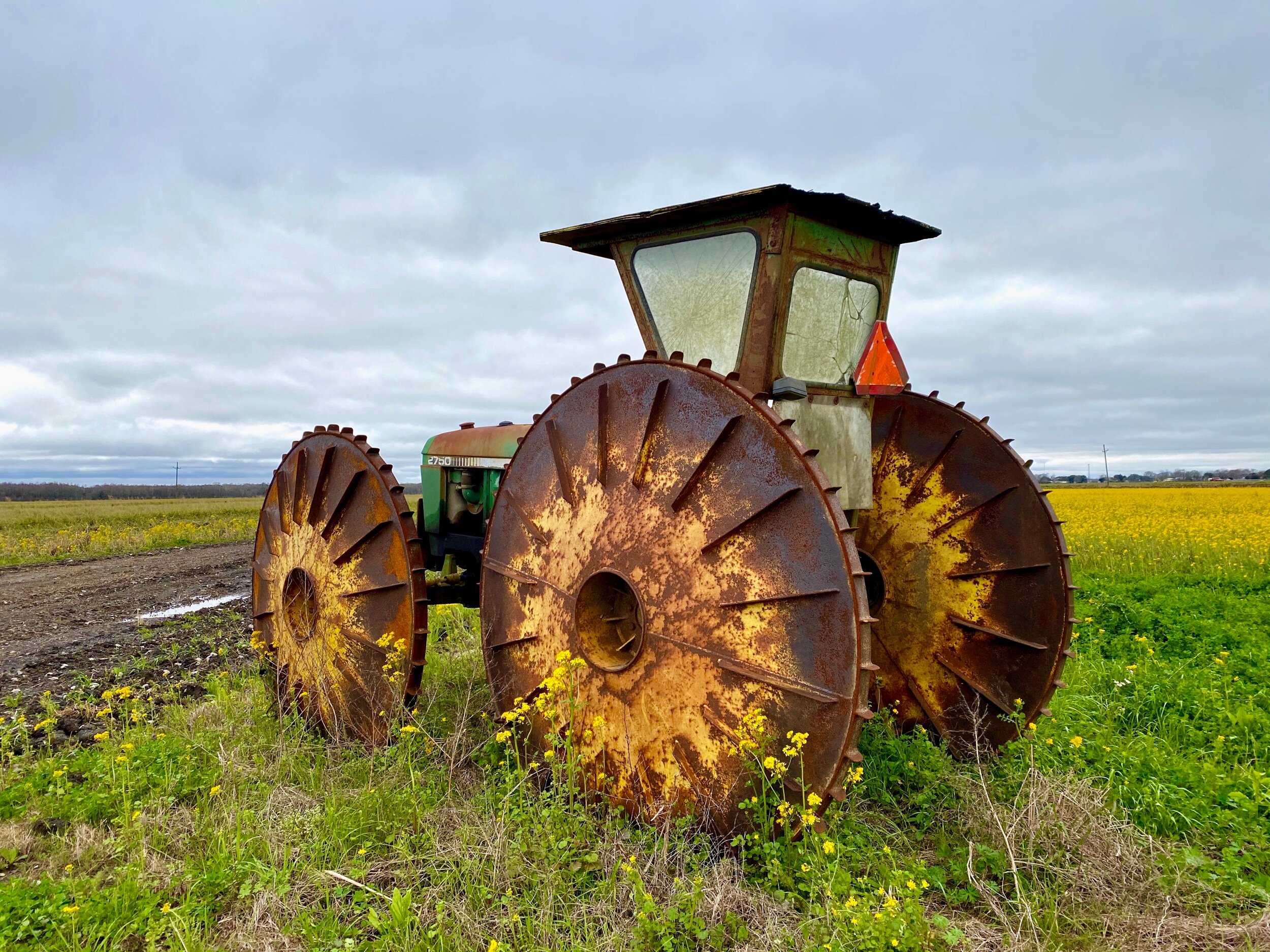
Tractor in a fallow sugar cane field near Baldwin , LA. Photo by Jennifer Hershey.
Maybe Orville is right. Yet, Congressional behavior during the impeachment proceedings teaches us that politicians will do just about anything they think the majority of their constituents want them to (with a few exceptions). And maybe that’s a good thing, especially if we want them to do what’s right. But more agreement on what “right” looks like among us constituents would be very helpful, especially when the prevailing view seems so very wrong. And how will we achieve that? I used to think I knew. Now I no longer do… so for myself, I'm trying out the follow idea: Observe more, judge less. And please know, dear reader, it's myself that I am encouraging.
For those of you who geek out on map routes, here are the last four days of our rides on Garmin: Day One, Day Two, Day Three, Day Four.
Thanks for reading! More to come…
All photos, unless credited or otherwise noted, are copyrighted property of the blog post author.
Getting Real About Global CO2 Emissions
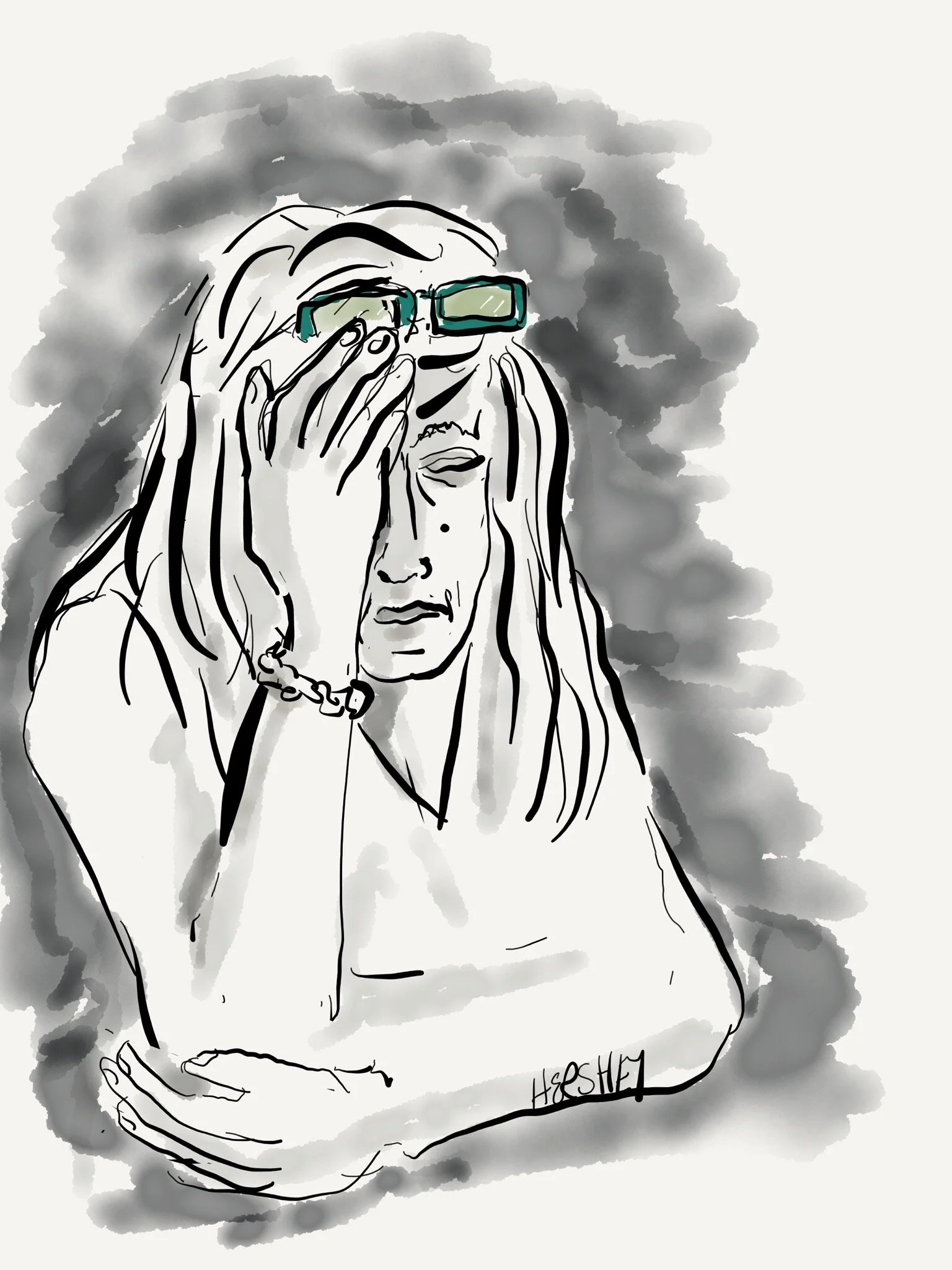
“The fear is real”. Drawing by Jenny Hershey, on Instagram at deeofo.
Greetings from New York City. For those of you who wonder what happened to me and Jenny Hershey along the GAP Trail as we left Pittsburgh last October, you can find a short blog post about that ride in the Archived Cycling Tours for 2019 in the drop down menu. And please look forward to following our next ride beginning in New Orleans and heading across southern Texas in early February, 2020. It’s an interesting time in the U.S. for blue state urban northerners to mix with red state rural southerners. We are certainly curious as to what our fellow Americans are thinking about climate change (and many other subjects), and we hope to see and learn some things worth sharing.
But let's attend to a present concern. Previous readers of these blog posts may have wondered about the CO2 icon in the upper left hand corner of this page above the carbonstories.org logo. That is a widget from the CO2.earth website, and is a reference to the latest annual average of parts per million (ppm) of carbon dioxide in the atmosphere as measured at the Scripps CO2 research project at the Mauna Loa Observatory in Hawaii.
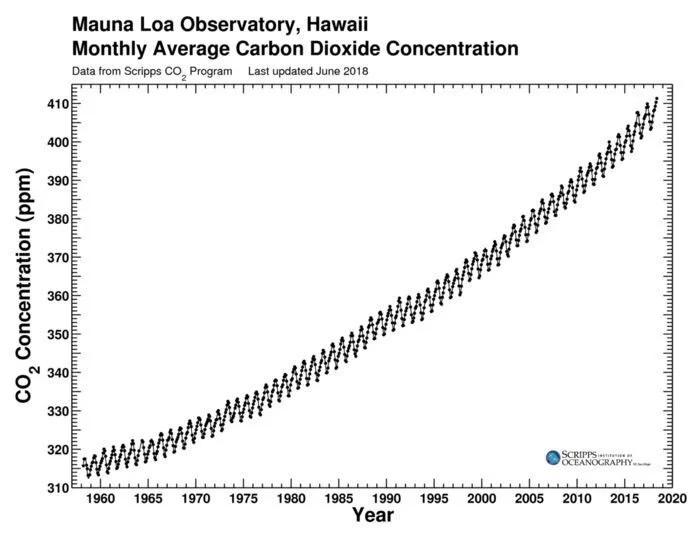
This is the famous Keeling curve, which demonstrates a 25 percent rise in carbon levels in our atmosphere since 1960.
This research project was initiated in 1956 by Charles Keeling, and operated under his direction until he died in 2005, when his son Ralph took direction of the project. The iconic “Keeling Curve” chart shown above is a result of their work, and is a well known and accurate record of the rise in CO2 levels since the 1950’s.
As of this writing, the most recently reported measurements of carbon dioxide at the Manua Loa Observatory are:
It is a widely understood, and easily verifiable physics experiment to demonstrate how increasing CO2 levels causes air temperature to rise; in fact this was proven well over 100 years ago by both the Irish physicist John Tyndall and Swedish physicist Svente Arrhenius. Tyndall is widely credited with discovering the greenhouse effect that underpins the science of climate change by publishing a series of studies on the way greenhouse gases, including carbon dioxide, trap heat in the Earth's atmosphere.
Following their leads, other scientists established a clear link at least 30 years ago between the accumulation of greenhouse gases in the atmosphere and increases in surface air temperatures. Scientists have established that temperatures increase 1.8 degrees C for each 3.7 trillion metric tons of additional CO2 in the atmosphere. (Emissions are expressed in metric tons, each of which is equal to about 2,205 pounds). Today's CO2 concentrations and global average temperatures are typically measured against levels that prevailed before the Industrial Revolution, when humans began to have a meaningful impact on the planet's natural chemistry.
That influence has been extraordinary. As you can see in the graph below, current parts per million (PPM’s) are above 400, even though CO2 levels have consistently hovered around 280 ppm for the last 800,000 years until quite recently. The upward explosion in the line graph below begins in the late nineteenth century, corresponding to a rapid rise in the production and use of oil and natural gas in addition to coal. Where the graph ends in real time is anyone’s guess; it depends entirely on what we humans decide to do.
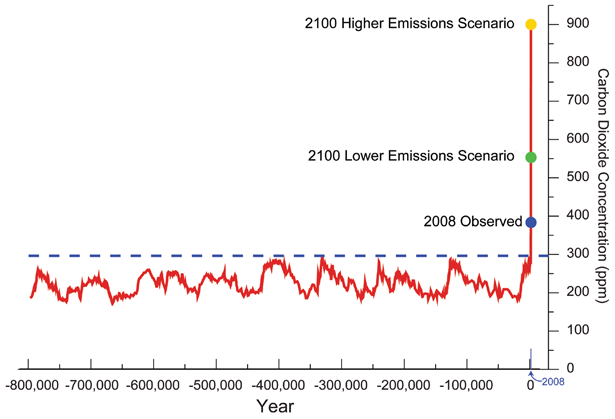
Sourced here from NASA. Note that although current parts per million (PPM’s) are currently over 400, CO2 levels have hovered around 280 ppm for the last 800,000 years until the late 1800’s.
Over the past few decades, scientists have come to understand that carbon dioxide emissions must be reduced to hold human caused global warming below levels that may cause dangerous changes in our climate. As a result, carbon budgets have become a staple of climate change analysis. One excellent source for immediate ongoing tracking is the Global Carbon Project.
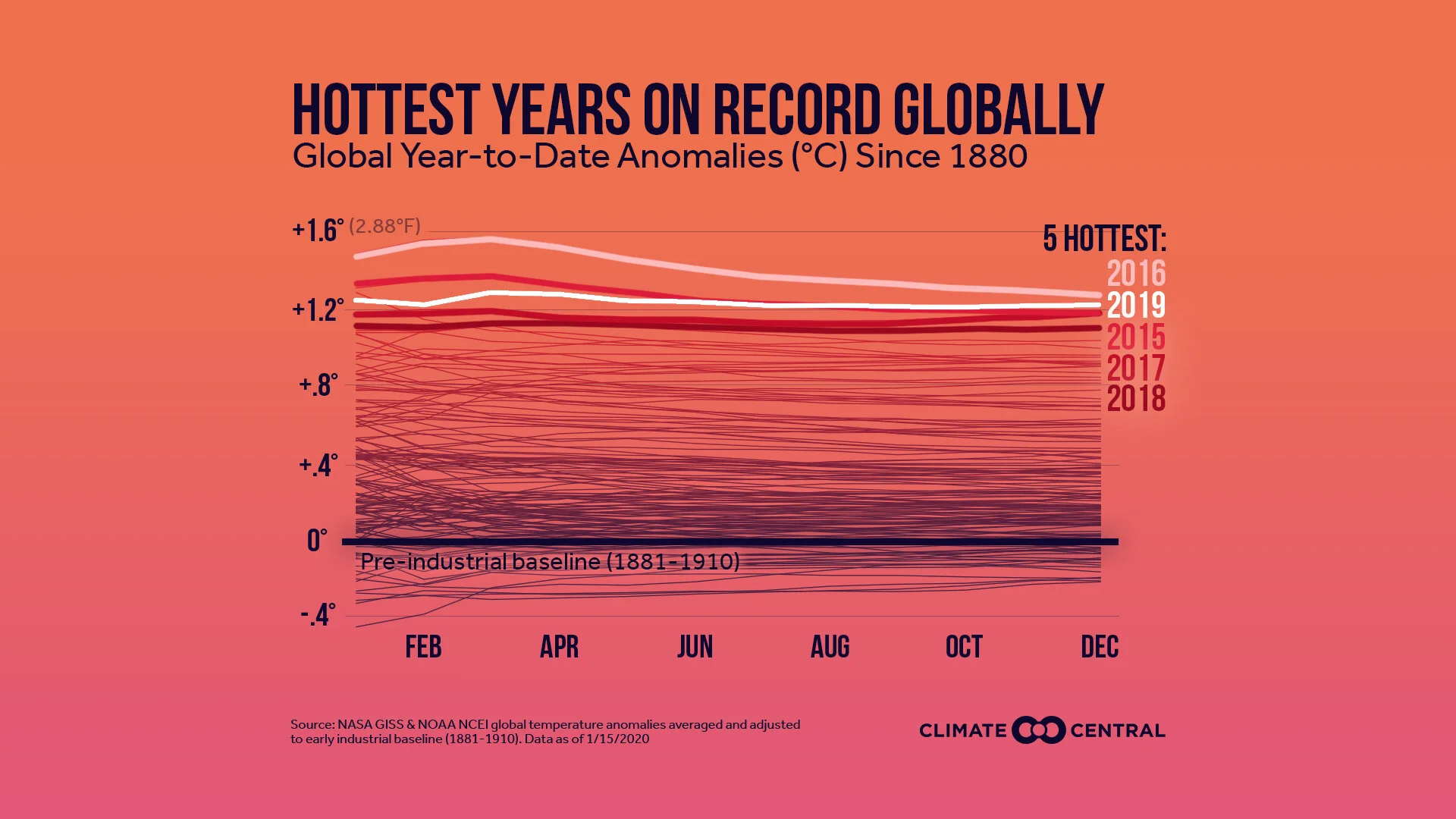
Sourced from Climate Central, this chart shows the increasing impact CO2 levels are having on global average temperatures.
Clearly, we are running out of time. Here’s a simple countdown clock from the Guardian that has been in use since the Paris Accord goals were established. It is as specific (and accurate) as the current science will allow. When it comes to global CO2 emissions and greenhouse gases in general, well …it’s time to get real.
Continuing our steady rise in fossil fuel use without capturing emissions is essentially a march toward oblivion. Not only will we experience life-threatening escalating temperatures, sea level rise, increasing diseases, and widespread crop failures, we’ll most likely experience a breakdown of civilization as we know it. For a current and quite sober assessment, see the most recent report by the World Economic Forum, Global Risk Report for 2020.
“Sure, they’re rebuilding in Ocracoke because of Hurricane Dorian. So what? It’s always been like that here”. Drawing from the Outer Banks, North Carolina, by Jenny Hershey. On Instagram at deeofo.
So what do we do? Talking to others is a start, especially policy makers. As you may know, I am active with the Citizens Climate Lobby (CCL), a global organization of over 100,000 volunteer citizen lobbyists who advocate for specific legislation (HR 763) to establish a price on carbon in the form of a fee that returns dividends directly to citizens to mitigate increases in energy costs. This group works hard to convince conservatives that climate change can still be addressed through aggressive market mechanisms. However, the need to act is a nonstarter for those who historically deny climate change science. CCL has been active for over 11 years, and while this ambitious and hardworking citizen lobbying organization has changed many minds in Congress, their legislative agenda remains unmet. If we are lucky enough to get a Democrat in the White House in 2020, CCL’s legislation will most likely prevail, and a decade of effort will finally pay off.
However, the current science tells us that global carbon emissions MUST be cut in half over the next ten years for us to maintain a climate anywhere close to what we humans have enjoyed in our comparatively short time on earth. If we end up with four more years of Trump plus a Republican Senate, we will lose 40% of the time we have to create aggressive changes in national (and global) policies to effectuate change. Considering the stakes, avoiding that outcome is essential.
Anyone who understands climate science agrees that Trump's policies are dangerous, and that his willfully ignorant characterization of those faniliar with the science as “prophets of doom” is patently ridiculous and beyond pernicious. As a result, many environmentalists argue that trying to convince his Republican supporters (especially in Congress) to think effectively about climate change is a complete waste of time and energy. Among them are activists in the interesting and global new group “Extinction Rebellion”. I think this group deserves credit for articulating an approach to the climate emergency that might push policy makers toward meaningful action. They focus on mobilizing people who are already passionate about climate change, and then work to consolidate progressive support for drastic action. Their approach is explained more fully in the following PBS article.
Their philosophy is summed up as follows: “We have finite energy, and spending energy trying to win over the people who are absolutely not going to be won over to your side is peanuts compared to mobilizing the people who would be active or passive supporters,” said Leah Francis, an organizer with the Extinction Rebellion U.S. national team. “We really want to shift people’s perspective on what constitutes normal, socially acceptable behavior around responding to climate change.”
Maybe that's exactly what we need. Maybe, just maybe, those of us who are alarmed by the existential issues of climate change are being just too damn nice.
I’m curious to know what you think…
Thanks for reading! More to come…
All photos, unless credited or otherwise noted, are copyrighted property of the blog post author.