
Food Systems and Climate Change; Biking Prince Edward Island

Eliot Coleman, organic farming author and founder of the prolific agroecological Four Season Farm in Harborside, Maine, reflects on one of his favorite books, Soils and Men, a 1938 yearbook published by the USDA. The farm produces year-round vegetable crops, even under harsh winter conditions (using unheated and minimally heated greenhouses and polytunnels). Drawing by Jenny Hershey. Follow her on Instagram @deeofo.
Fire made us human, fossil fuels made us modern, but now we need a new fire that makes us safe, secure, healthy and durable. - Amory Lovins
I don’t see problems, I see solutions. - Eliot Coleman, quoting Amory Lovins
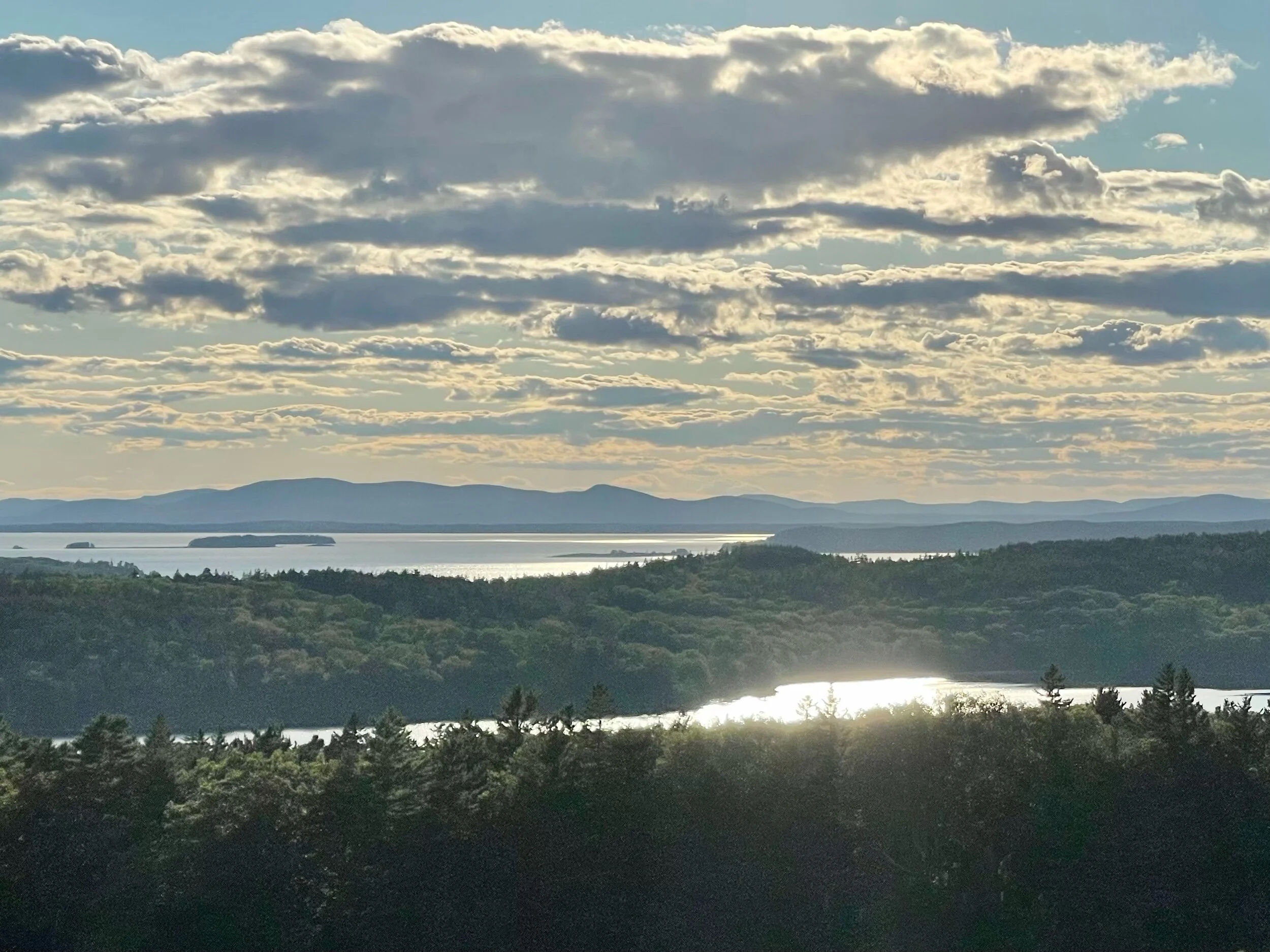
The view just above Deer Isle on Maine’s central coast on the way to Prince Edward Island. Photo by Michael Chase. Follow him on Instagram @mjohnsonchase.
Along the Way
Jenny and I left for our next biking adventure in mid-September. Following our usual custom for our bi-monthly explorations, we intended to drive to our starting place with our bikes in tow. This time our destination was Prince Edward Island (PEI) in Canada. We passed through Maine on the way, and stopped in Deer Isle to stay with friends Jack and Linda Viertel, who - knowing we have written about regenerative agriculture and climate change in previous blog posts - kindly introduced us to their friends Eliot Coleman and Barbara Damrosch.
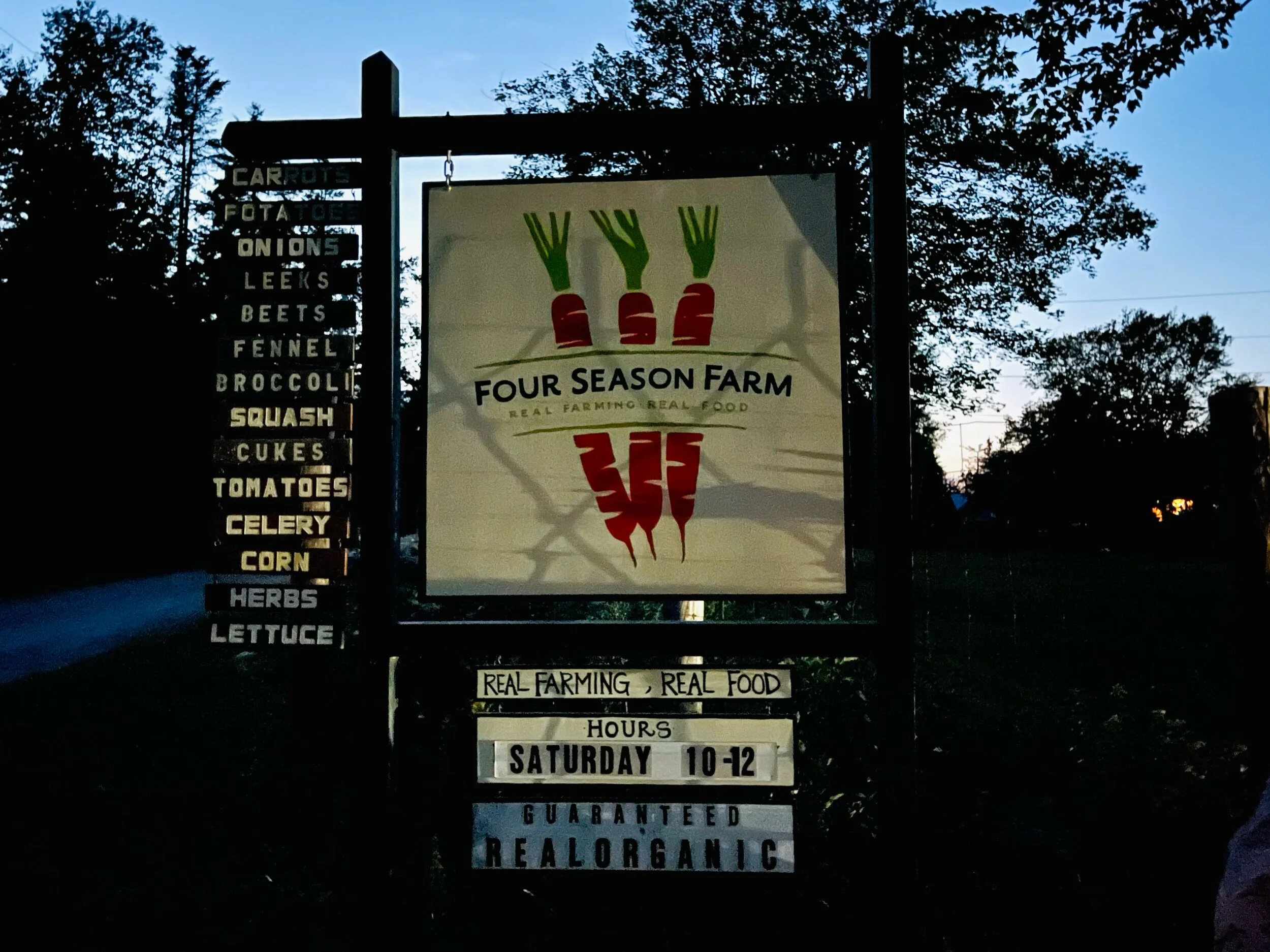
The sun sets behind the sign that identifies the road to Four Season Farm in Harborside, Maine, where Eliot and Barbara live. The farm is currently managed by Eliot’s daughter Clara Coleman. Photo by Michael Chase. Follow him on Instagram @mjohnsonchase.
Neither Jenny nor I fully grasped at the time what an extraordinary opportunity this was; both Eliot and Barbara are seminal authors, educators and very successful organic market gardeners. In addition, Eliot has invented many farm tools that other organic farmers have adopted over the years. Meeting them set the stage for subsequent meetings with organic farmers in PEI, as well as the helpful people we met at the Climate Lab at the University of PEI (more on that later). Everyone we talked to knew of Eliot Coleman’s work; he became a serendipitous calling card for all things organic, simply because we had been lucky enough to meet him along the way.
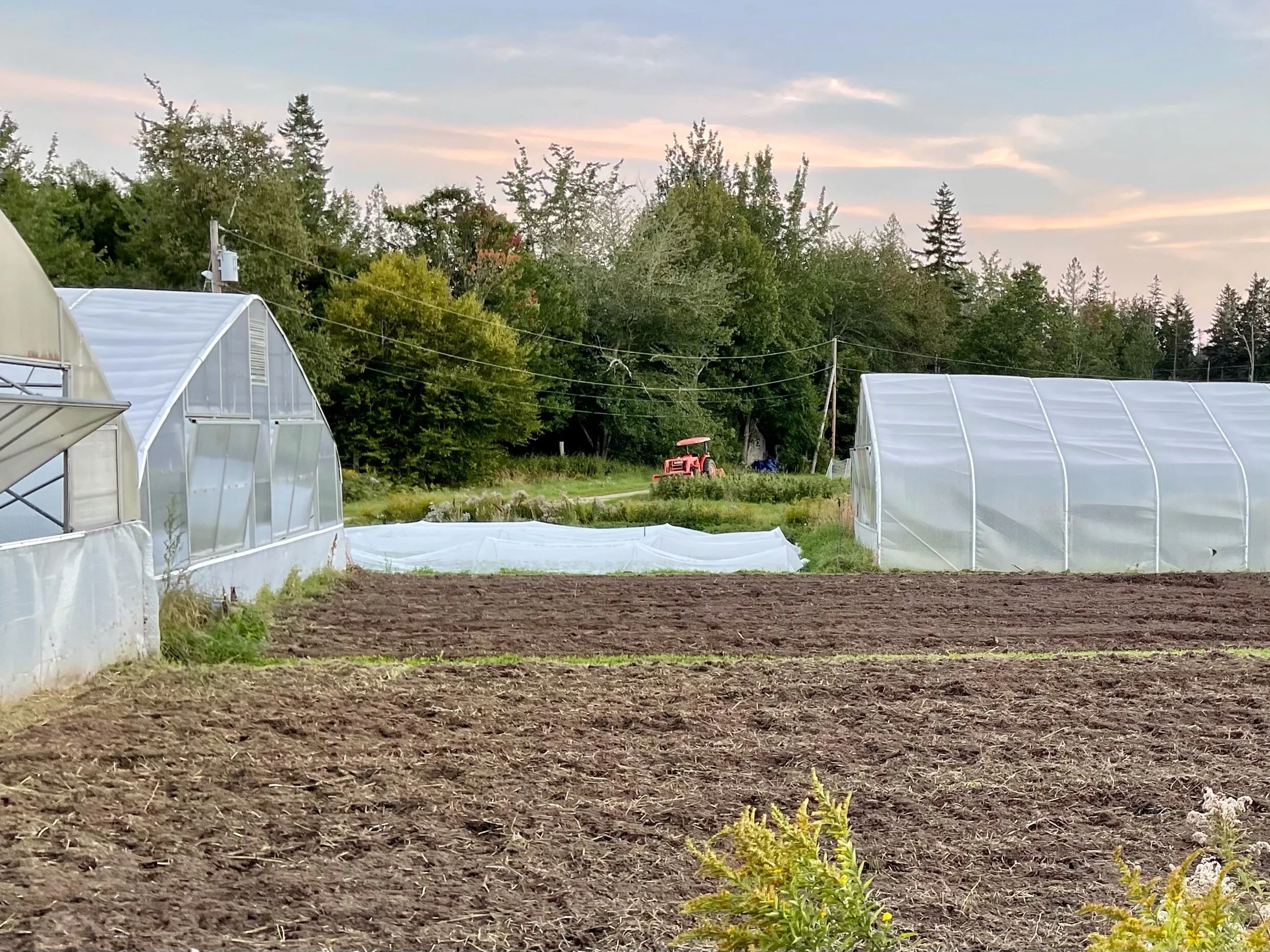
Several fields at Four Season Farm. The field in the foreground had just been tilled with an ample amount of green manure (crop residue from buckwheat plowed into the soil to enrich it) in preparation for a cover crop of winter rye. The field in the background was sown with peas and oats for the summer and will be planted with winter spinach, and the second greenhouse to the left will be moved over the spinach to optimize growing conditions. Photo by Michael Chase. Follow him on Instagram @mjohnsonchase.
As urban devotees of regenerative agriculture, we especially appreciated hearing Eliot’s critical perspective that the current buzz around “regenerative” farming is being be co-opted by large agriculture companies with little genuine interest in solving environmental problems.
Consider the ways agriculture is supported through government subsidies. In the US alone, the meat and dairy industry receives 63% of total agriculture subsidies, compared to fruits and vegetables producers who receive only 0.04% of total subsidies. If you are a meat producer (whether your product is regenerative or not), you will receive subsidies that small-scale organic growers (especially market gardeners) won’t. This suggests at least one of the reasons “regenerative” has rapidly grown in popularity, eclipsing the older “organic” processes revived by farmers like Eliot Coleman. But subsidies are only part of the issue. Corporations notice consumer trends, and the recent popularity of the “farm to table” movement has also driven corporate influence over small-scale organic farms as well.
Consequently, Eliot Coleman is also not a fan of the ways the label “organic” has been diluted. He explains this on the farm website: Four Season Farm in Harborside, Maine has been farmed organically since its inception in 1968. However, we are NOT “USDA Certified Organic.” And for good reason. The USDA refuses to uphold the honest, old-time, carefully stewarded farming practices that organic has always represented. The USDA National Organic Program has been totally corrupted by the money, power, and influence of industrial food corporations. USDA certification is a hollow sham.
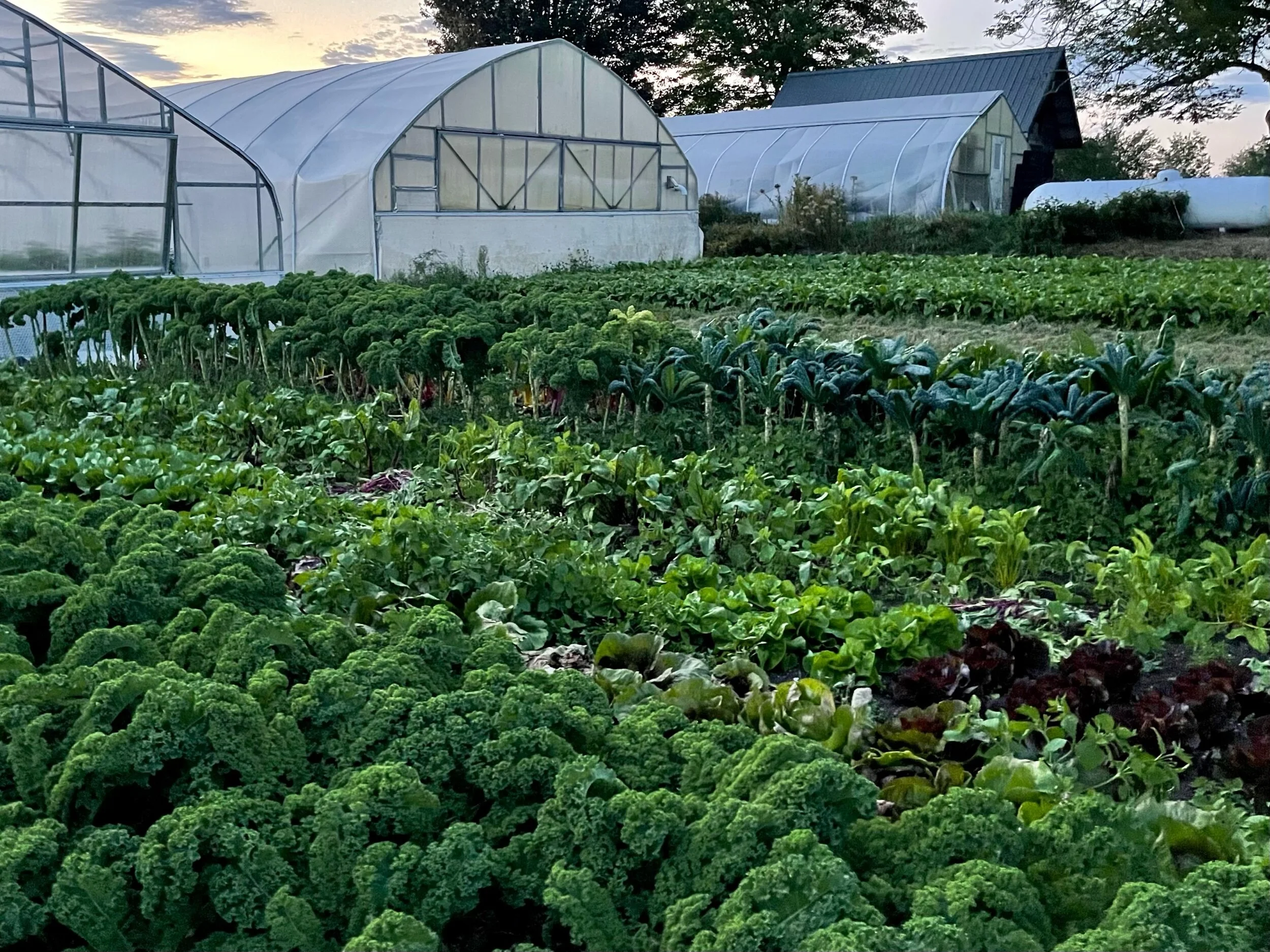
More vegetable fields at Four Season Farm. The greenhouse to the far left is the backside of the same one as in the previous picture, and it will be moved farther to the left to cover winter spinach. The extraordinarily productive field in the foreground is kale, lettuce and chard (photo taken mid-September). Photo by Michael Chase. Follow him on Instagram @mjohnsonchase.
The website goes on to explain what real organic standards should be: First, for uncompromised nutritional value all crops must be grown in a biologically active fertile soil in full contact with the earth and nourished by the natural biological activities of that soil. Research into the marvelously complex soil micro-biome reveals the vital ecological processes that support natural, non-chemical food production. Second, soil fertility should be maintained principally with farm-derived compost and mineral particles from ground rock. Why take the chance of bringing in polluted material from industrial sources when fertility can be created and maintained internally? Third, deep-rooting green manures, cover crops, and grazed pastures must be included within broadly based crop rotations to enhance soil fertility and biological diversity. The greater the variety of plants and animals on the farm, the more stable the system. Fourth, a “plant positive” rather than a “pest negative” philosophy is vital. The focus must be on correcting the cause of pest problems (weak plants) by creating optimum soil conditions to strengthen the plant, rather than merely treating the symptom (pest damage) by trying to kill the pests that are attracted to weak plants. More and more scientific evidence is available everyday on the mechanisms by which a biologically active fertile soil induces resistance to pests and diseases in the crops. Fifth, livestock must be raised outdoors on grass-based pasture systems to the fullest extent possible. Farm animals are an integral factor in the symbiosis of soil fertility on the organic farm.
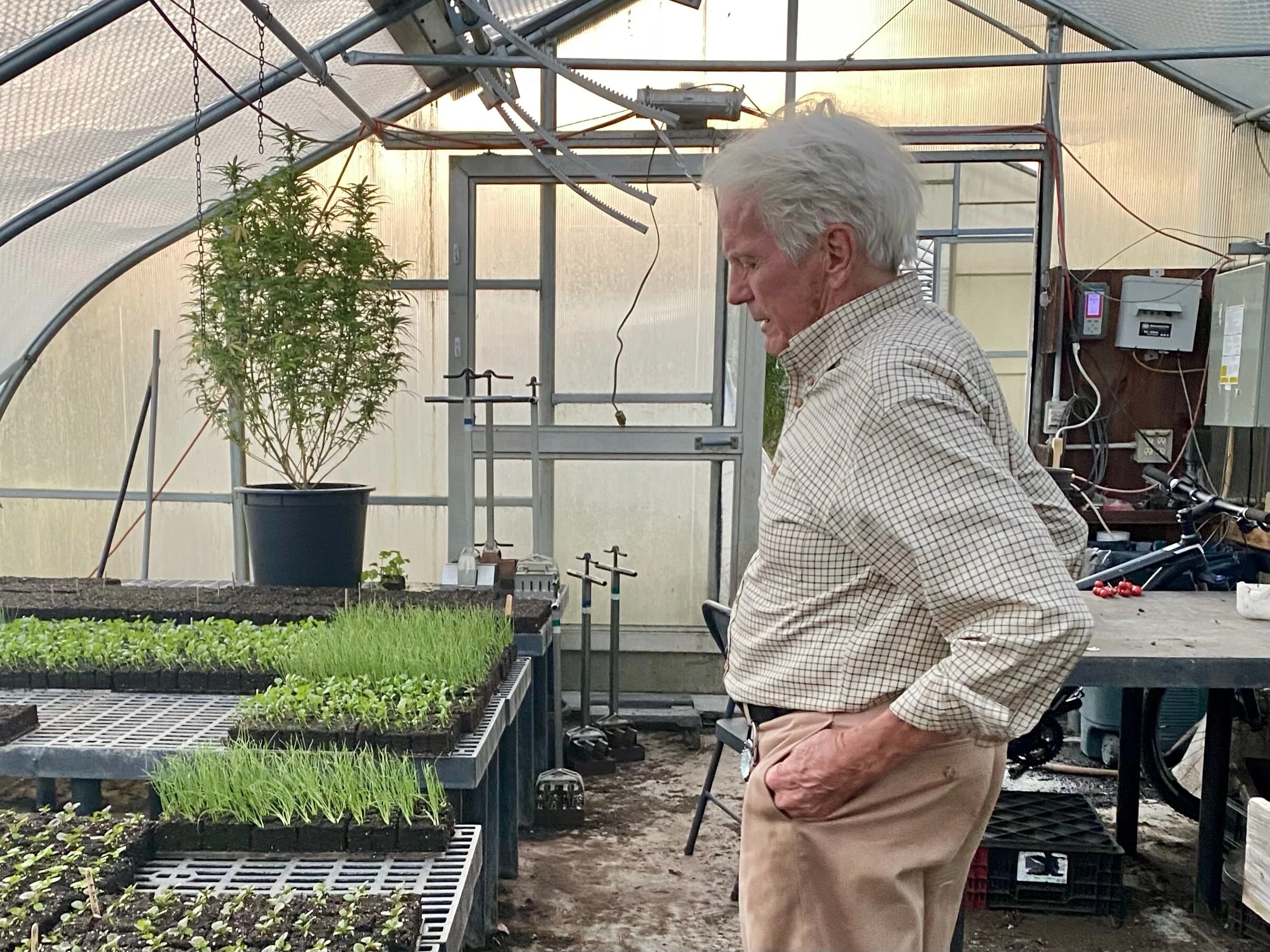
Eliot looks over starts for the winter season in one of his greenhouses. Photo by Jenny Hershey. Follow her on Instagram @deeofo.
Arriving in Canada
In September of 2021, Canada opened their border for recreational travel to Americans who are fully vaccinated for Covid-19 and demonstrate negative results on a Covid PCR test within 72 hours before entering. PEI requires an additional negative result on a second rapid test upon entering the Province. Given these safeguards (combined with the fact that the percentage of fully vaccinated Canadians is significantly higher than Americans), we felt safer biking here than we would have in the U.S. The sadness and irony of that realization wasn’t lost on us; in fact, it probably made us more attentive to the Canadian approaches to the science of both Covid and our rapidly changing climate.
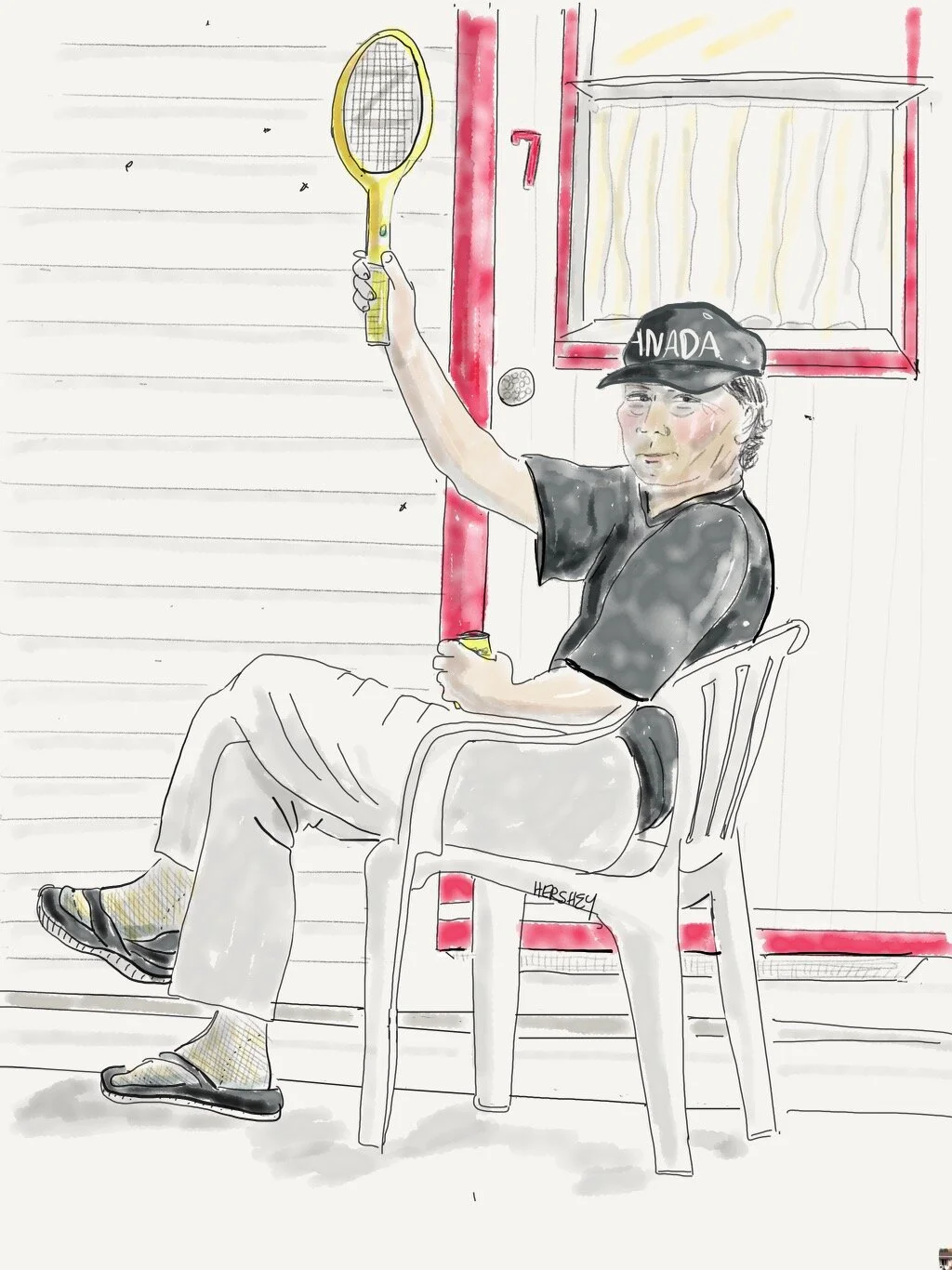
After their kids left the nest, Yeung and his wife left their home in Vancouver and came to PEI, where they bought a mid-century motel in Murray Harbor in the southeast of PEI. Yeung kept us safe from mosquitoes with his racquet zapper. Drawing by Jenny Hershey. Follow her on Instagram @deeofo.
Interestingly, we encountered no political resistance to Covid vaccination efforts or masking mandates in anyone we met. All of the major political parties in Canada (except the ultra-right Peoples Party of Canada at 4% of the electorate), are strongly pro-vaccine and equally attentive to the science of climate change. In fact, because we arrived just before the recall election, we had the refreshing opportunity to watch the major two parties - the Liberals and Conservatives (aka Tories) - attempt to outdo one another on general media about how to address both the pandemic and the climate emergency. We met no one who isn’t concerned about Canada’s rapidly changing climate. Perhaps this is because climate changes are more intensified toward the equator and at both poles, so the further to the north one is located the more obvious the changes are. In any case, the focus on method over content in Canadian politics was a refreshing change from American politics, where our major political parties perceive themselves as inhabiting planets facing distinctly different threats.
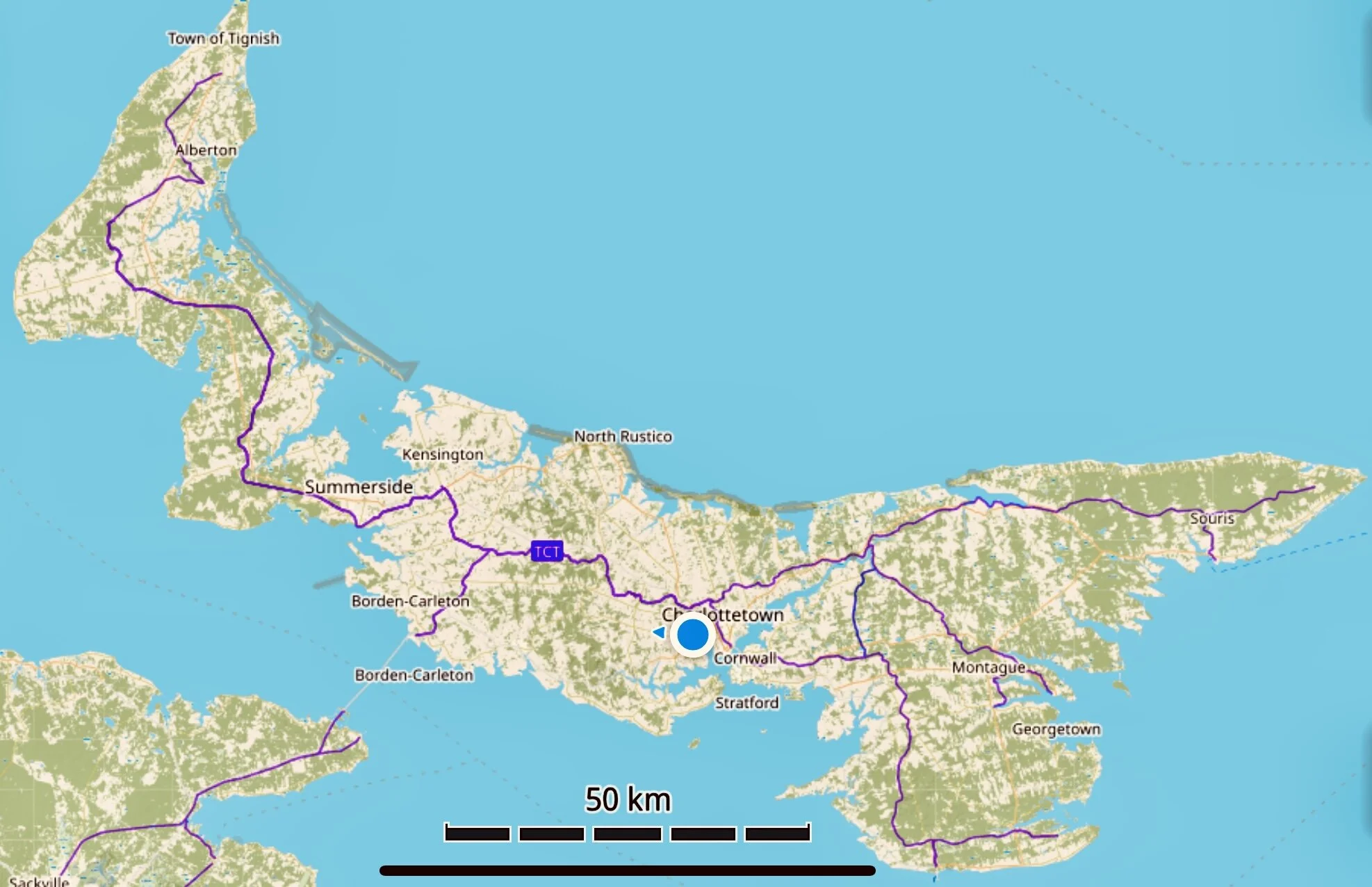
Charlottetown is near the blue dot. This is PEI’s largest city, with a metropolitan population of about 80,000 of the island’s 160,000 people. The purple lines on this map form the spine and the spurs of the Confederation Trail. The points at the ends of the wings are North Point in the northwest and East Point in the east. There are wind farms near both points, the largest in North Point. Currently, renewables supply about 25% of the Province’s power; they will supply 100% by 2040. PEI has no natural gas lines, and most cooking and heating is already electric. Summerside, a town in central PEI of about 15,000, uses wind farms, solar arrays, smart grids, industrial-scale lithium-ion batteries and the highest per capita concentration of electric car chargers in the country, and expects to derive the majority of its electricity from renewable sources by 2022. A fascinating story is how the town is dealing with the problem of intermittency: there are a suite of specialized appliances in homes throughout the city that can store energy as heat rather than electricity. This can be read about in more depth here. Photo from GuruMaps Pro.
We left our car at the parking lot for the Woods Island ferry to Caribou, Nova Scotia, and have spent the last several weeks biking the island. PEI is about 200 miles from end-to-end, and shaped like an angel’s wing veering rightward. What we missed in biking long distances every day, we made up for by enjoying biking the inland spines of the “rail to trail” conversion called “The Confederation Trail,” meandering the many mellow coastal roads that circumnavigate numerous bays, estuaries, peninsulas, isolated and peaceful beaches, and exploring lovely farming towns and charming fishing villages. The trip was idyllic.
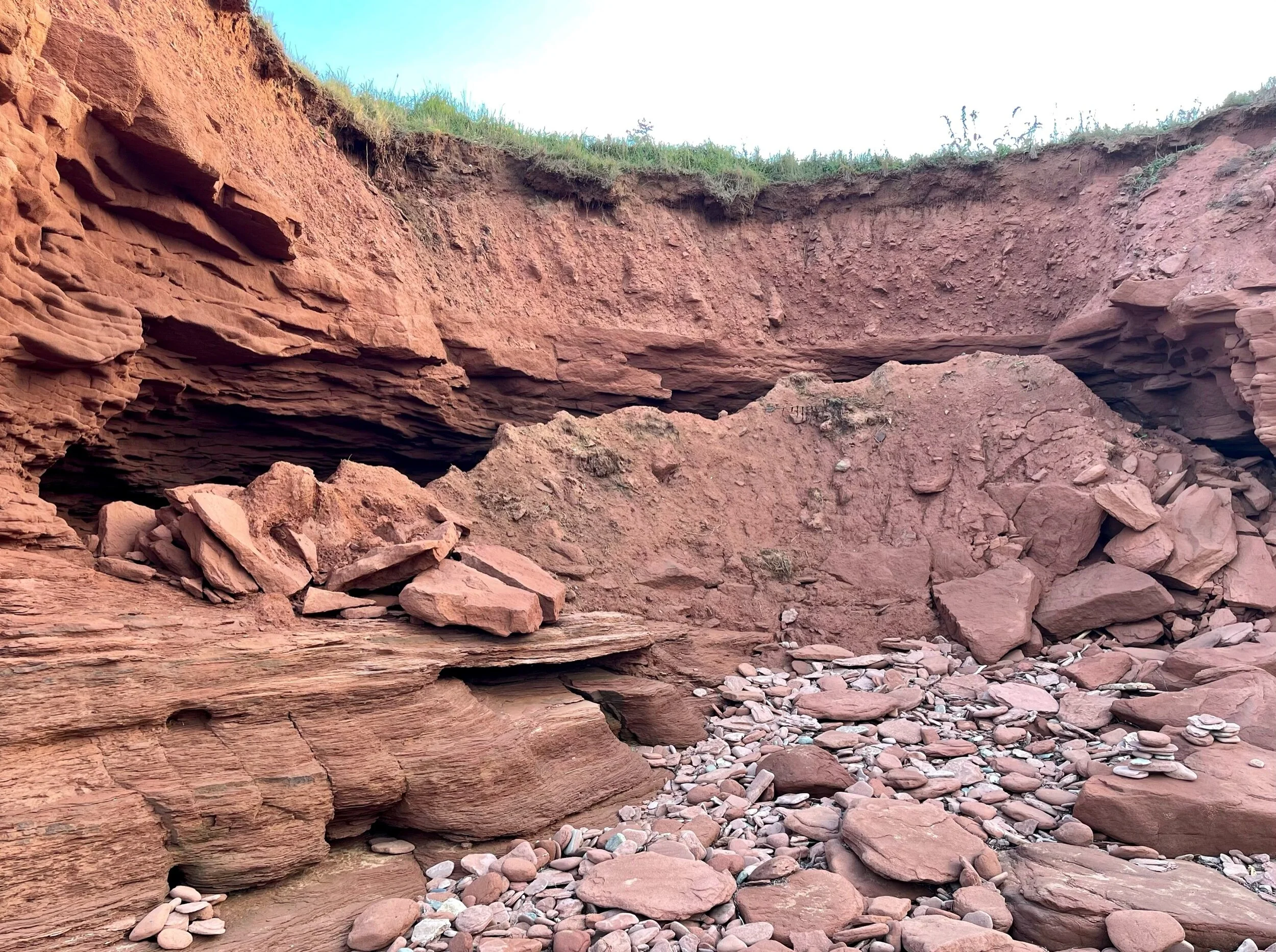
Taken on the north shore of PEI not far from Cabot Provincial Park, this picture demonstrates how erosion works on the shoreline. Waves wear away the sandstone cliffs until they collapse from underneath. Because of sea-level rise and increased storm surges, PEI has been losing an average of about two feet a year of its shoreline. Scientists expect the rate of erosion to worsen in the future. Other impacts of climate change on PEI include steadily rising average temperatures, milder winters with less snow, increasing swings between excessive drought and precipitation events, and greater exposure to extreme weather events such as hurricanes, storm surges and destructive winds. Photo by Michael Chase. Follow him on Instagram @mjohnsonchase.
Cabins are plentiful in PEI. Some are delightfully rustic and placed on windswept cliffs over the Gulf of Saint Lawrence in the north or the Northumberland Straight on the south shore. With only a few exceptions most have kitchens. After discovering that dining out was very expensive compared to cooking our own food, we began to sample the island’s sustainably raised mussels, oysters and lobsters by buying seafood at many of the small shops near the waterfronts. PEI mussels (which sell for CAD 1.50 - 2.00 a pound) are farm-raised on ropes hung in the ocean, which ensures that there is no dredging or disturbance to the ocean floor. Since there is no dredging, delicate life forms are undisturbed.
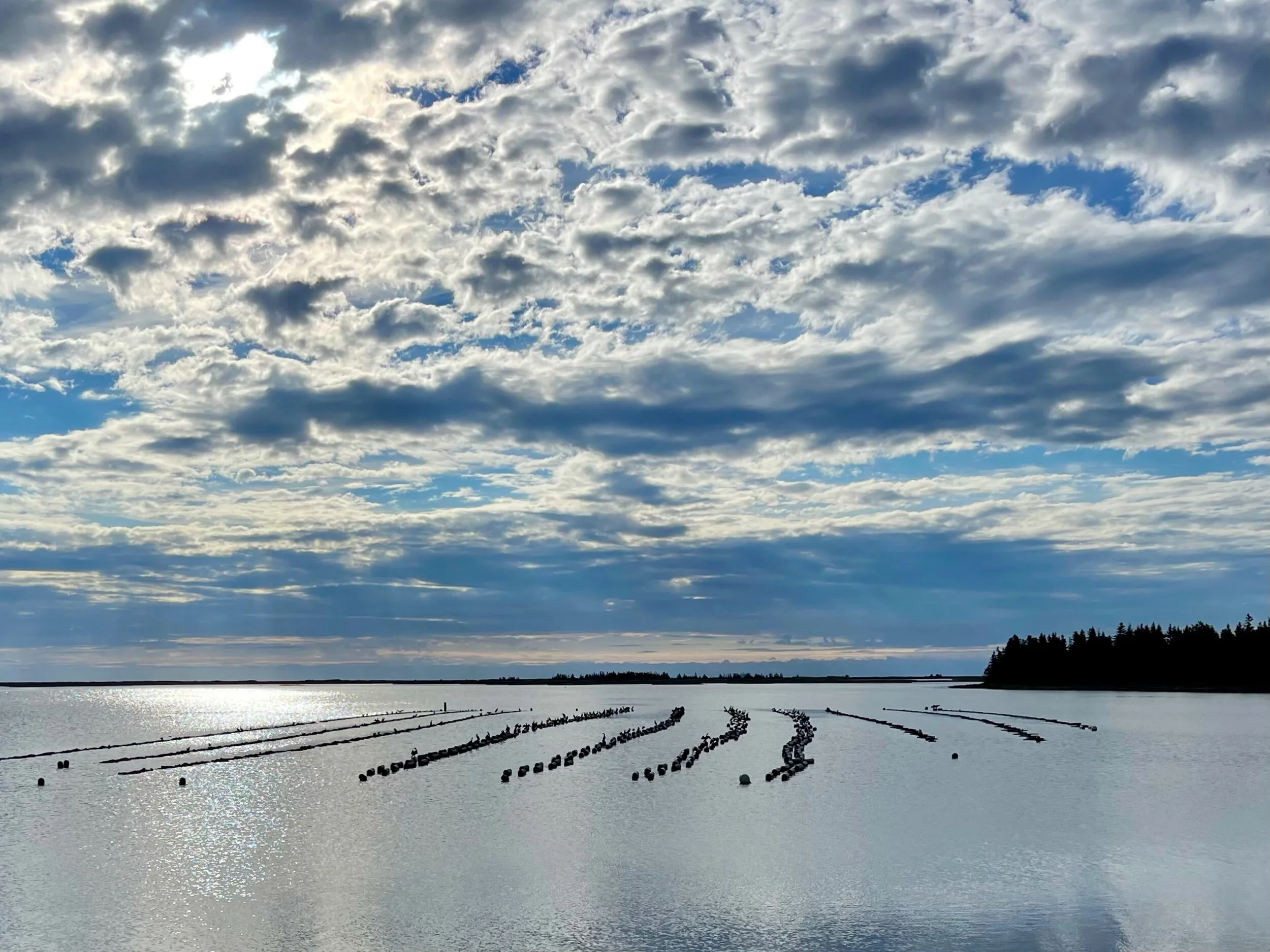
Oyster cages can be seen in the distance at a sustainable oyster farm. Photo by Michael Chase. Follow him on Instagram @mjohsonchase.
Oysters can be raised sustainably as well. The production cycle on a Canadian oyster farm begins with the collection/production of oyster larvae. Some farmers still collect larvae in the wild; however, larvae are increasingly produced in controlled hatchery facilities from spawning adult broodstock. The larvae are kept suspended in tanks by circulating water – and in a few weeks they transform into tiny seed. The seed is essentially a very small version of the adult oyster. Once the seed reaches an appropriate size, it can be transferred to the ocean for final grow-out in cages that are moved every year for 3 to 4 years to stimulate growth and achieve a marketable size.
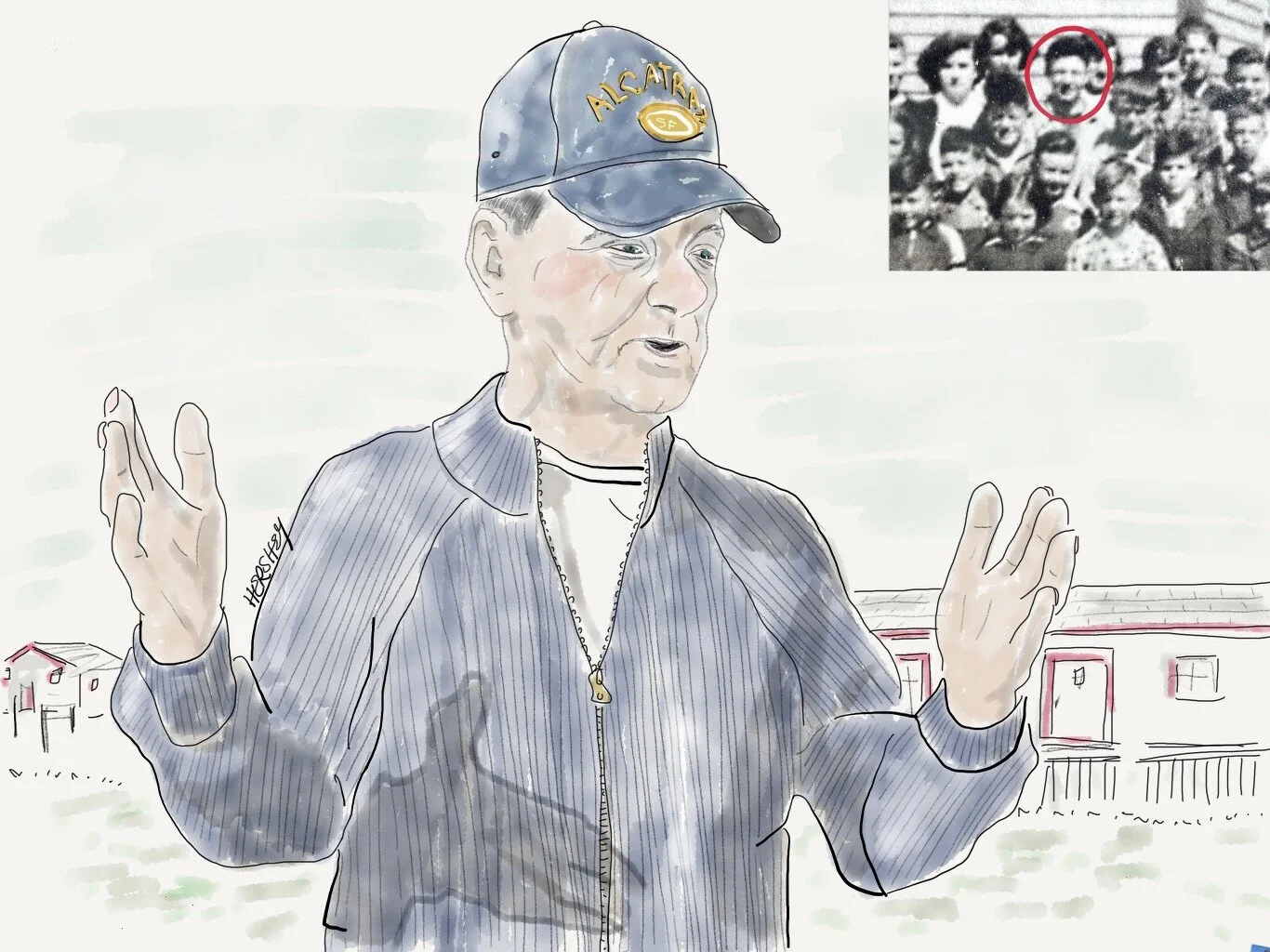
While we were reading an historical placard out loud at the old fishing harbor of Tignish Shore, Hector approached us and pointed himself out in a 1953 schoolhouse photo (upper right). A retired lobsterman, Hector bought his lobster fishing license for CAD 25 cents; now they cost CAD 1.5 million. Hector has survived many storms over the years. Because the beach kept receding, the provincial government moved his boyhood home (where he still lives) from the beach to the inland side of the street. Hector has watched the shoreline at Tignish Shore recede at least two hundred feet during his lifetime. Drawing by Jenny Hershey. Follow her on Instagram @deeofo.
Perhaps most exciting for us as laypeople (beyond eating these exquisite creatures) was recognizing the value of the industry to the local environment. Mussels and oysters raised in estuaries live off plankton and are very productive at filtering water; even nitrogen (a problem in PEI because of extensive commercial potato farming) and pesticides are absorbed and deposited in inert form on the sea bottom through feces by these amazing shellfish.
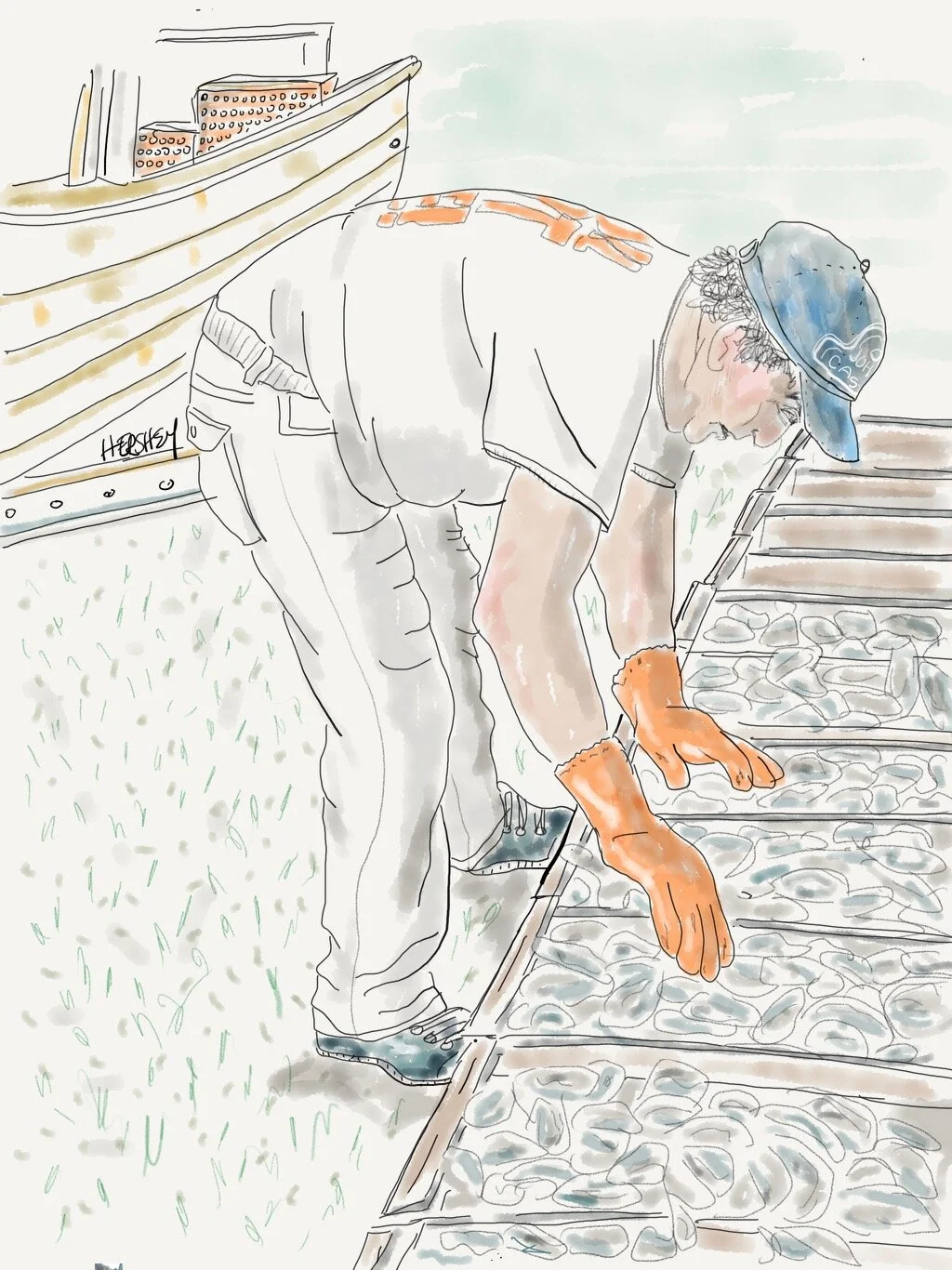
We met Frances, an oyster fisherman, at Yeung’s motel on the first day of the oyster season at Murray Harbour. Fishing the older conventional way by using 12-foot-long tongs (they used to be regulated for 10 feet, but the water is deeper now because of sea level rise), he rakes wild oysters off the sandy bottom in the numerous estuaries around the island. Frances (and his partner Pete) brought back 26 crates of oysters their first day out. They will earn CAD 50 cents per oyster for the bigger ones (which would cost USD 3-4). Both Frances and Pete were pleased with their catch, and they celebrated by gifting us a dozen of their largest oysters and another dozen quahogs. Needless to say, we were delighted! Drawing by Jenny Hershey. Follow her on Instagram @deeofo.
Why Bother?
In August, 2021, the International Panel on Climate Change (IPCC) published the 6th assessment of our changing climate (the first assessment was published in 1990). For the report, hundreds of scientists all over the world assess thousands of scientific papers published annually to provide a comprehensive summary of what is known about climate change, its impacts and future risks, and how efforts at adaptation and mitigation can reduce risks. The assessments represent the best of global general scientific consensus about what is most likely to happen to our climate in the near and reasonably near futures, depending on how many greenhouse gas (GHG) emissions humans continue to release into the atmosphere.
Although climate science has improved greatly over the years, most humans now understand we are placing our children and grandchildren at considerable risk by continuing to emit greenhouse gases into the atmosphere. But the recent IPCC report is sanguine. In general, emissions are not stabilizing, much less decreasing. We aren’t meeting the moment yet, and we are rapidly approaching crisis. We have only a few decades to decarbonize our atmosphere before we hit tipping points that may undermine civilization as we know it.
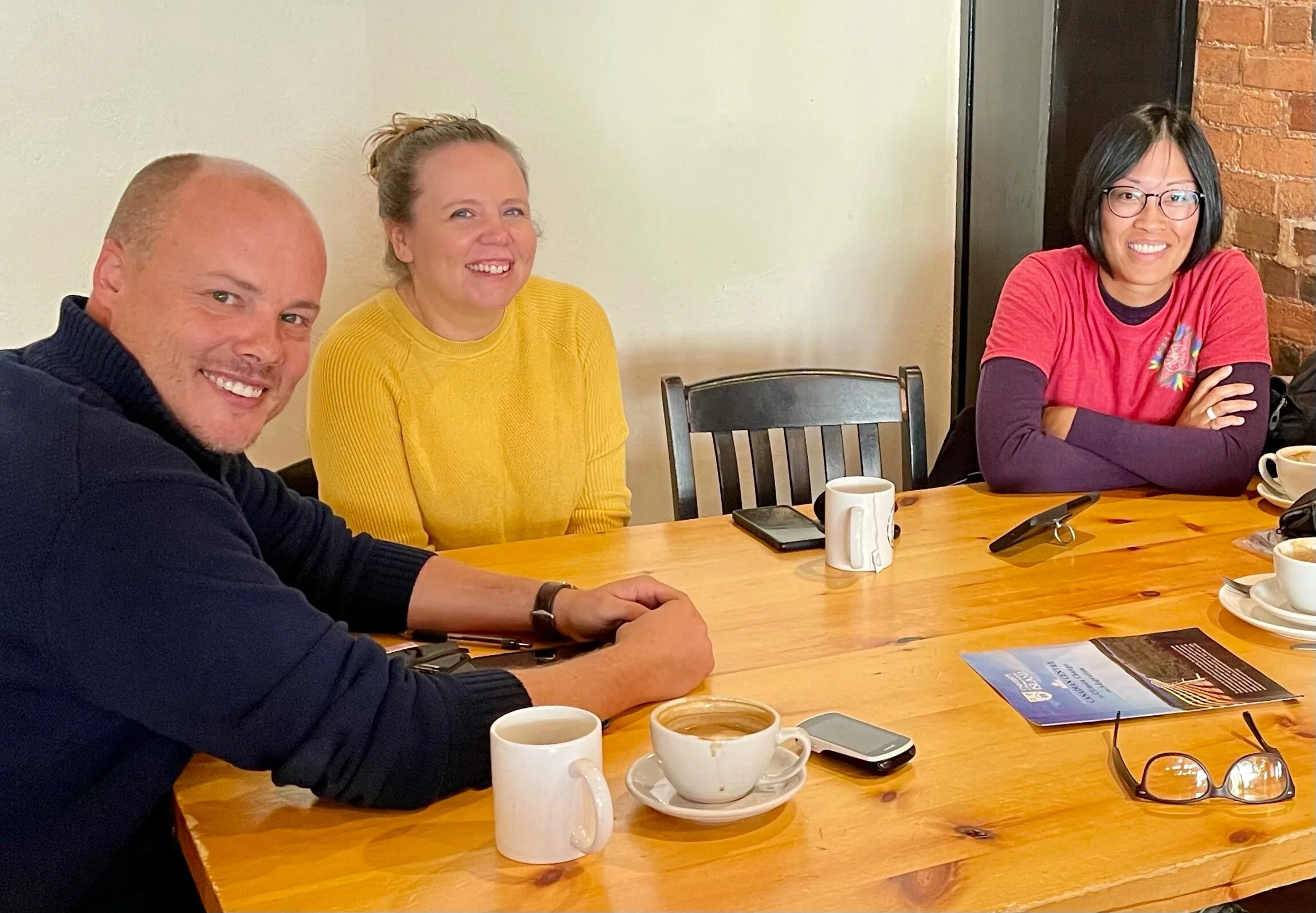
From left to right are Ross Dwyer, Erin Taylor and Stephanie Arnold. All three of them spent several hours chatting with us about PEI’s sustainability plans, particularly in the agricultural sector. PEI appears to be situated well for success, and key players in all industries are feeling pressure and excitement about improving their processes to become more sustainable. Ross Dwyer is the ClimateSense Project Coordinator and Project Manager at the Climate Lab at UPEI. Ross is a passionate representative, and was very welcoming to Jenny and me. Erin Taylor is the Manager of the Climate Change Secretariat at PEI’s Department of Environment. She is an intrepid connector and environmental advocate. Stephanie Arnold is a prolific author and PhD Candidate (UPEI). Her technical specialty is helping potato farmers adapt to societal pressures to become more sustainable and adapt to rapidly changing growing conditions. Read about the Provincial Prince Edward Island Climate Plan here. Photo by Michael Chase. Follow him on Instagram @mjohnsonchase.
Fortunately, many governments are listening to these onerous warnings, the PEI provincial government among them. But our talks with the climate team of university and government officials in PEI weren’t about quantifying GHG emissions, nor was it about making a transition in energy systems. That has to happen, and it’s already underway. But for the people we talked to that’s the easier part of dealing with climate change. Transformation in agriculture, which is the cornerstone of life on this island (and always has been) is the preoccupying problem, because farming here is so integral. And underlying how we live on the land is a more fundamental issue - our most cherished values.

Stephanie Arnold from the UPEI Climate Lab shares her feelings about the unfair blame directed at many well-meaning potato farmers by uninformed environmentalists.
We were lucky enough to hear Stephanie speak publicly (along with Adam MacClean) at a panel event on agriculture and climate change in New Glasgow. When asked what single-most important action she thought could be undertaken to get at the root causes of climate change, Stephanie answered Canadians could review and recommit to the country’s original Treaty Agreements with indigenous nations. Drawing by Jenny Hershey. Follow her on Instagram @deeofo.
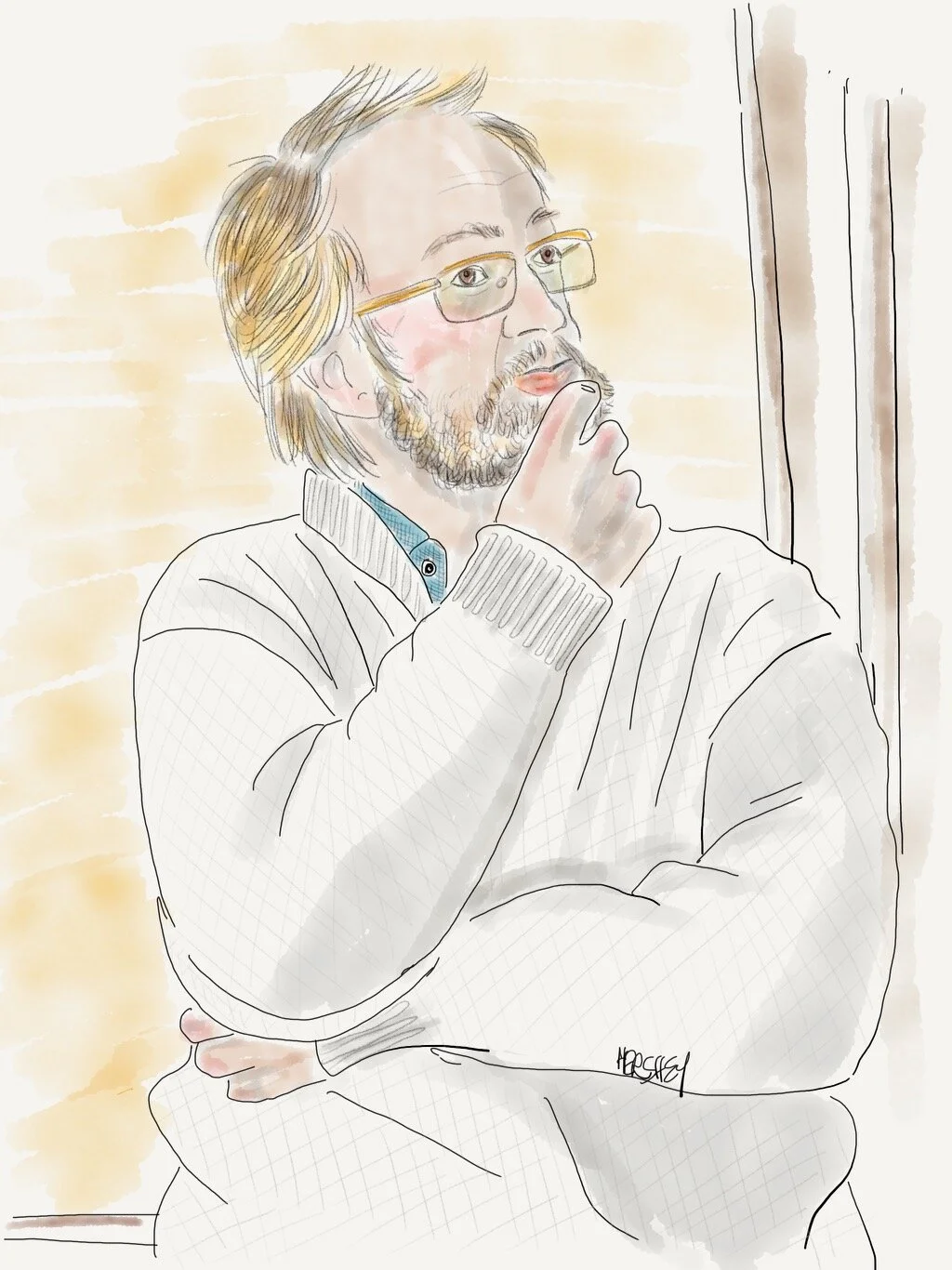
Adam MacLean describes himself as a shepherd-entrepreneur-scientist and very recently, a public servant, working with the PEI Department of Agriculture and Land as their Organic & Perennial Crop Development Officer. He practices regenerative agriculture by managing pastured livestock to produce nutritious meats in a way that respects the animal and heals the land. Together with his flock, in partnership with Island landowners, they are building soil, sequestering carbon and feeding the community. We were lucky enough to hear him speak in New Glasgow, where he agreed passionately with Stephanie Arnold that our biggest challenge is reckoning with our most fundamental values. Drawing by Jenny Hershey. Follow her work on Instagram @deeofo.
Our conversations revealed a collective agreement that climate change is a symptom of a larger problem: societies that value the rights of powerful individuals over those of poorer communities, societies that seek to dominate nature rather than live within natural processes, societies that place individual rights and personal consumption ahead of a collective commons with the capacity to allow all humans to live in natural abundance. Those are societies most responsible for polluting our atmosphere and bringing us to the brink of extinction.
Such talk used to be the province of the crazy and marginalized. But in PEI, such talk seems to be increasingly normal. Views are shifting everywhere, and PEI is small enough that shift is palpable. After all, relationships are the true currency of change, and that currency in a place as small as PEI is alive and well.
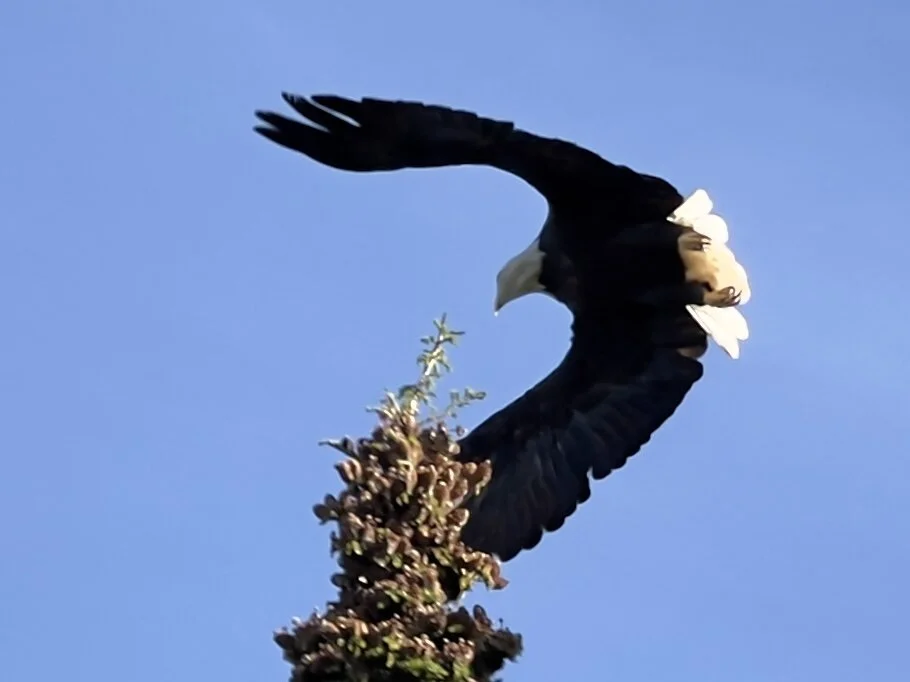
We saw this Bald Eagle (Canadians call them Sea Eagles) lift off a tree near North Point in PEI. For us urbanites, there are few things more exciting. Photo by Michael Chase. Follow him on Instagram @mjohnsonchase.
Organic and Regenerative Farming in PEI
Our first few days on the island revealed little information about farmers, other than the unmissable reality of the large and ubiquitous potato industry and the equally accessible shellfish and lobster industries. Before we learned more about how conventional potatoes were farmed, we were happy to dig up a few potatoes for our dinners as we biked by the corners of commercial fields. That is, until we learned that commercial potatoes growers use a spray that kills the plants from the ground up, leaving the potatoes easier to harvest. Although Roundup (glyphosate) is repeatedly used to kill weeds on the fields earlier in the season, we were never able to determine whether that is the herbicide used to kill the plants at harvest. But even if you never eat another potato from PEI, please understand that glyphosate is still the most-used herbicide in the U.S. Unless you’ve eaten only organic vegetables for years, you’ve been exposed to it in large quantities already. In any case. our past blog posts on regenerative agriculture and our serendipitous meeting with Eliot Coleman focused us to understand more about the agriculture scene in PEI.
We managed to look beyond the potatoes once we got wind of the PEI Certified Organic Producers Co-op (COPC) through an email exchange with my friend Regina Grabrovac of Healthy Acadia in Machias, a Maine-based food systems specialist and organic certification official for the USDA. Once we learned from Regina where and how to look, we began to appreciate how much fresh food was available all over the island.

Brian MacKay, an organic farmer at Crystal Green Farms in Bedeque, PEI, raises organic vegetables and livestock, as well as operates a small flour mill where they mill their own grains and prepare baking mixes. Their milled products can also be found on the shelves of many local retailers. Once Brian learned that Jenny was a vegetarian for environmental reasons, he patiently asked us what we thought “Beyond Beef” was made from? Did we think that the peas, corn and soy in the product was grown without fertilizers, herbicides, and pesticides? Did we think it was grown with crops that haven’t been sprayed with glyphosate? Did we think the crops used weren’t genetically modified, tying them in with Monsanto and other seed monopolies? (We checked the Beyond Meat website and supposedly they do not use GMO crops). Even so, might it be that eating beef, pork, chicken, lamb or sheep grazing in a field of perennial grasses creating healthy soil while sequestering carbon, was a better option environmentally? As Brian spoke, his grandson, Xaviar, hung onto every word, as did we. What do you think? Drawing by Jenny Hershey. Follow her on Instagram @deeofo.

Kathy MacCay from Crystal Green Farms in the 140 year-old farmhouse in which she was raised, and in which she raised her children. She has lived in this house for most of her life. Kathy runs a tight ship working with husband Brian and caring part-time for her 14 grandchildren. Somehow, she also managed to cook us delicious homemade waffles (from a pancake flour mix milled in their barn for market distribution). Drawing by Jenny Hershey. Follow her on Instagram @deeofo.
The COPC is run through volunteers. We assumed the most active farmers in the organization might be among the most dynamic farmers in PEI, so we reached out to their chief officers. COPC President Brian Mackay and his wife Kathy own and operate Crystal Green Farms located in Bedeque, PEI. Vice President Sally Bernard from nearby Freetown, co-manages a local Organic Grainery, and is the primary force behind raising livestock at Barnyard Organics. We weren’t disappointed. As characteristically warm and friendly as other islanders, they both welcomed us to stop by, meet their families, and learn about their operations.
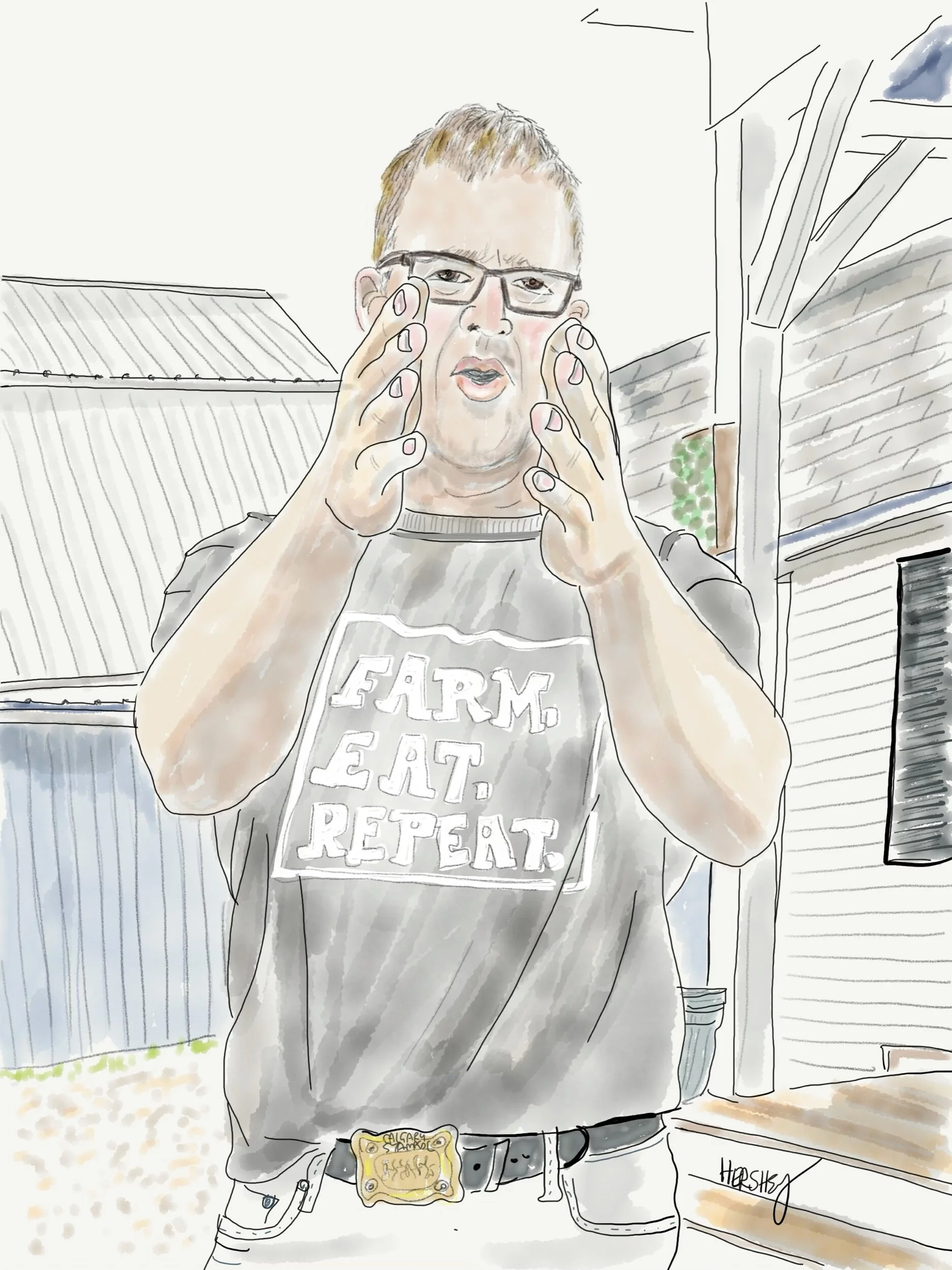
Mark Bernard makes a point about commercial versus organic feedstock. Mark is from Freetown, PEI, and along with his wife Sally converted his traditional family farm in 2002 into a Certified Organic production (primarily as a financial consideration). As their soil management practices improved and they witnessed land and nature respond positively to their organic practices, they started taking organic more seriously. They’ve never looked back. Sally co-manages the expanding Organic Grainery, and together they operate Barnyard Organics. Drawing by Jenny Hershey. Follow her on Instagram @deeofo.
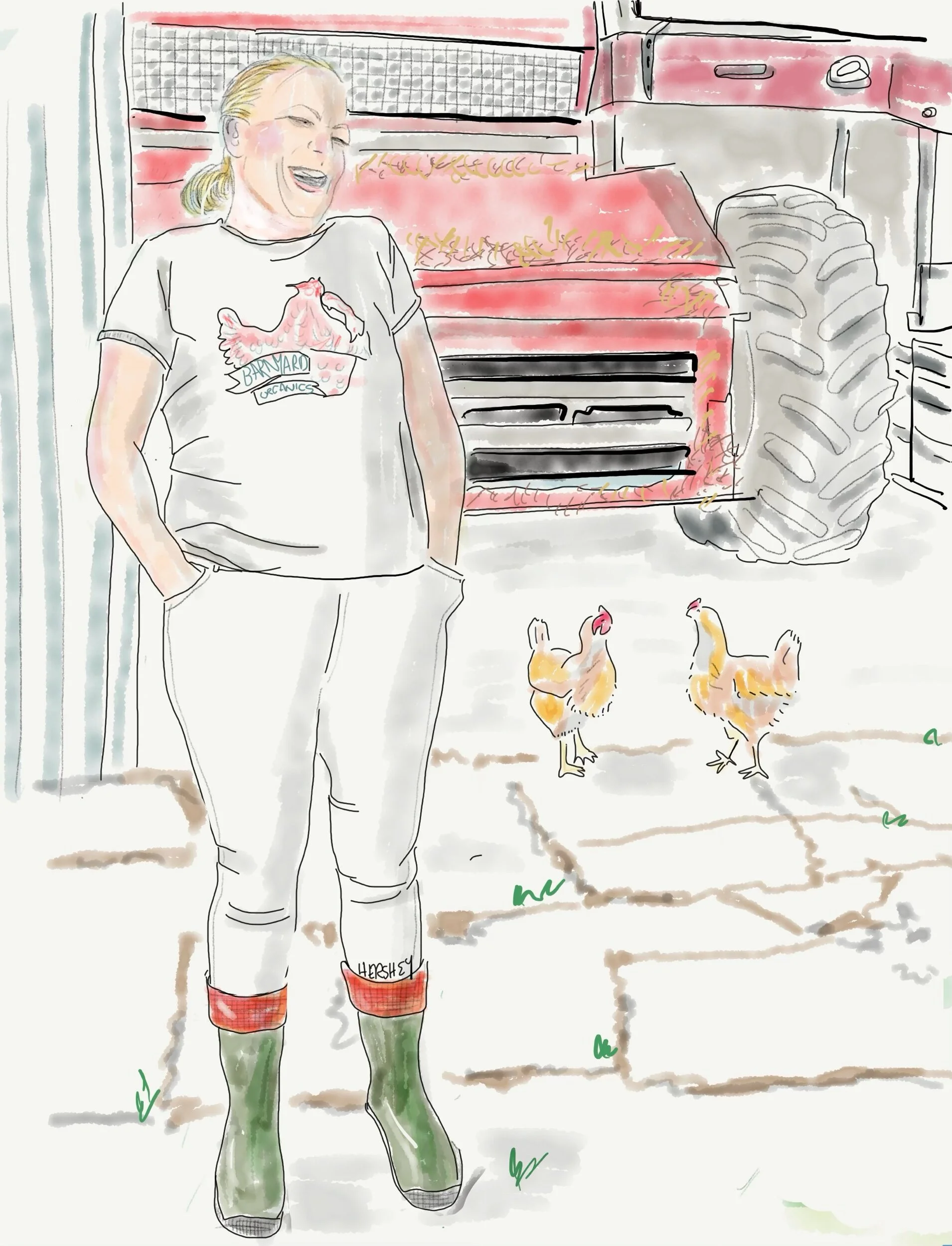
Sally, the youngest of nine from a cattle-ranching family, immediately impressed us with her wit and joy. She met Mark at the Agriculture University in Truro and told us she was immediately smitten. Together they work the land and raise four beautiful children. Sally has a special place in her heart for their three pigs (Dolly, Shania and Reba) and two dairy cows. They no longer raise chickens for market, but they keep quite a few hens for selling pasture raised eggs. Sally dislikes the local Sea Eagles, who will swoop down undetected, lift chickens in their claws and take them away to eat. Drawing by Jenny Hershey. Follow her on Instagram @deeofo.
COPC was established in 2002 and is composed of organic producers and like-minded consumers who wish to see organic agriculture grow within Prince Edward Island. They are a coalition of growers and not a certifying body. Instead, under the Safe Food for Canadians Regulations (SFCR), any food, seed, or animal feed that is labelled organic is regulated by the Canadian Food Inspection Agency (CFIA).
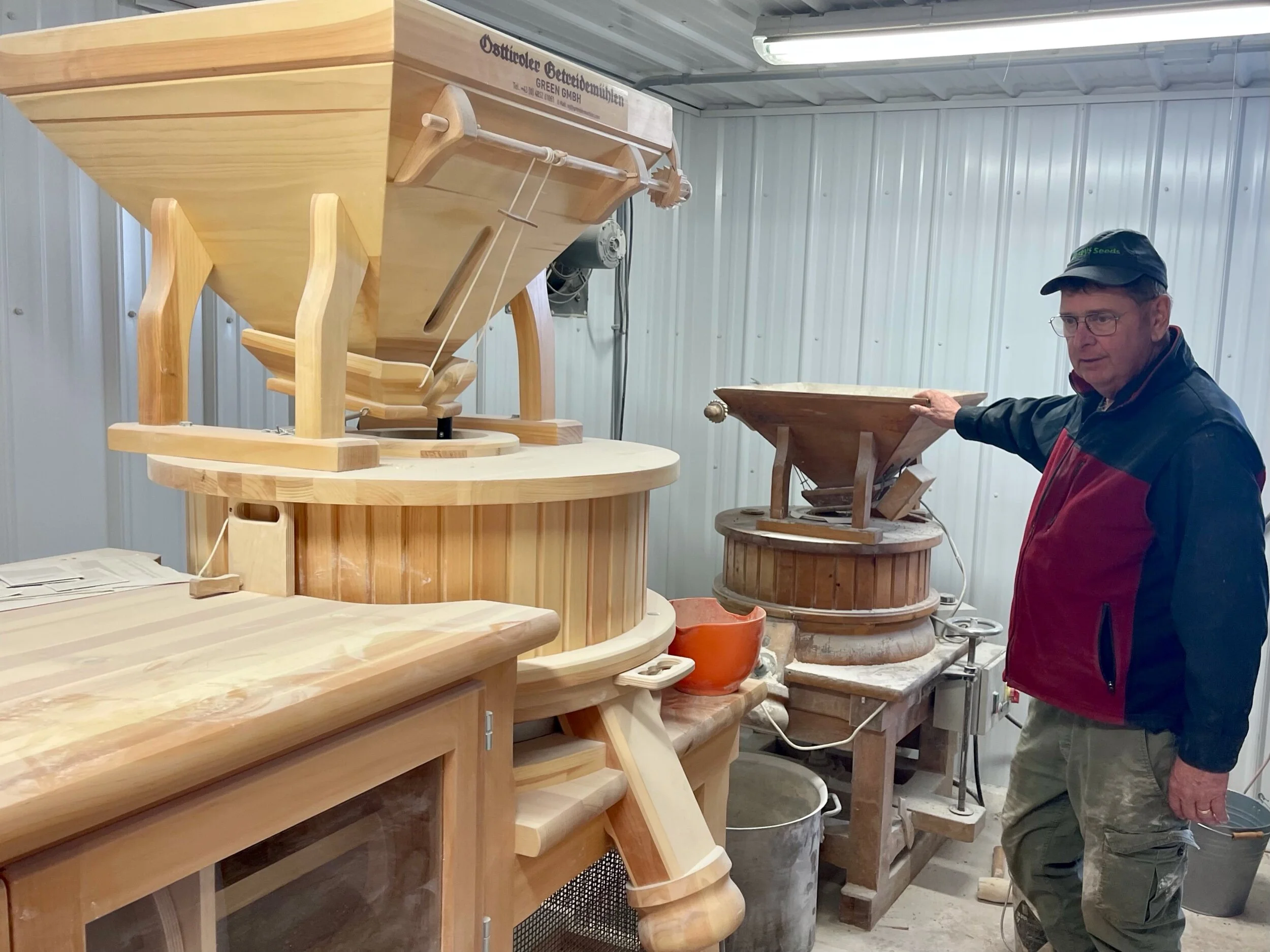
Brian MacCay explains how the multiple grinding and sifting options work on his new flour mill from Austria. Photo by Michael Chase. Follow him on Instagram @mjohnsonchase.
This allows COPC to function as an advocate for organic growers. Their vision entails a vibrant organic industry in PEI, and they are committed to supporting: 1) Quality healthy food for Islanders, 2) A revitalized rural economy and culture, 3) Protecting and enhancing the environment, and 4) A fair income for organic farmers.
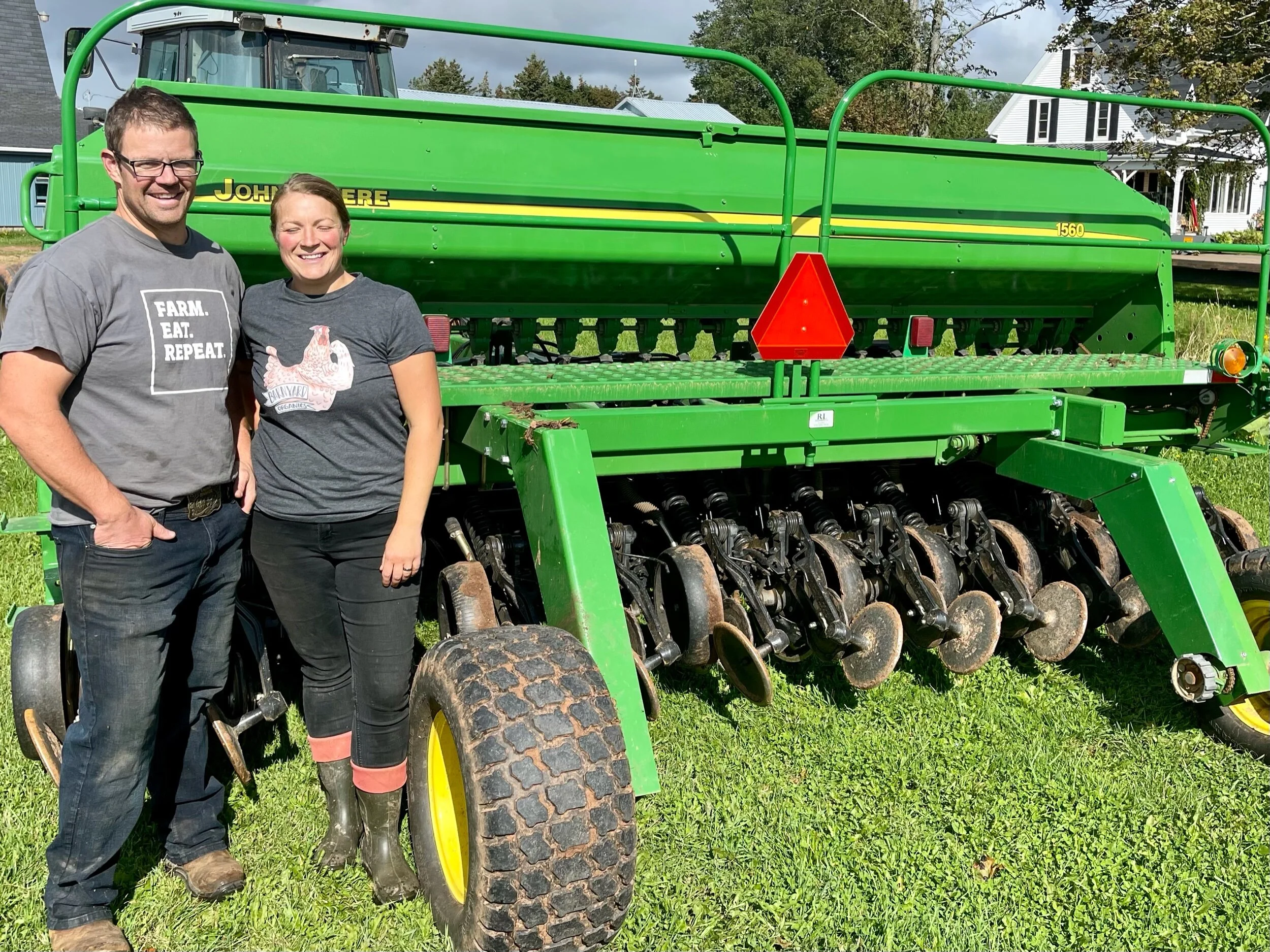
Mark and Sally standing next to their new “no-till” seeder. Photo by Michael Chase. Follow him on Instagram @mjohnsonchase.
This trip has caused us both to think a lot about the foods we eat and their intricate relationship to our changing climate. Clearly, there are wonderful upsides of knowing the farmer who grows your vegetables, grain, meat or fish. When you buy direct from the grower you can ask what he or she did to raise that food. But most of us don’t have that luxury.
However, it’s important we all know that, worldwide, the agriculture sector accounts for 25% of greenhouse gas emissions and as much as 75% of the world’s freshwater use, an issue that has grown more severe in recent decades as more farms have become industrialized to increase productivity. Farmers globally receive roughly $683 billion in government subsidies each year and government aid is expected to more than triple by 2030. Yet roughly 87 percent of these funds currently support industrial farming practices (mainly in the developed world) that harm the environment and human health. They also disproportionately help large corporations at the expense of smaller farmers and make food more expensive for millions of people. These are findings of a new UN report calling for repurposing damaging incentives to achieve more of the 2030 Sustainable Development Goals and realize the UN Decade of Ecosystem Restoration.
The most problematic supports are those tied to the production of specific commodities like corn, soy, or beef, said the study's authors. These funds encourage farmers to grow fewer crops and boost their yield with fertilizers, pesticides and other environmentally harmful technologies. Beyond this approach's environmental impact, the industrial production of a few commodities can make them unnaturally cheap while driving up the price of other, more nutritious foods. For instance, in many developed countries, industrial farms growing major commodity crops such as corn and soy, receive billions to help them stay afloat. Yet, as was stated earlier in this post, smaller-scale, more diverse and sustainable farms - who pollute and use water in significantly smaller quantities - tend to receive minimal or no government support at all.
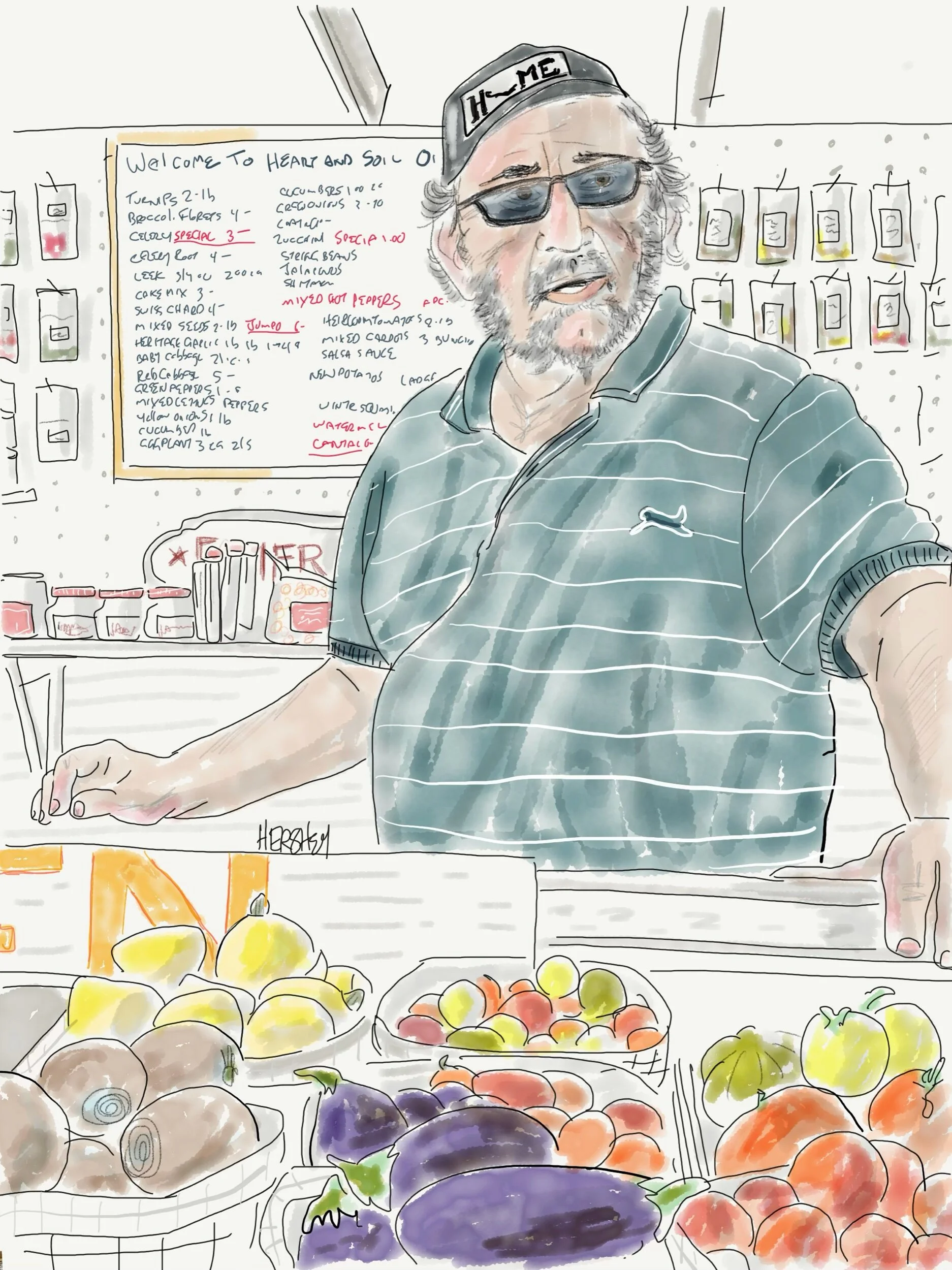
Michael Rossy is a well-known, organic farmer from near Montreal (Runaway Creek Farm in Arundel), who retired as a “hobby” farmer on a lovely farmstead and B&B called Heart and Soul, about 30 kilometers south of North Point in Highway 12. An innovator all his life, Michael currently pushes the envelope by growing and selling - among other unusual things - Asian Pears, Asian Pear Melons and Gojiberries. He enjoys showing locals that anything is possible with great soil, and tender loving care. Drawing by Jenny Hershey. Follow her on Instagram @deeofo.
…If we truly want a sustainable food future, we have to stop looking at food as capital and start looking at long-term land restoration projects, creating healthier soils, and creating more localized growth of food and food sharing that isn't out to make a buck, said Sarah Dunigan, host of the food-focused podcast Anthrodish, as quoted in Canada’s excellent Climate Change newsletter, the National Observer.
In other words, we need to change our values.
Stay vigilant! Thanks for reading. More to come. If you haven’t done so already, please subscribe to this blog, so you can follow our next biking trip later in the fall.
All material, unless credited or otherwise noted, are copyrighted property of the blog post authors.
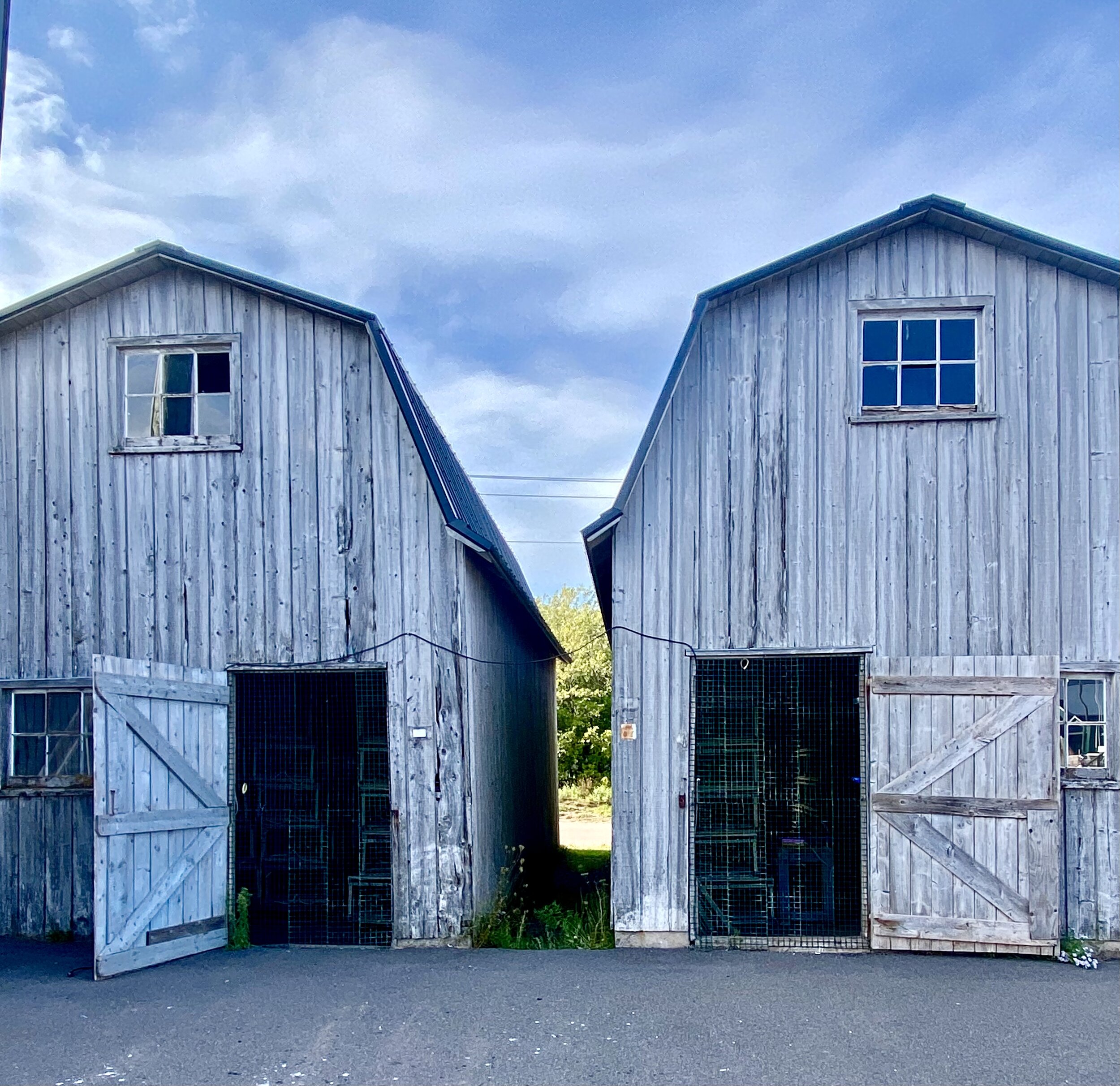
These buildings were on the pier at a small fishing village named Darnley near Rustico. The photo is a favorite of Jenny’s. Photo by Jenny Hershey. Follow her on Instagram @deeofo.
A Carbon Collage; Biking the Great Lakes
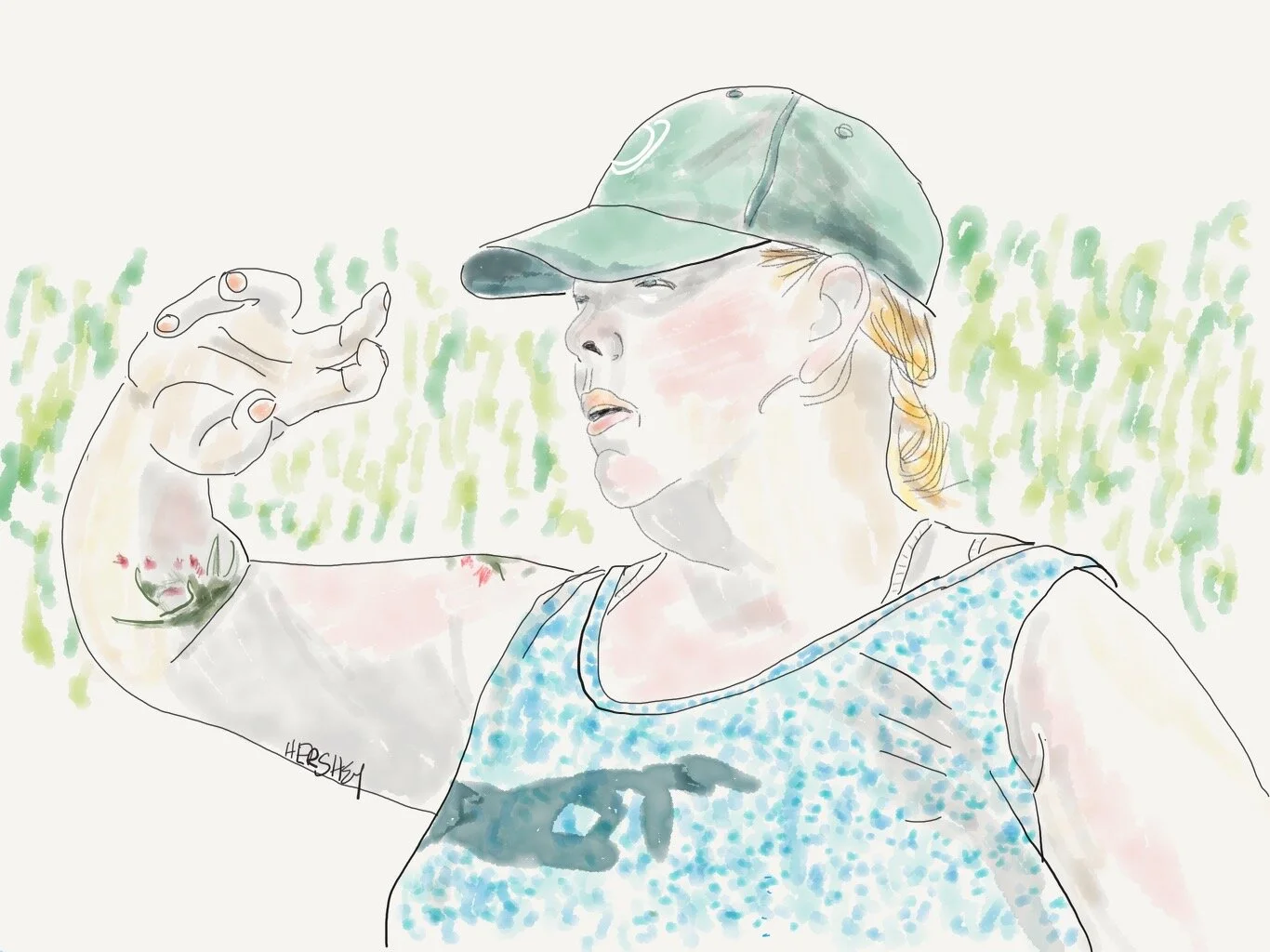
On a hot summer day in July, Molly, a farm manager with Verdant Hollow Farms in Buchanan, Michigan checks in on her happy and well-fed goats (animal welfare approved)!
You cannot escape the responsibility of tomorrow by evading it today. - Abraham Lincoln
The future depends on what we do in the present. - Mahatma Gandhi
We left Jenny’s Prius in Muskegon, MI in a wooded backyard storage area we located through an app called Neighbor. Our intention was to bicycle along the Lake Michigan coast across the Upper Peninsula, south into central Wisconsin and then over to Manitowoc to ferry across the lake back to the Michigan coast. But bicycle trips often inspire improvisation, and our route changed a bit to include both Munising and Marquette on the Lake Superior coastline. Unfortunately, we ran out of time (because we had the happy opportunity to visit my kids and grandkids in Wisconsin) so we didn’t get to some of the incredible places further west in the UP and far northern Wisconsin and Minnesota, but we will on another trip. This incredible north country got under our skin, and opened our eyes to another vast and remote area of this country we now long to see.
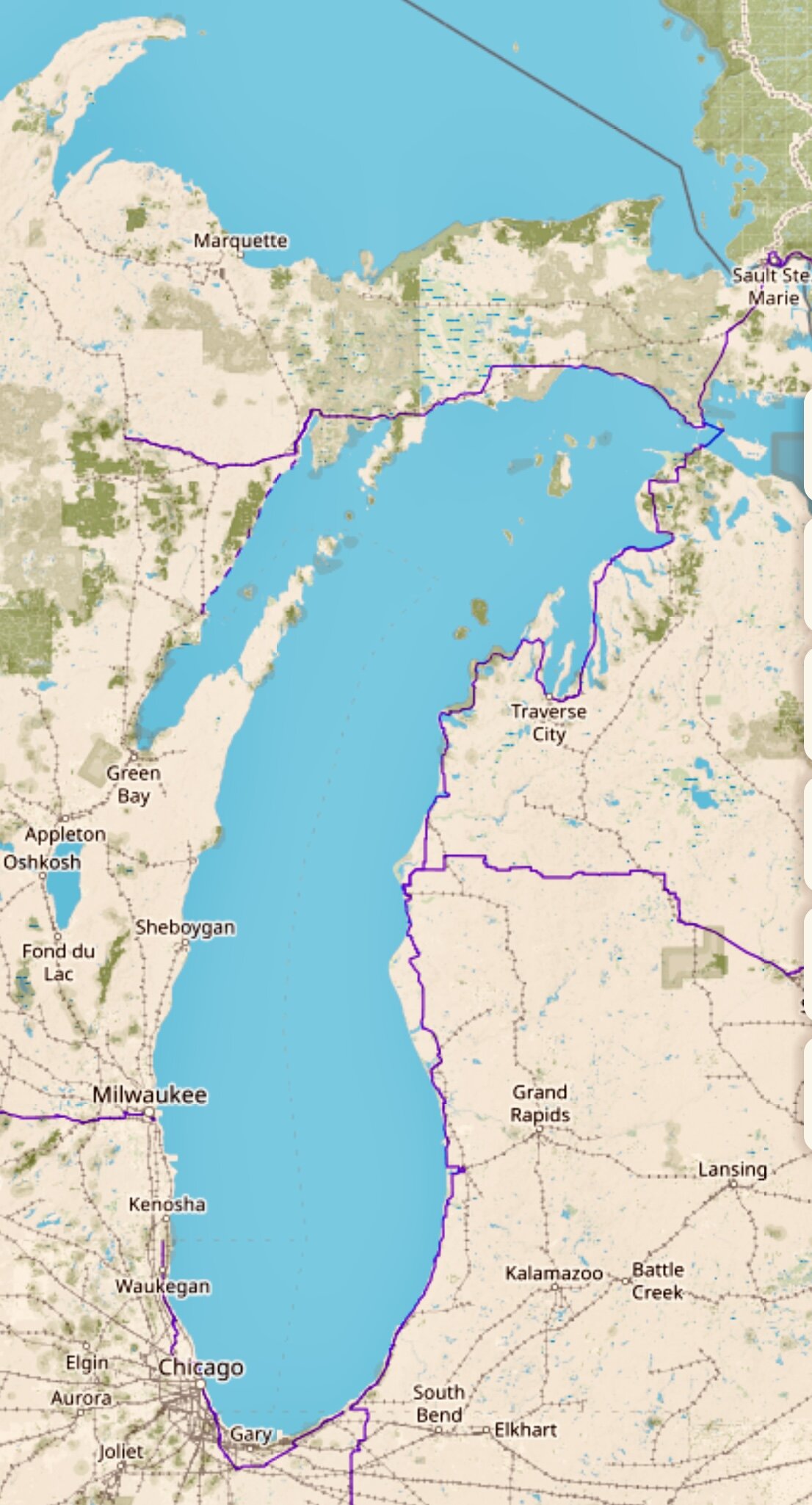
We began in Muskegon on the Michigan shore, rode to the Upper Peninsula, over to Marquette, and down to Manitowoc, WI, where we took a ferry to Ludington, MI and back to Muskegon. After that we visited Verdant Hollow Farm near Buchanan, MI. This map shows opencyclemap.org and United States Bike Route System (USBRS) routes in blue. We follow some of those, and some routes developed by the Adventure Cycling Association. Occasionally we just followed our noses.
Interestingly, the weather around the Great Lakes was pleasant for most of our trip. Although it was hot and rainy when we started, it became only slightly warm, and dry. Given that we track climate events, our enjoyment of good weather was bittersweet amidst the record shattering heat wave in the Pacific Northwest and British Columbia, the persistent drought, relentless heat and horrible forest fires plaguing the American and Canadian west, and the damaging, disrupting and record breaking flooding in Germany and then China.
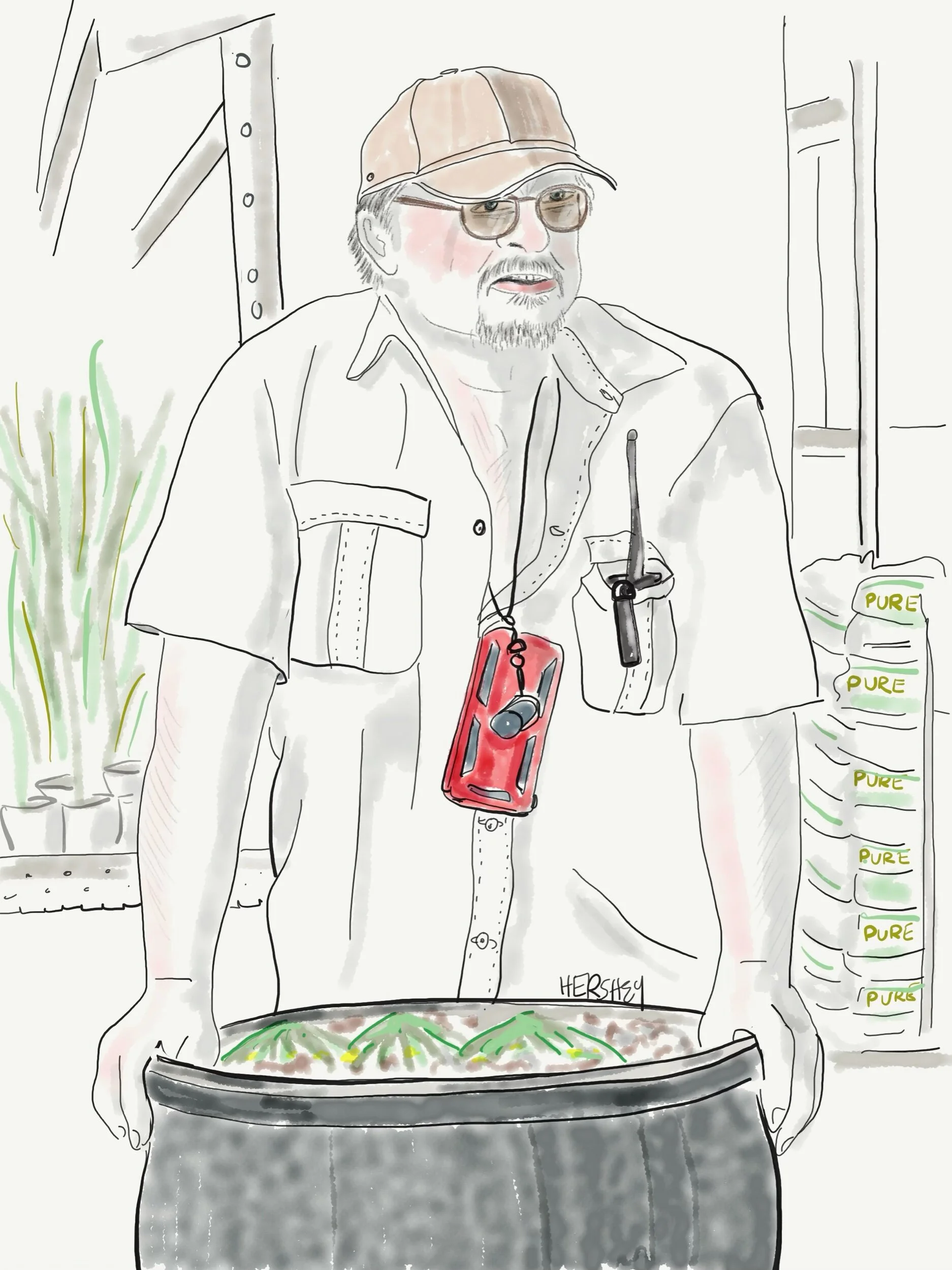
Forrest, the 17th of 19 children, remembers a hard-scrabble childhood in the Upper Peninsula. He now runs a successful roadside flower and vegetable business with his wife. Forrest’s family finally got electricity and running water when he was 6 years old. He joked that he now has more technology around his neck in his iPhone than you can find in a spaceship! He remembers when and how the first pipeline was built across the Mackinaw Straights, and he thinks the proposed new one will be far safer. For that reason he supports it, even though he knows climate change is an existential threat and is a strong supporter of decarbonized future. In fact, he described at some length how different the snow is now in the UP compared to his childhood. Drawing by Jennifer Hershey. Follow her work on Instagram at deeofo.
Like many other climate activists, I’m not surprised by such events, even though they always gnaw at my soul. Yet, every crisis inspires new hope that the inevitable shoe will drop and climate deniers will finally join the rest of the world in trying to solve the climate crisis, or at least get out of the way so others can. But truculent, misguided beliefs don’t die easily. As we boarded the SS Badger with our bikes near the end of our trip I mentioned those events as more evidence of a warming atmosphere to a Trump supporter. I was unhesitatingly told that weather events like that happen all the time, that volcanic eruptions add more carbon to the atmosphere than mankind ever has, and that warming is an act of God and we would be under 4000 feet of ice if it wasn’t happening. And then my tormentor-in-line told me with considerable glee the ferry we were about to take was the last remaining coal fired ferry in operation in the country. He is right about the ferry - and dead wrong about everything else.
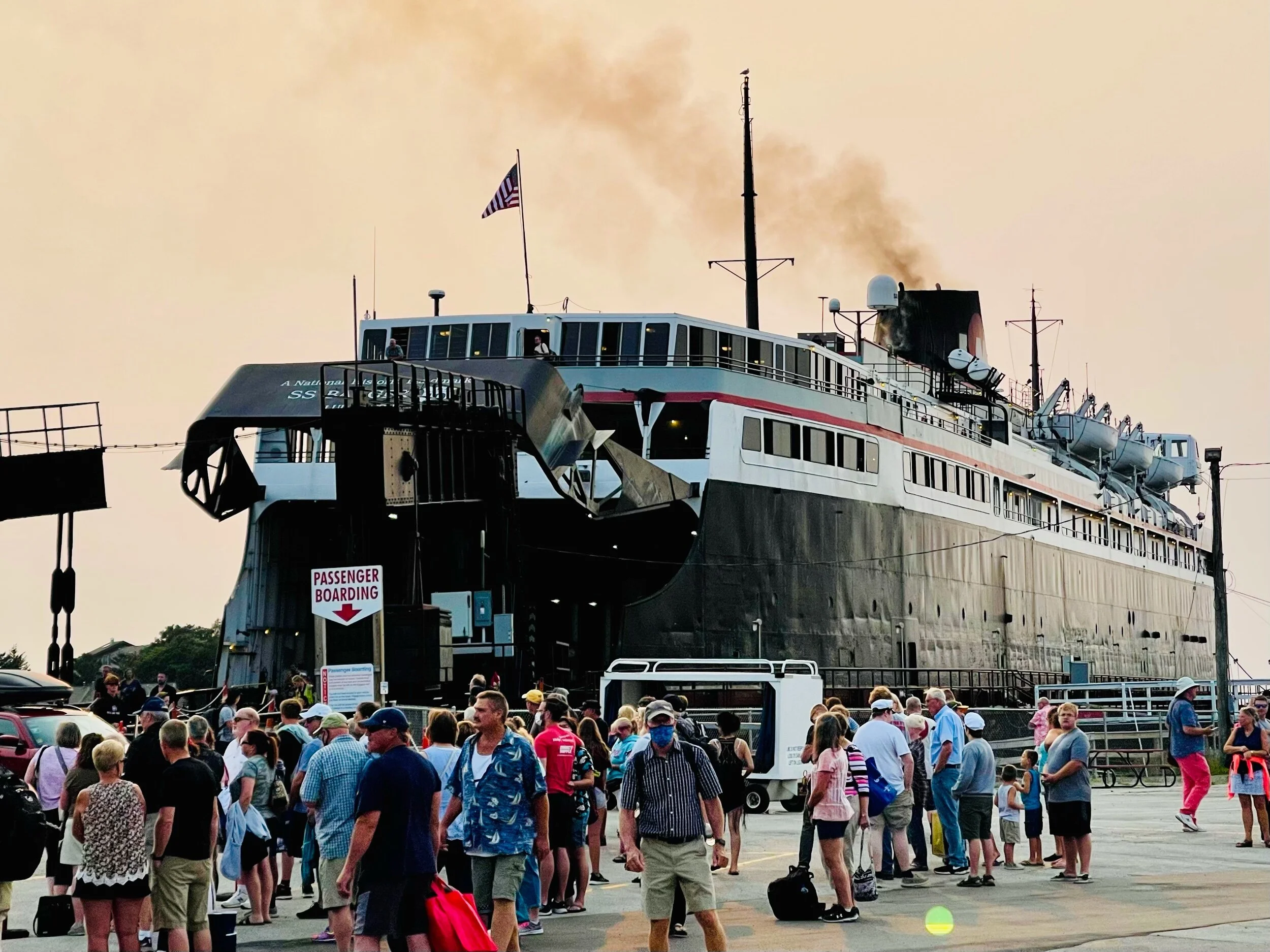
The SS Badger is the last coal-fired passenger vessel operating on the Great Lakes, and was designated a National Historic Landmark on January 20, 2016. The ship came under fire from the EPA and environmental groups in late 2008 because of its daily practice of dumping untreated coal ash from its boilers directly into the waters of Lake Michigan. Burning 50 tons of coal a day produces 3.63 tons of ash. The SS Badger had earlier been the subject of EPA Clean Air action but was granted an exemption under the law due to its historical significance as a coal-fired, steam-powered vessel. Photo by Michael Chase. Follow him on Instagram at mjohnsonchase.
It was a beautiful ride across the lake in placid waters, in spite of the depressing context. I checked the news on my iPhone. To add to my ever present black-humor-climate-despair, I came across an article in Inside Climate that reported the latest projections of the International Energy Agency (IEA) are that greenhouse gas (GHG) emissions will hit record levels again in 2023. Sigh….
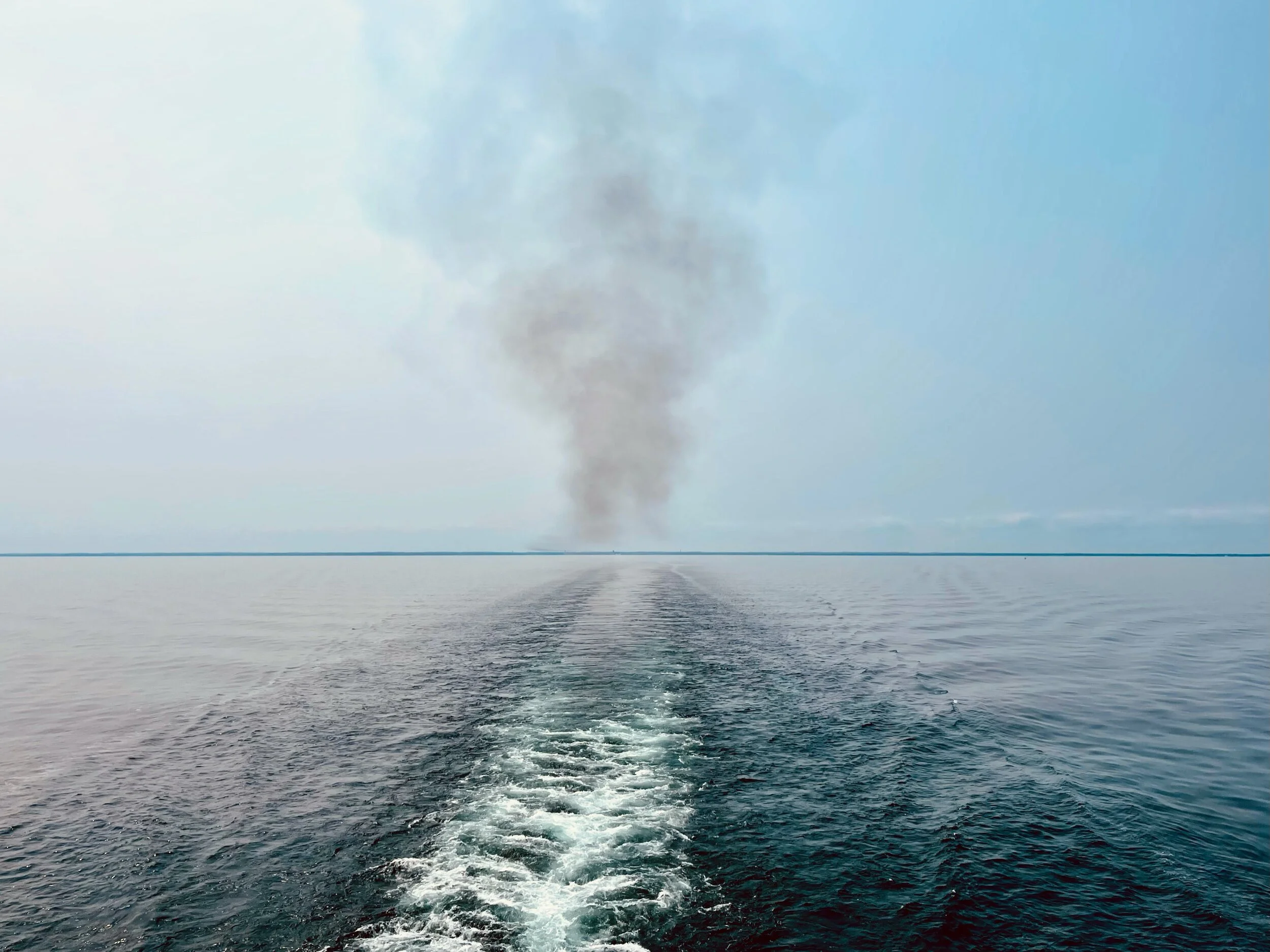
Photo by Michael Chase. Follow him on Instagram at mjohnsonchase.
We disembarked in a cloud of coal smoke.
Nevertheless, the Great Lakes are extraordinary natural treasures. Collectively, they hold about 90% of the freshwater in the United States and approximately 20% of the world's freshwater supply, with Lake Superior alone holding half of it. Both Lake Michigan and Superior can be surprisingly clear, quite colorful and deliciously bracing. In many places the surrounding forests are equally abundant and healthy, although many parts of Lake Michigan coastline are highly developed and coastal forests are a fraction of what they used to be.
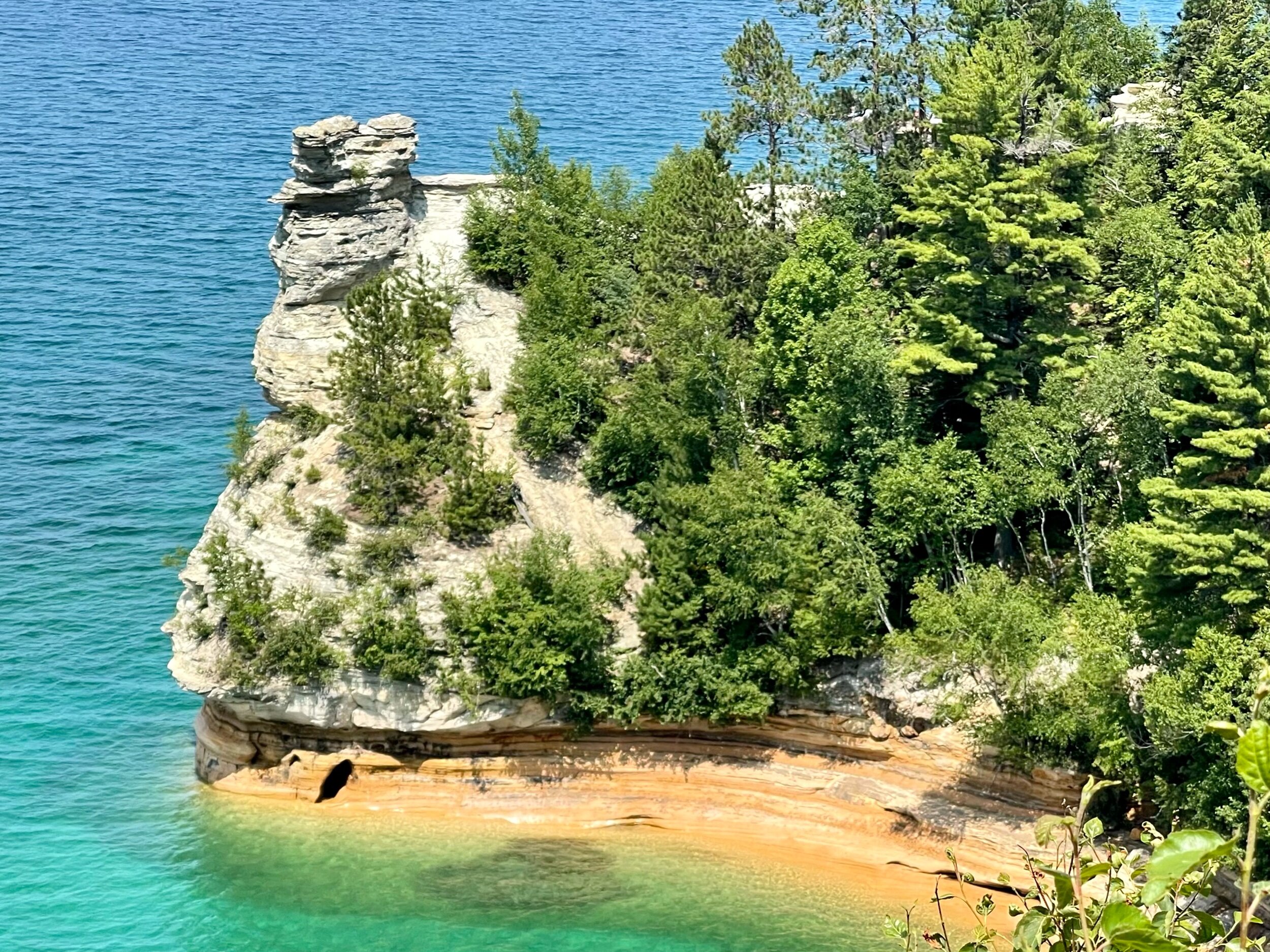
Pictured Rocks National Lakeshore near Munising, MI, where the 200-foot Pictured Rocks cliff face plummeted into Lake Superior earlier this summer. Photo by Michael Chase. Follow him on Instagram at mjohnsonchase.
Like everywhere else on our magnificent planet, the changing climate in the Great Lakes Region has both global and specific attributes. Over the last 100 years global temperatures have increased an average of almost 2 degrees Fahrenheit, and the rate of atmospheric temperature change is speeding up. Increased atmospheric warming creates two opposing physics in the Great Lakes region. Greater heat causes increases in evaporation. Yet, warmer air also causes increases in precipitation during the summer (and decreased amounts of snow in the winter). The competing occurrences of increased evaporation and summer rainfall are currently tipping the lakes toward record levels of lake water, although many scientists believe water levels will eventually drop as atmospheric heat increases and evaporation wins out over precipitation.
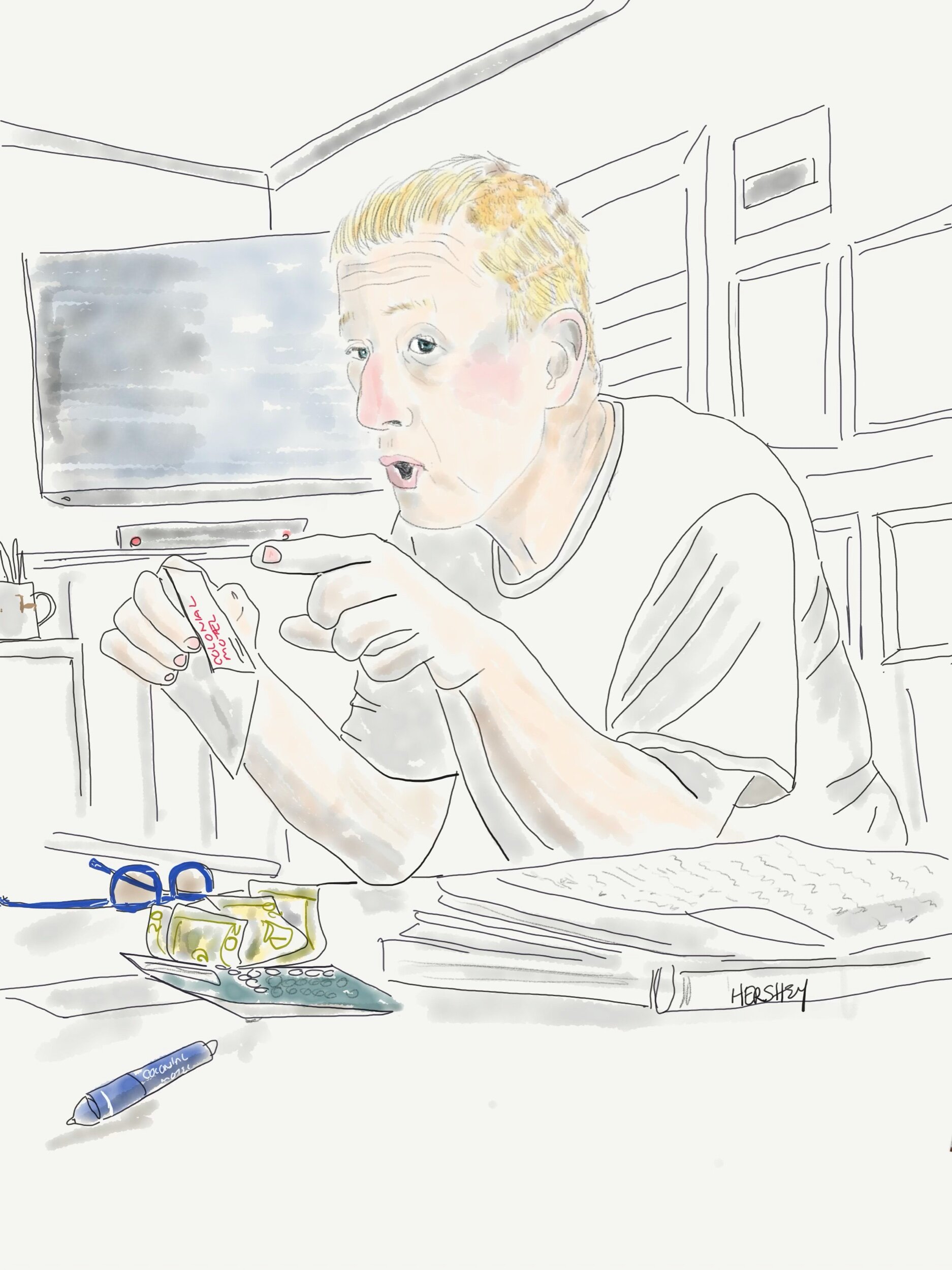
Mike is the owner of the Colonial Motel in Manistique, MI. He leans conservative, and served a few years as a city councilman in a small Indiana town near Chicago, where he became frustrated by local corruption and nepotism. Mike was highly affected by the mortgage collapse of 2007, and spent years scrambling to get whole again. After 4 years of running (and considerably improving) the motel, Mike is now content living with his two dachshunds and his Elvis memorabilia. He told us he has intentionally simplified his circle of influence to those he can impact directly. Something about his story made me question why I get so angry at climate deniers, since they are so clearly out of my circle of influence…. Drawing by Jennifer Hershey. Follow her work on Instagram at deeofo.
Either way, the result won’t be as pleasant now as predictable as weather was before the Anthropocene began (the geological epoch when human activity began to change the atmosphere, ending the Holocene). In the meantime, the average temperatures of lake water everywhere are warmer than they used to be. Perhaps you’ve noticed an increase in algae blooms on fresh water near you, which is driven by a combination of increasing temperatures on still water and fertilizer runoff. Consider them another version of a canary in a coal mine.
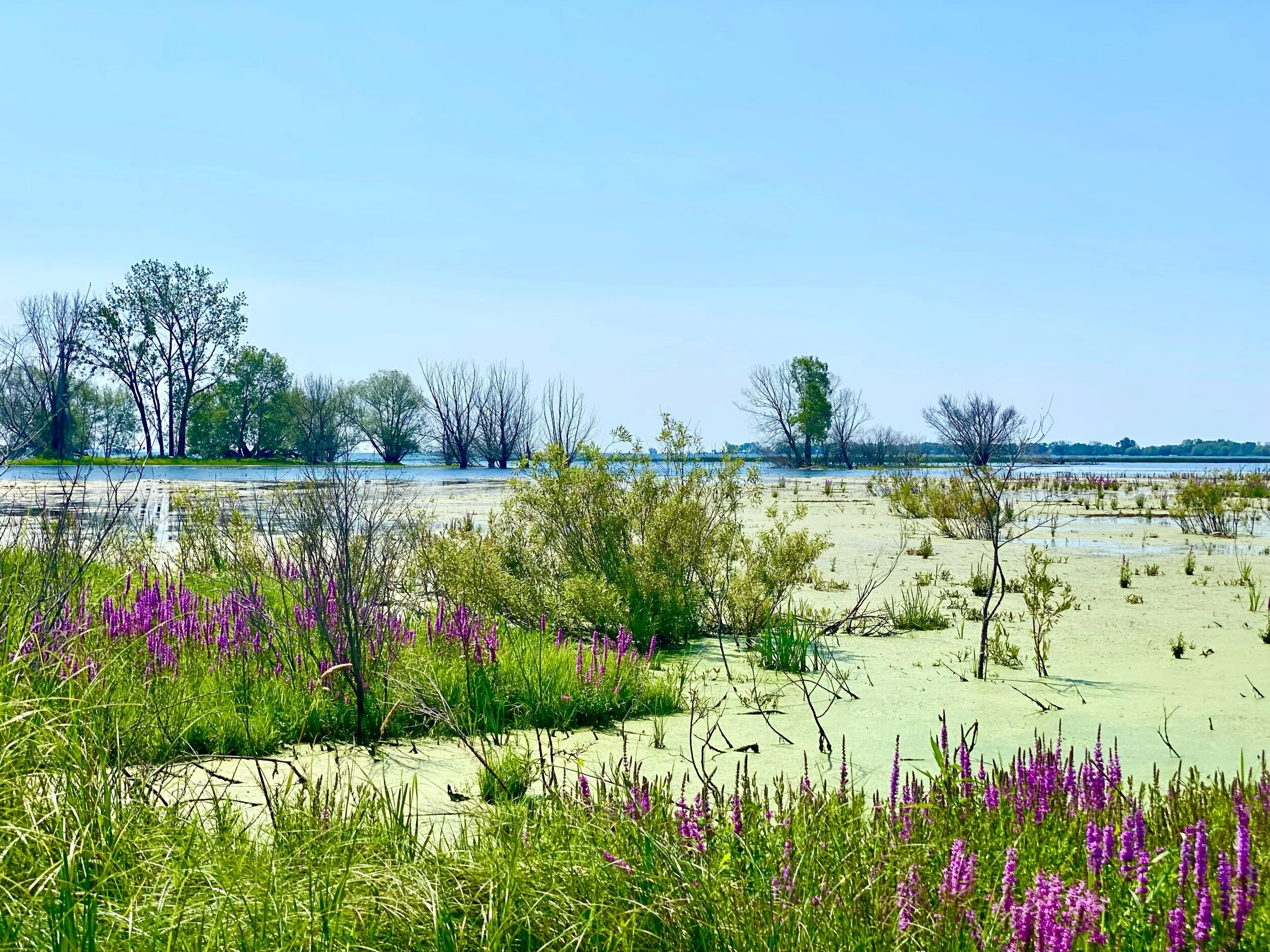
As beautiful as they are, these algae blooms on marshland on the Lake Michigan shoreline near Little River, WI are killing most of the life underneath them by depriving the water of oxygen. Photo by Jennifer Hershey. Follow her on Instagram at deeofo.
In fact, some of the surfaces of the world's largest lakes are warming faster than ocean and air temperatures. Lake Michigan surface temperatures are estimated to be warming at a rate of as much as a third of a degree Celsius per decade. The overall warming, ice loss and shrinking winters could lead to long-term shifts, altering the lake's food web and sending fisheries into uncharted territory.
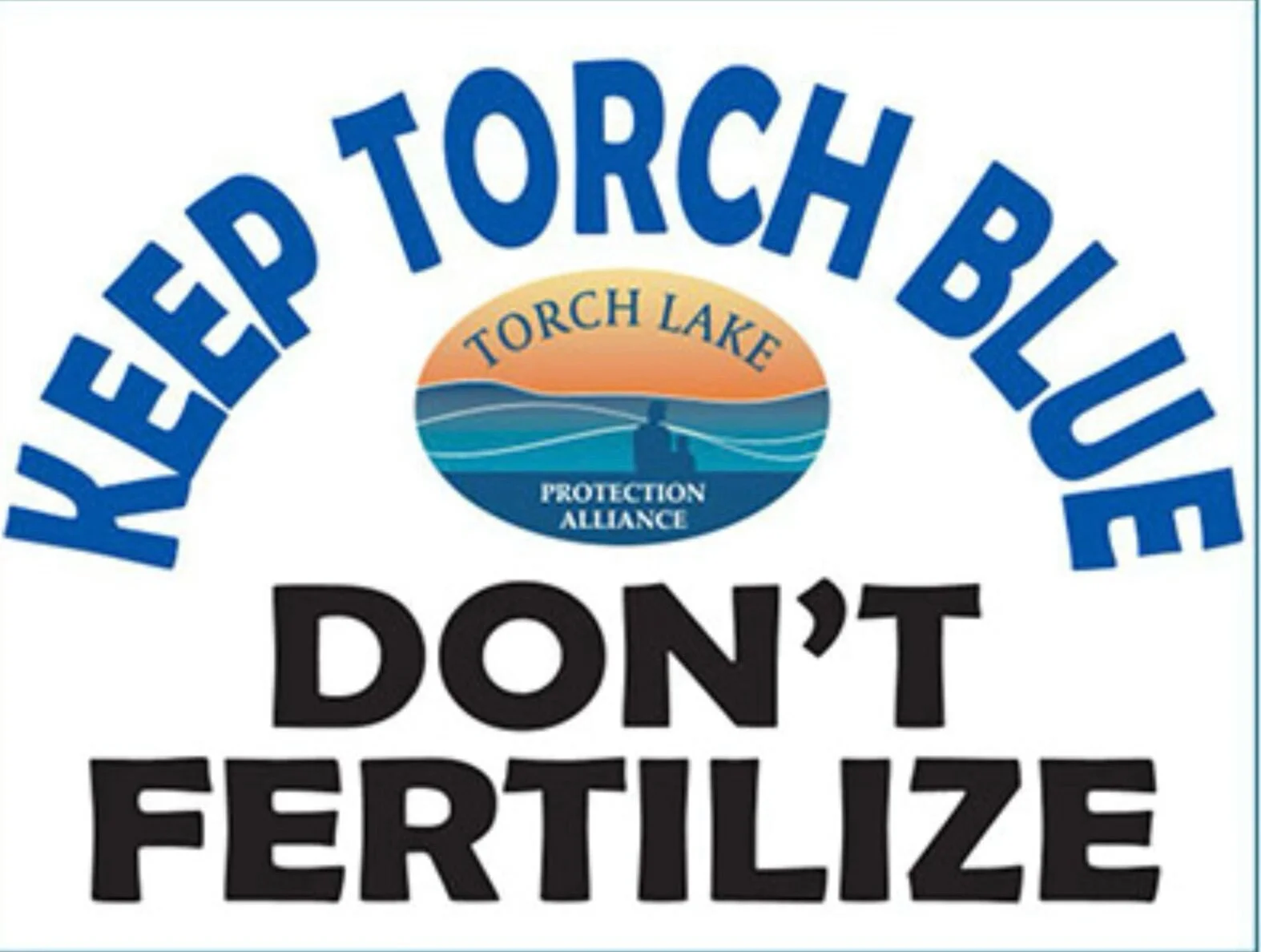
We saw these signs all over lawns on Torch Lake between Traverse City and Charlevoix, MI. Clearly, homeowners on the lake are realizing that fertilizers of any type (organic or conventional) result in phosphorus and nitrogen runoff, which feeds toxic algae and, with the help of warmer temperatures, results in uncontrollable blooms on the lake. It’s gratifying to see homeowners come together in an attempt to make smart choices. Photo by Jennifer Hershey. Follow her on Instagram at deeofo.
It’s July and the Michigan countryside is quite verdant. Some of the beauty around us is the result of the largest single land protection project in Michigan state history.
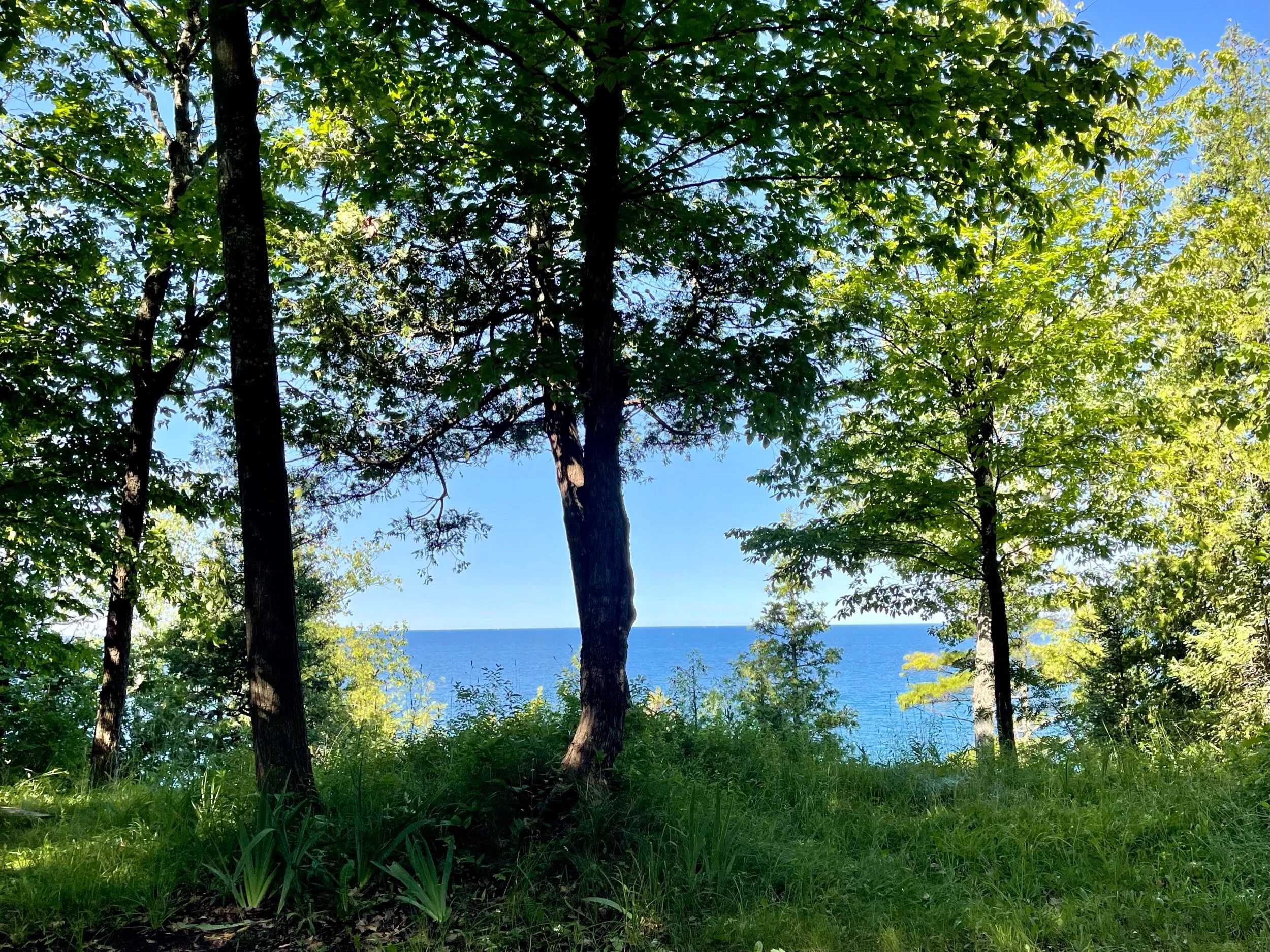
The work of The Nature Conservancy, the Northern Great Lakes Forest Project, protects 271,338 acres stretching across eight counties in Michigan’s Upper Peninsula. Their work is evidence that not all land use and conservation easement projects are the same, and paying attention to the details reveals a lot. By adopting an innovative "working lands" approach to conservation, this project not only provides the people of Michigan with the permanent protection of some of the state’s most treasured landscapes, but also helps protect thousands of timber and tourism jobs that working families in the area rely on for their livelihoods.
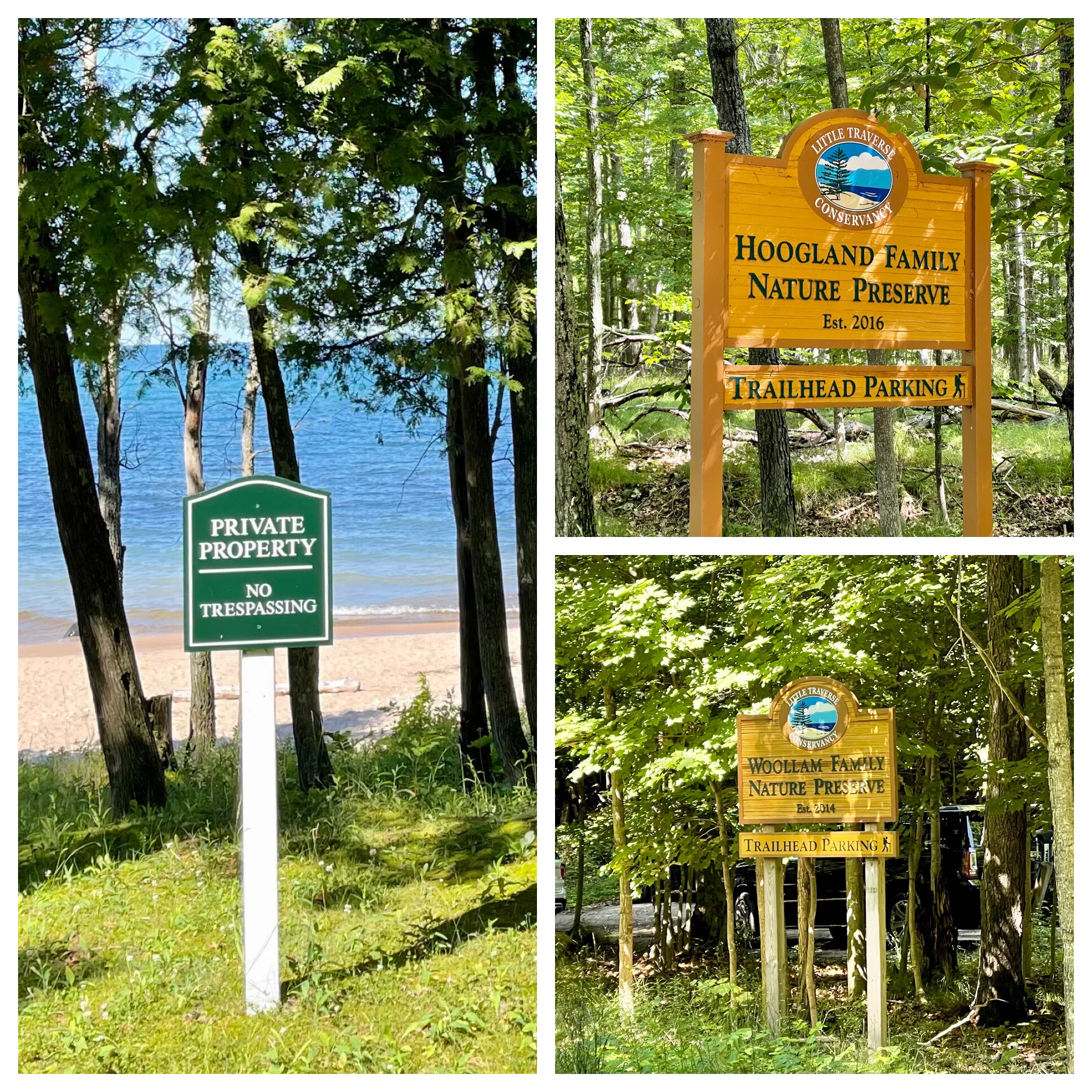
There are also 158 miles of private lakeshore property in smaller land trusts on the lower Lake Michigan shoreline with 110 miles of hiking trails on Little Traverse Bay above Traverse City on the Lake Michigan Coast of Michigan. Much of that land is set aside as conservation easements through the Little Traverse Conservancy, in land trusts on property with large secluded homes. (Yes, tax breaks for wealthy landowners.) However, much of Lake Michigan beachfront is privately owned and not publicly accessible. Photo by Michael Chase. Follow him on Instagram at mjohnsonchase.
In addition to seeing references to numerous land use projects, we are also seeing very little exposed soil. This is notable to my fledging eye as we bike along at about 15 miles an hour. Only in the last year have I learned how to identify the more obvious signs of carbon-poor soil. I’ve seen little of it this trip, and find myself wondering what we would notice if we were biking in Michigan in the Spring or Fall. Would we see the cover crops and evidence of reduced tilling that characterizes regenerative farming?

Kevin lives in his meticulously customized and highly efficient Mercedes van with his two bikes. He supports himself by selling stickers but his passion is his YouTube channel nomad bike rider. (He interviewed us; check it out!) We had stopped for a momentary rest near Marquette when Kevin approached us and said he had just seen a bald headed eagle fly over us into a nearby tree. Together we found the eagle. Drawing by Jennifer Hershey. Follow her on Instagram at deeofo.
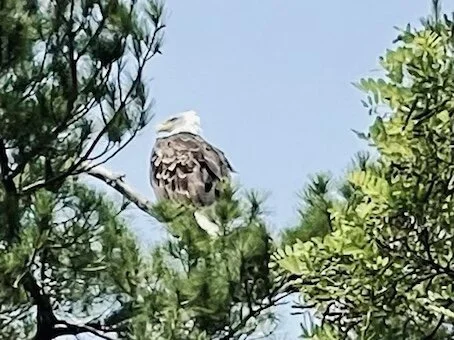
The eagle resting in a tree on the Lake Superior shoreline. Photo by Michael Chase. Follow him on Instagram at mjohnsonchase.
Or would we see the more common large tracts of exposed soil that are common to industrial farming? I suspect the latter, even though every square inch of soil that is not covered by buildings, concrete, algae blooms, water, gravel pits and human waste is green. Deep green. The Midwest in a hot and wet July is an experience in intensity; the green poetry of explosive photosynthesis is everywhere, it literally sticks to one’s skin and gets up one’s nose. You can smell things growing. And just as the earth keeps reminding me it’s not about to give up on life even if the human race fails itself, I see hopeful things every day as citizens from both political parties take on troublesome issues to protect their local environments. Here are some of the many examples we encountered.
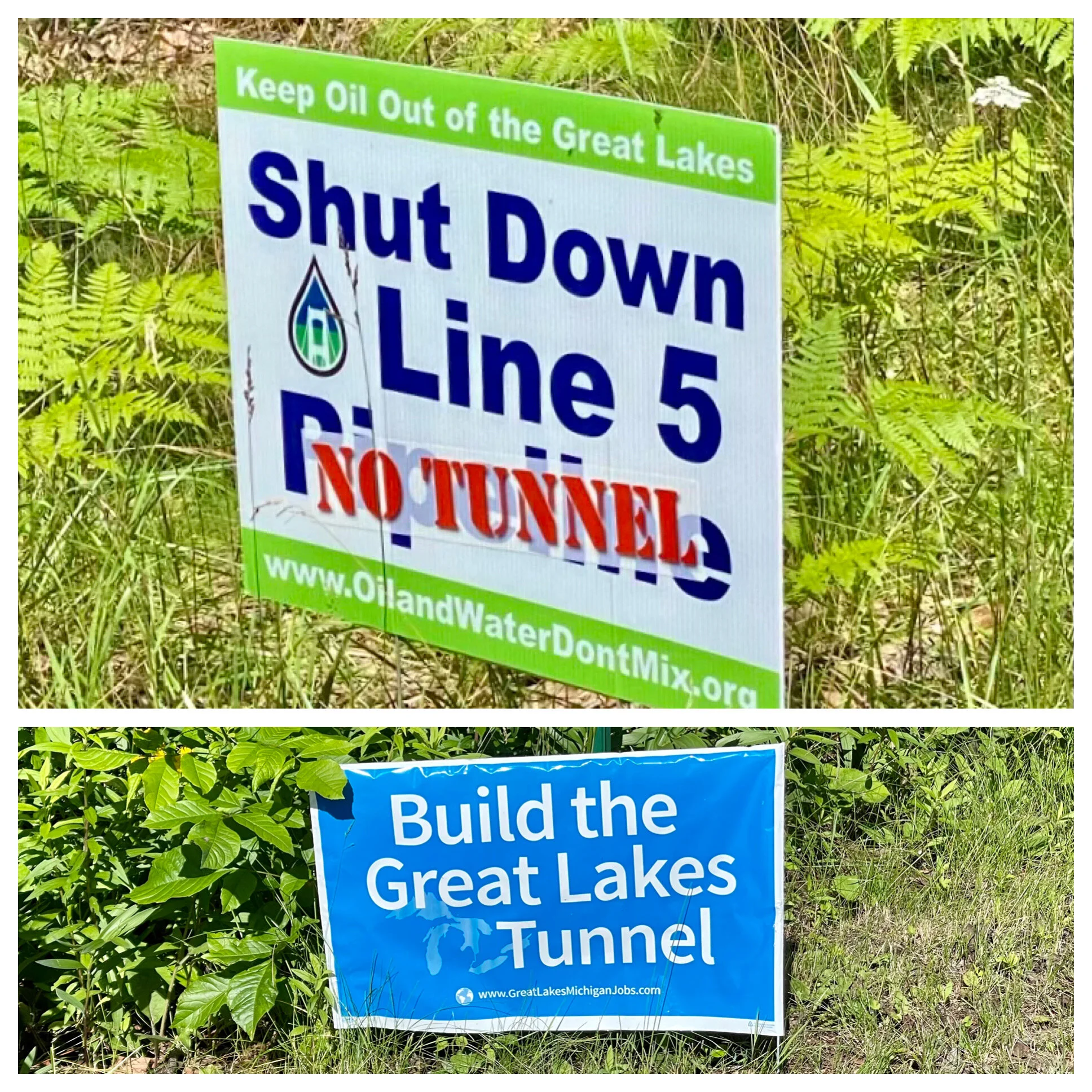
We saw many similar signs as we crossed the Mackinaw Straights (by ferry from Mackinaw City to Mackinaw Island and then to St. Ignace) and ventured into the UP. Turns out that Pipeline #5 is a proposed replacement pipeline for a current one that already traverses the straights. Built in the 1950’s the current pipeline is a steel tube on the bottom of the lake secured by concrete slabs. Enbridge (the same company that built sections of the currently abandoned Keystone Pipeline, as well as the pipeline that caused the largest on-land oil spill in US history in Kalamazoo, MI in 2010) says the new tunnel will be far safer than the current one with its aging steel and inadequate infrastructure. Opponents say otherwise. Later in the trip we saw a similar sign for Pipeline 3, another Enbridge Pipeline “replacement” project that cuts through northern Minnesota. Here’s an interesting You Tube presentation on Line 3. Photos by Michael Chase. Follow him on Instagram at mjohnsonchase.
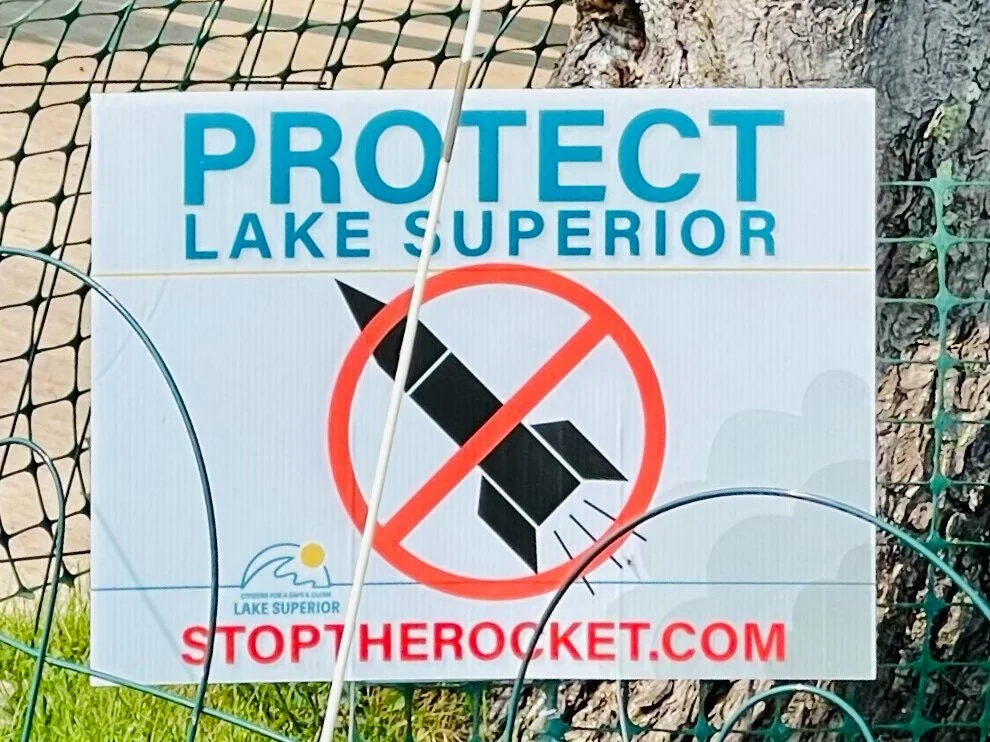
With all the media attention given to Richard Branson’s and Jeff Bezo’s recent journeys to the outer edge of our atmosphere, it was interesting to see these signs in a community that doesn’t want to spoil the Granot Loma’s pristine Lake Superior coast with a commercial rocket launch site. Photo by Michael Chase. Follow him on Instagram at mjohnsonchase.
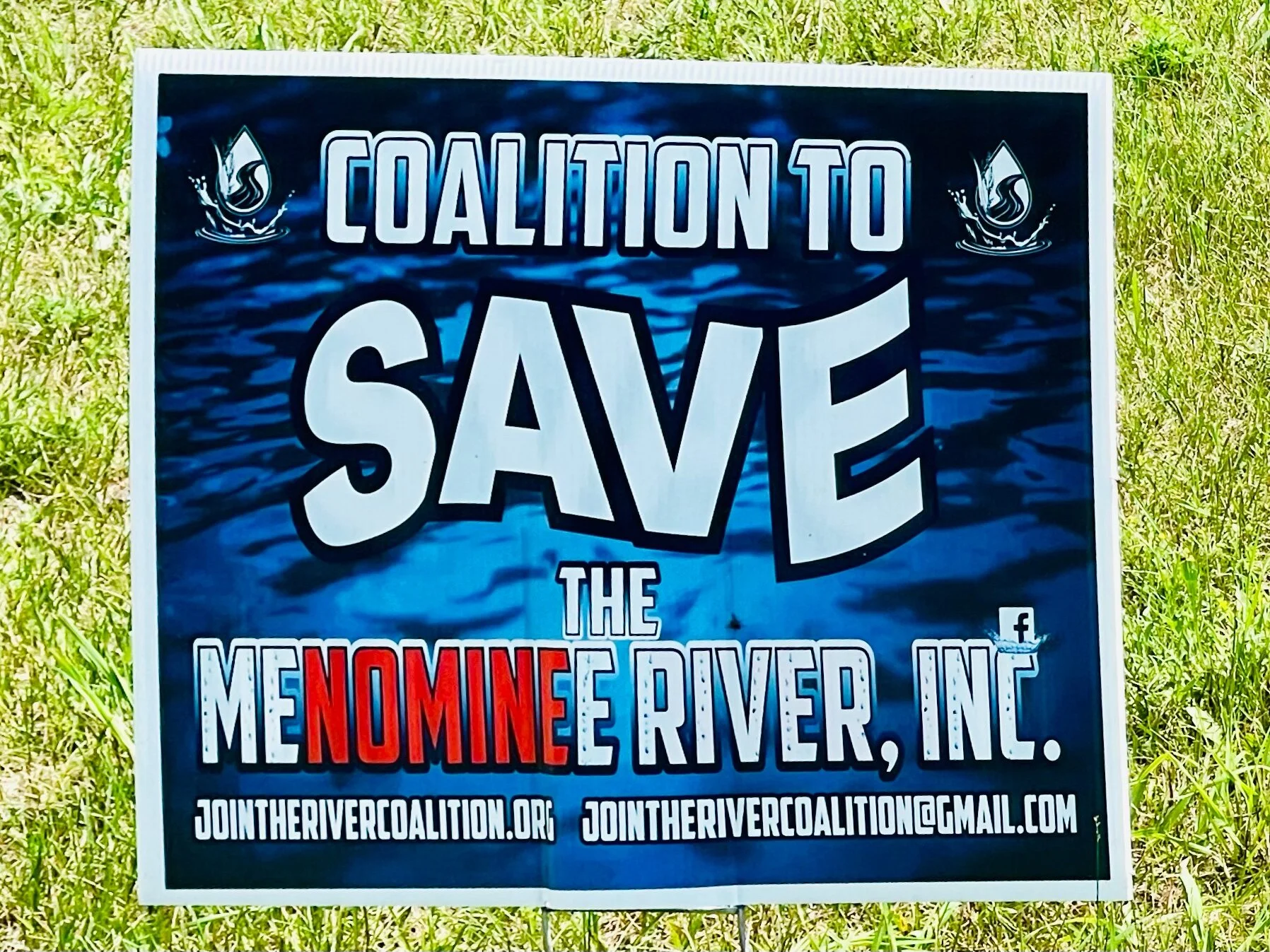
Many locals oppose the construction of the proposed Back Forty Mine on the Menominee River, and believe they are saving lives because the mine will contaminate air, water and soil, and endanger wildlife, property values, sacred lands, local tourism and permanent residents. Photo by Michael Chase. Follow him on Instagram at mjohnsonchase.
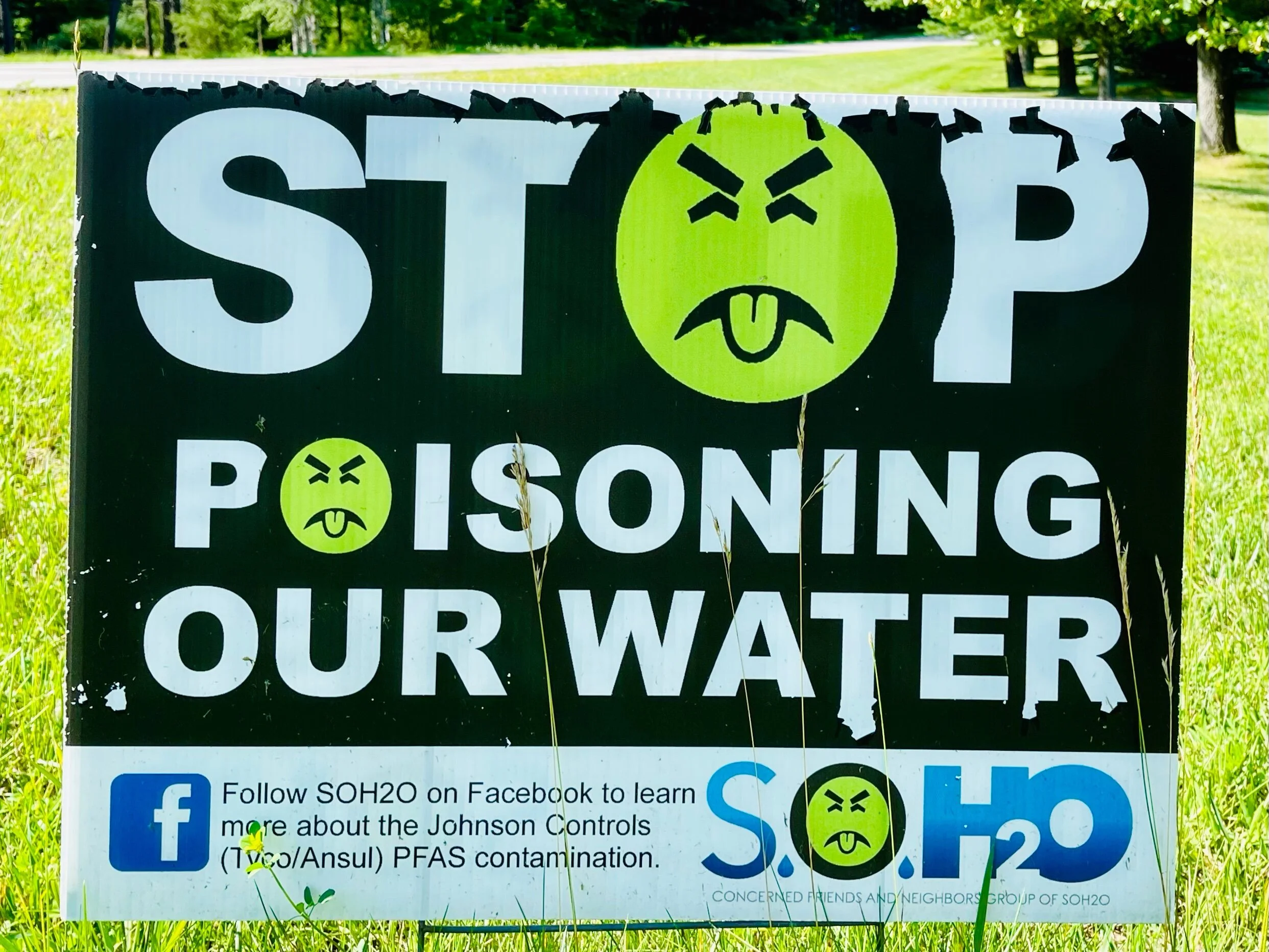
We noticed this sign near Peshtigo, WI, and realized we had wandered into a local struggle between Wisconsin residents and Johnson Controls-Tyco, a PFAS-infused firefighting foam manufacturer. For years there was no Clean Air or Water Acts watching out for the environment, and people weren’t thinking about potential air quality impacts or soil, surface and groundwater contamination. Then, in 2017 the Wisconsin DNR announced PFAS contamination in the Marinette/Peshtigo area as the highest known in the state. That’s when local residents learned that many private wells were situated in the center of the contamination plume. Shortly after that they formed a small group, concerned friends and neighbors, which later morphed into SOH2O, Save Our Water. Photo by Michael Chase. Follow him on Instagram at mjohnsonchase.
On a happier note, this past June the US Senate passed the Growing Climate Solutions Act of 2021 by a vote of 92-8, a remarkable bipartisan achievement for our divided Congress. Currently, there is a companion bill awaiting a hearing by the House Committee on Agriculture. If passed by the House, this legislation will make it easier for landowners to participate in the voluntary marketplace to sequester carbon and reduce greenhouse gas emissions. This bill tasks the USDA with ensuring that third-party verification of projects is accessible and affordable by providing technical assistance and creating a certification program.
Basically this means farmers, ranchers and foresters will be able to sell carbon credits as offsets to others in the voluntary carbon market in exchange for the carbon they sequester in their soil by using regenerative agriculture practices. They can then sell those credits (as offsets) to others who are looking to lower their overall carbon emissions as a form of trade. With this legislation, projects can also sequester carbon through afforestation (tree planting), cover cropping, low or no till farming, conservation and wetland easements and numerous other “healthy soil growing” applications.
Carbon offsets allows individuals, companies or even governments to pay to reduce their global greenhouse gas (GHG) emissions total instead of making radical or impossible reductions of their own. GHG emissions mix quickly with the air and, unlike other pollutants, spread around the entire planet. Because of this, it doesn't really matter where GHG reductions take place if fewer emissions enter the atmosphere. It’s important to note that to date, voluntary carbon markets have failed to lower the steady global rise in carbon emissions, although they probably have slowed the rise to a small degree. As the voluntary carbon market increases in size (which this bill will accelerate) it may help to decrease the global rise in carbon emissions more significantly. For a more in depth look at the voluntary carbon market, take a look at my 2018 blog post: Thinking about Carbon. You can also check out this excellent post from the University of Kentucky: Carbon Markets 101.
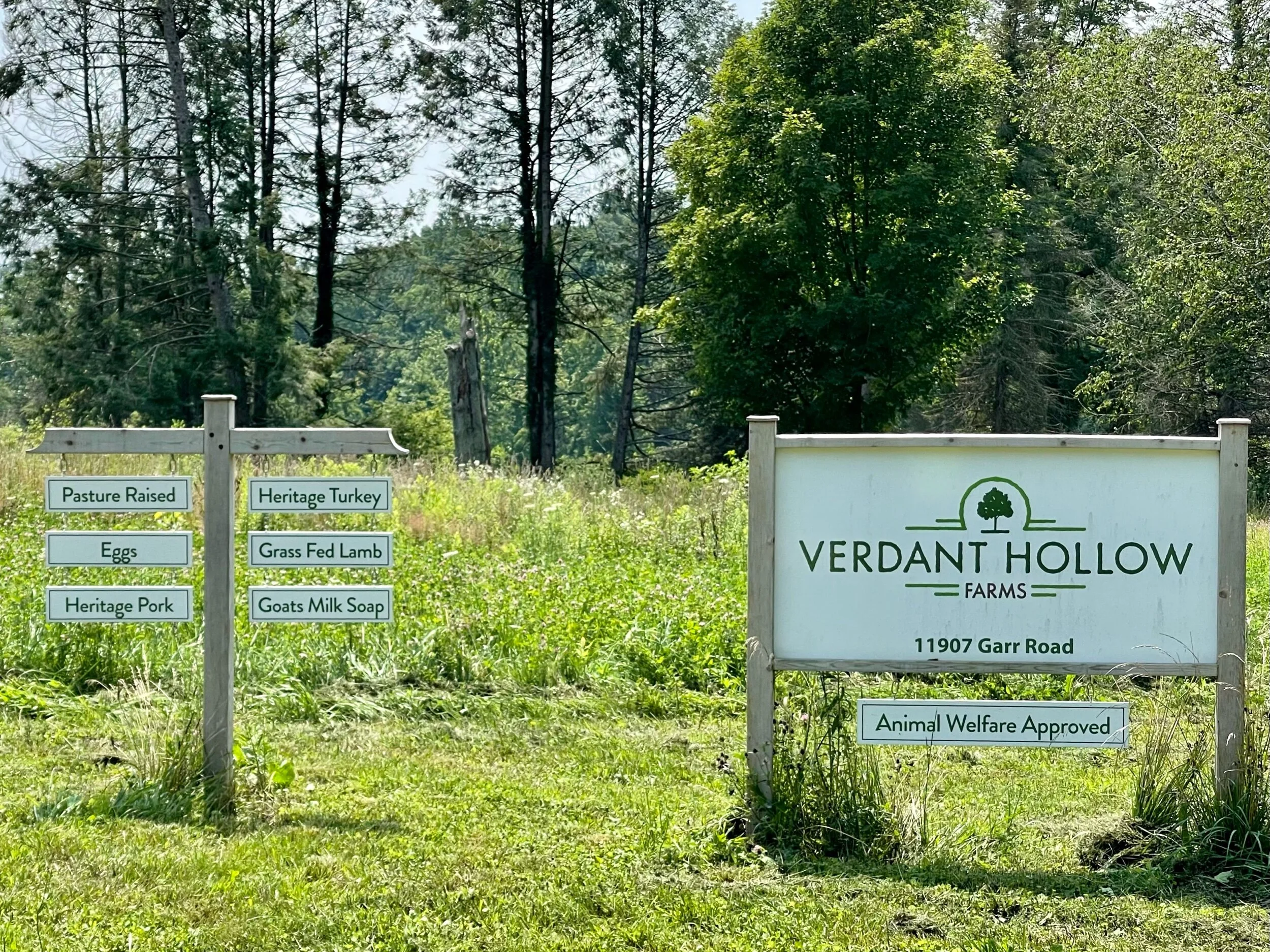
The entrance to Verdant Hollow Farm in Buchanan, MI. This farm has the highest rating for animal welfare approved and is gradually changing over fields once farmed by others as conventional corn and soy to perennial feed crops for grass-fed animal stock and soil-based carbon sequestration. Photo by Michael Chase. Follow him on Instagram at mjohnsonchase.
Some environmentalists doubt the validity and effectiveness of carbon offsets. Because the commercial carbon trade is an emerging market, it's difficult to judge the quality of offset providers and projects. For example, trees don't always live a full life, sequestration projects for long-term containment of emissions sometimes fail to deliver genuine results, and offset companies occasionally deceive their customers with less than transparent measurement practices. Most importantly, voluntary offsets can easily become an excuse for doing the real work to decarbonize our economy. And finally, some environmentalists worry that soil-based carbon sequestration measurement capacities are sill more of an art than a science. Others say that doesn’t matter because it works regardless, and measurement accuracy is a secondary concern. Because we have no time to waste, I lean toward the latter view. Regenerative farming is an important solution for the climate crisis. It improves water quality, soil erosion and microbial health, and reduces reliance on harmful fertilizers, fungicides and pesticides, creating a win-win for both farmers and consumers regardless of the successes of soil-based carbon sequestration. Converting is a smart move for many reasons, not the least of which is lower input costs for fertilizers and chemicals, resulting in increased profits. Perhaps that’s why 92 Senators in our very partisan Congress voted for the new bill.
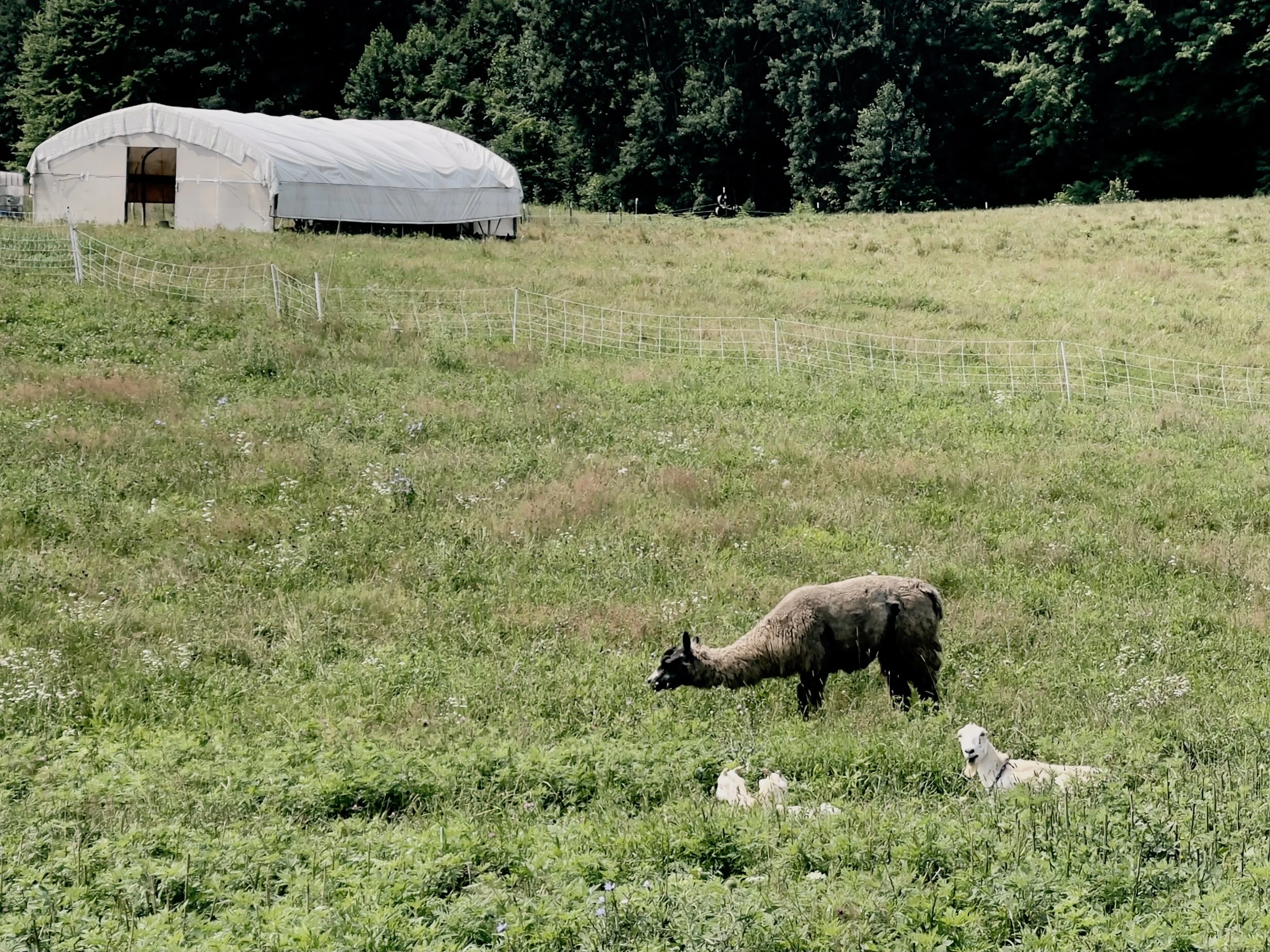
An 11 acre field planted in a diverse perennial cover crop at Verdant Hollow Farm. On the upper left is an open chicken coop, below is a llama and baby goats. The cover crop is very healthy and the animals appear content. This field is divided into 8 paddocks and animals are regularly moved to fresh fields to allow the previously used field to regenerate, which draws down soil-based carbon. Photo by Michael Chase. Follow him on Instagram at mjohnsonchase.
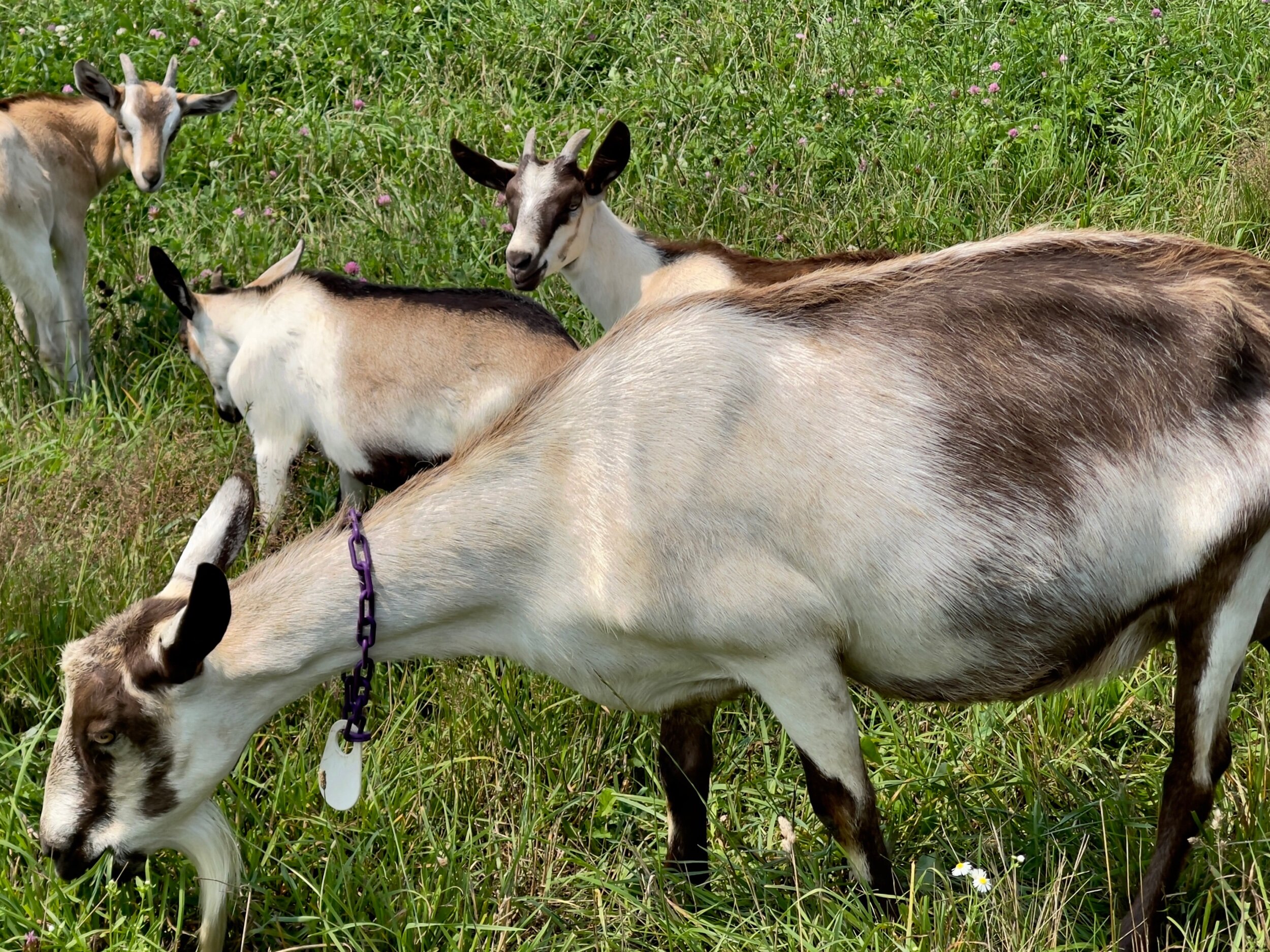
Happily grazing goats at Verdant Hollow Farm. Photo by Michael Chase. Follow him on Instagram at mjohnsonchase.
The Verdant Hollow farm has received some attention from the press as managers Molly and Brett Muchow pioneer farming and grazing practices that, among other benefits, reverse climate change by rebuilding soil organic matter and restores degraded soil biodiversity. Consequently, Molly and Brett are well situated to take advantage of the USDA’s certified carbon credit program once it is established (assuming the Growing Climate Solutions Act makes it through the House and becomes law). Although Molly and Brett took over management of the farm without a background in conventional agriculture (Brett was a teacher and Molly was a chef in Chicago), they both knew that they wanted to restore the soils, forests, and wetlands at Verdant Hollow. The previous owner of the farm had raised livestock for many years on the property and, at some point, began leasing “tillable” acreage to someone who grew conventional soy and corn, which depleted the soil. After working with a permaculture design team, Molly and Brett realized the best way to create a functional business model that reflected their values and would restore the farm was to utilize multi-species livestock rotation and organically grown flowers and vegetables largely through permaculture methods.
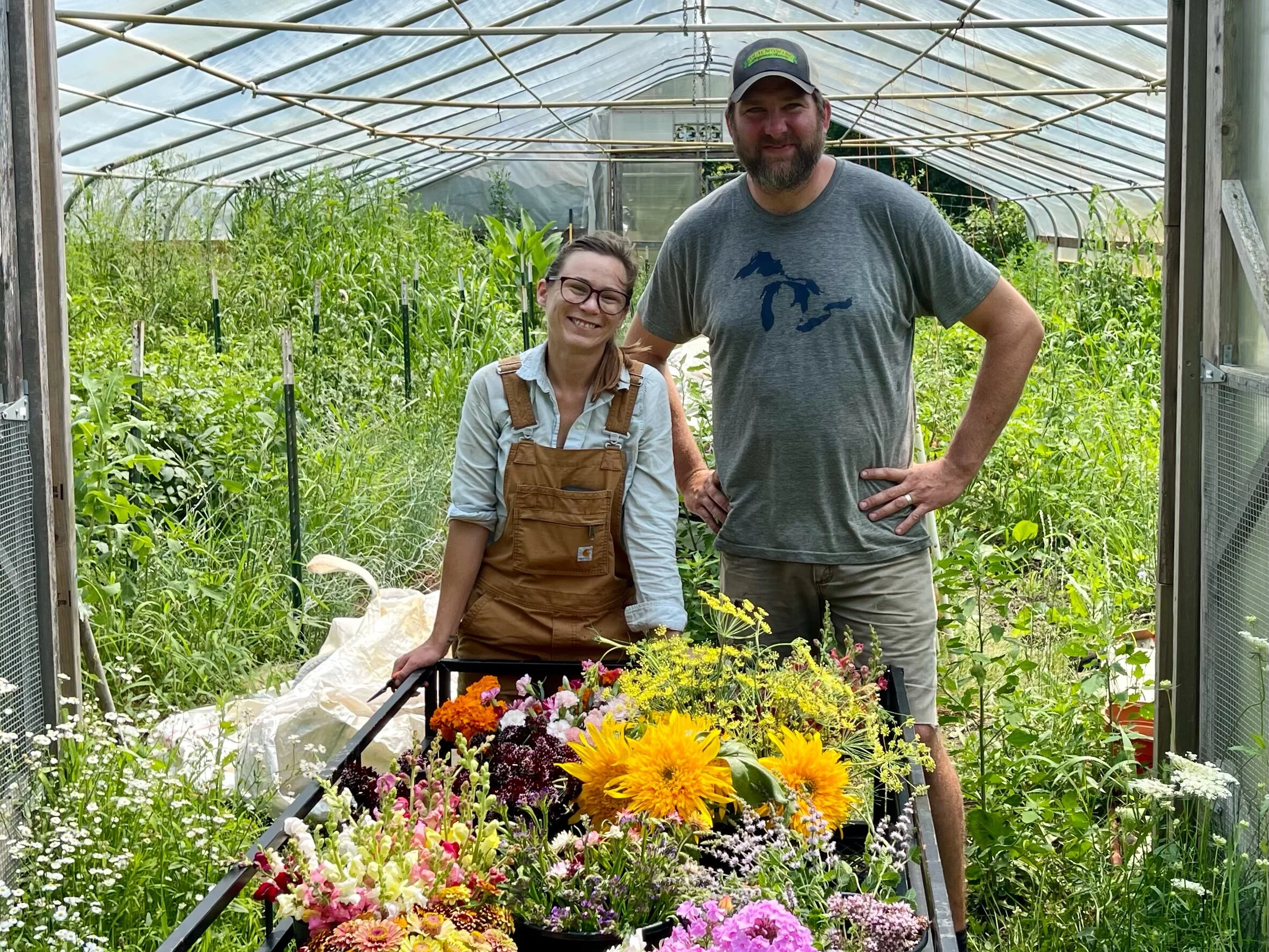
Heather, the Garden Manager at Verdant Hollow Farms stands in front of a very productive hoop house with Brett. When we met her, Heather was filling this wagon with flowers to deliver to local community supported agriculture (CSA ) customers.
Hailey, a farmhand at Verdant Hollow Farms, specializes in livestock management and agroecology.
An interesting feature of the approach at Verdant Hollow is a willingness to experiment. When we first talked with Molly about the general shape of the operation there, it was clear she and Brett were still exploring what kinds of cover crops they wanted for different needs, as well as how to repurpose storage buildings and other out-buildings. Because Michigan winters are long and cold, Molly and Brett wanted to extend their growing season so they had more crops to offer customers. In addition to conventional “hoop houses” which are common in northern climates, they went a step further and constructed a “climate battery” greenhouse to create an indoor forest garden. Brett was kind enough to give us a tour, and we were delighted to see lemon and avocado trees among numerous other warm weather plants.
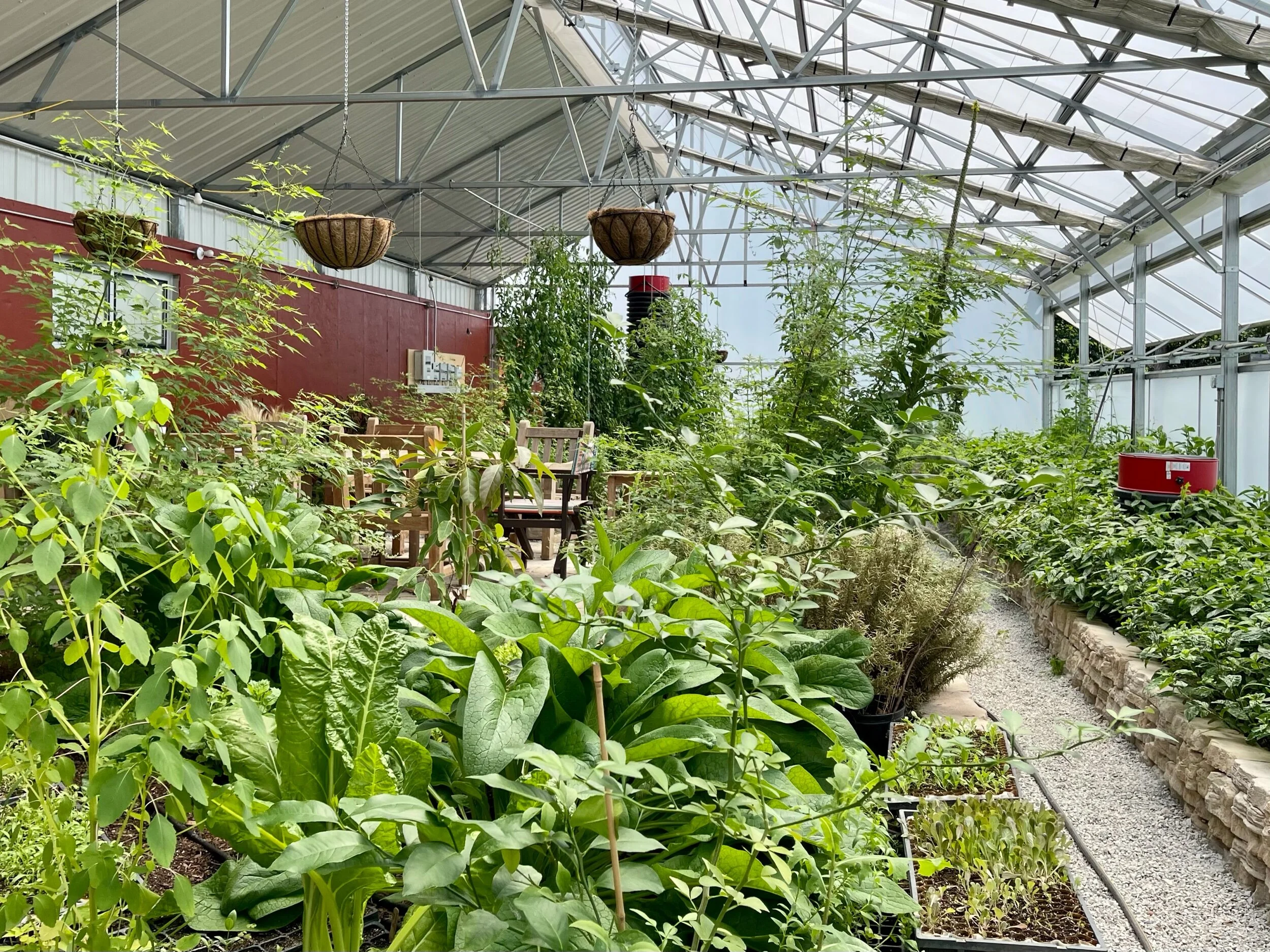
Following the work of Jerome Osentowski, Brett constructed a “climate battery” greenhouse to create an indoor forest garden.
A Colorado farmer named Jerome Osentowski is the inspiration behind revolutionary greenhouses that use a “climate battery.” This is a subterranean air-circulation system that takes the hot, moist, ambient air from the greenhouse during the day, stores it in the soil, and discharges it at night. Brett and Molly’s version works similarly. They intend to add a wood-fired sauna that will allow warm water to circulate through a wall constructed against a hillside that will increase humidity along with the passive solar and air circulation attributes of the “climate battery.”
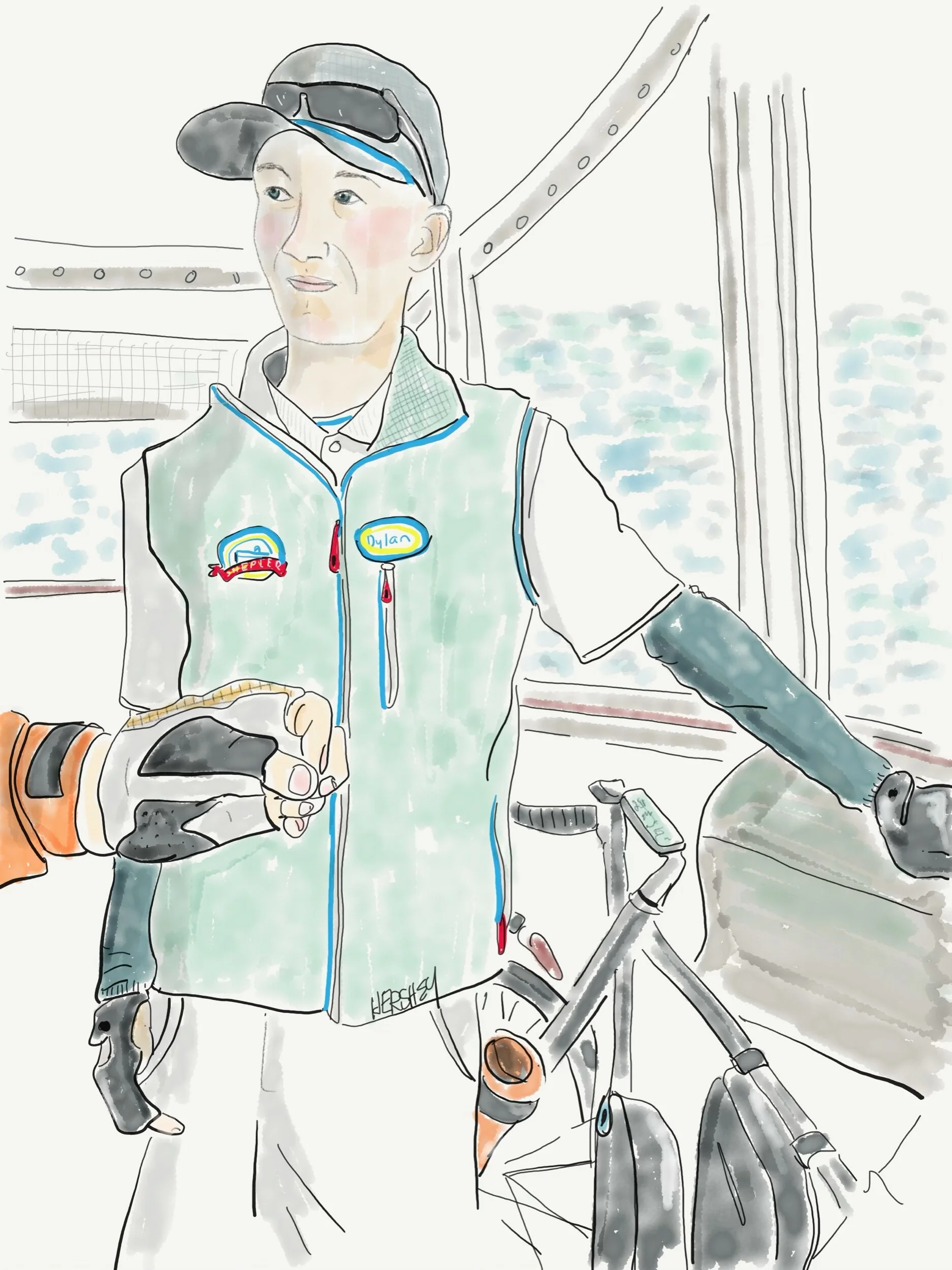
Dylan, who works on the Shepler’s Mackinaw Ferry, listens to us bemoan the fact that bicycles are not allowed on the “Big Mac” bridge over the Mackinaw Straits on I-75. Dylan drives the 5 mile span every day to get to his job.
Whether or not the Growing Climate Solutions Act becomes law, it is already evident that the USDA (especially through the Natural Resources Conservation Service), recognizes the very important contribution regenerative agriculture can make. By adopting climate-friendly agricultural practices more widely, agriculture can transition from a greenhouse gas source to a carbon sink. Just as important, soil scientists report that at current rates of soil destruction (i.e. decarbonization, erosion, desertification and chemical pollution), we have about 50 years before we will suffer serious damage to public health due to a qualitatively degraded food supply characterized by diminished nutrition and loss of important trace minerals. Even more frightening is the very real prospect that we will literally no longer have enough arable topsoil to feed ourselves. If we fail to protect and restore the soil on our 4 billion acres of cultivated farmland, 8 billion acres of pastureland, and 10 billion acres of forest land, it will be impossible to feed the world, keep global warming below 2 degrees Celsius, and halt the loss of biodiversity.
The time for change is now, and farmers like Gabe Brown and Molly and Brett Muchow are blazing a trail. There are many more farmers like them, and we hope to feature them in in future blog posts.
Stay vigilant! Thanks for reading. More to come. Follow our next biking trip from mid September to mid October.
All material, unless credited or otherwise noted, are copyrighted property of the blog post author.

Elvis, the manager of the Normandy Motel in St. Ignace on the north side of “Big Mac,” lost his wife right before COVID. He takes great pride in running the motel, computer free. He spends his day doing motel laundry in the garage and hanging out in his worn out easy chair watching NASCAR. Drawing by Jennifer Hershey. Follow her work on Instagram at deeofo.
Hauling Bees, Growing Soil; Biking the Dakotas
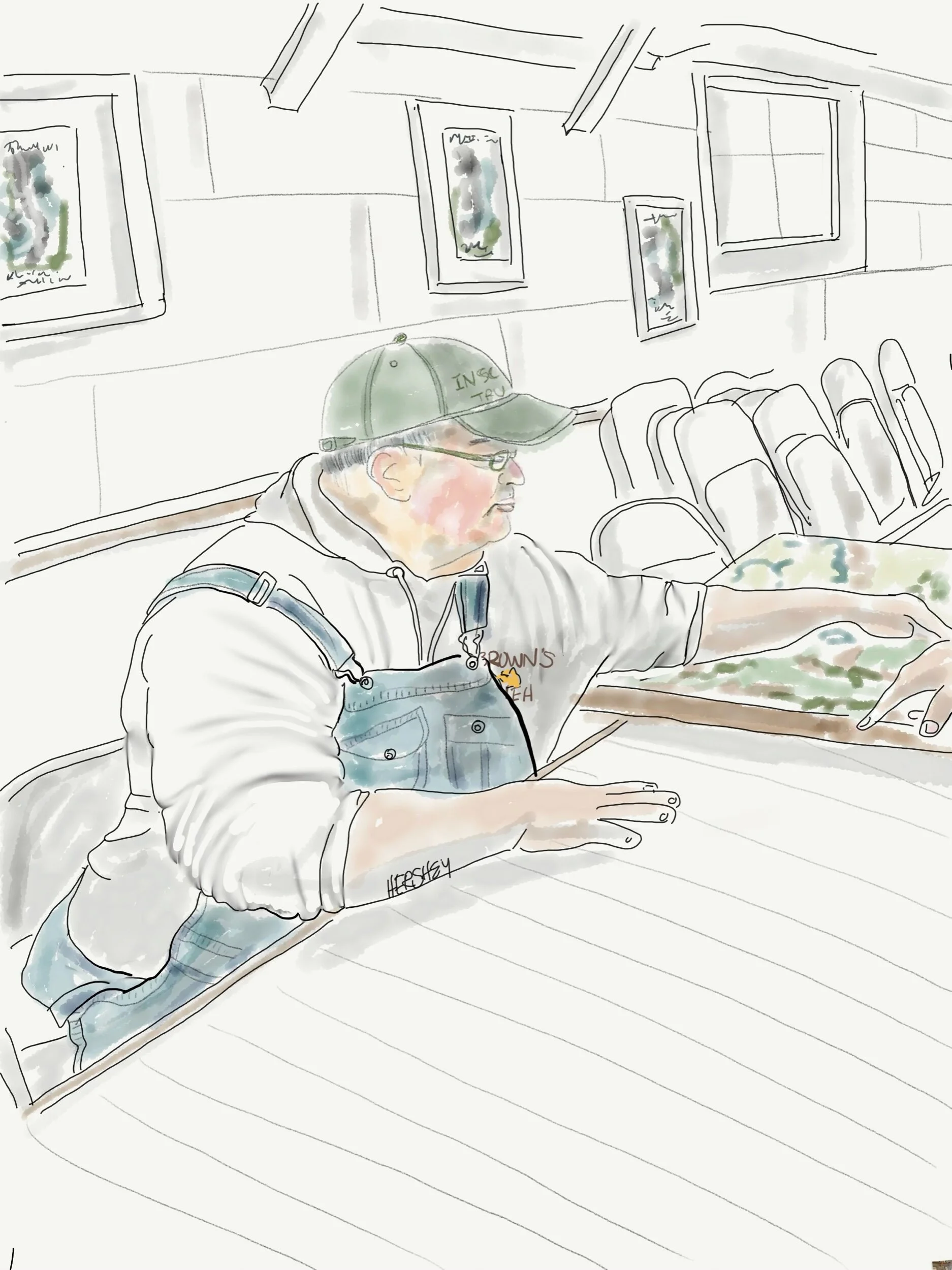
Gabe Brown shows us a map of his farm. Drawing by Jennifer Hershey. Follow her work on Instagram at deeofo.
If you want to make small changes, change how you do things. If you want to make major changes, change how you SEE things.
Don Campbell (as quoted by Gabe Brown in his book Dirt to Soil)
When I began long-distance bike touring six years ago I was enthralled by the sense of freedom it offered; I learned how to carry very little to meet essential needs, I relished the sensuality of riding as fast as I dared down a hill with the wind to my back, I experienced deep satisfaction in conquering long uphill slopes, even while riding directly into a headwind. Those very simple experiences - the rush of freedom, the pride of accomplishment - made touring on a bicycle worthwhile. Beauty, however, was a generalized experience. Mountains, lakes, rivers, clouds, rain and rainbows caught my eye, while most small things went unnoticed. A small town boy turned long ago into a city slicker, I was a “big picture” observer. If it was dramatic, I was likely to appreciate it. Most small things went unnoticed, and my curiosity was limited. I was content to not know the particulars of a landscape or what was growing in a field unless I could recognize what I was looking at without much effort. Yet, my experiential palette broadened as I continued to cycle, and my observations began to sharpen. So did my curiosity.
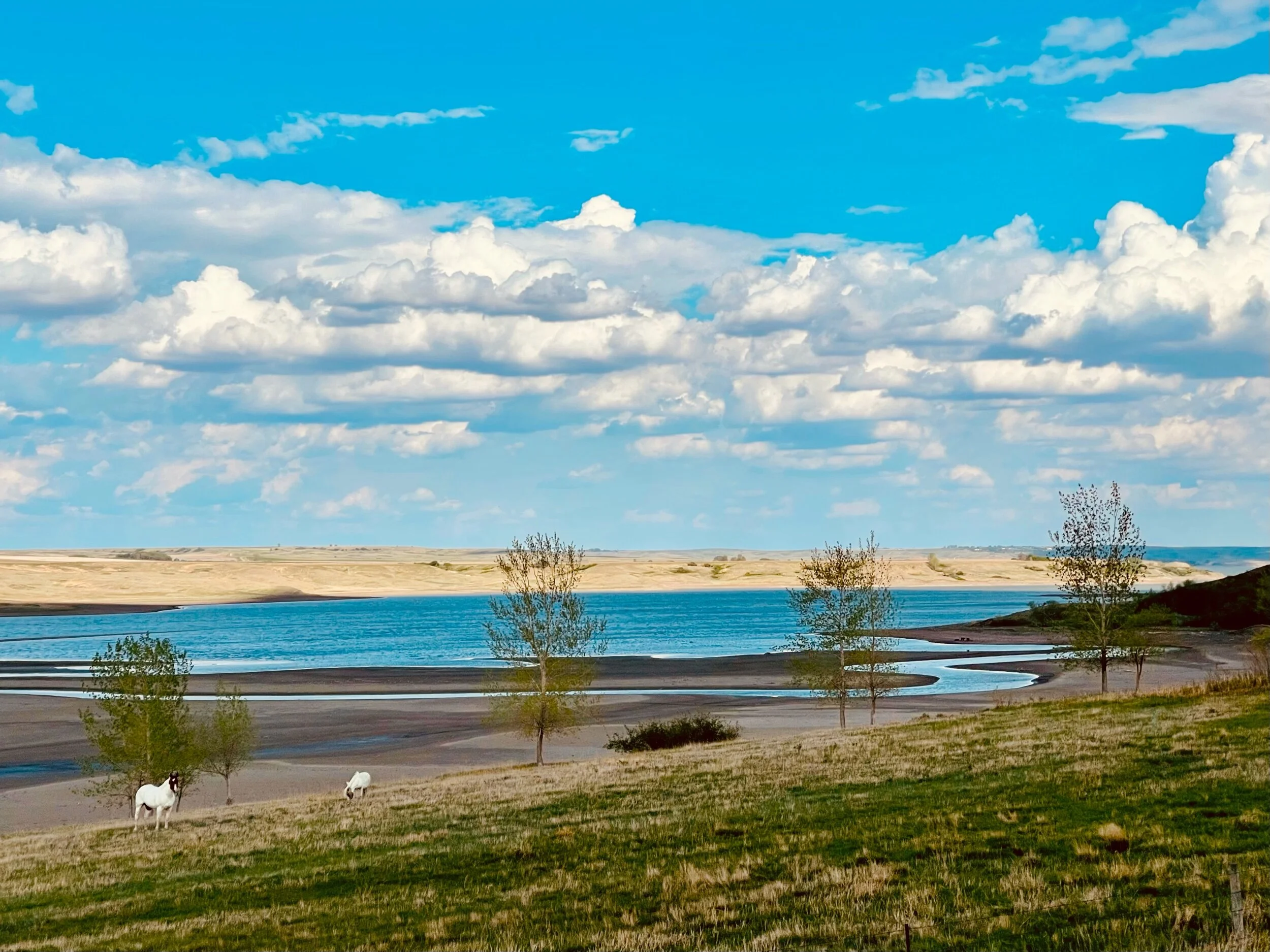
Horses in a field near Lake Oahu (the Missouri River) north of Mobridge, SD. Photo by Michael Chase.
At about the same time, Jenny Hershey started joining me on biking adventures, and it wasn’t long before we began to recognize how many different things we each see in the same landscapes. Jenny - as a visual artist - is drawn to detail, and her observations fueled my curiosity even more. I began to appreciate that no matter where I am, there is more to observe in any landscape than I can ever fully digest. I am not discouraged by that perception; rather it is an incentive to stay with it, to see (and potentially understand) all I possibly can before that day arrives when I am no longer able to lift my leg over a bike seat. And there is continual progress; I see and learn more every day. My skill as an observer is growing. I think Jenny would say the same about herself.
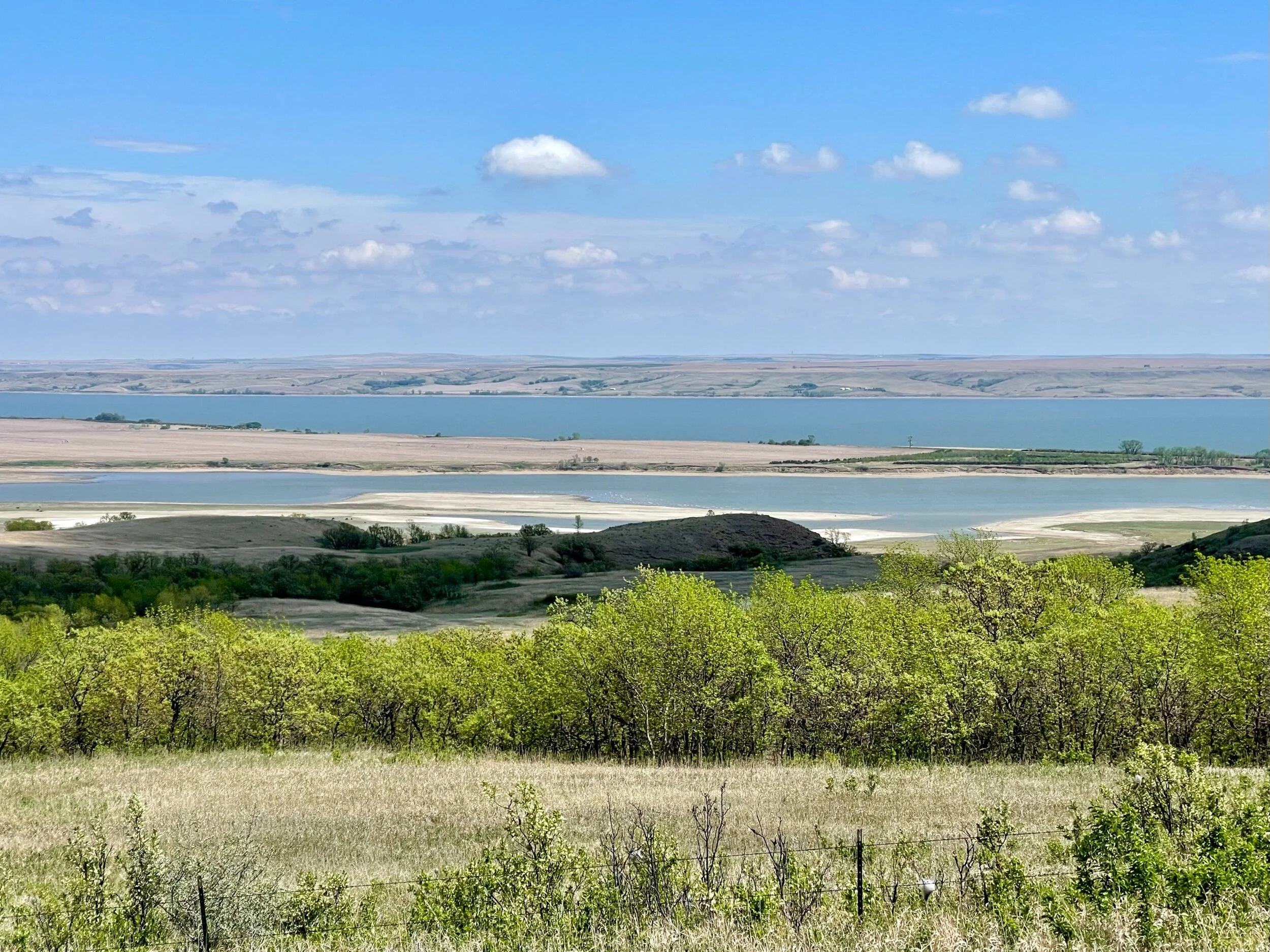
The Missouri River from Standing Rock Reservation. We cycled the entire length of the Reservation on Highway 1806 and were deeply impressed with the beauty of the environment. At one point near Fort Yates, a woman waved Jenny over to point out the Sitting Bull Sacred Horses on a hill. An omen of good luck for those who see them, these wild horses are regarded as descendants of Sitting Bull’s horses. Photo by Michael Chase.
Climate change is both the biggest conundrum humans have ever faced, and simultaneously the ultimate challenge to our observational capacities. It is the result of millions and millions of small things that humans do. Most of those things can be seen in small measure by observant people, yet many human actions are at a scale beyond that which is perceptible to individuals. One housing development becomes many and hundreds of acres are lost to food cultivation, an oil derrick becomes thousands strewn across a vast region, a tanker truck becomes hundreds of miles of pipelines, a bare field in the wind becomes tons of lost topsoil, an application of synthetic fertilizer on crops becomes ruined waterways and destroyed municipal water systems, an application of pesticide on crops kills insect pests and simultaneously their beneficial predators - including the honeybees the same crops rely on for pollination.
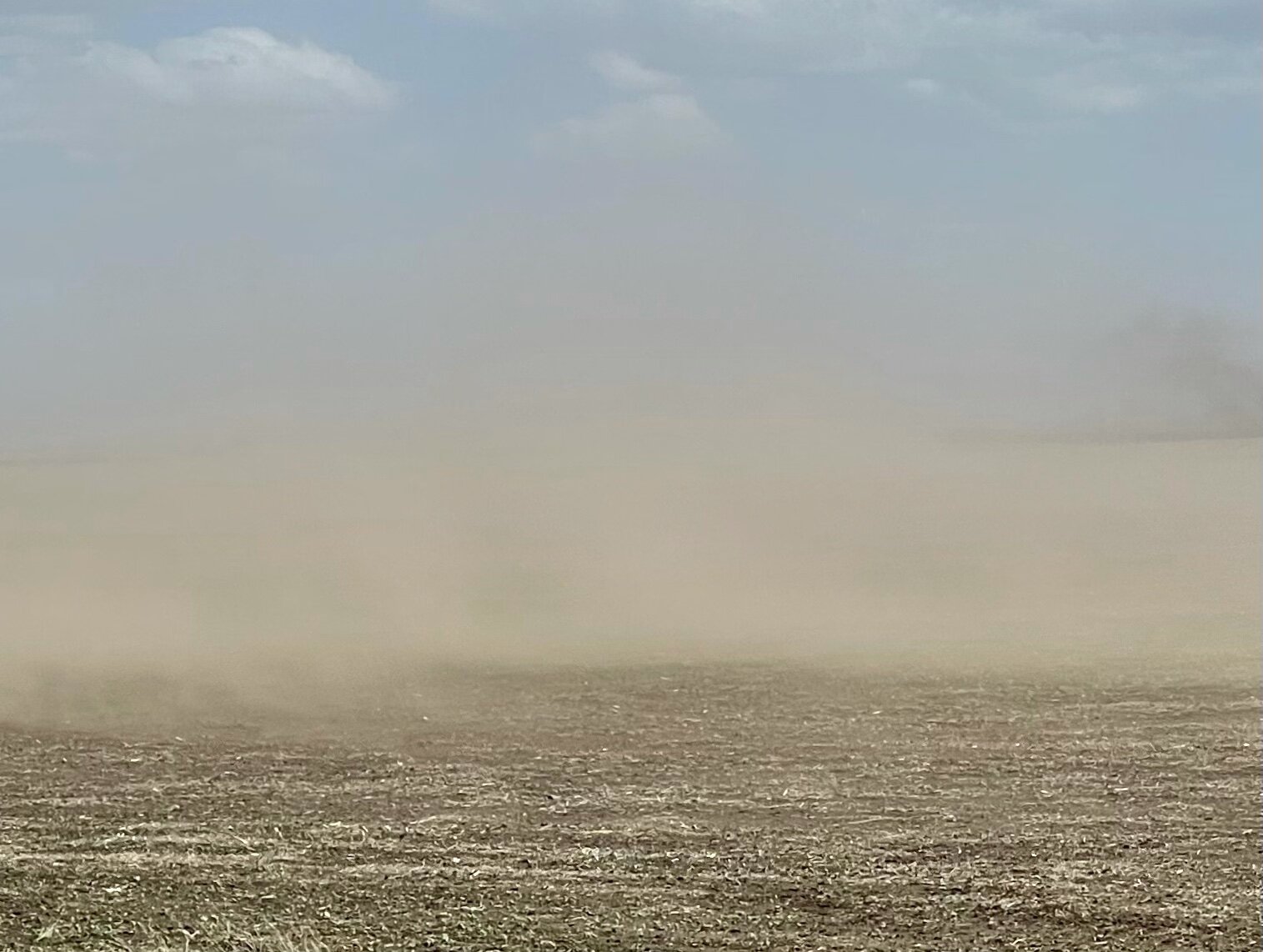
Wind erosion on a conventionally tilled field in South Dakota. Photo by Michael Chase.
Small things become big things. All these things happen right in front of us, day after day after day, and many of us fail to notice them or their consequences until it’s too late. Some people do notice, however. Proverbial canaries in a coal mine, some are well known and in the news a lot, such as climate scientists Michael Mann or Katherine Heyhoe, or environmental activists Greta Thunberg, Bill McKibbon or the Standing Rock Water Protectors.
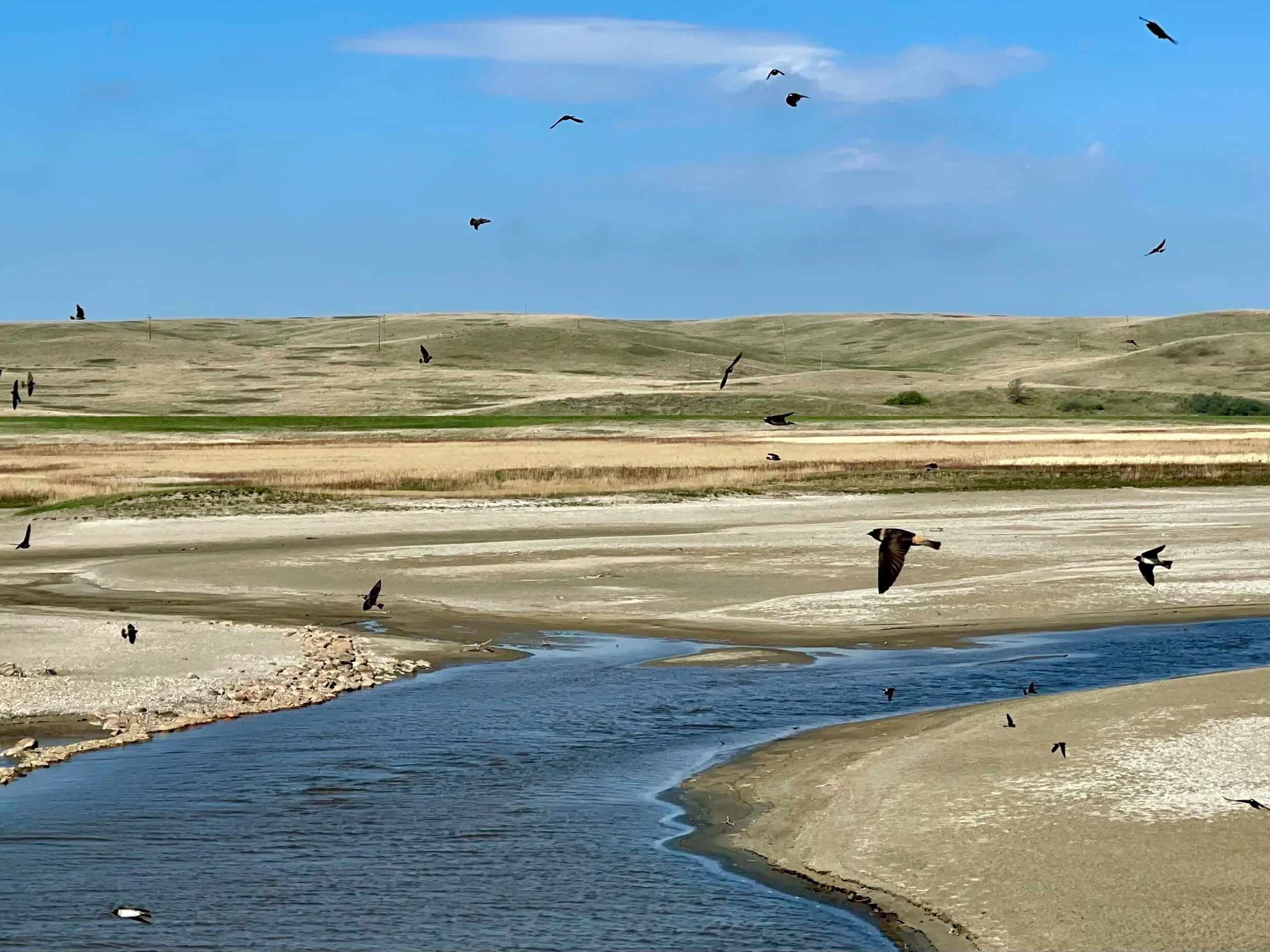
An inflow into Lake Oahe just south of the Cannonball River in South Dakota, where the Standing Rock protests of 2016 took place. Water Protectors have tried to protect groundwater sources from the probability of pollution, which in turn protects soil that nurtures healthy plants that feed bees and other pollinating insects. Although they were successful in getting the Obama administration to cancel the DAPL pipeline, Trump immediately approved it. Oil now flows under Lake Oahe and the pristine nature of this region is still under threat, yet, there is hope among Standing Rock residents that the Biden Administration will reverse Trump’s action and halt the flow of oil. Photo by Michael Chase.
Others don’t seek attention but attract it anyway by virtue of what they do, or how they see. John Miller is one of those people, as is Gabe Brown. While these two men (who are the primary subjects of this blog post) may be unlikely allies, they share a deep concern for the future, a love for the land, and a deep faith in nature as the greatest role model and teacher for agricultural practices.
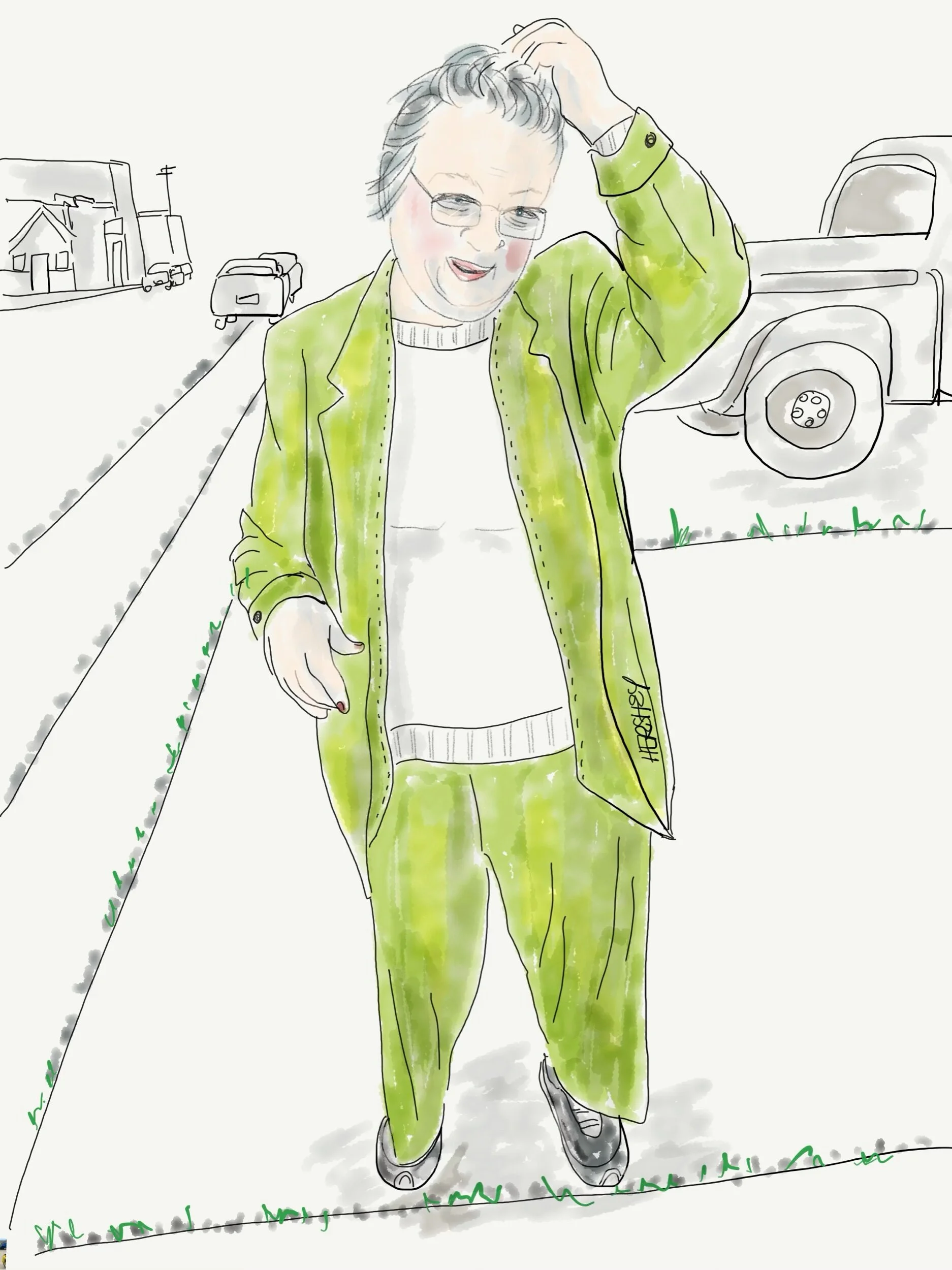
We met Mylene, the town historian of Enderlin, North Dakota, about 70 miles west of Fargo, the day before we got to Gackle. She greeted us in her bright green pant suit and shared with us the history of why this town was more diverse (in its European ancestry) than most other North Dakota towns. This says something about diversity in North Dakota, since the 2010 census indicates Enderlin is 98.6% White, 2.4% Hispanic, 0.2% African American, 0.8% Native American, 0.1% Asian, and 0.2% from two or more races. When asked, she said the population was exactly 884 - unless someone she didn’t know about had died the night before. Drawing by Jennifer Hershey. Follow her work on Instagram at deeofo.
This post is a story of our interactions with these remarkable people as we cycled west from St Cloud, MN, to Bismarck, ND, down the Missouri River (aka, Lake Oahe) to Pierre, SD, and back east to St Cloud, MN, in May 2021.
——————
Gackle, ND, is the only stop along the 110 miles between Enderlin and Napoleon, ND, on the Adventure Cycling Association “Northern Tier” route through North Dakota. Although Gackle has a bar and a Tasteefreeze, there are no motels. However, we weren’t worried. We had learned from the ACA map there is a wonderful place for cyclists to stay called the Honey Hub. Located in the back of a split-level ranch house that sits empty for 9 months each year, the makeshift bedroom and bathroom also features a hot plate and refrigerator stuffed with drinks. The guestbook revealed no one had stayed there since late summer of 2020 (apparently, only the most intrepid of touring fanatics biked the iconic Northern Tier during the pandemic).
Jenny and I were greeted in the front yard of the Honey Hub by John Miller, the father of Jason Miller. Jason owns the house (and now, with a partner, the Miller Honey Farm) but lives in California most of the time. John is the colorful protagonist of The Beekeepers Lament by Hanna Nordhaus. We had no idea who we were talking to as we unpacked our gear, although it didn’t take us long to figure out John Miller is an unusual man. There were clues all around us: a stack of Hanna’s books for sale, a large display of honeystinger cycling treats and other forms of honey swag. “It is called the Honey Hub after all,” I told myself.
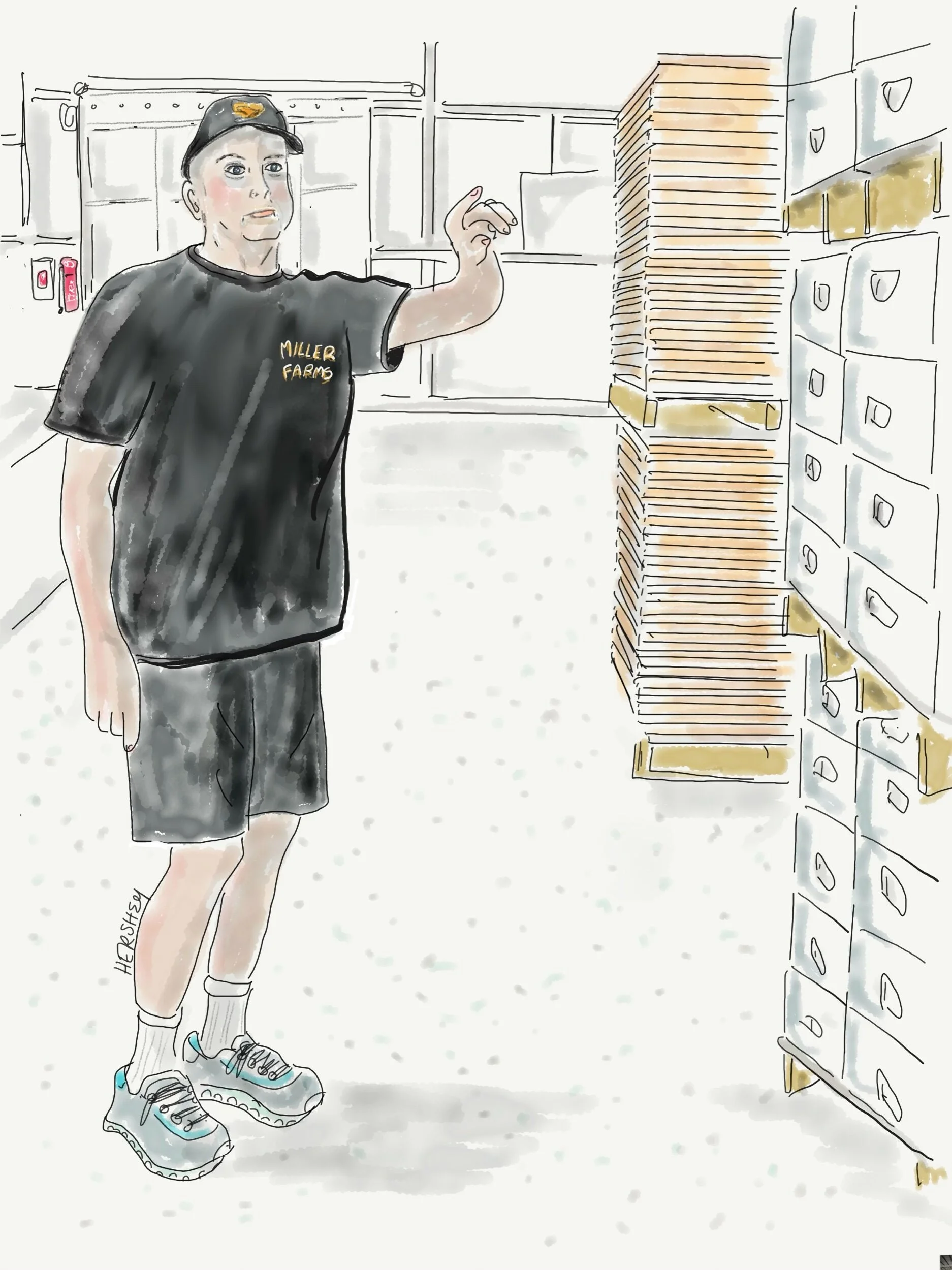
Miller Honey Farm created a winter home for their bees in a climate-controlled warehouse lit with infrared lighting that helps keep the bees dormant. Drawing by Jennifer Hershey. Follow her work on Instagram at deeofo.
I grabbed a copy of The Beekeepers Lament before we ambled over to the nearby Tasteefreeze for dinner, and read the book out loud to Jenny while we waited for some astonishingly good cod sandwiches. Our education was rapid, and we were transfixed. Turns out we had a complete misconception about how modern commercial beekeeping works. (It’s funny how something that seems so obvious after the fact, isn’t so obvious beforehand.)
As we thought, most beekeepers own just a few hives, and typically raise bees as a hobby. Some make extra money by selling honey, pollen, and beeswax. Commercial beekeepers, on the other hand, are responsible for thousands of hives and millions of bees. These colonies produce large amounts of honey and related products for profit, and are the primary means of large-scale agricultural pollination. Commercial beekeepers are distinct to the developed world; globally only about 5% of beekeepers run commercial operations, mainly in northern latitudes and Australia where industrial agriculture flourishes, and where (sadly) very few bees remain in the wild. Beekeepers elsewhere keep a much small number of hives in countries where farms are smaller and more diverse. That said, commercial beekeepers are responsible for as much as 60% of the world’s honey crop. Interestingly, the production, importing and packing of honey generates 22,000 jobs in the US, about half the amount of the total jobs created by the US coal industry.
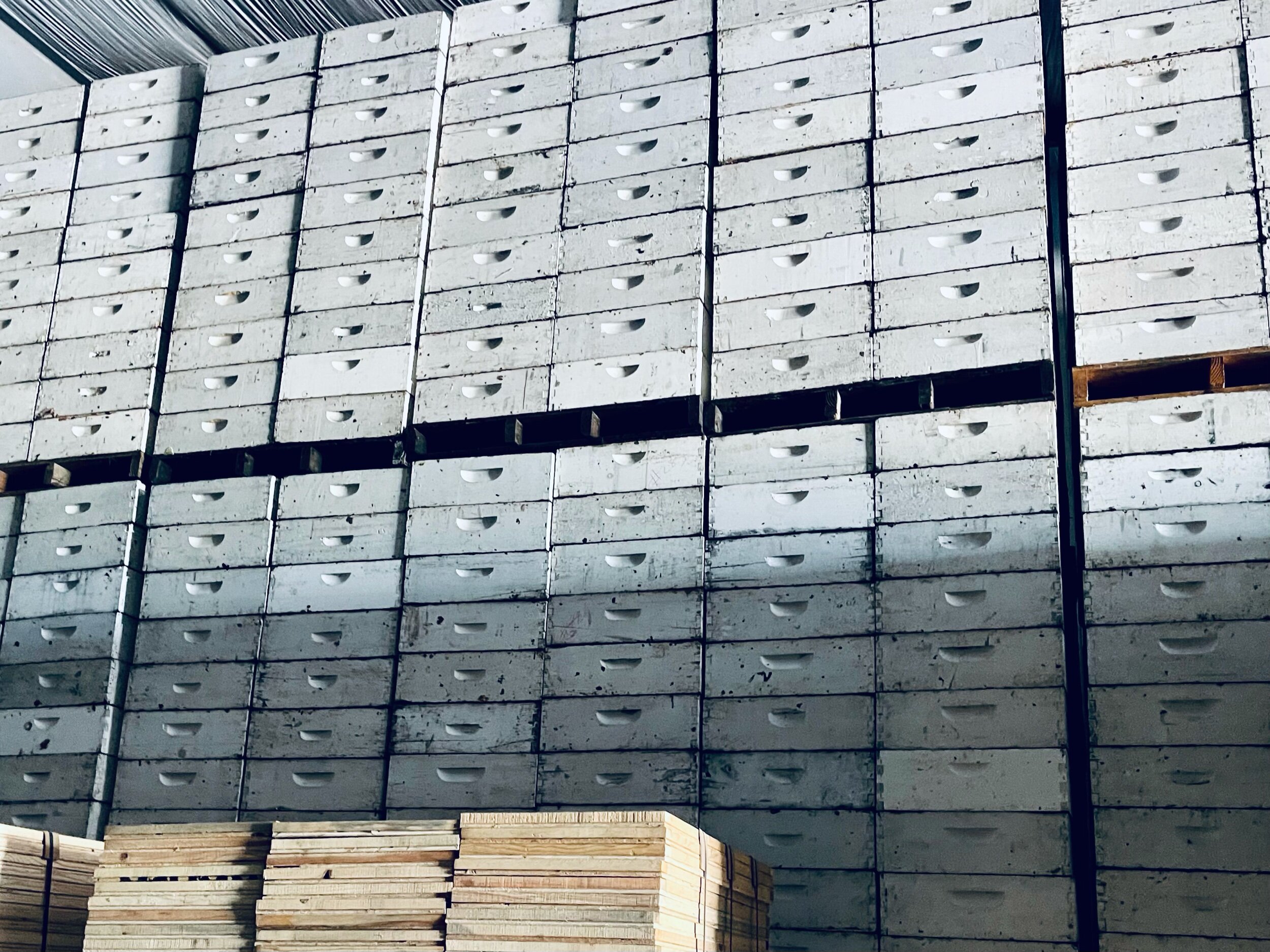
Extra beehive pallets line the wall in the Miller Honey winter storage facility in Gackle, ND. Photo by Michael Chase.
As we had expected, the Miller Honey Farm sells the honey their bees make. They normally ship their honey to a major supplier in Lancaster, PA. But honey and beeswax-related products aren’t their most important activities. Like the 1200 other commercial beekeepers across the United States, John (now in charge of the Modesto pollination region) and Miller Honey Farm essentially “rents” their bees out to different growers over the season for pollination services. And also like many other US beekeepers, their year begins in the almond groves of the California Central Valley.
Every year in January and February the world’s greatest pollination event takes place in the valley. Over 2 million hives from around the US are put on flatbeds (at least 2,600 truckloads of those bees come from outside California) to pollinate more than 1 million acres of almond orchards. That includes Miller Honey Farm hives. Before John retired and took a back seat in the company he owned, he used to transport his hives from Newcastle, California, where he once owned a ranch. Now the farm winters their entire colony in their climate-controlled warehouse in Gackle over 1500 miles from California’s Central Valley.
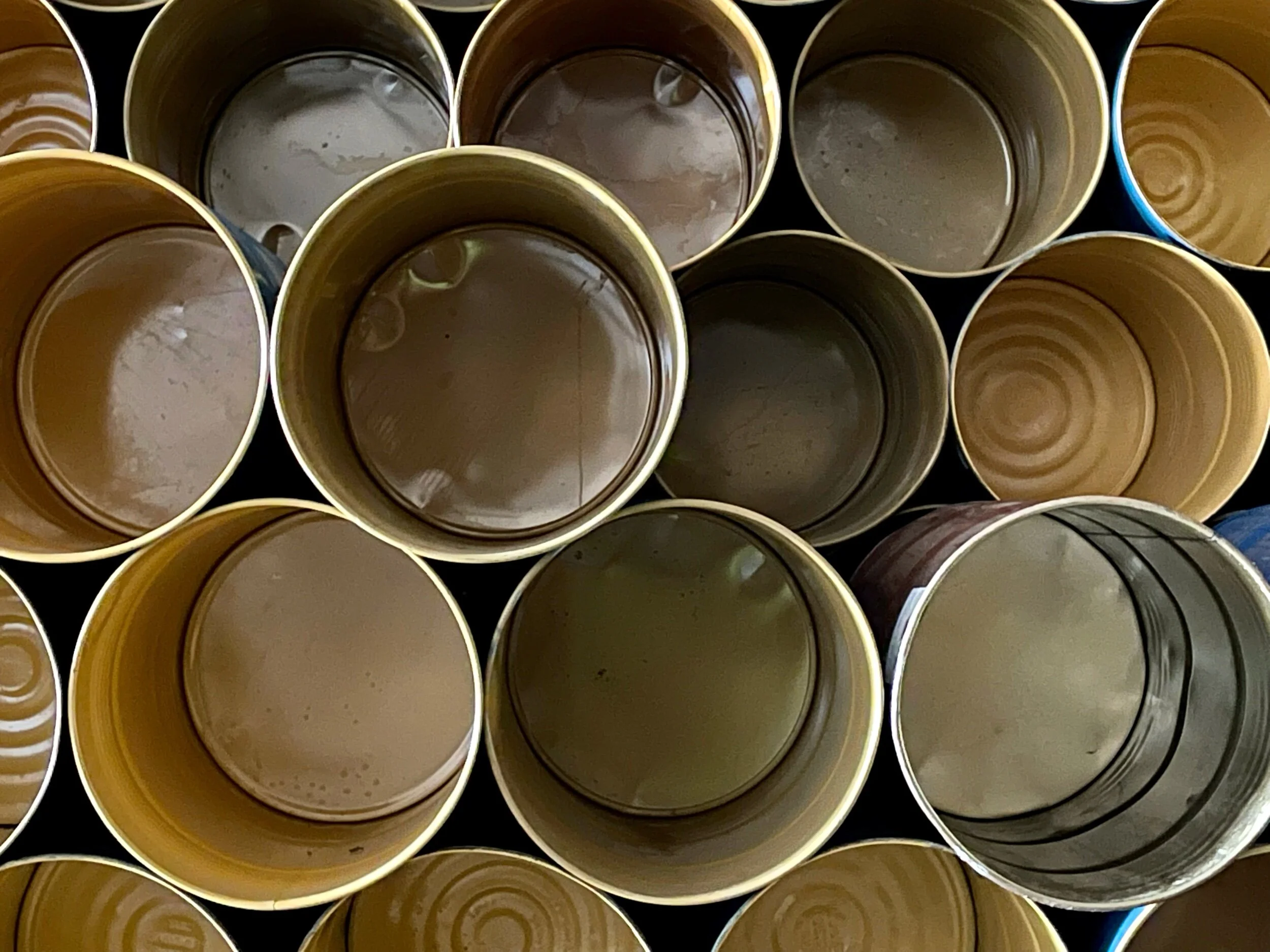
Barrels for transporting honey line a wall at the Miller Honey plant in Gackle, ND. Photo by Michael Chase.
John’s hives stay in the California almond orchards until the growers no longer need them - usually mid to late March, when he takes them away to pollinate another crop. Pollination is a critical part of growing almonds, so removing hives too early can result in reduced yields. Keeping them too long can delay Miller Honey’s commitments to other growers, resulting in risks for honey bees to find alternative food sources when the almond bloom is over - or worse yet - subjecting the bees to pesticides when the almond growers start spraying. Some beekeepers believe that pesticides are responsible for Colony Collapse Disorder (CCD), while others blame an invasive mite known as Varroa destructor. We got the impression that John Miller is agnostic about the subject of CCD as a persistent issue. …He once told Hanna Nordhaus the primary reason for massive bee collapse is PPM (piss poor management) by beekeepers.
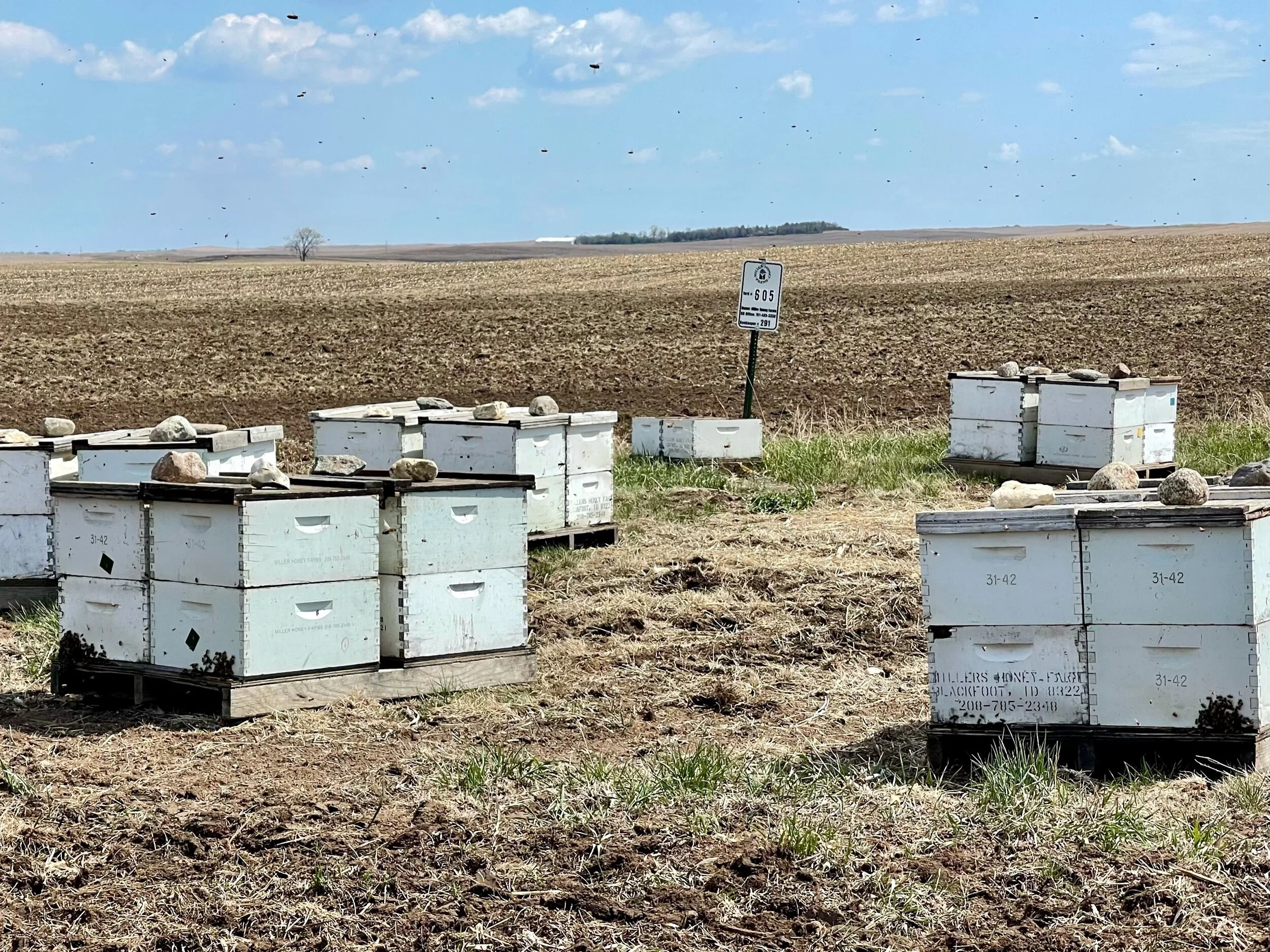
Miller Honey bees placed in a field near Napoleon, ND. Photo by Michael Chase.
That may be true for some. But while modern industrial agriculture is the hand that feeds him, John is not the greatest fan. He works closely with the Honeybee Health Coalition, and is on the Board of Bee Informed. More than once he mentioned to us that regenerative agricultural practices would considerably help his bees. He even gave us bumper stickers that say: Farmers Feed Bees. For bees, greater diversity in available plant life makes for healthier bees and richer honey. Monoculture - a primary feature of modern conventional industrial agriculture - is a definite buzzkill for bees and their honey. Pun intended.
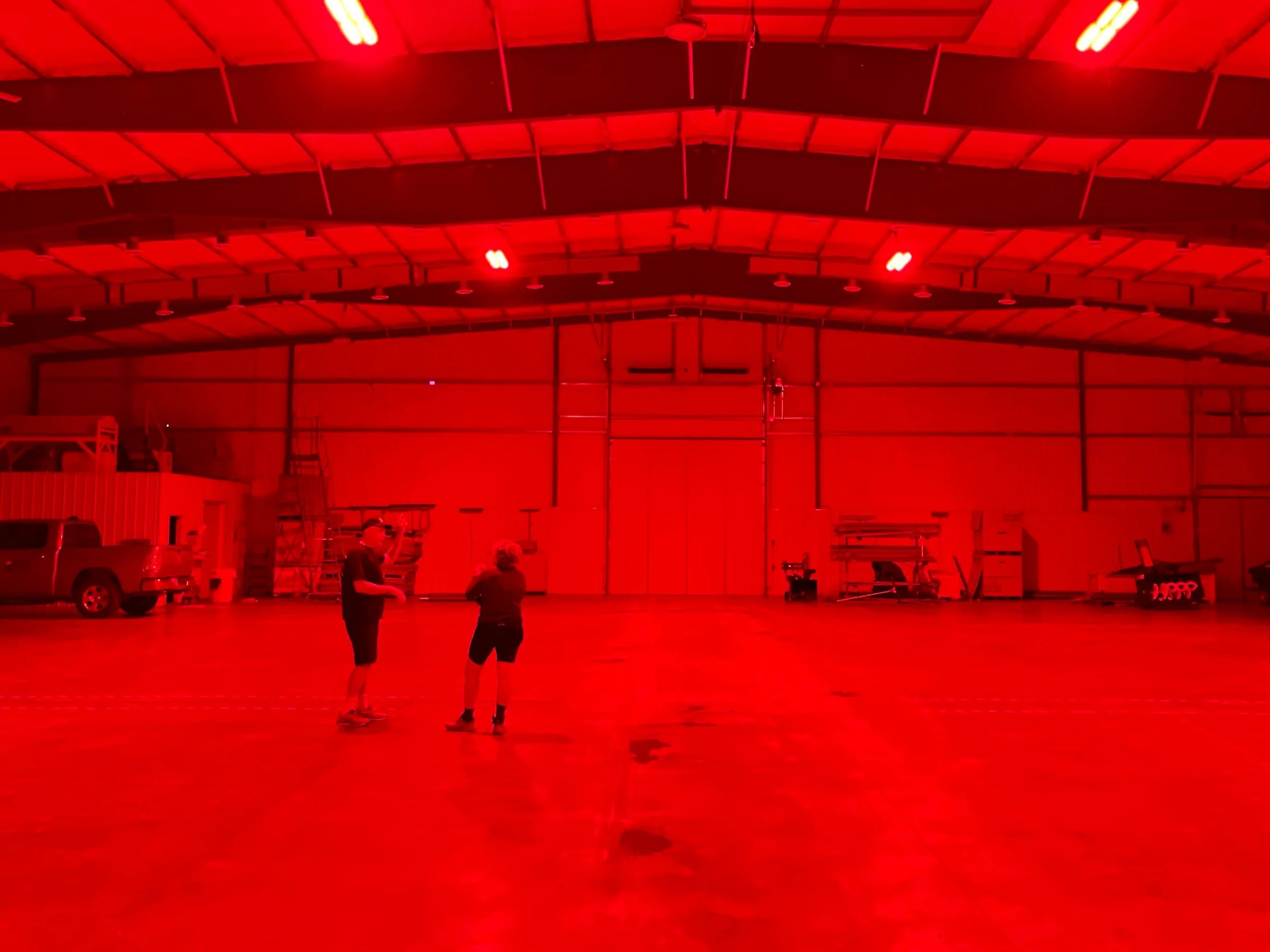
John Miller and Jenny Hershey in the Miller Honey winter bee storage facility in Gecko, ND. The light is infrared and won’t disturb resting bees. Photo by Michael Chase.
Besides, trucking bees around is no fun. I can’t imagine a beekeeper who wouldn’t be excited by placing bees in an environment so plant-rich he or she would never need to move them. The payoff would be considerable. One could even say that bees feed farmers.
As Hanna Nordhaus writes in The Beekeepers Lament: Farmers depend on honey bees to pollinate ninety different fruits and vegetables, from almonds to lettuce to cranberries to blueberries to canola—nearly $15 billion worth of crops a year. Although wind and wild insects pollinate some plants on a small scale, only bees promise the levels of production needed to meet the needs of the nation’s grocery shoppers. Like every aspect of American agriculture, beekeeping has, by necessity, joined the global economy of scale. Bees are pollination machines, and many of America’s farmers need them just as much as they need their tractors, threshers, and combines. For problems with water, labor, pest control, and soil quality, there are irrigation systems, big machines, pesticides, and synthetic fertilizers. Today the biggest factor limiting the amount of produce grown is, for many crops, the number of bees available.
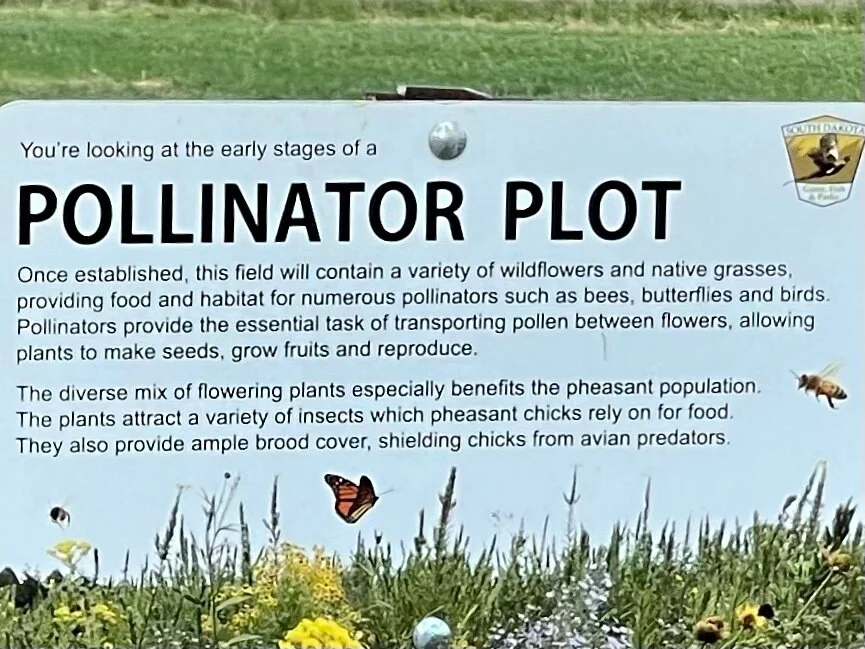
We saw this placard outside of Pierre, SD, at the Oahe Downstream State Recreation Area. Photo by Michael Chase.
Indeed, more pollinators (in the form of bees) are required if ever greater yields are the goal - especially if the type of agriculture practiced is fundamentally antithetical to the well-being of bees. And that is the conventional agricultural model. An unrelenting focus on yields has been the primary driver of industrial agriculture for decades, without regard to the health of the resources required to produce it. What if the predominant paradigm were to shift from chasing ever-higher yields to profits based on lower inputs based on increased soil health? Might we have happier farmers, cleaner water, richer soil, healthier consumers, less carbon in our atmosphere, and an abundance of bees? That, in essence, is the primary focus of regenerative agriculture.
———————
We organized this entire biking trip around a visit to Gabe Brown’s farm near Bismarck, ND. Our curiosity about regenerative agriculture had been heightened by our last bike trip through the Carolinas and our subsequent blog post on land trusts, where we learned about the potential importance of carbon sequestration through land use practices. So the opportunity to meet a successful farmer who is recognized as a leading practitioner of regenerative agriculture was a big lure. We weren’t disappointed. Nonetheless, much that happens on a biking adventure is based on serendipity, and our encounters with both John Miller and Gabe Brown were about as serendipitous as could be. Before we met him, we didn’t know John Miller existed, and although we intended to visit Gabe Brown’s Ranch, we really didn’t expect we’d get to meet the man himself. I don’t know if being able to spend precious time with each of these men was intervention by the gods or simply good luck. Gabe Brown told us he thinks people make their own luck; whatever the case, things definitely worked out for us.
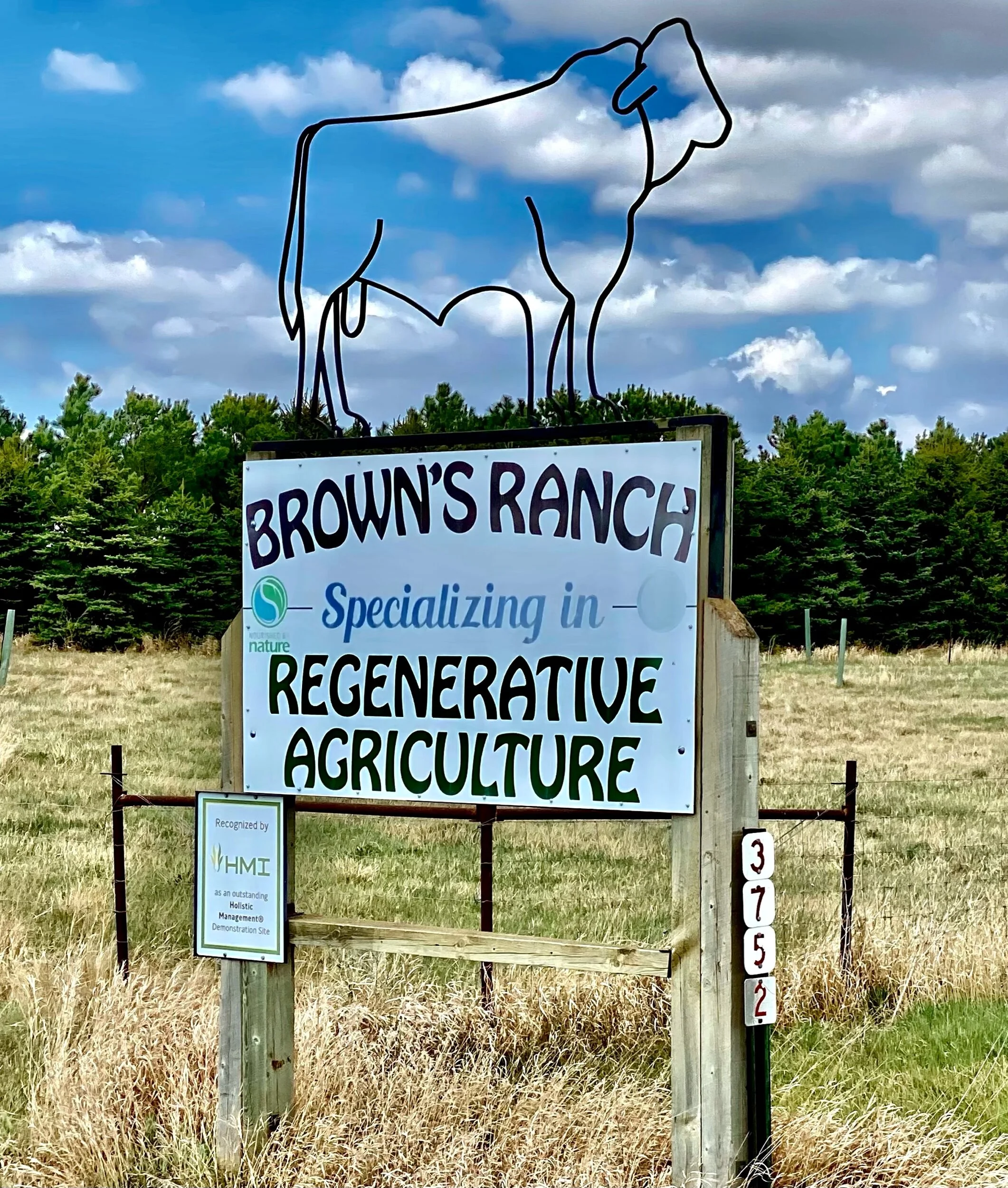
The entrance to Gabe Brown’s Ranch, about 11 miles northeast of downtown Bismarck. Photo by Jenny Hershey.
As we rode up the long gravel driveway to the Brown Ranch, it looked empty. I wasn’t surprised. It was mid-May after all, and I expected every available hand to be out in the fields. Yet, I had made a bet with Jenny that someone would be there, selling many of the remarkable products Gabe and his son had figured out how to direct market over the years, and describes so well in his book Dirt to Soil. Obviously, I was naive about how the Brown Ranch markets its products. Roadside stands are not common on the plains, and it’s much easier to market through the internet. Gabe Brown’s outlet is called Nourished by Nature.
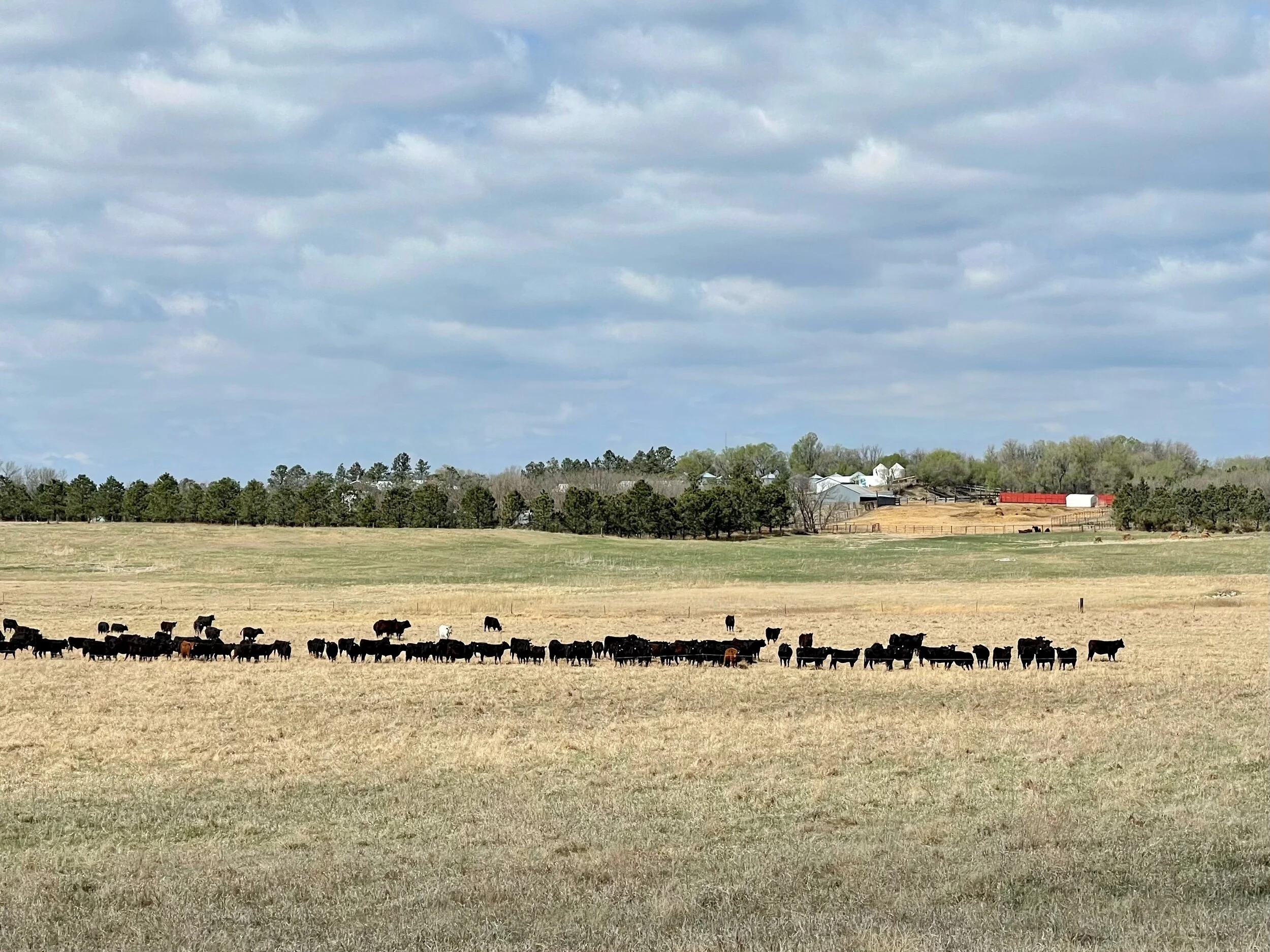
Gabe Brown’s farm looking west. Notice the perennial grassland and the size of the herd. Photo by Michael Chase
We arrived at a small ranch home, next to a barn and an equipment shed, and a few more buildings I didn’t recognize. In the distance near the shed, we saw a man get into a small off-road vehicle, and start driving toward us. Gabe Brown is a bit of a rock star because of his formidable presence in the movie Kiss the Ground (watchable on Netflix), and his ubiquitous presence on YouTube. We recognized him immediately. He was the only person around; we couldn’t believe our luck. Gabe seemed equally surprised. His first comment when he got close enough was, “That’s a first - I’ve never seen anyone arrive here on a bicycle before, much less a couple of older folks!” He was easygoing, but we were worried he might be really busy, so we quickly explained to him why we were there, and said we’d be happy looking around on our own. He replied, “I have a few minutes, so why not get out of the wind?” We went into a small building on the opposite side of the road - which, it turns out, is where Gabe Brown holds “soil health” seminars.
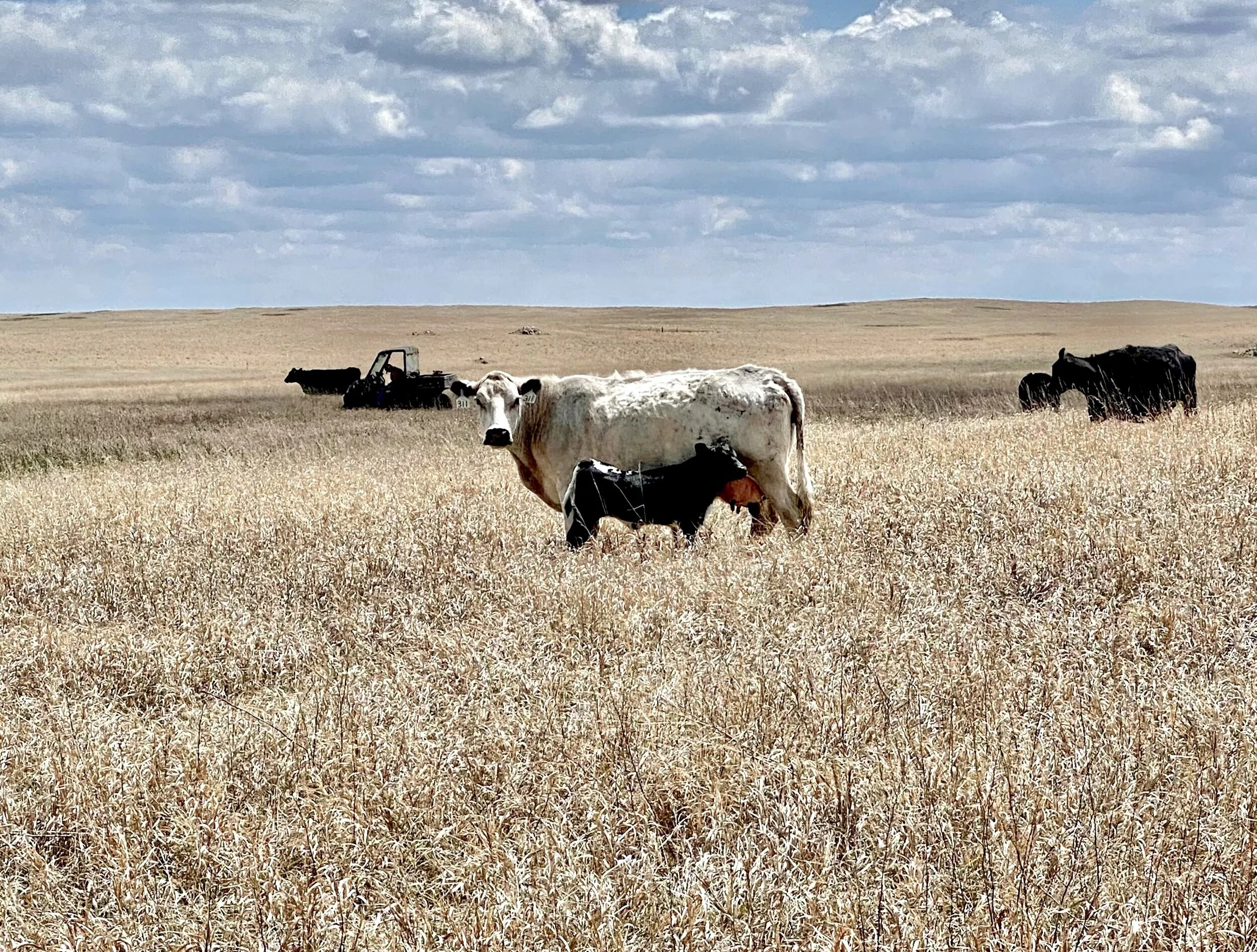
Perennial rangeland on Gabe Brown’s farm. Gabe is very thoughtful about where and how long he pastures his cattle so he can optimize the nutrient density and carbon content of his soil. Photo by Jenny Hershey.
Our conversation was quick and to the point. Gabe was a panelist on a Zoom call in about 20 minutes, so we covered a lot of territory quickly. My biggest takeaway was that while Gabe thinks the potential for sequestering carbon in soil through the use of cover crops, no-till seeding, and effective grazing of ruminating animals (his most profitable products), the science is still not clear on how to effectively measure the storage capacity of carbon from the atmosphere into soil. What is clear is that there are many other benefits of regenerative farming. As Gabe explains on his website: Our belief is that if we have healthy soil it will provide for clean air, clean water, healthy plants, healthy animals, and healthy people. Our soils are much more resilient than they once were. They now harbor billions of life forms that in fact “feed the food” we raise. Soils that are biologically active produce foods that are higher in vitamin and mineral content and when we eat these foods, these vitamins and minerals are passed on to us. These soils are also able to store more carbon and water which has a positive impact on the environment.
After a short while, Gabe handed over the keys to his off-road vehicle (apparently he thought if we were crazy enough to bike to his farm, we could certainly be able to drive his Polaris) and sent us off to see his pasturing chickens and his son’s iconic eggmobiles (described in Gabe’s book), where the Browns raise eggs and chickens, and integrate both into their soil development and management routine.
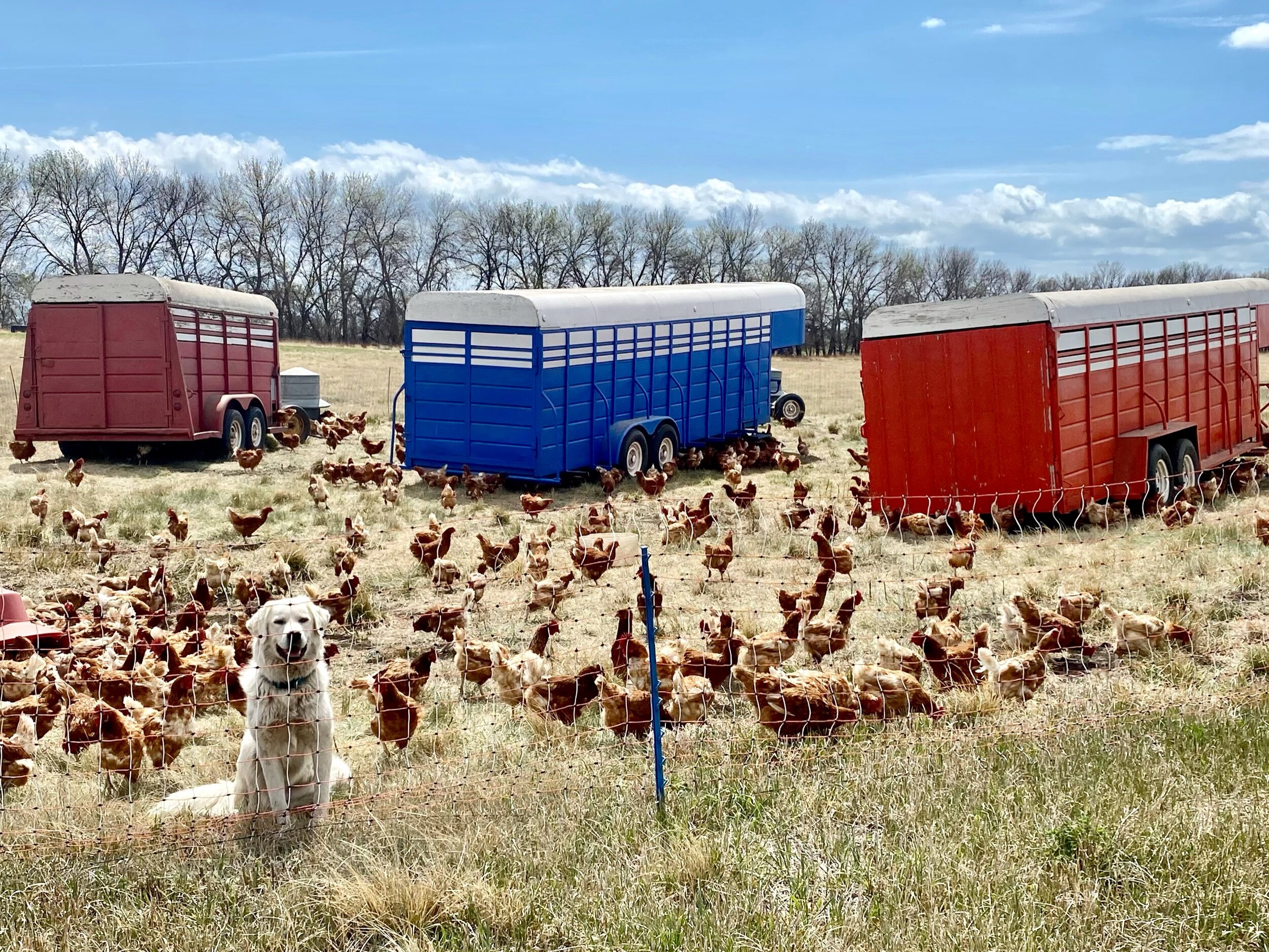
Chickens grazing in a section of field on Gabe’s land. When all the chickens are laying there is no need for fencing; the eggmobiles (where the chickens go to lay their eggs) are simply moved to another part of the field. The chickens don’t need to be fed, eggs are collected and sold, and the soil is naturally fertilized. Photo by Jenny Hershey.
A half hour later, he returned in a truck. Although Gabe had another Zoom call in an hour (we later learned it was with a major American retailer who is interested in supporting regenerative farmers by marketing their products), he wanted to show us more of his farm. We spent the next hour touring his remarkably beautiful perennial pastures and checking on his cows with him. We shared his delight as we saw some of the 11 new calves that had been born overnight. It was a wonderful way to spend an hour.
As a concept, regenerative agriculture aims to be more all-encompassing than or other types of agricultural practices, including organic. A recent article in Sustainable America lists five main principles that regenerative farmers agree upon: improving soil health, increasing biodiversity, aiding in carbon sequestration, incorporating humane treatment of livestock and farmworkers, and improving the overall larger ecosystem as a whole. These practices include:
Incorporating crop rotation and cover cropping
Increasing plant and crop diversity
Practicing minimal or no-till seeding to prevent erosion and increase soil health
Integrating managed grazing and pasturing of animals
One of the biggest potential benefits of regenerative agriculture is that it can help combat climate change. The hope is that regenerative agriculture’s strong focus on soil health and reduced tilling efforts will lead to more carbon being sequestered into healthy soil instead of being released into the atmosphere. However, many experts in addition to Gabe Brown agree: the science isn’t quite there to support the claims yet. Yet, whether regenerative agriculture ends up being a scientifically proven way to fight climate change or not, its methods still offer many benefits to the ecosystem, producers and consumers.
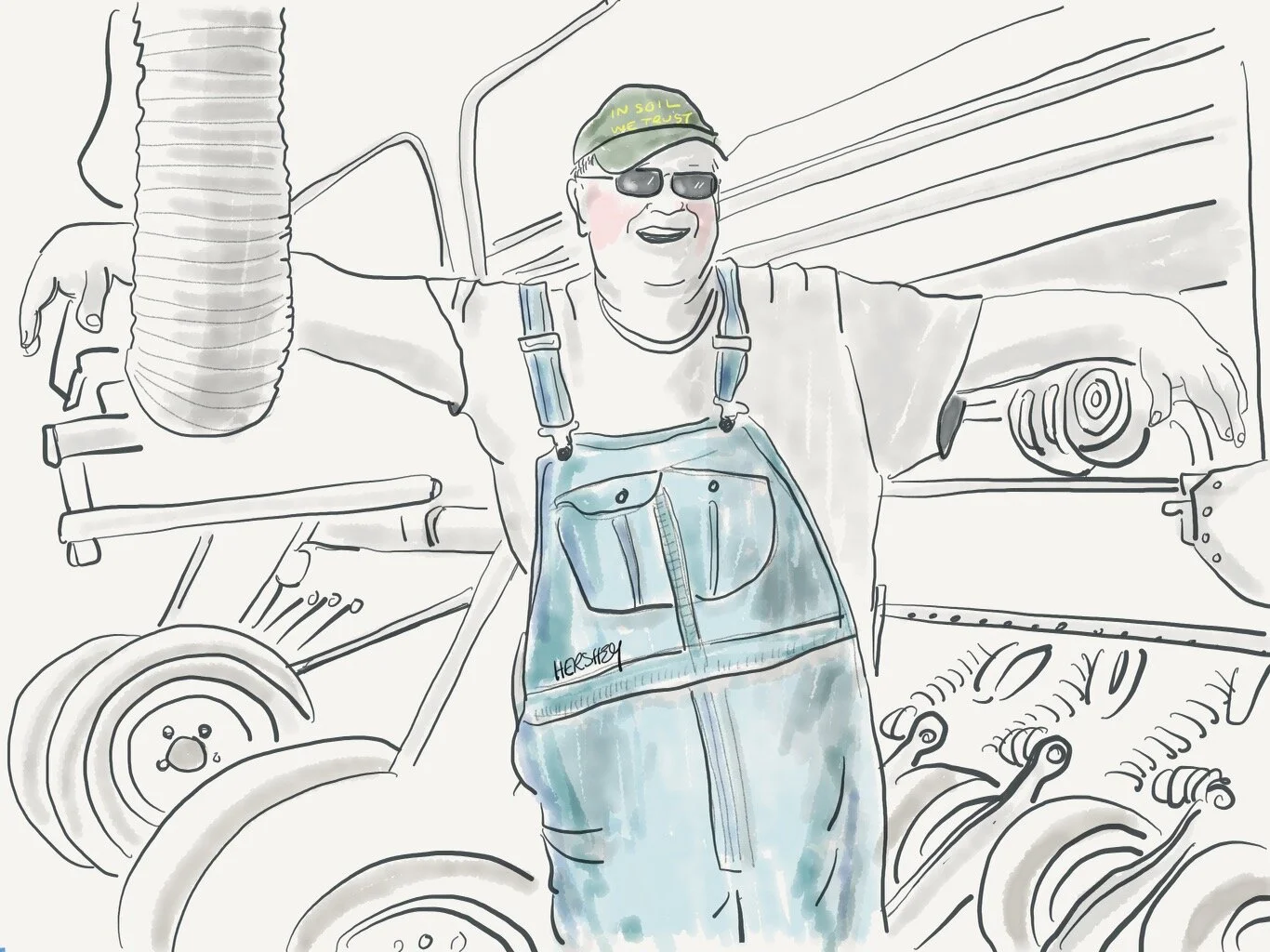
Gabe Brown relaxes on his no-till planter after explaining how it plants seed with minimal disruption to soil. Drawing by Jennifer Hershey. Follow her work on Instagram at deeofo.
Gabe Brown agrees, and it’s hard to imagine John Miller would disagree. The people at Understanding Ag, the Natural Resources Conservation Service (the NRCS is part of the USDA), and the Soil Health Academy also agree, as well as many more organizations that advocate for sustainable practices in modern agriculture. But the most stunning approval right now is bipartisan support coming from the federal government through the Growing Climate Solutions Act. This proposed legislation was reintroduced this April in the U.S. Senate by a large bipartisan group of senators, led by members of the Senate Agriculture Committee. Senators who are sponsoring the bill include 17 Democrats and 17 Republicans.
The bipartisanship toward this bill is almost stunning in our divided politics, and its potential should not be underestimated. In addition, more than 60 agriculture groups and many environmental organizations back the bill (but not all; some have a bad taste in their mouths because of previous problems with other voluntary carbon markets). As it is currently written, this bill will create a certification program at USDA to provide technical assistance for farmers and forest owners to enroll in a carbon-credit market. The USDA will provide guidelines to farmers on how to qualify for carbon-credit programs, and the carbon-credit program will then become "USDA certified." The legislation comes as an array of companies have started enrolling farmers in carbon sequestration programs to quantify and pay for farming practices that minimize tillage and increase organic matter in the soil.
Clearly, we have a lot more to learn about how to most effectively incentivize the agricultural sector to manage soil better, and policymakers must get this right. Yet, there is no time to waste and the potential for doing good is enormous. Let’s not forget: If you want to make small changes, change how you do things. If you want to make major changes, change how you SEE things.
In closing, I would like to add that Resources for the Future is one of my favorite go-to organizations for current information on large-scale climate solutions. Here’s what they have to say about carbon sequestration and storage in the land. Time will tell what we can accomplish. In the meantime, keep noticing the small stuff. It adds up.
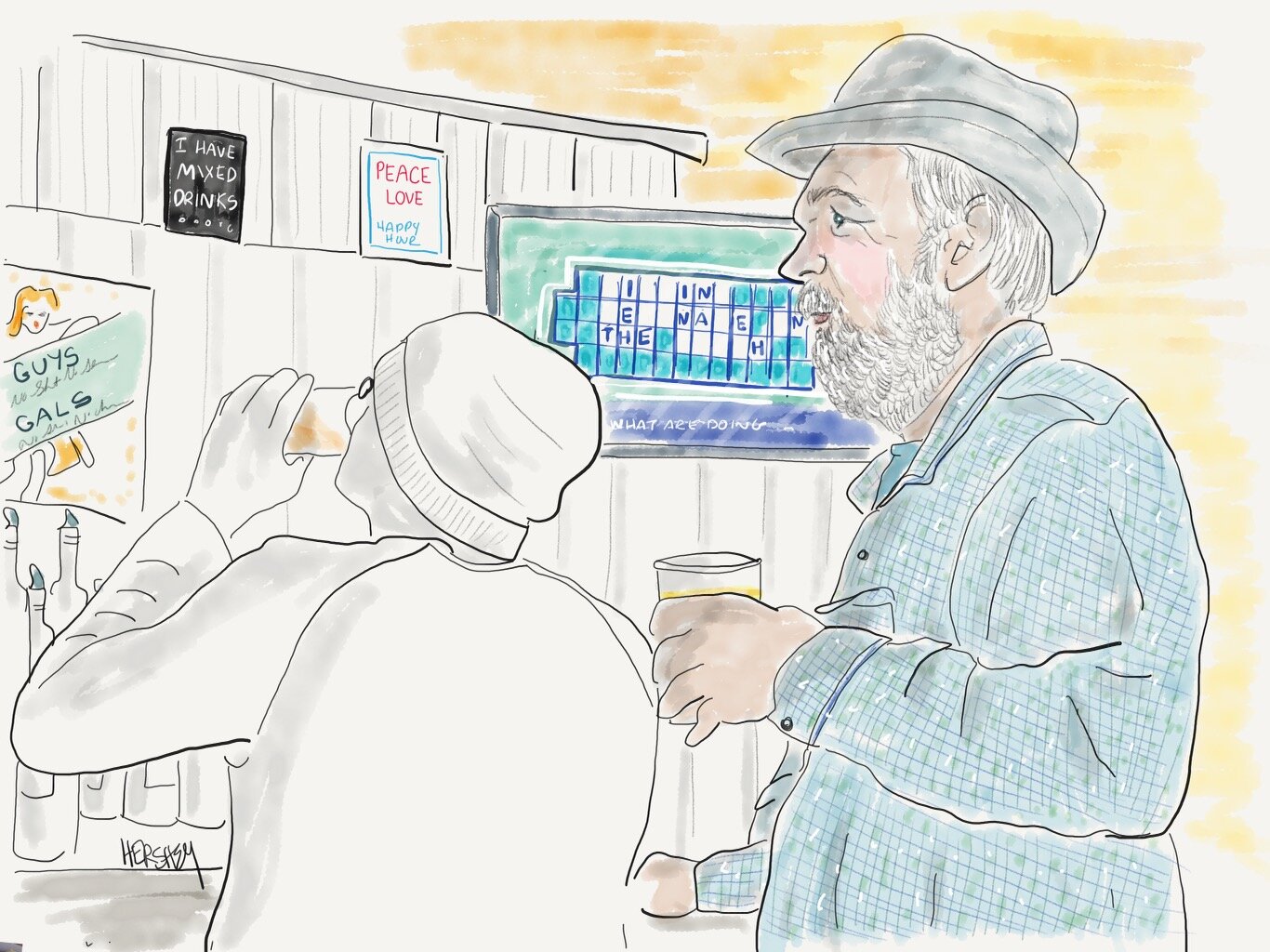
Walter, a retired railroad engineer, is the Enderlin, ND, Friendly Tavern’’s Wheel of Fortune champion. Drawing by Jennifer Hershey. Follow her work on Instagram at deeofo.
Stay vigilant! Thanks for reading. More to come. Follow our next biking trip this July (while places are still under consideration, land use and carbon sequestration will be likely subjects).
All material, unless credited or otherwise noted, are copyrighted property of the blog post author.
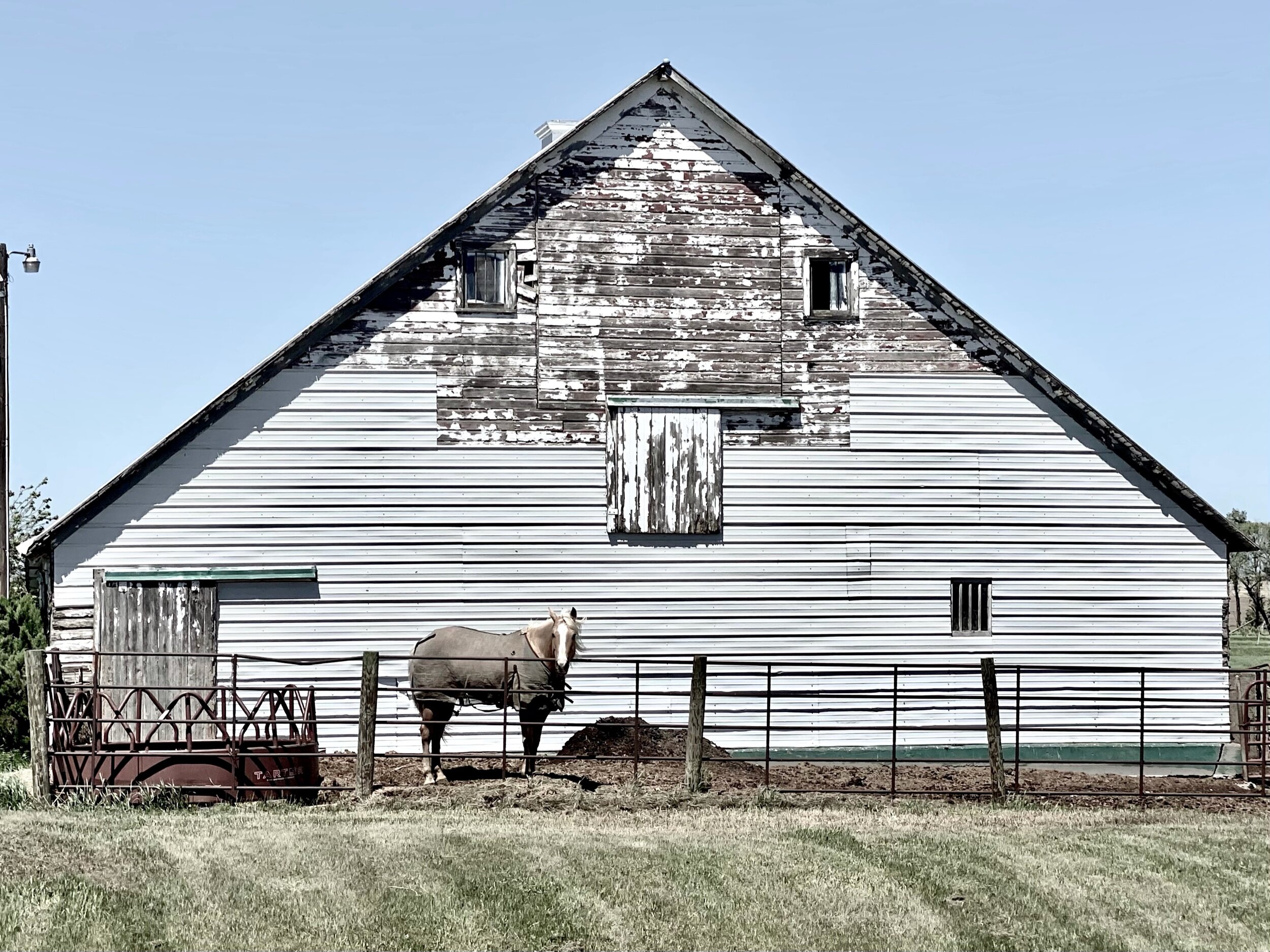
Jenny Hershey took this photo in South Dakota, and she really wanted me to add it to this post because she likes it so much. I do too.
A Journey into Land Use; Biking the Carolinas
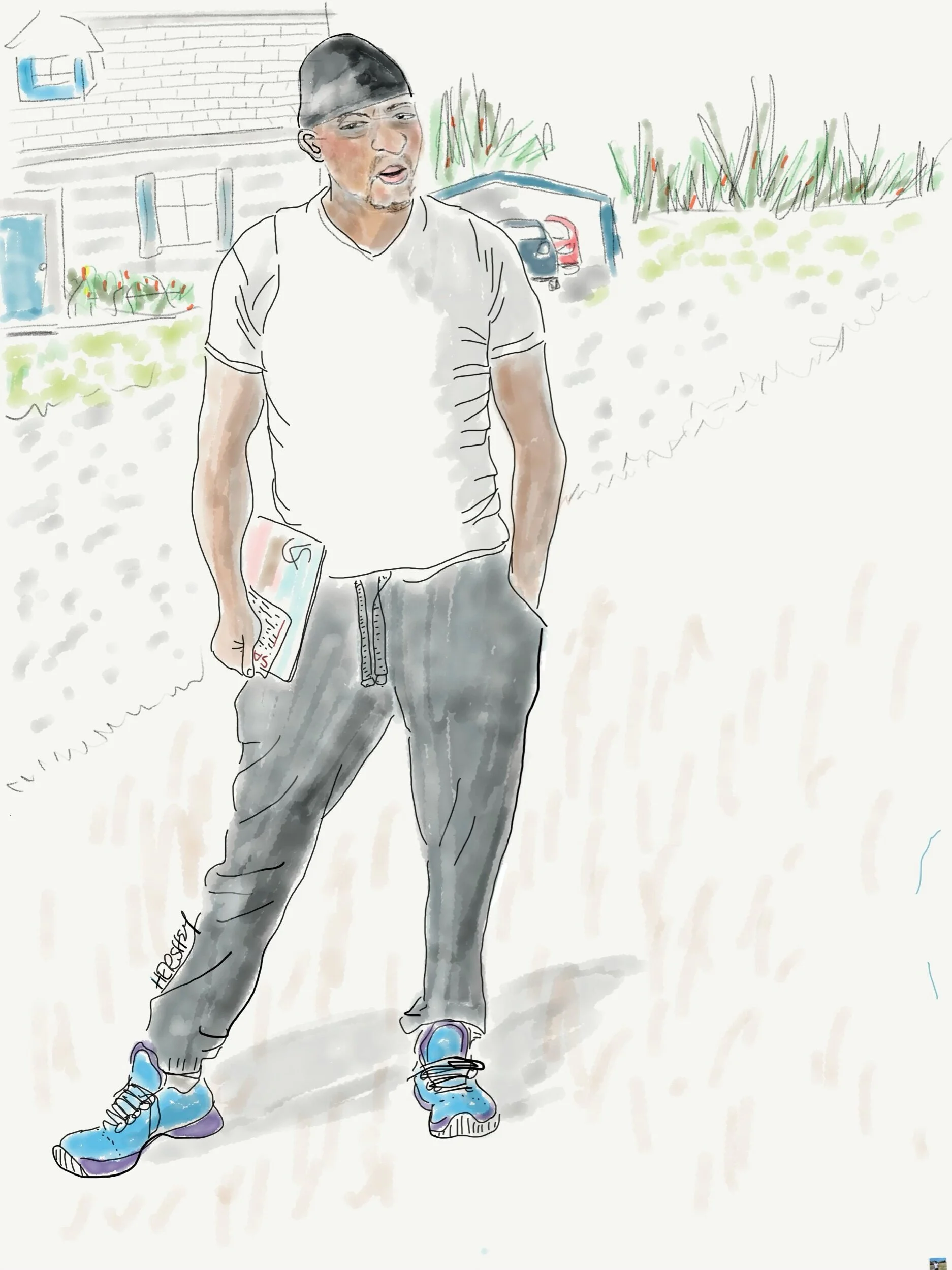
Calvin is from from Bennettsville SC. A forklift operator for Marley Engineered Products, he was given incentives and a bonus to work through the Covid pandemic. He has two kids and somehow managed to never miss a day of work, although his wife was furloughed. We met him on his way to his mailbox. He teasingly joked he was hoping for a stimulus check. …and then he said he’d been watching for it in his checking account…
Drawing by Jennifer Hershey. Follow her work on Instagram at deeofo.
To achieve great things, two things are needed; a plan, and not quite enough time.
Leonard Bernstein
We started our latest cycling trip in Chapel Hill, where Jenny’s son Sam lives with his family. Our plan was simple enough: we would bike to Savannah and back, and then drive back to New York City in time for our second Covid vaccination shot in late March. This was our first tour since the onset of the pandemic without a car, and like many of the “best laid plans of mice and men,” it didn’t go quite as we had expected. Who would have thought that a jumble of discarded wire could work its way into a derailer and rip off a speed sensor? Yet, that’s what happened to Jenny as we turned off a rather bucolic South Carolina road onto the notorious Highway 17. Because of aging infrastructure and an abundance of coastal marshland, this is essentially the only road that connects Savannah and Charleston with the sandhills to the north. To complicate matters, route 17 is recklessly identified as a cycling route on the East Coast Greenway.
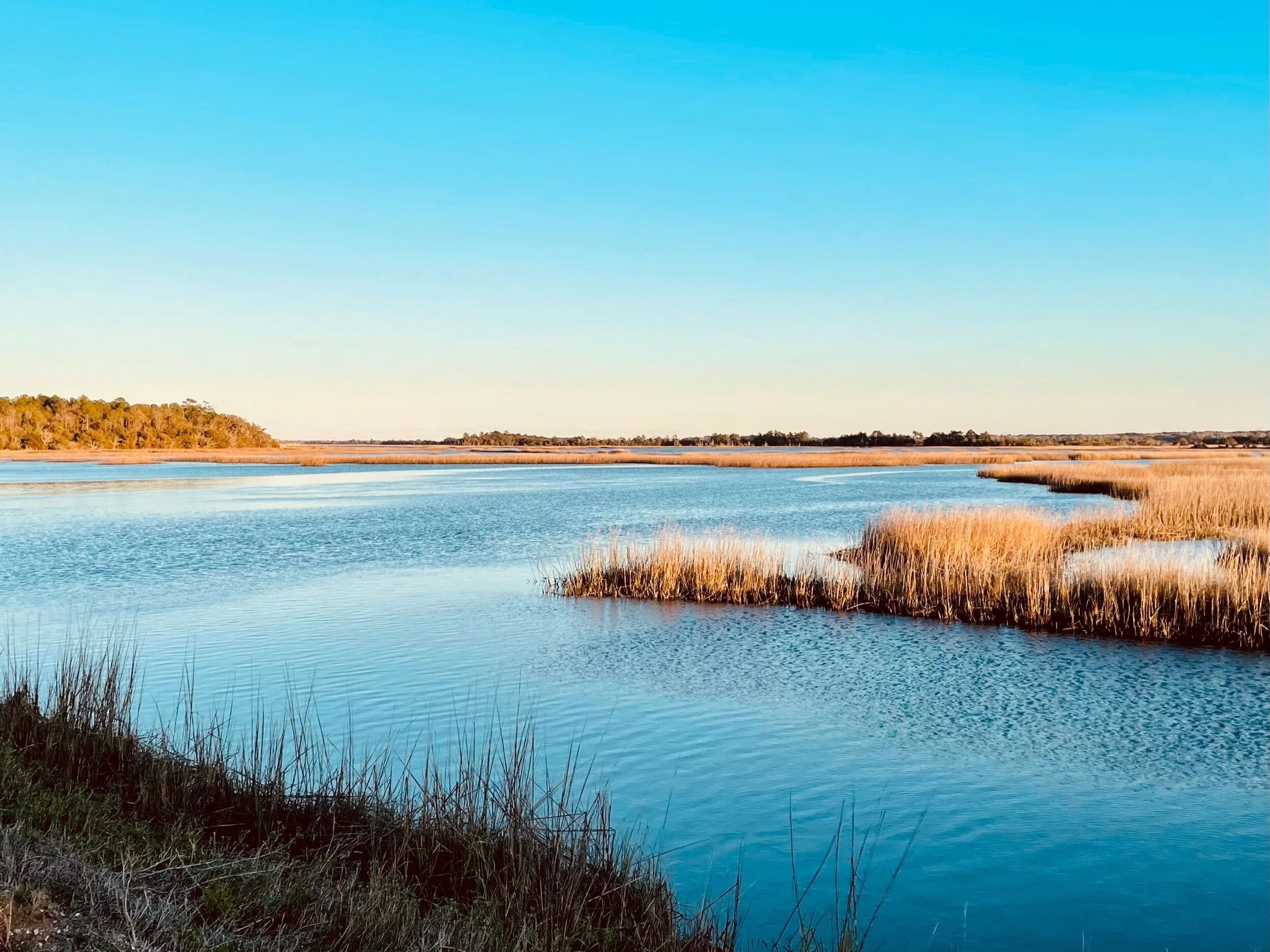
Marshland near Charleston, SC
It is also the most dangerous highway that Jenny and I have ever biked on. Where there is a shoulder (which is rare), this highly trafficked four lane highway offers cyclists lots of fast moving traffic, a customary South Carolina rumble strip, lots of loose gravel and stunningly challenging detritus. We saw the bundle of wire too late to avoid it. I went over it first, and my bike tossed the bundle into the air. Jenny swerved, but alas, it caught her rear wheel on its way down. Her bike seized immediately. Not good, but thankfully she didn’t crash.
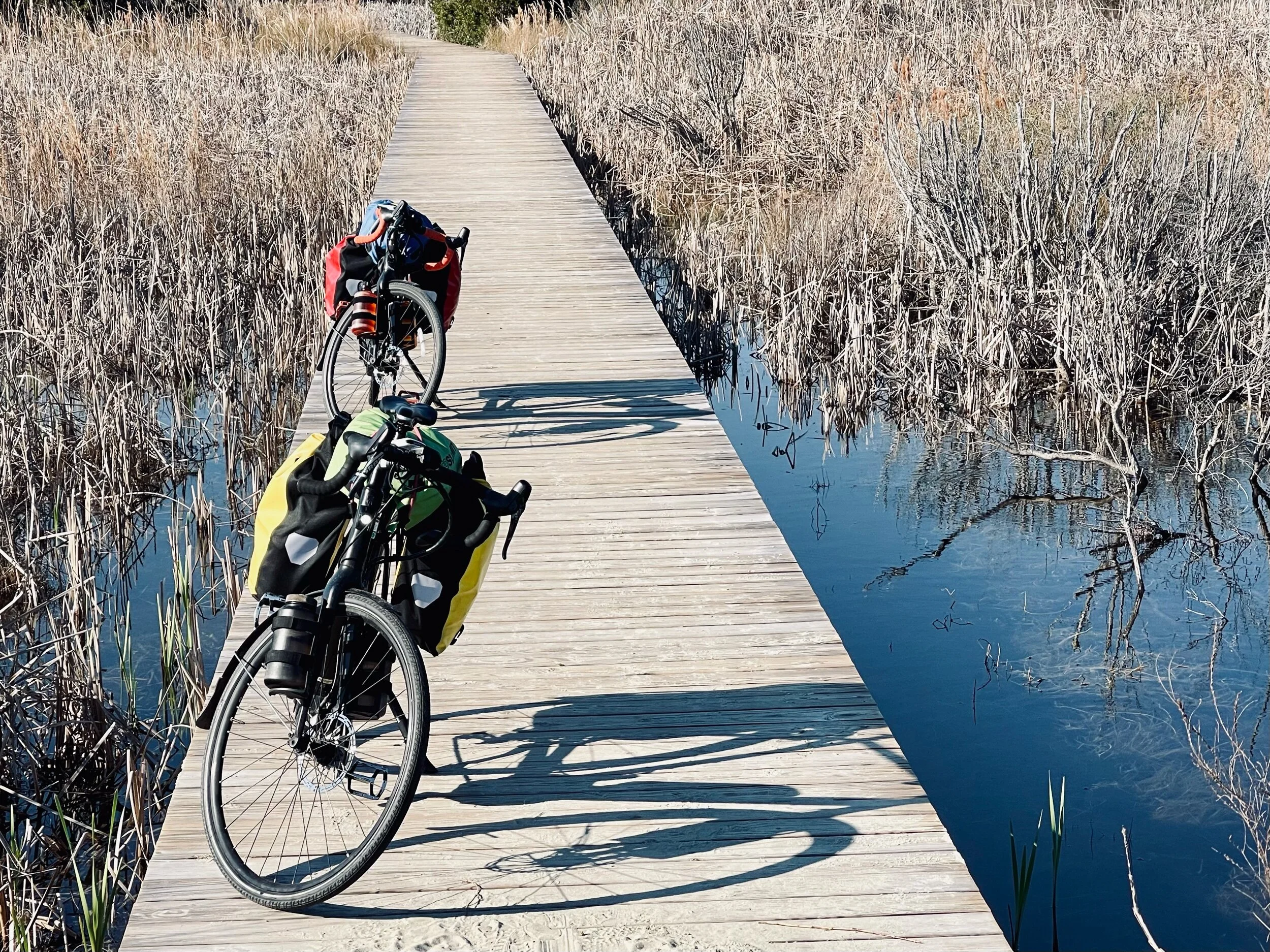
Our “fully loaded” Trek Crossrip e-bikes parked on a boardwalk near the beach on Sullivan Island in Charleston.
We both ride Trek Crossrip pedal assist e-bikes that increase our hourly touring speed by 3-5 miles/hour. This makes riding 70 miles a day on average a bit easier and faster, yet still physically challenging. But these extraordinary machines also have their downsides. After carefully disentangling and cutting out multiple strands of wire wound around the cassette, derailer, rear wheel and frame of Jenny's bike, imagine our disappointment when we discovered the wire had somehow managed to tear off the speed sensor for the small motor in her crankcase. It wasn’t the end of our trip altogether. Although we doubted we’d find a Trek dealer with such a rare part in stock, Jenny was able to nurse her bike along even though the motor would cease to work from time to time when the torque increased. This made for painful uphill cycling. We were about 400 miles from our car. Getting home on the bike would be possible, but it was going to take some fortitude.
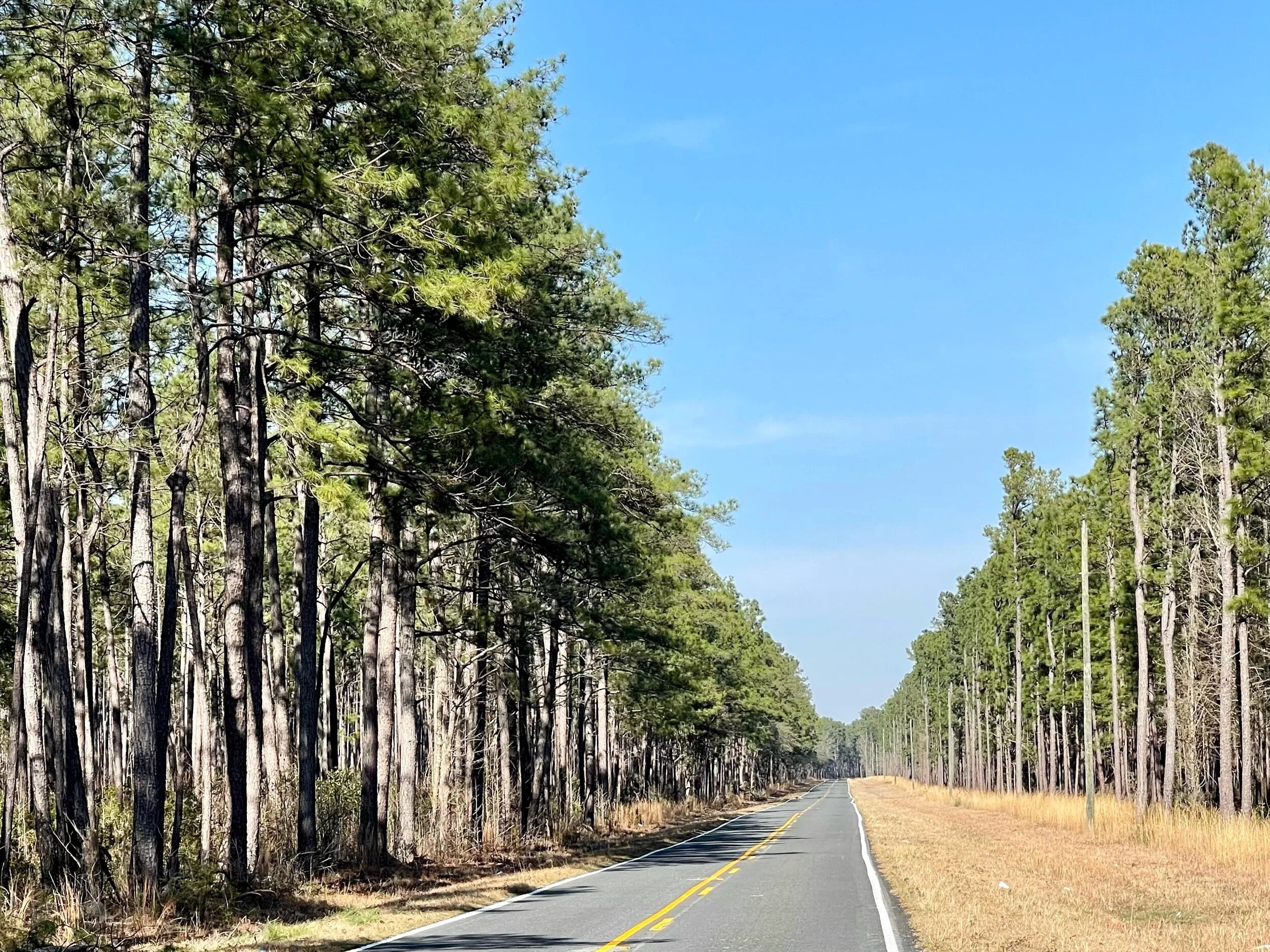
The Francis Marion National Forest on a mellow stretch of road off Route 41 north of Charleston. Formally established in the 1930’s, this forest covers approximately 259,000 acres. In 1989, the forest was nearly destroyed by Hurricane Hugo; only the young growth survived the storm and its aftermath. Today, most trees in the forest do not predate this hurricane.
A Great Egret flying over coastal marshland on the Isle of Palm Connector near Mount Pleasant, SC, southwest of the Francis Marion National Forest.
Jenny rose to the occasion, although it took us three days to reroute ourselves through Charleston and Mount Pleasant (where we found a bike shop that, predictably, didn’t have the part we needed). Please be forewarned; if you ever visit Charleston by bike, getting into or out of that extraordinarily charming and historic city is not fun. On the upside, there is talk by state and local officials of making both Savannah and Charleston more accessible to cyclists at some point in the not too distant future through “smart growth” planning.
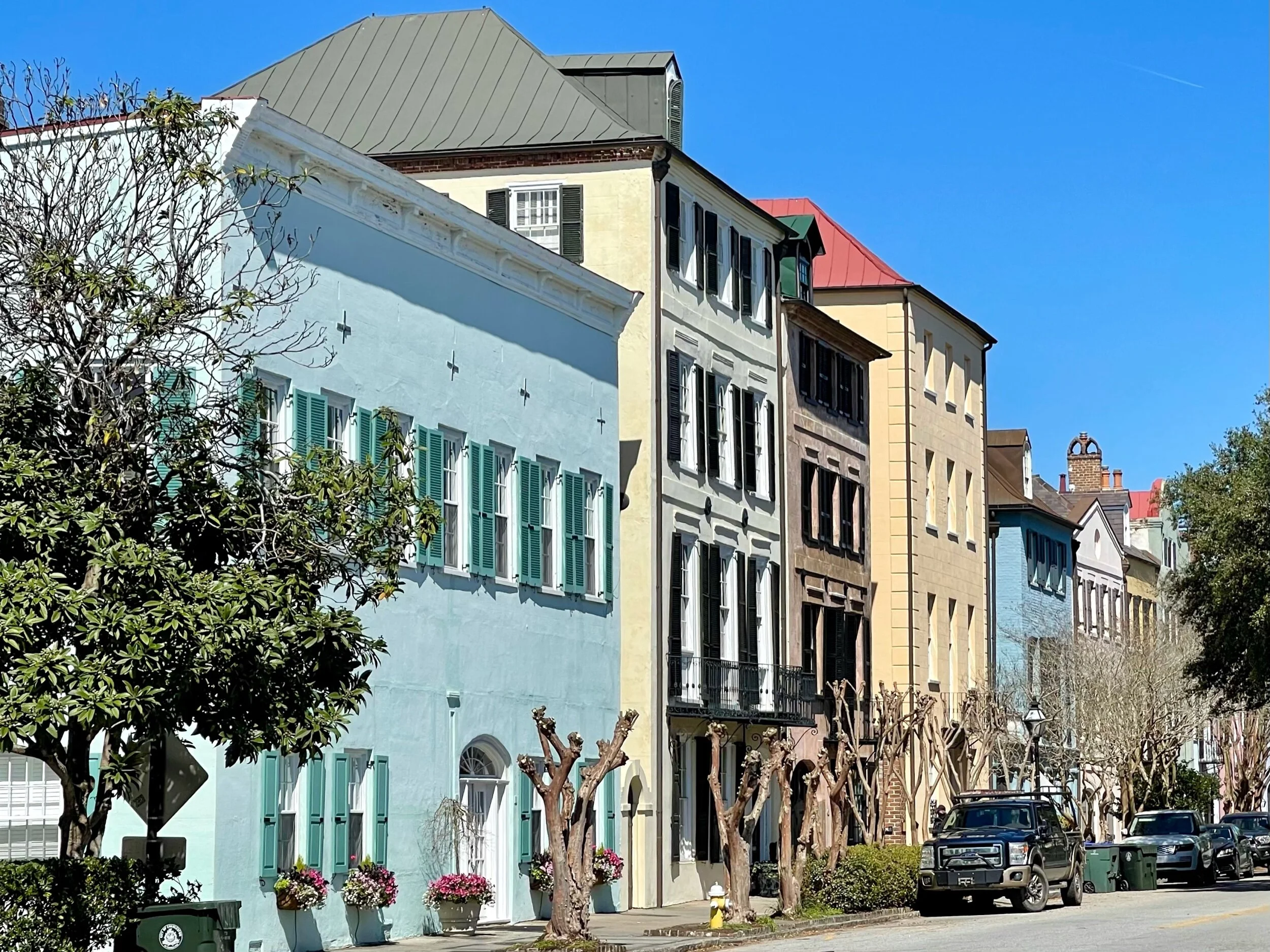
Charleston is a spectacularly attractive town, and it seemed to be gently waking from a Covid induced slumber when we passed through. There were lots of tourists wandering the streets, horse drawn carriages carrying passengers, and numerous guides talking to small groups of masked up people. We ate outside at a well known local fish restaurant, Eli Hyman’s, run by a 4th generation Jewish businessman who told us that just a few blocks away we’d find the oldest continuously used temple in the United States,
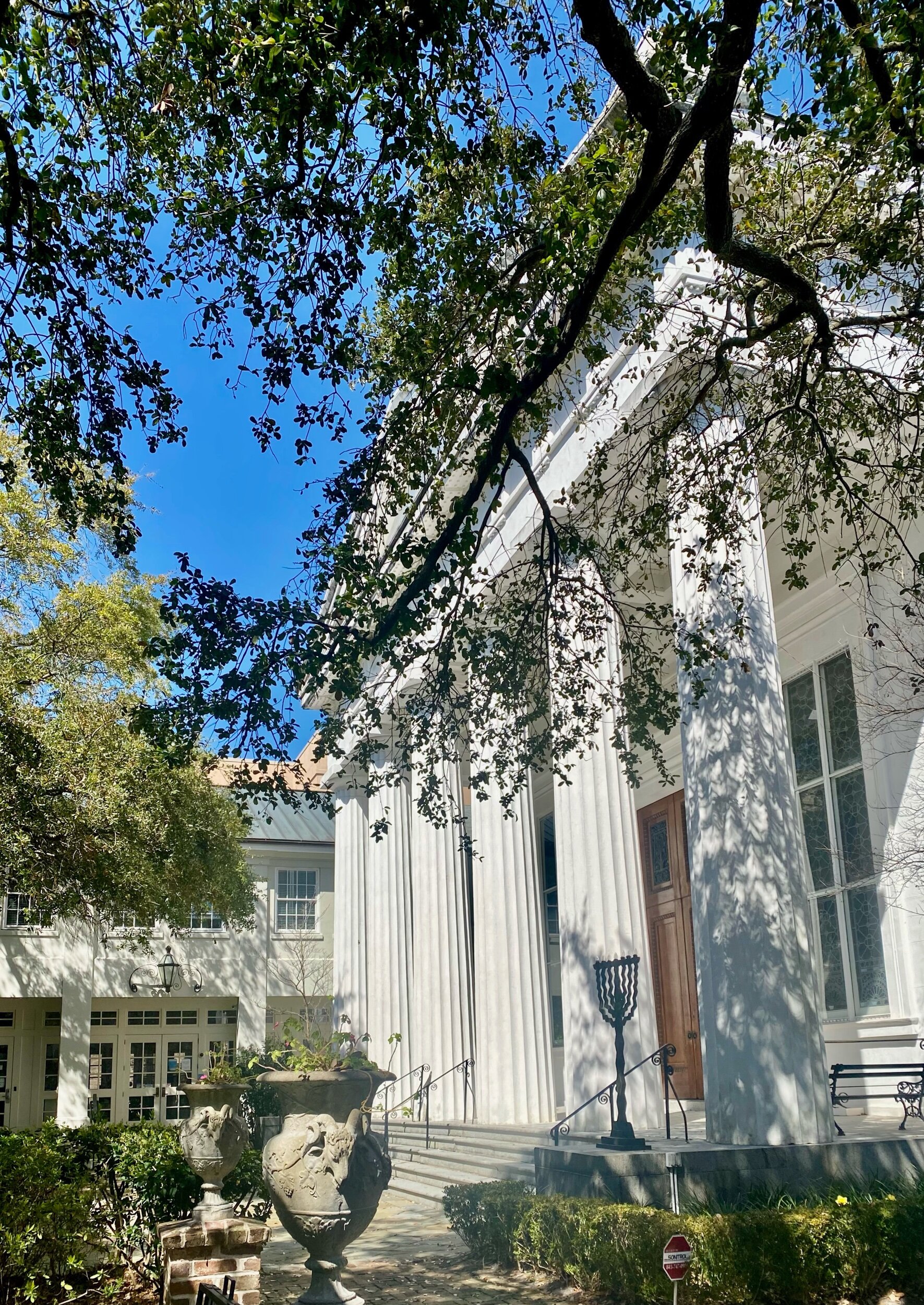
Temple Kahal Kadosh Beth Elohim in Charleston, SC. Founded in 1750, this temple is the cradle of reformed Judaism.
“Dumb growth” planning has irritated me for years. There are many roads in America where poor design fragments communities, destroys land unnecessarily, and makes walking or biking impossible. Humans have walked everywhere for thousands of years, yet in recent decades transportation planners have built many roads that can be navigated only in a functioning motorized vehicle. It's as if planners have acquired dementia about our capacity to ambulate. Where are the sidewalks or shoulders? God forbid that someone’s car should break down, and they would have to walk to the nearest gas station for help. Try ambulating by foot, in a wheelchair, or on a bike to the nearest mall next to a freeway in your community, and you’ll know what I mean. You're likely to be surprised at how terrorizing such a trip can be.
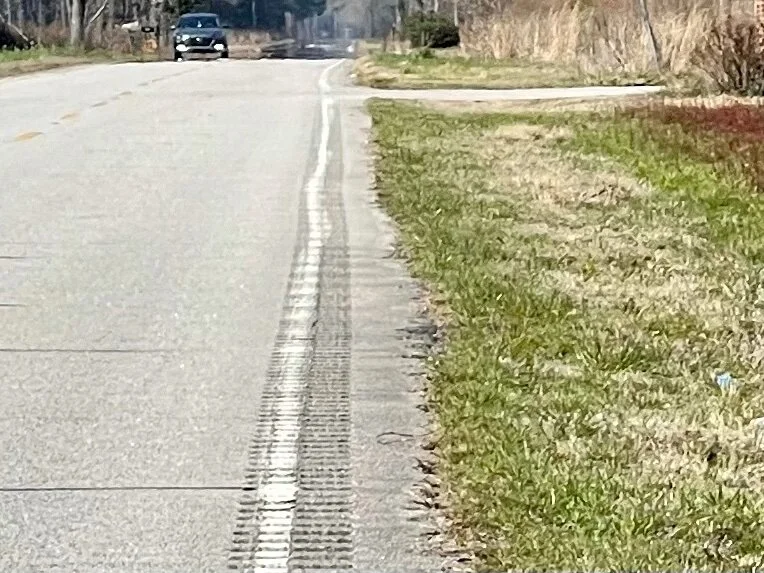
A typical road in South Carolina. While North Carolina has skinny or nonexistent shoulders, South Carolina has a terrible practice of adding rumble strips to their very narrow or nonexistent shoulders (at extra cost to taxpayers)! This might be helpful to the occasional driver, but it also forces cyclists onto very busy roads. I’d wager that for every sleepy or drunk driver whose life is saved, several cyclists are killed. This is so dangerous that the Adventure Cycling Association (ACA) runs an entire advocacy program focused solely on redesigning and/or eradicating rumble strips. You can read about it here.
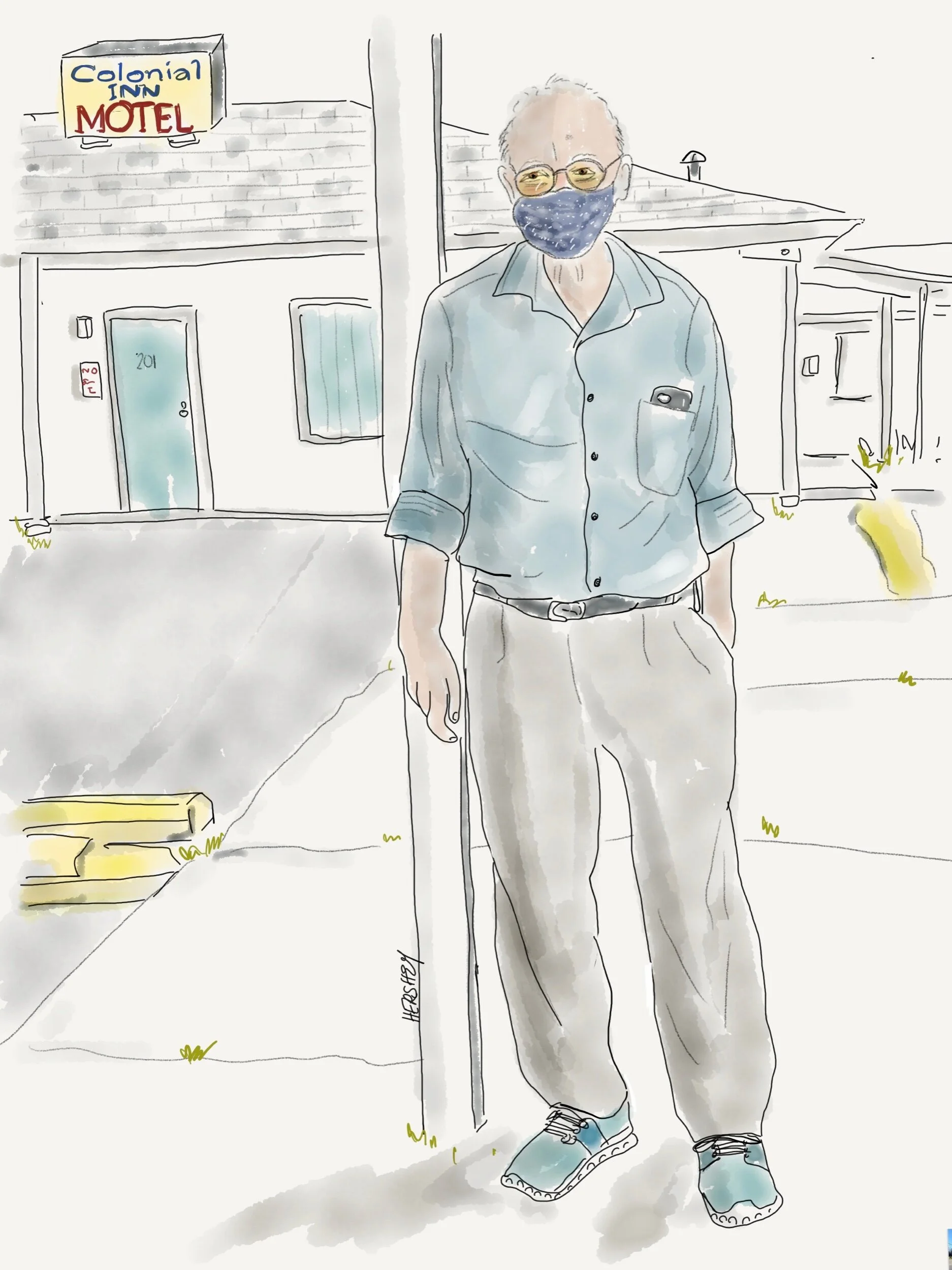
Mr Patel has owned the Colonial Inn in Andrews, SC, since he immigrated from India 41 years ago. He survived Hurricane Hugo in 1989, which devastated his town and blew off his motel sign. Mercifully, his motel was spared but his parking lot was filled with debris, including a few roofs from neighboring homes. Temporary power was restored after 4 days, and the motel prospered as it filled up with utility workers from all over the state. Currently Mr. Patel benefits when the nearby paper mill at Georgetown shuts down annually for maintenance because he houses all the workers.
Drawing by Jennifer Hershey. Follow her work on Instagram at deeofo.
In much of America, where clumps of population are mixed with cropland, pastureland and forests, it can be difficult to grasp the identity of a given “place.” That’s what Jenny and I experienced as we cycled south from Chapel Hill. After we passed a lovely (man made) reservoir on a narrow, shoulder-less, highly trafficked road and some seemingly affluent horse farms, much of the landscape became chaotic - a house here and there, a recently tilled dirt-exposed field, junked cars, abandoned appliances, a decaying shed and house, a few acres of lumpy clear-cut timber with trunks and branches strewn every which-way, a field of sod, a thin stand of trees, a gravel field of unused septic tanks, a half acre of forest, a driveway to nowhere, a parking lot, an abandoned industrial shed, a pile of tires, a Dollar General, enormous stacks of pipelines, a Family Dollar, a quaint house with a yard full of tchotchkes, a few trees, a large field revealing last year’s cotton crop.
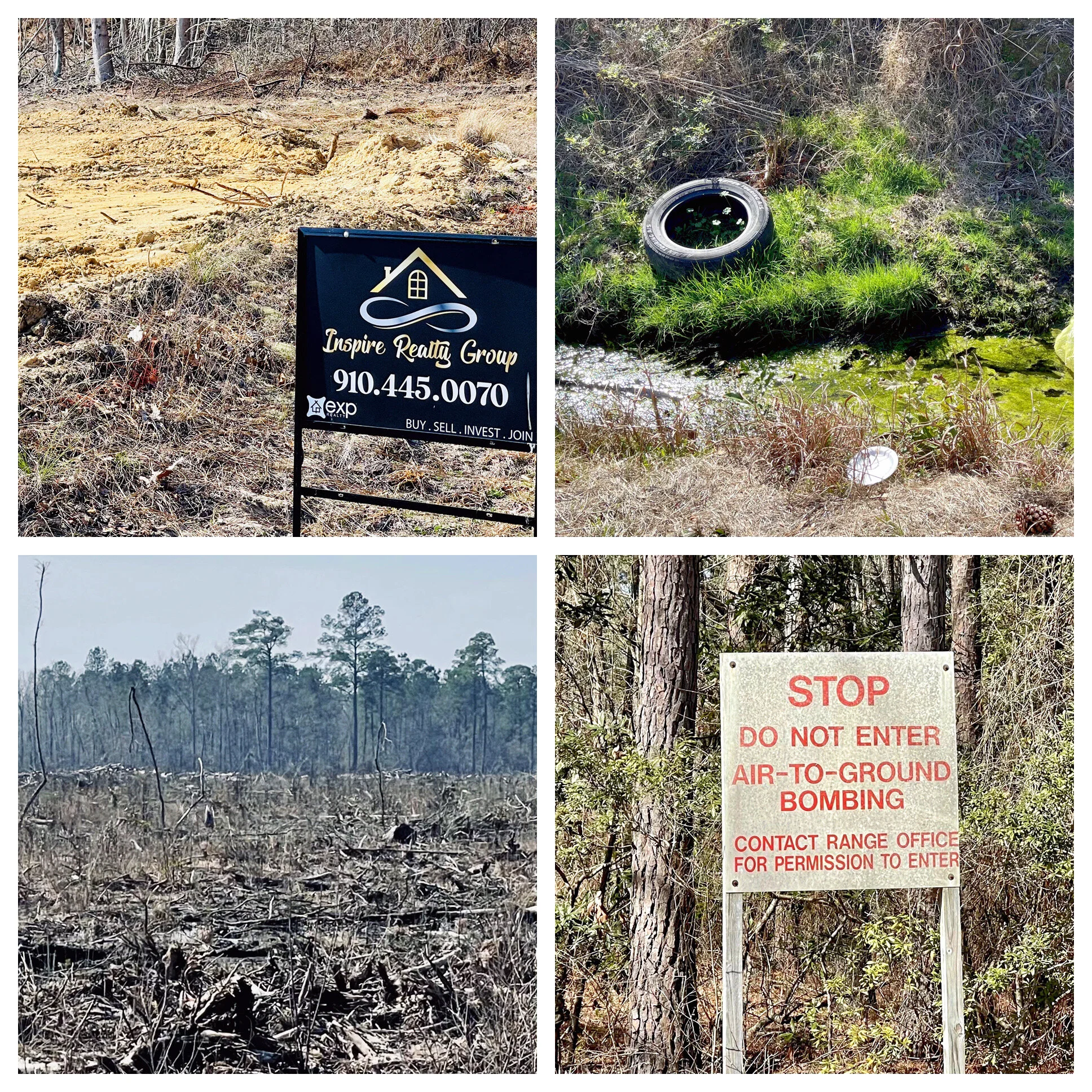
It was dizzying to take it all in, and even harder to know if there was anything at all sustainable about what we were looking at. Most likely not, we thought. And I mused on one of my obsessions - the persistent degradation of our treasured American landscape. It all seemed so ….disorganized. I really couldn’t get my mind around all that I was noticing. It was a crazy landscape, a random piecemeal (de)construction with no regard for itself. It reminded me of a frog in a slowly boiling pot who fails to notice the water is slowly heating up until it’s too late to do anything about it. There was persistent decay all around us, and no one seemed to care. But then, what do I know? As a small-city Midwesterner I can probably identify five to seven agricultural crops, and Jenny as an urbanite, even fewer. I am only now recognizing the difference between timberlands and forest. The sad fact is I know very little about rural landscapes beyond what I have come to appreciate in our magnificent national parks. But protected public land is very different from the vast stores of private land that occupies most of our landscape. And this was private land in a gentle rural landscape that had once been vast forests of Longleaf Pines nestled among swamp, marsh, bayou, streams, rivers and lakes. It is now small patches of forest, timberland, cropland and pasture, random houses and housing tracts, abandoned lots, industrial products, and an abundance of intentional and uninspired human detritus.
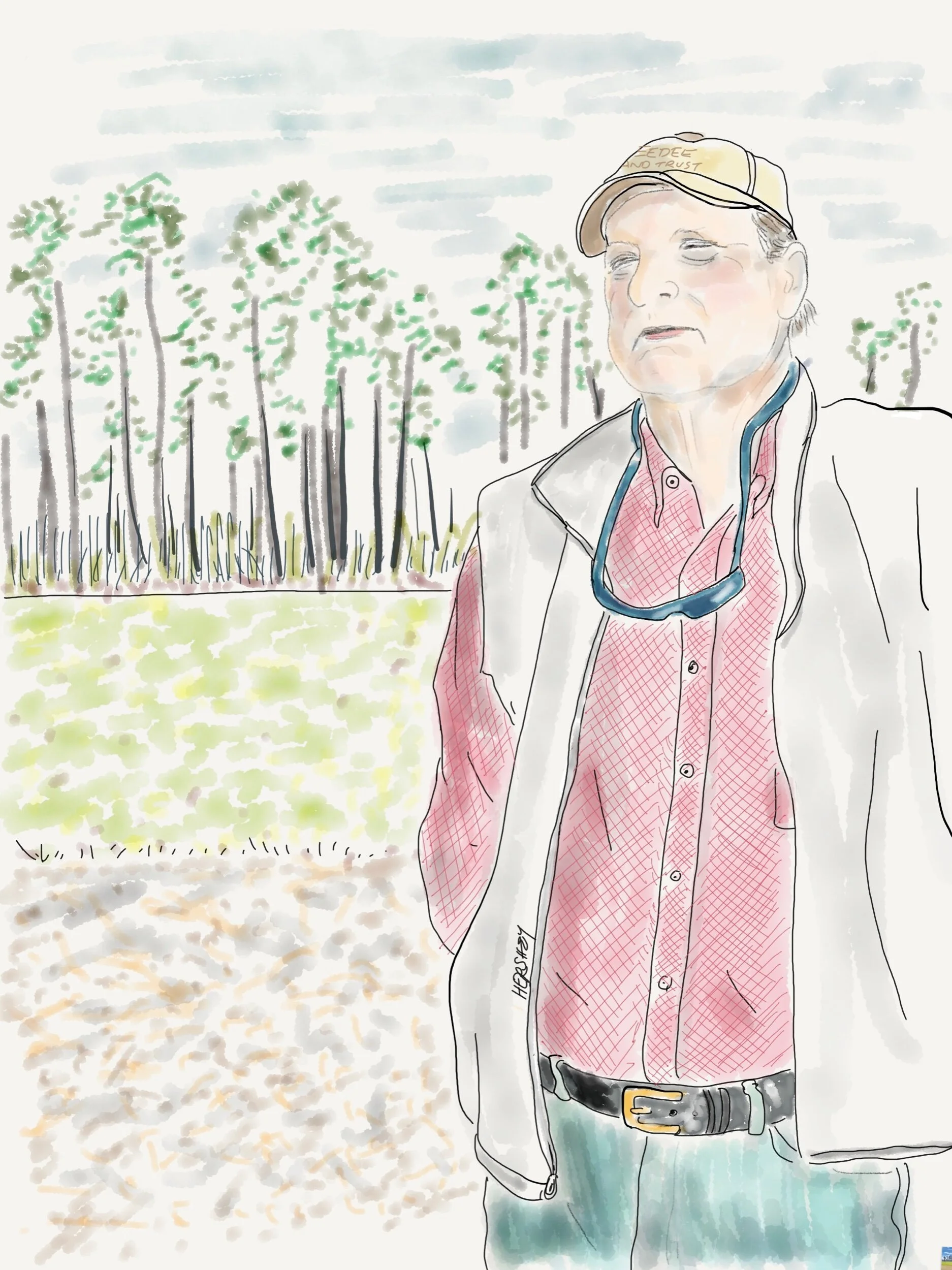
After explaining the value of winter wheat as a harvestable cover crop, the 6th generation farmer Keith Williamson tells us about the Pee Dee Land Trust (PDLT) which has partnered with private landowners throughout the Pee Dee River watershed (second in size on the eastern seaboard to the Delaware River watershed) to permanently protect over 32,000 acres of land. Over 80% of conservation easements held by PDLT are working farms and forests clustered mainly along waterways.
Did you know there are approximately 5 times more farmers over 65 years of age than there are farmers under 35?
Drawing by Jennifer Hershey. Follow her work on Instagram at deeofo.
Talking to Keith made our day. We saw him standing next to his car looking over a field that we had just been wondering about, so we pulled off on the grass (because there was no shoulder on the road) on the opposite side of the road, and yelled in our nasalized New York City and Midwest accents to get his attention. Keith didn’t seem the least bit phased by the bikes, or our car dodging as we crossed the busy road on foot all the while peppering him with questions. He patiently answered us in his gentle South Carolina drawl that we were looking at winter wheat, a cover crop on a field that would be soybeans in a few months. “It’s a complimentary process. The wheat takes up the nitrogen the soy puts down,” he explained. Legumes add nitrous oxide to the soil, which then enters the atmosphere through erosion or when the field is tilled. We learned later that nitrogen is a potent greenhouse gas, so using cover a crop like winter wheat to reduce nitrogen levels has a beneficial impact on climate change, as well as helping soil health. As we talked more, we learned about the Pee Dee Land Trust, which helped Keith and other members of his family to protect 3,000 acres of family land.
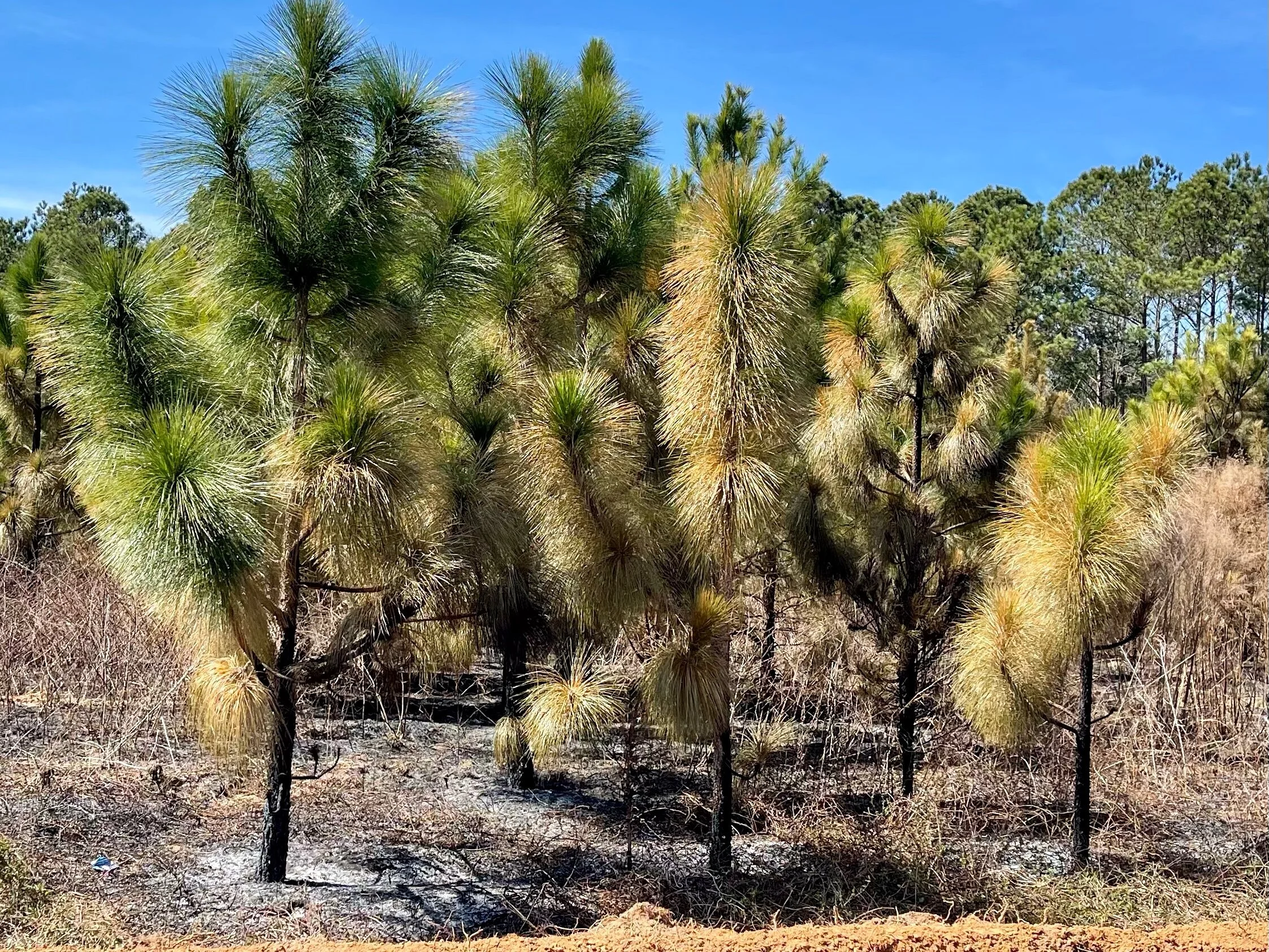
At one time most of the southeast was covered in Longleaf Pine forest. Naturally fire resistant, these superb trees would grow quite tall and create savanna-like conditions underneath, which would be routinely burned off, either by natural causes or intentionally by indigenous people. Now burning is almost always intentional. This relatively young forest was recently burned off.
Land trusts are an important tool for protecting land from development, preserving it for valuable forests, timberland and agricultural uses that encourages smart rural growth, improves water quality and ensures natural carbon storage and sequestration. For example, forests alone in the US store 59 billion metric tons of carbon in trees, roots, soils and forest products, and sequester 14% of the country's CO2 emissions. Agricultural crops are not quite as storage intensive due to their shorter life cycles, but their carbon storage and sequestration properties can be significant.
Land is typically conserved by outright purchase into a trust, or less expensively, by “conservation easement,” a deeded agreement with a Land Trust by the owner to protect a property. Conservation easements are irrevocable and apply to the present and all future owners of the land. As with other real property interests, a conservation easement is recorded in local land records and becomes a part of the chain of title for the property, permanently protecting the land from development.
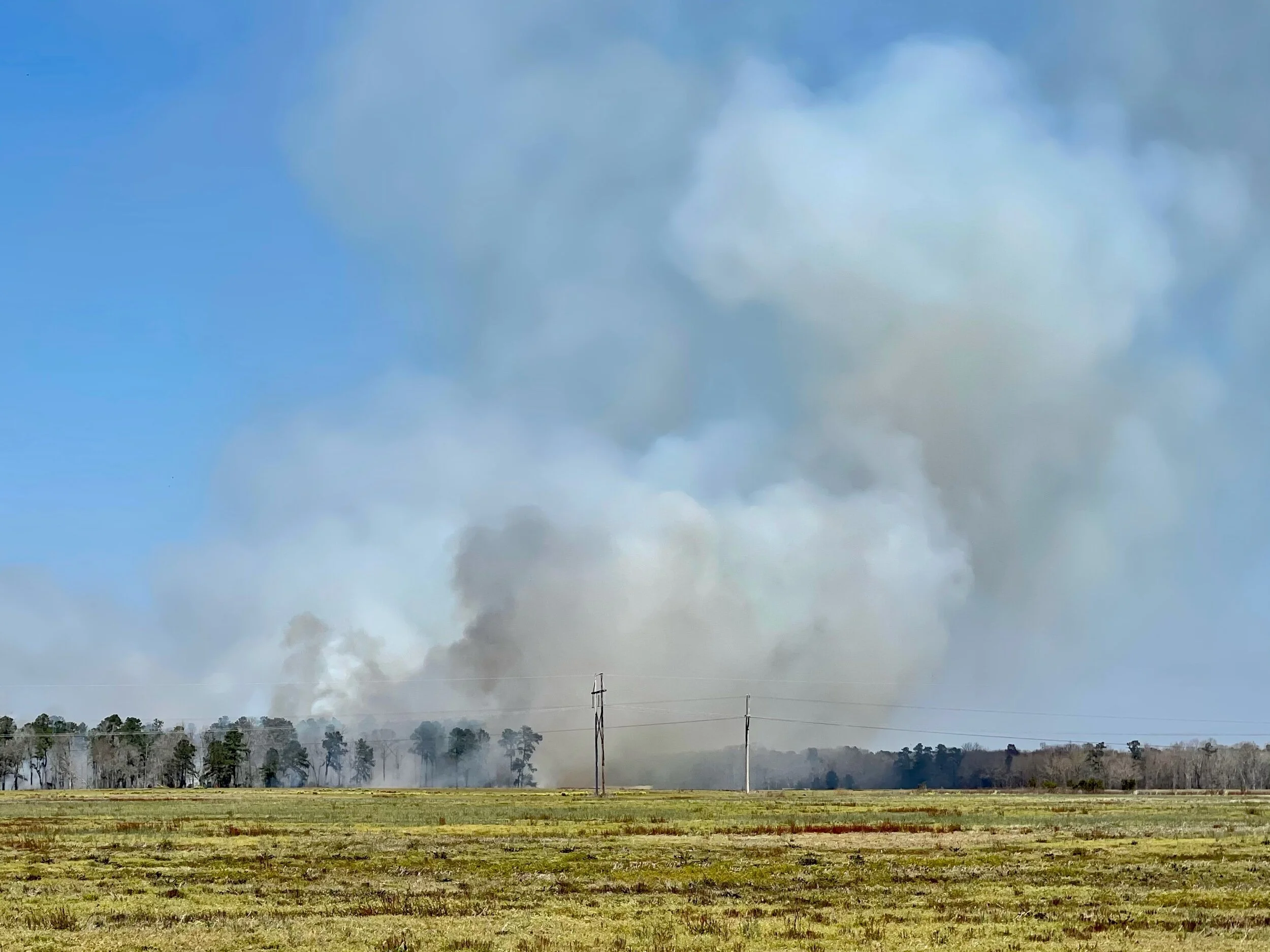
An intentional burn off seen at a distance.
Because approximately 9000 acres a day of farmland and forests in the US are lost to commercial and residential developers, land trust programs provide enormous public benefits. Conservation easements alone already protect an estimated 50 million acres of natural habitat in this country, and each year another 2 million acres are added to that total. Since 1982, the US has lost over 25 million acres of agricultural land to development, while global population and carbon emission levels have almost doubled. I couldn’t find a figure for how much farmland we have left in the US (I’m sure the USDA knows), but I did learn we currently have about 450 million acres of forestland in the US under threat of development, which is about 60% of our remaining forests. According to a study cited by the American Farmland Trust, land that is converted to other uses from its natural habitat (including agricultural land) emits greenhouse gas emissions at rates 50-70 times greater than had it remained undeveloped. Preserving our land is essential if we are going to reach net zero by 2050.
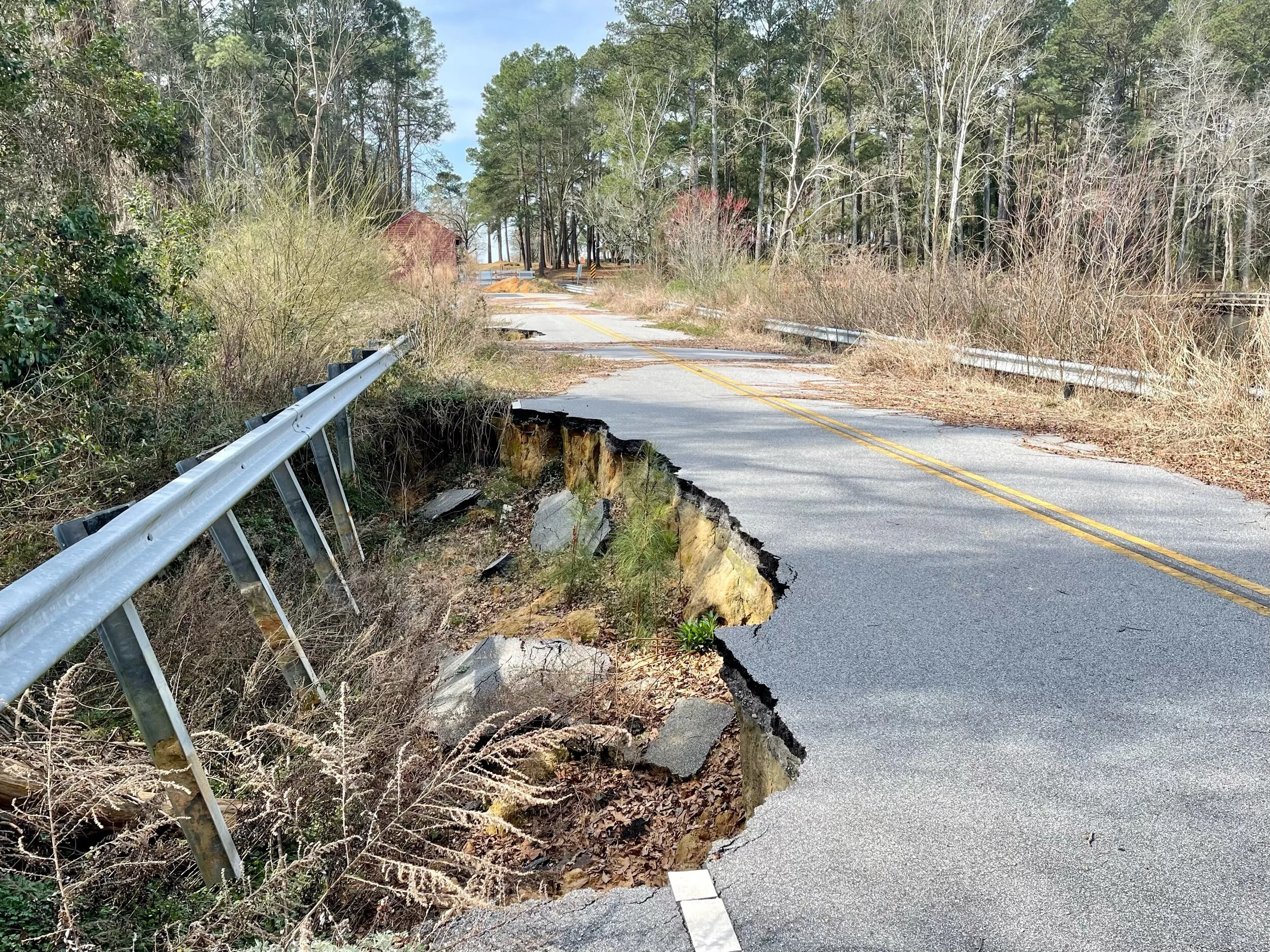
Flood damage on a road near McColl, SC
This protection doesn't come without a price tag, however. Easements are incentivized through tax credits or property tax reductions, so taxpayers effectively pay private citizens not to sell their land to developers at a higher price in order to benefit the greater good. (Frankly, that strikes me as analogous to the failure of capitalism to externalize the social costs of carbon pollution, but that’s a subject for another blog post.)
Yet, the effort is essential. Soil stores two to three times more carbon than the atmosphere and up to four times the amount of carbon stored in the vegetation on land. Since the advent of modern agriculture (till and fertilize; wash, rinse and repeat) soil health has degraded considerably and we have lost much of our topsoil to erosion, including more than half of the organic carbon originally stored in US soils. With nearly 400 million acres of cropland alone, we have an enormous opportunity to use “regenerative” farming methods to rebuild organic carbon in our soil, sequester atmospheric carbon and reduce greenhouse gas emissions. However, soils need healthy plant life on them to be able to accomplish this. How we manage carbon stocks on our land - whether it’s forest, timberland, cropland or pastureland - will have a significant impact on climate change over the coming decades. Climate activists, policy makers, and most importantly farmers, need to understand that how we use our land (and in particular, how we grow our food), are every bit as important to our collective efforts to decarbonize as transforming our energy system.
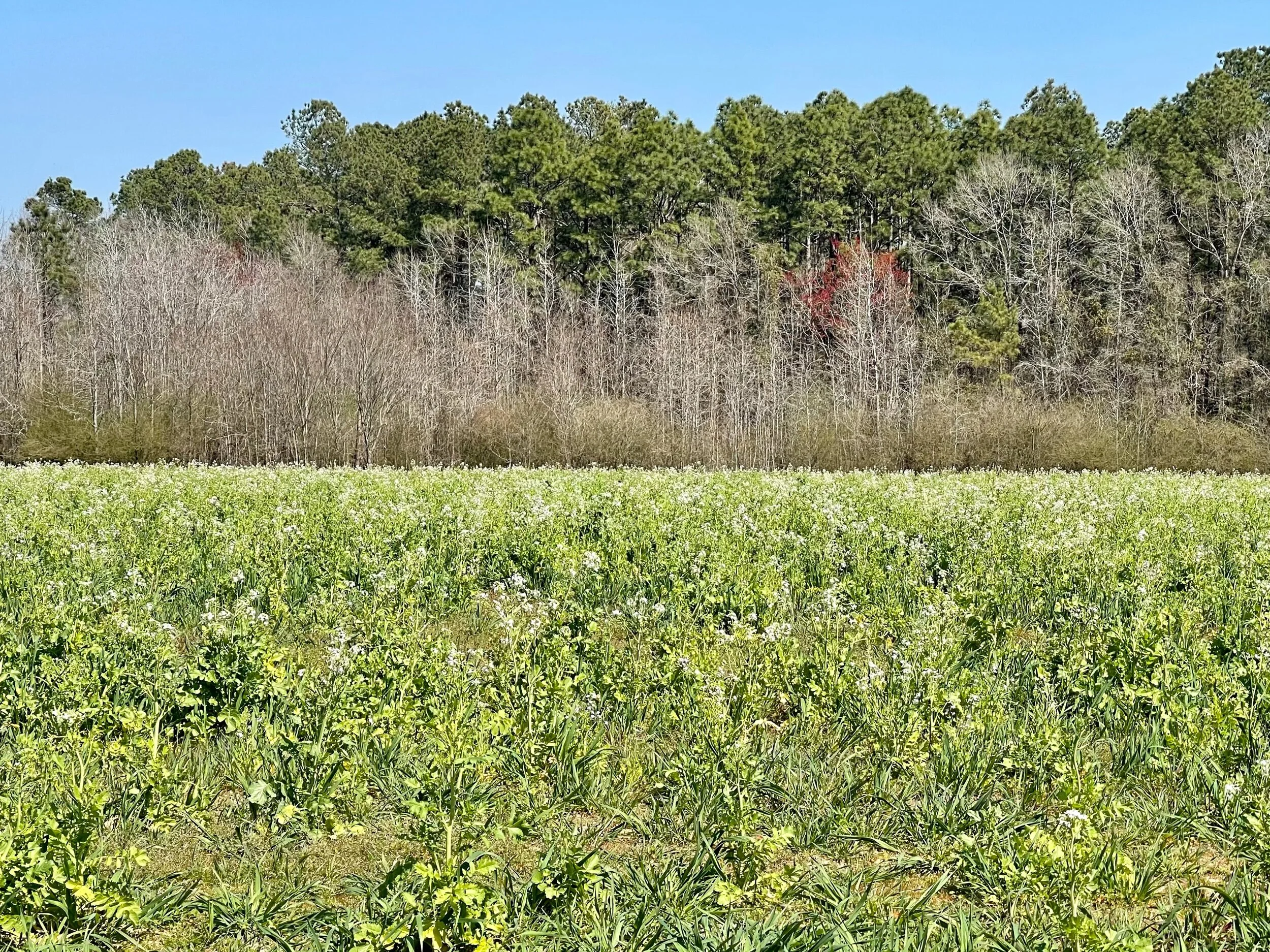
A field of turnip, another popular cover crop in regenerative agriculture.
Rural communities face a host of challenges - including changing demographics, lack of economic growth, community health and preservation, and a strong need for environmental protection. In addition, rural communities need workforce development, access to broadband, and effective transportation in their planning efforts. Smart growth strategies can help communities guide development while protecting working lands and preserving rural character. There are an increasing number of great organizations and online mapping tools for learning more about these topics. I list some of them below, especially those that I used to prepare this blog.
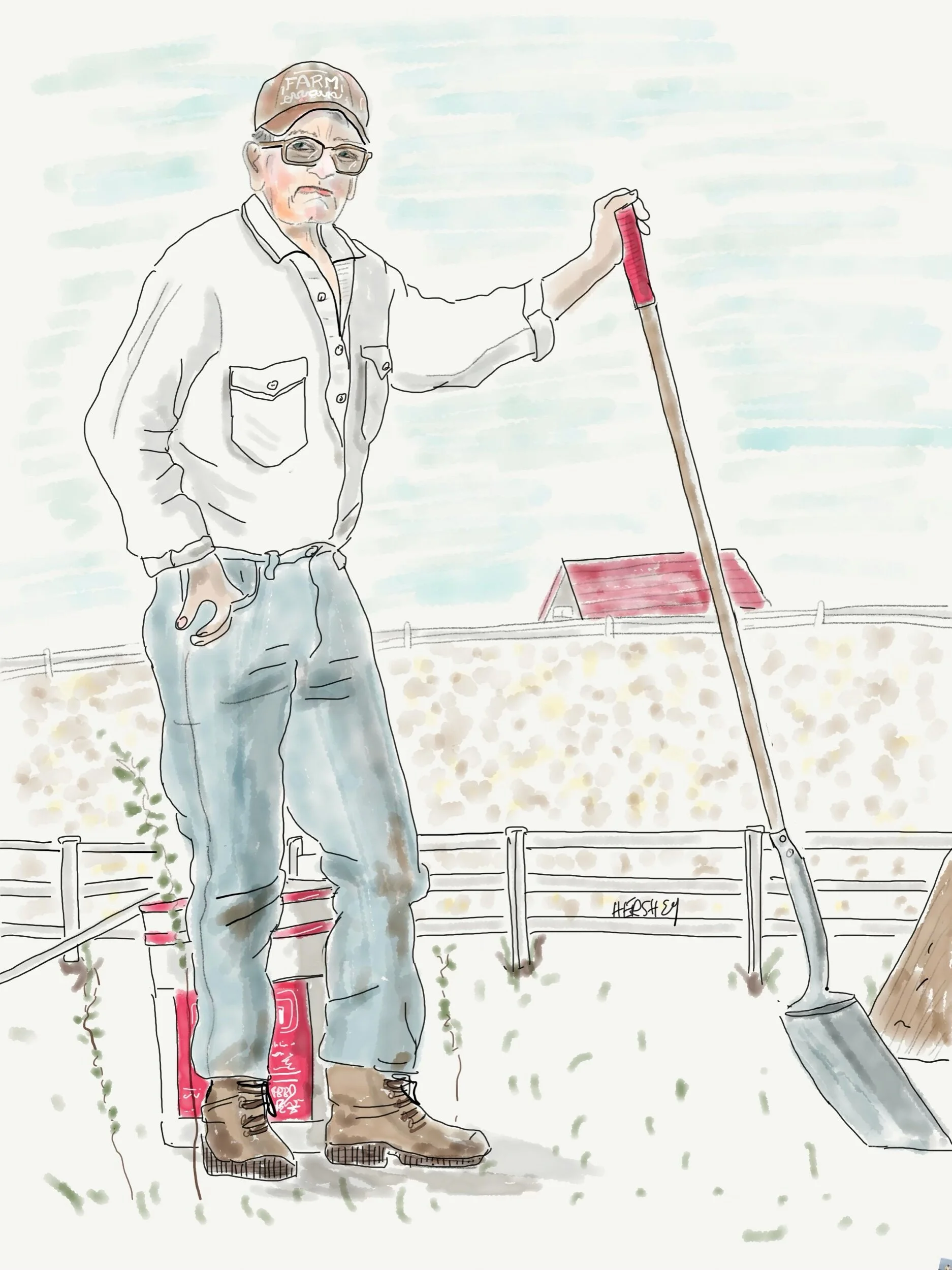
Lucky, a 74 year old ex jockey from Virginia, runs a 16 acre horse boarding farm in North Carolina. He believes everyone can find a job doing something even if they don't like it, and he doesn’t like the Covid stimulus package. He earned his way up “galloping” horses (Secretariat was his most famous) when he was young. He got paid $3.00 a run. He laughed as we biked away, just after we encouraged him to get a Covid vaccine. We gathered he wasn't interested.
Drawing by Jennifer Hershey. Follow her work on Instagram at deeofo.
And finally, the Biden administration’s recently-announced plan to address climate change, which includes provisions to conserve 30 percent of U.S. land and waters by the year 2030, is definitely worth attention.
Stay vigilant! Thanks for reading. More to come. Follow our next biking trip from central Wisconsin into the Dakotas this coming May, 2021.
All photos, unless credited or otherwise noted, are copyrighted property of the blog post author.
The Renewal Blues; Biking the Mississippi River Trail, Post 2

Dwight is 11 years old, and quite a drummer. We met him at the Pleasant Chapel M.B. Church just north of Memphis, TN. He was really proud to be part of the church gospel band.
Drawing by Jennifer Hershey. Follow her work on Instagram at deeofo.
What a great trip we’ve had during this time of change in America! Jenny and I have spent three weeks biking along two routes: the Mississippi River Trail (MRT), a fabulous Open Cycle Map bike trail that runs along or near the Mississippi River from north of Minneapolis to south of New Orleans; and the iconic “Southern Tier” route mapped out by the Adventure Cycling Association (ACA) that runs from San Diego to St Augustine, Florida. We biked along the MRT south from Ste. Genevieve, Missouri through Memphis, Tennessee and south through the Delta country of Arkansas and Mississippi to Vicksburg, then down to Natchez, Mississippi, where we turned east on the ACA’s “Southern Tier” and made our way along the Gulf coast through Mobile, Alabama to Orange Beach, Florida on the panhandle coastline.
An armadillo seen in the St Francis National Forest near West Helena, AR.
The American South didn’t disappoint us. Although it’s been unusually cold and intermittently rainy in the southeastern United States this winter, we were glad to avoid the harsher weather to the north in our hometown of New York. We biked through areas rich with wildlife, occasionally stopping to admire the countryside or take in the extraordinary cacophony of countless birds and frogs. We also biked through both dull and very interesting human environments in the form of villages and small to medium-sized cities.
The Pearl River forms the far eastern border of Louisiana and the southwestern border of Mississippi.
Experiencing the social vibe just after the recent presidential inauguration has been both heartening and sobering. Today, in southern Alabama we passed two abandoned semitrailers with “stop the steal,” “the election was stolen”, and “Trump is our President” graffiti painted across them. They were too far away, and we were moving too quickly to be able to photograph them, yet they definitely echoed the spirit of insurrection at the Capital. We have also seen signs that both puzzled and amused us.
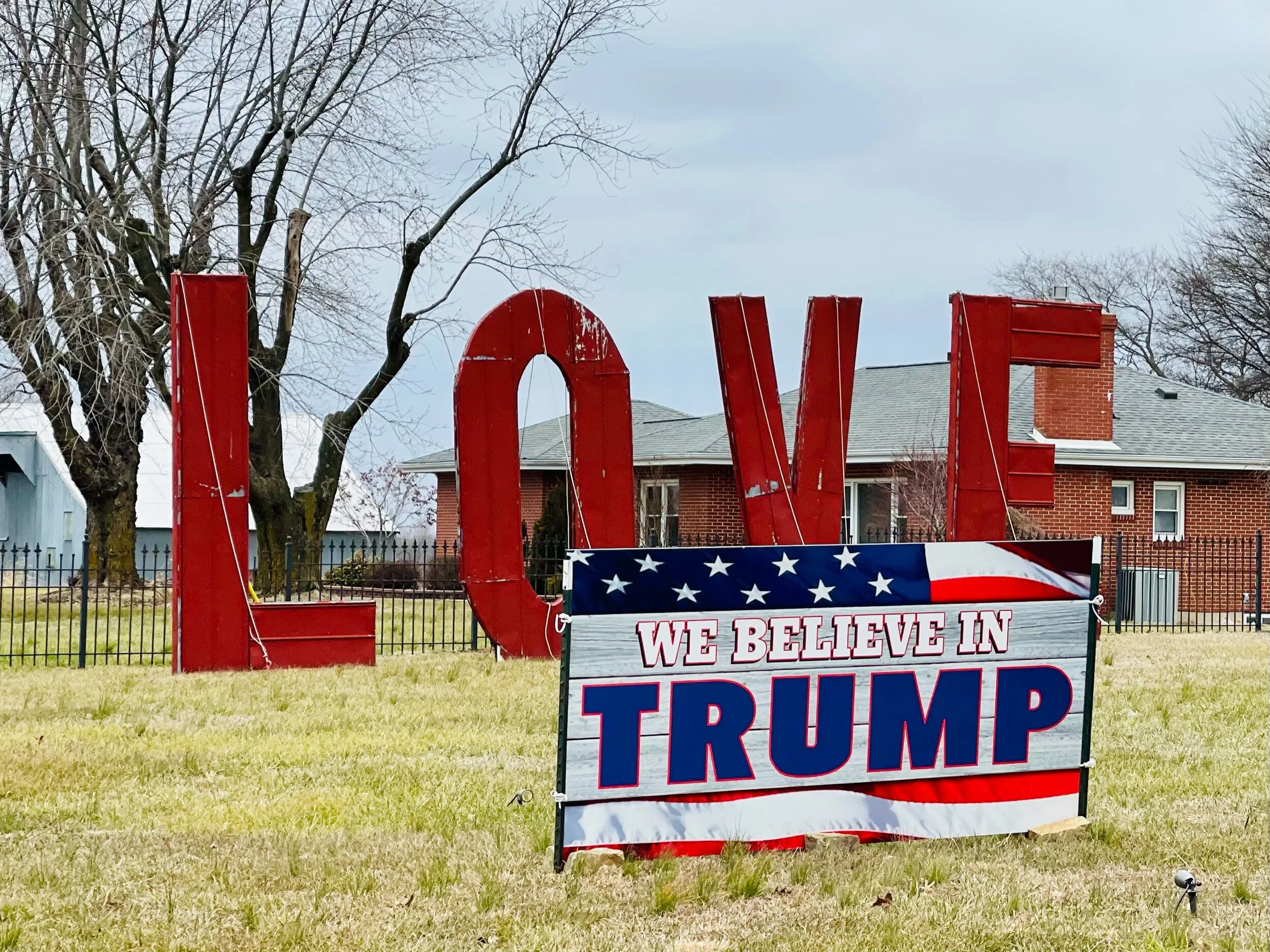
Seen near Perryville, MO.
It’s interesting to speculate how long Trump 2020 signs will remain up. We've seen a few Biden/Harris signs as well, but - in these parts at least - the folks who voted for Biden aren’t as overt about their preference as those who voted for Trump. But whatever their beliefs, I’d wager most Americans are wondering how the coming weeks and months will play out.
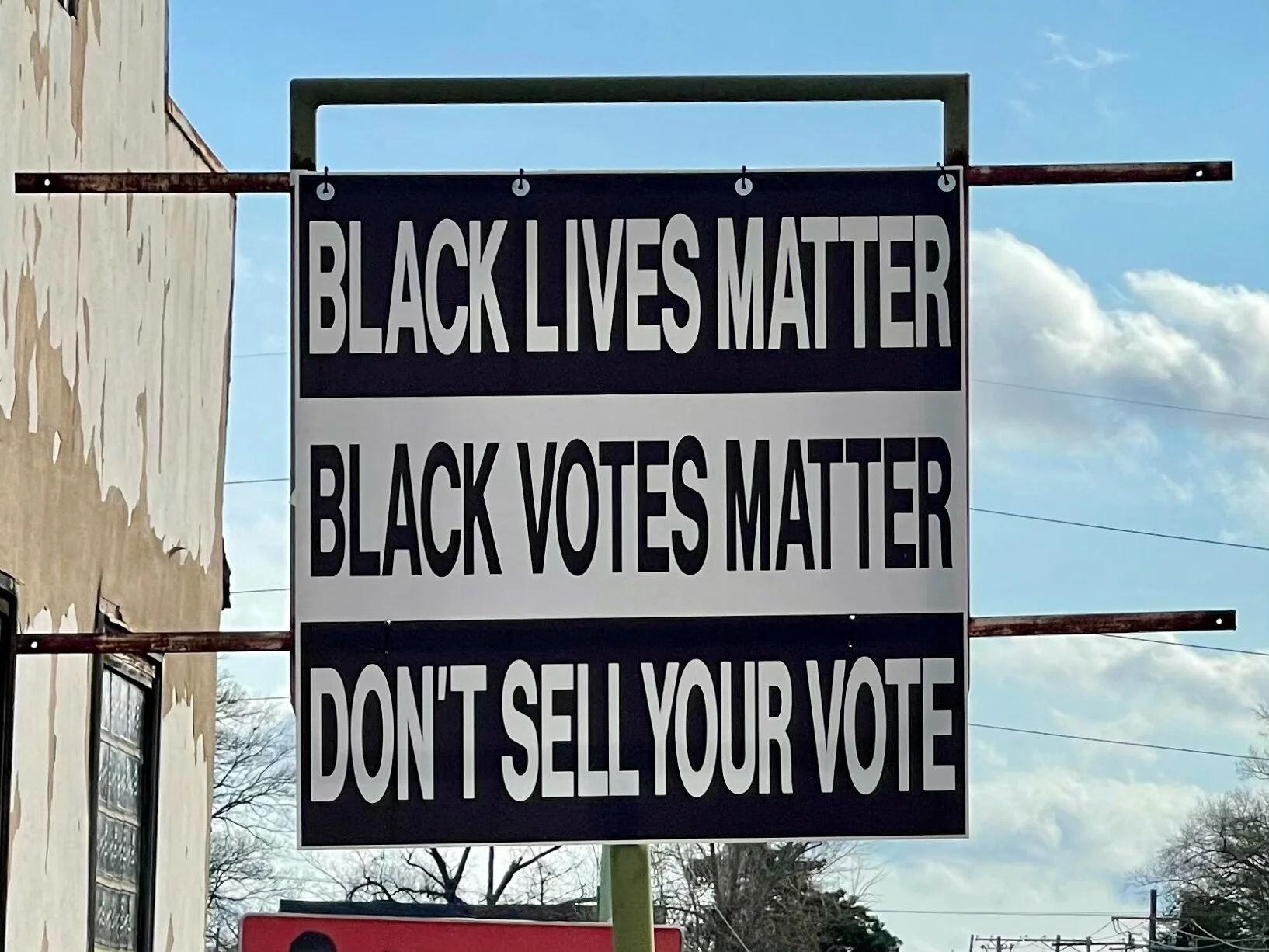
A sign in Natchez, Mississippi. Apparently vote selling has happened there in the past, and the local Democratic Party wanted to make sure that was not a problem in the recent election, as per the following quote from an October, 2020 article in apnews.com by Tim Sullivan: By at least one measure, it’s harder to vote in Mississippi than any other state. And despite Mississippi having the largest percentage of Black people of any state in the nation, a Jim Crow-era election law has ensured that a Black person hasn’t been elected to statewide office in 130 years. After years of being shut out of state races, Democrats hope mobilizing Black voters and recruiting Black candidates can eventually give them a path back to relevance in one of the reddest of red states. But sometimes, it can seem that voting rights in Mississippi are like its small towns and dirt roads, which can appear frozen in the past.
When an African-American from Mississippi is finally elected to Congress (as almost happened last November) it won’t be for the first time. That happened in the late 19th century when Hiram Revel was the first African-American ever elected to the US Senate. You can read about that here.
As much as we enjoyed occasional sunny warmth on the Gulf coastline, we found the Delta country of Arkansas and Mississippi the most interesting part of our trip. We followed the famous Mississippi Blues Trail as we progressed downriver on the MRT in the Delta country, taking in the birthplaces of blues legends such as Conway Twitty, Eddy Taylor, and Ike Turner.
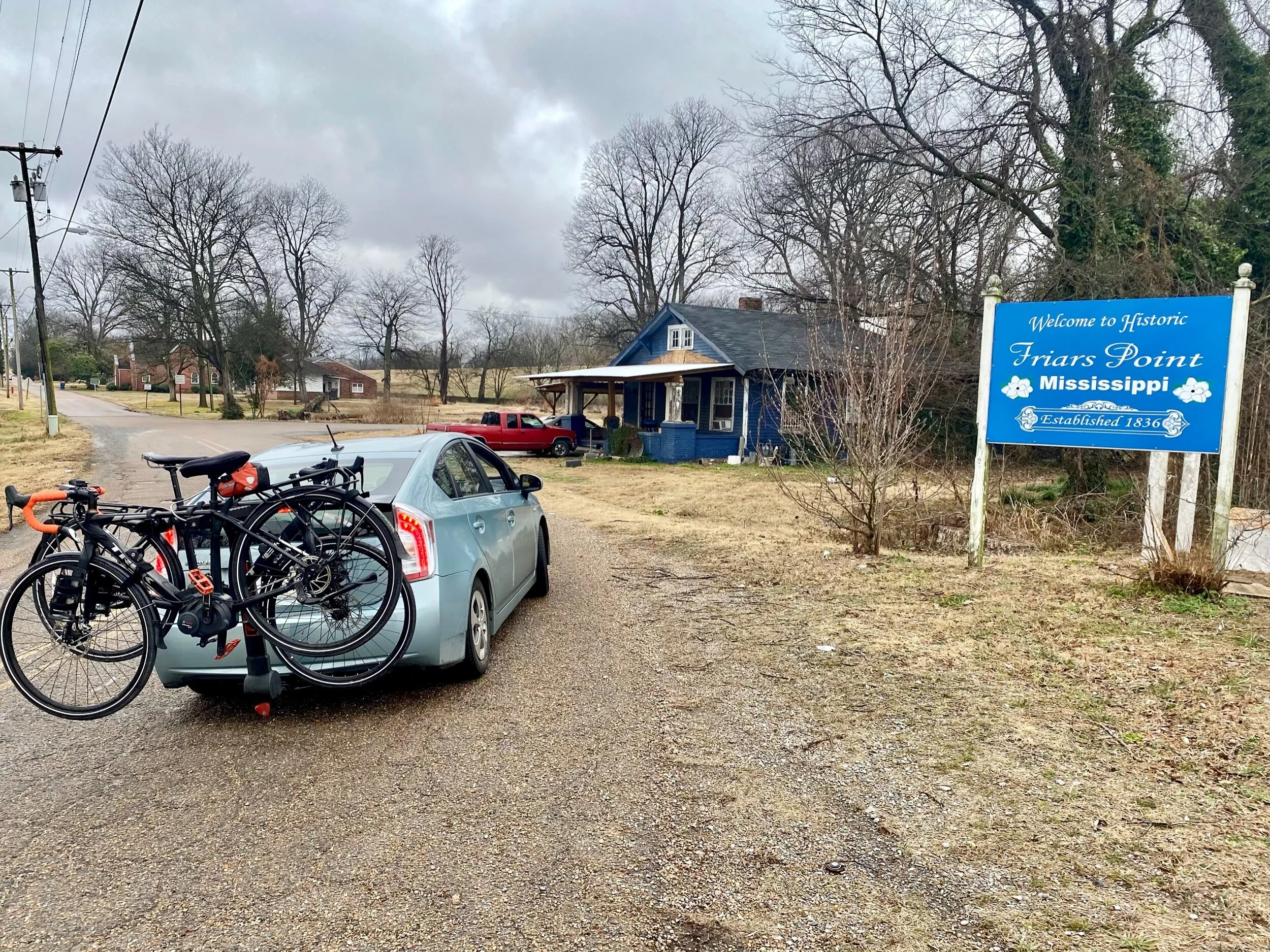
A shot of our rig in Friar’s Point, Mississippi. We haul our food in a car because we chose to minimize our exposure to Covid by not eating in restaurants. Our conversations with locals usually take place outside when we are riding our bikes. We drive an average of 100 miles a day and bike an average of 50. We call this method of travel carbiking. It’s almost as satisfying as touring exclusively on our bikes, although we can’t wait for Covid to be neutralized enough to leave the car behind…
But as rich as the history of the blues and religion is in those parts, I found myself more intrigued about the local economies reflected through their physical environments.
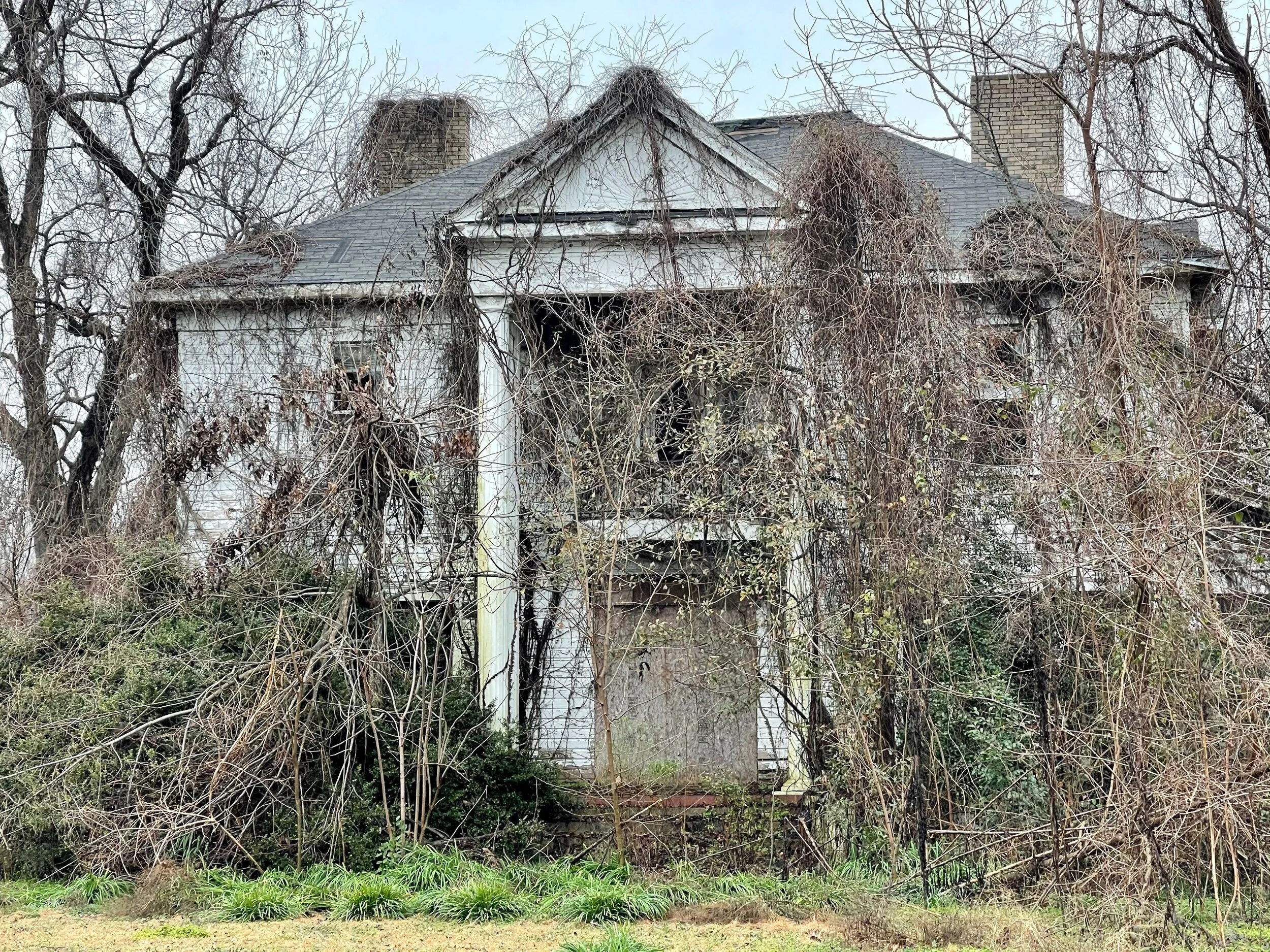
A decaying mansion returns to the earth in Mayersville, Mississippi.
I’m used to seeing one or a few shuttered buildings in most small towns all across the Midwest and West. Since my childhood in the farming town of Galesburg, Illinois, I’ve been witness to the decline of rural America. But what Jenny and I saw in the Mississippi Delta country is on another level altogether. Every town we passed through, from Helena - West Helena, Arkansas to Friars Point, Mississippi to Gunnison to Rosedale to Greenville, Mississippi has a surprising (and distressing) number of abandoned buildings. It looks like 50 to 60% of commercial buildings are shuttered and maybe 20% are in disrepair with broken windows, damaged walls and collapsed ceilings. What is even more startling are the considerable number of boarded up and destroyed residential buildings. In many of these towns there are entire blocks full of abandoned homes. It seems like people have been leaving these towns for years, and no one is claiming their property. Apparently, the cost of demolishing a home or commercial property often isn't worth the land it sits on.
The welcoming sign on the way into Gunnison, Mississippi.
Just past the welcoming sign in Gunnison, Mississippi.
Our first encounter with "lost" cities on this trip was Cairo, Illinois, which has lost about two-thirds of its population since the late 1960's. That trend is playing out all along large sections of the Mississippi River south of Cairo, all the way down to Baton Rouge.
Helena, Arkansas, is home to the longest running daily radio program in the US, King Biscuit Time. This photo was taken on Main Street near the recording studio. Most of the buildings on the four block-long Main Street are shuttered.
The abandoned Delta Oil Mill outside of Helena, Arkansas. Losing a local industry was particularly harsh for Helena after mechanization beginning in the 1950’s reduced the need for farm workers. The city also lost the Mohawk Rubber Company, a subsidiary of Yokohama Rubber Company, in the 1970s. Unemployment surged shortly after, starting a long economic decline that has lasted for decades.
Much of the Delta country sits on the remarkable Mississippi alluvial plain, which boasts some of best crop land in the country. Alluvial soil has many functions, the greatest of which is serving as the earth’s kidneys. Alluvial soil removes sediments and captures nutrients flowing in adjacent water, so it is very fertile and makes excellent crop land. As a result, the Delta region has been a prime contributor to our country’s agricultural based economy throughout most of the past two centuries.
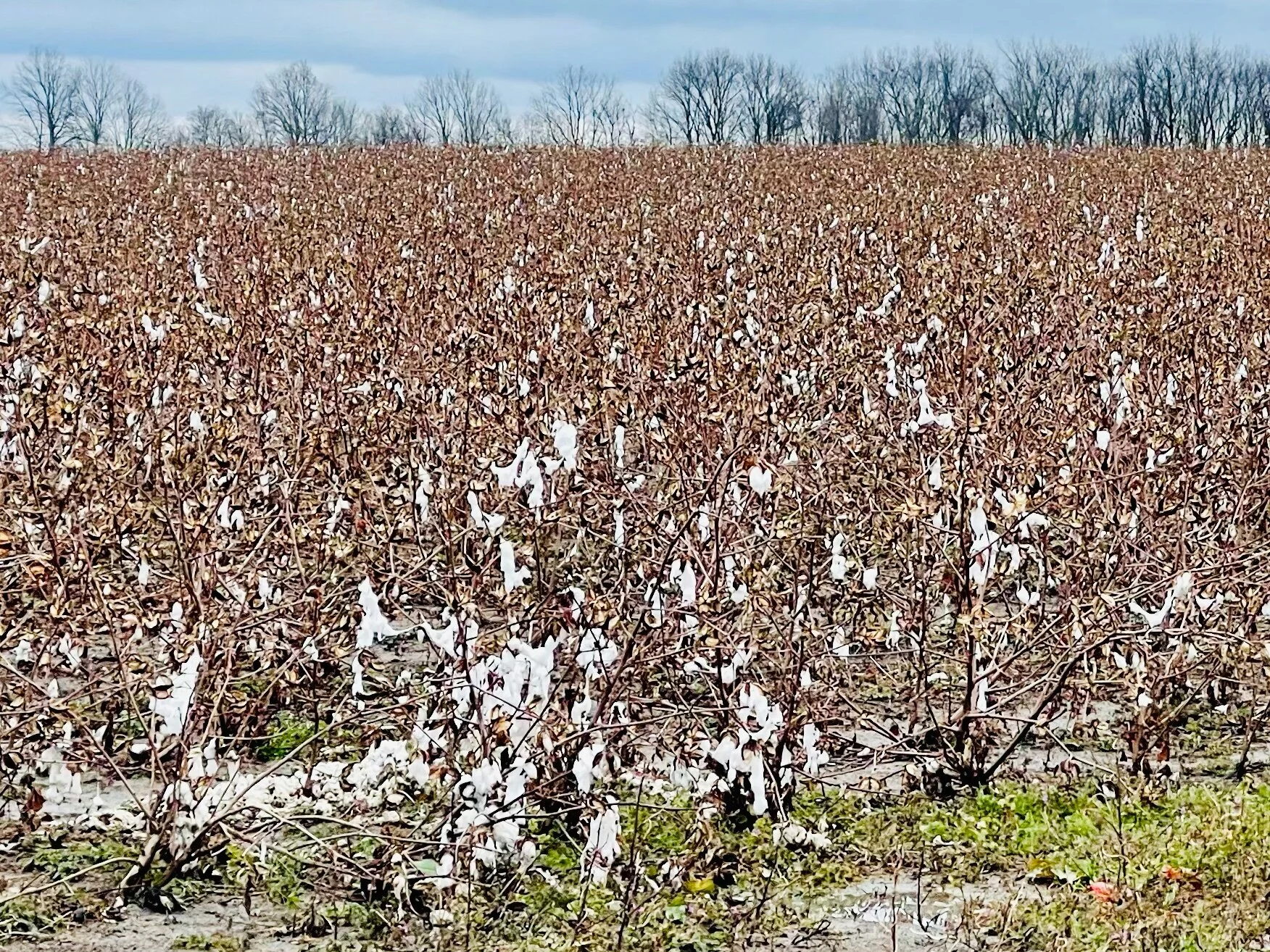
A harvested cotton field near Alligator, Mississippi.
Before the Civil War, farm products comprised up to 82% of all exports, and cotton was especially important on the international market. Agriculture remained the most important activity in the Delta region’s economy for nearly 200 years, and cotton was king. But farming in the Delta was harsh. Between 1910 and 1970, 6.5 million African-Americans went North, leaving the South, the cotton fields, and sharecropping behind. Five million more African-Americans left after 1940, creating the second great migration to the North. By the end of World War II, much of cotton farming had been mechanized, and most of the remaining sharecroppers were forced from the land.
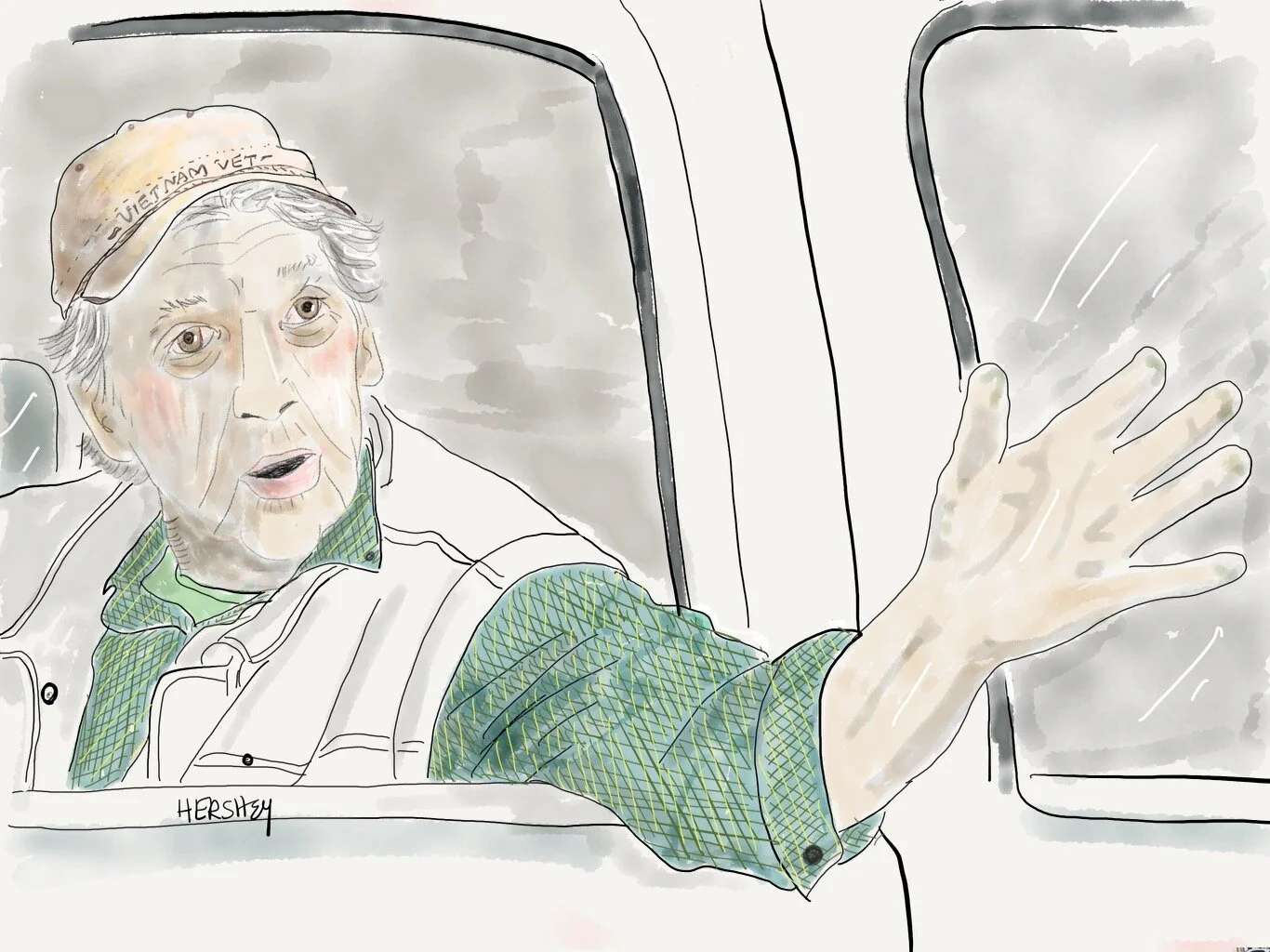
We met Clyde in Mayersville, Mississippi. Although he was on his way to a haircut, he stopped his truck after passing us navigating our bikes down a rugged gravel road, and waited for us to catch up. He told us he was a Vietnam Vet, and when he came home from the war he wanted to be the biggest cotton farmer in the state. He said he now wants to be the smallest. He explained that with the latest machinery two men can farm 2000 acres of cotton, but that level of production is no longer of interest to him. Unfortunately, he was late for his haircut, so we were unable to learn why…..
Clyde lives in Issaquena County. He told us he knew every family there. We checked Wikipedia and sure enough, “As of the 2010 census, the population was 1,406, making it the least populous county in the United States east of the Mississippi River”.
Drawing by Jennifer Hershey. Follow her work on Instagram at deeofo.
I understand how the mechanization of farming would displace thousands of workers. I can also understand how related factories like cottonseed oil mills will close down when agribusiness can cheaply truck goods to larger cities, or even ship raw cotton overseas for cheaper processing. But it’s hard to imagine such distressing trends playing out for over 100 to 150 years. But that’s the reality of the Delta region in Arkansas and Mississippi. Technological unemployment may be thought of more often as an urban problem, but it has been happening in Delta country for decades. And nothing has replaced what has been lost.
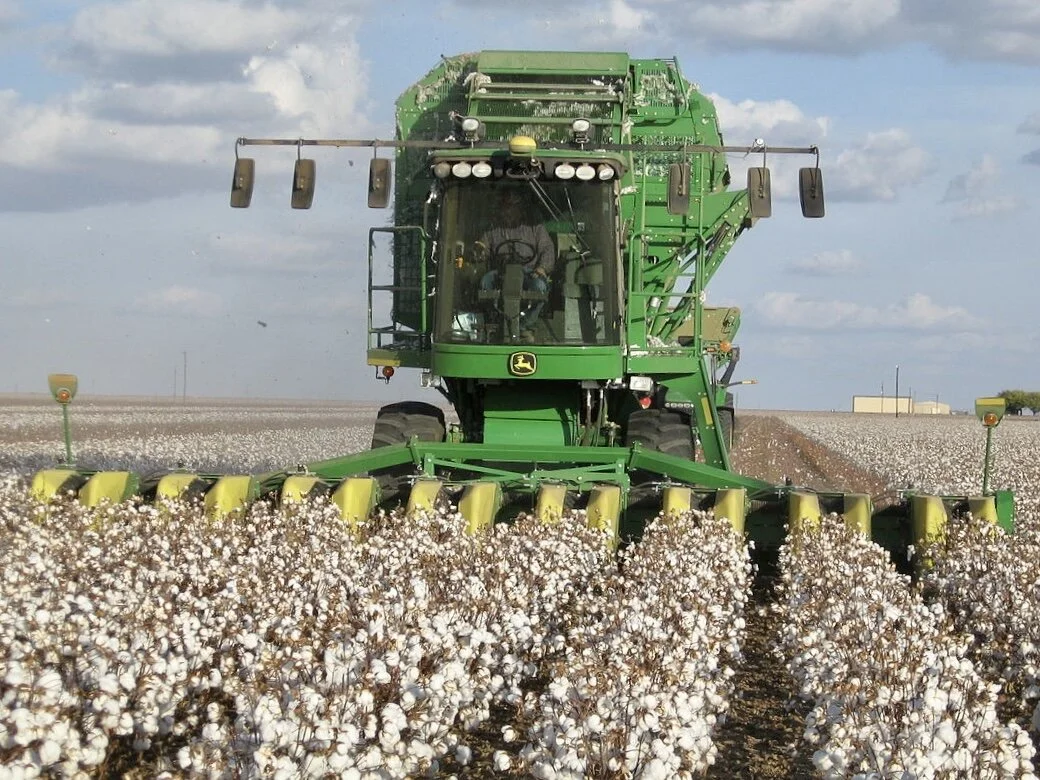
A John Deere cotton harvester. Photo from Wikipedia.
We were deeply impressed by the beauty of the land, the bird life, and most especially the friendliness and soulfulness of the locals we met in the Delta country. We had some really touching conversations with local folks. And our hearts are heavy. What can be done to help people there? Or will most everyone be forced out eventually as homes, commercial buildings and abandoned factories are gradually reclaimed by the earth? Will the Delta become a no-mans land visited by solitary individuals driving massive agricultural planters and harvesters, plus a few intrepid motorists, rugged cyclists or passionate birding enthusiasts? It would be so sad to see the tapestry of such a rich human past die out. Clearly, a major reset is needed, although there are many small attempts at resetting. One example of positive change we came across is the green technical training program in Ocean Springs on the Gulf Coast of Mississippi.

We met this remarkable woman named Tammy in Friars Point in the delta country of northern Mississippi. The park nearby has a walk named after her father, who was a pastor at a local church. Quite a churchgoer herself, Tammy told us she had learned how to “’pay no mind” to the locals who displayed confederate flags. Her church had taught her to forgive others and let them be. She and both her kids had caught Covid, but fortunately for all the cases were mild.
Drawing by Jennifer Hershey. Follow her work on Instagram at deeofo.
This brings me to the end of this blog post, and the beginning of whatever is next for the Mississippi Delta region and beyond. I believe we can already visualize the next great global economic transition and the primary features of its potential success. Three major accomplishments are necessary: 1) our energy system must transform from fossil fuels to renewable form of energy, 2) we must switch from till-based, high-fertilizer, carbon-intensive forms of farming to no-till, low-fertilizer, carbon-mitigating forms of farming that replace dirt-with-soil, and 3) we must set aside one-third of our world’s land and oceans to restore the rapidly vanishing wildlife and biodiversity our species depends on for our own survival.
We are finally making some headway, at least on the national level. President Biden’s first few weeks have bern dynamic and productive. For those who worry about how our rapidly changing climate will continue to wear down our already vulnerable economy, many of his climate-related executive orders are very welcome.
Also, you may have read about the lackluster oil lease sale in the Alaska National Wildlife Refuge (ANWR) in the final days of the Trump administration. Even as the Trump administration failed to acknowledge climate change, many corporations are finally recognizing our changing climate as a true threat. Finally there's a visible mainstream momentum toward a healthier, more reliable renewable energy supply. Jobs may not be that far behind, nor will be agricultural and wildlife restoration. In the meantime, the Mississippi Delta region will continue to languish for its inhabitants while delighting many of its visitors.
Stay vigilant! Thanks for reading. More to come. Follow our next trip this coming March, 2021.
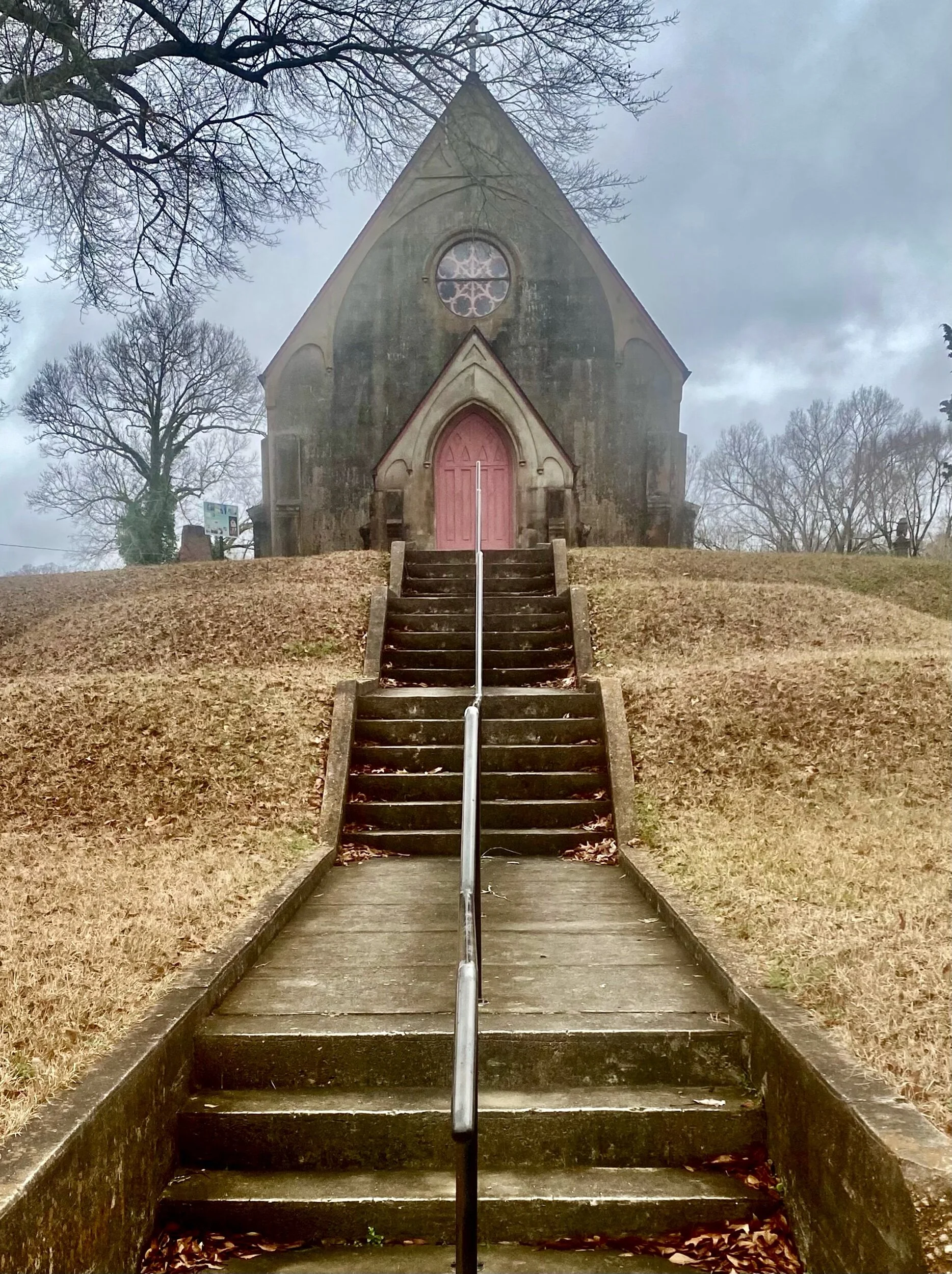
An Episcopal Church in Lorman, Mississippi.
All photos, unless credited or otherwise noted, are copyrighted property of the blog post author.
An Inauguration; Biking the Mississippi River Trail, Post 1

Waiting for something new… For the pandemic to end? …Is the economy to improve? …Social justice at last? ….Climate action that will make a real difference? …An election? …An electoral college certification? …An insurrection? …An inauguration? The dialing down of the great American political feud? ….None of the above. … Instead, two of my grandchildren wait for ice cream.
Drawing by Jennifer Hershey. Follow her work on Instagram at deeofo.
There is no real ending. It’s just the place where you stop the story.
Frank Herbert
Welcome to another inauguration. Americans are deeply divided right now about where we have arrived and where we should go, and I am hopeful that a new beginning is underway. As challenging as 2020 has been, we may have grown stronger as a nation. Some of us were either privileged or lucky enough to survive the past year without loss of life or the destruction of our livelihoods, while others of us have experienced great hardship. And our public health travails are far from over. At the same time, we’ve watched our economy slow down so much that shuttered buildings and “out of business” signs are now as commonplace in cities as they have been for decades in small towns. We don’t know yet if we have a minor problem with domestic terrorism that will fade away, or a full blown crisis that may destabilize our government and communities in frightening ways. In the meantime, the issues of racial justice and a changing climate hover around us like a dense fog.
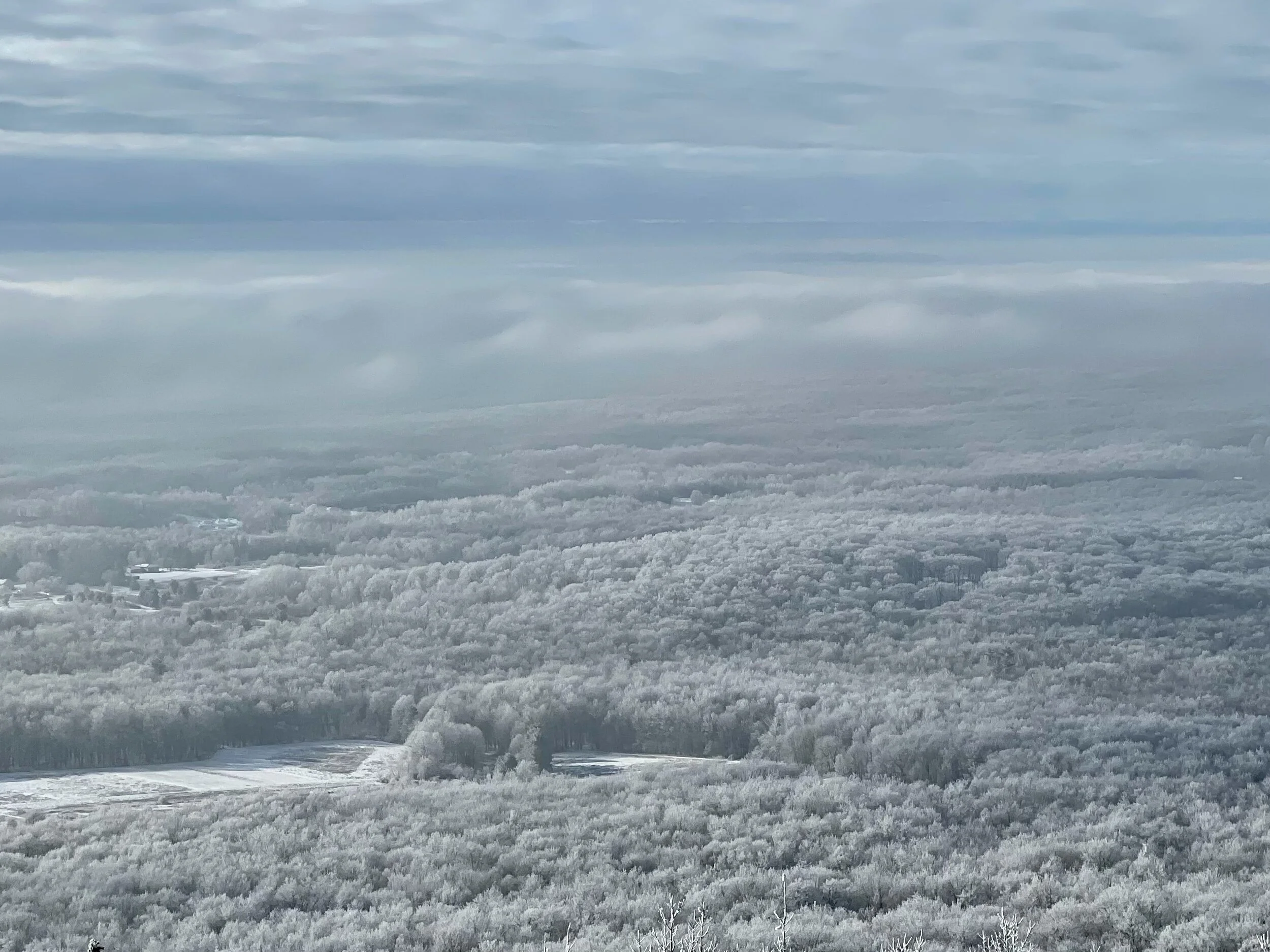
A view from Rib Mountain in Marathon County in central Wisconsin, where Jenny and I made a trip to visit my daughter’s family and my son’s family in Milwaukee before beginning our Mississippi River Trail Trip.
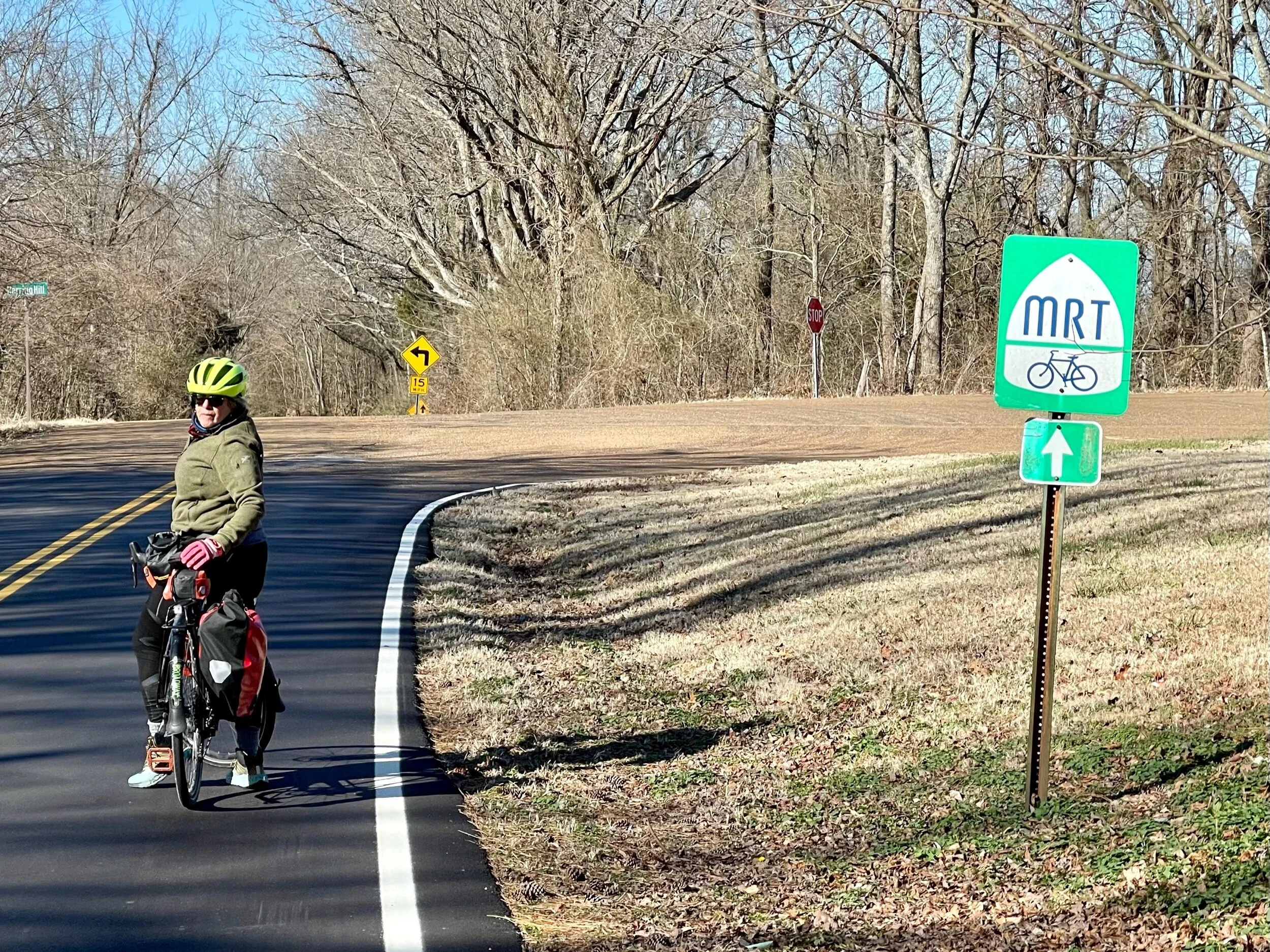
Jenny watches while I take a photo of the Mississippi River Trail (MRT ) sign about 20 miles north of Memphis. The Mississippi River Trail (MRT) extends from Elk River, Minnesota to New Orleans, Louisiana. It is a conglomeration of roads that traverses the Mississippi sometimes on both sides, sometimes only on one. We are very impressed by the beauty and peacefulness of the route, which can be found on opencyclemap.org.
For much of the past year I have been preoccupied by how differently our political parties think about freedom. That said, I don’t know any American who wouldn’t fight for the rights so clearly outlined in the Declaration of Independence: … that all men are created equal, that they are endowed by their Creator with certain unalienable Rights, that among these are Life, Liberty and the pursuit of Happiness.
However, I have heard a lot of disagreement over the concept of liberty (and its synonym freedom). Freedom to a conservative seems to means freedom from government intervention, and the freedom to do as one pleases - even if the long term outcomes are not necessarily helpful to others. (Popular examples used at the RNC are the freedom to drive any car you want, or to eat as much meat as you like). In contrast, freedom to a liberal means the freedom to solve shared problems through collective action (such as using a mask during a respiratory based pandemic to protect the health of others). As long as the rights of individuals are not egregiously abused, liberals expect citizens to be mindful of others as a condition of being part of a community.
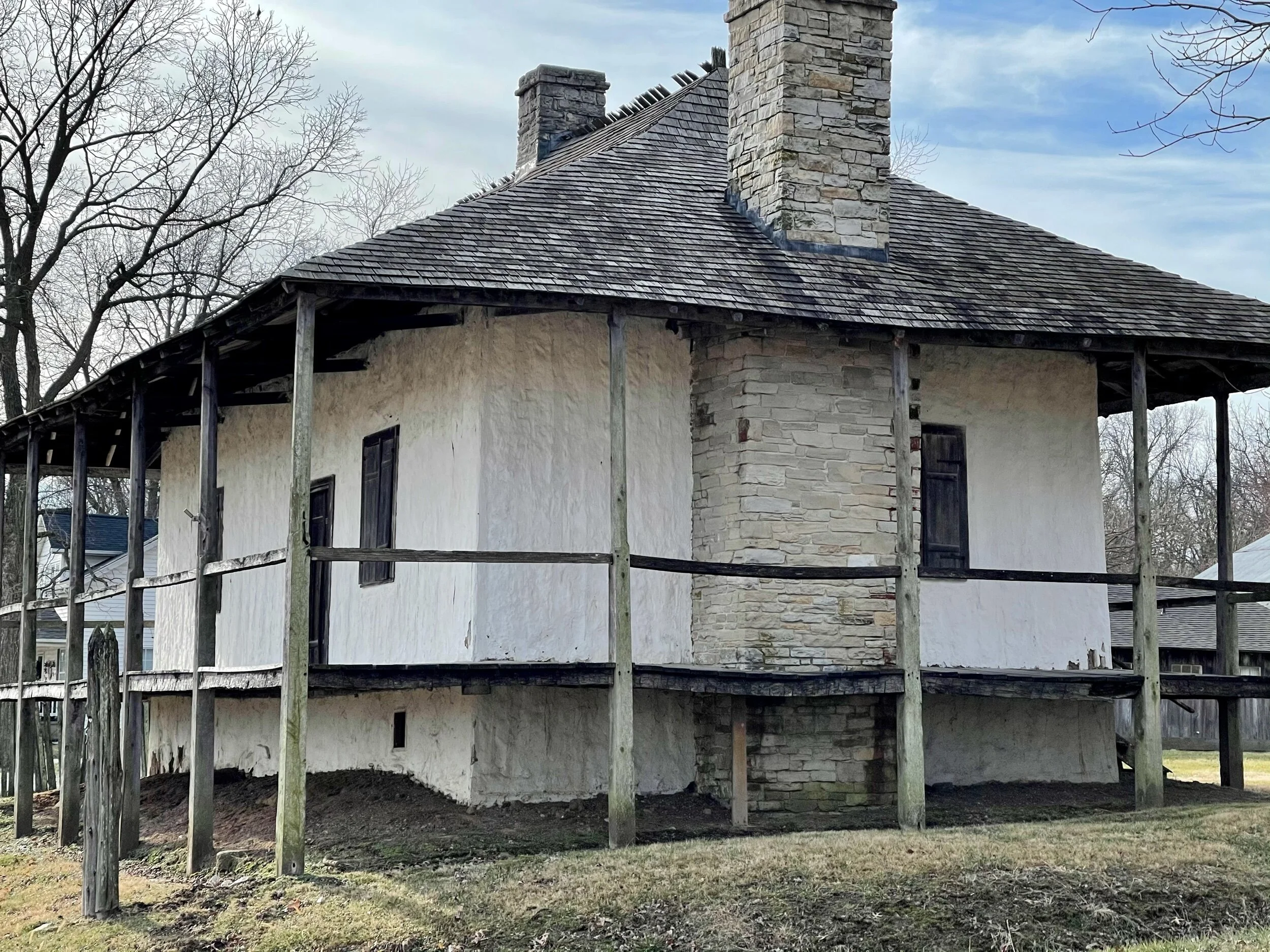
We began this cycling trip just south of St Louis near a small Missouri town called Ste. Genevieve on the Mississippi River. It was settled in the early 1700’ as part of New France. The post-in-ground style was one of the timber construction methods used for French colonial structures. It was called poteaux-en-terre.
There is much more to write about on this topic, and I hope to follow up in future blogs. To my mind, a workable sense of freedom is neither easy to understand or articulate. Struggling to write about it makes me appreciate our nation’s founding fathers and our historical civil rights leaders more than ever. They seemed to understand the potential interplay between individual and group rights so much better than we do at this moment in our nation’s history. Our most pressing problems - addressing the pandemic effectively, creating equal economic opportunity for all, addressing climate change on a much bolder level than individual consumption - will surely test our ideas about individual liberties. For example, the freedom to go maskless when that action threatens the health of others is not different from a society's choice to use forms of energy that adversely impacts the health of others.
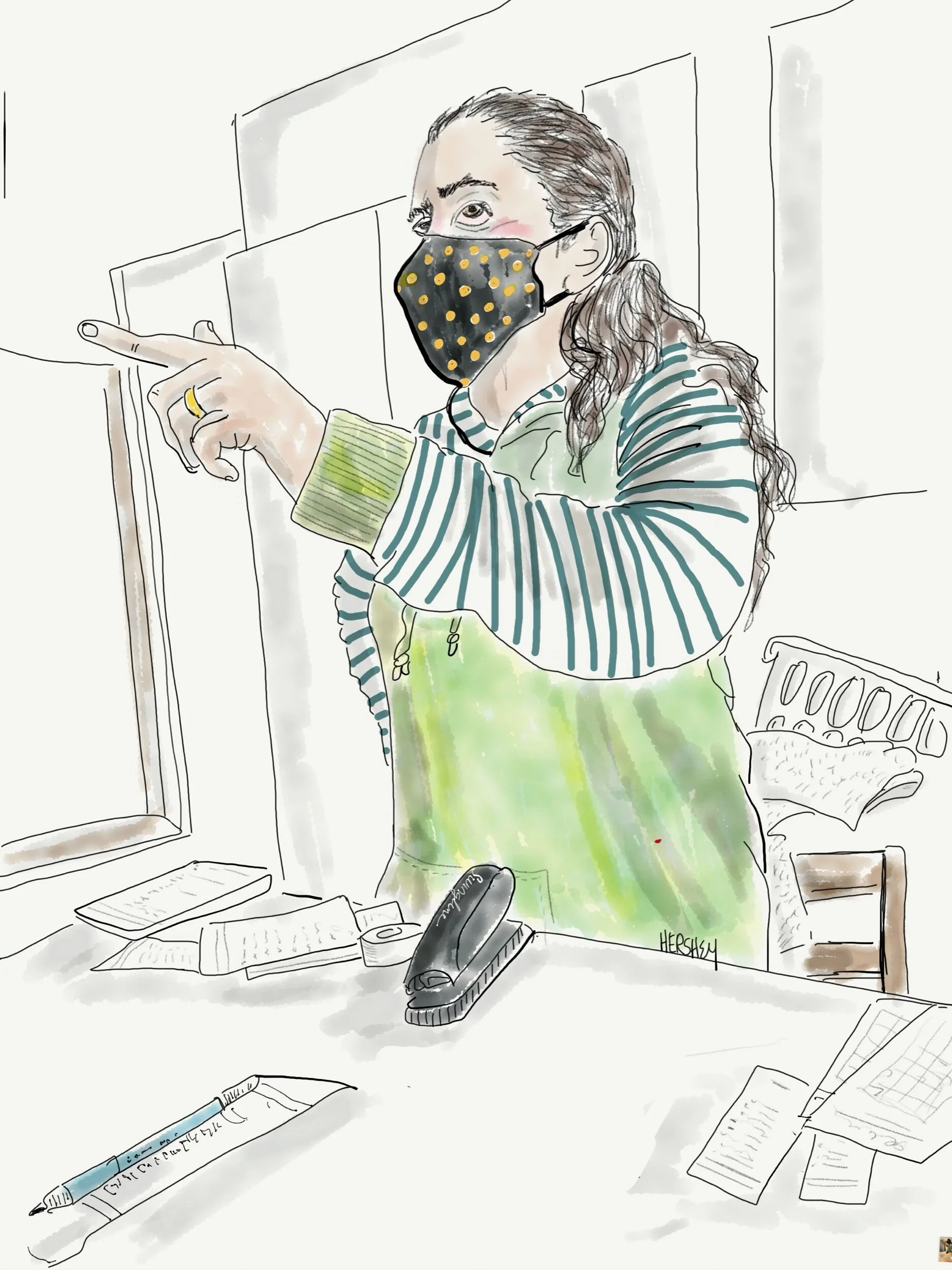
“Lots of people in Missouri believe in freedom so many of them won’t wear masks. I’m mean though. I tell them they can’t stay here unless they wear one.” Dee runs the Triangle Motel in Ste. Genevieve, Missouri. Originally from India, Dee immigrated to the states from Zimbabwe with her parents, who live with her at the motel. She is a mother to several boys, and knows a lot of people in her adopted town. A warm and friendly person, she works hard and tries to never miss a town funeral.
Drawing by Jennifer Hershey. Follow her work on Instagram at deeofo.
In spite of the considerable problems we face on both the national and global levels, I am optimistic about the future. Although I certainly don’t expect the divergent political viewpoints among Americans to go away, adversity can bring people together to solve problems. I think that the sobering events of the past few weeks (an insurrection on our nation's Capital) have shocked us into recognizing our discord has gone too far.
…As will COVID-19 after a robust vaccination program. And hopefully the sharp divisions between so many well-meaning Americans will eventually disappear as well.
Like the presidential transition, this blog post is also a form of commencement. Clearly, its been hard to celebrate the extraordinary experience that biking through America (or anywhere else for that matter) can offer. Most of our biking this past year has been closer to home, or tied to several stressful trips to help out a family member. Although we have learned how to use a car to support our biking habits, it took us more time to figure out how to travel while staying socially isolated than we had anticipated. Consequently, Jenny and I have only recently gone looking - once again - for the story of America. And we are finding it.
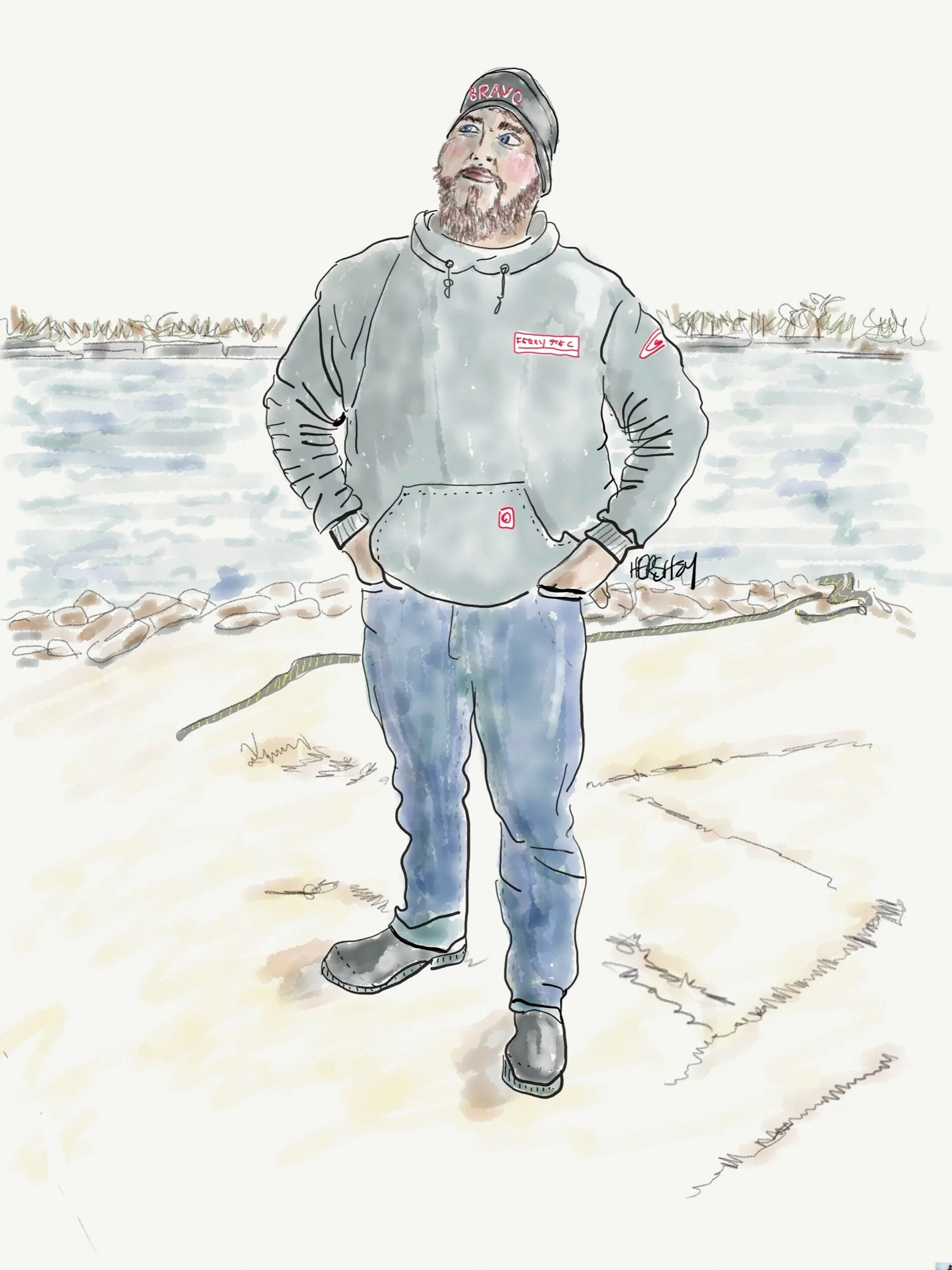
“Yeah, some parts of Missouri are east of the Mississippi and some parts of Illinois and Kentucky are west of it. People don’t know how much the river has shifted over the years”. Rex has been working hard for years running ferries on the Mississippi and local canals. We talked to him at a ferry crossing at Ste. Genevieve, Missouri, and expressed our puzzlement at noticing that the original Capital of Illinois, Kakaskia, was on the west side of the Mississippi in land we thought belonged to Missouri.
Drawing by Jennifer Hershey. Follow her work on Instagram at deeofo.
Rural America is just as distressed as it has been for the past two or three decades. If anything, economic conditions seem worse. There are plenty of abandoned buildings in the smaller towns, both commercial and residential, and there doesn’t seem to be a whole lot of activity. We haven’t yet found a motel that was fully booked. We’re cooking our own food in order to isolate ourselves from exposure to Covid, so we have no idea what the local restaurant scenes are like. That said, grocery stores are predictably busy.
An abandoned barn near Blandville in far western Kentucky,
It seems to us that people who might not have connected a few years ago are now more open to talking. We certainly feel that way. We find ourselves trying to engage in conversations with everyone we meet. Because we are traveling largely in what was Trump Country (Missouri, Kentucky, Tennessee, Arkansas, Mississippi, and Louisiana) we’re slow to reveal how little we trust Trump and believe Biden is a better choice for the nation. However, we are finding that people enjoy talking if we ask questions in an open-ended way.
I worked on this post on our National holiday to celebrate Martin Luther King’s birthday. Interestingly, while I was sitting in Jenny's car writing, she was on her bike in Memphis, and through an accident of fate rode past the Lorraine Hotel where King was shot, where she took these pictures. The first shot is the marquee of the hotel, and the second is the balcony of the motel where MLK was shot (now part of the National Civil Rights Museum).
We spoke to an 81-year old farmer today named Don who was delighted to chat with us about growing up in Marianna, Arkansas, and his many years working on a farm nearby the town of Helena-West Helena. He told us nostalgically how the local economy in the delta used to be more dynamic - there was a tire and a clothing factory, and a chemical manufacturing plant as well as lots of family farms. The plants left long ago, and now there are fewer family farms. Don voted for Trump twice, believing Trump would make things better. After he talked awhile, Don paused and reflected, “I feel real bad about how things turned out. I really don’t understand what’s going on anymore.”
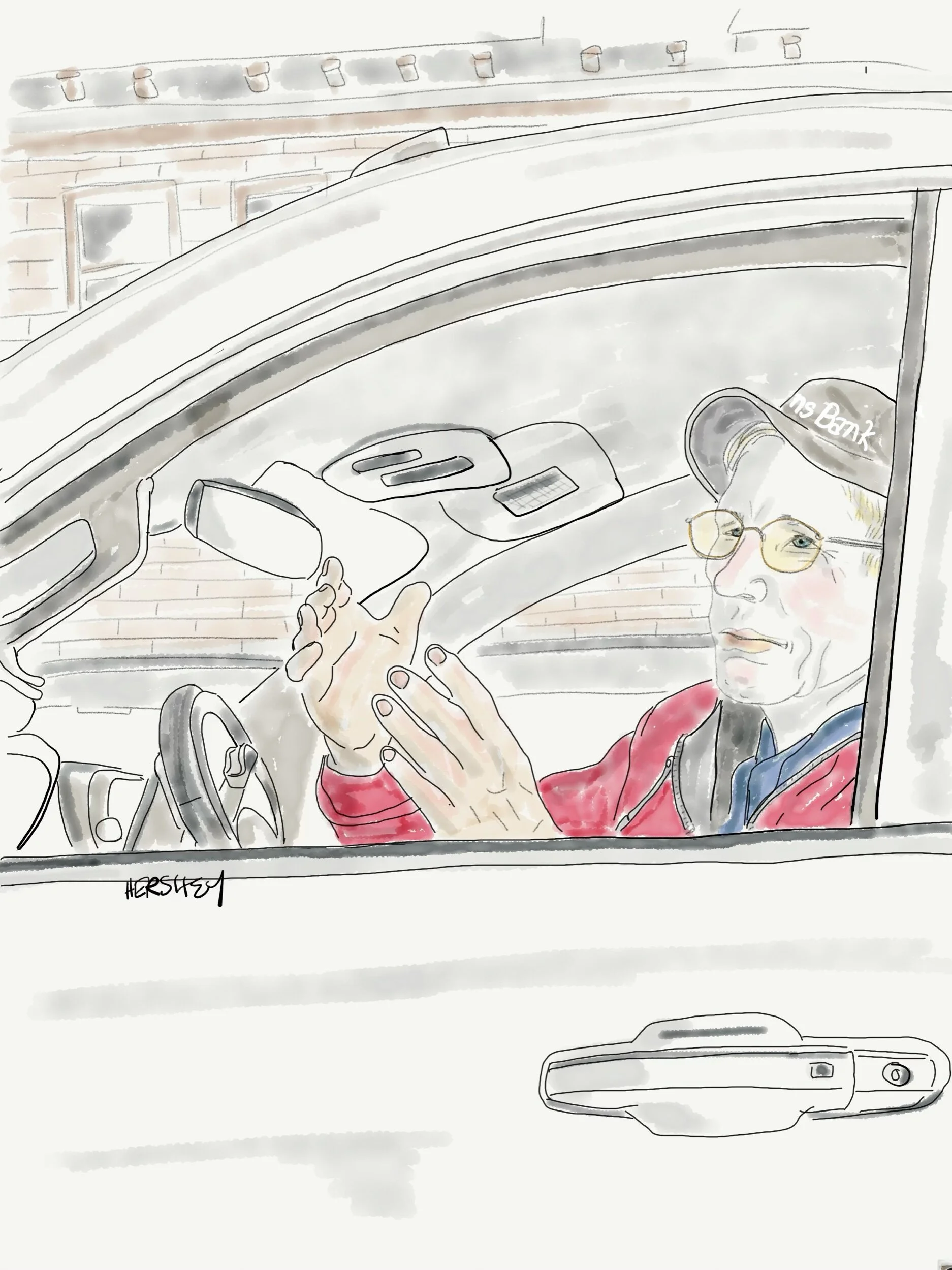
We met Mike Major in Hickman, Kentucky, while we were eating lunch at a gazebo in a local park (which commemorated construction funding from Mitch McConnell). Mike was a farmer his entire life until his recent retirement. He grew up in Hickman and lives nearby on his farm. Mike is tolerant of McConnel’s stand against Trump in the GOP, and seemed as relieved as we are that Biden will soon replace Trump. It wasn’t lost on us that just across the river in Missouri many citizens are rallying behind a very different senator - Josh Hawley. We learned from Mike that Hickman had a bustling downtown when he was growing up, but the town had fallen on hard times through successive floods on the Mississippi. The most recent floods were in 2011 and 2018. In the 2011 flood, the Army Corps of Engineers blew up a dike in Missouri to provide a spillway for floodwater in order to save what is left of Hicksville. But the flood of 2018 was the final nail in the coffin when all but two of the remaining buildings near the river were abandoned. Below is a picture of one of the remaining occupied buildings and another photo of a workshed in a field in Missouri after the 2011 flood.
Drawing by Jennifer Hershey. Follow her work on Instagram at deeofo.
The mostly abandoned downtown in Hickman, Kentucky.
A Mark Twain mural on one of the few occupied buildings in downtown Hickman, Kentucky.
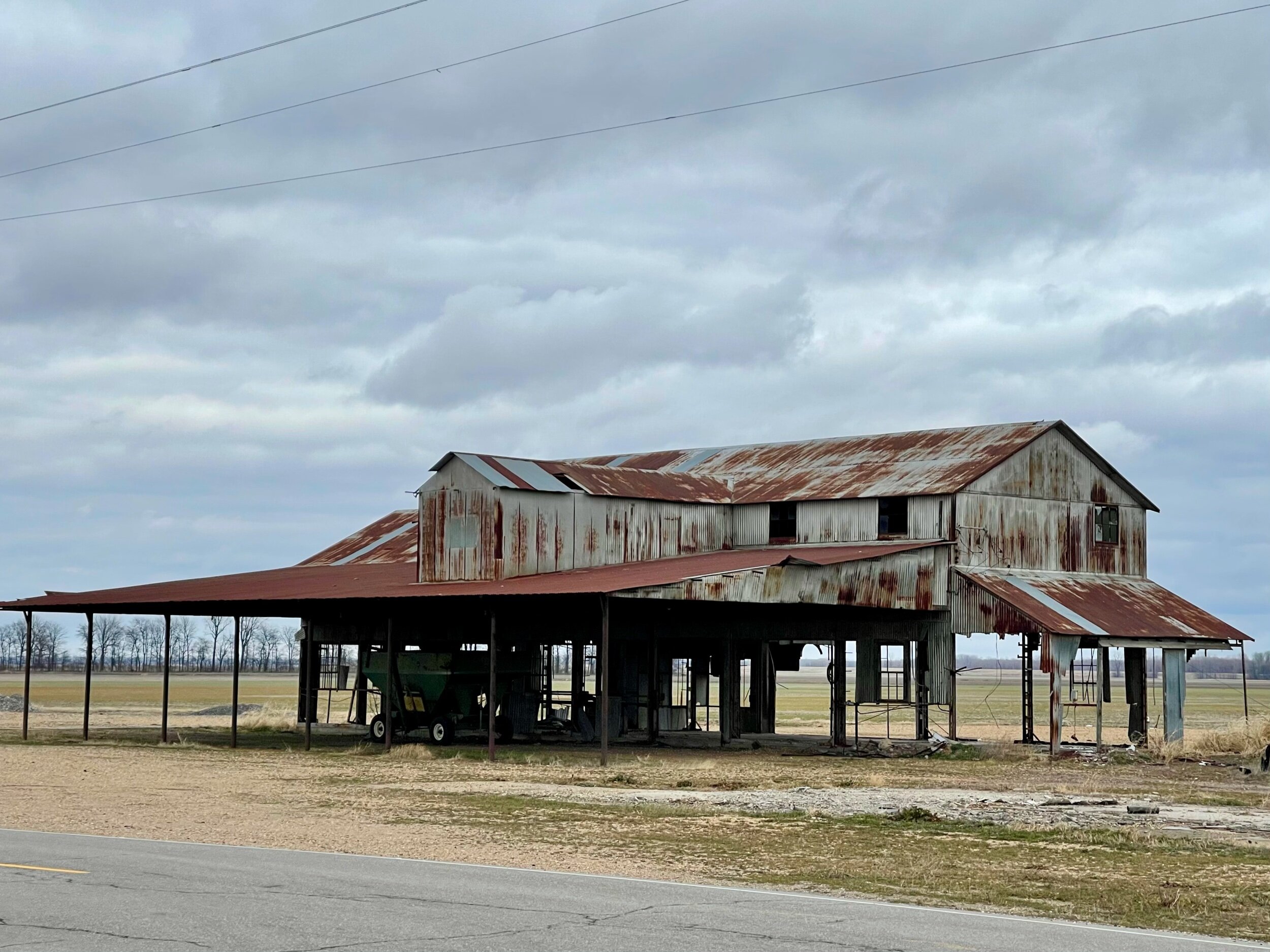
Remains of a building in Missouri on the other side of the river from Hickman after the 2011 spillway flood.
Like everyone else, I look forward to a time when Covid is behind us and we are able once again to congregate, worship, learn, teach, perform, dance, sing, and celebrate together. And it will be even more joyful when our nation becomes recognizable - when Americans appreciate one another because we share a continent and a unique and durable constitution. And hopefully we will enjoy other things many of us used to take for granted - domestic peace, an enthusiasm for innovation and problem solving, a healthy atmosphere and oceans, clean water, economic opportunity for all, and of course - life, liberty and the pursuit of happiness.
I’ve been writing posts on this website for almost five years, and no prior post has been as hard to write as this one. Perhaps it’s covid, perhaps the election, perhaps it’s the sheer overwhelming magnitude of this historical moment. How about you? Do you yearn for reconciliation? Do you want America to get her mojo back? I think the answer is yes. I think we are all aching to connect with each other. I think we want to heal. I think we want to celebrate what unites us. Let's do that. This inauguration is a good place to start.
Stay vigilant! Thanks for reading. More to come.
Taken just below Union City, Tennessee. I’ve seen Confederate flags displayed underneath American flags with Trump/Pence signs, but never before an American and Confederate flag blended together.
All photos, unless credited or otherwise noted, are copyrighted property of the blog post author.