
Fear and Reality; Biking from Mississippi to Savannah
Writing by Michael Chase, Drawings by Jenny Hershey
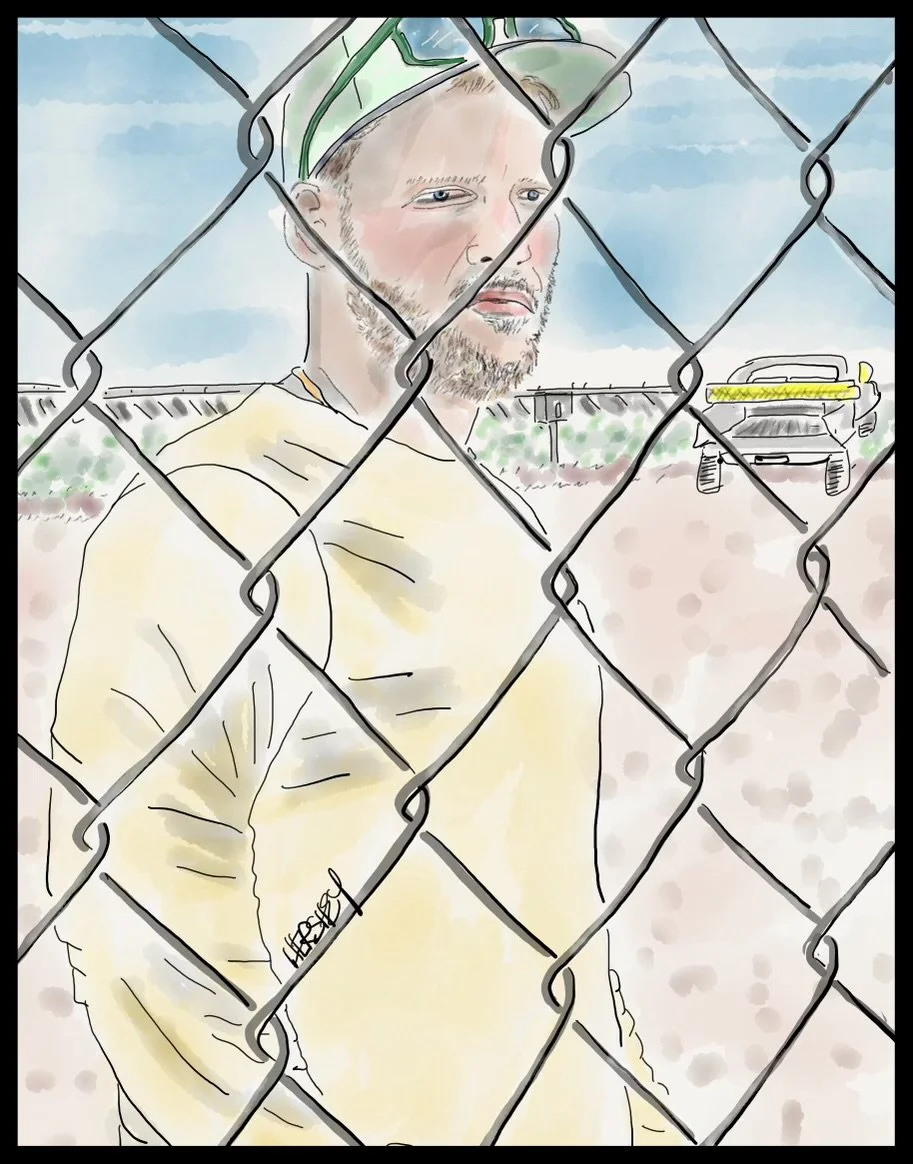
We met Louis, an electrical contractor from Miami, at the NextEra Energy Resources solar farm just south of Bainbridge, Georgia. Louis works for Moss Construction, and he travels all over the south installing and solar facilities. Louis approached us cautiously at a chain-link fence. He thought we stopped to complain because so many other locals have. The installation generates 350 MW per day (enough to power an average of 136,000 homes).“People just don’t like change,” he said to us, “Even when we hire local people to work alongside us, they just don’t like change.” But we were delighted to see such an enormous solar farm. We learned later the biggest fear overwhelming Bainbridge is the proposed construction of a facility to breed 30,000 research monkeys for lab research. “STOP THE MONKEYS” signs were everywhere. Locals are worried that fecal and urine waste from the monkeys will negatively impact the local water supply. Drawing by Jenny Hershey. Follow her on instagram @deeofo.
“When it comes down to it, doomsday attitudes are often no better than denial.”
Hannah Ritchie, from Not the End of the World; How We Can Be the First Generation to Build a Sustainable Planet
“Put simply, there are many reasons to fear … fear.”
Christopher Bader, from Fear Itself; the Causes and Consequences of Fear in America
Our train was delayed leaving the Birmingham station for over an hour because of a derailed oil tanker car on the Amtrak line. Trains can be relaxing so the delay wasn’t too bothersome to me or Jenny until we realized we were likely to arrive in Meridian, Mississippi, at just around sundown. We didn’t like that at all; it would force us to bike in the dark through a busy industrial section of town, and cross several bridges to get to a supermarket before descending a curvy, pothole-filled highway passing under Interstate 20 to get to our motel.
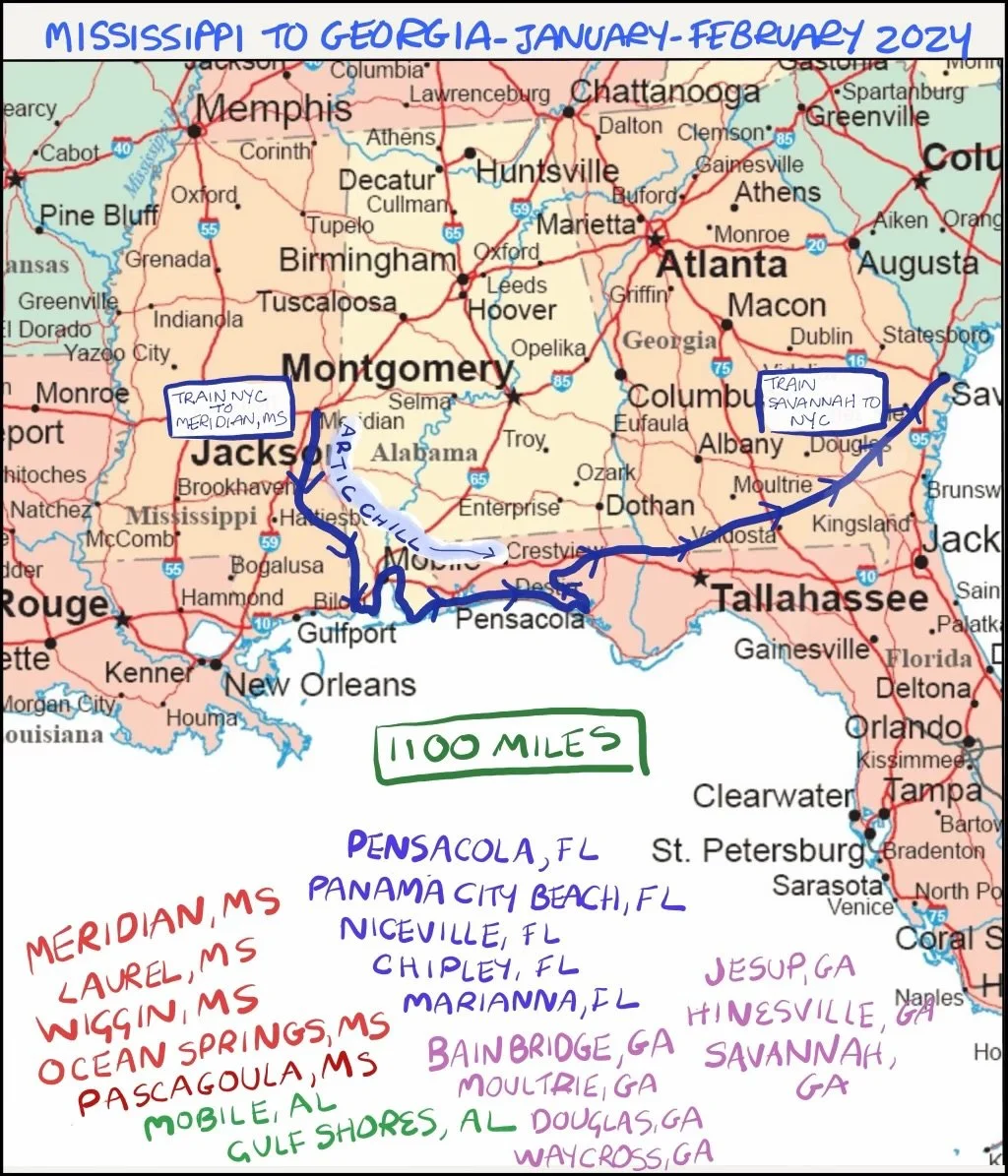
This is our route as we bicycled from Meridian to Savannah. Drawing by Jenny Hershey. Follow her on instagram @deeofo.
As the train pulled in, we could see Bunky, the stationmaster at Meridian, waiting. Jenny and I said our goodbyes to the train steward Darian, jumped off the train and unloaded our gear on the platform. I walked toward the luggage car to retrieve our bicycles while Jenny caught up with Bunky. We had met Bunky on a previous trip to Meridian, and you can find a drawing and a bit about him in a previous post here. Just as before, he was warm and helpful. In no time we were conversing like old friends while we loaded our gear onto our bikes. Clearly, Bunky enjoys folks who ride bikes in unexpected places, just as we respect his loyalty to Meridian, and loved his wonderful stories.
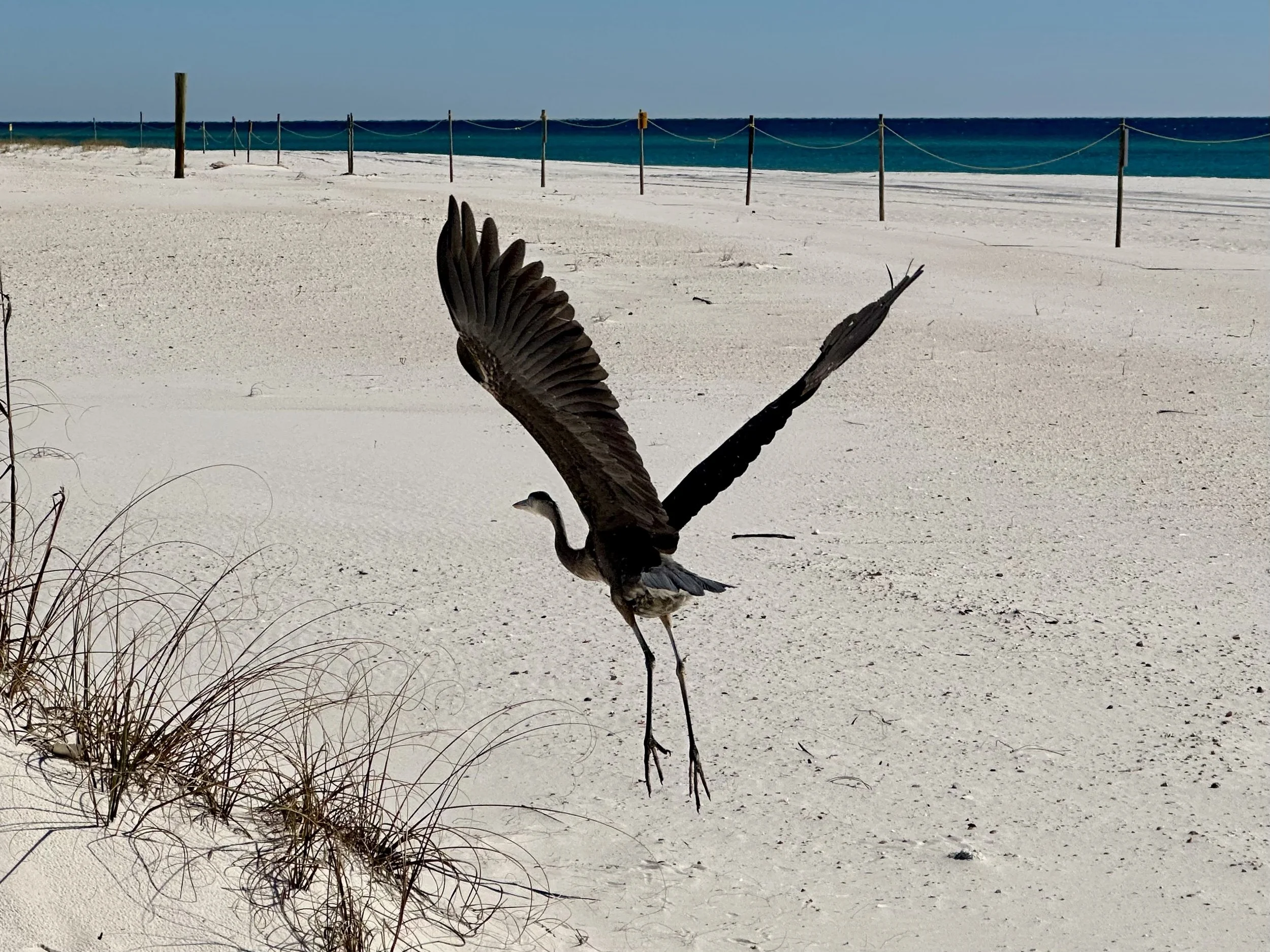
As cold as it was during the first week of our trip, we layered up with almost all our clothing, and pushed on. We saw this lonely crane at Alabama Point near Perdido Bay east of Mobile on a secluded beach. Photo by Michael Chase. Follow him on Instagram @mjohnsonchase.
We said goodbye to Bunky just as the sun disappeared beyond the horizon. There was a cold breeze as we biked past dimly lit and abandoned factories, parking lots, rode over several railroad bridges and a took a steep downhill run almost to the freeway where the Cost Saver is, nestled well off the road behind a large empty parking lot. We got off our bikes, and I stayed behind to watch over them. On the way in, Jenny was told to leave her backpack behind. I looked up, and saw a pudgy and disheveled young man with a gun in a holster on his hip. Jenny said, “Ok”, while I blurted out, “Who are you?” He answered, “Security. Too many people shoplift here.” Another young man was standing nearby, and he lifted up a clear plastic see-through backpack and said, “I work here, but it’s ok for me to go inside with this because they can see what’s inside.”
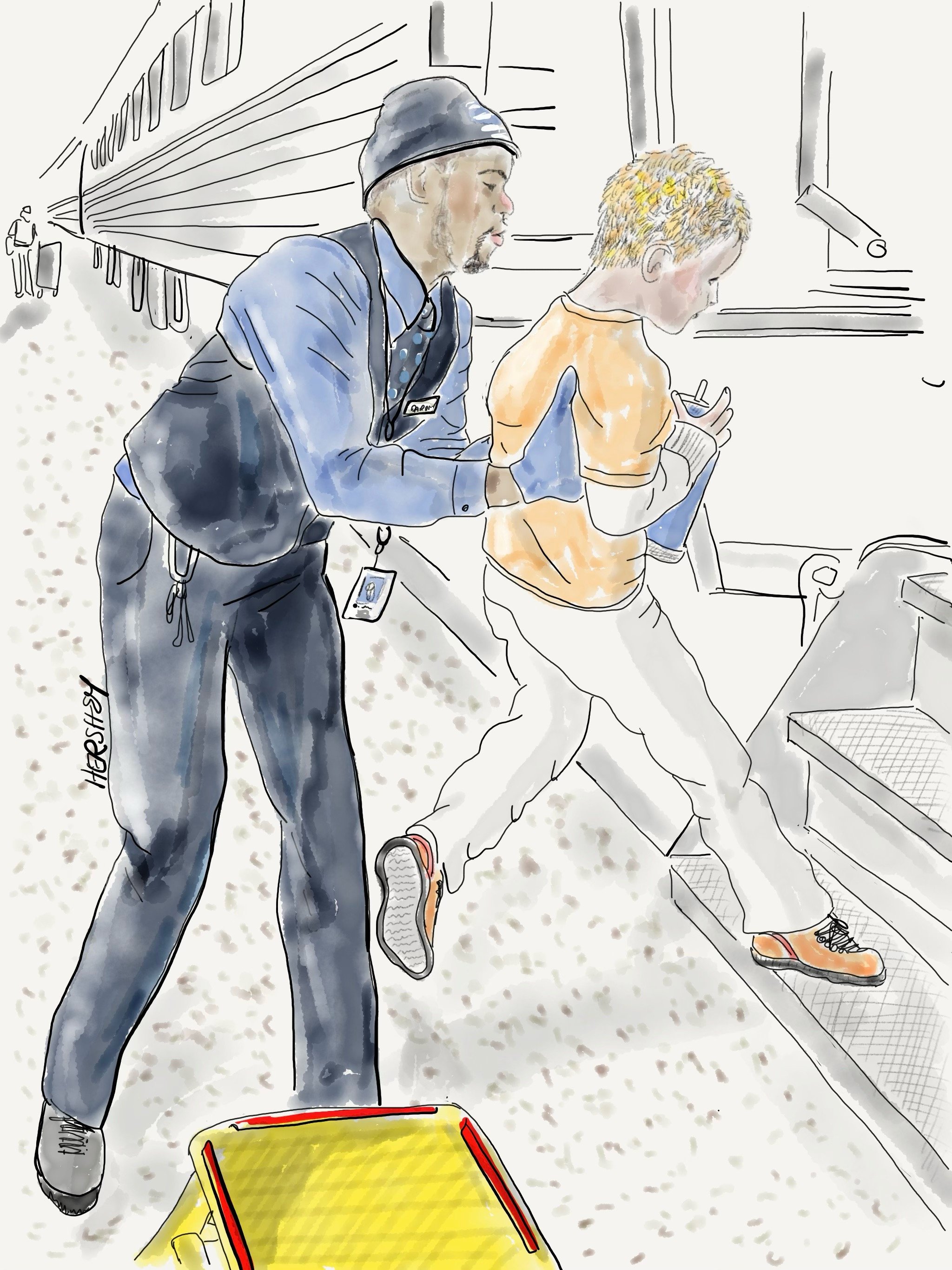
We met Darian, a steward on the Amtrak Crescent that travels between New York City and New Orleans. At each stop we observed him helping older folks off the train by offering his shoulder, and also gently lifting small children onto the train. Darian loves his job, and he’s also passionate about being a real estate agent and part-time actor in New Orleans. Both Jenny and I agreed he would make a great spokesperson for Amtrak. Drawing by Jenny Hershey. Follow her on Instagram @deeofo.
Jenny handed me her backpack and entered the store. “Do you know it’s gonna get real cold in a few days?” asked the man with the backpack. “Yes,” I responded. “Are you ready for it?” He didn’t answer, but the security officer patted his gun and said, “Yea, I got this.” … I was puzzling that out just as Jenny returned. We already knew a very large and intense polar vortex was coming (we had read about it on the train), but neither of us knew how it was going to affect our bike trip. We packed up our groceries and left the store, and finally managed to check into the motel, feeling relieved to be there and excited to be starting a new adventure. Yet, we were not at all certain how we were going to manage the extremely cold and wintry weather heading our way.
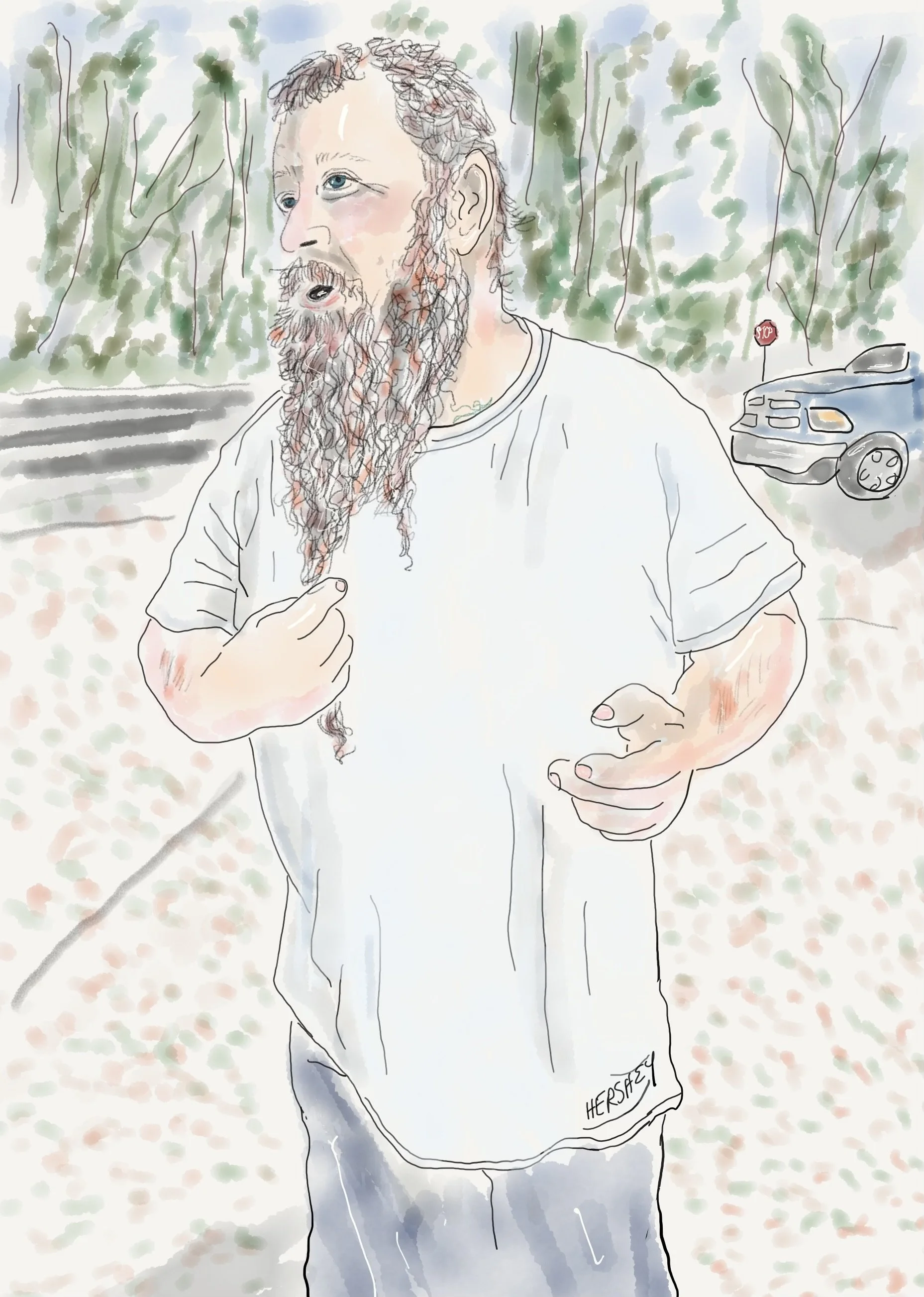
We met Louis outside Ellisville, Mississippi, as we were adjusting our gear at an abandoned gas station. Louis was driving by, and made a sudden u-turn, pulled into the station and jumped out of his truck. We didn’t have time to react before he asked in a booming voice, “You got a weapon?” “A weapon?” Jenny replied, “We’re from New York City. We don’t carry weapons. Do we need them here?” Louis shrugged, and walked back to his pickup, bringing back a box cutter. He handed it to me, and I almost took it, but then I said, “I have a knife in my gear (I did, although it would take me about 10 minutes to find it), so I don’t need that. But thanks!” We fell into chatting, learning that Louis had lived his whole life in Mississippi except for one week in Missouri and he came back because he was homesick. Jenny admired Louis’s beard. He told us he grew it for his sister-in-law who makes wigs for kids with cancer. He cuts it for her every three years. “My beard is coarse so it makes great wigs for black kids. Here, feel it.” Jenny did. Then he touched his head, “My hair up top is softer. It’s for the white kids.” As we finished talking, Louis reached out and hugged Jenny, and waved me over to share a group hug (to our complete surprise) before he jumped back in his truck and drove away. Drawing by Jenny Hershey. Follow her on Instagram @deeofo
According to a recent article in Scientific American, the cold snap that hit the US was one of the most impressive Arctic outbreaks of this century, bringing deadly cold to 231 million people. It was caused by a polar vortex, a high-altitude swirl of counter-clockwise flowing winds that usually keeps cold air trapped in the Arctic. As the atmosphere heats up, the polar winds become disrupted and they slow down, causing their oscillations to increase. Think of how a spinning top becomes wobblier as it loses speed. The polar jet stream becomes wobblier and the polar vortex is increasingly likely to dip southward. The vortex this past January was highly unusual in both depth and width, covering almost all of the United States in one fell swoop. Don't forget that 2023 was the hottest year on record, and the Arctic is warming up four times faster than the rest of the planet. Because we are in an El Niño cycle, next year could be even hotter which, counterintuitively, may make polar vortexes even more extreme.
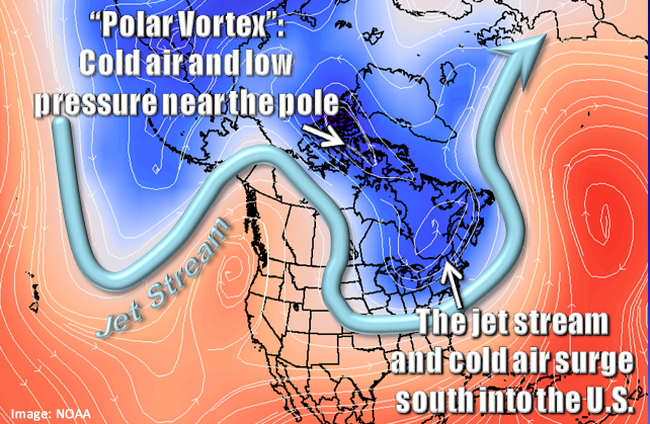
The January, 2024, vortex was deeper and wider than this image indicates. Image courtesy of weather.gov and NOAA.
As a result, Jenny and I are more vigilant about checking weather patterns and planning for unusual events on our cycling trips. Interestingly, weather challenges only add to the fascination of our trips. Sometimes extreme weather becomes the climate story itself, eclipsing what we learn about liquified natural gas export terminals, sacrifice zones, local pollution issues and poor development. And, just as often, the weather is tolerable; we woke up to about 25 degrees and 10-15 mph winds out of the south. Not bad, given that our NOAA weather service app was predicting 13 degrees for the next night in Meridian. We headed south toward Laurel, taking it one day at a time. We had hoped to go to Hattiesburg next, where we had spent a lovely afternoon a year ago on a different trip, but instead decided to go directly south in search of warmer temperatures. So we headed toward Ocean Springs, Mississippi, on the Gulf Coast. We survived the worst part of the arctic blast, although we were forced to stay inside our motel for an extra day. We did venture out on foot to visit the Walter Anderson Museum of Art (definitely worth a visit!) and eat sensational crab cakes at a nearly empty local restaurant. It remained in the 20’s and 30’s with intense winds out of the east for the rest of the week, and we soldiered into the wind, staying as close to the coast as possible.
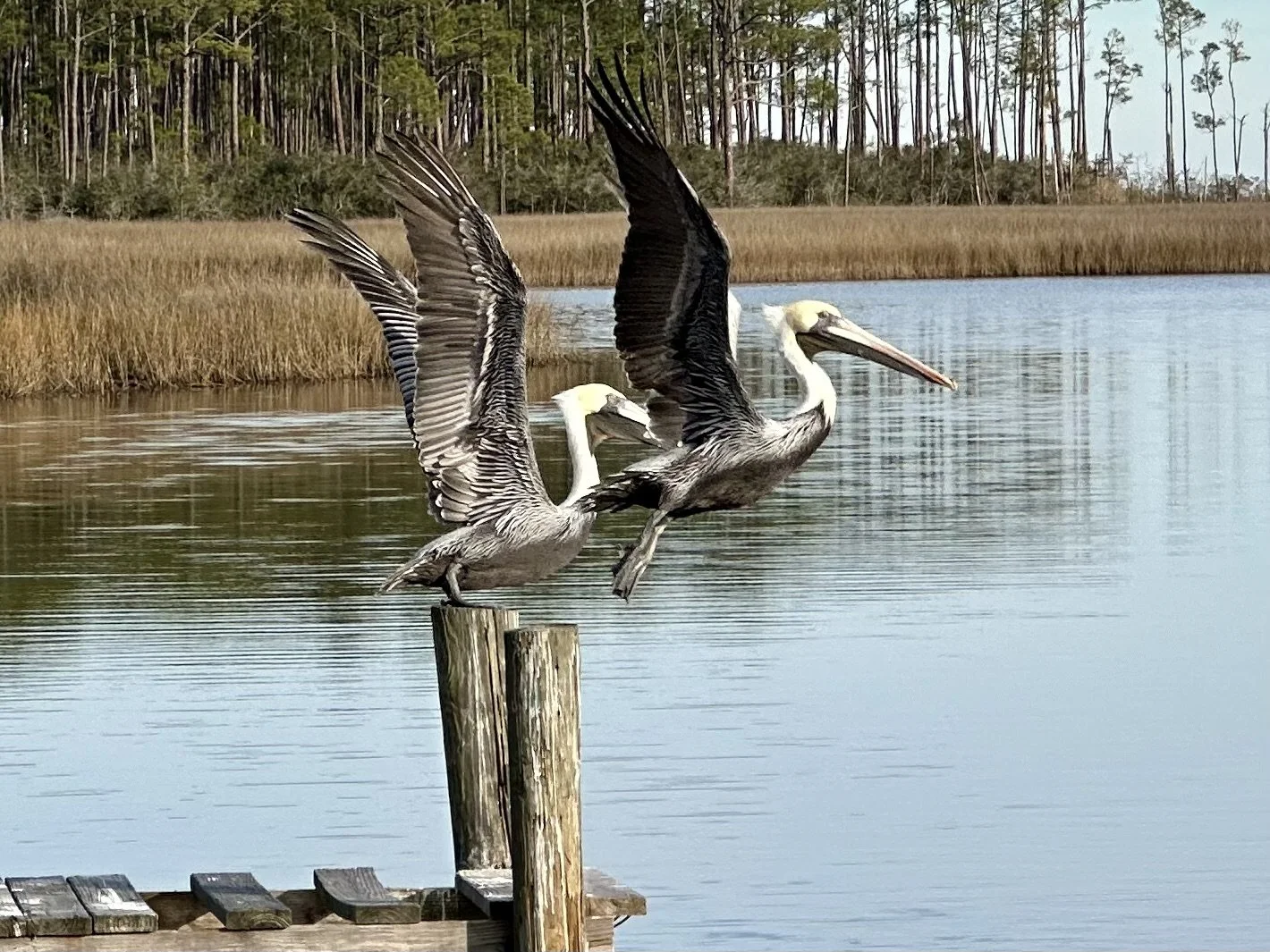
According to ProPublica investigative research, these gorgeous Pelicans are in a “sacrifice zone” neighborhood near Pascagoula, Mississippi, that is at risk of cancer 3.4 times more than what EPA says is acceptable. Photo by Michael Chase. Follow him on Instagram @ mjohnsonchase.
For anyone paying attention it’s hard to miss that last year the world broke yet another record for the sheer volume of greenhouse gases emitted into the atmosphere. Consequently, we are witnessing a disturbing acceleration in the number, speed and scale of broken climate records. 86 days were recorded in 2023 with temperatures exceeding 1.5°C above pre-industrial levels. In fact, National Oceanic and Atmospheric Administration (NOAA) data on billion dollar weather disasters indicates significant increases in both the frequency and the cost of such disasters during the period from 2003 to 2022, compared to 1983 to 2002. More alarming, this trend appears likely to continue: by the end of 2023 there had been 28 weather and climate disasters just in the United States that had resulted in over $1 billion in damages. The total cost of disasters in 2023 alone in the US was at least $92 billion dollars.
Given there is a lag between when emissions occur and when their effects are felt, it is already clear things will get worse before they will get better, no matter what we do now. After all, it takes time for the physics to work itself out, and that time is more likely measured in years than months. Scientists know this, and that is why there is already wide agreement we are going to permanently surpass the aspirational limit of 1.5 C degrees of warming that was set at the Paris Accords.
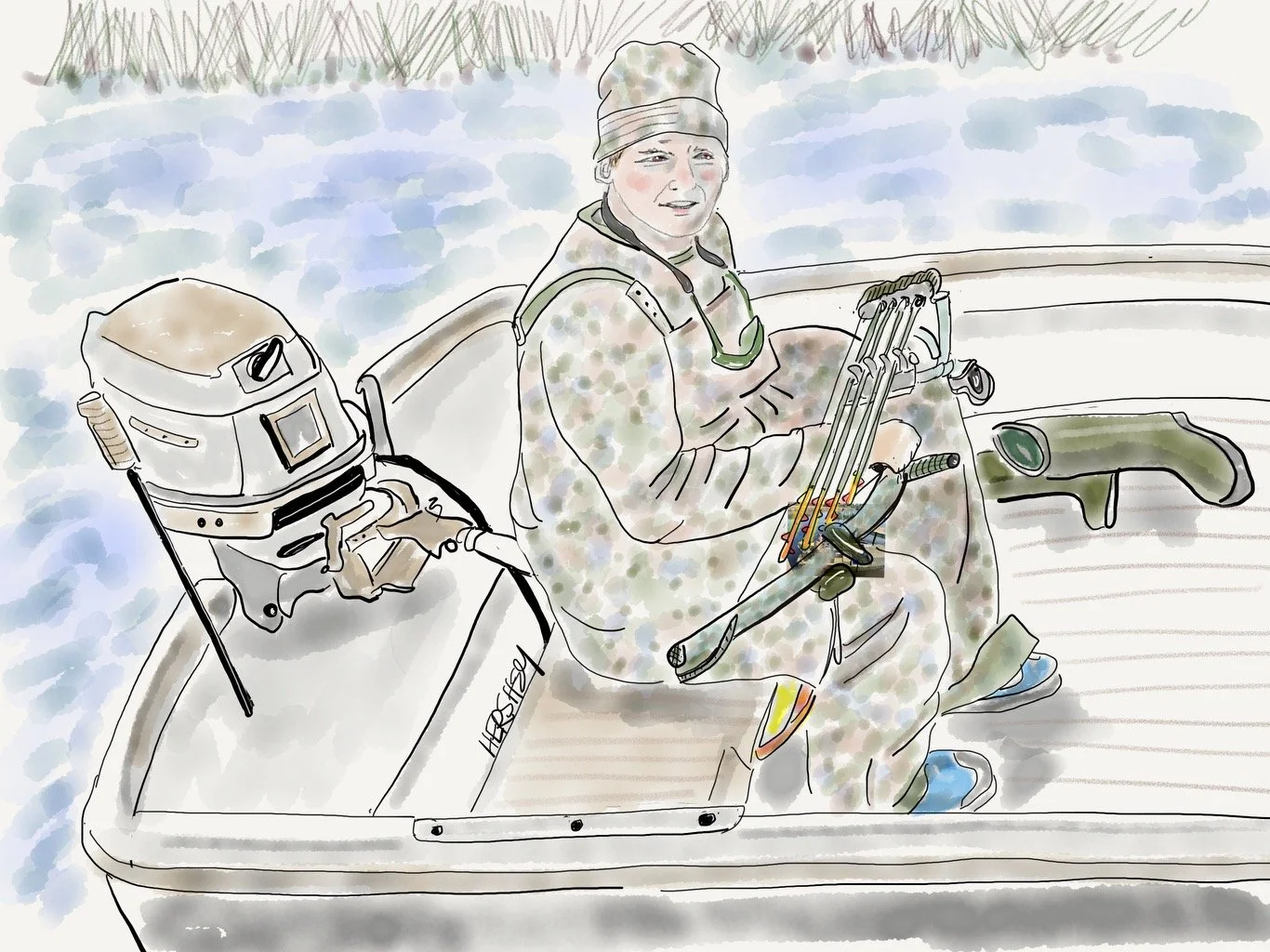
We met Christman at a boat launch in Bayou Cumbest outside Pascagoula, Alabama, near where I took the Pelican photo above. Christman explained how to spell his name like he’d said it hundreds of times - “It’s Christmas with an N, and it’s a family name.”Christman works as a mate on a tugboat in the river, and was fully dressed in camouflage as he set out on his skiff as the day was ending. Having just finished his shift, he was hoping to kill a deer or a boar with his bow and arrow, although he said he preferred venison over boar meat. Christman was headed for the closest barrier island, where he would have to bushwhack half a mile through the marshes to find prey. He needed the food because his refrigerator was empty. We had no idea if Christman knows about the elevated cancer rates in this “sacrifice zone neighborhood.” As outsiders we didn’t think it was our place to ask. Drawing by Jenny Hershey. Follow her on Instagram @deeofo.
COP participating nations remain committed to the goal of zero emissions by the year 2050. There is increasing evidence we can achieve it, even if we are turning toward change as a large battleship might… slowly and steadily, in spite of obstacles everywhere. While we have still failed to see a drop in global emissions, all indications are that we will in a few years. Recent rapid deployment of renewable energy has breathed hope into global efforts to reduce emissions, and the best informed writers and climate scientists around us are telling us not to let our fears give way to despair. There are many signs of positive change. Interestingly, many of the changes in the US are driven by red states because of the positive economics of renewables in the heartland. An excellent analysis of the extraordinary growth in US wind and solar can be read here.
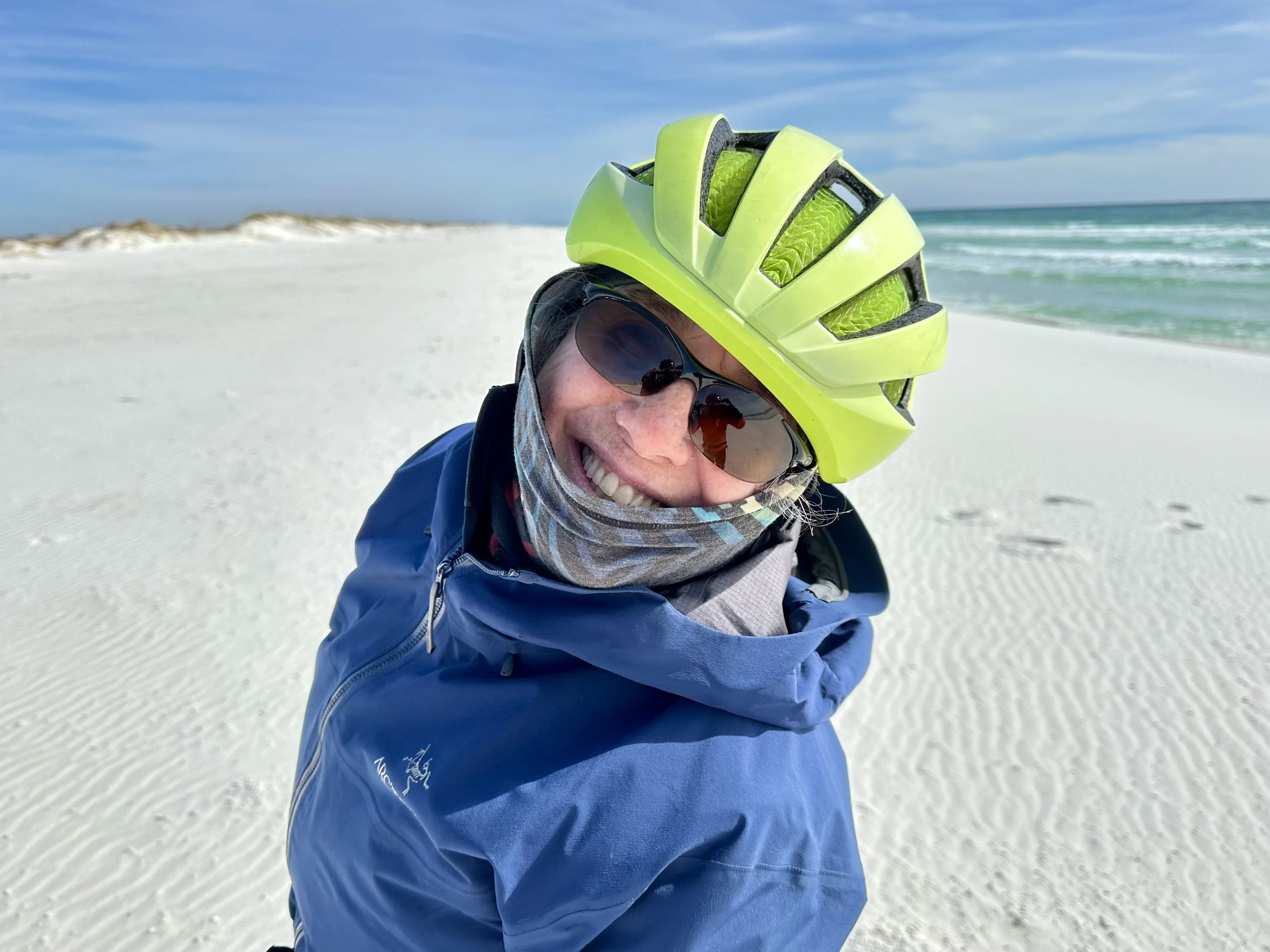
Jenny frolicks at the Gulf Island National Seashore near Navarre, Florida. This is a delightful ten mile stretch of unspoiled parkland on a barrier island. Photo by Michael Chase. Follow him on Instagram @ mjohnsonchase.
In 2010, global installations of solar and wind combined made up only 1.7% of global electricity generation. By last year, global installations had climbed to 8.7%, which is far higher than what had been predicted. In 2012 the International Energy Agency expected that global solar energy generation would reach 550 TWh by 2030, but that number was reached by 2018, making the growth of renewables more exponential than linear.
At home, the US installed 37.3 GW of wind and solar power in 2022 (a record high), generating 383 TWh of wind power generation, up from 275 TWh in 2018. In the same time span, solar power generation rose from 96 TWh to 212 TWh. These are unprecedented rates of growth and have contributed considerable economic benefits to communities across America. Renewable energy developers pay property taxes, which boosts public funds. Most of the states that have been bullish on renewables also have low electricity prices well below the US average.

Solar panels on display in an aerial photograph of the 700,000 panel solar energy installation near Bainbridge, Georgia, where we met Louis from Jenny's first drawing. NextEra leased the 1,400 linear miles needed (measured by putting the panels side by side). According to WTXL TV in Tallahassee this project, “creates opportunities for the landowners and the farmers to increase their operations while they’re able to rely on the revenue from a plant like this,” said NextEra Energy Resources VP of Development Stuart McCurdy. And farmers and landowners aren’t the only ones benefiting. This project created 350 jobs during the construction period and over the next 30 years it’s expected to generate nearly $14 million dollars in tax revenue for Decatur County. Image above from onXBackcountry.
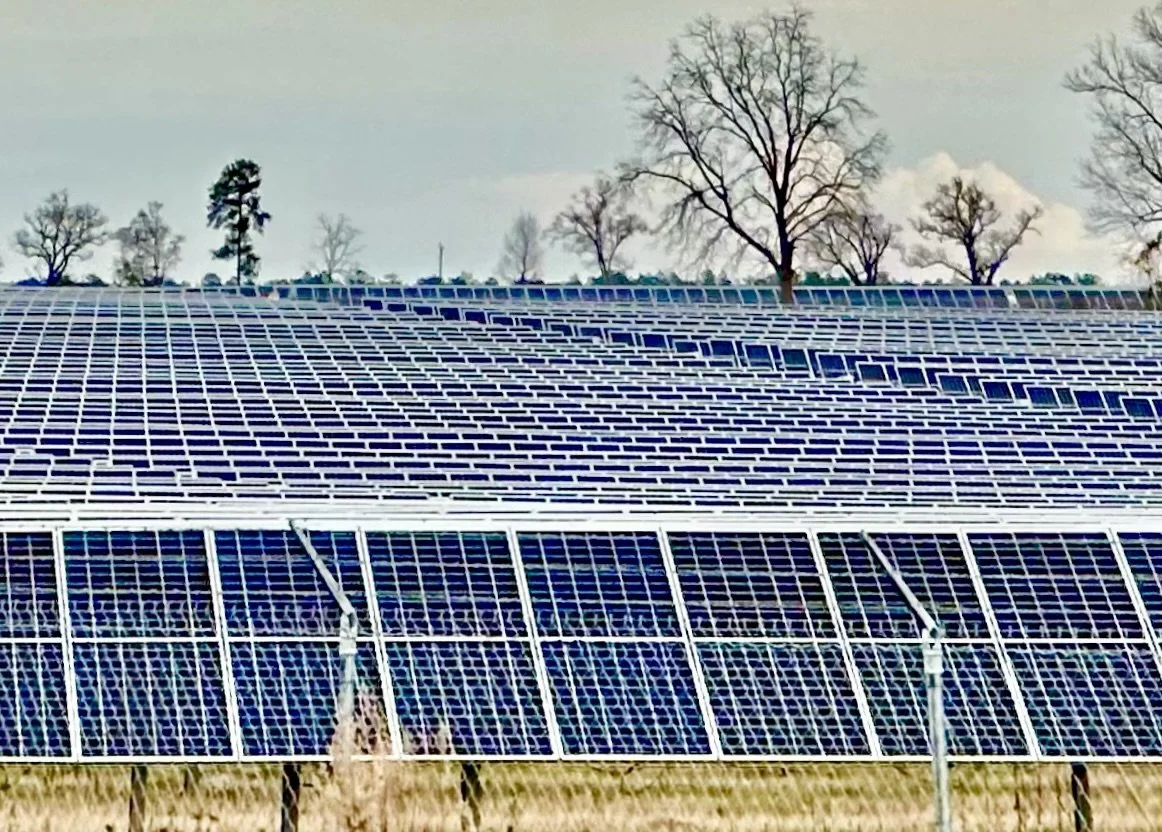
This photo is a landscape view of the installation above from an easement on a county road. Photo by Michael Chase. Follow him on Instagram @ mjohnsonchase.
In a recent opinion piece in the New York Times, David Wallace-Wells writes about an unusually successful effort to defend renewables by explaining an effort in Texas by state Republican officials to shut down the wind and solar sectors, which was was soundly “defeated by Republican businessmen who realized that would “raise electricity bills, harm economic development and imperil the state’s grid, which has been saved from blackouts several times in recent years by new renewable capacity.”
It’s also important to mention the bold step taken by the Biden administration to request environmental reviews of 17 new liquified natural gas (LNG) terminals, especially the enormous LNG terminal CP2 near Cameron, Louisiana. Even though the Biden administration has already approved more LNG export facilities than the Trump administration did, there is little division over the decision to delay these terminals in the White House. Halting them is not seen as a major energy security issue, since the United States is already producing and exporting so much gas. Capacity is already set to nearly double over the next four years, making the need for these additional terminals less urgent.
Analysts have said that pausing permit approvals will have little immediate impact on the flow of American LNG exports to European allies, nor will it impede the eight LNG export projects currently operating or halt ten LGN export terminals already approved and under construction. The United States now ranks as the world’s biggest LNG exporter after doubling its exports over the past four years. The projects already approved and under construction are expected to double the current volume of American LNG exports by 2028. For those reasons, and in spite of the spin at Fox News, there will be little, if any, geopolitical downside. Now, a critical calculation can be assessed on whether methane emissions will push the world too far toward a highly dangerous climate scenario. This evaluation reflects the advice of many climate scientists, and has relieved millions of Americans who are worried about the consequences of a rapidly changing climate.
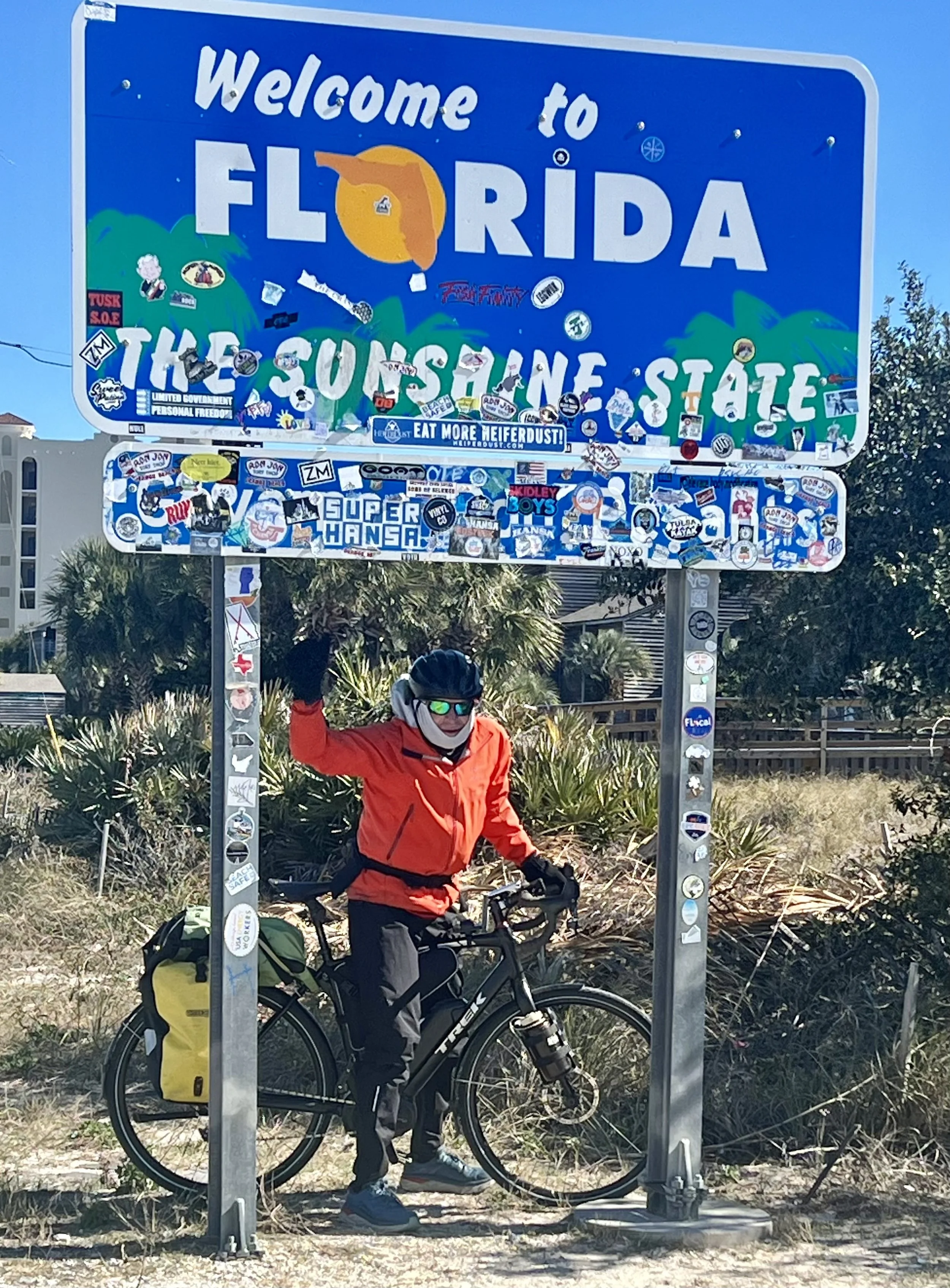
I celebrate at a state line marker between Alabama and Florida on the coast. I have three shirts, one of them wool, plus two Gore-tex jackets and a down vest on. My legs and head are similarly layered. Thankfully, the sun was shining. Photo by Jenny Hershey. Follow her on Instagram @deeofo.
I particularly treasure a newsletter on Substack called “Sustainability by Numbers” by a 35 year-old Scottish climate scientist named Hannah Ritchie, author of a fascinating book called “Not the End of the World”. Ms Ritchie works at a European organization called Our World in Data. Here are some of their core beliefs:
“It is possible to change the world. To work towards a better future, we need to understand how and why the world is changing. In important ways global living conditions have improved…. While we believe this is one of the most important facts to know about the world we live in, it is known by surprisingly few. Instead, many believe that global living conditions are stagnating or getting worse and much of the news media’s reporting is doing little to challenge this perception. It is wrong to believe that one can understand the world by following the news alone and the media’s focus on single events and things that go wrong can mean that well-intentioned people who want to contribute to positive change become overwhelmed, hopeless, cynical and in the worst cases give up on their ideals.”
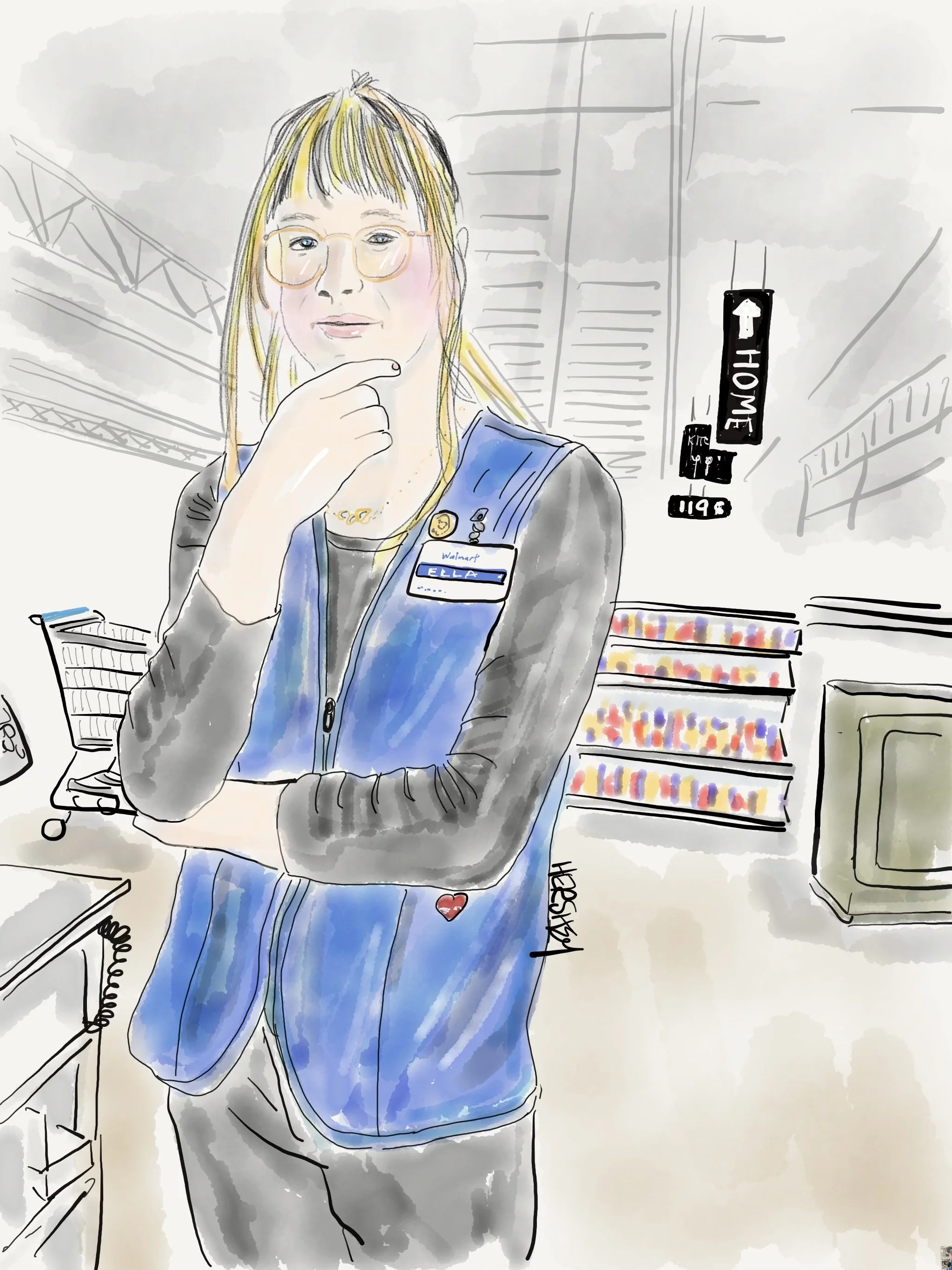
In Chipley, Florida, I went looking for drinking water while Jenny went to the local Walmart to buy food. While checking out, Jenny met Ella, who kindly helped Jenny use the Walmart app. On a hunch, Jenny asked Ella, “So? How’s that governor of yours working out for you?” “He’s not MY governor,” Ella quickly retorted. Now 24, Ella began her transition from a man to a woman at age 20. She acknowledged that Florida is a very difficult state for younger kids in need of hormone treatments. Even so, Jenny learned that Ella’s co-workers are quite supportive, and Ella has learned how to roll with the punches when customers react uncomfortably to her. She remains calm, “stays in her lane” and doesn’t react. Ella isn’t a marcher or an activist for transgender rights; it’s enough for her to do what she can to live a good life and enjoy herself - particularly her life with her girlfriend. Drawing by Jenny Hershey. Follow her on Instagram @ deeofo.
One afternoon, after we sought shelter sooner than we usually would because of very cold winds, I came across a body of work in sociology that complements Hannah Ritchie’s. While researching how apocalyptic thinking permeates viewpoints about the solvability of our climate crisis, I googled the sociologist Christopher Bader. I was delighted to discover the book: “Fear Itself; The Causes and Consequences of Fear in America” by Christopher D. Bader, Joseph O. Baker, L. Edward Day, and Ann Gordon.
Fear Itself, and its related project the Chapman University Annual Survey of American Fears, addresses the more pernicious aspects of fear on American life. We know that persistent fear can negatively affect our decision-making abilities and cause anxiety, depression, and poor physical health. But what we often miss is that fear also harms communities and society by corroding social trust and civic engagement. One needs only to look at our current divisive politics, and the ways that politicians effectively leverage fears to garner votes. It is quite clear that fears are driven by the kind and volume of news and social media we consume. Consider survey data about the impacts of daily viewing of highly partisan news on both conservative and progressive news outlets: “The more frequently our survey respondents reported watching Fox News, the greater their number of fears related to Obamacare, gun control, illegal immigrants, and other “horrors” frequently addressed by Fox. The effect is quite strong. Someone who reports watching Fox News every day is, on average, afraid of three times as many conservative political concerns compared to someone who never does. Across the political spectrum from Fox News sits MSNBC. Their viewers are hardly immune from fear; they just fear different things. Fear of Trumpcare, white supremacists, anti-immigrant groups, sovereign citizens, and extreme anti-tax groups steadily increases the more frequently someone watches MSNBC. Those who watch every day are fearful of almost twice as many of these concerns compared to those who never watch MSNBC.”
I don’t mean to suggest that being uninformed is better than being informed, but I am suggesting that we need better ways to assess reality, and are wrong to assume that watching highly partisan news is going to teach us what is truly happening in our world. As Ritchie suggests, we are better off paying less attention to what is new, and more attention to what is important. Or put another way: let’s pay less attention to problems, and more attention to solutions.
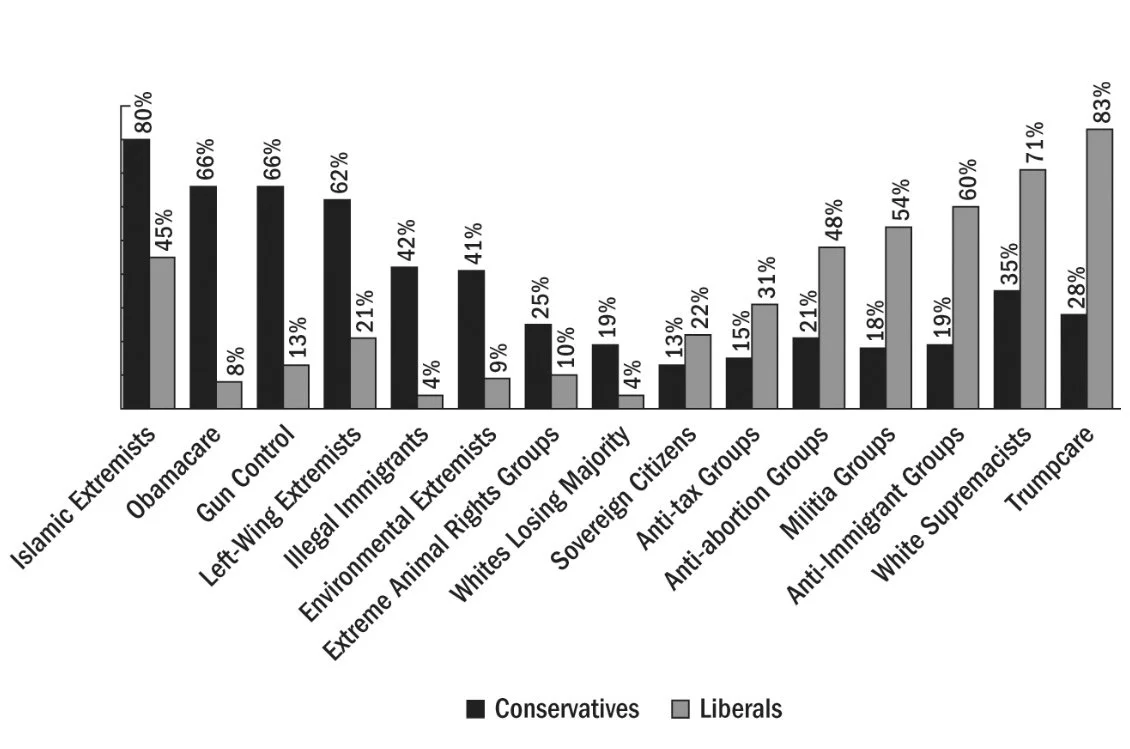
The graphic above features Conservative and Liberal Fears: Percentage Afraid by Political Orientation (2017). Notice how there are significant fears by respondents from both parties, although what is feared is distinctly different. Graphic from “Fear Itself; The Causes and Consequences of Fear in America.”
For example, if you study crime statistics it is quite clear that fear of crime in America is considerably out of proportion with the reality of crime. I regard this misperception as an example of Ritchie’s point that we need to focus on what's real through data, and not succumb to misguided fears.
The Chapman survey verifies increasing high fear levels of crime since 2016, even though - in reality - the national violent crime rate in the US decreased by 1.7% in 2022, consistent with the trend of a long-term decline in violent crime since 1993. Crime rates for Louisiana, Mississippi, Alabama, Florida and Georgia has been steadily decreasing in all categories except shootings. What’s more, crime has been steadily decreasing in New York City for years, making it the safest large city in America right now. The New York City Police Department (NYPD) reports that the major felony offenses of murder, rape, robbery, felony assault, burglary, grand larceny, and grand larceny of motor vehicle, have declined by 28.6% from 2012 to 2022.
However, some types of crimes, such as shootings and hate crimes, have increased across the nation in recent years. The old phrase “coincidence doesn’t indicate causality” might apply here, but it is worth contemplating that gun ownership in the US increased by 28% from 1994 to 2023. It is estimated that there are now over 393 million civilian-owned firearms in America. That said, most gun deaths occur by people who know their victims. (Hopefully that fact will mollify some our more fearful liberal friends who worry that Jenny or I will be shot on our bikes if we cycle in states with “conceal and carry” laws.)
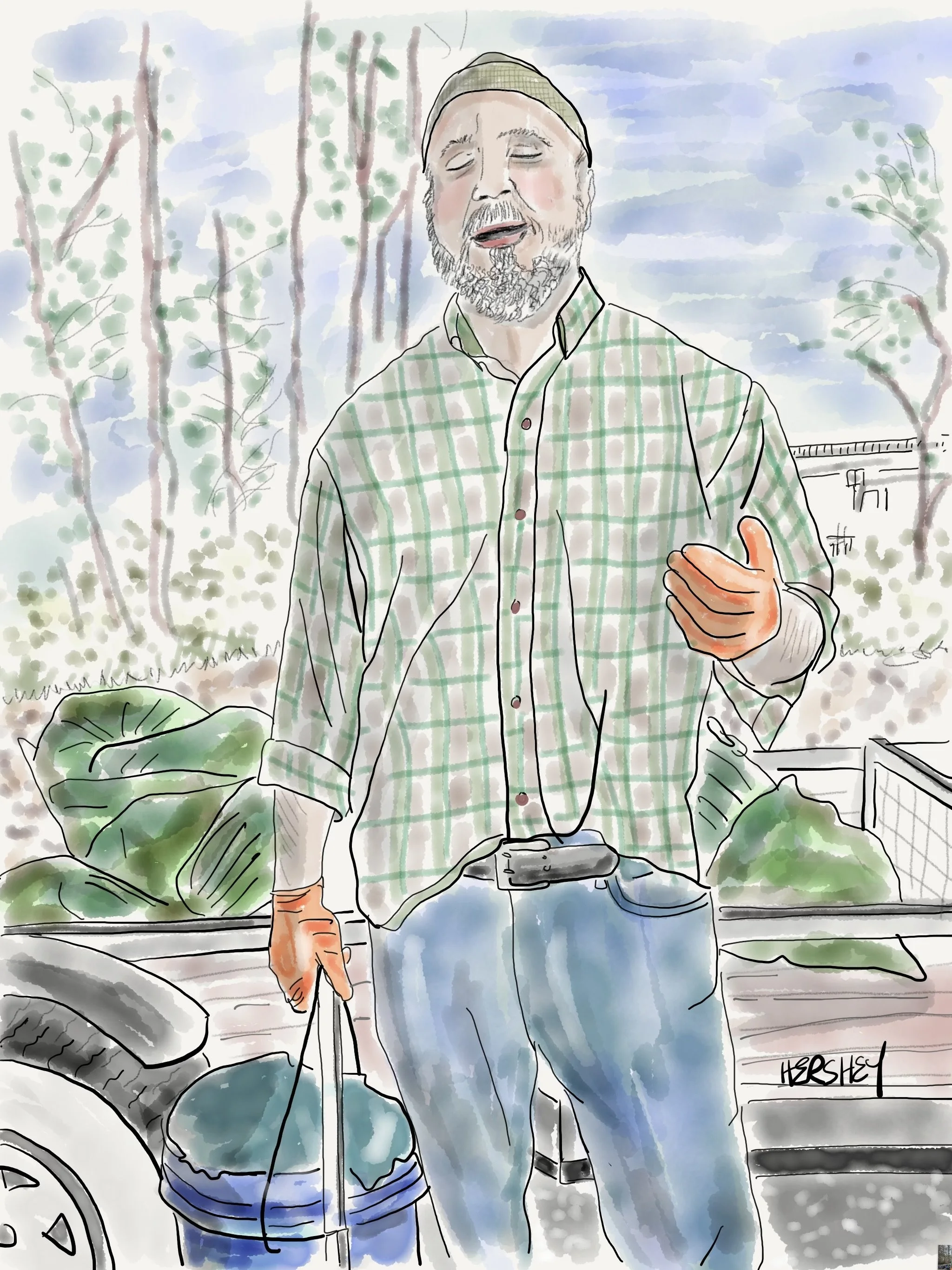
We were eating lunch near a boat launch in Walton County, Florida, when Chris pulled up in his truck, and stepped out. Jenny immediately said, “Hi, how are you doing today?” “Chris responded “I’m doing really well, thank you, Ma’am.” Jenny replied, “Where are you from? That’s an unusual accent you have.” Chris responded: “It’s not an accent. It’s a speech impediment”. And a long conversation followed. Chris is a 49 year-old sanitation employee for the county. He was 23 years old when he suffered a brain stem injury in an automobile accident. The accident put him in a coma for a week, and left him unable to walk and speak for three months. He told us,“Every night I’d cry myself to sleep, feeling sorry for myself. Finally I started praying for the Lord to save me.” Then he had a vision in which the Lord came to him, and lifted him up. And he started to heal, and Chris realized he had survived that accident for a reason, and it was to live a life in service to the Lord. Chris used to be embarrassed about his speech difficulties, but now proudly shares his miraculous story with others, “Praise the Lord!” As we were packing up, Chris asked Jenny, “Do you go to church?” Jenny replied, “I’m Jewish, and I sometimes go to temple. Hope that doesn’t bother you.” Chris kindly responded, “Doesn’t matter. God loves all people.” In closing, Chris told us he’s praying that, “DeSantis will become Trump’s VP so there can be 12 years of solid, God-loving leadership of our country.”
If you have read our last two blog posts, you know about our previous random encounters with conspiracy theorists. I was intrigued to learn from Bader that there is a direct correlation between the number of fears reported by Americans and the number of conspiracy theories they believe. In spite of climate activists being called “alarmists” by some, there aren’t conspiracies created by individuals who understand and accept climate science. However, there are nonsensical and exaggerated claims made by environmentalists from time to time. In contrast, there are numerous conspiracy theories about fake or distorted climate science, as well as researchers so corrupted they actively perpetuate the climate myth to access massive amounts of grant money (the latter conspiracy was shared by a family friend who voted for Trump). Of course, these conspiracies theories do what all conspiracy theories do; undermine public trust.
According to the Chapman survey, the “fear of corrupt government officials” has been the top concern for Americans for six consecutive years, from 2018 to 2023. This tells us much about the erosion of public trust. If we cannot trust our government, our scientists, our finest universities, or our most successful corporations (all participants of the public trust), how will we successfully tackle large and complex problems as a nation, much less as a world?
Fear itself is our greatest adversary. It keeps us from figuring out what’s real. And if we don't know what's real, we can’t know the world and we don’t have the power to truly change it. So, to return to Hannah Ritchie’s point, how do we really understand what is happening in the world? Are our worst fears based in real things, or are they out of proportion with reality? And is the news media we consume distorting our real knowledge of the world, or increasing it? Are we feeling apocalyptic because that’s always been part of the human experience, or because our news media and social media offers fear up to us as an endless banquet?
Stay vigilant! Thanks for reading. If you haven’t done so, please subscribe to this blog to follow our next biking trip.
Blog writing by Michael Chase. Drawings by Jenny Hershey. Unless credited or otherwise noted, all material is the copyrighted property of the blog post authors.
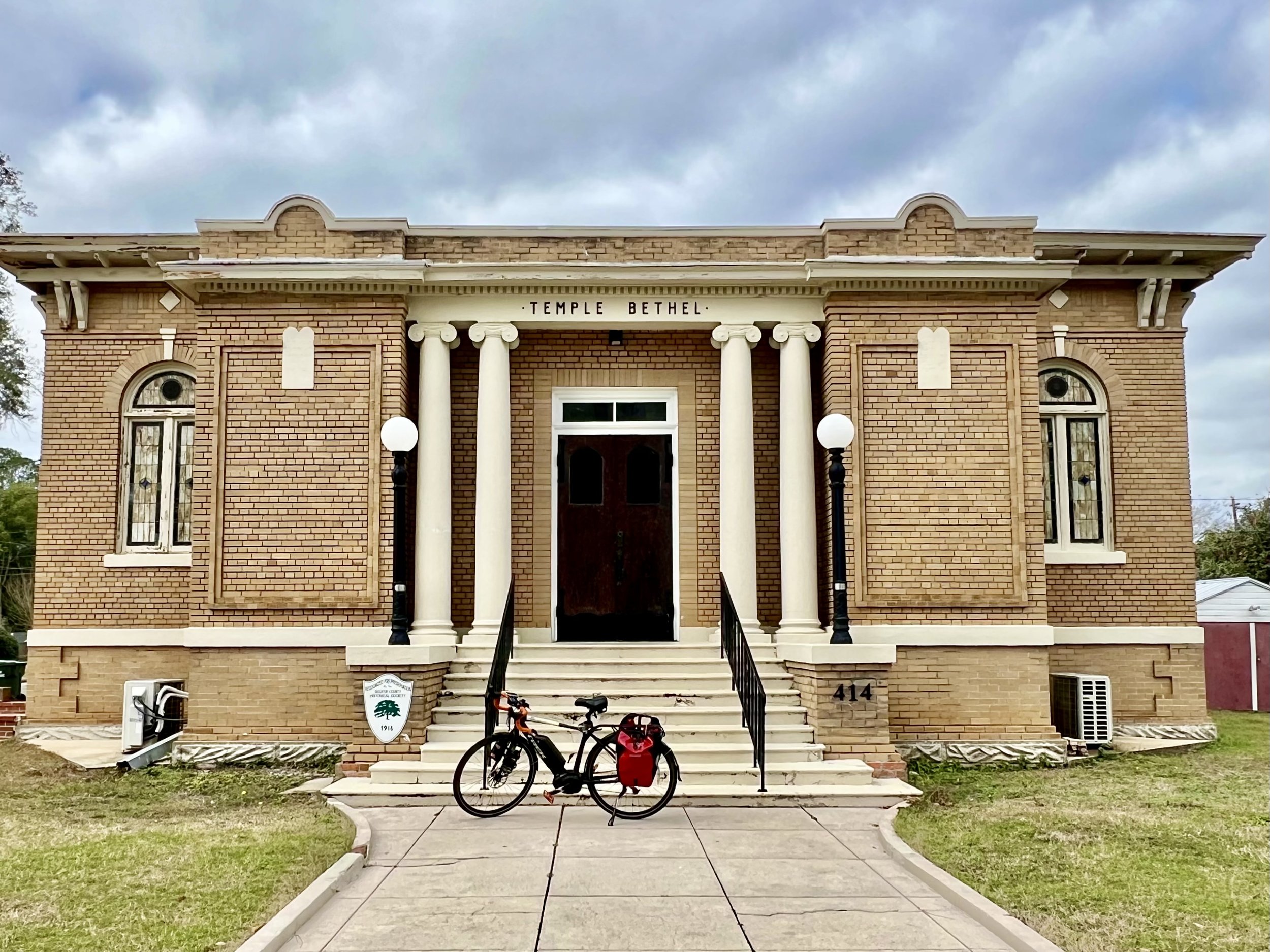
Temple Bethel was the only synagogue Jenny found on this tour until we got to Savannah. It was in Bainbridge, GA, and after an exodus of Jews, it was converted to an Airbnb. Photo by Jenny Hershey. Follow her on Instagram @deeofo.
Water and a Pipeline; Biking Mississippi and Arkansas, Part 2
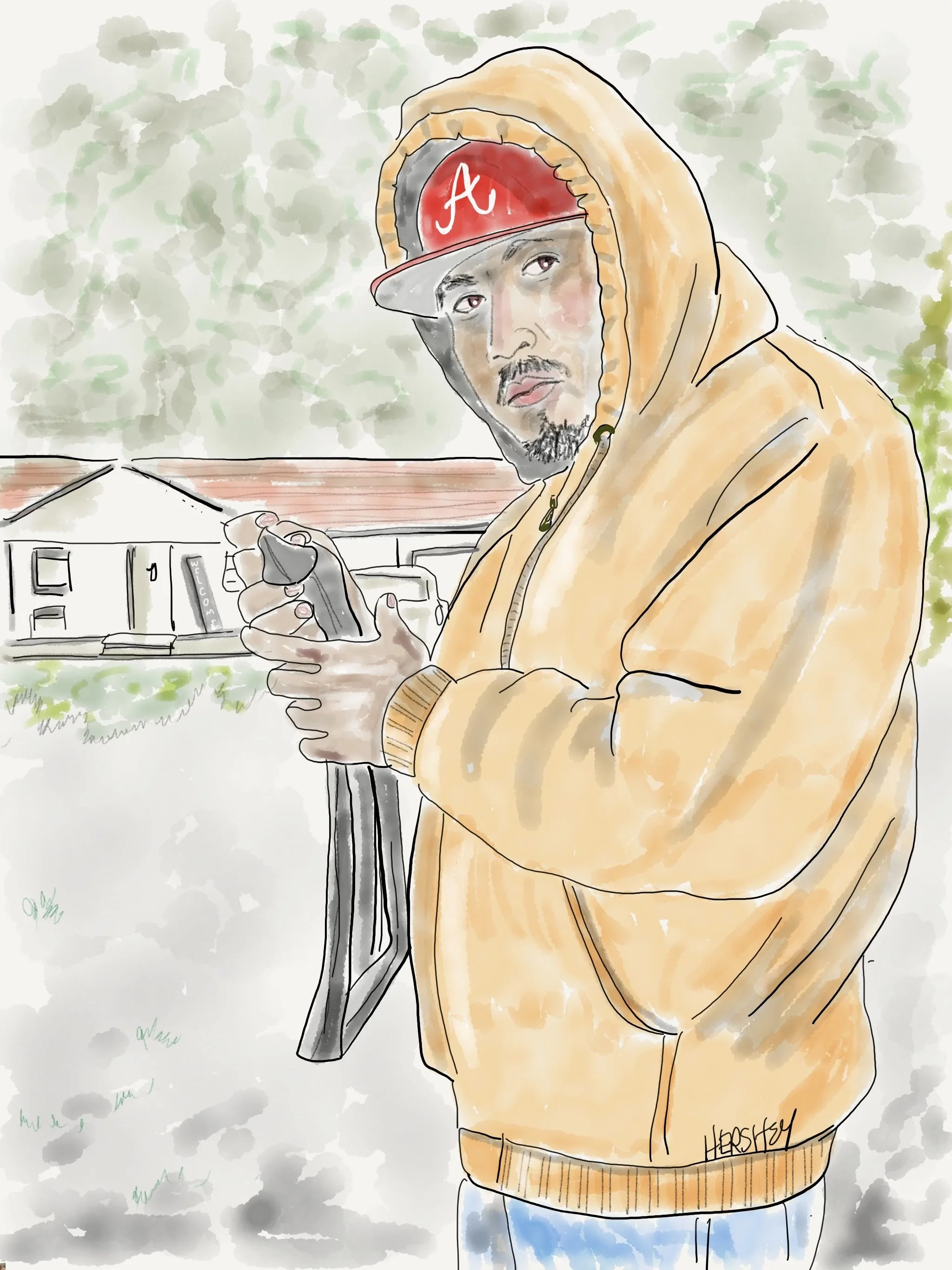
We met Jorge outside Jacksonville, Arkansas, just east of Conway. He graciously allowed us to fix a flat tire in his driveway, the third of seven flats we had on this trip. Jorge immigrated to Arkansas from San Luis Potosí, Mexico, 12 years ago, and enjoys a peaceful life with his wife and 4 kids. He told us he was “muy feliz.” He works a 9-5 job Monday through Friday in home construction, and spends the weekends with his kids doing sports. Jorge was a bicycle mechanic in Mexico and masterfully found the leak in our tube before we were even able to look. We were touched by his kindness.
Drawing by Jenny Hershey. Follow her on Instagram @deeofo.
——————
“Caution is the eldest child of wisdom.”
- Victor Hugo
——————
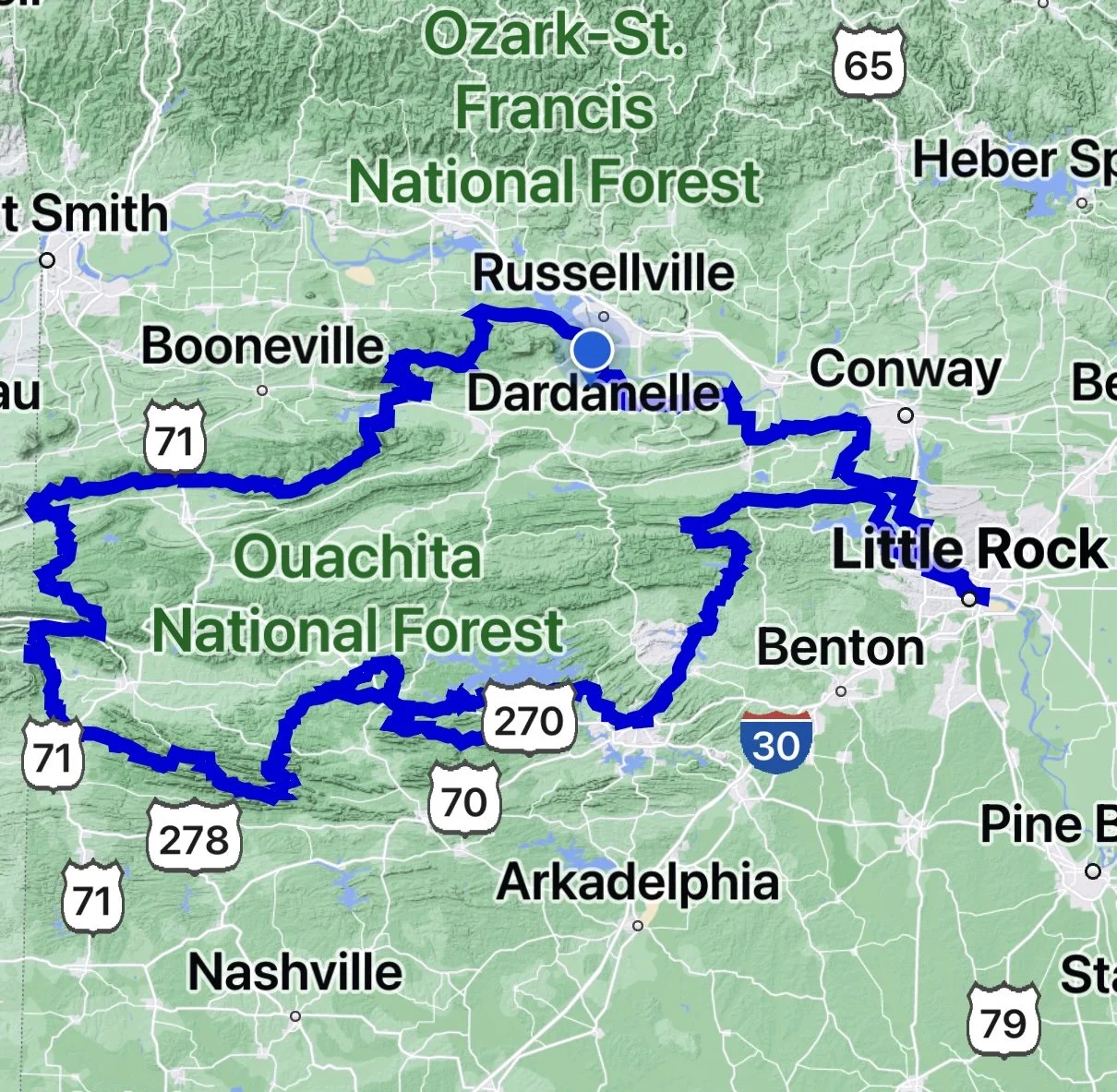
Jenny and I planned our bicycling trip through the Ouachita Mountains in the Ozark High Country, following a route from Conway to Little Rock. From there, we will take an Amtrak train to visit family in Milwaukee and another train back home from Chicago to New York City. We used a map the American Cycling Association provided to guide us on our journey.
Writing by Michael Chase, Drawings by Jenny Hershey
After a very satisfying ride across Alabama and Mississippi and the extraordinary delta country of eastern Mississippi and Arkansas (the subjects of Post 1 in this series), we headed toward the Arkansas River and the Conway/Little Rock region of Arkansas. The Adventure Cycling Association has created an extraordinary tour of the Ozarks out of Little Rock that features northern and southern loops collectively called the Arkansas High Country Route.
Confidant that climate-related stories are now to be found anywhere and everywhere, we already knew about the deadly tornadoes of March 31, 2023, that had moved through a large portion of the south and midwest, including a particularly devastating tornado that hit North Little Rock, only one week after the Amory, Rolling Fork and Silver City tornadoes in Mississippi. Although we didn’t see the neighborhoods in North and West Little Rock devastated (nor the shopping center that took out a Trek Bike Shop, among other businesses), we saw large swaths of park damage on both sides of the Arkansas River. The North Little Rock tornado had winds up to 165 mph and a path length spanning 20-25 miles, which is unusually large. We thought we would likely see more tornado destruction (see Part 1 in this series). However, on our way to Lake Maumelle from Little Rock, we discovered a different water-related climate story that captured our interest.
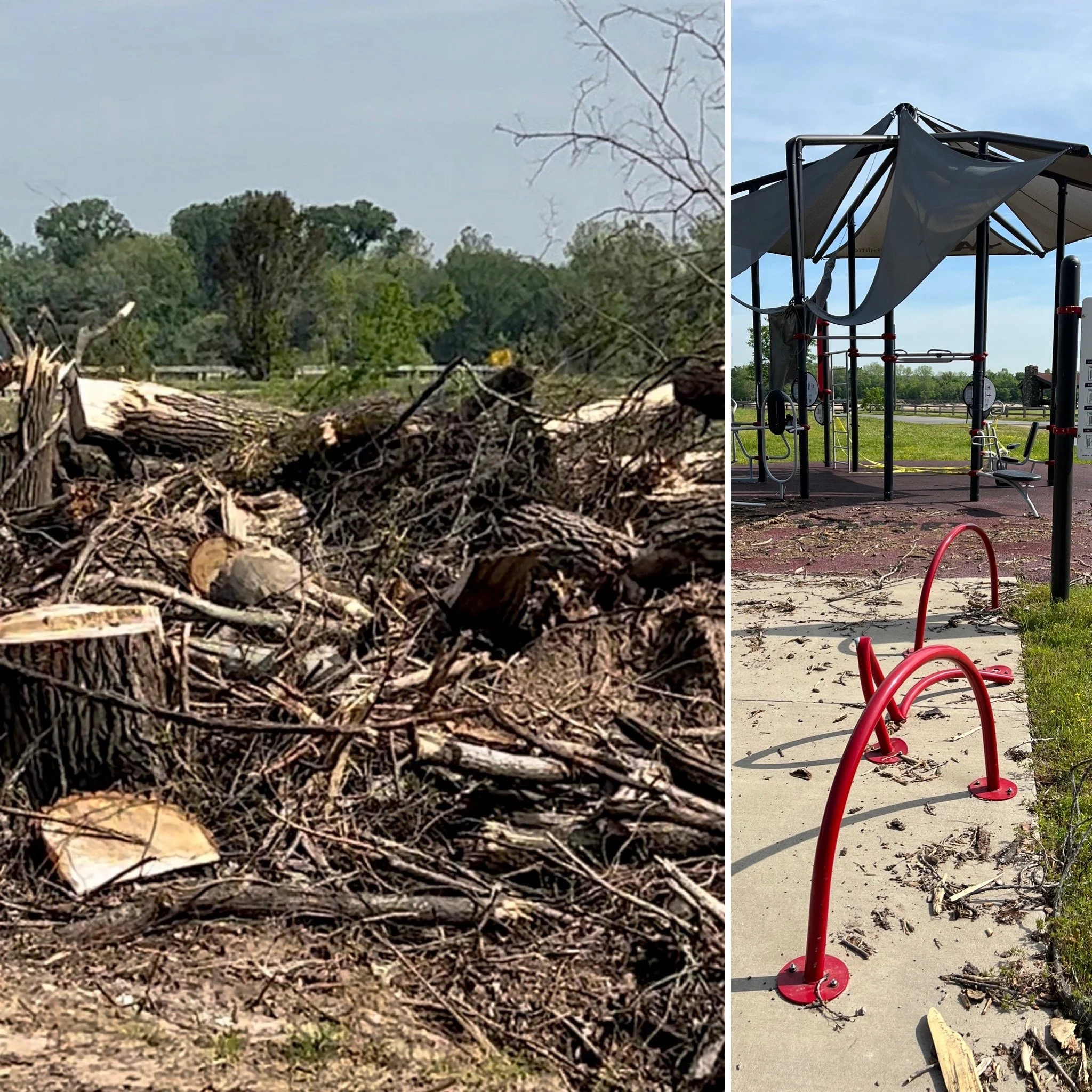
It’s difficult to photograph the impact of a tornado in a natural setting, and we took many pictures we weren’t pleased with. We must have seen several hundred stumps in one area of Rebsamen Park in Little Rock. We captured these shots more than 5 weeks after the tornado hit. Workmen have been working nonstop to get debris cleared, and there are still many places in the park that are this damaged.
—————
Mayflower, Arkansas, is a small suburban development nestled between North Little Rock and Conway. You might remember the Pegasus Pipeline oil spill in 2013. Owned by ExxonMobil, and used to carry Canadian tar sands oil to the Gulf Coast, it ruptured and dumped approximately 10,000 gallons of tar sands oil into the Mayflower Northwoods subdivision.
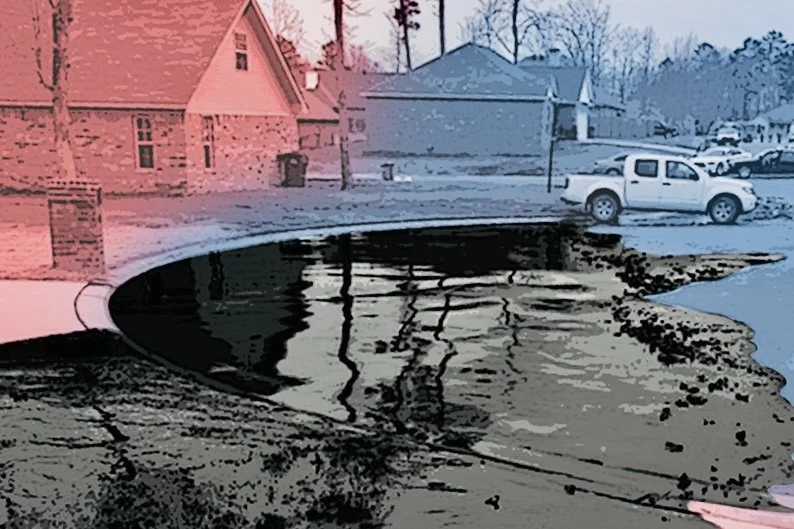
A picture of the spill in 2013, as published in Inside Climate News. Credit:EPA.
Jenny and I were intrigued by this story (and its lack of a resolution, which I will get to later), so we chose to bike to Mayflower, Arkansas, to see the site of the spill for ourselves. Not surprisingly, ten years later there are no telltale signs of the spill short of a pipeline identification pole (see photo below). Yards blackened by oil that we had seen in other pictures are now green with grass and homes evacuated shortly after the spill look intact and peaceful with pickups and SUVs in the driveways. Among the only visible reminders of the leak are a couple of vacant plots on each side of a cul-de-sac at the corner of the neighborhood closest to the pipeline.
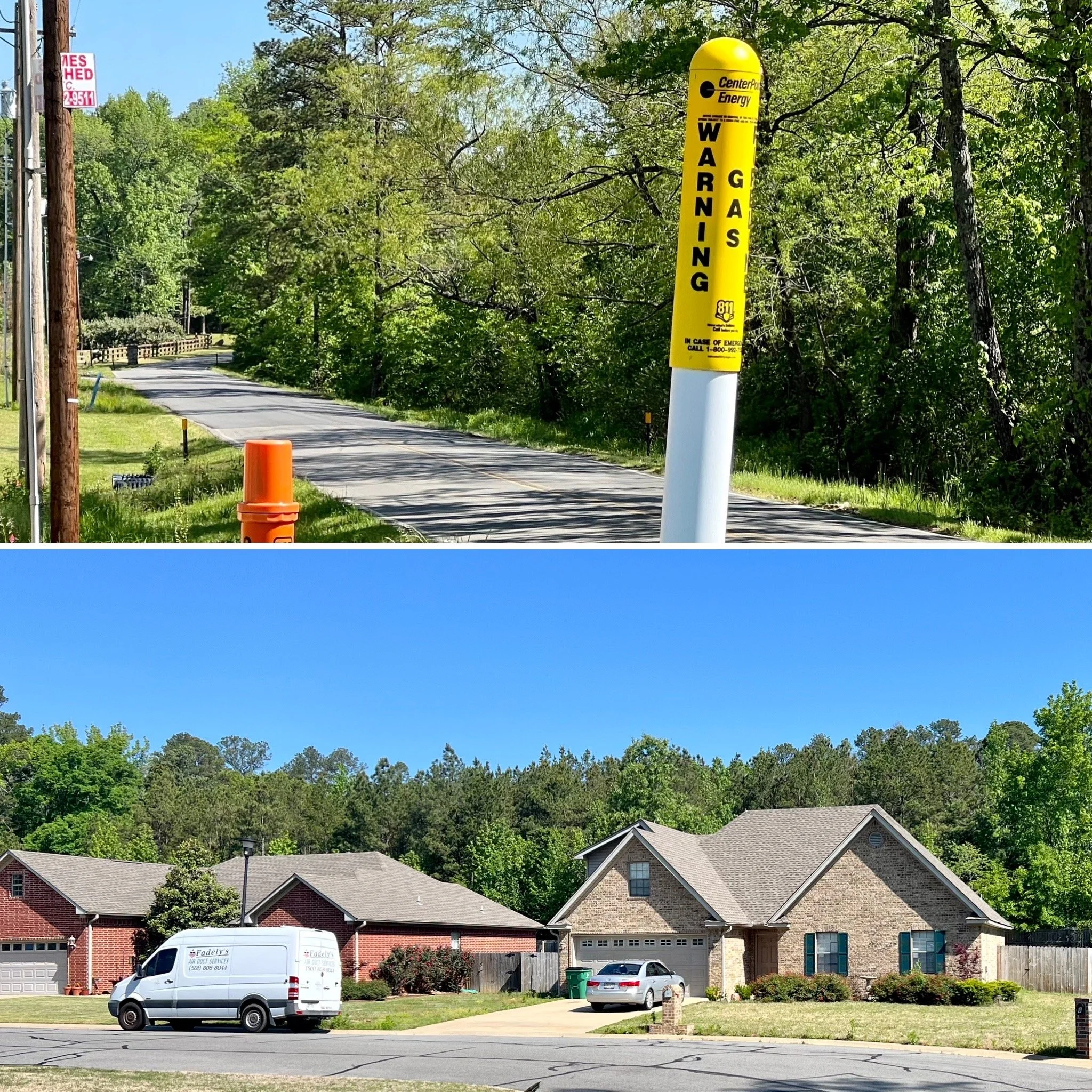
The gas pipeline marker sits next to the main road leading into the Northwoods subdivision of Mayflower, Arkansas. About 100 feet later, a road turns to the right and ends in a cul-de-sac partially visible to the right. These houses are the first things one sees. To our eye, all the houses on this street and many of the houses behind it are new and make up the bulk of the homes that were rebuilt as part of the settlement with ExxonMobil. Despite confidentiality agreements, several plaintiffs said that compensation for medical distress ranged from $2,000 to $15,000, depending on the proximity of the residents to the oil spill.
To avoid confusion, please note the pipeline was renamed the Permian Express Pipeline after ExxonMobil sold it to Energy Transfer Partners, LLC (ETP) in 2018.
Photo by Michael Chase. Follow him on Instagram @mjohnsonchase.
Most of the residents that live in the subdivision now did not live there in 2013. According to an article in the Arkansas Democrat-Gazette, Meggie Hardcastle, who recently moved into a home near the spill site, said most people living on her street were also new to the area. Of the two locals we talked to, one had heard nothing about the possibility of the pipeline starting up again, and the other believed the entire pipeline had been replaced. Sadly, they are both wrong; I explain why later in this story.
Things were very different when the spill occurred. It required an immediate evacuation of 22 homes, killed hundreds of animals, and severely impacted the surrounding wetland habitat near the subdivision. Fortunately, the spill was rapidly contained through the efforts of fast-acting first responders, including firefighters, city employees, county road crews, and local police, who successfully blocked culverts to stop the oil from getting into the water system of nearby Lake Conway (an area enjoyed for its natural beauty and recreational opportunities).
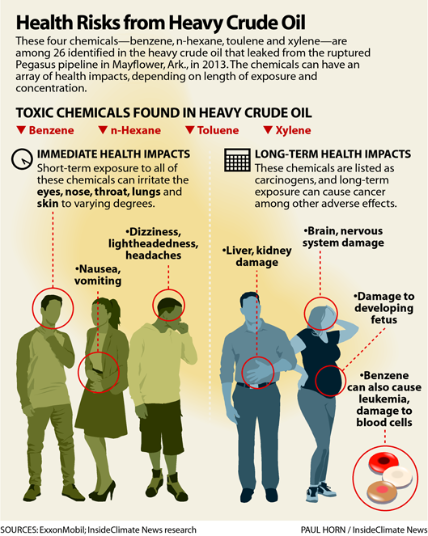
Graphic courtesy of Inside Climate News.
Back in the Northwoods subdivision, a few hundred people were sickened by an odor that was almost thick enough to feel; the spilled oil was bitumen mixed with diluted hydrocarbons. Residents complained about headaches, diarrhea, swollen eyes, dry heaves, and burning lungs. But the full extent of the medical consequences didn’t come to light until 2017 when 708 pages of documents were finally released by the federal pipeline safety regulator known as the Pipeline and Hazardous Materials Safety Administration (PHMSA) after a protracted court battle where PHMSA and ExxonMobil squared off with a nonprofit watchdog group, the Pipeline Safety Trust.
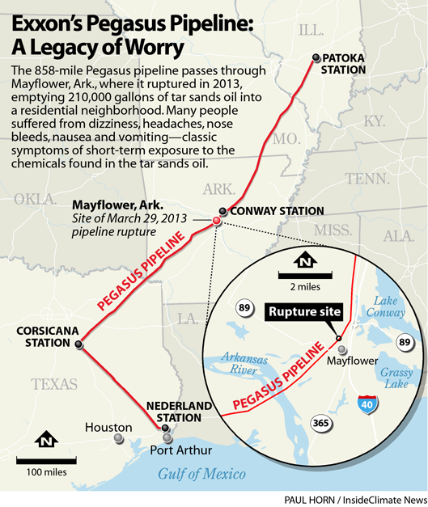
Built in the 1940s, the current condition and usability of what is now called the Permian Basin Pipeline are unknown to the public. Although not in use since 2013, its current owner, Energy Transfer Partners, LLC, has no obligation to reveal any maintenance process or testing results, nor does it have to indicate if and when the pipeline is operational. In the fall of 2021, Energy Transfer Partners, LLC began testing the pipeline again for potential deployment. This map shows more detail about the pipeline’s location. The pipeline traverses 13 miles of the Lake Maumelle shoreline in Arkansas and runs through Lake Hamilton in Hot Springs.
Graphic courtesy of Inside Climate News.
Sealed depositions obtained by the trust detail the true depth of health concerns after the spill. More than two dozen Mayflower residents described serious physical and mental harm suffered due to the oil spill. Residents tossed out furniture and ripped up carpets that had become hopelessly steeped with the stench of oil. They talked about the unexplained death of pets and how they became afraid even to take walks through their neighborhood.
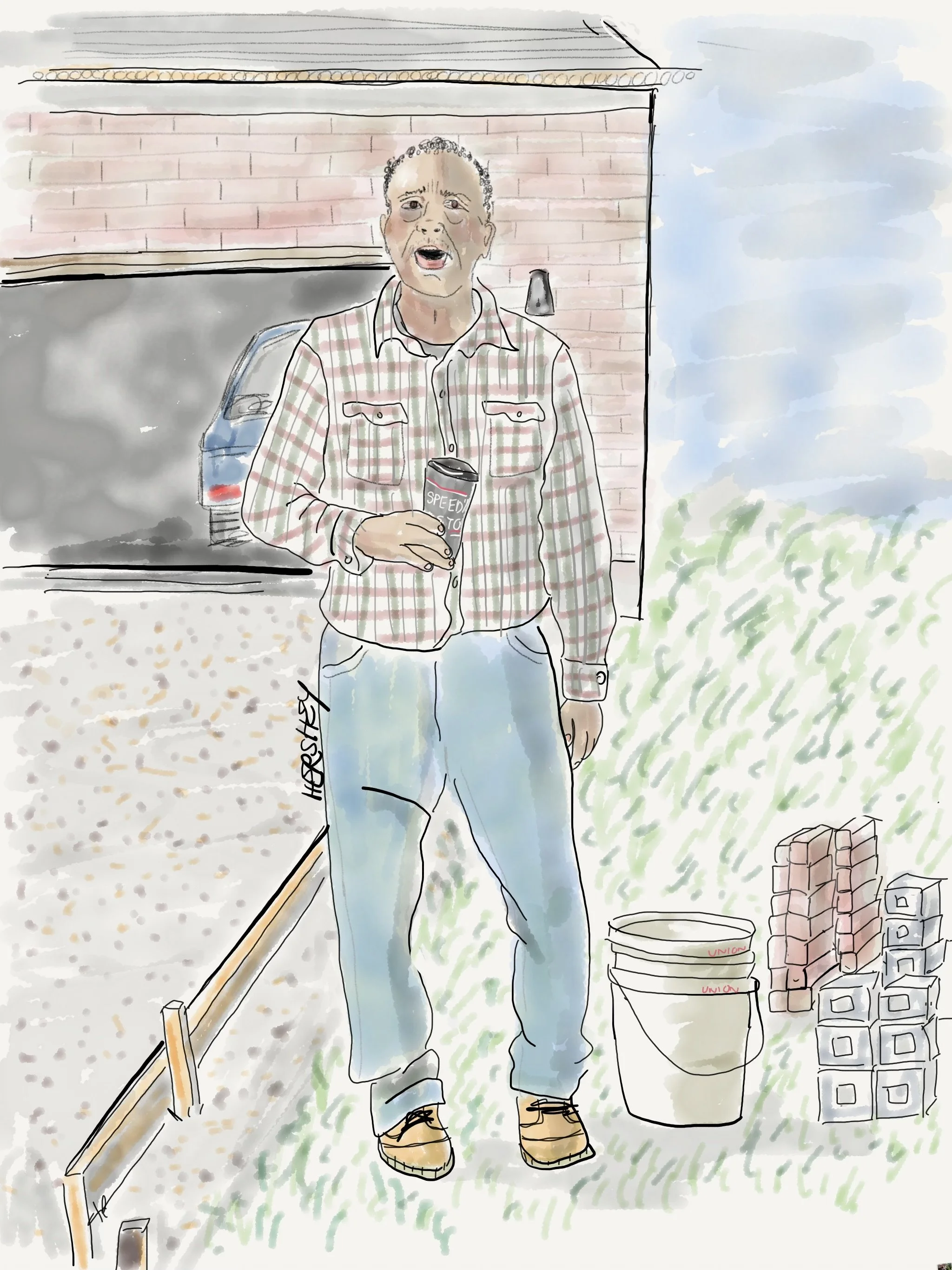
We met Hirty Hopper, a lifelong resident of Mayflower, in the Northwoods subdivision. Hirty is a mason and has been involved in masonry work on many homes following the oil spill. He trusted that the pipeline had been repaired, even telling us the entire pipeline had been rebuilt (it hasn’t). Hirty’s greater concern was seeing the construction completed on a railroad overpass nearby. He explained that the subdivision was only remotely accessible to the nearest hospital. It was located near a railroad track with so few crossings that ambulances couldn’t access the subdivision quickly enough, causing deaths because the wait was so long. “Six people passed,” he told us.
Drawing by Jenny Hershey. Follow her on Instagram @deeofo.
Settlements between homeowners, sickened residents, and ExxonMobil took years. The Arkansas Democrat-Gazette reported that, as part of its effort to address the spill, ExxonMobil ultimately purchased and rebuilt 31 homes in the subdivision and demolished at least three. It took the court system about six years to reach a final accounting. Along the way, PHMSA filed violations against ExxonMobil and attempted to fine them. For years before the Mayflower disaster, ExxonMobil had conducted multiple tests which uncovered more than ten ruptures or leaks along the pipeline. According to PHMSA, ExxonMobil failed to address those concerns, although the reports are still unavailable to the public, and the complaint is shrouded in secrecy. However, a federal appeals court sided with ExxonMobil when the oil giant stated, “There is no proof its actions contributed to the spill.” Then, in a ruling that astonished me when I read about it, the court found that ExxonMobil had followed the law in conducting adequate inspections and analysis in accordance with federal regulations and that“despite adherence to safety regulations and guidelines, oil spills still do occur.”
Think about that. The court essentially ruled that pipelines DO and WILL fail - just like any other form of plumbing. Yet, when they do, operating companies may not be held culpable. If they have followed regulatory laws (often legislated by federal and state governments that are anti-regulatory) and the pipelines fail, operators can walk away scot-free. Unfortunately, when that happens, the public is stuck with a lasting burden of recovery that goes well beyond token gestures of compensation by offending parties.
I wish I could say that such outcomes create greater awareness among the public that weak regulations and self-interested companies are not to be trusted. Companies will do what is right for them, but not necessarily what is right. If the law won’t stop them and they can make money doing it, they will do as much damage as possible until a disaster unfolds. Yet, I am often struck by the passivity of those at risk, like the Northwoods resident who lived through the previous spill and assumes the pipeline will never be used again.
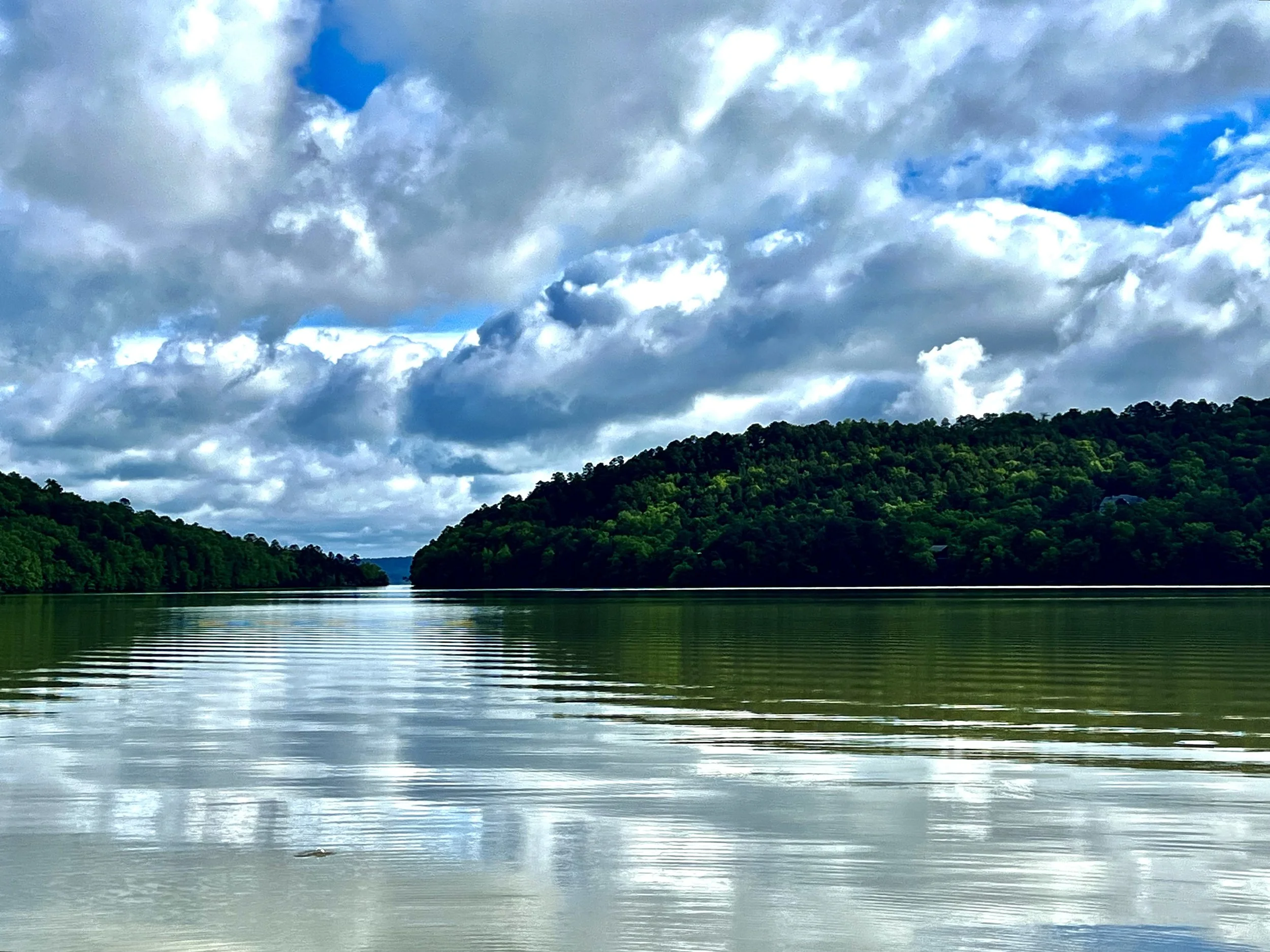
Lake Dardanelle is near the Arkansas River, slightly northwest of Dardanelle, Arkansas. Photo by Jenny Hershey. Follow her on Instagram @ deeofo.
In the fall of 2019, after Energy Transfer Partners (ETP) had purchased the pipeline from ExxonMobil and renamed it the Permian Express Pipeline, they notified Central Arkansas Water that they planned to start testing it again for potential use. Central Arkansas Water is the utility that supplies drinking water to approximately half a million residents in the Little Rock metropolitan region. It draws water from the Lake Maumelle watershed and smaller tributaries fed by the Maumelle River. Built in the late 1940s (well before the Northwoods subdivision existed), ETP’s newly named Permian Express Pipeline also skirts along 13 miles of shoreline of Lake Maumelle. Along this stretch, the pipeline crosses bodies of water, including tributary streams and wetlands at 13 points. In addition, several sections of pipe near the lake are above ground, making them more susceptible to damage.
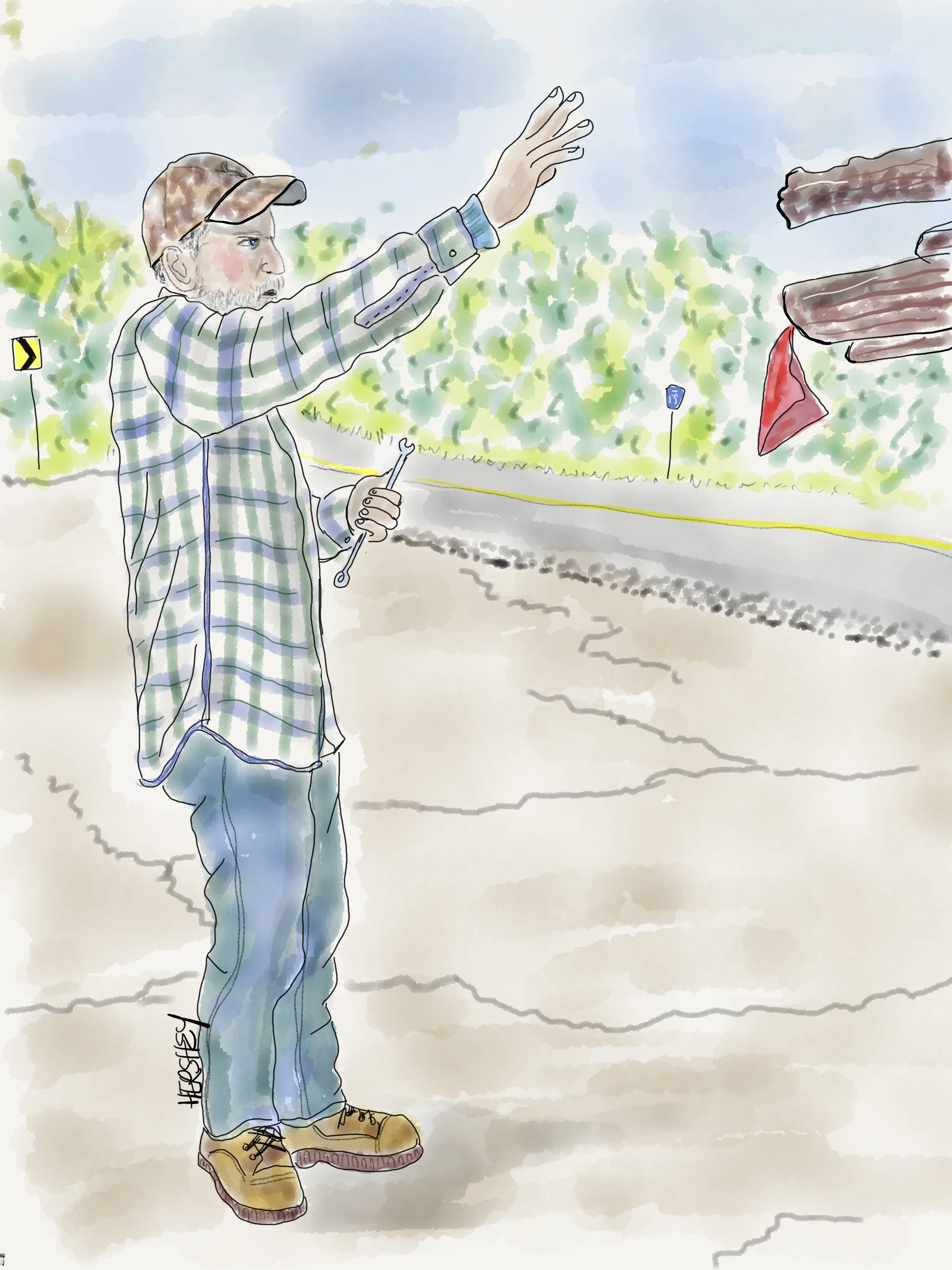
Gary is a 62-year-old log hauler from Clarksville, Arkansas. We met him on Petite Jean Mountain in the Ouachita Mountain west of Little Rock (pronounced like Wichita, except it is Watch-i-ta). Gary was adjusting his brakes under a truck carrying a large load of timber. Gary has been hauling logs for almost 30 years. Still, when Hurricane Harvey hit Houston, he and his wife headed west to help communities by hauling away debris and offering emotional family support. Gary loves to hunt wild turkeys. When we asked Gary about his age, he laughed and told us he was like an overworked mule, “rode hard and put up wet.” He sincerely asked us, “How could we stand living in a city as big as New York?” Jenny launched into her appreciation for the diversity of her neighborhood in New York, and that’s when he told us how much he enjoyed helping diverse folks in Houston after Hurricane Harvey hit. As different as our lives are, we enjoyed learning about our shared values.
Drawing by Jenny Hershey. Find her on Instagram @deeofo.
Surprisingly, ETP is not required by law to disclose whether it conducts tests or if it reopens the pipeline. Notifying the water utility about its intention to conduct tests suggests the company is interested, at least, in the appearance of good public relations. However, it has not been willing to divulge its long-term intentions. The water utility and various community environmental groups have openly worried that the company might consider reopening the pipeline. After all, the stakes are quite high - a pipeline failure within the Lake Maumelle watershed could have catastrophic consequences for the half million people who use the water supply.
In 2020, officials from Central Arkansas Water sent letters to ETP offering to discuss the potential purchase of the section of pipeline that runs through the watershed, but they never heard back.
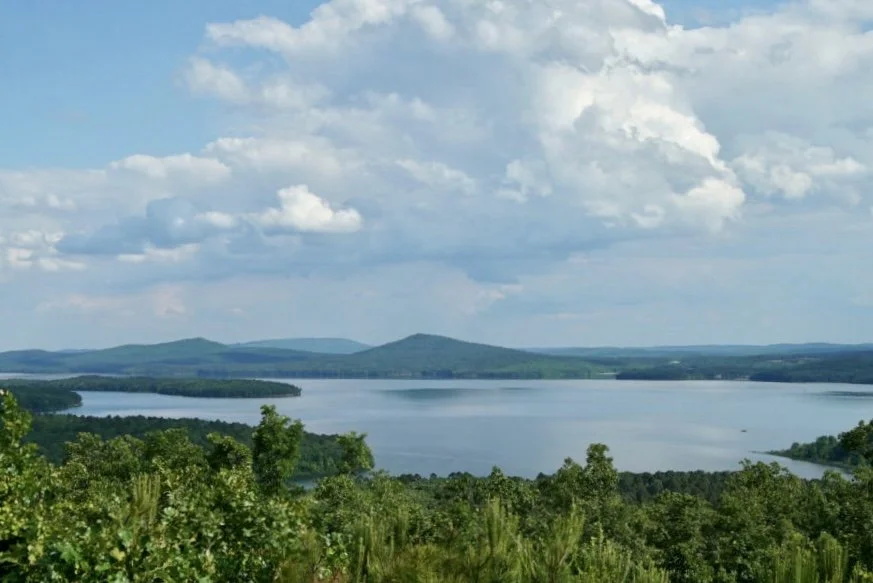
Stock photo of Lake Maumelle, the reservoir that is the source of drinking water for Little Rock and the water utility Central Arkansas Water. We visited the lake on our last day in Little Rock and tried to find an access point for a photograph but were unsuccessful, so we had to settle for this photo found in Google Images.
The most recent accounting of what might happen with the pipeline is an article in the Arkansas Democrat-Gazette, dated March 27, 2023 (ironically, on the same weekend that media was hyper-focused on the North Little Rock tornado). The Gazette interviewed Raven Lawson, the watershed protection manager at Central Arkansas Water, who said, “The possibility of the pipeline reopening is a top concern.” If oil begins to flow through the pipeline again, Lawson said she believed it would not be a question of "if" but "when" the conduit would rupture again. However, Max Shilstone, director of government affairs for ETP, told Central Arkansas Water in a letter dated May 23, 2022, that his company has "no plans to bring the pipeline back into service at this time." Shilstone said "current market conditions" did not warrant restarting the conduit but noted his company would "continue to maintain the pipeline in a safe, idle condition. Should circumstances involving the pipeline and its future use change, we will communicate with interested parties, of which Central Arkansas Water would be included.”
So, the people who use Central Arkansas Water must wait passively, trusting that ETP will do the right thing. Let’s hope it goes that way. I think it’s unlikely that ETP has plans to run oil through the Permian Express Pipeline. They are more likely to use the pipeline to transport liquified natural gas (LGN) to the Gulf Coast. A methane leak would be less harmful to waterways, making public relations issues more manageable (methane emission disasters are harder to detect and less likely to gain media attention).
However, I think it is even more likely that ETP is quietly testing the pipeline as they bide their time until they can use the pipeline to transport CO2 or hydrogen. Unless the GOP's recent budget ploy successfully results in repealing the recent hike in 45Q tax credits as provided by the Inflation Reduction Act (see our recent blog post for an explanation), the financial rewards for transporting those materials may be quite remunerative. And while that effort might help decarbonization efforts, they are also largely untested and may include unintended consequences. Like you, I would much rather deal with pollution accidents resulting from efforts to decarbonize. But it’s also important that we understand the risk profile for anything we transport, and right now, there is much about carbon and hydrogen transport and storage that is not understood.
But I’m willing to make a solid bet the ETP didn’t purchase the Pegasus Pipeline, so it can lay idle. It’s only a matter of time before it is back in use. And considering that it is over 70 years old and the relaxed regulatory rules under which it is governed, it’s only a matter of time before Little Rock’s drinking water supply is again threatened.
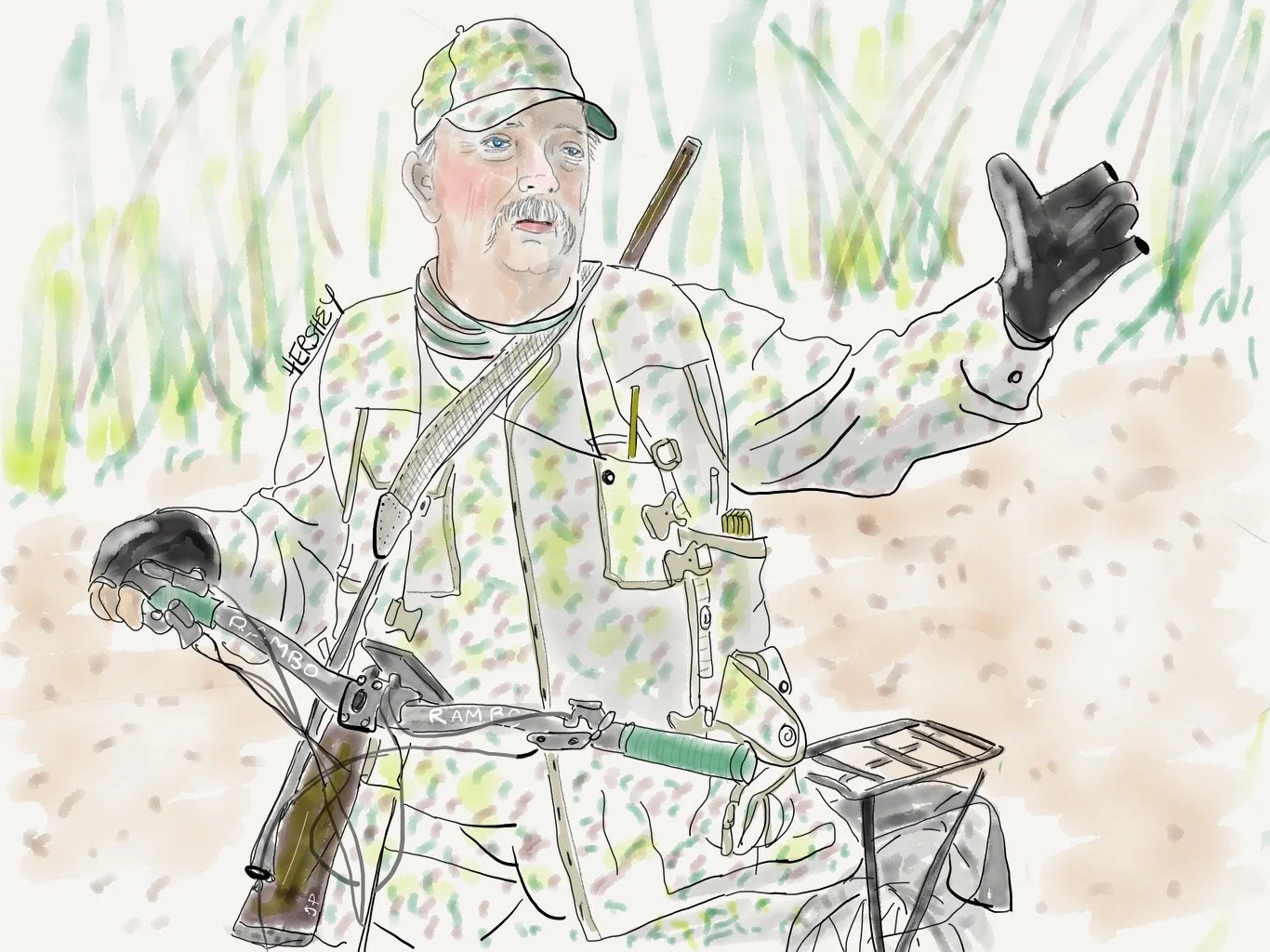
On our way up Magazine Mountain in Arkansas, we met Joey on his souped-up e-bike on a gravel backroad. Joey was born and raised (and still lives) in the Arkansas Valley near Paris, Arkansas. Retired from a job with Bridgestone Tire, Joey enjoys hunting for wild turkeys on his bike. He said that his truck scares the turkeys, and he can sneak up on them on a bike. Turkey season in Arkansas is short; it lasts from April 17th - May 7th. An old back injury haunts Joey, but he pushes through, and at the end of the day, he goes home to a loving wife. Two grown children who don’t live very far away not far away give him much joy. A jovial, soft-spoken man with a gun dressed in camouflage riding an e-bike on a gravel road in the woods; can’t find that in Times Square…
Drawing by Jenny Hershey. Follow her on Instagram @deeofo.
Stay vigilant! Thanks for reading. If you haven’t done so, please subscribe to this blog to follow our next biking trip.
Blog writing by Michael Chase. Drawings by Jenny Hershey. Unless credited or otherwise noted, all material is the copyrighted property of the blog post authors.
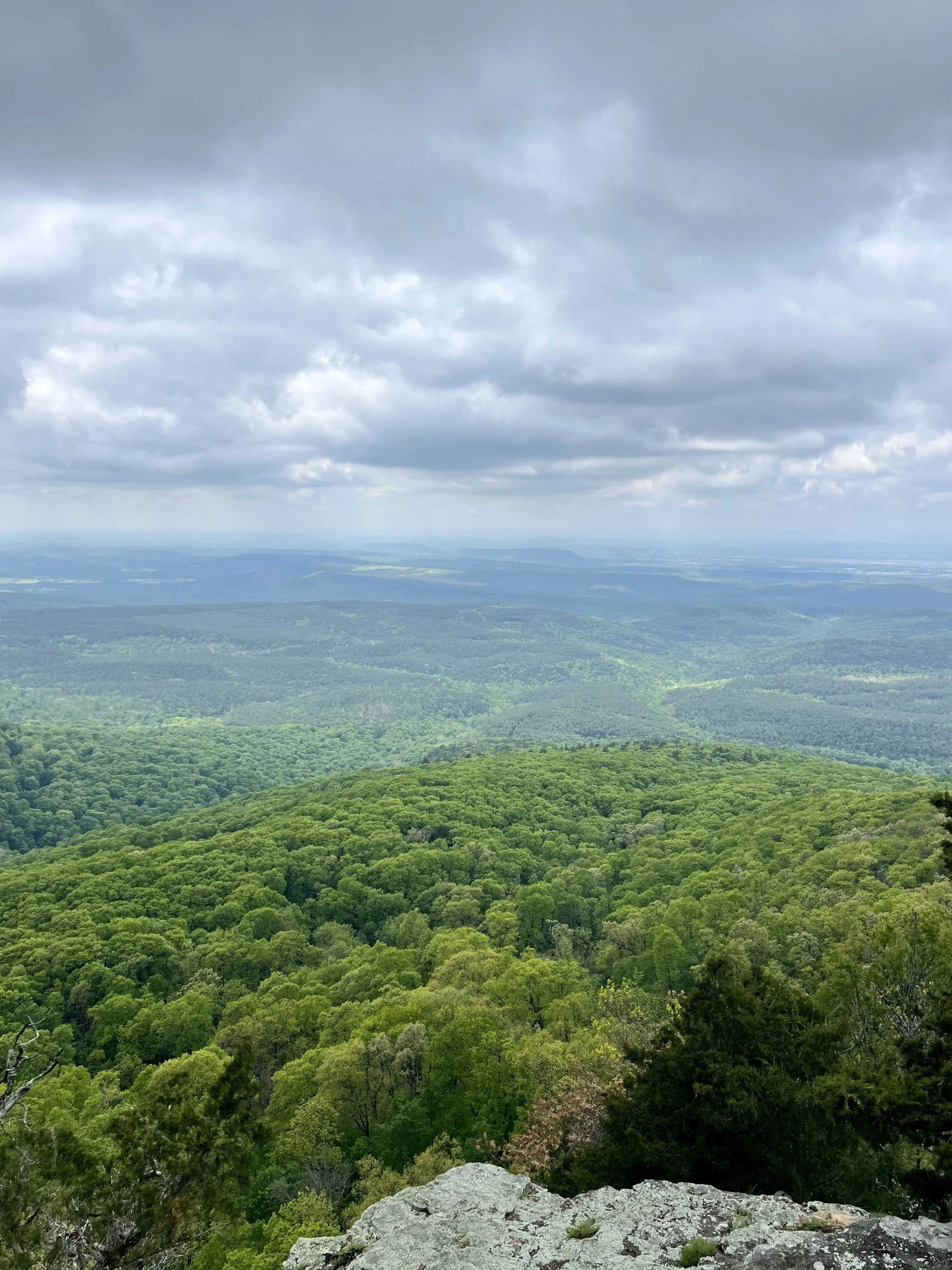
This view looks north from Petite Jean Mountain in the Ouachita Mountains. Although this entire region is loosely referred to as “the Ozarks,” the southern border of the Ozark Plateau technically starts at the Boston Mountains, which are visible in the distance. Jenny and I were charmed by the natural beauty of Arkansas and challenged by its ruggedness. Photo by Michael Chase. Follow him on Instagram @mjohnsonchase.
Water and a Tornado; Biking in Mississippi and Arkansas, Part 1
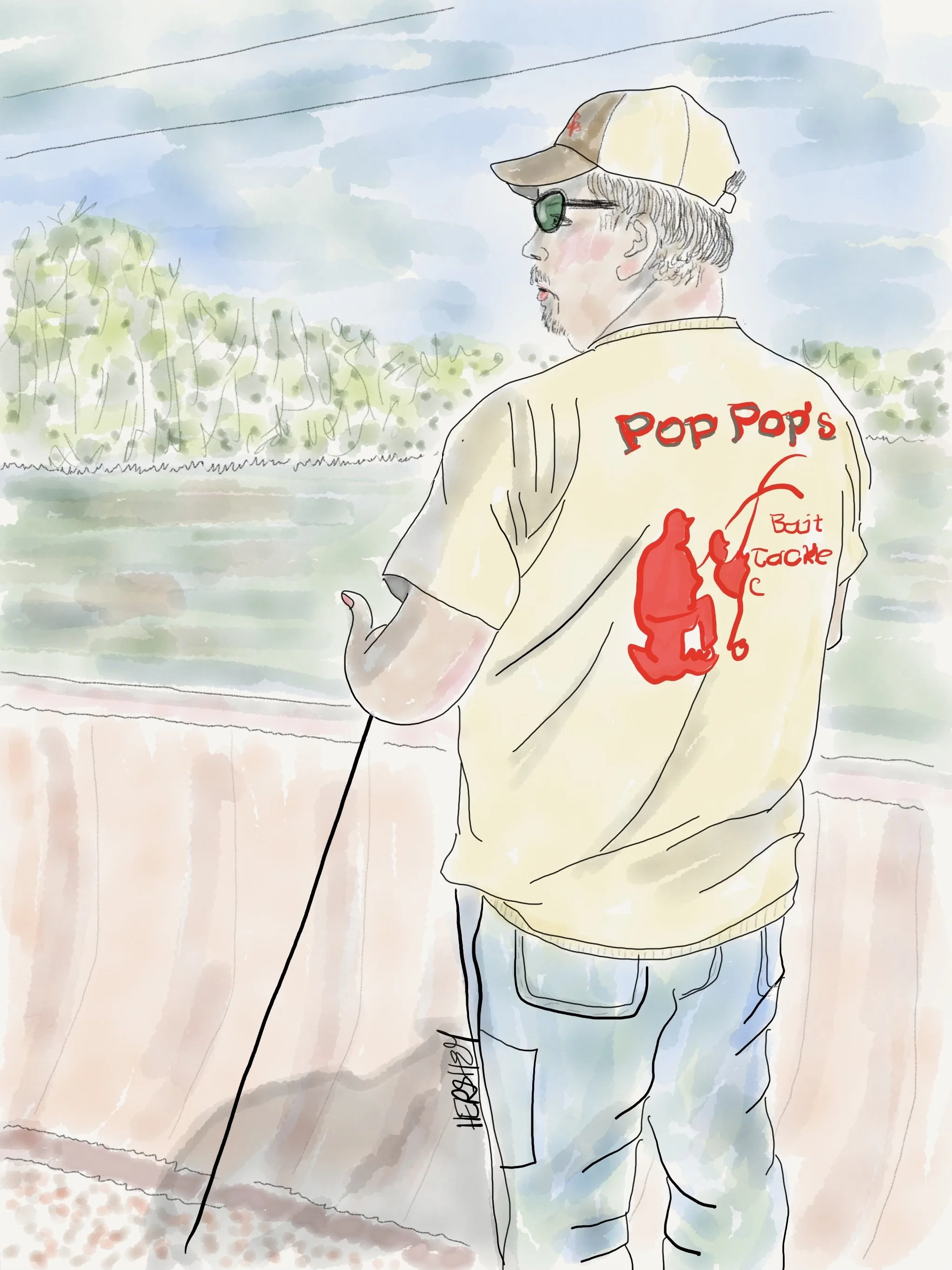
Jenny and I met Brian while he was gazing at the extraordinary amount of surface water flowing through Indian Bay near the White River east of DeWitt, Arkansas, in the Dale Bumpers National Recreation Area. This led to a conversation about how all the surface water we saw was unlikely to replenish groundwater supplies in the Mississippi Delta. Brian was about to say something when a valve spontaneously blew on my front tire, causing it to deflate instantly. Brian owns Pop Pop’s Bait and Tackle in Helena, Arkansas, near the Mississippi River on the Arkansas side of the Mississippi Delta (technically known as the Mississippi Embayment). He was fishing for Skipjack Herring, a great bait for catfish and quite lucrative for his shop. Brian started Pop Pop’s with his father about 12 years ago. He is proud of his daughter who will attend medical school next year. A hard-working man, Brian has lived in Arkansas his entire life.
Drawing by Jenny Hershey. Follow her in Instagram @deeofo.
—————
“Our very survival depends on our ability to stay awake, to adjust to new ideas, to remain vigilant and to face the challenge of change.”
– Martin Luther King
—————
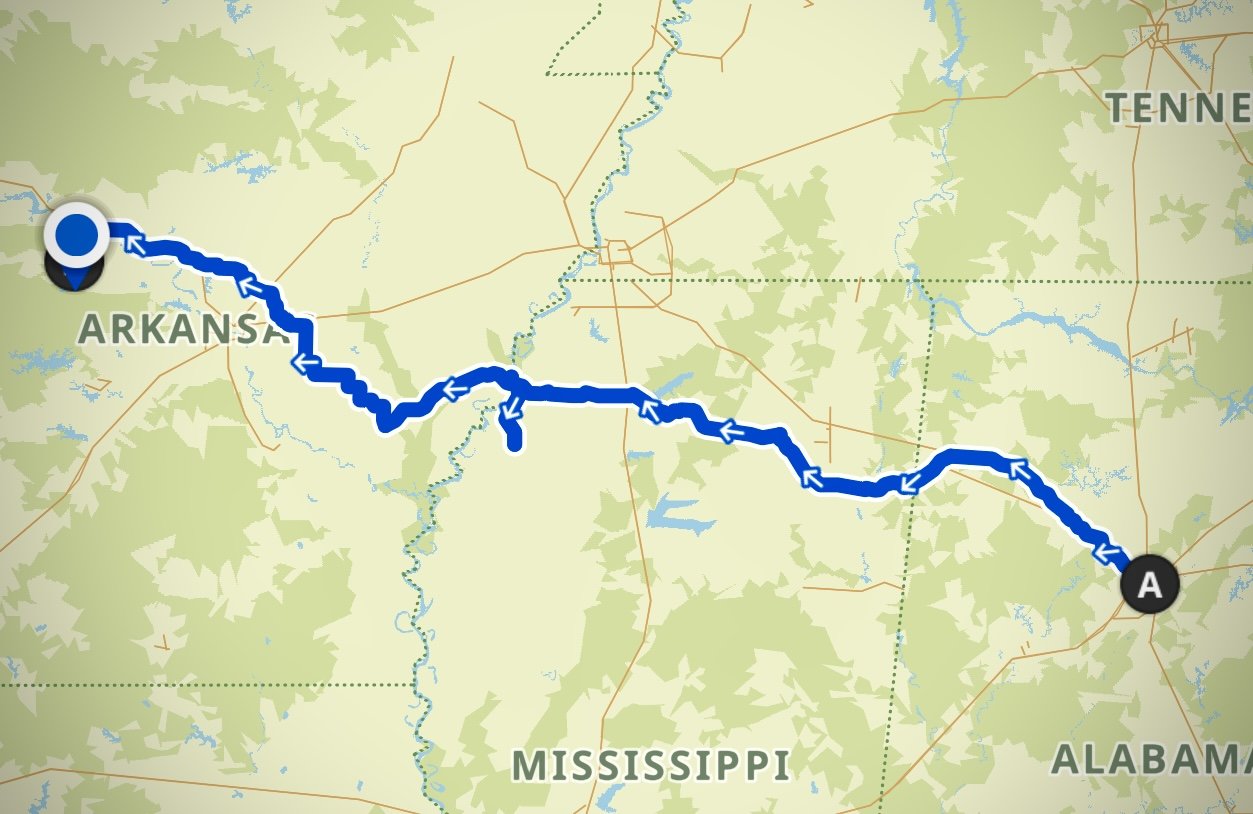
Our approximate route was from Birmingham, Alabama, to Conway, Arkansas. Once we reached Conway, Jenny and I entered the Arkansas Ozarks, which will be covered in Part 2 of this trip series. Image courtesy of Kamoot.
Writing by Michael Johnson Chase, Drawings by Jenny Hershey
For the second time this year, Jenny Hershey and I boarded an Amtrak train in New York City with our bicycles and got out in Birmingham, Alabama. Our ultimate destination was the Arkansas Ozarks this time, so we have been riding westward since we got to Birmingham. Fascinated by water issues and how they intersect with climate change, we were initially disappointed that our route wouldn’t take us through beleaguered Jackson, Mississippi, where water issues have become a water crisis.
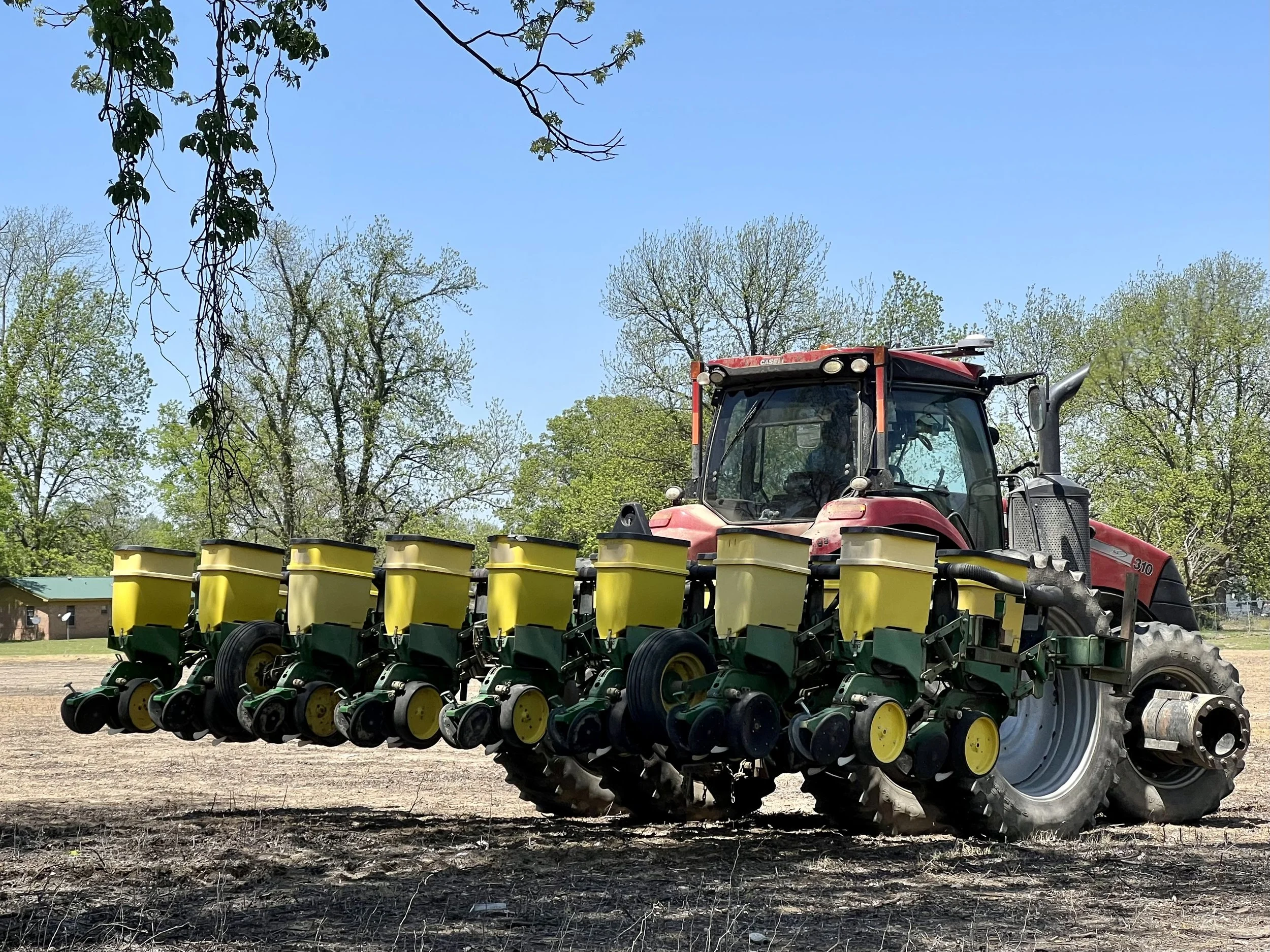
We talked to a farmer near Friar’s Point, Mississippi, in the Mississippi Delta (not to be confused with the Mississippi River Delta, which is the extension of the Mississippi River into the Gulf of Mexico south of New Orleans). The farmer told us that low-till planting methods for water conservation and soil development are becoming increasingly common in this part of the Delta. When we asked about the water levels in the alluvial aquifer, the farmer replied that the aquifer was decreasing over time. Still, he also thought the issues were more critical on the Arkansas side of the Delta because water-intensive rice farming is more common. Photo by Michael Chase. Follow him on Instagram @mjohnsonchase.
We decided that climate issues are ubiquitous enough that we will discover plenty of interesting stories wherever we go. We were right, of course. The prevalence of climate stories is much greater now than even a few short years ago, in 2016, when I started bicycle touring. Extreme weather-related disasters are now straining American communities so intensely that climate stories are everywhere. Climate-related events are occurring at a magnitude greater than the most conservative climate scientists predicted just a few years ago. However, the truly scary thing is that extreme weather-related natural disasters are only going to keep increasing in quantity, duration, and strength.
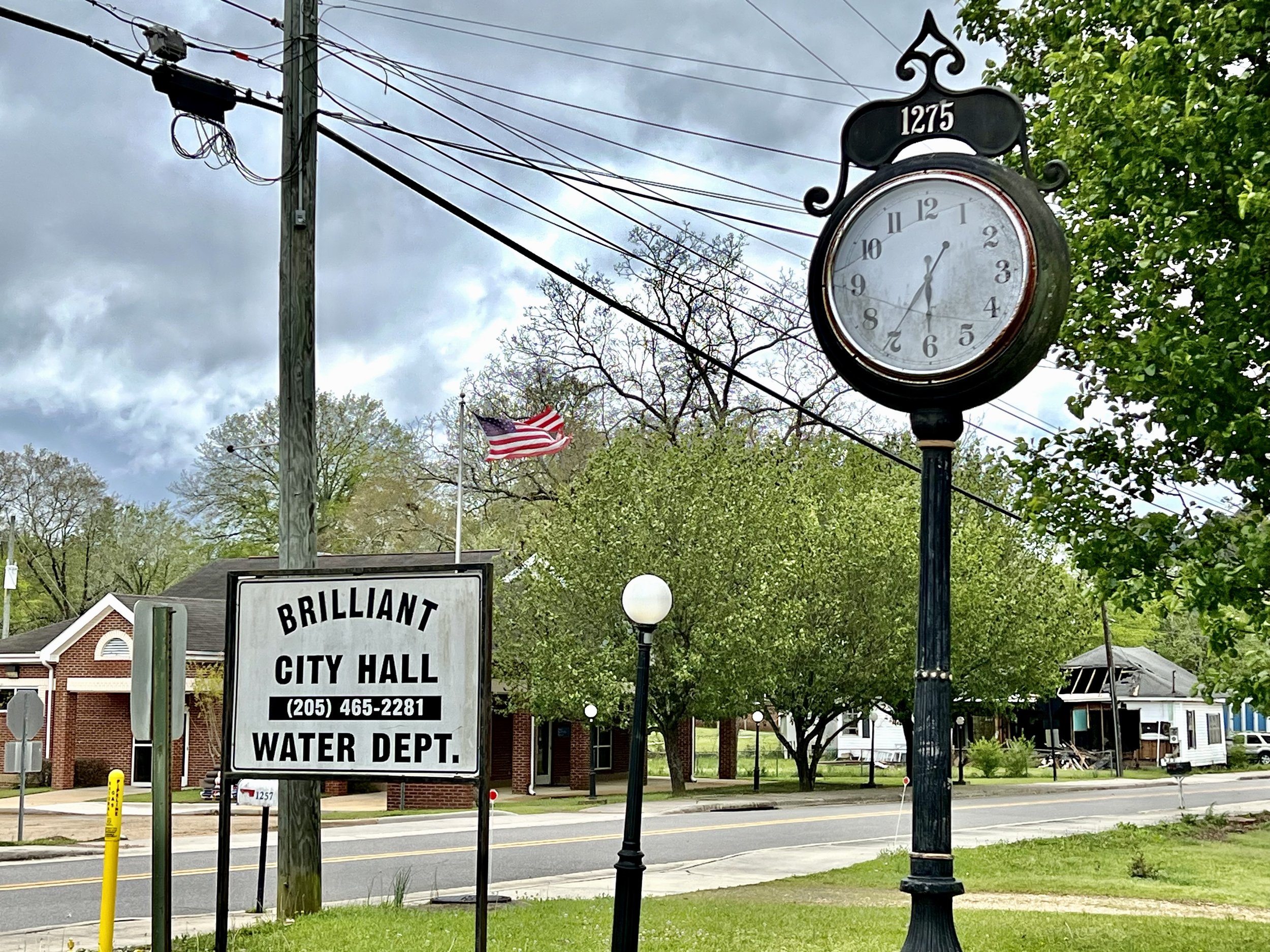
It’s no accident that City Hall and the Water Department are the most important municipal offices in Brilliant, Alabama. Access to clean and reliable water and safe sanitation are baseline conditions for health, prosperity, and well-being. Of America’s 145,000 municipal water systems, 97% of them are municipalities of 10,000 people or fewer. More than any other factor, climate change reveals and exacerbates racial and societal inequities in disproportionately small and rural communities that struggle for funding and technical services. Photo by Jenny Hershey. Follow her on Instagram @deepfo.
With that as a backdrop, let’s briefly return to the subject of Jackson, Mississippi (even though Jenny and I didn’t go there). The American media has coveted the drinking water crisis in Jackson as a story of poor management and neglect. But it is also a story about the convergence of climate change, aging infrastructure, water contamination, and rising costs. All those factors make providing clean water to every community in America an increasingly daunting problem. Already, more than two million Americans lack access to running water, indoor plumbing, or wastewater services.
While it is true that Jackson’s water system was poorly managed and neglected for decades (partially related to declining property values due to “white flight” into other towns and neighboring suburbs), the water system reached its final tipping point during a flooding crisis in 2022. When double-digit rainfall fell across central Mississippi in the last week of August, the Pearl River flooded and completely overwhelmed Jackson’s long-troubled water system. Destruction from the flood disabled the Curtis Water Treatment Plant for an extended period of time, forcing residents to go without drinking water for weeks. At the same time, there was not even enough water pressure to flush the toilets or shower.
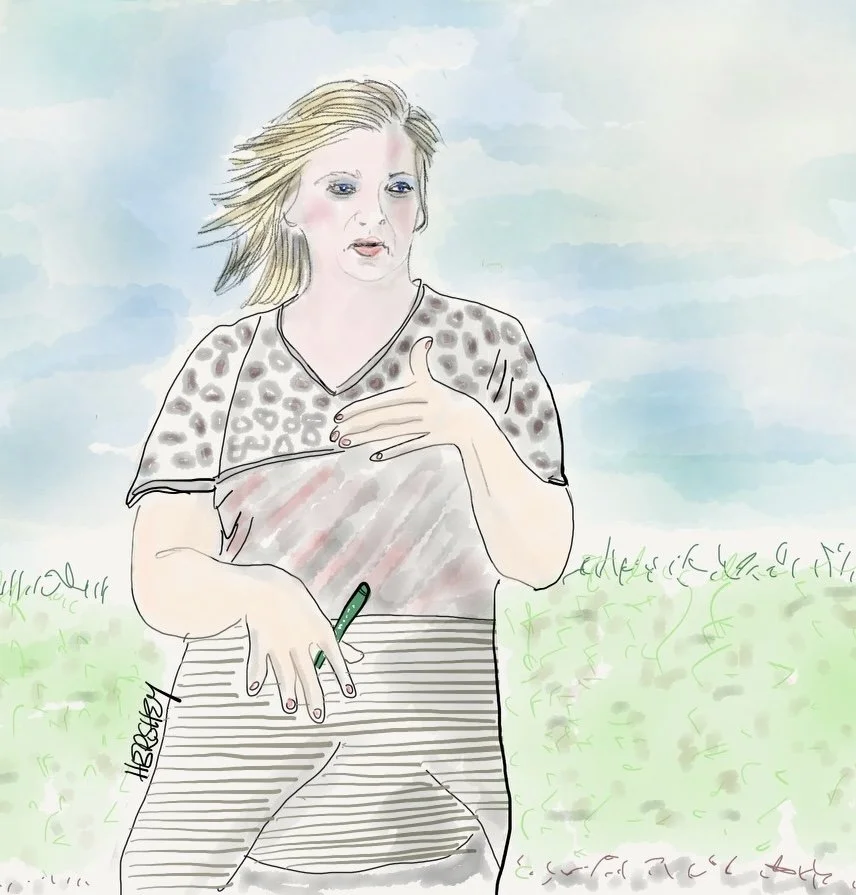
Jessica is the town clerk in Brilliant, Alabama. She came out of her office to welcome us while we took a picture of the City Hall and Water Department sign. After some pleasantries, we asked Jessica about Brilliant’s water supply. She explained the town is building a new water tower supplied from local wells with help of the governor and a state based economic development organization (and most likely block grants from the 2021 Infrastructure Investment and Jobs Act). This new water tower will supply water for nearly 500 residents and 36 businesses. Jessica, a lifelong Alabaman, proudly waved at a passing school bus carrying the local baseball team (including her two teenage sons) to a nearby high school. Her warmth and hospitality were topped off with a pen from the mayor. Brilliant town promotion in Brilliant!
Drawing by Jenny Hershey. Follow her on Instagram @deeofo.
Jackson is a canary in a coal mine. Even currently “adequate” infrastructure will become increasingly compromised as the climate grows hotter, dryer, and wetter. There are an ever-increasing number of hot spots worldwide where climate change is driving cycles of flooding, drought, water stress, interruptions in agriculture and subsequent famine. Perhaps the most dire situation of all is unfolding in the Horn of Africa, where drought is forcing millions of people into what Inside Climate calls a “raging food catastrophe.” And all around the world major rivers are drying up, including the Rhine and the Loire in Europe. Water flow through China’s massive Yangtze River is more than 50% below the average of the last five years, threatening the water supply of 400 million people. Closer to home, the Colorado River, which supplies drinking water for 40 million Americans and irrigates 7 million acres of our farmland, is suffering through the the worst dry spell in 1200 years. Though an unusually wet winter has provided temporary relief it’s nowhere near enough to fill the deficit. At the same time, many of the western states that saw record-breaking amounts of rain and snow over the winter are experiencing rapid spring snowmelt, which is becoming a massive flood threat. In California, thousands of acres are already underwater and that land area is expected to triple by summer.
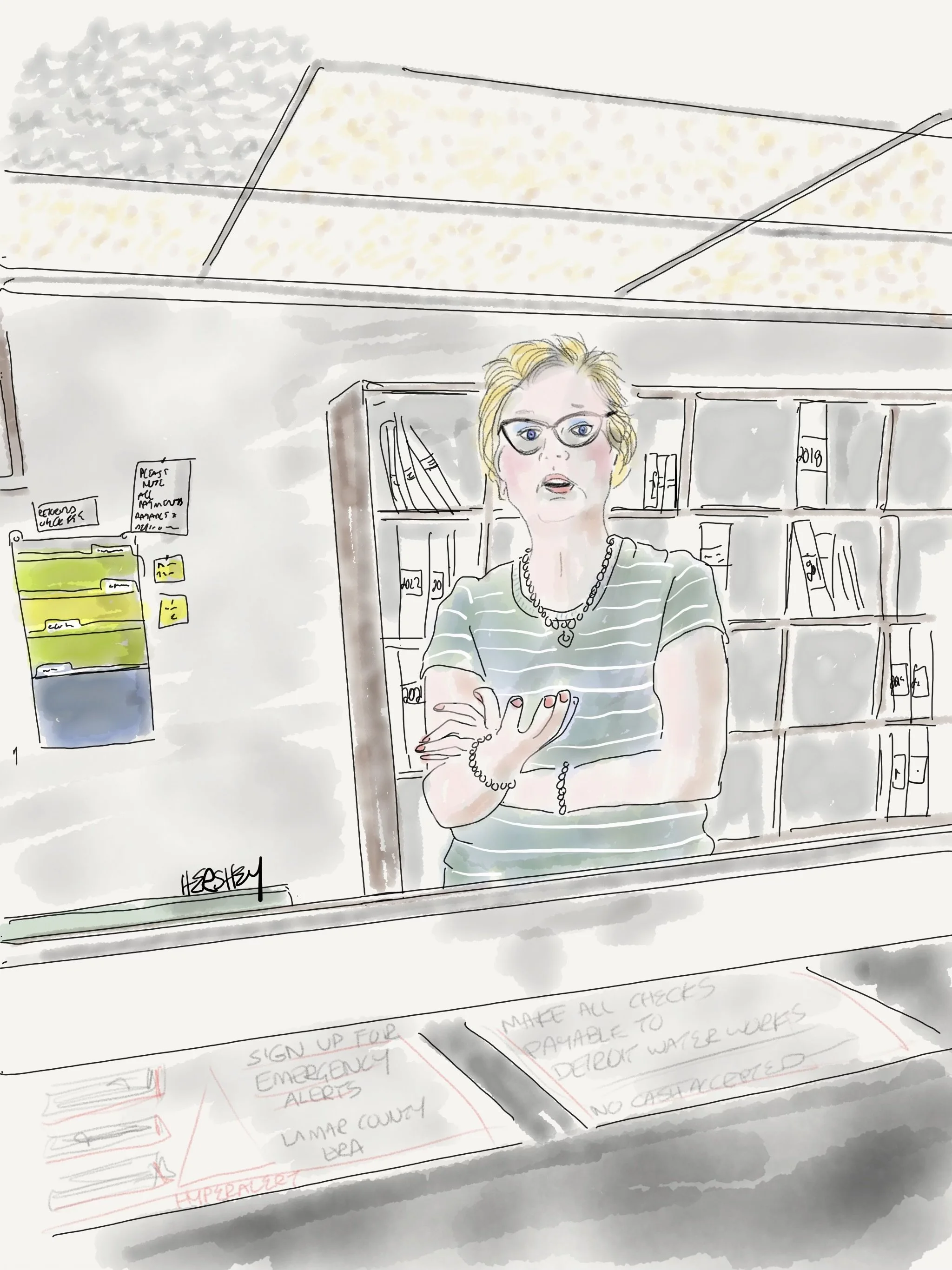
Frankie works part-time at the water department in Detroit, Alabama (population of 150 people). Water comes from a nearby well and costs the residents $20 for 2000 gallons. A replica of a check for $350,000 for water infrastructure improvement from the governor hung on the wall behind her, demonstrating the state’s commitment to helping local communities. Frankie served as county clerk for 30 years in nearby Hodges and was blunt about extreme weather threatening the region. A devout Christian, Frankie belongs to a missionary group that rebuilds churches after floods, windstorms and tornadoes. Many of their projects are for African-American congregations. When we asked her what she thought was driving the increase in tornadoes in her area she replied, “I think it’s the end-times.”
Drawing by Jenny Hershey. Follow her work on Instagram @deeofo.
Our route toward Little Rock from Birmingham took us west through the hill country of Jasper and Hamilton in western Alabama and then through beautiful farm country to Amory, Mississippi. You might have heard of Amory for several reasons. For one, a devastating tornado ripped through the town on March 25, 2023. There was widespread damage, and even Amory’s water treatment plant took a direct hit. Thankfully, Amory got its water running after a boil advisory that lasted only about a day. Even better, no one died in the town (although there were three deaths in Morgan County, where Amory is located).
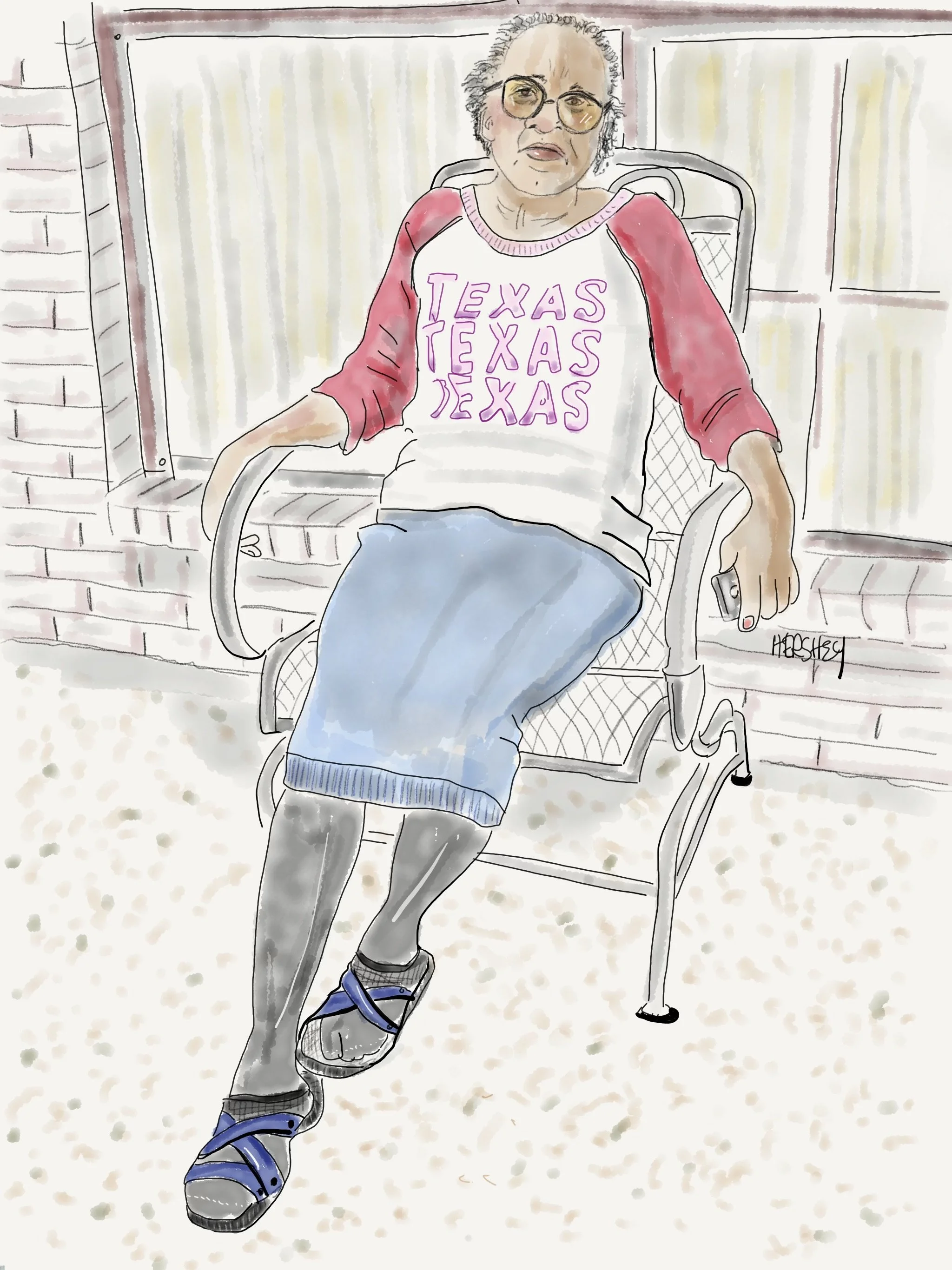
Brenda, a woman of strong faith, prayed hard in her home as she huddled with her two brothers when a tornado struck her neighborhood in Amory, Mississippi. After the storm passed, she walked outside to find her front porch missing, although her home remained intact. A huge tree was lying on her neighbor’s house. Luckily, her neighbor survived by sheltering in the back of her house. Miraculously, no one in the town was killed, despite the tornado’s widespread devastation. When we came across Brenda, she was relaxing outside in a chair where her porch had been only days before, taking in the sunshine.
Drawing by Jenny Hershey. Follow her on Instagram @deeofo.
Other places were not so lucky. Over a dozen tornadoes tore through Mississippi and Alabama during the same storm, leaving at least 26 dead and a swath of destruction 100 miles wide and devastating the communities of Rolling Fork and Silver City, Mississippi. We considered biking to Rolling Fork just as we had considered stopping in Jackson but decided we didn’t want to be in the way or use resources needed by first responders. From what we understand, homes and businesses have been reduced to rubble. The recent tornadoes stretched from the Louisiana border of Mississippi through Alabama as part of a supercell, or rotating thunderstorm - a rare, extended path for such a storm.
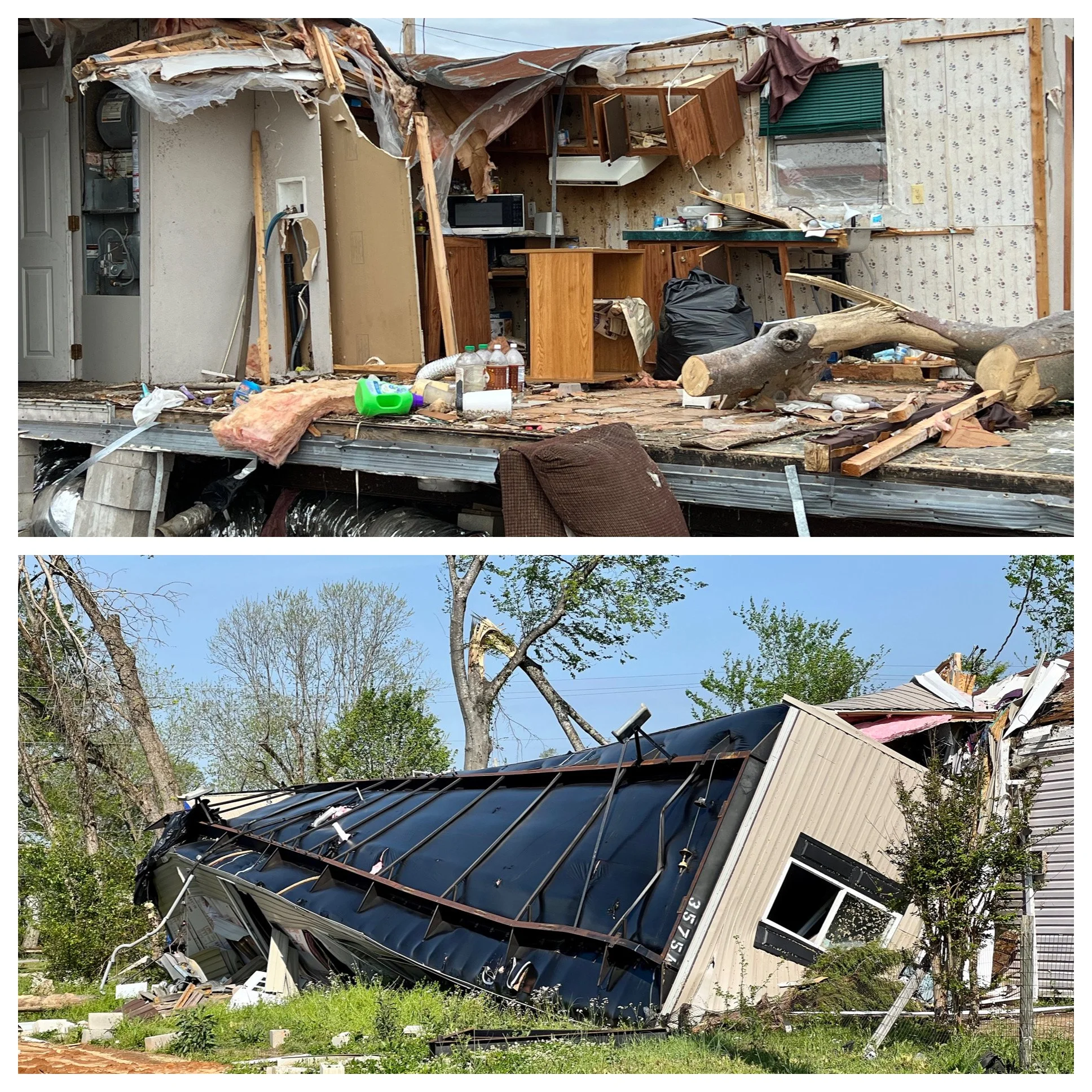
We saw at least 3 trailer homes that had been ripped off their foundations and were upside down, making it clear that a trailer home is not a safe place to be during a tornado. Yet, in low income neighborhoods they are very common. The average cost of a typical single-family home in Mississippi is $144,074. In contrast, the average cost of a single-wide mobile home is $37,100 and double-wide mobile home is $73,600. Top photo by Jenny Hershey @deeofo and bottom photo by Michael Chase @mjohnsonchase.
Climate scientists have not been able to determine if there is a link between climate change and the frequency or strength of tornadoes. The primary tool scientists use to attribute extreme weather events to climate change is intensive computer modeling based on large amounts of aggregated data. This is difficult to achieve with tornadoes because of the localized conditions that determine their formation, combined with their relatively small size over a given region. Yet, scientists affirm that tornadoes are occurring in greater clusters, and the region of the United States in the Great Plains where most tornadoes occur (known as Tornado Alley) appears to be shifting eastwards toward more populated regions in the southeast. Therefore, tornadoes may be in the news more because more people are being impacted.
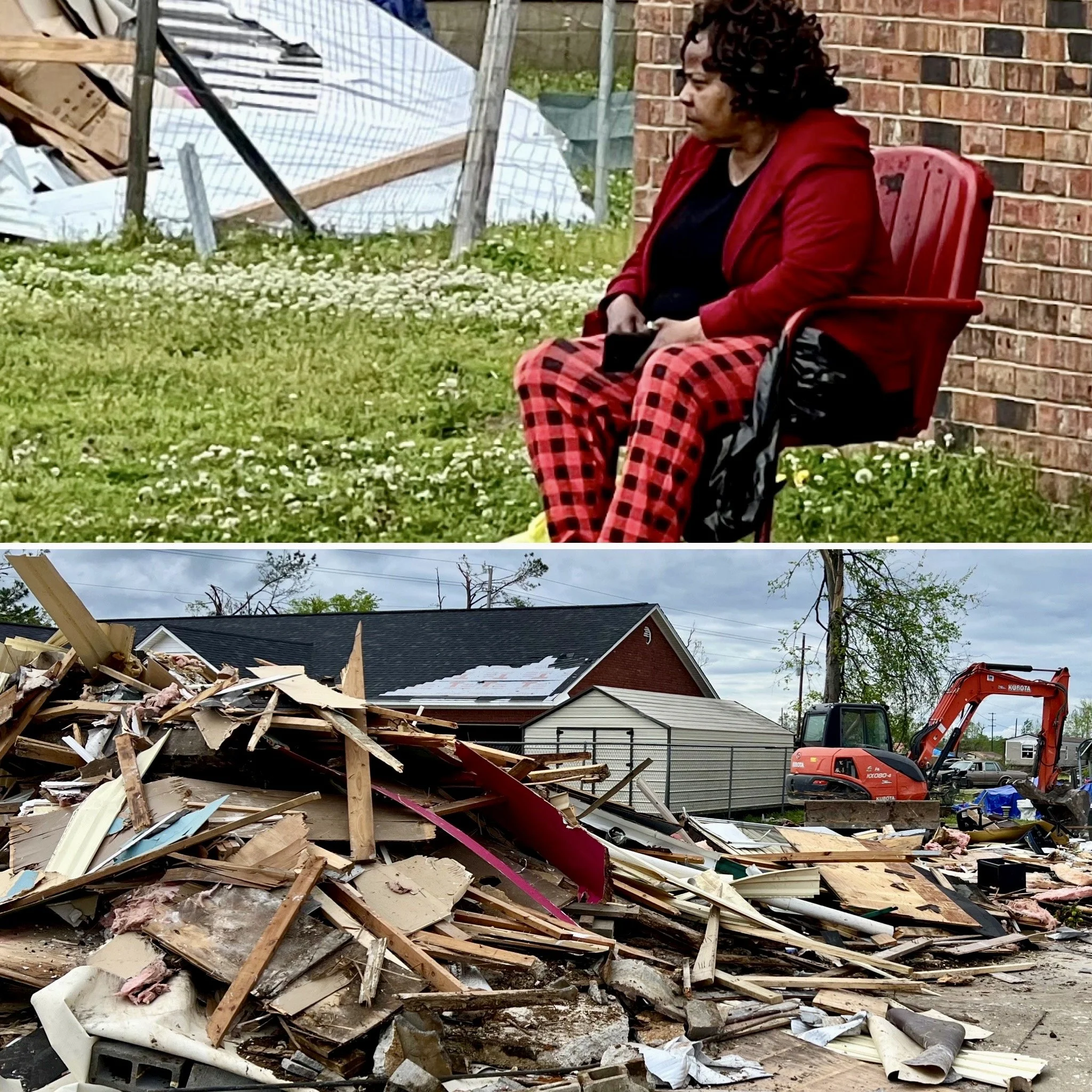
While biking through Amory, we noticed the woman above watching an excavator consolidate the debris below into a pile. When I asked her if she lived in the still-intact house behind her, she shook her head no and pointed to the pile of debris. She clearly didn’t want to talk, so we expressed our condolences and quickly moved on. Photos are by Michael Chase. Follow him on Instagram @mjohnsonchase.
Tornadoes form inside large rotating thunderstorms when the ingredients are just right; a perfect mix of temperature and a specific moisture and wind profile. This suggests that an increase in water vapor and precipitation, indicative of climate change in the southeastern region, may be contributing to the shift eastwards. In any case, when air is unstable, cold air is pushed over warmer humid air, creating an updraft as the warm air rises. When the wind speed or direction changes over a short distance, the air inside the clouds starts to spin. If the air column begins spinning vertically and rotates near the ground, surface friction can accelerate the air even more. All these features must come together to cause a tornado to form. And despite their small size compared to an atmospheric river or a hurricane, they can be quite devastating. I certainly hope Jenny and I are lucky enough to avoid them on our travels, and my heart goes out to anyone forced to live through a direct hit.
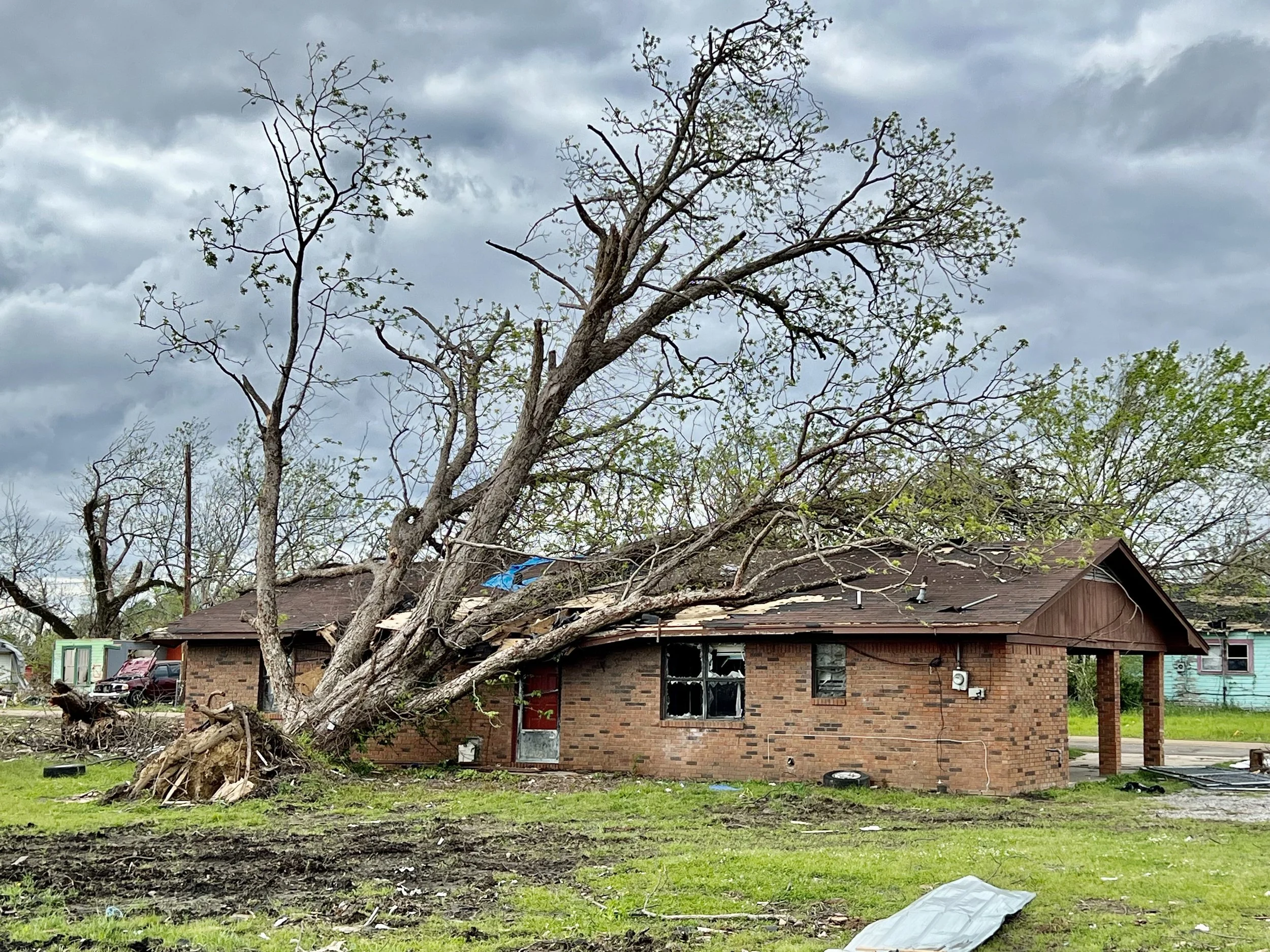
A large tree rests on a home in the northwest section of Amory. Sadly, the tornado’s path tore through the least affluent part of town, underlining the reality that the most vulnerable among us are often the most affected during weather-related disasters. Photo by Jenny Hershey. Follow her on Instagram @deeofo.
In Amory, and especially for Rolling Fork and Silver City, recovery from the tornado damage is uncertain. FEMA is out in force, but the devastation is quite extensive. Here’s how to help those impacted.
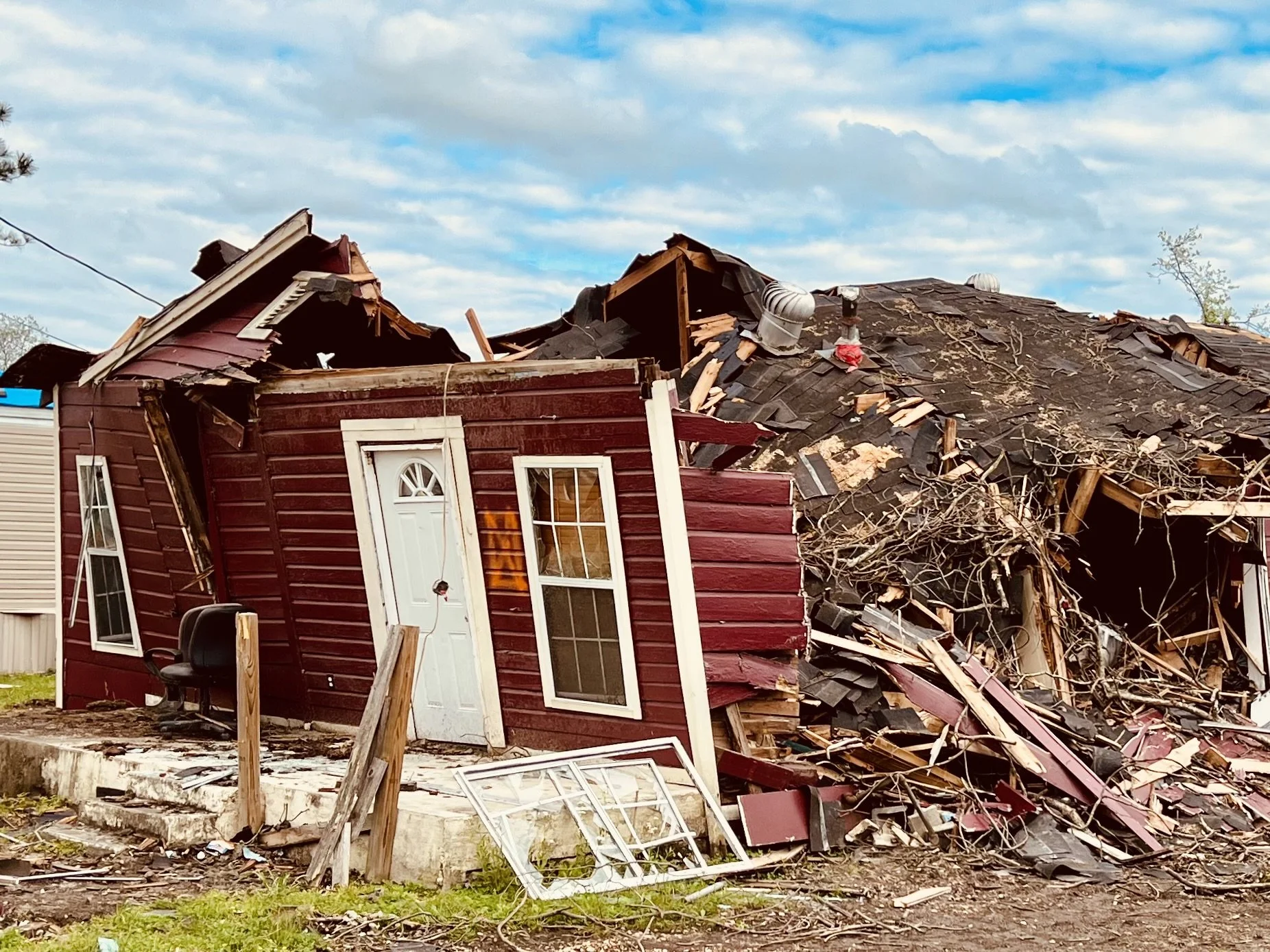
Another photo from Amory, Mississippi. Interestingly, meteorologists measure the strength of a tornado by the destruction it leaves in its wake because it is almost impossible to measure a tornado while it is active. Photo by Michael Chase. Follow him on Instagram @mjohnsonchase.
The second reason you may know about Amory, Mississippi, is more fun. Two residents from Morgan County are competing in the 21st American Idol contest: Colin Stough and Zachariah Smith, both of whom have wowed the judges in their solo auditions. It’s striking that so many fine American gospel, blues and country musicians have come from the rural South. Still, Amory has the distinction of also having the 2015 American Idol winner, Trent Harmon. This is a good news story, and you can check out the contestants at the links above.
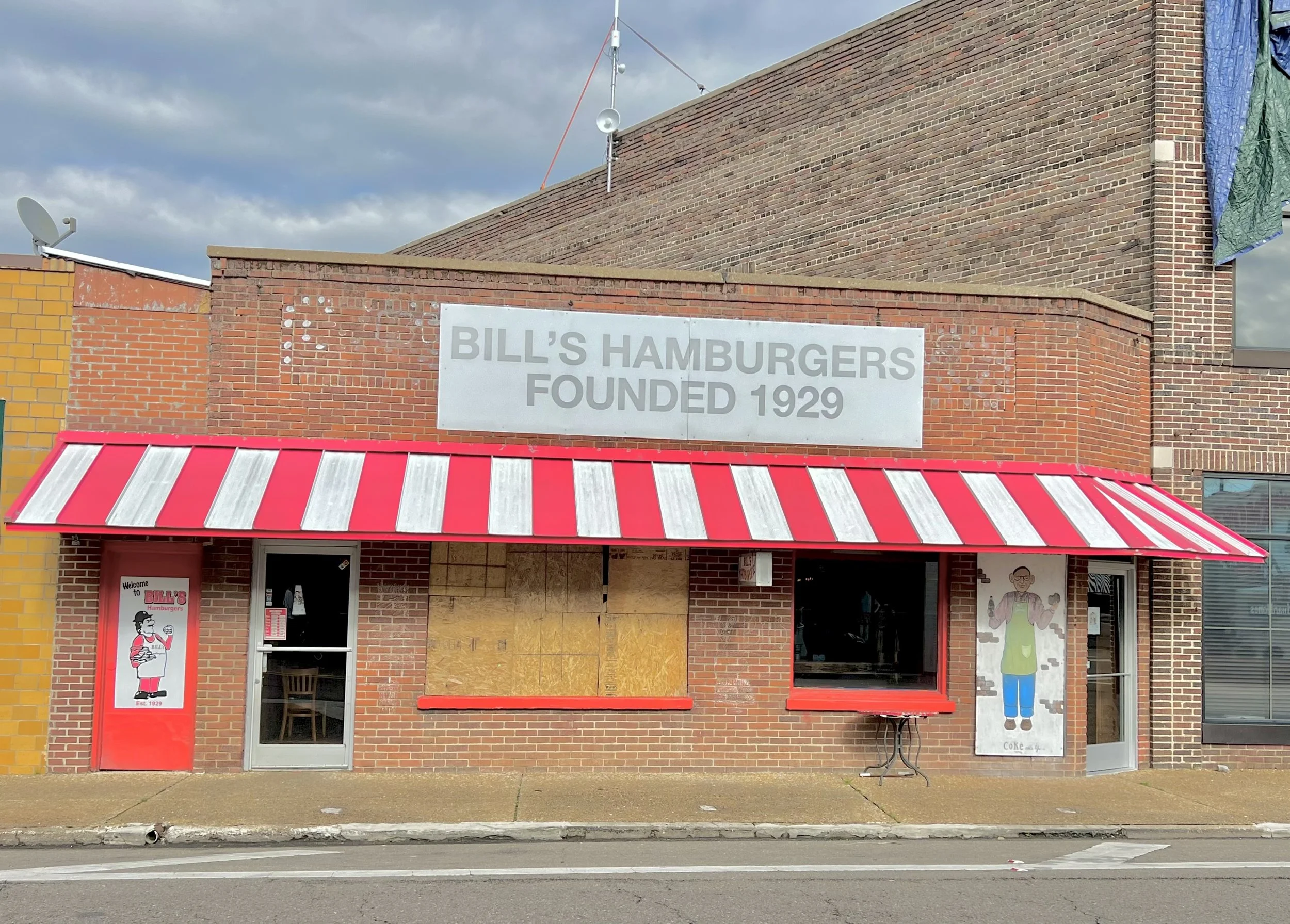
Bill’s Hamburgers sits temporarily closed after the Amory tornado, where 2023 American Idol contestant Zachariah Smith flipped over 400 hamburgers every Saturday. Photo by Jenny Hershey. Follow her on Instagram @deeofo.
Stay vigilant! Thanks for reading. Part 2 of this series will come soon. If you haven’t done so, please subscribe to this blog to follow our next biking trip.
Blog writing by Michael Johnson Chase. Drawings by Jenny Hershey. Unless credited or otherwise noted, all material is the copyrighted property of the blog post authors.
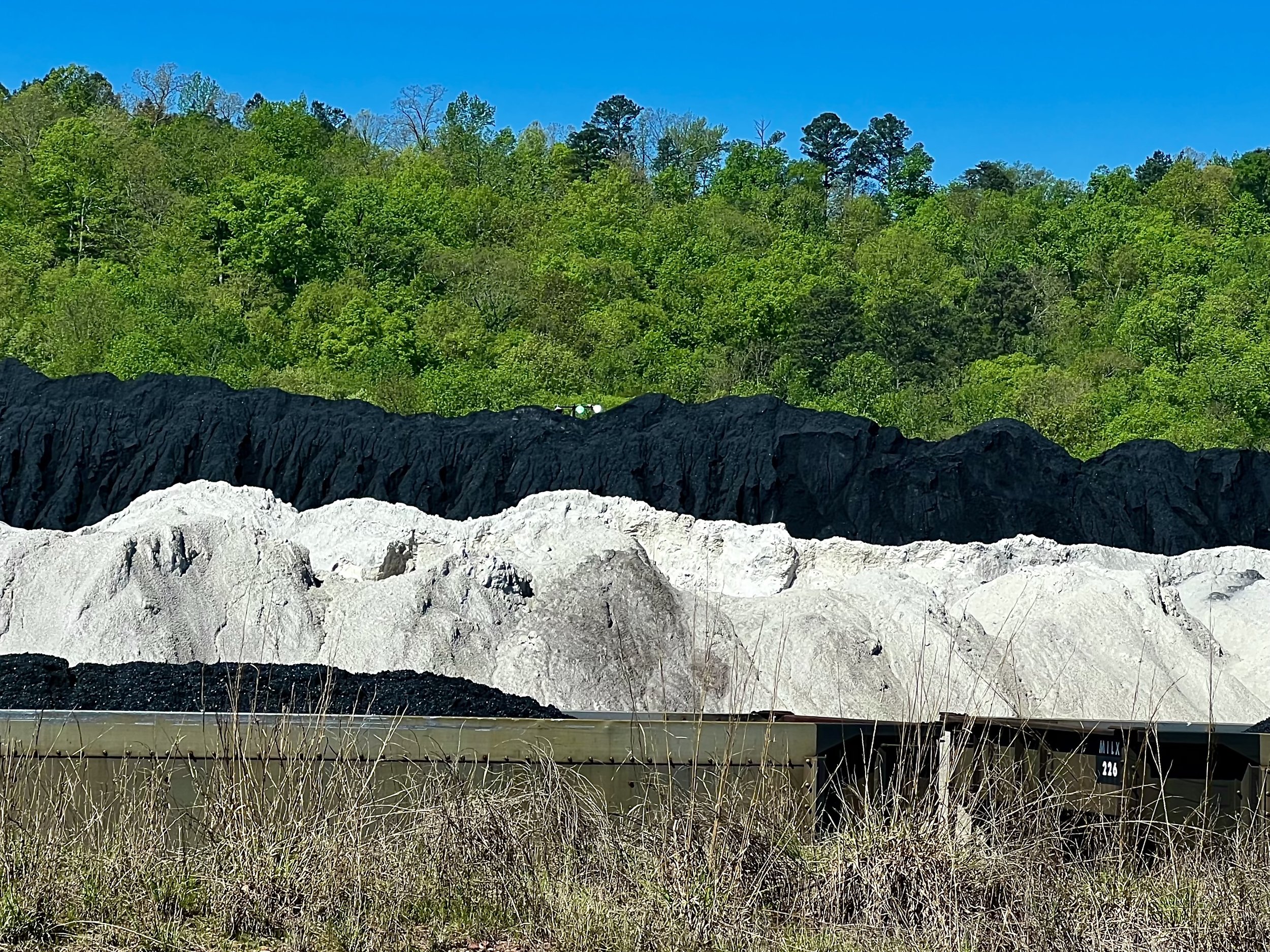
Although coal powers 18% of the electricity in Alabama and only 8% in Mississippi, coal still powers 50% of the electricity in Arkansas. We are a long ways from “electrifying everything,” but the vision and template to get there is a big part of the Inflation Reduction Act. If we care about young people, public health, and economic well-being, we must all work hard to utilize this bill's opportunities. Photo by Michael Chase. Follow him on Instagram @mjohnsonchase.