
A Province of Foresight: Biking Newfoundland
Writing by Michael Chase, Drawings by Jenny Hershey
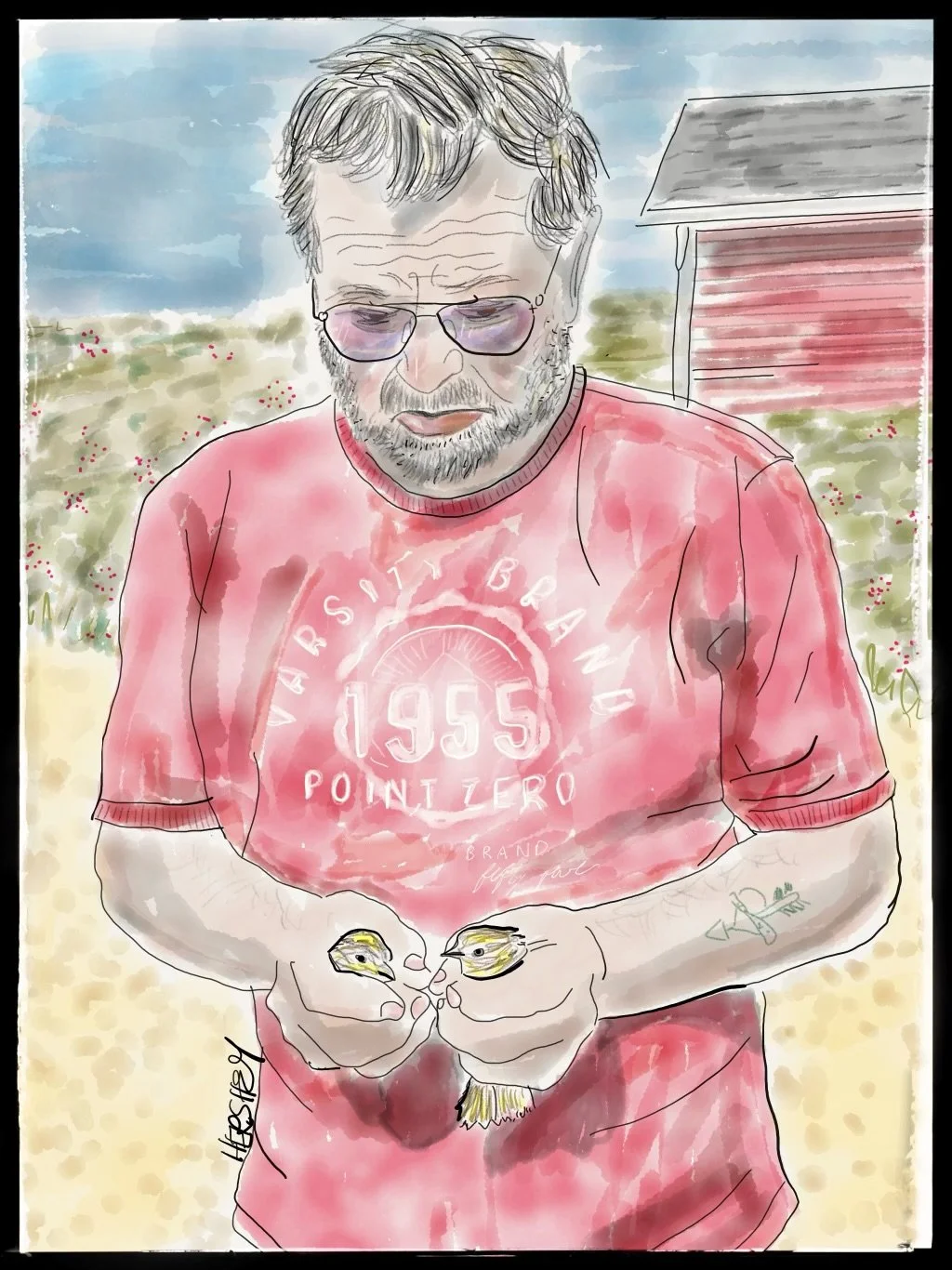
We met Pearce Cull outside the last house in St. Anthony Bight at the tip of Bobby’s Cove. Pearce was busy rescuing two little fire sparrows that had snuck into his shed. A very kind soul, Pearce feeds the sparrows every day. He also mentioned how hard life is for the seagulls nearby. They used to eat scraps from the fisheries but now have to “survive on berries.” Pearce showed us a nearby bluff filled with crackleberries (“don’t eat 'em”) and partridge berries (“pick those when they’re dark purple, then they’re sweet as can be”). Retired, Pearce spends his time drying cod and being an attentive grandfather. He invited us into his house and shared photos of his kids. We noticed a well-crafted blue guitar, but he told us he no longer plays because his hands “don't work so well.” We learned later from another local that Pearce Cull is a well-known traditional Newfoundland musician and songwriter who achieved fame with numerous recordings, including “The Cold Storage,” a song about a cod fishery he wrote and recorded in the 70s. ….You never know who you’re going to meet up here! Drawing by Jenny Hershey. Follow her on Instagram @deeofo.
“History is a relentless master. It has no present, only the past rushing into the future. To try to hold fast is to be swept aside.”
John F. Kennedy
The Trip
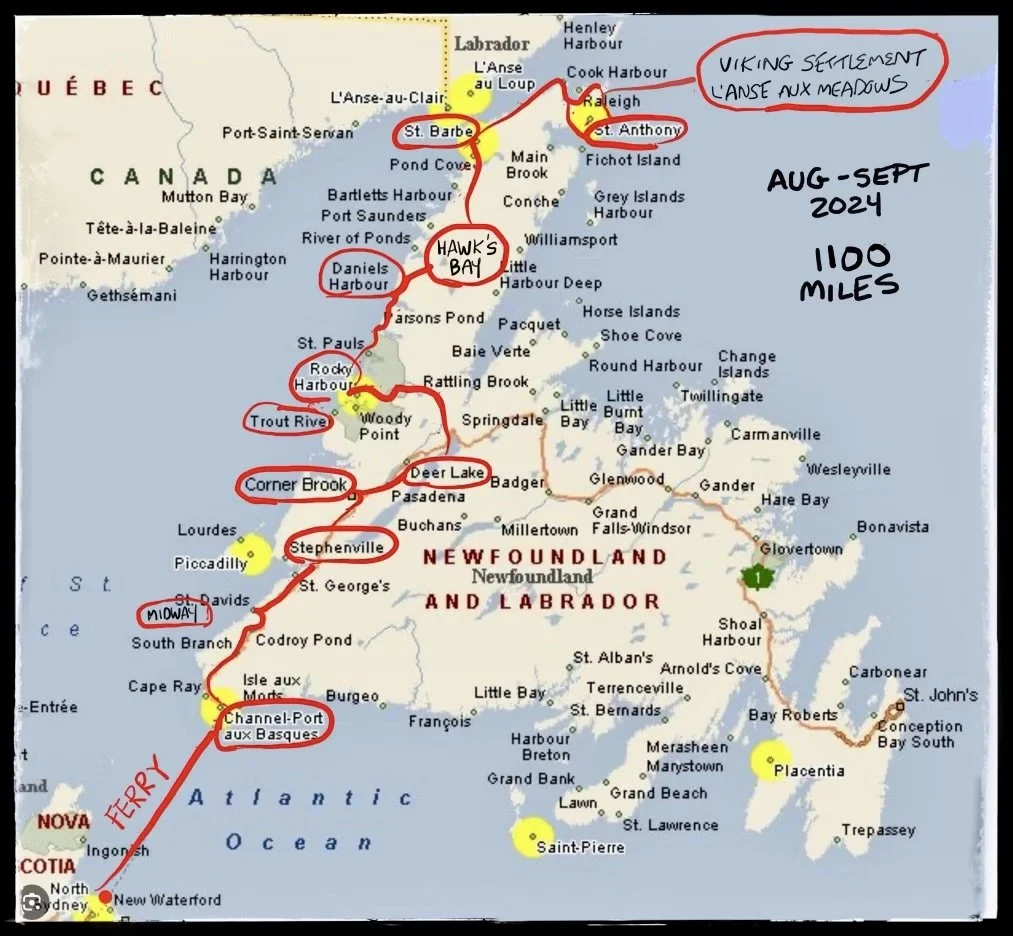
The red line was our route. We left our car in Nova Scotia and biked from Port aux Basques to St. Anthony and L’Anse aux Meadows and back along Newfoundland's western peninsula. With side trips, we cycled about 1100 miles. Next time, we’ll visit St John’s and key places on the eastern shore. And hopefully, someday we will make it to Labrador! We had planned to go this trip, but winds and a lack of time got in our way.
It was probably 50 years ago when I first thought about biking in Newfoundland, and it’s been at least six years since Jenny and I decided to go. In my youth, I imagined circumnavigating the island on a bicycle, not knowing the southern coast is too rugged for a throughroad. That said, it is possible to traverse the whole island on the Trans-Canada Highway between the western and eastern shores (where ferries run between the island and Nova Scotia) by following a single arc that cuts from the southwestern corner of the island to its southeastern shores. However, Jenny and I didn’t take the route from Port aux Basque in the west to Saint John’s in the east (nor did we follow the iconic all-terrain biking “rail trail” that runs roughly along the same route as the Trans-Canada).
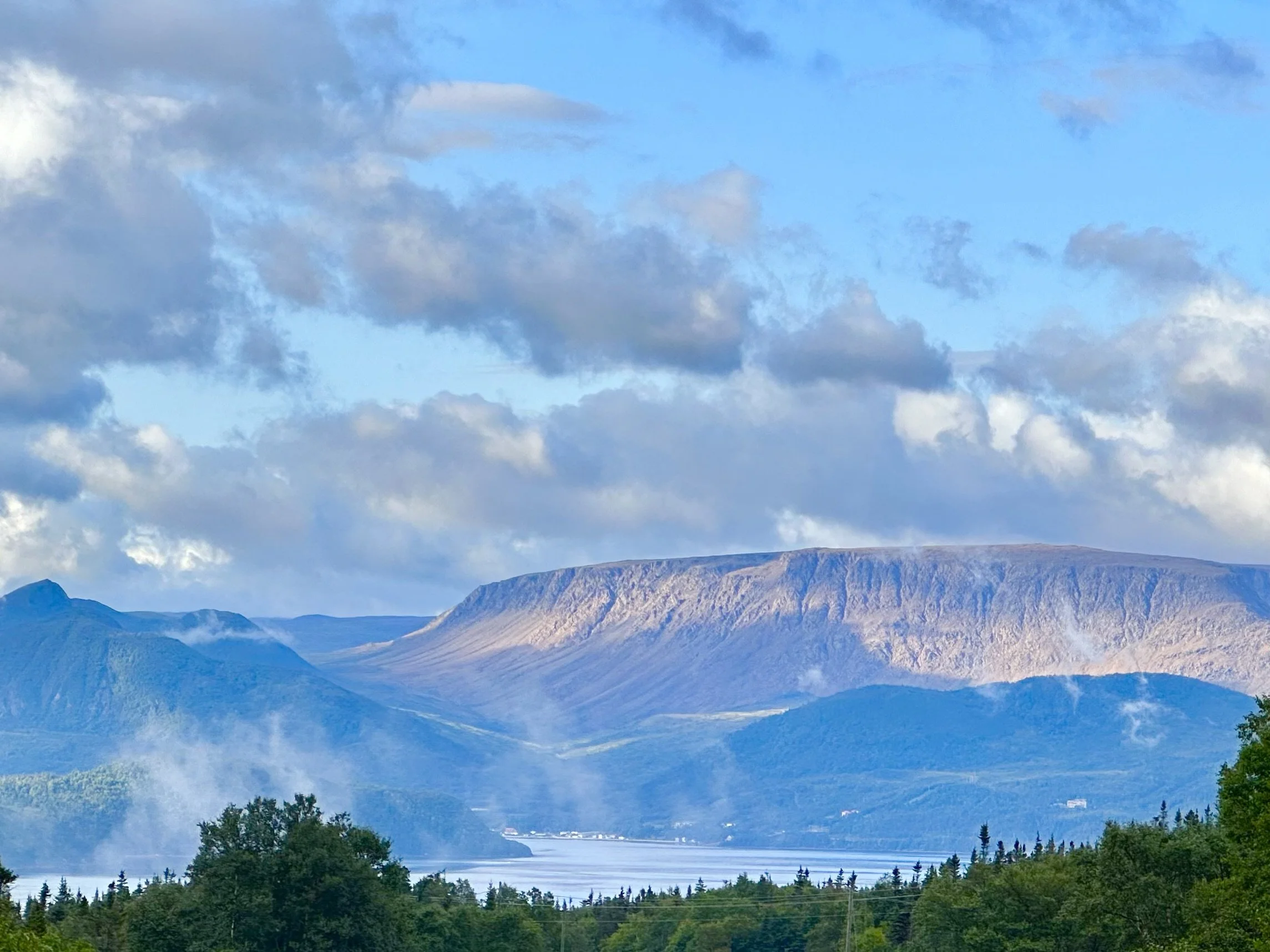
A shot of the Tablelands (the flat peak on the right) and Bonne Bay in Gros Morne Provincial Park. The scenery on the western peninsula of Newfoundland is unparalleled, and the island (together with Labrador) is the least densely populated of all the Canadian provinces, at 1.4 people per square kilometer. It is also home to some of the friendliest and most cheerful people we have ever encountered.
We had heard the west coast was more rugged and mountainous than the many scenic bays and forested peninsulas to the east. But the biggest attraction was the overwhelming beauty of the Gros Morne Provincial Park (and UNESCO World Heritage Site) to our immediate north, which has played a significant role in the understanding of plate tectonic theory, a central feature of modern geology. We were also seduced by the L’Anse aux Meadows Viking settlement (another UNESCO World Heritage Site) at the northern tip of the western peninsula, a short distance from Labrador. Finally, we knew the collapse of the cod fisheries in the 1990s had hit the fishing villages on the Westen Pennisula particularly hard, and we wanted to learn how communities were faring.
So, we left the main highway at Deer Lake and biked up the final stretch of the Appalachian mountains known to Newfoundlanders as the “Long Chain” and then hugged the coast almost to the northern end of the western Peninsula, passing through Gros Morne. A hundred or so miles above the park, the route passes within easy sighting of Labrador, providing access to the only ferry on the island between Newfoundland and its sibling province on Canada’s mainland. We finally turned east and crossed a high, rocky, windswept plateau that meanders to its end at the northeastern tip of the peninsula at L’Anse aux Meadows. If you go directly, the trip up and back is about 1520 kilometers or about 900 miles. It’s more than worth the effort. On bicycles, it’s extraordinary. It was simultaneously the most beautiful and challenging cycling trip Jenny and I have taken.
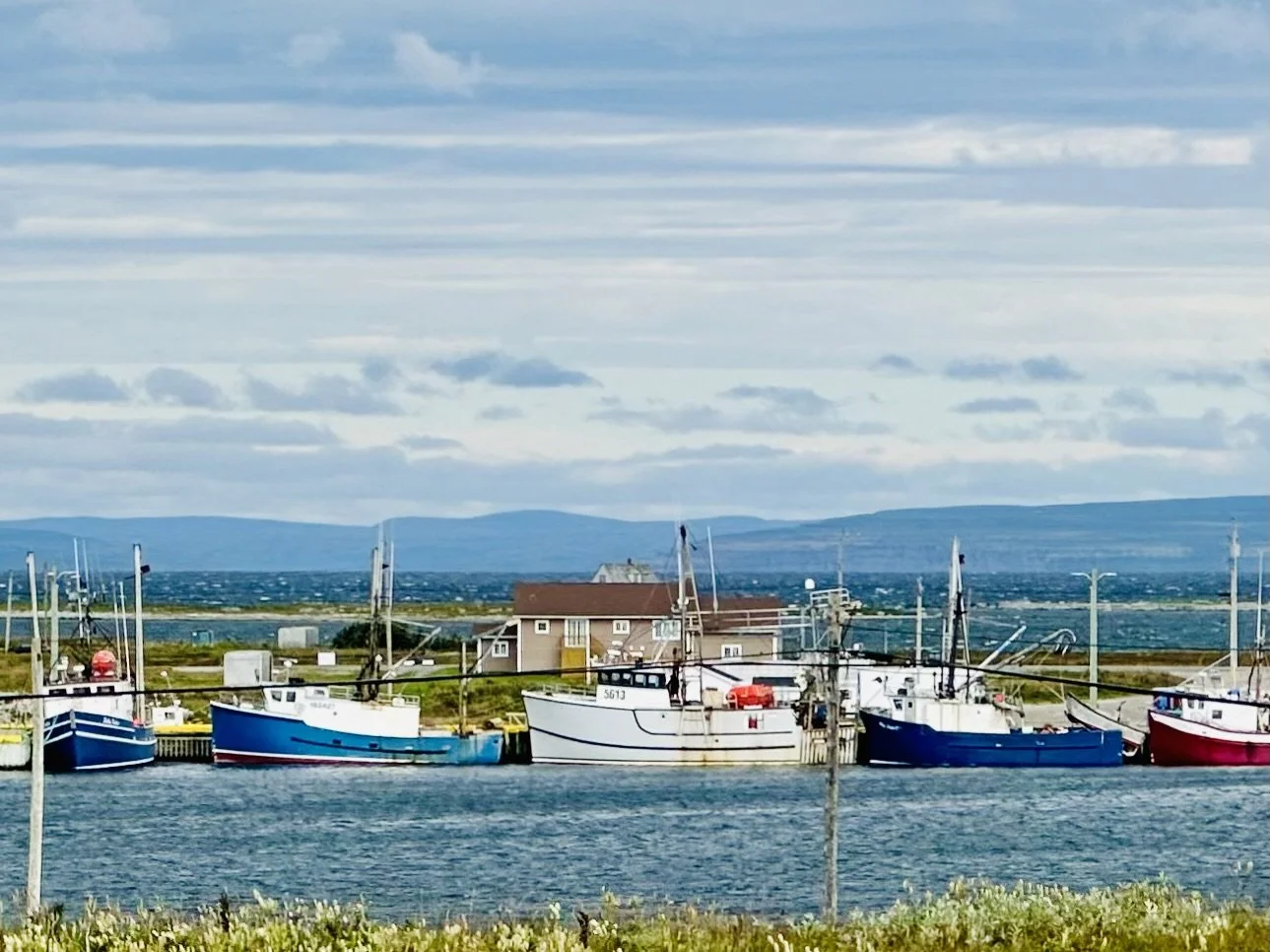
Fishing boats docked in Flowers Cove. Across the Gulf of St Lawrence, in the background, lies Labrador.
As we cycled toward Labrador, we were intrigued to learn that it has shared centuries of intertwined history with Newfoundland. Labrador was settled along its coastline, and navigating the 30 miles across ice or water in the upper Gulf of St Lawrence to get to Newfoundland is far easier than navigating a thousand miles overland through boreal forest to reach lower Canada. The region's earliest known inhabitants were the Innu and Inuit in Labrador and the Beothuk in Newfoundland. These groups had rich cultures and trading histories long before European explorers arrived. The first known European contact came around 1000 AD when the Vikings briefly settled at L'Anse aux Meadows. Through the 16th to 18th centuries, Newfoundland and Labrador were battlegrounds for colonial competition between European powers, notably the English and French. The French occupied Labrador and Newfoundland’s Western Peninsula for a time, and the British occupied eastern Newfoundland, establishing St. John’s as America’s oldest city in 1583.
The 20th century brought significant changes, including Newfoundland and Labrador's brief period as an independent Commonwealth dominion starting in 1907. However, economic difficulties during the Great Depression led to Newfoundland and Labrador joining Canada as its tenth province in 1949. Their shared history has shaped Newfoundland and Labrador's unique cultural and political identity, blending Indigenous heritage with European influences and modern Canadian development.
The Context
If you have read other posts on this blog, you know we look at our cycling trips through the lens of Earth’s rapidly changing climate. Over the past few years, extreme weather events have increased in number, intensity, and duration at a pace that requires us to catch up every time we travel (approximately every other month).
Here’s an example: Global temperatures between June and August this year averaged 1.5 degrees Celsius (2.7 degrees Fahrenheit) above the preindustrial average. The sweltering season reached its apex in late July, breaking a record for the four hottest days ever recorded. Temperatures for this year have far exceeded anything seen in more than 80 years of recordkeeping, making it all but certain that 2024 will be the hottest year known to science.
Although we are in Canada, we begin our climate review in the United States since the US is the most prone to weather-related disasters among the three countries occupying the North American continent. Because of its unique geography and unsurpassed variety of climatic zones that span two oceans, the Gulf of Mexico and the Rocky Mountains, Americans suffer disproportionately from weather extremes compared to their neighbors. By August 2024, the US had already experienced over fifteen separate $billion-plus weather and climate disasters. Total costs for extreme events in the US for 2024 may eventually exceed $50 billion, along with several hundred fatalities (there were 84 known fatalities by the end of May). Some estimates of property damage from Hurricane Beryl’s landfall in Texas have already exceeded $30 billion. And, as I write this, in the first week of September, at least 36 million Americans are enduring record-breaking heatwaves in the Southwest and on the West Coast. In the Los Angeles area, over 110,000 acres of land are currently burning due to the intense heat. The fires have forced tens of thousands of people to evacuate and have destroyed dozens of homes. The situation remains critical, with dry conditions and complex terrain challenging firefighting efforts.
Hopefully, last year’s wildfires were an exception in Canada, when fires released over 647 million tons of carbon into the atmosphere. (That amount is roughly comparable to India's annual CO2 emissions and more than four times larger than Canada's.) While not as brutal, the 2024 season has still been severe, with over 6,500 fires recorded so far across British Columbia, Alberta, and the Northwest Territories. In addition, Eastern Ontario, Northern and Southern Quebec, and Atlantic Canada all experienced intense heatwaves in June, as temperatures hovered significantly above past normals.
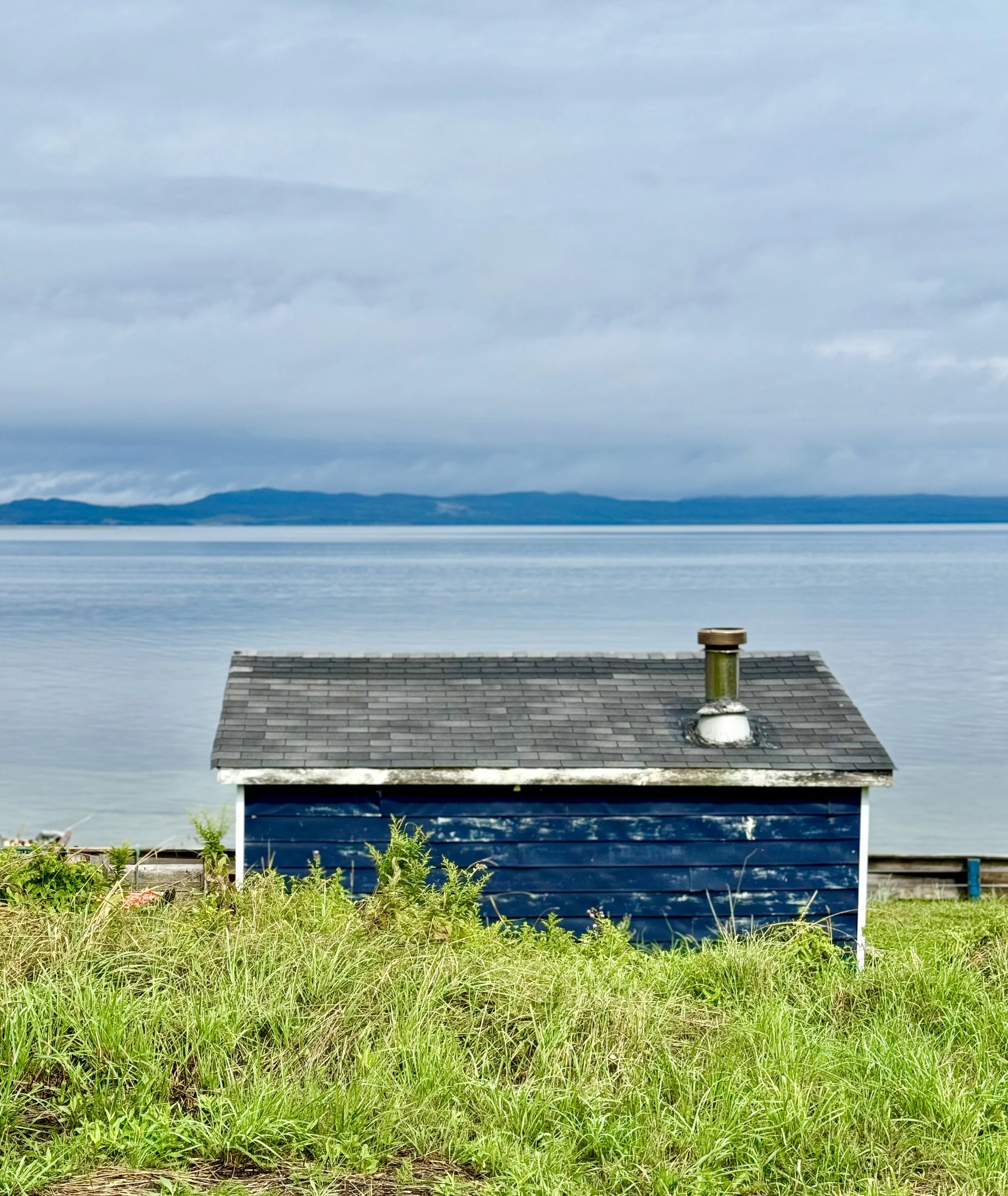
Rain clouds above on our second day out, as we rested near an old fishing shack looking across Sandy Point Bay toward Stephenville.
Our arrival in Newfoundland coincided with the end of a dry spell as we endured four days of heavy rain and wind from Hurricane Ernesto after we disembarked from the ferry. Nevertheless, we could easily see how dry the rivers and grasslands had become. With global ocean temperatures at record highs, the Canadian Hurricane Centre expects a very active hurricane season. We have not forgotten that prediction, and as I write this, we are following Francine's impact on Louisiana and points north.
The rest of the world has experienced its fair share of extreme weather events this year, including severe and enduring heatwaves in India, the Philippines, Thailand, and Bangladesh. In India, temperatures reached up to 46.3°C or 115.34 F, considerably impacting public health and daily life. As if that wasn't bad enough, a combination of global warming and deforestation led to devastating landslides there in July, resulting in the deaths of over 420 people. The state of Rio Grande do Sul in Brazil faced extensive flooding between April and May, with over 100 fatalities and significant damage. At the same time, 7.4 million acres of Brazil’s Amazon burned in the first half of 2024, a 122% increase from the previous year. The United Arab Emirates experienced its heaviest rainfall in 75 years in April, causing widespread flooding and disruptions, leading to over 225 deaths and displacing more than 212,630 people.
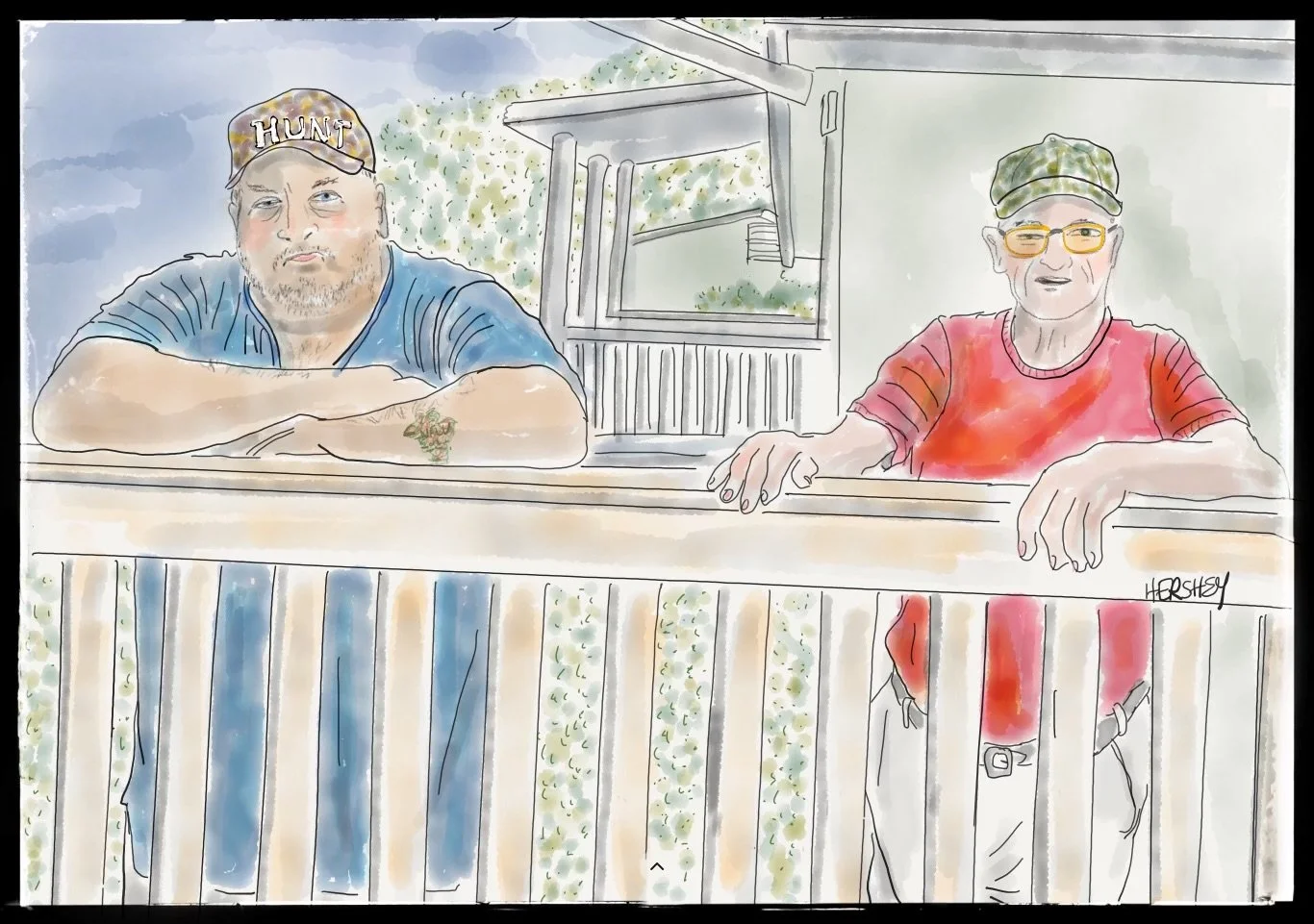
We met Doug and Cyril in the town of St. George. They are best friends and have fishing cabins next to each other, and both work in the limestone mine on the other side of the bay in Stephenville. Doug offered to let us eat lunch on his porch as a respite from Hurricane Ernesto's rain as we all chatted about Newfoundland’s changing weather and politics in the US. Locally born, both men were unequivocal about how the weather has changed since they were kids; there is less and less snow every year, the winters are warmer and shorter, the summers hotter and longer, and there are longer spells of rain and drought than there used to be. Regarding US politics, Doug believed our economy was better under Trump. But Cyril didn’t buy it, and he called Trump a “Hitler.” As opposite as their views were, there was little divisive energy between them. Ironically, Doug is in blue, and Cyril is in red. Drawing by Jenny Hershey. Follow her on Instagram @deeofo.
Newfoundland and Labrador
Like the rest of Canada, 2023 was a challenging year for wildfires in Newfoundland and Labrador. This year has been better, but with temperatures averaging approximately 0.8C (1.44F) above historical norms, fires will intensify as the climate grows warmer. In addition, sea ice will decrease, permafrost will thaw, and wildlife and vegetation will change. Like Doug and Cyril above, every Newfoundlander we met acknowledged how much warmer the weather is from a few decades ago. The warming climate directly affects local communities, most notably in Labrador where cold temperatures are crucial in daily life. Warmer winters are disrupting traditional activities and cultural events, such as snowmobile races and even the Labrador Winter Games.
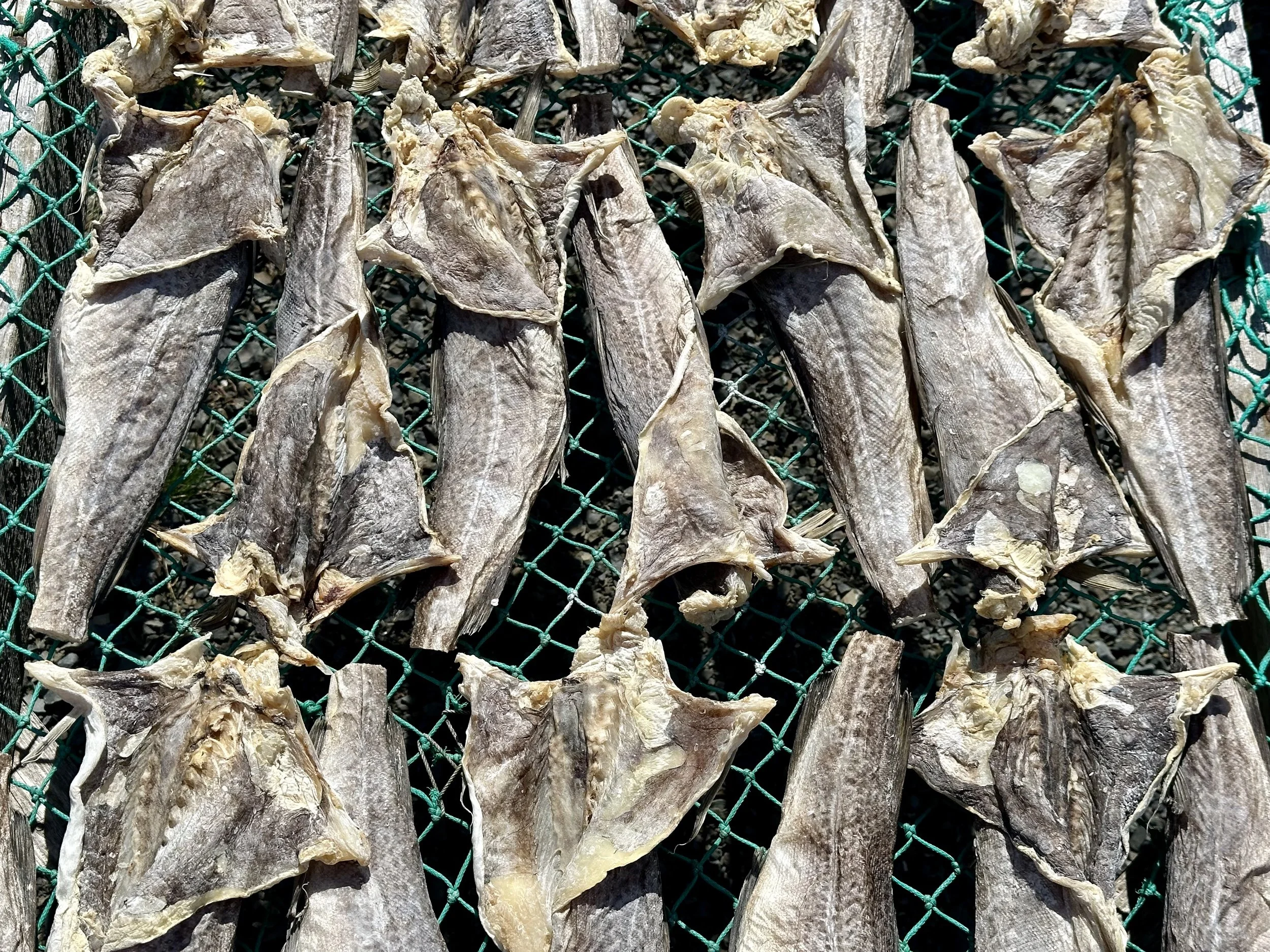
Salted cod drying in the sun at Pearce Cull’s place in St Anthony’s Bight. Pearce kindly explained to us how he cures salt cod the way Newfoundlanders have for centuries.
For most of their history, Newfoundland and Labrador’s economies and cultures have depended heavily on fishing. The province's cold, nutrient-rich waters have supported abundant fish stocks, mainly cod, for centuries. However, overfishing led to the tragic collapse of cod stocks in the 1990s, devastating coastal communities. Although the discovery of offshore oil reserves in the late 1970s helped to diversify the province's economy, the offshore rigs are located off the eastern shore and have not brought employment to the western peninsula. However, iron ore, nickel, gypsum, limestone and rock salt mining have all been significant job providers on the western shore.
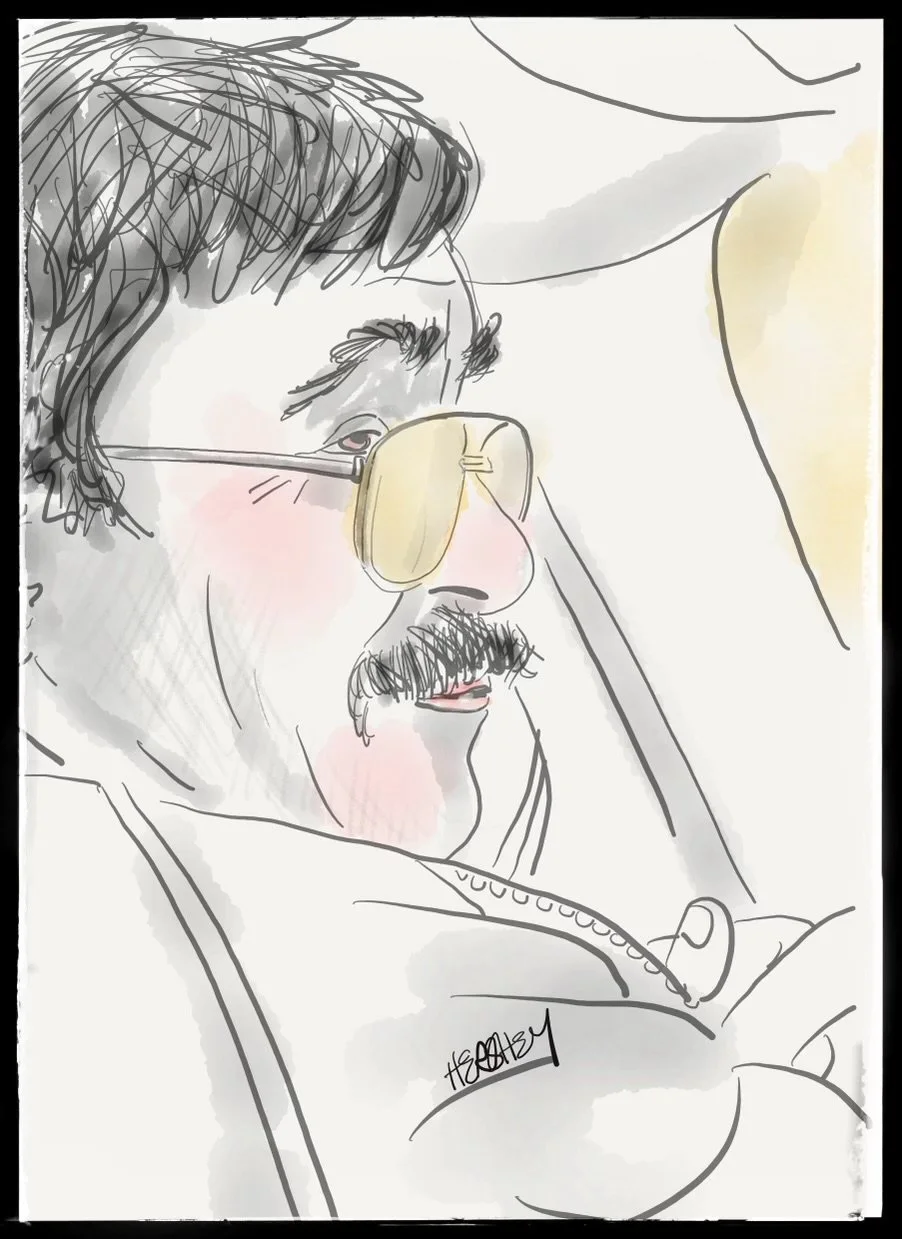
Primus, a retired fisherman, helped Jenny and me escape a challenging situation. We met him in his hometown of Green Island Brook in far northern Newfoundland. Although Jenny and I had cycled across a very windy high plateau as we left St. Anthony to begin our trip back to Port aux Basques, we hit ferocious 30-40 mph winds as we turned down the coast toward Saint Barbe. We couldn't stay upright, even on our fully-loaded pedal-assist e-bikes. We had already drained our batteries of most of their power getting over the plateau, so using enough energy to ride 26 more miles in that wind was not an option. We probably had covered about 4 miles since we had hit the coast when we saw a tiny cluster of houses in a cove ahead. Jenny had made her mind up. We took a turn down Main St and saw a child playing outside in the wind with her dog. She was having fun throwing a frisbee that would travel far in the wind, and her dog was happy to bring it back. We noticed the child’s mother standing in the doorway of a nearby house. Jenny removed her helmet to reveal her gray hair and said,” I hear the people of Newfoundland are good people, and we are in trouble.” In a moment, an older man came to the door and listened patiently to Jenny’s tale. He said, “My brother can help you.” He went back inside, and in a few minutes a man drove up the road in an old pickup truck. With the thickest Newfie accent we had heard yet, Primus and his brother helped us load our bikes and gear into his truck, and he drove us to our motel in Saint Barbe. Although we couldn't understand everything Primus was saying, we learned that shore fishing was no longer possible, and there was little work for most of the permanent residents along this coast. Consequently, the population is aging and schools are closing. It turned out that day's wind was so intense that the only ferry to Labrador had been cancelled. The next day was a bit less windy, and the ferry resumed. And so did we, continuing south for the remainder of our trip with a substantial headwind and periods of rain. But it was manageable, proving the adage that “what doesn't kill you makes you stronger.” Drawing by Jenny Hershey. Follow her on Instagram @deeofo.
Foresight
In recent years, Newfoundland and Labrador have formalized plans to transition to renewable energy exports by using wind power to generate green hydrogen. Given the province's longstanding economic ties to resource extraction and fishing, it seems fitting that the province would leverage its abundant wind and strategic location to become a significant player in the fast-growing global clean energy economy.
In fact, the province is already home to a clean electricity industry, although not without its downsides. Approximately 96% of Newfoundland’s electricity is supplied by hydropower, primarily from Labrador. The largest hydroelectric station was built in the late 1950s at Churchill Falls, about 150 miles east of Labrador City. In 2020, a smaller hydropower station was opened at Muskrat Falls, just east of Goose Bay, Labrador. In the 1960s, a power station was built at Bay d’Espoir in Newfoundland. The two stations in Labrador transmit power to Newfoundland via the Labrador-Island link or LIL.
Although there was limited pushback during construction in the 1950s and 60s when the first hydroelectric plants at Churchill Falls and Bay d’Espoir were constructed, the recent construction of Muskrat Falls in Labrador frustrated many locals across the Province. The project was initially estimated to cost $6 billion but, plagued by management problems, ballooned to over $13 billion, causing electricity rates to increase. In addition, ongoing technical issues have required costly repairs and raised doubts about the project's long-term viability. And although Indigenous groups and environmentalists raised alarms about methylmercury contamination, their concerns were overlooked.
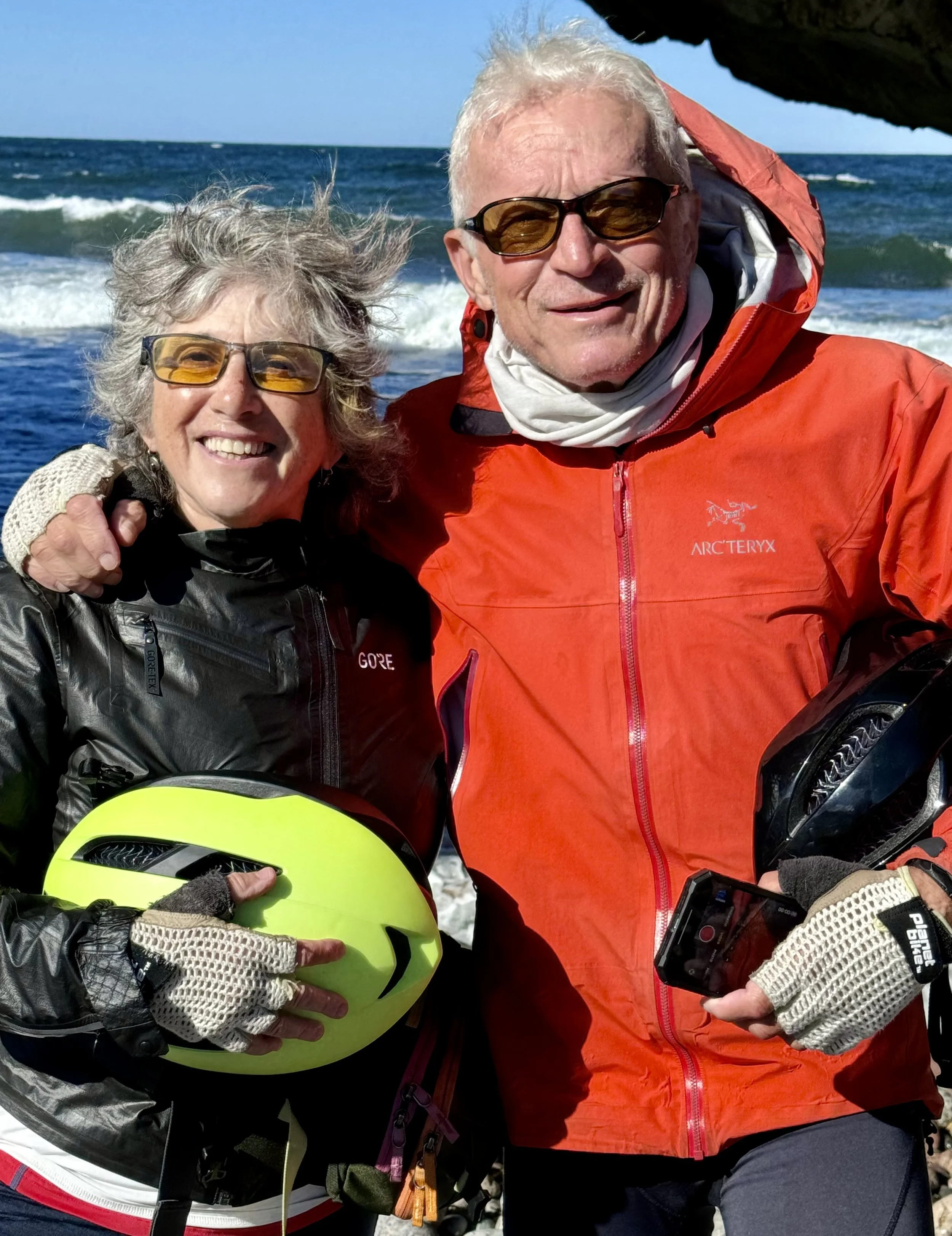
Jenny and Michael relax at Arches Provincial Park on Newfoundland's western shore.
Sadly, it is now understood that the flooding of large areas common to the construction of hydroelectric dams can adversely impact local Indigenous communities by limiting access to traditional hunting grounds. Further, these plants do indeed result in methylmercury contamination, harming regional food harvesting downstream. It is known that indigenous residents who rely on “country” food sources face more methylmercury exposure than other Canadians. Long-term dietary exposure to methylmercury causes neurocognitive delays in children, including long-term brain development issues, attention deficit behavior, and reductions in verbal function and memory. Additionally, methylmercury damages cardiovascular health in adults.
Ironically, none of the Indigenous communities affected by downstream mercury contamination receive electricity from the Muskrat Falls Project or the Churchill Falls Project. All six Indigenous communities on Labrador’s North Coast are exposed to contamination from shore fishing and harvesting where the effluence from the Grand River downstream of Churchill and Muskrat Falls flows into the Gulf of St. Lawrence. Yet, electricity in these communities is supplied by diesel generators.
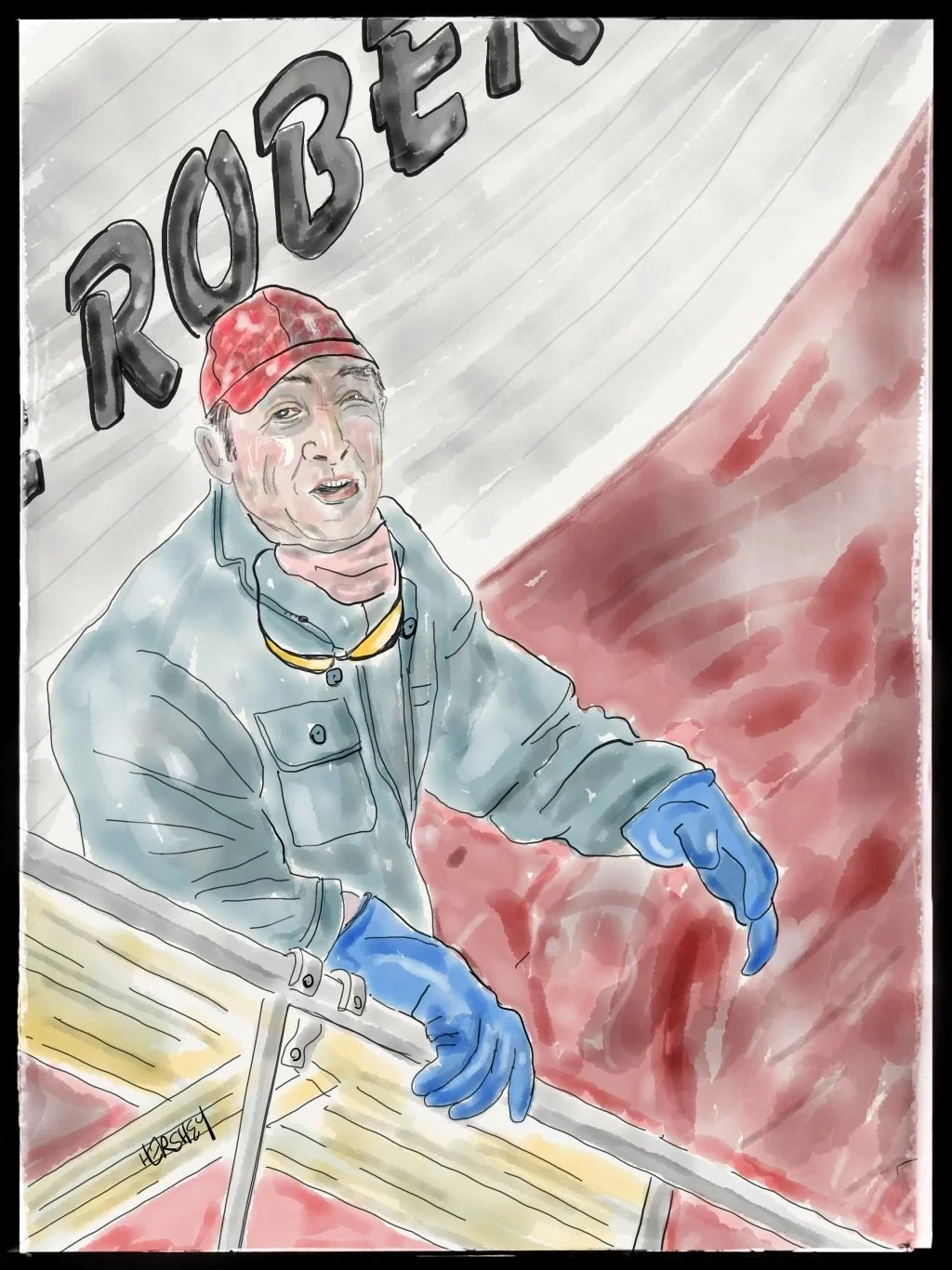
We met Dwayne in Port Saunders as he was hanging off a scaffold and sanding away a crack on the hull of the shrimping boat Cape Robert. In a melodic accent that sounded like a mash-up of Irish hill country and the rocky shores of eastern Canada, Dwayne told us he is crew for a commercial off-shore shrimp fisherman out of nearby Port au Choix. Except for a ten-year stint working on skid-mounted rigs in Alberta's tar sands, Dwayne has fished for shrimp his entire life. He gets 10% of the take for each trip, but part of the deal includes maintaining the ship, so he works for no pay when “she’s” docked. A few times every summer, he and his fellow crew members have to dry-dock the boat, mend all the cracks in the hull, and paint it as quickly as possible to get it back in the water. That’s how the deal works; “It's jus' part o' da arrangement, it is." Dwayne is 62, but he doesn’t see retiring anytime soon. He’s always spends what he earns, so he needs every penny to get from one season to the next. Seemingly unbothered and quite cheerfully, he told us, "I'll work 'til I can't, me friends. Jus' don't 'ave a choice, do I?" Drawing by Jenny Hershey. Follow her on Instagram @deeofo.
Now a public-private corporation under Crown jurisdiction, Newfoundland and Labrador Hydro (NL Hydro) has never needed to generate more clean electricity through wind power. However, they do need to address inequities in their design and siting plans for their hydropower to include and benefit local indigenous communities. The lack of need for wind power may explain why the province placed a moratorium on wind development in 2002 (which was lifted in 2022). Although there is a maritime link from Newfoundland to Nova Scotia, it is already working at capacity. So years ago, when wind developers came knocking, NL Hydro could neither manage nor build the transmission capacity required to handle wind-generated electricity. NL Hydro and government collaborated to create the moratorium on wind development until they had a sound plan for utilization.
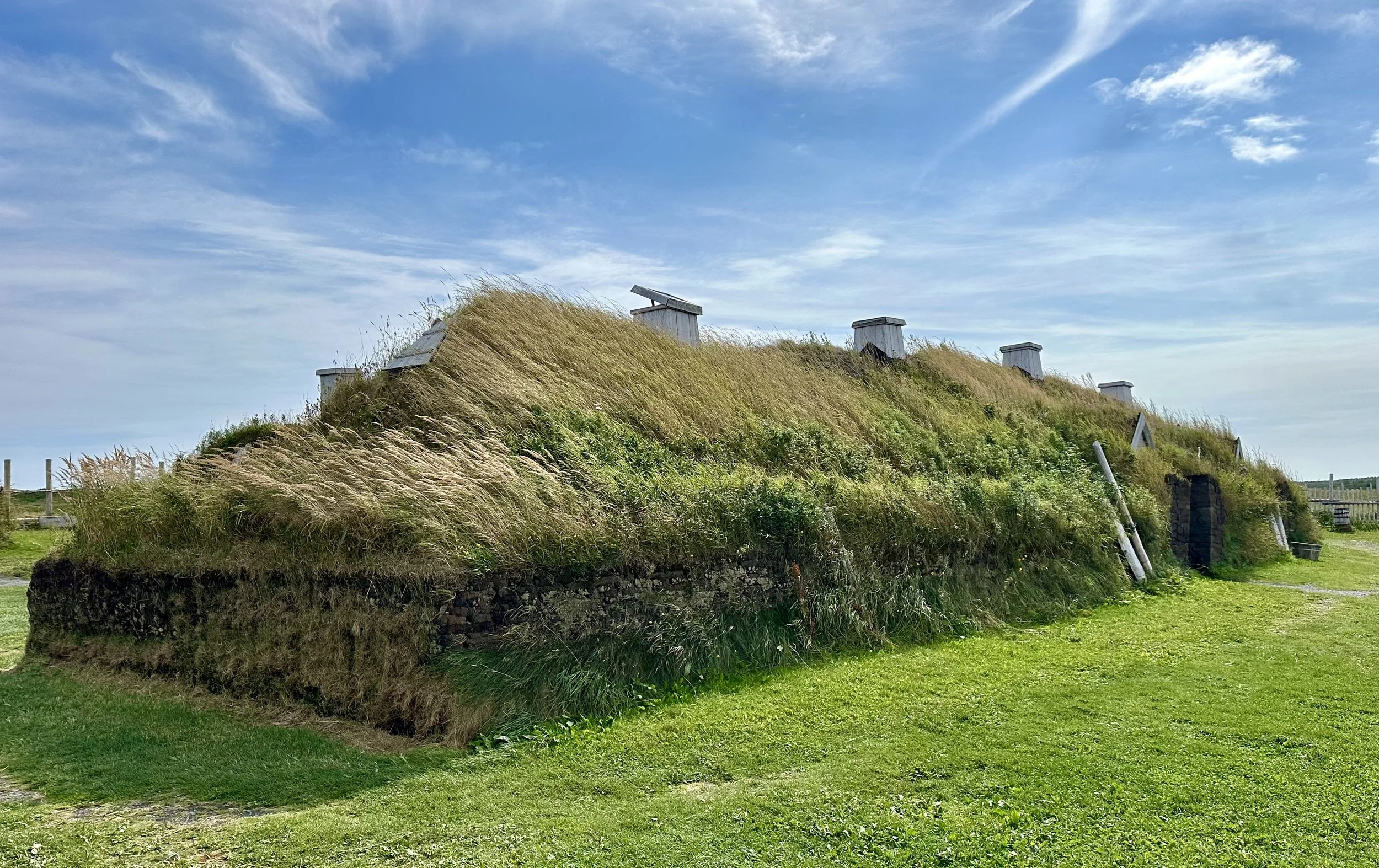
The main sleeping and eating room at L’Anse aux Meadows, a reconstructed Viking settlement dating back to 1000 AD. This extraordinary archeological site (and the only known Viking site in North America) was “discovered” in 1960 by Norwegian explorers and archeologists Helge and Anne Stine Instad. They identified the site (known to locals as the old “Indian” site) as a Norse settlement, which was later confirmed through extensive excavations. Today, L’Anse aux Meadows is a popular tourist destination. We really enjoyed visiting!
And now, because Russia invaded Ukraine, a plan for wind power has finally emerged. Geopolitical trends have driven Europe to avoid buying Russian gas and oil. This has been a boon to America’s shale gas industry, which now exports more natural gas than it uses domestically because Europe no longer wants to do business with Russia. And Germany, in particular, which has long been a leader in clean energy, foresees a massive market for hydrogen as the world moves away from fossil fuels. Germany’s renewable energy sources currently provide 57% of Germany’s electricity. However, electricity can only go so far to address the decarbonization of shipping, aviation, long-haul ground transport, rocket fuel, and the production of basic materials such as cement and steel. Hydrogen can address all those needs. Consequently, Germany seeks to be on the cutting edge of hydrogen development.
With these geopolitics in the background, Canadian Prime Minister Justin Trudeau and German Chancellor Olaf Scholz signed an agreement in August 2022 to develop a transatlantic supply corridor for green hydrogen. The deal, known as the "Canada-Germany Hydrogen Alliance," aims to help Germany reduce its dependency on Russian energy. Since then, a provincial “Request for Projects” (RFP) has resulted in more projects being selected across the island and Labrador. They all aim to use wind power to manufacture green hydrogen through hydrolysis, which can be converted to ammonia and then shipped to European markets, starting with Germany.
But, like the Muskrat Falls Hydroelectric plant construction, this plan has downsides. One of the critical projects in this agreement is the World Energy GH2 initiative, which includes the construction of a large hydrogen manufacturing plant in Stephenville, with 164 wind turbines positioned nearby on the Port au Port Peninsula. Although World Energy GH2 is the first Newfoundland Company to undergo environmental review, it currently must address at least 60 concerns. Other drawbacks include a considerable pushback among the 500+ “old French” residents who live in the Port aux Port peninsula and do not want the rugged character of their beloved peninsula permanently altered. Although almost 45% of the local population is currently on unemployment insurance, and many others are retired, most are skeptical that there will be jobs when the construction phase is complete.
To understand how many jobs are likely once construction is complete, we consulted numerous sources through Microsoft's AI tool Copilot, and we learned that after the construction phase, a 3900 megawatt wind farm (approximately the size of the World Energy GH2 project proposal) and its associated wind to green hydrogen supply chain may create as many as 16,000 permanent jobs. This includes operations and maintenance, manufacturing, supply chain logistics, and green hydrogen/ammonia production jobs.
Nevertheless, Jenny and I heard complaints about the proposal pretty regularly. At the same time, we couldn't help but notice the province's economic challenges. It was disheartening to learn that a significant portion of the population lives in low-income conditions, well below the Canadian national average. The limited job opportunities, particularly in rural areas, seem to exacerbate the financial hardship experienced by many residents, making it difficult for them to make ends meet.
We spoke with a motel owner in Corner Brook who shared a poignant story about his three kids, referring to them as "economic refugees," because they had all “moved away to cities on the mainland” to find work. This story echoed what we were told by many other Newfoundlanders; apart from two individuals we encountered who had one or two kids living in St John's, everyone else we spoke to mentioned that their children had left Newfoundland and Labrador to seek better opportunities elsewhere.
As outsiders, we can't help but worry about the long-term implications of the exodus of young people on the province's future. The loss of skilled, youthful workers can have far-reaching consequences, affecting the demographic composition, local economy, and overall vitality of communities. It became clear to us that efforts to retain young talent and attract newcomers are crucial for the province's long-term sustainability and growth.
So, as much as we understand the pushback by residents who are mistrustful of this idea, yet still deeply love Newfoundland and Labrador for the beauty of the land and the rugged self-reliance of its people, we believe they should rise to the challenge at hand and work together with government and industry to build a brighter future for their province. We sincerely hope to return one day and witness Newfoundland and Labrador thriving with a vibrant economy and opportunities for all its residents, including its younger generations.
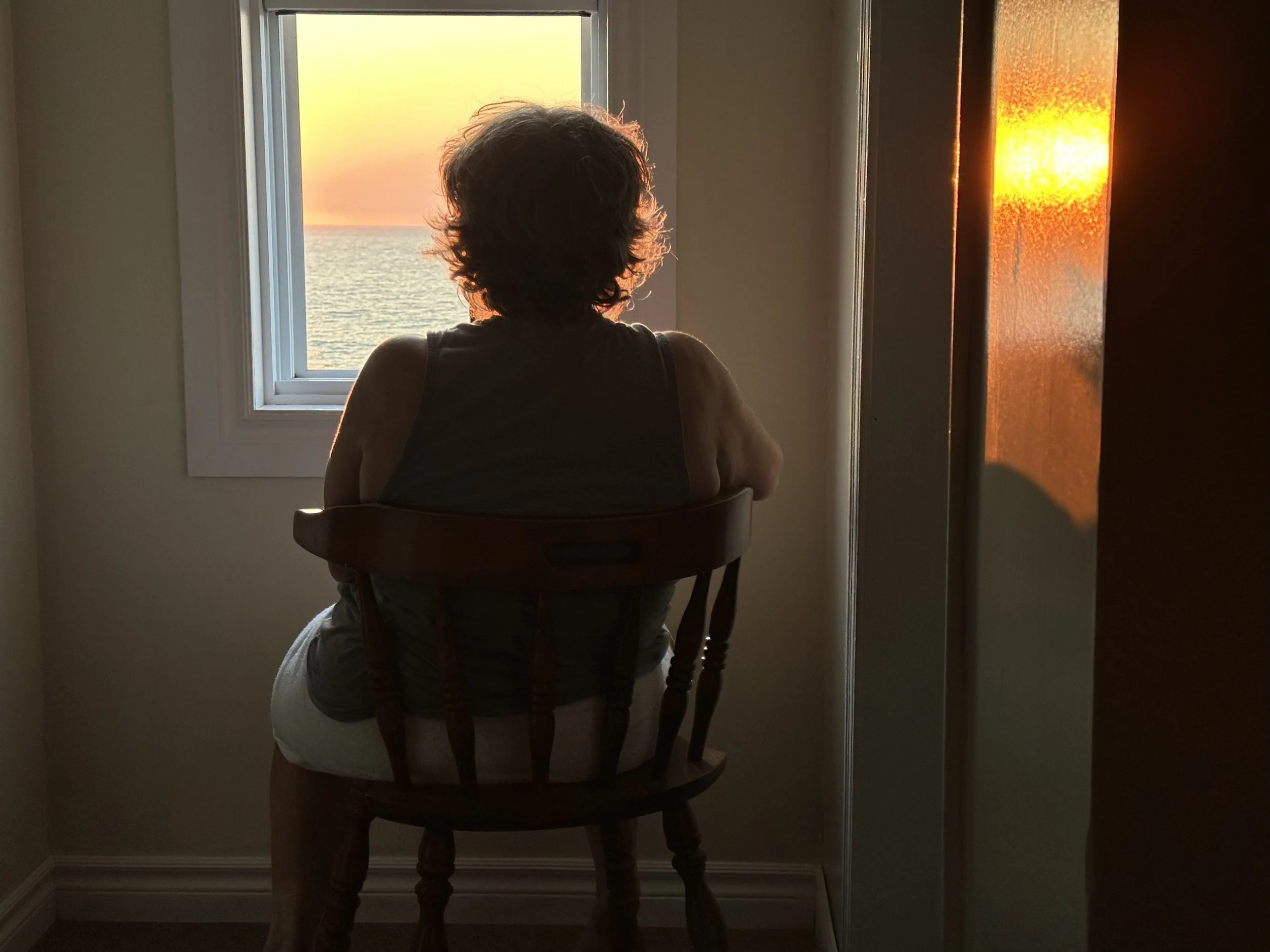
Jenny watches the sunset from a motel window in Daniel’s Harbour.
It would be exciting to watch Newfoundland become a significant player in the global clean energy economy, and it could certainly attract jobs and a renewed vitality to a beautiful place with atrophying industries. While challenges remain, Newfoundland and Labrador’s bold vision for a renewable energy future offers a model for other regions seeking to diversify their economies and combat climate change. Newfoundland and Labrador is truly a province of foresight. Let’s hope they succeed and we can learn from them.
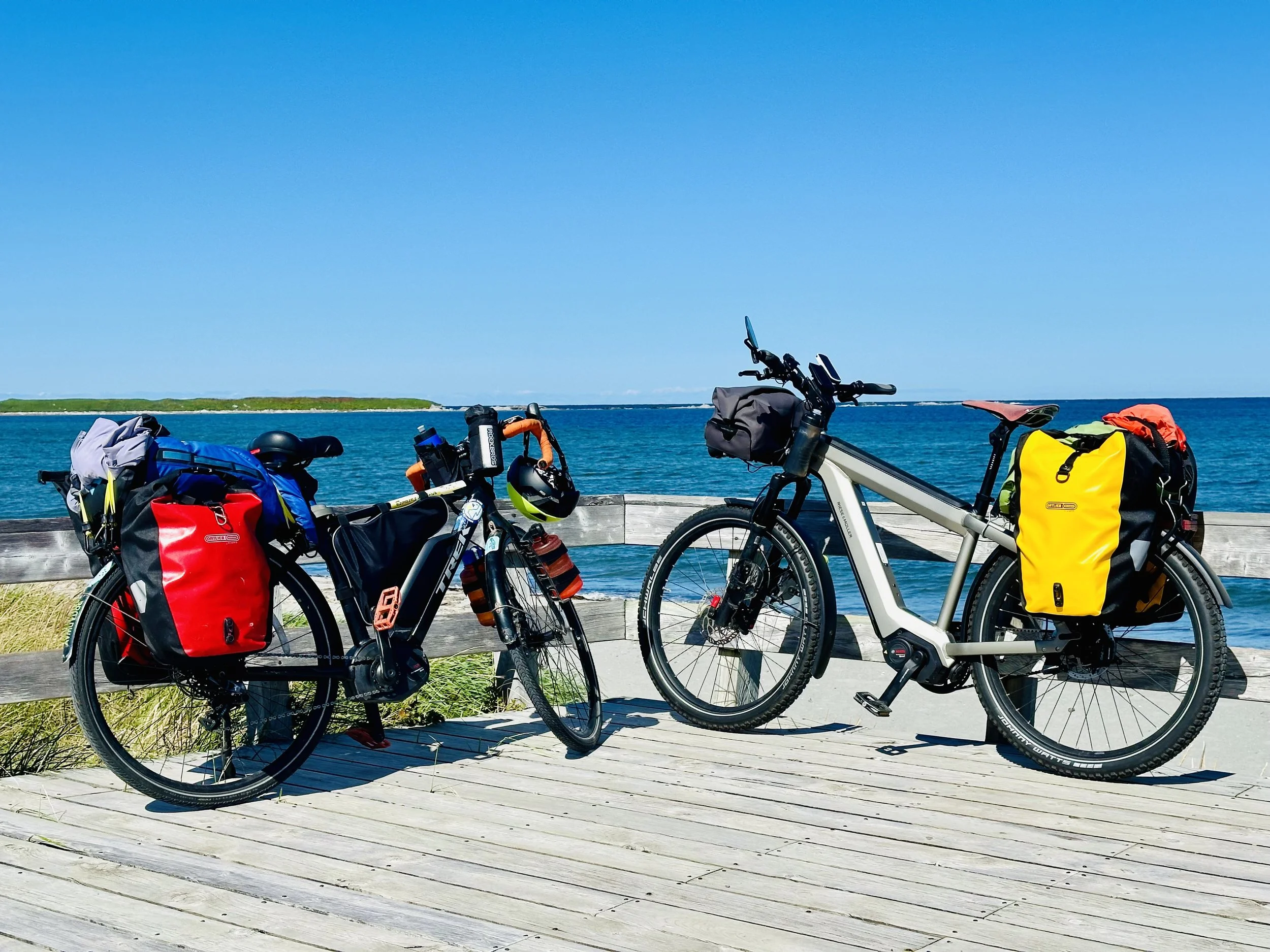
Our bikes on a boardwalk in Gros Morne Park at Shallow Bay near the town of Cow Head.
Consequently, we were pleased to learn that a second wind-to-green hydrogen company in St. John's recently announced a German buyer for its ammonia, a first among the Newfoundland companies competing in this space. A deal with the German energy firm Mabanaft places Pattern Energy ahead of World Energy GH2 in the race for foreign markets. The agreement is currently limited to a letter of intent as Mabanaft does its due diligence and Pattern refines the project's financial model (expected to cost about $1.5 billion). At 300 megawatts of wind power, the Pattern project is the smallest of the proposals in Newfoundland and Labrador. In contrast, the World Energy GH2 project on the Port au Port Peninsula is about 13 times larger. Pattern is also the only company proposing to build its project on private land within the Port of Argentia. While other companies have talked about the potential for ammonia to be turned back into hydrogen and used as the clean fuel of the future, Pattern is content to sell ammonia for the sake of ammonia. Mabanaft views ammonia itself as a transition fuel, not just a carrier of hydrogen.
Epilogue
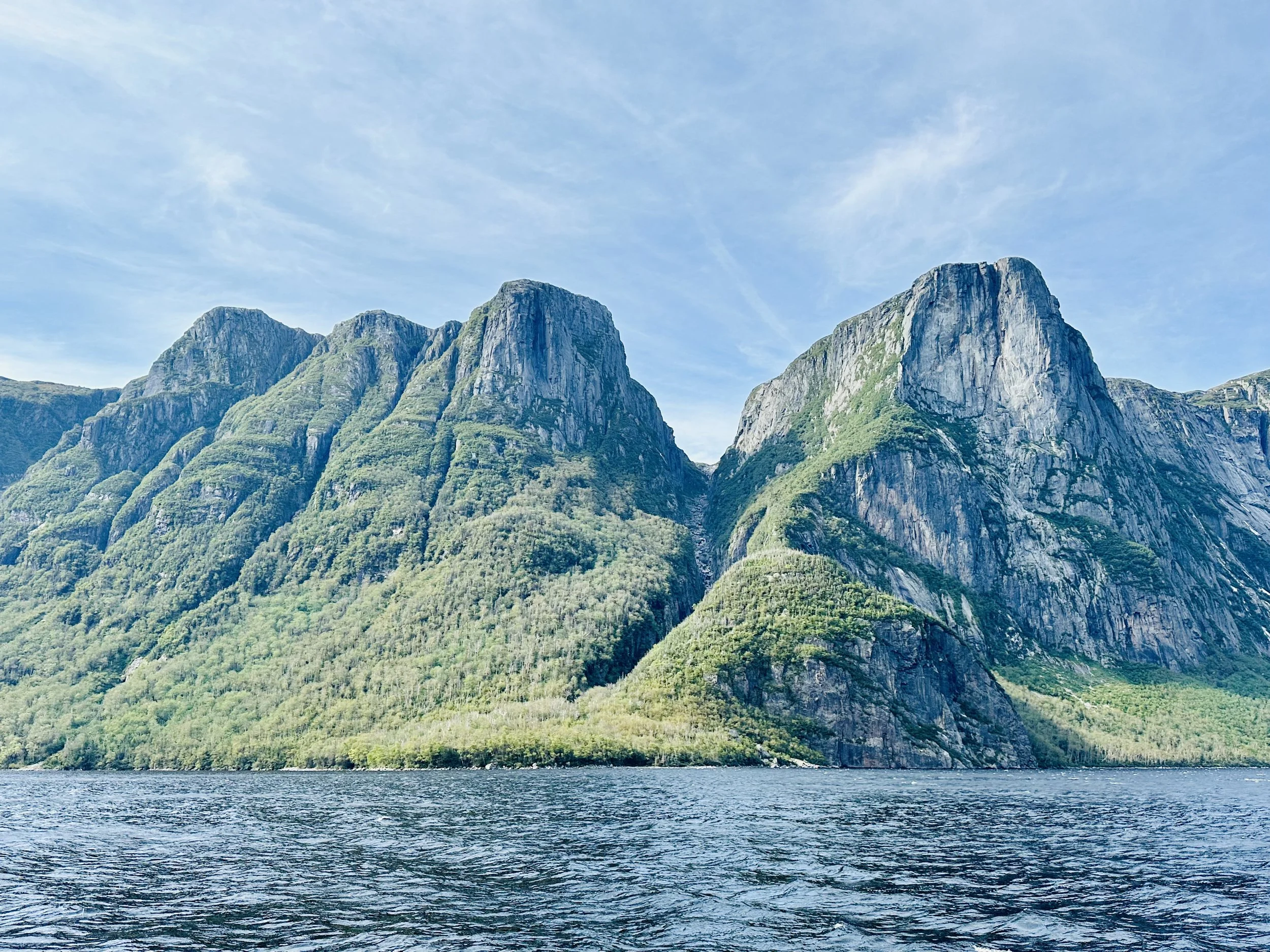
Mountains across Western Brook Park in Gros Morne Provincial Park.
People all over the world are reeling from the mounting costs and suffering wrought by our overheating world. And it’s going to get worse before it gets better. The latest forecast from the World Meteorological Association (WMO) indicates an 80 percent likelihood that the annual average global temperature will temporarily exceed 1.5°C above pre-industrial levels for at least one full year of the next five. These discouraging figures underscore the urgent need for robust, science-based policies among world leaders to address the climate crisis head-on. Yet, in the face of this unfolding catastrophe, many of our current leaders cling to woefully inadequate measures that fail to meet the scale and severity of our challenge. Something can always be done, especially in democracies where one has the right to vote.
Consider the Presidential race in the United States. Democrats passed the most significant climate bill in US history (the Inflation Reduction Act) during the Biden administration, which will continue to have support under Kamala Harris. Yet, Trump says he will repeal it. The Republican party’s denial of science in this day and age is profoundly disturbing. Currently, 97% to 99% of climate scientists agree that climate change is happening and that human activity is the primary cause. In contrast, the U.S. House of Representatives includes 40 times as many climate science deniers as are found among the authors of scientific articles.
It’s not too different in Alberta, Canada, where big oil economic interests and climate science denial also shapes the province’s policy landscape. Many Alberta politicians, most notably Premier Danielle Smith, have vehemently opposed Canadian federal climate policies, criticizing federal clean energy regulations as absurd, illogical, unconstitutional, and unscientific. It's the same everywhere: where big oil money talks, common sense walks...
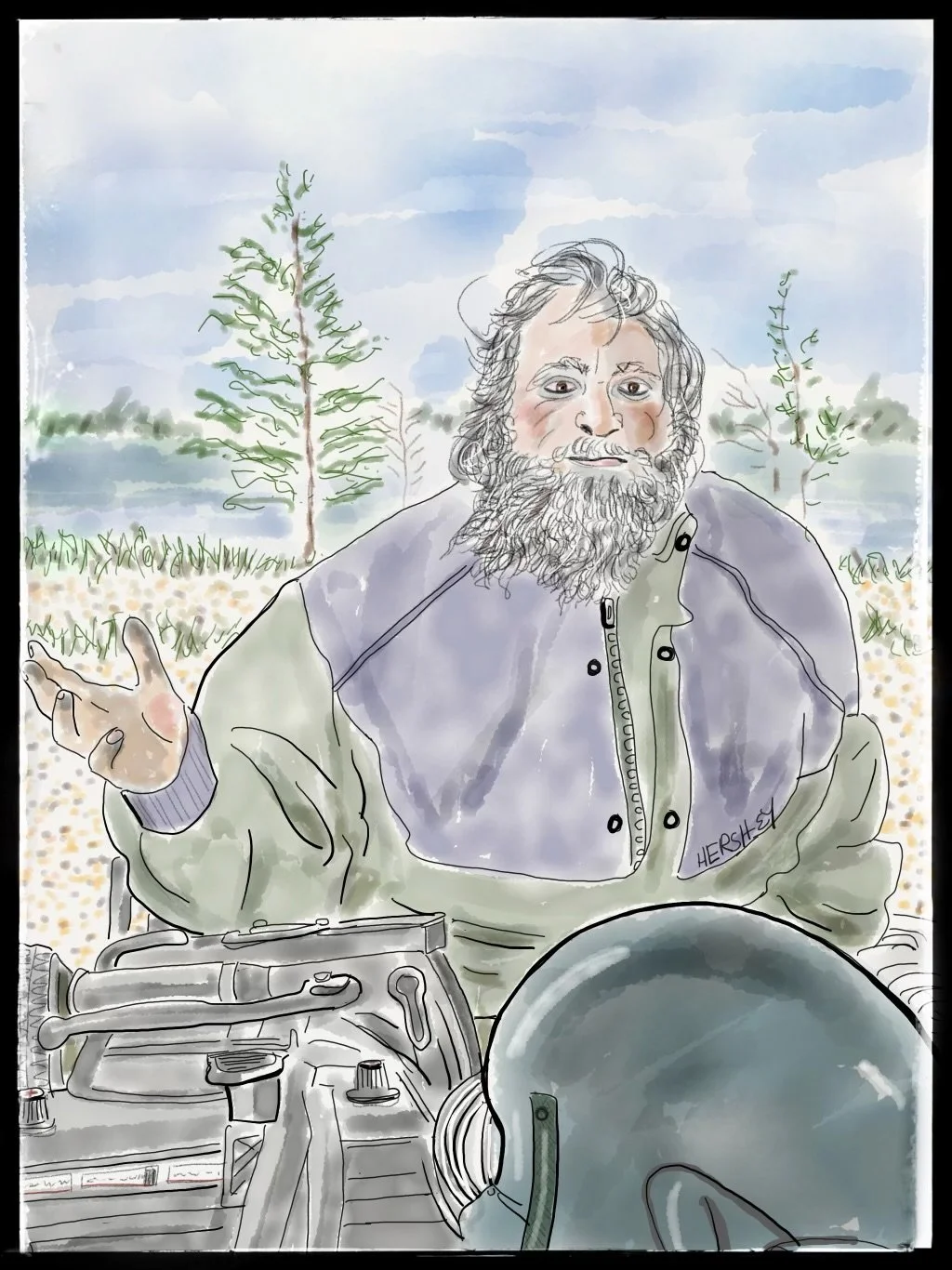
We met Victor in Port Saunders while packing groceries into our bicycle panniers. He pulled up on a weathered ATV, hauling an old wooden trailer full of wood, tools, and gas containers. Very friendly, and with a thick accent of Irish brogue and Canadian twang that we could only half understand, he told us he used to be a fisherman but now he lives on $600 a month he gets from the government. He said it’s not enough to survive and certainly not enough to pay for rent. Victor’s life is hardscrabble, but his one comfort and lifeline is his trusty ATV. He referred to her as “she” and called her his prostitute, “Cause I 'ave ta pay so damn much money ta keep 'er runnin', I do.” Victor then took us by surprise by lecturing us (once he learned we were from the States) about Donald Trump’s ethics. He referred to the Inside Hollywood tapes of Trump talking about what he would do to a woman’s…. well, he wouldn’t even say the word! But then he went on, “‘Ow could a man who was found guilty of sexual assault be elected as President? Dat's absolutely mental, it is!" A man with firm convictions and lots of common sense, we agreed with most everything Victor said (that we could understand). Drawing by Jenny Hershey. Follow her on Instagram @deeofo.
Yet, our politics in the States gets even weirder. Republicans have a massive and well-developed agenda for global warming. As Emily Atkinson writes in Heated on Substack (August 26), it boils down to three words: “Let it rip.” She goes on: “The Republican climate agenda is summarized nicely in Project 2025, the notorious 900-page policy plan developed for Donald Trump by the conservative Heritage Foundation. It proposes gutting the Environmental Protection Agency and its climate regulations, re-opening the Arctic National Wildlife Refuge for drilling, defunding the nationwide transition to renewable energy, and eliminating environmental justice initiatives. In addition, political appointees serving under Trump “will have to eradicate climate change references from absolutely everywhere”—because, as we know, ignoring a problem helps fix it. Overall, Project 2025 is a veritable smorgasbord of “burn it all down,” and it aligns squarely with Trump’s own actions and pledges.”
Ignoring overwhelming scientific evidence and consensus is not just misguided; it's morally bankrupt and irresponsible, particularly in the face of such obvious and indisputable evidence. Ignoring extreme weather events is a flagrant gamble with the lives and livelihoods of millions, the stability of the global economy, and the very habitability of the only planet we call home. As these ever-growing multi-billion dollar disasters make painfully clear, Americans and Canadians can no longer afford to indulge those who put short-term profits and political expediency over the safety and well-being of our communities. The catastrophic losses we're already experiencing are a mere preview of the unimaginable human suffering, ecological devastation, and economic havoc to come if we fail to act with the boldness and urgency demanded by science.
Our path forward could not be more starkly vivid. We can choose to heed these unmistakable warning signs and launch an all-out mobilization to slash emissions, transition to clean energy, and bolster our resilience in the face of unavoidable climate shocks to come. Or we can condemn ourselves and future generations to an ever-escalating onslaught of climate mega-disasters that will make today's $billion+ calamities woefully insignificant by comparison. Let us pray we choose wisely for the sake of ourselves, our children, and generations yet to be born. The hour is late, and time is not on our side.
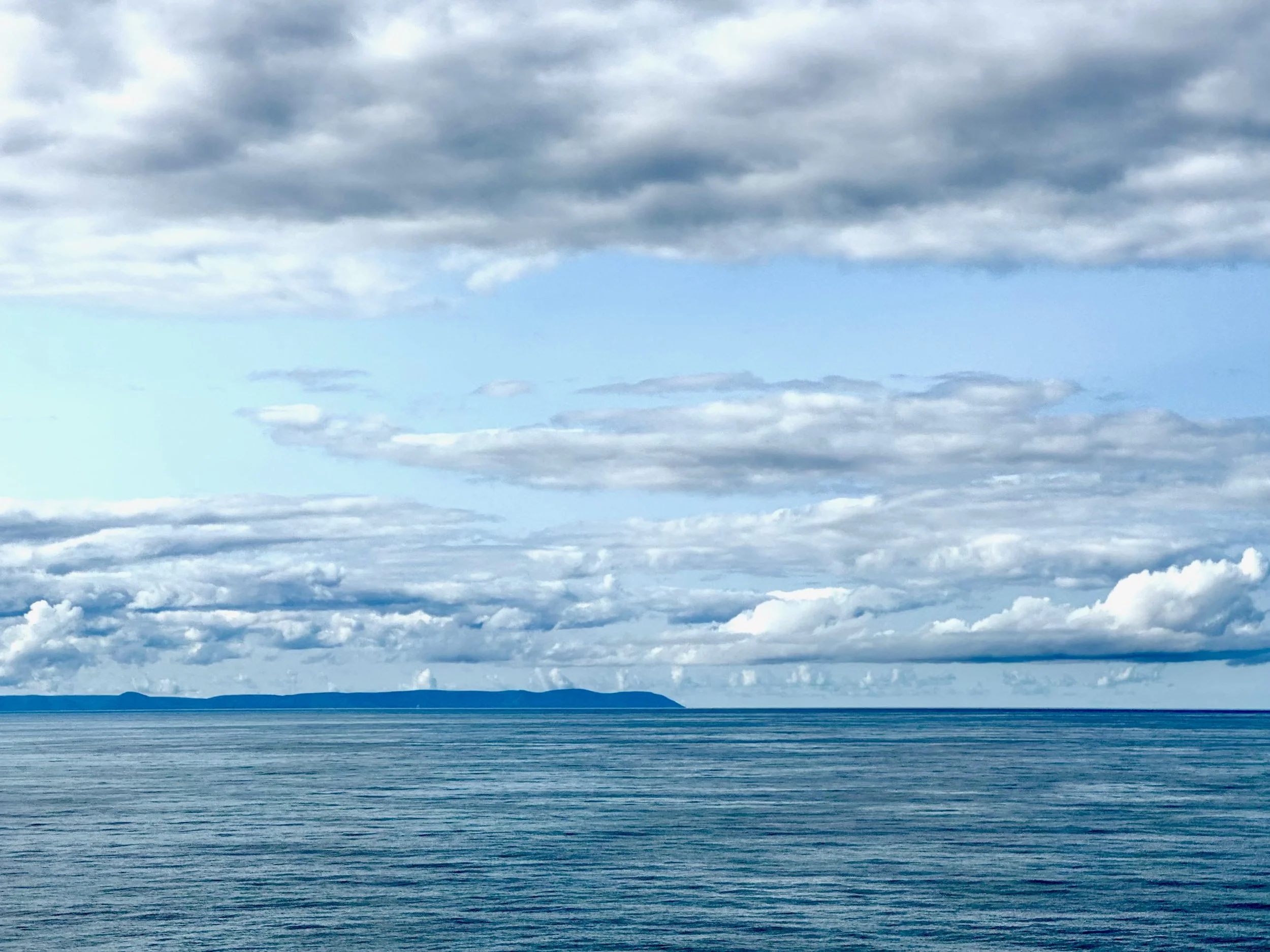
A shot of Cape Breton, Nova Scotia, from the ferry on our return.
Stay vigilant! Thanks for reading. If you haven’t done so, please subscribe to this blog to follow our next biking trip.
Blog writing by Michael Chase. Drawings by Jenny Hershey. Unless otherwise noted, all material is the copyrighted property of the blog post authors, including all photographs and drawings.
Jennifer Hershey’s drawings can be enjoyed on Instagram @deeofo.
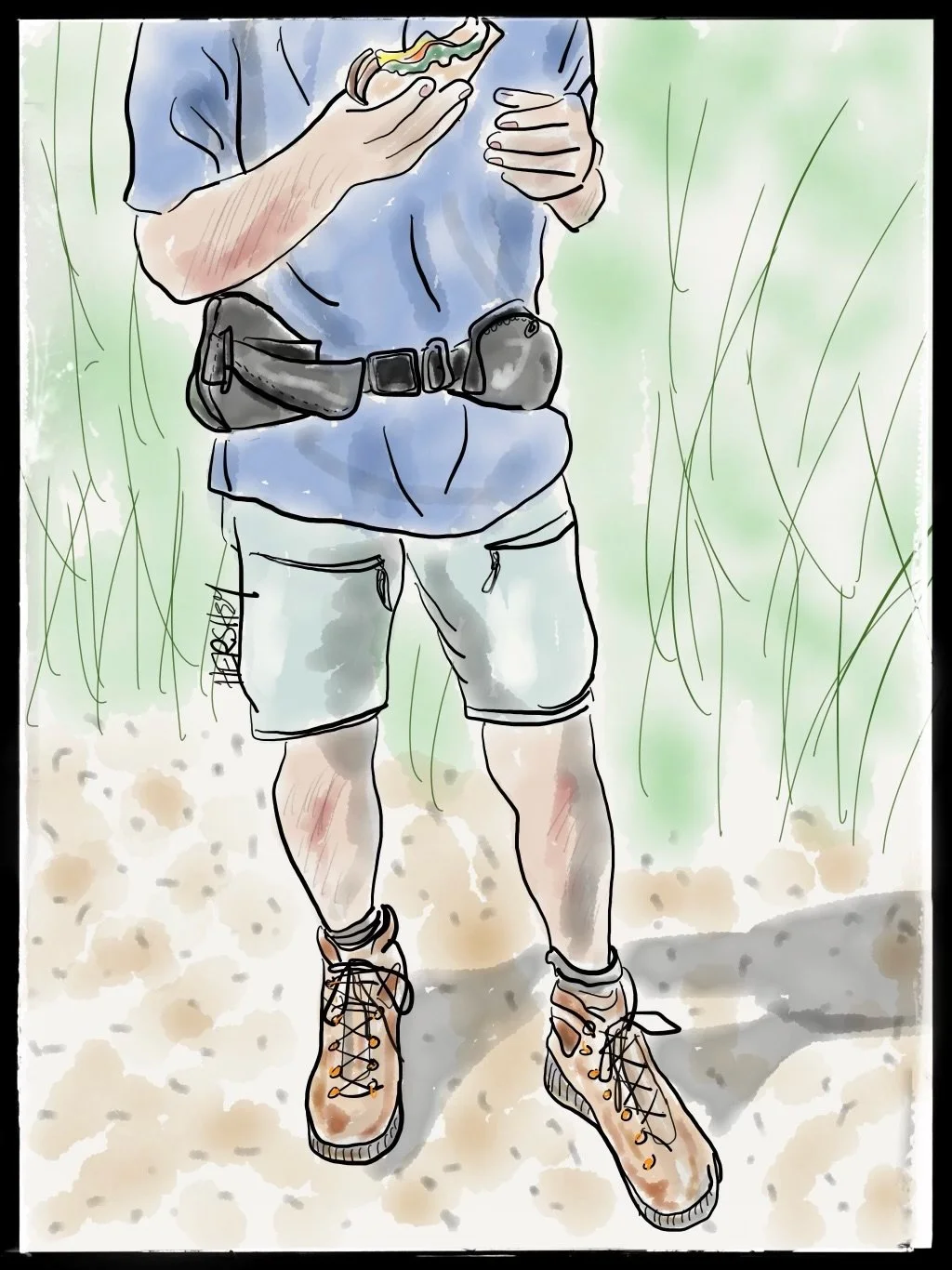
We first met Gary on his 81st day of walking across Canada between Nipigon and Thunder Bay, Ontario, during our May 2024 cycling trip around Lake Superior. At the time, Gary explained he was walking from Vancouver to St John’s, Newfoundland, to raise money for a cause he was passionate about. Jokingly, Jenny said, “Maybe we’ll see you there; we’re going to Newfoundland in September.” On Day 162 of his transcontinental hike, we met him again. We were biking toward Port aux Basque to catch a ferry back to the mainland on Trans-Canada Highway 1, just south of Corner Brook, NL. We had been following Gary on social media, so we thought our paths might cross. We brought him a huge sandwich and fresh fruit, exchanged travel stories, and then went our separate ways. Gary was on his third pair of hiking boots, and Jenny was on her oldest touring bicycle. Drawing by Jenny Hershey. Follow her on Instagram @deeofo.
Free Markets, Wildfires and Conspiracy Theories; Biking Ontario and Quebec
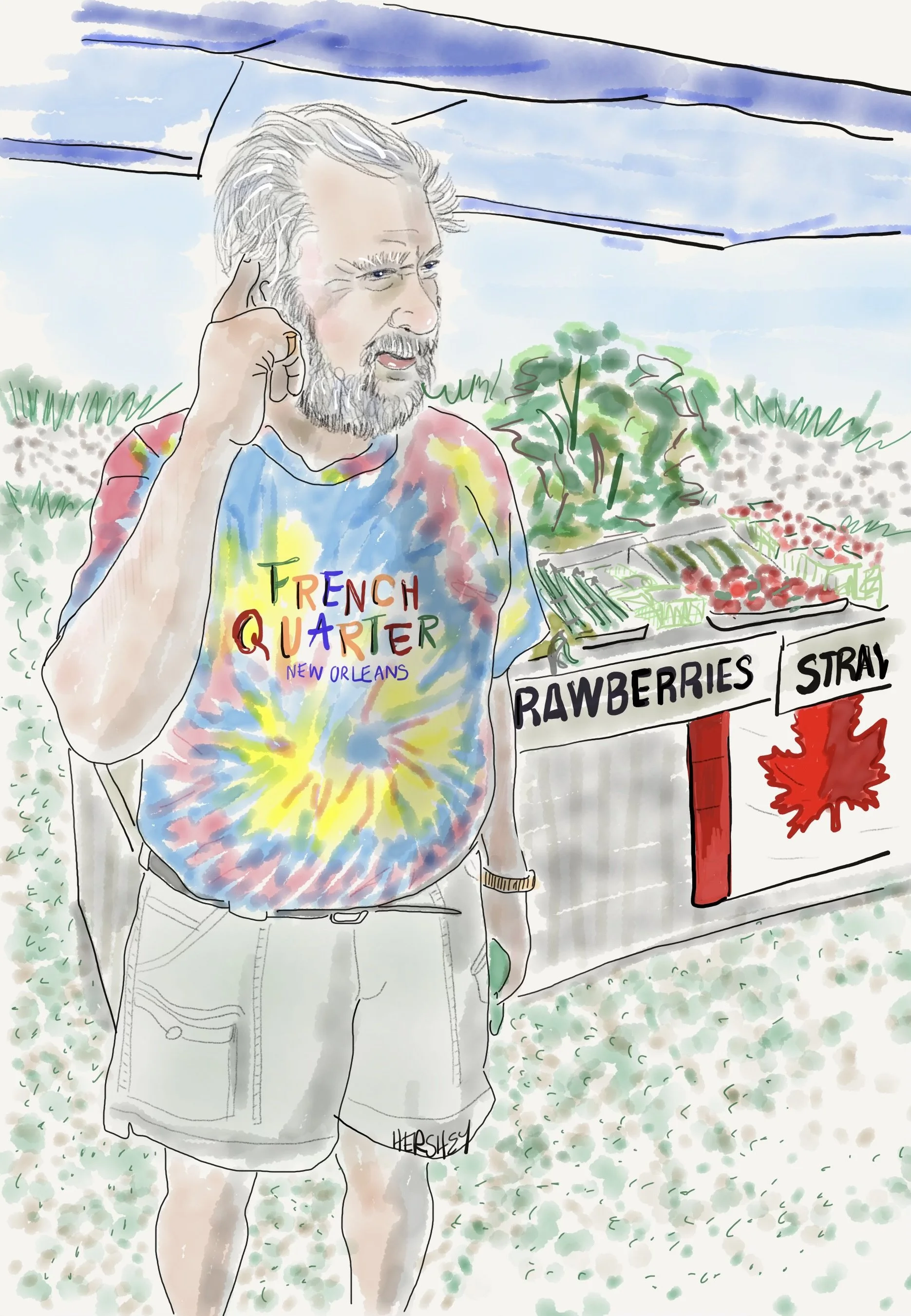
Jenny and I met Dave in Fitzroy Harbor, Ontario. An 80-year-old retired cop from St. Catherine, he was selling organic produce from his garden at a roadside stand. Dave lives alone in a small trailer tending his “Garden of Eden” and described himself as a DP (displaced person). He showed Jenny where a teenager shot off a small chunk of his ear with a buckshot rifle. When we asked him about the wildfires further north, Dave replied without hesitation, “They were set intentionally by the government so they can develop the land up north. It will make them money on property taxes. And it's where they plan on putting all the immigrants.” When we asked him where the immigrants would find jobs if they lived on cleared land up north, he replied, “It’s a socialist country, so they won't work anyway.” He went on, “That's why the government says it's climate change - they blame it on something we can't do anything about, and that's how they get away with it.” Drawing by Jenny Hershey. Follow her work on Instagram @deeofo.
————
Free Markets
“All truth passes through three stages. First, it is ridiculed. Second, it is violently opposed. Third, it is accepted as being self-evident.”
-Arthur Schopenhauer
————
Writing by Michael Chase, Drawings by Jenny Hershey
Jenny and I planned our next cycling tour for late June as we rode the train back to New York City last May from Little Rock, Arkansas (read a post about that trip here). Since neither of us had ever been to Ottawa, and because summer is a great time to cycle in Canada, we decided to ride our bikes northwest around the Adirondacks from Albany into Ontario and Quebec. We had no idea what it would be like, but we guessed it would as interesting as it might be challenging. Of course, we reconsidered when New York City broke air quality records because of wildfires in Ontario and Quebec; but decided to go after learning that poor air quality is as determined by wind currents as it is by proximity to wildfires. Our hunches were accurate, and although we grappled with poor air quality in both Ontario and Quebec, we kept reading it was worse in the States. And, of course, we were aware that many others are also suffering from extreme heat in the American south. It’s been a rough summer all around. Like so many other aspects of climate change, there’s nowhere to hide from increasing weather extremes.
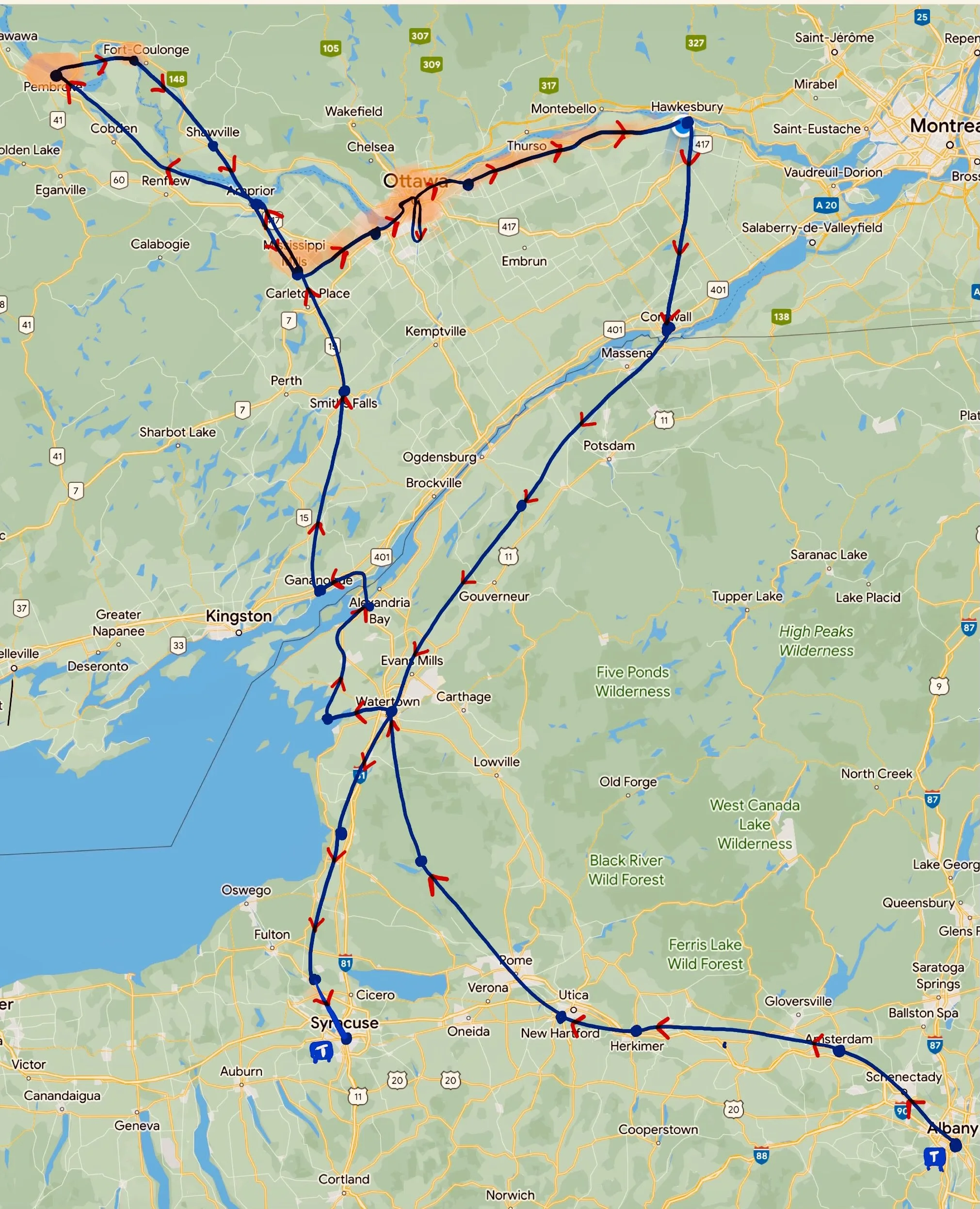
Jenny and I started our trip in Albany after taking Amtrak from NYC. We couldn't ferry into Canada at Cape Vincent because the ferry captain retired during the pandemic, and no one has replaced him. Consequently, we had to ride northeast 30 miles to the Alexandria Bay crossing and walk several miles on a narrow pedestrian walkway on the American side. We then rode illegally across another bridge into Canada from Wellesley Island (no one told us not to at Canadian customs). From there, Jenny and I headed north toward the Ottawa River, hopscotching between Ontario and Quebec. We encountered the worst air quality from the Canadian wildfires in the orange areas. We ended the trip in Syracuse, where we took a train back to NYC. Altogether we biked about 1000 miles. Map drawing by Jenny Hershey. Follow her work on Instagram @deeofo.
Some other things needed to happen before we left. In addition to personal care, home projects, and catching up with friends and family, there was a Citizens Climate Lobby (CCL) conference in early June followed by a day of lobbying Congress in Washington, DC. This was CCL’s first in-person lobbying effort since the pandemic, attended by almost 1000 environmentalists from all over the country. Over 465 visits to both Republican and Democratic members of Congress to lobby for climate policies were made in one well-orchestrated day. I joined small teams of other citizen lobbyists to visit with the staffs of NYC Representatives Nydia Velasquez, Ritchie Torres, Adriano Espaillat and Hakim Jeffries. Although there is predictable resistance to the GOP’s continuing agenda to weaken the National Environmental Policy Act (NEPA) and the GOP’s ongoing support for fossil fuels, CCL lobbyists are now able to argue that market forces overwhelmingly favor clean energy over fossil fuels. The clean energy marketplace has found its groove, and if we trust that open competition in a truly free market will deliver the highest quality products for the lowest possible prices, then clean energy will indeed emerge victorious as long as the playing field is even. Renewables are already cheaper than coal, and will soon be cheaper than natural gas (even without factoring in the social costs of carbon emissions and air pollution). Consequently, Republican insistence that oil and gas deserves greater subsidy support than clean energy (usually in the name of “market based parity”) is a less serious threat to long term decarbonization goals than it has ever been.
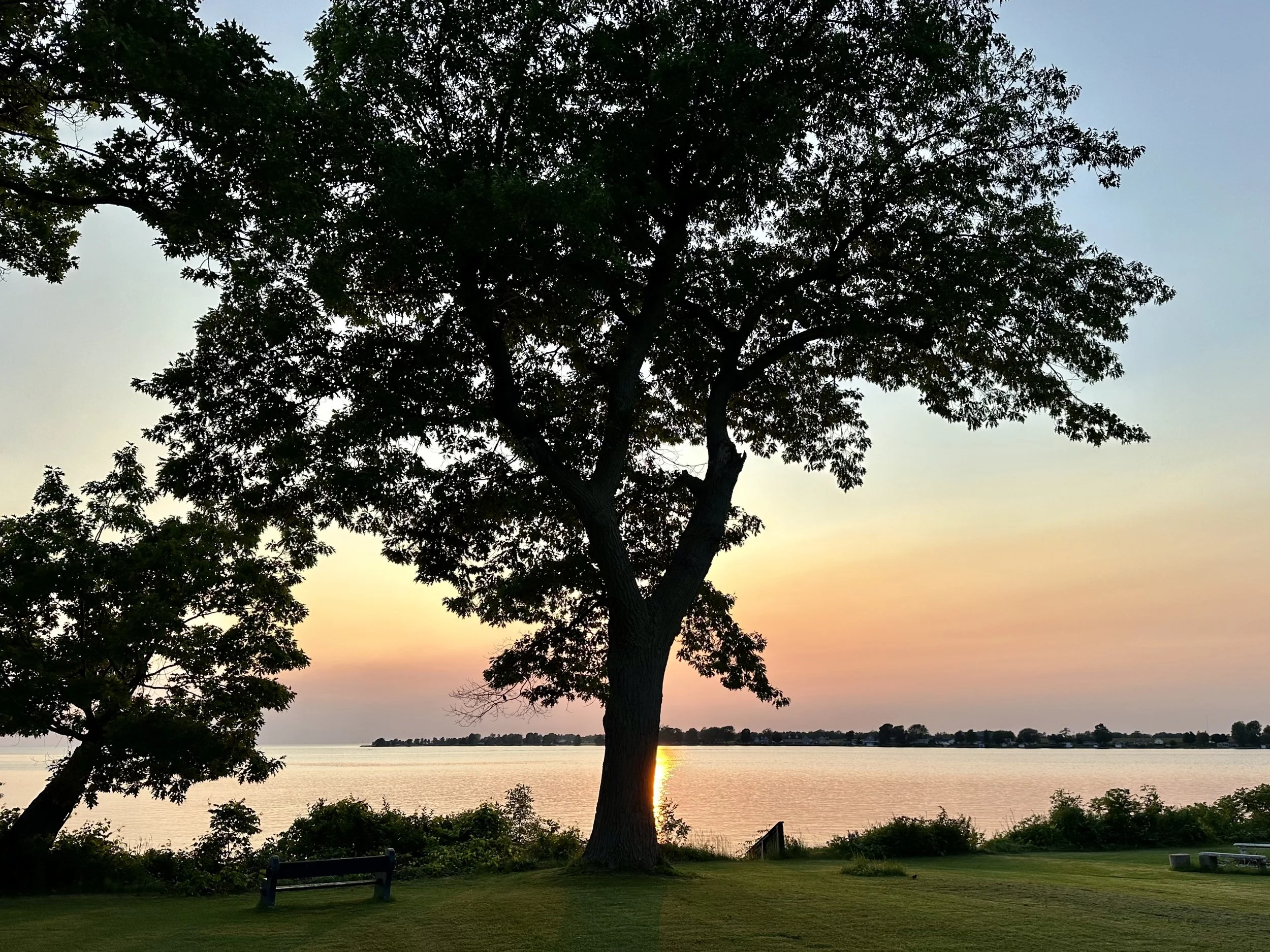
Tree overlooking Lake Ontario. Photo by Michael Chase. Follow him on Instagram @mjohnsonchase.
Consequently, the overriding concern of CCL lobbyists for this year is permitting reform (with a secondary emphasis on CCL’s signature carbon dividend policy with its carbon border adjustments, or CBAM’s). Both issues are heavy lifts in our polarized political atmosphere, although there is a reasonable chance that both parties might come together in the next Congress to pass meaningful legislation. Effective permitting reform will speed up the permitting process for clean energy projects and streamline the buildout of transmission lines. It will also preserve the input of local communities around quality energy projects, provide lasting jobs and ensure the safety and welfare of American citizens. For Republicans, permitting reform will give all energy projects a bump, including carbon capture, utilization and storage (CCUS), hydrogen manufacturing, and even small modular nuclear reactors.
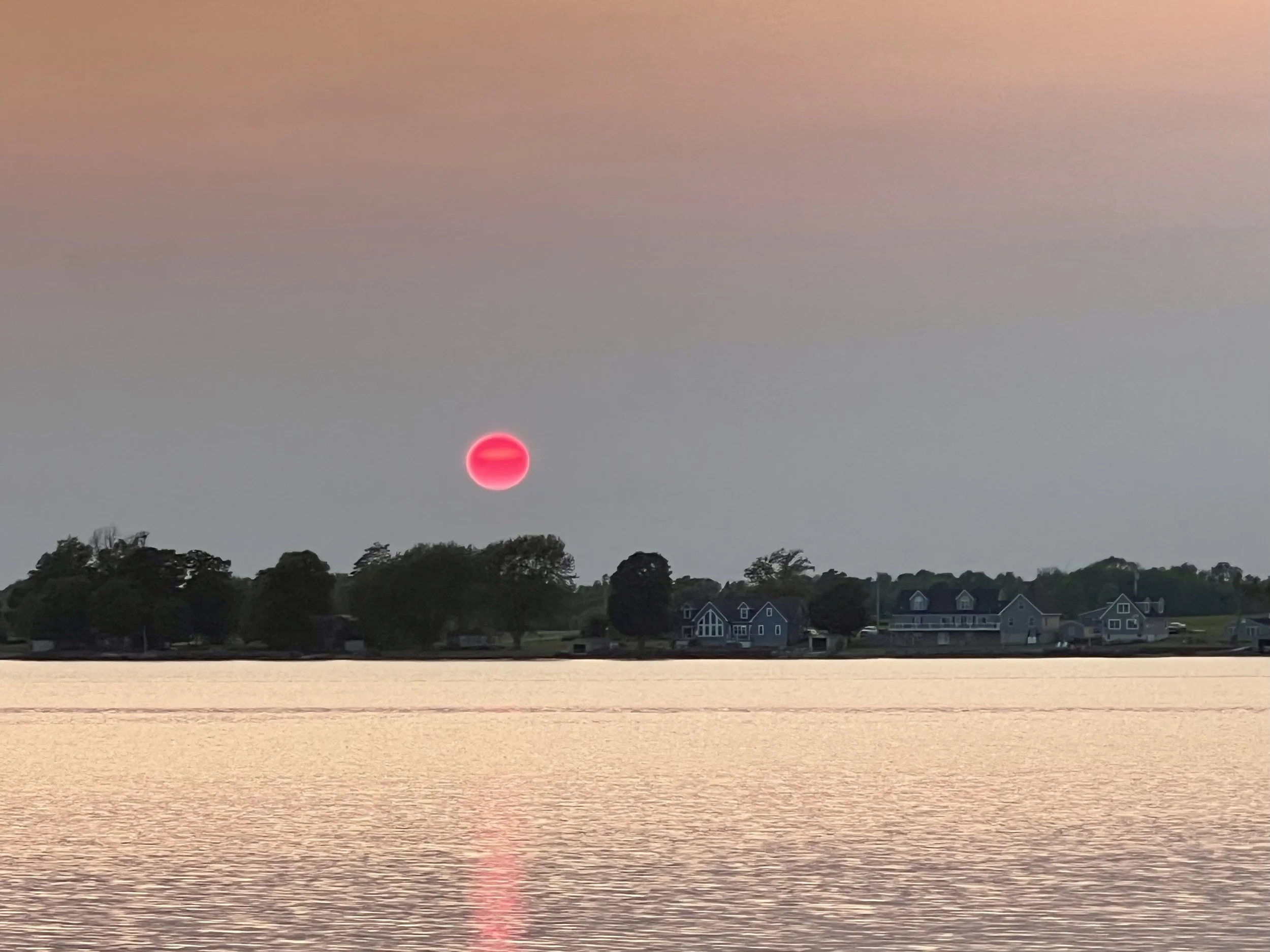
The sun sets over a bay in Lake Ontario in the middle of June south of Cape Vincent, New York, where the headwaters of the St. Lawrence River begin. The sky seemed clear the day we were there, but this picture indicates there might have been some wildfire smoke in the air. Photo by Jenny Hershey. Follow her on Instagram @deeofo.
All combined, electric utility grids in the US currently transmit approximately one Terawatt of electricity every day. Yet, because permitting new projects now takes as long as four years, there is a large backlog of 1.4 Terrawatts of potential energy waiting to be permitted, so we already have the potential capacity to double the amount of electricity available for our rapidly electrifying energy economy over the coming years. And well over 85% of all project applications in the queue are clean energy projects! This means that if ALL the energy projects (meaning fossil fuel and clean energy projects combined) waiting in the queue were green-lighted today, our energy mix will shift so dramatically toward clean energy that we will make significant progress toward decarbonizing our economy.
So, in one sense, there is very little reason anymore to fight over what NOT to build, and environmentalists can relax a bit because the momentum is on our side. What we can’t relax about, however, is advocating for citizen engagement in the permitting reform process. Whether clean or dirty, the siting, scale and development of new energy projects and transmission lines may result in public health and environmental injustices, eminent domain conflicts, and biodiversity losses and degradation. Local communities should be closely involved in reviews, revisions, and approvals wherever necessary. It’s also time for wealthier communities to step away from historic forms of “not in my backyard” (NIMBY-ism) and accept solar farms, windmills, transmission lines (and even CO2 pipelines and underground storage) into their own neighborhoods. In every way - both good and bad - it’s important for the impacts of the next great energy revolution to be shared equally.
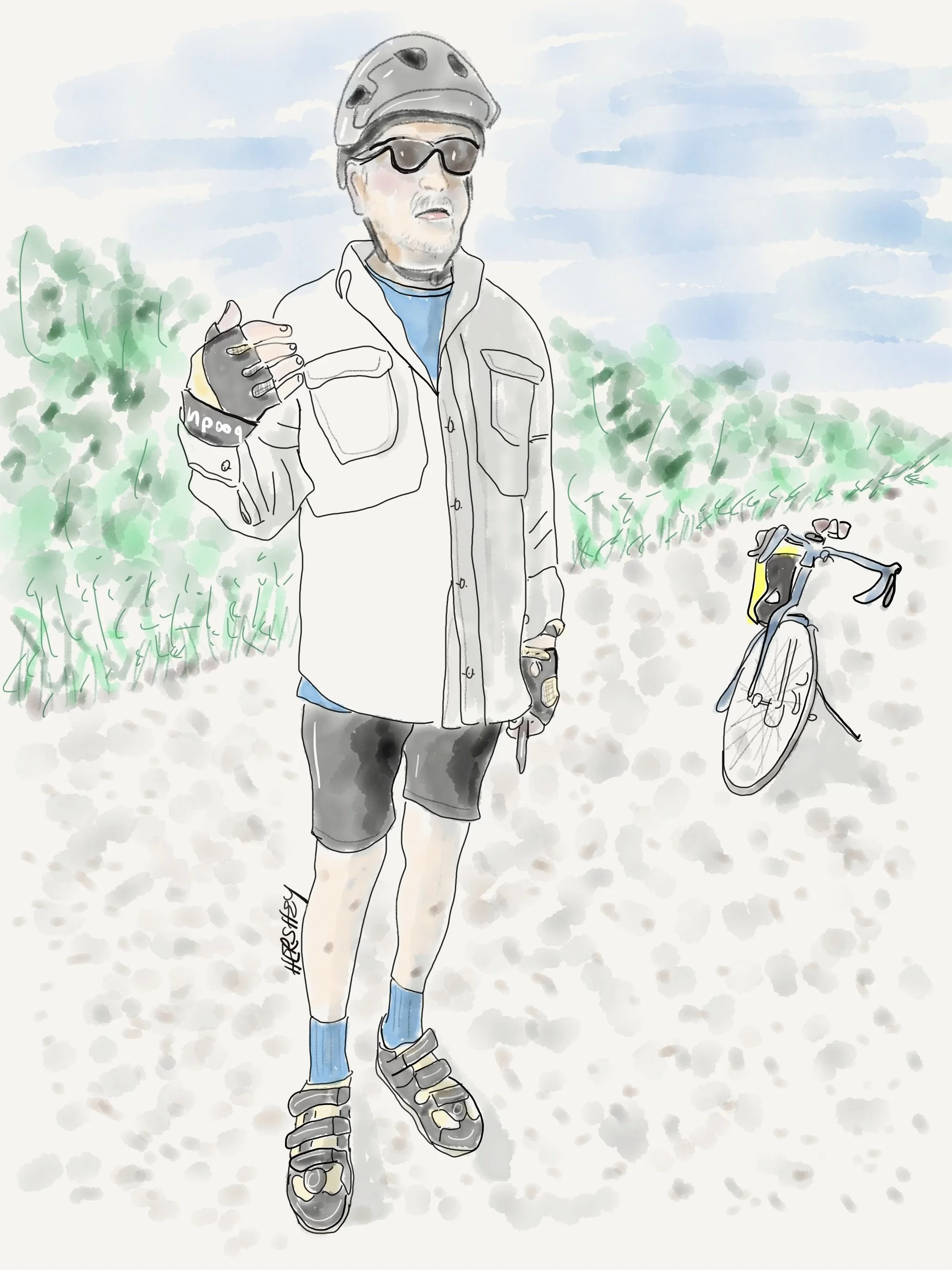
Jeff Mills is a resident of Lanark County in Ontario, Canada. We met him while biking on the Ottawa Valley Recreational Trail (OVRT). A lifelong community developer, Jeff helps to create great biking infrastructure in Lanark and Renfrew Counties. He (and his colleagues) envision a system of rail-trails similar to the Greater Allegheny Passage (GAP Trail) that runs from Pittsburgh, PA to Cumberland, MD. The hope is to create a bicycling destination with global appeal that will help revitalize small communities in northeastern Ontario. Between the OVRT and the Algonquin Trail, they have an excellent start! We were lucky enough to spend a wonderful evening at Jeff’s beautiful home with his lovely wife Gillian and his friends Chandler and Mike. Drawing by Jenny Hershey. Follow her on Instagram @ deepfo.
That isn’t to say that the oil and gas lobby, and the politicians in their pockets, won’t engage in mind-boggling attempts to stop that momentum. Republican politicians in some red states are seeing clean energy handwriting on the wall, and they don’t like it. In fact, the legislatures in both Texas and Florida have recently tried to stop the growth of clean energy projects in their states. Thankfully, because investments in clean energy in both states are so strong (and led by many registered Republicans), the Chambers of Commerce and other business groups, local municipalities, environmentalists, public health advocates and investors have prevailed in their fight against these legislatures to preserve the workings of the free market. It isn’t hard to understand why. According to research by Energy Innovation as reported by David Wallace-Wells in a recent New York Times Op Ed, green energy tax credits in the Inflation Reduction Act are poised to create more than 100,000 jobs in Texas alone by 2030 — which would add more than $15 billion to the state economy over that time. And similar gains are estimated in Florida, where Energy Innovation projects more than 85,000 new jobs and $10 billion in state G.D.P. gains by 2030.
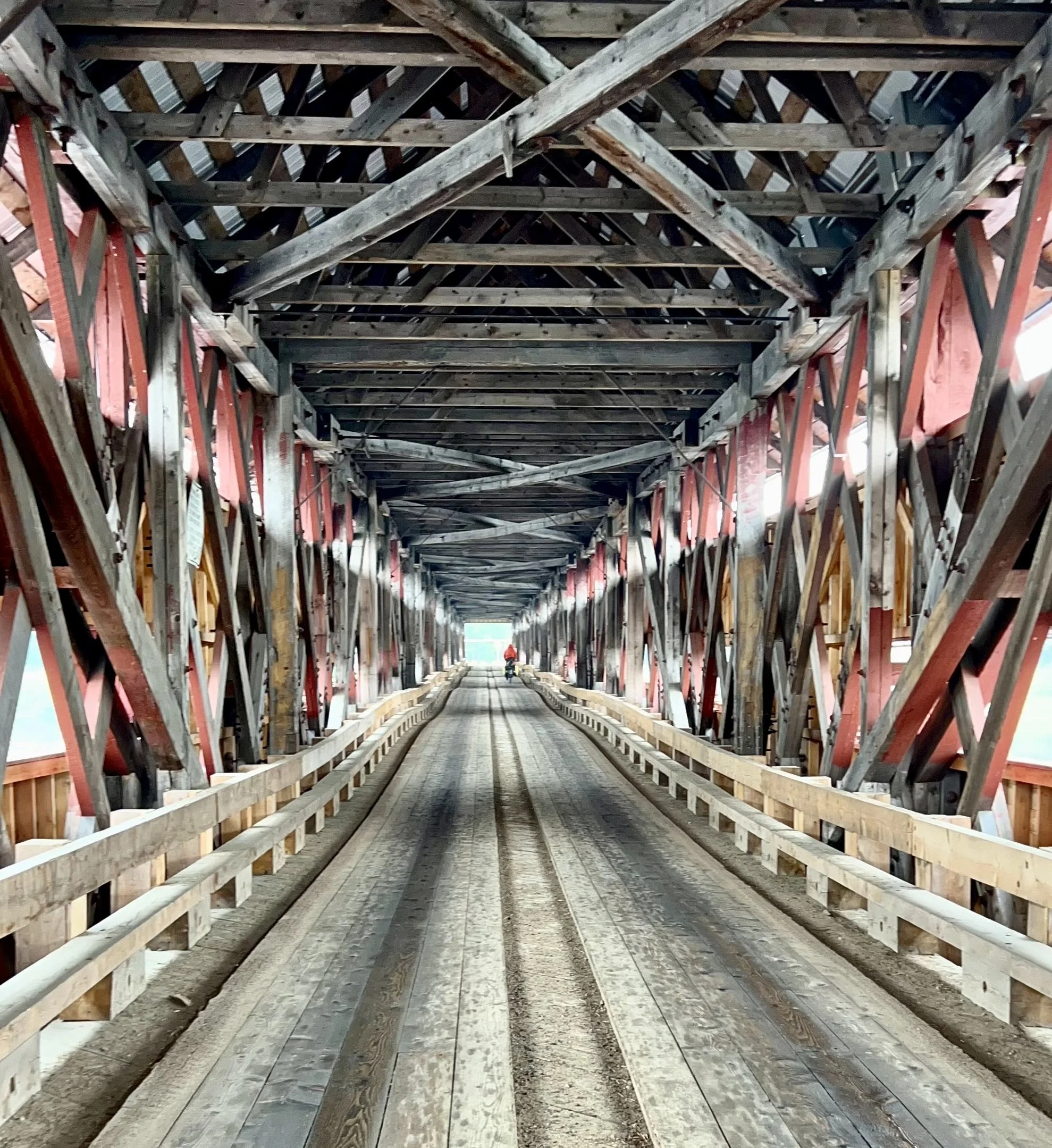
Michael bikes across a covered bridge in Mansfield et Pontefract, Quebec. Photo by Jenny Hershey. Follow her on Instagram @ deeofo.
But it’s not just a couple of red states that are being forced to capitulate to the self-evidence of market forces. Other parts of the world are willing to get serious about the energy transition, as well. China remains focused on cornering the huge new clean energy market, with ever-more massive investments in electric vehicle production, battery technology, wind turbines and solar panels. Europe continues to aggressively wean itself off both oil (through electric vehicle mandates) and Russian gas imports (through energy conservation and the rapid deployment of renewables). Canada established a price on carbon several years ago to incentivize clean energy development. Currently, 90% of the revenue from a federal fuel charge goes directly back to households through the climate action incentive payment (CAIP). This is a tax-free benefit the government pays back to citizens to help offset the cost of carbon pricing. The average household gets back more than they’ve paid into the system. Only higher income households pay more than they get back because they tend to use more fossil fuels.
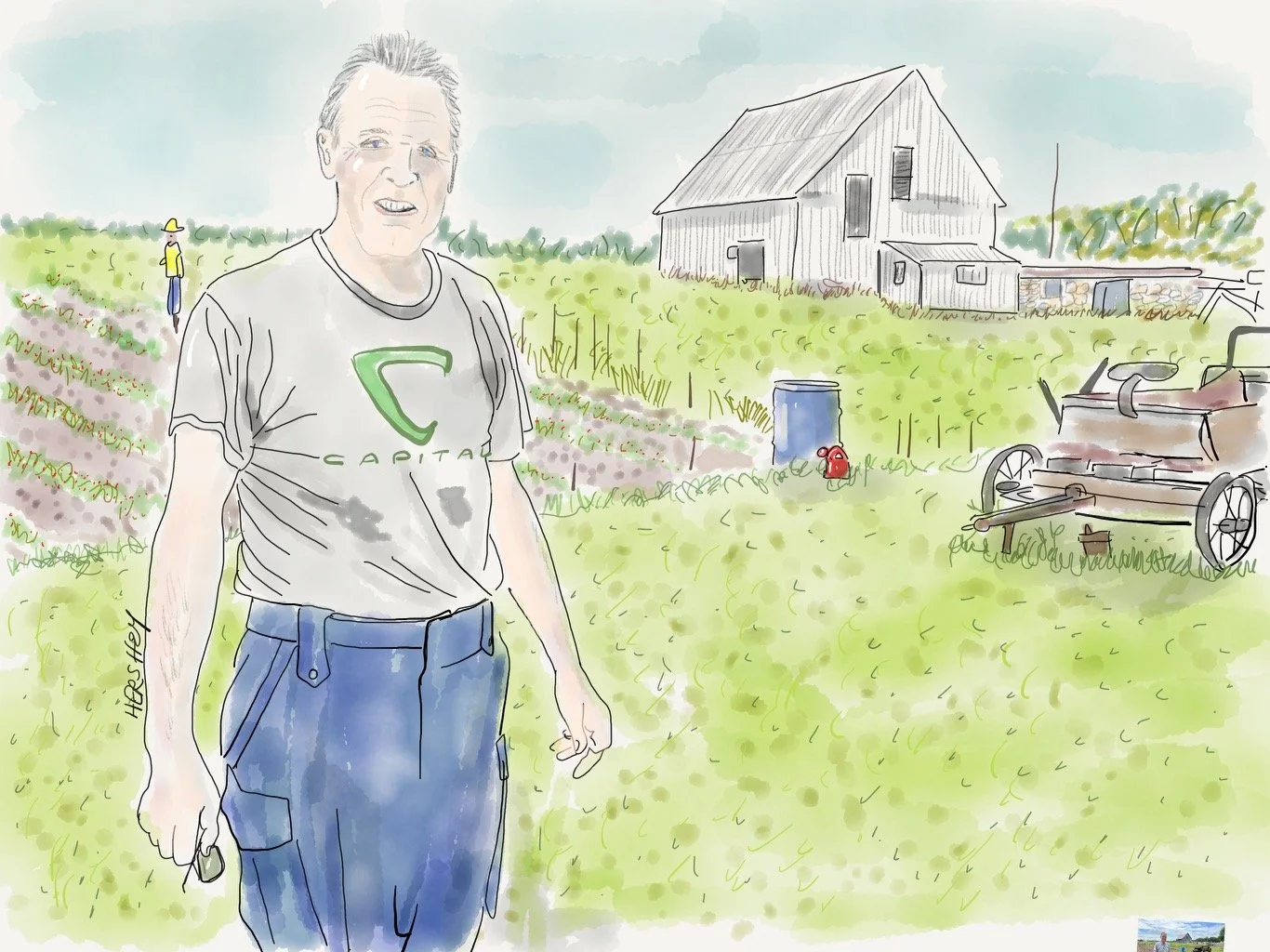
Al is a retired policeman from Ottawa. We met him in Renfrew while he was tending his garden. He was eager to chat and showed us a stone house from 1865 he had purchased from a family that had acquired homesteading land from the Crown seven generations earlier. Al was proud of his antique collection. Eventually we asked about the wildfires. He believes the fires were most likely started by carelessness, and maybe some lightening. He hedged about the climate but eventually agreed with us the climate is changing. A very friendly guy, Al sent us off with a classic milk bottle and a horseshoe for luck (both somewhat challenging to carry on our bikes, but he was insistent). Michael gave the milk bottle away to our host Jeff Mills, and Jenny left the horseshoe at a farm stand with a couple of Mennonite boys, telling them it might bring good luck. Their father quickly corrected Jenny, saying Mennonites don't believe in luck. But the boys kept the horseshoe anyway. Drawing by Jenny Hershey. Follow her on Instagram @deeofo.
So for all the reasons above, Democrats and other environmentalists in the States don’t need to worry as much about opposing fossil fuel projects as they need to be thinking about getting stuff built, not only to address climate but to keep our economy strong. Yet make no mistake; building out clean energy projects in the United Sates and getting that energy to residents and industries won’t be an easy task, even if that energy is already cheaper and cleaner than fossil fuels. Without a serious effort to streamline permitting and double the size of our utility grid over the next decade (while effectively engaging communities in decision making), we may fail to accomplish up to 80% of the decarbonization goals of the Inflation Reduction Act (IRA).
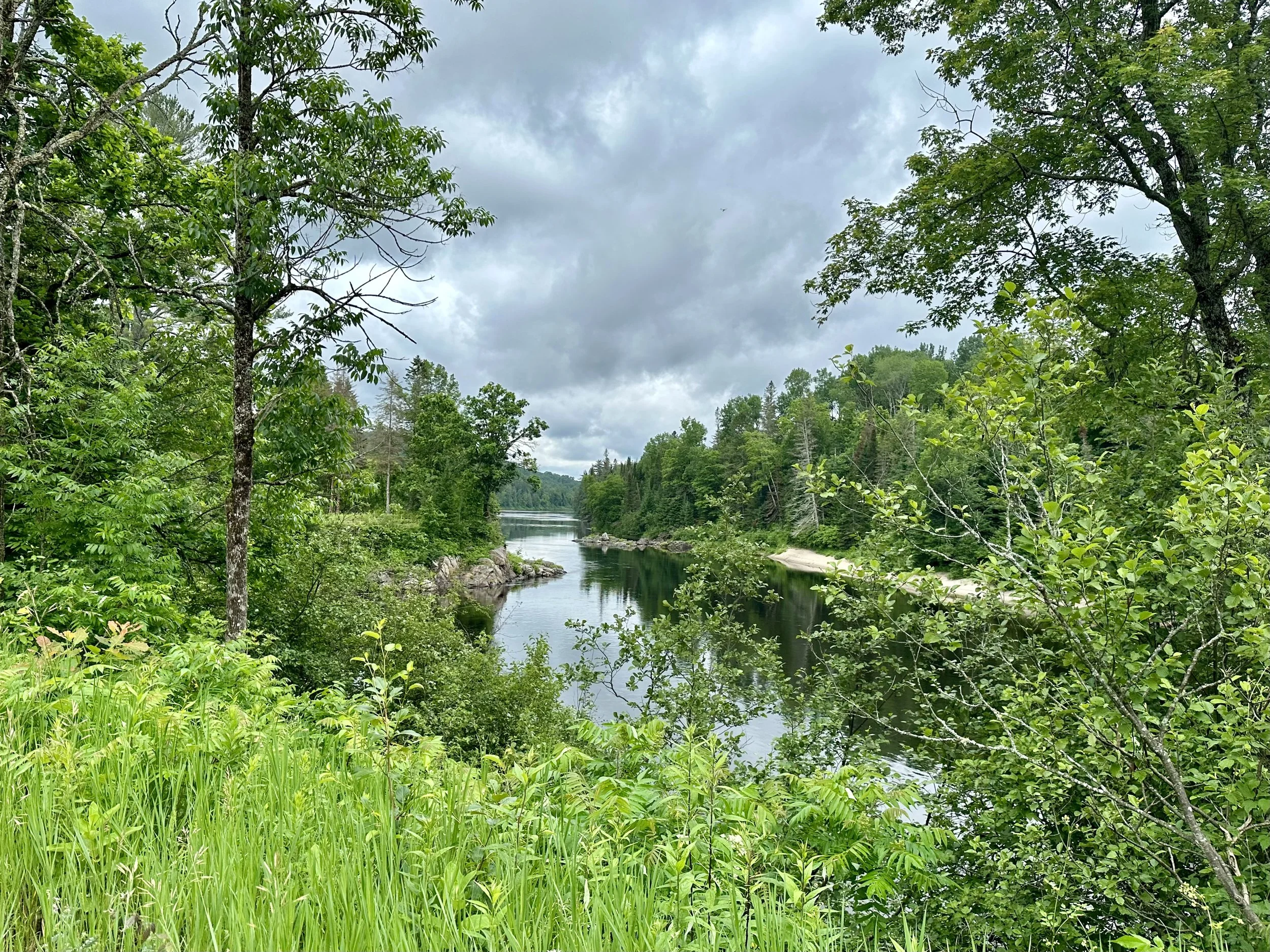
This photo was taken northwest of Fort Coulonge, Quebec, on an unpaved road called the Chemin du Bois Franc. The road extends north for more than a hundred kilometers and is one of many rugged routes into Quebec’s boreal forest. Although we weren't able to ride north on this road for more than about 20 kilometers we felt like we got a small taste of the forest. It was humid, extremely buggy, and although we were told it was unusually dry, we saw water everywhere. Not only is Canada’s boreal forest rich with trees that sequester huge amounts of carbon, it is also home to one of the most significant stores of fresh water on the planet. Photo by Michael Chase. Follow him on Instagram @mjohnsonchase.
————
Wildfires and Conspiracy Theories
“No amount of evidence will ever persuade an idiot.”
-Mark Twain
————
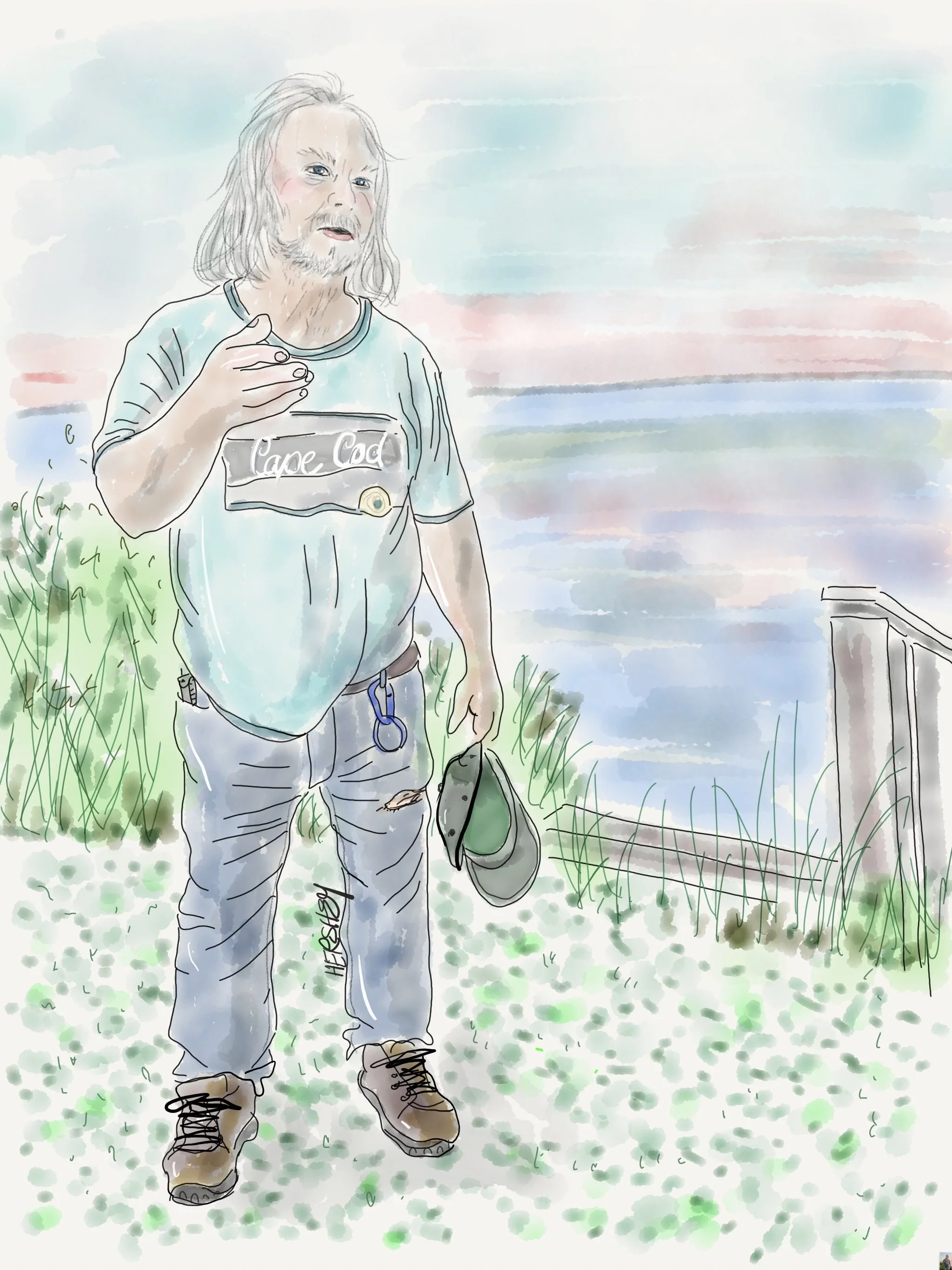
We met “Andy” and his wife “Carol” in Cape Vincent, NY. “Carol” invited us down to the Lake Ontario shoreline to share a sunset made even more intense by wildfire smoke drifting toward us from Quebec. As we talked, “Andy” began to share thoughts about how a group of elites from around the world are plotting to eliminate individual liberties to impose a dictatorial, one-world government. He threw out some names: Klaus Schwab, Rothschild, Mayer, Zuckerberg, Bill Gates…. We were curious and a bit uneasy. So, later in the evening Jenny and I did an internet search. “Andy’s” searches probably go directly to “The Great Reset Conspiracy” attributed to the World Economic Forum (WEF); a conspiracy of world control by a select few through Covid mandates, climate lockdowns, space lasers, and ecoterrorism. “Andy” may assume everyone else will find the same information if they bother to look. But that’s a danger of the internet and misinformation. Search engines learn how to show you results you are most likely to like to maximize your eyeballs on associated advertising. Consequently, whatever information we encounter online, we curate online through our own interests and biases. So, Jenny and I had to do some digging. Apparently “Andy” didn’t notice the Star of David around Jenny’s neck; in any case, she didn’t sleep well that evening. Drawing by Jenny Hershey. Follow her on Instagram @deeofo.
As we are all too aware, Canadian wildfires have been burning for weeks. Research shows that record heat and drought creates earlier starts to every season (with this year breaking all records), resulting in wildfire activity that is longer-lasting and more intense. Caused by a mix of human activity (carelessness and arson), and lightning, it is clear that climate change affects the local conditions and fuel available for these fires to spread, as do the decades of fire suppression techniques that have contributed to unnaturally dense forest environments.
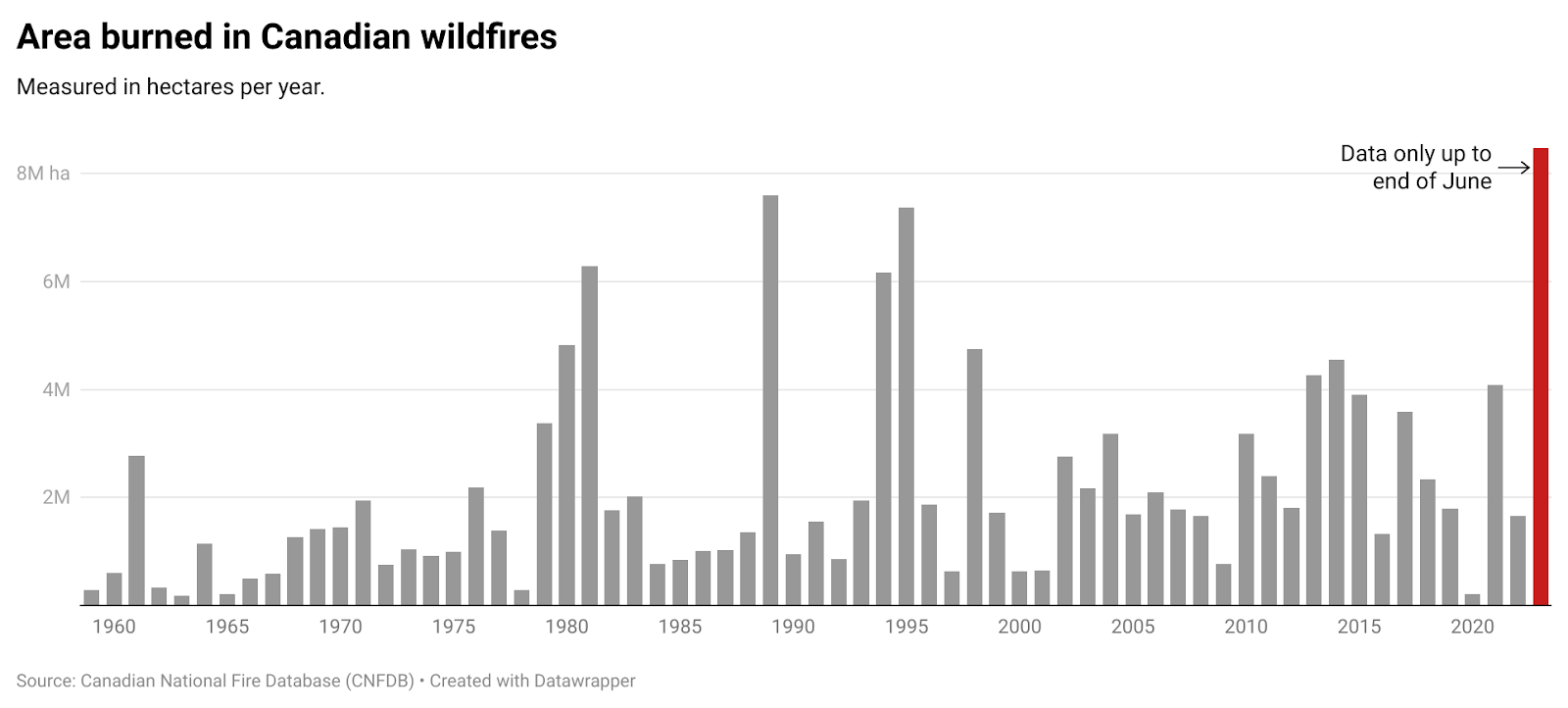
This simple bar graph indicates that by the end of June of this year, a greater percentage of hectares have already burned in Canada than any year since records have been kept. Some news outlets argue that climate change isn't the cause of wildfires because the number of annual fires has been decreasing. However, they all ignore the sheer size and destructive nature of the current fires.
New Yorkers won’t soon forget what the air quality was like on June 7th, 2023. At its peak in the afternoon, the air quality index (AQI) for the city reached 405 out of 500; the highest since records began, according to an analysis of the Environmental Protection Agency (EPA). While we have been biking in Canada over the month of June, over 400 wildfires have continued to drive air quality indexes to record levels in many cities across the eastern seaboard and the midwest. Air quality has been equally poor in Canada. Yesterday (7/2/23), four of the five cities with the worst air quality in the world were in North America. New York City had the second-worst air quality in the world with a recorded air quality index of 162, lagging only behind Jakarta. Toronto and Montreal ranked 3rd and 4th, reporting AQI’s of 155 and 153, respectively. The fifth-ranked city, Washington, D.C., is hundreds of miles away from where Canadian wildfires continue to rage. There, air quality was slightly better than the other three North American cities on the list, with an AQI of 122.
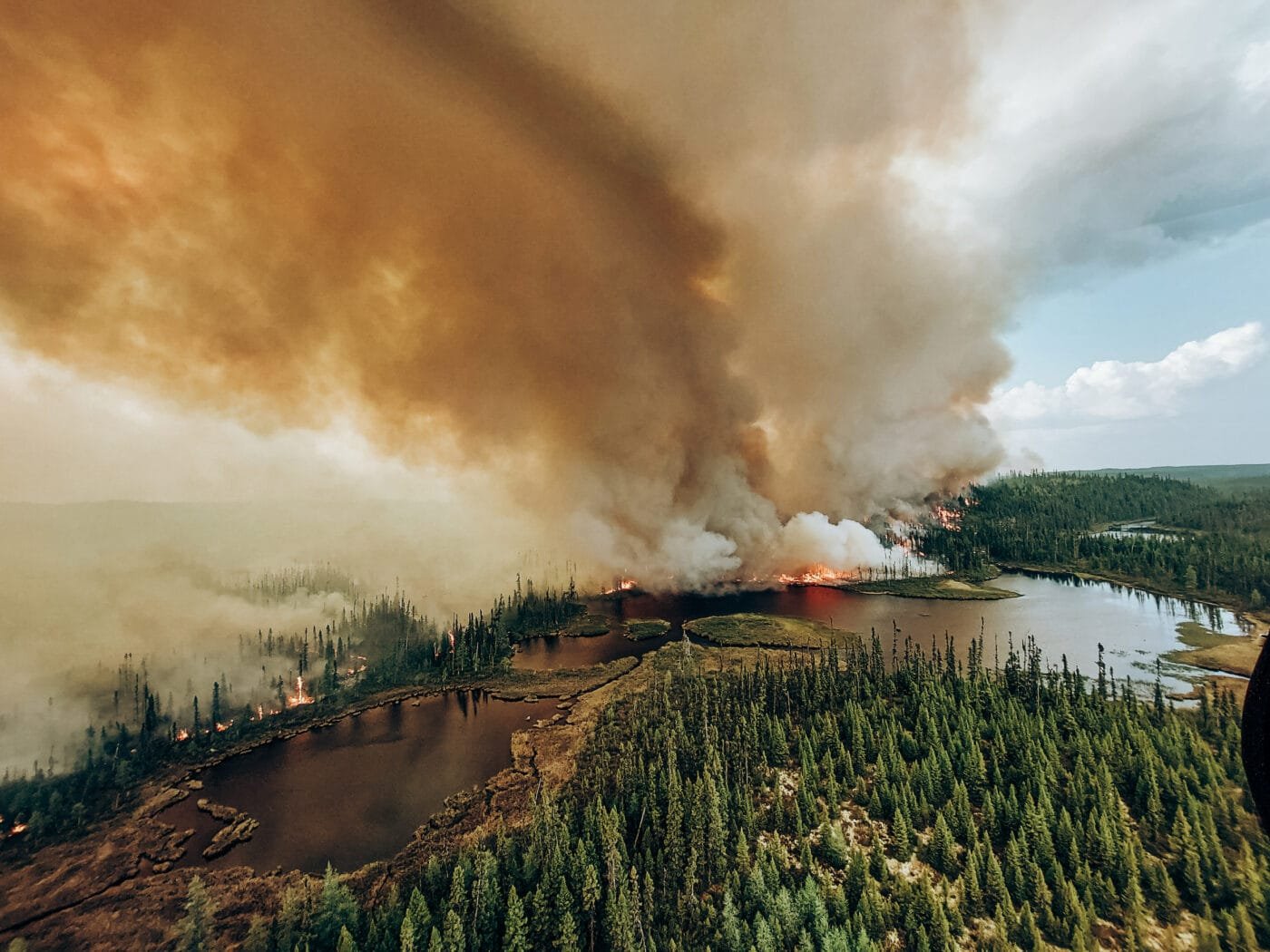
Almost 40 per cent of Canada’s 2023 wildfires have been in Quebec, threatening to evacuate more than 15,000 people. Photo: Société de protection des forêts contre le feu; as seen in The Narwhal.
Ten percent of the world’s forests rise up from Canadian soil, and increasingly those forests look poised to burn as our atmosphere grows warmer. Consider the following passage from a poetic and startling new book by John Vaillant called Fire Weather: “Girdling the Northern Hemisphere in a circumpolar band, the boreal forest is the largest terrestrial ecosystem, comprising almost a third of the planet’s total forest area (more than 6 million square miles—larger than all fifty U.S. states). Fully a third of Canada is covered by boreal forest. Continuing west, over the Rocky Mountains, through British Columbia, the Yukon, Alaska, and across the Bering Strait into Russia (where it is known as the taiga), the boreal forest stretches all the way to Scandinavia and then makes landfall on Iceland before picking up again in Newfoundland and continuing westward to complete the circle. It is a green wreath crowning the globe. This colossal biome stores as much, if not more, carbon than all tropical forests combined and, when it burns, it goes off like a carbon bomb. Under the right conditions, a big boreal fire can come on like the end of the world, roaring and unstoppable. These are fires that can burn thousands of square miles of forest along with everything in it, and still be out of control.”
The scale is hard to get my head around. You may feel the same. And if that wasn't sobering enough, here's another important milestone; fires across Canada this year have ALREADY generated nearly 600 million tons of CO2, which is equivalent to 88% of Canada’s total greenhouse gas emissions from all sources in 2021. More than half of that carbon pollution went up in wildfire smoke in June alone. And the fire season here is only beginning.
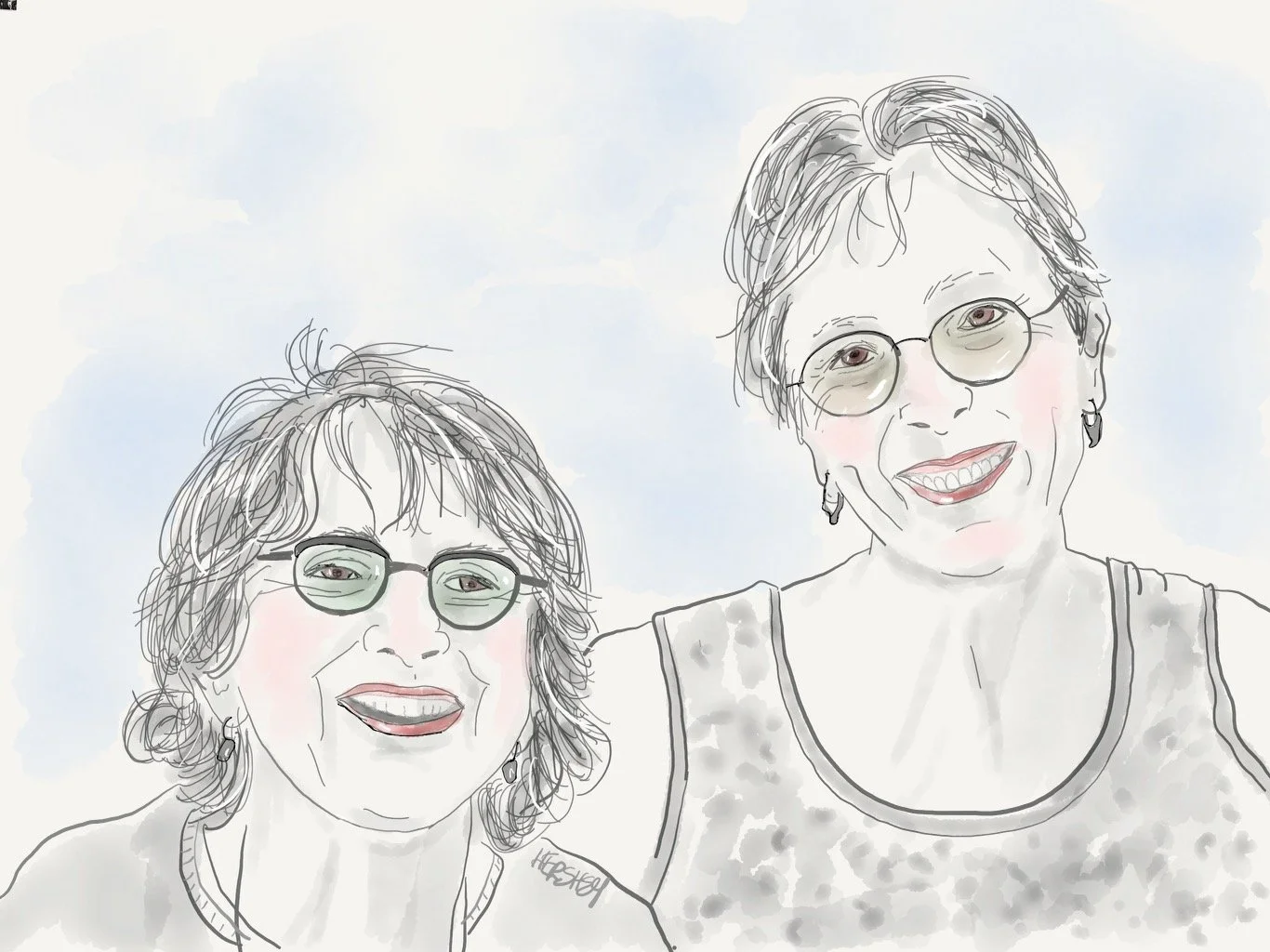
Jenny (left) and Chandler Swain. We met Chandler at our dinner with Jeff and Gillian Mills. Chandler is a master potter, artist, environmental activist and communications director for the Climate Network in Lanark County, Ontario. Although Jenny rarely draws herself, she felt a strong bond with Chandler, whose enthusiasm, tenacity and buoyant energy is infectious. Chandler’s passion for environmental work has led her to write about network initiatives for the local online paper, The Humm. Her personal website can be found here. Drawing by Jenny Hershey. Follow her work on Instagram @deeofo.
And the causes of the fires? Well, as we discovered through our conversations with some Canadians (but not all, thankfully), blaming wildfires on the unusually hot and dry conditions resulting from a gradually warming world brought on by 250 years of unrelenting greenhouse gas emissions is, well, a bit too convenient. After all, why buy into dry weather that makes human carelessness or lightning strikes the reason (but not the root cause) when you can believe in something far less complex? Stew Peters, the same man who made a film claiming that Covid-19 is caused by synthetic snake venom, blamed the Canadian wildfires on Directed Energy Weapons on June 5th of this year. Apparently he sent out a TikTok video with visuals that made southeast Quebec appear as though hundreds of locations were catching on fire at the same time. This allowed him to claim that “our governments” are targeting their own forests for nefarious reasons.
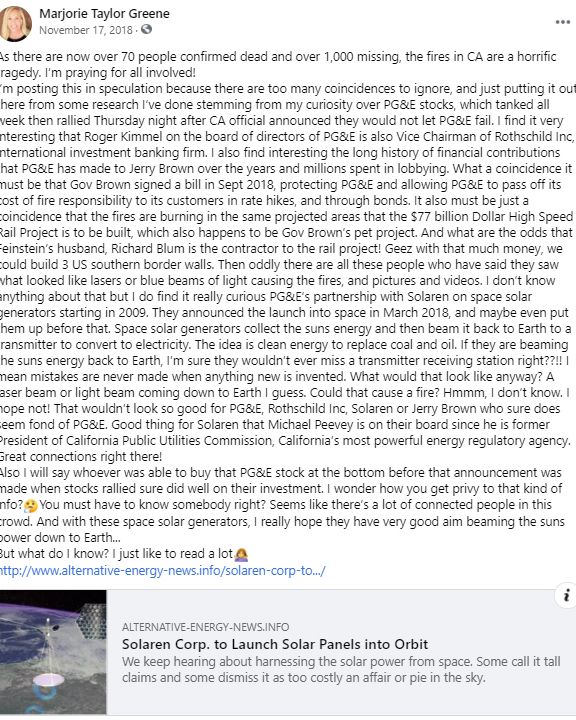
I'm not sure if Directed Energy Weapons (DEWs) are related to the infamous Jewish Space Lasers that Congressional Representative Marjorie Taylor Greene previously implicated in a wildfire outbreak, but it's clear her theory is followed. Here it is on Donald Trump’s Truth Social. According to the Congresswoman, forests don’t catch fire simply because they are extraordinarily hot and dry. Representative Greene claimed the blazes had been started by PG&E in conjunction with the Rothschilds, by using a space laser to clear room for a high-speed rail project. Really, one cannot make this stuff up. For those of you who don’t believe me, you can read Greene’s entire post here on Media Matters.
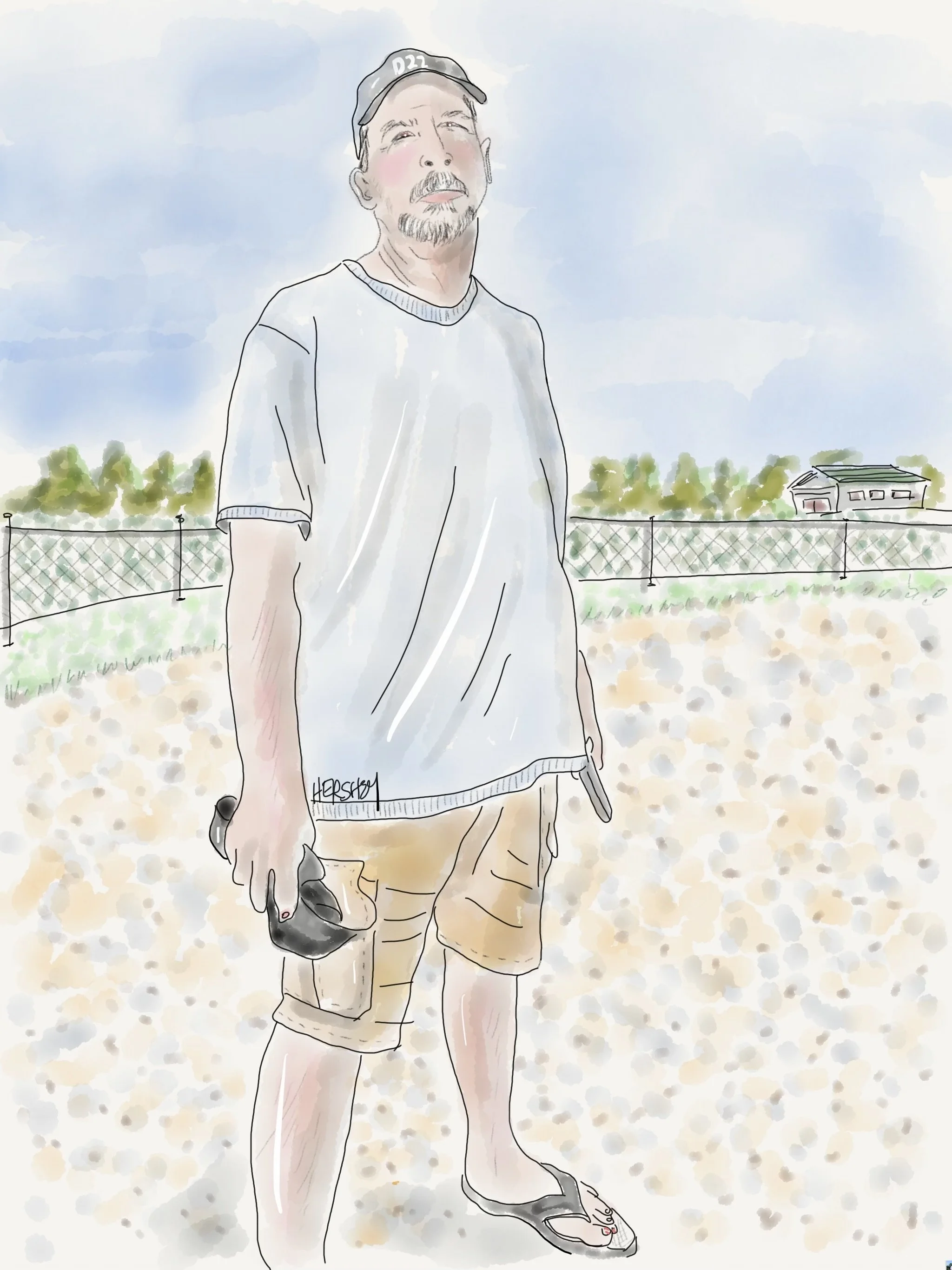
We stayed in Alain and Paola’s small cabin behind their home in Mansfield-et-Pontefract. Alain is a retired postman. He started his route after graduating from high school when he was 16 years old. His dad was a supervisor and he wanted to follow in his father's footsteps. Alain walked 20 Km (12 miles) a day, year round, using ice cleats to navigate cold, icy winters for over 40 years. Each neighborhood he serviced brought new friendships and relationships. Alain said, “I don’t get attached easily, but the old folks - they’d wait all day for me. I was sometimes the only person they talked to. It was hard to walk away.” Alain is very devoted to his wife. He is also a superb Airbnb host with a simple philosophy—deliver hospitality! Drawing by Jenny Hershey. Follow her on Instagram @deeofo.
But not all the theories borrow from Conspiracy mongers who make their homes in the States. Alberta Premier Danielle Smith (who is not friendly toward Canadian climate policies) was asked about the cause of Alberta wildfires in early June by Canadian talk show host Ryan Jespersen, and suggested that the more than 175 fires burning in Alberta at the time were all caused by arson, not climate change. Others in Canada have taken the arson theory a step further, indicating that the arsonists are Trudeau government operatives who are out to increase the federal carbon price.
Our friend Andy from Cape Vincent disturbed us with his reference to a cabal with mostly Jewish names, seemingly unaware that he (and others of his ilk) are dredging up the same anti-Jewish theories that preceded the Nazis and the rise of Hitler. “Anti-Jewish prejudice is very old – it goes back to antiquity – but the 19th century was crucial,” writes Matthias B. Lehmann, Teller Family Chair in Jewish History and professor of history at UCI, in The Baron: Maurice de Hirsch and the Jewish Nineteenth Century. “It was the moment when modern-day antisemitic conspiracy theories first crystallized, and those are still very much being used today.”
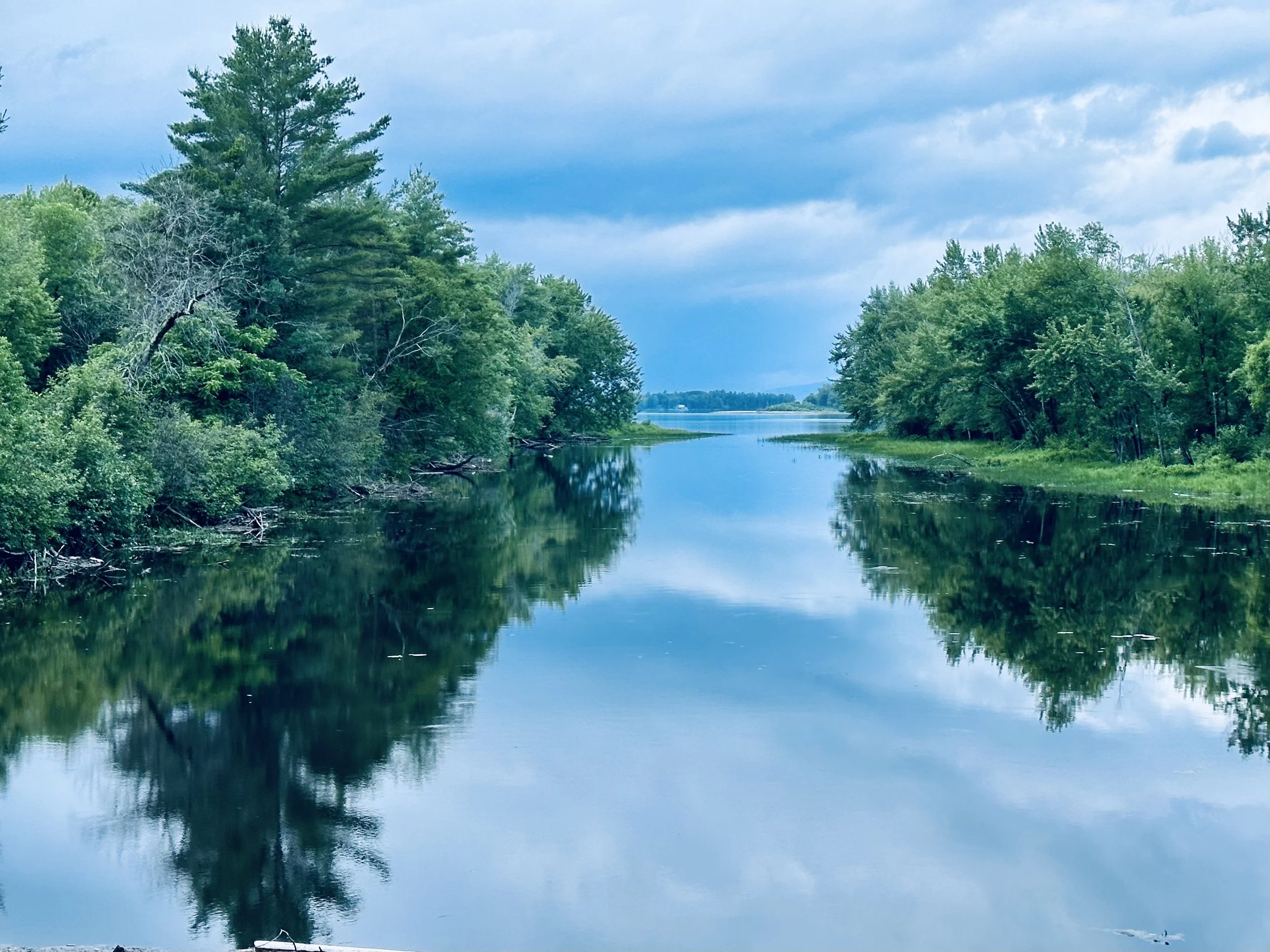
A view of the Coulonge River looking north. We were told that one of the smaller fires in Quebec was about 75 miles north of here. Photo by Michael Chase. Follow him on Instagram @mjohnsonchase.
Sometimes the enemy is the U.S. government and Biden, or the Canadian government or Trudeau. Or it's a cabal of rich people connected to the World Economic Forum wanting to control the world. Or sometimes it’s wealthy people in general, especially if they are Jewish. Or blacks or Hispanics or Muslims. Or they might be communists or socialists. Or Democrats. Or LBGTQ people. Or Public Health officials. Recently it was the queen of England, believed by a number of people to be the head of a brutal global drug cartel. As Anna Merlen writes in her fascinating book, Republic of Lies, conspiracy theories are, in the end, not so much an explanation of events as they are an effort to assign blame. More than questioning an official narrative, they are aimed at identifying the real perpetrators, the true power behind the throne, the hidden hand pulling beneath the surface.
So, it almost seems quaint that a not-insignificant chorus of Canadians blame the current wildfires sweeping across much of the country on climate activists and laser-less government operatives willing to drive into the woods and strike a match. It’s those pesky arsonists, and not natural forces or human carelessness driven by a hotter and drier climate that’s the real culprit for all the choking smoke that has driven children, seniors and others with respiratory issues inside, blocking out the sun and making air nearly impossible to breathe.
Whoever, or whatever it is, it's likely to happen more and more often until well after we decarbonize our atmosphere.
Let's get on with it.
Stay vigilant! Thanks for reading. If you haven’t done so, please subscribe to this blog to follow our next biking trip.
Blog writing by Michael Chase. Drawings by Jenny Hershey. Unless credited or otherwise noted, all material is the copyrighted property of the blog post authors.
Here are a few more photos from the trip:
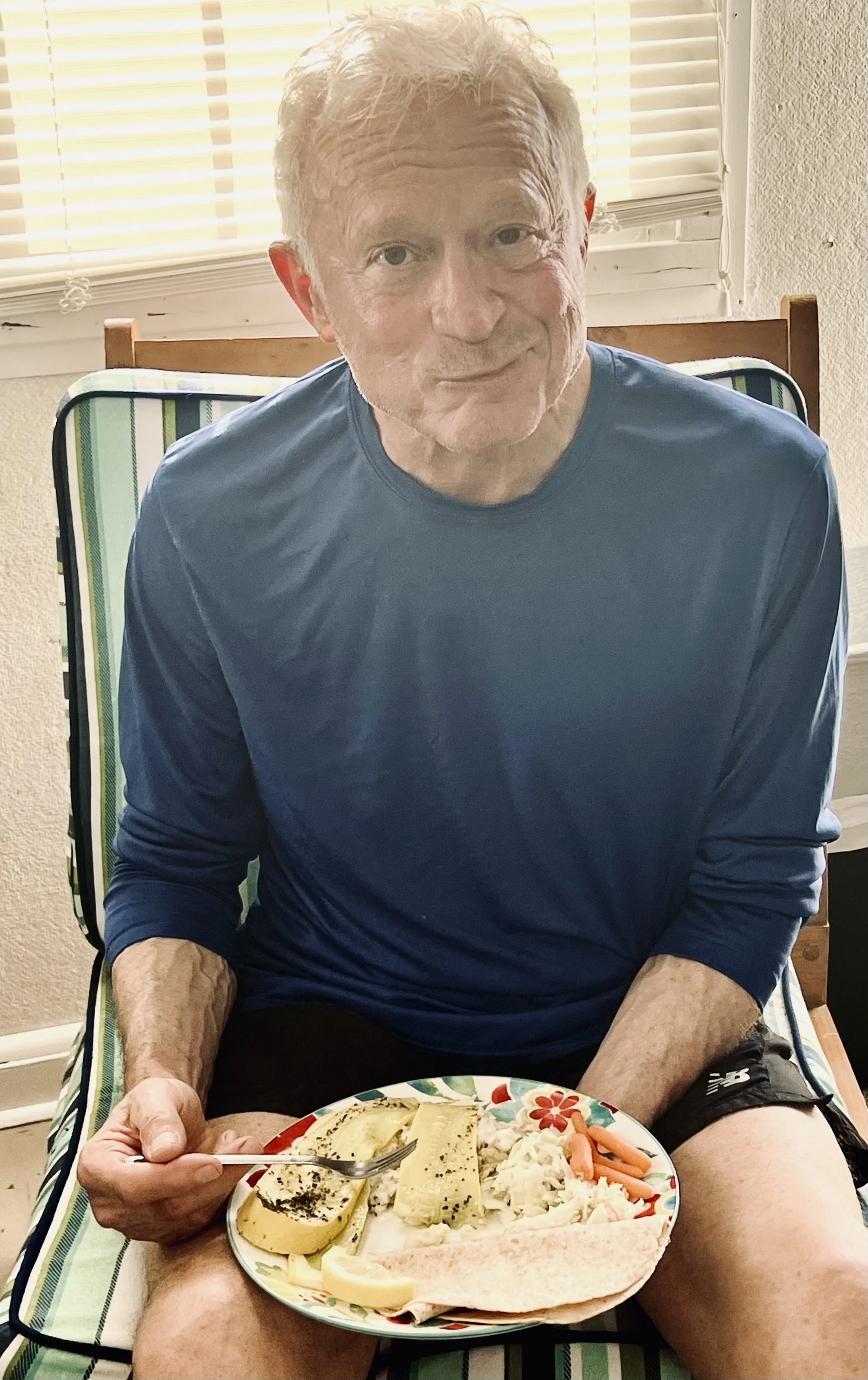
Michael enjoying one of Jenny’s extraordinary meals.Although Michael is a decent cook in his own right, Jenny has become an exceptional cook on the road, and we eat very well using local produce and protein and the microwaves we find in our modest accommodations. Photo by Jenny Hershey. Follow her on Instagram @deeofo.
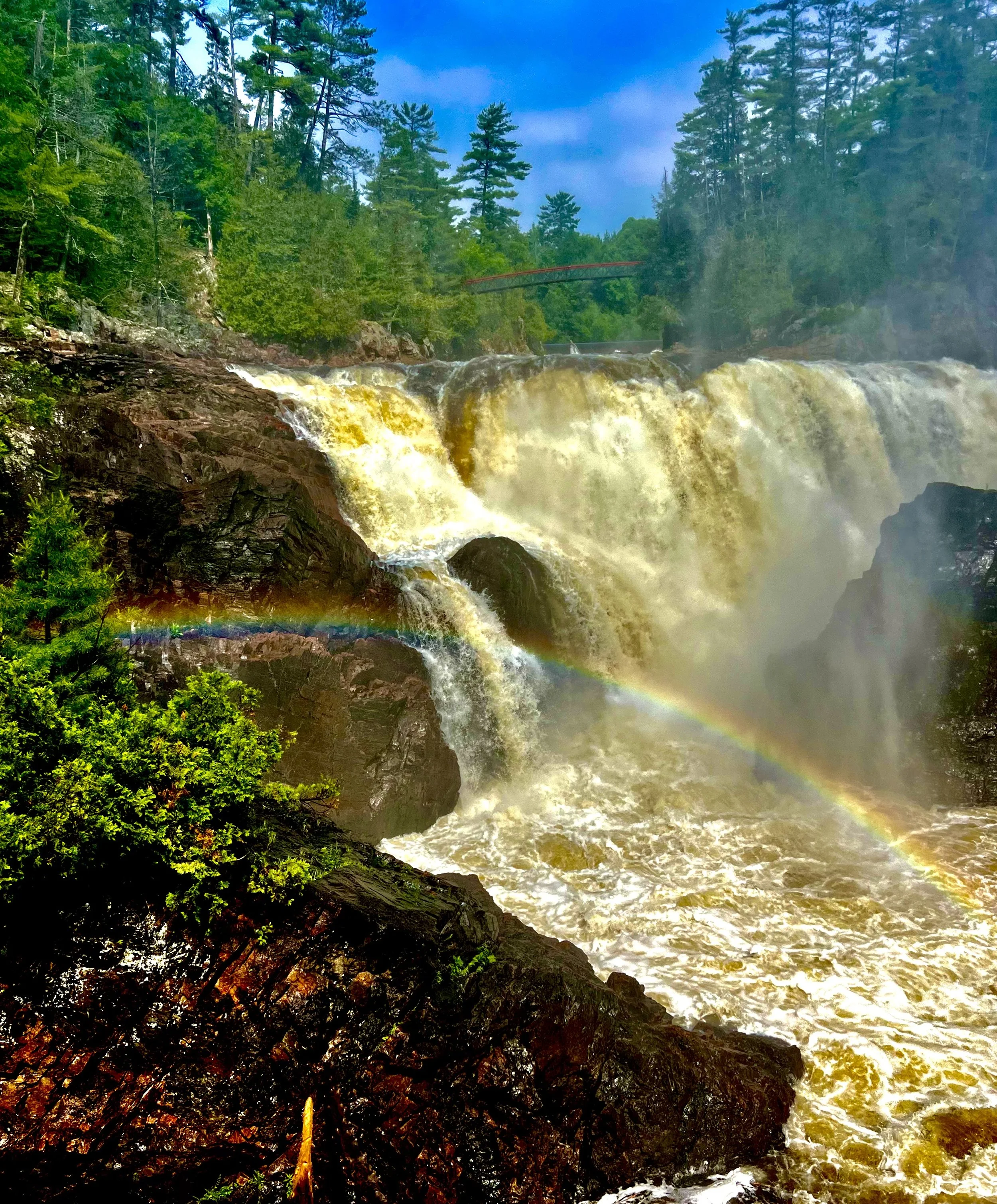
The Chutes de Coulonge on the Coulonge River in Quebec. Photo by Jenny Hershey. Follow her on Instagram @deeofo.
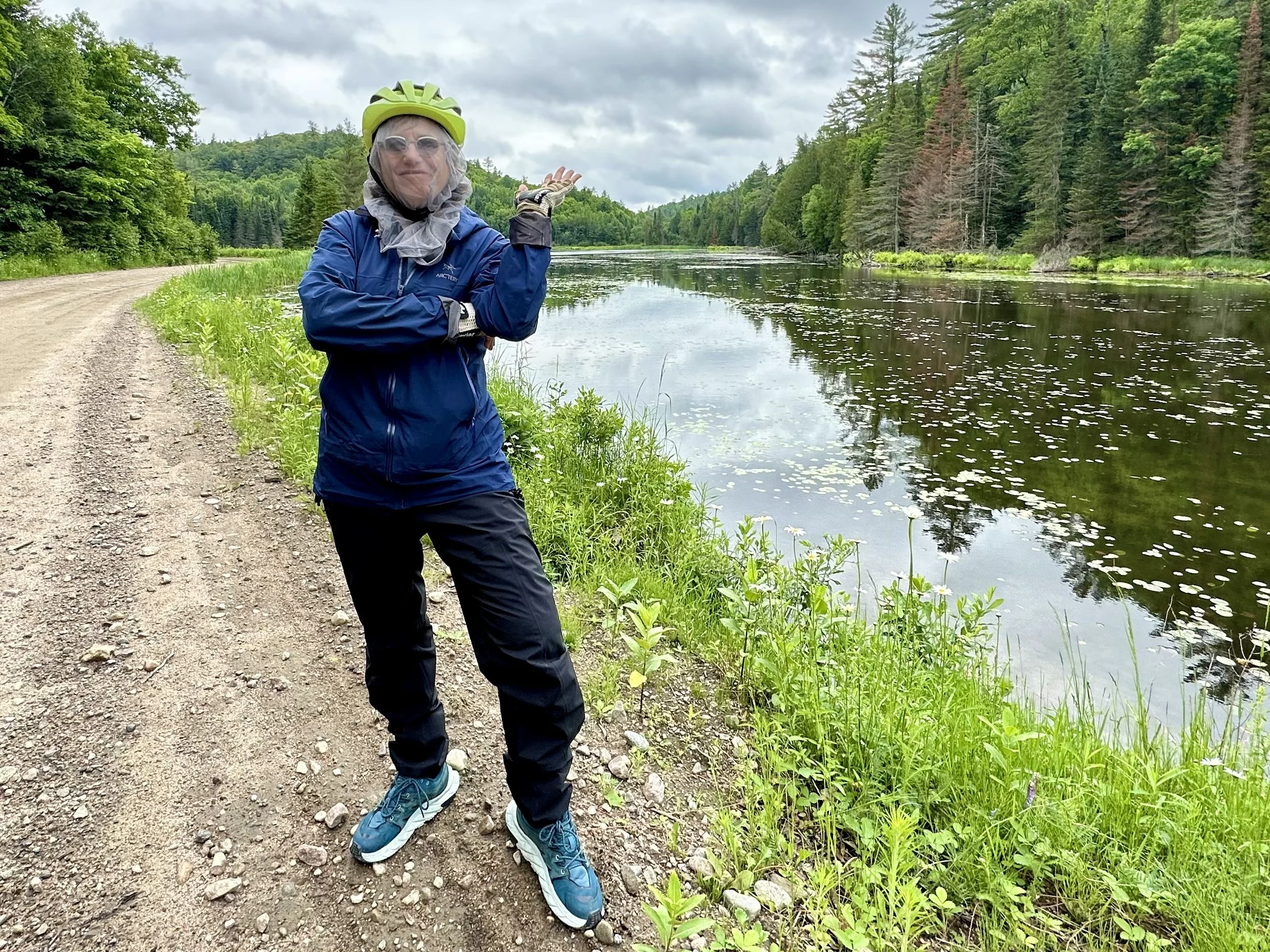
Jenny with a mosquito net over her head goofing around in Quebec. Photo by Michael Chase. Follow him on Instagram @mjohnsonchase.