
Water and a Pipeline; Biking Mississippi and Arkansas, Part 2
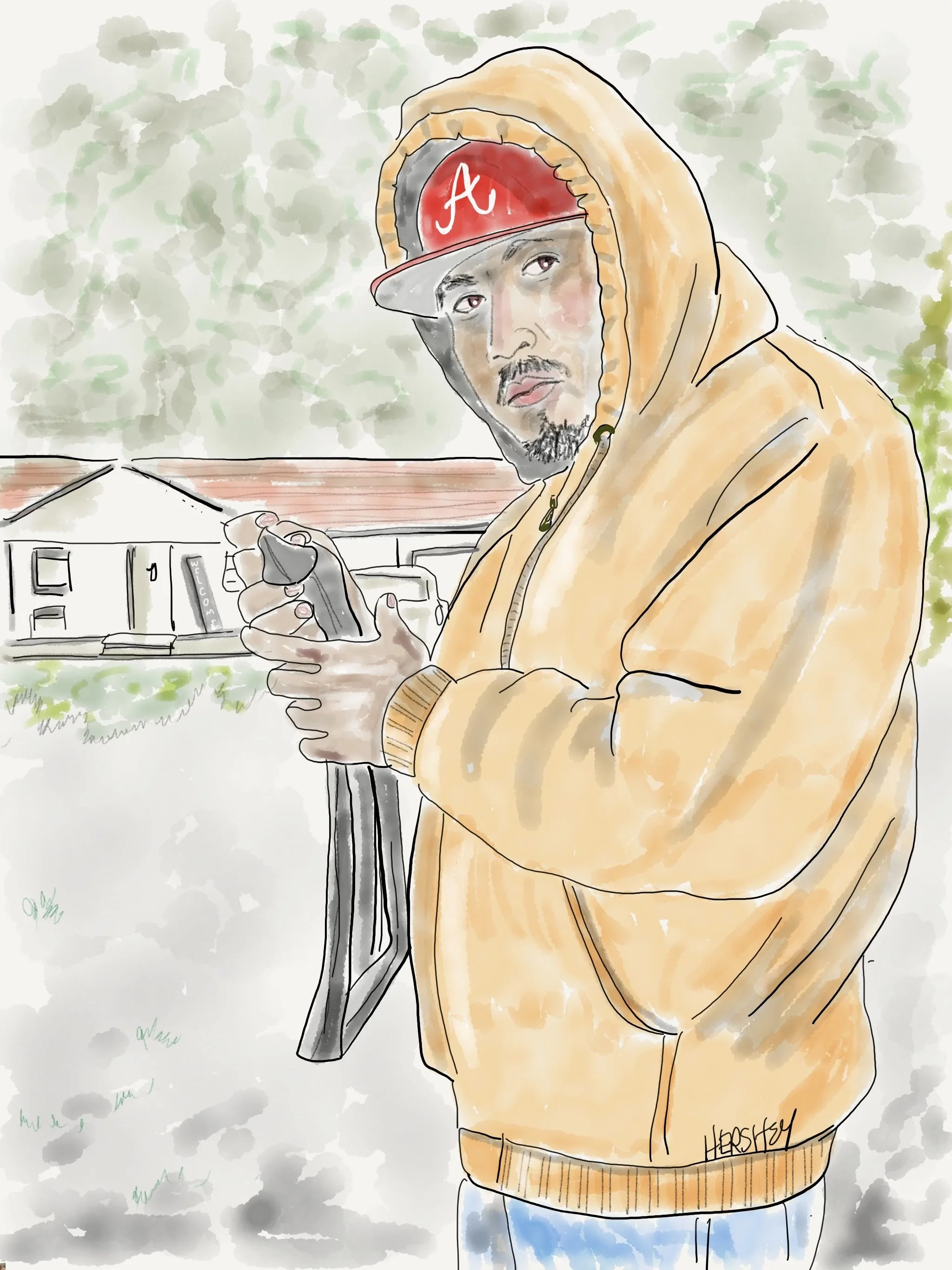
We met Jorge outside Jacksonville, Arkansas, just east of Conway. He graciously allowed us to fix a flat tire in his driveway, the third of seven flats we had on this trip. Jorge immigrated to Arkansas from San Luis Potosí, Mexico, 12 years ago, and enjoys a peaceful life with his wife and 4 kids. He told us he was “muy feliz.” He works a 9-5 job Monday through Friday in home construction, and spends the weekends with his kids doing sports. Jorge was a bicycle mechanic in Mexico and masterfully found the leak in our tube before we were even able to look. We were touched by his kindness.
Drawing by Jenny Hershey. Follow her on Instagram @deeofo.
——————
“Caution is the eldest child of wisdom.”
- Victor Hugo
——————
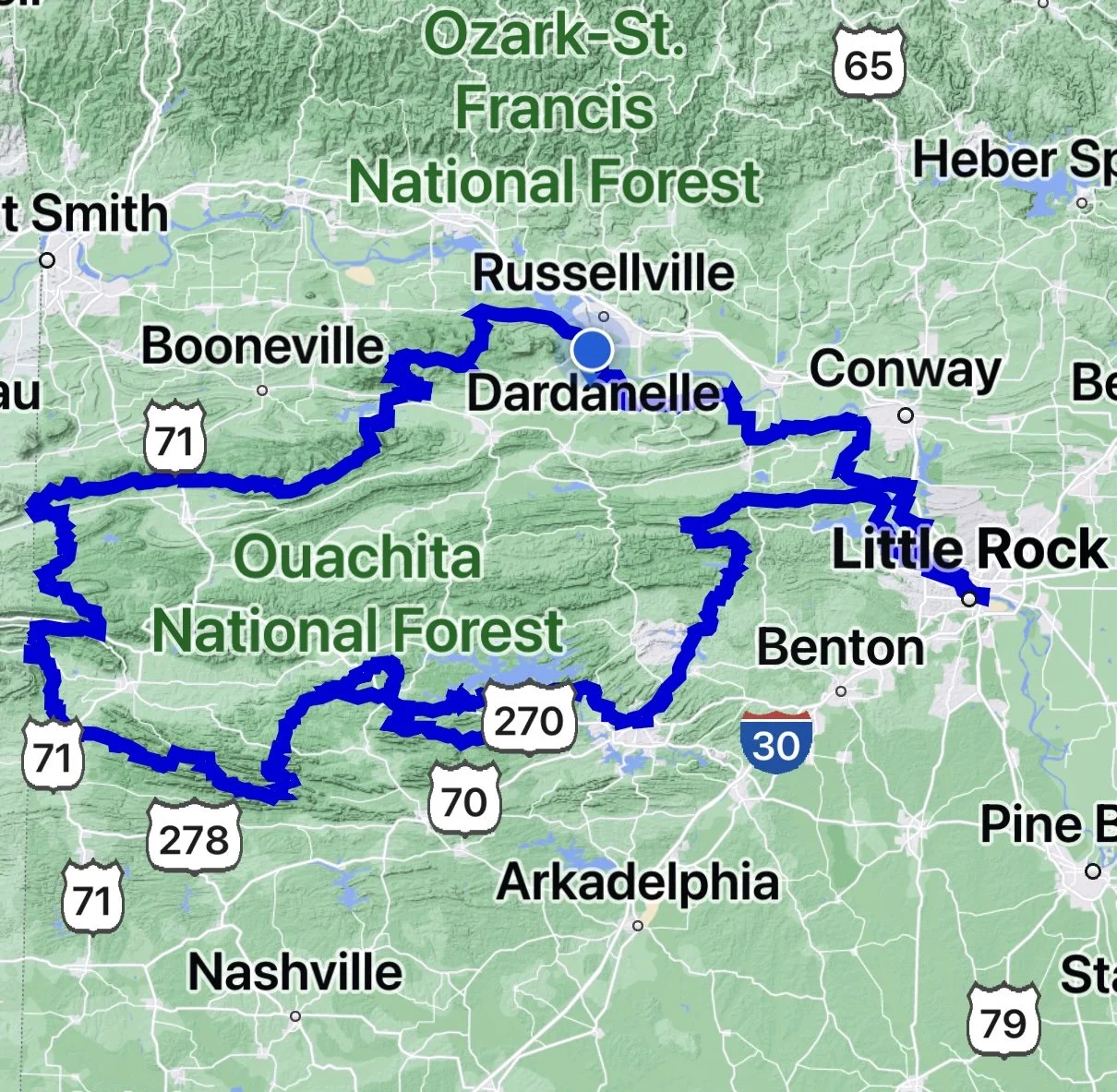
Jenny and I planned our bicycling trip through the Ouachita Mountains in the Ozark High Country, following a route from Conway to Little Rock. From there, we will take an Amtrak train to visit family in Milwaukee and another train back home from Chicago to New York City. We used a map the American Cycling Association provided to guide us on our journey.
Writing by Michael Chase, Drawings by Jenny Hershey
After a very satisfying ride across Alabama and Mississippi and the extraordinary delta country of eastern Mississippi and Arkansas (the subjects of Post 1 in this series), we headed toward the Arkansas River and the Conway/Little Rock region of Arkansas. The Adventure Cycling Association has created an extraordinary tour of the Ozarks out of Little Rock that features northern and southern loops collectively called the Arkansas High Country Route.
Confidant that climate-related stories are now to be found anywhere and everywhere, we already knew about the deadly tornadoes of March 31, 2023, that had moved through a large portion of the south and midwest, including a particularly devastating tornado that hit North Little Rock, only one week after the Amory, Rolling Fork and Silver City tornadoes in Mississippi. Although we didn’t see the neighborhoods in North and West Little Rock devastated (nor the shopping center that took out a Trek Bike Shop, among other businesses), we saw large swaths of park damage on both sides of the Arkansas River. The North Little Rock tornado had winds up to 165 mph and a path length spanning 20-25 miles, which is unusually large. We thought we would likely see more tornado destruction (see Part 1 in this series). However, on our way to Lake Maumelle from Little Rock, we discovered a different water-related climate story that captured our interest.
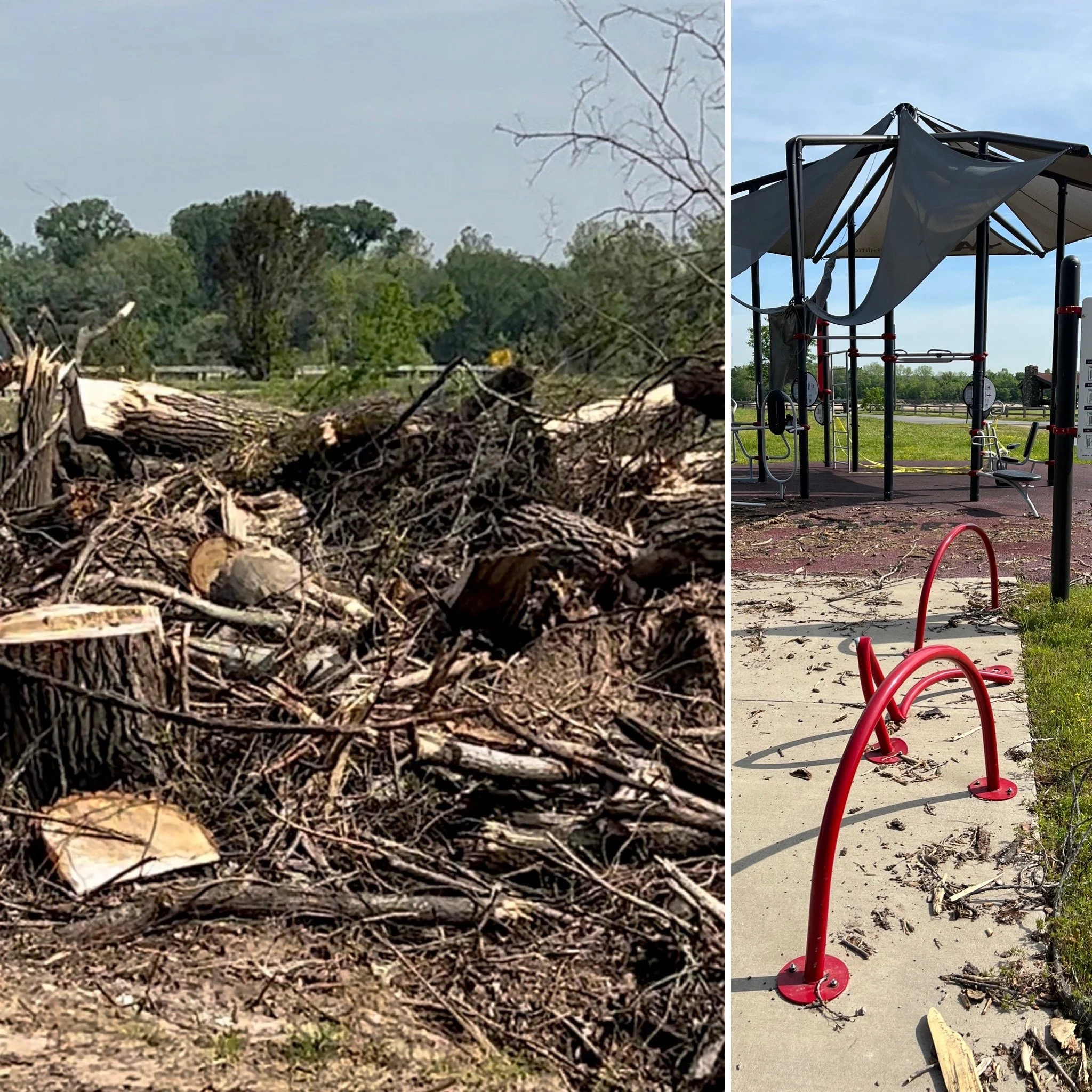
It’s difficult to photograph the impact of a tornado in a natural setting, and we took many pictures we weren’t pleased with. We must have seen several hundred stumps in one area of Rebsamen Park in Little Rock. We captured these shots more than 5 weeks after the tornado hit. Workmen have been working nonstop to get debris cleared, and there are still many places in the park that are this damaged.
—————
Mayflower, Arkansas, is a small suburban development nestled between North Little Rock and Conway. You might remember the Pegasus Pipeline oil spill in 2013. Owned by ExxonMobil, and used to carry Canadian tar sands oil to the Gulf Coast, it ruptured and dumped approximately 10,000 gallons of tar sands oil into the Mayflower Northwoods subdivision.
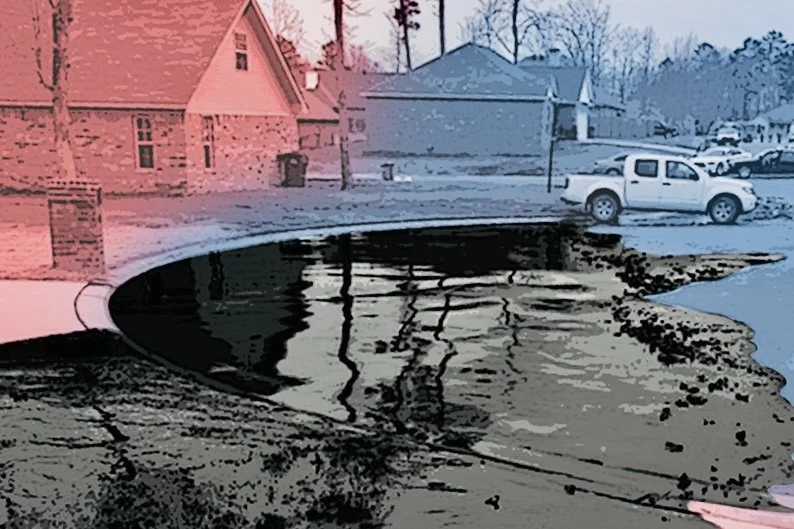
A picture of the spill in 2013, as published in Inside Climate News. Credit:EPA.
Jenny and I were intrigued by this story (and its lack of a resolution, which I will get to later), so we chose to bike to Mayflower, Arkansas, to see the site of the spill for ourselves. Not surprisingly, ten years later there are no telltale signs of the spill short of a pipeline identification pole (see photo below). Yards blackened by oil that we had seen in other pictures are now green with grass and homes evacuated shortly after the spill look intact and peaceful with pickups and SUVs in the driveways. Among the only visible reminders of the leak are a couple of vacant plots on each side of a cul-de-sac at the corner of the neighborhood closest to the pipeline.
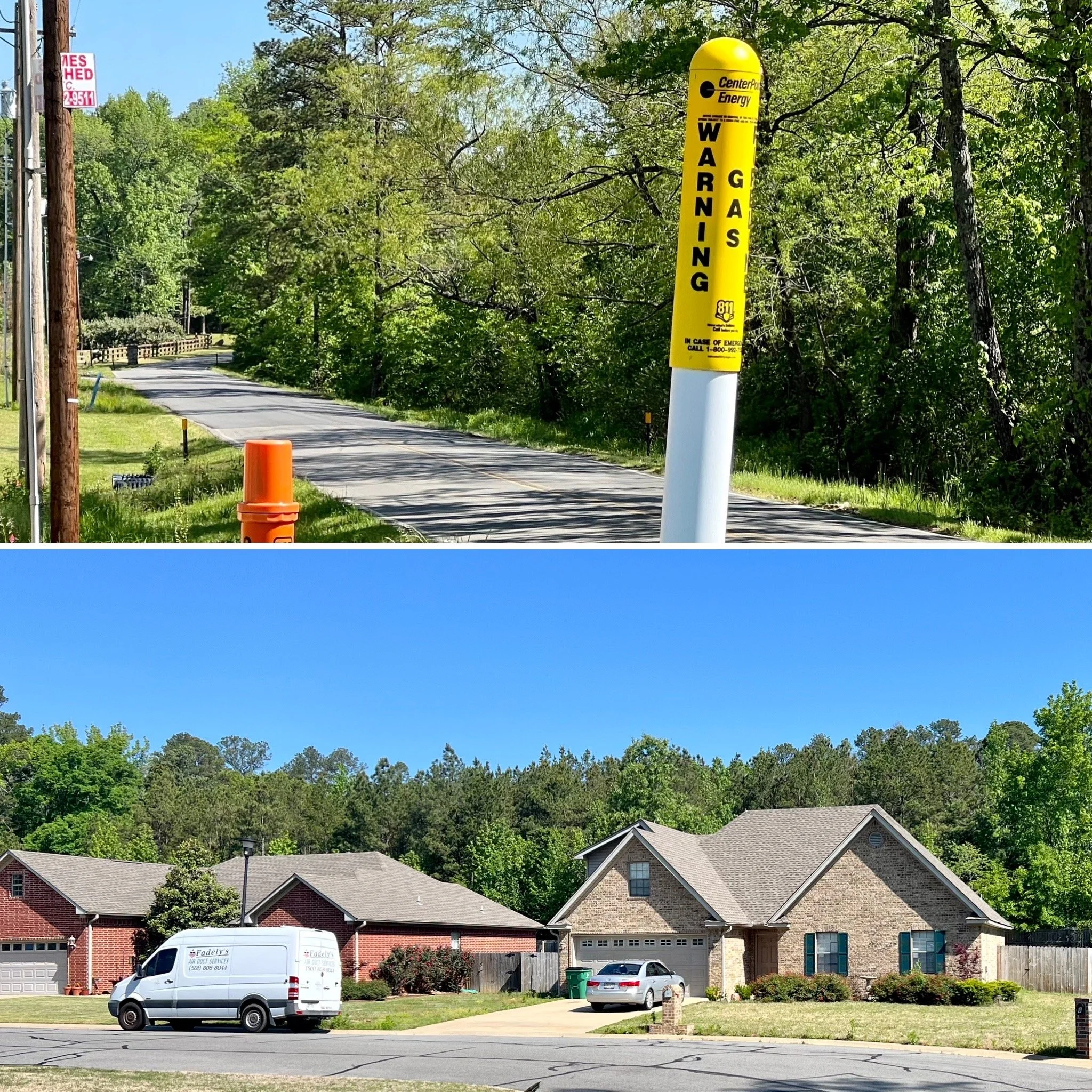
The gas pipeline marker sits next to the main road leading into the Northwoods subdivision of Mayflower, Arkansas. About 100 feet later, a road turns to the right and ends in a cul-de-sac partially visible to the right. These houses are the first things one sees. To our eye, all the houses on this street and many of the houses behind it are new and make up the bulk of the homes that were rebuilt as part of the settlement with ExxonMobil. Despite confidentiality agreements, several plaintiffs said that compensation for medical distress ranged from $2,000 to $15,000, depending on the proximity of the residents to the oil spill.
To avoid confusion, please note the pipeline was renamed the Permian Express Pipeline after ExxonMobil sold it to Energy Transfer Partners, LLC (ETP) in 2018.
Photo by Michael Chase. Follow him on Instagram @mjohnsonchase.
Most of the residents that live in the subdivision now did not live there in 2013. According to an article in the Arkansas Democrat-Gazette, Meggie Hardcastle, who recently moved into a home near the spill site, said most people living on her street were also new to the area. Of the two locals we talked to, one had heard nothing about the possibility of the pipeline starting up again, and the other believed the entire pipeline had been replaced. Sadly, they are both wrong; I explain why later in this story.
Things were very different when the spill occurred. It required an immediate evacuation of 22 homes, killed hundreds of animals, and severely impacted the surrounding wetland habitat near the subdivision. Fortunately, the spill was rapidly contained through the efforts of fast-acting first responders, including firefighters, city employees, county road crews, and local police, who successfully blocked culverts to stop the oil from getting into the water system of nearby Lake Conway (an area enjoyed for its natural beauty and recreational opportunities).
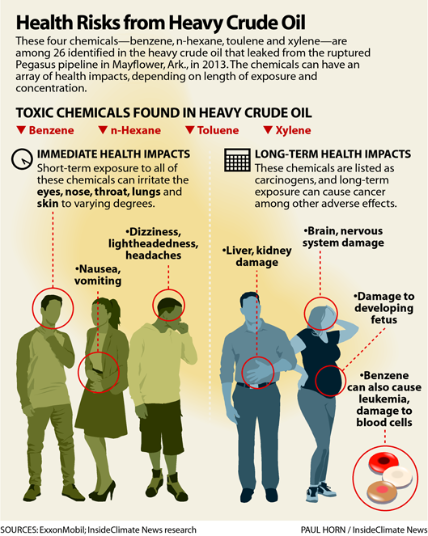
Graphic courtesy of Inside Climate News.
Back in the Northwoods subdivision, a few hundred people were sickened by an odor that was almost thick enough to feel; the spilled oil was bitumen mixed with diluted hydrocarbons. Residents complained about headaches, diarrhea, swollen eyes, dry heaves, and burning lungs. But the full extent of the medical consequences didn’t come to light until 2017 when 708 pages of documents were finally released by the federal pipeline safety regulator known as the Pipeline and Hazardous Materials Safety Administration (PHMSA) after a protracted court battle where PHMSA and ExxonMobil squared off with a nonprofit watchdog group, the Pipeline Safety Trust.
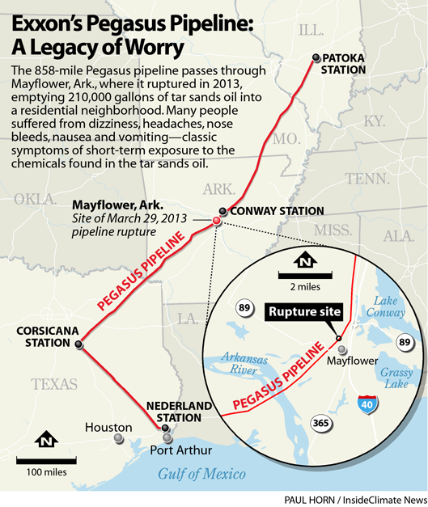
Built in the 1940s, the current condition and usability of what is now called the Permian Basin Pipeline are unknown to the public. Although not in use since 2013, its current owner, Energy Transfer Partners, LLC, has no obligation to reveal any maintenance process or testing results, nor does it have to indicate if and when the pipeline is operational. In the fall of 2021, Energy Transfer Partners, LLC began testing the pipeline again for potential deployment. This map shows more detail about the pipeline’s location. The pipeline traverses 13 miles of the Lake Maumelle shoreline in Arkansas and runs through Lake Hamilton in Hot Springs.
Graphic courtesy of Inside Climate News.
Sealed depositions obtained by the trust detail the true depth of health concerns after the spill. More than two dozen Mayflower residents described serious physical and mental harm suffered due to the oil spill. Residents tossed out furniture and ripped up carpets that had become hopelessly steeped with the stench of oil. They talked about the unexplained death of pets and how they became afraid even to take walks through their neighborhood.
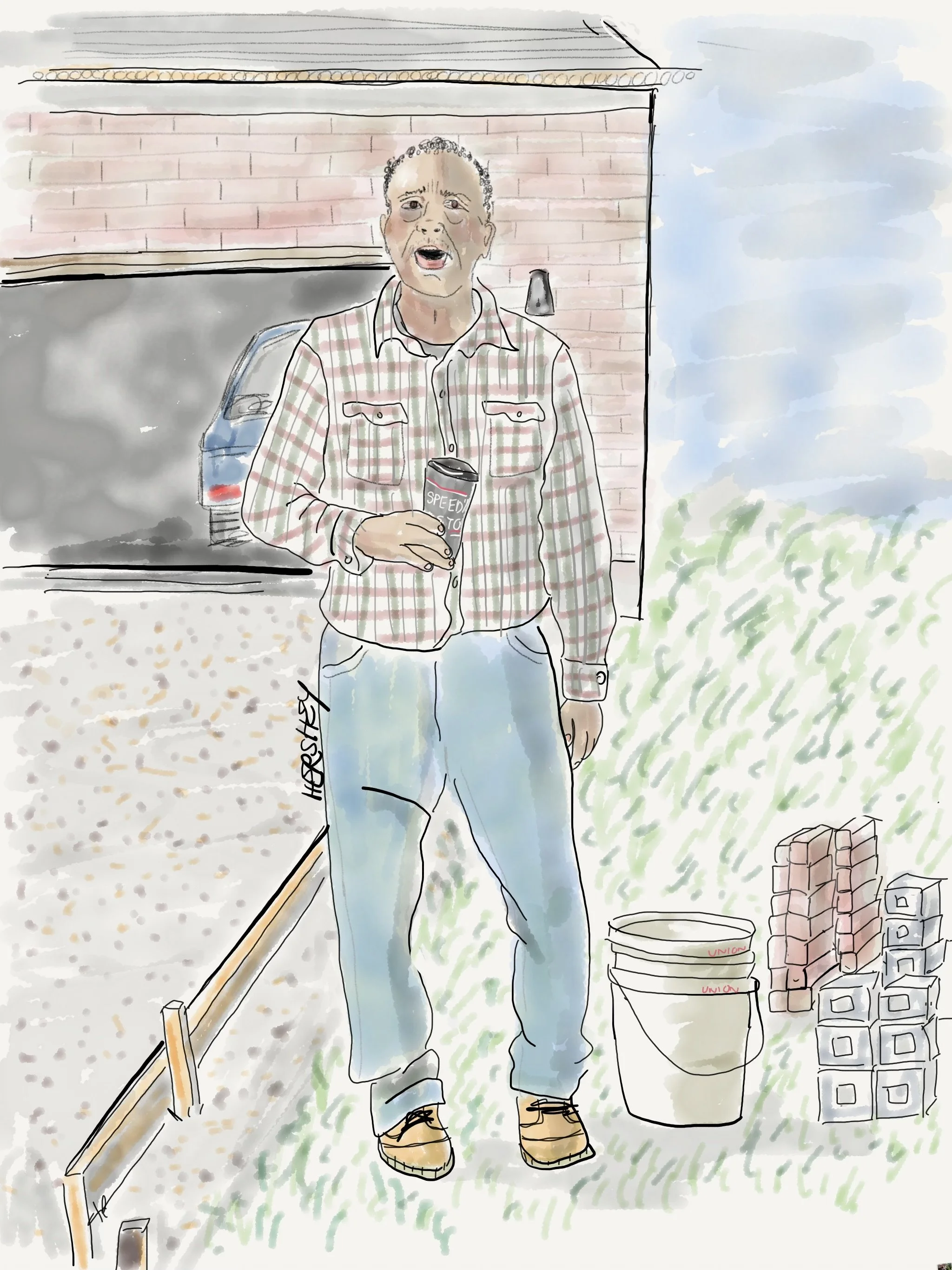
We met Hirty Hopper, a lifelong resident of Mayflower, in the Northwoods subdivision. Hirty is a mason and has been involved in masonry work on many homes following the oil spill. He trusted that the pipeline had been repaired, even telling us the entire pipeline had been rebuilt (it hasn’t). Hirty’s greater concern was seeing the construction completed on a railroad overpass nearby. He explained that the subdivision was only remotely accessible to the nearest hospital. It was located near a railroad track with so few crossings that ambulances couldn’t access the subdivision quickly enough, causing deaths because the wait was so long. “Six people passed,” he told us.
Drawing by Jenny Hershey. Follow her on Instagram @deeofo.
Settlements between homeowners, sickened residents, and ExxonMobil took years. The Arkansas Democrat-Gazette reported that, as part of its effort to address the spill, ExxonMobil ultimately purchased and rebuilt 31 homes in the subdivision and demolished at least three. It took the court system about six years to reach a final accounting. Along the way, PHMSA filed violations against ExxonMobil and attempted to fine them. For years before the Mayflower disaster, ExxonMobil had conducted multiple tests which uncovered more than ten ruptures or leaks along the pipeline. According to PHMSA, ExxonMobil failed to address those concerns, although the reports are still unavailable to the public, and the complaint is shrouded in secrecy. However, a federal appeals court sided with ExxonMobil when the oil giant stated, “There is no proof its actions contributed to the spill.” Then, in a ruling that astonished me when I read about it, the court found that ExxonMobil had followed the law in conducting adequate inspections and analysis in accordance with federal regulations and that“despite adherence to safety regulations and guidelines, oil spills still do occur.”
Think about that. The court essentially ruled that pipelines DO and WILL fail - just like any other form of plumbing. Yet, when they do, operating companies may not be held culpable. If they have followed regulatory laws (often legislated by federal and state governments that are anti-regulatory) and the pipelines fail, operators can walk away scot-free. Unfortunately, when that happens, the public is stuck with a lasting burden of recovery that goes well beyond token gestures of compensation by offending parties.
I wish I could say that such outcomes create greater awareness among the public that weak regulations and self-interested companies are not to be trusted. Companies will do what is right for them, but not necessarily what is right. If the law won’t stop them and they can make money doing it, they will do as much damage as possible until a disaster unfolds. Yet, I am often struck by the passivity of those at risk, like the Northwoods resident who lived through the previous spill and assumes the pipeline will never be used again.
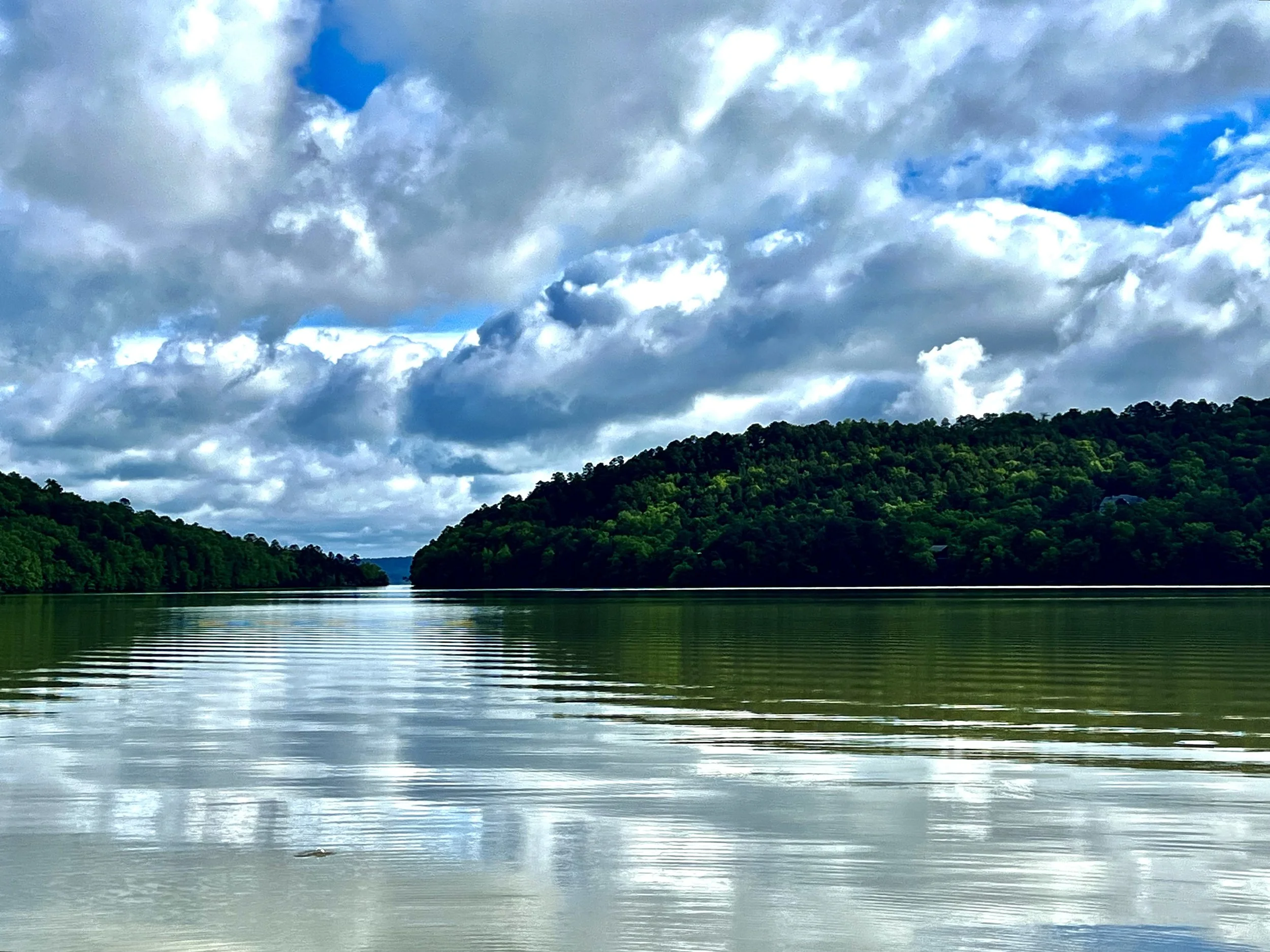
Lake Dardanelle is near the Arkansas River, slightly northwest of Dardanelle, Arkansas. Photo by Jenny Hershey. Follow her on Instagram @ deeofo.
In the fall of 2019, after Energy Transfer Partners (ETP) had purchased the pipeline from ExxonMobil and renamed it the Permian Express Pipeline, they notified Central Arkansas Water that they planned to start testing it again for potential use. Central Arkansas Water is the utility that supplies drinking water to approximately half a million residents in the Little Rock metropolitan region. It draws water from the Lake Maumelle watershed and smaller tributaries fed by the Maumelle River. Built in the late 1940s (well before the Northwoods subdivision existed), ETP’s newly named Permian Express Pipeline also skirts along 13 miles of shoreline of Lake Maumelle. Along this stretch, the pipeline crosses bodies of water, including tributary streams and wetlands at 13 points. In addition, several sections of pipe near the lake are above ground, making them more susceptible to damage.
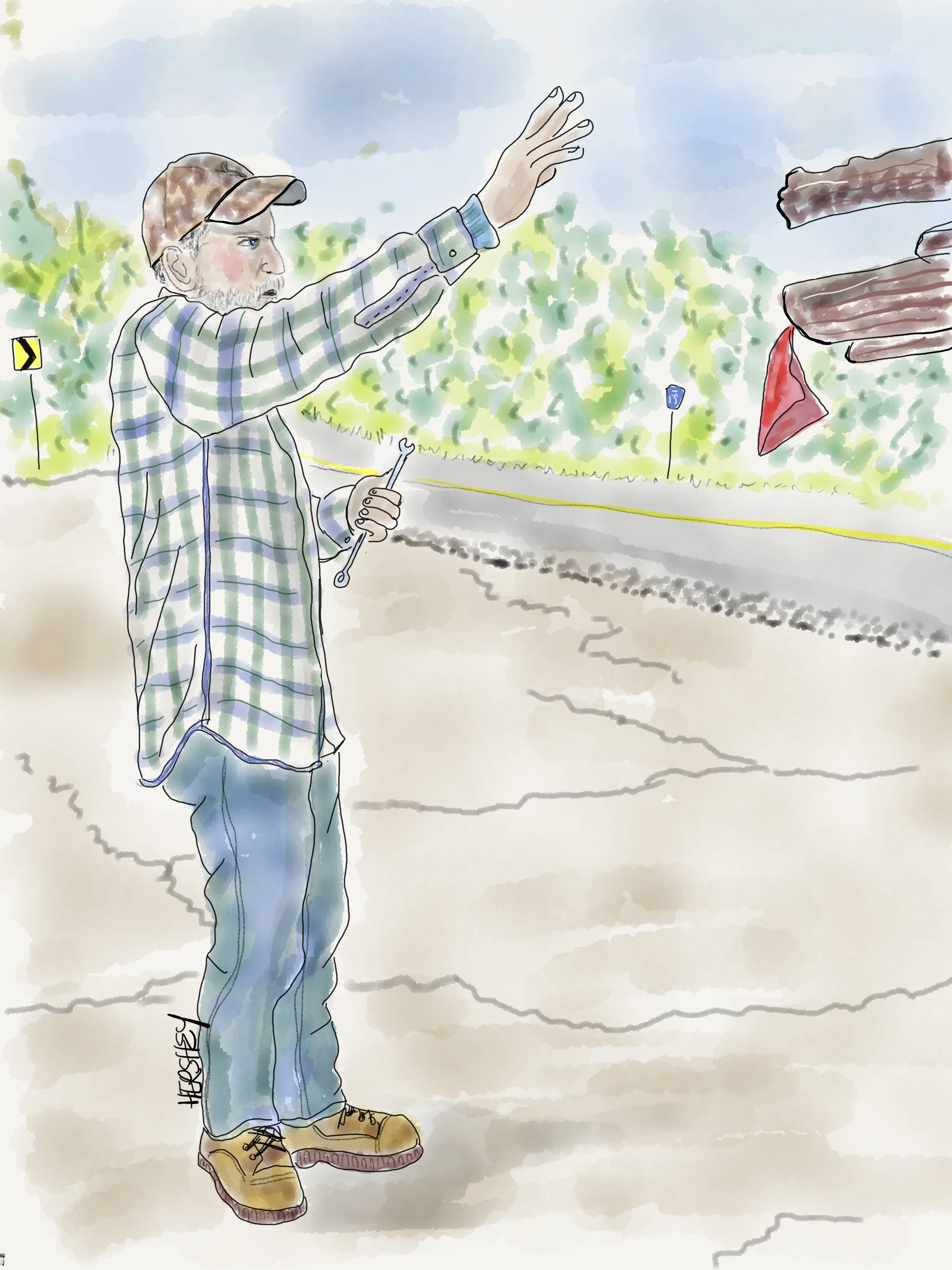
Gary is a 62-year-old log hauler from Clarksville, Arkansas. We met him on Petite Jean Mountain in the Ouachita Mountain west of Little Rock (pronounced like Wichita, except it is Watch-i-ta). Gary was adjusting his brakes under a truck carrying a large load of timber. Gary has been hauling logs for almost 30 years. Still, when Hurricane Harvey hit Houston, he and his wife headed west to help communities by hauling away debris and offering emotional family support. Gary loves to hunt wild turkeys. When we asked Gary about his age, he laughed and told us he was like an overworked mule, “rode hard and put up wet.” He sincerely asked us, “How could we stand living in a city as big as New York?” Jenny launched into her appreciation for the diversity of her neighborhood in New York, and that’s when he told us how much he enjoyed helping diverse folks in Houston after Hurricane Harvey hit. As different as our lives are, we enjoyed learning about our shared values.
Drawing by Jenny Hershey. Find her on Instagram @deeofo.
Surprisingly, ETP is not required by law to disclose whether it conducts tests or if it reopens the pipeline. Notifying the water utility about its intention to conduct tests suggests the company is interested, at least, in the appearance of good public relations. However, it has not been willing to divulge its long-term intentions. The water utility and various community environmental groups have openly worried that the company might consider reopening the pipeline. After all, the stakes are quite high - a pipeline failure within the Lake Maumelle watershed could have catastrophic consequences for the half million people who use the water supply.
In 2020, officials from Central Arkansas Water sent letters to ETP offering to discuss the potential purchase of the section of pipeline that runs through the watershed, but they never heard back.
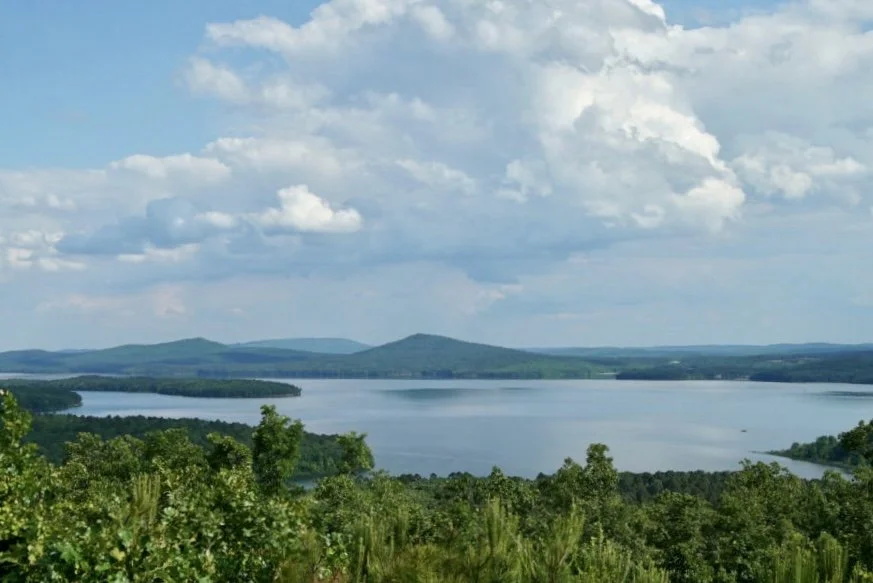
Stock photo of Lake Maumelle, the reservoir that is the source of drinking water for Little Rock and the water utility Central Arkansas Water. We visited the lake on our last day in Little Rock and tried to find an access point for a photograph but were unsuccessful, so we had to settle for this photo found in Google Images.
The most recent accounting of what might happen with the pipeline is an article in the Arkansas Democrat-Gazette, dated March 27, 2023 (ironically, on the same weekend that media was hyper-focused on the North Little Rock tornado). The Gazette interviewed Raven Lawson, the watershed protection manager at Central Arkansas Water, who said, “The possibility of the pipeline reopening is a top concern.” If oil begins to flow through the pipeline again, Lawson said she believed it would not be a question of "if" but "when" the conduit would rupture again. However, Max Shilstone, director of government affairs for ETP, told Central Arkansas Water in a letter dated May 23, 2022, that his company has "no plans to bring the pipeline back into service at this time." Shilstone said "current market conditions" did not warrant restarting the conduit but noted his company would "continue to maintain the pipeline in a safe, idle condition. Should circumstances involving the pipeline and its future use change, we will communicate with interested parties, of which Central Arkansas Water would be included.”
So, the people who use Central Arkansas Water must wait passively, trusting that ETP will do the right thing. Let’s hope it goes that way. I think it’s unlikely that ETP has plans to run oil through the Permian Express Pipeline. They are more likely to use the pipeline to transport liquified natural gas (LGN) to the Gulf Coast. A methane leak would be less harmful to waterways, making public relations issues more manageable (methane emission disasters are harder to detect and less likely to gain media attention).
However, I think it is even more likely that ETP is quietly testing the pipeline as they bide their time until they can use the pipeline to transport CO2 or hydrogen. Unless the GOP's recent budget ploy successfully results in repealing the recent hike in 45Q tax credits as provided by the Inflation Reduction Act (see our recent blog post for an explanation), the financial rewards for transporting those materials may be quite remunerative. And while that effort might help decarbonization efforts, they are also largely untested and may include unintended consequences. Like you, I would much rather deal with pollution accidents resulting from efforts to decarbonize. But it’s also important that we understand the risk profile for anything we transport, and right now, there is much about carbon and hydrogen transport and storage that is not understood.
But I’m willing to make a solid bet the ETP didn’t purchase the Pegasus Pipeline, so it can lay idle. It’s only a matter of time before it is back in use. And considering that it is over 70 years old and the relaxed regulatory rules under which it is governed, it’s only a matter of time before Little Rock’s drinking water supply is again threatened.
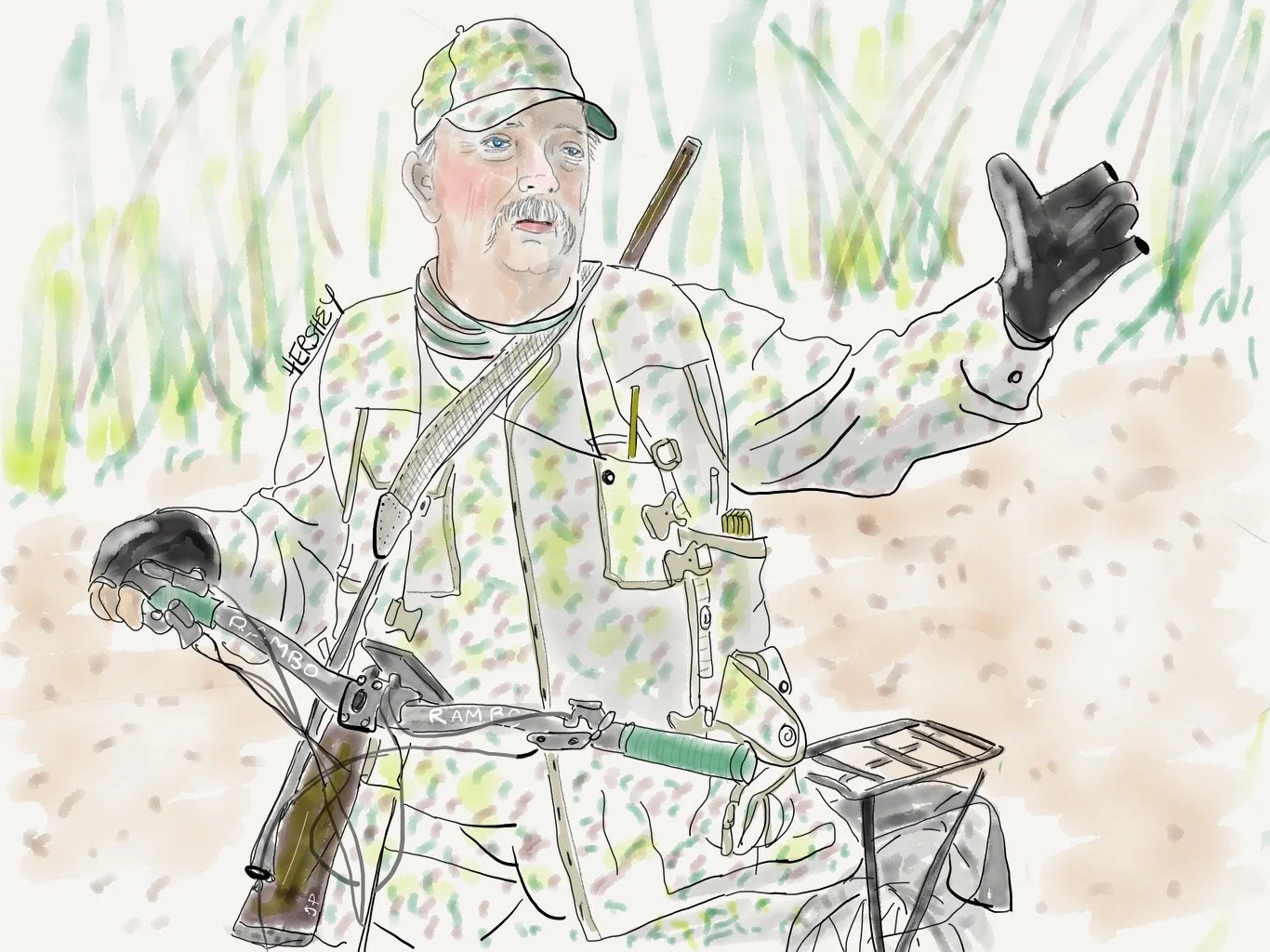
On our way up Magazine Mountain in Arkansas, we met Joey on his souped-up e-bike on a gravel backroad. Joey was born and raised (and still lives) in the Arkansas Valley near Paris, Arkansas. Retired from a job with Bridgestone Tire, Joey enjoys hunting for wild turkeys on his bike. He said that his truck scares the turkeys, and he can sneak up on them on a bike. Turkey season in Arkansas is short; it lasts from April 17th - May 7th. An old back injury haunts Joey, but he pushes through, and at the end of the day, he goes home to a loving wife. Two grown children who don’t live very far away not far away give him much joy. A jovial, soft-spoken man with a gun dressed in camouflage riding an e-bike on a gravel road in the woods; can’t find that in Times Square…
Drawing by Jenny Hershey. Follow her on Instagram @deeofo.
Stay vigilant! Thanks for reading. If you haven’t done so, please subscribe to this blog to follow our next biking trip.
Blog writing by Michael Chase. Drawings by Jenny Hershey. Unless credited or otherwise noted, all material is the copyrighted property of the blog post authors.
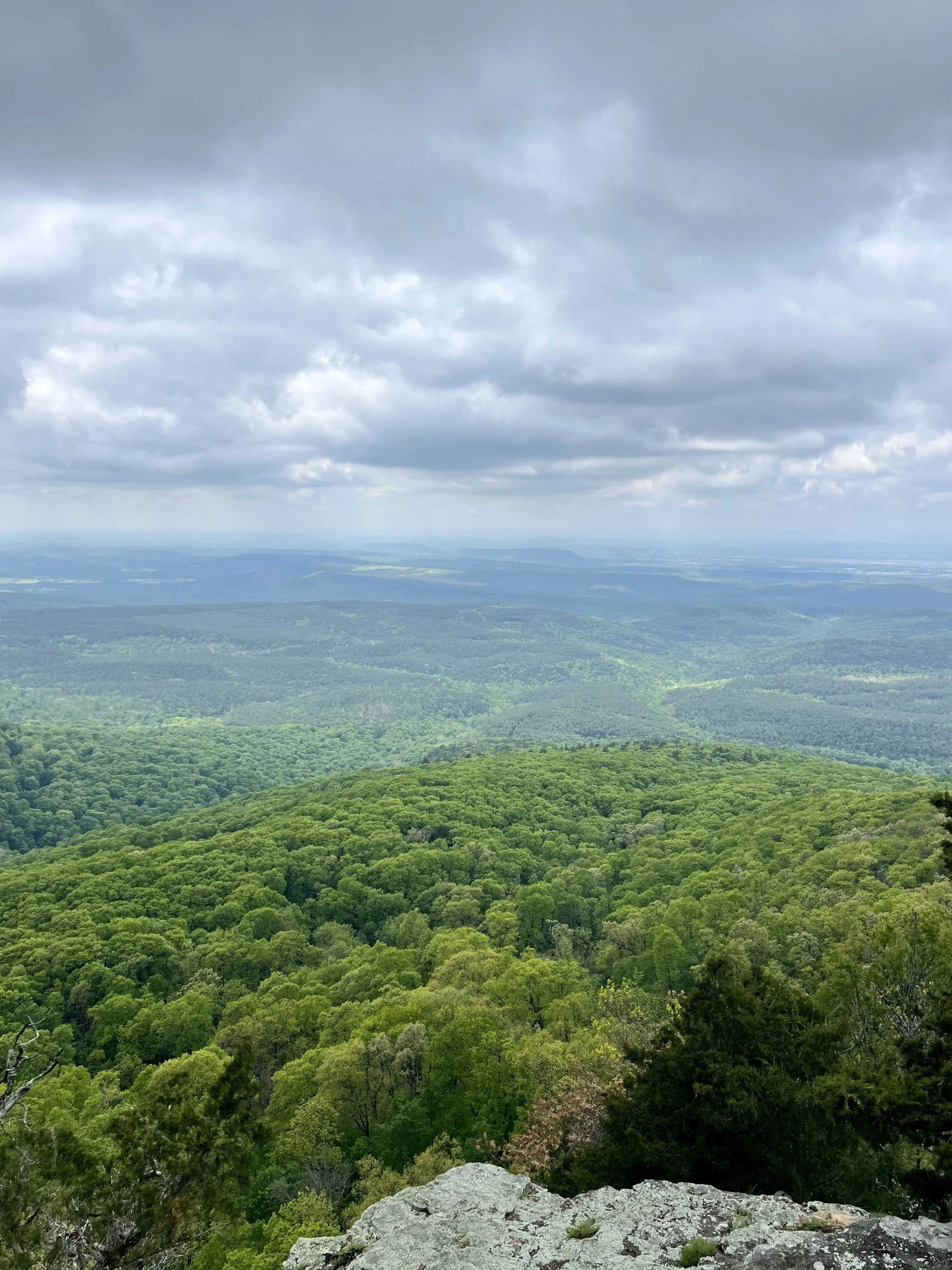
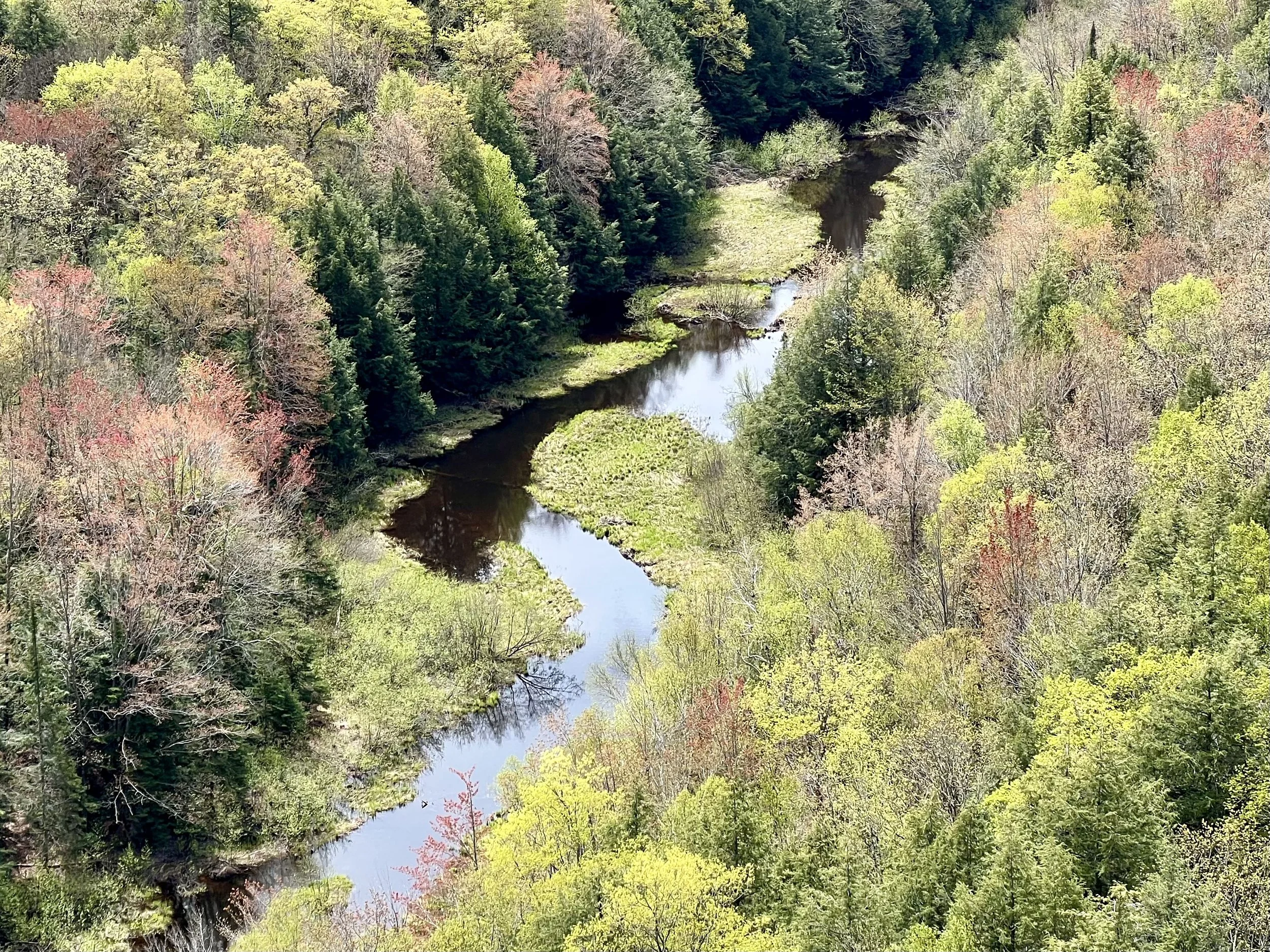
This view looks north from Petite Jean Mountain in the Ouachita Mountains. Although this entire region is loosely referred to as “the Ozarks,” the southern border of the Ozark Plateau technically starts at the Boston Mountains, which are visible in the distance. Jenny and I were charmed by the natural beauty of Arkansas and challenged by its ruggedness. Photo by Michael Chase. Follow him on Instagram @mjohnsonchase.
Water and a Tornado; Biking in Mississippi and Arkansas, Part 1
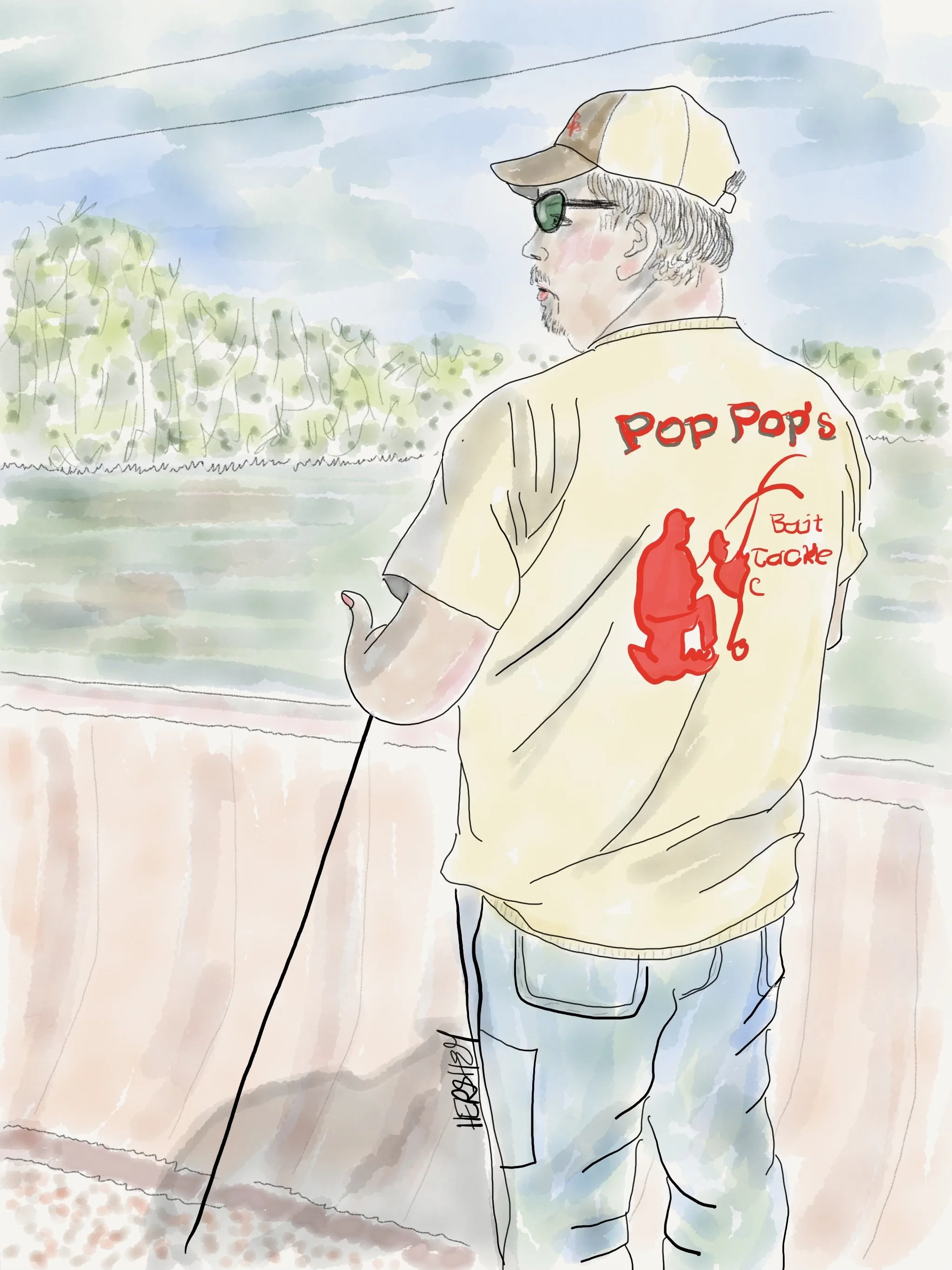
Jenny and I met Brian while he was gazing at the extraordinary amount of surface water flowing through Indian Bay near the White River east of DeWitt, Arkansas, in the Dale Bumpers National Recreation Area. This led to a conversation about how all the surface water we saw was unlikely to replenish groundwater supplies in the Mississippi Delta. Brian was about to say something when a valve spontaneously blew on my front tire, causing it to deflate instantly. Brian owns Pop Pop’s Bait and Tackle in Helena, Arkansas, near the Mississippi River on the Arkansas side of the Mississippi Delta (technically known as the Mississippi Embayment). He was fishing for Skipjack Herring, a great bait for catfish and quite lucrative for his shop. Brian started Pop Pop’s with his father about 12 years ago. He is proud of his daughter who will attend medical school next year. A hard-working man, Brian has lived in Arkansas his entire life.
Drawing by Jenny Hershey. Follow her in Instagram @deeofo.
—————
“Our very survival depends on our ability to stay awake, to adjust to new ideas, to remain vigilant and to face the challenge of change.”
– Martin Luther King
—————
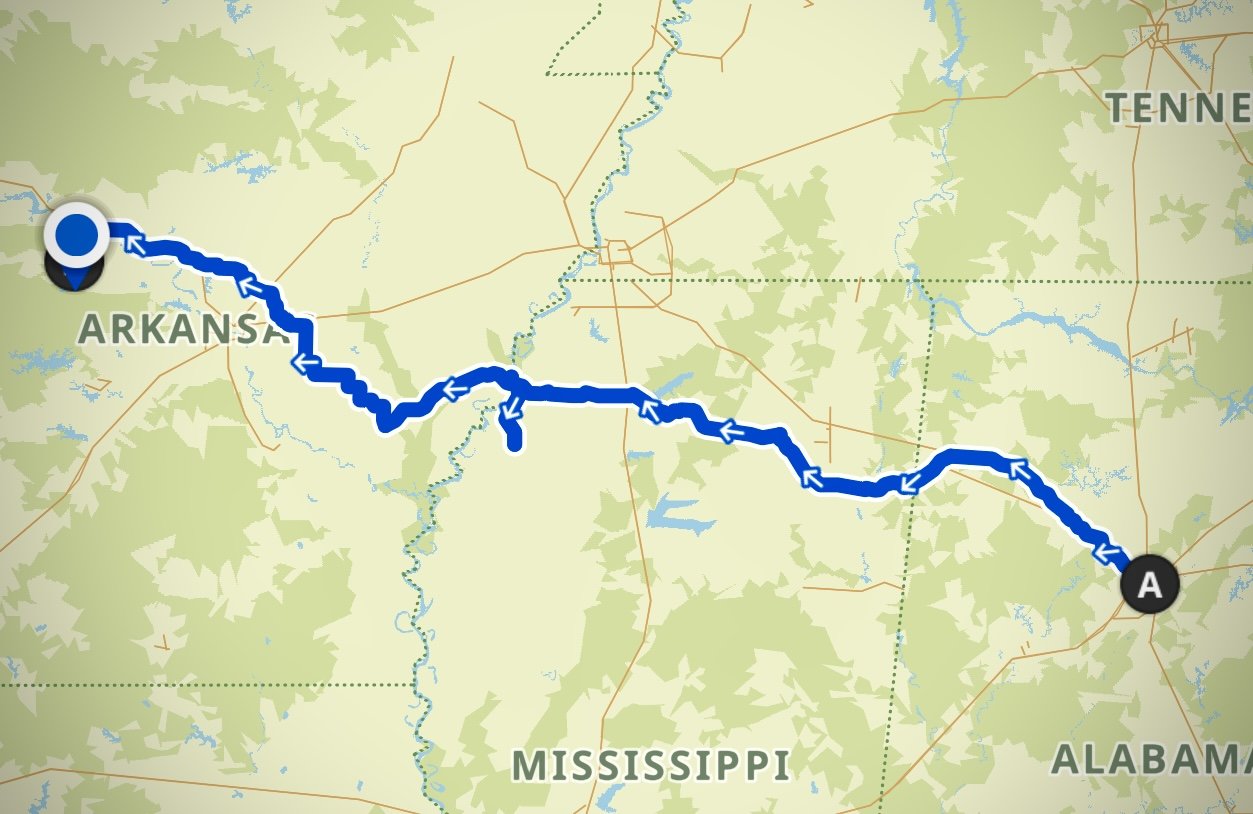
Our approximate route was from Birmingham, Alabama, to Conway, Arkansas. Once we reached Conway, Jenny and I entered the Arkansas Ozarks, which will be covered in Part 2 of this trip series. Image courtesy of Kamoot.
Writing by Michael Johnson Chase, Drawings by Jenny Hershey
For the second time this year, Jenny Hershey and I boarded an Amtrak train in New York City with our bicycles and got out in Birmingham, Alabama. Our ultimate destination was the Arkansas Ozarks this time, so we have been riding westward since we got to Birmingham. Fascinated by water issues and how they intersect with climate change, we were initially disappointed that our route wouldn’t take us through beleaguered Jackson, Mississippi, where water issues have become a water crisis.
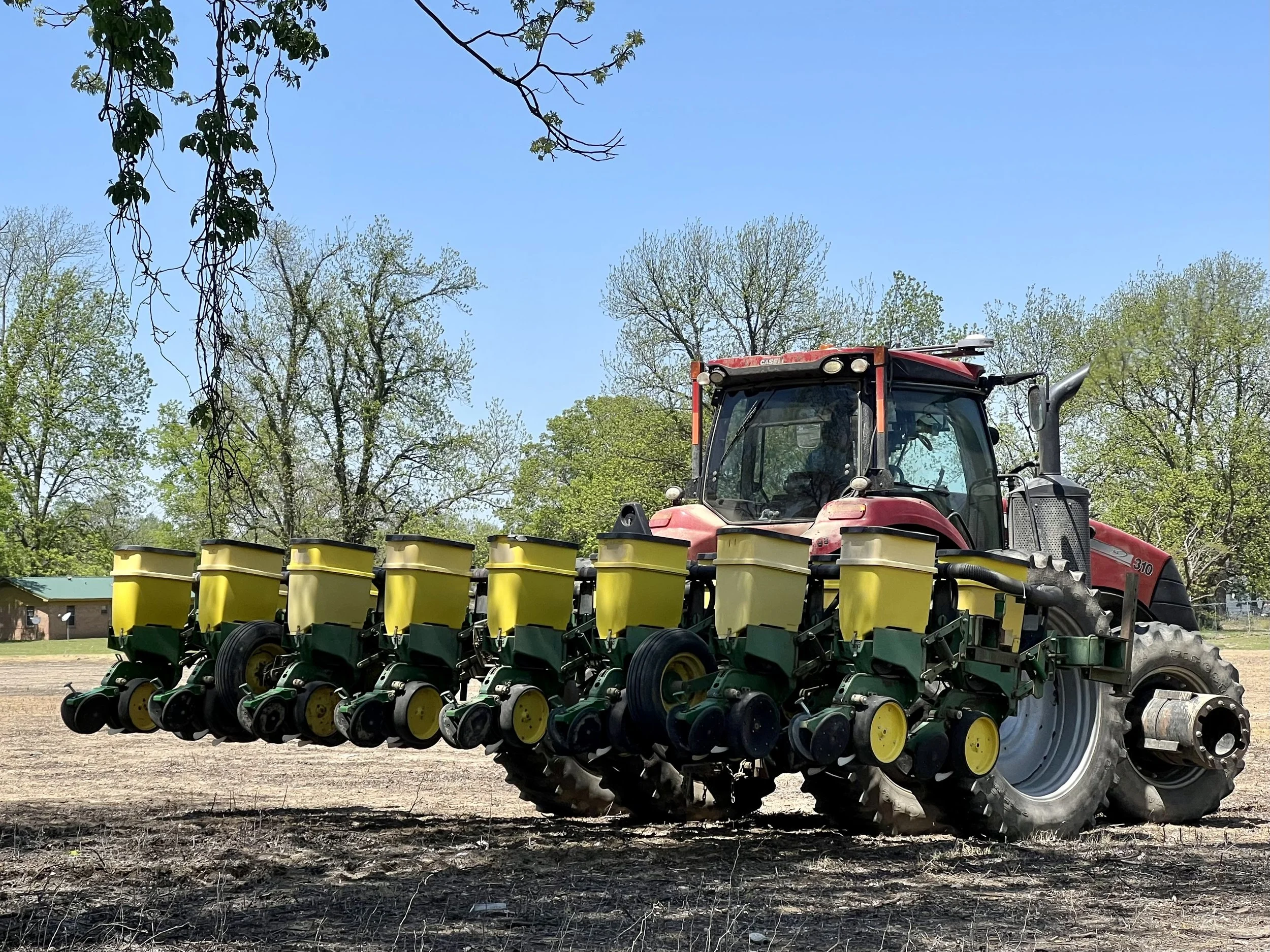
We talked to a farmer near Friar’s Point, Mississippi, in the Mississippi Delta (not to be confused with the Mississippi River Delta, which is the extension of the Mississippi River into the Gulf of Mexico south of New Orleans). The farmer told us that low-till planting methods for water conservation and soil development are becoming increasingly common in this part of the Delta. When we asked about the water levels in the alluvial aquifer, the farmer replied that the aquifer was decreasing over time. Still, he also thought the issues were more critical on the Arkansas side of the Delta because water-intensive rice farming is more common. Photo by Michael Chase. Follow him on Instagram @mjohnsonchase.
We decided that climate issues are ubiquitous enough that we will discover plenty of interesting stories wherever we go. We were right, of course. The prevalence of climate stories is much greater now than even a few short years ago, in 2016, when I started bicycle touring. Extreme weather-related disasters are now straining American communities so intensely that climate stories are everywhere. Climate-related events are occurring at a magnitude greater than the most conservative climate scientists predicted just a few years ago. However, the truly scary thing is that extreme weather-related natural disasters are only going to keep increasing in quantity, duration, and strength.
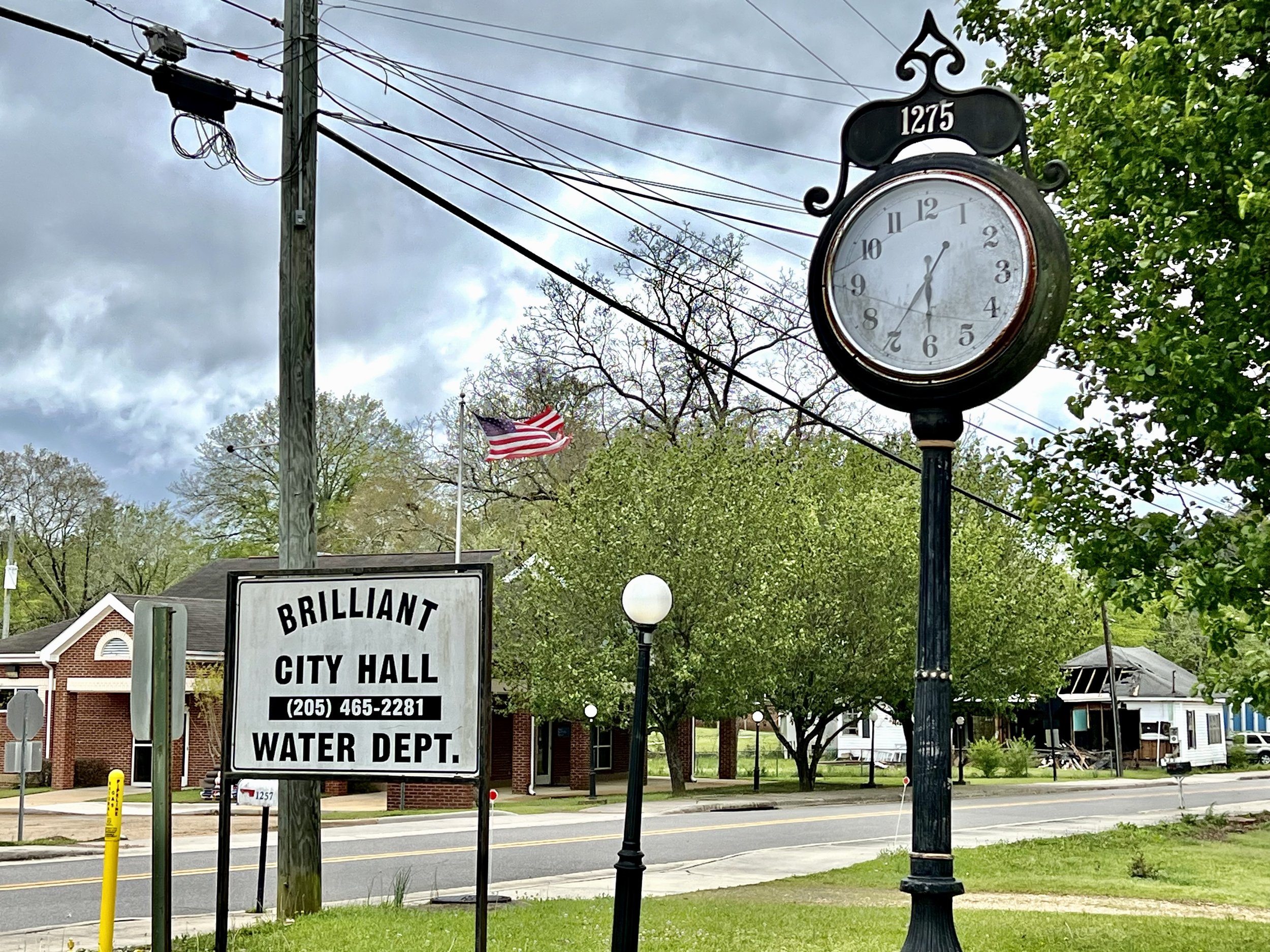
It’s no accident that City Hall and the Water Department are the most important municipal offices in Brilliant, Alabama. Access to clean and reliable water and safe sanitation are baseline conditions for health, prosperity, and well-being. Of America’s 145,000 municipal water systems, 97% of them are municipalities of 10,000 people or fewer. More than any other factor, climate change reveals and exacerbates racial and societal inequities in disproportionately small and rural communities that struggle for funding and technical services. Photo by Jenny Hershey. Follow her on Instagram @deepfo.
With that as a backdrop, let’s briefly return to the subject of Jackson, Mississippi (even though Jenny and I didn’t go there). The American media has coveted the drinking water crisis in Jackson as a story of poor management and neglect. But it is also a story about the convergence of climate change, aging infrastructure, water contamination, and rising costs. All those factors make providing clean water to every community in America an increasingly daunting problem. Already, more than two million Americans lack access to running water, indoor plumbing, or wastewater services.
While it is true that Jackson’s water system was poorly managed and neglected for decades (partially related to declining property values due to “white flight” into other towns and neighboring suburbs), the water system reached its final tipping point during a flooding crisis in 2022. When double-digit rainfall fell across central Mississippi in the last week of August, the Pearl River flooded and completely overwhelmed Jackson’s long-troubled water system. Destruction from the flood disabled the Curtis Water Treatment Plant for an extended period of time, forcing residents to go without drinking water for weeks. At the same time, there was not even enough water pressure to flush the toilets or shower.
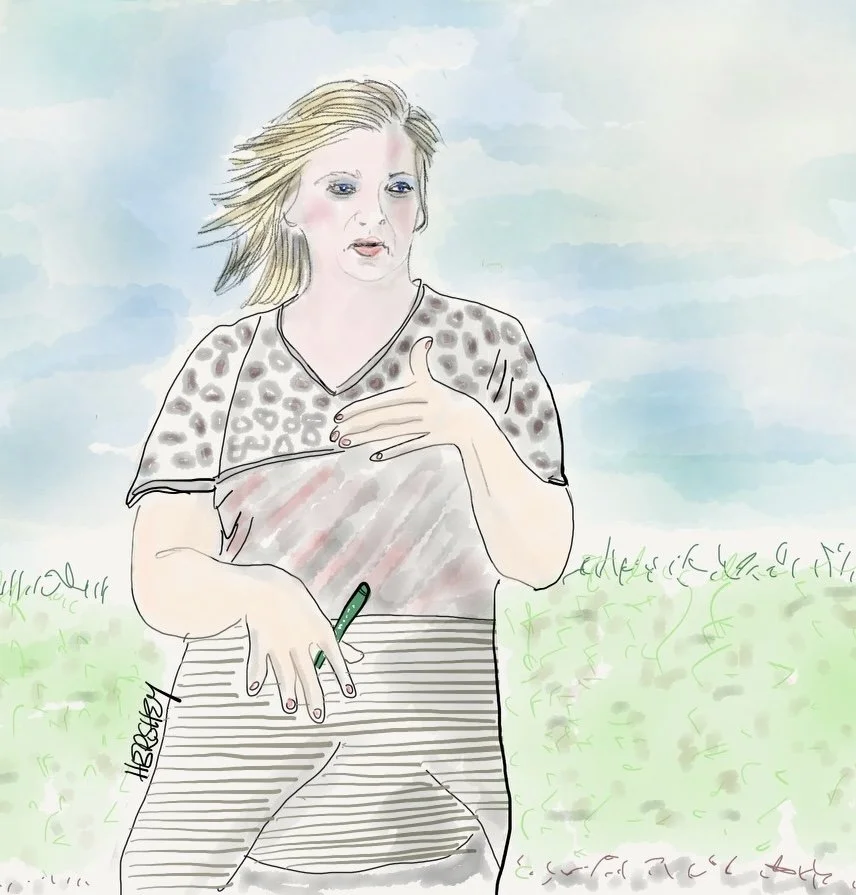
Jessica is the town clerk in Brilliant, Alabama. She came out of her office to welcome us while we took a picture of the City Hall and Water Department sign. After some pleasantries, we asked Jessica about Brilliant’s water supply. She explained the town is building a new water tower supplied from local wells with help of the governor and a state based economic development organization (and most likely block grants from the 2021 Infrastructure Investment and Jobs Act). This new water tower will supply water for nearly 500 residents and 36 businesses. Jessica, a lifelong Alabaman, proudly waved at a passing school bus carrying the local baseball team (including her two teenage sons) to a nearby high school. Her warmth and hospitality were topped off with a pen from the mayor. Brilliant town promotion in Brilliant!
Drawing by Jenny Hershey. Follow her on Instagram @deeofo.
Jackson is a canary in a coal mine. Even currently “adequate” infrastructure will become increasingly compromised as the climate grows hotter, dryer, and wetter. There are an ever-increasing number of hot spots worldwide where climate change is driving cycles of flooding, drought, water stress, interruptions in agriculture and subsequent famine. Perhaps the most dire situation of all is unfolding in the Horn of Africa, where drought is forcing millions of people into what Inside Climate calls a “raging food catastrophe.” And all around the world major rivers are drying up, including the Rhine and the Loire in Europe. Water flow through China’s massive Yangtze River is more than 50% below the average of the last five years, threatening the water supply of 400 million people. Closer to home, the Colorado River, which supplies drinking water for 40 million Americans and irrigates 7 million acres of our farmland, is suffering through the the worst dry spell in 1200 years. Though an unusually wet winter has provided temporary relief it’s nowhere near enough to fill the deficit. At the same time, many of the western states that saw record-breaking amounts of rain and snow over the winter are experiencing rapid spring snowmelt, which is becoming a massive flood threat. In California, thousands of acres are already underwater and that land area is expected to triple by summer.
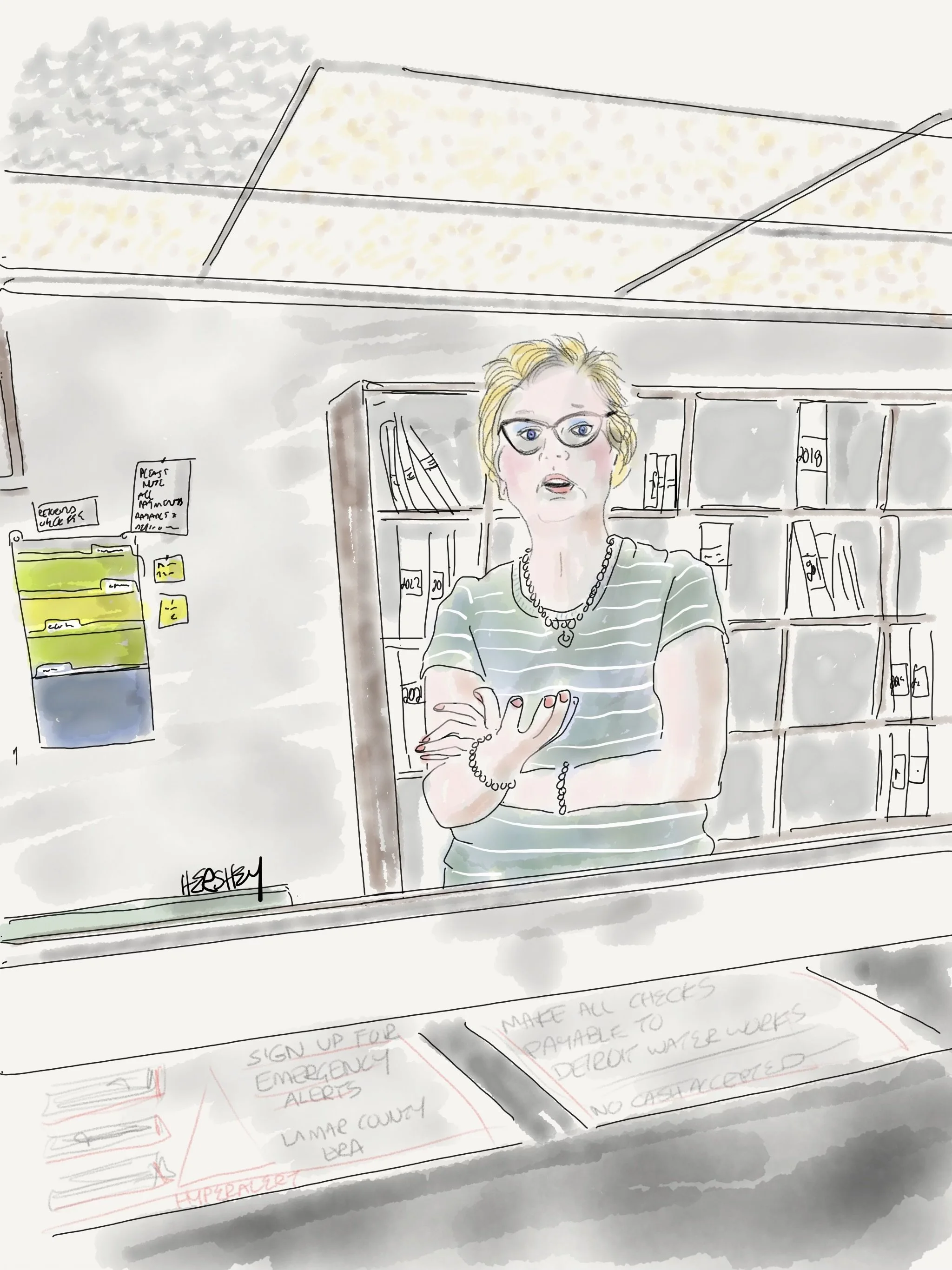
Frankie works part-time at the water department in Detroit, Alabama (population of 150 people). Water comes from a nearby well and costs the residents $20 for 2000 gallons. A replica of a check for $350,000 for water infrastructure improvement from the governor hung on the wall behind her, demonstrating the state’s commitment to helping local communities. Frankie served as county clerk for 30 years in nearby Hodges and was blunt about extreme weather threatening the region. A devout Christian, Frankie belongs to a missionary group that rebuilds churches after floods, windstorms and tornadoes. Many of their projects are for African-American congregations. When we asked her what she thought was driving the increase in tornadoes in her area she replied, “I think it’s the end-times.”
Drawing by Jenny Hershey. Follow her work on Instagram @deeofo.
Our route toward Little Rock from Birmingham took us west through the hill country of Jasper and Hamilton in western Alabama and then through beautiful farm country to Amory, Mississippi. You might have heard of Amory for several reasons. For one, a devastating tornado ripped through the town on March 25, 2023. There was widespread damage, and even Amory’s water treatment plant took a direct hit. Thankfully, Amory got its water running after a boil advisory that lasted only about a day. Even better, no one died in the town (although there were three deaths in Morgan County, where Amory is located).

Brenda, a woman of strong faith, prayed hard in her home as she huddled with her two brothers when a tornado struck her neighborhood in Amory, Mississippi. After the storm passed, she walked outside to find her front porch missing, although her home remained intact. A huge tree was lying on her neighbor’s house. Luckily, her neighbor survived by sheltering in the back of her house. Miraculously, no one in the town was killed, despite the tornado’s widespread devastation. When we came across Brenda, she was relaxing outside in a chair where her porch had been only days before, taking in the sunshine.
Drawing by Jenny Hershey. Follow her on Instagram @deeofo.
Other places were not so lucky. Over a dozen tornadoes tore through Mississippi and Alabama during the same storm, leaving at least 26 dead and a swath of destruction 100 miles wide and devastating the communities of Rolling Fork and Silver City, Mississippi. We considered biking to Rolling Fork just as we had considered stopping in Jackson but decided we didn’t want to be in the way or use resources needed by first responders. From what we understand, homes and businesses have been reduced to rubble. The recent tornadoes stretched from the Louisiana border of Mississippi through Alabama as part of a supercell, or rotating thunderstorm - a rare, extended path for such a storm.
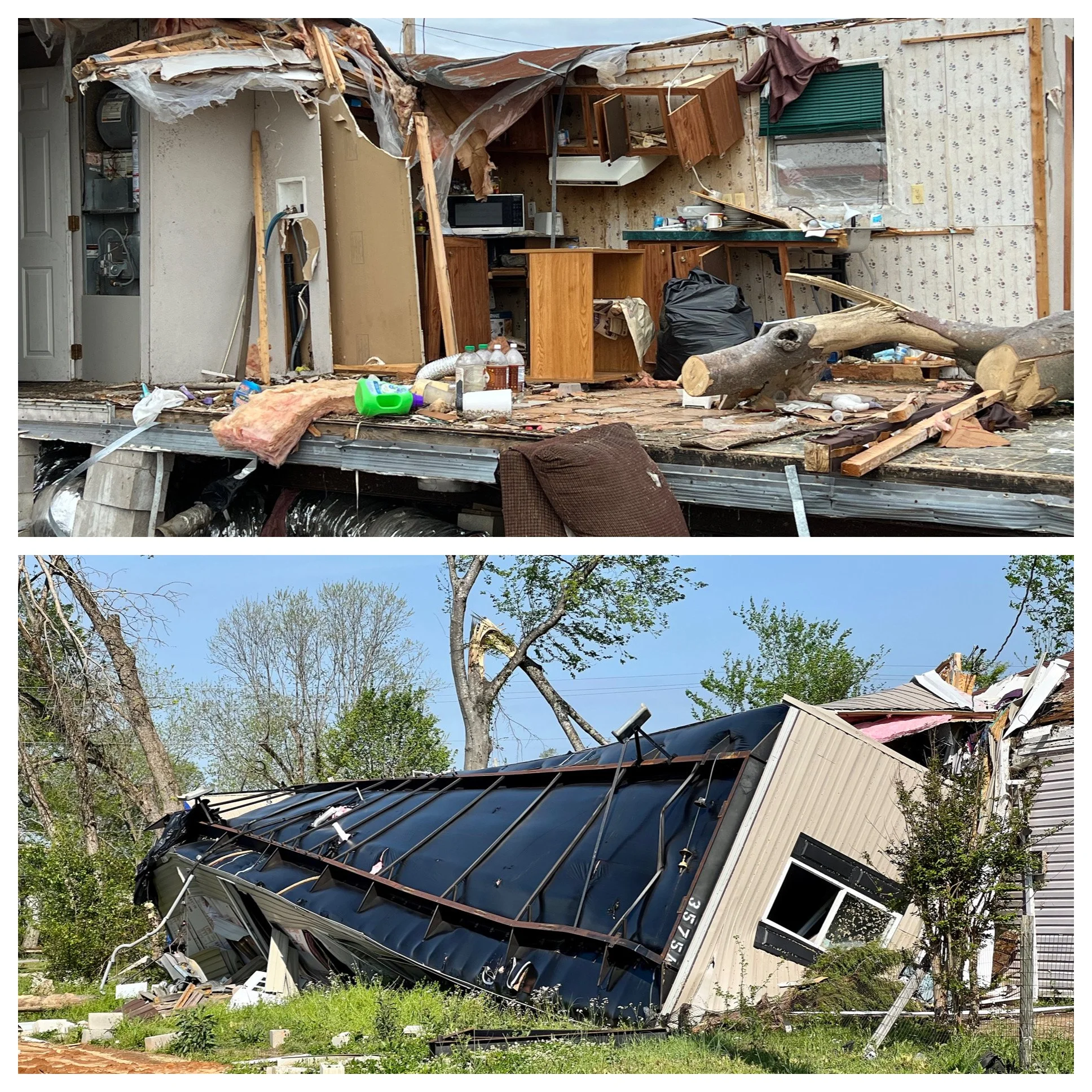
We saw at least 3 trailer homes that had been ripped off their foundations and were upside down, making it clear that a trailer home is not a safe place to be during a tornado. Yet, in low income neighborhoods they are very common. The average cost of a typical single-family home in Mississippi is $144,074. In contrast, the average cost of a single-wide mobile home is $37,100 and double-wide mobile home is $73,600. Top photo by Jenny Hershey @deeofo and bottom photo by Michael Chase @mjohnsonchase.
Climate scientists have not been able to determine if there is a link between climate change and the frequency or strength of tornadoes. The primary tool scientists use to attribute extreme weather events to climate change is intensive computer modeling based on large amounts of aggregated data. This is difficult to achieve with tornadoes because of the localized conditions that determine their formation, combined with their relatively small size over a given region. Yet, scientists affirm that tornadoes are occurring in greater clusters, and the region of the United States in the Great Plains where most tornadoes occur (known as Tornado Alley) appears to be shifting eastwards toward more populated regions in the southeast. Therefore, tornadoes may be in the news more because more people are being impacted.
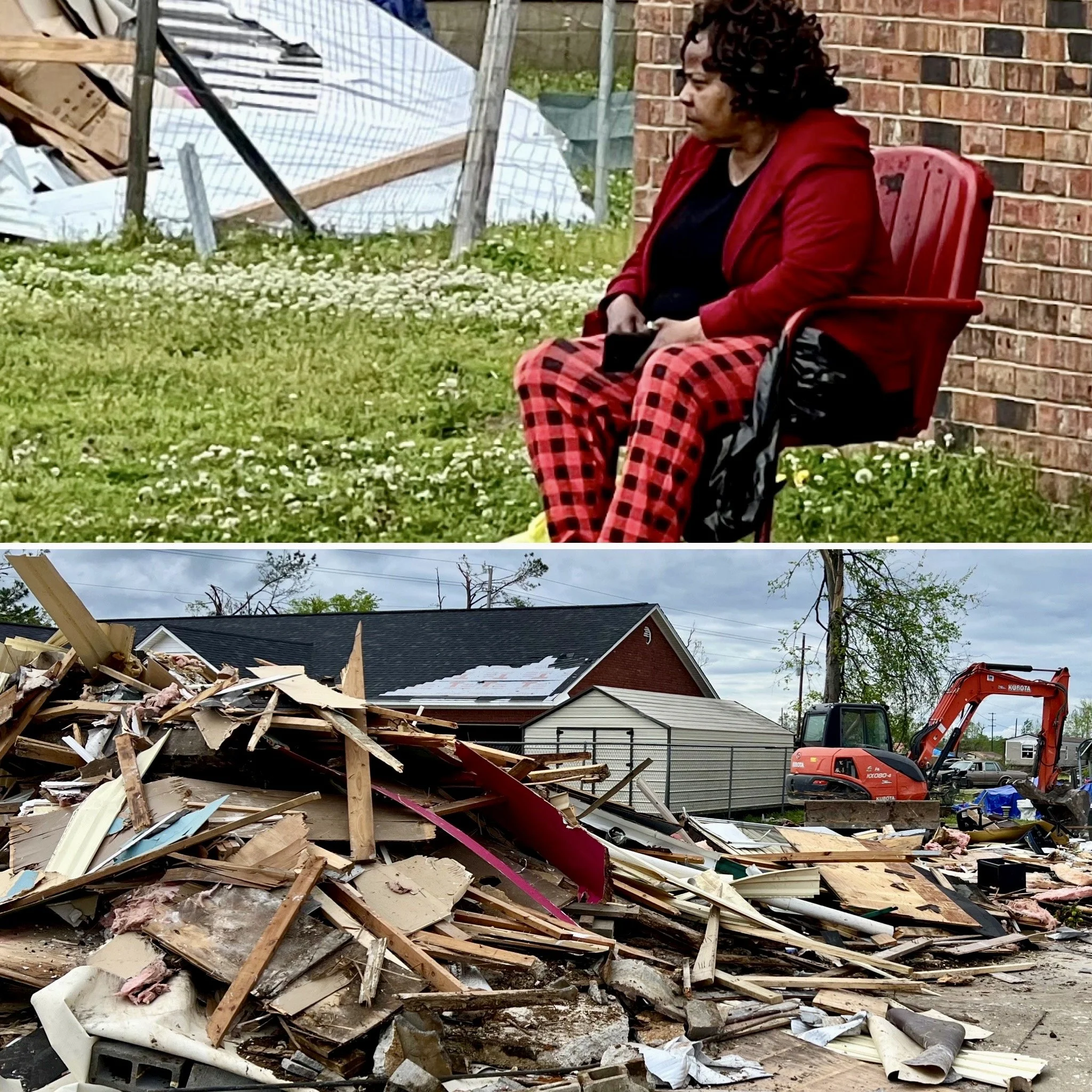
While biking through Amory, we noticed the woman above watching an excavator consolidate the debris below into a pile. When I asked her if she lived in the still-intact house behind her, she shook her head no and pointed to the pile of debris. She clearly didn’t want to talk, so we expressed our condolences and quickly moved on. Photos are by Michael Chase. Follow him on Instagram @mjohnsonchase.
Tornadoes form inside large rotating thunderstorms when the ingredients are just right; a perfect mix of temperature and a specific moisture and wind profile. This suggests that an increase in water vapor and precipitation, indicative of climate change in the southeastern region, may be contributing to the shift eastwards. In any case, when air is unstable, cold air is pushed over warmer humid air, creating an updraft as the warm air rises. When the wind speed or direction changes over a short distance, the air inside the clouds starts to spin. If the air column begins spinning vertically and rotates near the ground, surface friction can accelerate the air even more. All these features must come together to cause a tornado to form. And despite their small size compared to an atmospheric river or a hurricane, they can be quite devastating. I certainly hope Jenny and I are lucky enough to avoid them on our travels, and my heart goes out to anyone forced to live through a direct hit.
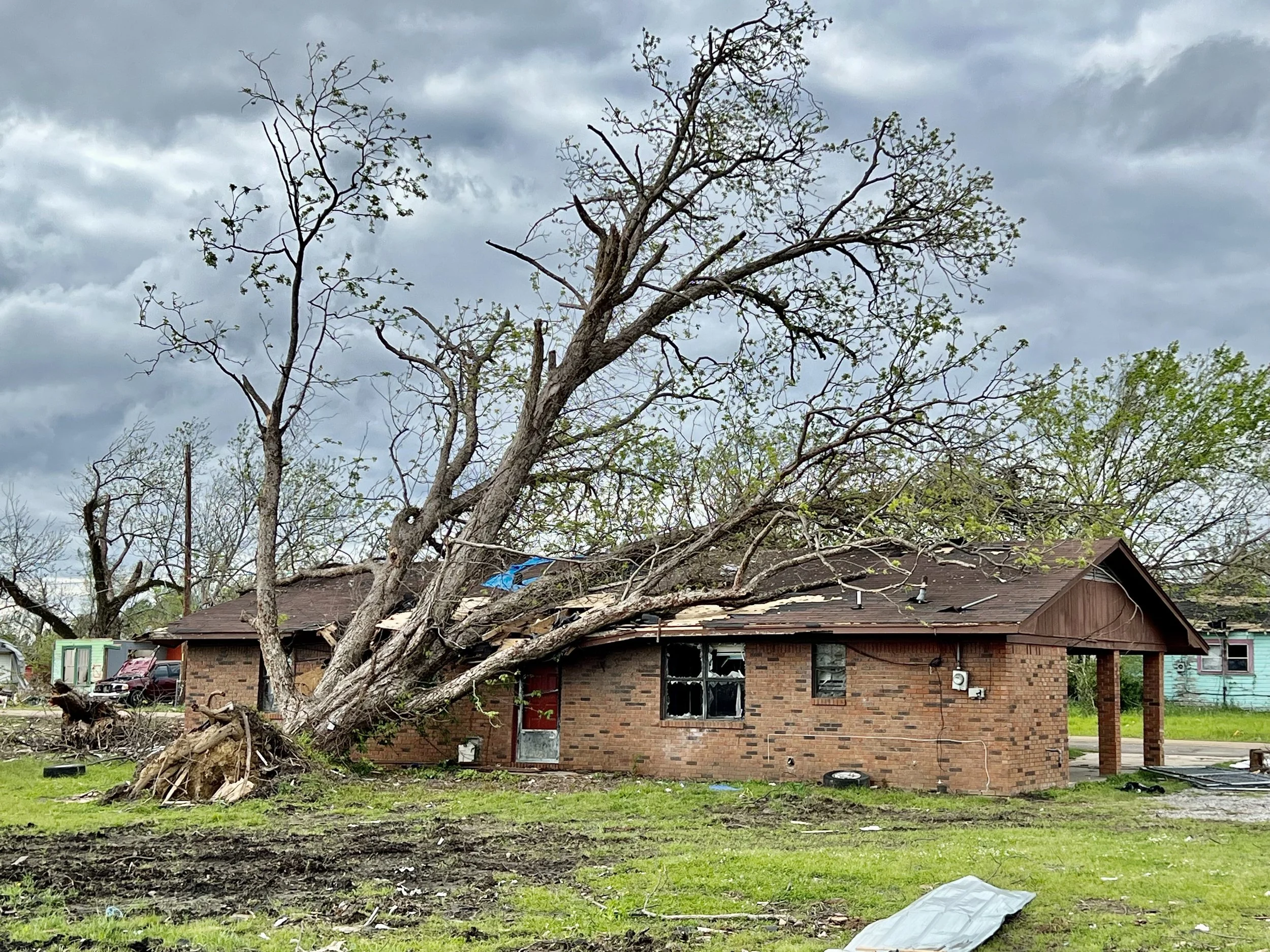
A large tree rests on a home in the northwest section of Amory. Sadly, the tornado’s path tore through the least affluent part of town, underlining the reality that the most vulnerable among us are often the most affected during weather-related disasters. Photo by Jenny Hershey. Follow her on Instagram @deeofo.
In Amory, and especially for Rolling Fork and Silver City, recovery from the tornado damage is uncertain. FEMA is out in force, but the devastation is quite extensive. Here’s how to help those impacted.
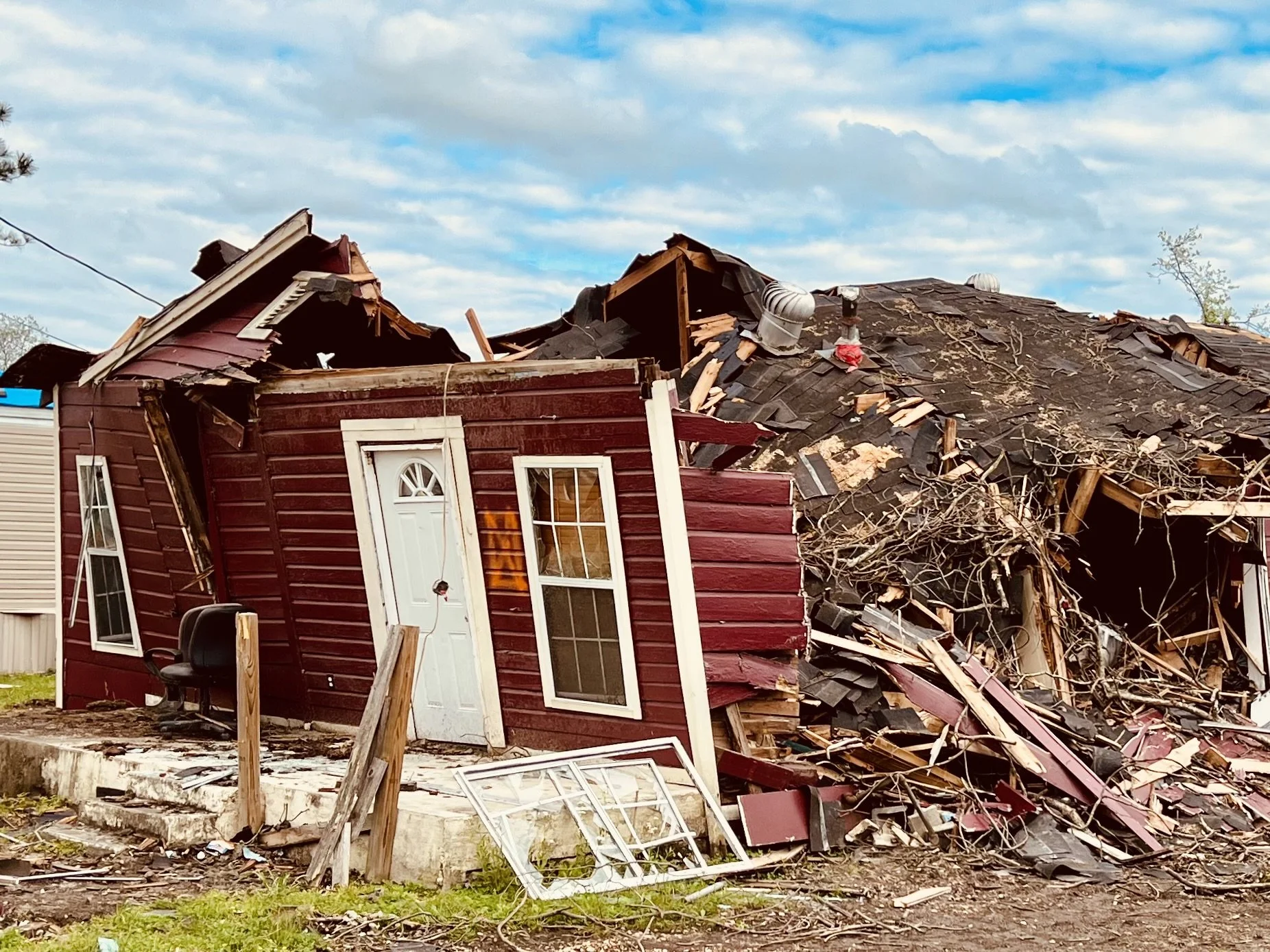
Another photo from Amory, Mississippi. Interestingly, meteorologists measure the strength of a tornado by the destruction it leaves in its wake because it is almost impossible to measure a tornado while it is active. Photo by Michael Chase. Follow him on Instagram @mjohnsonchase.
The second reason you may know about Amory, Mississippi, is more fun. Two residents from Morgan County are competing in the 21st American Idol contest: Colin Stough and Zachariah Smith, both of whom have wowed the judges in their solo auditions. It’s striking that so many fine American gospel, blues and country musicians have come from the rural South. Still, Amory has the distinction of also having the 2015 American Idol winner, Trent Harmon. This is a good news story, and you can check out the contestants at the links above.
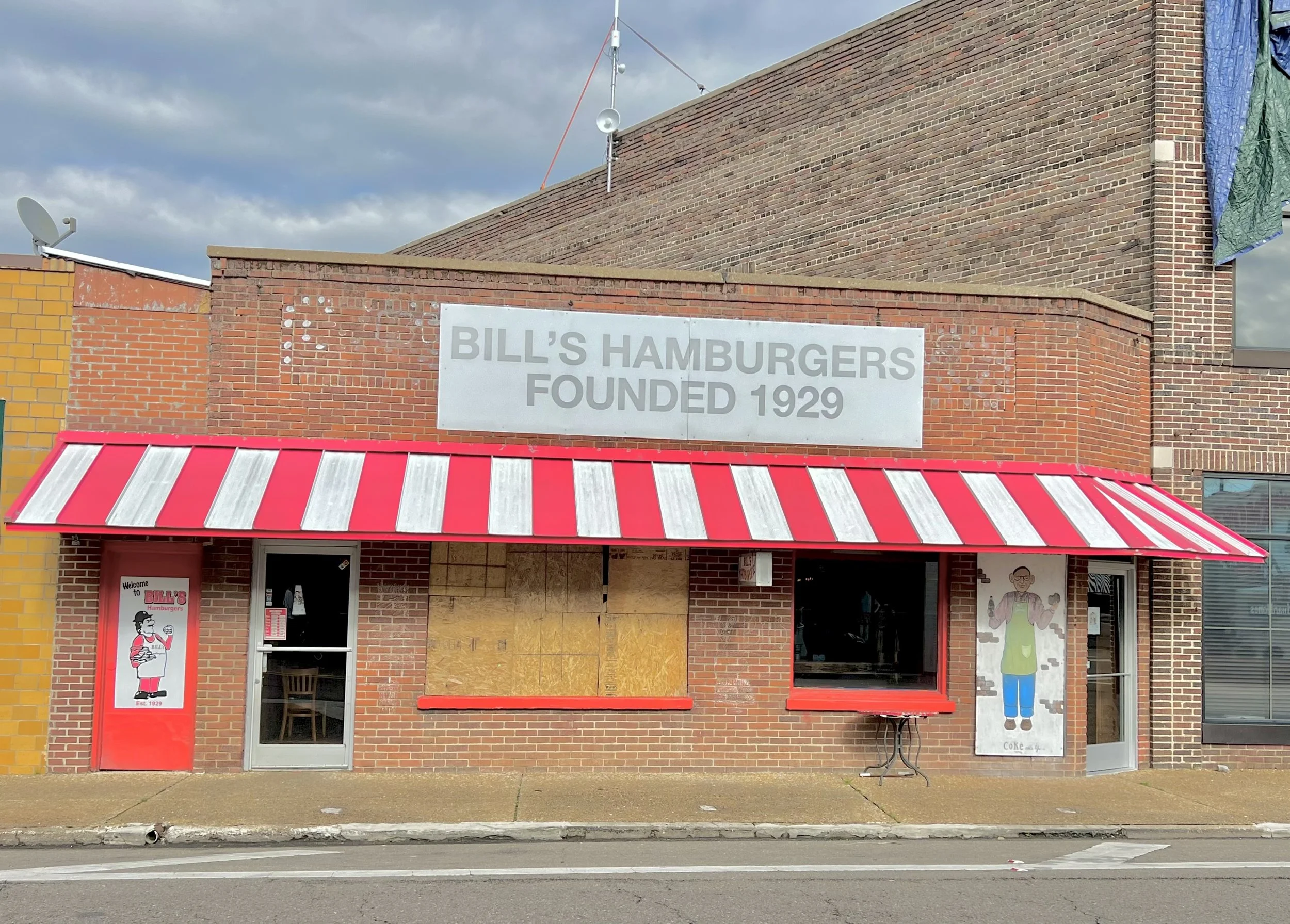
Bill’s Hamburgers sits temporarily closed after the Amory tornado, where 2023 American Idol contestant Zachariah Smith flipped over 400 hamburgers every Saturday. Photo by Jenny Hershey. Follow her on Instagram @deeofo.
Stay vigilant! Thanks for reading. Part 2 of this series will come soon. If you haven’t done so, please subscribe to this blog to follow our next biking trip.
Blog writing by Michael Johnson Chase. Drawings by Jenny Hershey. Unless credited or otherwise noted, all material is the copyrighted property of the blog post authors.
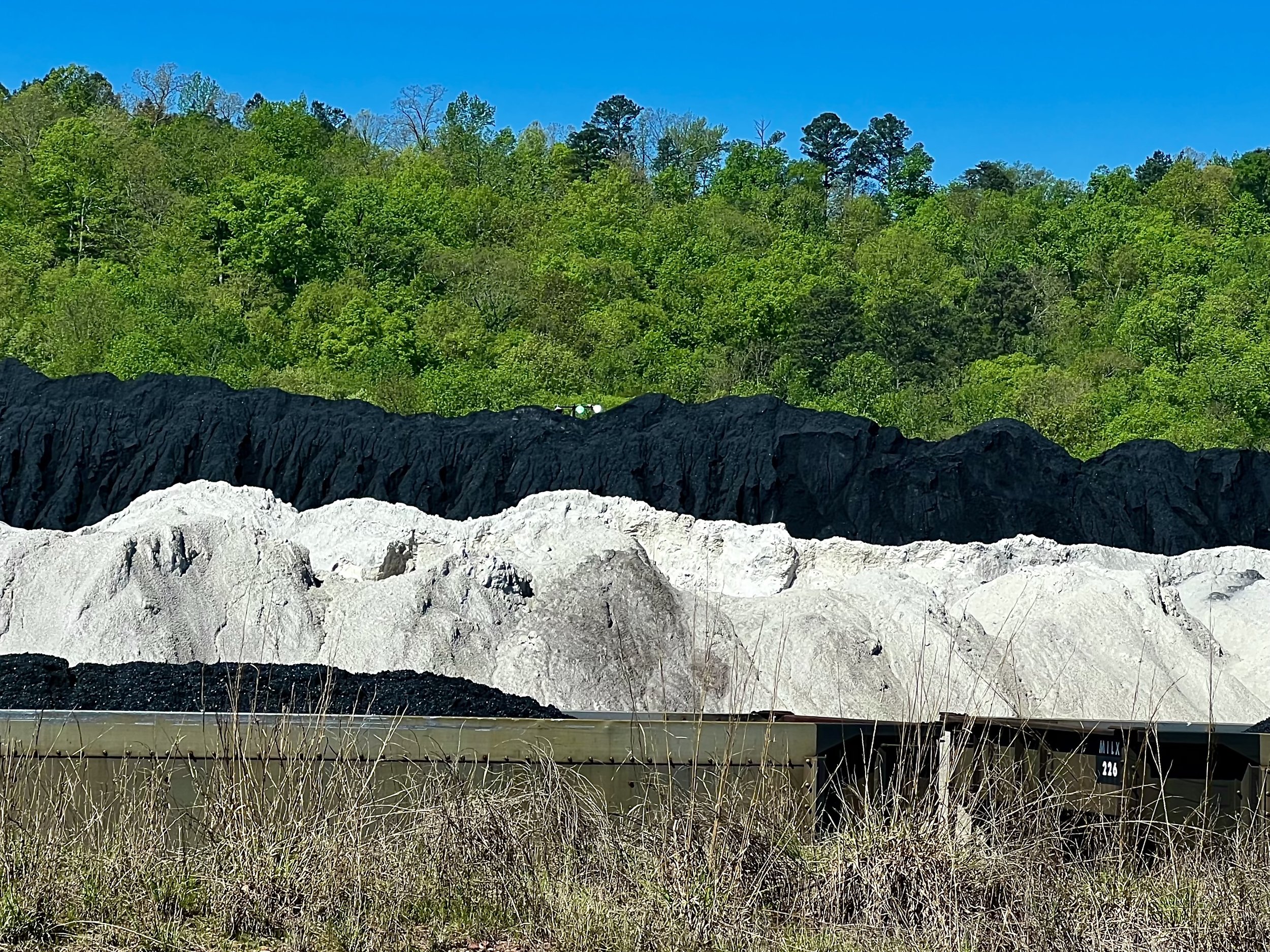
Although coal powers 18% of the electricity in Alabama and only 8% in Mississippi, coal still powers 50% of the electricity in Arkansas. We are a long ways from “electrifying everything,” but the vision and template to get there is a big part of the Inflation Reduction Act. If we care about young people, public health, and economic well-being, we must all work hard to utilize this bill's opportunities. Photo by Michael Chase. Follow him on Instagram @mjohnsonchase.
Money Talks and Goliath Walks; Biking from Birmingham to New Orleans
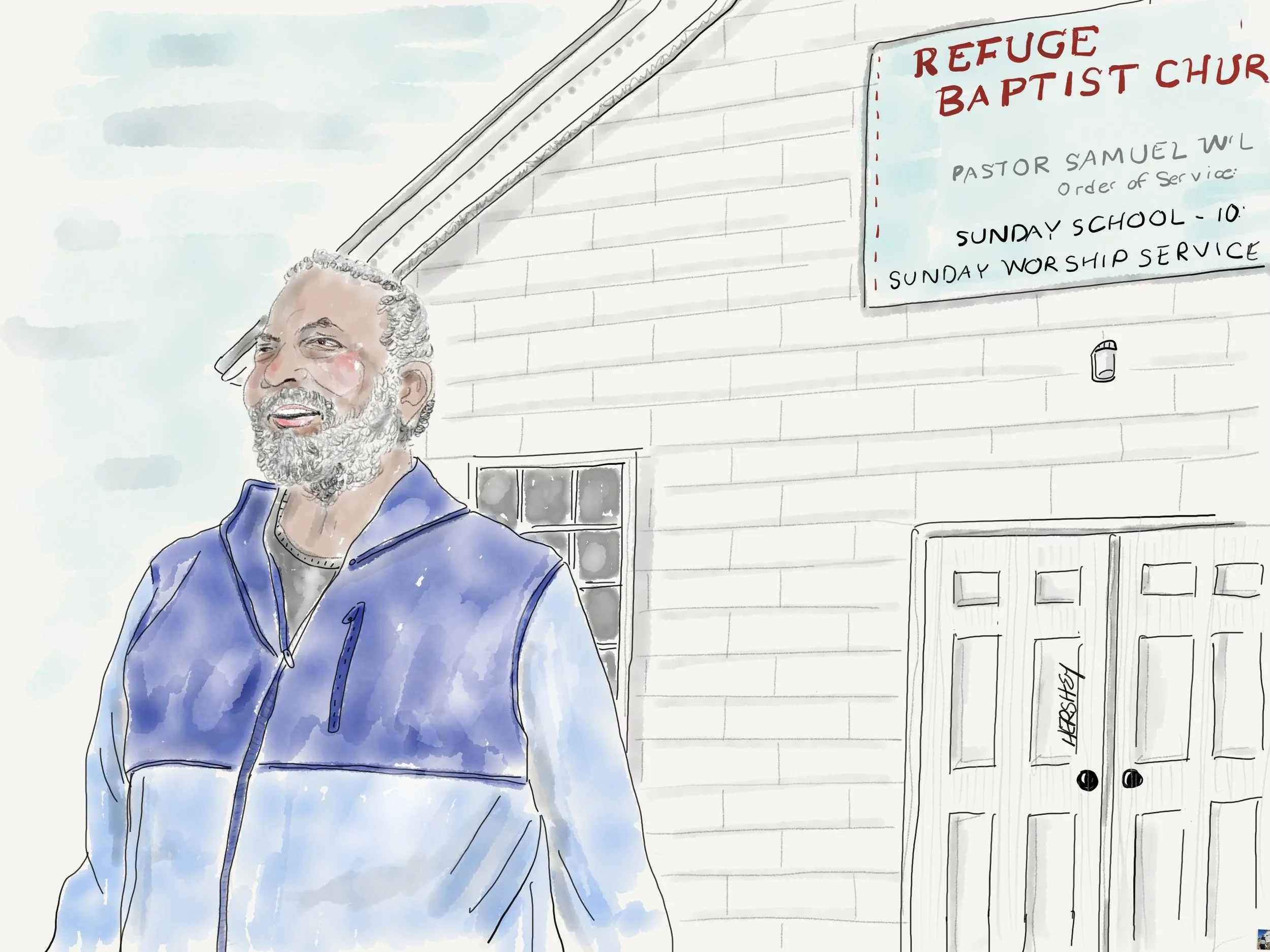
Jenny and I met Pastor Samuel Williams on the outskirts of Tuscaloosa. Although he was fixing a frozen water pipe outside his church (which had prevented him from having services that day), he stopped working and gave us his full attention when we asked about a closed road ahead. A patient and charitable man, the Paster’s dedication to spiritual life was palpable, and he seemed to exude peace and happiness. When he learned we live in New York City, he asked us immediately if we had been affected similarly to Buffalo. We told him thankfully not, although NYC was experiencing its own extreme weather with unusually warm temperatures for January with lots of rain. But we had woken up to 28 degrees Fahrenheit in Tuscaloosa that morning, so it was easy to understand why his pipe had frozen. We all had a good laugh about how unpredictable the weather was growing. As we started to bike away, Jenny reflexively remarked, “Take care, Pastor Samuel.” The Pastor’s response took us by surprise “According to scripture, taking care means a person is experiencing anxiety and needs to give it away to God. So I think you mean take it easy”. So be it, Pastor Samuel. We’re taking it easy… Drawing by Jenny Hershey. Follow her work on Instagram @deeofo.
“We must accept finite disappointment, but never lose infinite hope.”
–Martin Luther King, Jr.
Finally Jenny and I are back on the road, this time in the Deep South. After a hiatus in bike touring to manage some family affairs last summer, we were fortunate enough to take an early autumn bicycling tour through the northeast and a bit of Quebec. I was about to publish a post late in that trip when both Jenny and I contracted Covid. While recovering, my mood grew so dark that I abandoned the post (I have since learned that depression can be a symptom of Covid). I didn’t want to inflict my grim mood on others - and there’s only so much one can say about the growing potential for societal collapse if GHG emissions continue to rise (alas, it looks like we will increase GHG emissions yet again in 2023). It had already been a very rough year for extreme weather events, foreshadowing deeper challenges to come as our climate grows less stable.
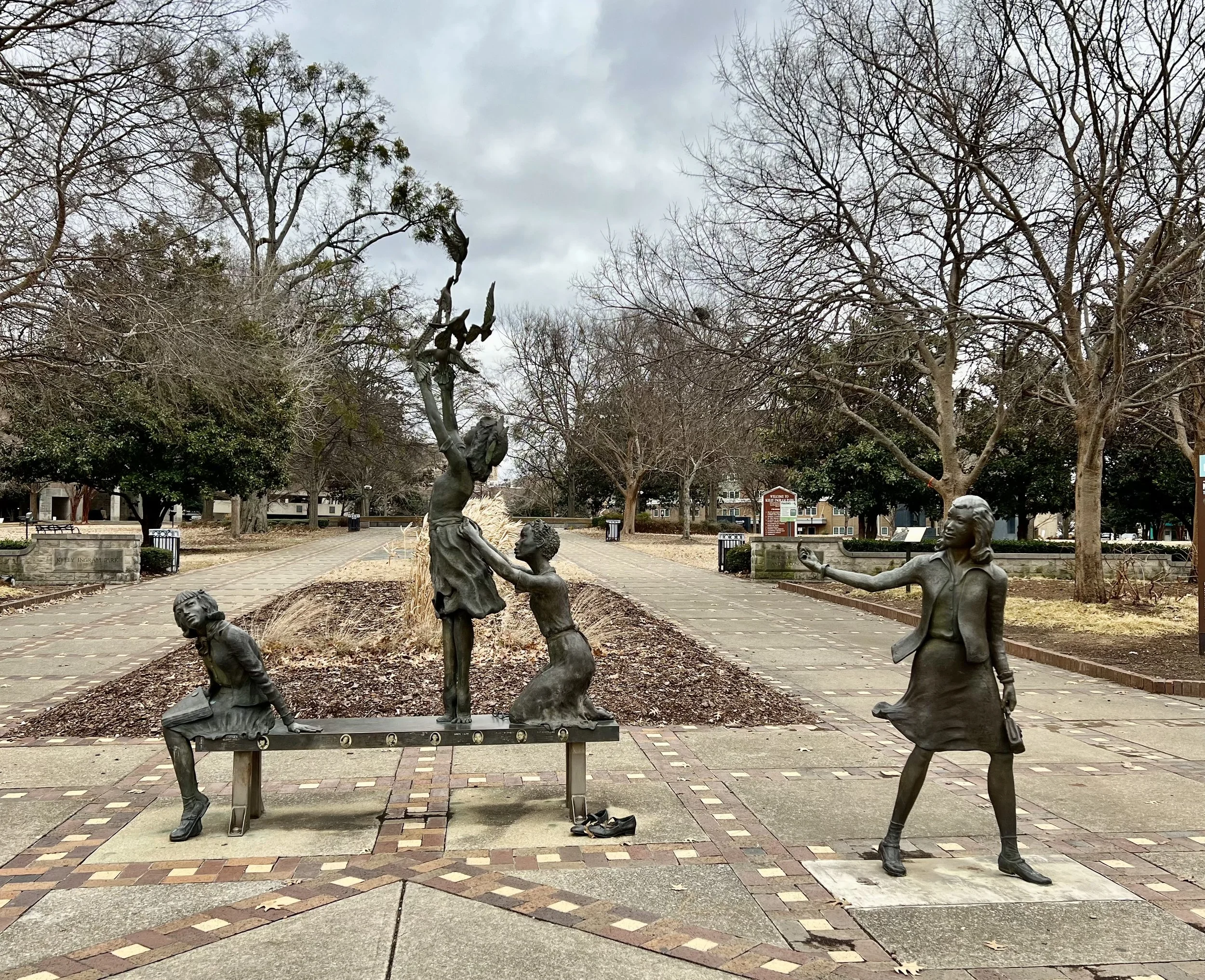
A statue of the girls who perished in the 16th Street Baptist Church bombing in Birmingham, Alabama on Sunday, September 15, 1963. Described by Martin Luther King as "one of the most vicious and tragic crimes ever perpetrated against humanity," the explosion at the church killed four girls and injured between 14 and 22 other people. Photo by Jenny Hershey. Follow her work on Instagram @deeofo.
And as usual, the most vulnerable among us are the impacted the greatest. I was feeling especially bad for people in the global south who have been ravaged by climate related disasters. I was also discouraged by the game of chicken underway by a few members of Congress as meaningful climate legislation was repeatedly on, and then off, the table. Although I knew the world was about to break yet another GHG emissions record for 2022, I didn’t know until late in the summer that Chuck Schumer, Joe Manchin and other Senators were engaging in backroom log rolling toward a revised version of the Build Back Better plan. Had I known, I might not have been so discouraged.
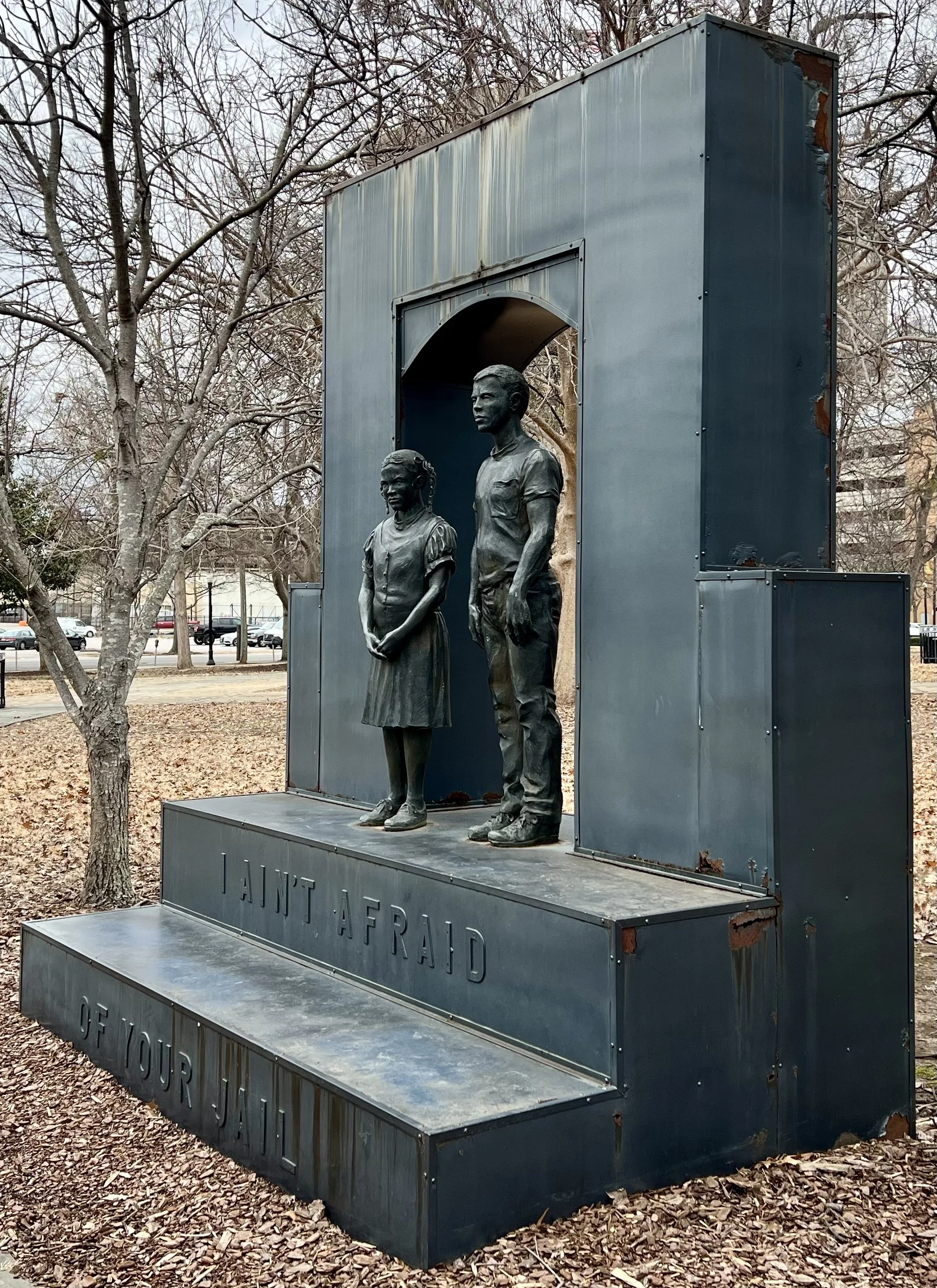
A statue in Kelly Ingram Park in Birmingham commemorating student protests that occurred for weeks after the 16th Street Baptist Church bombing, bearing the inscription “ “I ain’t afraid of your jail.” Photo by Michael Chase. Follow his work on Instagram @mjohnsonchase.
You may have felt similarly. Just to remind us of how extreme weather events are both speeding up and cascading, here is a cursory review of global events from the spring of 2022 through the early winter of 2023:
As a result of persistent droughts, communities across Africa, including Kenya, Nigeria, Ethiopia, and Somalia currently face the worst food crisis seen in 40 years. Earlier in the summer of 2022 more than 2,000 people died in Spain and Portugal during a brutal heatwave, while drought in Somalia displaced more than a million. In the United States, climate-related disasters exceeded $1 billion in damages the first 6 months of the year, including the ongoing drought in the west and southern plains and a tornado outbreak in Alabama, Florida, and Mississippi in March. In late July heavy flooding in eastern Kentucky killed at least 38 people. Also in July, parts of the United Kingdom saw temperatures soar for the first time ever to 104 degrees Fahrenheit, and much of Europe similarly suffered. In Pakistan, one third of the country experienced widespread destruction from three months of heavy rains after a prolonged period of heat in the spring. Flooding killed more than 1,400 people across the country during the summer and damaged or leveled more than a million homes, including many that were swept away by water. In total, over 30 million people have been affected. Additionally, Pakistani farmers lost up to a million head of cattle as well as 90% of the country’s fall harvest. Now starvation looms for millions of people as Pakistan faces a “second wave of death” that is likely to spiral toward implosion without major global assistance. September brought Hurricane Ian to the Caribbean and Florida, upending the lives of thousands, killing 109 people in the US alone, and resulting in a staggering $100 billion in damages. Then, a record-breaking snowstorm and polar vortex slammed much of the midwestern and northeastern US in January and produced a massive snowstorm that killed over 40 people in Buffalo in early 2023. That tragedy was followed by three weeks of extraordinary rain in California as a stubborn weather pattern sent wave after wave of tropically-infused atmospheric rivers, triggering widespread flooding, landslides and power outages across the state. At the same time, the mountains were buried under several feet of snow. 22 people were killed, and damages are still being assessed. Shortly thereafter, there were record breaking rains in New Zealand, freezing cold across the South and a polar vortex in New England. …and it’s only going to grow worse. Buckle your seat belts, folks. That's only the beginning.
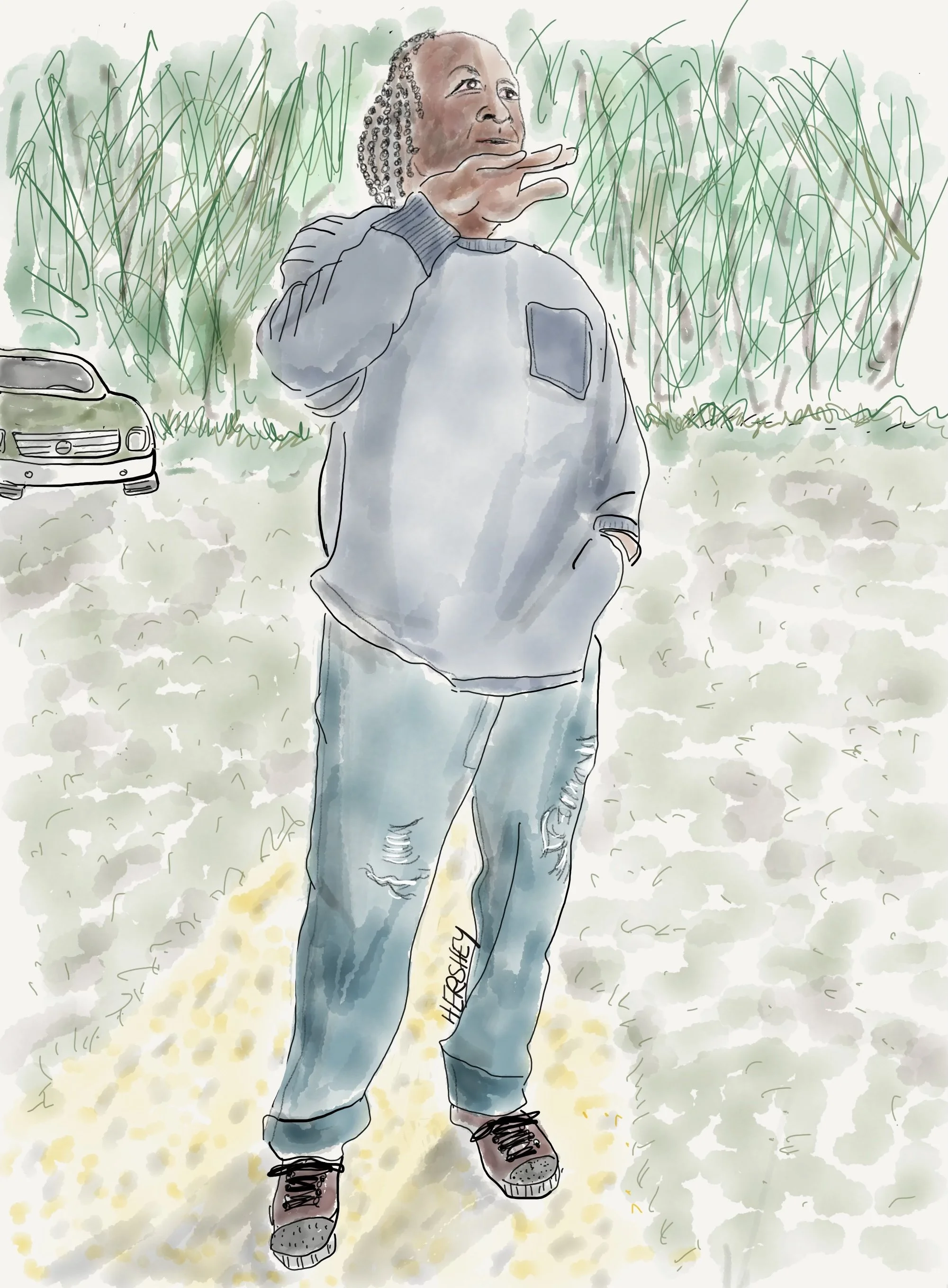
We met Joe deep in the countryside outside of Fosters, Alabama. He was content grazing his six cows on a neighbor’s land across the road. He is hoping for a little growth in his herd when a bull joins his girls next month. He also enjoys a small herd of goats that roam freely on his property just because, “he likes them.” Joe lives a simple life by making and selling his own BBQ sauce. He lives a cherished “second life” after a near-death automobile accident (during the Covid pandemic) that laid him up for over a year. Drawing by Jenny Hershey. Follow her work on Instagram @deeofo.
As I recovered from Covid my depression began to lift, yet I continued to wrestle with my grim perspective of the future. It helped to study two bills passed in the last Congress - the Inflation Reduction Act and the bipartisan Infrastructure Investment and Jobs Act. Almost as an act of will, I have chosen to believe in their potential. While I am certain that significant change is coming straight at us, things can - and may - change as much for the better as they can for the worse. Perhaps society will re-organize in an increasingly aggressive climate in a manner to avoid civilizational collapse, maybe making civilization even more - well, civilized. In any event, I have decided that a curated vision of the worst possible outcome is not good for one’s mental well-being - even if one is proved right. I’d so much rather be proved wrong.
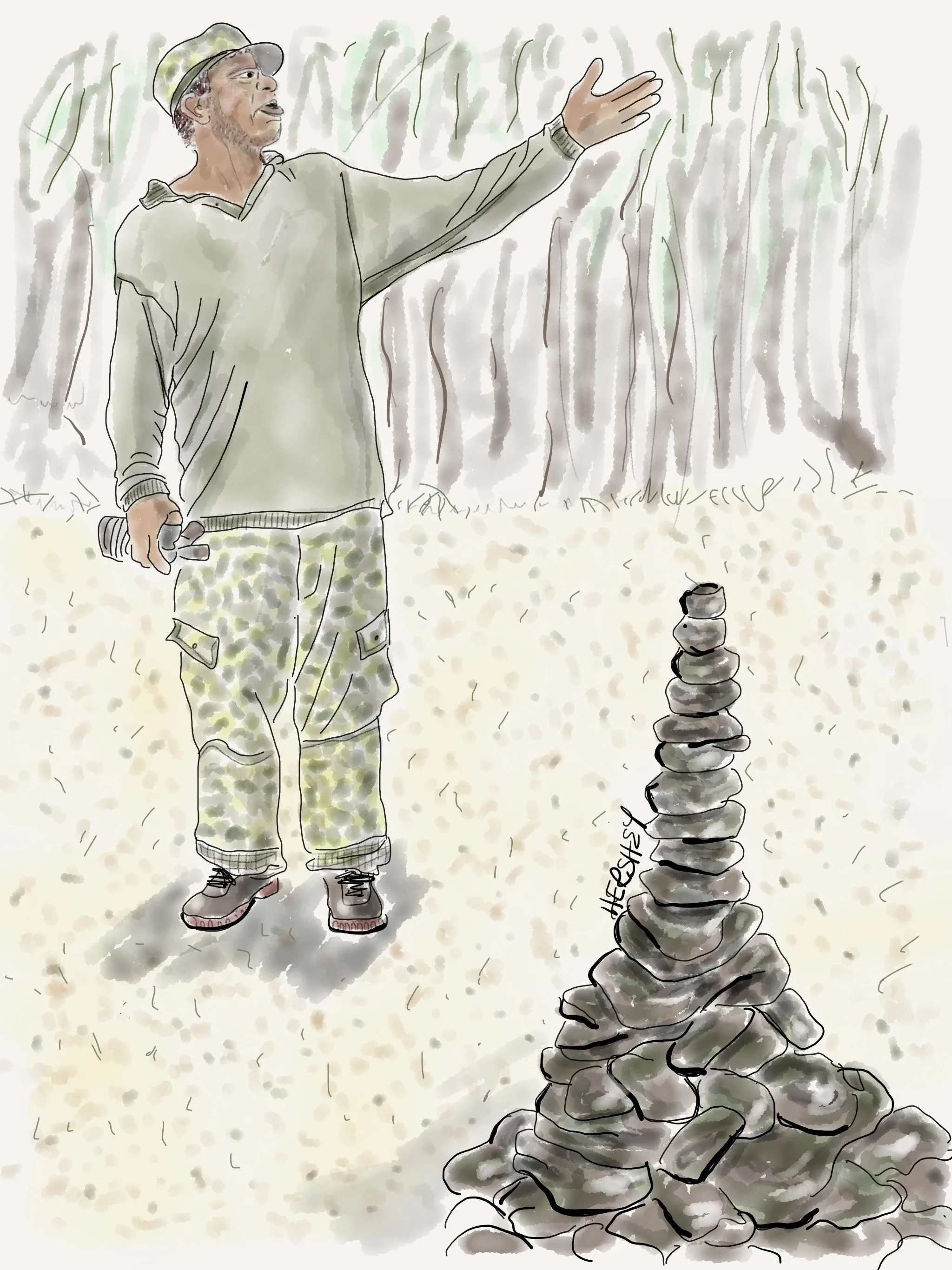
“God spoke to me, and told me to build it”! said Lester. We met him while biking on Route 11 in Jasper County, Mississippi. Busy clearing brush, he stopped to proudly showed us his cairns at the base of his driveway. Lester still cares for his disabled daughter after his wife died from diabetes 15 years ago. His older daughter works in the big city of Hattiesburg, MS. A simple man who has worked hard all his life caring for others, Lester finds solace and support in his local church. He was quite enthusiastic about the important and accomplished people that attended a recent service at his church commemorating Martin Luther King. Drawing by Jenny Hershey. Follow her work on Instagram @deeofo.
Jenny and I believe that tracking the implementation of the Inflation Reduction and the Infrastructure Acts over the coming years will be the focus of future our biking tours as climate investments are scaled up. If all goes well, over the next decade the world will witness widespread growth in renewable energy, grid modernization, electrification of our transportation and building systems (in spite of the ridiculous culture war in the US over stoves), the growth of hydrogen-based fuel for long haul transport and some forms of heating, and - if safety and siting concerns are adequately addressed - deployment of carbon capture, storage and industrial uses for carbon. Below is a graph that shows how both bills will complement each other.
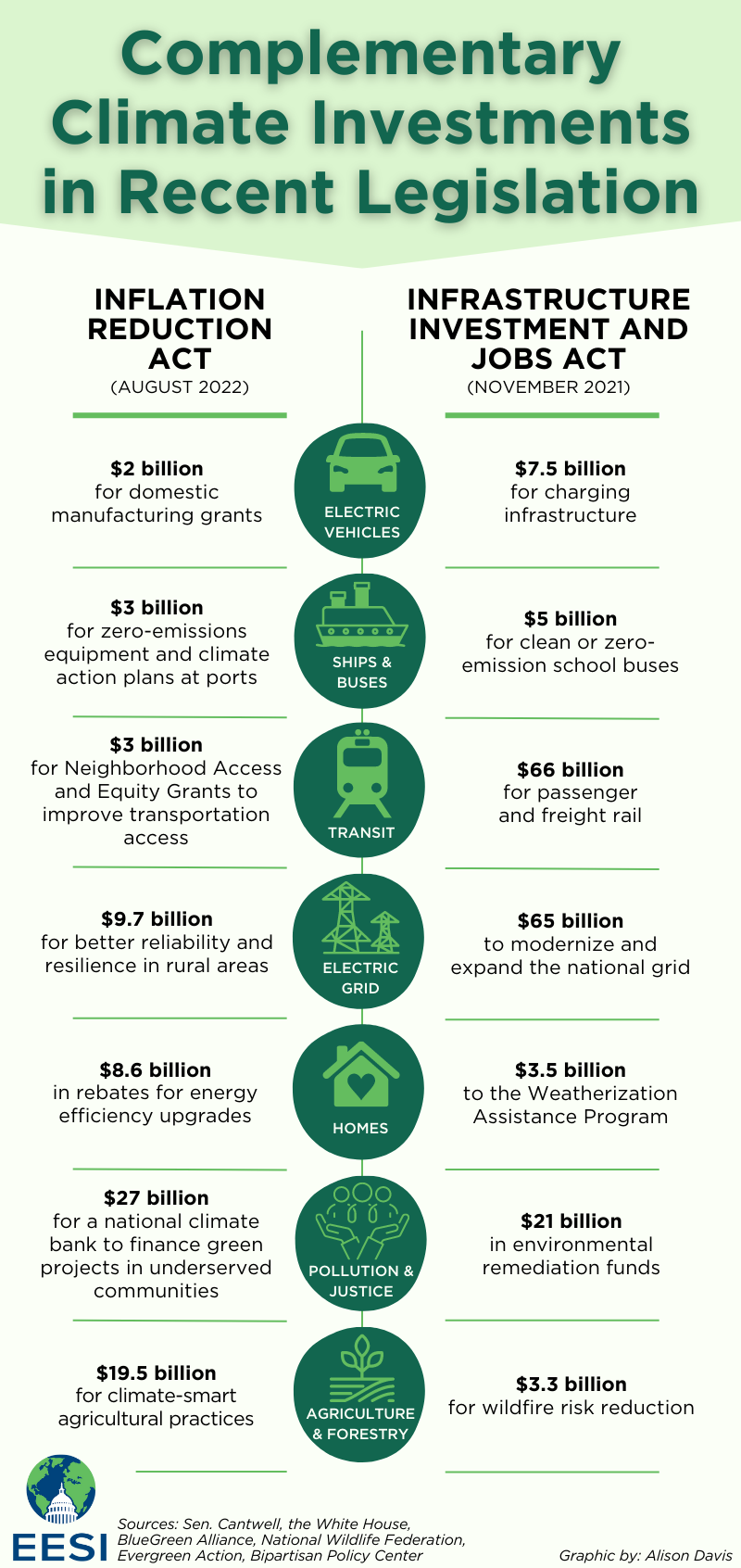
This graph can be sourced here. Along with tax reforms (which are under threat of repeal by the new Congress) and investments in healthcare, the Inflation Reduction Act provides $369 billion to address climate through tax credits for clean energy and electric vehicles, by boosting energy efficiency, establishing a national climate bank, supporting climate-smart agriculture, bolstering production of sustainable aviation fuel, reducing air pollution at ports, and more. The law represents the boldest action Congress has taken on climate yet—if enacted successfully and quickly enough, it will put the United States on a path to reduce greenhouse gas emissions by 40 percent below 2005 levels by 2030, according to several independent analyses. That is, of course, if implementation is both rapid and effective. Additionally, the Infrastructure Investment and Jobs Act provides complementary investments in energy modernization, transportation, workforce development, and building decarbonization.
We are pleased that the bipartisan infrastructure bill provides $66 billion to rebuild our decaying US rail system, because Jenny and I are supporters of combining train travel and bike touring. We started our current trip in the Deep South by taking a train (with our bicycles onboard) from Penn Station, New York, to Birmingham, Alabama - leaving on a rainy and uncharacteristically warm New York City in mid-January, and arriving in an uncharacteristically cold Birmingham the next day. We set out on our bikes for Meridian, MS, intending to catch a train to New Orleans and then another to San Antonio (we had purchased multi-ride ticket passes). But upon our arrival in Meridian we discovered that track work was limiting the number of trips on the Crescent line so there was no train for four more days. We decided to bike to New Orleans instead. We are glad we did. Serendipity has its place, especially when traveling on bicycles.
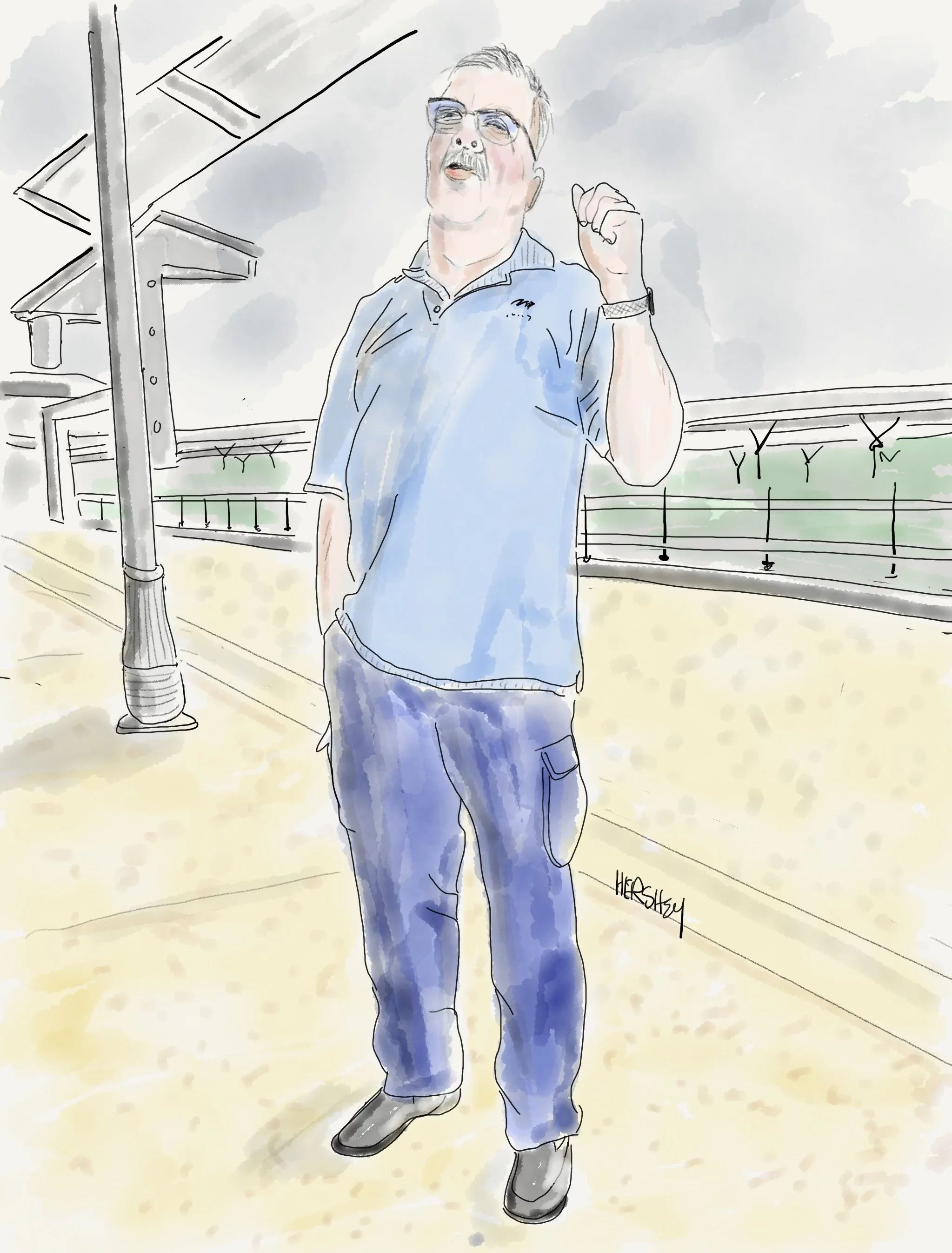
Bunky is the Amtrak Station Manager in Meridian, Mississippi. When we learned our intended train to New Orleans was delayed for four days, he took us out on the station platform and shared quite a bit about the history of Meridian. A proud yet humble man, Bunky also shared his previous life as the Fire Chief of Meridian, and held us rapt as he recounted the time a plane crashed on the interstate that passes through town. But his biggest challenge was getting to New York a week after 9/11 to help restore order and rescue firefighters and civilians at the World Trade Center. That fact alone inspired our trust, so when Bunky encouraged us to go to the Mississippi Arts Museum, we said of course we would. Modern and interactive, the museum is extremely well curated and it inspired us to stay longer in Mississippi, so we decided to forgo our plans to get to Texas, and instead bike to New Orleans through Mississippi. The South had us hooked. Drawing by Jenny Hershey. Follow her work in Instagram @deeofo.
We’ve been on our bikes ever since, with our eyes open for early indications of progress in climate infrastructure development that might link to either legislation. What we found surprised us. I was researching early climate infrastructure projects while spending a rainy day in a motel in Bogalusa, Louisiana, when I encountered an interesting story about Parish Councils near Lake Maurepas to the west of New Orleans.
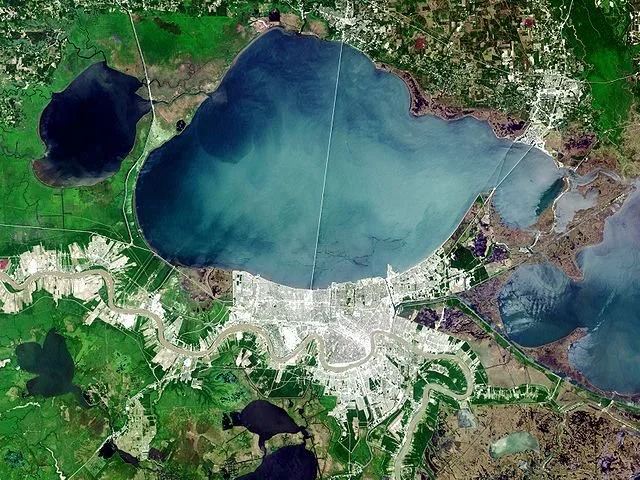
Lake Maurepas is in the upper left of this satellite image of southeastern Louisiana. Lake Pontchartrain lies to its east, with New Orleans about 25 miles away along Pontchartrain's southern shore. (Satellite image via Wikimedia Commons.)
In October 2021, Louisiana Governor John Bel Edwards announced that Air Products, a multinational chemical company based in Pennsylvania, will invest $4.5 billion to develop a “clean” energy complex in Ascension Parish, Louisiana, by 2026. This project involves the construction of a new plant in the unincorporated community of Burnside (across the Mississippi River from Donaldsonville, a petrochemical capital of Louisiana) to convert natural gas to “blue” hydrogen by capturing the resulting carbon dioxide. The plant will use its own preexisting pipeline infrastructure to ship hydrogen to market, and build a new pipeline through the largely untouched Lake Maurepas marsh to transport the resulting CO2 about 30 miles to injection wellheads for permanent storage under the lake.
In this instance, the CO2 created as a byproduct of cracking methane (which makes up about 70-90% of natural gas) to form hydrogen will be compressed into a denser liquid-like form, and injected into geological formations called saline aquifers (a layer of porous rocks saturated with salty water) 7000 feet under Lake Maurepas. Apparently, saline aquifers are ubiquitous across much of southern and coastal Louisiana, so given the intensity of the petrochemical industry here, it seems likely there will be many more proposals made by fossil fuel companies to store CO2 in the Gulf coastal region.
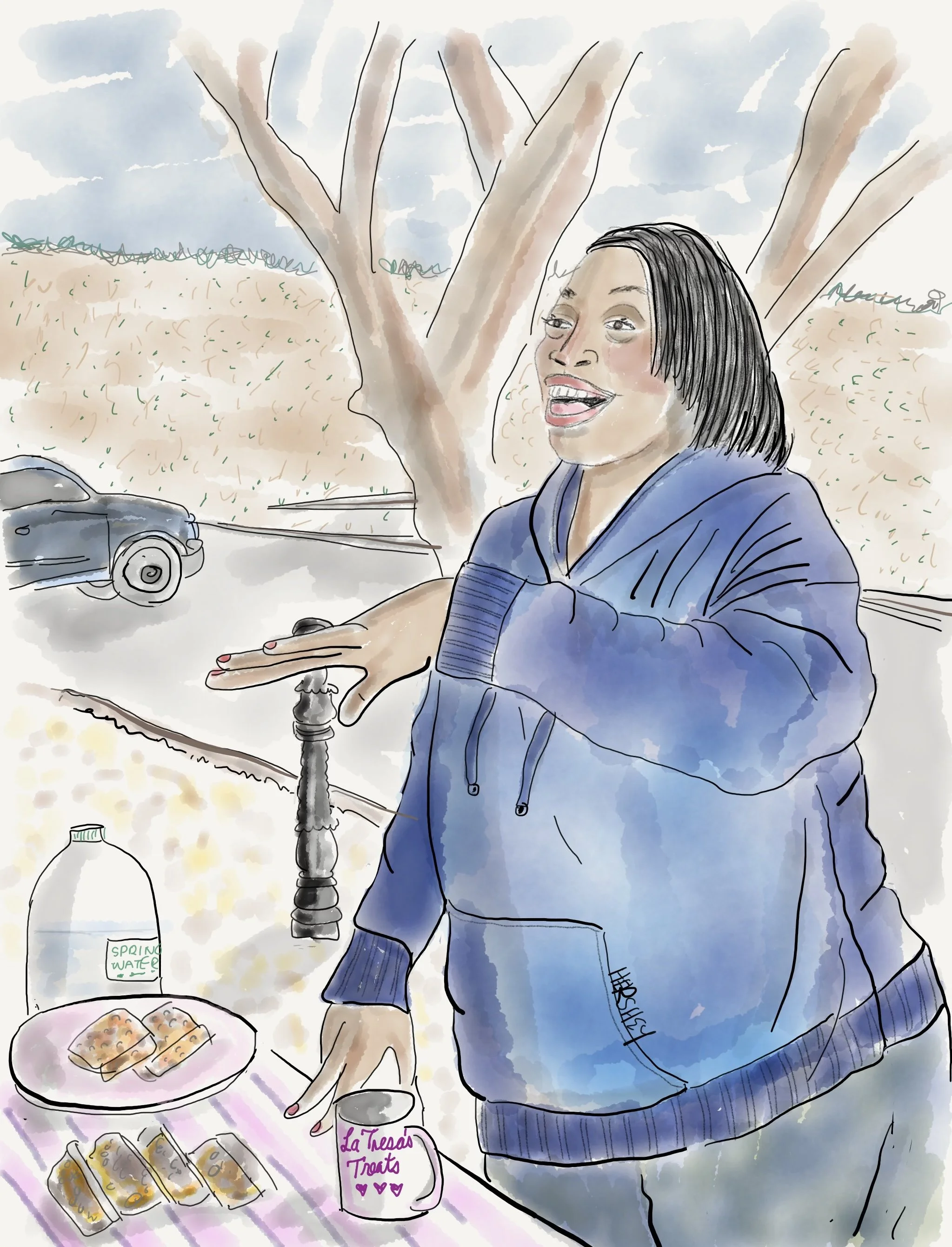
Ms. Rosalyn radiated joy. A talented baker and co-owner of LaTresa’s Treats, she tempted us with her homemade pecan squares at the small weekly farmer’s market on the town square in delightful historic Hattiesburg, Mississippi. “They taste like heaven” she assured us, “if you like pecan pie, you’ll love these squares”… Sampling one that evening for dessert, we discovered Ms. Rosalyn was right. Imagine something that tastes better than a piece of pecan pie! And she’ll ship them! You can order them here. Drawing by Jenny Hershey. Follow her work on Instagram @deeofo.
Interestingly, hydrogen is described by colors as shorthand for how it is created. Although hydrogen is the world’s most plentiful chemical, it doesn't exist on its own in nature; instead it bonds to other chemicals and is most abundant as H2O. It is also present in the atmosphere and in methane. Hence, hydrogen made from burning natural gas is referred to as “blue” when the carbon is captured, “grey” when carbon escapes into the atmosphere, and “green” when it is cracked or separated from water through electrolysis using electricity made from renewable sources. Only green hydrogen can be made without creating CO2.
When blue hydrogen is manufactured and the resulting CO2 emissions are captured and stored underground, the process is often described by the manufacturer as carbon-neutral. And although Air Product’s proposal is touted as such, closer examination suggests otherwise. Some studies suggest that the carbon footprint of blue hydrogen is 20% larger than gas and coal for the energy required to crack the hydrogen. That doesn’t count the CO2 the process creates, which is what Air Products intends to capture and store. Additionally, natural gas production inevitably results in methane emissions from so-called fugitive leaks, which are leaks of methane from the drilling, extraction and transportation process.
Although fossil fuel companies claim they have years of experience storing carbon, they usually fail to mention their experience is with enhanced oil recovery (EOR), which involves injecting carbon dioxide into oil wells to coax out hard-to-get oil. That is not the same thing as permanent CO2 storage, which is a new technology. In fact, it is so new that there are only two long-term carbon storage wells currently in use in the US.
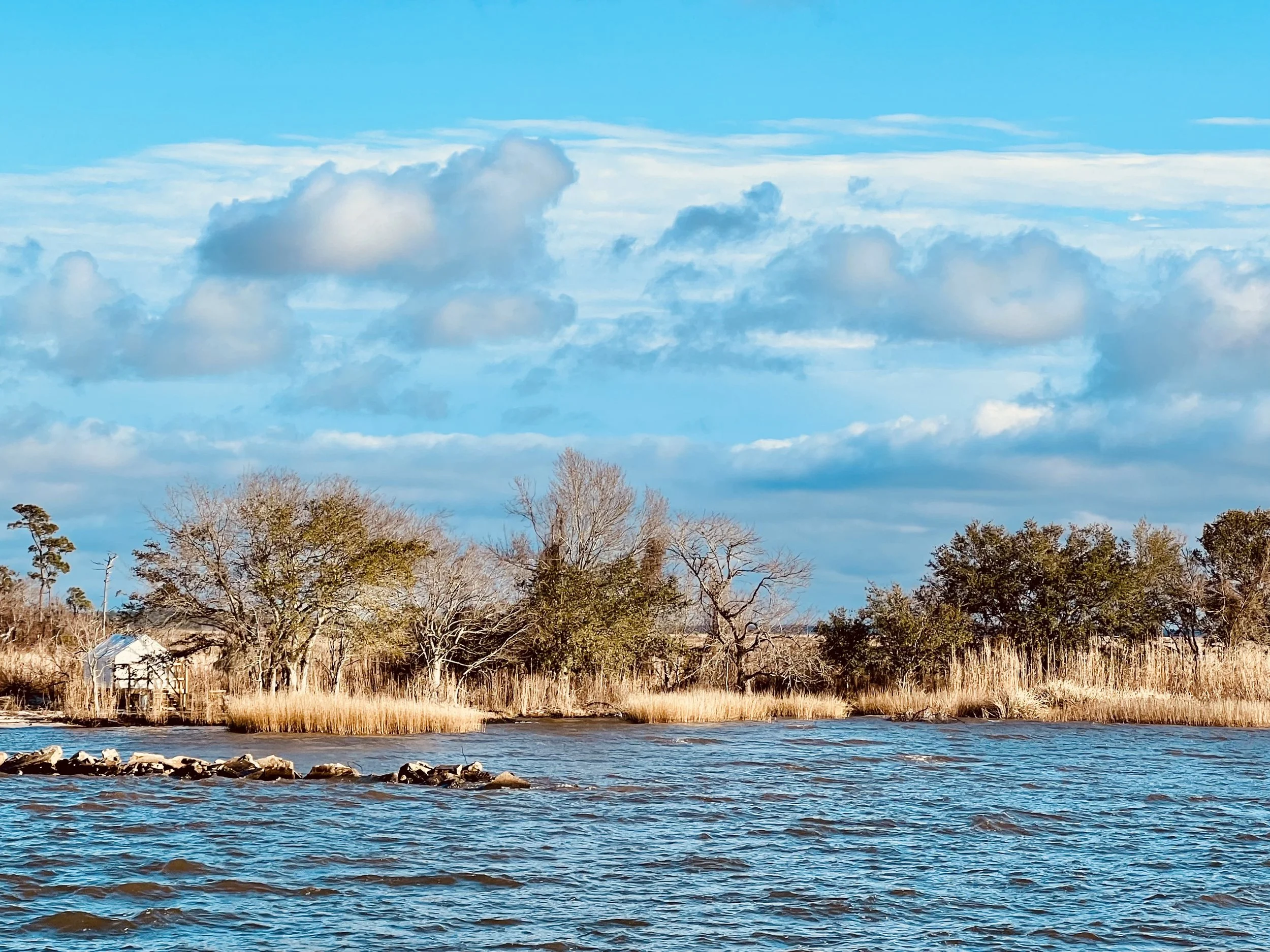
Picture taken at Fontainebleau State Park, Louisiana, on the northern shore of Lake Pontchartrain. Photo by Michael Chase. Follow his work on Instagram @mjohnsonchase.
Some people still might ask, what's the big deal? After all, we currently release about 11 million tons of CO2 into our atmosphere daily. As the longest-lasting GHG in our atmosphere, CO2 is currently at about 450 parts per every million (ppm) molecules of atmospheric gases (and rising) and that concentration doesn't impact human health yet. But to transport and/or store carbon, CO2 must be concentrated into a liquid of vastly higher concentration. Although Air Products claims their process of transfer and storage will be perfectly safe, the technology and infrastructure pose a safety risk to the communities they encounter. The bottom line is that sequestering CO2 at a commercial scale is, as yet, unproven to work in the real world.
It’s also important to be skeptical about the carbon capture rates that companies have promoted. Mark Jacobson, a professor of civil and environmental engineering at Stanford University helped publish a recent study on blue hydrogen. When interviewed by The Lens - an excellent New Orleans local news organization - Jacobson noted that methane leakage is essentially unavoidable in the blue hydrogen process. Assuming a 3.5% methane leakage rate would be conservative for a project like Air Products’. He goes on to say, “The only blue hydrogen facility that produces hydrogen from natural gas at a commercial scale for which there is relevant data is Shell’s Alberta plant, which has demonstrated a mean capture rate of 78%.” A separate analysis conducted by the watchdog group Global Witness says the figure is closer to 48%. Carbon capture prolongs the life span of industrial facilities that contribute significantly to climate change, yet according to Jacobson, carbon capture rates are inadequate, and simply not worth the investment. Yet, the fossil fuel industry is aggressively selling carbon sequestration, utilization and storage (CCUS) to the public as a safe and significant way to achieve full decarbonization by 2050.
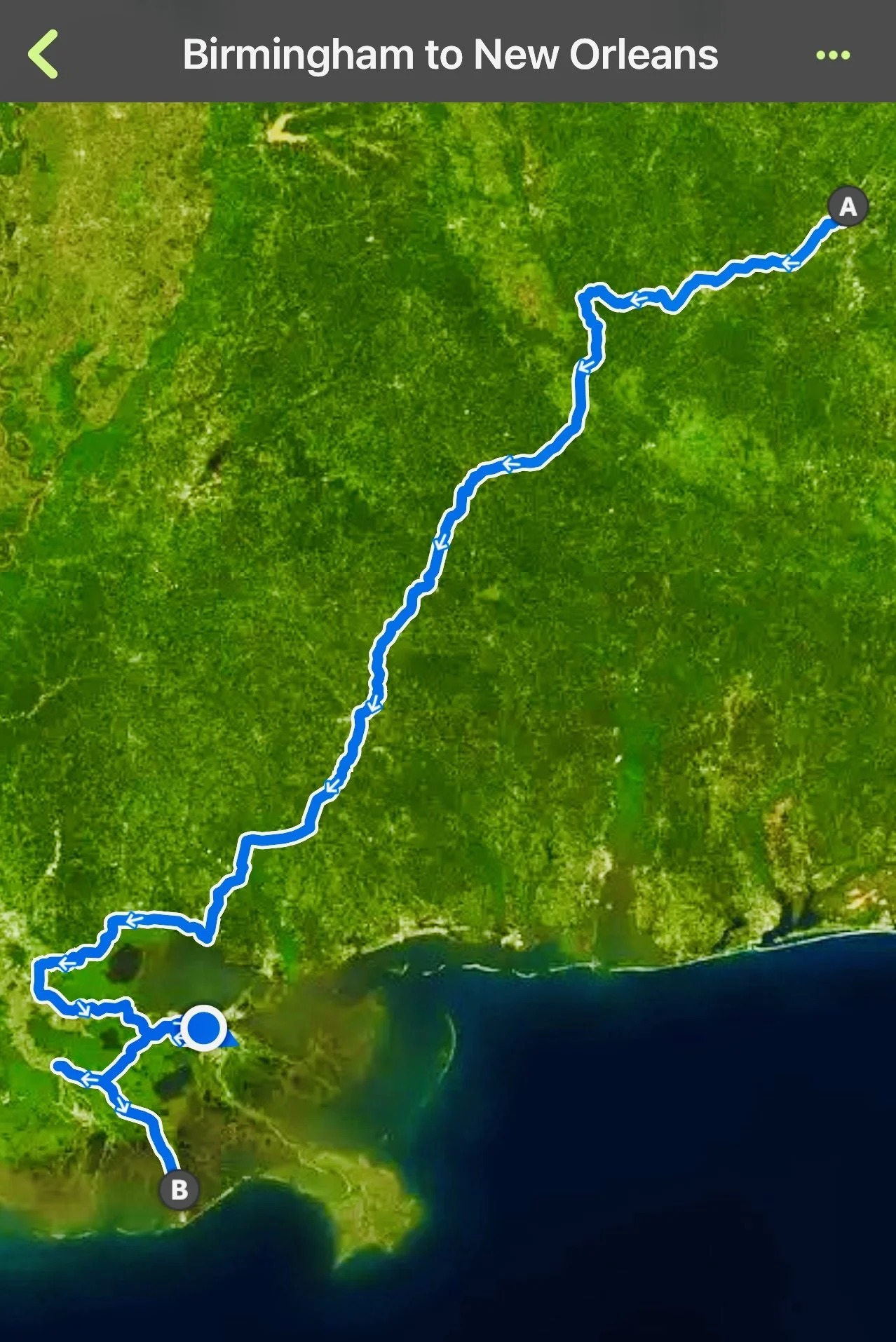
Traveling almost 1000 miles on bicycles, this is the shape of our trip. “A” is Birmingham, where we started, and “B” is Golden Meadow, deep in the coastal marsh of Louisiana below New Orleans, which is as far south as we were able to go because of damage from Hurricane Ida. The blue dot is where we were when we made this map. Map created on Kamoot.
I've been aware for some time that environmental justice groups are very wary of plans by fossil fuel companies to decarbonize their product as a way to keep selling it. There are many significant players in this arena, and many of them are pressuring the EPA to decline permits for a proliferation of CCS applications. One example is from California's Central Valley Air Quality Coalition. Another is in New Orleans, at the Deep South Center for Environmental Justice. The DSCEJ has been pushing local and federal leaders to consider the potential consequences of CCUS on Black communities around the Gulf Coast who have dealt with the consequences of the oil and gas industry’s careless pollution on their health and livelihood for decades. It was their advocacy that prompted The New Orleans City Council to unanimously pass Resolution NO. R-22-219. This resolution urges the prohibition of underground storage of carbon dioxide and facilities for this purpose. Passed in May of 2022, Dr. Beverly Wright, Executive Director of the Deep South Center for Environmental Justice, commented: “I am proud of New Orleans for being a trailblazer in policies that protect local communities from CCS technologies. As I said when Energy Secretary Jennifer Granholm visited recently, supporting CCS will encourage the growth of fossil fuel industries and continue the injustice of putting profits over communities of color. Instead, we need to develop and implement an energy plan for Louisiana that cleans our air and powers our homes and vehicles while prioritizing equitable investments in communities and invests in people to get the necessary training for clean energy jobs of the future. We encourage other local municipalities around the country to follow New Orleans’ lead to prohibit CCS technology”.
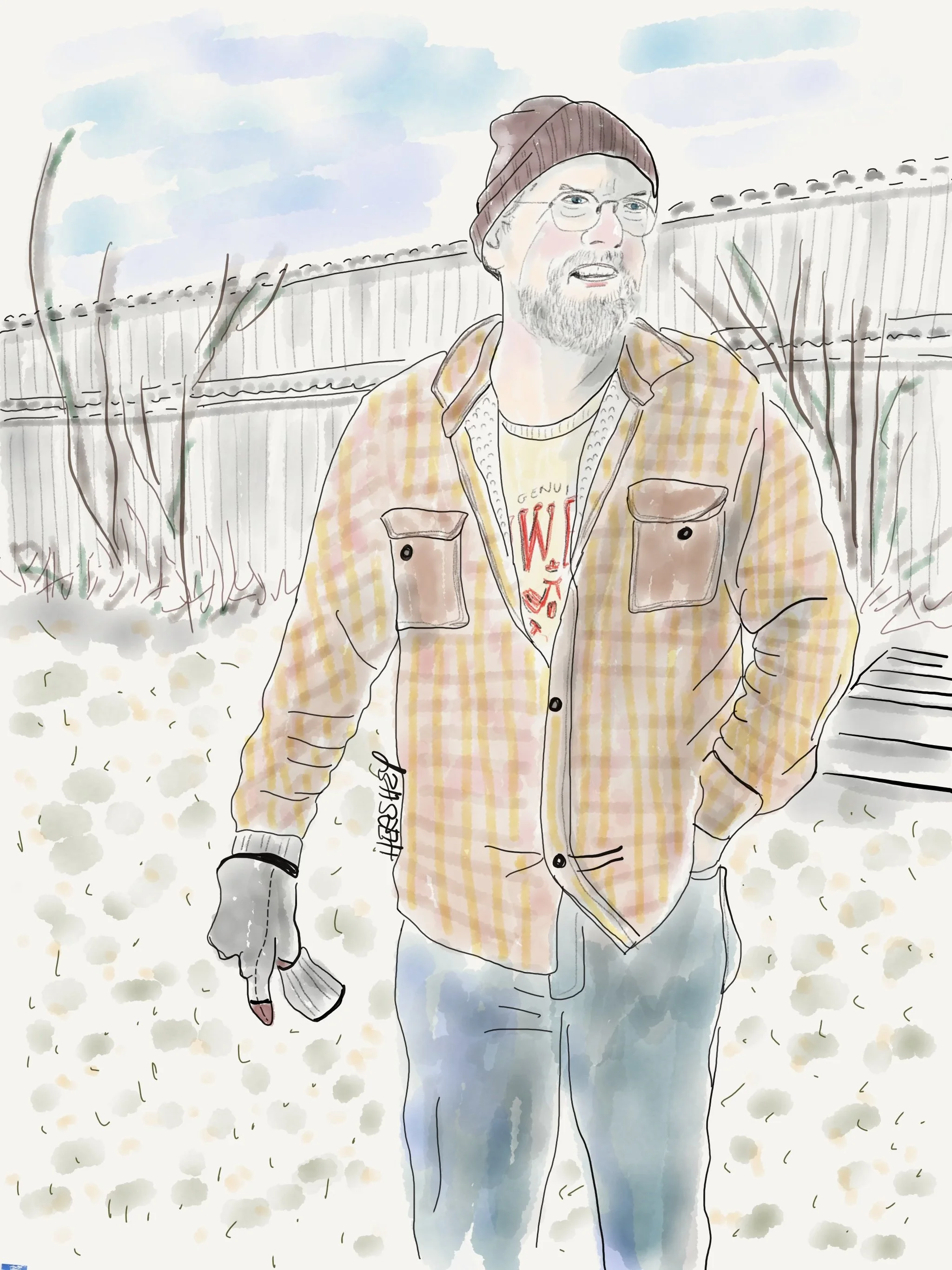
We met Gary, a retired school bus driver, on Head of Island near a canal on the Amite River that flows into Lake Maurepas. Born and raised in the Maurepas swamp area, Gary recounted some vivid tales from his father about encountering strange sinkholes while fishing in the waterways. Now, Gary is concerned about the seismic testing on the lake in preparation for Air Product’s carbon storage project. He is concerned for his 12 grandkids and potential hazards to the water supply and surrounding wildlife. Gary told us a story he heard from a few friends who are tracking the seismic testing contracted by Air Products. When his friends approached a boat in the lake they believed was involved in testing they were greeted by a security guard carrying a rifle who made it clear they should leave. Drawing by Jenny Hershey. Follow her work on Instagram @deeofo.
In October of 2022, the Livingston Parish Council voted unanimously to place a year-long moratorium on the construction of carbon dioxide injection wells below Lake Maurepas. Although Livingston Parish was the only council that passed an attempt at a legal moratorium, their concerns are supported by many locals living in Tangipahoa Parish to the east and Ascension Parish to the southwest.
Interestingly, two of those Parishes would not be considered typical “Environmental Justice” (EJ) communities. They contrast with Donaldsonville, which is 85% people of color (and fits the classic definition of a frontline community) and Burnside, which is about 65% people of color (and the location of Air Products’ blue hydrogen facility). Both of those towns are in Ascension Parish. By contrast Livingston Parish is 95% white, while Tangipahoa Parish is about 65% white. Since neither of those parishes have been frontline communities before, an historical tolerance toward the oil and gas industries might be confusing the issues. As a case in point, I noticed the following comment in The Lens by a Council Member from one of the involved Parishes, “I’m not against the oil and gas industry, and I want to reduce carbon dioxide in the atmosphere as much as anybody else. But this is not correcting the problem. This is creating one more problem.”
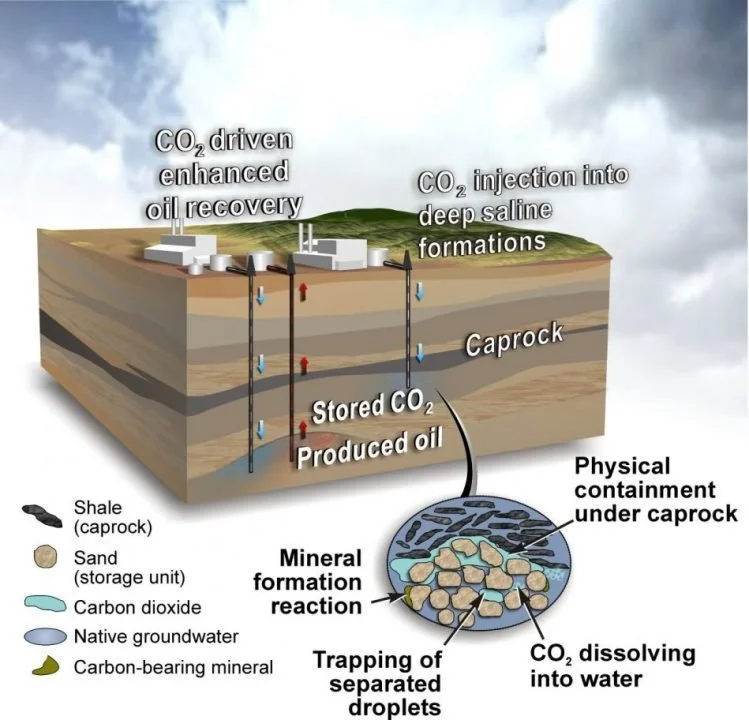
Section 45Q of the Unites States Internal Revenue Code is intended to incentivize deployment of carbon capture, utilization and storage (CCUS). The credit amount also significantly increases for direct air capture (DAC) projects to $180 a ton of CO2 permanently stored and $130 a ton for used CO2. The information above can be referenced here.
I sympathize completely with the Parish residents for their concern about their local environment, and believe all three parishes are being unfairly steamrolled by a large company, and state and federal level politicians. I very much hope the residents will prevail. I also think it's time to end the “not in my backyard mentality” (NIMBYism) that has been an unconscious feature of white middle-class communities for so long. We all need to share the burdens wrought by our way of life, or we need to change our way of life. Fair is fair. In other words, If you don't want something in your backyard, then it’s not ok to put it in someone else’s. And conversely, if you stand by when it happens to your neighbors then don’t be surprised when it happens to you. Instead, focus on stopping the root causes of the problem.
Traveling on a bicycle increases the odds of serendipity. Through a chance encounter in a health food store in Pontchatoula, Louisiana, Jenny and I were able to speak by phone with two members of the Tangipahoa Council, Brigette Hyde and Kim Coates, both of whom represent many local parish constituents who are quite upset by Air Products’ proposal. We learned the permitting process for the carbon storage injection wells - which normally takes years - was pushed through in only four months with no public transparency or local input. Needless to say, locals are fearful about how carbon storage will affect Lake Maurepas’ plethora of wildlife, its recreational boating industry and the health of the local population.
Currently, there is nothing the Parish Councils can do to slow down this project. The lake body itself is owned by the state, which has preemption rights over the Parishes, and a federal judge recently ruled that Livingston Parish cannot enforce its moratorium. Air Products argued it would lose more than $75,000 spent on seismic tests and well preparations to satisfy EPA regulations should the moratorium stay in place because the state permits they’ve been granted will expire. So Air Products, predictably, prevailed in court, also arguing the entire process is perfectly safe and will help them meet federal GHG emissions goals. “We are pleased with the ruling, and we remain committed to continuing to share information with all local parish councils, elected and regulatory officials and local residents about Air Products’ clean energy project and its environmental and economic benefits, and employment opportunities,” said Art George, Air Products’ communications director.
Federal and state officials and industry experts alike have welcomed carbon capture and storage projects as a means to meet net-zero carbon emissions goals. In fact, when Congress passed the Inflation Reduction Act in August, it increased the value of the Q45 carbon capture tax credit to $85 a ton. Because of that adjustment, Air Products stands to receive as much as $425 million in annual tax credits for storing carbon dioxide under Lake Maurepas.
Small wonder they are moving full speed ahead.
Money talks. Goliath walks.
Stay vigilant! Thanks for reading. More to come. If you haven’t done so already, please subscribe to this blog, so you can follow our next biking trip.
All material, unless credited or otherwise noted, are copyrighted property of the blog post authors.
Jenny asked me to post this drawing here as a postscript out of gratitude.
Keith is a retired automation manager from the Union Carbide plant. Route 20 became too treacherous for biking in Vacherie, Louisiana and we were forced to ride on dirt paths through sugar cane fields until we could get no farther. In the distance we saw Keith working on his small John Deere tractor, clearing debris off the road by his house that abuts the sugar cane field. We biked over to told Keith and explained our predicament. He confirmed that there was only one way to the next town, which was down the dangerous Route 20. Thankfully, Keith then offered to use his truck to drive our bikes and gear into Thibodeaux 14 miles down the road. Both he and wife Debbie were very kind and hospitable. Keith dropped us off at a motel we had a reservation for, and they went off to their favorite fish spot for “date night.”
Drawing by Jenny Hershey. Follow her work on Instagram @deeofo.
Hope and Despair; Biking the Western Upper Peninsula

Carly, her boyfriend Paxton and his sister Ali all moved from Minneapolis to Ontonagon, Michigan, in the Upper Peninsula in August of 2021, and bought a small motel. Renaming it after their black lab Griswold, Griswold’s Lodge is their hope and promise for the future. They believe in this area’s potential for growth. Drawing by Jenny Hershey. Follow her on Instagram @deeofo.
When you’re at the end of your rope, tie a knot and hold on. - Theodore Roosevelt
It’s been a rough news cycle. The names of two American towns say it all: Buffalo, New York and Uvalde, Texas.
———————
Thank you for taking the time to read the latest blog post from carbonstories.org. I apologize for the long hiatus between posts. In March, a bike trip to the Ozarks (which would have resulted in a posting) was upended by a family emergency that required consistent attention for several months. Yet, happily over the same period, my daughter Saren had a second child. ….Welcome to this very troubled and extraordinarily beautiful world, Kaia Spire!

A proud grandfather holding Kaia Spire, born April 5, 2022.
After meeting my new grandchild over a week ago, my intrepid cycling partner Jenny Hershey and I left my daughter’s place in Wausau, Wisconsin, and headed north on our bicycles to explore the western Upper Peninsula of Michigan and the Lake Superior shore of Wisconsin. So far we’ve biked about 500 miles from Wausau, Wisconsin into the Lake Superior shore in the state of Michigan, up the Keweenaw Peninsula to Copper Harbor, and back to Ontonagon, Michigan just east of the Porcupine Mountains Wilderness State Forest. Next we will head to Ironwood, Michigan and then to Ashland, Wisconsin and the Apostle Island area. If we are lucky, we’ll make it to Duluth, Minnesota, before heading back to Wausau and Milwaukee to visit family before our return to New York City. The copper ridges, mountains, wet valleys and innumerable lakes of this country - mixed with cool temperatures and copious rain that keep the insects in check - are making for a bracing and energetic trip (with occasional unplanned layovers as we wait for storms to let up).
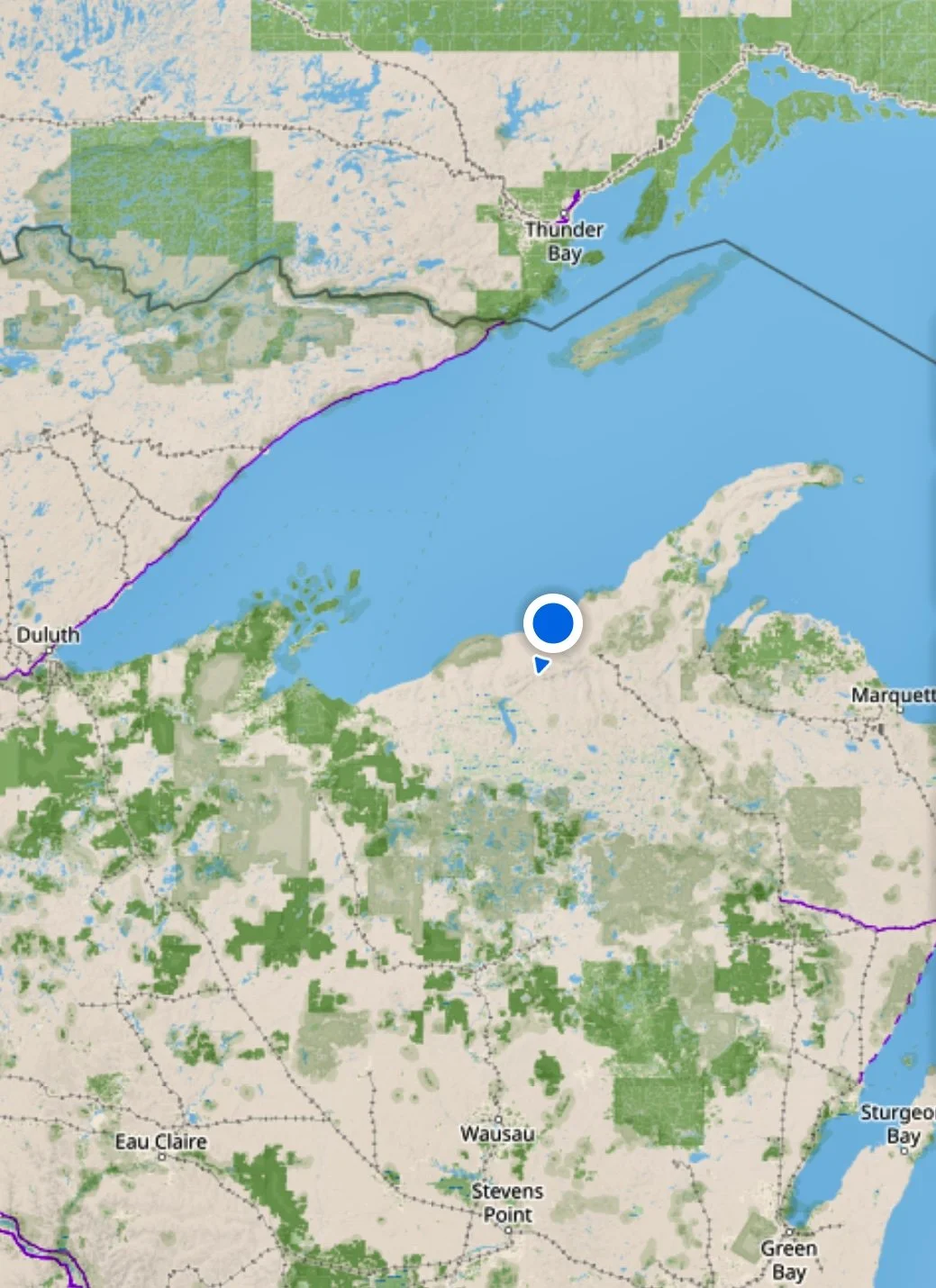
Wausau is to the south on this map. The circle is Ontonagon, Michigan. Near the end of the long peninsula to the northeast lies Copper Harbor, where we were several days prior. From Copper Harbor or Houghton, Michigan, one can take a ferry to Isle National Royale, a US National Park wilderness area. We wanted to go, but were unable to make the ferry schedule work out…. Another time! Map by Guru Maps Pro.
I’m a lucky man, and I try not to take my good fortune for granted. I have loving and wonderful friends and family. I am healthy enough to do most everything I aspire to. I get enough to eat, and I usually sleep where it is dry and warm. When I experience physical discomfort, I know it won’t last and I will be comfortable again soon. I have lived a life of privilege; among other forms of good fortune, my gender, race and education have always worked in my favor. I suppose you can call me “woke.” Well, so be it, especially when the alternative is to be not-woke, which really means “asleep.” A lot of sleeping folk are in Houston right now, railing against the possibility of meaningful gun legislation. They are “asleep at the wheel,” as far as I’m concerned… on gun control, on climate, on constitutional protection from religious persecution on a woman’s right to choose. They are loud, but common sense will always be louder, even if it arrives too late to mitigate some of our pain.
I had polio as a child (and am so grateful for the polio vaccine). I’ve had several major illnesses and surgeries as an adult, and I am managing post-polio syndrome as I enter my “golden” years. I’ve lost people I loved a great deal. I’ve had other setbacks. But on the whole, life has been very good to me. I worked hard at several careers and was rewarded for it; now in retirement, I bike the world and live a life of adventure. Given how challenging life has been over millennia for most humans, I regard my good fortune as remarkable.
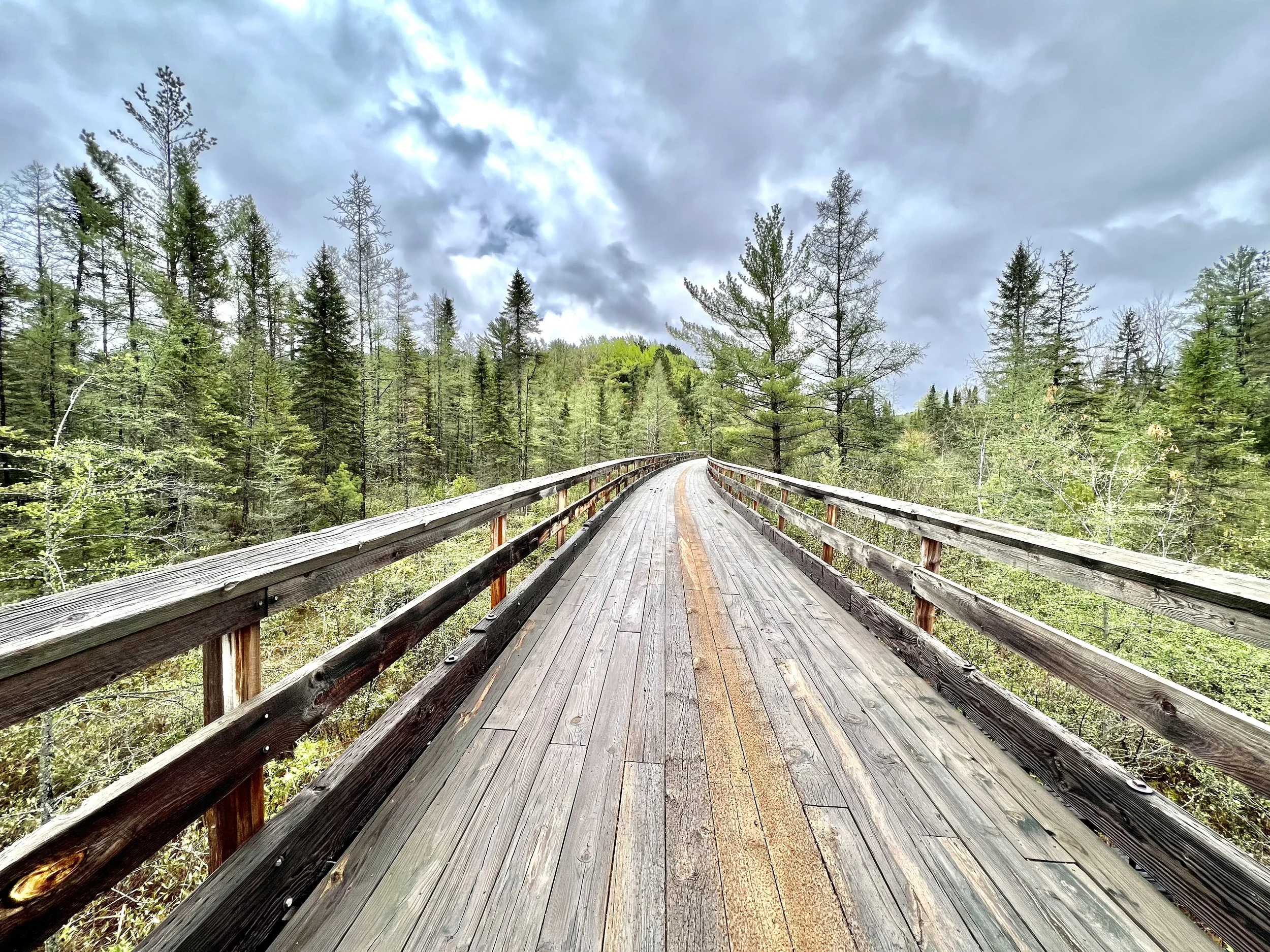
Heading north on the Bear Skin State Trail south of Minocqua, Wisconsin. Photo by Jenny Hershey. Follow her on Instagram @deeofo.
Yet, the future of humankind weighs heavily on my imagination. I worry for my grandchildren. I worry for the human species. I grieve for the many people experiencing life-altering and deadly extreme weather events now, for those trapped in extreme poverty, random inexplicable violence in so-called “safe communities,” and those unfortunate enough to be living under wartime conditions. I grieve the rapidly accelerating loss of so many animal, plant and insect species all over the globe. At times, witnessing the extinction of the earth’s magnificent biodiversity makes me overwhelmingly sad.
The emergency report published in February by the International Panel on Climate Change (IPCC) - the largest peer reviewed body of climate scientists in the world - was grim, concluding with this paragraph: “The cumulative scientific evidence is unequivocal: Climate change is a threat to human well-being and planetary health. Any further delay in concerted anticipatory global action on adaptation and mitigation will miss a brief and rapidly closing window of opportunity to secure a livable and sustainable future for all.”
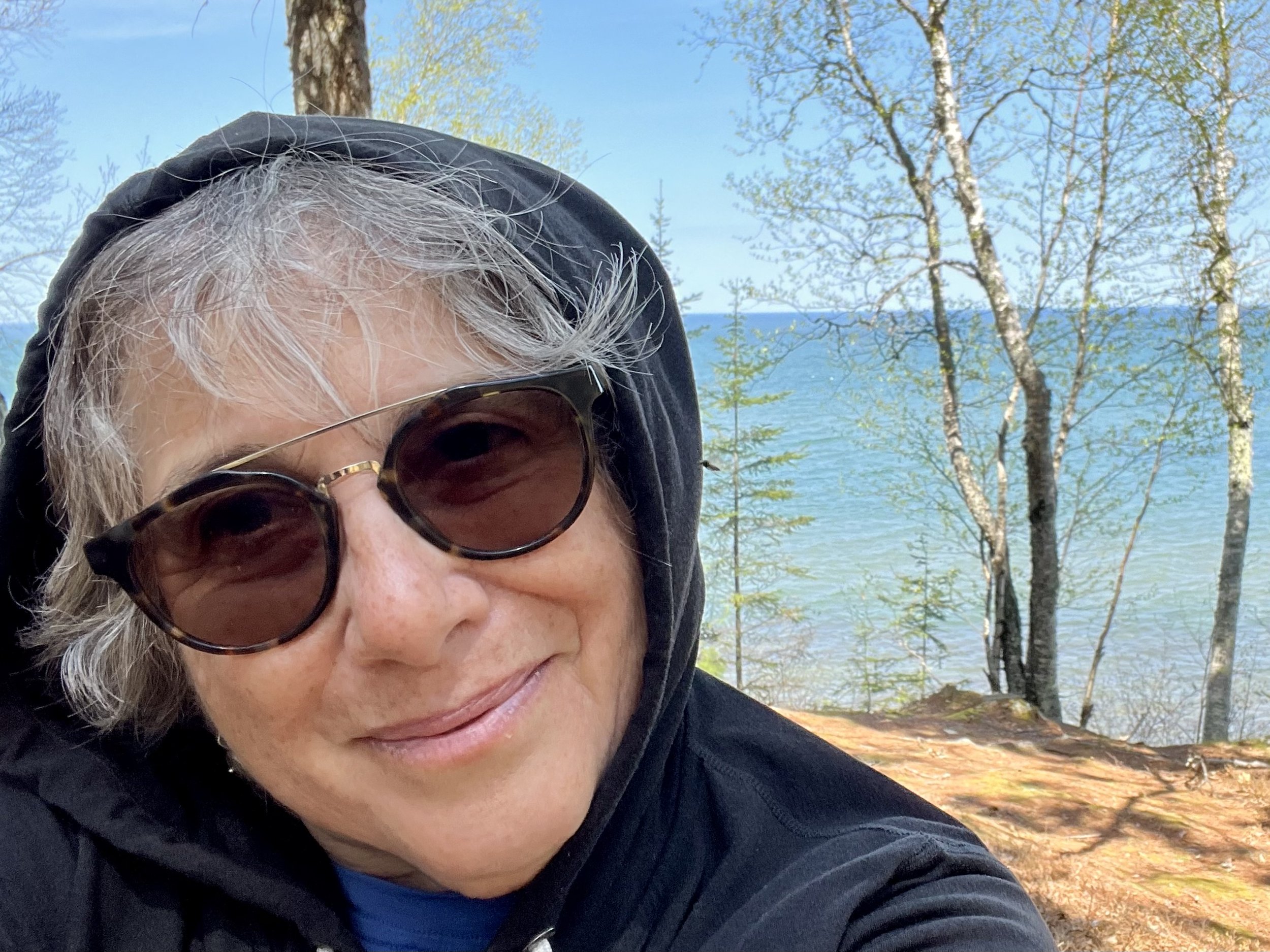
Jenny Hershey takes a break on Five Mile Point Road in the Porcupine Mountains Wilderness. Lake Superior is behind her… Photo by Michael Chase. Follow him on Instagram @mjohnsonchase.
This report coincided with the sidelining of the most aggressive climate legislation ever attempted by the US Congress, and then was quickly eclipsed by an immediate humanitarian catastrophe - the Russian invasion of Ukraine. Geopolitical concerns are now displacing climate change among world leaders as the most critical issue on the global stage. Some decades ago we might have had enough time to solve one global crisis and then move on to another - but now we are facing twin crises of equal magnitude that must be solved simultaneously. Which world governments will remain democratic and which ones will embrace or collapse into authoritarianism? And can governments work collectively to reduce emissions rapidly at the same time they are struggling to preserve their geopolitical identities?
We don’t yet know how such dilemmas will resolve themselves. But I, for one, wouldn’t place my bet on things remaining the same. I think our reasonably immediate futures are going to look vastly different from our reasonably immediate pasts. Change is speeding up. In fact, I think those who try to keep things the same are fighting the wrong battle. My biggest objection to “conservatism” the world over is that “stopping or slowing down change” at a time when change is increasing exponentially in speed and scope - whether we like it or not - is essentially useless. There is little point in being nostalgic for a past that no longer exists (and didn’t work for large numbers of people anyway). The best we can do is “direct change” so that we survive, first and foremost, and hopefully do so in a way that is somewhat to our collective liking. We might be able to survive with some dignity in a harsher and less predictable climate while we create an equitable and sustainable way of life and help others less fortunate than ourselves. But we can no longer sustain massive climate destroying autocracies and pseudo-democracies that coddle carbon intensive behaviors by wealthy individuals, encourage racial inequality, accept massive poverty and wantonly destroy our earth for personal gain. Those days are over. Either we adapt or we perish.
And what might adapting look like? In my last blog post, as Jenny and I rode through the southwestern desert just before the massive spring fires of 2022 set in, I wrote about the formal movement of Deep Adaptation. Deep Adaptation argues for a deeper accounting of adaptive processes. This perspective assumes that extreme weather events and other related climate stressors will increasingly disrupt power, food, water, shelter, and social and governmental systems, and that society and local regional governments need to prepare for such occurrences.
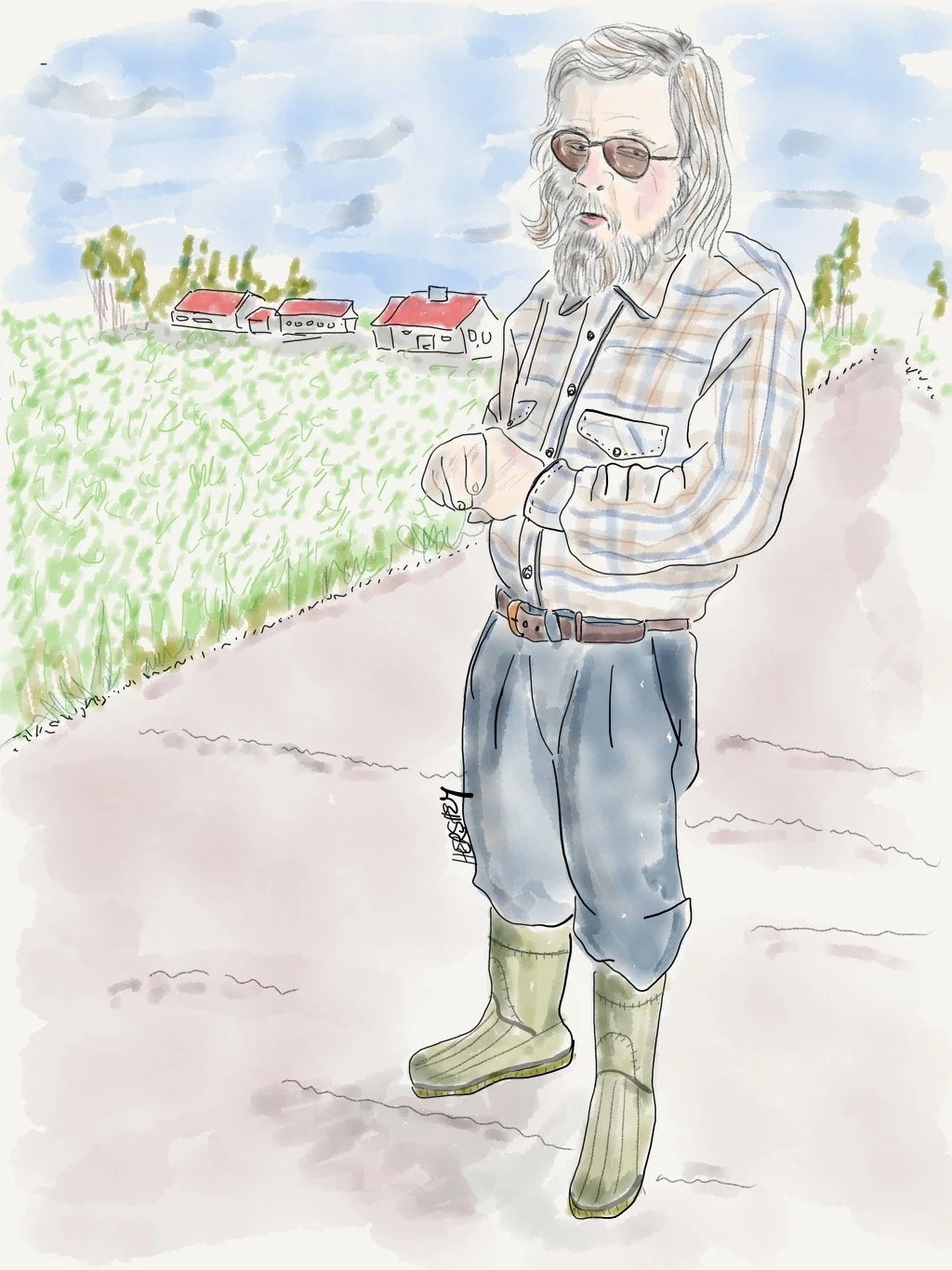
Dick is a wood grader who has lived his entire life in Marenisco, Michigan (population 250). He cheerfully explained the difference between White Pines and Spruces and detailed how Jack Pines form their weird cones. When we asked if he knew of any COVID cases in his town, he thought a minute, and then replied, “Yea, a couple people croaked from it.” Drawing by Jenny Hershey. Follow her on Instagram @deeofo.
However, we’ve come across another form of thoughtful climate adaptation while biking in the upper Midwest. Among the leaders in developing scientific and analytical tools for anticipating human migration in the United States is the American Society of Adaptation Professionals, a ten-year-old group of resilience scholars and practitioners based in Ypsilanti. ASAP, as it’s known, is collaborating with Ann Arbor, the National League of Cities, Florida State University, and the state of New York to develop the first scientific models for anticipating economic and population shifts under changing climate conditions. Their work focuses on migration in the Great Lakes region.
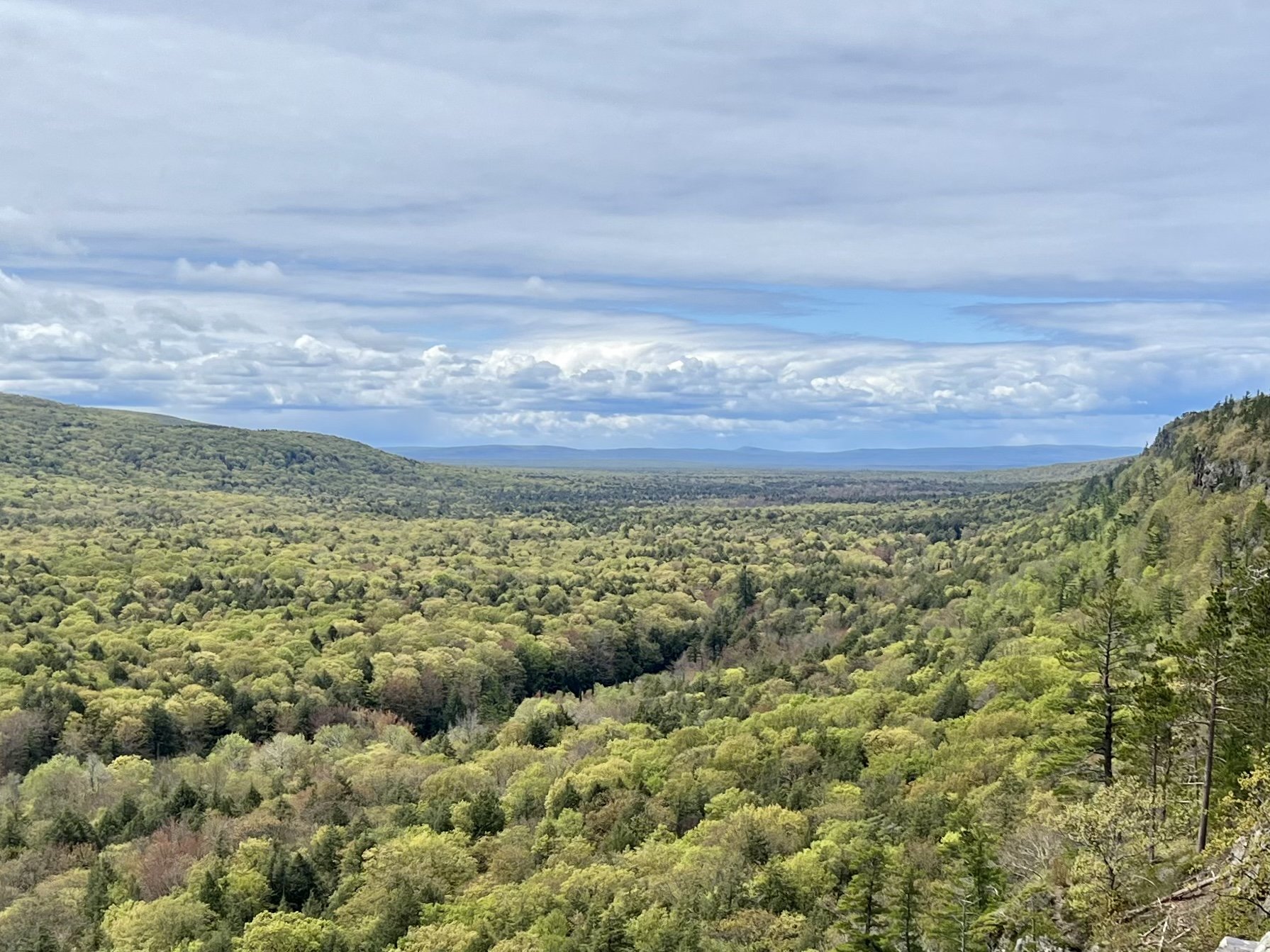
Near the summit at Porcupine Mountains Wilderness State Park. Photo by Michael Chase. Follow his work on Instagram @mjohnsonchase.
It isn’t hard to find opinions on the internet about which American cities might be the best (and the worst) places to live as climate change advances. For example, the insurance broker website Policygenius published a study in 2020 listing the top 10 best and worst places to live over the coming decades. Interestingly enough, the top two best cities on this list are San Francisco and Seattle (while the worst are Houston and Miami). However, air quality issues from fires close to both San Francisco and Seattle over the past few years plus the unprecedented heat dome over Seattle in the summer of 2021 challenge the wisdom of these choices. Additionally this research was based on the largest 50 metropolitan areas in the US, which suggest that Policygenious is thinking more about where large numbers of people may suffer or do slightly better, meaning those who are most likely to need insurance products.
ASAP - as a group of adaptation professionals - isn’t focused on how communities will come apart (and which ones to avoid), but rather on where human societies may do better through the lens of social justice and equity as climate change accelerates. Quality of life issues such as availability of jobs and affordable housing are emphasized in the communities studied, as are livability concerns such as good transit, walk-ability and bike-ability. Although this research is still in early stages, ASAP has teamed up with the New York State Energy Research Development Authority (NYSERDA) to anticipate trends of climate migration throughout the Great Lakes region. This approach is notably different from the more common images of climate migration in developing and underdeveloped parts of the world, which typically reference patterns such as those driven by large numbers of Bangladeshi farmers fleeing into nearby countries as their delta disappears, or South Pacific Islanders abandoning islands submerged by sea level rise, or farmers in sub-Saharan Africa moving to cities to escape desertification of their farmland.
In contrast, the migration patterns under study through ASAP imagine the possibility of a reversal of the last half decade of American population expansion into the south and southwest, and consider how Great Lakes regions might be affected by refugees from other states fleeing fires and water shortages and in search of cooler temperatures. This analysis now serves as a prescient preview to questions gaining relevance for human migration: will fierce meteorological turbulence cause Americans to move — away from danger and toward safety? Will people stay or go?
I wager they’ll go. Most Americans have always sought out better places to live. With the exception of Native Americans, it’s in our DNA as a nation of immigrants.
The flowage from “Lake of the Clouds” heads towards Lake Superior at Porcupine Mountains Wilderness State Park. Photo by Michael Chase. Follow his work on Instagram @mjohnsonchase.
And it turn outs the northern midwest, which has been losing population for decades, is a likely destination. As is true everywhere, there are significant contemporary challenges that climate change presents for land and water, communities and governance in the Great Lakes region. Still, the northern midwestern region is now viewed by scientists and social theorists as one of the more ecologically resilient regions in the country, so it makes perfect sense to think about how business, government, and culture can evolve to accommodate the climate-altered seasons. That’s why the American Society of Adaptation Professionals is …convening researchers who anticipate that warming winters, ample reserves of fresh water, and forests not prone to wildfire are ecological benefits that will attract millions of new residents to the Great Lakes and reverse decades of slow population growth.
Here’s an example of a climate professional turned climate migrant (Jamie Beck Alexander, the Director of Drawdown Labs at Project Drawdown,) who choose to leave California with her family for a safer, more sustainable life in Duluth, Minnesota. Our Ontonagon hosts Carly, Paxton and Ali may be leading a similarly smart migration from a larger to a smaller town. Perhaps population density will also factor into quality of life issues as we reshape our communities for climate adaptation, just as COVID reversed a decades-long trend of people moving to cities from rural communities. As residents of New York City, this definitely gives us something to chew on… how about you?

Gaylynn, our server at Syl’s in Ontonagon (population 1400) has spent her entire life in this small town, except for a period of service in the Navy. She is happily upbeat about life in the Upper Peninsula, and a proud citizen of Michigan. An energetic and attentive waitress, it was a pleasure to watch her interact with townspeople she knows very well. Drawing by Jenny Hershey. Follow her on Instagram @deeofo.
Stay vigilant! Thanks for reading. More to come. If you haven’t done so already, please subscribe to this blog, so you can follow our next biking trip later in the summer of 2022.
All material, unless credited or otherwise noted, are copyrighted property of the blog post authors.
Deep Adaptation; Biking from Los Angeles to Tucson

Reading to my grandson Emery as he nods off. Like most grandparents, I wonder what the world will be like when my grandkids are older. It will be 2089 when Emery is the age I am now. The world seems so precarious now; what will it be like then? Will life be better or worse? Will we even be here? Drawing by Jenny Hershey. Follow her on Instagram @deeofo.
Any way you slice it, keeping warming below 2°C requires an immediate, massive, and global mitigation effort. With each passing day, it’s less likely that we’ll succeed. Indeed, over 90% of Earth scientists believe we’ll surpass this threshold.
Here’s an idea that’s simple and beautiful but goes against both the myths of the mainstream culture and our deepest mental habits. It’s this: don’t be afraid, and spread love every chance you get.
Peter Kalmus, climate scientist at NASA, from his book Being the Change
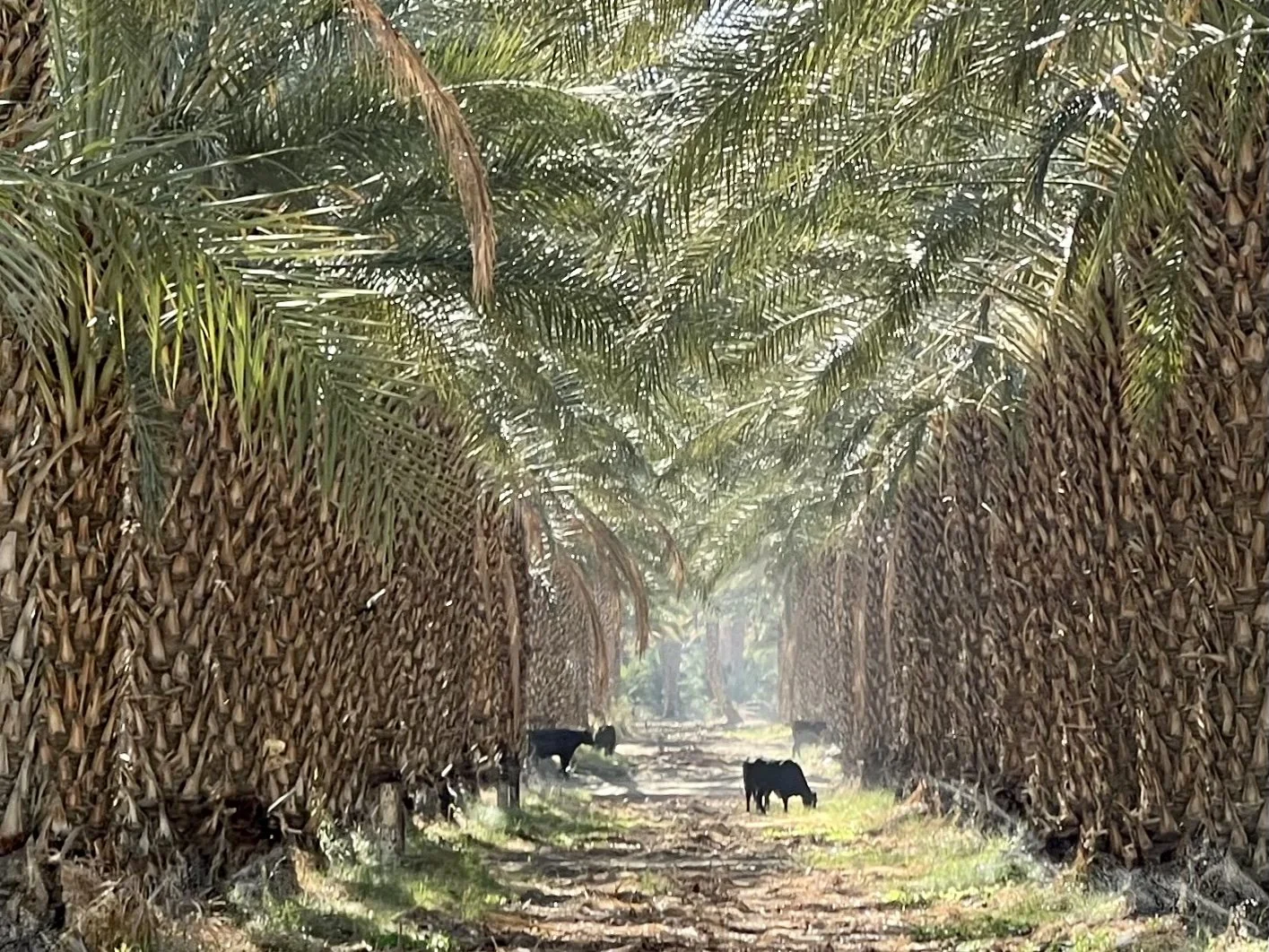
Cows wander through a date tree orchard in the Imperial Valley near Brawley, California. Photo by Michael Chase. Follow him on Instagram @mjohnsonchase.
When I set out on my first solo-biking adventure in 2015, I had no idea I would remain enthusiastically committed to long distance biking seven years later. Nor did I imagine I would have the good fortune to share many trips with an enthusiastic and equally curious biking partner who is also an excellent illustrator. Jenny and I both hope our occasional blog posts enrich your life (as they do ours) in some small way. Traveling at the speed of a bicycle is great exercise, and it’s an in-your-face way to experience how a place actually feels. It also provides a very intimate experience of the natural world, which is especially important in an age where most of us (at least in the Global North) are mostly protected - even isolated - from our rapidly changing climate and increasingly degrading environment.
After trips to Wisconsin to see my kids and grandkids over the Christmas holidays, we drove Jenny’s car to El Paso (stopping for a few days to bike in Big Bend National Park), and then took Amtrak to Los Angeles with our bikes to visit my brothers Chris and Steve for a few days. Our plan was to ride our bikes from Anaheim back to El Paso. We only made it to Tucson.
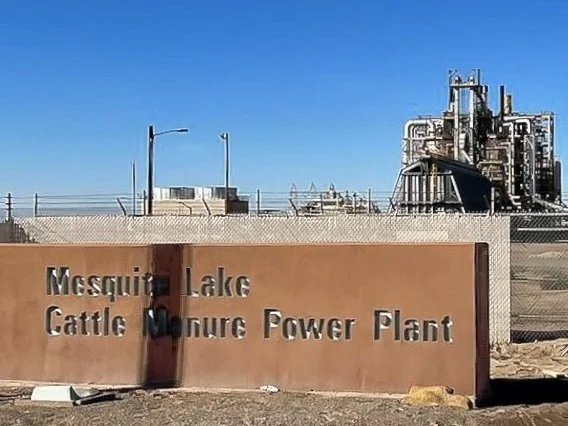
We rode by a Cattle Manure Power Plant south of Brawley in California’s famed Imperial Valley. The plant is now abandoned, after opening twice over the last 30 years to great fanfare under two different private companies - one of whom claimed they would help local cattle ranchers dispose of manure by turning it into electricity under a contract with Southern Californian Edison, and another who was going to also process King Grass for the biofuel market. Unfortunately, the first project was plagued by a massive rainstorm that made manure retrieval and processing impossible, and the second was closed after an earthquake in 2010 damaged the processing plant. Photo by Michael Chase. Follow him on Instagram @mjohnsonchase.
After some very long rides (over 85 miles), mixed with several brutal days riding into intense and unremitting easterly winds while climbing several thousands of feet in elevation, Jenny and I decided that it would be best for us to rest up in Tucson, and then take the train back to El Paso from Tucson for a more leisurely return to our car, where we would car/bike our way back home to New York City (I had been hoping to ride Highway 9 along the New Mexico border through historic Columbus, NM into El Paso, but that will wait for another trip).

Lizzie is a takeout restaurant hostess in Canyon City, California, with a complex story about the many people for whom she is responsible. She patiently listened to Jenny express frustration over the lack of regard drivers demonstrated toward us on Gilman Springs Road on the way to the Palm Springs desert. We were unavoidably placed in a very dangerous situation (having been directed there by a bicycle mapping program I don’t think we’ll continue to use). We found ourselves several miles up a canyon when the shoulder disappeared on a narrow two-lane road, with high winds and cars passing feet away at 75 miles an hour showing no intention or interest in our situation or safety. We were forced to walk our bikes over a rumble strip trying to avoid traffic on our left and thorny bushes on the right. Nobody stopped or slowed down. The indifference of drivers to our situation was stupefying. After listening to Jenny’s story, Lizzie said “That’s so sad. What’s going on in people’s heads? We’ve lost our humanity with traffic. It’s as if it’s no longer human beings driving those cars”. Then, she offered to bag up extra chips and guacamole (which turned out to be excellent) for our ride into Palm Springs the next day. Drawing by Jenny Hershey. Follow her on Instagram @deeofo.
Deciding to change our plans wasn’t easy. Jenny and I have different strengths and limitations. We both felt challenged and each reacted differently. But like all collective human endeavors, we had to accept our limits as we confronted our own personal challenges and devise a bail-out strategy that worked for both of us. In the meantime, we rode through many diverse industrial and agricultural environments and basked in 650 miles of extraordinary natural landscapes during our ride from Anaheim to Tucson.

“!Hay zanahorias. Muchas zanahorias!” Workers near the road express their pleasure over the harvest to Jenny. Drawing by Jenny Hershey. Follow her on Instagram @deeofo.
It’s easy to love the sheer rawness and massive scale of the American southwest, especially as seen from a bike. Where there is water for irrigation (delivered through a system of canals from the Colorado and Gila Rivers) green fields of lettuces, cabbages, broccoli, sugar beets, carrots, alfalfa, wheat, king grass and countless other plants stretch into the horizon on endlessly flat terrain. In every direction lie mountains - craggy and massive, brown, apricot, and hazelnut in full sunlight, gray, impersonal and barren under cloudy skies. Where there is no water, barrel-cactus covered flatlands fall into the horizon, ubiquitous washes create carved out ridge-lines that delight the eye and ominously warn of floods to come, and Joshua trees and Saguaro cacti stand like regal gifts from Diego Rivera. The sun can be unrelenting (thank God it is January), and the wind can be deafening. The rare absence of wind results in a silence more peaceful than a Buddhist retreat. These physical polarities get under one’s skin like dirt under one’s fingernails. And it’s impossible to get enough of the warm afternoons, especially when the sun slants lower in the sky and casts a golden glow on all it shines upon, even trash.
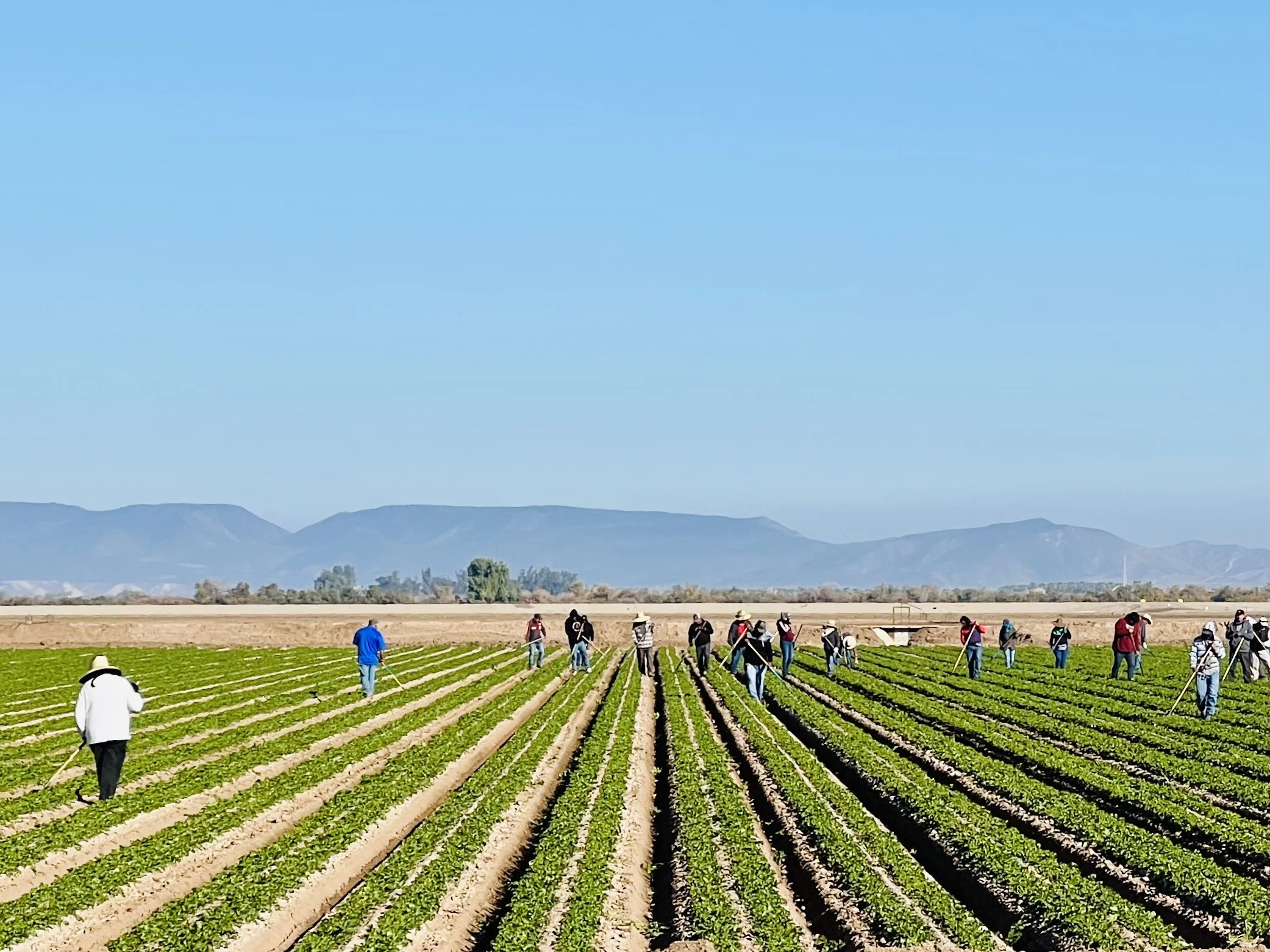
Field workers in the Imperial Valley. Photo by Michael Chase. Follow him on Instagram @mjohnsonchase.
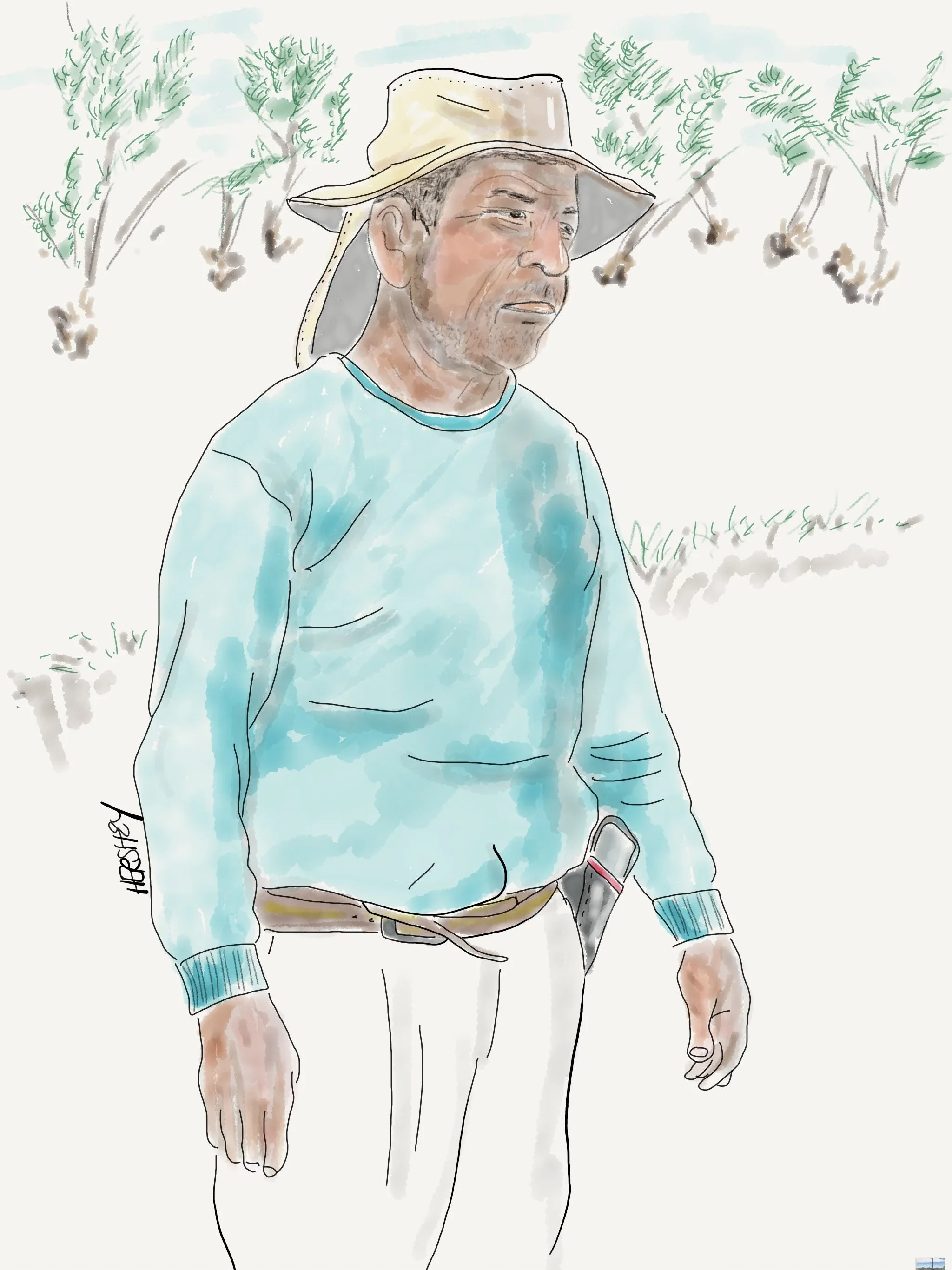
Manuel, a hard working date farmer from Calexico, CA, tends to a date palm orchard about 20 miles from his home. After telling us what the trees behind him were, he explained to us that dates are harvested once a year in August. Manuel also does agricultural work in the adjoining border town of Mexicali, Mexico, and has traveled back and forth between California and Mexico for years. He worries about the heat and extended drought in his region, and how it will impact crops in both countries. Drawing by Jenny Hershey. Follow her work on Instagram @deeofo.
During the recent months American environmentalists have been hyper-focused on the passage of the climate provisions in the “Build Back Better” act. Hoping to finally address climate change at a policy level that approaches the scale scientists tell us is required, climate activists were seriously disappointed by recent setbacks to the bill’s passage. Other occurrences haven’t added comfort: in mid-January the news broke that the hottest eight years ever recorded have occurred in the last eight years, and US emissions jumped in 2021 over 2020 levels, making our national goal of a 50% reduction in 2005 CO2 levels by 2030 further out of reach. Yet, these troublesome headlines are only part of discouraging news. Bloomberg just published an article about the potential of Kuwait becoming too hot for people or wildlife in a few decades, and NPR just published an article and video about how a climate change-induced drought in Kenya and nearby Uganda is parching landscapes, killing livestock and creating a humanitarian crisis. And only a few days ago, Weekend Edition published a story and video footage about a crippling drought now underway in Iraq. It’s sad to say there is little that is surprising in such reports, and it is easy to cite so much other alarming news (such as unprecedented high temperatures and decline of sea ice in the Arctic, and the rapid melting of the Thwaite Glacier in Antartica).
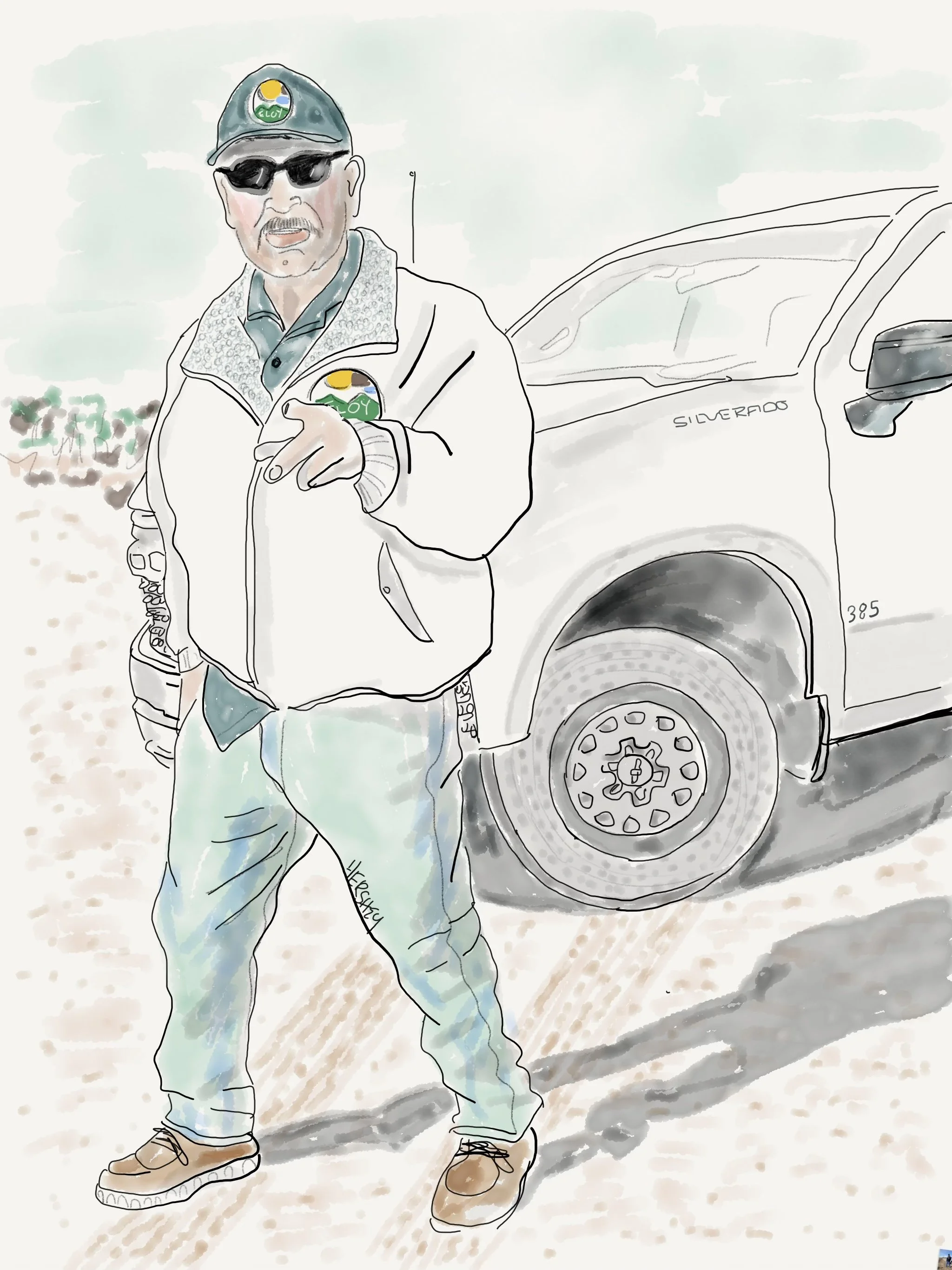
We met David on a dirt road near Eloy, Arizona. A road safety and maintenance manager for 35 years, David helped us avoid some dangerous paved roads without shoulders by directing us down some safer dirt roads. He pointed to one area and said teasingly, “Oh don’t go down there—the locals will shoot at you just to mess with you.” He suggested a course for us that he would confidently cycle with his wife. We deeply appreciated his kindness as we made our way to safer terrain.
It isn’t my intention to be depressing, but rather to lay a foundation for what I’ve been thinking about on this trip. Now that meaningful action on climate change appears stalled once again in America, it might be time to think more deeply about the potential consequences of climate chaos. In January of 2020, I wrote the following in a blog post titled Getting Real About Global CO2 Emissions: ….current science tells us that global carbon emissions MUST be cut in half over the next ten years for us to maintain a climate anywhere close to what we humans have enjoyed in our comparatively short time on earth. In that post I worked through the most recent science on the carbon budget climate scientists tell us we shouldn’t exceed to stay below a 2°C rise in global temperatures. However, global emissions have not decreased in the past two years; instead they have increased, making what we have to achieve in the coming years even more challenging. This has happened even though we achieved a slight aggregate reduction of GHG emissions in the US (a 10% drop in 2020 versus a 6% rise in 2021), and the successful enactment of a few nationally determined contributions (NDC’s), as outlined in the Paris Accords, most particularly by the European Union.
Current CO2 levels today are at the historically high figure of 417 ppm, which is 50% higher than at the beginning of the industrial revolution. In other words, in spite of lots of incredible efforts by millions of activists and sustainability professionals, hundreds of corporations, countless NGO’s and other agencies, and many national governments and world government organizations, we aren’t yet moving the needle downward on GHG emissions. Not yet, anyway.
Hope is an extraordinary thing, and there are new reasons to be hopeful every day (such as the recent creation of the Clean Energy Corp by the US Department of Energy). Still, I often hear others say that while they aren’t optimistic we will deal with climate change successfully, they are hopeful regardless. I feel the same way, and savor living each day with the future in mind far more than I despair over what we may have already wrought.
Yet, a persistent thought nags at me from the back of my mind, a thought that until now, I have only expressed to my closest friends. What happens if we fail? What happens if the world doesn’t get it together to stop our use of fossil fuels soon enough to avert catastrophe? What happens if we unwittingly set in motion one or a few climate tipping points (if we haven’t done so already), and climate chaos arrives suddenly and violently? What might that look like, and when might that happen? How will civilization respond? Will it be game over? Or might we rebuild something of value out of the rubble of a wounded, mangled or even collapsed civilization?
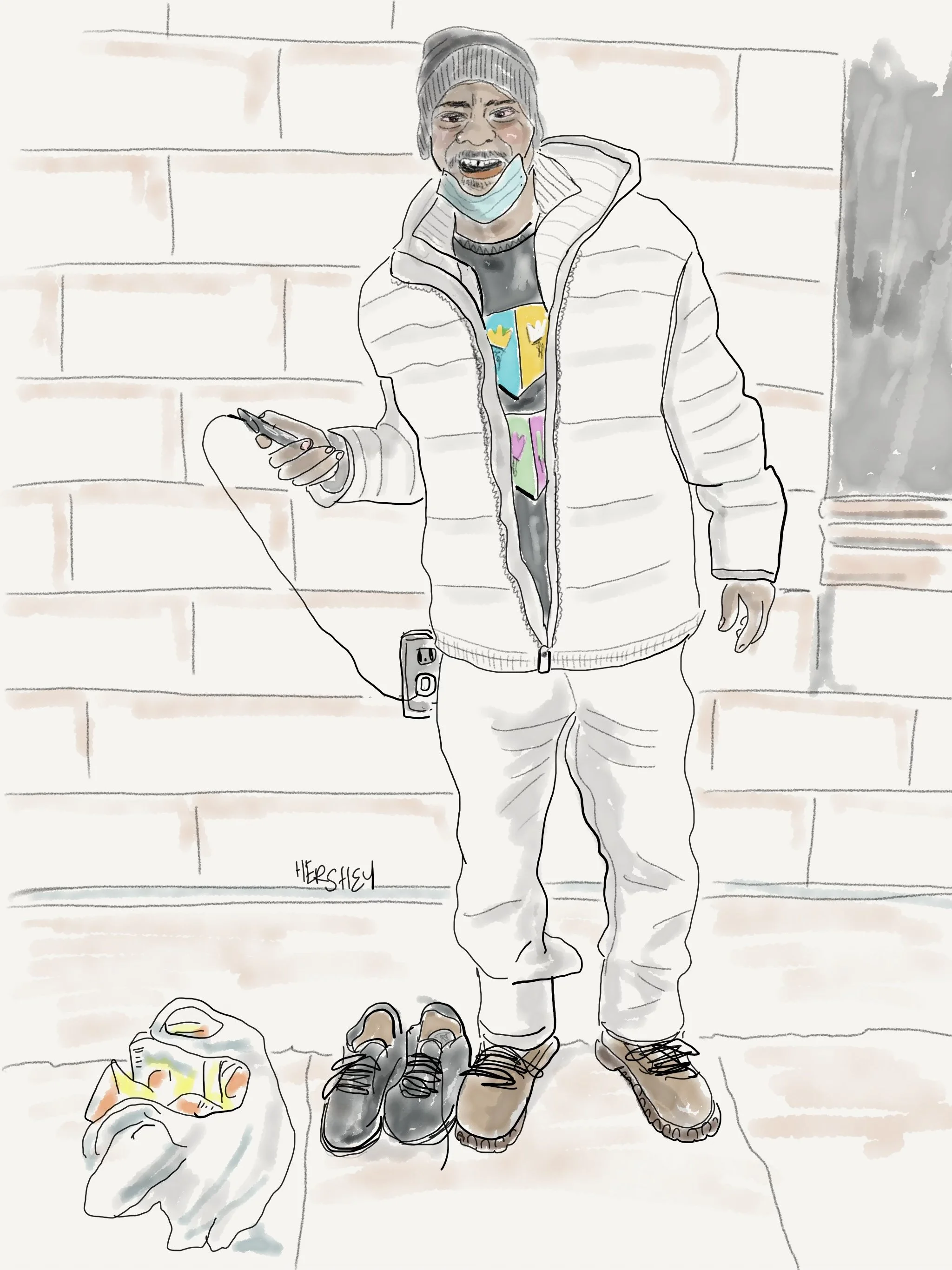
Jenny met Derek in Tucson outside a Walmart store. Recently released from prison, he is currently homeless. Jenny needed someone to watch her bike while she shopped for dinner, and he needed someone to keep an eye on his cellphone as it charged while he shopped. They negotiated an exchange: Jenny watched Derek’s phone while he shopped and Derek watched Jenny’s bike while she did. This unlikely exchange resulted in a long conversation with common ground on many subjects. As Jenny began to leave, she told Derek he was a good man, and to stay strong no matter what others said about him. He had served 2.5 years in jail for possessing narcotics. He believes he has paid his dues, and he dreams of moving home to Atlanta to be close to his daughter and opening up a car detailing shop. Drawing by Jenny Hershey. Follow her on Instagram @deepfo.
I’m not alone in wondering about such outcomes. I suspect many readers of this blog have had similar fleeting thoughts. As it happens, there is a growing body of literature and activist thinking by writers (especially scholars) who are wondering (out-loud) if civilization will indeed collapse as climate change gets worse. The most well-known version of this literature is based on a paper published in 2018, and a subsequent book published in 2021 called Deep Adaptation: Navigating the Realities of Climate Chaos, edited by Jem Bendell and Rupert Read.
Some of the leading scholars of this approach are already convinced civilizational collapse is inevitable, and believe climate chaos will arrive in the next few decades. Others aren’t as certain the collapse of civilization is imminent, but strongly believe we should consider it a potential outcome for which we should make preparations. These perspectives are not intended to be nihilistic, and no scholar is suggesting we should refrain from doing all we can as quickly as we can to mitigate climate change. But Deep Adaptation does argue for a deeper accounting of adaptive processes. It is simultaneously a concept, agenda, and an international social movement. It assumes that extreme weather events and other related climate stressors will increasingly disrupt power, food, water, shelter, and social and governmental systems. The word deep in this context indicates that strong measures are required to adapt to an unraveling of western industrial lifestyles. That agenda includes values of nonviolence, compassion, curiosity, and respect, and a framework for constructive action. This agenda was recently featured in an article in Inside Climate News.
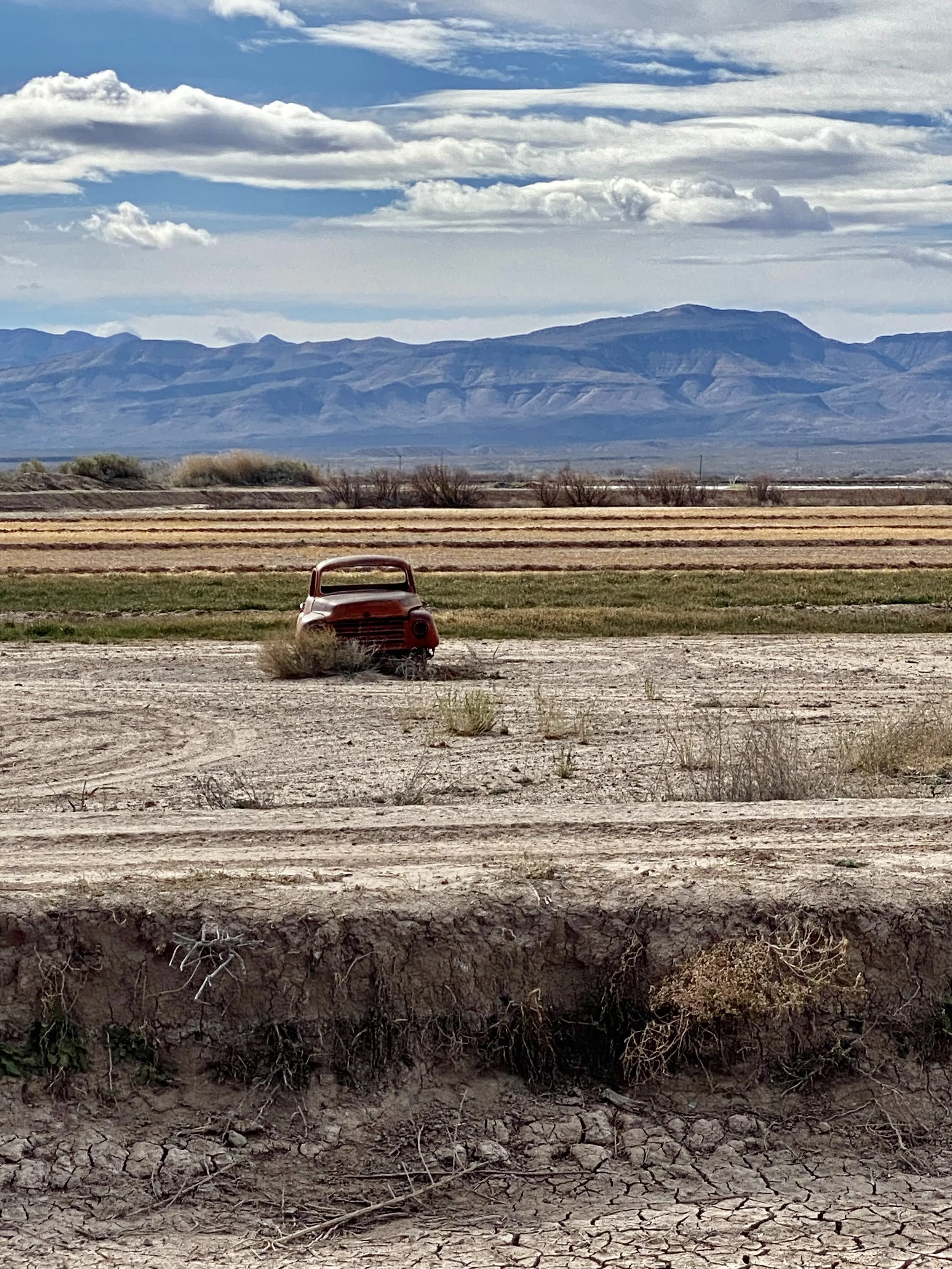
Seen near Fort Hancock, Texas. Photo by Jenny Hershey. Follow her on Instagram @deeofo.
The term deep adaptation follows a logical naming sequence. A few decades ago, activists and scientists talked about mitigating the negative impacts of GHG in our atmosphere by finding alternatives to carbon-based fuels and increasing ways to draw down carbon through natural processes and technological fixes. However, over the years the realization that we also need to adapt to irretrievable changes already baked into our atmosphere and oceans are driving public conversation about changing where to locate human communities (and where not to), and how to prepare communities for more extreme weather. As a result, scientists and activists began to speak about helping communities to develop greater resilience as an attribute of adaptation. Now we have a term that describes the kind of adaptation we will need if climate chaos causes civilizations to collapse. Deep adaptation can be thought of as a re-adaptation of the structures of societies to create new ways for humans to survive and prosper.
There’s a related scientific field called collapsology that studies how civilizations have collapsed in the past, and how environmental overshoot might cause them to collapse in the future. Collapse in this context doesn’t necessarily mean that societal disruption will be sudden and complete, but does imply a form of breakdown in systems that is comprehensive and cannot be reversed. Deep Adaptation describes personal and collective responses to the anticipation or experience of societal collapse. And, as already stated, it suggests that by getting out in front of the possibility, we may have time to create new structures and/or institutions that will allow human life to flourish.
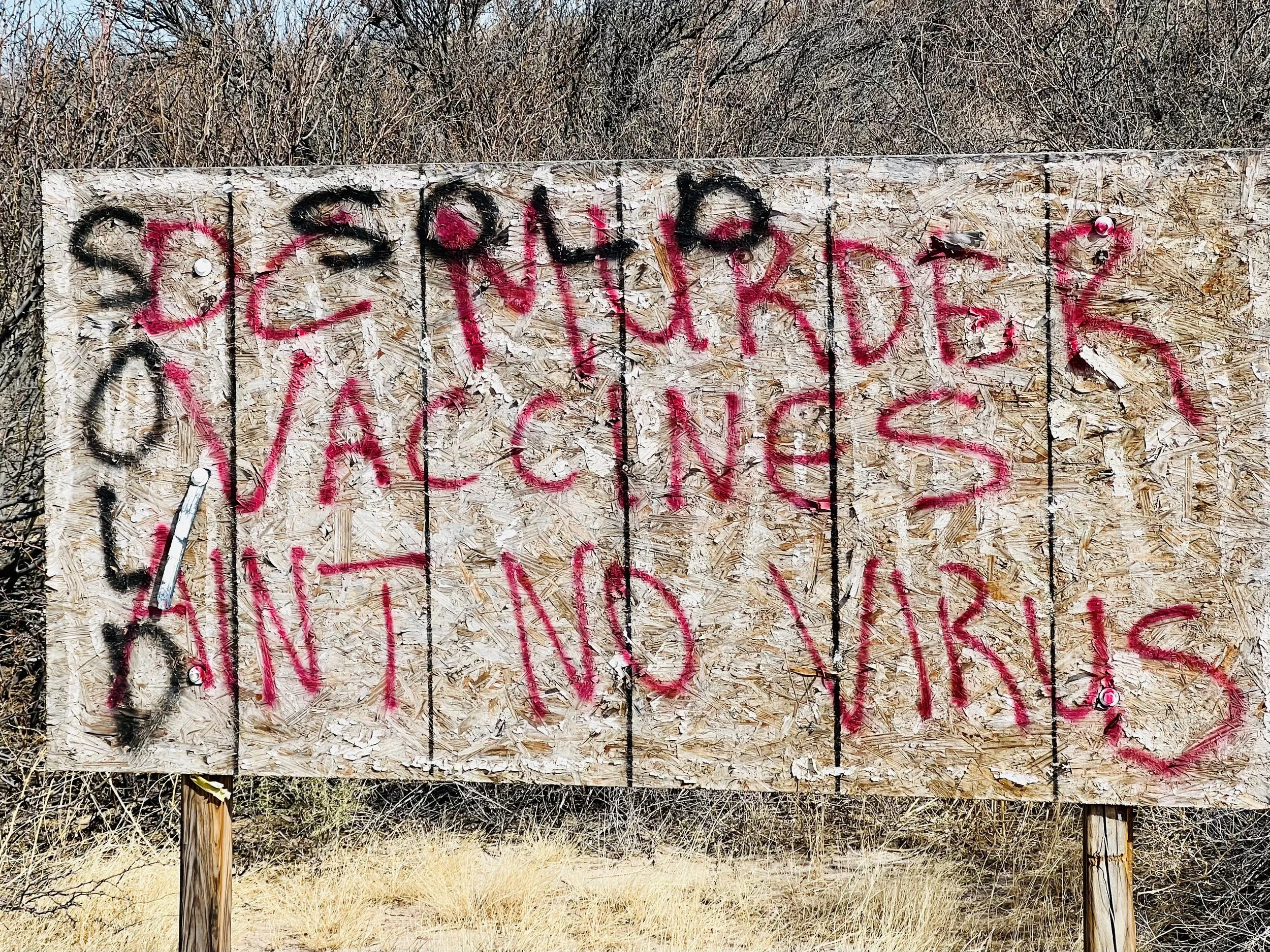
Seen on Texas State Highway 20, east of El Paso. Photo by Michael Chase. Following him on Instagram @mjohnsonchase.
Thus far, deep adaptation has been met with a great deal of resistance, and with only a few exceptions, it hasn’t caught the attention of media. After all, it is unthinkable. Anticipating societal collapse - whether from a range of environmental, economic, political or technological factors - has been attacked as pessimism, alarmism, doomism, fatalism or defeatism. Yet, proponents consider it would be defeatist to not even begin exploring what we can do to help in the face of massive societal disruption, and that any call for public engagement with the unthinkable is especially germane in this moment of a global pandemic. Not very long ago, it was unthinkable that a virus would shut down nations. It may have been this obvious global lack of preparation and resilience in the face of the COVID pandemic that inspired more than five hundred international scholars to sign and publicize a Scholar’s Warning Letter in March of 2021. The letter publicly addresses the equally unthinkable topics of societal disruption and potential collapse.
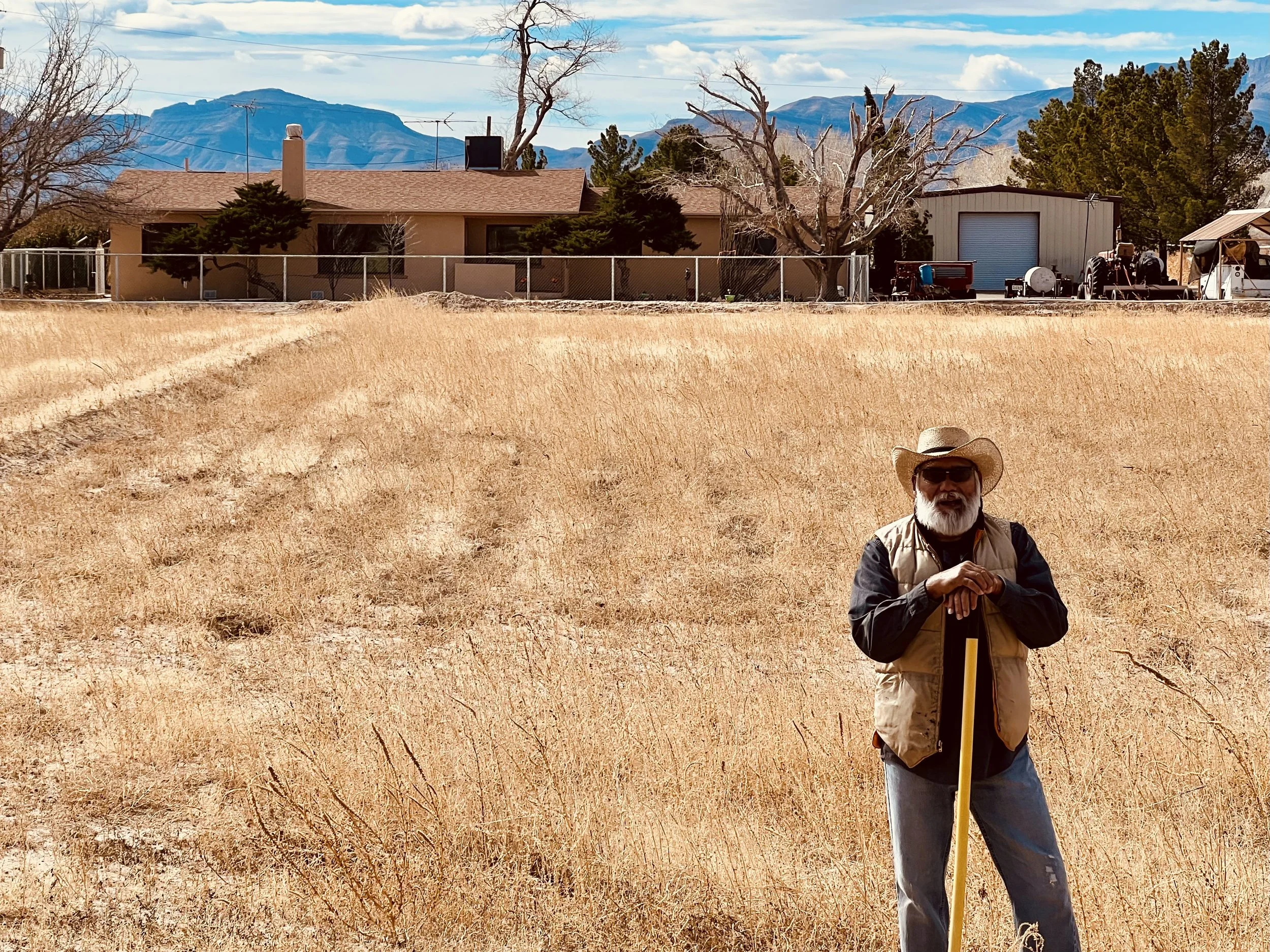
We met Raul east of El Paso as we were heading home. He was tending the field in front of his ranch, preparing to turn the hay under as green manure. He joked he was doing it for the exercise, since he had no access to water for planting anyway. Turns out much of the Rio Grande valley is in the 7th year of a drought; this one being the most serious one Raul has seen in the 50 years he’s lived in this valley. If farmers don’t have wells (the use of which, ironically lowers the water table), they have to rely on a water allotment from the local canal system. The canals are fed by Rio Grande river water, whose headwaters are the Weminuche Wilderness in southwestern Colorado, some 575 miles away. The wilderness is three quarters the size of Rhode Island, and has fed the Rio Grande for centuries. Now, between the competing problems of a reduced snowpack in the Rocky Mountains of Colorado, and increased use of water upstream as New Mexico also grapples with drought, Raul’s usual allotment of 3 acre feet has been reduced to a few inches. Since Raul doesn’t have a well, he basically can’t grow anything now. He even said it would be risky to grow a vegetable garden because, “you never know if you’ll have the water”. Raul also told us that it used to be a lot colder, with some snow on the ground and more wind than now. We were enjoying the weather, but it was a placid day with full sunshine and about 65 degrees Fahrenheit. I asked Raul if he thought rain would come. He replied, “I hope so”. And I replied, “ I read a lot of climate science, and I think that although you might get occasional relief, what you’re going through now is likely to be the trend for a long time”. And I added, “I hope I’m wrong”. Raul gestured with open palms as if to say, what will come, will come. The Rio Grande is about a mile behind Raul’s ranch and the mountains in the distance are the Chihuahua Mountains of Mexico. Raul used to visit Mexico a lot but now the area behind his ranch is controlled by the cartel, so it’s no longer fun to go there. Photo by Michael Chase. Follow his work on Instagram @mjohnsonchase.
It can take a while for new perspectives to establish themselves in academic communities, much less among citizens and policymakers. Think about how long it has taken to get consensus on even the most conservative scientific warnings about climate change. It was well over 30 years ago that Congress held its first hearing on the subject of a warming climate, long before we had a vocabulary for what is now everyday news: extreme weather, droughts, floods, sea level rise, ocean acidification, rapid biodiversity loss, crop loss and famine, human migration and resource wars over water and arable land.
Similar to many of the citizens, politicians, and media outlets represented in the movie Don’t Look Up, some of of us don’t want to face information that challenges our closely held assumptions of security. However, some people will find dignity no matter what is coming. The final scene in the movie is a window into that possibility. A small group of people (who fought hard to avoid what they are about to experience) share a simple and final meal accepting their fate and fortifying themselves through prayer and conversation over their good fortune to know and love one another. In that moment, as in all moments: acceptance and love, recognition and kindness, staring into the abyss and knowing humanity means something, even though like all things, it was just another blink of life in the everlasting expansion and contraction of universal consciousness.
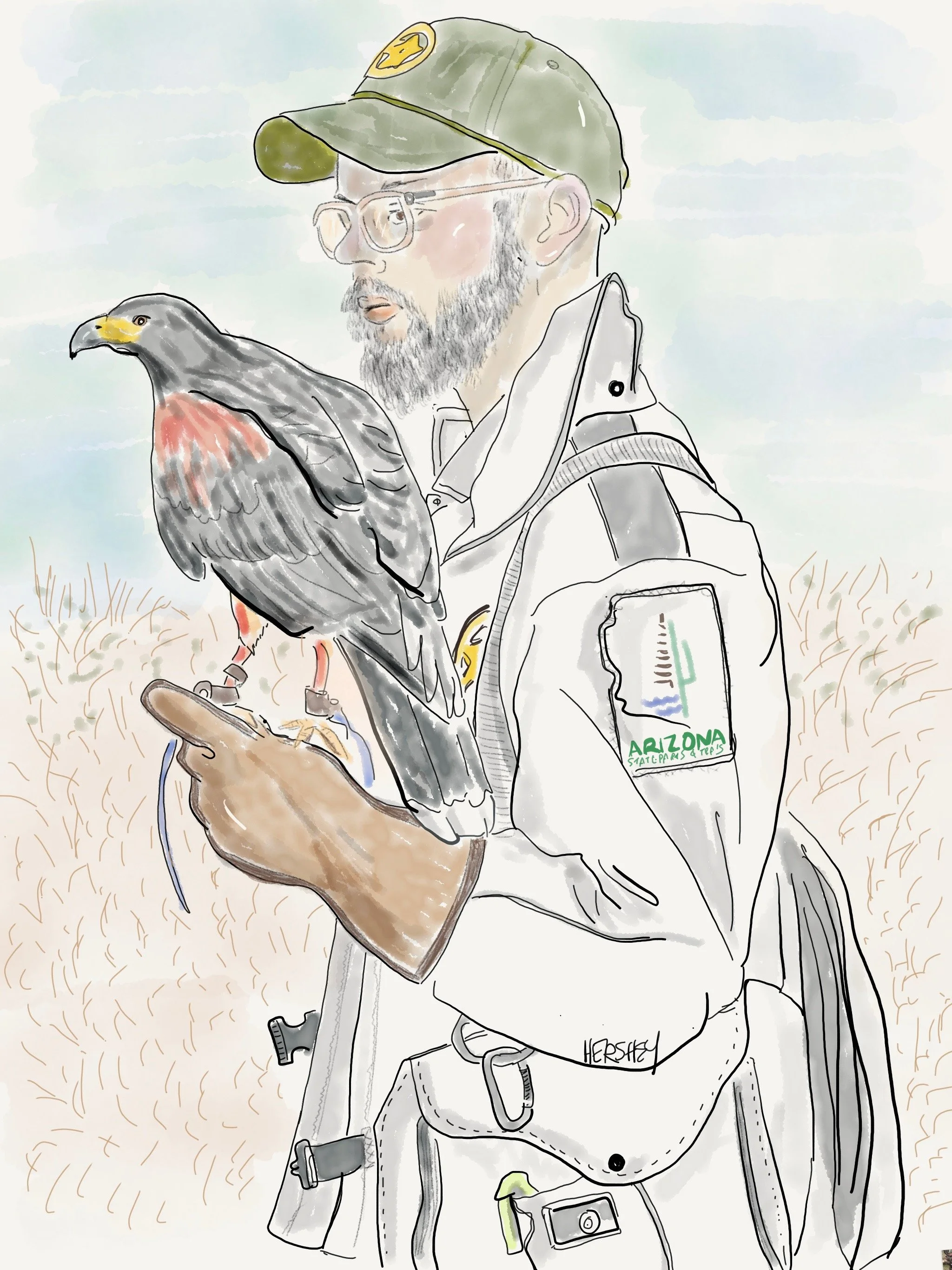
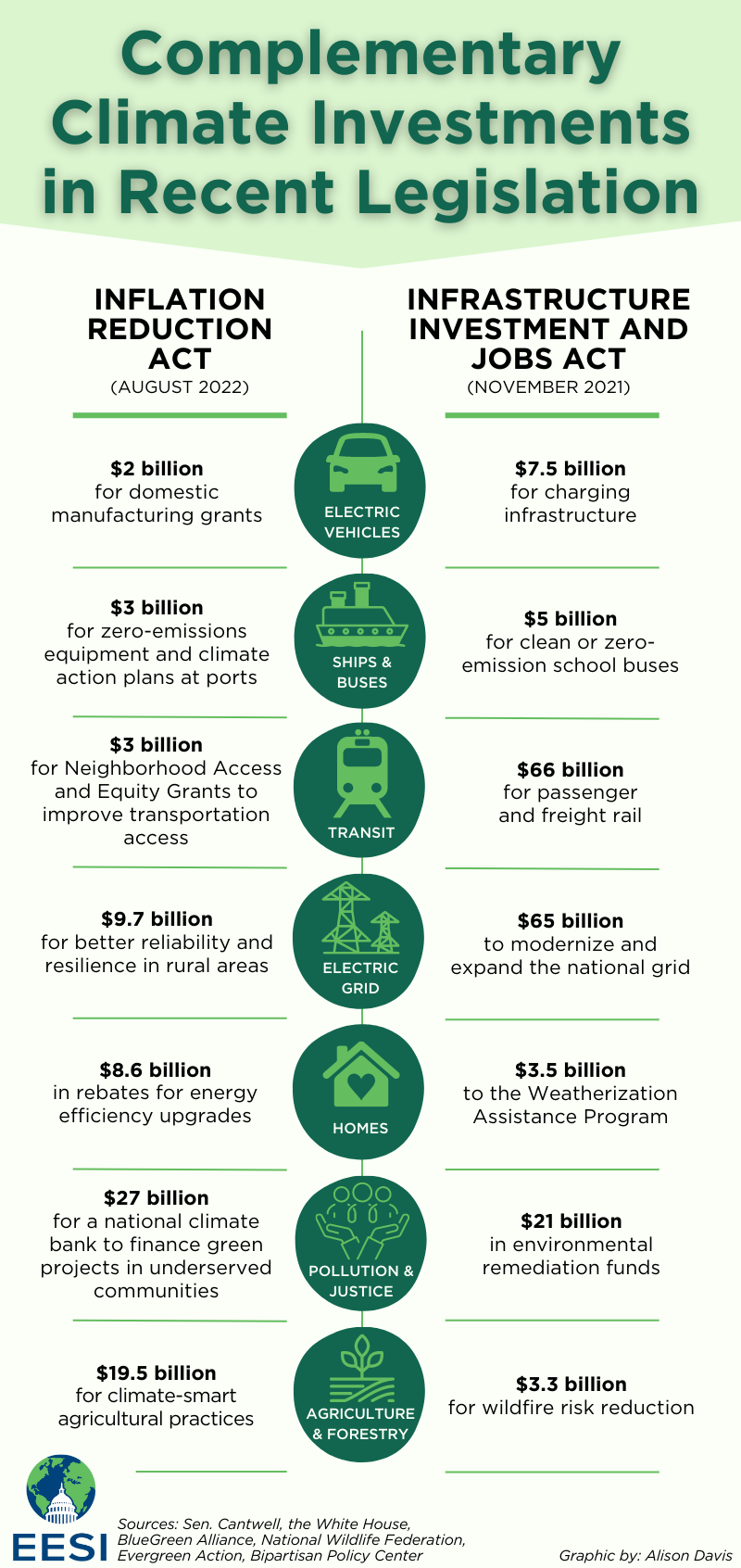
We met Erik at Catalina State Park just outside of Tucson. A park ranger, he is also a licensed falconer, and was leading a seminar with Virgil, a Harris Hawk. Erik became falconer to Virgil a couple of years ago and is devoted to him. Yet, Erik seemed quite realistic about the limitations of the relationship. When Jenny asked him if he loved the bird, he blushed and said, “Well, it’s not reciprocal because Virgil has no emotion”. Jenny's (sotto voce) response to me was, “Call me crazy, but that bird is attached to Erik. You can see it in his eyes”. In any case, we were enchanted by the extraordinary relationship between this man and a hawk, and found it a great inspiration for how different species can harmonize in such a profound way. Perhaps on the other side of “Deep Adaptation,” we can cultivate more sacred and symbiotic relationships with other species on this fragile world. Drawing by Jenny Hershey. Follow her on Instagram @deeofo.
Jenny’s sister, Terry Hershey, sent the following poem to start the new year in 2022. We both believe it says much about what the world needs right now.
Kindness
Before you know what kindness really is
you must lose things,
feel the future dissolve in a moment
like salt in a weakened broth.
What you held in your hand,
what you counted and carefully saved,
all this must go so you know
how desolate the landscape can be
between the regions of kindness.
How you ride and ride
thinking the bus will never stop,
the passengers eating maize and chicken
will stare out the window forever.
Before you learn the tender gravity of kindness
you must travel where the Indian in a white poncho
lies dead by the side of the road.
You must see how this could be you,
how he too was someone
who journeyed through the night with plans
and the simple breath that kept him alive.
Before you know kindness as the deepest thing inside,
you must know sorrow as the other deepest thing.
You must wake up with sorrow.
You must speak to it till your voice
catches the thread of all sorrows
and you see the size of the cloth.
Then it is only kindness that makes sense anymore,
only kindness that ties your shoes
and sends you out into the day to gaze at bread,
only kindness that raises its head
from the crowd of the world to say
It is I you have been looking for,
and then goes with you everywhere
like a shadow or a friend.
Naomi Shihab Nye, from Words Under the Words: Selected Poems
Stay vigilant! Thanks for reading. More to come. If you haven’t done so already, please subscribe to this blog, so you can follow our next biking trip later in the spring of 2022.
All material, unless credited or otherwise noted, are copyrighted property of the blog post authors.