
Louisiana/Texas, Post 3
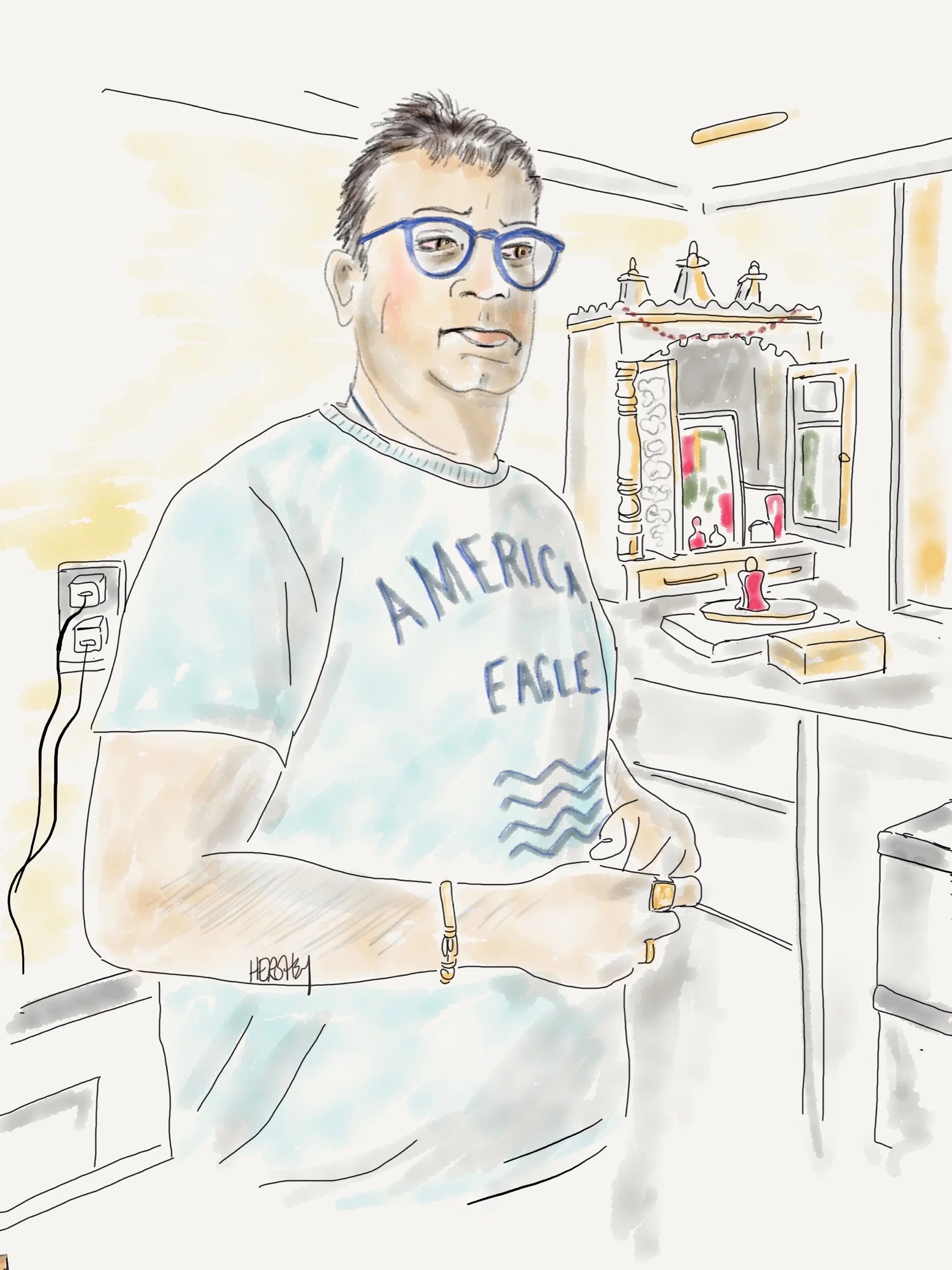
“My wife and I take turns praying at our altar. We are Hindus. But we love this motel. It’s all ours”. This drawing of a proprietor of a mid-century motel in Freeport, Texas was done by Jennifer Hershey. You can follow her work in Instagram at deeofo.
Welcome from Port Aransas, Texas, just slightly southeast of Corpus Christi, Texas.
—————
“It was the best of times, it was the worst of times, it was the age of wisdom, it was the age of foolishness, it was the epoch of belief, it was the epoch of incredulity, it was the season of light, it was the season of darkness, it was the spring of hope, it was the winter of despair.”
-from a A Tale of a Two Cities by Charles Dickens.
Such are the times we live in.
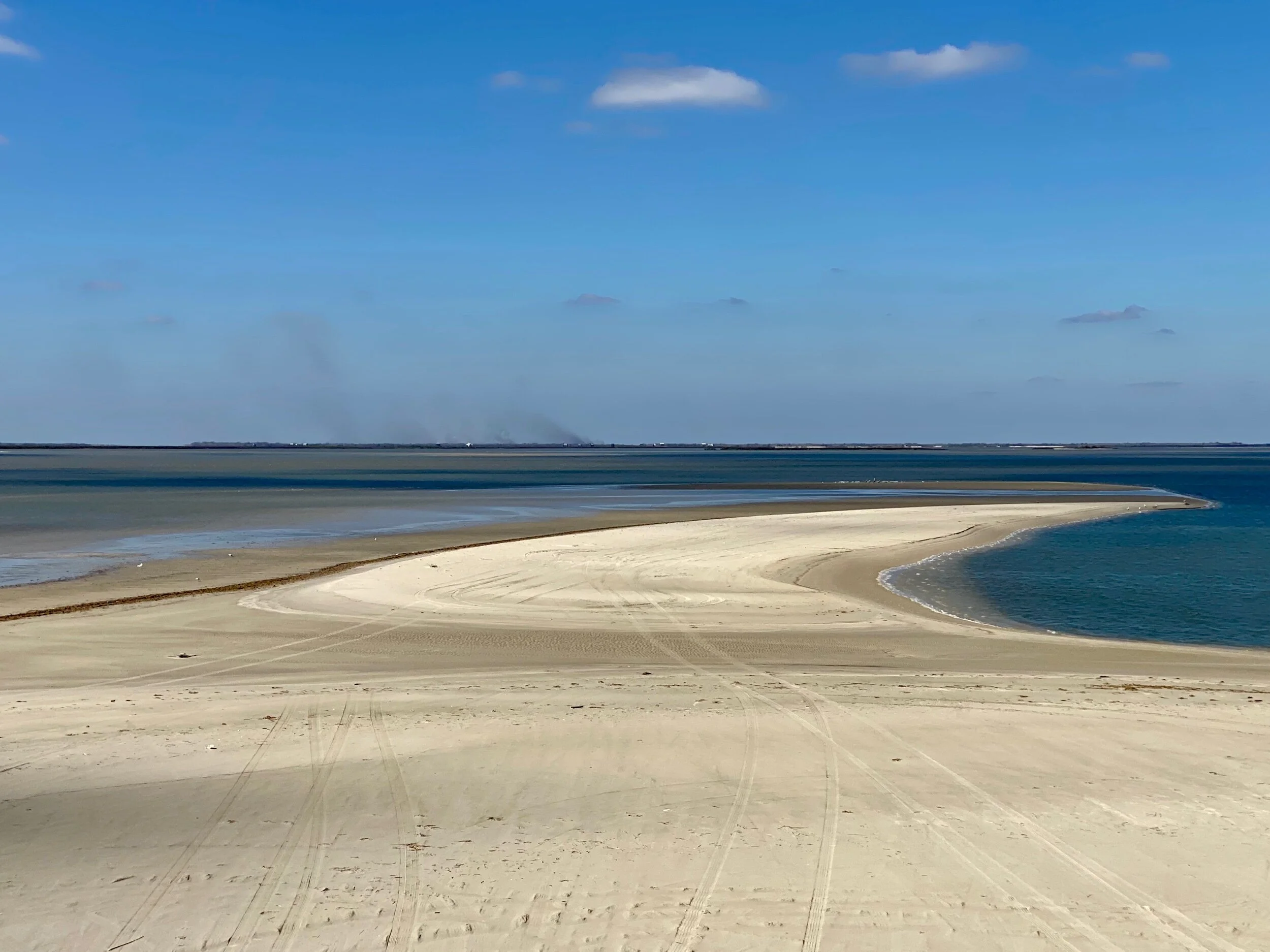
On the way to Freeport, Texas. We learned later the smoke in the background is from a Dow Chemical plant that removes magnesium from sea water.
Our trip continues to be an extraordinary exploration of exquisite natural landscapes, occasional encounters with wildlife (dead and alive), great conversations with diverse and friendly people, navigating delightful and terrifying roads, dealing with sublime and challenging weather, and periodic confrontations with seedy and startlingly ugly industrial landscapes.
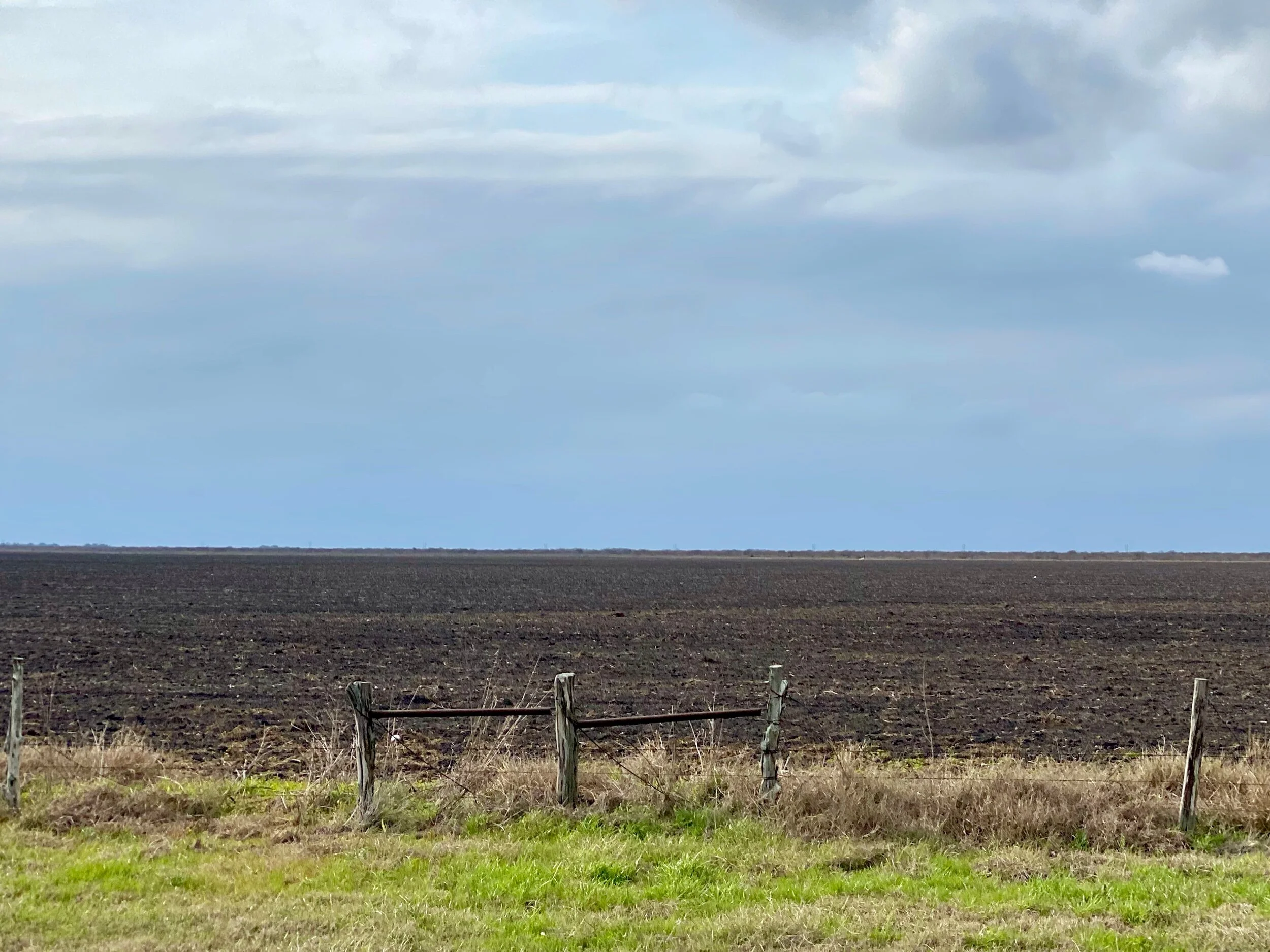
Texas is definitely big sky country, and southeastern Texas is as flat as a pancake on a hot griddle.
Perhaps we can borrow from Dickens, and instead of symbolic cities substitute citadels, or communities of people who live inside of self-imposed walls. Like any citadel that is protected from others, we can only see what’s inside, and have no idea of what’s on the outside.
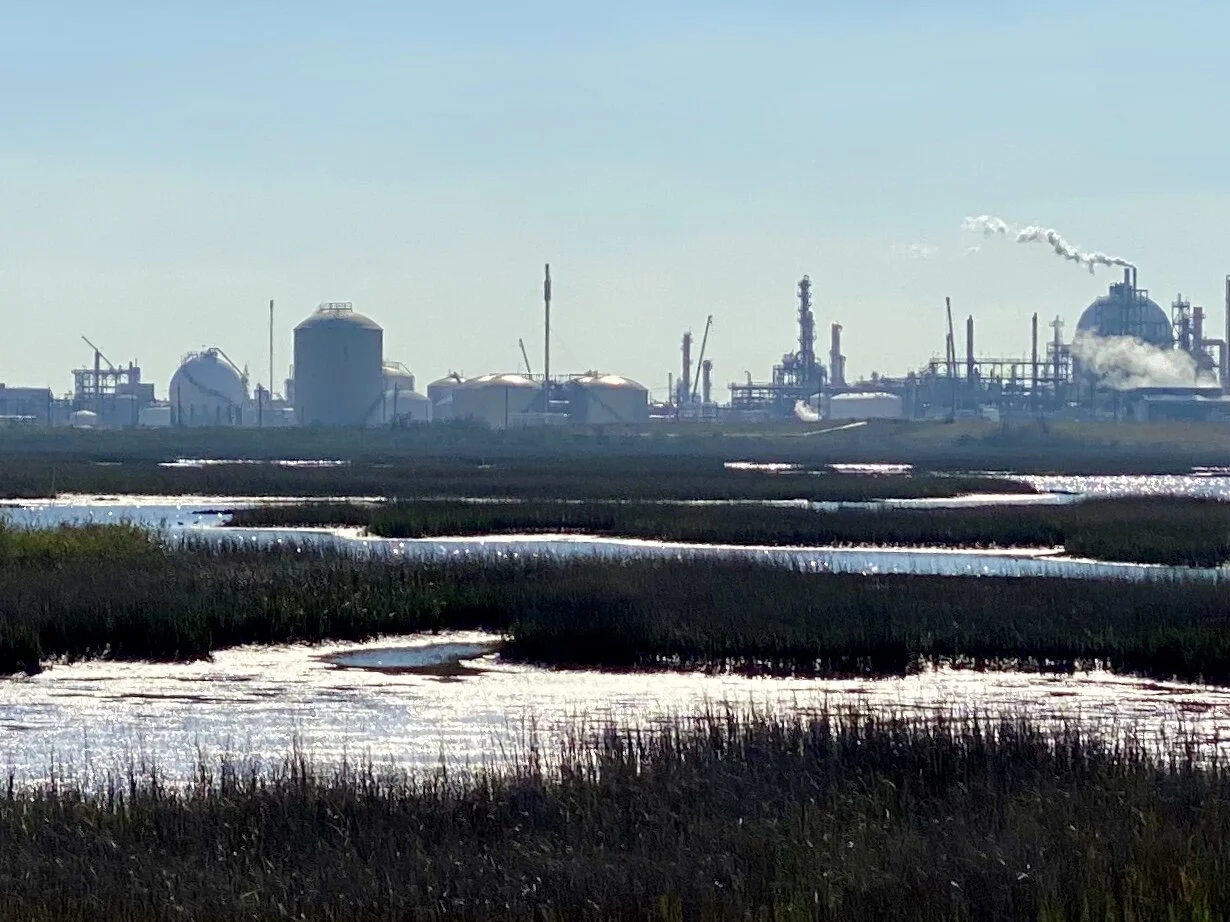
The Dow Chemical Plant near Freeport is situated just above the Intercoastal Waterway on a vast marsh.
In a way, Fox News and CNN are the storytellers for two distinct narratives that reflect two separate citadels: urban and rural America. Our cities are the center of our intellectual, artistic, entertainment and media capitals. Our rural areas - especially evident down here in southeastern Texas - provide access to our natural environments, produce our food (and also increasingly produce electricity through wind-power on the same land), and also extract and move our oil and gas providing our cities with both food and energy. Consequently, they also are the sites for some of our most polluting, dangerous and economically critical industries.
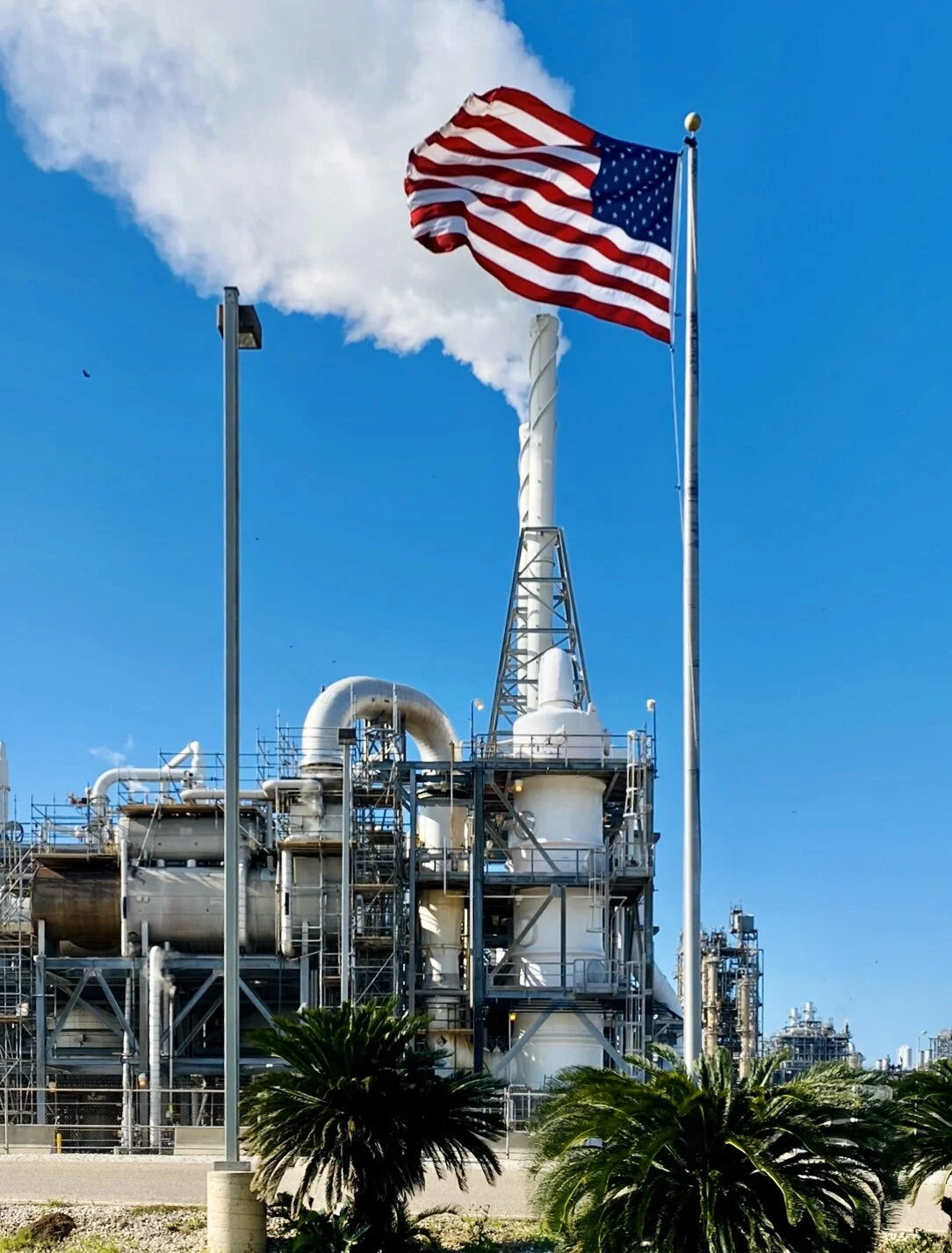
A close up shot of the Dow Chemical plant in Freeport. Locals say this is one of the largest chemical plants in the world.
As I mull over what we are encountering, I find myself thinking the challenges on the Louisiana and Texas coastlines result in a mixed landscape not unlike our home town of New York City. There’s an abundance of both beauty and squalor, and avoiding either one gives visitors an incomplete understanding.
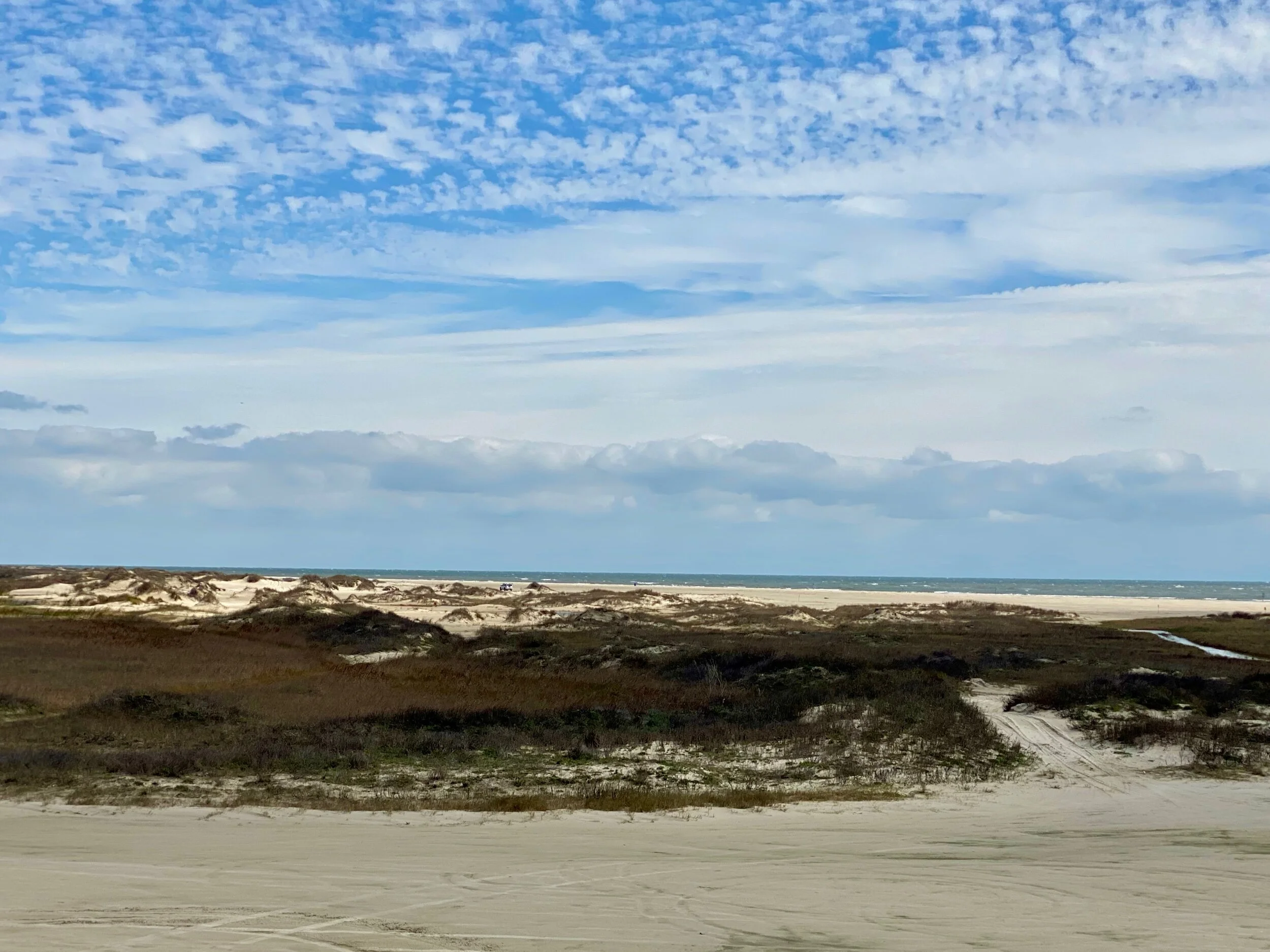
View from the San Luis Pass-Vacek Toll Bridge, which spans San Luis Pass into Brazoria County, Texas.
Clearly, I love the natural beauty of this coastline and its inland marshes, farms, and woodlands. But the story told through the industrialization of the Gulf Coast sticks in my craw. As a northerner, I’m struck by my own complicity in a type of NIMBY (Not in my Backyard) reality. I enjoy living in a city that has (with some exceptions in poorer neighborhoods in the outer boroughs) enjoyed increasingly cleaner air and water over the past several decades through stricter environmental regulations and a shift in focus from industrial production to digital technology.
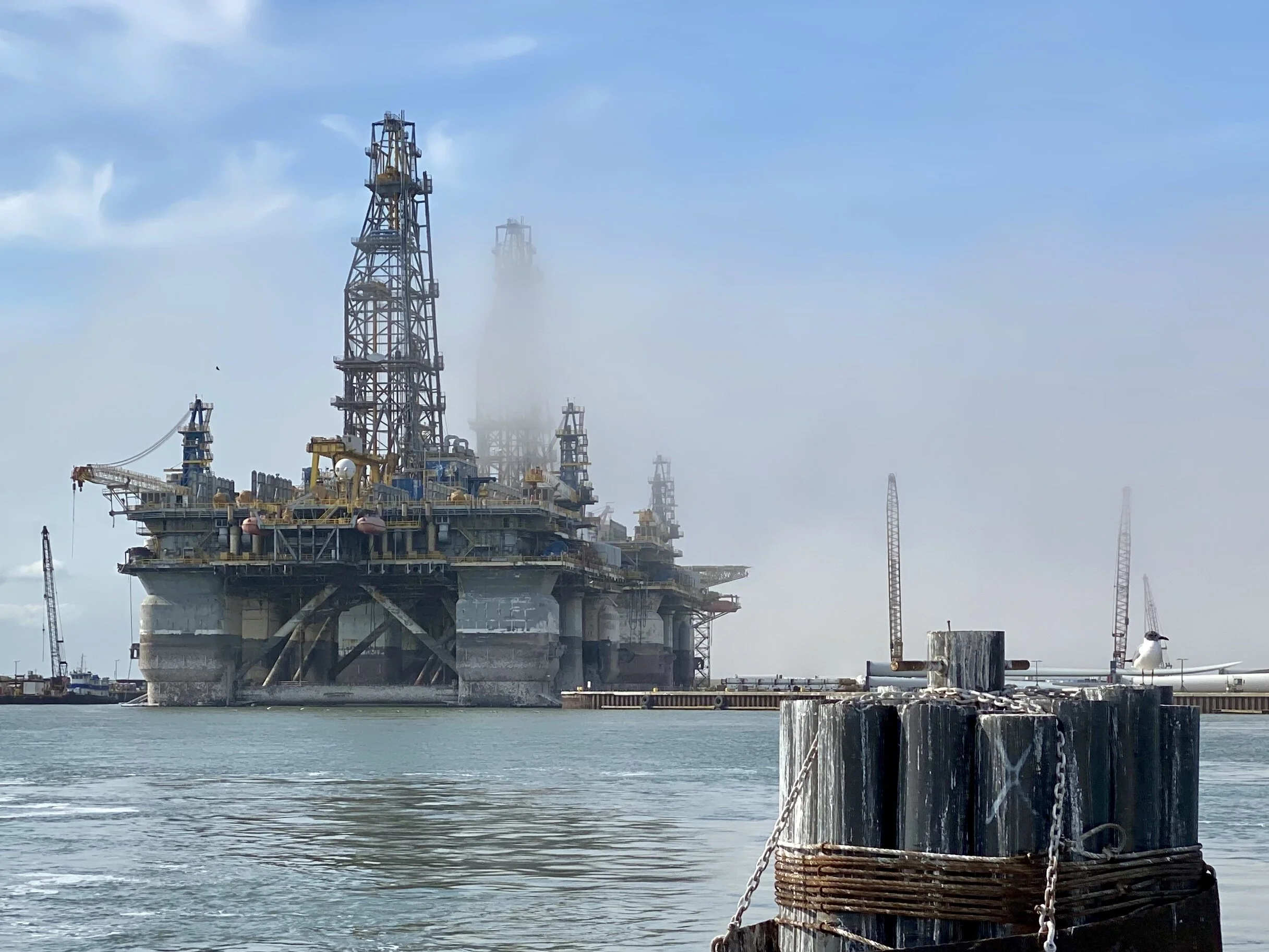
Temporary oil derricks next to the Corpus Christi shipping channel. The local community was told they would be there for six months, but are still there after almost 3 years. And it’s a big bone of contention in this community. Picture taken from the Port Aransas Ferry.
Yet, the nasty stuff used in so many of our industrial processes, plastics and household products has to be made somewhere (at least in our current economy), and some of those places are along the Louisiana and Texas coasts. And like all poor and moderately poor neighborhoods, when jobs are at stake the nature and consequences of those industries matter less than the jobs they bring.
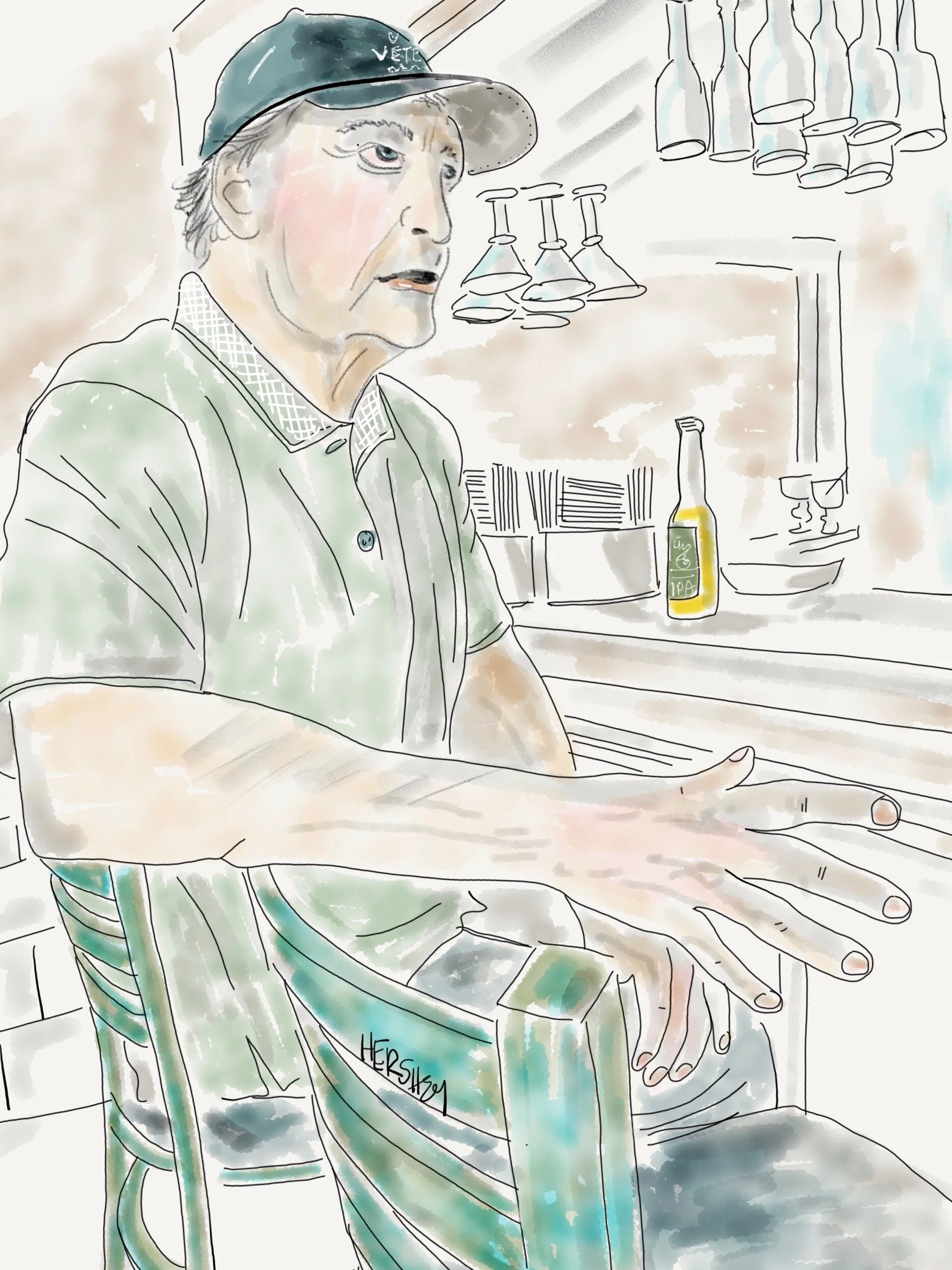
“Well I’ll tell you what—they got the best seafood right on that Seawall”. Drawing by Jennifer Hershey. Follow her on Instagram at deeofo.
Occasionally locals will resist. We met a local at a great Mexican restaurant in Freeport who had worked in most of the nearby plants over his decades long career (he was probably in his 60’s). He did a short stint at the nearby Dow Chemical plant, but didn’t stay long. The plant officials said it was safe, but he told us that it sure didn’t seem safe to him, so he moved on.
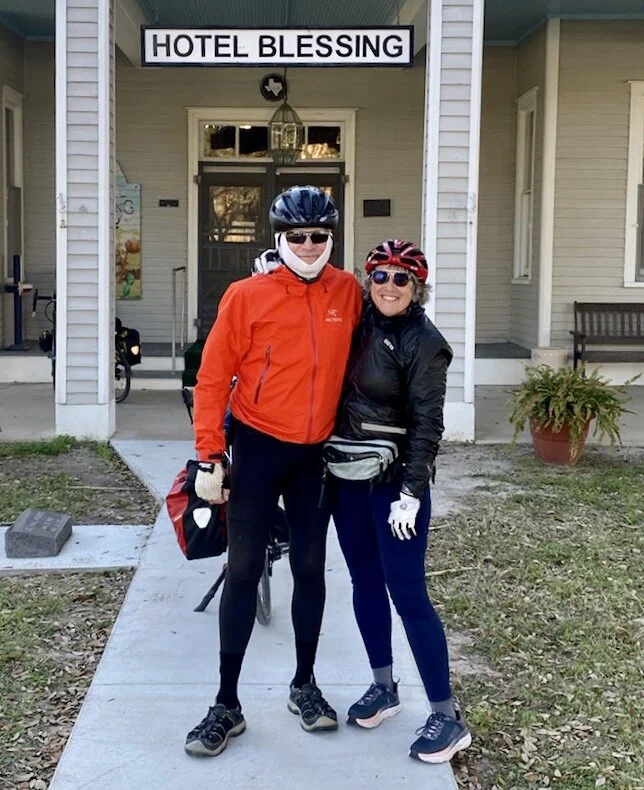
Jenny and I standing in front of the Hotel Blessing.
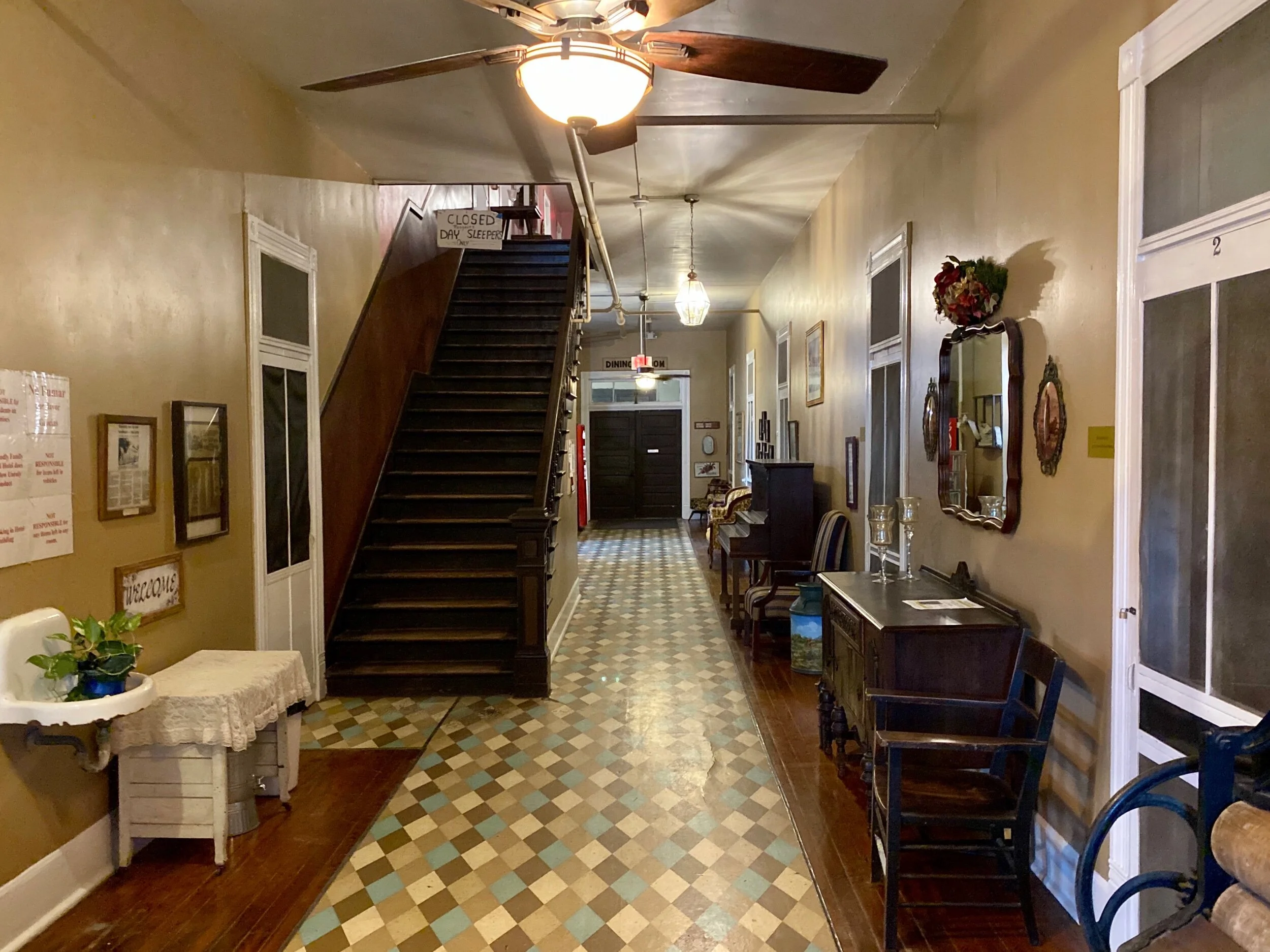
The downstairs interior of the Hotel Blessing in Blessing, Texas, population 861. Blessing was named in the early 1900’s out of the gratitude for local agriculture, railroad and coastal development.
Yet, lots of folks down here are glad for all that Texas has to offer. I’ve heard more than one person boast about being “Texas born and bred”. And even one town has named itself after its good fortune. By sheer coincidence, we found ourselves needing to stop at the one hotel about the right distance between Freeport and the Corpus Christi area (we couldn't stay on the coast because the old coast road was washed out by Hurricane Ike). It’s called Hotel Blessing, named after the town of Blessing.
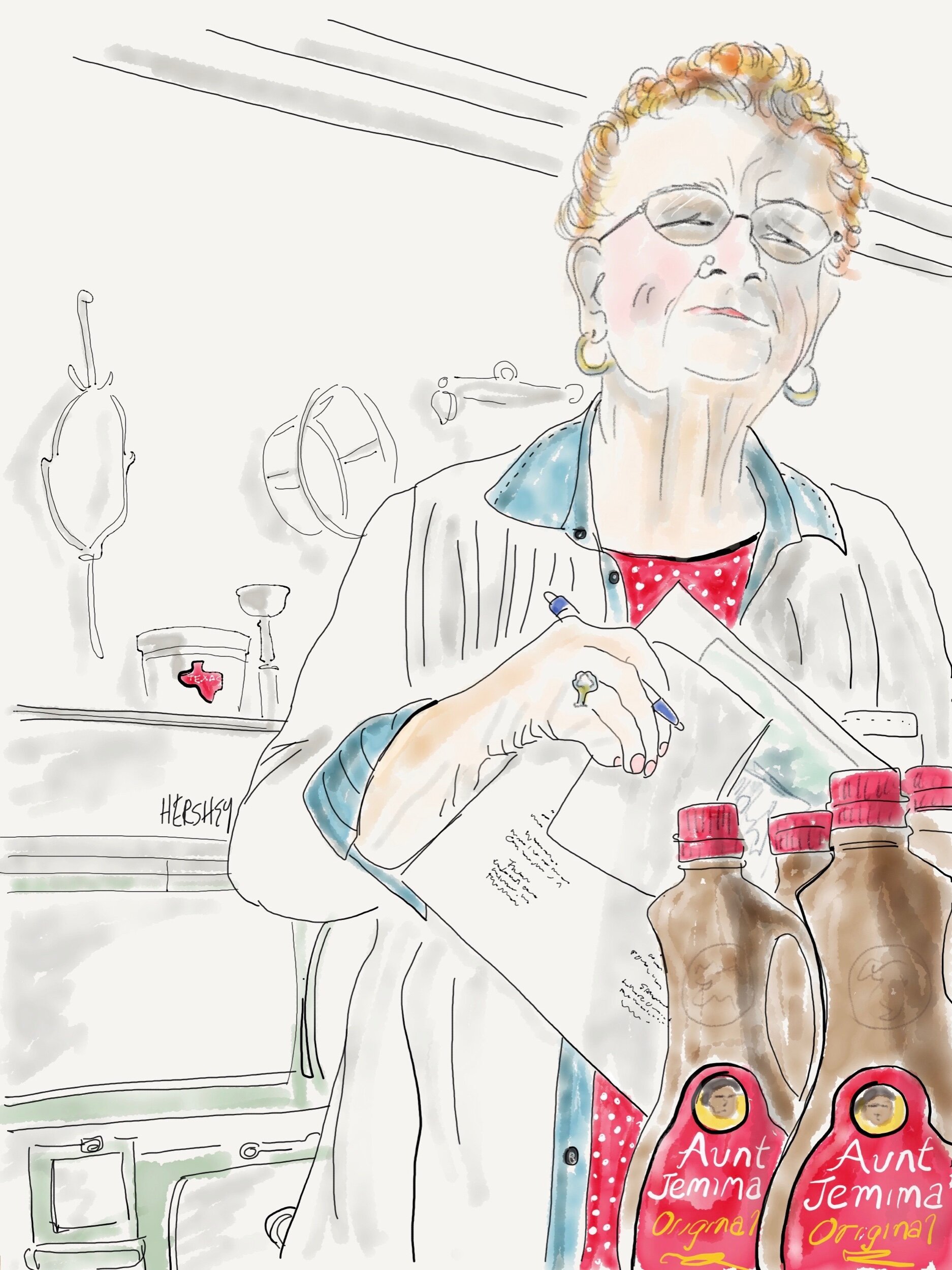
“Oh I’ve been doing this for years. If they keep coming....I’ll be here”. Drawing of Helen Feldhousen by Jennifer Hershey. Follow her on Instagram at deeofo.
We didn’t know what we were in for at the time, but after a restless night at the Hotel (we could hear everything - yep, everything - going on during a busy Valentines Day evening) we went to breakfast at the Hotel Blessing Coffee Shop. We were greeted by the intrepid Helen Feldhousen and a cast of other folks - some of whom who show up in the Texas “Bucket List” broadcast below.
I am thinking quite a bit about the concept of “the tragedy of the commons”. This is a situation where individual users, acting independently according to their own self-interest, behave contrary to the common good of all users by depleting or spoiling the shared resource through their collective action. “Not in my Backyard” (NIMBY) actions are related conceptually. For example, my own life is made better by situating so many large petroleum chemical and oil and gas plants so far away from large cities on either the west or the east coasts. At the same time, the people of southeastern Texas gain through employment opportunities where the only other options would be tourism or agriculture. Yet, their very livelihoods are put at risk by the significant carbon pollution of the industrial activity here, because it contributes to the extreme weather that may ultimately destroy those plants, along with their jobs.
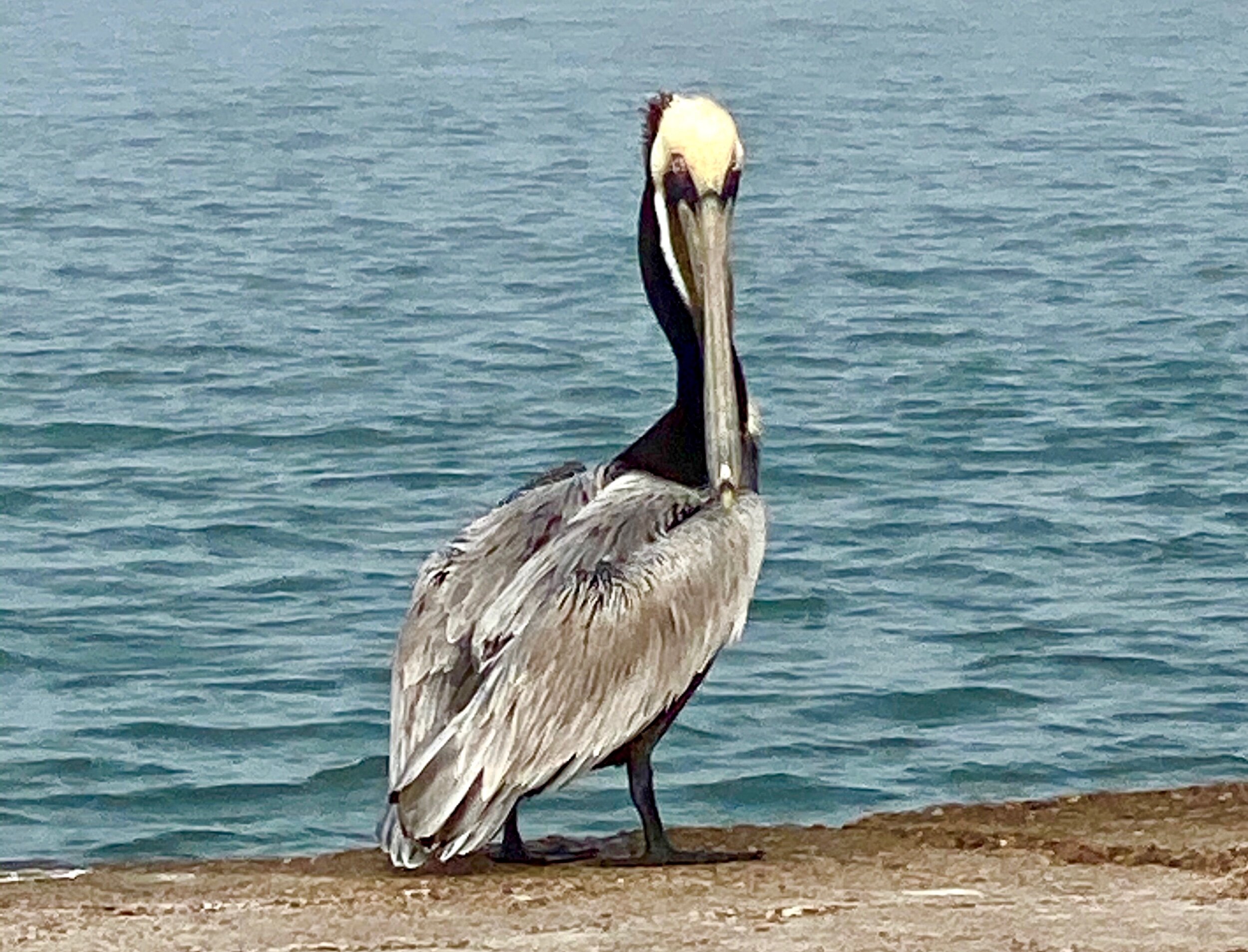
A very mellow Pelican stares us down on the beach at Port Aransas.
Additionally, citizens around the world gain nothing by the carbon these plants and their related industries have added to our atmosphere. It’s worth contemplating that although America contains 5% of the worlds population, we are responsible for 25% of the carbon put into the atmosphere since the dawn of the industrial revolution. And although China is now the world’s greatest carbon polluter, we remain the world’s greatest carbon emitter on a per capita and country basis combined. That fact alone suggests that our way of life is a big part of the tragedy of the commons that climate change is extracting. It's clear that staying with the status quo is the worst thing we can do. It’s time to step up to a different plate.
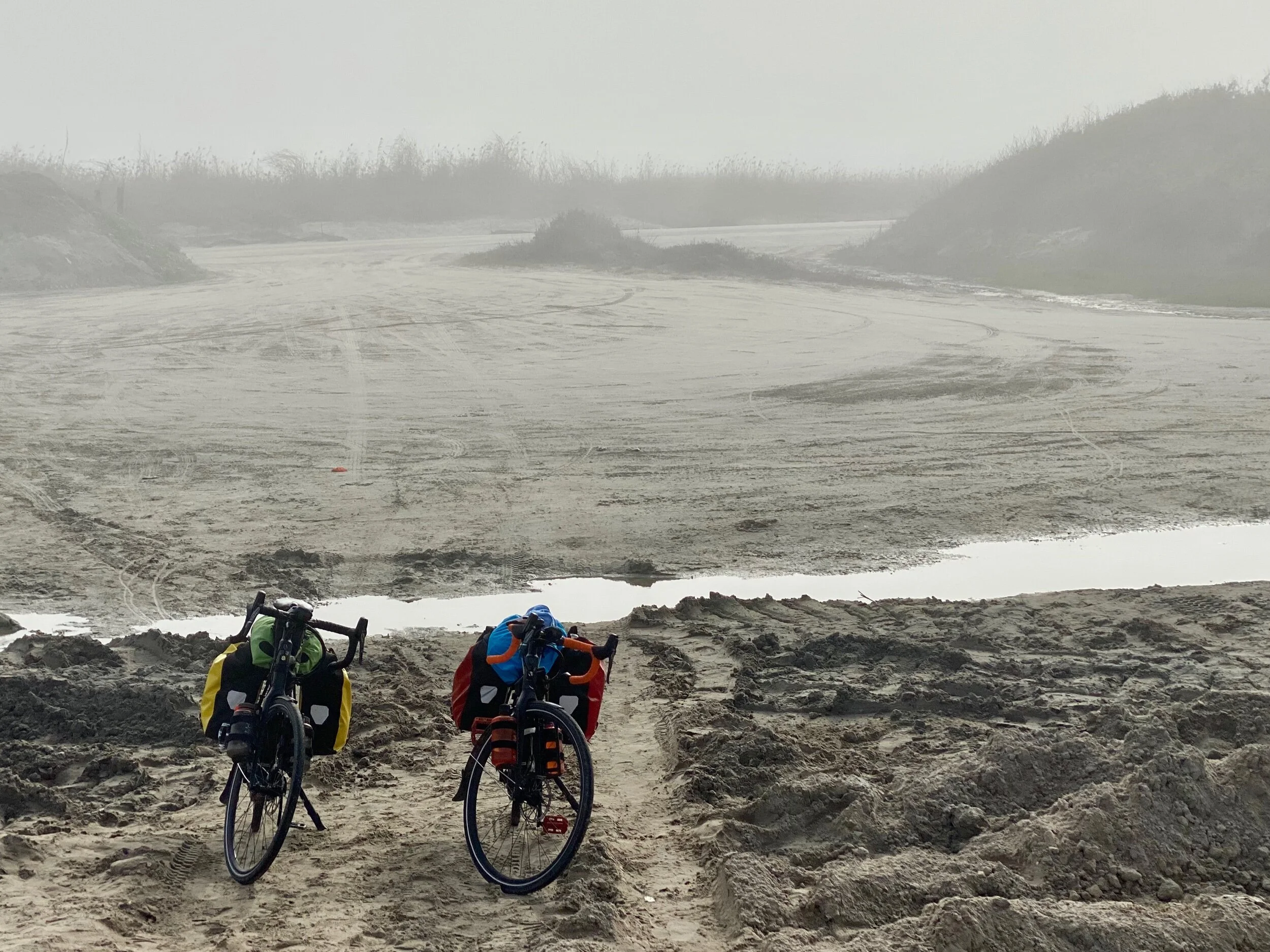
Our bikes in fog at the beach on Port Aransas Beach, Texas.
A few of you told me you missed the links to the Garmin maps showing our journey day by day, so I include links below to our entire trip to date. If you don’t have a Garmin account you will have to create one to see them (it's worth it if you're a biking geek or map lover).
1) New Orleans Road Cycling, 2) New Orleans Road Cycling, 3) Donaldsonville Road Cycling, 4) Morgan City Road Cycling, 5) St Mary Parish Road Cycling, 6) Abbeville Road Cycling, 7) Lake Arthur Road Cycling, 8) Cameron Parish Road Cycling, 9) Port Arthur Road Cycling, 10) Galveston Road Cycling, 11) Freeport Road Cycling, 12) Matagorda County Road Cycling, 13) Refugio Road Cycling, 14) Today we are in Port Aransas, Texas, just slightly southeast of Corpus Christi, Texas.
Thanks for reading! More to come…
All photos, unless credited or otherwise noted, are copyrighted property of the blog post author.
Louisiana/Texas, Post 2
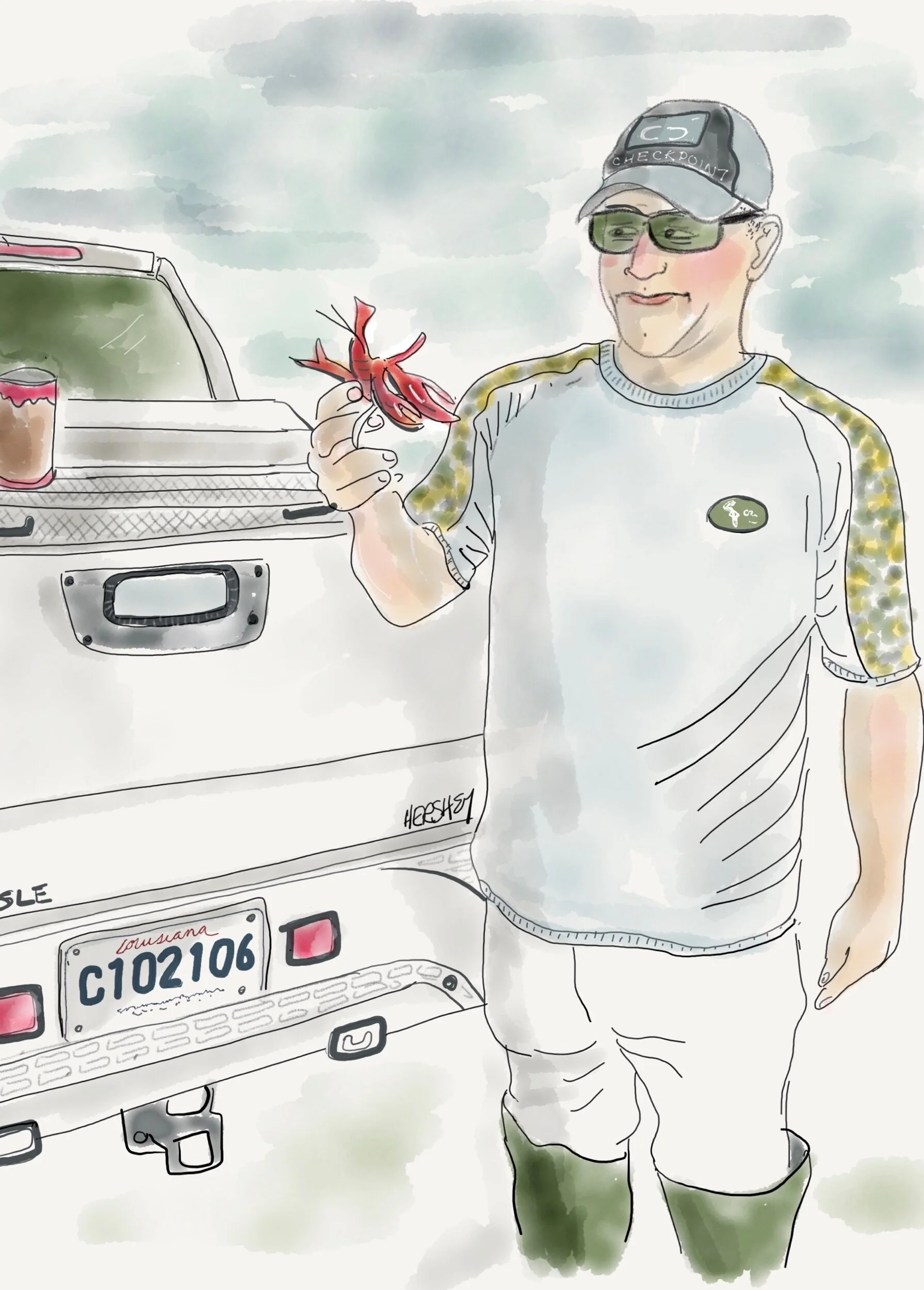
“Yes Ma’am...it’s alive. They be millions of them in pots out there in them rice fields”. Drawing by Jennifer Hershey. Follow her on Instagram at deeofo.
Welcome from Galveston, Texas, where we arrived from Louisiana by way of the coastal towns Cameron, Louisiana, and Port Arthur, Texas. Most of south central and southwestern Louisiana below the I-10 corridor from Houston to New Orleans is less than 20 feet above sea level. On both sides of the Intercoastal Waterway this land of marshy prairies, bayous, forests and intense wetlands supports many wildlife sanctuaries, cattle ranches, sugarcane and rice farms, and crawfish trapping. It was a pleasure to cycle through. People are friendly, and the inland towns are small and attractive.
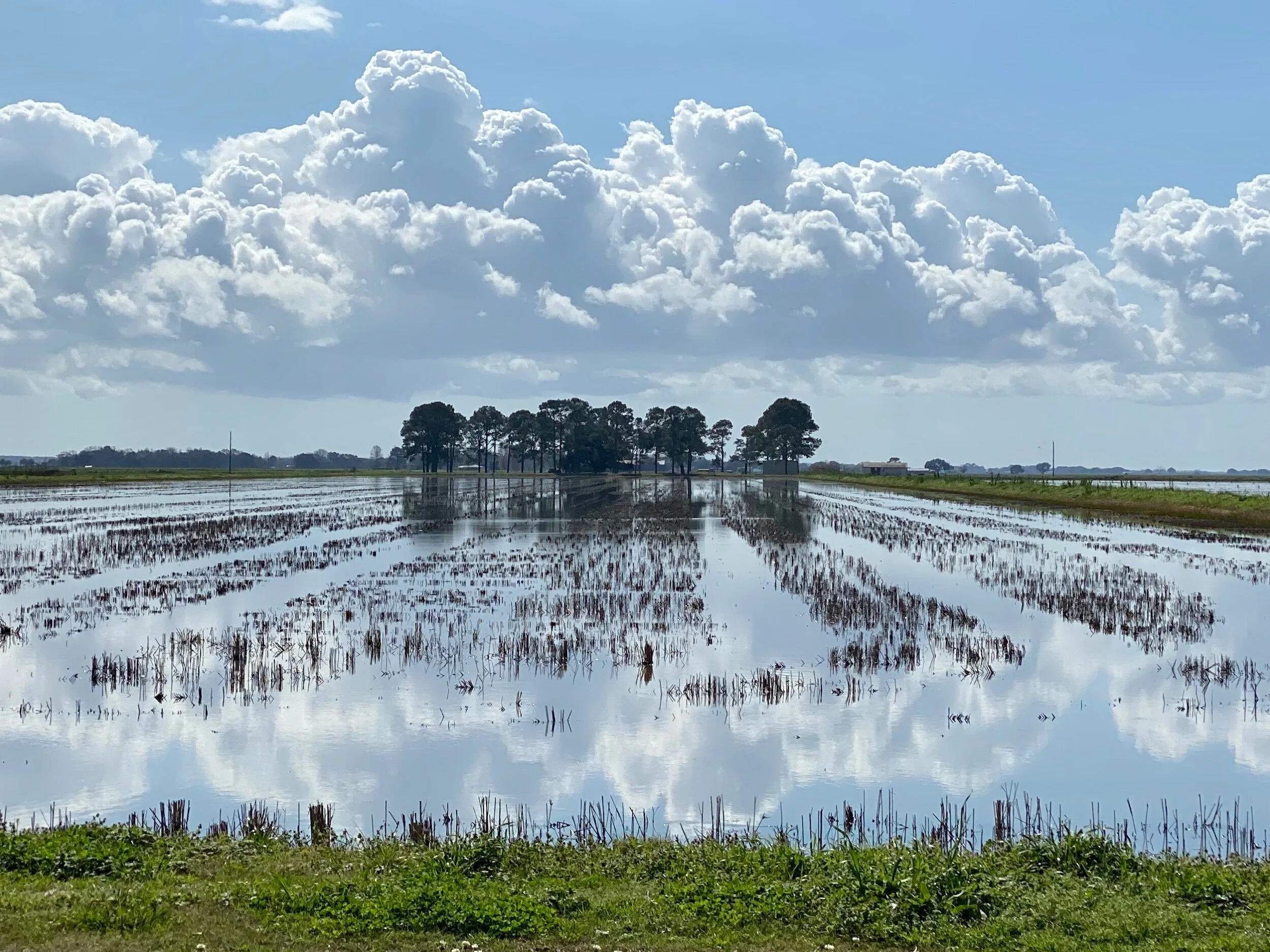
A rice field east of Lake Arthur, LA.
We had an interesting encounter with a very busy and successful woodworker named Mark near New Iberia, Louisiana, who showed us his shop, and introduced us to some of his workers. After we got settled into a motel in nearby Abbeville, he and his wife Dona picked us up and took us out for a sensational seafood dinner. We enjoyed Louisiana hospitality at its best, with good food and plenty of libation and conversation. Although we could sense we weren’t all likely to be on the same page politically (even though we shared a concern for rising sea level and the fate of the lowlands), a strong and jovial spirit of acceptance and friendship remained intact. Interestingly, the next day Mark read my recent blog post, and texted me “Great post. Observe more, judge less. Good way to live. Just remember, sometimes you have to step up to the plate”. Jenny drew his picture, and I thought about what exactly he meant.
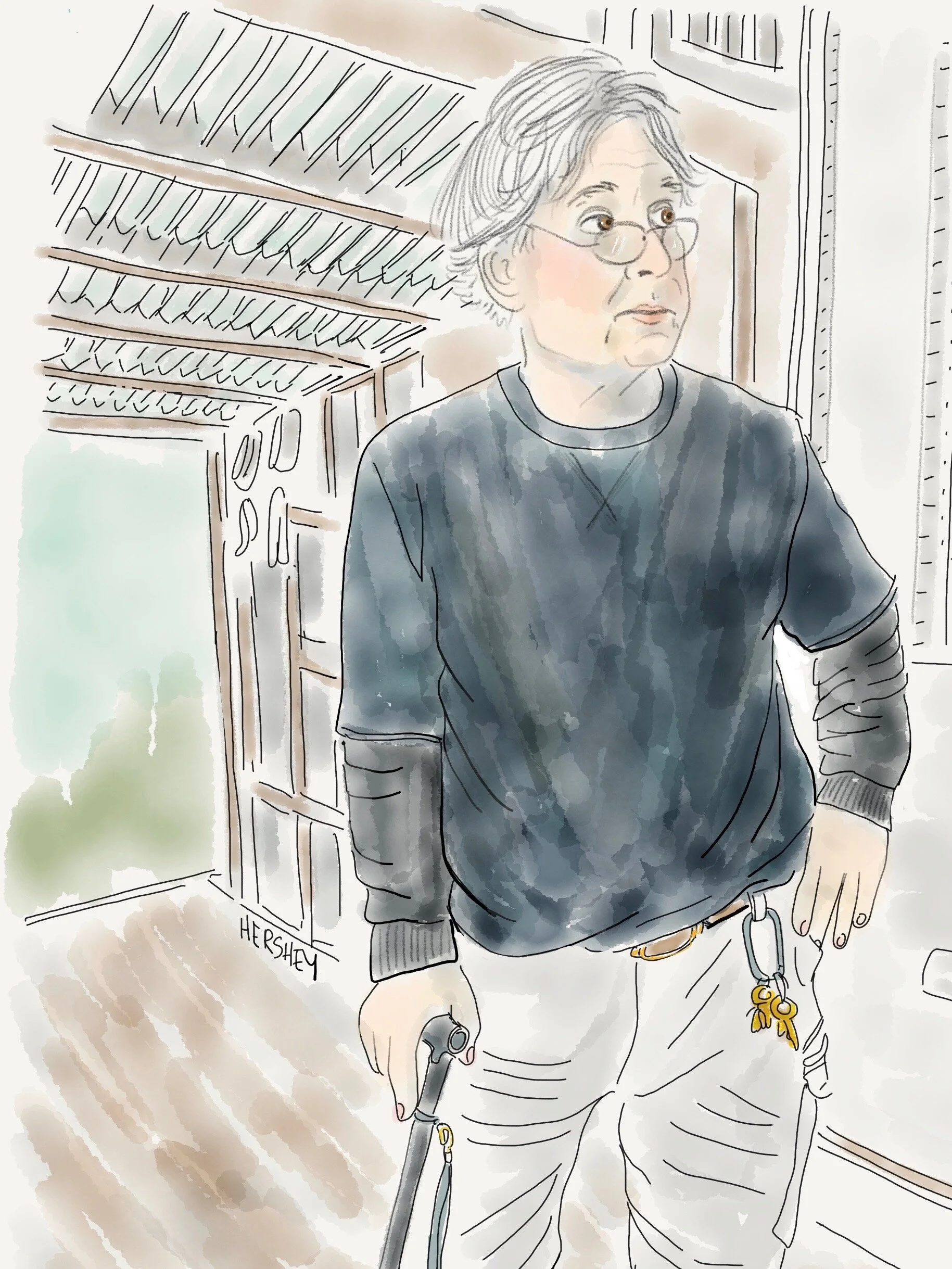
“I got three good sons in laws. I want my family to be healthy. But I worry that the land to the south of here is going to be under water”. Drawing by Jennifer Hershey. Follow her on Instagram at deeofo.
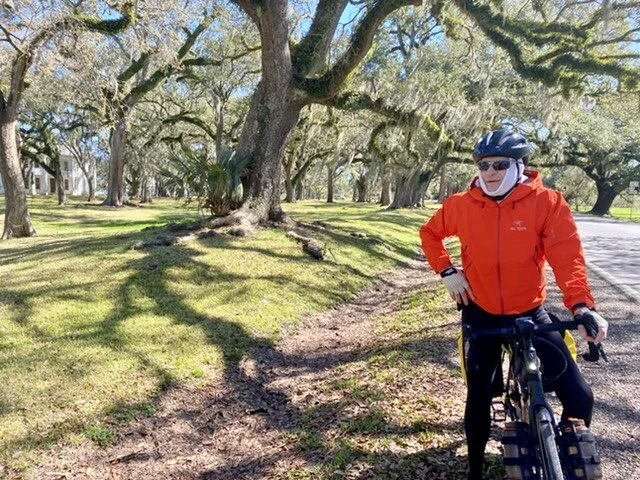
Michael biking through historic Jeanerette, LA.
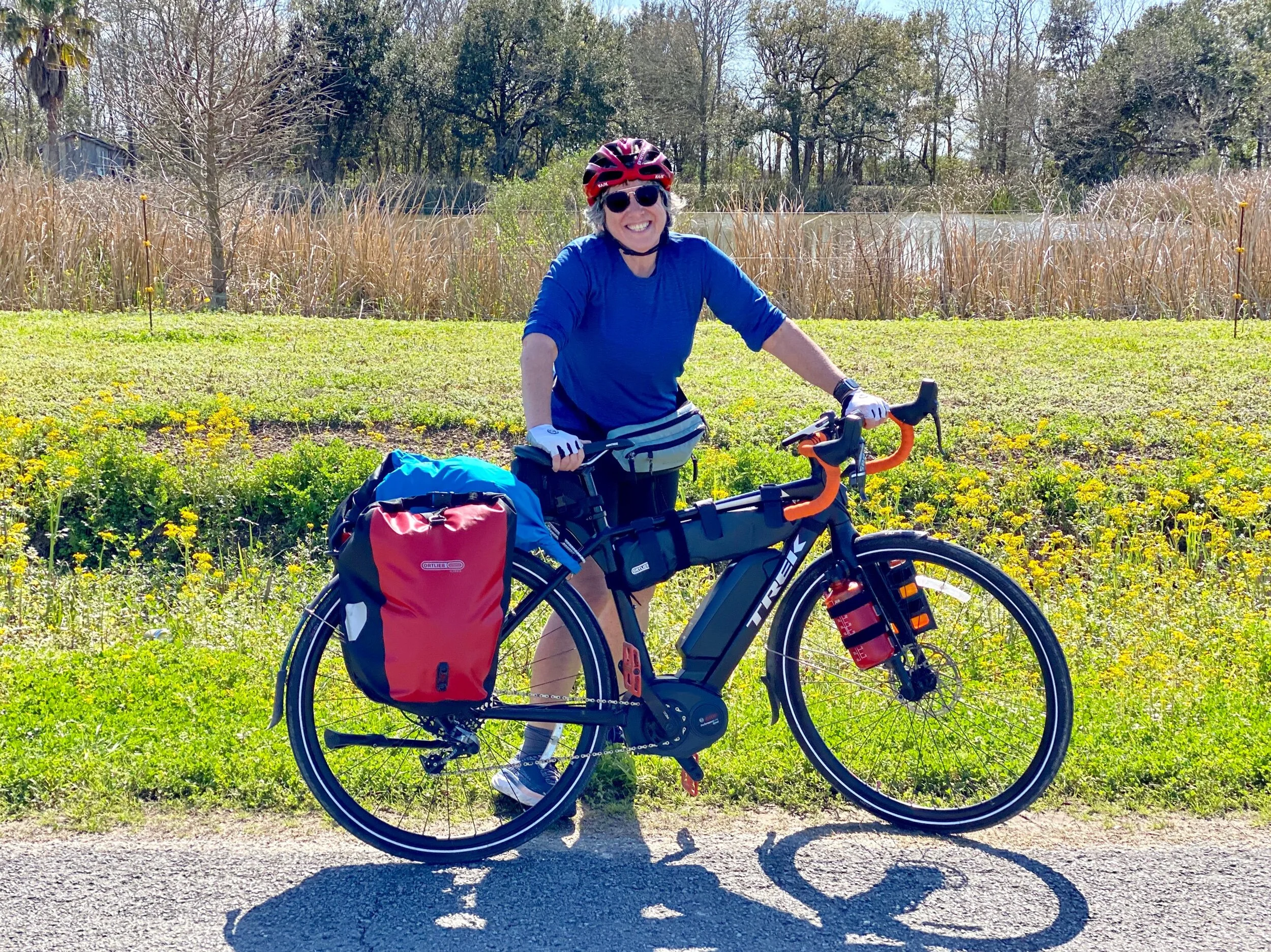
Jenny with her bike on the way to Lake Arthur, LA.
In addition to their beauty and the warmth of their inhabitants, southern Louisiana and Texas can also be disturbing places to bike through. This bucolic landscape is riddled with debris, machinery, abandoned oil wells and new fracked gas compressor stations. It’s crisscrossed by pipelines carrying oil and gas from conventional wells found underneath the marsh, and an abundance of fracked gas piped in from the north. Much of the fracked gas in western Louisiana originates from the nearby 9000 square mile Haynesville Shale, a large shale play in northwestern Louisiana.
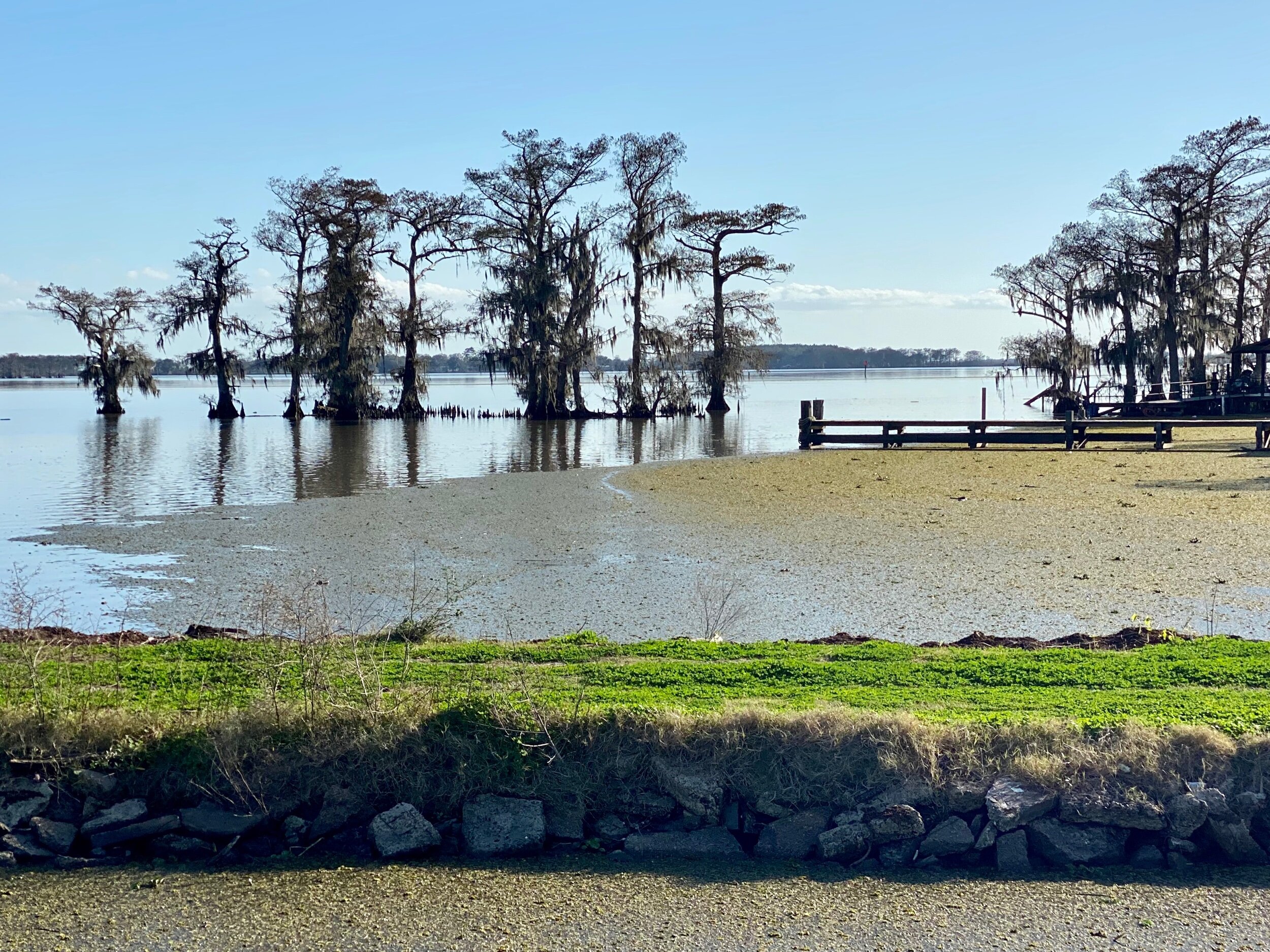
A view of Lake Arthur, LA.
Given the low elevation and the marshy characteristics of the land, it’s obvious that this area is very prone to coastal erosion, storm surges, tidal flooding, and extreme weather events such as hurricanes. A few days earlier, just west of New Orleans, we had contended with tornado warnings, which are quite unusual for the area. Locals agreed, although no one we spoke to suggested a changing climate as a possible cause.
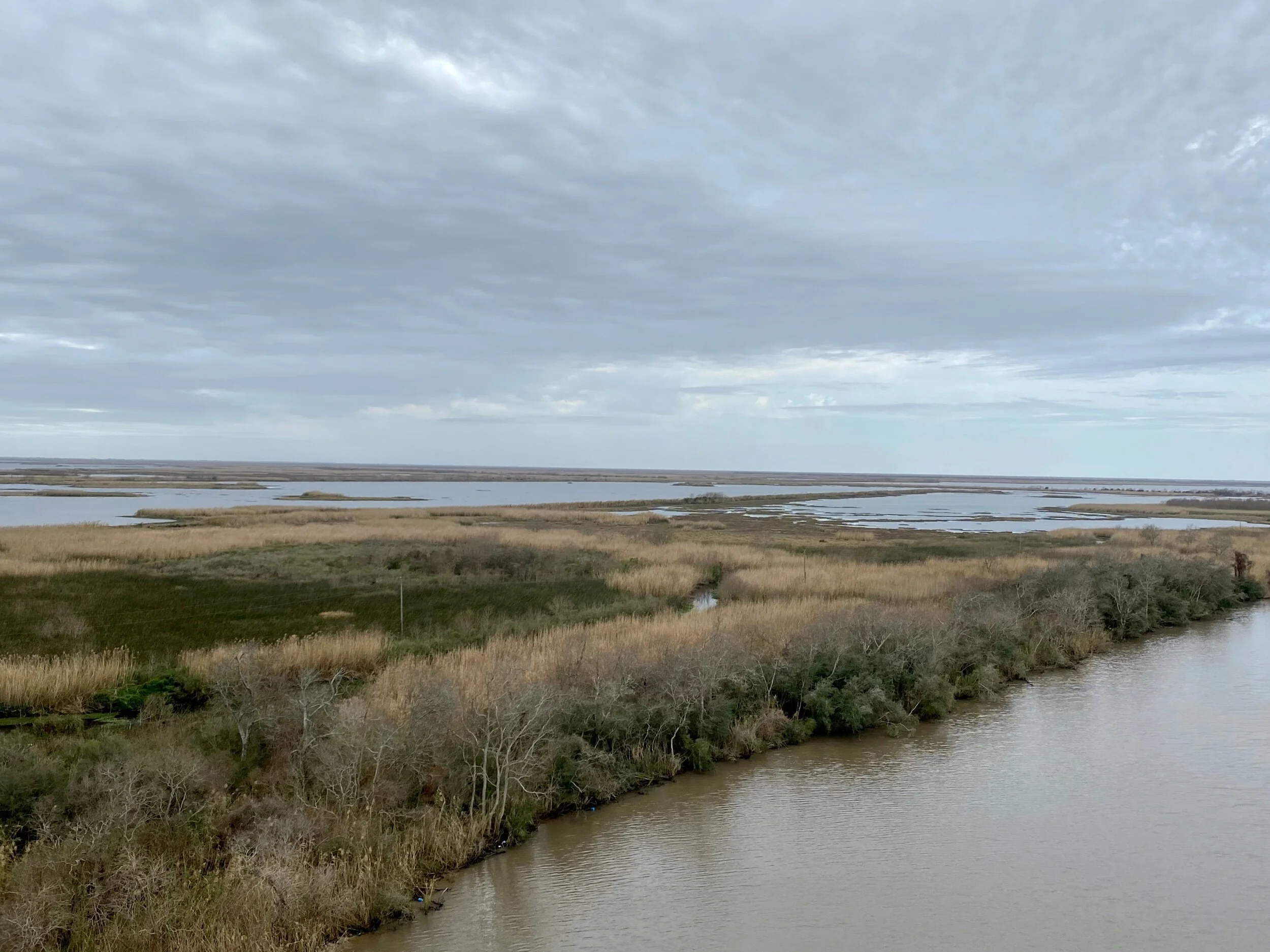
Just south of the Intercoastal Waterway on Highway 24 in southwestern Louisiana. Under these marshes lie a maze of pipelines carrying oil and gas from local deposits and the shale play in northwestern Louisiana.
The sheer vulnerability of the lowland coastal areas of the Gulf Coast seems hauntingly palpable. It’s clear to any thoughtful observer that Louisiana is deeply and complexly affected by our changing climate.
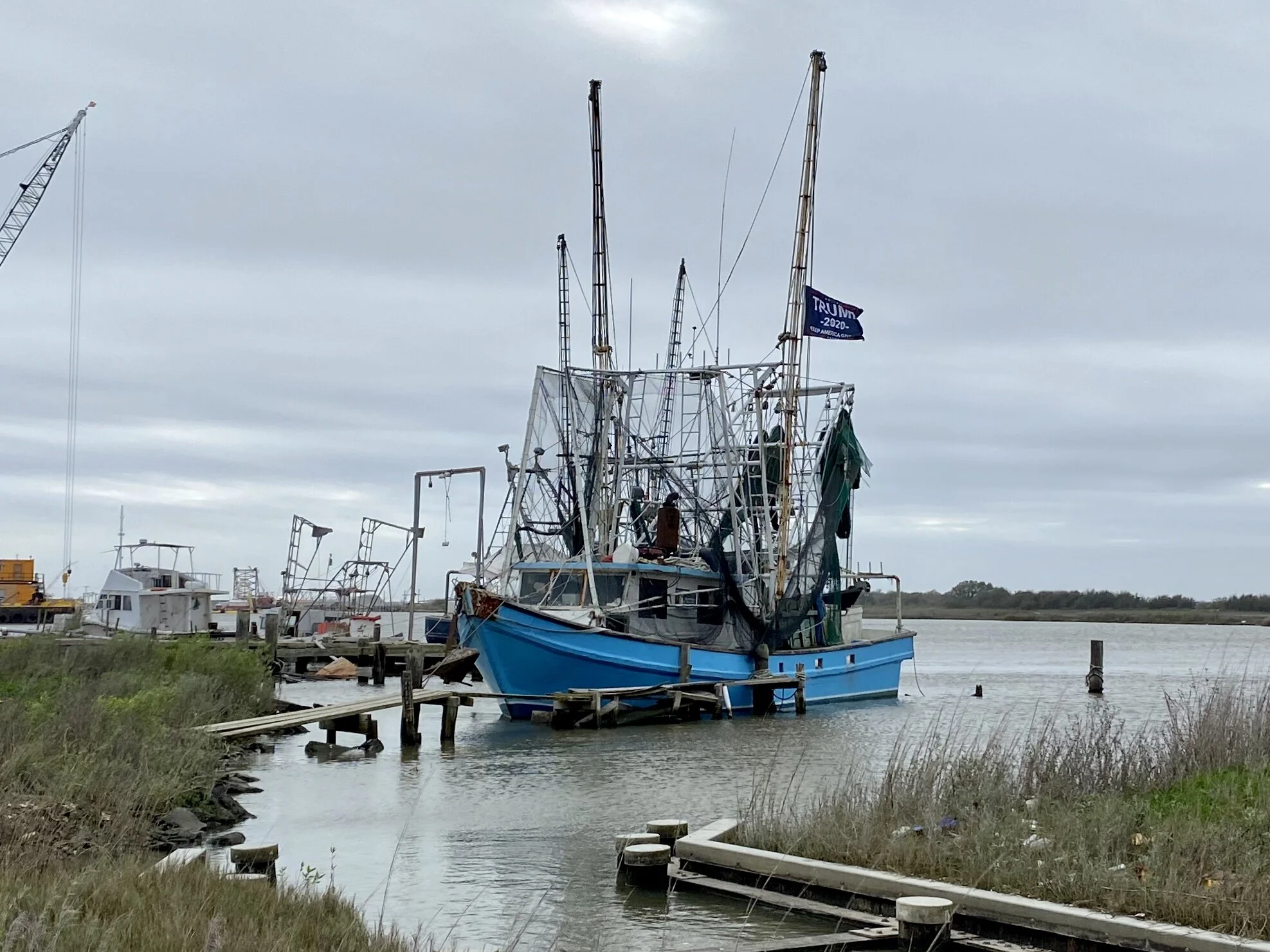
A fishing boat moored near the site of the new LNG global exporting plant at Cameron, LA. The flag on the boat says Trump/Pence 2020 . The entire port area just south of this boat (which used to be public land) is now privately owned by the company building the incoming plant. We weren’t allowed to see it.
The town of Cameron, LA, (once a bustling resort town of 3000 people that was devastated by Category 3 Hurricane Audrey about 60 years ago, and slammed again by Ike in 2008) now only has a few hundred permanent citizens. However, it is now a site for a large liquified natural gas (LNG) global exploring plant that will compete with an equally large LNG global exporting plant under construction in nearby Port Arthur, Texas. This much larger blue collar town lies just across Louisiana's southwestern border, where the Spindletop gusher was struck in 1901, setting off an oil rush that resulted in nearby Houston eclipsing Galveston as the primary port for southeastern Texas.
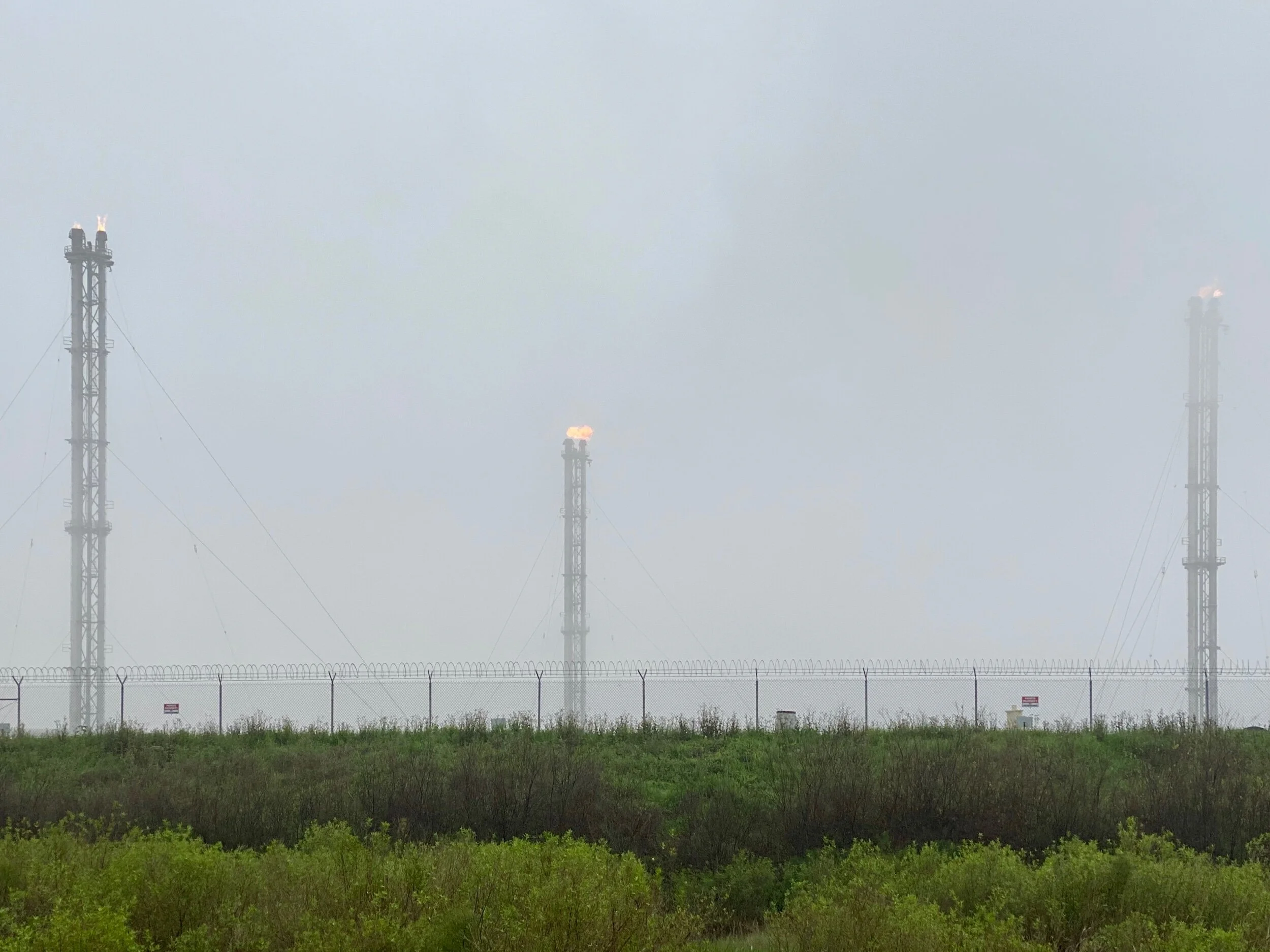
Gas flares in the marsh about a mile from the Liousiana Coast.
Each new plant currently employs about 3000 construction workers. When complete, the Cameron plant will support 160 permanent jobs, and the Port Arthur plant will support about 200 permanent jobs. That is, of course, unless a major hurricane hits this part of the Gulf Coast, in which case operations will either be temporarily or permanently interrupted.
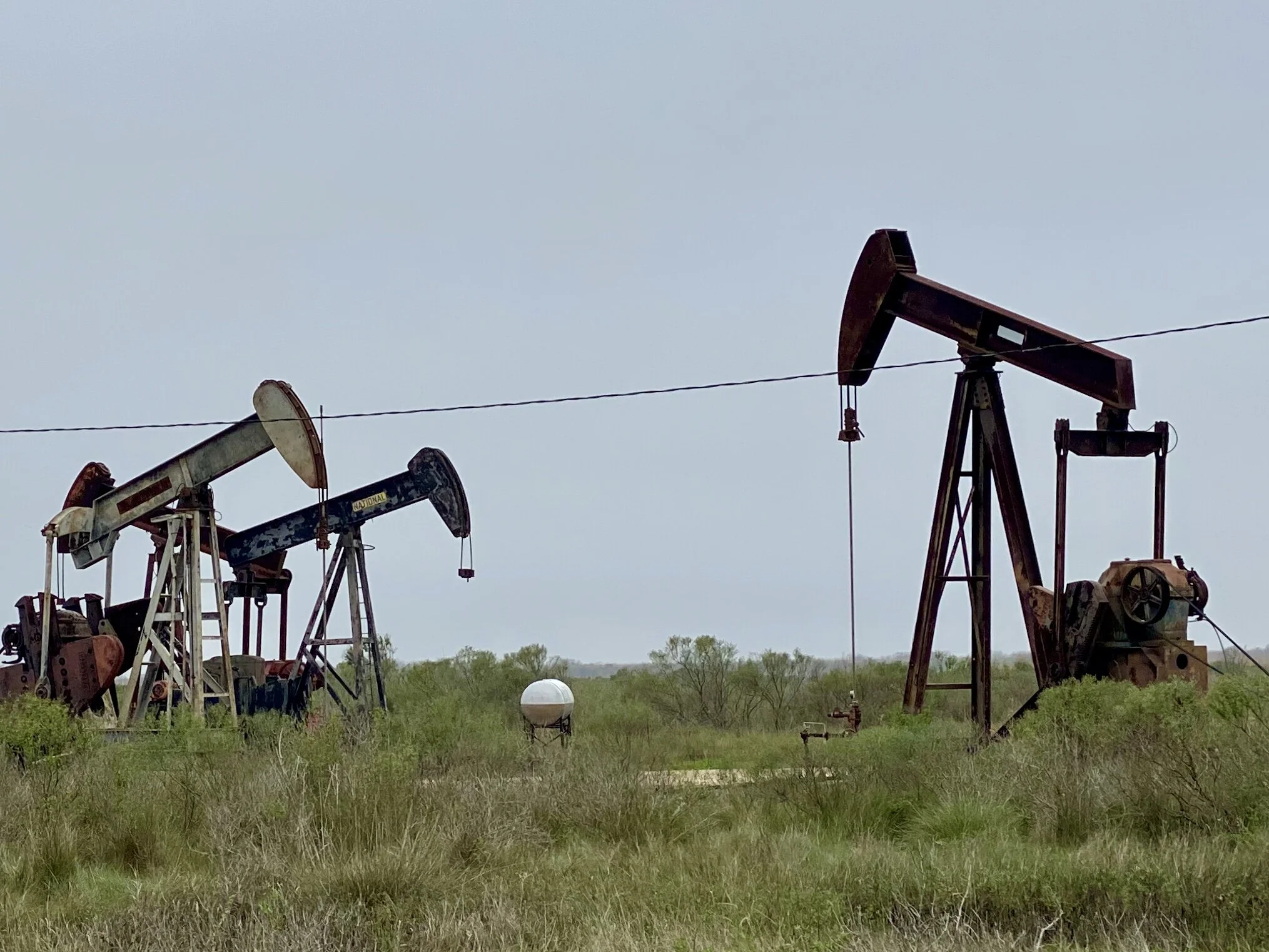
Abandoned oil wells in High Island, Texas, about a half mile from the Gulf Coast.
The reasons for this activity make economic sense in the short term. Cameron has been quite poor since Hurricane Audrey hit, and jobs are scarce. Consequently, the new plant is very popular among locals. Port Arthur is also poor, although it has more economic diversity than Cameron. However, the proximity of its site for a new receiving terminal will have additional benefit to Houston, so it’s popularity is even greater. Interestingly, in Houston, there is tacit, if not public, recognition among local officials that climate change is real. Based on a conversation we had with a local in Port Arthur, it seems there is hope that new sea walls east of Port Arthur across the Sabine River and further west across the Houston ship channel will mitigate storm surge issues for awhile, at least for southeastern Texas. …For how long, we wondered?
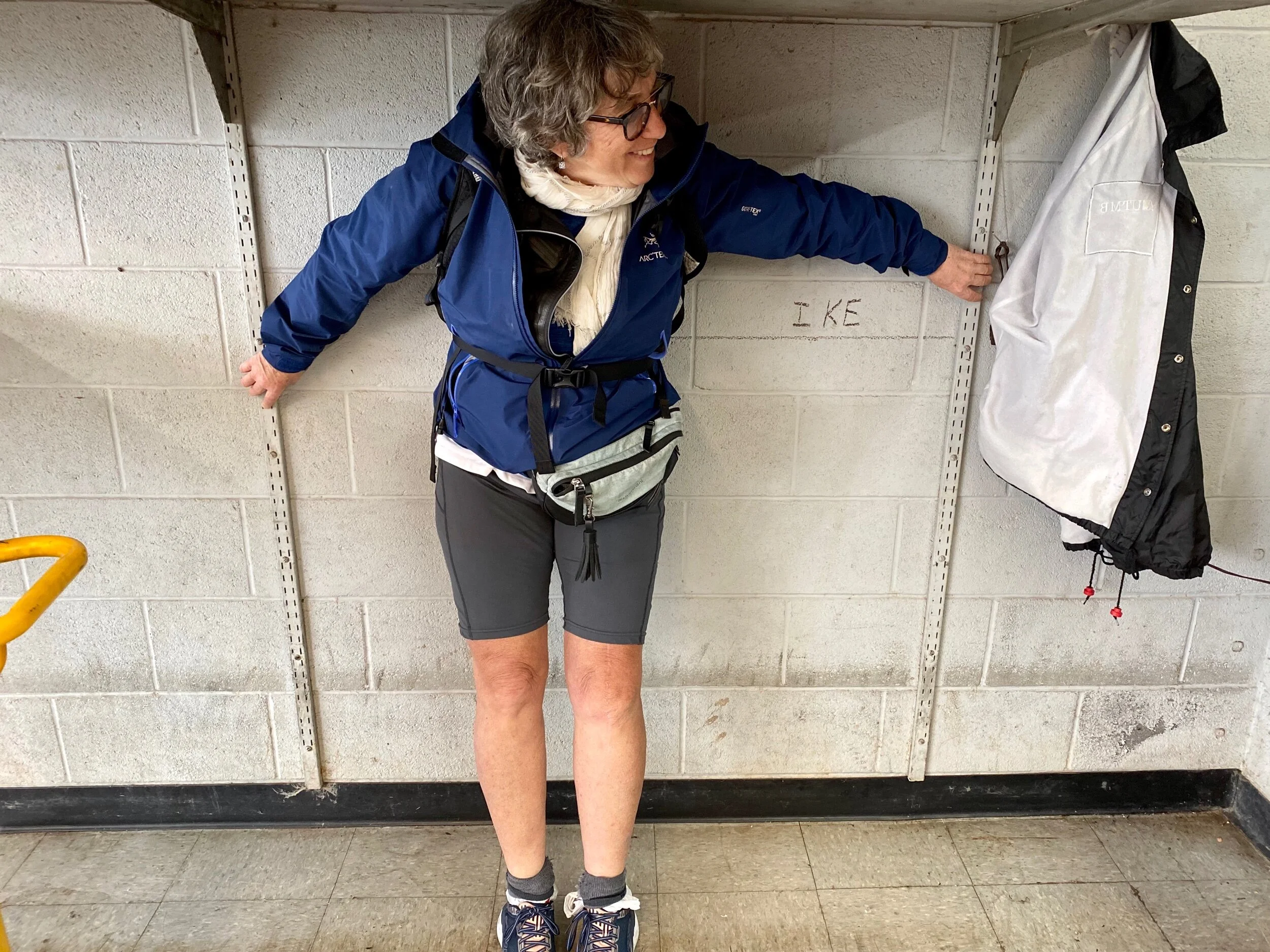
Jenny’s left arm marks the water line for Hurricane Ike in a bicycle shop we went to in Galveston. This 2008 hurricane holds the record for storm surge in Port Arthur, cresting at 22 feet.
So why do so many people in Louisiana and Texas embrace the very industry that may ultimately do them in? Isn't one definition of insanity, “doing the same thing over and over again and expecting different results?”
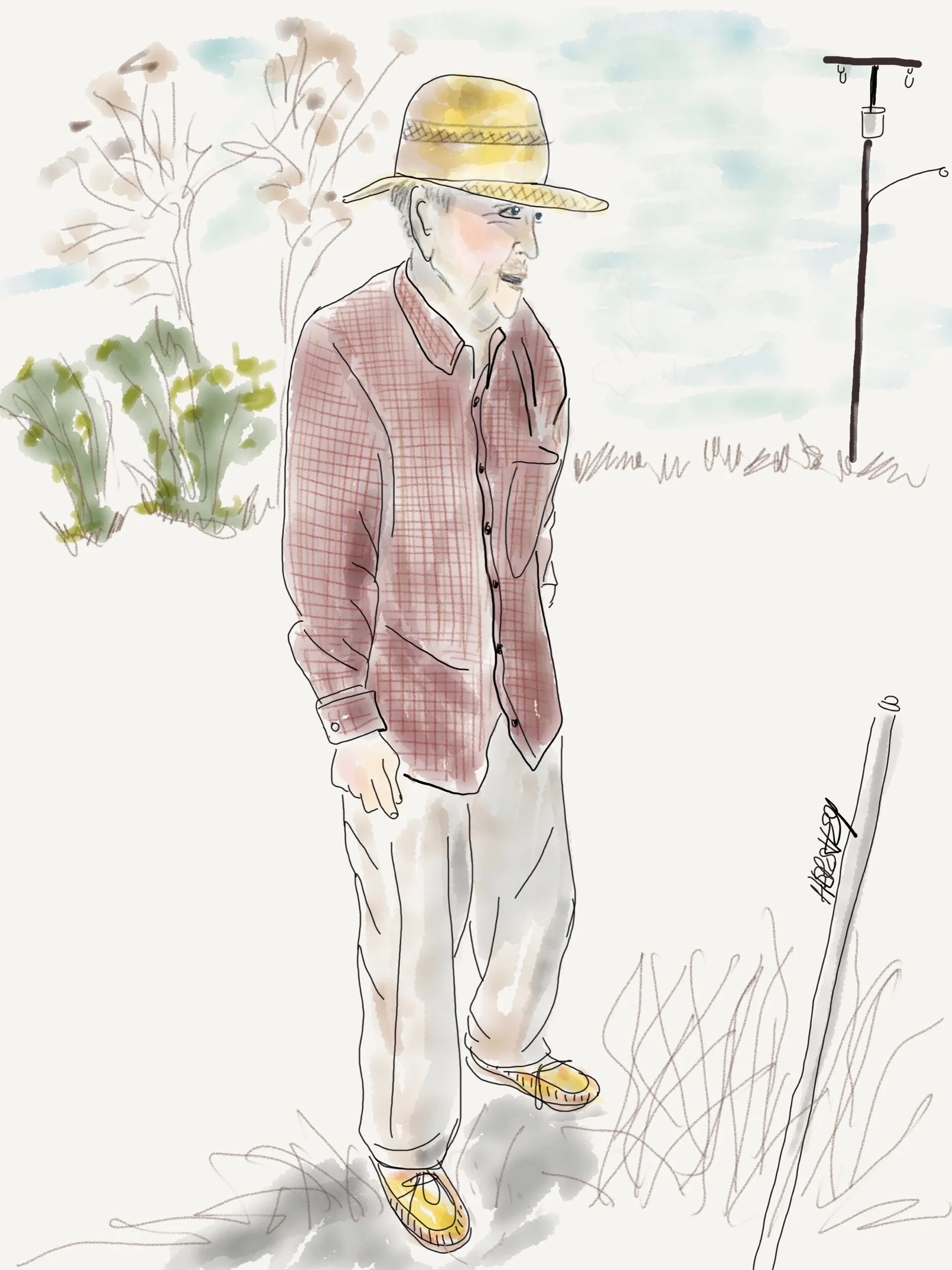
“I moved one time..in 1954...from next door to here.” Drawing by Jennifer Hershey. Follow her on Instagram at deeofo.
Jobs are important, and 460 permanent jobs might have lasting value for your communities. But at what cost? When your home is losing land to coastal erosion at alarming rates, when scientist are warning us that sea level rise is occurring faster than their previous conservative estimates indicated, when extreme weather events such as hurricanes and tornadoes are becoming more frequent with every passing year, when scientists are looking at establishing a Category 6 for hurricanes because they are growing so much more intense, …..when does that community cut its losses, and change its economic base?
Yes, life will be harder in the short term, but potentially much more livable and rewarding in the long term. Maybe that’s a plate that’s worth stepping up to…
For those of you who geek out on map routes, please email me and I will happily include links to the Garmin maps in this blog post. Frankly, I simply don’t know if they are very important to my readers. If I’m wrong, I’d love to know.
Thanks for reading! More to come…
All photos, unless credited or otherwise noted, are copyrighted property of the blog post author.
Getting Real About Global CO2 Emissions
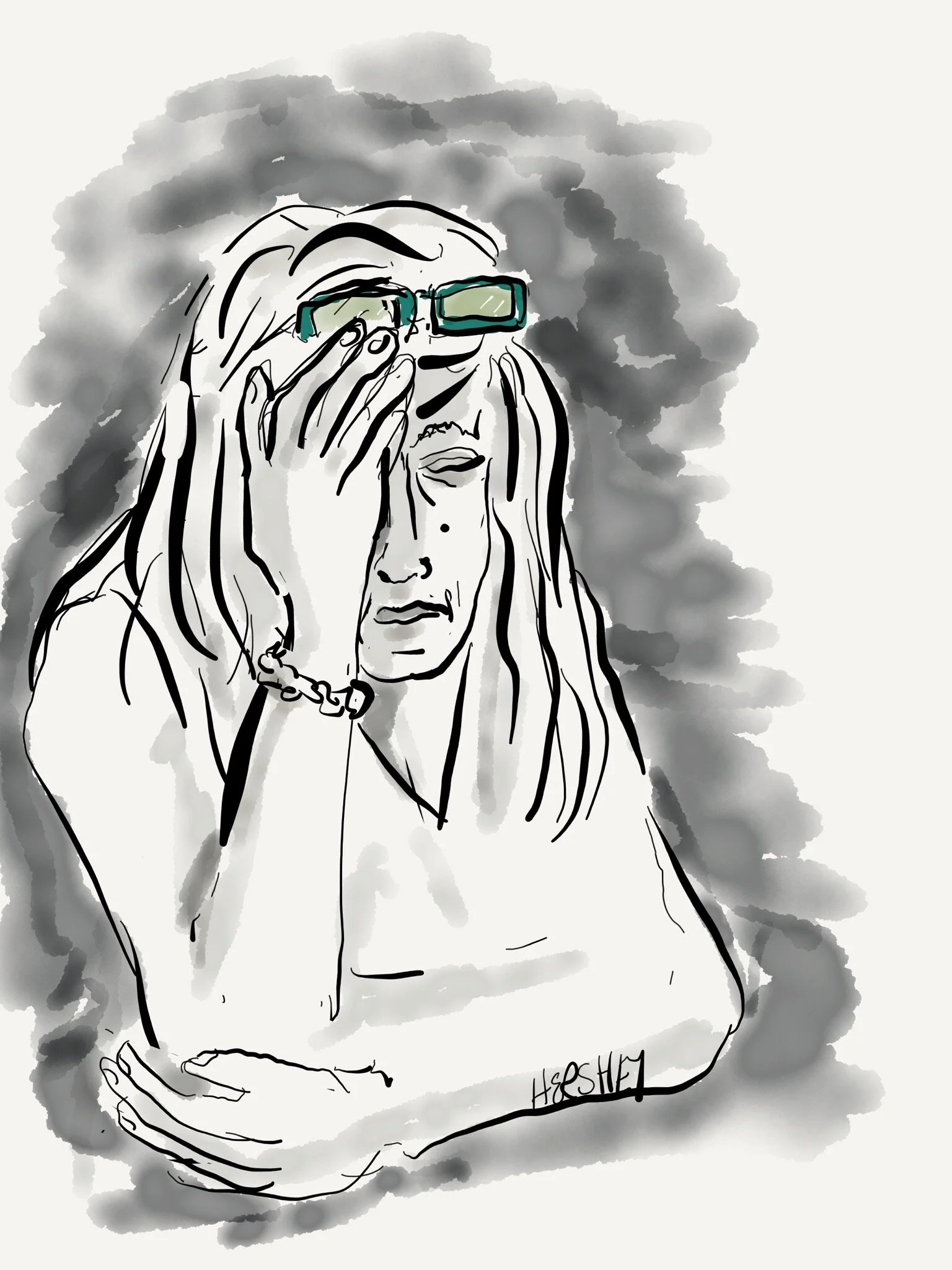
“The fear is real”. Drawing by Jenny Hershey, on Instagram at deeofo.
Greetings from New York City. For those of you who wonder what happened to me and Jenny Hershey along the GAP Trail as we left Pittsburgh last October, you can find a short blog post about that ride in the Archived Cycling Tours for 2019 in the drop down menu. And please look forward to following our next ride beginning in New Orleans and heading across southern Texas in early February, 2020. It’s an interesting time in the U.S. for blue state urban northerners to mix with red state rural southerners. We are certainly curious as to what our fellow Americans are thinking about climate change (and many other subjects), and we hope to see and learn some things worth sharing.
But let's attend to a present concern. Previous readers of these blog posts may have wondered about the CO2 icon in the upper left hand corner of this page above the carbonstories.org logo. That is a widget from the CO2.earth website, and is a reference to the latest annual average of parts per million (ppm) of carbon dioxide in the atmosphere as measured at the Scripps CO2 research project at the Mauna Loa Observatory in Hawaii.
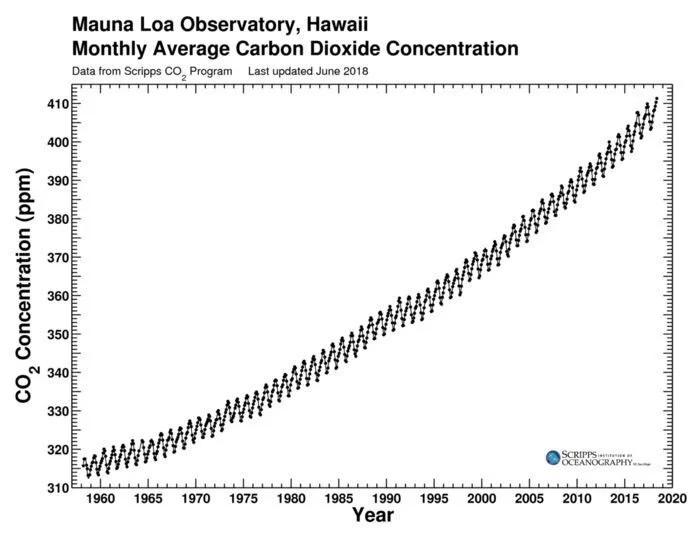
This is the famous Keeling curve, which demonstrates a 25 percent rise in carbon levels in our atmosphere since 1960.
This research project was initiated in 1956 by Charles Keeling, and operated under his direction until he died in 2005, when his son Ralph took direction of the project. The iconic “Keeling Curve” chart shown above is a result of their work, and is a well known and accurate record of the rise in CO2 levels since the 1950’s.
As of this writing, the most recently reported measurements of carbon dioxide at the Manua Loa Observatory are:
It is a widely understood, and easily verifiable physics experiment to demonstrate how increasing CO2 levels causes air temperature to rise; in fact this was proven well over 100 years ago by both the Irish physicist John Tyndall and Swedish physicist Svente Arrhenius. Tyndall is widely credited with discovering the greenhouse effect that underpins the science of climate change by publishing a series of studies on the way greenhouse gases, including carbon dioxide, trap heat in the Earth's atmosphere.
Following their leads, other scientists established a clear link at least 30 years ago between the accumulation of greenhouse gases in the atmosphere and increases in surface air temperatures. Scientists have established that temperatures increase 1.8 degrees C for each 3.7 trillion metric tons of additional CO2 in the atmosphere. (Emissions are expressed in metric tons, each of which is equal to about 2,205 pounds). Today's CO2 concentrations and global average temperatures are typically measured against levels that prevailed before the Industrial Revolution, when humans began to have a meaningful impact on the planet's natural chemistry.
That influence has been extraordinary. As you can see in the graph below, current parts per million (PPM’s) are above 400, even though CO2 levels have consistently hovered around 280 ppm for the last 800,000 years until quite recently. The upward explosion in the line graph below begins in the late nineteenth century, corresponding to a rapid rise in the production and use of oil and natural gas in addition to coal. Where the graph ends in real time is anyone’s guess; it depends entirely on what we humans decide to do.
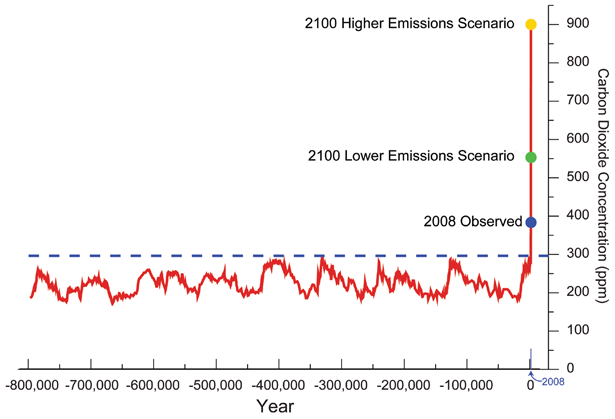
Sourced here from NASA. Note that although current parts per million (PPM’s) are currently over 400, CO2 levels have hovered around 280 ppm for the last 800,000 years until the late 1800’s.
Over the past few decades, scientists have come to understand that carbon dioxide emissions must be reduced to hold human caused global warming below levels that may cause dangerous changes in our climate. As a result, carbon budgets have become a staple of climate change analysis. One excellent source for immediate ongoing tracking is the Global Carbon Project.
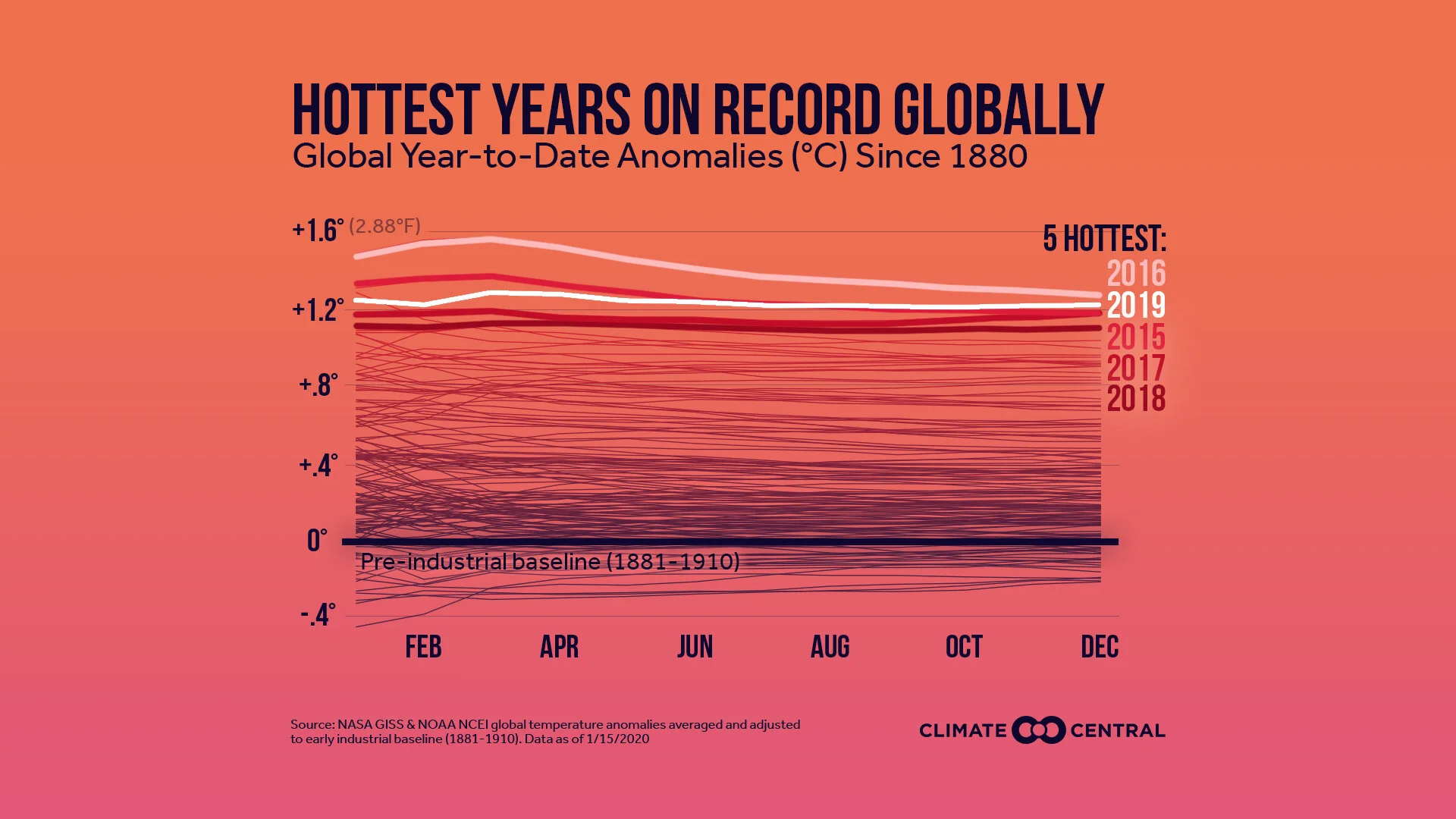
Sourced from Climate Central, this chart shows the increasing impact CO2 levels are having on global average temperatures.
Clearly, we are running out of time. Here’s a simple countdown clock from the Guardian that has been in use since the Paris Accord goals were established. It is as specific (and accurate) as the current science will allow. When it comes to global CO2 emissions and greenhouse gases in general, well …it’s time to get real.
Continuing our steady rise in fossil fuel use without capturing emissions is essentially a march toward oblivion. Not only will we experience life-threatening escalating temperatures, sea level rise, increasing diseases, and widespread crop failures, we’ll most likely experience a breakdown of civilization as we know it. For a current and quite sober assessment, see the most recent report by the World Economic Forum, Global Risk Report for 2020.
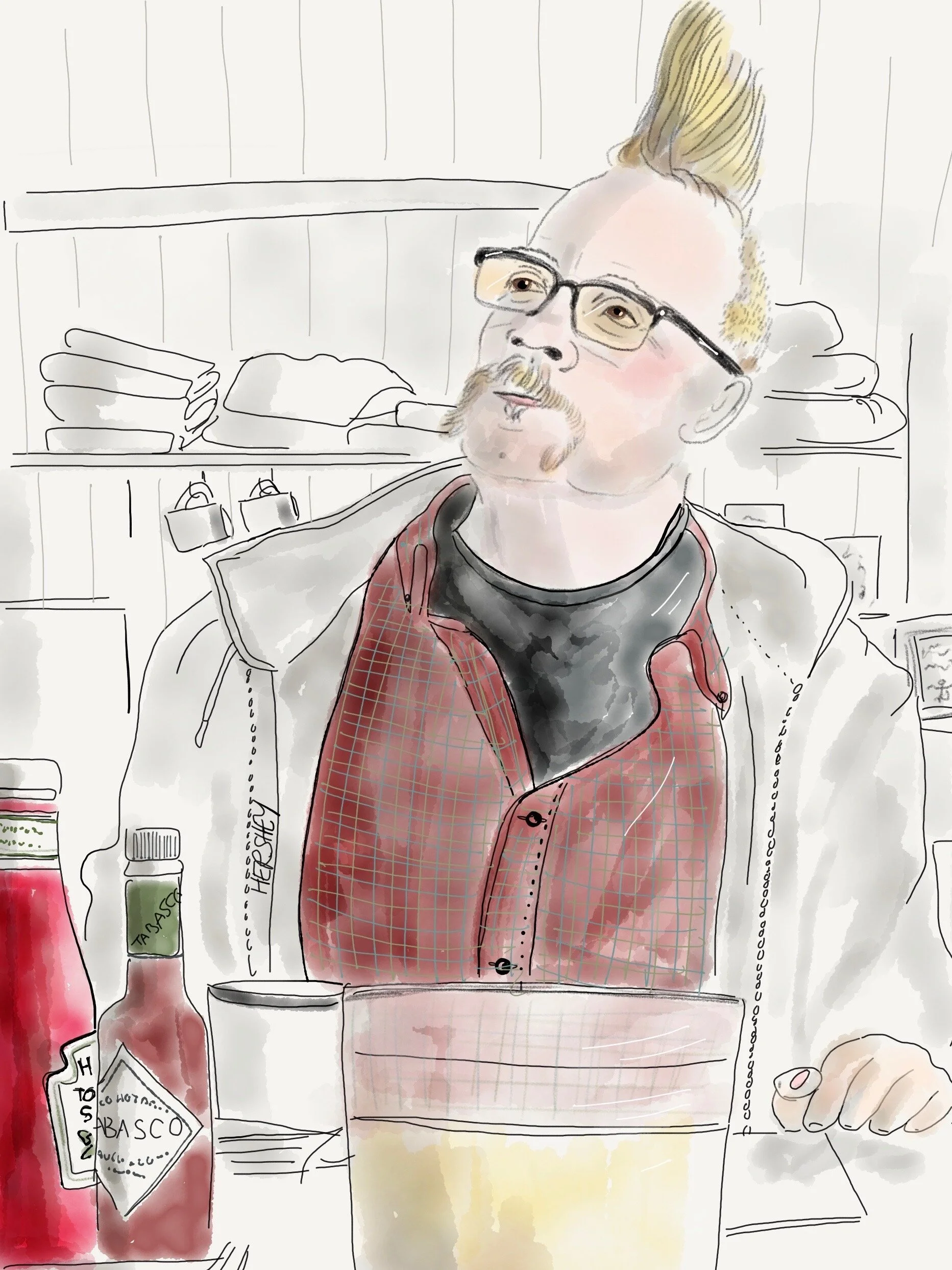
“Sure, they’re rebuilding in Ocracoke because of Hurricane Dorian. So what? It’s always been like that here”. Drawing from the Outer Banks, North Carolina, by Jenny Hershey. On Instagram at deeofo.
So what do we do? Talking to others is a start, especially policy makers. As you may know, I am active with the Citizens Climate Lobby (CCL), a global organization of over 100,000 volunteer citizen lobbyists who advocate for specific legislation (HR 763) to establish a price on carbon in the form of a fee that returns dividends directly to citizens to mitigate increases in energy costs. This group works hard to convince conservatives that climate change can still be addressed through aggressive market mechanisms. However, the need to act is a nonstarter for those who historically deny climate change science. CCL has been active for over 11 years, and while this ambitious and hardworking citizen lobbying organization has changed many minds in Congress, their legislative agenda remains unmet. If we are lucky enough to get a Democrat in the White House in 2020, CCL’s legislation will most likely prevail, and a decade of effort will finally pay off.
However, the current science tells us that global carbon emissions MUST be cut in half over the next ten years for us to maintain a climate anywhere close to what we humans have enjoyed in our comparatively short time on earth. If we end up with four more years of Trump plus a Republican Senate, we will lose 40% of the time we have to create aggressive changes in national (and global) policies to effectuate change. Considering the stakes, avoiding that outcome is essential.
Anyone who understands climate science agrees that Trump's policies are dangerous, and that his willfully ignorant characterization of those faniliar with the science as “prophets of doom” is patently ridiculous and beyond pernicious. As a result, many environmentalists argue that trying to convince his Republican supporters (especially in Congress) to think effectively about climate change is a complete waste of time and energy. Among them are activists in the interesting and global new group “Extinction Rebellion”. I think this group deserves credit for articulating an approach to the climate emergency that might push policy makers toward meaningful action. They focus on mobilizing people who are already passionate about climate change, and then work to consolidate progressive support for drastic action. Their approach is explained more fully in the following PBS article.
Their philosophy is summed up as follows: “We have finite energy, and spending energy trying to win over the people who are absolutely not going to be won over to your side is peanuts compared to mobilizing the people who would be active or passive supporters,” said Leah Francis, an organizer with the Extinction Rebellion U.S. national team. “We really want to shift people’s perspective on what constitutes normal, socially acceptable behavior around responding to climate change.”
Maybe that's exactly what we need. Maybe, just maybe, those of us who are alarmed by the existential issues of climate change are being just too damn nice.
I’m curious to know what you think…
Thanks for reading! More to come…
All photos, unless credited or otherwise noted, are copyrighted property of the blog post author.
Illinois to New York City, Post 2
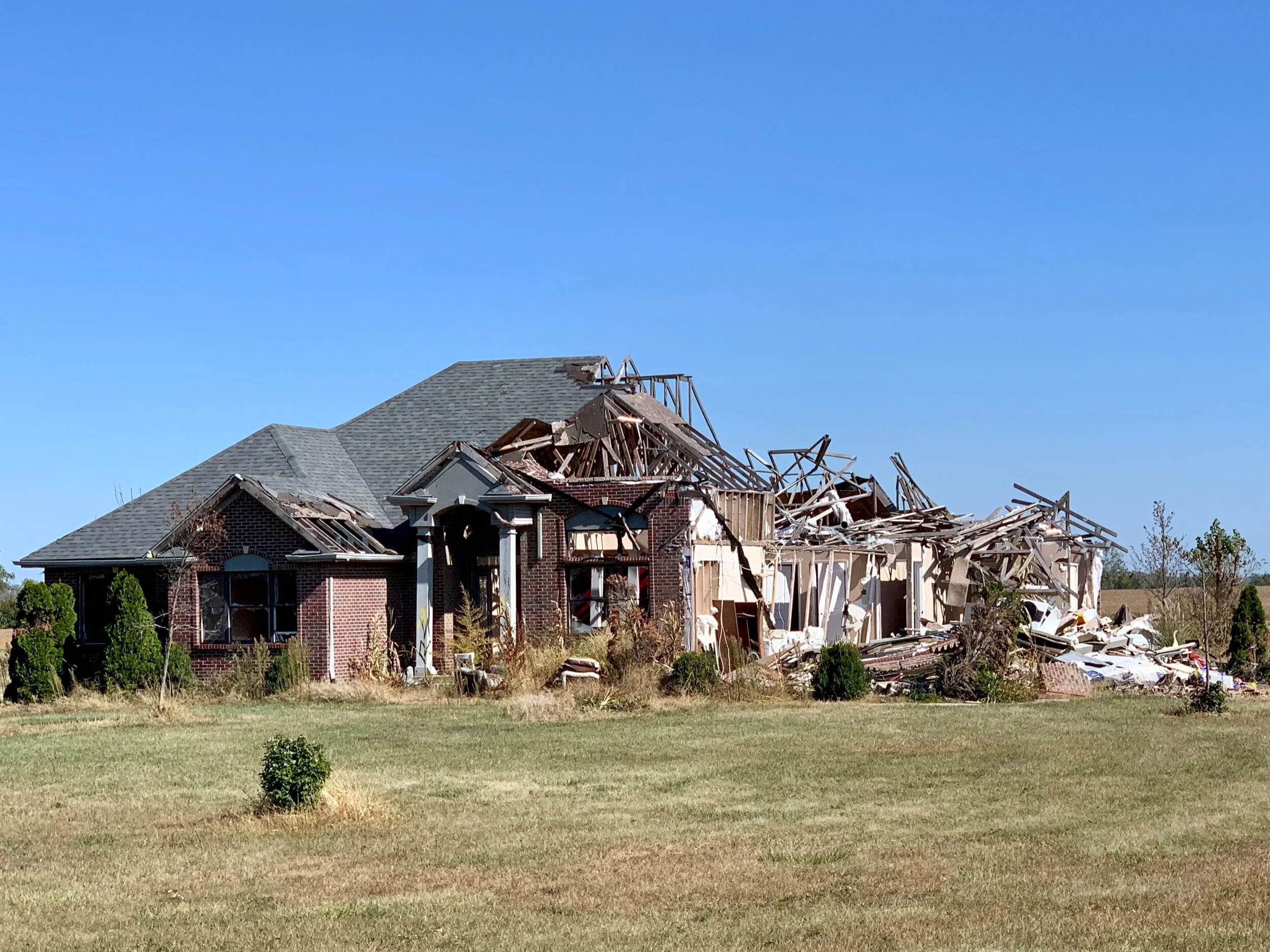
Remains of a home in Brookfield, Ohio, in a populated suburb after a tornado touched down in June of 2019. When we saw it, nearby homes were fine and people were going about their business.
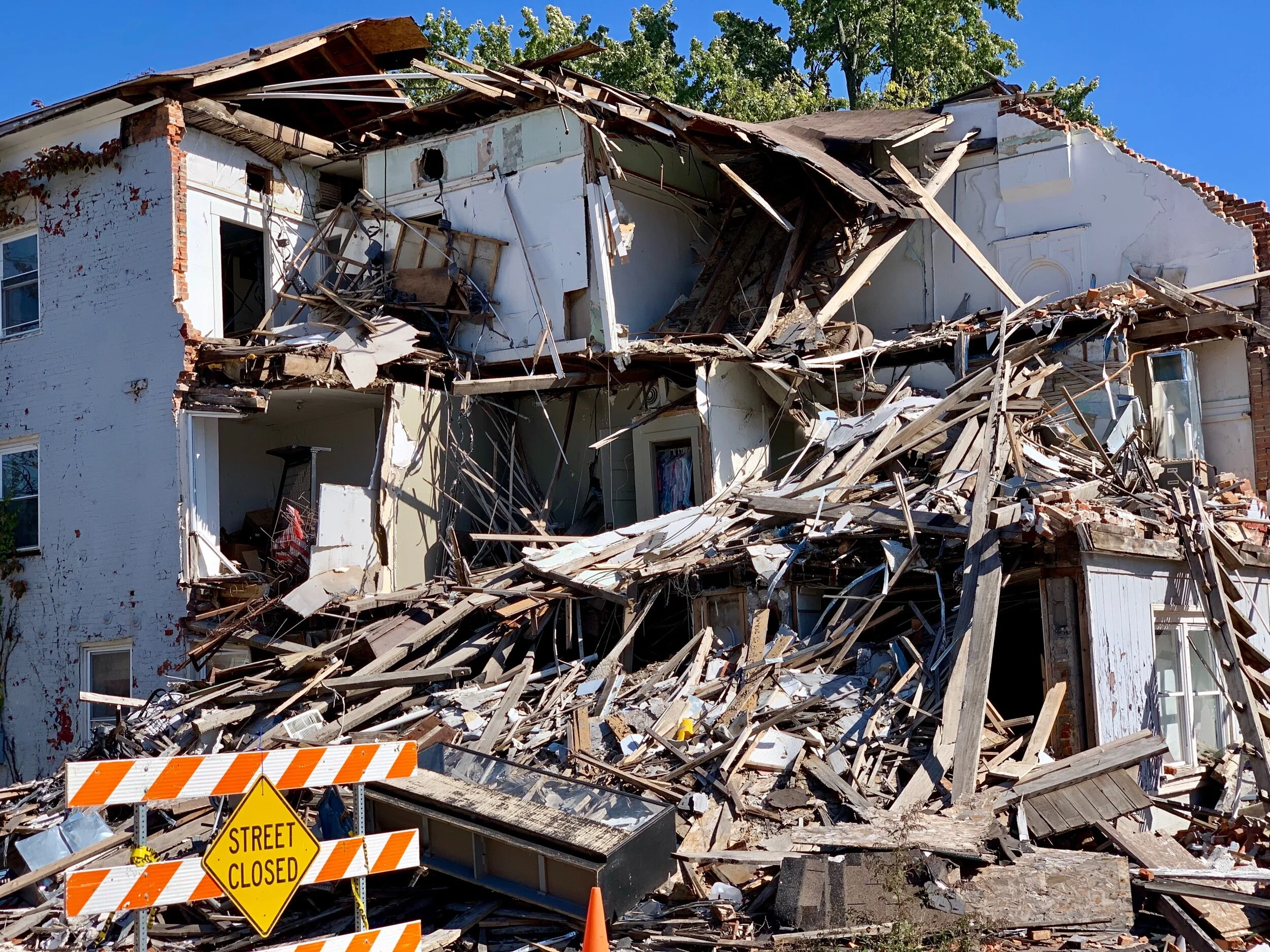
This house is on Main Street in Cambridge City, Indiana. It was intact until July of this year, when it collapsed. A local resident we talked to didn’t know why.
Hello from South Pittsburgh on the historic GAP (Greater Allegheny Passage) Trail. We biked here yesterday from Steubenville, Ohio, an old steel and coal town about 25 miles north of historic Wheeling, West Virginia. The night before we were near Morristown, Ohio, in the rolling western foothills of the Alleghenys.
Both yesterday and today we encountered numerous hills, a few with grades as steep as 15 degrees. But what goes up also comes down, so we enjoyed some great downhill runs. Although it’s grey and rainy today, the past few days have been sunny and warm, and the hill country has been spectacular.
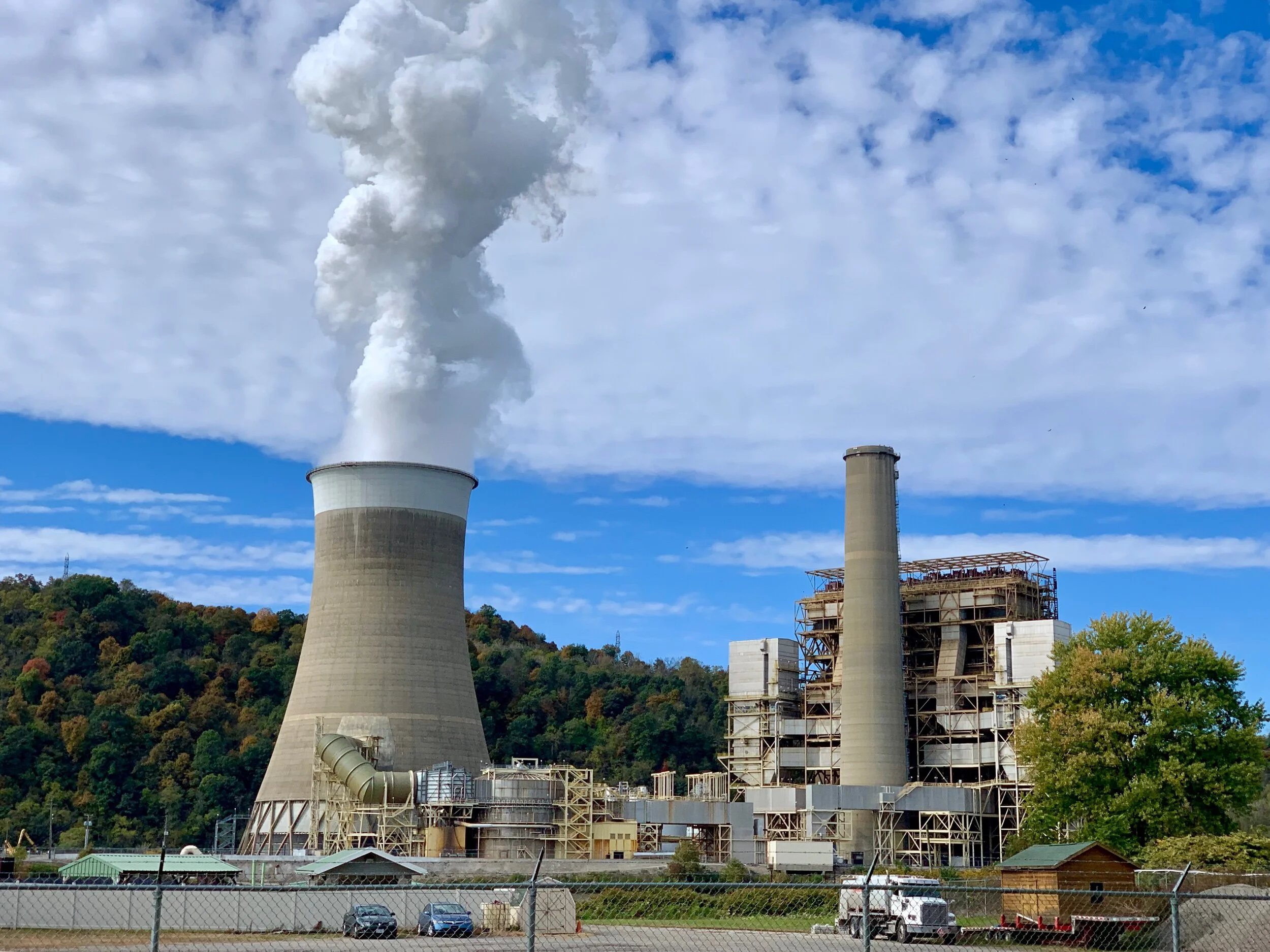
The Cardinal Operating Company, a plant north of Wheeling where coal is made into coke for steel manufacturing. In the 1990’s there were over 100,000 jobs in the steel industry in this valley; now there are about 10,000 jobs.
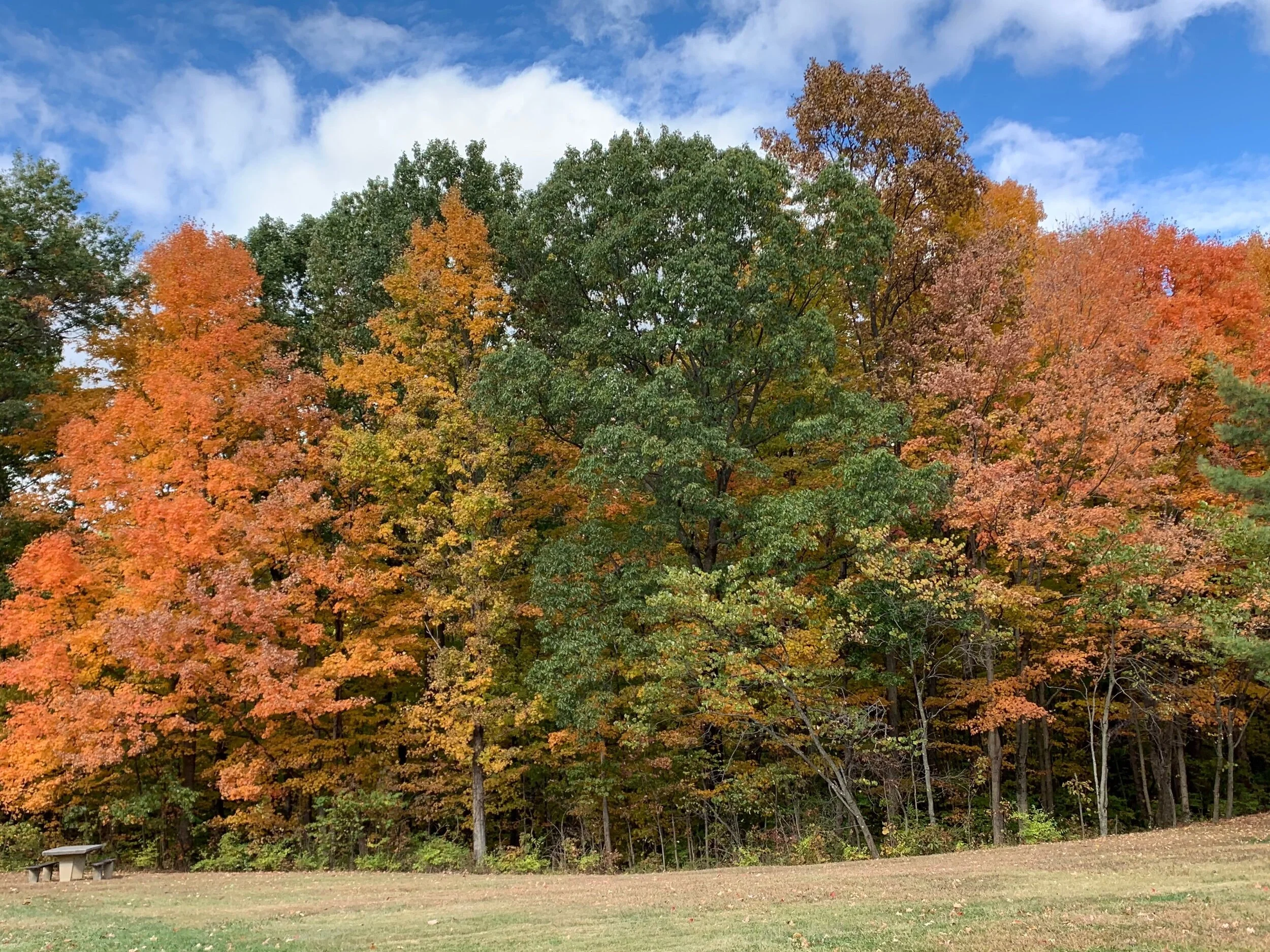
Fall colors on the way.
After some reflection, Jenny and I decided to take the historic GAP bike trail from Pittsburgh, PA to Cumberland, MD, and then a portion of the C&O (Chesapeake and Ohio) Trail before heading up to Lancaster, PA, on our way back to New York City. Today we are resting and waiting out a rainstorm near the western end of the trail. We chose this alternate route instead of the northern ACA Route to NYC because it is less climbing (by about 20,000 cumulative feet)! I’ve done this route before, and remember it very fondly, so I'm looking forward to sharing it with Jenny. We have currently traveled over 800 miles total, and tomorrow we will start the 150 miles that make up the GAP trail.
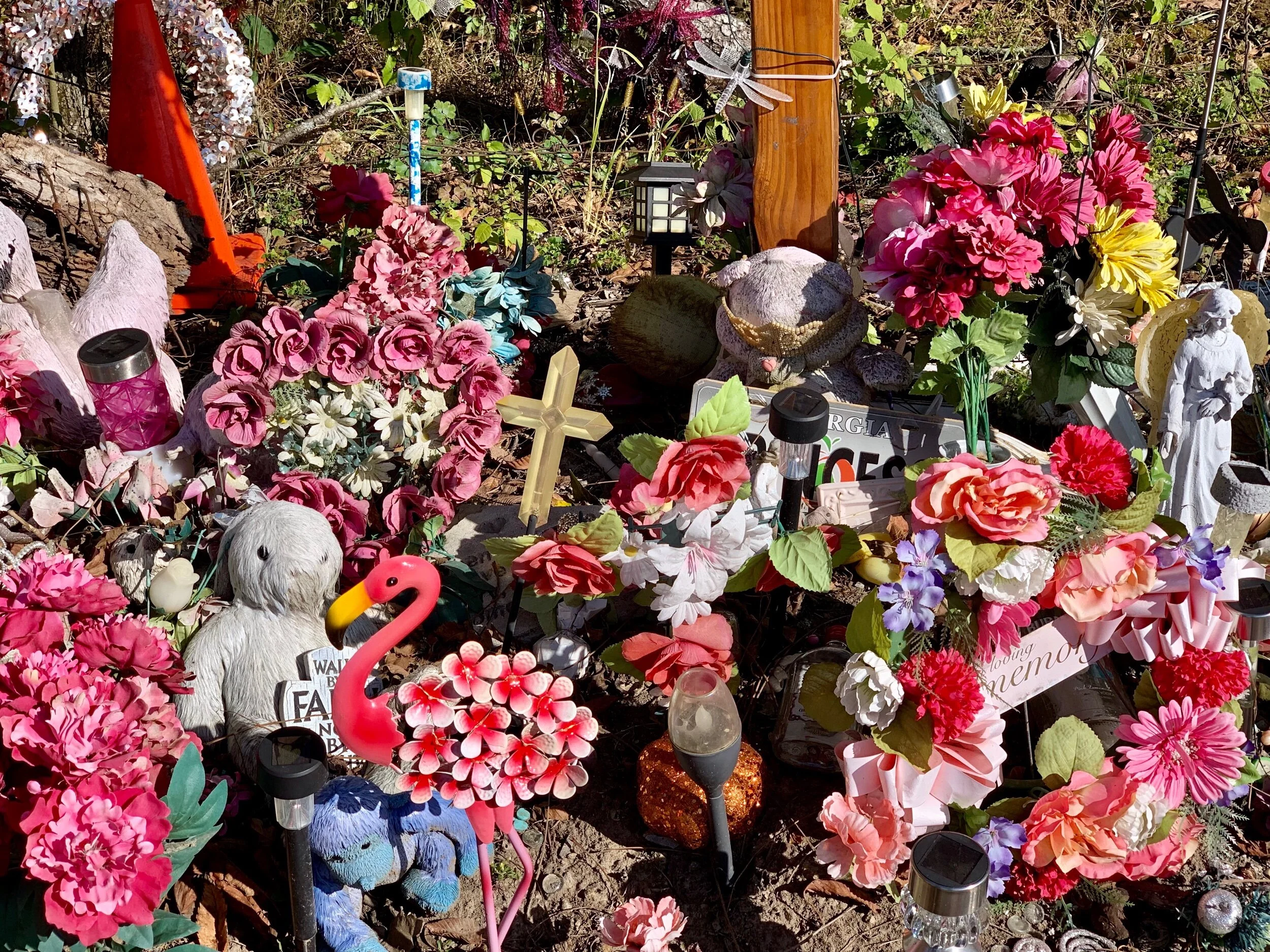
This memorial is for 16-year -old Olivia Starrwallace, who ran off the road and into a tree in eastern Indiana while driving near the National High School (which she attended).
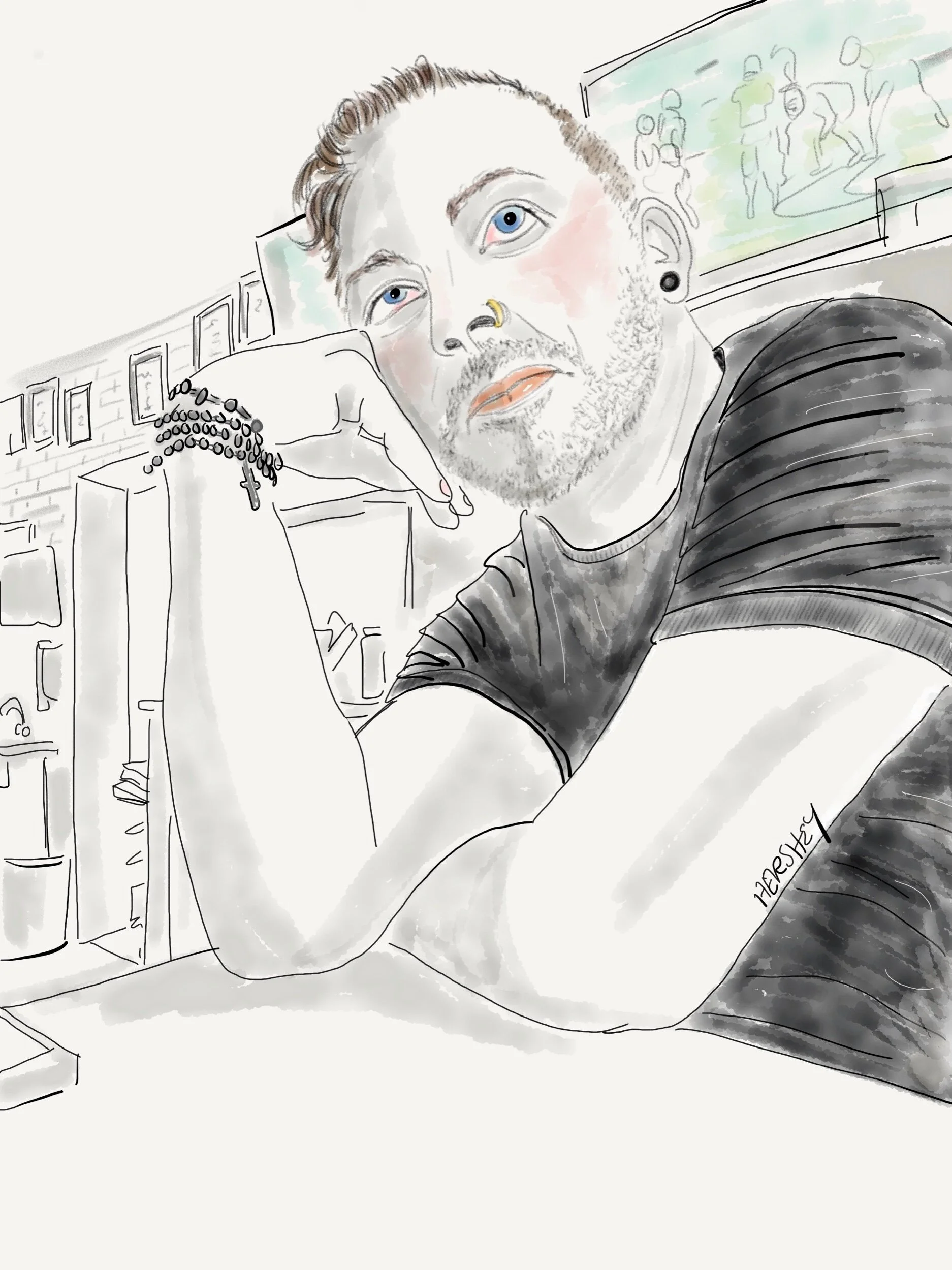
Jenny’s drawing of our bartender Dennis at the Pike 40 Bar and Grill in Morristown , Ohio. You can see more of Jennifer Hershey's work on Instagram at “deeofo”.
While such a distance is not new for me, I must compliment my biking partner Jenny. She’s never biked this far, and she has done so with great joy and resolve. She’s tackled intense hills, aggressive and threatening traffic, poor road surfaces, lousy and non-existent shoulders, cold and rain - all without losing her cool or diminishing her spirit.
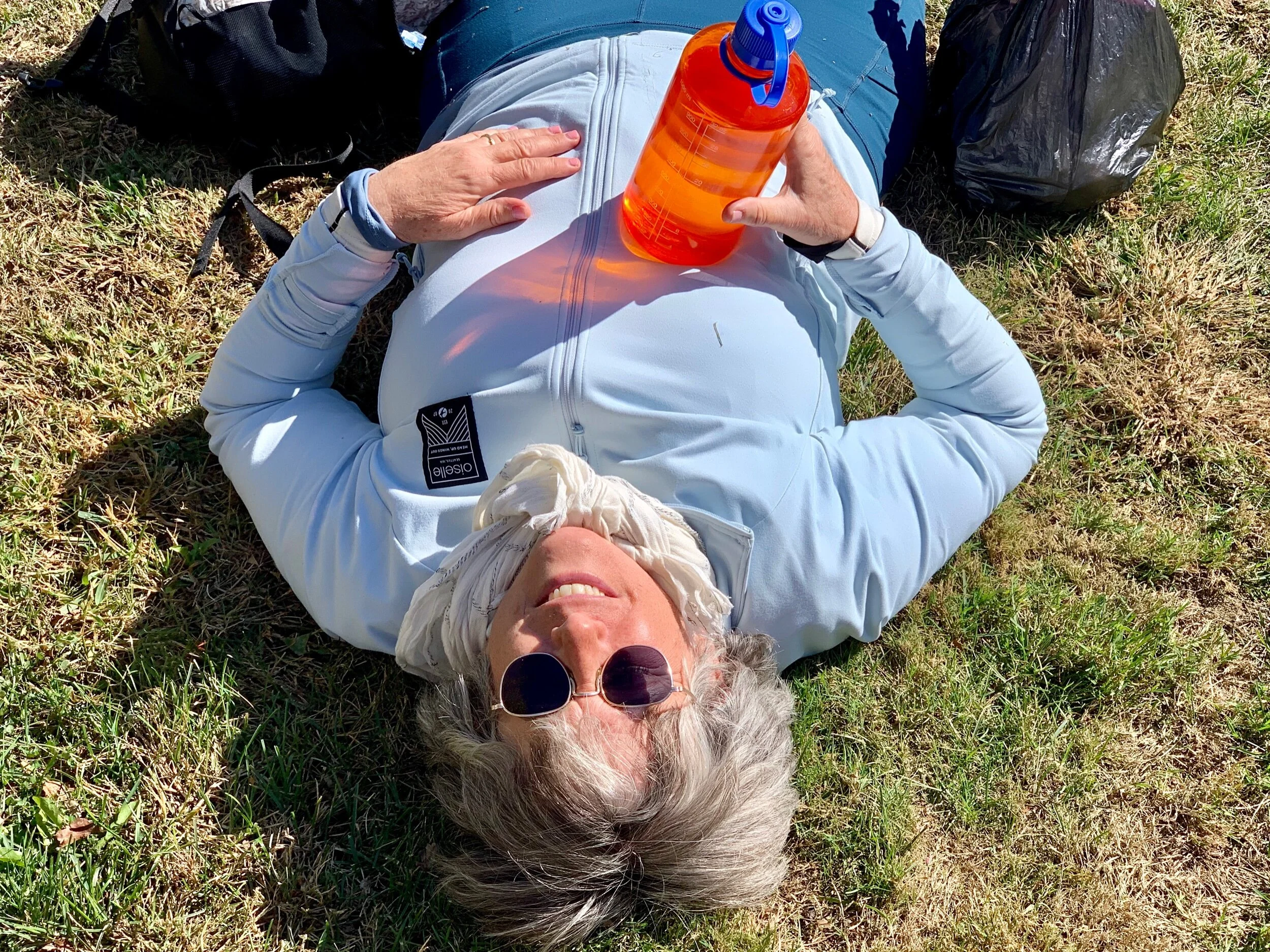
A tired cyclist rests after lunch.
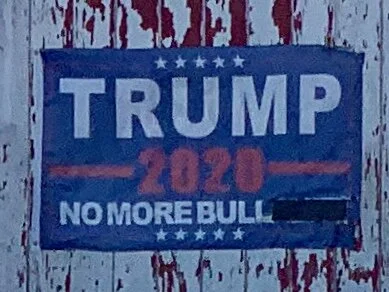
Locals tell us we’re in Trump country, and we’ve definitely seen a few 2020 campaign signs. The TV is on in our motel. It’s hard to imagine the nation isn’t focused entirely on the impeachment investigation and the Turkish invasion of Syria. But frankly, those issues are not the topic of conversation in most of the places we’ve visited. The Americans we are encountering seem more focused on the basic logistics of making their daily lives work.
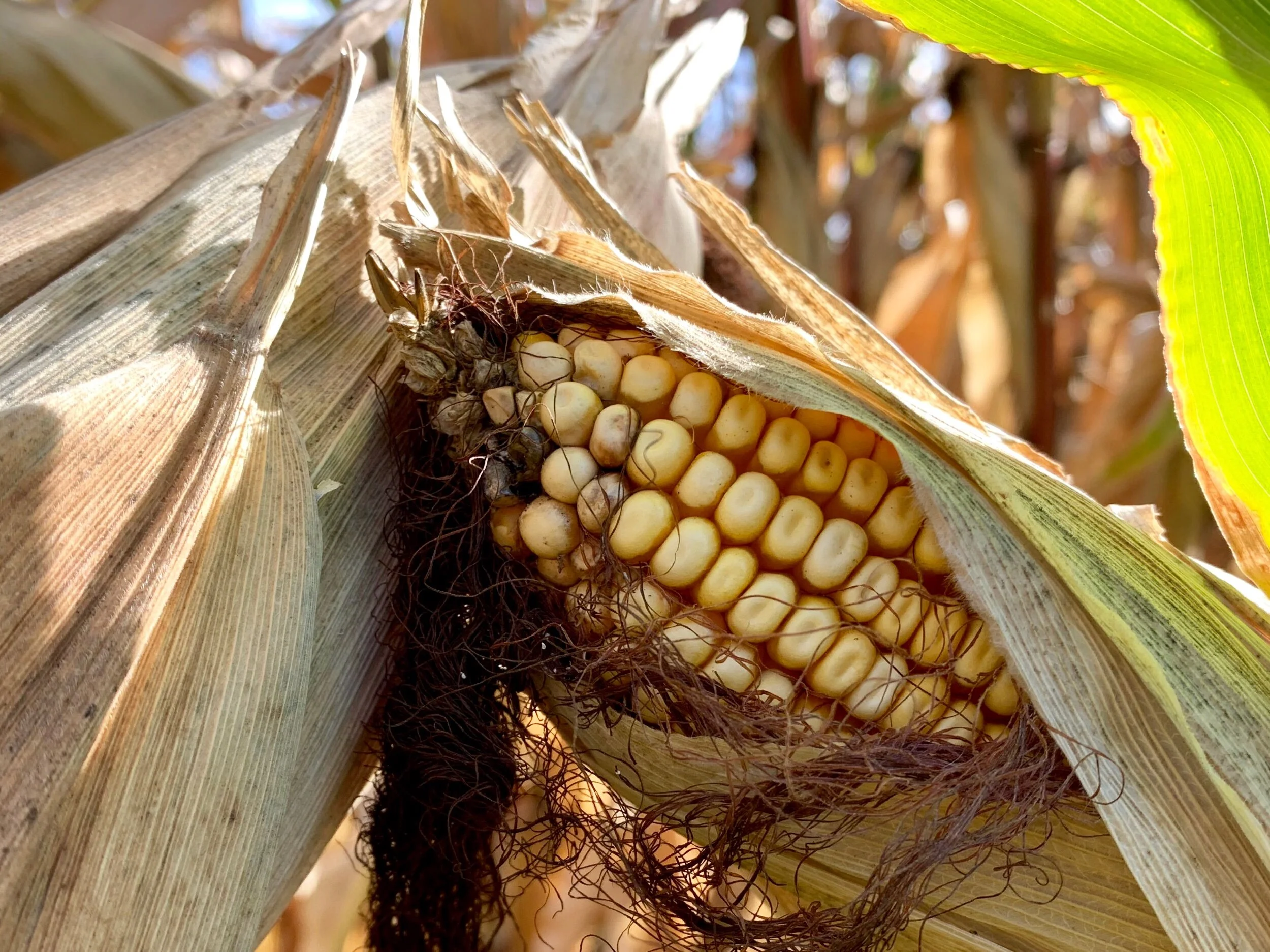
Earlier today I found myself wondering what the connection to the outside world was like in small midwestern communities during WWII? Was our nation so focused on winning the war and supporting our troops that you could feel history being made even in the smallest of towns? Did the overwhelming majority of citizens feel like their daily actions were contributing to the creation of a better world?
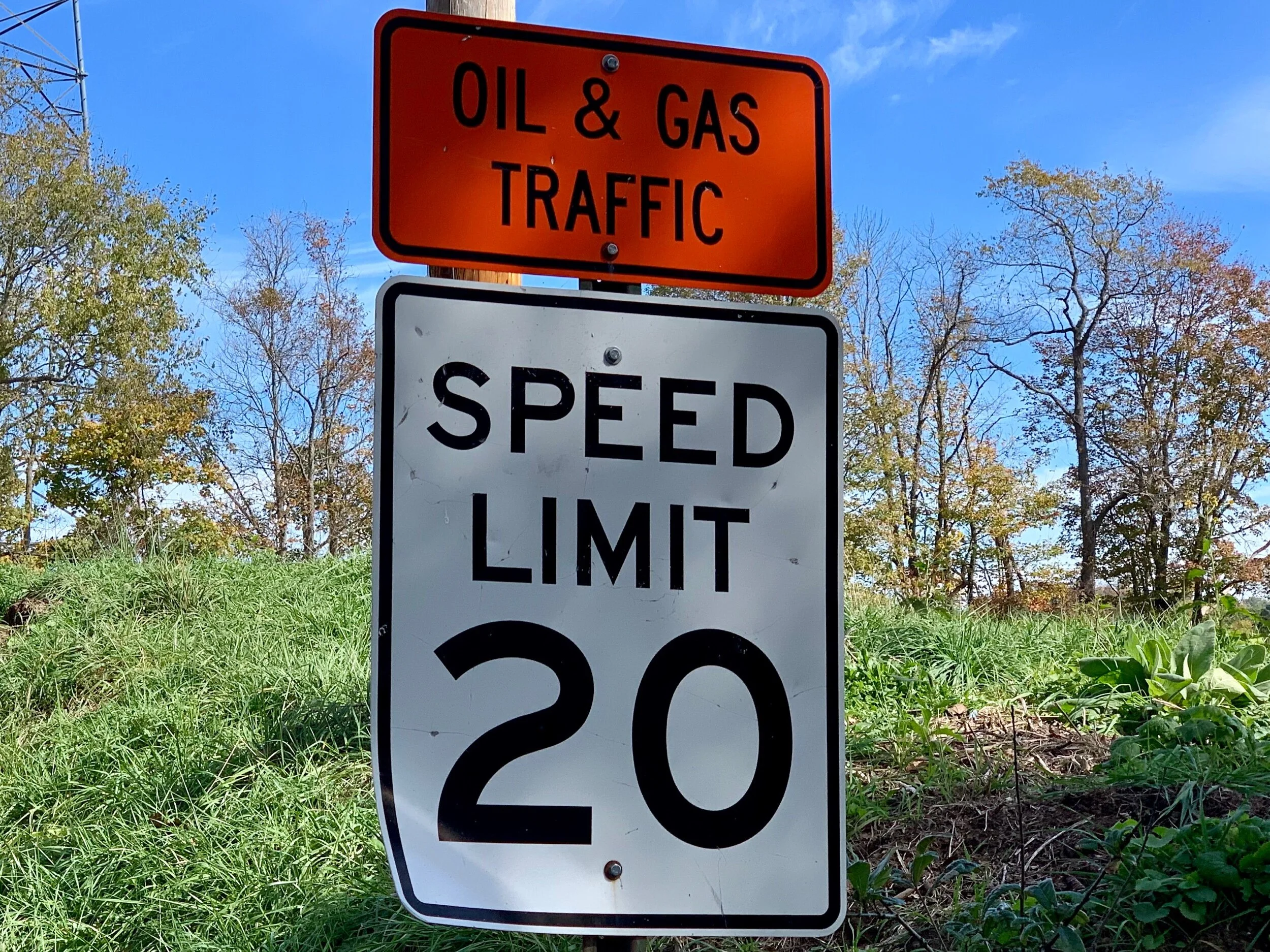
Some new driving jobs have been created in the Ohio River Valley in the last decade as fracking has expanded. That said, isn’t all traffic (except for electric vehicles powered by renewables) essentially “oil and gas traffic”?
Or did life in rural America then seem more like now, when the unrelenting noise of the outside world seems so far away? Perhaps those who had a close relative involved in the war effort felt involved, much like farm families further to the west might feel more concerned about climate change now, after experiencing several very tough years of extreme weather. Yet, I don’t know how to reconcile the sense of urgent hopefulness I felt last month in New York City as I participated in the Youth Climate March, attended numerous panels at the ever busier annual Climate Week, and followed the extraordinary appearances of Greta Thunberg at the United Nations Climate Summit. It all seemed so significant, and a signal of shifting perspectives.
But in the Ohio River Valley, there’s still plenty of pain (and anger) over decades of economic losses. Worrying about climate change almost seems like a luxury… until one thinks soberingly about an even harsher future. So, as always, lets keep our resolve to change our trajectory. The future is waiting to be invented.
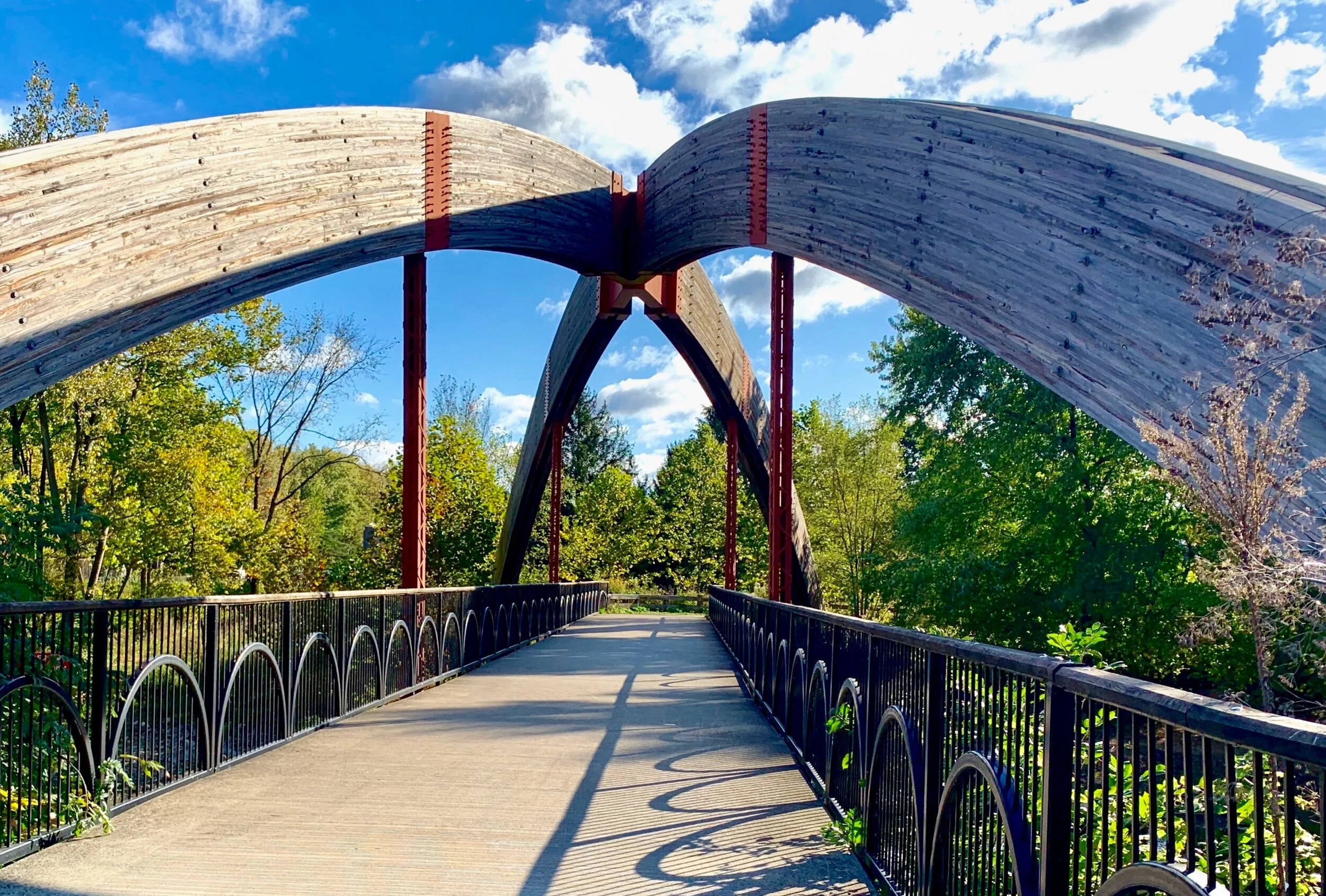
A bridge to another bike path near OSU in Columbus, Ohio.
Speaking of a bright side, we have encountered many long, beautiful and very well maintained cycling trails. About 20 miles west of Dayton, Ohio, we picked up a rural “Rail to Trail” cycling trail, and with a few exceptions of unfinished sections, followed the trail until we left Columbus, about 90 miles later.
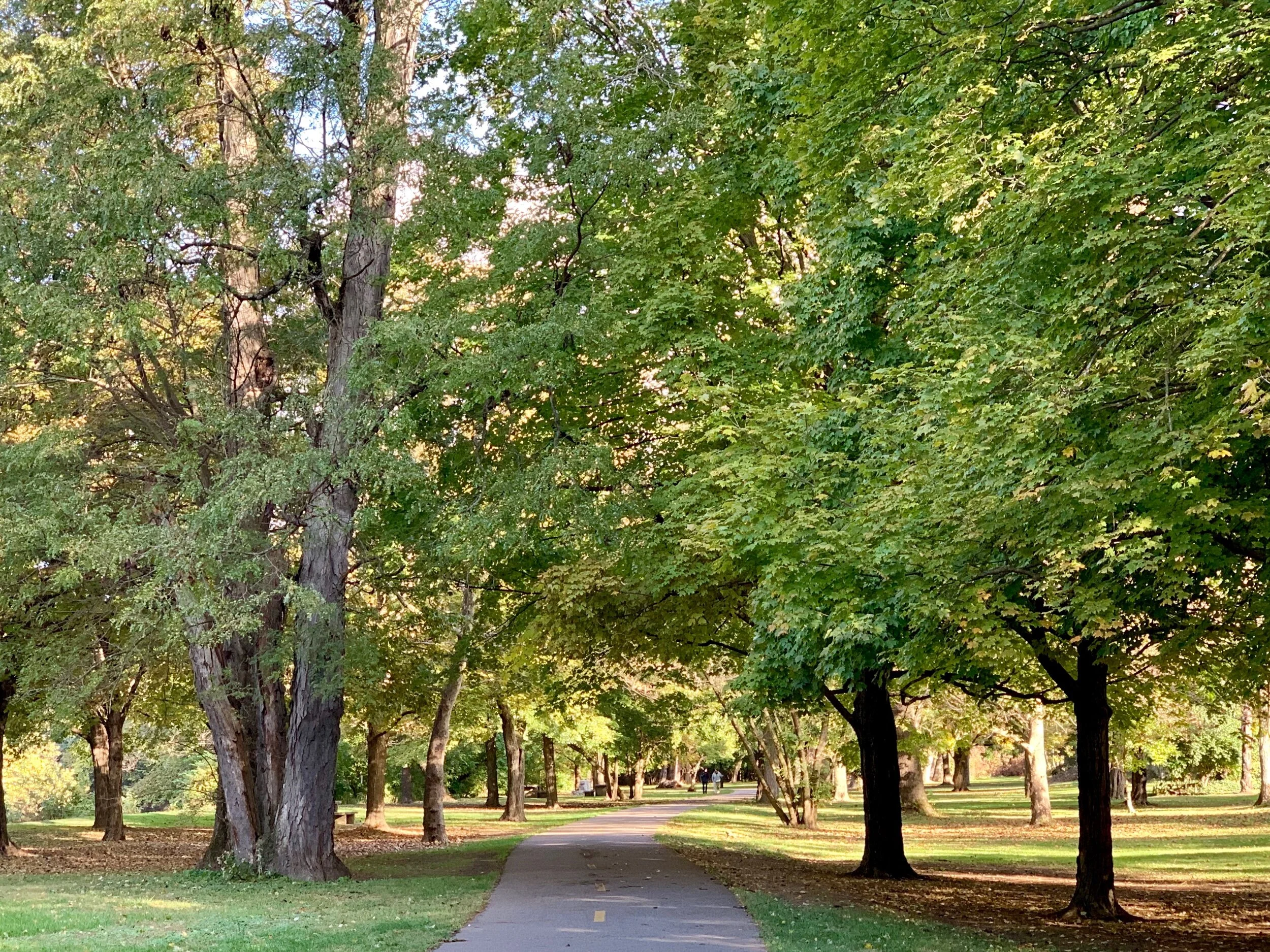
The Olentangy River Trail makes its way through much of Columbus, including this lovely park.
This was a remarkable and incredibly pleasant run. We encountered another long section of cycling trail later the same day from Granville past Newark, Ohio, making our total run on trails well over 120 miles. Then, we enjoyed another 20 miles of trail along the scenic Ohio River out of Wheeling, West Virginia, as we headed north to Steubenville, Ohio.
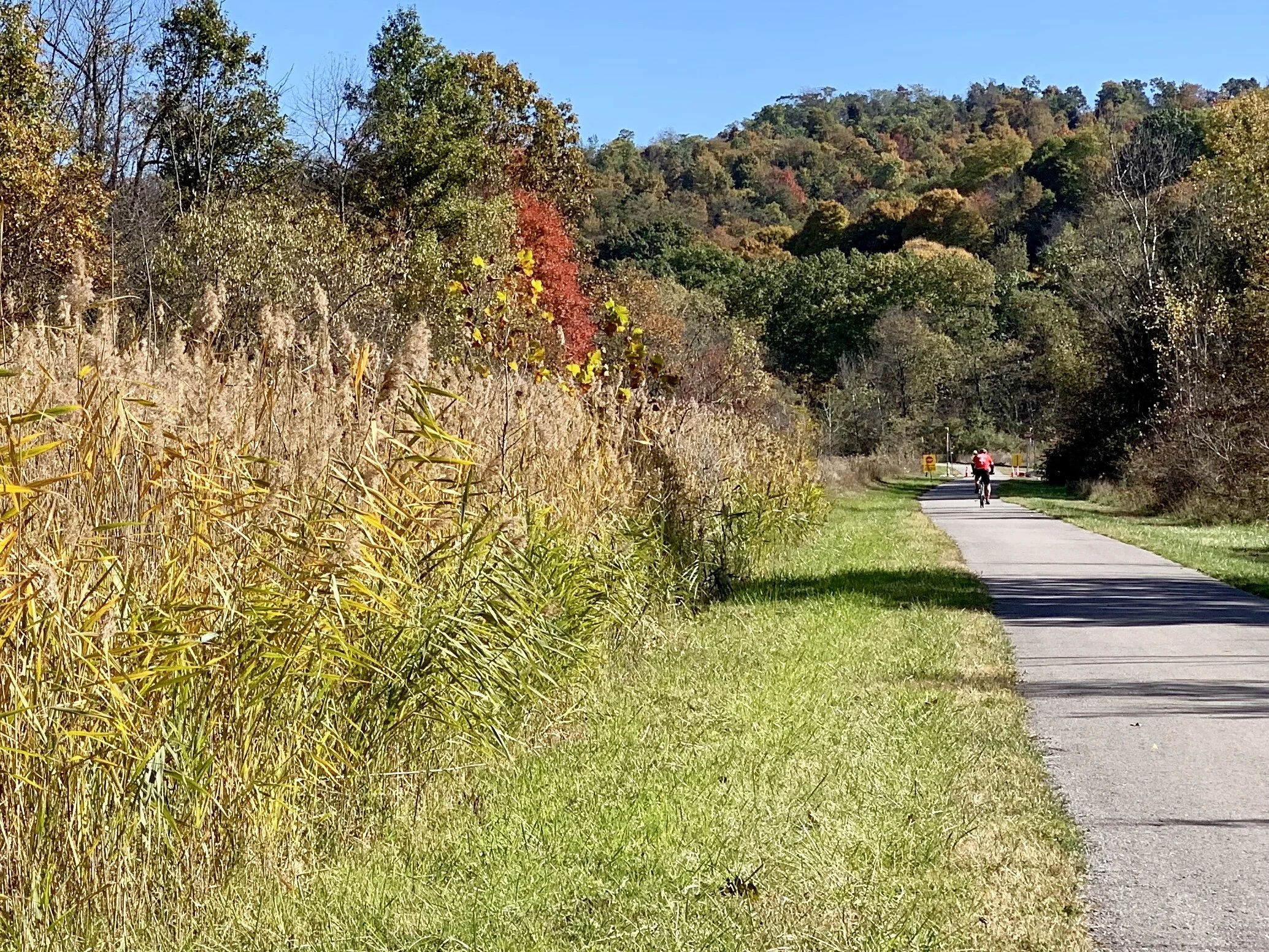
Finally, we rode the Panhandle Trail most of the way into Pittsburgh, capping off a series of great trails through much of central and eastern Ohio.
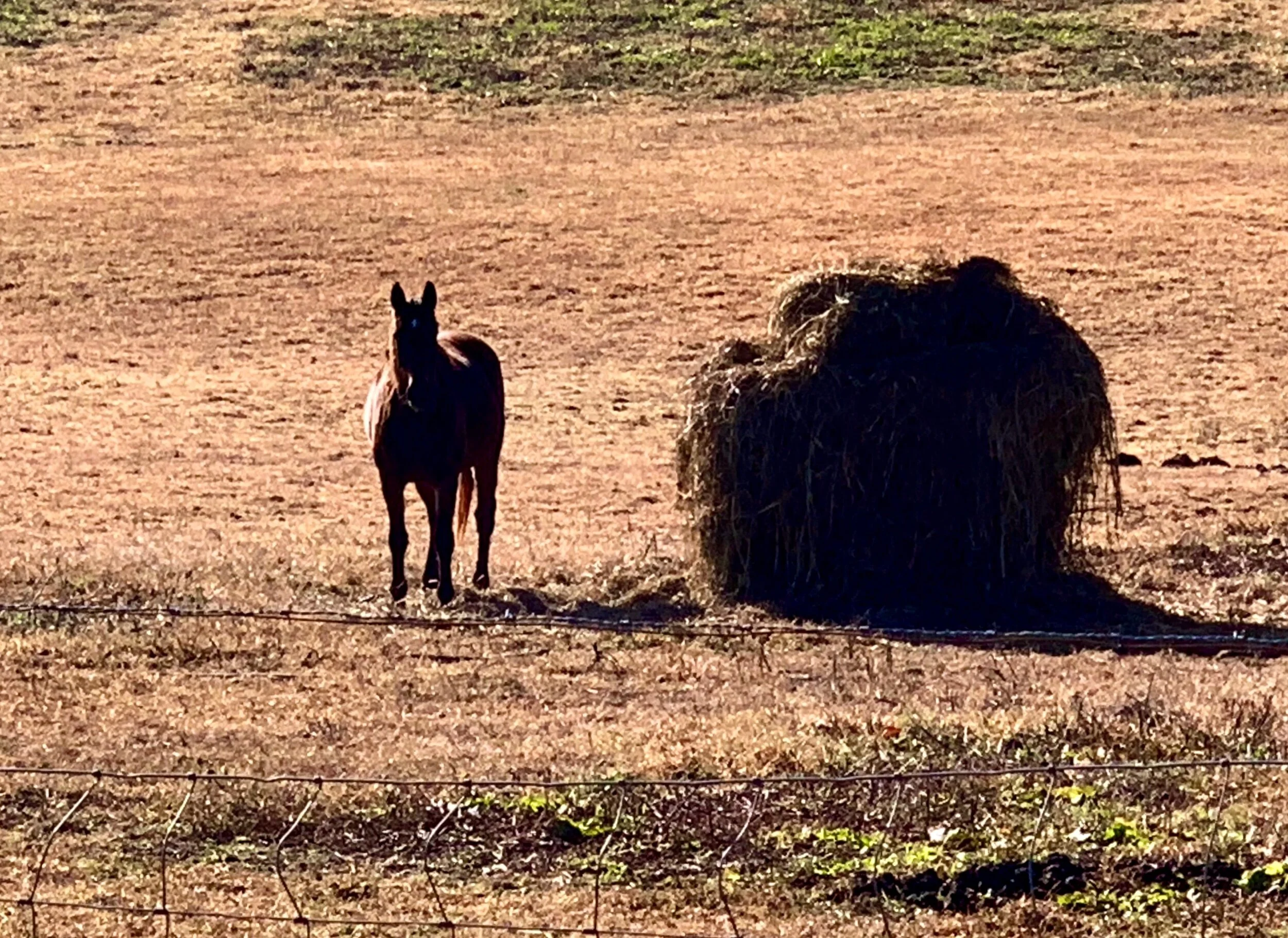
So we are happy and content, and looking forward to another stretch of dry weather once the current storm passes over. The GAP trail awaits!
Thanks for reading! More to come…
All photos, unless credited or otherwise noted, are copyrighted property of the blog post author.
Illinois to New York City, Post 1
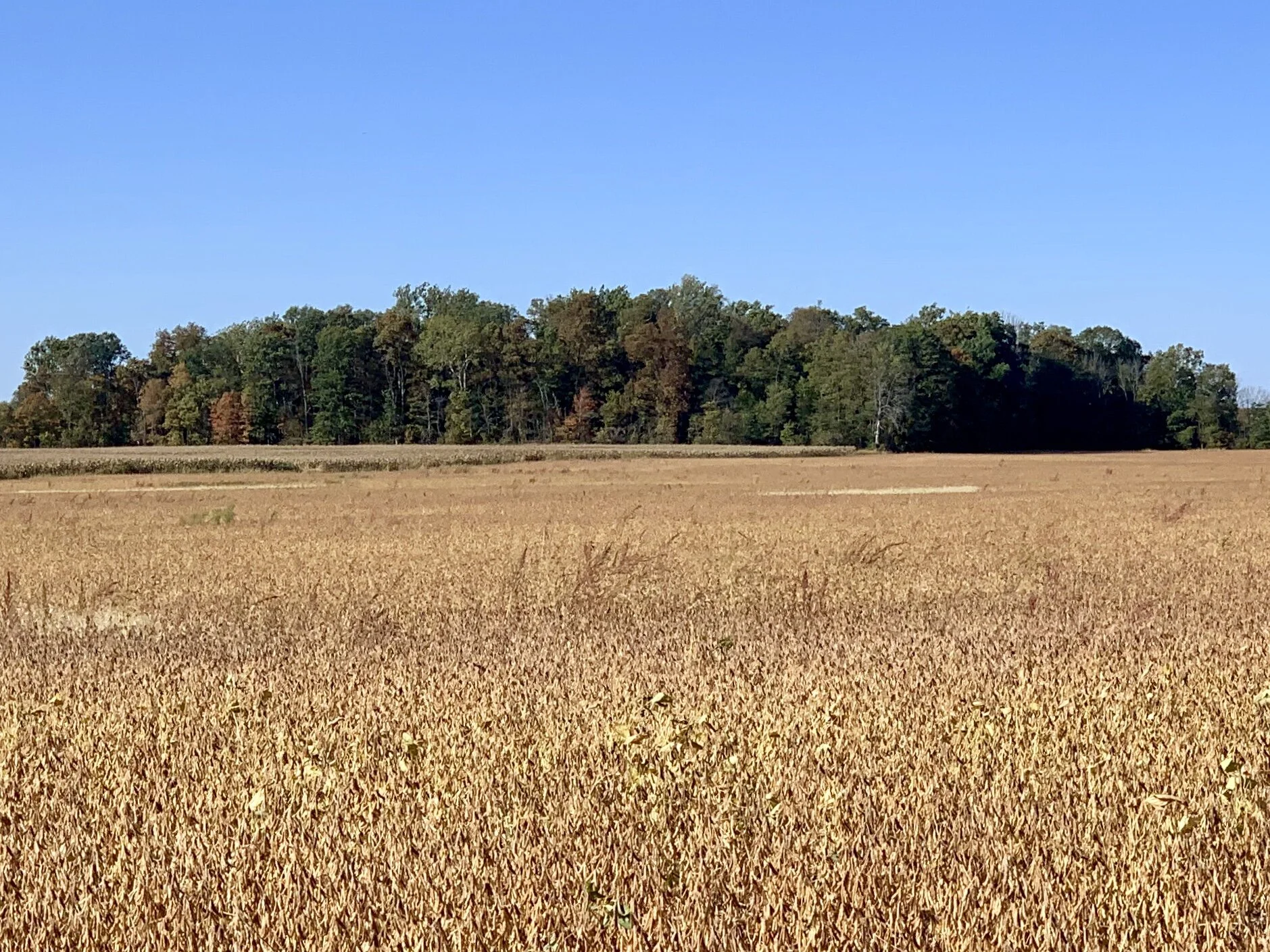
Soybeans wait for harvesting in Greenfield, Indiana.
Back in the Saddle Again
Greetings from my bicycle! My last blog post was in May, and I apologize to readers who may be curious about my disappearance in rough weather somewhere near Westgate, NV, on a cycling trip from Palo Alto to Salt Lake City.
If you’ve been wondering, you might be pleased to know that I did get back home to New York City. In fact, I spent a great summer there. While there, I wrote a blog about how I got home: backtracking to Reno, skipping my plans for Salt Lake, shipping my bike and flying back to New York City. But alas, I got distracted and never posted it. So much for the best laid plans of mice and men (and me).
Even so, I took a few more photographs in Nevada in May that I think are still worth sharing, even if the trip back to New York no longer seems relevant. I include these because I am fascinated by extreme weather events. They are increasingly part of our lives, and I think there is value in bearing witness to what we see around us. You may remember from my last blog that I was fighting my way through a very unusual rain and snow storm in a part of Nevada that is usually hot and dry in May. Along with many other folks I was surprised and challenged by the inclement weather I encountered. Below are a few more shots from that trip that I’m particularly proud of…
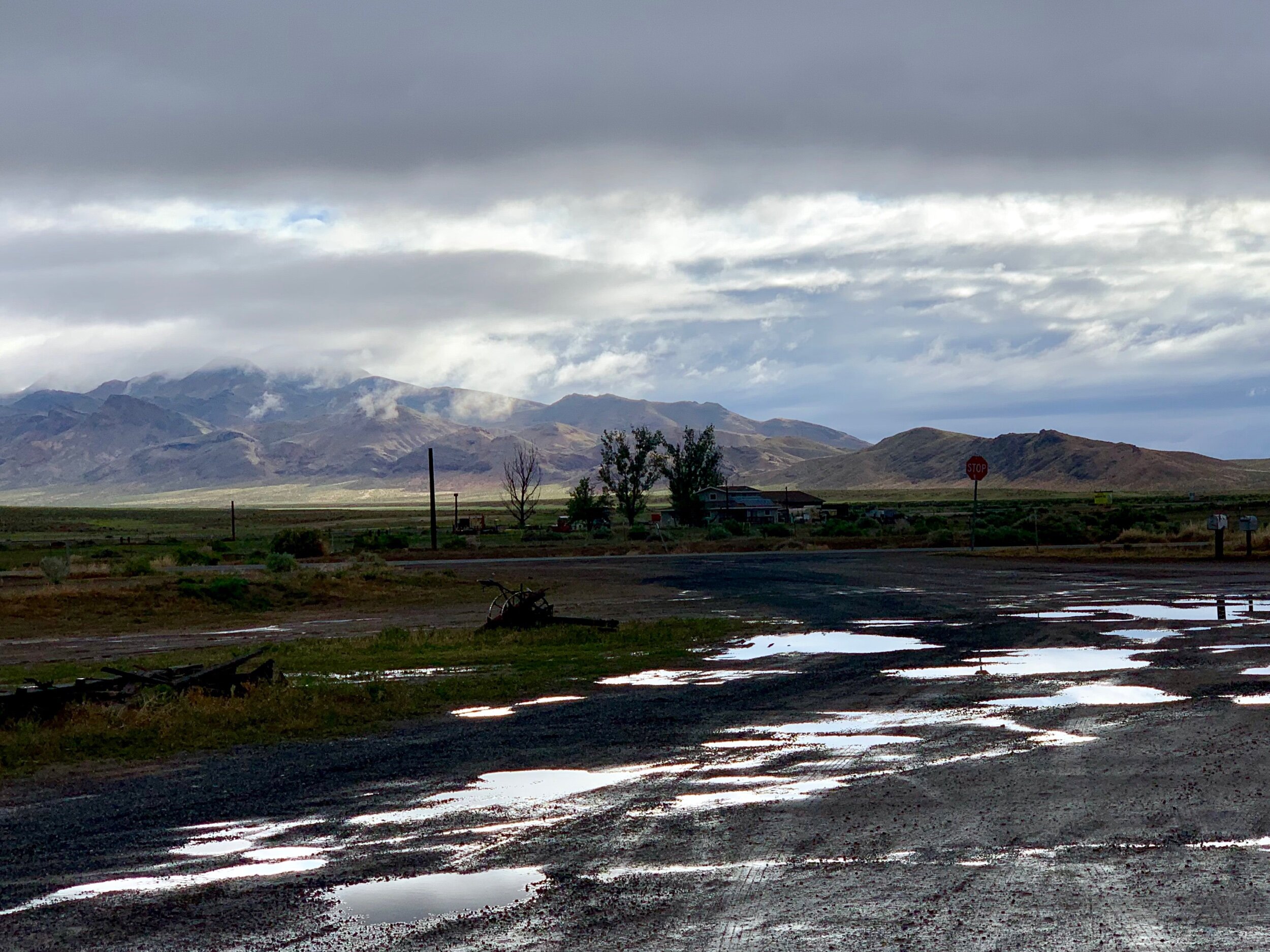
Water in the Westgate Bar parking lot on the day I left in late May, 2019.
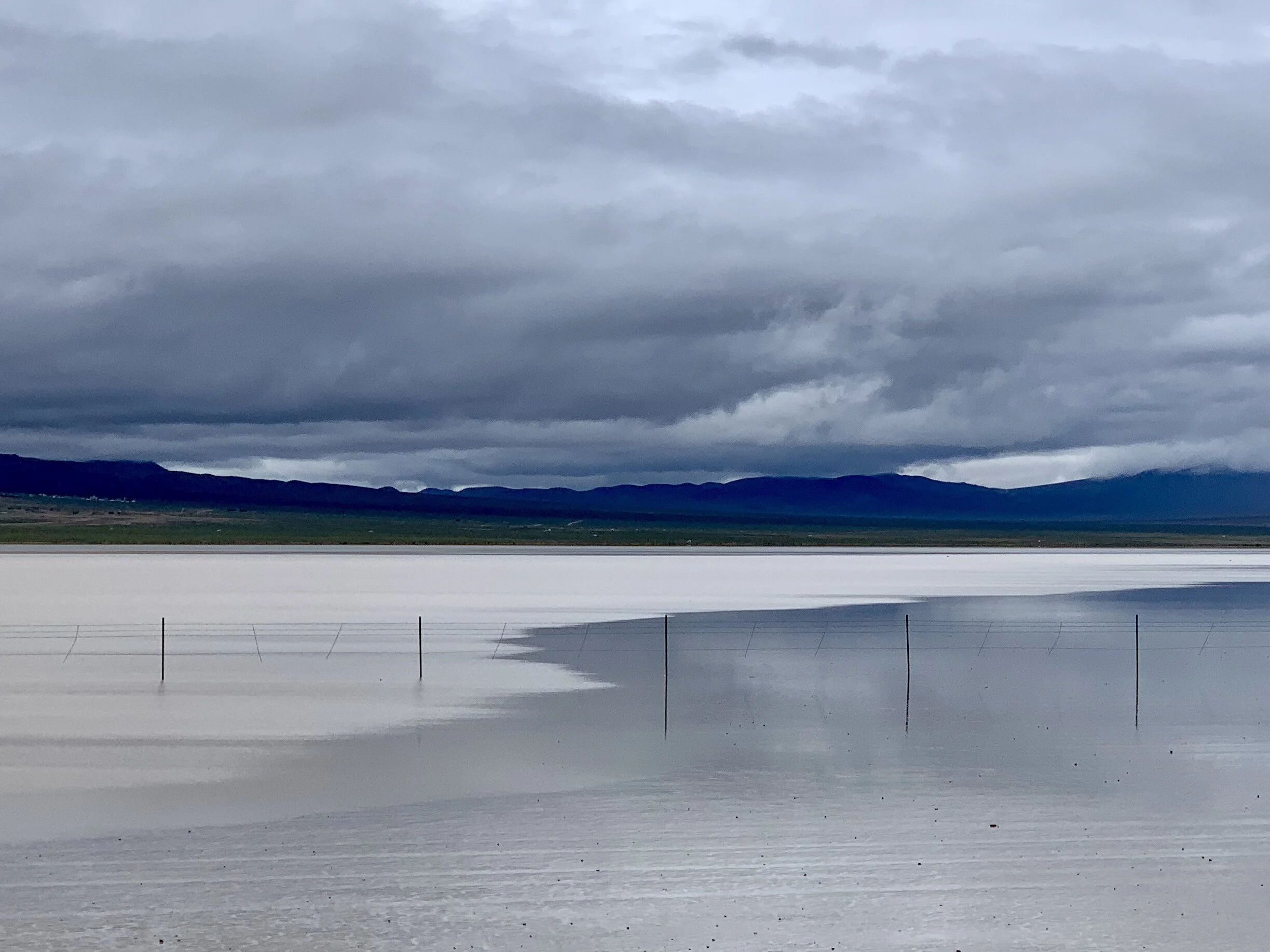
Flooded salt flats east of Reno.
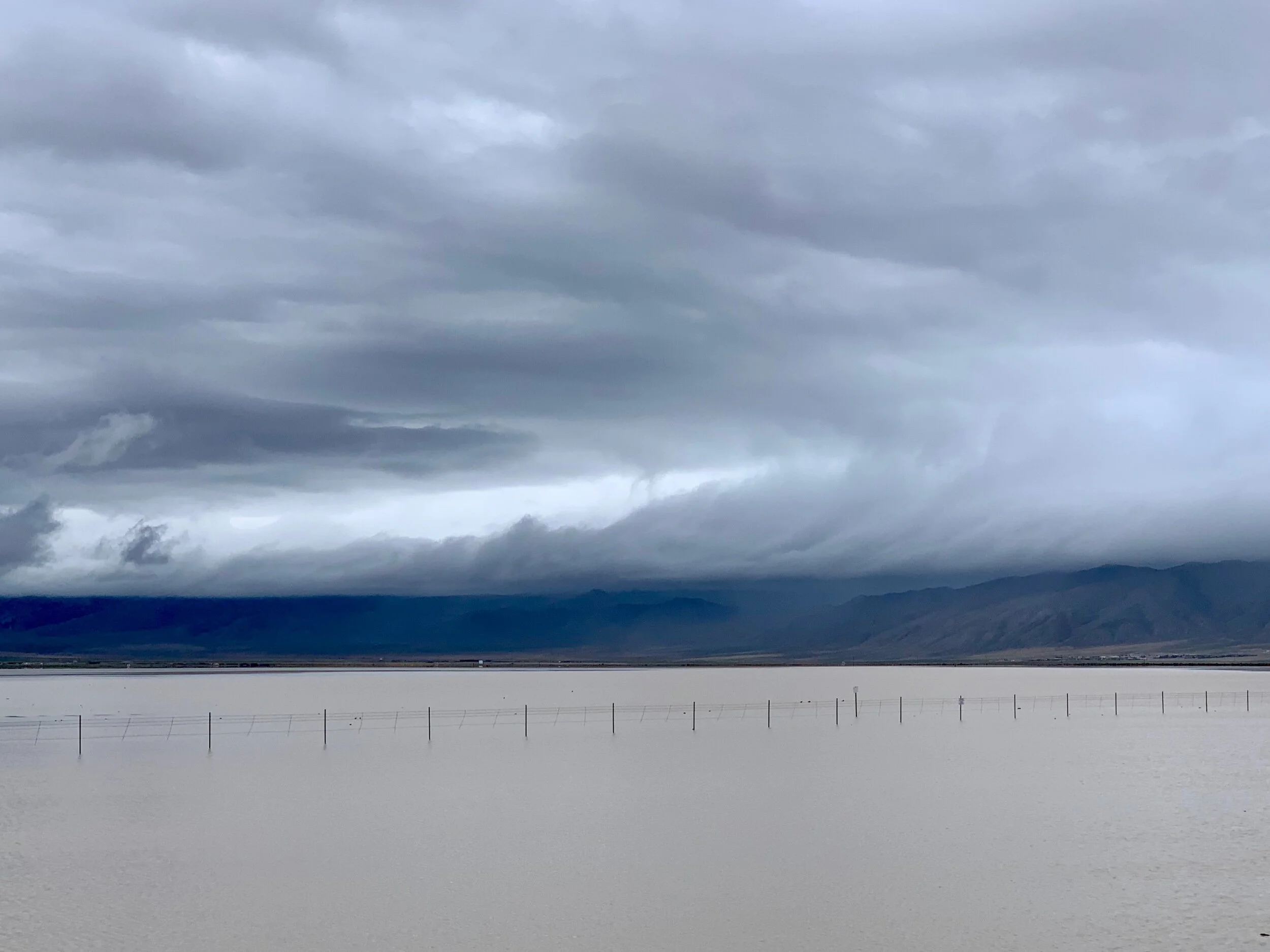
Rain clouds above the salt flats.
As the summer progressed, I made plans for future cycling with my friend Jenny Hershey, who had just retired from a 31-year career running building operations for Jujamcyn Theaters on Broadway. A founder of the Broadway Green Alliance, Jenny is both an environmentalist and an avid cyclist. To get our feet wet, we took a car camping/cycling starter trip to New Brunswick, the fabulous Cabot Trail in Cape Breton in Nova Scotia, Prince Edward Island (PEI), and explored traveling together on bikes for multiple days at a time. If you’ve never been there, I strongly recommend cycling in PEI. There are numerous rail to trail conversions that allow cyclists to get everywhere one could want to go. The shoreline is vast and beaches are beautiful. The islanders take great pride in their environment, and they enjoy rich local culture. Prices are reasonable, and the pace of life is remarkably comfortable. At the same time, internet services and other modern amenities are easy to come by. Don’t miss it!
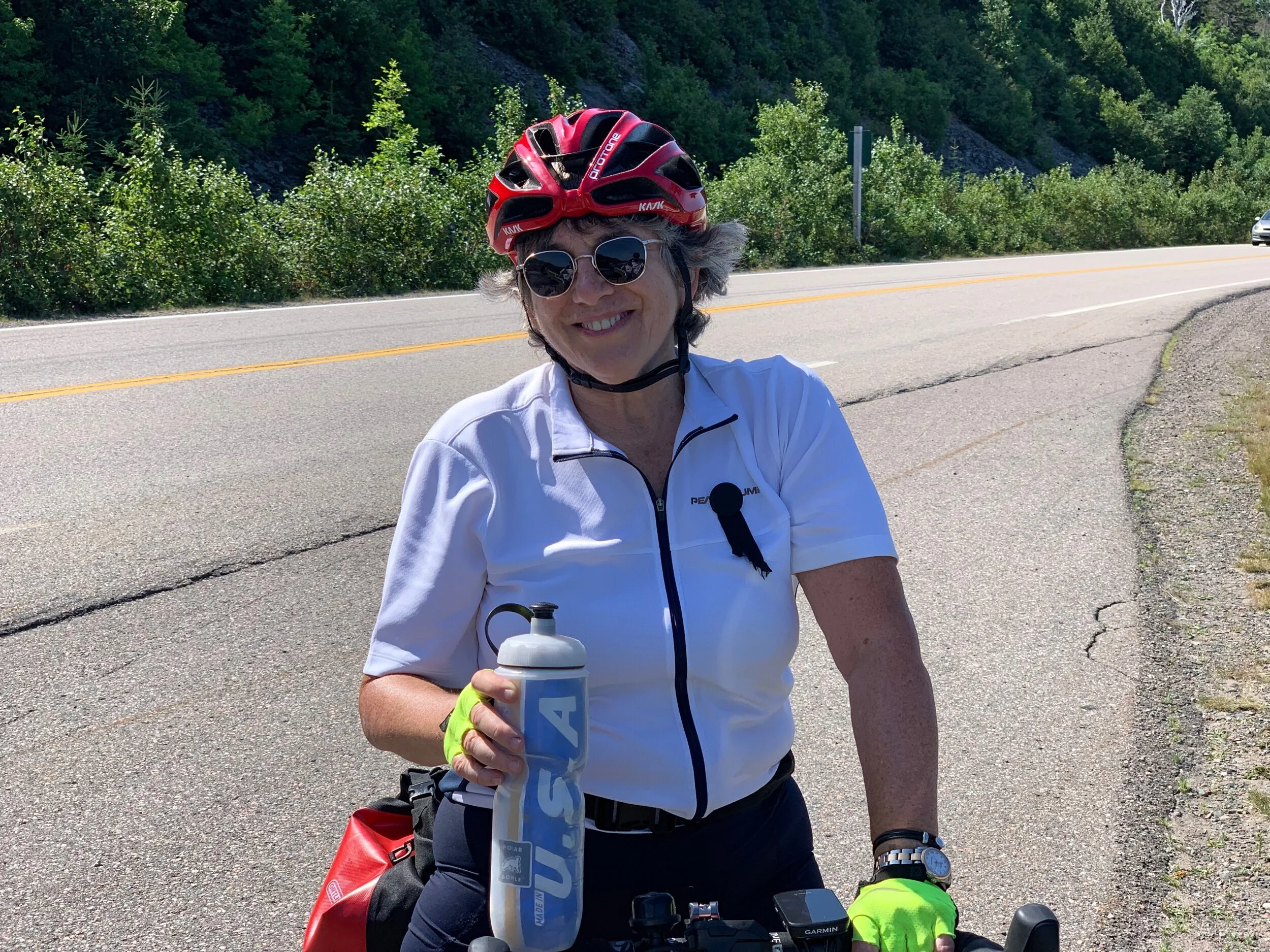
Jenny by the roadside in PEI. She is wearing a mourners ribbon signifying the period of shiva after the death of her mother Merle Weisman.
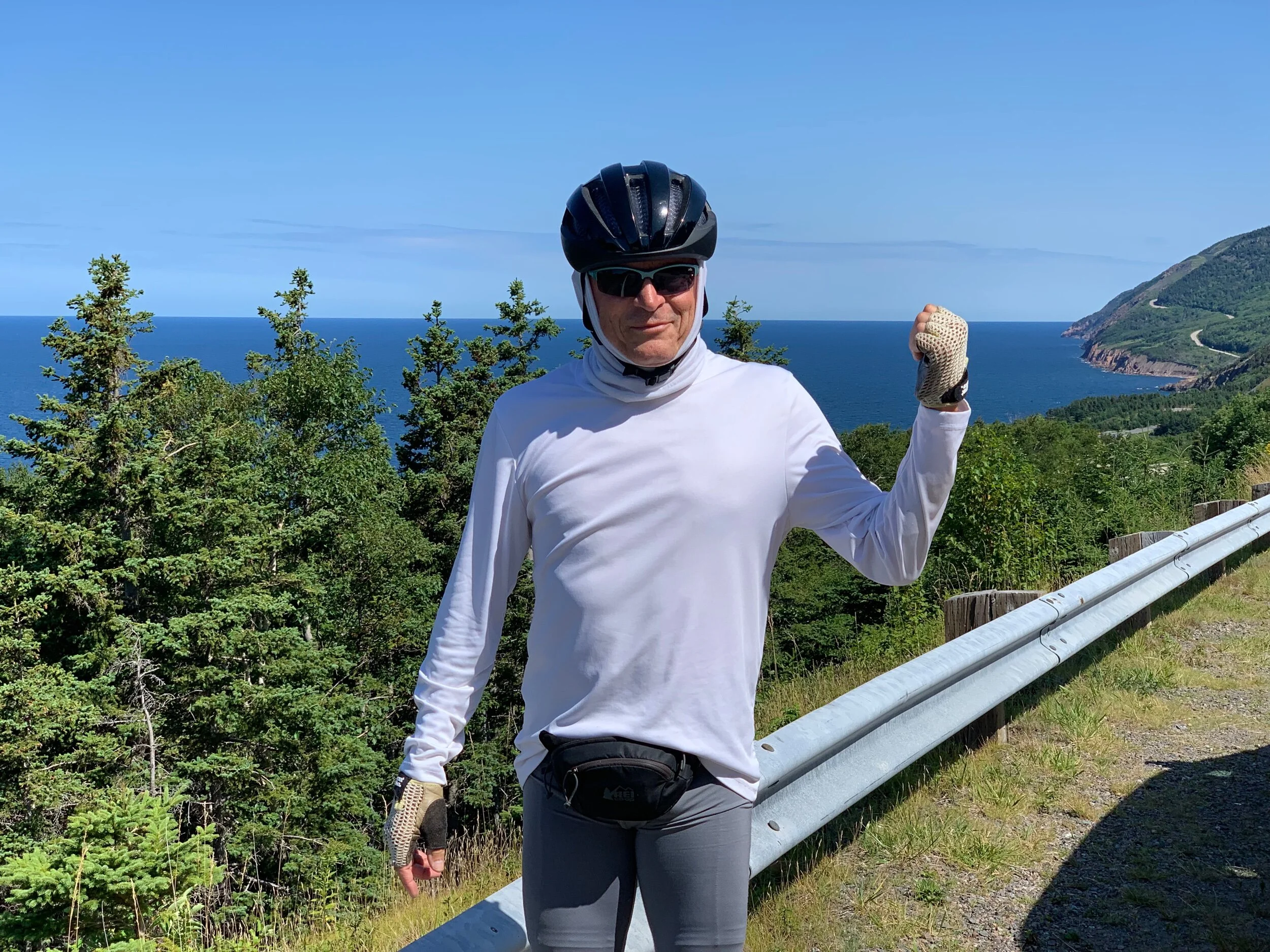
Michael gesturing toward the Northumberland Straight in Cape Breton.
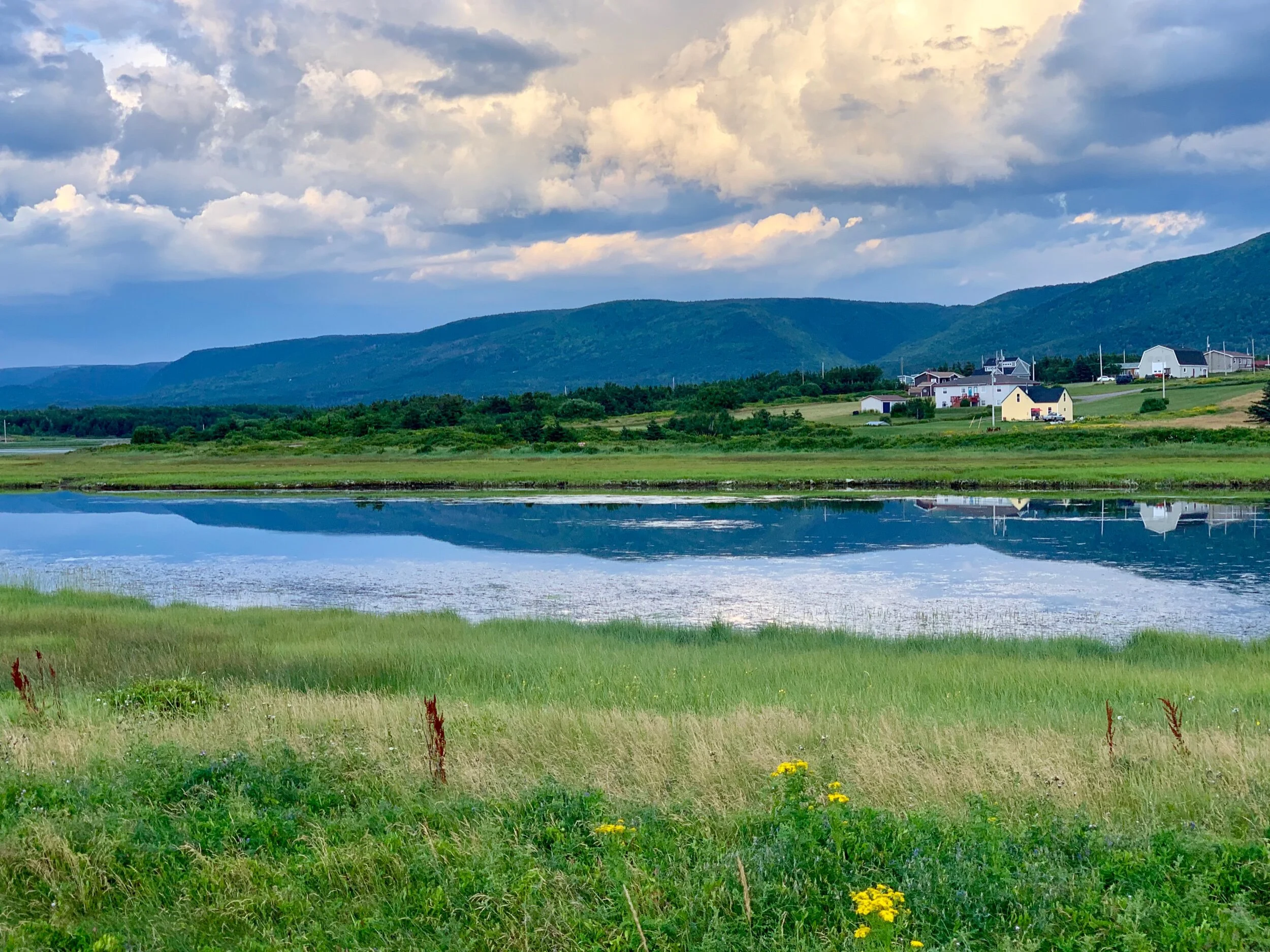
Near our campground in Chetticamp, Nova Scotia.
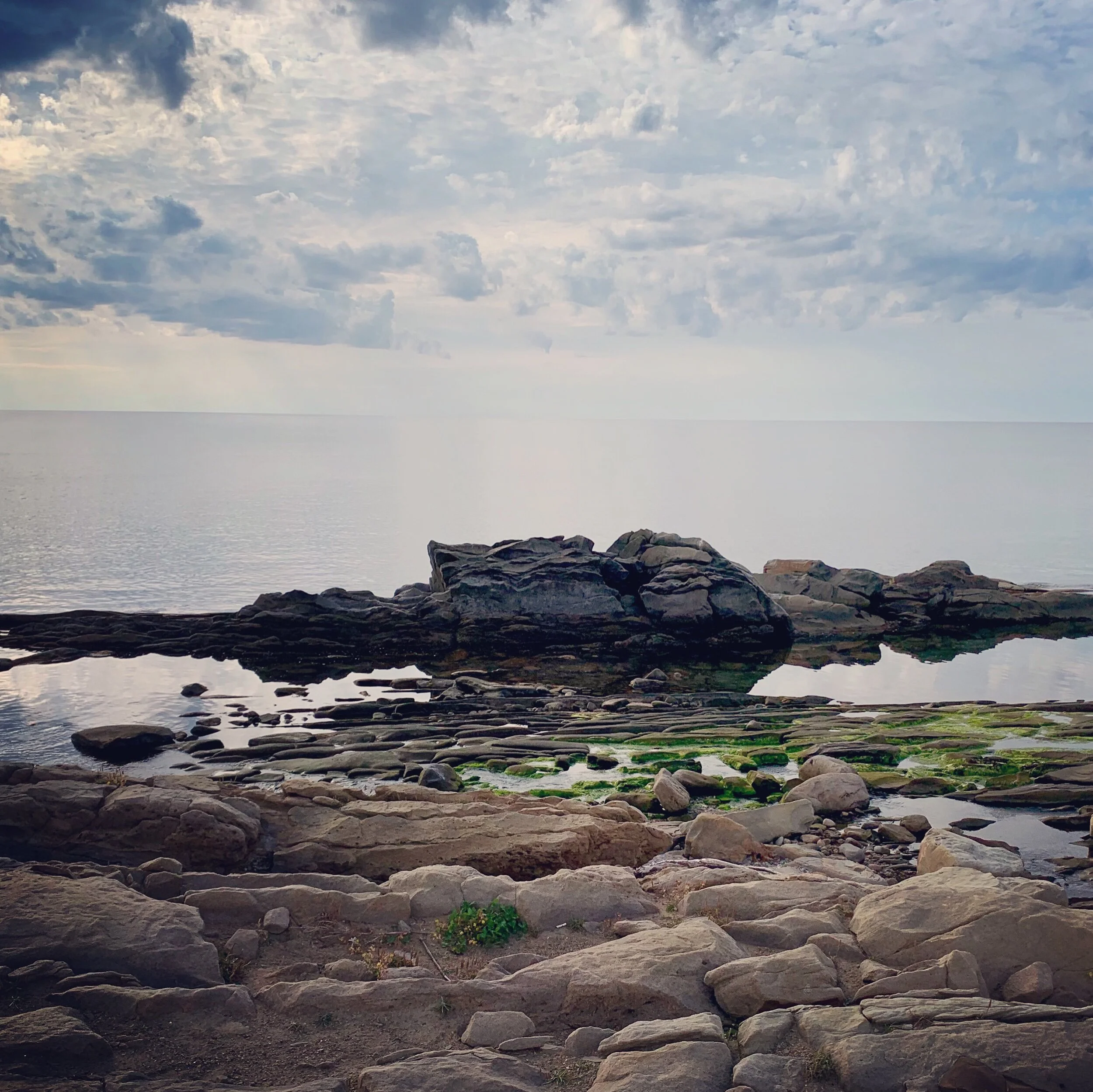
The coast near Chetticamp, Nova Scotia.
Moving On
In addition to being busy, last summer was emotionally eventful. In June and July, as my brothers and I recovered from my Dad’s recent death, we helped our Mom move from an assisted living facility to a nursing home in Galesburg, IL. She didn’t like losing her independence, but is gradually getting used to both the irritation and value of full-time long- term care. Like most older people, my Mom has good days and bad days. A good day occurred recently when Jenny and I arrived via train to meet up with my daughter Saren and her family from Wausau, Wisconsin. My Mom was able to meet her new great grandson Landon.
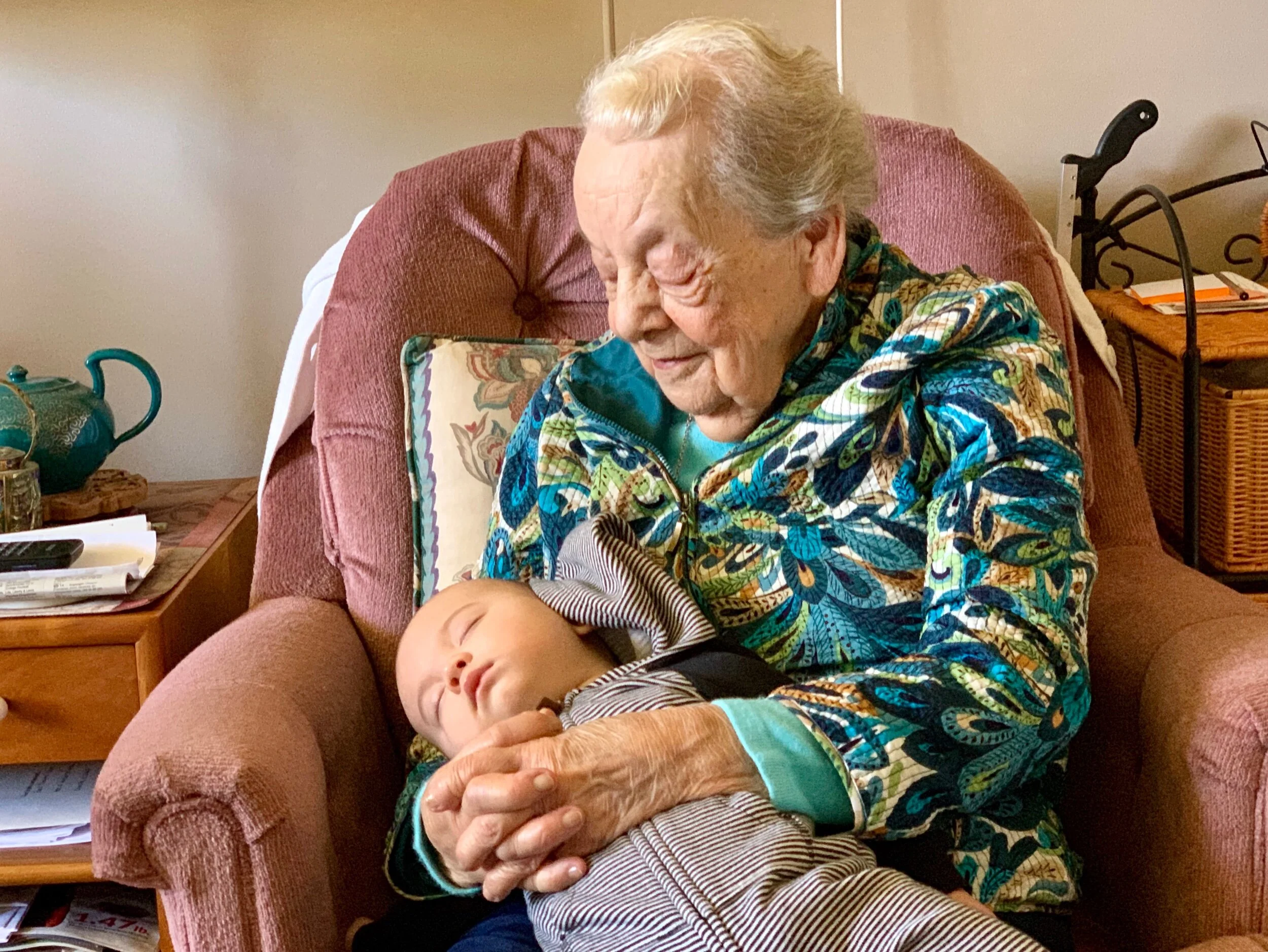
My Mom Sue Chase and her great grandson Landon Spire.
As I joyfully watched my Mom, my daughter and her son, I realized there were four generations of us in the same room sharing our love. And of course, I found myself wondering what life will be like for Landon when he is my Mom’s age (it will be 2106). Will civilization as we presently know it even exist? Will animal species other than humans and their pets and feedstock still exist? Or will our species be gone as well?
There is increasing scientific evidence that we are quickly running out of time, and we must significantly turn the tide on greenhouse gas emissions over the next decade. I am so pleased that all the Democratic candidates for President are acknowledging climate change as an existential threat, and are developing policy proposals for meaningful change. Personally, I cannot think of a more important way to address our climate emergency right now than to back whatever Democratic candidate is nominated, and to work my heart out for his or her election. And if we are lucky enough to have an administration that understands climate science, then we must put our shoulders to the wheel for national policy that supports carbon pricing and returns dividends to citizens to help bear the increased costs of fossil fuels. We will also need policies to help build the next great economic expansion in renewable energy, carbon sequestration through changing agriculture practices, and carbon technologies to include air-based and flu-based greenhouse gas capture and carbon recycling through manufacturing of inert products such as polymers, fuel and even food. These nascent, yet promising technologies are very hopeful. We only need the will to make them happen. For more information check out the Circular Carbon Network.
——————
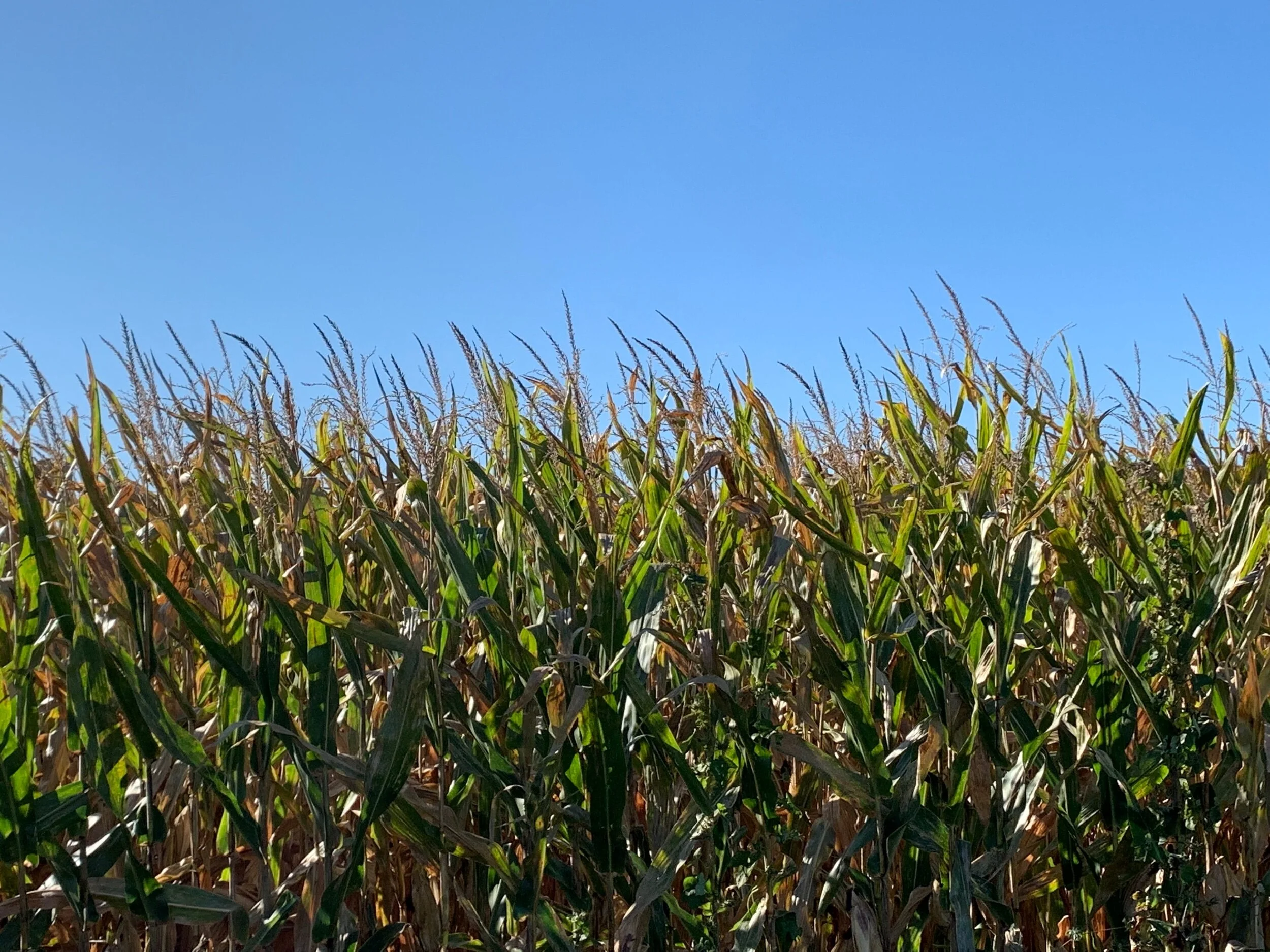
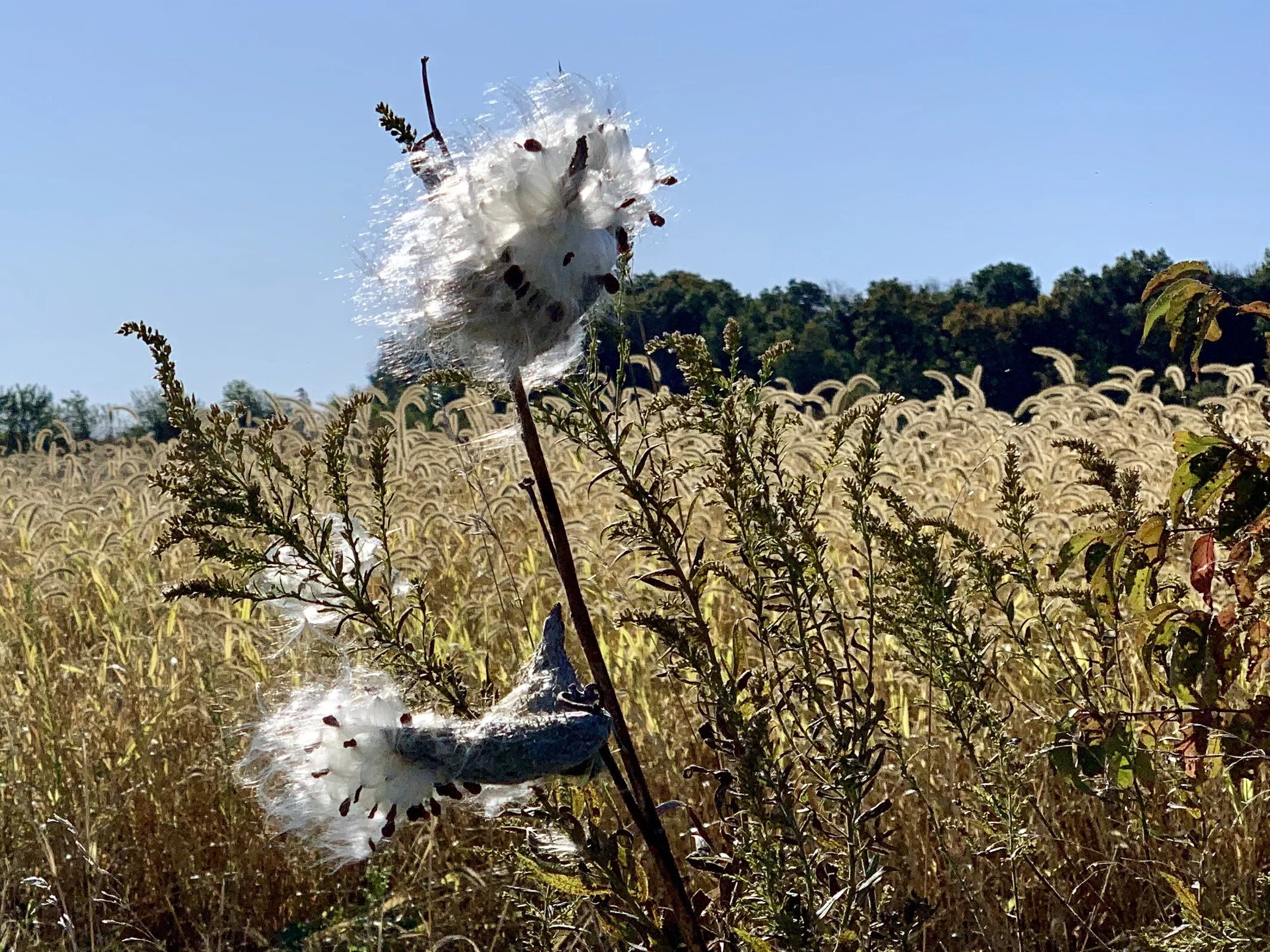
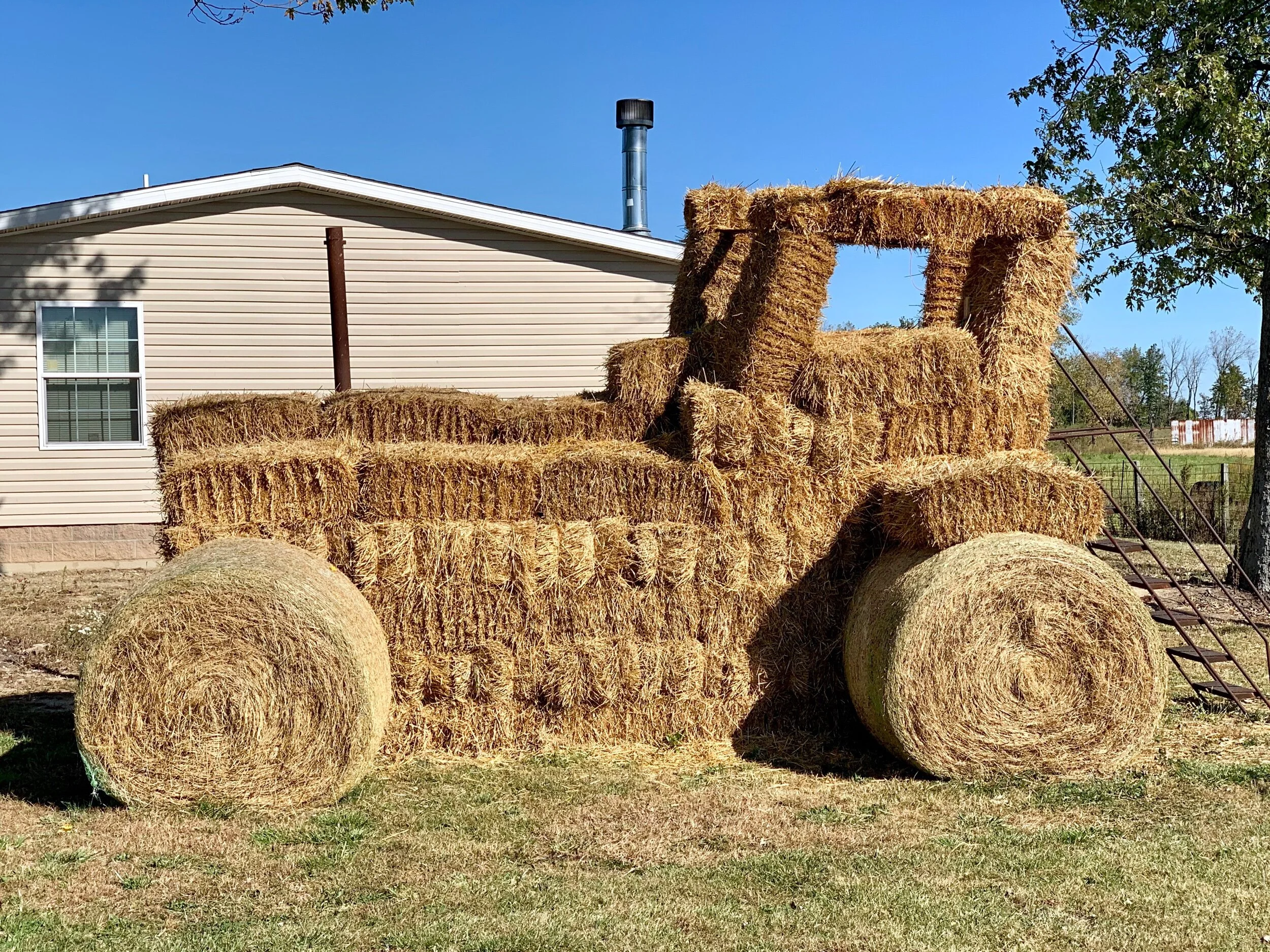
Today I'm writing from a motel in Richmond, Indiana. Jenny and I began this cycling trip about a week ago from Galesburg, Illinois. As I’m sure you are aware, the fall has been unusually hot in the Midwest and the northeast. That changed suddenly last Friday, just as we left Bloomington, Illinois, for Gibson City (with the help of a local Samaritan who drove us 37 miles in his pickup to avoid rain as the temperature plunged to the high 30’s). The next day was even more inclement. By Saturday evening, after Jenny and I had biked 72 miles to Attica, Indiana, we were very cold, wet, miserable and tired.
But the joy of biking is often in the recovery phase. The last two days have been lovely, and today was exceptional. Our trip has become glorious again. Galesburg is about 400 miles west of us at this point. We’re tired and windblown, and enjoying the pleasant and peaceful endorphin rush that comes after several days of hard cycling. It’s nice to feel used up.
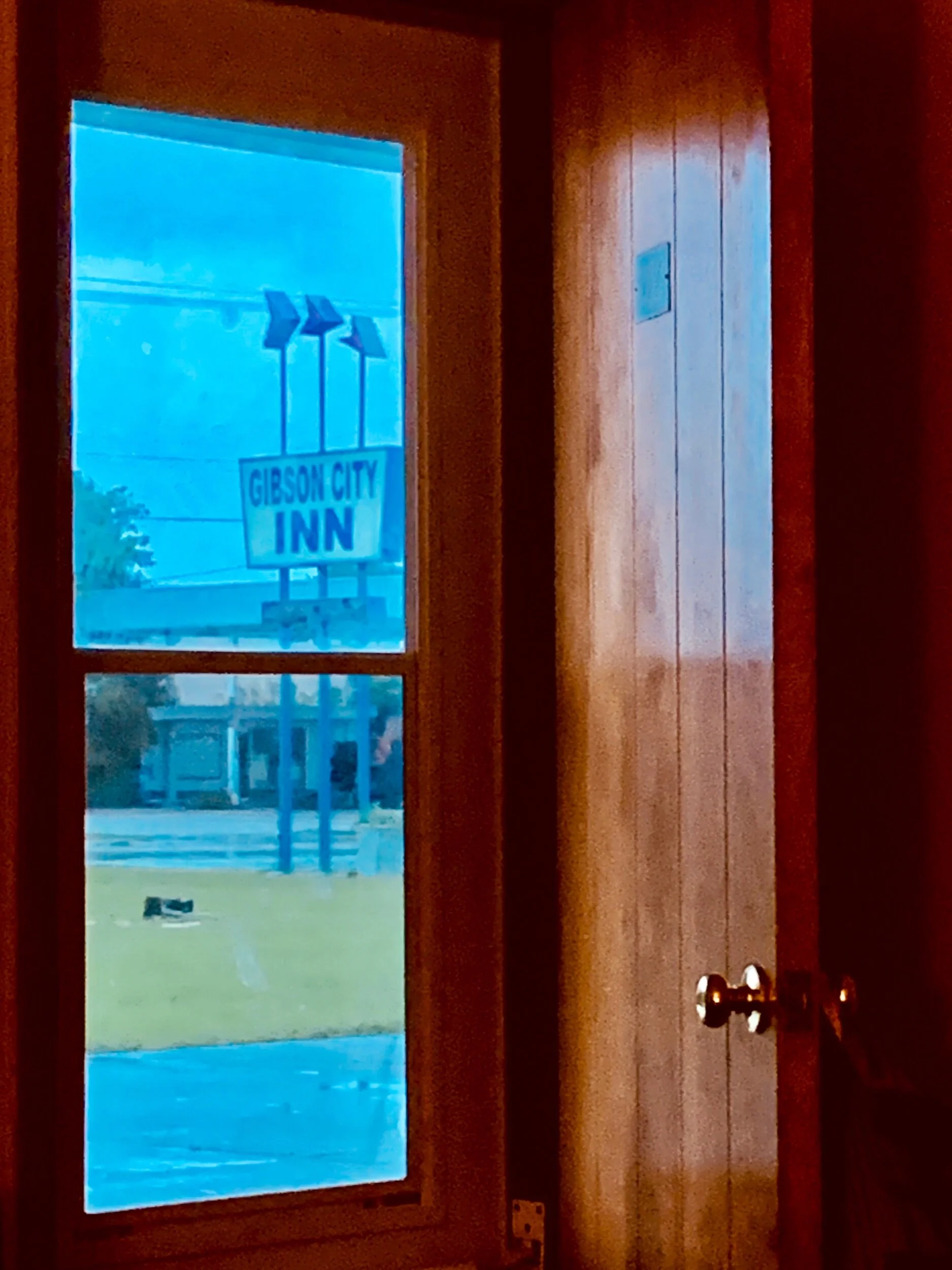
The rainy view outside our motel in Gibson City, IL.
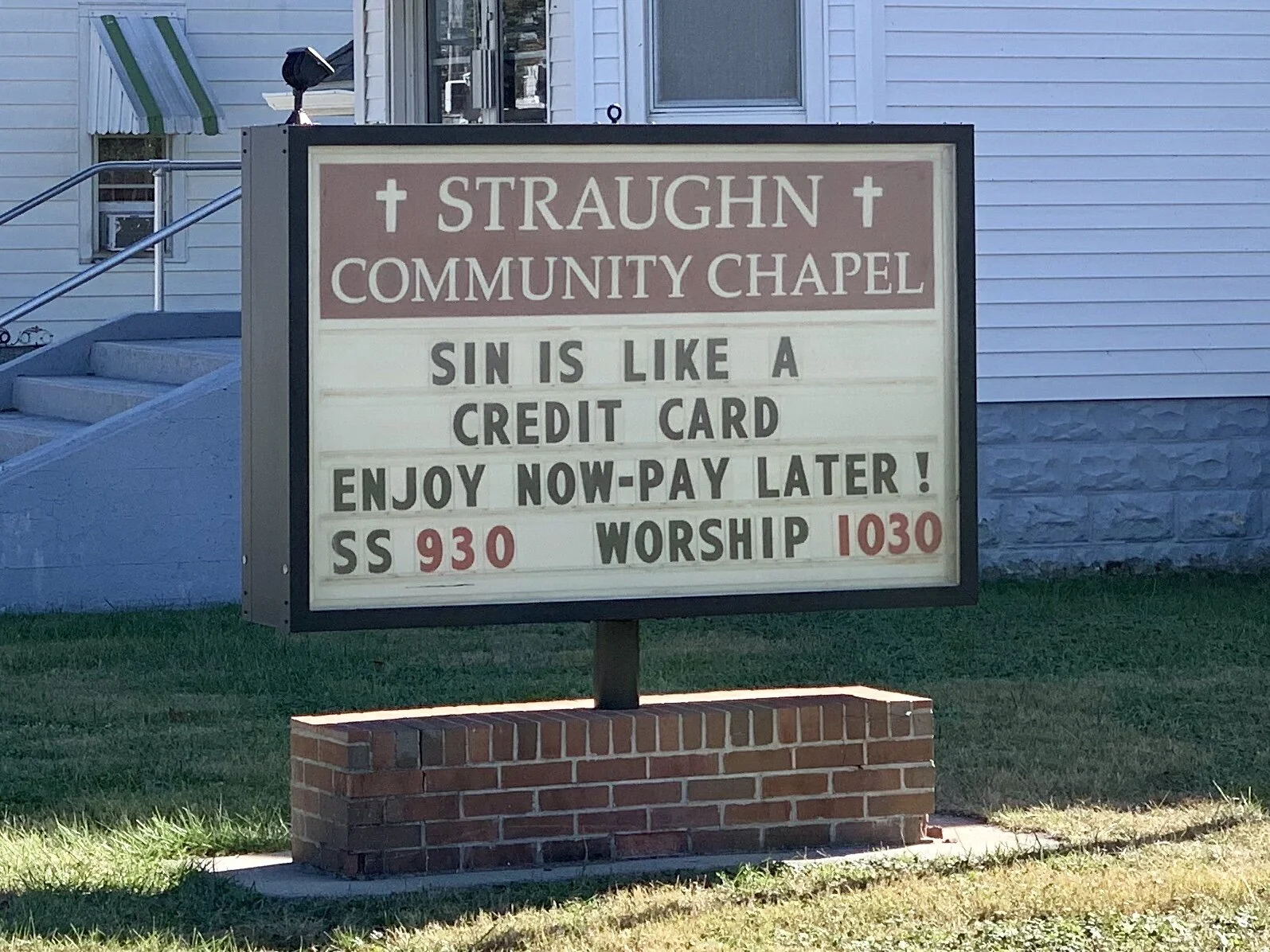
Fossil fuels are like this as well! We enjoy now, our grandchildren pay later….
Thanks for reading! More to come…
All photos, unless credited or otherwise noted, are copyrighted property of the blog post author.
The Highway of Life; A Tribute to Kim Chase
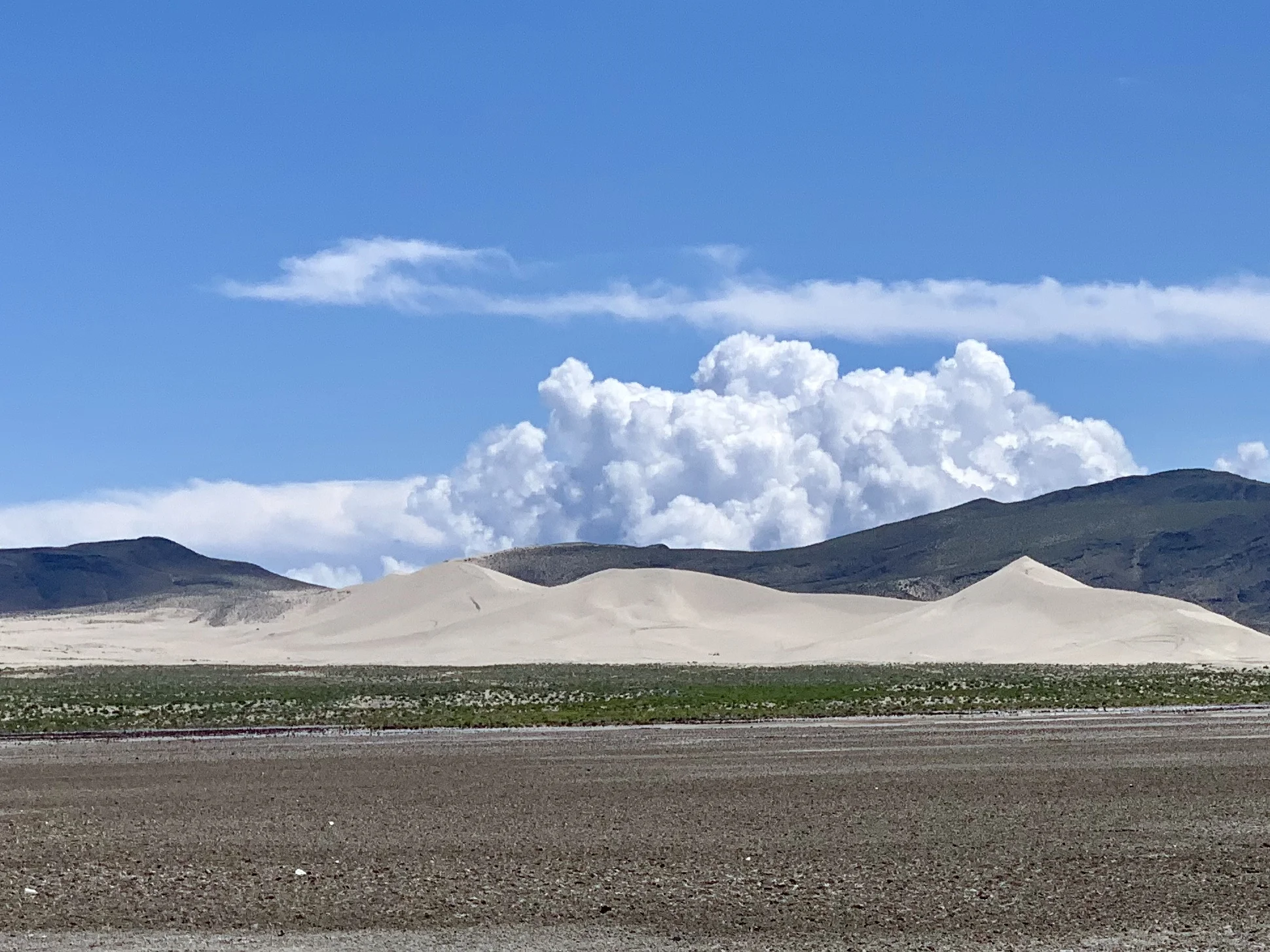
Sand hills east of Fallon, Nevada.
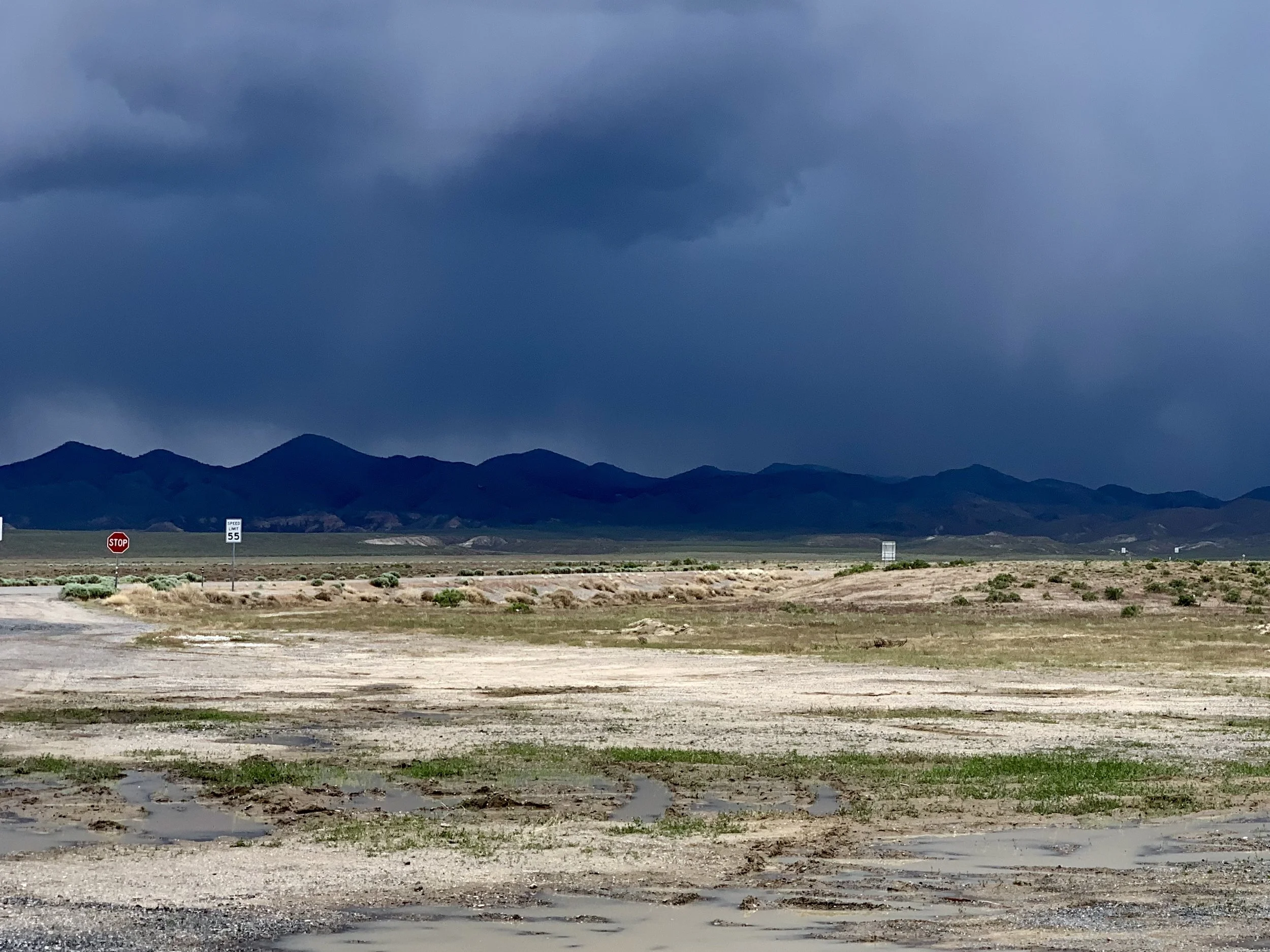
Storm clouds forming to the east of Middlegate, Nevada.
Greetings. I am writing this from Middlegate, Nevada, in a pleasant ramshackle motel that must date back to the 1930's. It doesn't have a name, other than the motel.
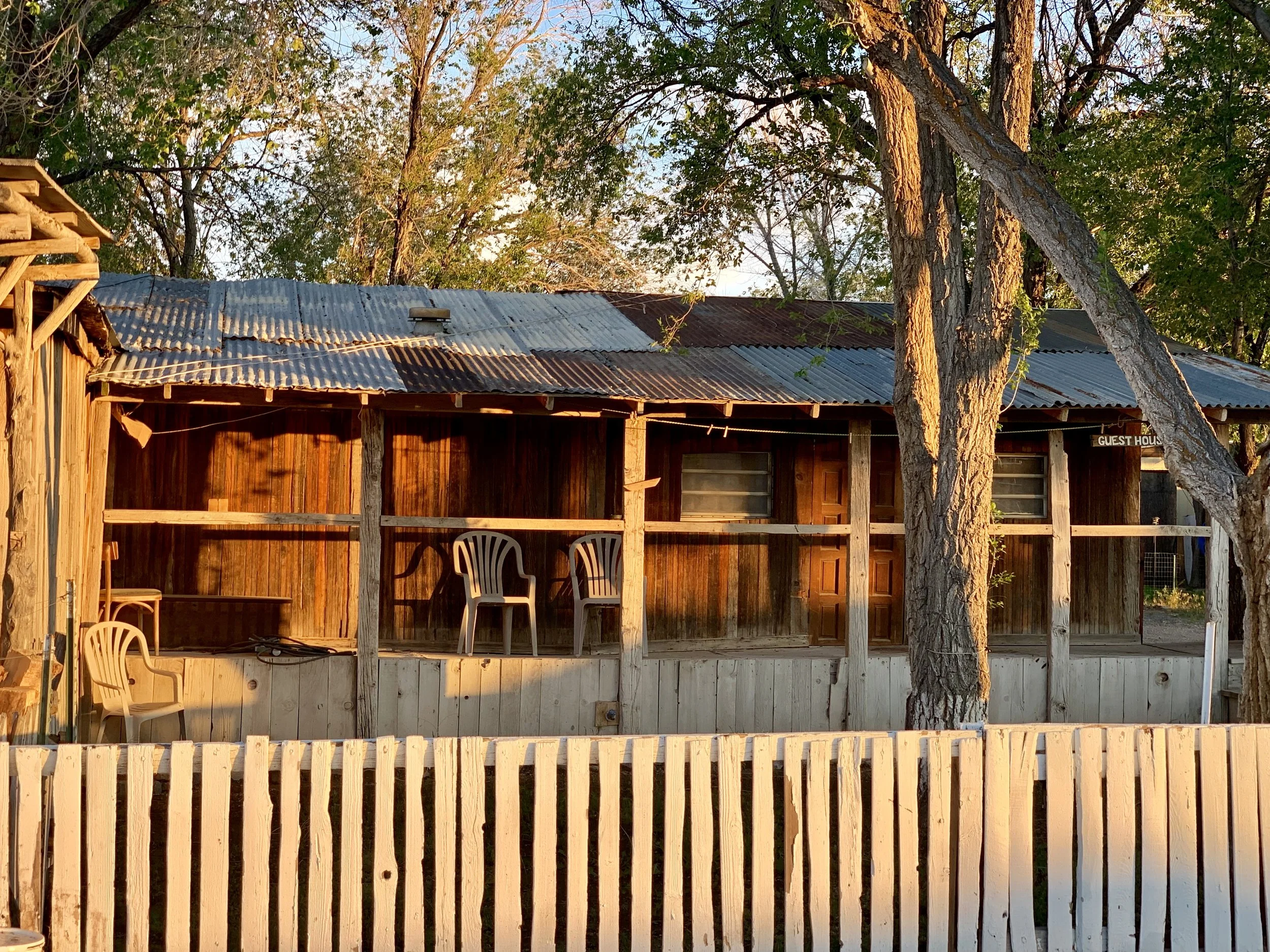
This building across the parking lot does have a name - the guest house.
I am traveling by bike from Palo Alto, California to Salt Lake City, Utah, where I will catch a flight back to New York City. Since Carson City, Nevada, I've been on Highway 50; a road once marketed as "The Loneliest Highway in America.." It's part of the "Adventure Cycling Association's "Great Western Trail." It's raining today. A lot. It rained and hailed on Carson Pass. A lot. All along my entire route, locals have been saying it's unusually wet and cold. I wasn't expecting this - I took this route on my GRID Tour in 2016, and enjoyed pleasant and reasonably warm weather the entire time. But with extreme weather on the rise everywhere, cycling is impacted more and more by increasingly greater unpredictability in weather patterns. The same is true for outdoor industries such as farming and construction. Much of our knowledge - which is based in being able to make reasonably accurate predictions - is becoming less useful.
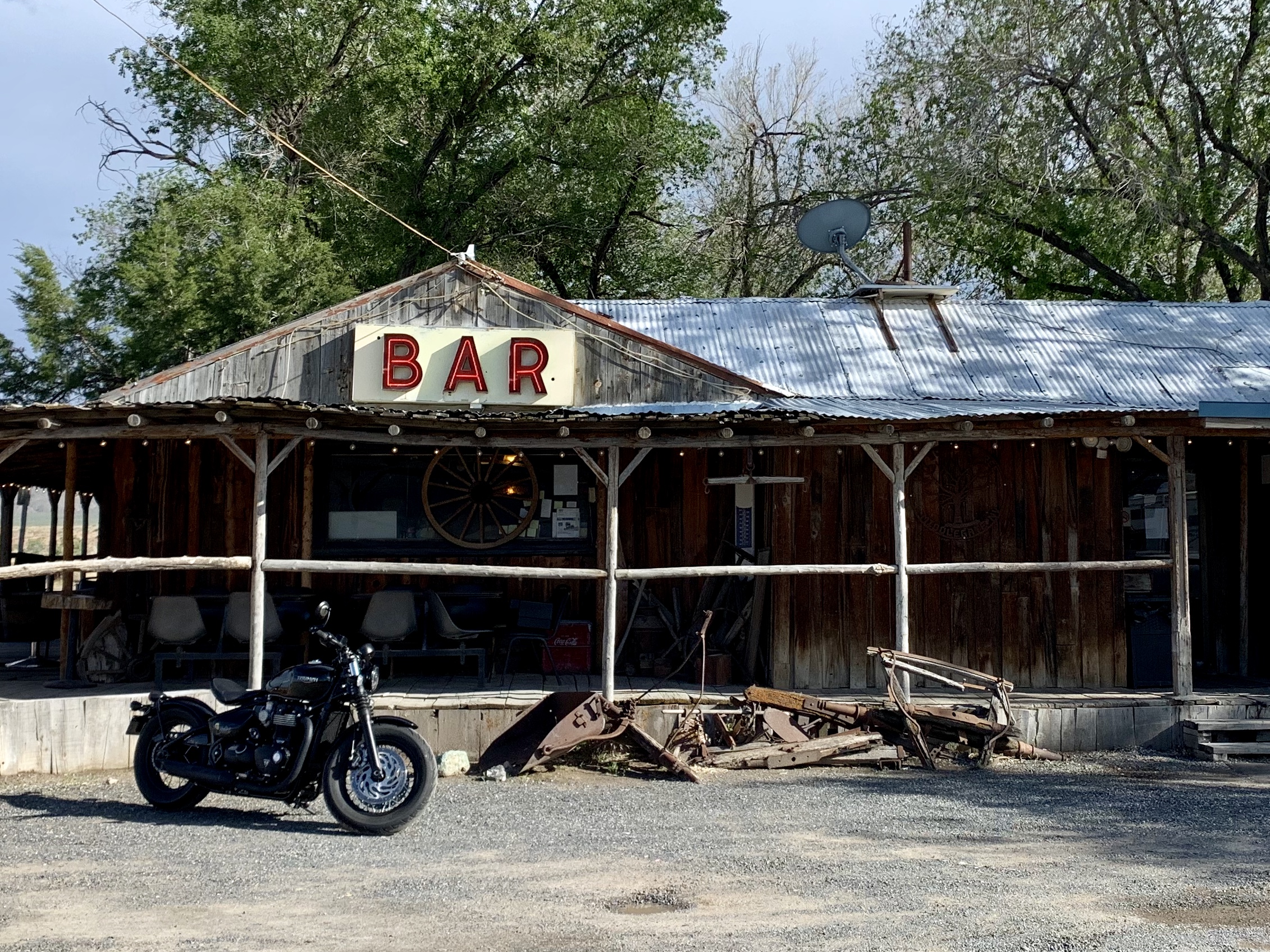
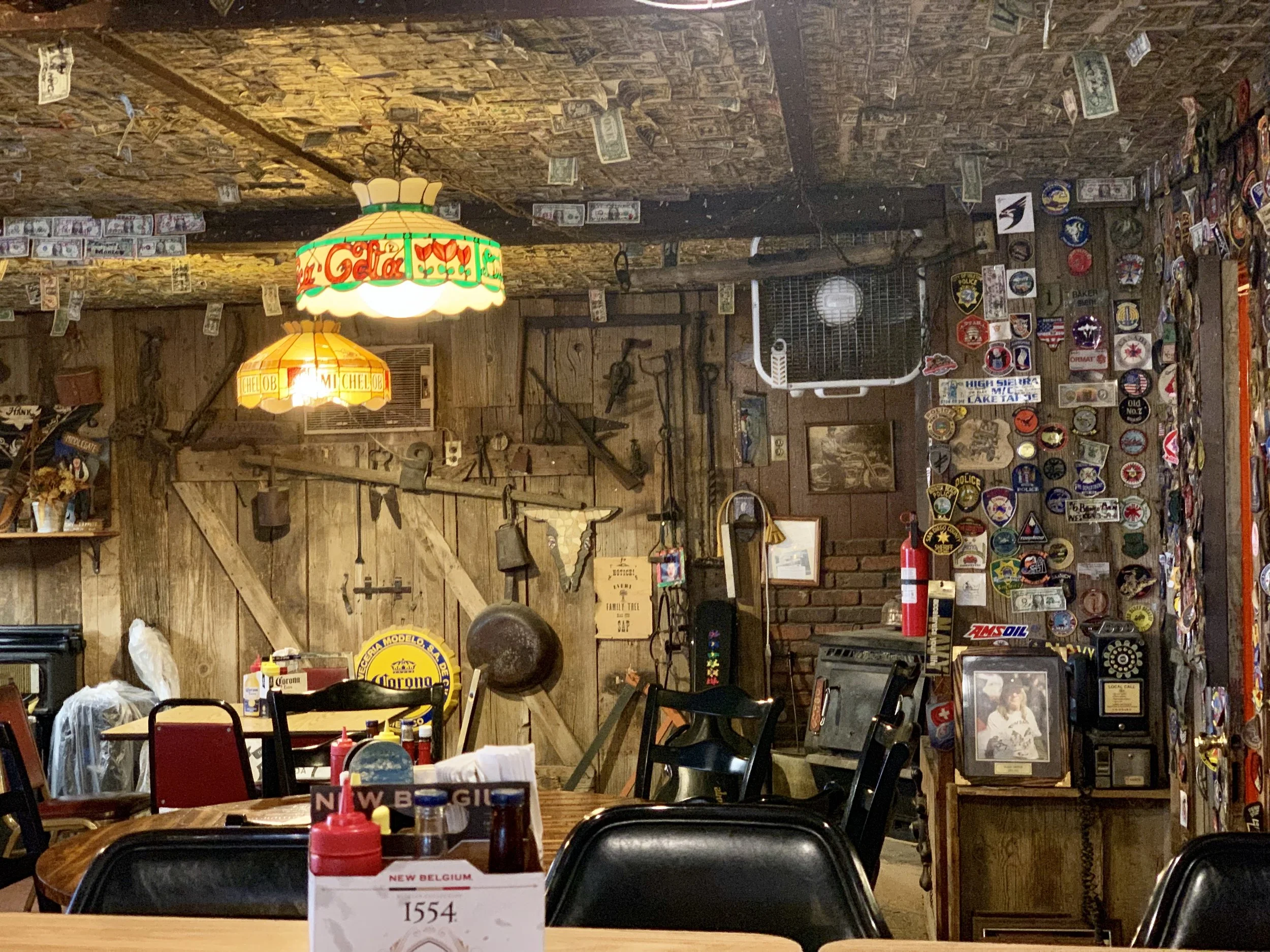
Outside and inside the bar at Middlegate.
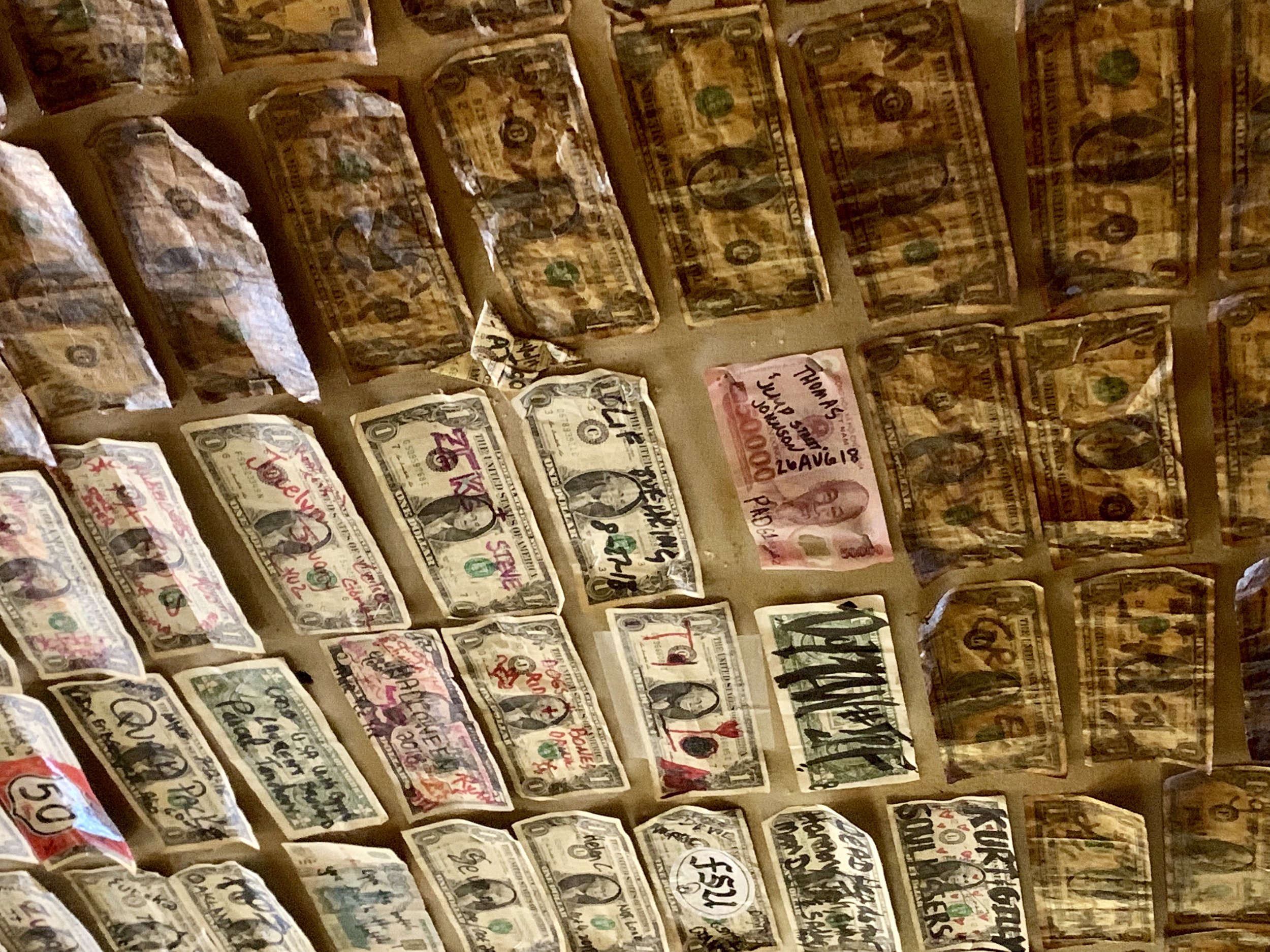
Close up of the ceiling in the bar.
I didn't intend to take this trip a few months ago. I had a different plan in mind. But circumstances changed things. On May 4, a few hours after I had arrived for a visit, my Dad passed away. I was fortunate enough to be with him, along with my stepmother Dawn - my Dad's wife of 53 years. Our entire family and so many friends are devastated, of course, but after an amazing life that lasted over 100 years, there is also so much to be grateful for. My Dad lived a long and active life, much of it on his own terms, and he died a reasonably peaceful death with only a few weeks of a troublesome decline. Few are so lucky.
On May 19, many friends and family came together to celebrate my father. My brother Steve did a masterful job as "Master of Ceremonies", and the stories and eulogies for my Dad were very poignant and touching. I think we said goodbye well, in a manner that would have pleased my Dad. The next day a small group of us took a scouting party to a lovely nearby park in the coastal mountains to identify a place where we will disperse his ashes when the time is right.
On the following day I left Palo Alto to cycle to Salt Lake City. I wanted a challenge, and I wanted solitude. I am getting both. At the same time, this route allows me to stay near the California Zephyr train-line so I can easily get to my home town of Galesburg, Illinois, if need be (where my elderly mother lives) with my bike in tow. I guess I'm feeling a bit fragile, and don't want to be very far away if my Mom takes a turn for the worse.
Below is the eulogy I delivered at my Dad's commemoration. Perhaps it will mean something to others who weren't able to attend his memorial.
May 19, 2019, A Tribute to Kim Chase
Love and Loss
My Dad could be quite funny. One day, while I was stressing out about something, he put his hand on my shoulder and looked me straight in the eye. Then he grinned and said, "Stop worrying Michael. You'll get from one end of your life to the other".
Well, I haven't done that yet. But he has. And boy, I miss him.
We all know there's a shadow that comes with loving someone. That shadow is called loss. To love someone deeply means that, sooner or later, you will lose them, and they will lose you. There's no getting out of that experience.
Some of you may not know that Dad's first wife died during the polio epidemic in the early 1950's. It was a staggering loss for him, as it was for me and my brother Chris. It was 1953, and my Dad was just starting his teaching career. There he was, having lost his wife, with two toddlers to care for. But that was only one of many loves and losses. My Dad married again, and had another son, Steve. And then some years later, he married Dawn, bringing her into our lives. Yet, by the time he died at 100 my Dad had lost every other member of his immediate family except those of us in this room, and all of his friends from his own generation. Still, he lived and died surrounded by people who loved him, most notably Dawn, with whom he was able to share 53 wonderful years.
There's no remedy for losing a loved one. It happens to us all. We love, we lose. But still, we can do what Kim Chase did - we can love full out, completely present, gently, quietly, regardless of the cost. We can just keep showing up. My Dad was good at that.
Acceptance and Support
I should know; I tested him quite a bit as a young man. For a time, I was quite angry at him for ways I thought he had let me down. But my Dad would stand his ground, and gave me something to push against. And even though my harsh words and actions would hurt him, he remained steadfast. And I can say that I never, ever doubted his love and commitment to me, even when I was testing it in every possible way I could. No matter what I did or said, he'd come back for more, he'd keep fighting the battle for us to become whole - as father and son, friend and family, mentor and protege. Our relationship in those days was explosive, but I always encountered a man who believed we have it in us to find our own way in life, and we don't need to be coddled or indulged, we just need steady acceptance and support.
Luck and Opportunity
My Dad would often say he was very lucky. Some of you may know he attributed his luck to having been loved so unconditionally as a child by his mother, Elizabeth. She definitely doted on him, and he grew up knowing that - at least in her eyes - he was special.
I don't want to suggest that fortune and misfortune always distribute themselves equally. Clearly they don't. But fortune smiles more often on those who are ready to see and run with the opportunities that life offers up. My Dad's natural optimism and buoyancy allowed him to make the most out of any moment. He had an amazing life force. He lived through the Great Depression, the rise of fascism in Europe, WWII, the Korean and Vietnam wars, peacetime expansion, the civil rights movement, hippies, LSD, Reagan, the Gulf War, 9/11, Osama Bin Laden, our first black President, the age of Trump and the dawning of the age of climate change. He saw it all, with his eyes wide open.
And all the while, he kept learning and adapting. As many of you know, Dad was a backpacker. When he got old enough that he had to pee every few hours, he figured out how to build and use a pee jar in his tent at night. (God forbid he should drink less booze.) When he could no longer hike, he rode a mule. When he could no longer ride a mule he started going to aquatic exercise classes. When he was no longer steady enough with his cane, he got a walker on wheels. When that didn't get him around quickly enough he got a tricycle. He just kept growing. He even learned how to use Facebook, although he complained that he'd be damned if he'd ever do something that used the word "friend" as a verb.
Nothing stopped this guy. I am so proud he was my Dad. Kim Chase was an amazing man who lived an amazing life. I miss him so much, and I am filled to the brim with gratitude for the life he lived.
Lucky him. Lucky me. Lucky us.
Thank you.
And thanks for reading this blog.
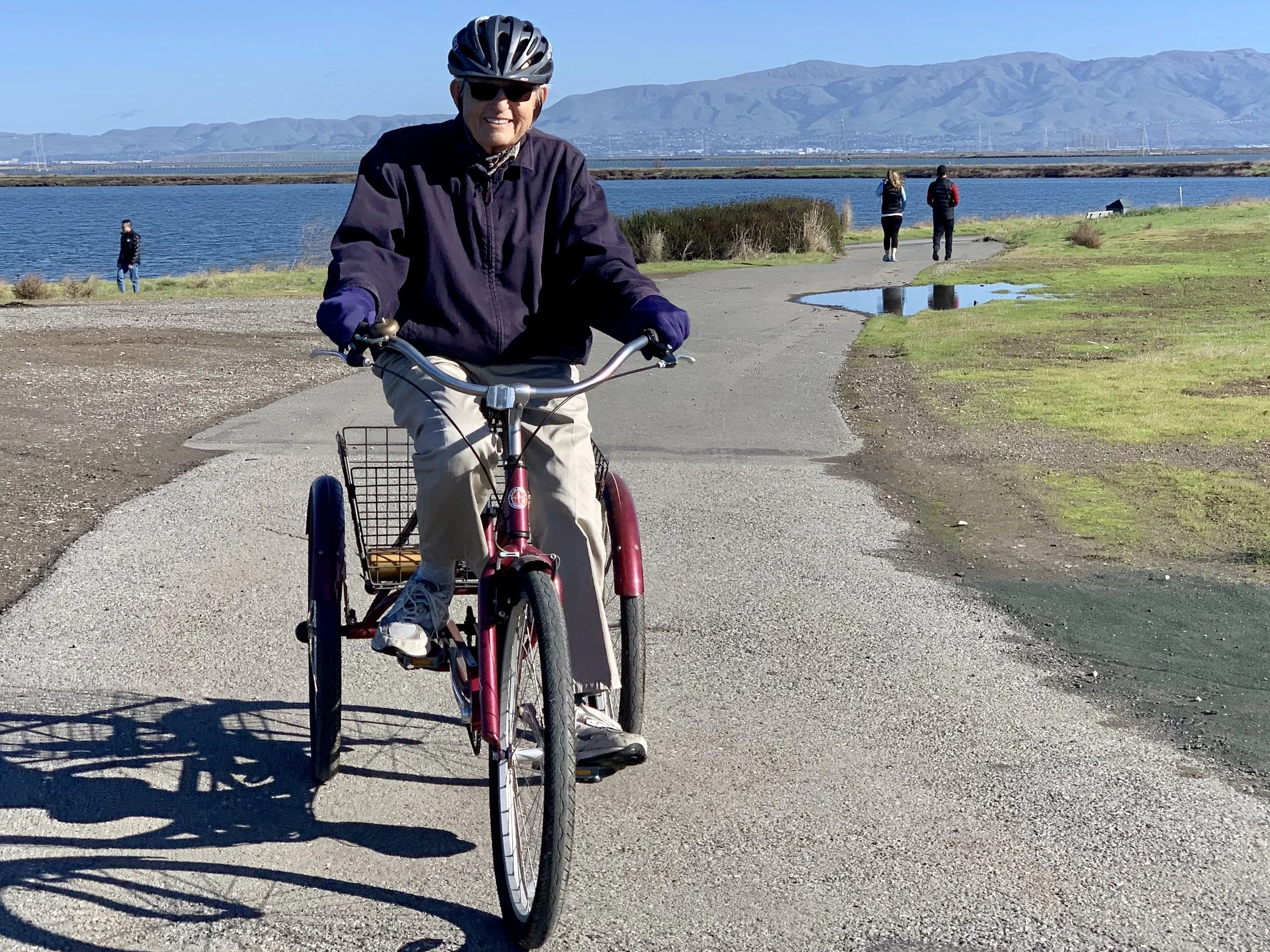
Kim Chase, December, 2018
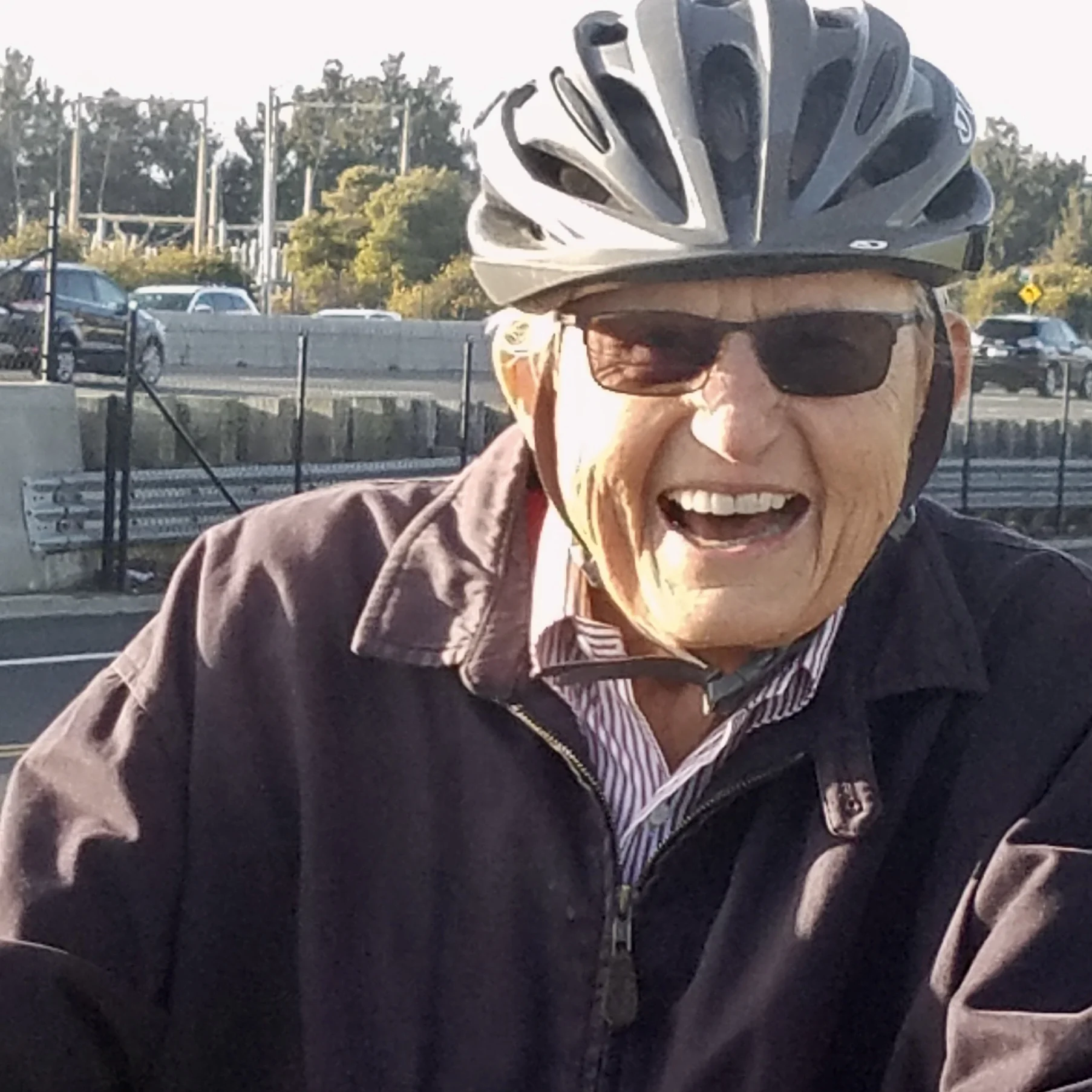
Kim Chase, December, 2018
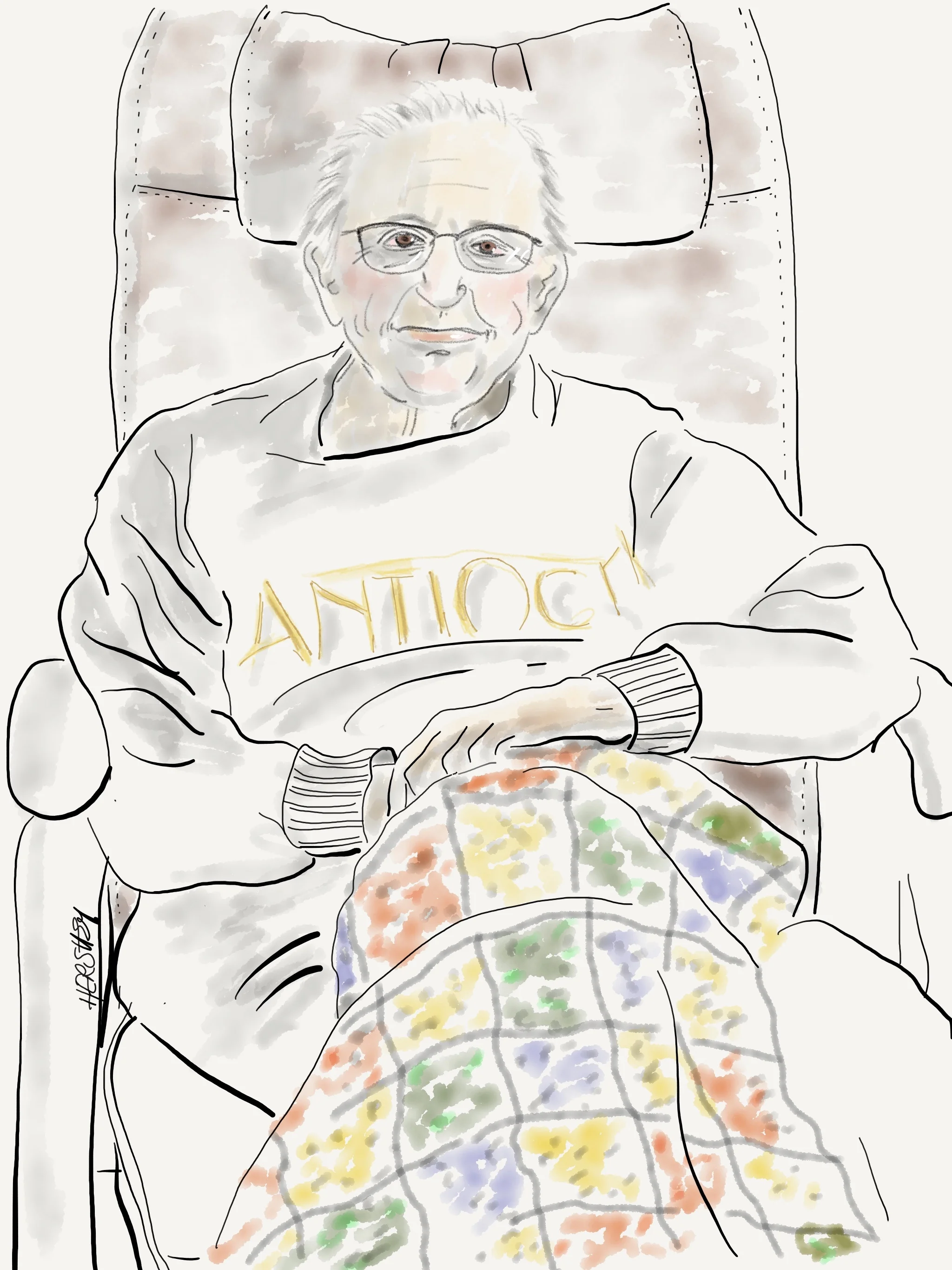
Kim Chase, December, 2018, drawing by Jennifer Hershey
More to come.
All photos, unless credited or otherwise noted, are copyrighted property of the blog post author.