
Free Markets, Wildfires and Conspiracy Theories; Biking Ontario and Quebec
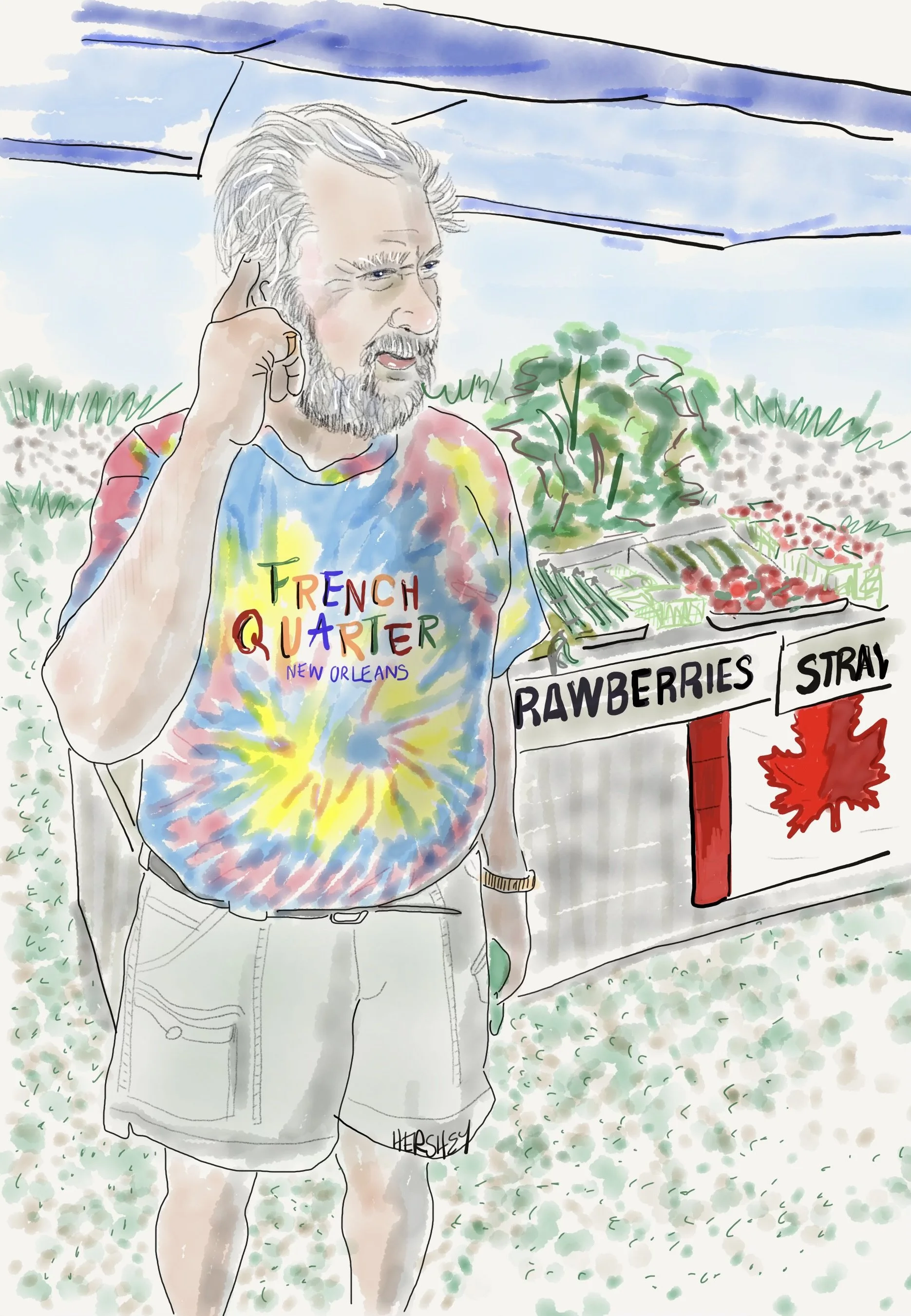
Jenny and I met Dave in Fitzroy Harbor, Ontario. An 80-year-old retired cop from St. Catherine, he was selling organic produce from his garden at a roadside stand. Dave lives alone in a small trailer tending his “Garden of Eden” and described himself as a DP (displaced person). He showed Jenny where a teenager shot off a small chunk of his ear with a buckshot rifle. When we asked him about the wildfires further north, Dave replied without hesitation, “They were set intentionally by the government so they can develop the land up north. It will make them money on property taxes. And it's where they plan on putting all the immigrants.” When we asked him where the immigrants would find jobs if they lived on cleared land up north, he replied, “It’s a socialist country, so they won't work anyway.” He went on, “That's why the government says it's climate change - they blame it on something we can't do anything about, and that's how they get away with it.” Drawing by Jenny Hershey. Follow her work on Instagram @deeofo.
————
Free Markets
“All truth passes through three stages. First, it is ridiculed. Second, it is violently opposed. Third, it is accepted as being self-evident.”
-Arthur Schopenhauer
————
Writing by Michael Chase, Drawings by Jenny Hershey
Jenny and I planned our next cycling tour for late June as we rode the train back to New York City last May from Little Rock, Arkansas (read a post about that trip here). Since neither of us had ever been to Ottawa, and because summer is a great time to cycle in Canada, we decided to ride our bikes northwest around the Adirondacks from Albany into Ontario and Quebec. We had no idea what it would be like, but we guessed it would as interesting as it might be challenging. Of course, we reconsidered when New York City broke air quality records because of wildfires in Ontario and Quebec; but decided to go after learning that poor air quality is as determined by wind currents as it is by proximity to wildfires. Our hunches were accurate, and although we grappled with poor air quality in both Ontario and Quebec, we kept reading it was worse in the States. And, of course, we were aware that many others are also suffering from extreme heat in the American south. It’s been a rough summer all around. Like so many other aspects of climate change, there’s nowhere to hide from increasing weather extremes.
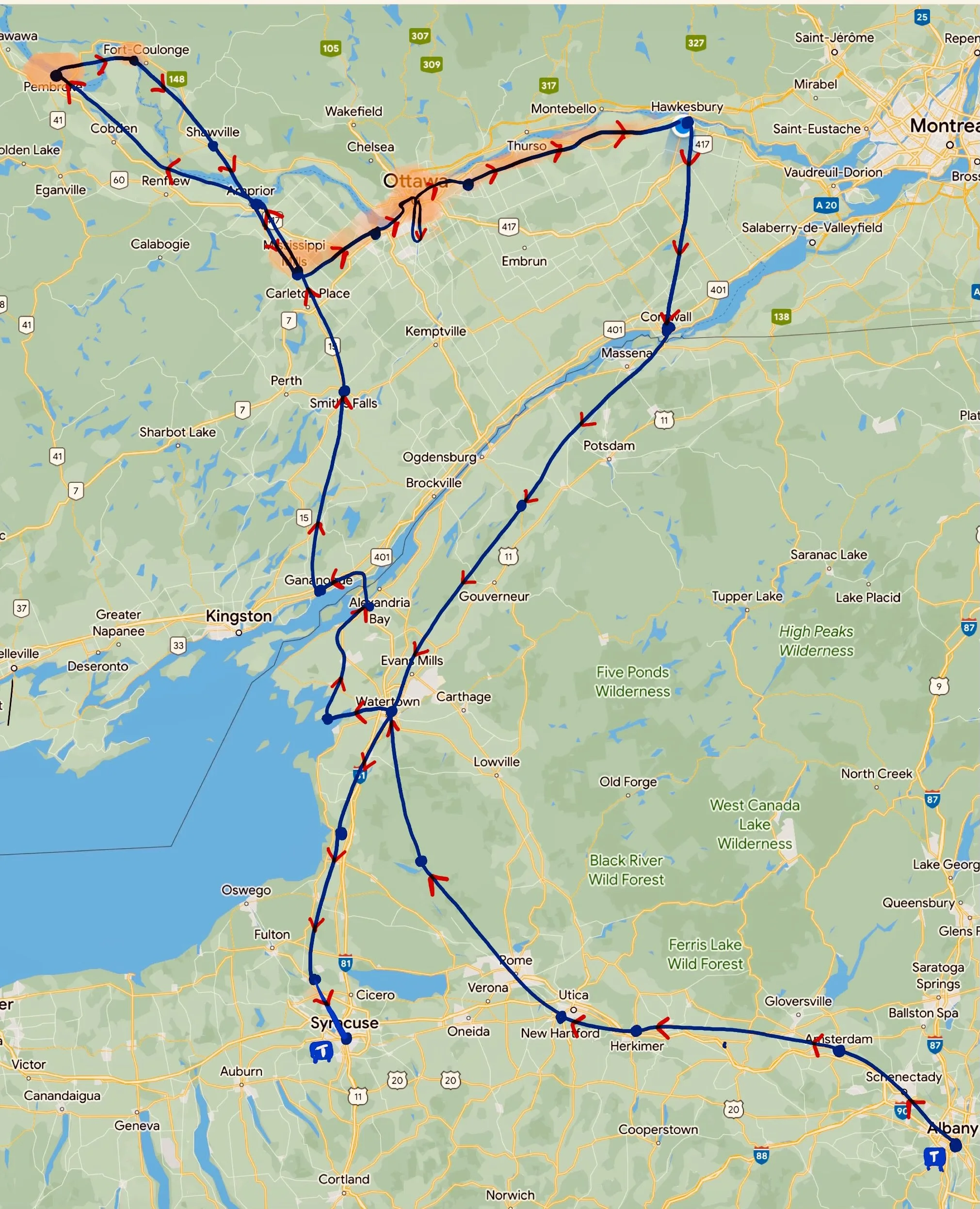
Jenny and I started our trip in Albany after taking Amtrak from NYC. We couldn't ferry into Canada at Cape Vincent because the ferry captain retired during the pandemic, and no one has replaced him. Consequently, we had to ride northeast 30 miles to the Alexandria Bay crossing and walk several miles on a narrow pedestrian walkway on the American side. We then rode illegally across another bridge into Canada from Wellesley Island (no one told us not to at Canadian customs). From there, Jenny and I headed north toward the Ottawa River, hopscotching between Ontario and Quebec. We encountered the worst air quality from the Canadian wildfires in the orange areas. We ended the trip in Syracuse, where we took a train back to NYC. Altogether we biked about 1000 miles. Map drawing by Jenny Hershey. Follow her work on Instagram @deeofo.
Some other things needed to happen before we left. In addition to personal care, home projects, and catching up with friends and family, there was a Citizens Climate Lobby (CCL) conference in early June followed by a day of lobbying Congress in Washington, DC. This was CCL’s first in-person lobbying effort since the pandemic, attended by almost 1000 environmentalists from all over the country. Over 465 visits to both Republican and Democratic members of Congress to lobby for climate policies were made in one well-orchestrated day. I joined small teams of other citizen lobbyists to visit with the staffs of NYC Representatives Nydia Velasquez, Ritchie Torres, Adriano Espaillat and Hakim Jeffries. Although there is predictable resistance to the GOP’s continuing agenda to weaken the National Environmental Policy Act (NEPA) and the GOP’s ongoing support for fossil fuels, CCL lobbyists are now able to argue that market forces overwhelmingly favor clean energy over fossil fuels. The clean energy marketplace has found its groove, and if we trust that open competition in a truly free market will deliver the highest quality products for the lowest possible prices, then clean energy will indeed emerge victorious as long as the playing field is even. Renewables are already cheaper than coal, and will soon be cheaper than natural gas (even without factoring in the social costs of carbon emissions and air pollution). Consequently, Republican insistence that oil and gas deserves greater subsidy support than clean energy (usually in the name of “market based parity”) is a less serious threat to long term decarbonization goals than it has ever been.
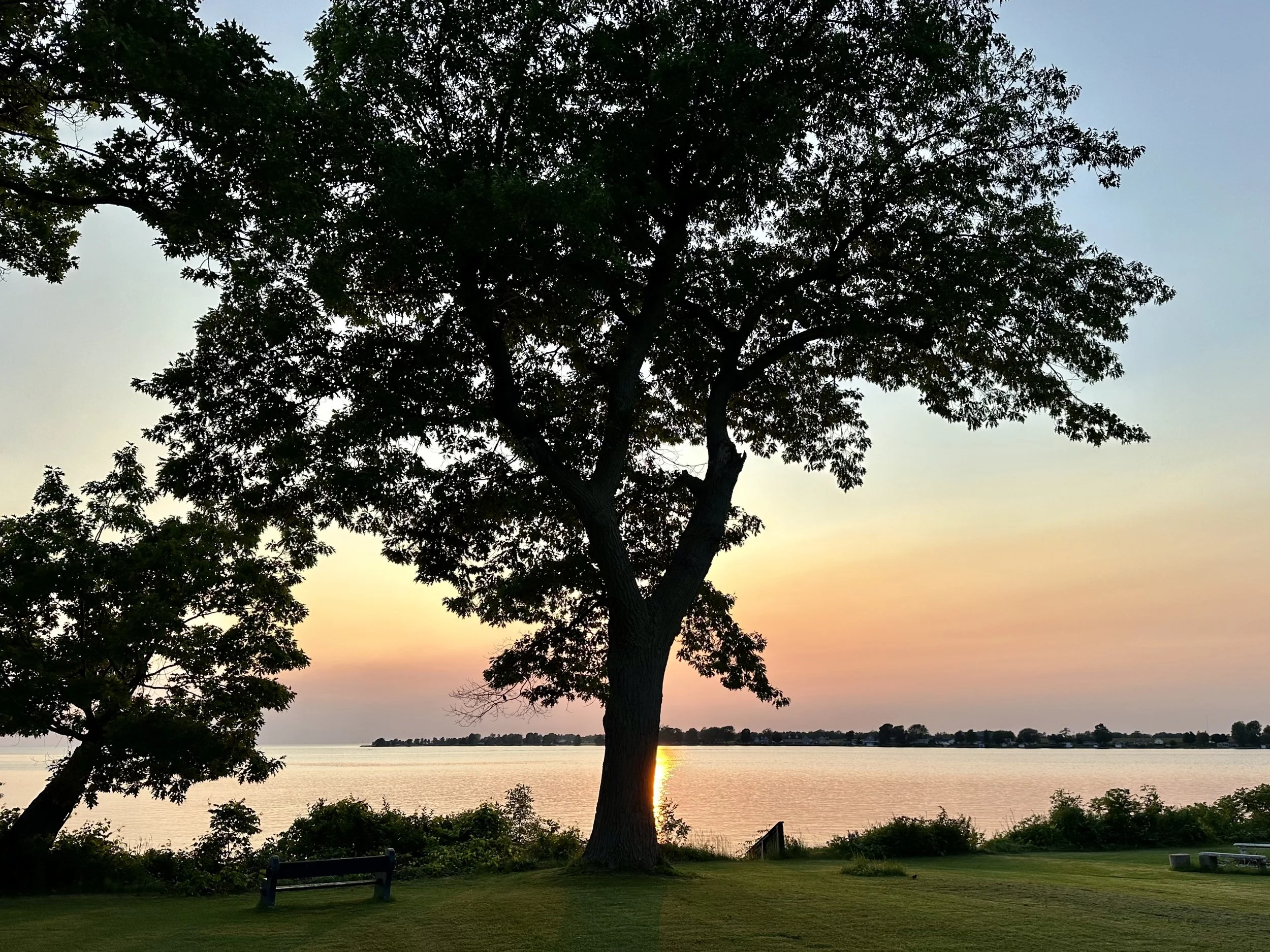
Tree overlooking Lake Ontario. Photo by Michael Chase. Follow him on Instagram @mjohnsonchase.
Consequently, the overriding concern of CCL lobbyists for this year is permitting reform (with a secondary emphasis on CCL’s signature carbon dividend policy with its carbon border adjustments, or CBAM’s). Both issues are heavy lifts in our polarized political atmosphere, although there is a reasonable chance that both parties might come together in the next Congress to pass meaningful legislation. Effective permitting reform will speed up the permitting process for clean energy projects and streamline the buildout of transmission lines. It will also preserve the input of local communities around quality energy projects, provide lasting jobs and ensure the safety and welfare of American citizens. For Republicans, permitting reform will give all energy projects a bump, including carbon capture, utilization and storage (CCUS), hydrogen manufacturing, and even small modular nuclear reactors.
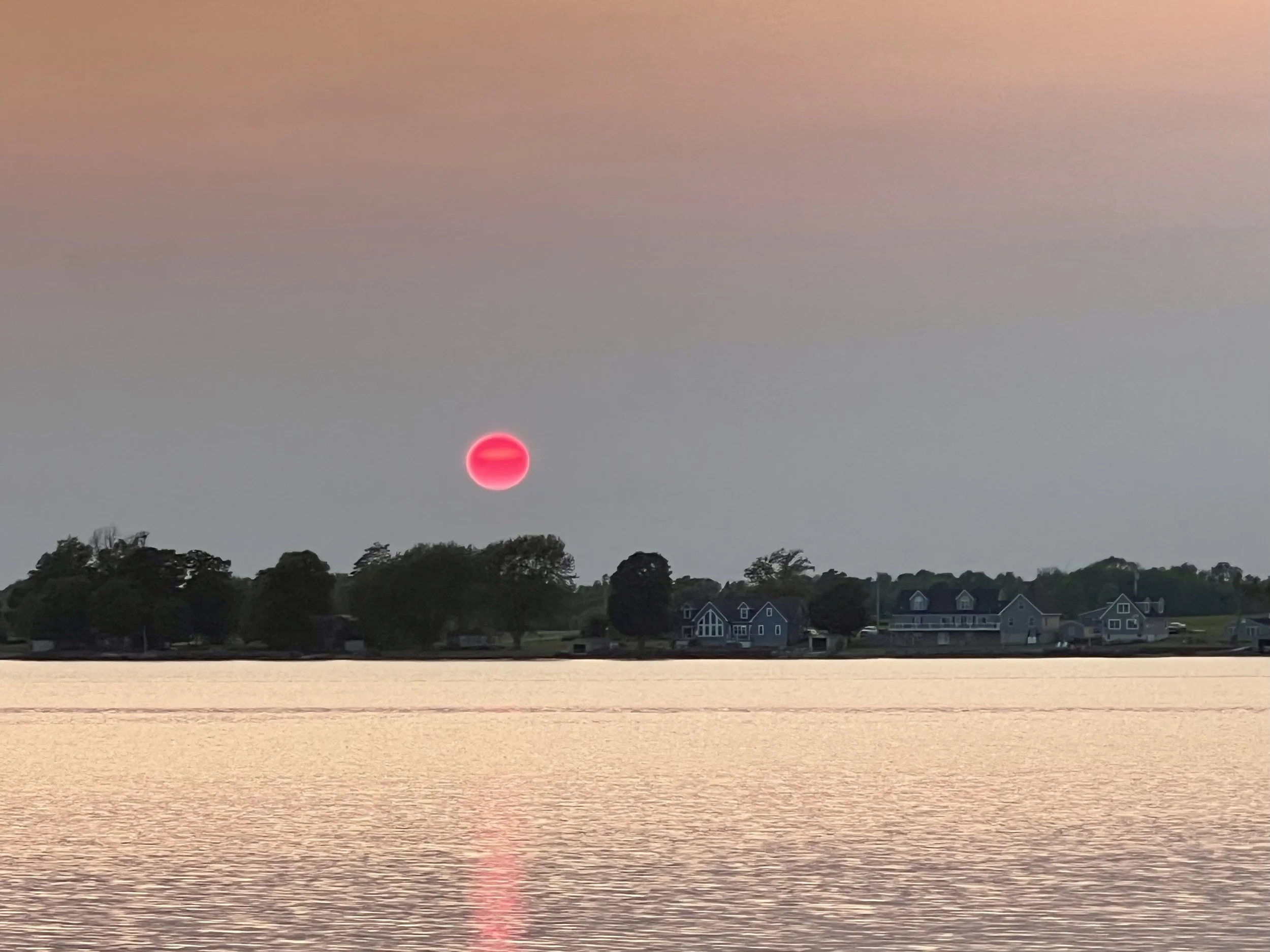
The sun sets over a bay in Lake Ontario in the middle of June south of Cape Vincent, New York, where the headwaters of the St. Lawrence River begin. The sky seemed clear the day we were there, but this picture indicates there might have been some wildfire smoke in the air. Photo by Jenny Hershey. Follow her on Instagram @deeofo.
All combined, electric utility grids in the US currently transmit approximately one Terawatt of electricity every day. Yet, because permitting new projects now takes as long as four years, there is a large backlog of 1.4 Terrawatts of potential energy waiting to be permitted, so we already have the potential capacity to double the amount of electricity available for our rapidly electrifying energy economy over the coming years. And well over 85% of all project applications in the queue are clean energy projects! This means that if ALL the energy projects (meaning fossil fuel and clean energy projects combined) waiting in the queue were green-lighted today, our energy mix will shift so dramatically toward clean energy that we will make significant progress toward decarbonizing our economy.
So, in one sense, there is very little reason anymore to fight over what NOT to build, and environmentalists can relax a bit because the momentum is on our side. What we can’t relax about, however, is advocating for citizen engagement in the permitting reform process. Whether clean or dirty, the siting, scale and development of new energy projects and transmission lines may result in public health and environmental injustices, eminent domain conflicts, and biodiversity losses and degradation. Local communities should be closely involved in reviews, revisions, and approvals wherever necessary. It’s also time for wealthier communities to step away from historic forms of “not in my backyard” (NIMBY-ism) and accept solar farms, windmills, transmission lines (and even CO2 pipelines and underground storage) into their own neighborhoods. In every way - both good and bad - it’s important for the impacts of the next great energy revolution to be shared equally.
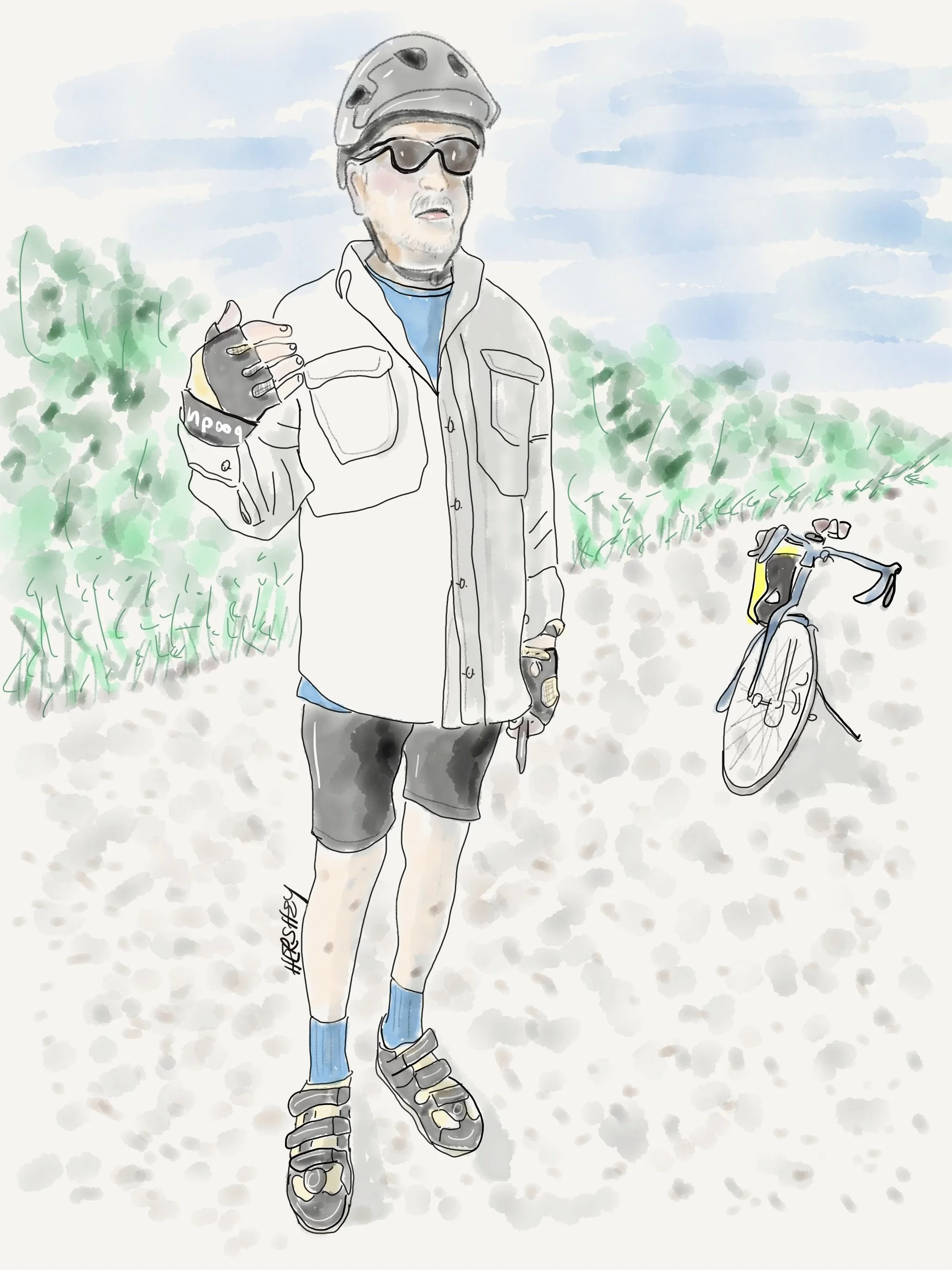
Jeff Mills is a resident of Lanark County in Ontario, Canada. We met him while biking on the Ottawa Valley Recreational Trail (OVRT). A lifelong community developer, Jeff helps to create great biking infrastructure in Lanark and Renfrew Counties. He (and his colleagues) envision a system of rail-trails similar to the Greater Allegheny Passage (GAP Trail) that runs from Pittsburgh, PA to Cumberland, MD. The hope is to create a bicycling destination with global appeal that will help revitalize small communities in northeastern Ontario. Between the OVRT and the Algonquin Trail, they have an excellent start! We were lucky enough to spend a wonderful evening at Jeff’s beautiful home with his lovely wife Gillian and his friends Chandler and Mike. Drawing by Jenny Hershey. Follow her on Instagram @ deepfo.
That isn’t to say that the oil and gas lobby, and the politicians in their pockets, won’t engage in mind-boggling attempts to stop that momentum. Republican politicians in some red states are seeing clean energy handwriting on the wall, and they don’t like it. In fact, the legislatures in both Texas and Florida have recently tried to stop the growth of clean energy projects in their states. Thankfully, because investments in clean energy in both states are so strong (and led by many registered Republicans), the Chambers of Commerce and other business groups, local municipalities, environmentalists, public health advocates and investors have prevailed in their fight against these legislatures to preserve the workings of the free market. It isn’t hard to understand why. According to research by Energy Innovation as reported by David Wallace-Wells in a recent New York Times Op Ed, green energy tax credits in the Inflation Reduction Act are poised to create more than 100,000 jobs in Texas alone by 2030 — which would add more than $15 billion to the state economy over that time. And similar gains are estimated in Florida, where Energy Innovation projects more than 85,000 new jobs and $10 billion in state G.D.P. gains by 2030.
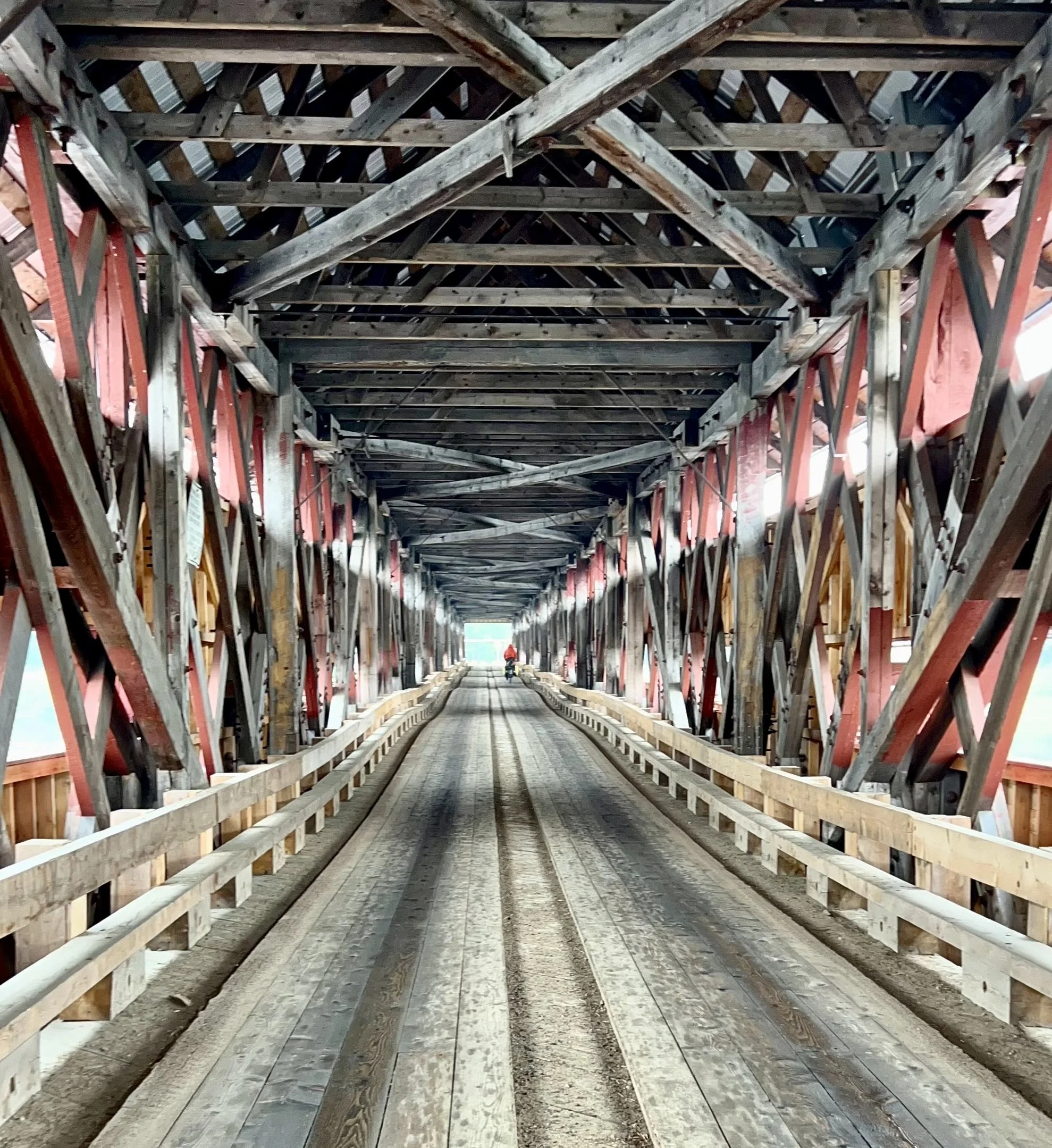
Michael bikes across a covered bridge in Mansfield et Pontefract, Quebec. Photo by Jenny Hershey. Follow her on Instagram @ deeofo.
But it’s not just a couple of red states that are being forced to capitulate to the self-evidence of market forces. Other parts of the world are willing to get serious about the energy transition, as well. China remains focused on cornering the huge new clean energy market, with ever-more massive investments in electric vehicle production, battery technology, wind turbines and solar panels. Europe continues to aggressively wean itself off both oil (through electric vehicle mandates) and Russian gas imports (through energy conservation and the rapid deployment of renewables). Canada established a price on carbon several years ago to incentivize clean energy development. Currently, 90% of the revenue from a federal fuel charge goes directly back to households through the climate action incentive payment (CAIP). This is a tax-free benefit the government pays back to citizens to help offset the cost of carbon pricing. The average household gets back more than they’ve paid into the system. Only higher income households pay more than they get back because they tend to use more fossil fuels.
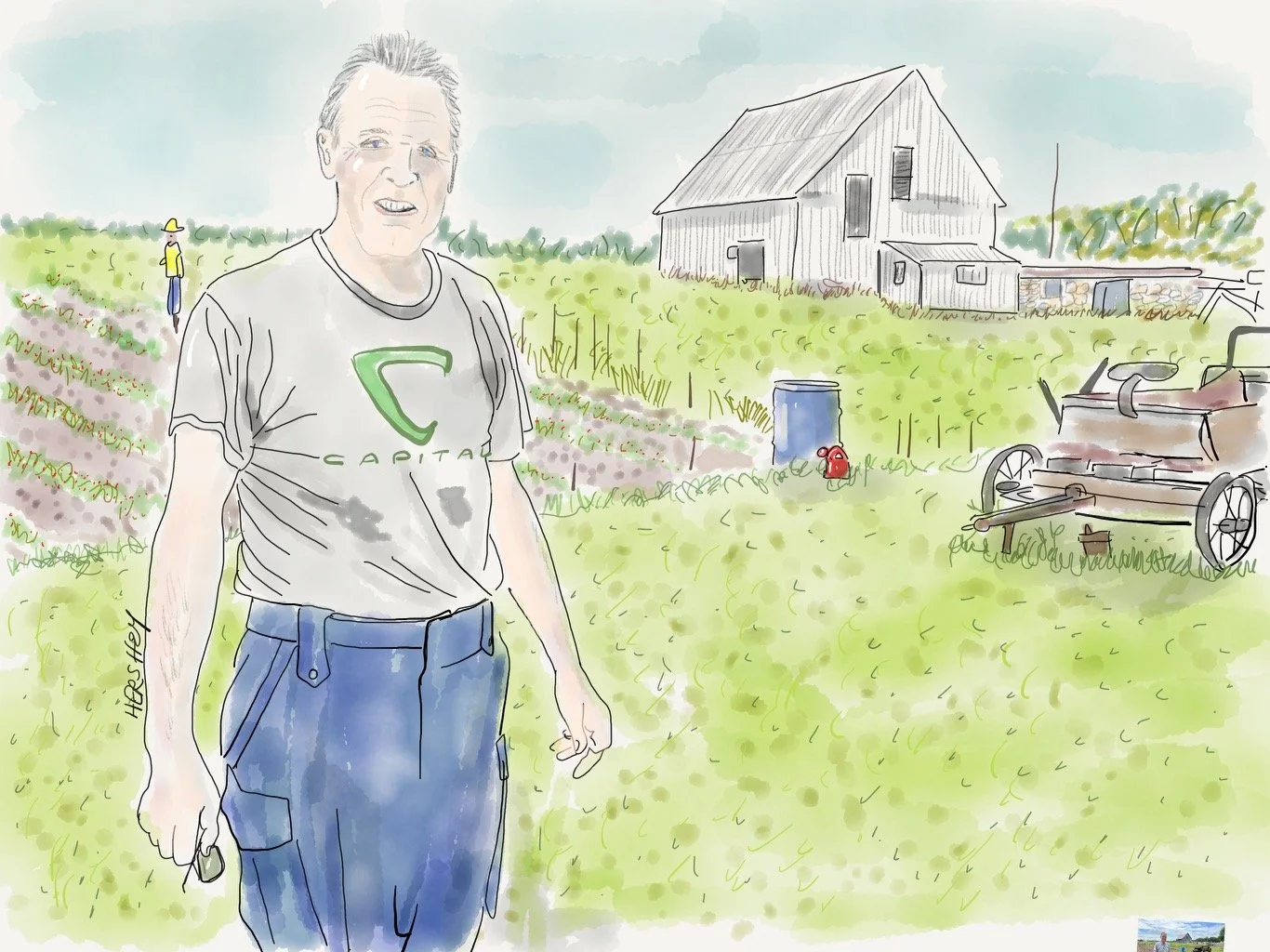
Al is a retired policeman from Ottawa. We met him in Renfrew while he was tending his garden. He was eager to chat and showed us a stone house from 1865 he had purchased from a family that had acquired homesteading land from the Crown seven generations earlier. Al was proud of his antique collection. Eventually we asked about the wildfires. He believes the fires were most likely started by carelessness, and maybe some lightening. He hedged about the climate but eventually agreed with us the climate is changing. A very friendly guy, Al sent us off with a classic milk bottle and a horseshoe for luck (both somewhat challenging to carry on our bikes, but he was insistent). Michael gave the milk bottle away to our host Jeff Mills, and Jenny left the horseshoe at a farm stand with a couple of Mennonite boys, telling them it might bring good luck. Their father quickly corrected Jenny, saying Mennonites don't believe in luck. But the boys kept the horseshoe anyway. Drawing by Jenny Hershey. Follow her on Instagram @deeofo.
So for all the reasons above, Democrats and other environmentalists in the States don’t need to worry as much about opposing fossil fuel projects as they need to be thinking about getting stuff built, not only to address climate but to keep our economy strong. Yet make no mistake; building out clean energy projects in the United Sates and getting that energy to residents and industries won’t be an easy task, even if that energy is already cheaper and cleaner than fossil fuels. Without a serious effort to streamline permitting and double the size of our utility grid over the next decade (while effectively engaging communities in decision making), we may fail to accomplish up to 80% of the decarbonization goals of the Inflation Reduction Act (IRA).
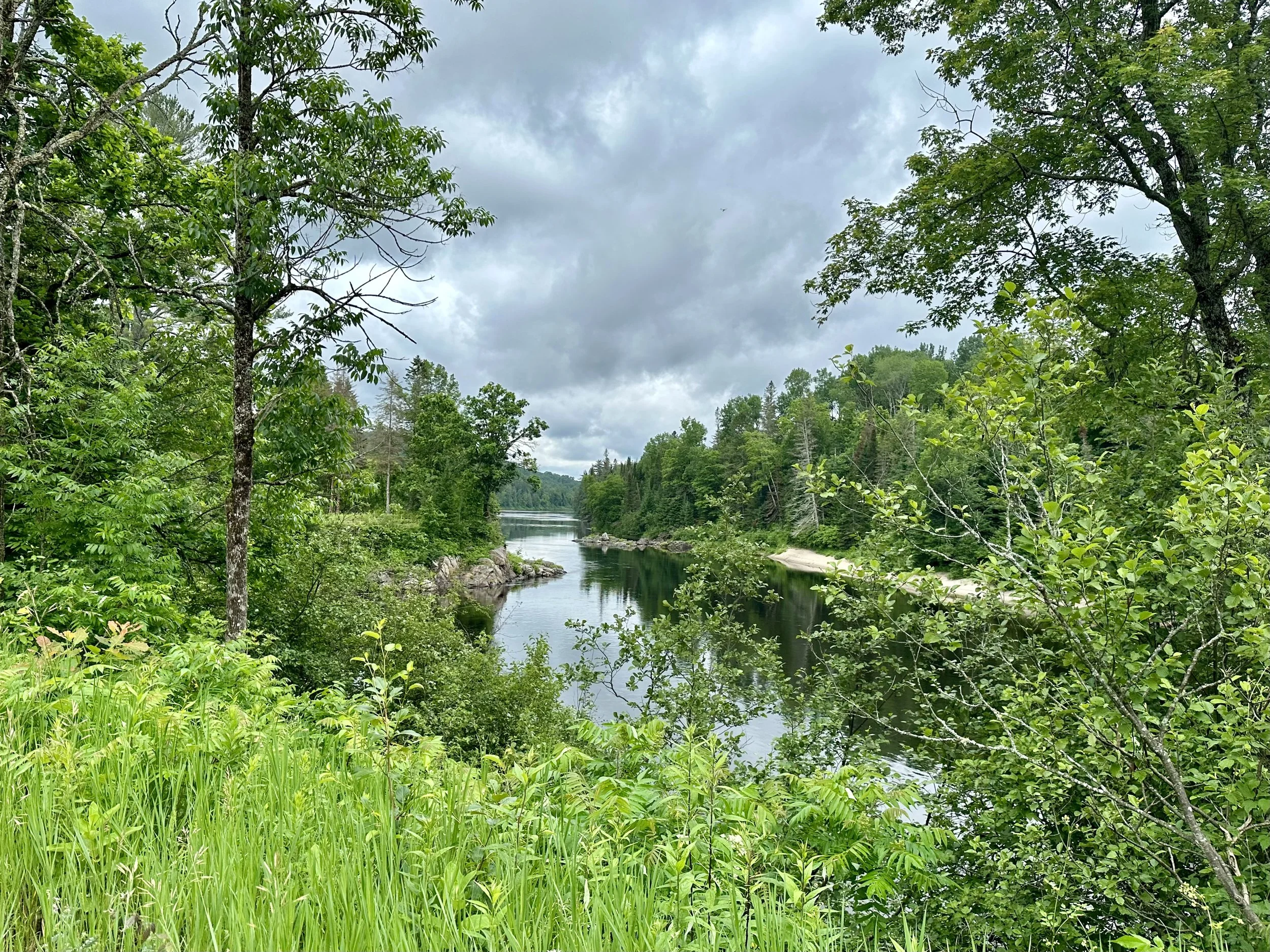
This photo was taken northwest of Fort Coulonge, Quebec, on an unpaved road called the Chemin du Bois Franc. The road extends north for more than a hundred kilometers and is one of many rugged routes into Quebec’s boreal forest. Although we weren't able to ride north on this road for more than about 20 kilometers we felt like we got a small taste of the forest. It was humid, extremely buggy, and although we were told it was unusually dry, we saw water everywhere. Not only is Canada’s boreal forest rich with trees that sequester huge amounts of carbon, it is also home to one of the most significant stores of fresh water on the planet. Photo by Michael Chase. Follow him on Instagram @mjohnsonchase.
————
Wildfires and Conspiracy Theories
“No amount of evidence will ever persuade an idiot.”
-Mark Twain
————
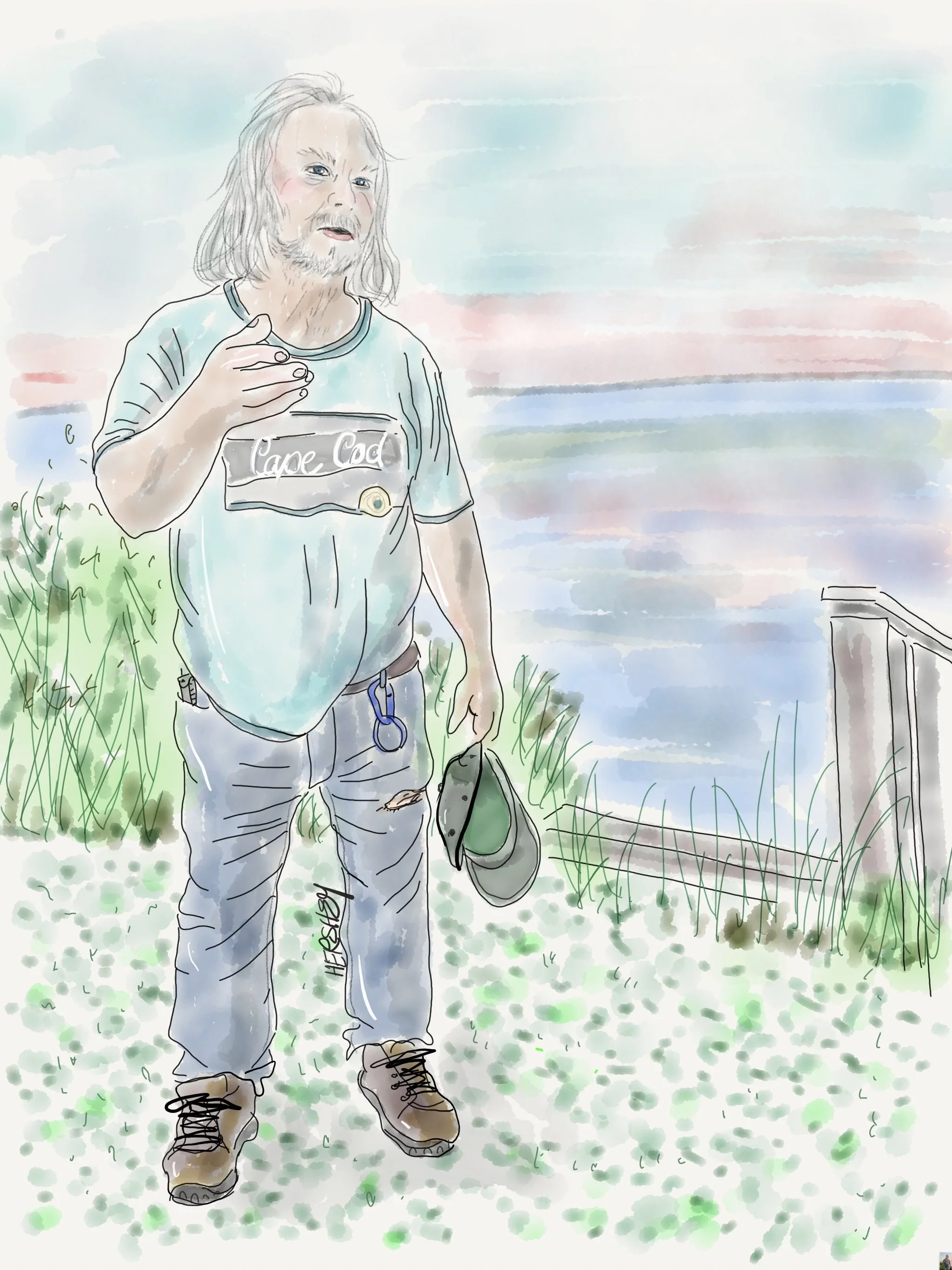
We met “Andy” and his wife “Carol” in Cape Vincent, NY. “Carol” invited us down to the Lake Ontario shoreline to share a sunset made even more intense by wildfire smoke drifting toward us from Quebec. As we talked, “Andy” began to share thoughts about how a group of elites from around the world are plotting to eliminate individual liberties to impose a dictatorial, one-world government. He threw out some names: Klaus Schwab, Rothschild, Mayer, Zuckerberg, Bill Gates…. We were curious and a bit uneasy. So, later in the evening Jenny and I did an internet search. “Andy’s” searches probably go directly to “The Great Reset Conspiracy” attributed to the World Economic Forum (WEF); a conspiracy of world control by a select few through Covid mandates, climate lockdowns, space lasers, and ecoterrorism. “Andy” may assume everyone else will find the same information if they bother to look. But that’s a danger of the internet and misinformation. Search engines learn how to show you results you are most likely to like to maximize your eyeballs on associated advertising. Consequently, whatever information we encounter online, we curate online through our own interests and biases. So, Jenny and I had to do some digging. Apparently “Andy” didn’t notice the Star of David around Jenny’s neck; in any case, she didn’t sleep well that evening. Drawing by Jenny Hershey. Follow her on Instagram @deeofo.
As we are all too aware, Canadian wildfires have been burning for weeks. Research shows that record heat and drought creates earlier starts to every season (with this year breaking all records), resulting in wildfire activity that is longer-lasting and more intense. Caused by a mix of human activity (carelessness and arson), and lightning, it is clear that climate change affects the local conditions and fuel available for these fires to spread, as do the decades of fire suppression techniques that have contributed to unnaturally dense forest environments.
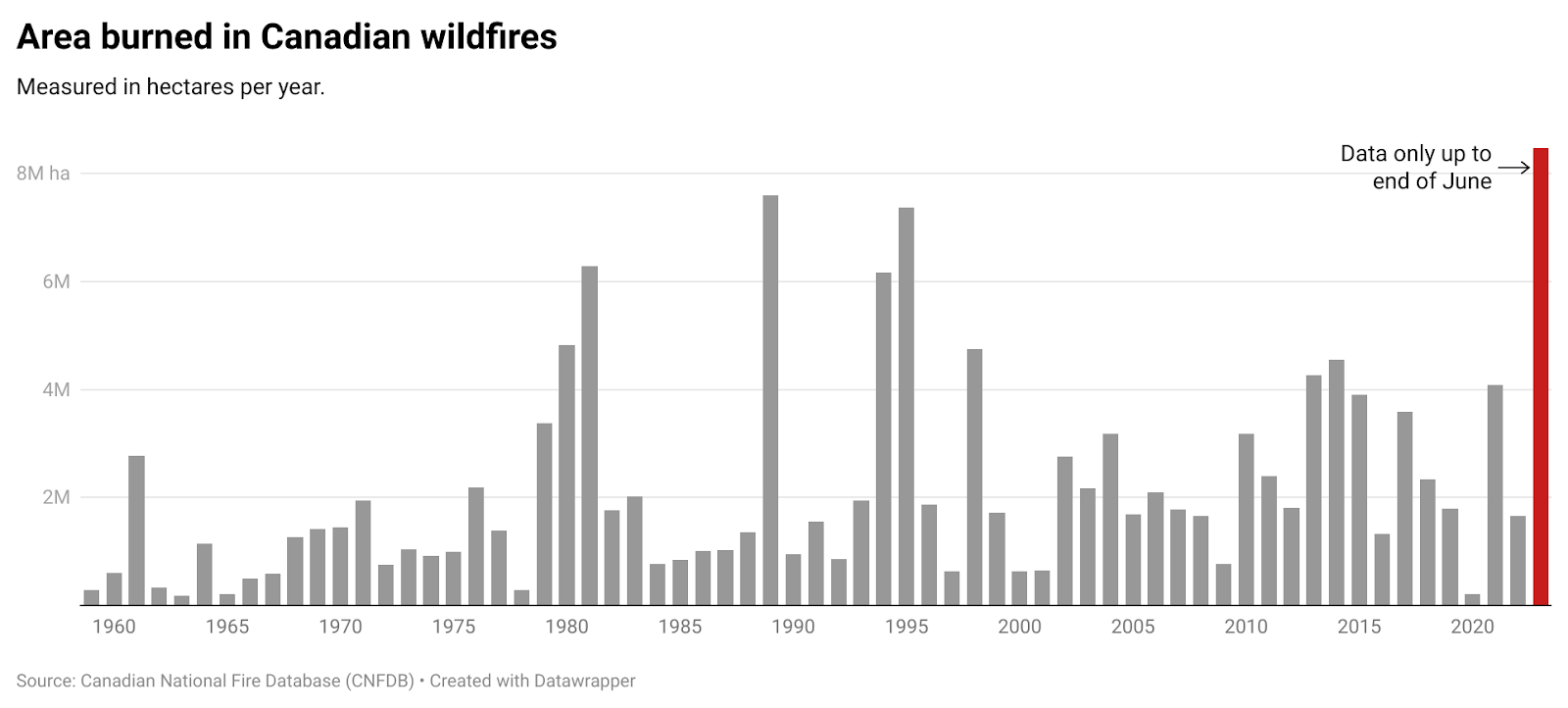
This simple bar graph indicates that by the end of June of this year, a greater percentage of hectares have already burned in Canada than any year since records have been kept. Some news outlets argue that climate change isn't the cause of wildfires because the number of annual fires has been decreasing. However, they all ignore the sheer size and destructive nature of the current fires.
New Yorkers won’t soon forget what the air quality was like on June 7th, 2023. At its peak in the afternoon, the air quality index (AQI) for the city reached 405 out of 500; the highest since records began, according to an analysis of the Environmental Protection Agency (EPA). While we have been biking in Canada over the month of June, over 400 wildfires have continued to drive air quality indexes to record levels in many cities across the eastern seaboard and the midwest. Air quality has been equally poor in Canada. Yesterday (7/2/23), four of the five cities with the worst air quality in the world were in North America. New York City had the second-worst air quality in the world with a recorded air quality index of 162, lagging only behind Jakarta. Toronto and Montreal ranked 3rd and 4th, reporting AQI’s of 155 and 153, respectively. The fifth-ranked city, Washington, D.C., is hundreds of miles away from where Canadian wildfires continue to rage. There, air quality was slightly better than the other three North American cities on the list, with an AQI of 122.
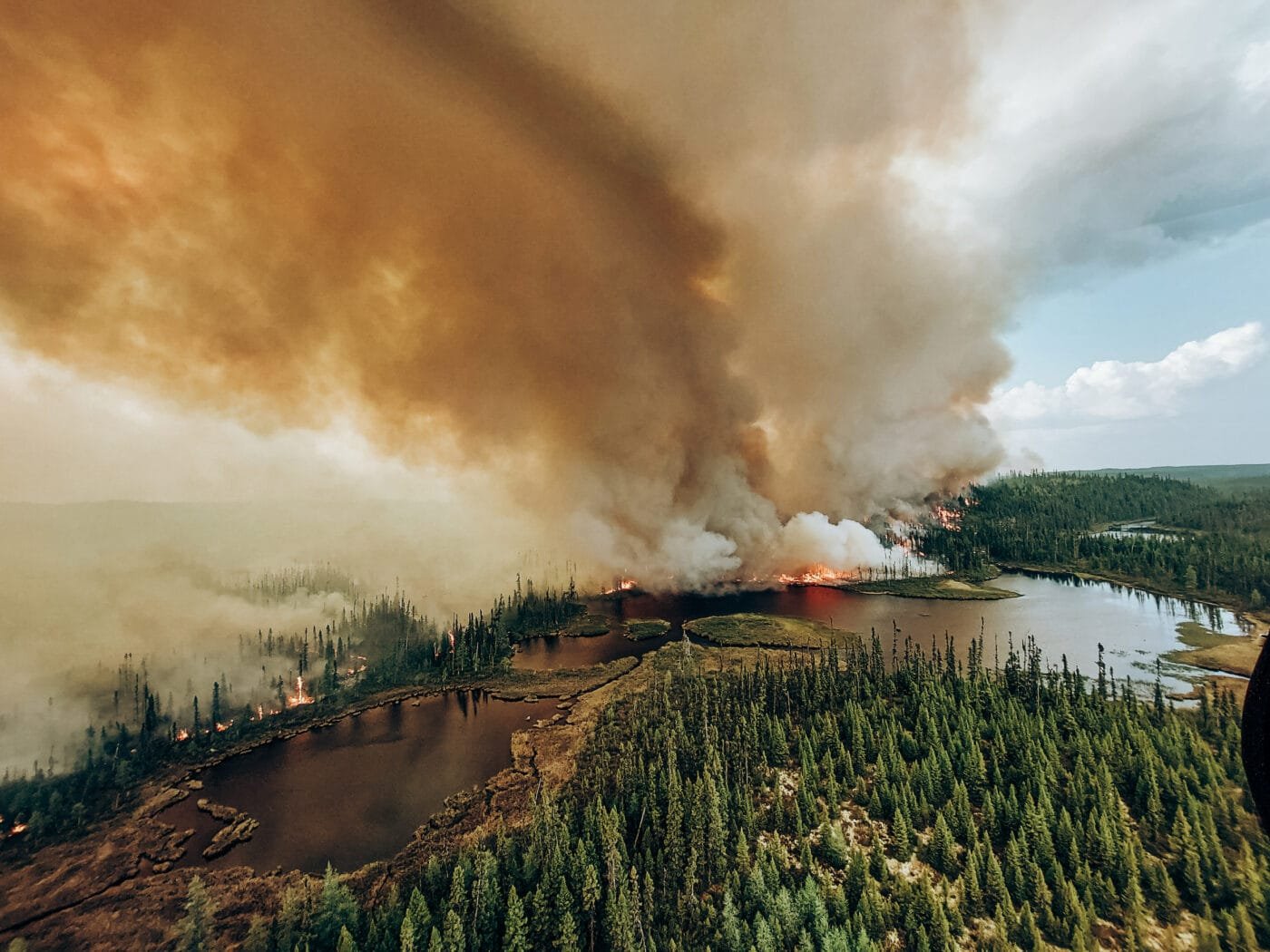
Almost 40 per cent of Canada’s 2023 wildfires have been in Quebec, threatening to evacuate more than 15,000 people. Photo: Société de protection des forêts contre le feu; as seen in The Narwhal.
Ten percent of the world’s forests rise up from Canadian soil, and increasingly those forests look poised to burn as our atmosphere grows warmer. Consider the following passage from a poetic and startling new book by John Vaillant called Fire Weather: “Girdling the Northern Hemisphere in a circumpolar band, the boreal forest is the largest terrestrial ecosystem, comprising almost a third of the planet’s total forest area (more than 6 million square miles—larger than all fifty U.S. states). Fully a third of Canada is covered by boreal forest. Continuing west, over the Rocky Mountains, through British Columbia, the Yukon, Alaska, and across the Bering Strait into Russia (where it is known as the taiga), the boreal forest stretches all the way to Scandinavia and then makes landfall on Iceland before picking up again in Newfoundland and continuing westward to complete the circle. It is a green wreath crowning the globe. This colossal biome stores as much, if not more, carbon than all tropical forests combined and, when it burns, it goes off like a carbon bomb. Under the right conditions, a big boreal fire can come on like the end of the world, roaring and unstoppable. These are fires that can burn thousands of square miles of forest along with everything in it, and still be out of control.”
The scale is hard to get my head around. You may feel the same. And if that wasn't sobering enough, here's another important milestone; fires across Canada this year have ALREADY generated nearly 600 million tons of CO2, which is equivalent to 88% of Canada’s total greenhouse gas emissions from all sources in 2021. More than half of that carbon pollution went up in wildfire smoke in June alone. And the fire season here is only beginning.

Jenny (left) and Chandler Swain. We met Chandler at our dinner with Jeff and Gillian Mills. Chandler is a master potter, artist, environmental activist and communications director for the Climate Network in Lanark County, Ontario. Although Jenny rarely draws herself, she felt a strong bond with Chandler, whose enthusiasm, tenacity and buoyant energy is infectious. Chandler’s passion for environmental work has led her to write about network initiatives for the local online paper, The Humm. Her personal website can be found here. Drawing by Jenny Hershey. Follow her work on Instagram @deeofo.
And the causes of the fires? Well, as we discovered through our conversations with some Canadians (but not all, thankfully), blaming wildfires on the unusually hot and dry conditions resulting from a gradually warming world brought on by 250 years of unrelenting greenhouse gas emissions is, well, a bit too convenient. After all, why buy into dry weather that makes human carelessness or lightning strikes the reason (but not the root cause) when you can believe in something far less complex? Stew Peters, the same man who made a film claiming that Covid-19 is caused by synthetic snake venom, blamed the Canadian wildfires on Directed Energy Weapons on June 5th of this year. Apparently he sent out a TikTok video with visuals that made southeast Quebec appear as though hundreds of locations were catching on fire at the same time. This allowed him to claim that “our governments” are targeting their own forests for nefarious reasons.
I'm not sure if Directed Energy Weapons (DEWs) are related to the infamous Jewish Space Lasers that Congressional Representative Marjorie Taylor Greene previously implicated in a wildfire outbreak, but it's clear her theory is followed. Here it is on Donald Trump’s Truth Social. According to the Congresswoman, forests don’t catch fire simply because they are extraordinarily hot and dry. Representative Greene claimed the blazes had been started by PG&E in conjunction with the Rothschilds, by using a space laser to clear room for a high-speed rail project. Really, one cannot make this stuff up. For those of you who don’t believe me, you can read Greene’s entire post here on Media Matters.
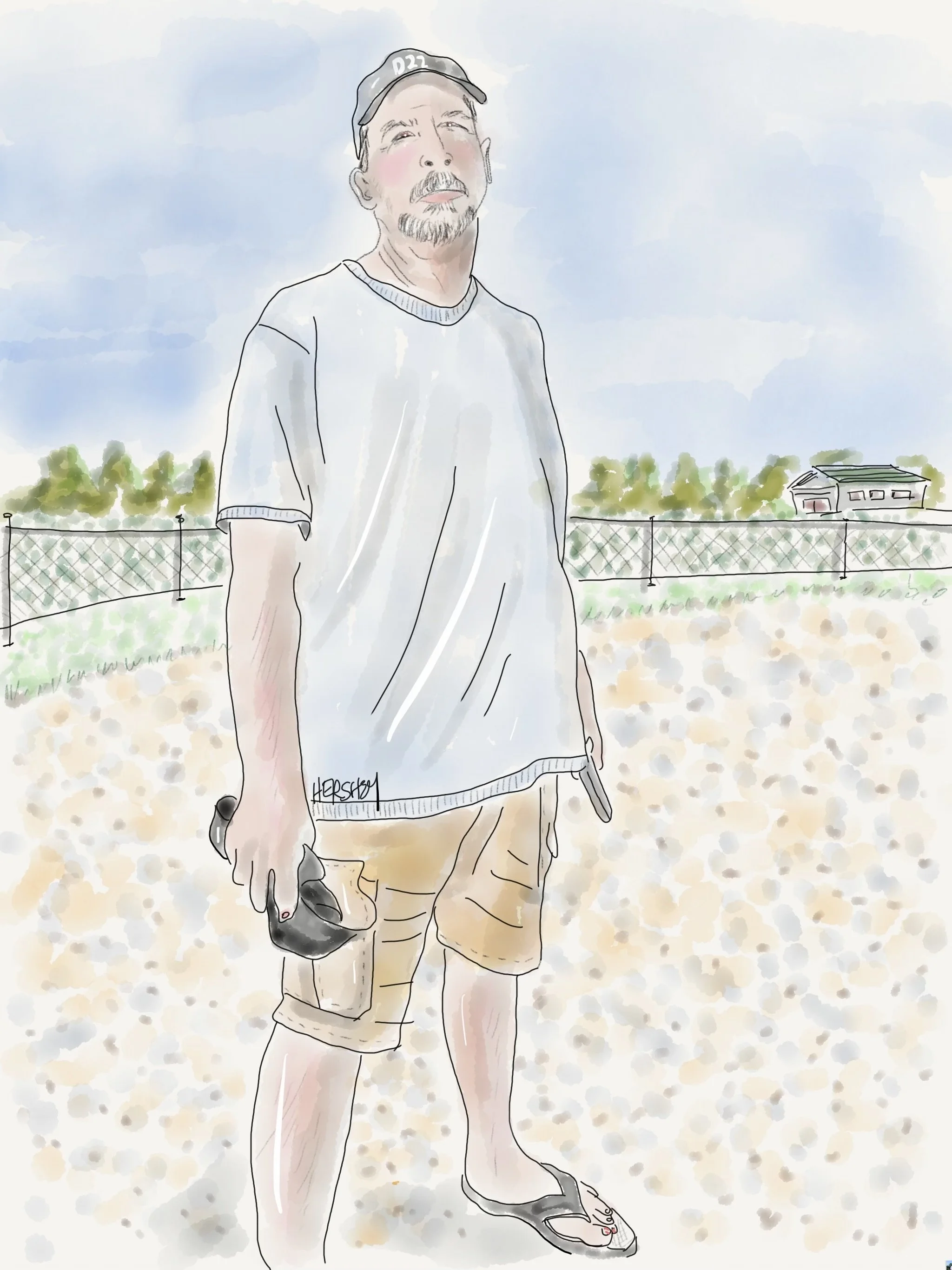
We stayed in Alain and Paola’s small cabin behind their home in Mansfield-et-Pontefract. Alain is a retired postman. He started his route after graduating from high school when he was 16 years old. His dad was a supervisor and he wanted to follow in his father's footsteps. Alain walked 20 Km (12 miles) a day, year round, using ice cleats to navigate cold, icy winters for over 40 years. Each neighborhood he serviced brought new friendships and relationships. Alain said, “I don’t get attached easily, but the old folks - they’d wait all day for me. I was sometimes the only person they talked to. It was hard to walk away.” Alain is very devoted to his wife. He is also a superb Airbnb host with a simple philosophy—deliver hospitality! Drawing by Jenny Hershey. Follow her on Instagram @deeofo.
But not all the theories borrow from Conspiracy mongers who make their homes in the States. Alberta Premier Danielle Smith (who is not friendly toward Canadian climate policies) was asked about the cause of Alberta wildfires in early June by Canadian talk show host Ryan Jespersen, and suggested that the more than 175 fires burning in Alberta at the time were all caused by arson, not climate change. Others in Canada have taken the arson theory a step further, indicating that the arsonists are Trudeau government operatives who are out to increase the federal carbon price.
Our friend Andy from Cape Vincent disturbed us with his reference to a cabal with mostly Jewish names, seemingly unaware that he (and others of his ilk) are dredging up the same anti-Jewish theories that preceded the Nazis and the rise of Hitler. “Anti-Jewish prejudice is very old – it goes back to antiquity – but the 19th century was crucial,” writes Matthias B. Lehmann, Teller Family Chair in Jewish History and professor of history at UCI, in The Baron: Maurice de Hirsch and the Jewish Nineteenth Century. “It was the moment when modern-day antisemitic conspiracy theories first crystallized, and those are still very much being used today.”
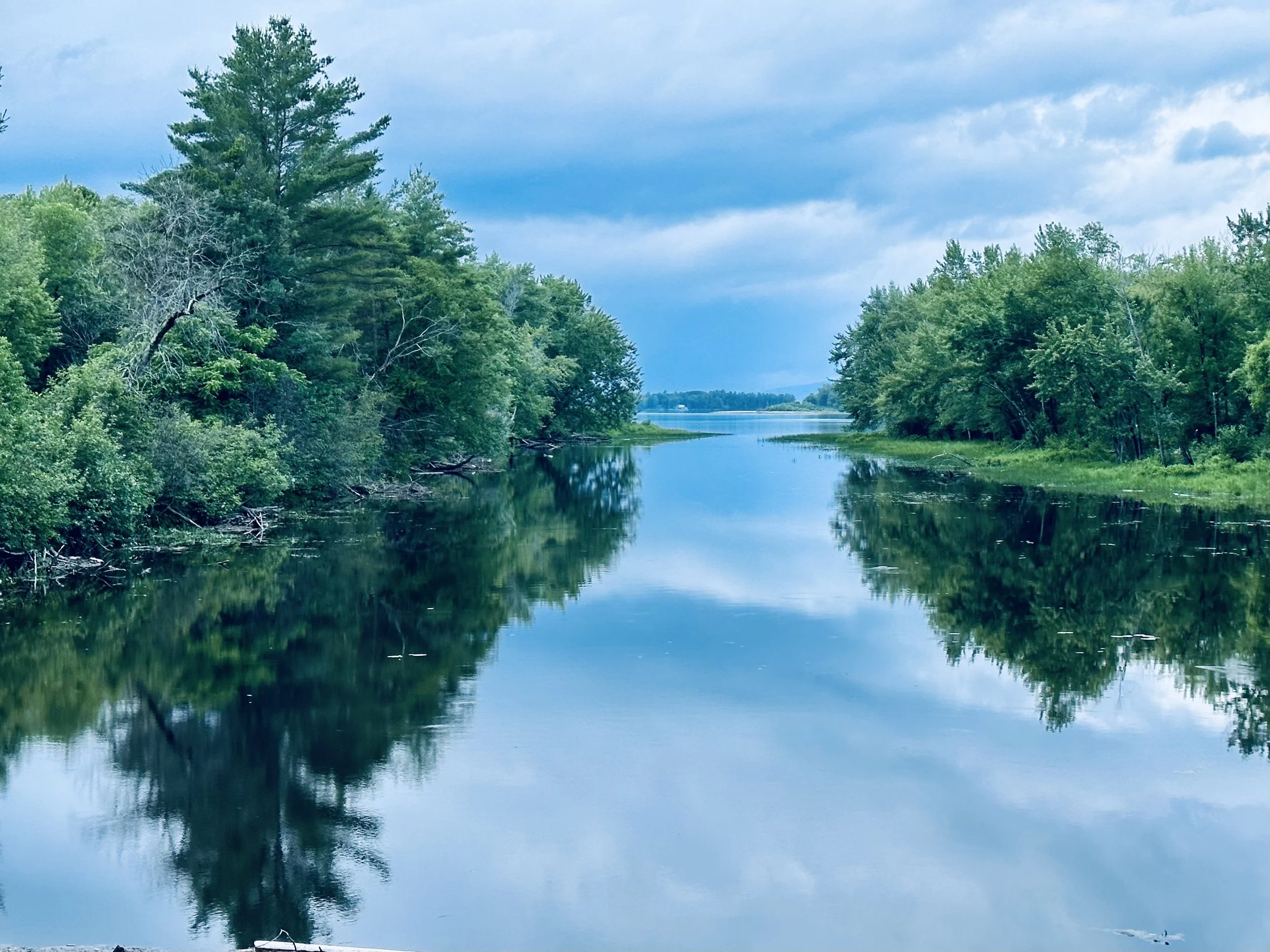
A view of the Coulonge River looking north. We were told that one of the smaller fires in Quebec was about 75 miles north of here. Photo by Michael Chase. Follow him on Instagram @mjohnsonchase.
Sometimes the enemy is the U.S. government and Biden, or the Canadian government or Trudeau. Or it's a cabal of rich people connected to the World Economic Forum wanting to control the world. Or sometimes it’s wealthy people in general, especially if they are Jewish. Or blacks or Hispanics or Muslims. Or they might be communists or socialists. Or Democrats. Or LBGTQ people. Or Public Health officials. Recently it was the queen of England, believed by a number of people to be the head of a brutal global drug cartel. As Anna Merlen writes in her fascinating book, Republic of Lies, conspiracy theories are, in the end, not so much an explanation of events as they are an effort to assign blame. More than questioning an official narrative, they are aimed at identifying the real perpetrators, the true power behind the throne, the hidden hand pulling beneath the surface.
So, it almost seems quaint that a not-insignificant chorus of Canadians blame the current wildfires sweeping across much of the country on climate activists and laser-less government operatives willing to drive into the woods and strike a match. It’s those pesky arsonists, and not natural forces or human carelessness driven by a hotter and drier climate that’s the real culprit for all the choking smoke that has driven children, seniors and others with respiratory issues inside, blocking out the sun and making air nearly impossible to breathe.
Whoever, or whatever it is, it's likely to happen more and more often until well after we decarbonize our atmosphere.
Let's get on with it.
Stay vigilant! Thanks for reading. If you haven’t done so, please subscribe to this blog to follow our next biking trip.
Blog writing by Michael Chase. Drawings by Jenny Hershey. Unless credited or otherwise noted, all material is the copyrighted property of the blog post authors.
Here are a few more photos from the trip:
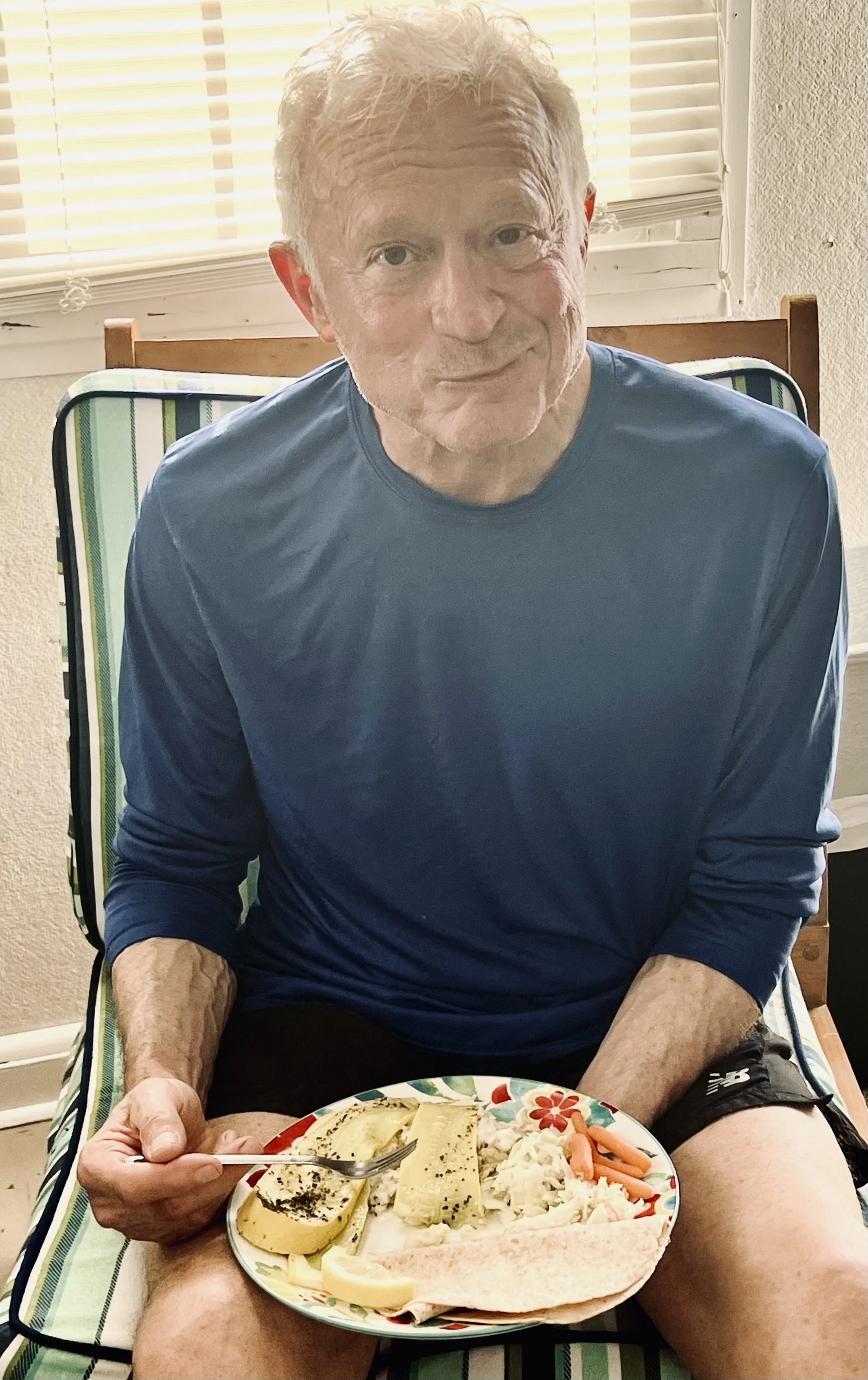
Michael enjoying one of Jenny’s extraordinary meals.Although Michael is a decent cook in his own right, Jenny has become an exceptional cook on the road, and we eat very well using local produce and protein and the microwaves we find in our modest accommodations. Photo by Jenny Hershey. Follow her on Instagram @deeofo.
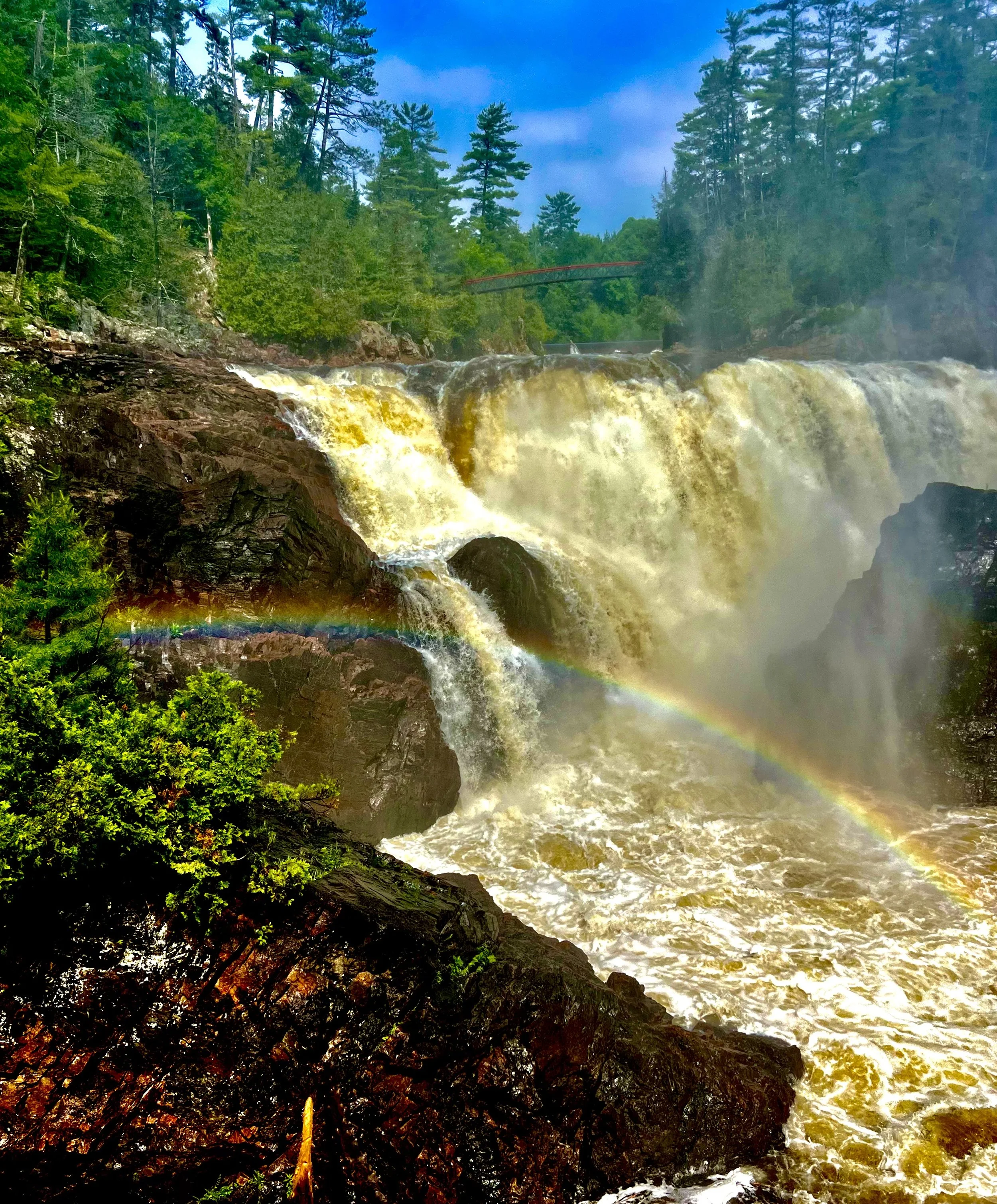
The Chutes de Coulonge on the Coulonge River in Quebec. Photo by Jenny Hershey. Follow her on Instagram @deeofo.
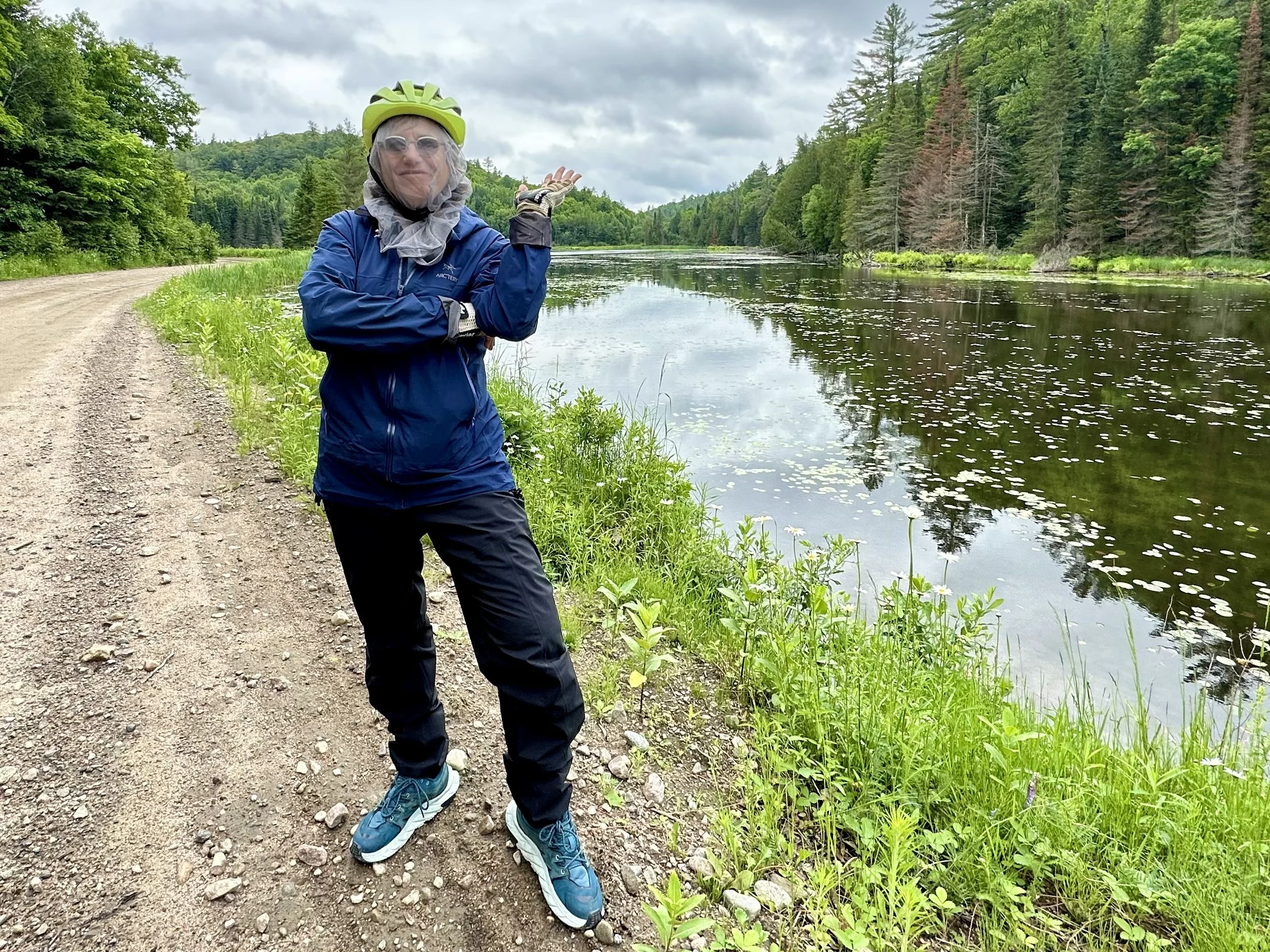
Jenny with a mosquito net over her head goofing around in Quebec. Photo by Michael Chase. Follow him on Instagram @mjohnsonchase.
Money Talks and Goliath Walks; Biking from Birmingham to New Orleans
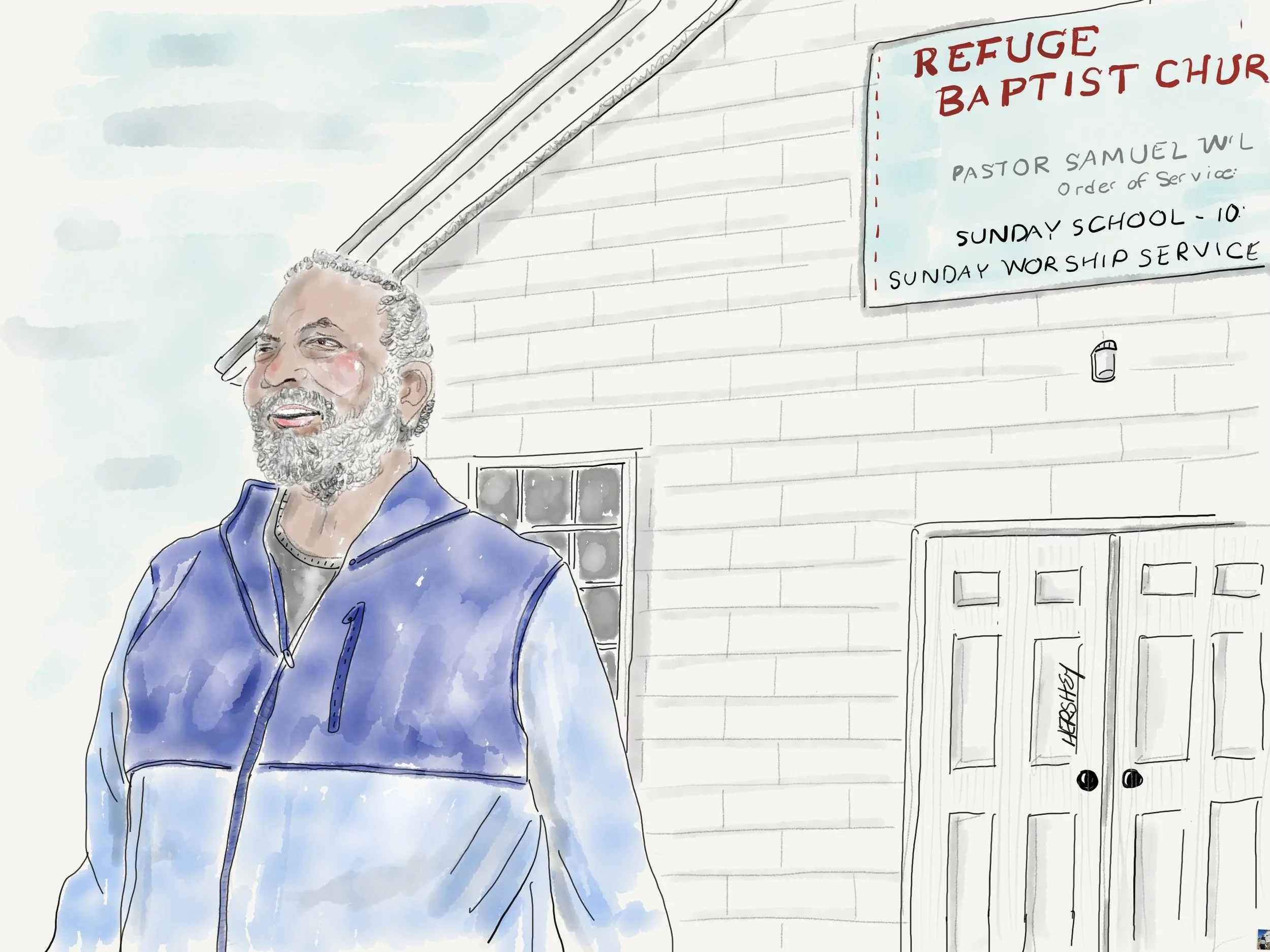
Jenny and I met Pastor Samuel Williams on the outskirts of Tuscaloosa. Although he was fixing a frozen water pipe outside his church (which had prevented him from having services that day), he stopped working and gave us his full attention when we asked about a closed road ahead. A patient and charitable man, the Paster’s dedication to spiritual life was palpable, and he seemed to exude peace and happiness. When he learned we live in New York City, he asked us immediately if we had been affected similarly to Buffalo. We told him thankfully not, although NYC was experiencing its own extreme weather with unusually warm temperatures for January with lots of rain. But we had woken up to 28 degrees Fahrenheit in Tuscaloosa that morning, so it was easy to understand why his pipe had frozen. We all had a good laugh about how unpredictable the weather was growing. As we started to bike away, Jenny reflexively remarked, “Take care, Pastor Samuel.” The Pastor’s response took us by surprise “According to scripture, taking care means a person is experiencing anxiety and needs to give it away to God. So I think you mean take it easy”. So be it, Pastor Samuel. We’re taking it easy… Drawing by Jenny Hershey. Follow her work on Instagram @deeofo.
“We must accept finite disappointment, but never lose infinite hope.”
–Martin Luther King, Jr.
Finally Jenny and I are back on the road, this time in the Deep South. After a hiatus in bike touring to manage some family affairs last summer, we were fortunate enough to take an early autumn bicycling tour through the northeast and a bit of Quebec. I was about to publish a post late in that trip when both Jenny and I contracted Covid. While recovering, my mood grew so dark that I abandoned the post (I have since learned that depression can be a symptom of Covid). I didn’t want to inflict my grim mood on others - and there’s only so much one can say about the growing potential for societal collapse if GHG emissions continue to rise (alas, it looks like we will increase GHG emissions yet again in 2023). It had already been a very rough year for extreme weather events, foreshadowing deeper challenges to come as our climate grows less stable.
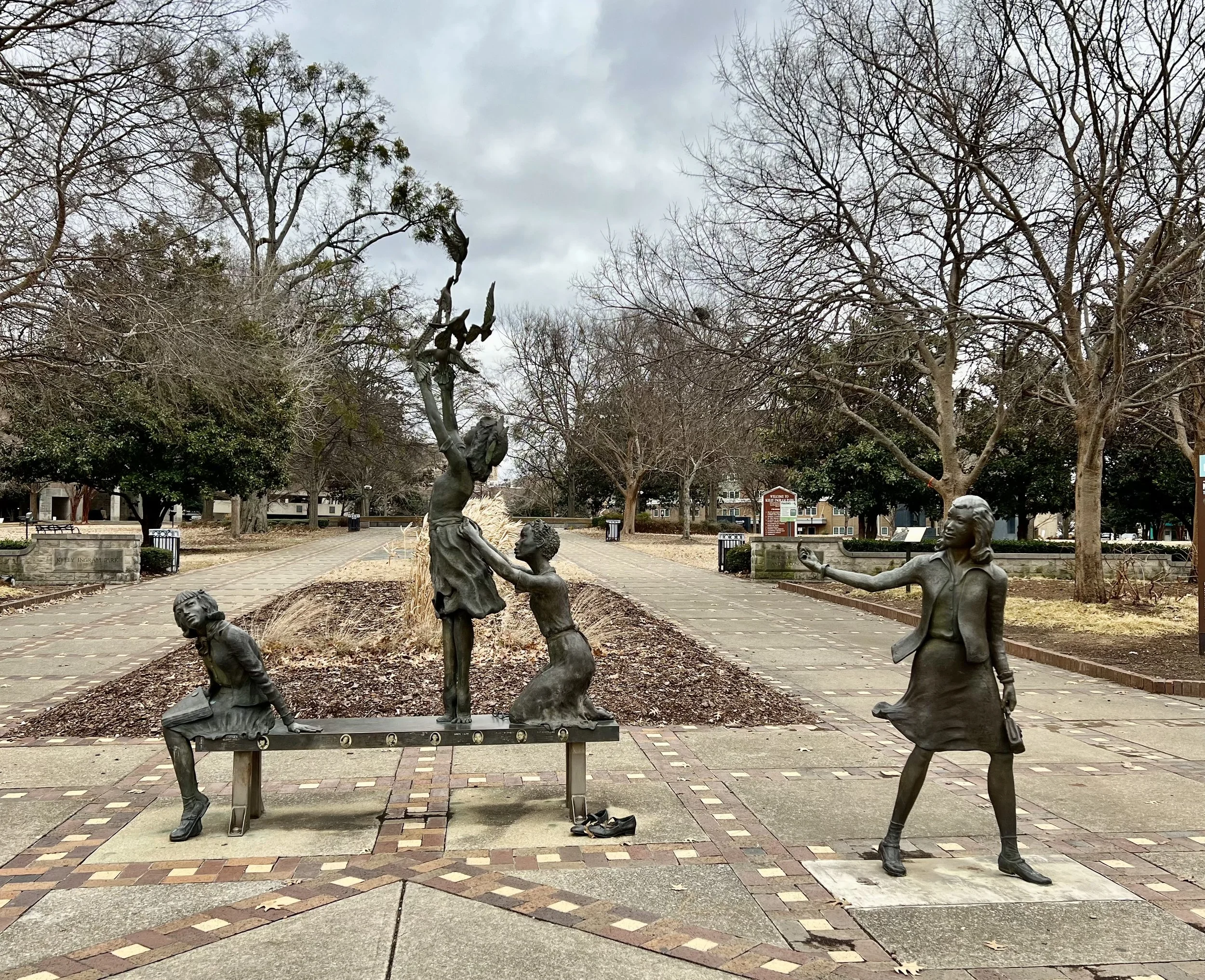
A statue of the girls who perished in the 16th Street Baptist Church bombing in Birmingham, Alabama on Sunday, September 15, 1963. Described by Martin Luther King as "one of the most vicious and tragic crimes ever perpetrated against humanity," the explosion at the church killed four girls and injured between 14 and 22 other people. Photo by Jenny Hershey. Follow her work on Instagram @deeofo.
And as usual, the most vulnerable among us are the impacted the greatest. I was feeling especially bad for people in the global south who have been ravaged by climate related disasters. I was also discouraged by the game of chicken underway by a few members of Congress as meaningful climate legislation was repeatedly on, and then off, the table. Although I knew the world was about to break yet another GHG emissions record for 2022, I didn’t know until late in the summer that Chuck Schumer, Joe Manchin and other Senators were engaging in backroom log rolling toward a revised version of the Build Back Better plan. Had I known, I might not have been so discouraged.
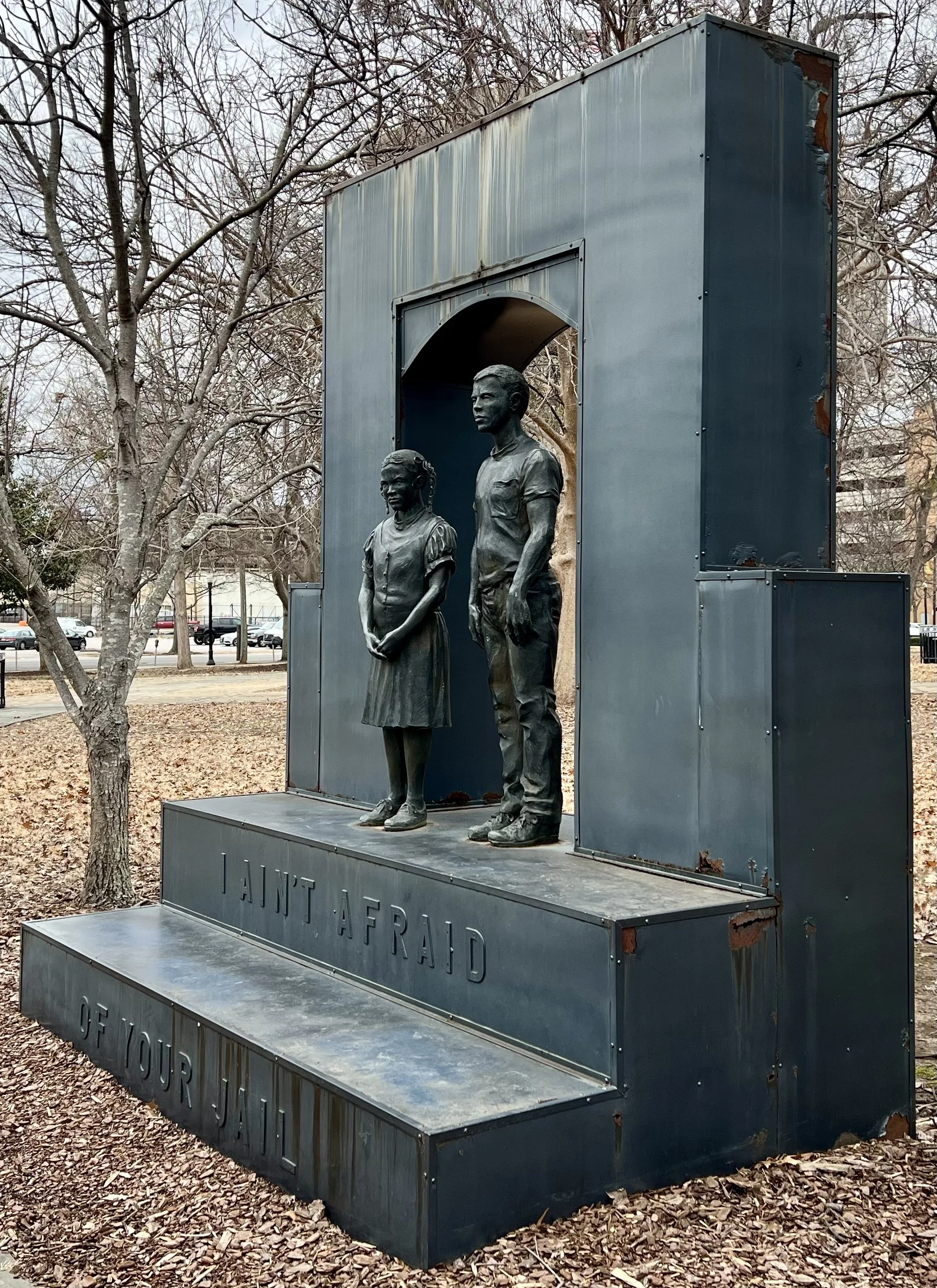
A statue in Kelly Ingram Park in Birmingham commemorating student protests that occurred for weeks after the 16th Street Baptist Church bombing, bearing the inscription “ “I ain’t afraid of your jail.” Photo by Michael Chase. Follow his work on Instagram @mjohnsonchase.
You may have felt similarly. Just to remind us of how extreme weather events are both speeding up and cascading, here is a cursory review of global events from the spring of 2022 through the early winter of 2023:
As a result of persistent droughts, communities across Africa, including Kenya, Nigeria, Ethiopia, and Somalia currently face the worst food crisis seen in 40 years. Earlier in the summer of 2022 more than 2,000 people died in Spain and Portugal during a brutal heatwave, while drought in Somalia displaced more than a million. In the United States, climate-related disasters exceeded $1 billion in damages the first 6 months of the year, including the ongoing drought in the west and southern plains and a tornado outbreak in Alabama, Florida, and Mississippi in March. In late July heavy flooding in eastern Kentucky killed at least 38 people. Also in July, parts of the United Kingdom saw temperatures soar for the first time ever to 104 degrees Fahrenheit, and much of Europe similarly suffered. In Pakistan, one third of the country experienced widespread destruction from three months of heavy rains after a prolonged period of heat in the spring. Flooding killed more than 1,400 people across the country during the summer and damaged or leveled more than a million homes, including many that were swept away by water. In total, over 30 million people have been affected. Additionally, Pakistani farmers lost up to a million head of cattle as well as 90% of the country’s fall harvest. Now starvation looms for millions of people as Pakistan faces a “second wave of death” that is likely to spiral toward implosion without major global assistance. September brought Hurricane Ian to the Caribbean and Florida, upending the lives of thousands, killing 109 people in the US alone, and resulting in a staggering $100 billion in damages. Then, a record-breaking snowstorm and polar vortex slammed much of the midwestern and northeastern US in January and produced a massive snowstorm that killed over 40 people in Buffalo in early 2023. That tragedy was followed by three weeks of extraordinary rain in California as a stubborn weather pattern sent wave after wave of tropically-infused atmospheric rivers, triggering widespread flooding, landslides and power outages across the state. At the same time, the mountains were buried under several feet of snow. 22 people were killed, and damages are still being assessed. Shortly thereafter, there were record breaking rains in New Zealand, freezing cold across the South and a polar vortex in New England. …and it’s only going to grow worse. Buckle your seat belts, folks. That's only the beginning.
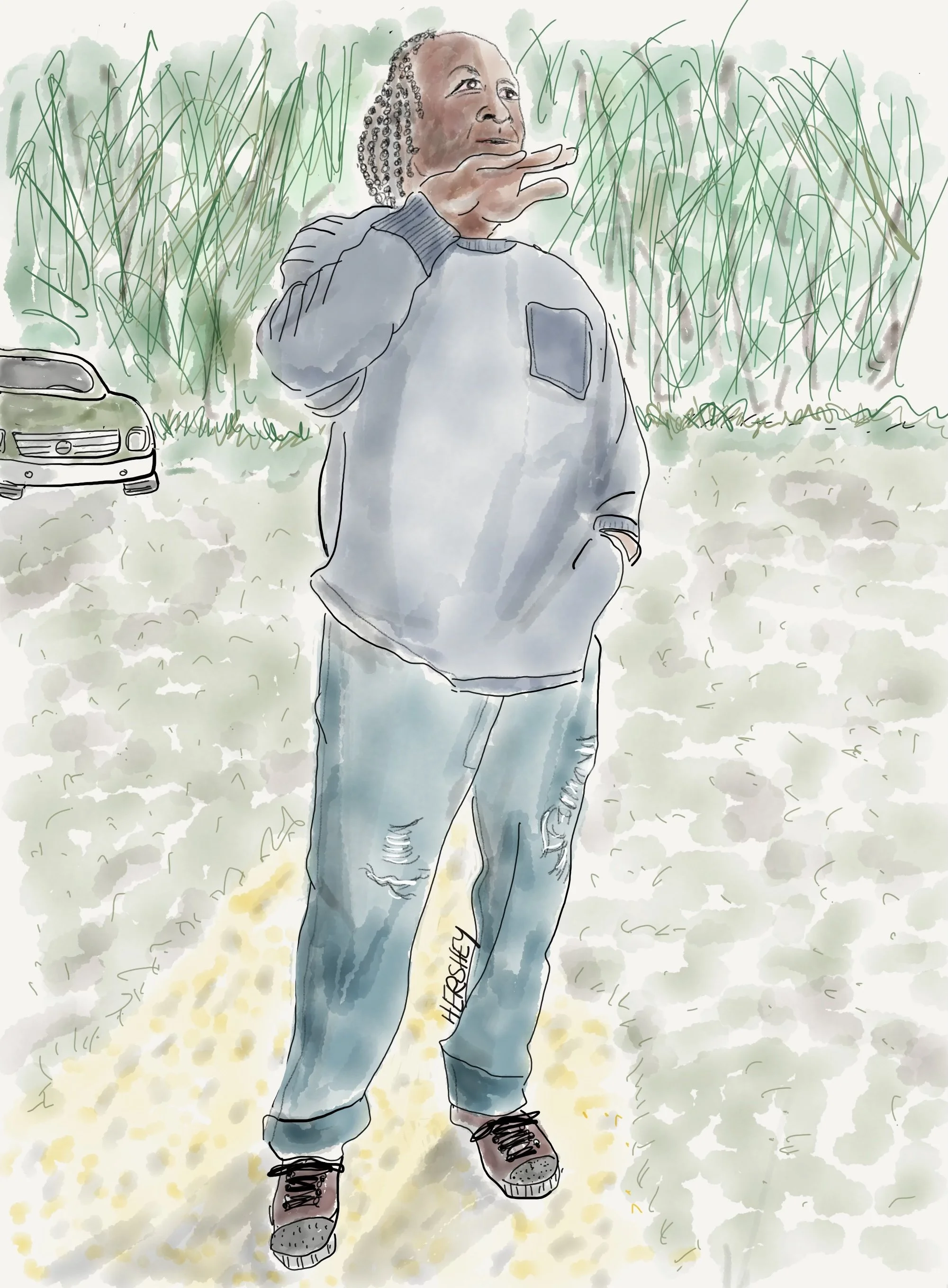
We met Joe deep in the countryside outside of Fosters, Alabama. He was content grazing his six cows on a neighbor’s land across the road. He is hoping for a little growth in his herd when a bull joins his girls next month. He also enjoys a small herd of goats that roam freely on his property just because, “he likes them.” Joe lives a simple life by making and selling his own BBQ sauce. He lives a cherished “second life” after a near-death automobile accident (during the Covid pandemic) that laid him up for over a year. Drawing by Jenny Hershey. Follow her work on Instagram @deeofo.
As I recovered from Covid my depression began to lift, yet I continued to wrestle with my grim perspective of the future. It helped to study two bills passed in the last Congress - the Inflation Reduction Act and the bipartisan Infrastructure Investment and Jobs Act. Almost as an act of will, I have chosen to believe in their potential. While I am certain that significant change is coming straight at us, things can - and may - change as much for the better as they can for the worse. Perhaps society will re-organize in an increasingly aggressive climate in a manner to avoid civilizational collapse, maybe making civilization even more - well, civilized. In any event, I have decided that a curated vision of the worst possible outcome is not good for one’s mental well-being - even if one is proved right. I’d so much rather be proved wrong.
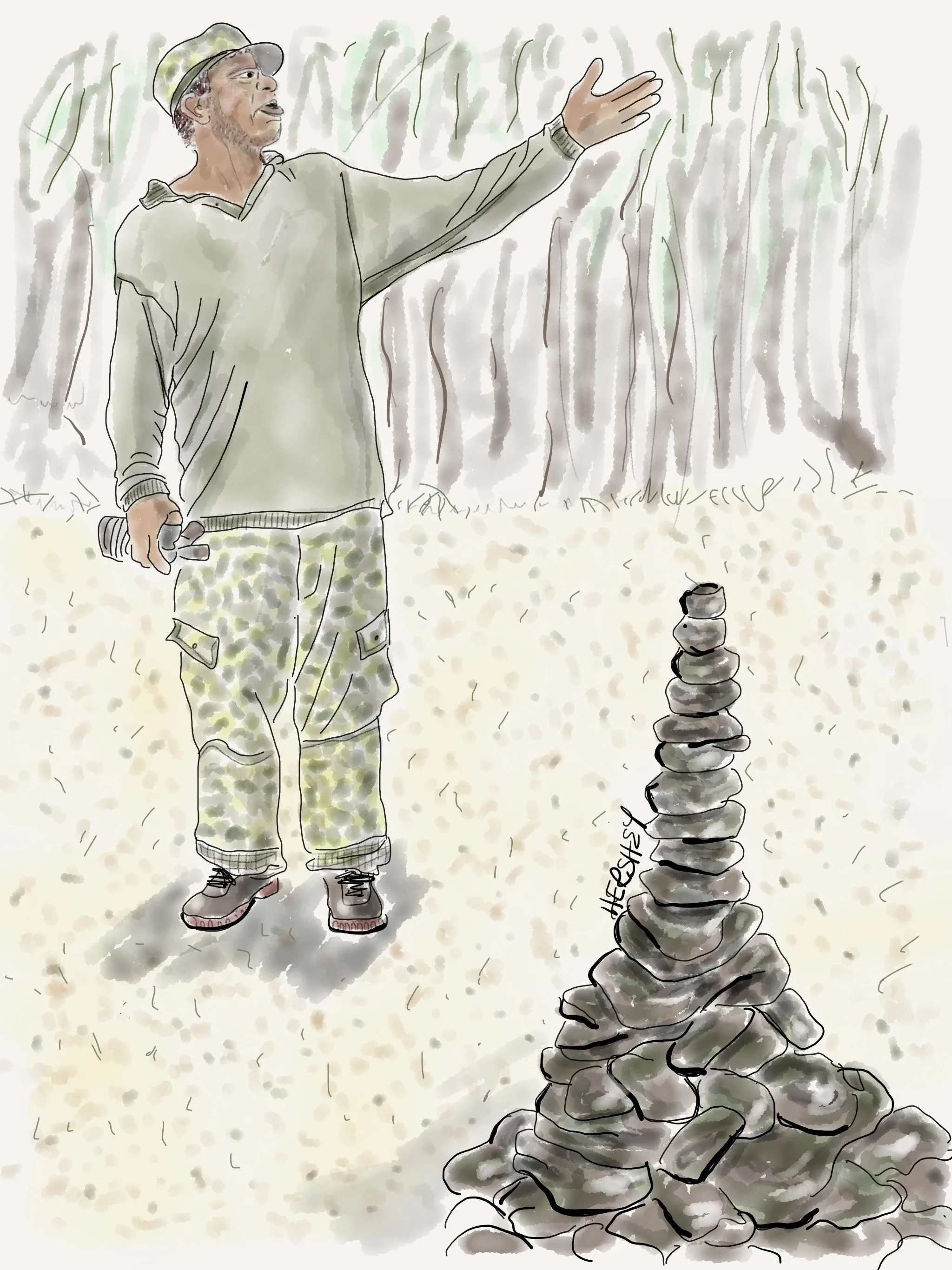
“God spoke to me, and told me to build it”! said Lester. We met him while biking on Route 11 in Jasper County, Mississippi. Busy clearing brush, he stopped to proudly showed us his cairns at the base of his driveway. Lester still cares for his disabled daughter after his wife died from diabetes 15 years ago. His older daughter works in the big city of Hattiesburg, MS. A simple man who has worked hard all his life caring for others, Lester finds solace and support in his local church. He was quite enthusiastic about the important and accomplished people that attended a recent service at his church commemorating Martin Luther King. Drawing by Jenny Hershey. Follow her work on Instagram @deeofo.
Jenny and I believe that tracking the implementation of the Inflation Reduction and the Infrastructure Acts over the coming years will be the focus of future our biking tours as climate investments are scaled up. If all goes well, over the next decade the world will witness widespread growth in renewable energy, grid modernization, electrification of our transportation and building systems (in spite of the ridiculous culture war in the US over stoves), the growth of hydrogen-based fuel for long haul transport and some forms of heating, and - if safety and siting concerns are adequately addressed - deployment of carbon capture, storage and industrial uses for carbon. Below is a graph that shows how both bills will complement each other.
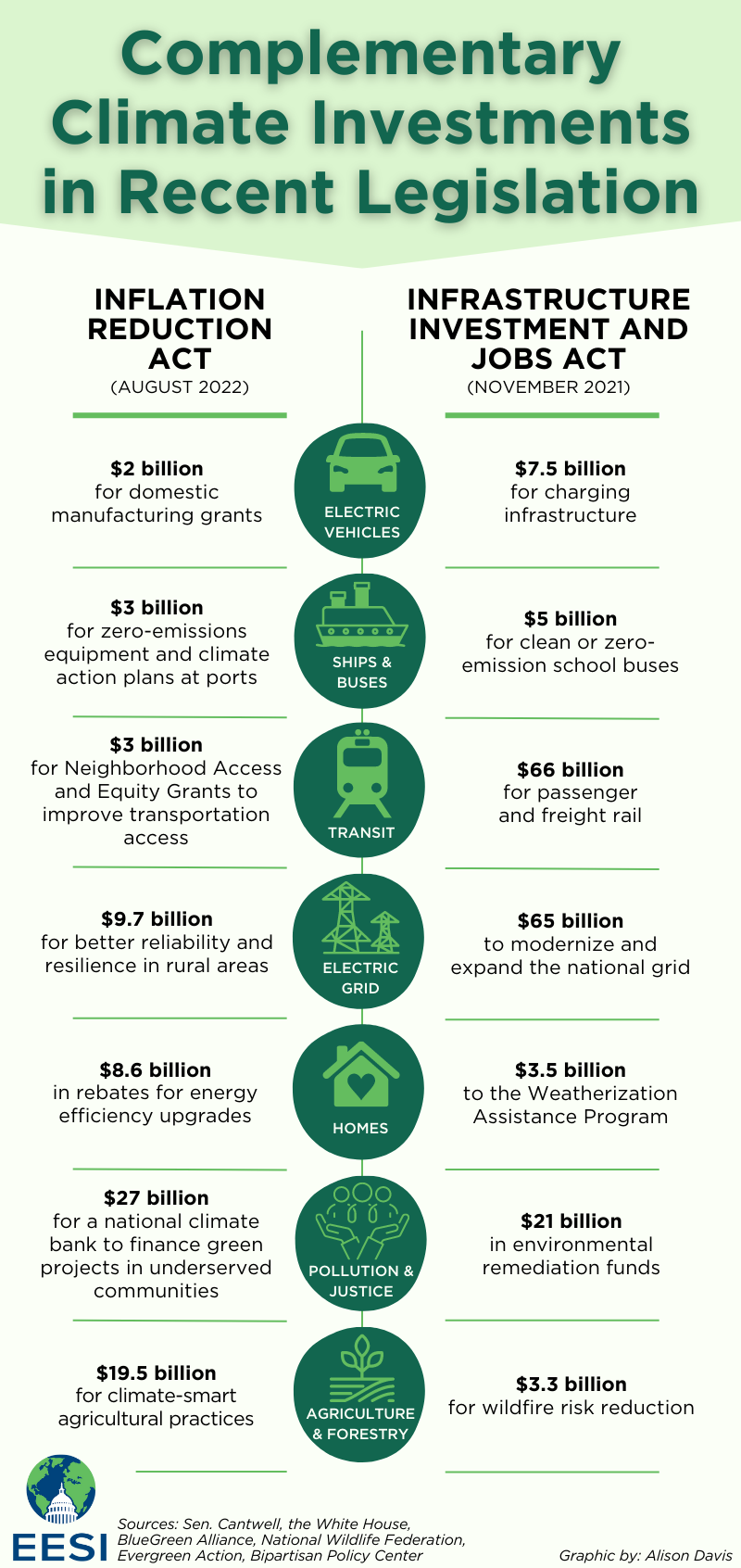
This graph can be sourced here. Along with tax reforms (which are under threat of repeal by the new Congress) and investments in healthcare, the Inflation Reduction Act provides $369 billion to address climate through tax credits for clean energy and electric vehicles, by boosting energy efficiency, establishing a national climate bank, supporting climate-smart agriculture, bolstering production of sustainable aviation fuel, reducing air pollution at ports, and more. The law represents the boldest action Congress has taken on climate yet—if enacted successfully and quickly enough, it will put the United States on a path to reduce greenhouse gas emissions by 40 percent below 2005 levels by 2030, according to several independent analyses. That is, of course, if implementation is both rapid and effective. Additionally, the Infrastructure Investment and Jobs Act provides complementary investments in energy modernization, transportation, workforce development, and building decarbonization.
We are pleased that the bipartisan infrastructure bill provides $66 billion to rebuild our decaying US rail system, because Jenny and I are supporters of combining train travel and bike touring. We started our current trip in the Deep South by taking a train (with our bicycles onboard) from Penn Station, New York, to Birmingham, Alabama - leaving on a rainy and uncharacteristically warm New York City in mid-January, and arriving in an uncharacteristically cold Birmingham the next day. We set out on our bikes for Meridian, MS, intending to catch a train to New Orleans and then another to San Antonio (we had purchased multi-ride ticket passes). But upon our arrival in Meridian we discovered that track work was limiting the number of trips on the Crescent line so there was no train for four more days. We decided to bike to New Orleans instead. We are glad we did. Serendipity has its place, especially when traveling on bicycles.
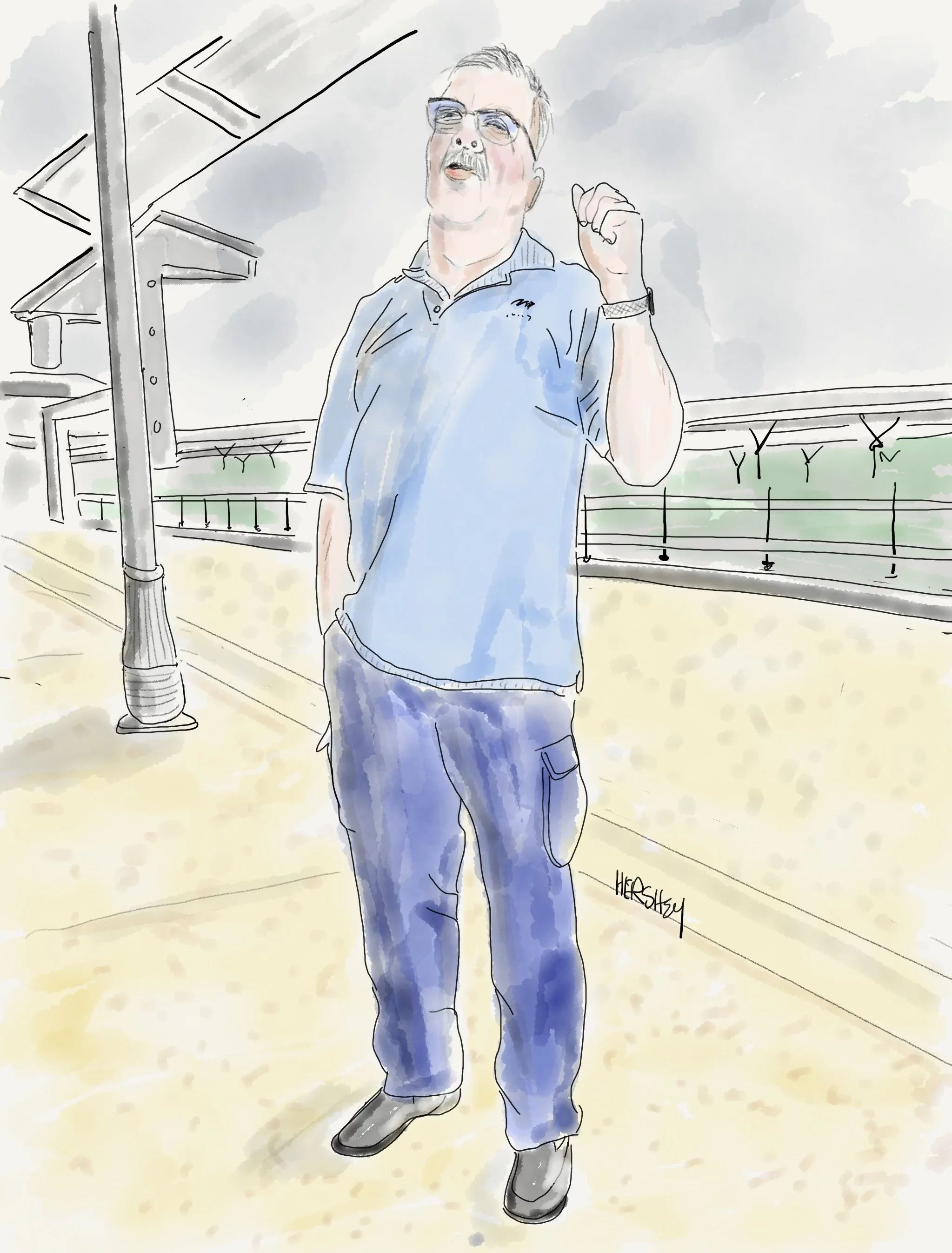
Bunky is the Amtrak Station Manager in Meridian, Mississippi. When we learned our intended train to New Orleans was delayed for four days, he took us out on the station platform and shared quite a bit about the history of Meridian. A proud yet humble man, Bunky also shared his previous life as the Fire Chief of Meridian, and held us rapt as he recounted the time a plane crashed on the interstate that passes through town. But his biggest challenge was getting to New York a week after 9/11 to help restore order and rescue firefighters and civilians at the World Trade Center. That fact alone inspired our trust, so when Bunky encouraged us to go to the Mississippi Arts Museum, we said of course we would. Modern and interactive, the museum is extremely well curated and it inspired us to stay longer in Mississippi, so we decided to forgo our plans to get to Texas, and instead bike to New Orleans through Mississippi. The South had us hooked. Drawing by Jenny Hershey. Follow her work in Instagram @deeofo.
We’ve been on our bikes ever since, with our eyes open for early indications of progress in climate infrastructure development that might link to either legislation. What we found surprised us. I was researching early climate infrastructure projects while spending a rainy day in a motel in Bogalusa, Louisiana, when I encountered an interesting story about Parish Councils near Lake Maurepas to the west of New Orleans.
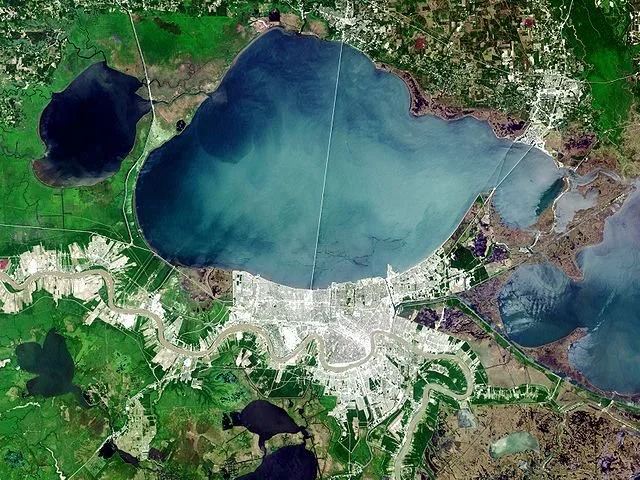
Lake Maurepas is in the upper left of this satellite image of southeastern Louisiana. Lake Pontchartrain lies to its east, with New Orleans about 25 miles away along Pontchartrain's southern shore. (Satellite image via Wikimedia Commons.)
In October 2021, Louisiana Governor John Bel Edwards announced that Air Products, a multinational chemical company based in Pennsylvania, will invest $4.5 billion to develop a “clean” energy complex in Ascension Parish, Louisiana, by 2026. This project involves the construction of a new plant in the unincorporated community of Burnside (across the Mississippi River from Donaldsonville, a petrochemical capital of Louisiana) to convert natural gas to “blue” hydrogen by capturing the resulting carbon dioxide. The plant will use its own preexisting pipeline infrastructure to ship hydrogen to market, and build a new pipeline through the largely untouched Lake Maurepas marsh to transport the resulting CO2 about 30 miles to injection wellheads for permanent storage under the lake.
In this instance, the CO2 created as a byproduct of cracking methane (which makes up about 70-90% of natural gas) to form hydrogen will be compressed into a denser liquid-like form, and injected into geological formations called saline aquifers (a layer of porous rocks saturated with salty water) 7000 feet under Lake Maurepas. Apparently, saline aquifers are ubiquitous across much of southern and coastal Louisiana, so given the intensity of the petrochemical industry here, it seems likely there will be many more proposals made by fossil fuel companies to store CO2 in the Gulf coastal region.
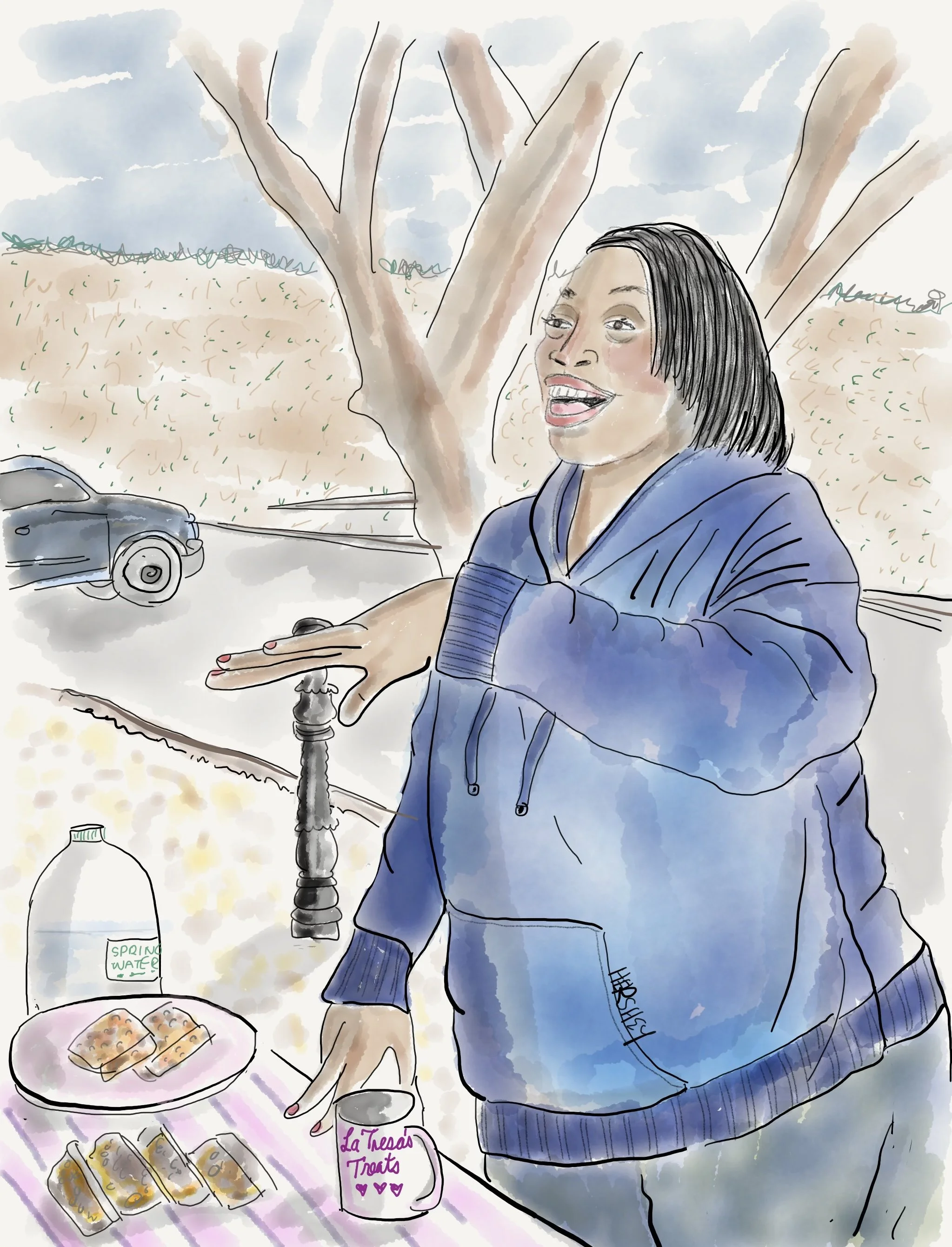
Ms. Rosalyn radiated joy. A talented baker and co-owner of LaTresa’s Treats, she tempted us with her homemade pecan squares at the small weekly farmer’s market on the town square in delightful historic Hattiesburg, Mississippi. “They taste like heaven” she assured us, “if you like pecan pie, you’ll love these squares”… Sampling one that evening for dessert, we discovered Ms. Rosalyn was right. Imagine something that tastes better than a piece of pecan pie! And she’ll ship them! You can order them here. Drawing by Jenny Hershey. Follow her work on Instagram @deeofo.
Interestingly, hydrogen is described by colors as shorthand for how it is created. Although hydrogen is the world’s most plentiful chemical, it doesn't exist on its own in nature; instead it bonds to other chemicals and is most abundant as H2O. It is also present in the atmosphere and in methane. Hence, hydrogen made from burning natural gas is referred to as “blue” when the carbon is captured, “grey” when carbon escapes into the atmosphere, and “green” when it is cracked or separated from water through electrolysis using electricity made from renewable sources. Only green hydrogen can be made without creating CO2.
When blue hydrogen is manufactured and the resulting CO2 emissions are captured and stored underground, the process is often described by the manufacturer as carbon-neutral. And although Air Product’s proposal is touted as such, closer examination suggests otherwise. Some studies suggest that the carbon footprint of blue hydrogen is 20% larger than gas and coal for the energy required to crack the hydrogen. That doesn’t count the CO2 the process creates, which is what Air Products intends to capture and store. Additionally, natural gas production inevitably results in methane emissions from so-called fugitive leaks, which are leaks of methane from the drilling, extraction and transportation process.
Although fossil fuel companies claim they have years of experience storing carbon, they usually fail to mention their experience is with enhanced oil recovery (EOR), which involves injecting carbon dioxide into oil wells to coax out hard-to-get oil. That is not the same thing as permanent CO2 storage, which is a new technology. In fact, it is so new that there are only two long-term carbon storage wells currently in use in the US.
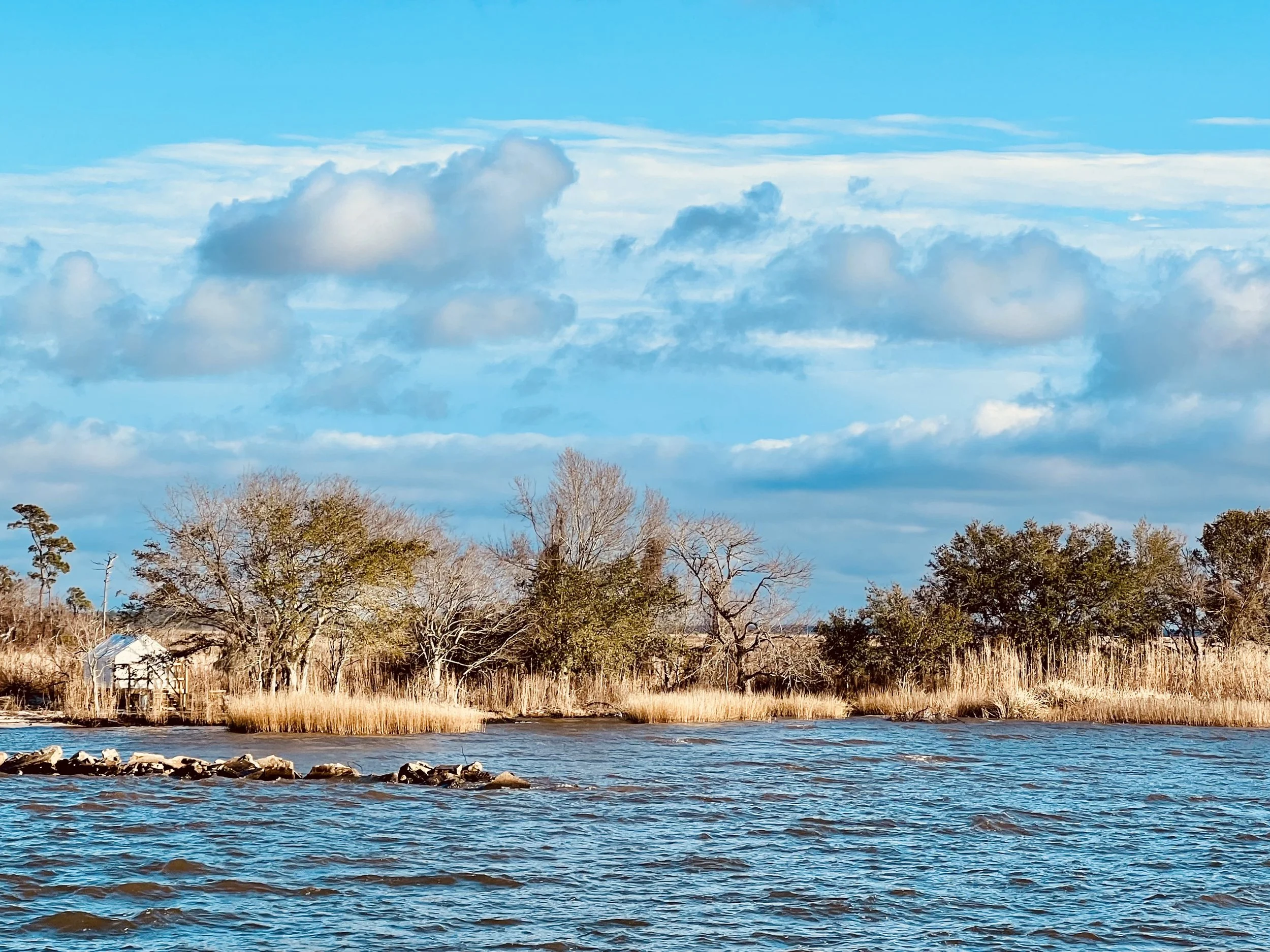
Picture taken at Fontainebleau State Park, Louisiana, on the northern shore of Lake Pontchartrain. Photo by Michael Chase. Follow his work on Instagram @mjohnsonchase.
Some people still might ask, what's the big deal? After all, we currently release about 11 million tons of CO2 into our atmosphere daily. As the longest-lasting GHG in our atmosphere, CO2 is currently at about 450 parts per every million (ppm) molecules of atmospheric gases (and rising) and that concentration doesn't impact human health yet. But to transport and/or store carbon, CO2 must be concentrated into a liquid of vastly higher concentration. Although Air Products claims their process of transfer and storage will be perfectly safe, the technology and infrastructure pose a safety risk to the communities they encounter. The bottom line is that sequestering CO2 at a commercial scale is, as yet, unproven to work in the real world.
It’s also important to be skeptical about the carbon capture rates that companies have promoted. Mark Jacobson, a professor of civil and environmental engineering at Stanford University helped publish a recent study on blue hydrogen. When interviewed by The Lens - an excellent New Orleans local news organization - Jacobson noted that methane leakage is essentially unavoidable in the blue hydrogen process. Assuming a 3.5% methane leakage rate would be conservative for a project like Air Products’. He goes on to say, “The only blue hydrogen facility that produces hydrogen from natural gas at a commercial scale for which there is relevant data is Shell’s Alberta plant, which has demonstrated a mean capture rate of 78%.” A separate analysis conducted by the watchdog group Global Witness says the figure is closer to 48%. Carbon capture prolongs the life span of industrial facilities that contribute significantly to climate change, yet according to Jacobson, carbon capture rates are inadequate, and simply not worth the investment. Yet, the fossil fuel industry is aggressively selling carbon sequestration, utilization and storage (CCUS) to the public as a safe and significant way to achieve full decarbonization by 2050.
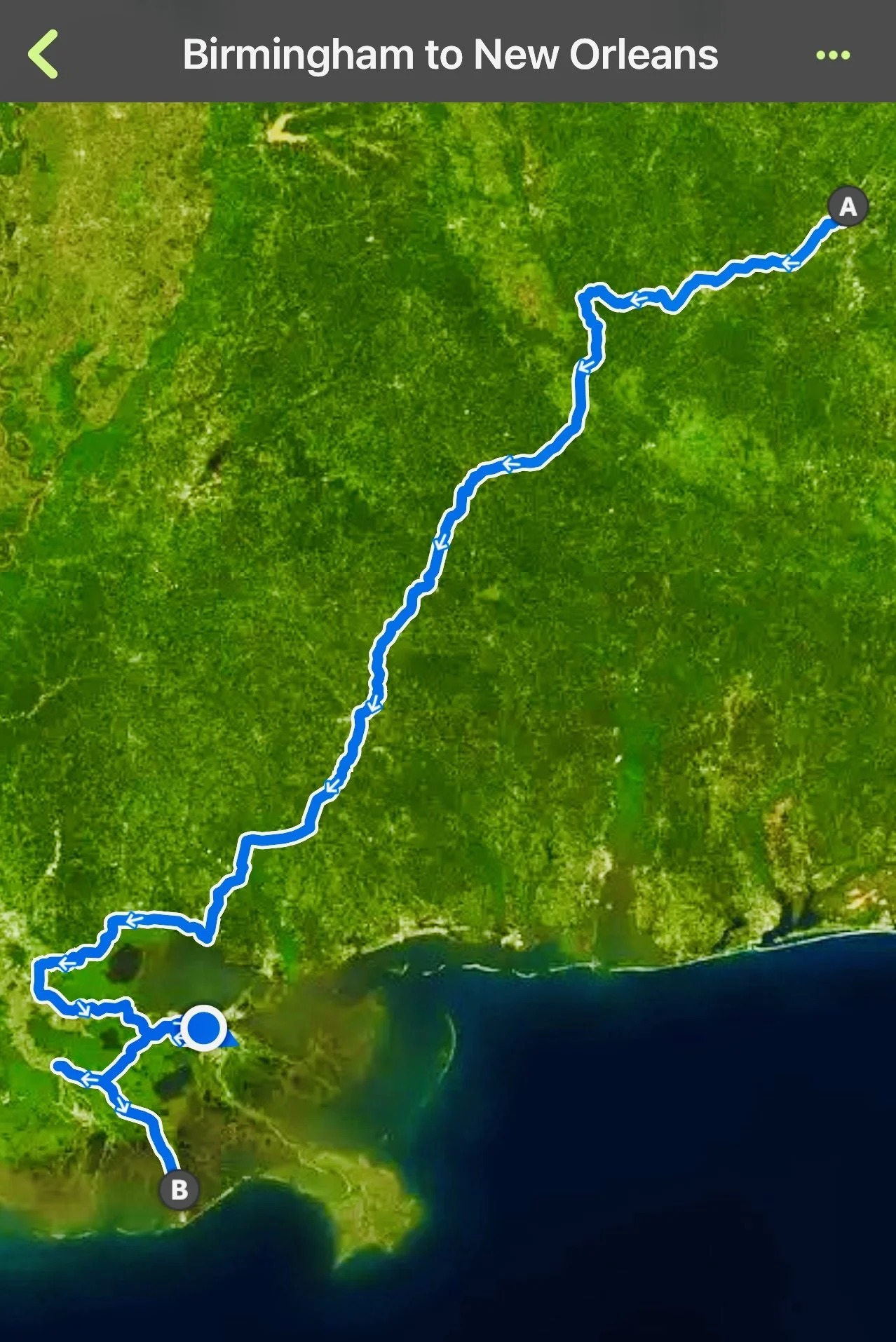
Traveling almost 1000 miles on bicycles, this is the shape of our trip. “A” is Birmingham, where we started, and “B” is Golden Meadow, deep in the coastal marsh of Louisiana below New Orleans, which is as far south as we were able to go because of damage from Hurricane Ida. The blue dot is where we were when we made this map. Map created on Kamoot.
I've been aware for some time that environmental justice groups are very wary of plans by fossil fuel companies to decarbonize their product as a way to keep selling it. There are many significant players in this arena, and many of them are pressuring the EPA to decline permits for a proliferation of CCS applications. One example is from California's Central Valley Air Quality Coalition. Another is in New Orleans, at the Deep South Center for Environmental Justice. The DSCEJ has been pushing local and federal leaders to consider the potential consequences of CCUS on Black communities around the Gulf Coast who have dealt with the consequences of the oil and gas industry’s careless pollution on their health and livelihood for decades. It was their advocacy that prompted The New Orleans City Council to unanimously pass Resolution NO. R-22-219. This resolution urges the prohibition of underground storage of carbon dioxide and facilities for this purpose. Passed in May of 2022, Dr. Beverly Wright, Executive Director of the Deep South Center for Environmental Justice, commented: “I am proud of New Orleans for being a trailblazer in policies that protect local communities from CCS technologies. As I said when Energy Secretary Jennifer Granholm visited recently, supporting CCS will encourage the growth of fossil fuel industries and continue the injustice of putting profits over communities of color. Instead, we need to develop and implement an energy plan for Louisiana that cleans our air and powers our homes and vehicles while prioritizing equitable investments in communities and invests in people to get the necessary training for clean energy jobs of the future. We encourage other local municipalities around the country to follow New Orleans’ lead to prohibit CCS technology”.
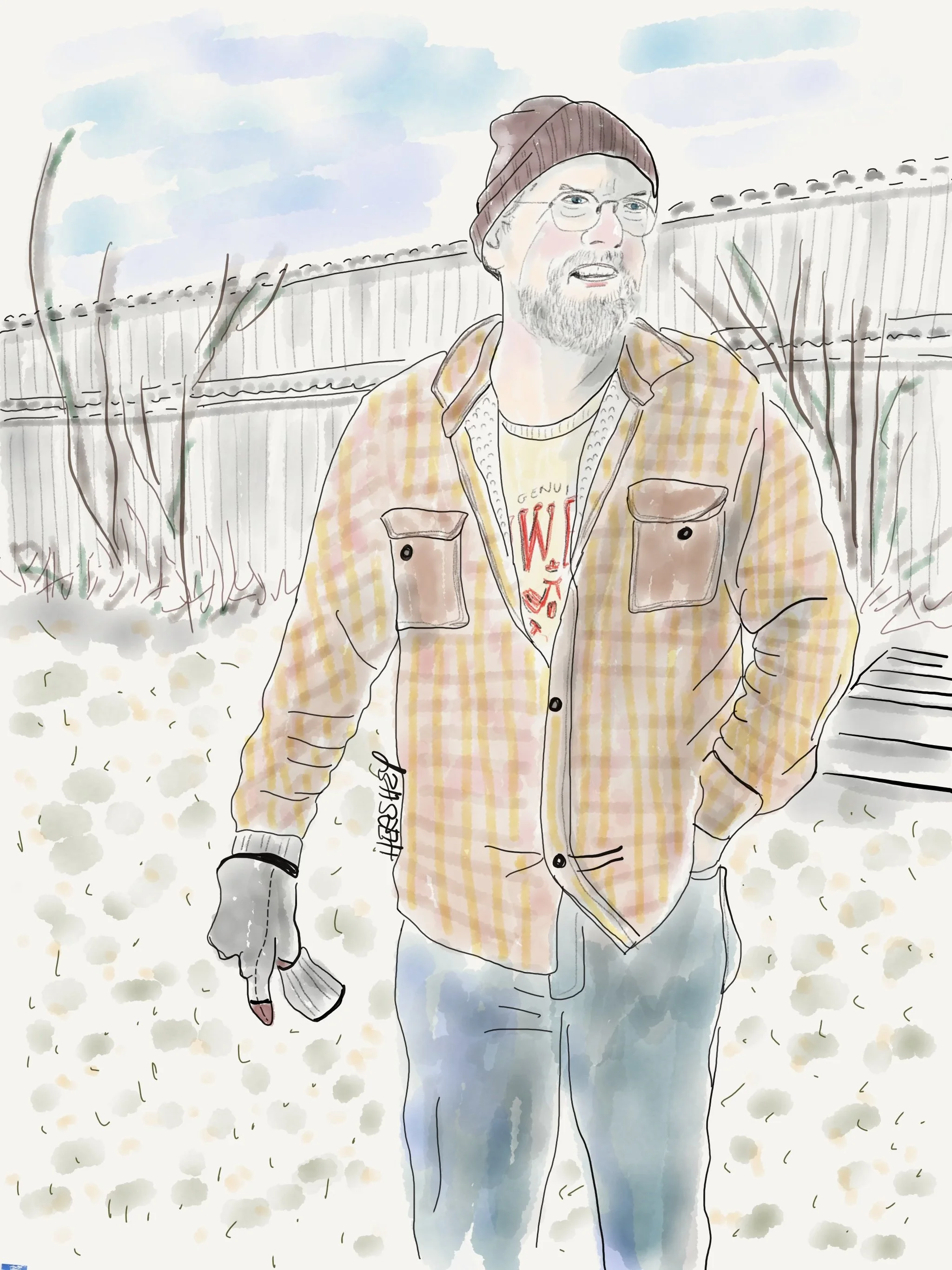
We met Gary, a retired school bus driver, on Head of Island near a canal on the Amite River that flows into Lake Maurepas. Born and raised in the Maurepas swamp area, Gary recounted some vivid tales from his father about encountering strange sinkholes while fishing in the waterways. Now, Gary is concerned about the seismic testing on the lake in preparation for Air Product’s carbon storage project. He is concerned for his 12 grandkids and potential hazards to the water supply and surrounding wildlife. Gary told us a story he heard from a few friends who are tracking the seismic testing contracted by Air Products. When his friends approached a boat in the lake they believed was involved in testing they were greeted by a security guard carrying a rifle who made it clear they should leave. Drawing by Jenny Hershey. Follow her work on Instagram @deeofo.
In October of 2022, the Livingston Parish Council voted unanimously to place a year-long moratorium on the construction of carbon dioxide injection wells below Lake Maurepas. Although Livingston Parish was the only council that passed an attempt at a legal moratorium, their concerns are supported by many locals living in Tangipahoa Parish to the east and Ascension Parish to the southwest.
Interestingly, two of those Parishes would not be considered typical “Environmental Justice” (EJ) communities. They contrast with Donaldsonville, which is 85% people of color (and fits the classic definition of a frontline community) and Burnside, which is about 65% people of color (and the location of Air Products’ blue hydrogen facility). Both of those towns are in Ascension Parish. By contrast Livingston Parish is 95% white, while Tangipahoa Parish is about 65% white. Since neither of those parishes have been frontline communities before, an historical tolerance toward the oil and gas industries might be confusing the issues. As a case in point, I noticed the following comment in The Lens by a Council Member from one of the involved Parishes, “I’m not against the oil and gas industry, and I want to reduce carbon dioxide in the atmosphere as much as anybody else. But this is not correcting the problem. This is creating one more problem.”
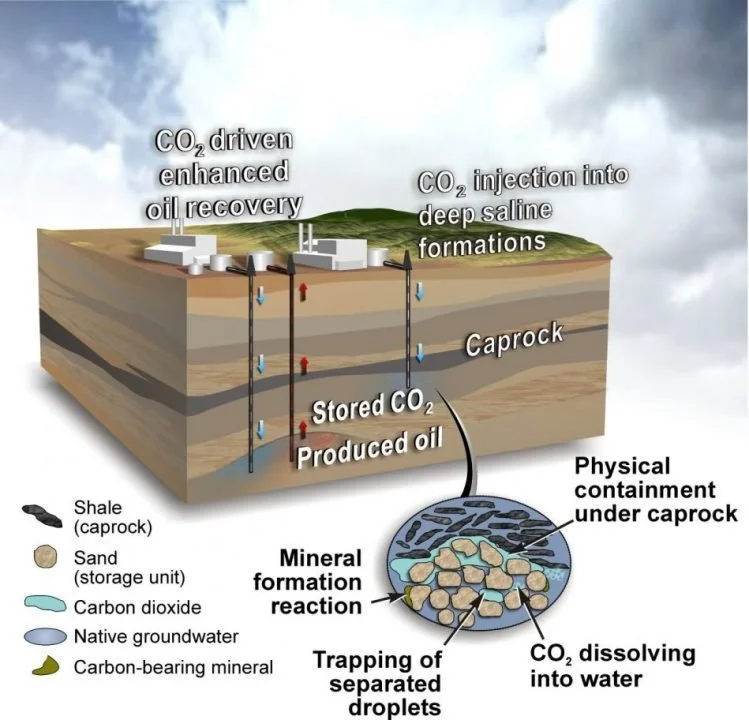
Section 45Q of the Unites States Internal Revenue Code is intended to incentivize deployment of carbon capture, utilization and storage (CCUS). The credit amount also significantly increases for direct air capture (DAC) projects to $180 a ton of CO2 permanently stored and $130 a ton for used CO2. The information above can be referenced here.
I sympathize completely with the Parish residents for their concern about their local environment, and believe all three parishes are being unfairly steamrolled by a large company, and state and federal level politicians. I very much hope the residents will prevail. I also think it's time to end the “not in my backyard mentality” (NIMBYism) that has been an unconscious feature of white middle-class communities for so long. We all need to share the burdens wrought by our way of life, or we need to change our way of life. Fair is fair. In other words, If you don't want something in your backyard, then it’s not ok to put it in someone else’s. And conversely, if you stand by when it happens to your neighbors then don’t be surprised when it happens to you. Instead, focus on stopping the root causes of the problem.
Traveling on a bicycle increases the odds of serendipity. Through a chance encounter in a health food store in Pontchatoula, Louisiana, Jenny and I were able to speak by phone with two members of the Tangipahoa Council, Brigette Hyde and Kim Coates, both of whom represent many local parish constituents who are quite upset by Air Products’ proposal. We learned the permitting process for the carbon storage injection wells - which normally takes years - was pushed through in only four months with no public transparency or local input. Needless to say, locals are fearful about how carbon storage will affect Lake Maurepas’ plethora of wildlife, its recreational boating industry and the health of the local population.
Currently, there is nothing the Parish Councils can do to slow down this project. The lake body itself is owned by the state, which has preemption rights over the Parishes, and a federal judge recently ruled that Livingston Parish cannot enforce its moratorium. Air Products argued it would lose more than $75,000 spent on seismic tests and well preparations to satisfy EPA regulations should the moratorium stay in place because the state permits they’ve been granted will expire. So Air Products, predictably, prevailed in court, also arguing the entire process is perfectly safe and will help them meet federal GHG emissions goals. “We are pleased with the ruling, and we remain committed to continuing to share information with all local parish councils, elected and regulatory officials and local residents about Air Products’ clean energy project and its environmental and economic benefits, and employment opportunities,” said Art George, Air Products’ communications director.
Federal and state officials and industry experts alike have welcomed carbon capture and storage projects as a means to meet net-zero carbon emissions goals. In fact, when Congress passed the Inflation Reduction Act in August, it increased the value of the Q45 carbon capture tax credit to $85 a ton. Because of that adjustment, Air Products stands to receive as much as $425 million in annual tax credits for storing carbon dioxide under Lake Maurepas.
Small wonder they are moving full speed ahead.
Money talks. Goliath walks.
Stay vigilant! Thanks for reading. More to come. If you haven’t done so already, please subscribe to this blog, so you can follow our next biking trip.
All material, unless credited or otherwise noted, are copyrighted property of the blog post authors.
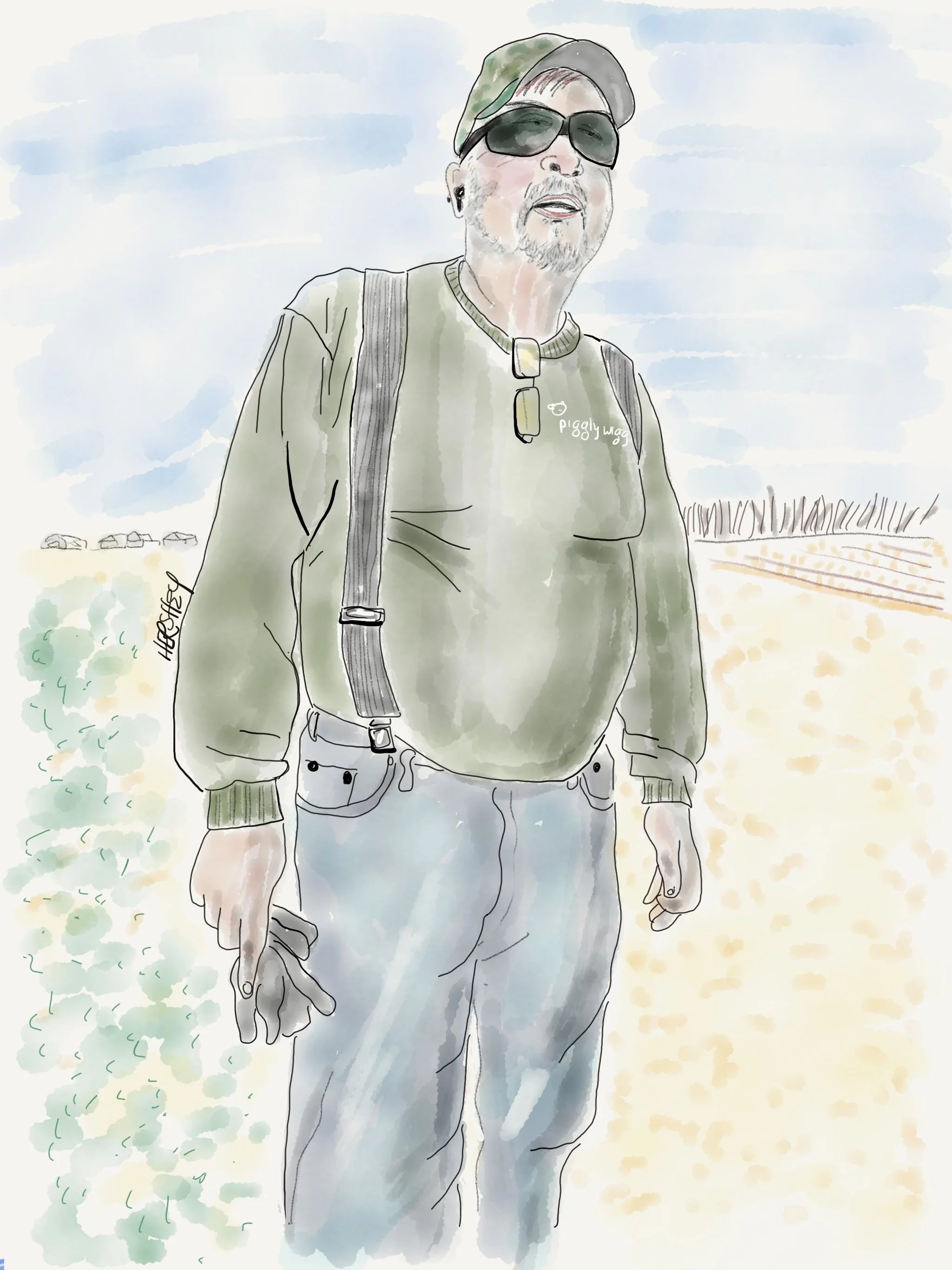
Jenny asked me to post this drawing here as a postscript out of gratitude.
Keith is a retired automation manager from the Union Carbide plant. Route 20 became too treacherous for biking in Vacherie, Louisiana and we were forced to ride on dirt paths through sugar cane fields until we could get no farther. In the distance we saw Keith working on his small John Deere tractor, clearing debris off the road by his house that abuts the sugar cane field. We biked over to told Keith and explained our predicament. He confirmed that there was only one way to the next town, which was down the dangerous Route 20. Thankfully, Keith then offered to use his truck to drive our bikes and gear into Thibodeaux 14 miles down the road. Both he and wife Debbie were very kind and hospitable. Keith dropped us off at a motel we had a reservation for, and they went off to their favorite fish spot for “date night.”
Drawing by Jenny Hershey. Follow her work on Instagram @deeofo.
The Renewal Blues; Biking the Mississippi River Trail, Post 2
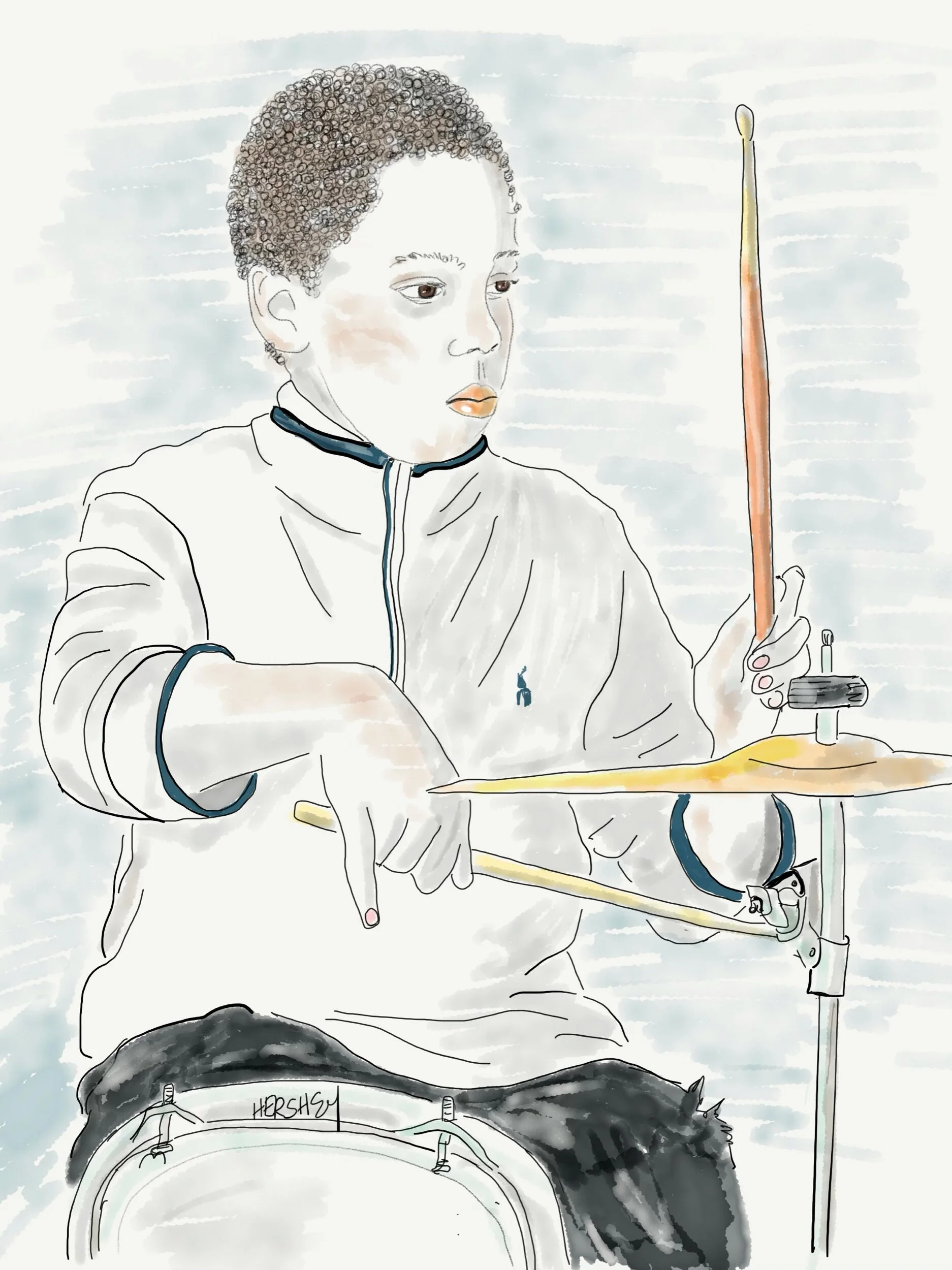
Dwight is 11 years old, and quite a drummer. We met him at the Pleasant Chapel M.B. Church just north of Memphis, TN. He was really proud to be part of the church gospel band.
Drawing by Jennifer Hershey. Follow her work on Instagram at deeofo.
What a great trip we’ve had during this time of change in America! Jenny and I have spent three weeks biking along two routes: the Mississippi River Trail (MRT), a fabulous Open Cycle Map bike trail that runs along or near the Mississippi River from north of Minneapolis to south of New Orleans; and the iconic “Southern Tier” route mapped out by the Adventure Cycling Association (ACA) that runs from San Diego to St Augustine, Florida. We biked along the MRT south from Ste. Genevieve, Missouri through Memphis, Tennessee and south through the Delta country of Arkansas and Mississippi to Vicksburg, then down to Natchez, Mississippi, where we turned east on the ACA’s “Southern Tier” and made our way along the Gulf coast through Mobile, Alabama to Orange Beach, Florida on the panhandle coastline.
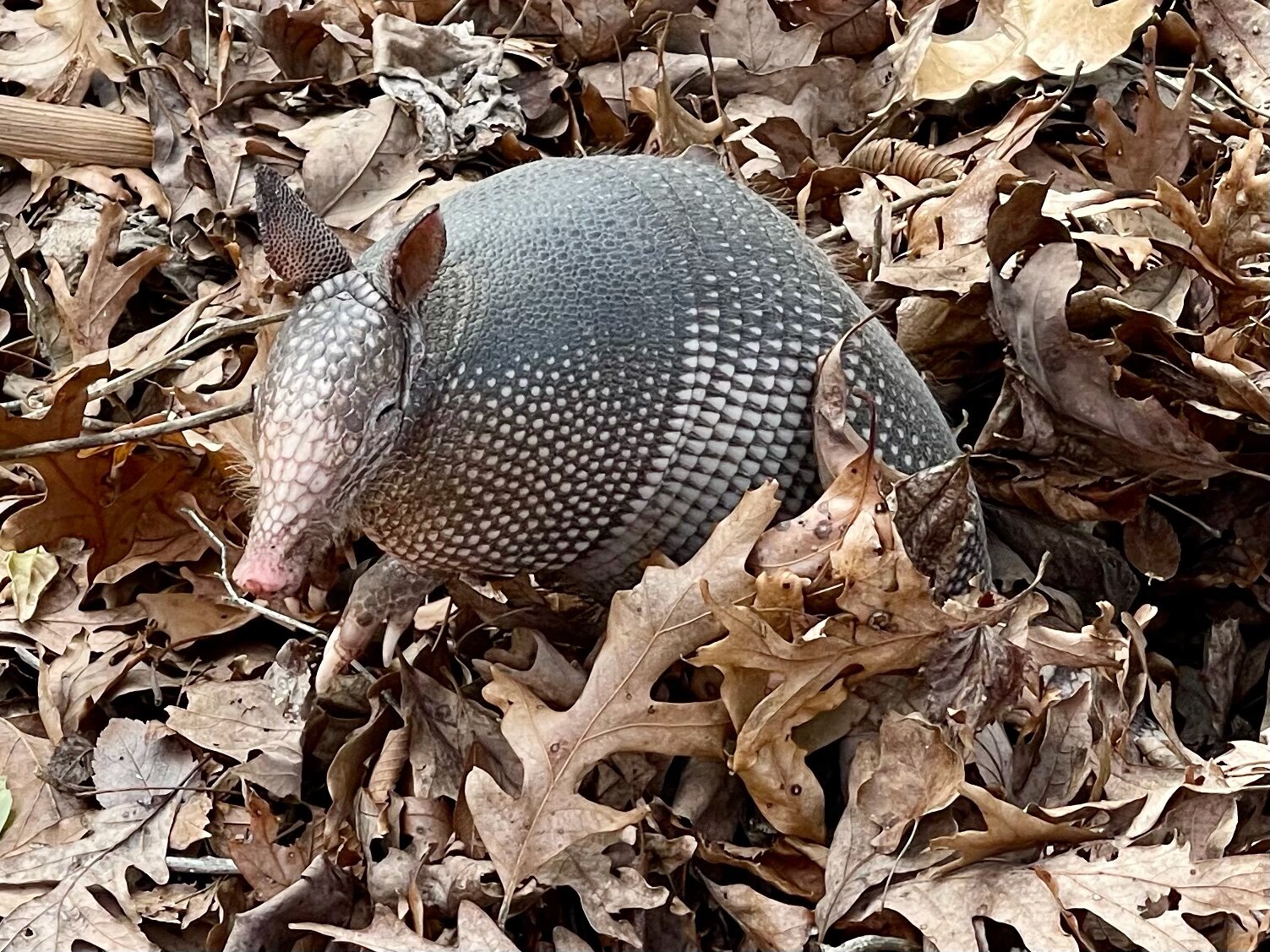
An armadillo seen in the St Francis National Forest near West Helena, AR.
The American South didn’t disappoint us. Although it’s been unusually cold and intermittently rainy in the southeastern United States this winter, we were glad to avoid the harsher weather to the north in our hometown of New York. We biked through areas rich with wildlife, occasionally stopping to admire the countryside or take in the extraordinary cacophony of countless birds and frogs. We also biked through both dull and very interesting human environments in the form of villages and small to medium-sized cities.
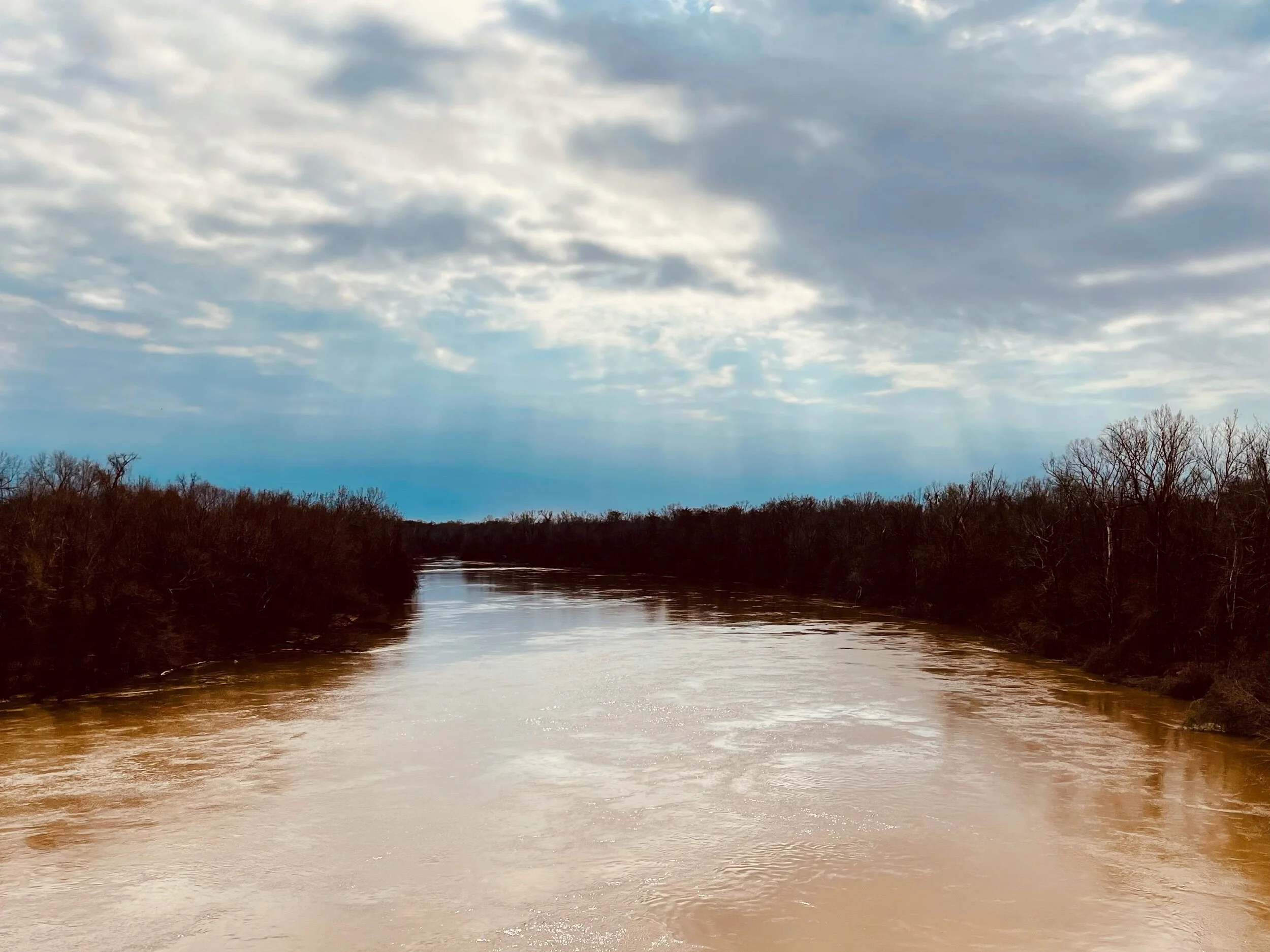
The Pearl River forms the far eastern border of Louisiana and the southwestern border of Mississippi.
Experiencing the social vibe just after the recent presidential inauguration has been both heartening and sobering. Today, in southern Alabama we passed two abandoned semitrailers with “stop the steal,” “the election was stolen”, and “Trump is our President” graffiti painted across them. They were too far away, and we were moving too quickly to be able to photograph them, yet they definitely echoed the spirit of insurrection at the Capital. We have also seen signs that both puzzled and amused us.
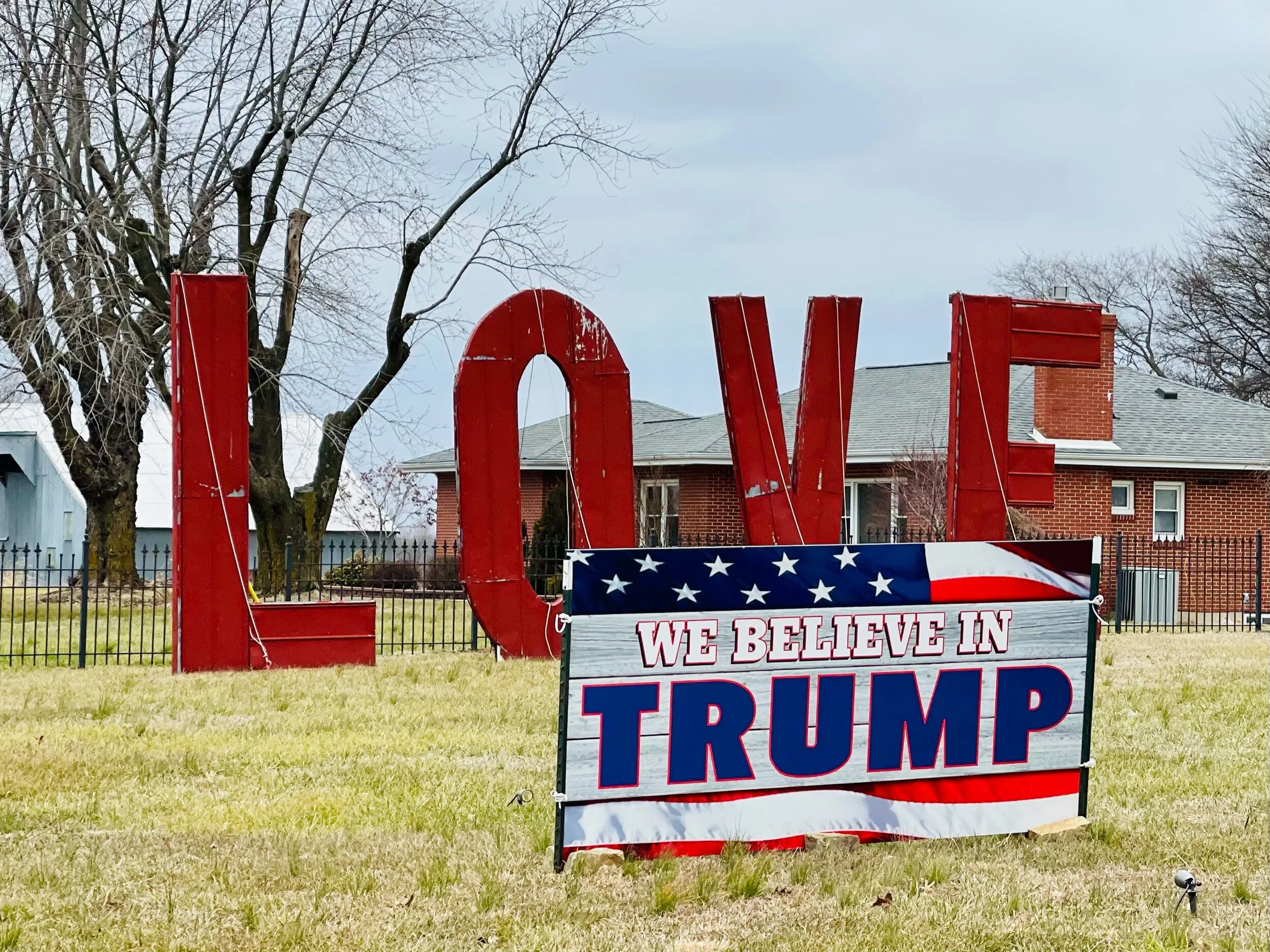
Seen near Perryville, MO.
It’s interesting to speculate how long Trump 2020 signs will remain up. We've seen a few Biden/Harris signs as well, but - in these parts at least - the folks who voted for Biden aren’t as overt about their preference as those who voted for Trump. But whatever their beliefs, I’d wager most Americans are wondering how the coming weeks and months will play out.
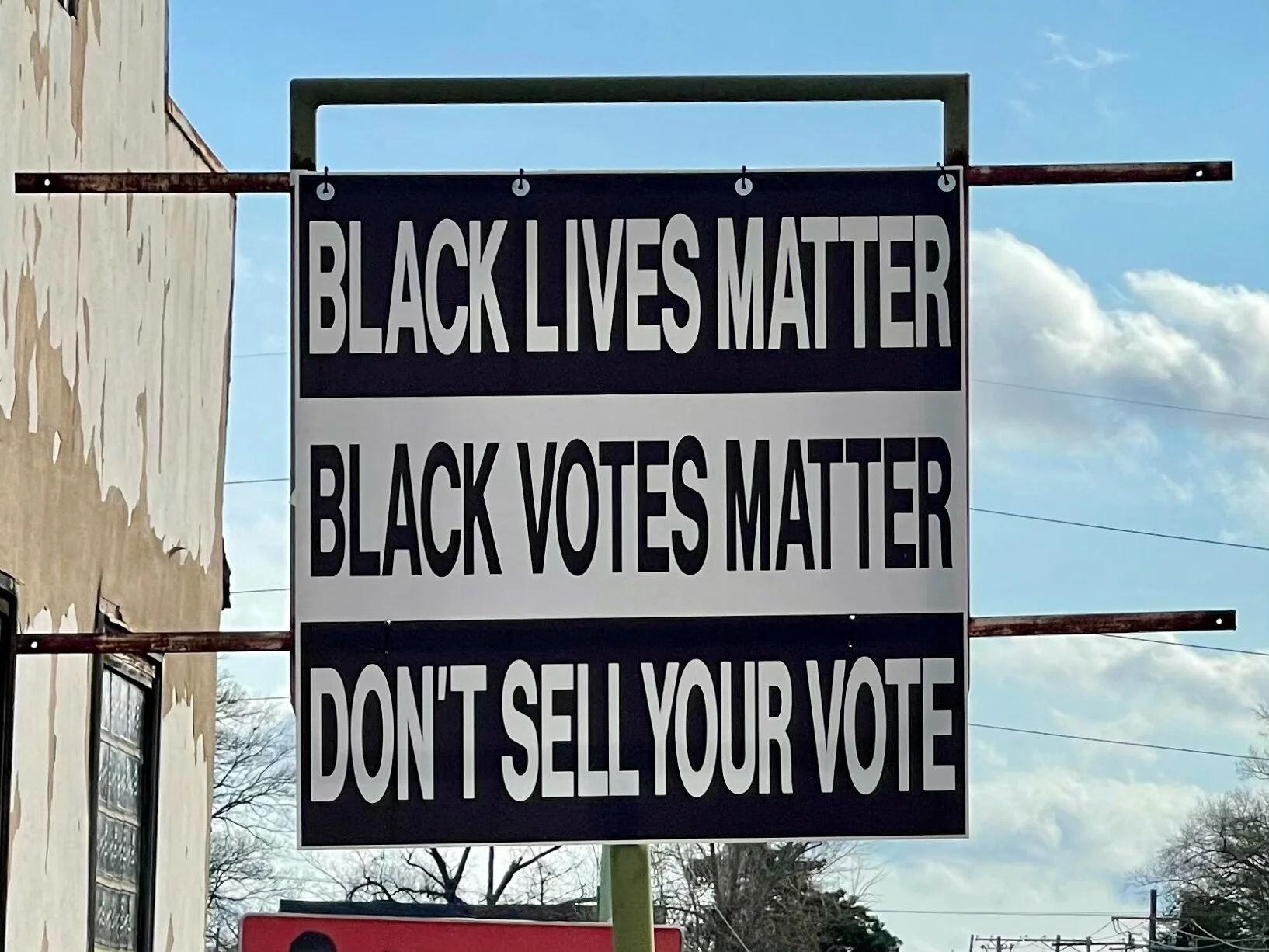
A sign in Natchez, Mississippi. Apparently vote selling has happened there in the past, and the local Democratic Party wanted to make sure that was not a problem in the recent election, as per the following quote from an October, 2020 article in apnews.com by Tim Sullivan: By at least one measure, it’s harder to vote in Mississippi than any other state. And despite Mississippi having the largest percentage of Black people of any state in the nation, a Jim Crow-era election law has ensured that a Black person hasn’t been elected to statewide office in 130 years. After years of being shut out of state races, Democrats hope mobilizing Black voters and recruiting Black candidates can eventually give them a path back to relevance in one of the reddest of red states. But sometimes, it can seem that voting rights in Mississippi are like its small towns and dirt roads, which can appear frozen in the past.
When an African-American from Mississippi is finally elected to Congress (as almost happened last November) it won’t be for the first time. That happened in the late 19th century when Hiram Revel was the first African-American ever elected to the US Senate. You can read about that here.
As much as we enjoyed occasional sunny warmth on the Gulf coastline, we found the Delta country of Arkansas and Mississippi the most interesting part of our trip. We followed the famous Mississippi Blues Trail as we progressed downriver on the MRT in the Delta country, taking in the birthplaces of blues legends such as Conway Twitty, Eddy Taylor, and Ike Turner.
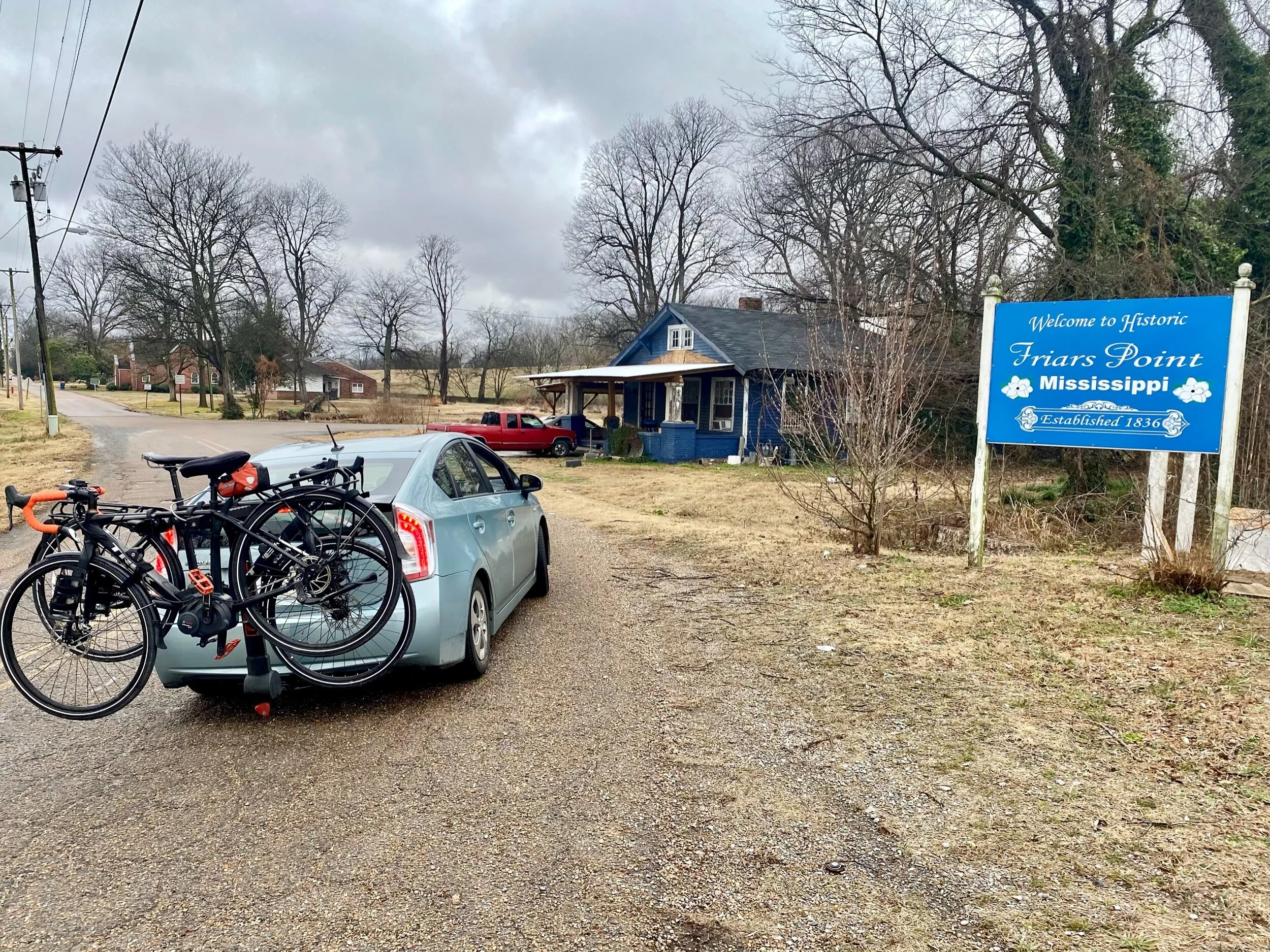
A shot of our rig in Friar’s Point, Mississippi. We haul our food in a car because we chose to minimize our exposure to Covid by not eating in restaurants. Our conversations with locals usually take place outside when we are riding our bikes. We drive an average of 100 miles a day and bike an average of 50. We call this method of travel carbiking. It’s almost as satisfying as touring exclusively on our bikes, although we can’t wait for Covid to be neutralized enough to leave the car behind…
But as rich as the history of the blues and religion is in those parts, I found myself more intrigued about the local economies reflected through their physical environments.
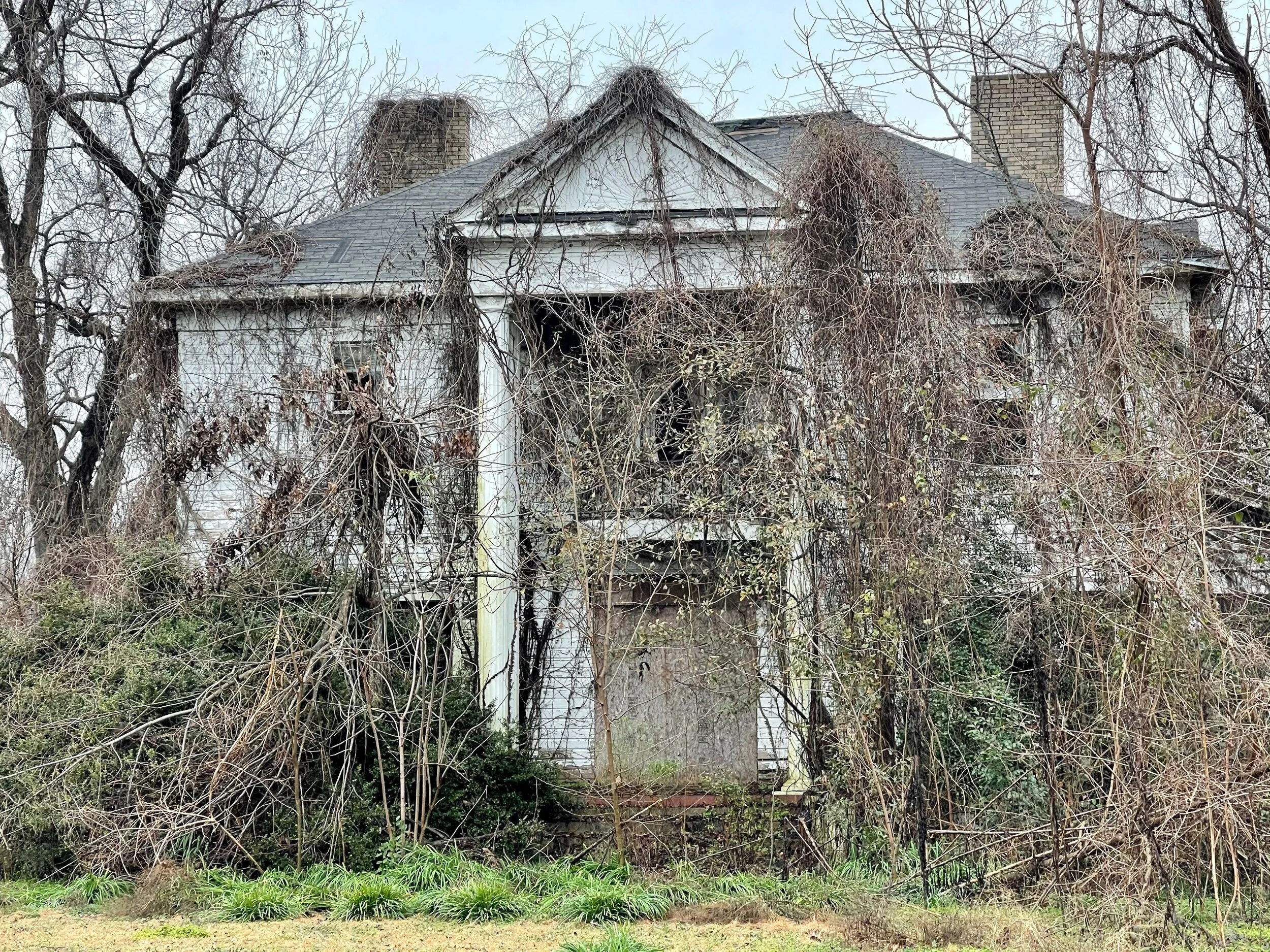
A decaying mansion returns to the earth in Mayersville, Mississippi.
I’m used to seeing one or a few shuttered buildings in most small towns all across the Midwest and West. Since my childhood in the farming town of Galesburg, Illinois, I’ve been witness to the decline of rural America. But what Jenny and I saw in the Mississippi Delta country is on another level altogether. Every town we passed through, from Helena - West Helena, Arkansas to Friars Point, Mississippi to Gunnison to Rosedale to Greenville, Mississippi has a surprising (and distressing) number of abandoned buildings. It looks like 50 to 60% of commercial buildings are shuttered and maybe 20% are in disrepair with broken windows, damaged walls and collapsed ceilings. What is even more startling are the considerable number of boarded up and destroyed residential buildings. In many of these towns there are entire blocks full of abandoned homes. It seems like people have been leaving these towns for years, and no one is claiming their property. Apparently, the cost of demolishing a home or commercial property often isn't worth the land it sits on.
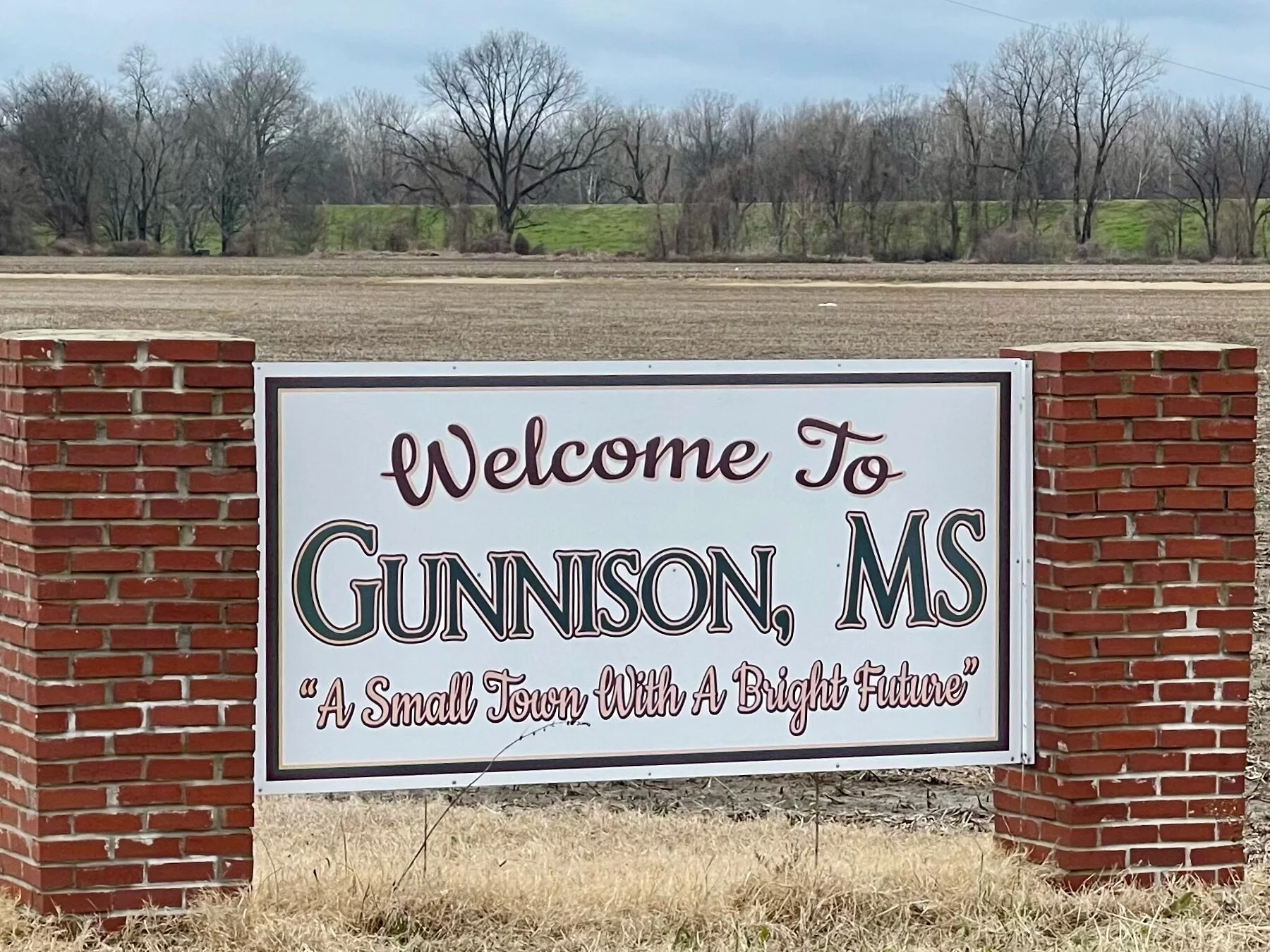
The welcoming sign on the way into Gunnison, Mississippi.
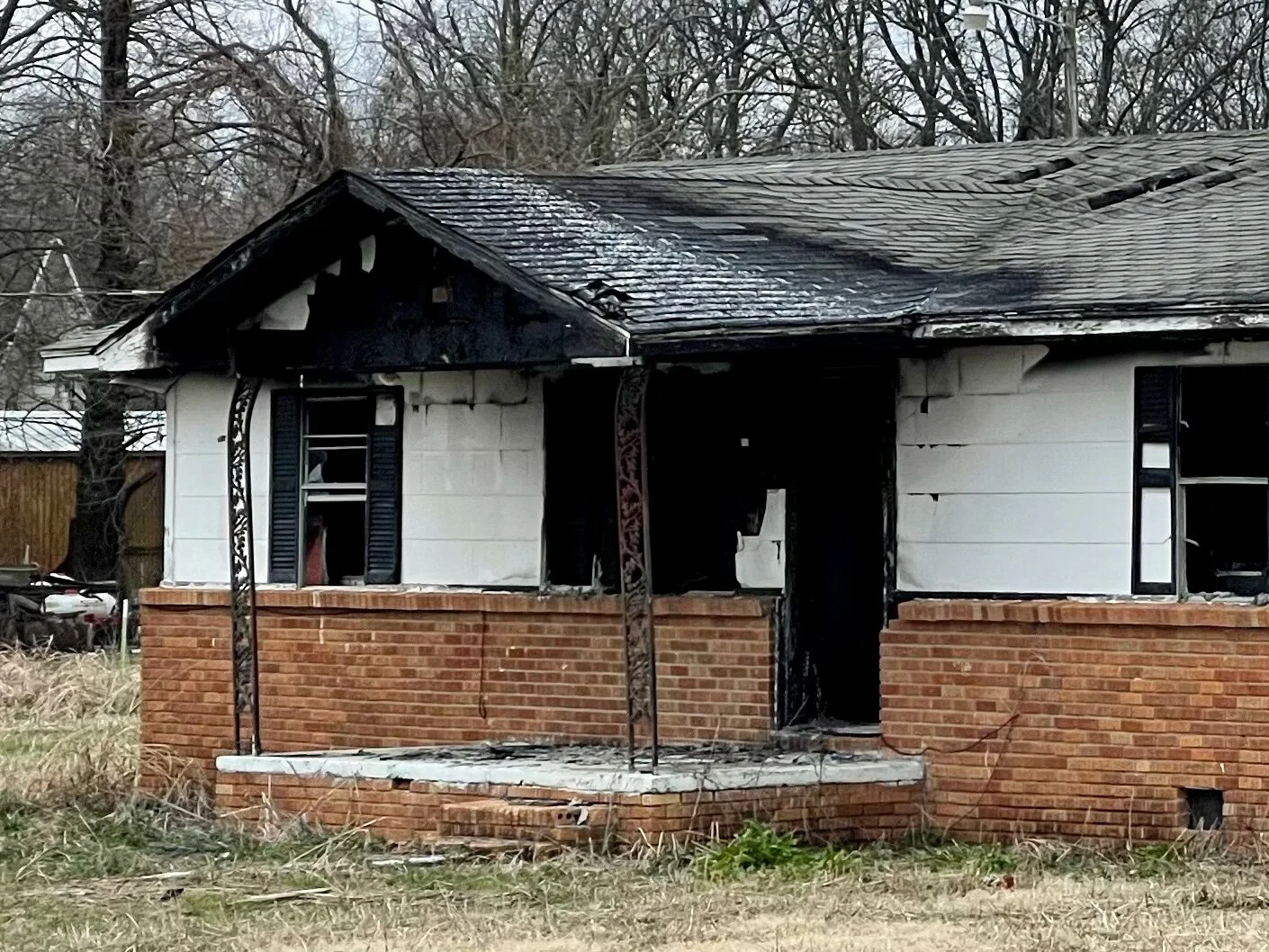
Just past the welcoming sign in Gunnison, Mississippi.
Our first encounter with "lost" cities on this trip was Cairo, Illinois, which has lost about two-thirds of its population since the late 1960's. That trend is playing out all along large sections of the Mississippi River south of Cairo, all the way down to Baton Rouge.
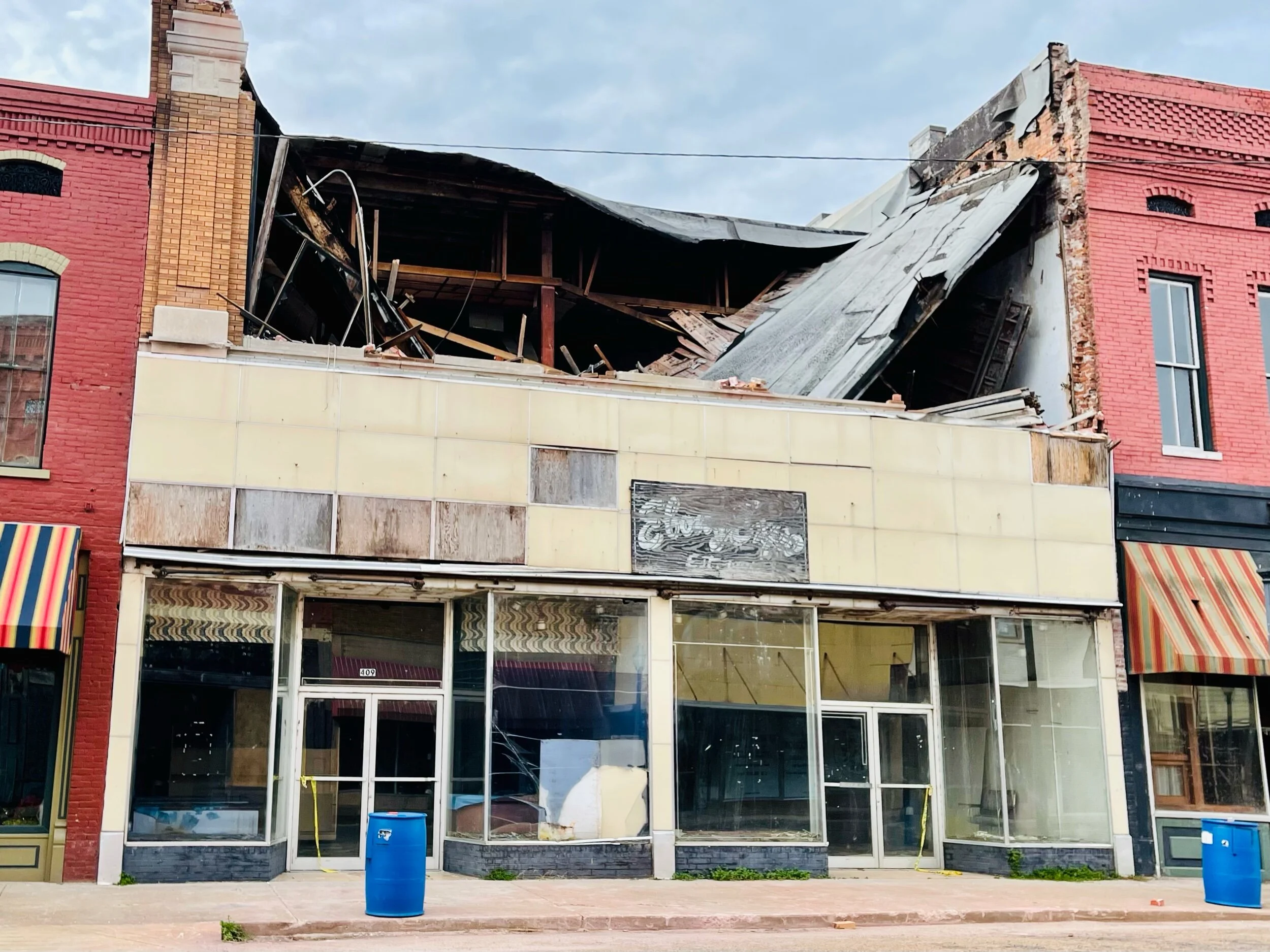
Helena, Arkansas, is home to the longest running daily radio program in the US, King Biscuit Time. This photo was taken on Main Street near the recording studio. Most of the buildings on the four block-long Main Street are shuttered.
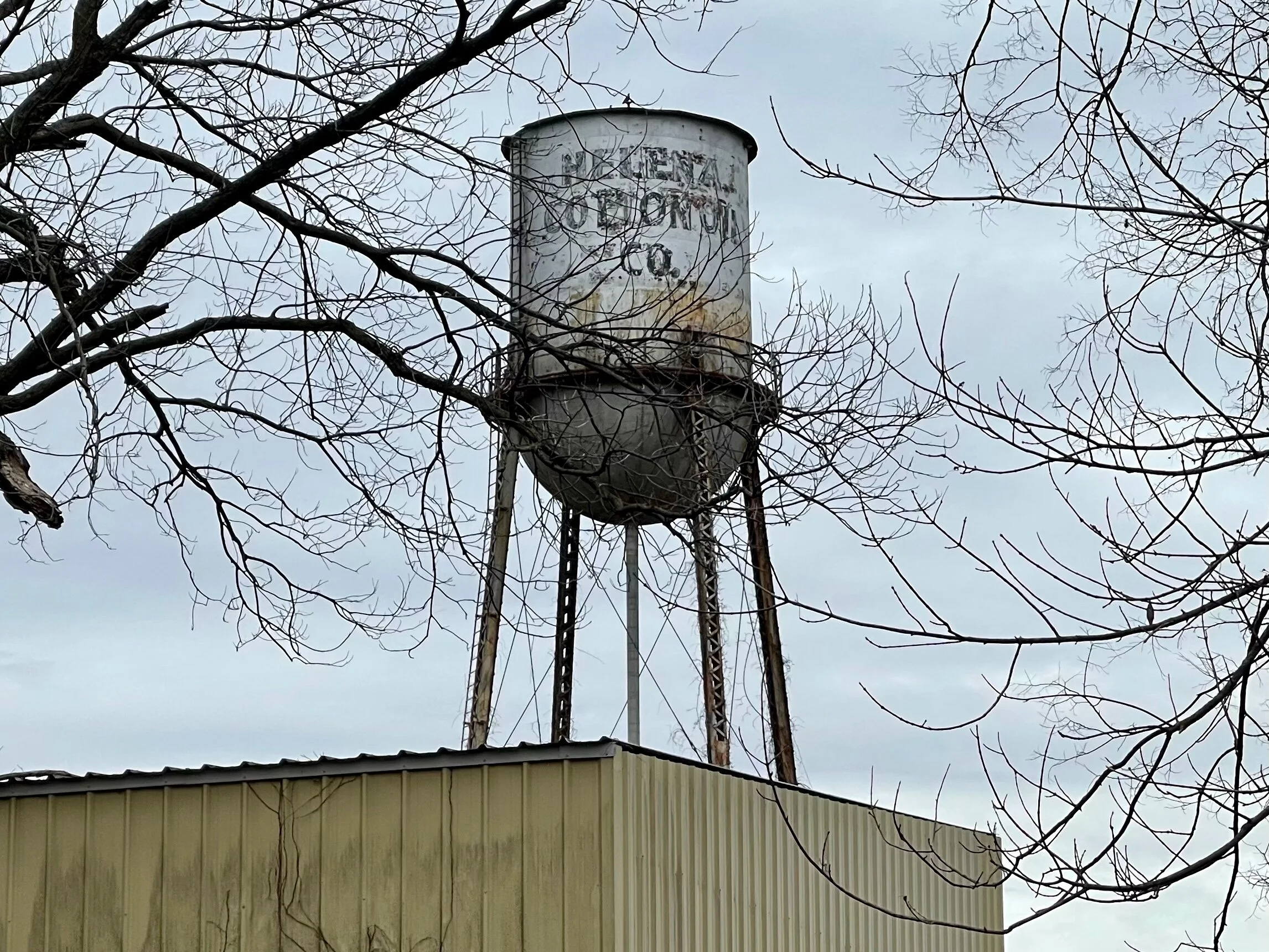
The abandoned Delta Oil Mill outside of Helena, Arkansas. Losing a local industry was particularly harsh for Helena after mechanization beginning in the 1950’s reduced the need for farm workers. The city also lost the Mohawk Rubber Company, a subsidiary of Yokohama Rubber Company, in the 1970s. Unemployment surged shortly after, starting a long economic decline that has lasted for decades.
Much of the Delta country sits on the remarkable Mississippi alluvial plain, which boasts some of best crop land in the country. Alluvial soil has many functions, the greatest of which is serving as the earth’s kidneys. Alluvial soil removes sediments and captures nutrients flowing in adjacent water, so it is very fertile and makes excellent crop land. As a result, the Delta region has been a prime contributor to our country’s agricultural based economy throughout most of the past two centuries.
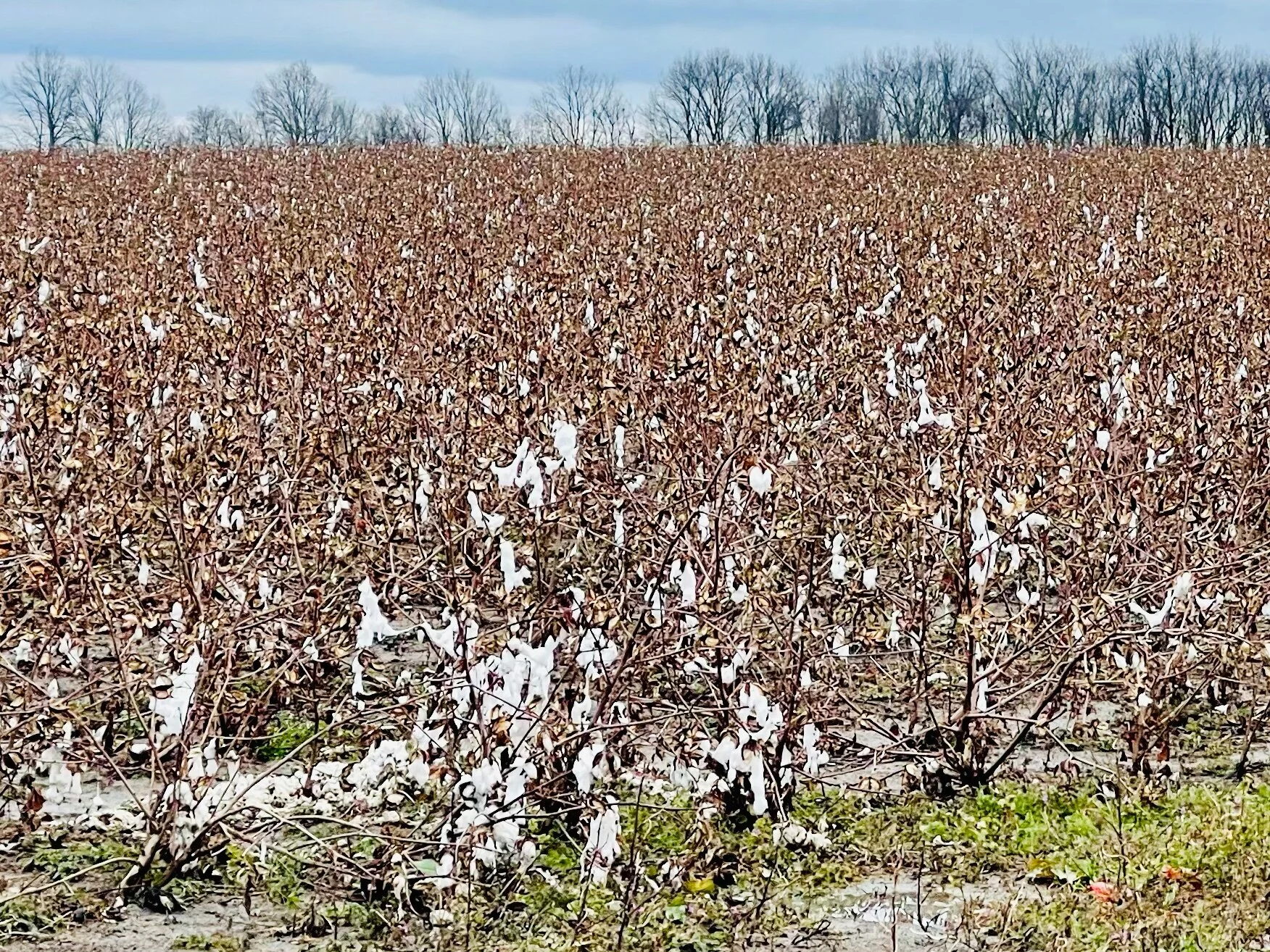
A harvested cotton field near Alligator, Mississippi.
Before the Civil War, farm products comprised up to 82% of all exports, and cotton was especially important on the international market. Agriculture remained the most important activity in the Delta region’s economy for nearly 200 years, and cotton was king. But farming in the Delta was harsh. Between 1910 and 1970, 6.5 million African-Americans went North, leaving the South, the cotton fields, and sharecropping behind. Five million more African-Americans left after 1940, creating the second great migration to the North. By the end of World War II, much of cotton farming had been mechanized, and most of the remaining sharecroppers were forced from the land.
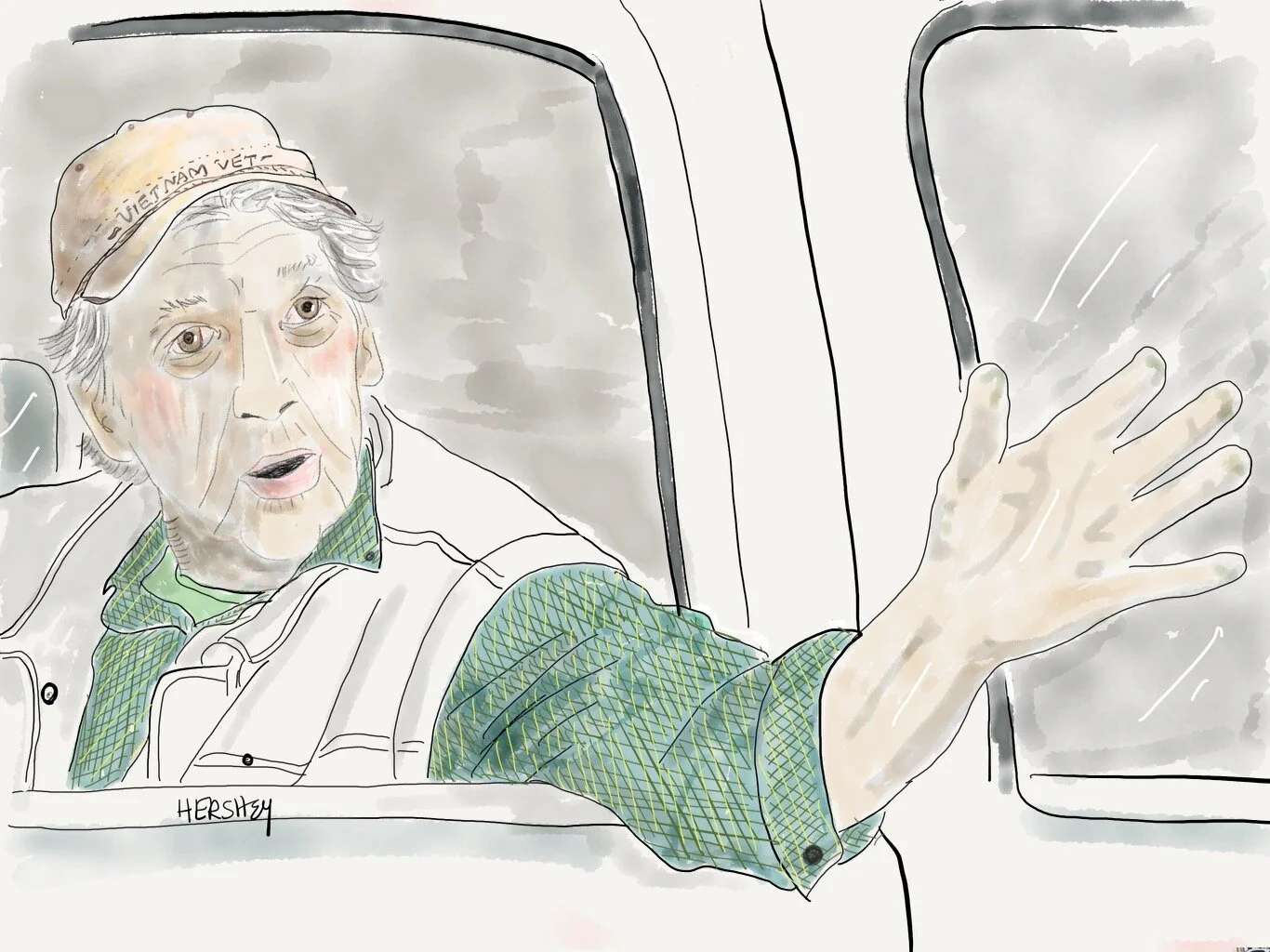
We met Clyde in Mayersville, Mississippi. Although he was on his way to a haircut, he stopped his truck after passing us navigating our bikes down a rugged gravel road, and waited for us to catch up. He told us he was a Vietnam Vet, and when he came home from the war he wanted to be the biggest cotton farmer in the state. He said he now wants to be the smallest. He explained that with the latest machinery two men can farm 2000 acres of cotton, but that level of production is no longer of interest to him. Unfortunately, he was late for his haircut, so we were unable to learn why…..
Clyde lives in Issaquena County. He told us he knew every family there. We checked Wikipedia and sure enough, “As of the 2010 census, the population was 1,406, making it the least populous county in the United States east of the Mississippi River”.
Drawing by Jennifer Hershey. Follow her work on Instagram at deeofo.
I understand how the mechanization of farming would displace thousands of workers. I can also understand how related factories like cottonseed oil mills will close down when agribusiness can cheaply truck goods to larger cities, or even ship raw cotton overseas for cheaper processing. But it’s hard to imagine such distressing trends playing out for over 100 to 150 years. But that’s the reality of the Delta region in Arkansas and Mississippi. Technological unemployment may be thought of more often as an urban problem, but it has been happening in Delta country for decades. And nothing has replaced what has been lost.
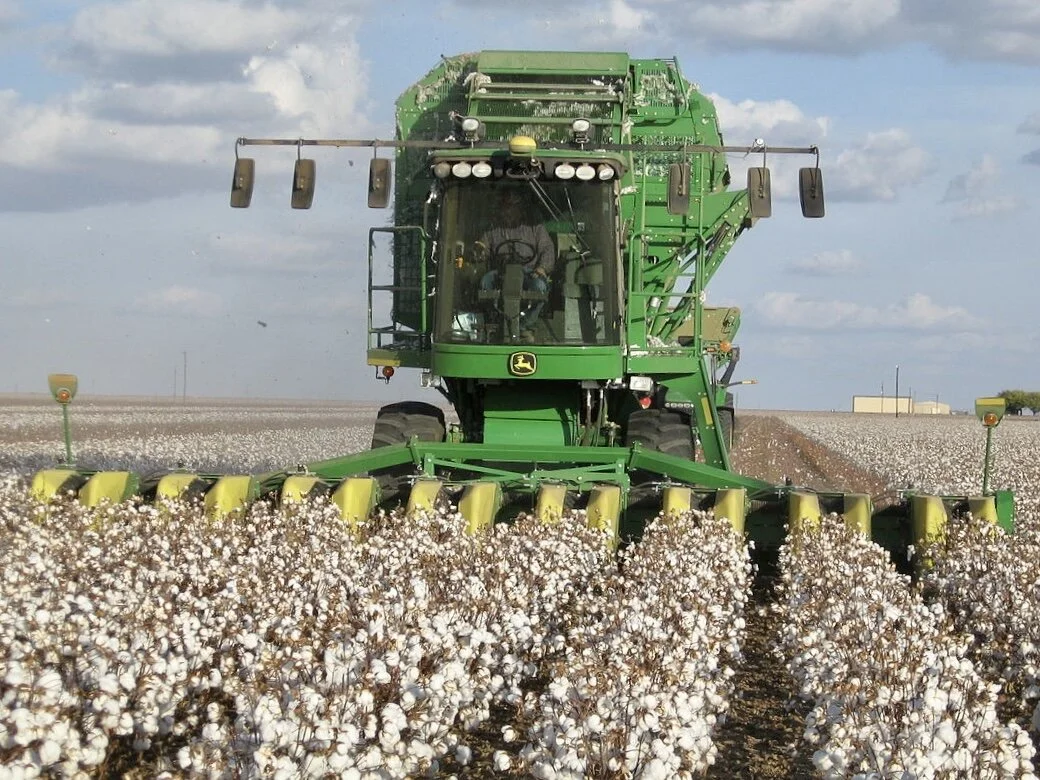
A John Deere cotton harvester. Photo from Wikipedia.
We were deeply impressed by the beauty of the land, the bird life, and most especially the friendliness and soulfulness of the locals we met in the Delta country. We had some really touching conversations with local folks. And our hearts are heavy. What can be done to help people there? Or will most everyone be forced out eventually as homes, commercial buildings and abandoned factories are gradually reclaimed by the earth? Will the Delta become a no-mans land visited by solitary individuals driving massive agricultural planters and harvesters, plus a few intrepid motorists, rugged cyclists or passionate birding enthusiasts? It would be so sad to see the tapestry of such a rich human past die out. Clearly, a major reset is needed, although there are many small attempts at resetting. One example of positive change we came across is the green technical training program in Ocean Springs on the Gulf Coast of Mississippi.
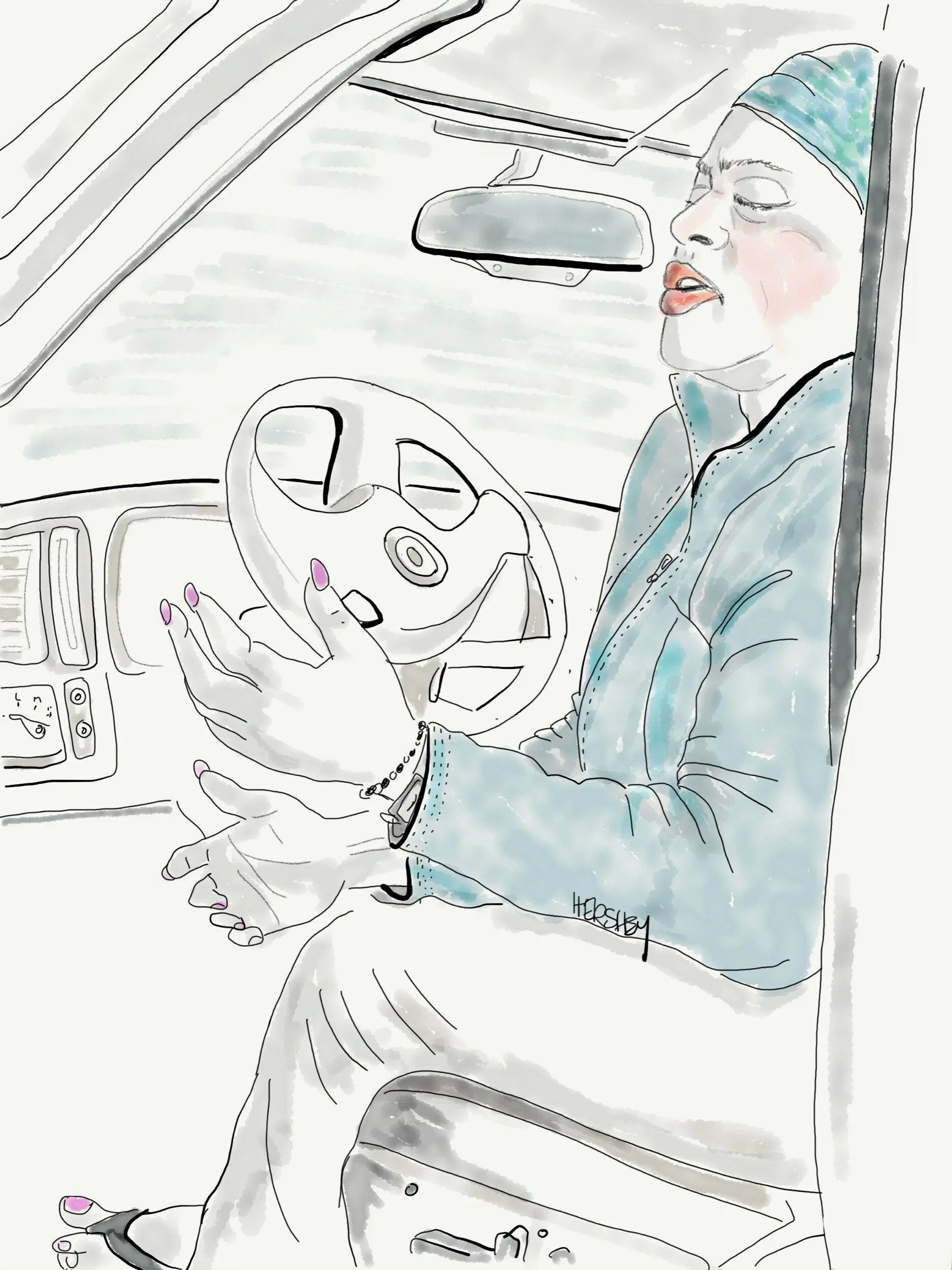
We met this remarkable woman named Tammy in Friars Point in the delta country of northern Mississippi. The park nearby has a walk named after her father, who was a pastor at a local church. Quite a churchgoer herself, Tammy told us she had learned how to “’pay no mind” to the locals who displayed confederate flags. Her church had taught her to forgive others and let them be. She and both her kids had caught Covid, but fortunately for all the cases were mild.
Drawing by Jennifer Hershey. Follow her work on Instagram at deeofo.
This brings me to the end of this blog post, and the beginning of whatever is next for the Mississippi Delta region and beyond. I believe we can already visualize the next great global economic transition and the primary features of its potential success. Three major accomplishments are necessary: 1) our energy system must transform from fossil fuels to renewable form of energy, 2) we must switch from till-based, high-fertilizer, carbon-intensive forms of farming to no-till, low-fertilizer, carbon-mitigating forms of farming that replace dirt-with-soil, and 3) we must set aside one-third of our world’s land and oceans to restore the rapidly vanishing wildlife and biodiversity our species depends on for our own survival.
We are finally making some headway, at least on the national level. President Biden’s first few weeks have bern dynamic and productive. For those who worry about how our rapidly changing climate will continue to wear down our already vulnerable economy, many of his climate-related executive orders are very welcome.
Also, you may have read about the lackluster oil lease sale in the Alaska National Wildlife Refuge (ANWR) in the final days of the Trump administration. Even as the Trump administration failed to acknowledge climate change, many corporations are finally recognizing our changing climate as a true threat. Finally there's a visible mainstream momentum toward a healthier, more reliable renewable energy supply. Jobs may not be that far behind, nor will be agricultural and wildlife restoration. In the meantime, the Mississippi Delta region will continue to languish for its inhabitants while delighting many of its visitors.
Stay vigilant! Thanks for reading. More to come. Follow our next trip this coming March, 2021.
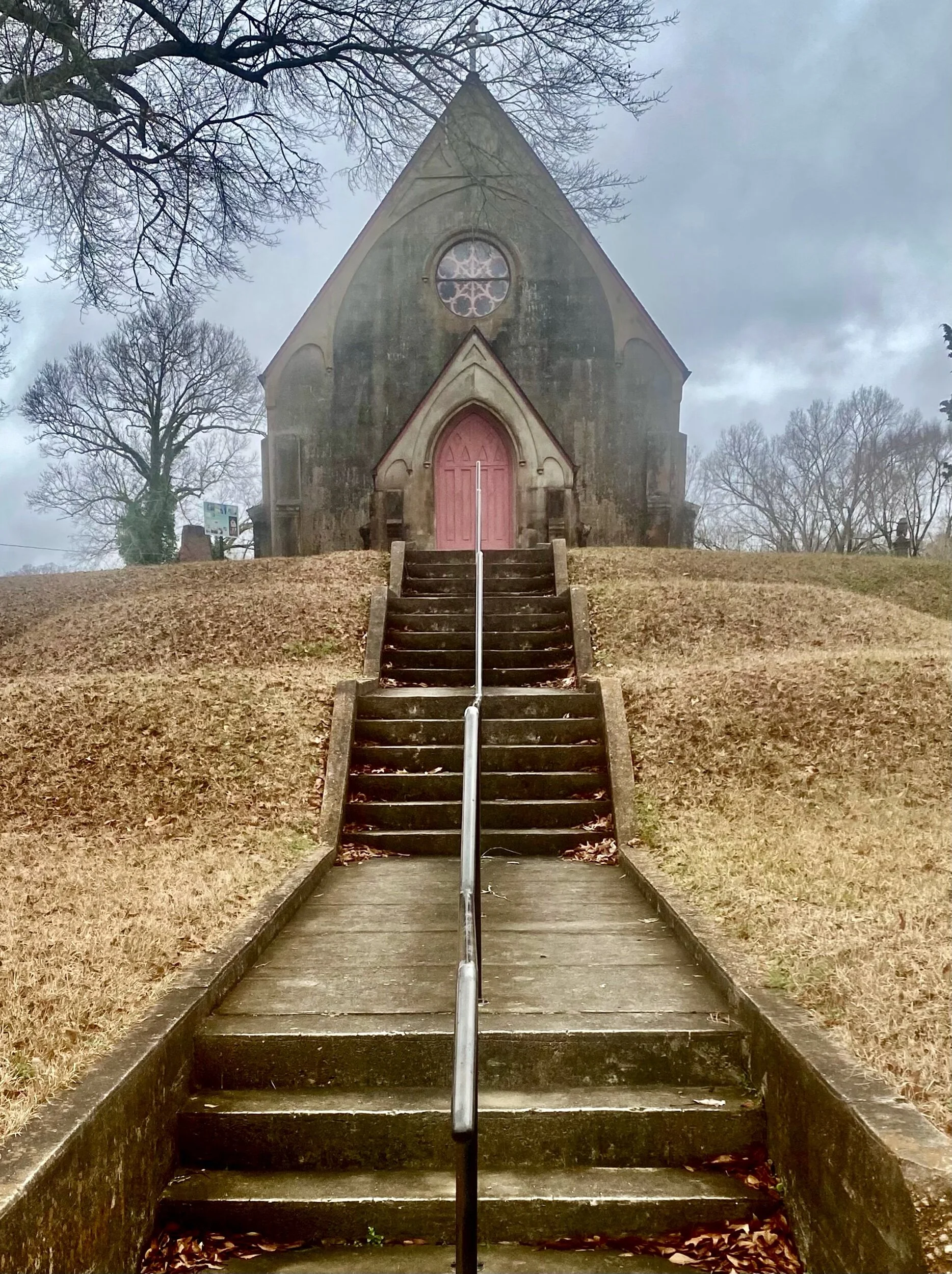
An Episcopal Church in Lorman, Mississippi.
All photos, unless credited or otherwise noted, are copyrighted property of the blog post author.
Louisiana/Texas, Post 4
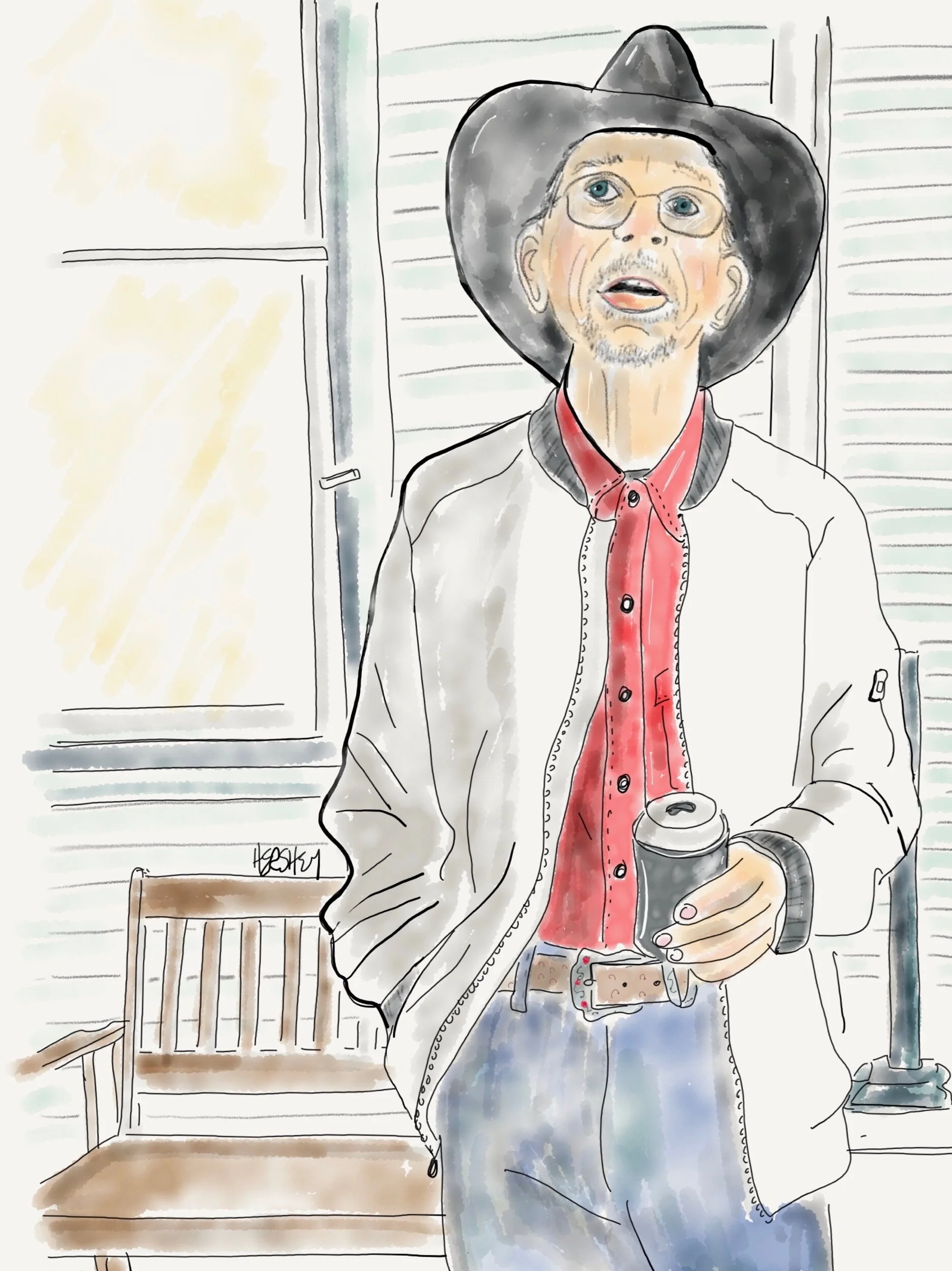
“I work up at United Ag in El Campo. I live at this hotel. Spend Sundays off in Bay City.” Drawing by Jennifer Hershey. Follow her work on Instagram at deeofo.
“Don’t go around saying the world owes you a living. The world owes you nothing. It was here first.” — Mark Twain
Most everywhere we’ve been in Louisiana and Texas, we’ve encountered people who believe deeply in the concept of hard work. I don't know if the importance of work is stronger in the south than elsewhere (it’s hard to imagine a more frenetic work environment than New York City), but its virtue came up repeatedly in our conversations with locals. Often the merits of working seem linked to another highly prized value in these parts - self-reliance - the pathway to the most exalted of American values, our freedom.
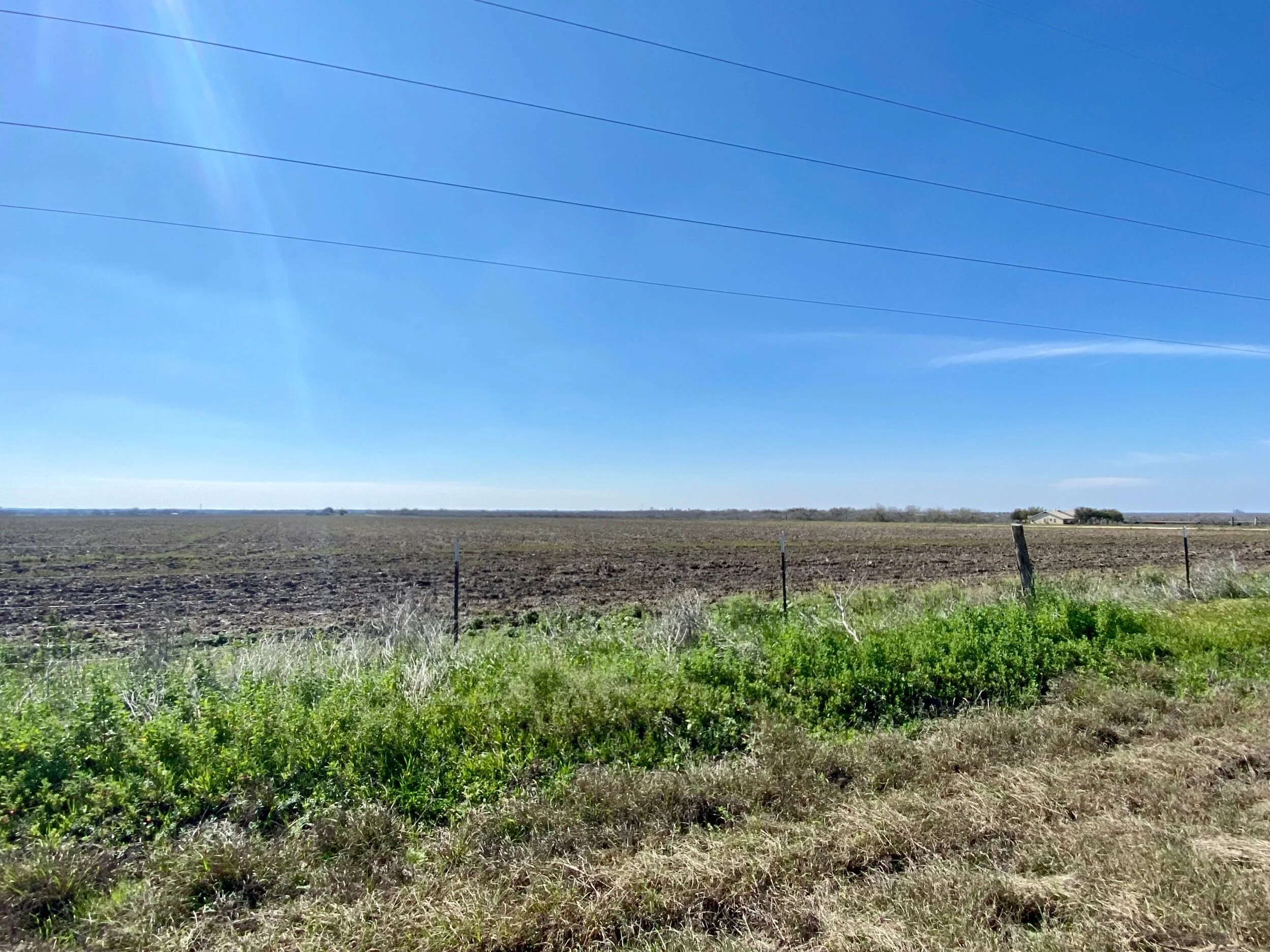
Big sky country in Texas between Corpus Christi and San Antonio.
One of our first conversations with a local in Louisiana centered around the concept of a strong “work ethic.” The man we were speaking to was a small businessman and boss of six employees. His perspective made a lot of sense. What boss wouldn't want productive workers? He went on to explain he wasn’t a fan of freeloaders - people too lazy to work, who wanted a handout from the government. I’m sure he’d fired his share of poor workers, but when it came to individuals wanting handouts, it seemed more like he was talking about an idea of what people are like than a reality. Maybe others know people who don’t seek the meaning that work brings us (even when they are unemployed or underemployed), but I do not. I can’t help but wonder if that experience is a reflection of my own cultural viewpoint, or an indication of a lack of exposure to reality seen through a cultural and political naivety.
One thing is certain to me: it is fundamentally human to seek meaningful activity. We all must live. And even in an age of extraordinary inequalities in wealth and income, the majority of us still must - and want to - work. So while there may be poor workers, are there really folks out there who think they deserve something for nothing?
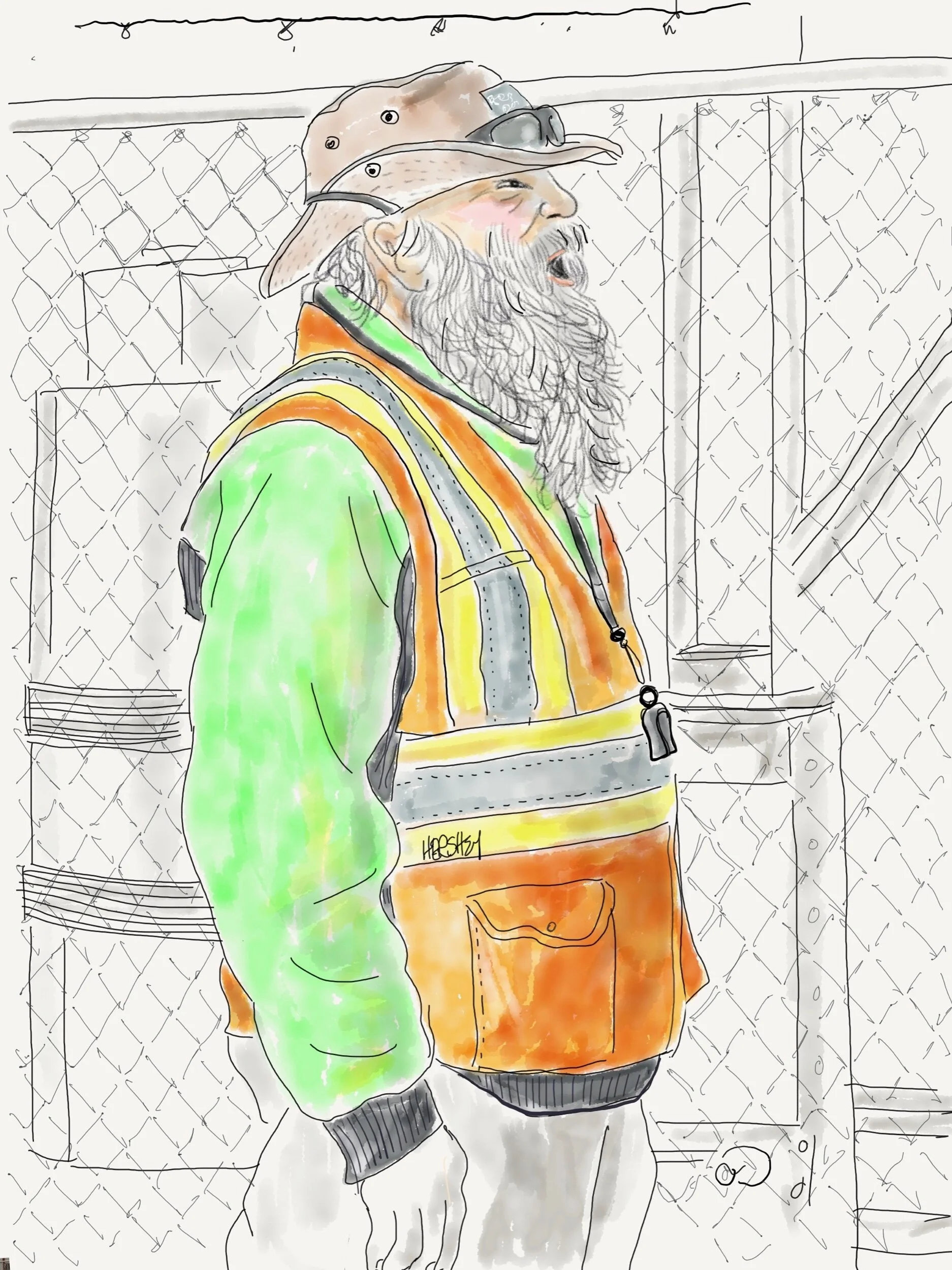
“We don’t get many bikes down here— just make sure you walk ‘em onto the ferry”! Drawing by Jennifer Hershey. Follow her work on Instagram at deeofo.
Although southwest Louisiana and southeast Texas are equally flat, the land between Corpus Christi and San Antonio seems especially vast. Perhaps it’s the steady 150 mile rise from the coast to San Antonio (which is 650 feet above sea level). Or perhaps it’s the unrelenting expanse of open, uninterrupted fields. Perhaps it’s the long, straight roads. Whatever the reason, it's BIG.
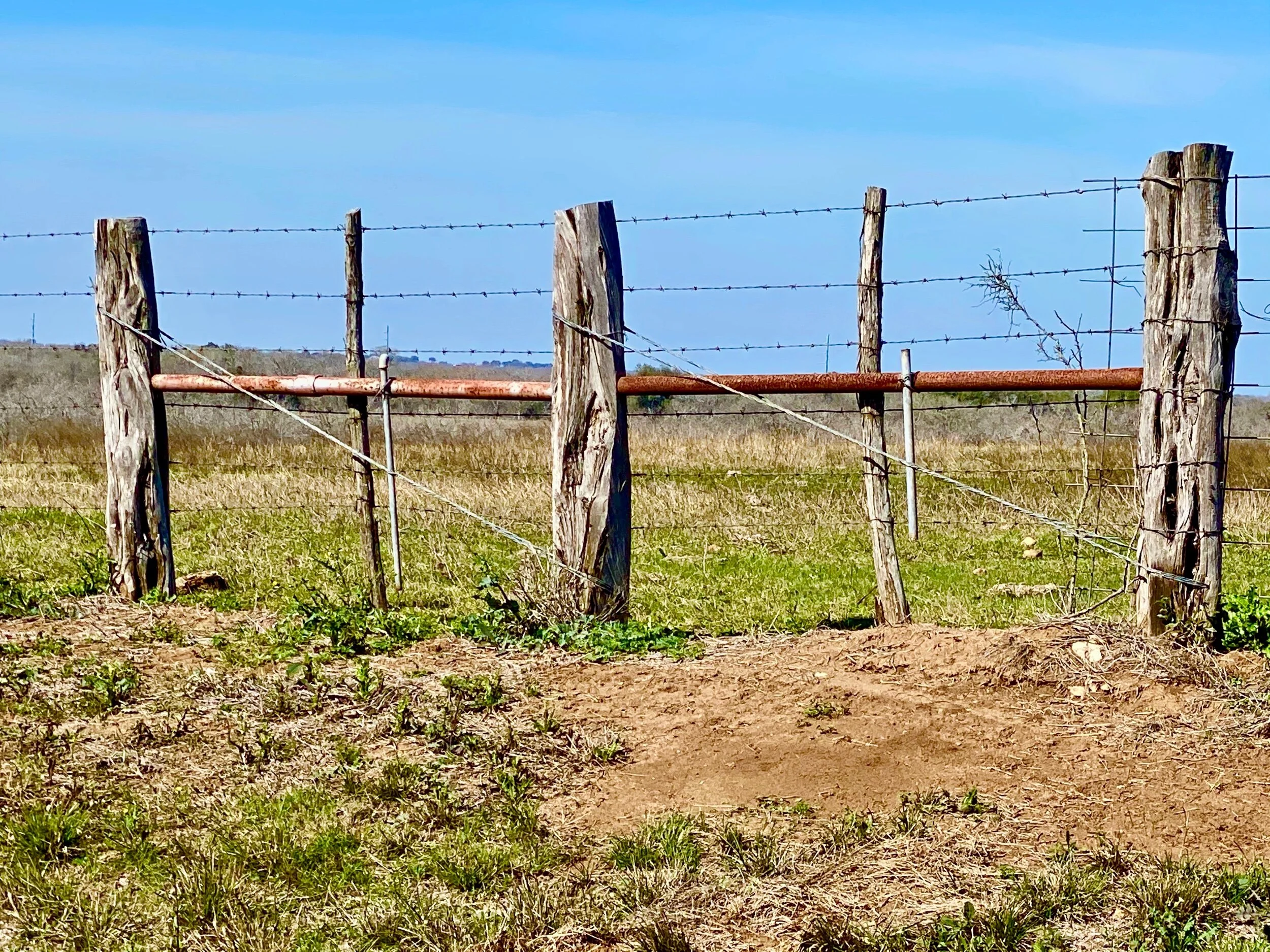
Taken on Texas State Highway 181 between Corpus Christi and San Antonio. Prior to the invention of barbed wire in the 1870’s, fences couldn't reliably contain cattle.
At the same time, both the land and people between Corpus Christi and San Antonio are hardscrabble. Pickups are normal, sedans are unusual. Regular folks are used to fishing and hunting. Although they don’t rely on their catches to stay alive, fish and animal wildlife seem to be part of the rural Texan diet, at least among the people we talked to. And the land is used in every way possible; for agriculture, farming, fishing, hunting, wind power, oil and gas extraction, compression stations, pipelines, home building, junkyards, storage sheds, telephone poles, auto graveyards, human graveyards… The Texas countryside is a hodgepodge of so many competing uses I often found it as overstimulating and confusing as a Wal-Mart Megastore.
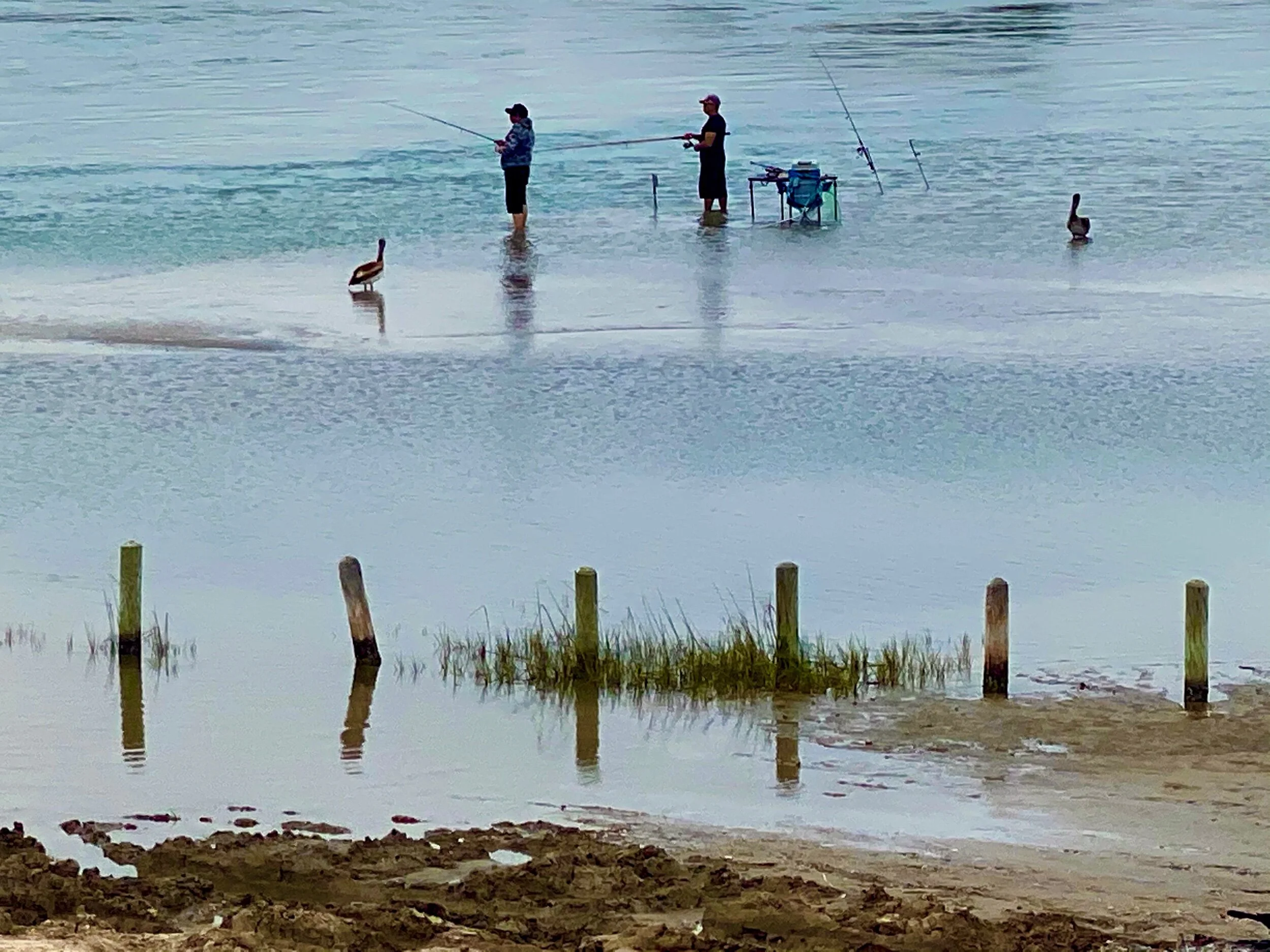
Texans fishing off the causeway between Aransas and Port Aransas, Texas. The birds nearby are Pelicans.
There's also a lot of workers. A surprising number of people work for wind farms and quite a few work in agriculture, but most of the people we met work for oil and gas or petrochemical companies. And there are a lot of companies. Thirty one new petrochemical plants have been approved for construction or reconstruction in hurricane prone areas on, or near, the Louisiana and Texas coasts since 2016. In our last post, we wrote about two large LNG exporting plants under construction in Cameron, Louisiana and nearby Port Arthur, Texas. These are among those 31 new plants.
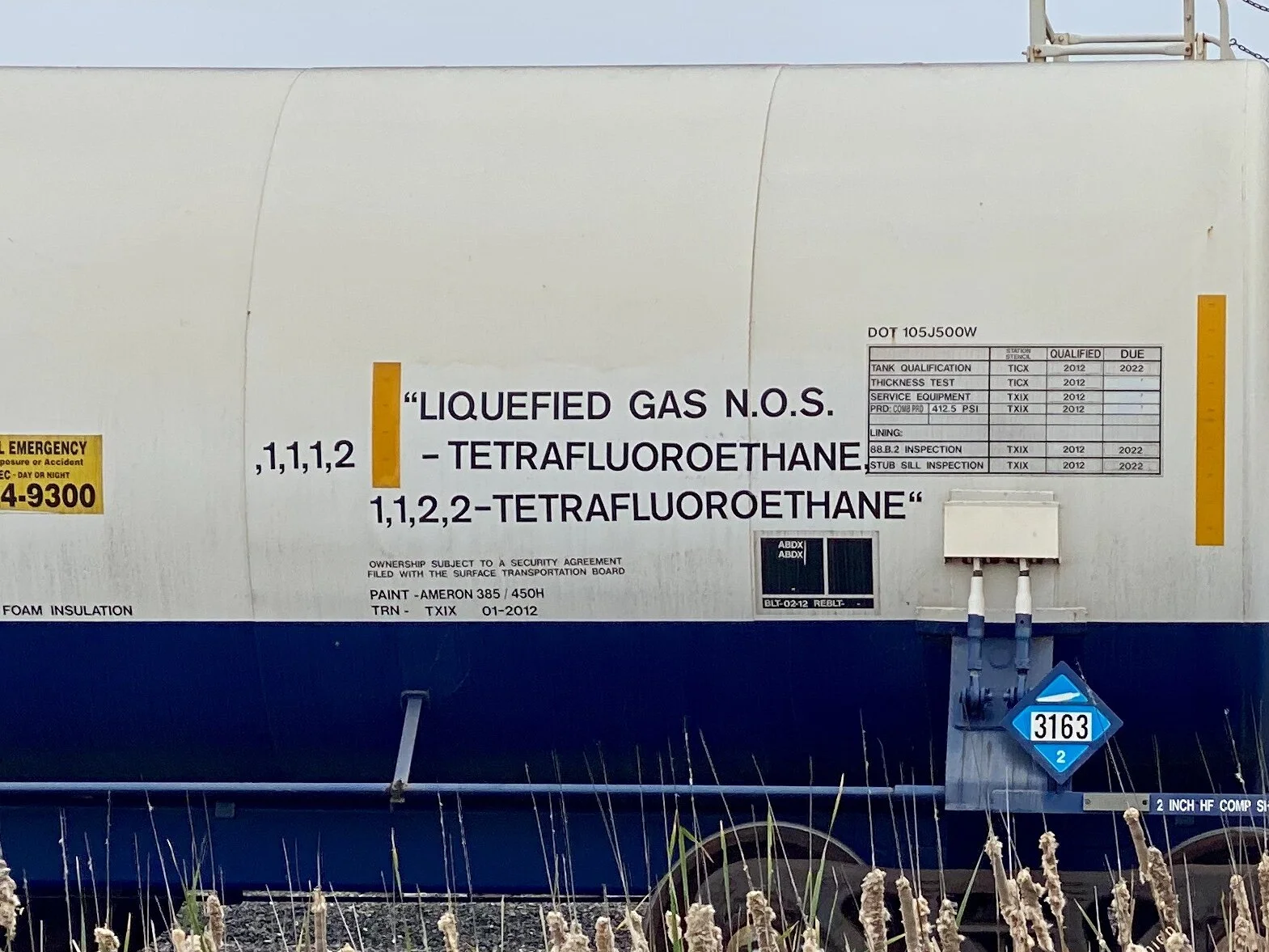
One of hundreds of refrigerant tank cars lined up near the Occidental Petroleum, Chemours, and Nashtec Plants at Gregory and Ingleside, Texas, not far from the Gulf Coast on the way inland to Beeville, Texas.
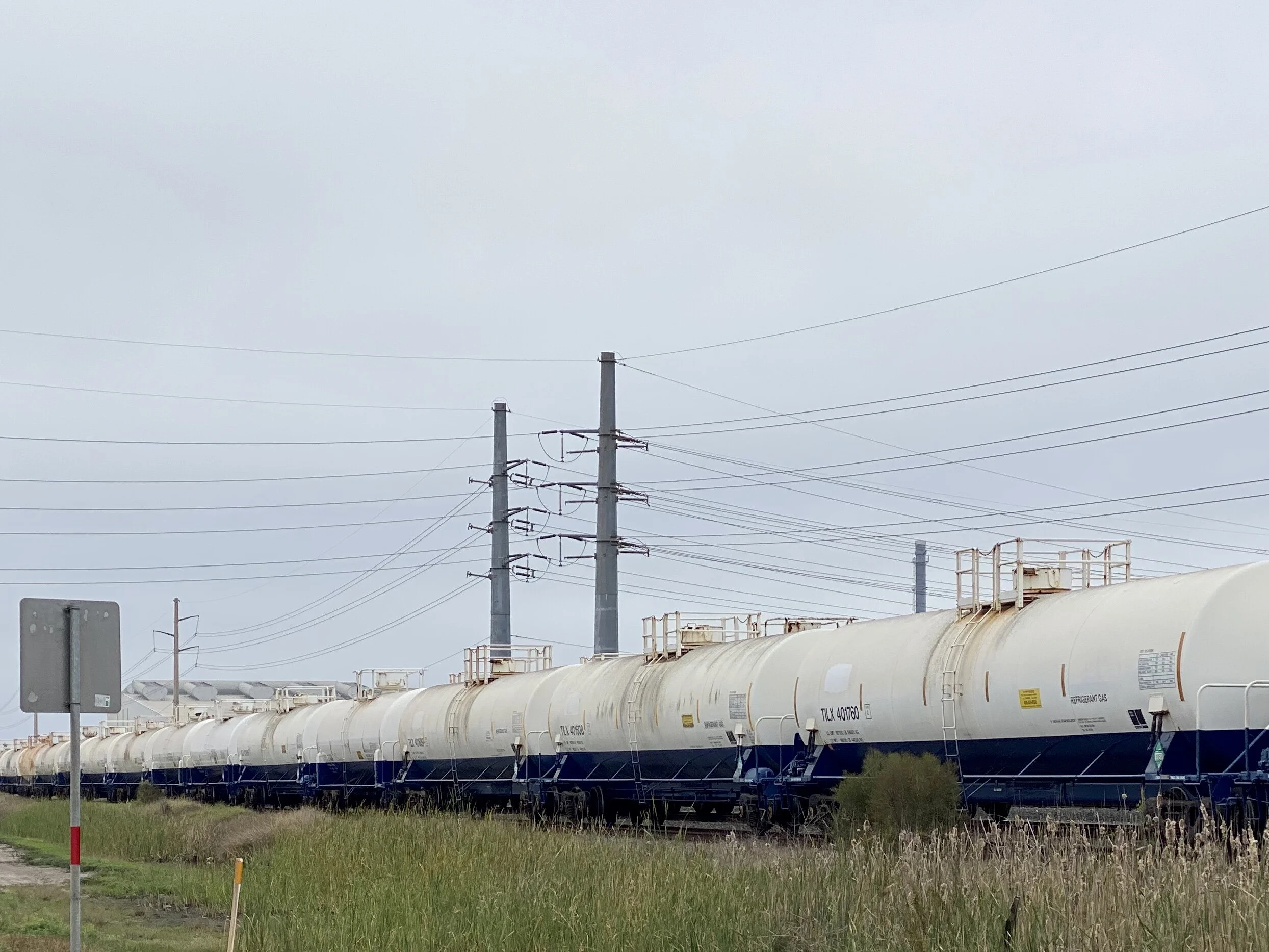
Tetrafluorethane is regarded as a “sustainable” refrigerant because it has lower carbon emissions than previous versions, and a minimal impact on ozone.
As much as we were profoundly charmed and cheered by the warmth of the people we met, the omnipresence of these facilities contributed to our uneasiness. In the face of climate change, does this boom really make sense? There’s something profoundly unsettling about the trend. I’m not so sure the locals feel any different. In Texas, even cognitive dissonance is BIG.
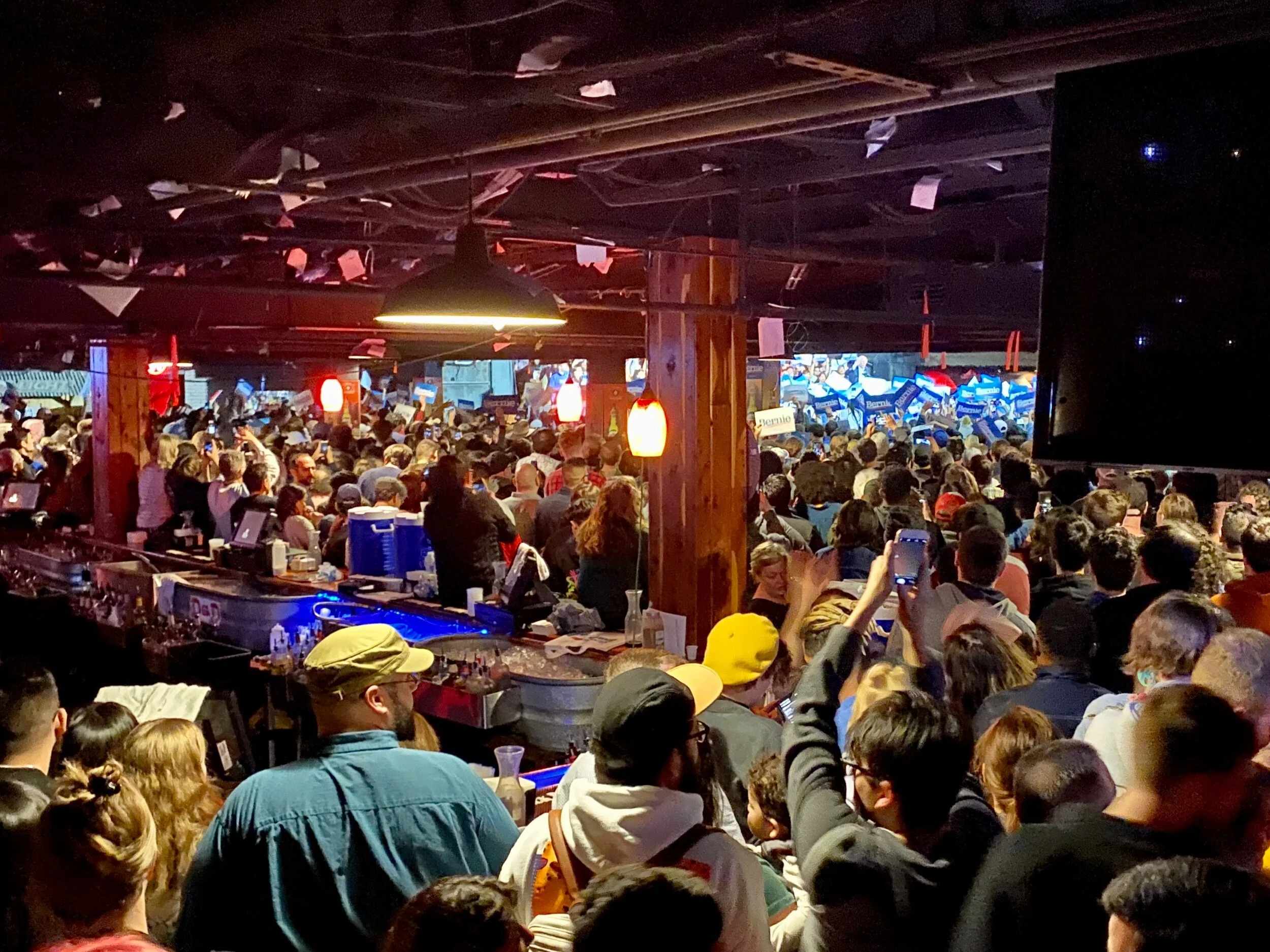
Interestingly, Jenny and I arrived in San Antonio on the night of the Nevada Democratic caucus, and we had the opportunity to drop into the famed Cowboy Dance Hall to catch a raucous, youthful and well-supported Bernie Sanders rally. Just for the record, we both appreciate Bernie’s concerns about climate change, but worry he is over-focused on what we need to achieve and under-focused on how to do it without causing a destructive backlash.
Northerners may not be aware that Texas is the leading U.S. producer of both crude oil and natural gas. In 2017, the state accounted for 37% of the nation's crude oil production and 24% of its marketed natural gas production. NPR.org reports that Texas currently supports a total of 163 natural gas production plants, and Texas has the largest processing capacity in the U.S. In addition, there are 29 petroleum refineries in Texas that process more than 5.7 million barrels of crude oil per day. These plants account for 31% of the nation's refining capacity.
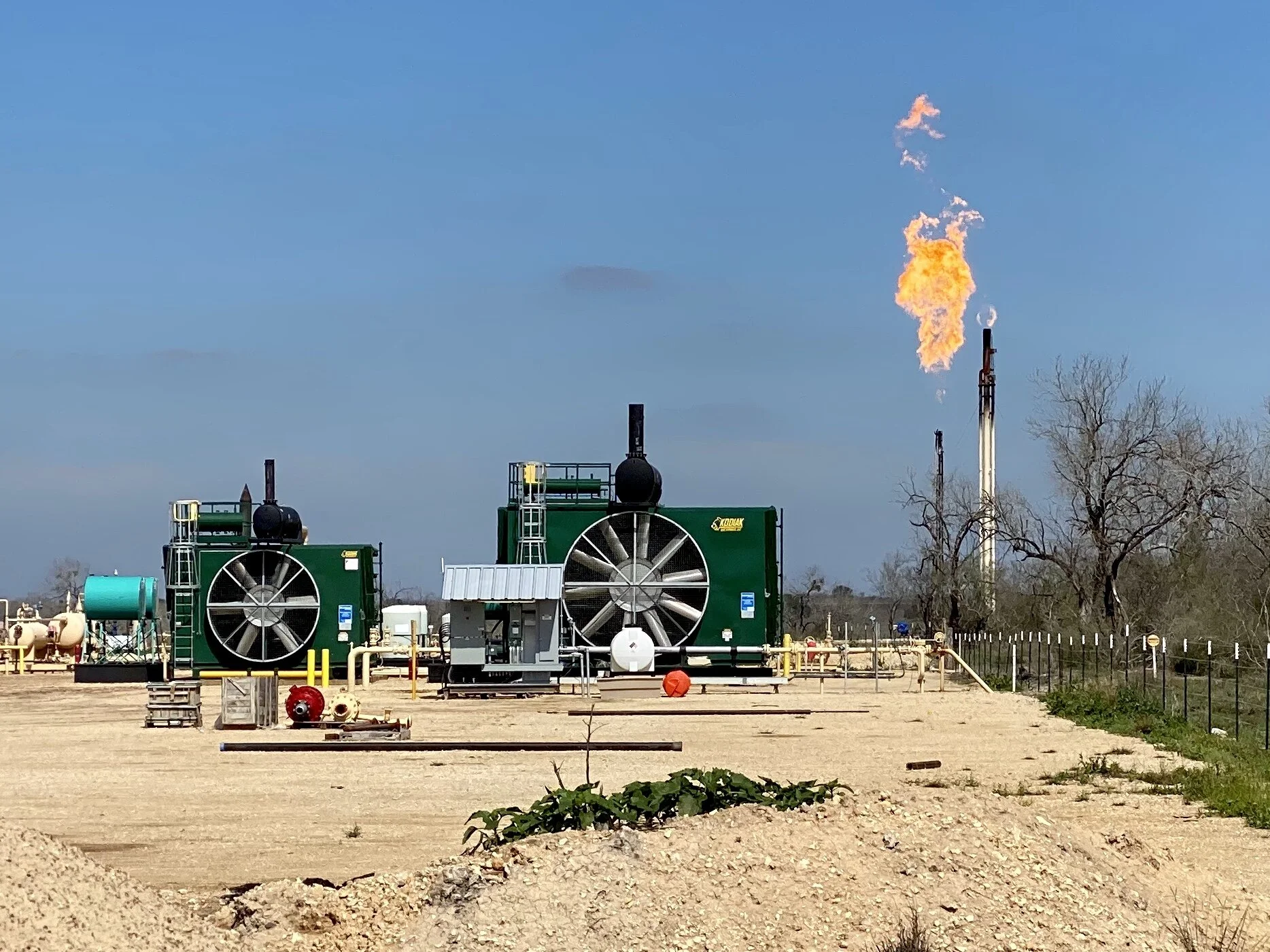
A hydrogen sulfide (H2S) flare near a gas pad. Flaring burns off gas that is deemed uneconomical to collect and sell. It is common to flare natural gas that contains hydrogen sulfide to convert the highly toxic hydrogen sulfide gas into less toxic compounds. Although the practice of flaring is decreasing as pipeline efficacy improves, the following air pollutants may be released from natural gas flares: benzene, formaldehyde, polycyclic aromatic hydrocarbons (PAHs, including naphthalene), acetaldehyde, acrolein, propylene, toluene, xylenes, ethyl benzene and hexane. Taken from this source.
On our next trip to the southwest, we hope to visit the fast growing, second most productive oil field in the world (as of 2018), located in the Permian Basin in western Texas and New Mexico.
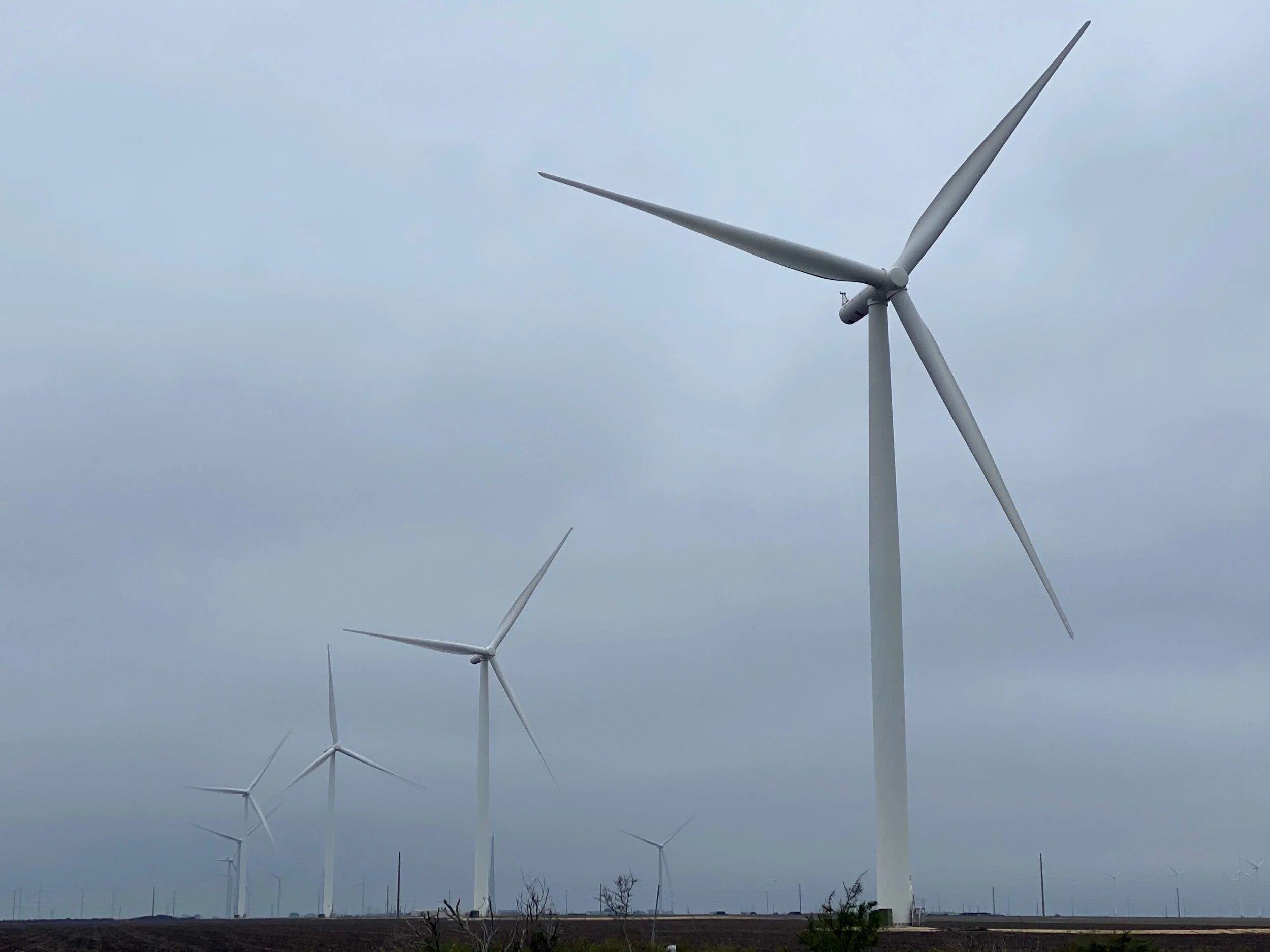
Just above Gregory we encountered a large wind farm on agricultural fields that spanned to the horizon on both sides of the road for almost 8 miles. Later we learned it is run by E.ON Climate and Renewables North America, one of the worlds largest developers, owners, and operators of renewable energy projects. EON owns and operates over 1,900 MW of wind farms in the United States. The wind on these flat plains are intense (we learned that the hard way), and there are quite a few more wind power companies in the area.
Perhaps more surprisingly, Texas leads the nation in wind-powered generation. The state produced one-fourth of all the U.S. wind powered electricity in 2017. Texas wind turbines have produced more electricity than both of the state's nuclear power plants since 2014. And equally interesting, Texas produces more electricity than any other state, generating almost twice as much as Florida, the second-highest electricity-producing state. All combined, Texas is the largest energy-producing state in the country. It’s also the largest energy-consuming state in the nation. In fact, the industrial sector, including its refineries and petrochemical plants, accounts for half of the energy consumed in the state.
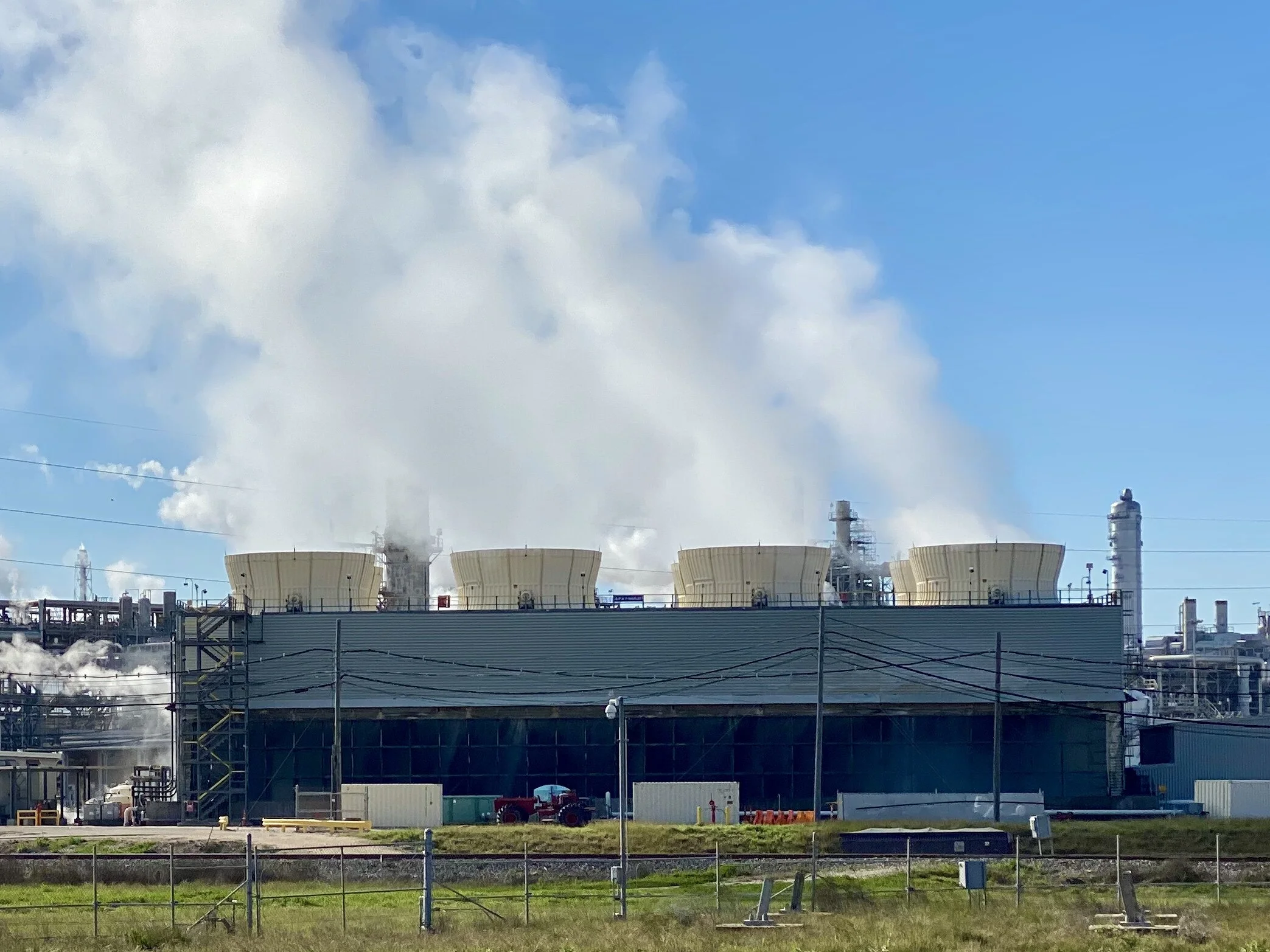
Cooling Towers on the Dow Chemical Plant in Freeport, Texas.
Given our lowbrow method of bicycle travel to offbeat roads and towns, we had lots of opportunities to speak with locals. We didn’t meet one person who spoke of his or her job in disparaging terms. We were often met with gratitude for the opportunities that seemed to be available. Truth is, Texas is humming. The unemployment rate is 3.4%, while the national average is 3.6%. Louisiana’s rate is slightly higher at 4.5%, although it was 6% in November of 2016. By most measures in both states, employment is looking up.
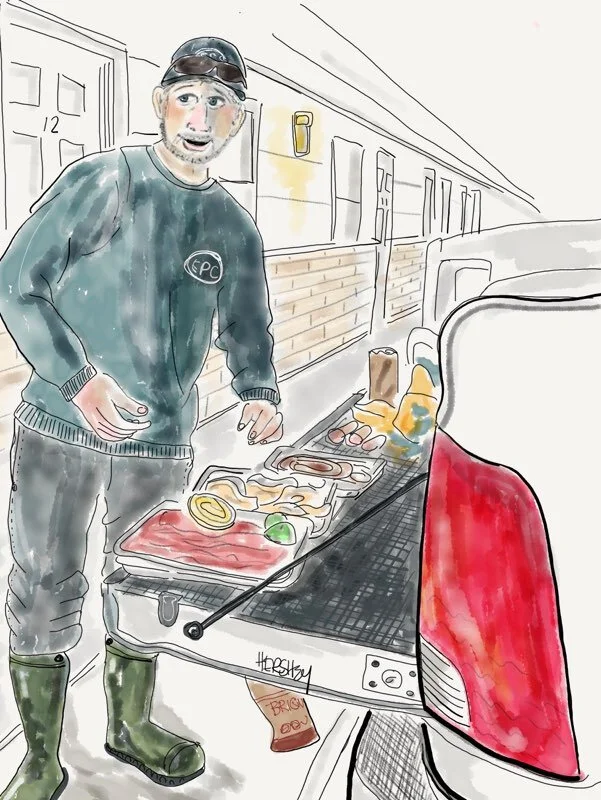
“Me?- I’m Norberto. Me an’ my brothers, Ivan and Freddy cook our meals for the week out here. We take our lunches to the plant.” Drawing by Jennifer Hershey. Follow her work on Instagram at deeofo.
Norberto and his brothers had traveled from their home near Brownsville to work at a plant near Kenedy, Texas. There’s a lot of available jobs there. We counted 9 oil and gas plants in this town of 3500 people.
The evening we hung out with Norberto and his brothers, I fell into a conversation with one of their friends, an oil worker named Jose. An Hispanic transplant from Indiana, Jose was happy to be finding so much work in a part of the country that he preferred. He educated me for awhile about H2S flaring and modern pipeline construction methods, which I appreciated. It was comforting to hear the industry was actually trying to lower methane emissions. After a while, I asked him about his politics. Jose was unabashedly straightforward about supporting Trump because Trump supported his industry. I turned the conversation to climate change. He hesitated a bit as I gently expressed my concern about carbon emissions and what might happen to the world my grandchildren will be inheriting. He didn’t have children, so I kept the conversation a few generations out. I could also tell Jose was aware lots of folks felt like I did, and I could feel him becoming defensive. So I changed tack. I told him I didn’t begrudge anyone working in any industry who was trying to achieve his or her fair share of the American Dream.
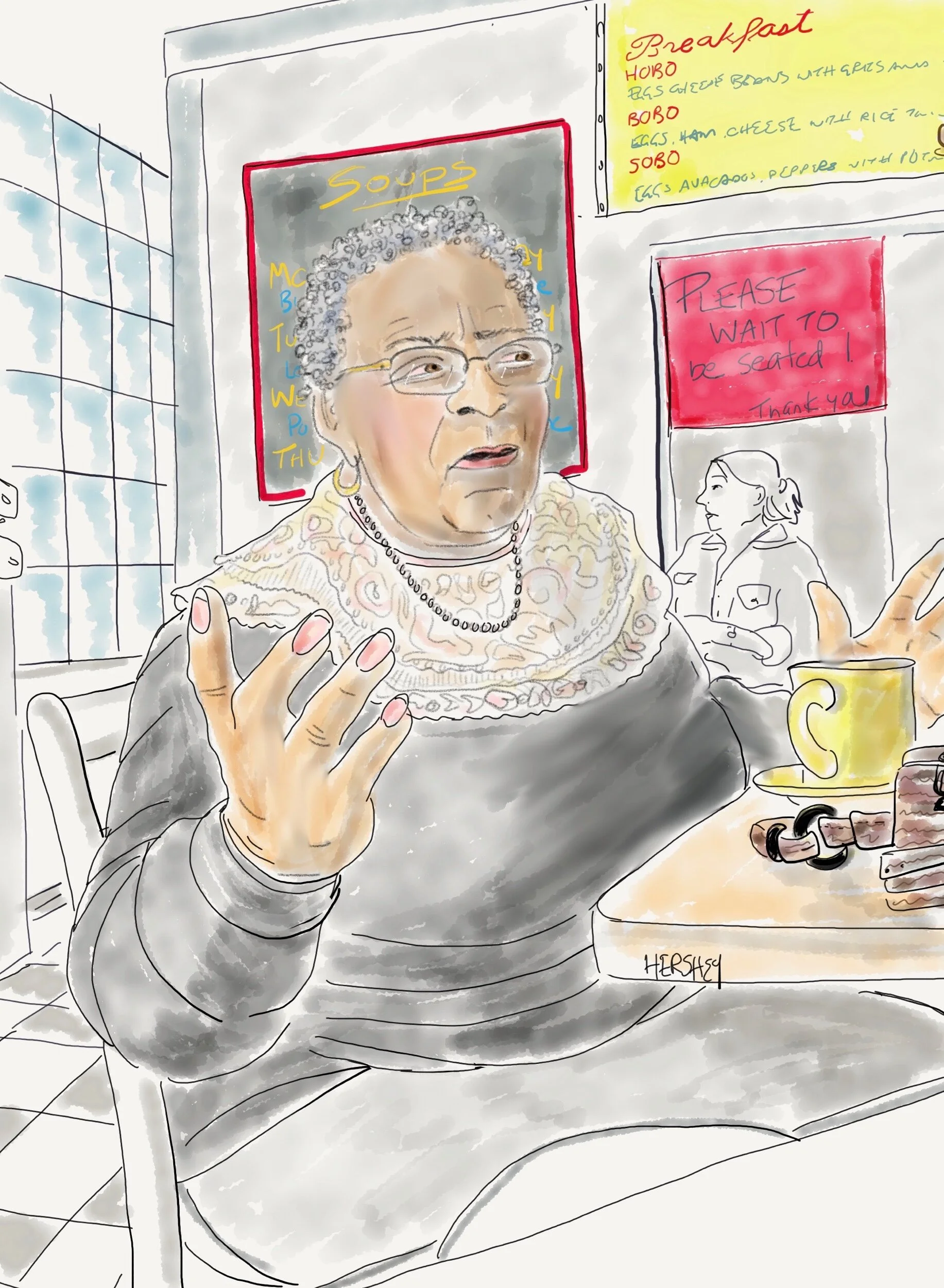
“I used to be an intelligence analyst for the army in Germany. I moved back here to be close to my military family. I pray everywhere and anywhere because God is always where I’m praying”. Drawing by Jennifer Hershey. Follow her on Instagram at deeofo.
I remember how isolated veterans felt when they returned from the Vietnam war many years ago. Coming back to a divided country after having served in an unpopular war was a miserable experience for so many veterans, and their shame and degradation cloyed deeply at those of us who opposed the war. Consequently, it was a relief when Americans did not do the same thing to vets when they returned from the second Gulf War - a war equally as unpopular as Vietnam. It seemed that Americans understood had that our vets were not the perpetrators of an unpopular and ill-advised conflict, but were instead brave men and women who had been asked to do something unpopular and counterproductive by their superior officers. In that case, the right people were held accountable for poor choices.
Just as those of us who are deeply worried about the growing climate emergency are realizing that meaningful change has little relevance to the consumer-based choices of the average middle class, we also need to avoid blaming our brothers and sisters who work at low and mid-level technical jobs in an industry that has brought us so much, but is also causing us great damage.
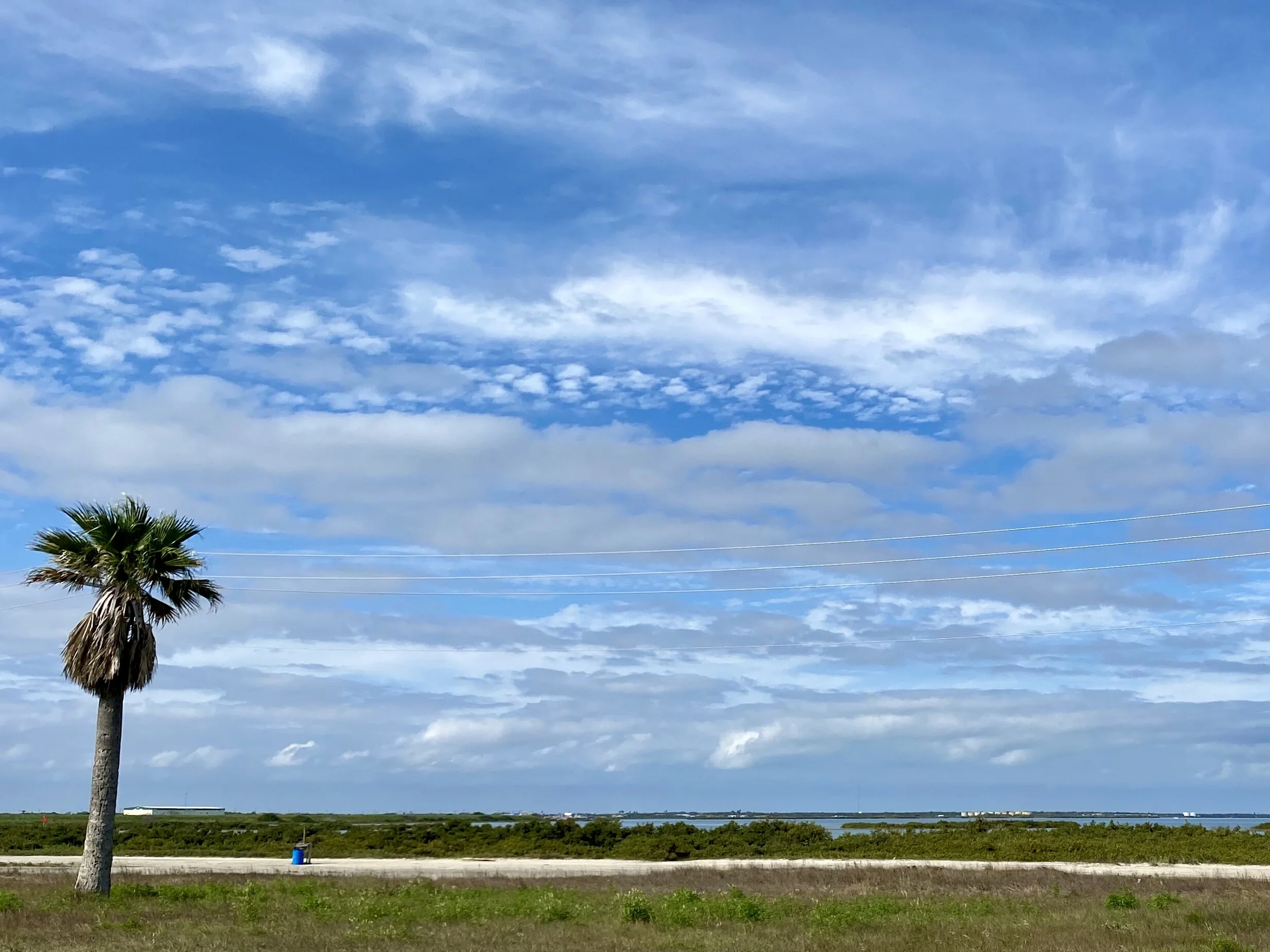
Looking south from the causeway between Aransas and Port Aransas, Texas.
Jobs matter. They are a necessity. At the same time, we need policies that will aggressively curb and eliminate carbon emissions. I've heard conservative Republicans say that it’s not fossil fuels that are the problem, it's emissions. In response, I say …. great! If one really trusts the free market, then put a price on those emissions (and return the proceeds as a dividend to taxpayers to mitigate additional costs), and trust the market to work its magic. And if that intervention doesn’t do the work fast enough (at the rate that science tells us we need) then let’s put our money where our mouth is and trust the market enough to increase the price of carbon until it’s enough. Let’s bring the emissions down! If we can use the market to stimulate innovation that will help us save a lot of our oil and gas jobs, that’s terrific! If not, then let’s accept the truth of our situation and create a different kind of economy.
As one of the people we met kept saying, “I'll tell you what” …Using the ridiculous excuse that the science isn’t settled isn’t acceptable. The science of climate change is as verified and verifiable as the concept of gravity (about 98% of scientists agree both are happening). Climate change isn’t convenient, that’s for sure. But just because we don’t like that it’s happening isn’t a reason for denial. Let’s deal with it.
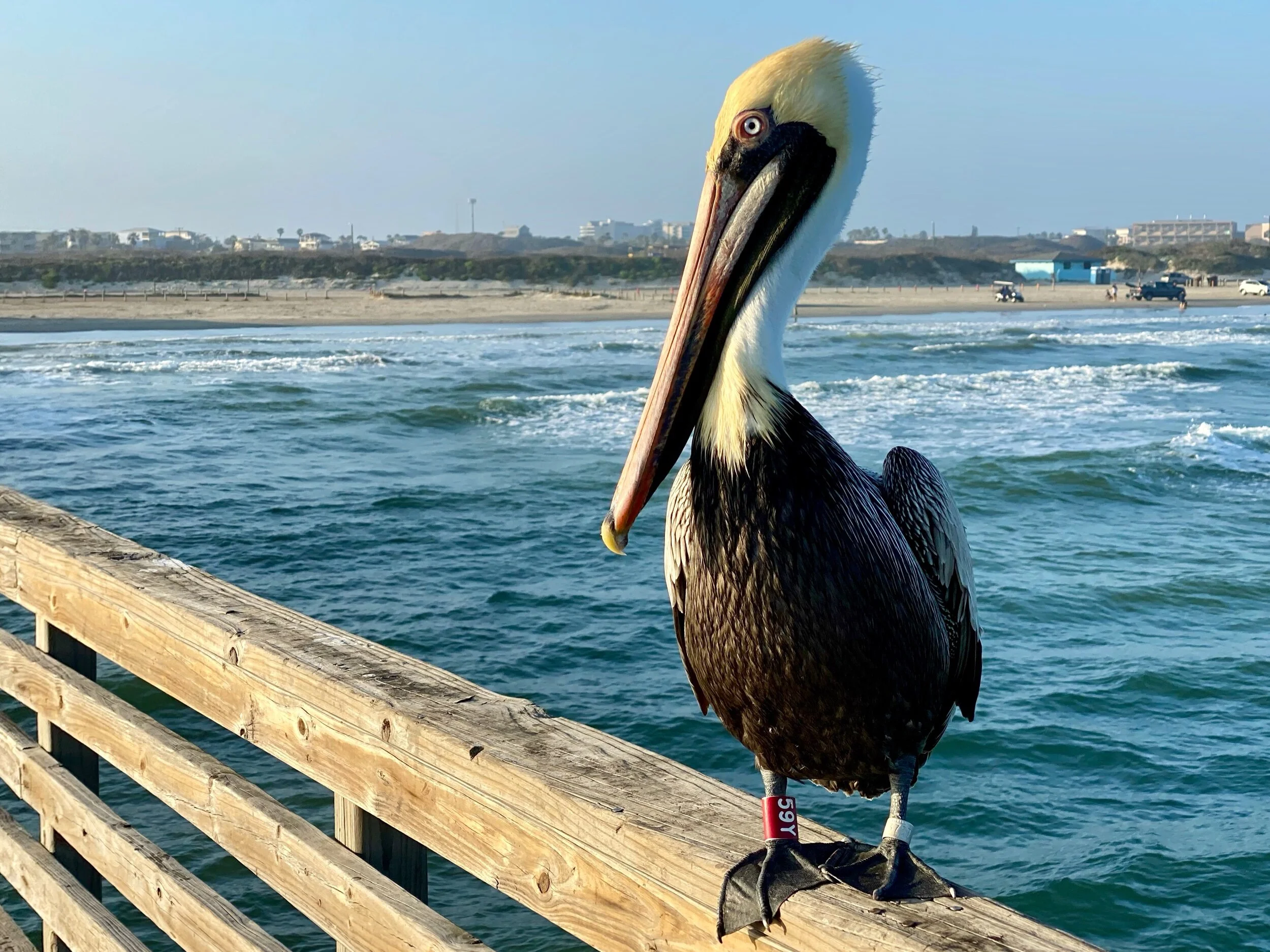
Yet another Pelican poses for us near Corpus Christi.
This blog post concludes our latest trip from New Orleans to San Antonio. I am writing this on an Amtrak train, with our bikes safely stowed in the baggage car. It’s been an extraordinary trip. If you haven’t visited the 4 missions on the San Antonio River, we enthusiastically recommend them, especially Mission San Juan. A few key pictures from there are posted below.
Below are links to this entire trip. If you don’t have a Garmin account you will have to create one to see them (it's worth it if you're a biking geek or map lover).
1) New Orleans Road Cycling, 2) New Orleans Road Cycling, 3) Donaldsonville Road Cycling, 4) Morgan City Road Cycling, 5) St Mary Parish Road Cycling, 6) Abbeville Road Cycling, 7) Lake Arthur Road Cycling, 8) Cameron Parish Road Cycling, 9) Port Arthur Road Cycling, 10) Galveston Road Cycling, 11) Freeport Road Cycling, 12) Matagorda County Road Cycling, 13) Refugio Road Cycling, 14) Port Aransas Road Cycling, 15) Bee County Road Cycling, 16) Kenedy Road Cycling, 17) Floresville Road Cycling, 18) San Antonio Road Cycling, 19) San Antonio Road Cycling, 20) San Antonio Road Cycling.
Thanks for reading! There’s always more to come, but this particular trip is complete.
All photos, unless credited or otherwise noted, are copyrighted property of the blog post author.
Louisiana/Texas, Post 3
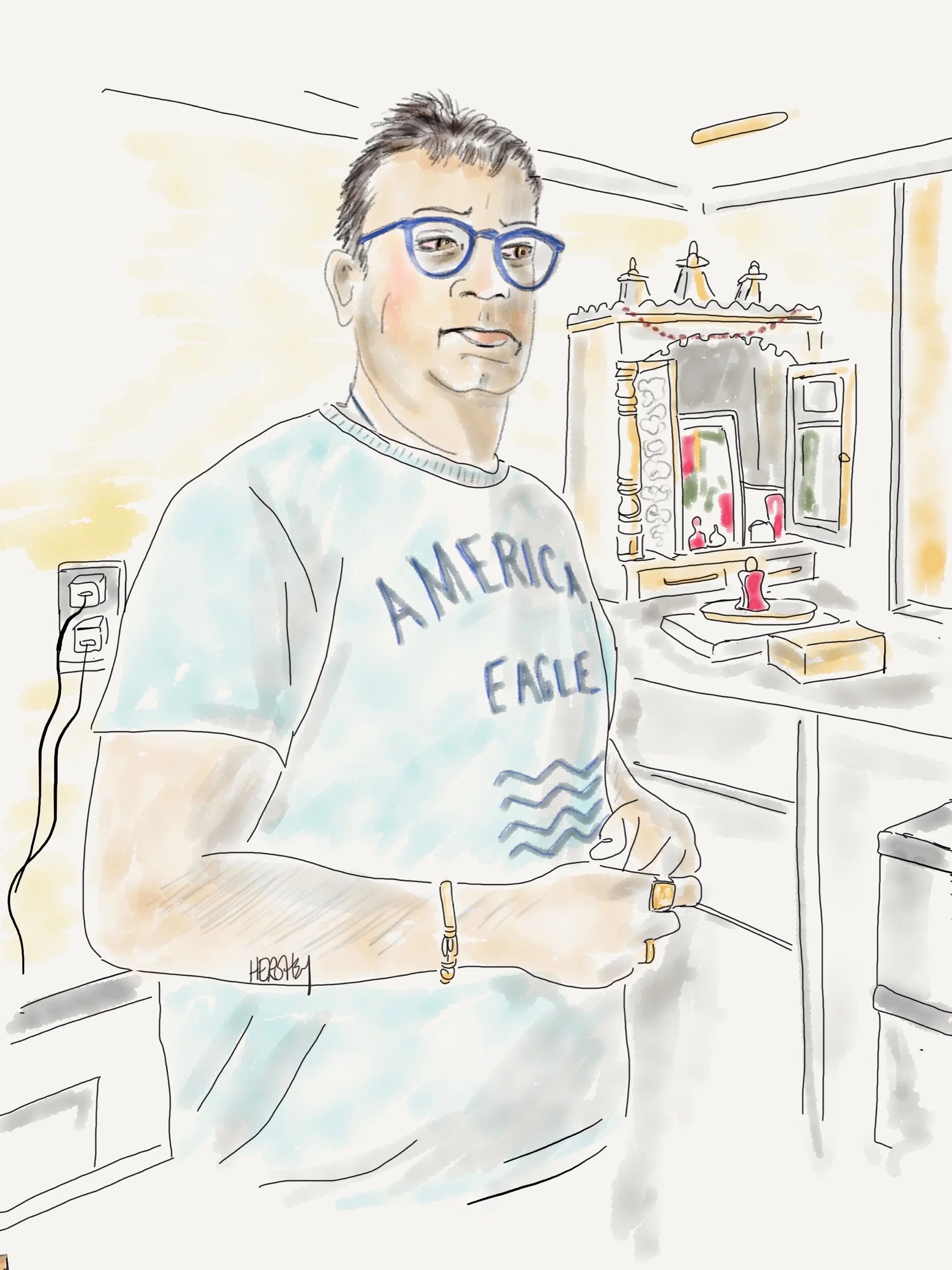
“My wife and I take turns praying at our altar. We are Hindus. But we love this motel. It’s all ours”. This drawing of a proprietor of a mid-century motel in Freeport, Texas was done by Jennifer Hershey. You can follow her work in Instagram at deeofo.
Welcome from Port Aransas, Texas, just slightly southeast of Corpus Christi, Texas.
—————
“It was the best of times, it was the worst of times, it was the age of wisdom, it was the age of foolishness, it was the epoch of belief, it was the epoch of incredulity, it was the season of light, it was the season of darkness, it was the spring of hope, it was the winter of despair.”
-from a A Tale of a Two Cities by Charles Dickens.
Such are the times we live in.
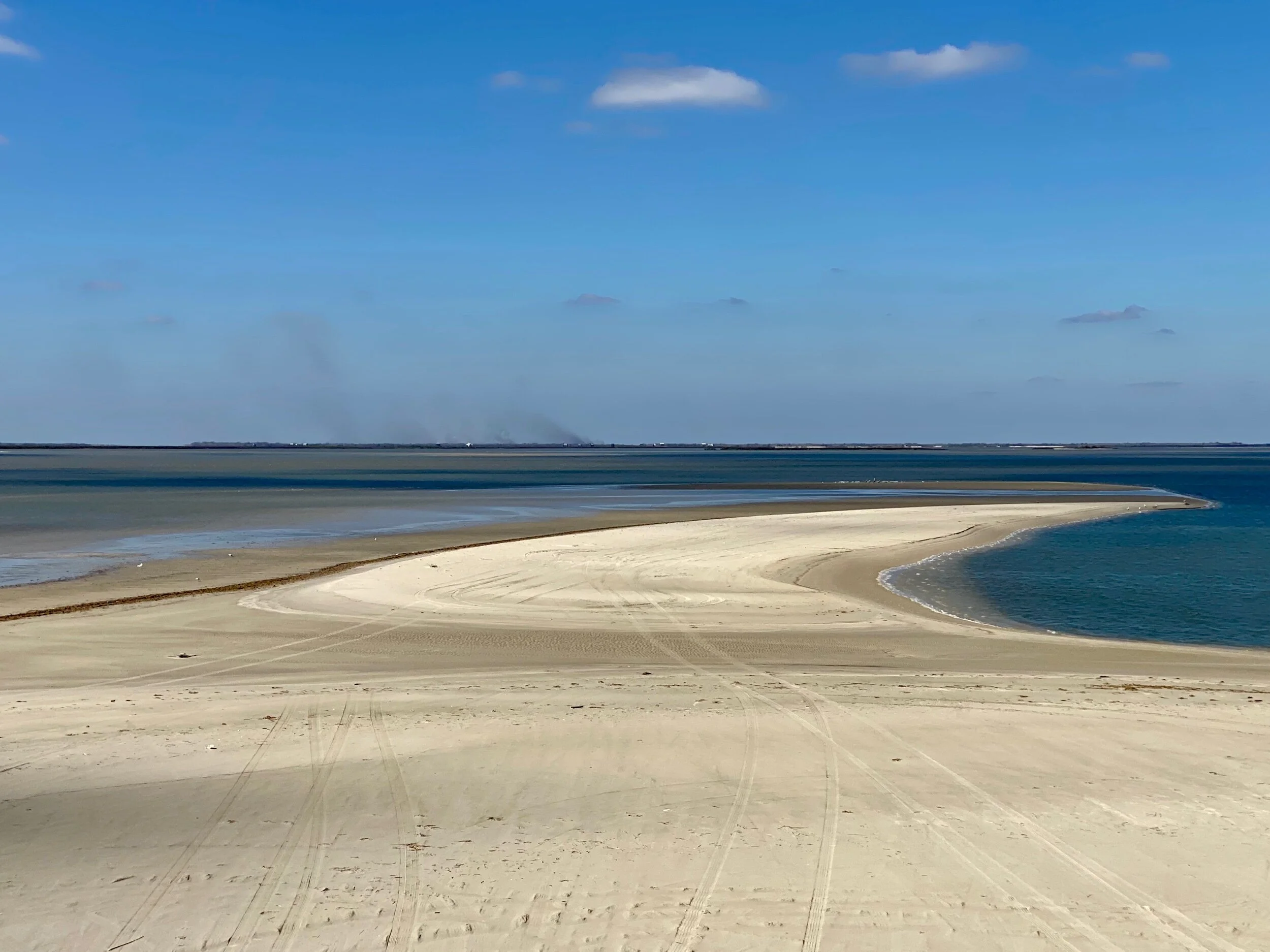
On the way to Freeport, Texas. We learned later the smoke in the background is from a Dow Chemical plant that removes magnesium from sea water.
Our trip continues to be an extraordinary exploration of exquisite natural landscapes, occasional encounters with wildlife (dead and alive), great conversations with diverse and friendly people, navigating delightful and terrifying roads, dealing with sublime and challenging weather, and periodic confrontations with seedy and startlingly ugly industrial landscapes.
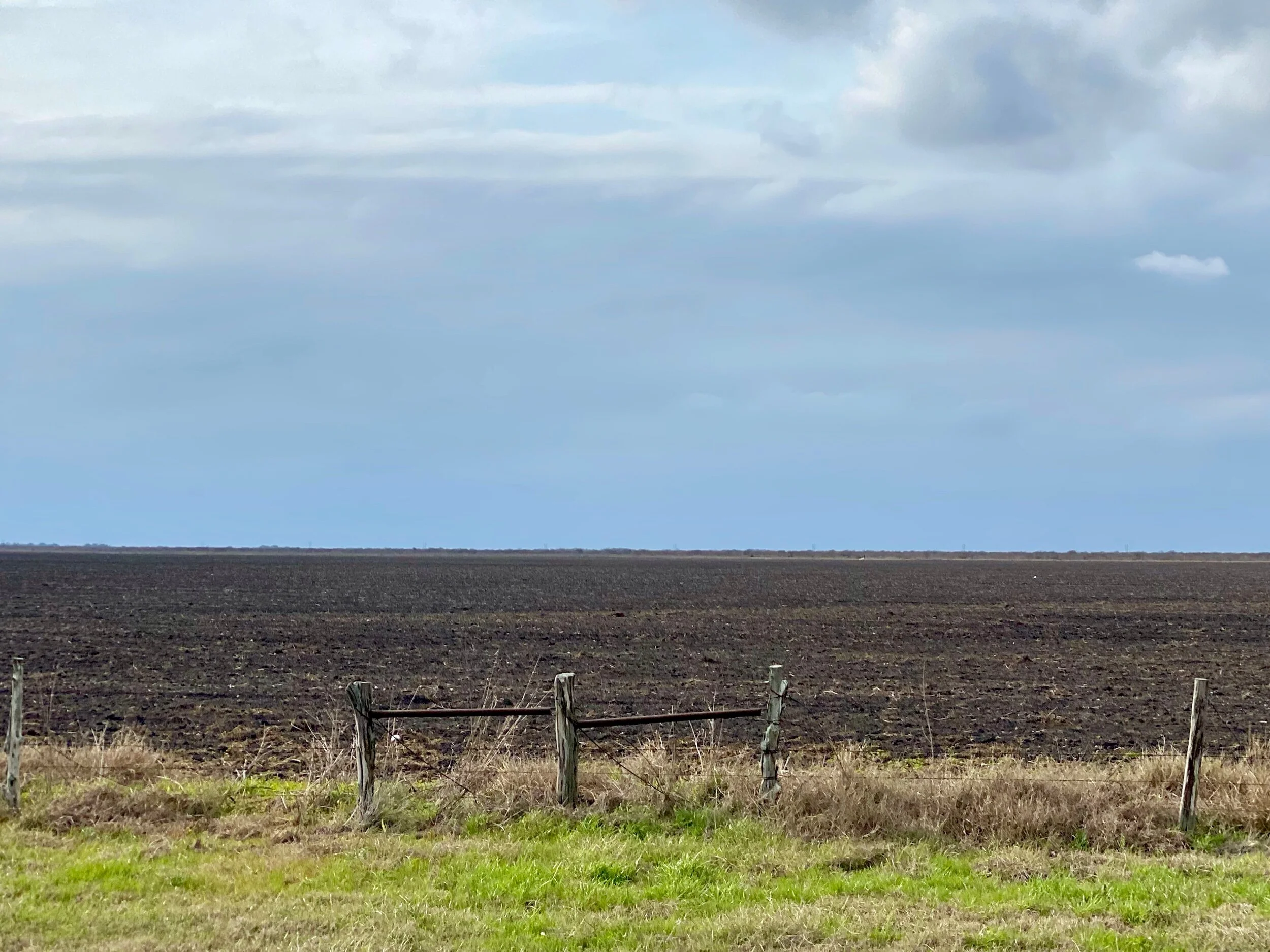
Texas is definitely big sky country, and southeastern Texas is as flat as a pancake on a hot griddle.
Perhaps we can borrow from Dickens, and instead of symbolic cities substitute citadels, or communities of people who live inside of self-imposed walls. Like any citadel that is protected from others, we can only see what’s inside, and have no idea of what’s on the outside.
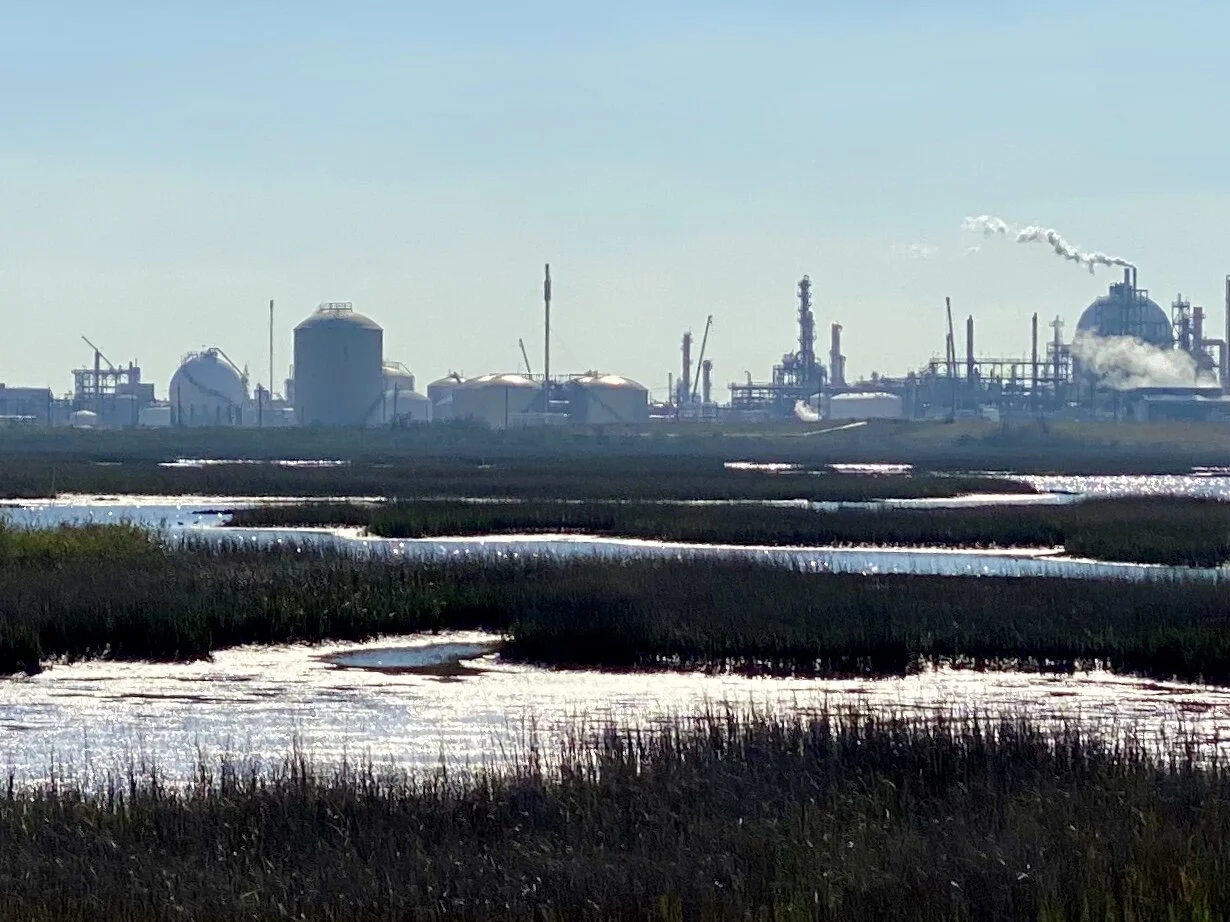
The Dow Chemical Plant near Freeport is situated just above the Intercoastal Waterway on a vast marsh.
In a way, Fox News and CNN are the storytellers for two distinct narratives that reflect two separate citadels: urban and rural America. Our cities are the center of our intellectual, artistic, entertainment and media capitals. Our rural areas - especially evident down here in southeastern Texas - provide access to our natural environments, produce our food (and also increasingly produce electricity through wind-power on the same land), and also extract and move our oil and gas providing our cities with both food and energy. Consequently, they also are the sites for some of our most polluting, dangerous and economically critical industries.
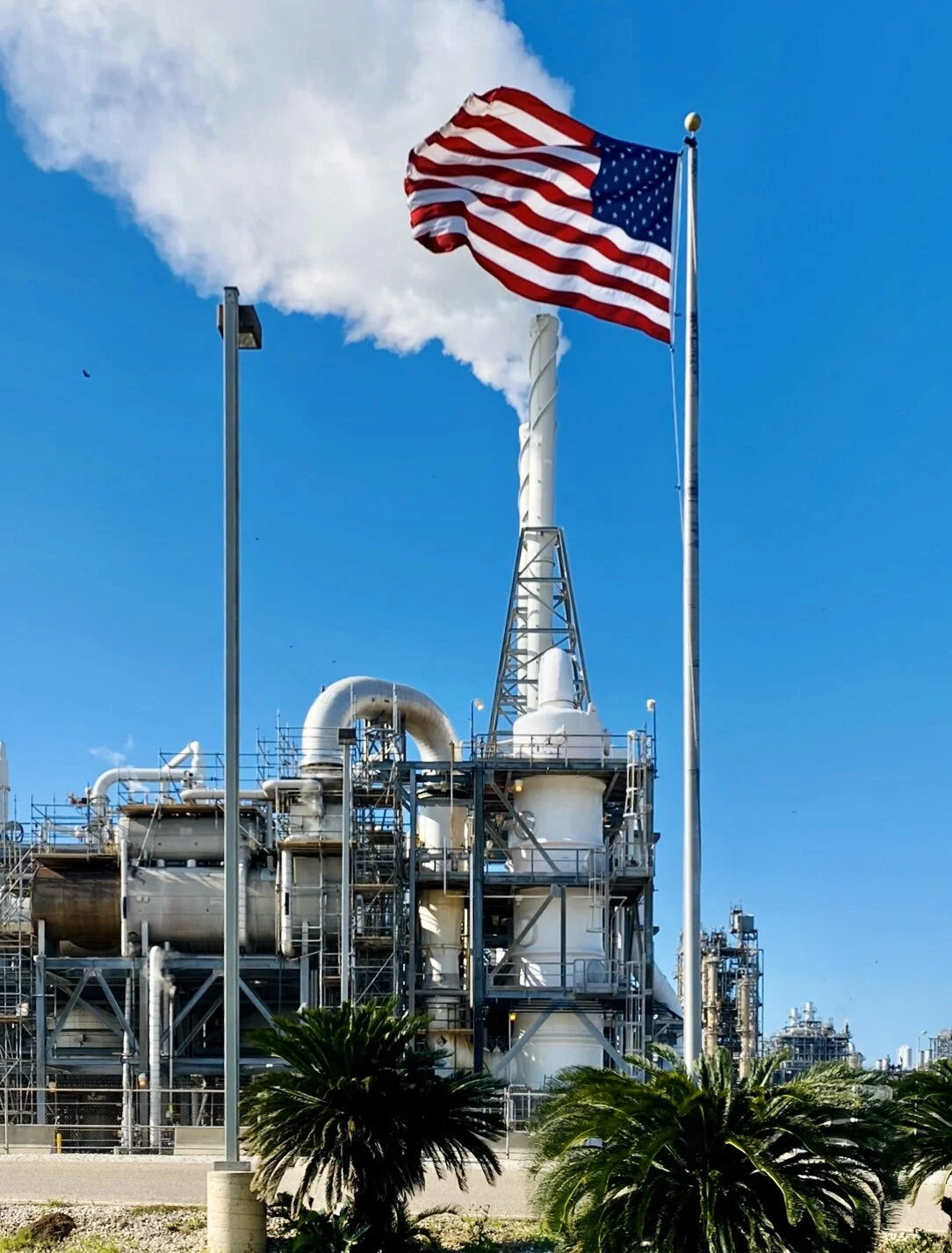
A close up shot of the Dow Chemical plant in Freeport. Locals say this is one of the largest chemical plants in the world.
As I mull over what we are encountering, I find myself thinking the challenges on the Louisiana and Texas coastlines result in a mixed landscape not unlike our home town of New York City. There’s an abundance of both beauty and squalor, and avoiding either one gives visitors an incomplete understanding.
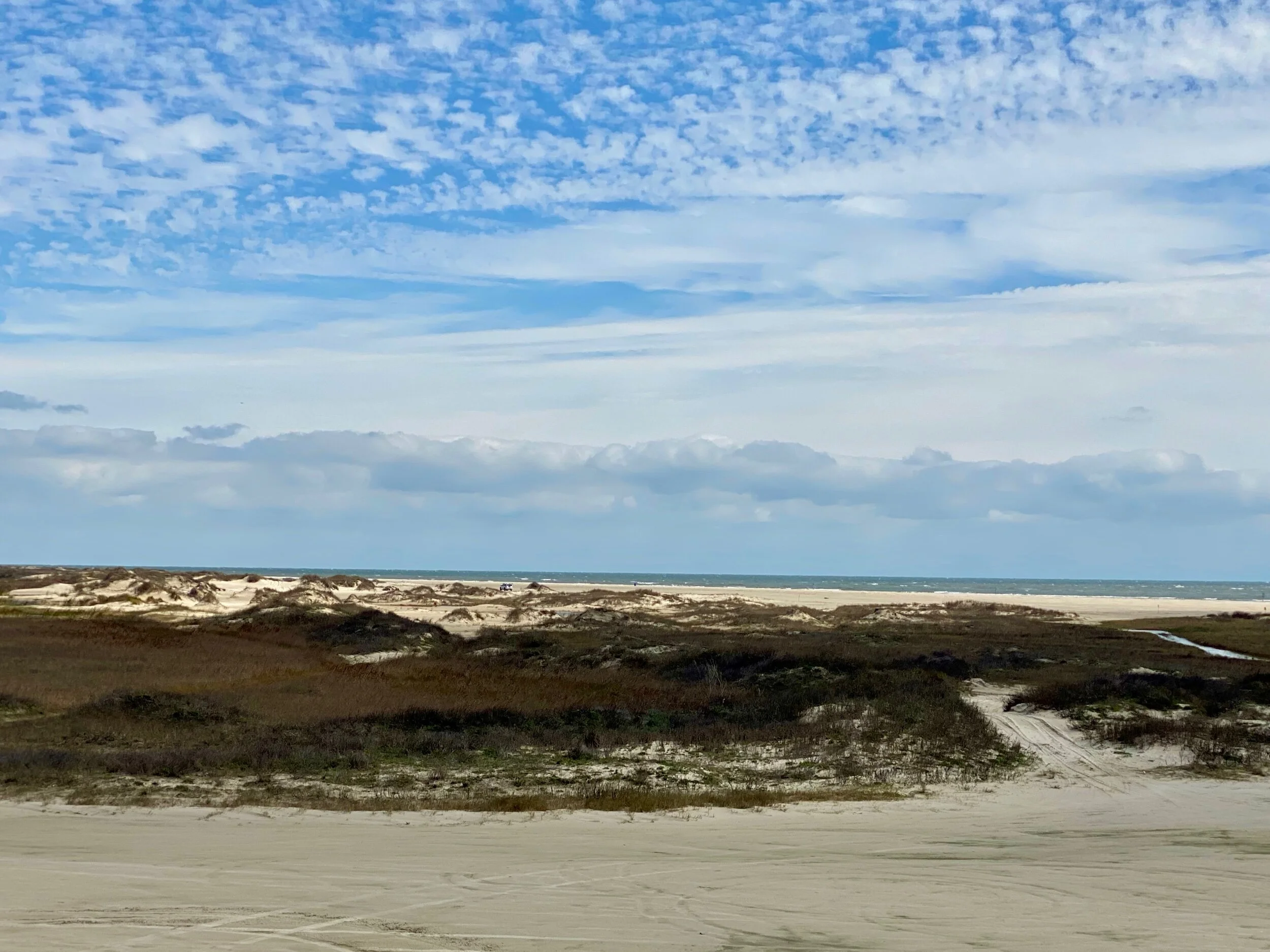
View from the San Luis Pass-Vacek Toll Bridge, which spans San Luis Pass into Brazoria County, Texas.
Clearly, I love the natural beauty of this coastline and its inland marshes, farms, and woodlands. But the story told through the industrialization of the Gulf Coast sticks in my craw. As a northerner, I’m struck by my own complicity in a type of NIMBY (Not in my Backyard) reality. I enjoy living in a city that has (with some exceptions in poorer neighborhoods in the outer boroughs) enjoyed increasingly cleaner air and water over the past several decades through stricter environmental regulations and a shift in focus from industrial production to digital technology.
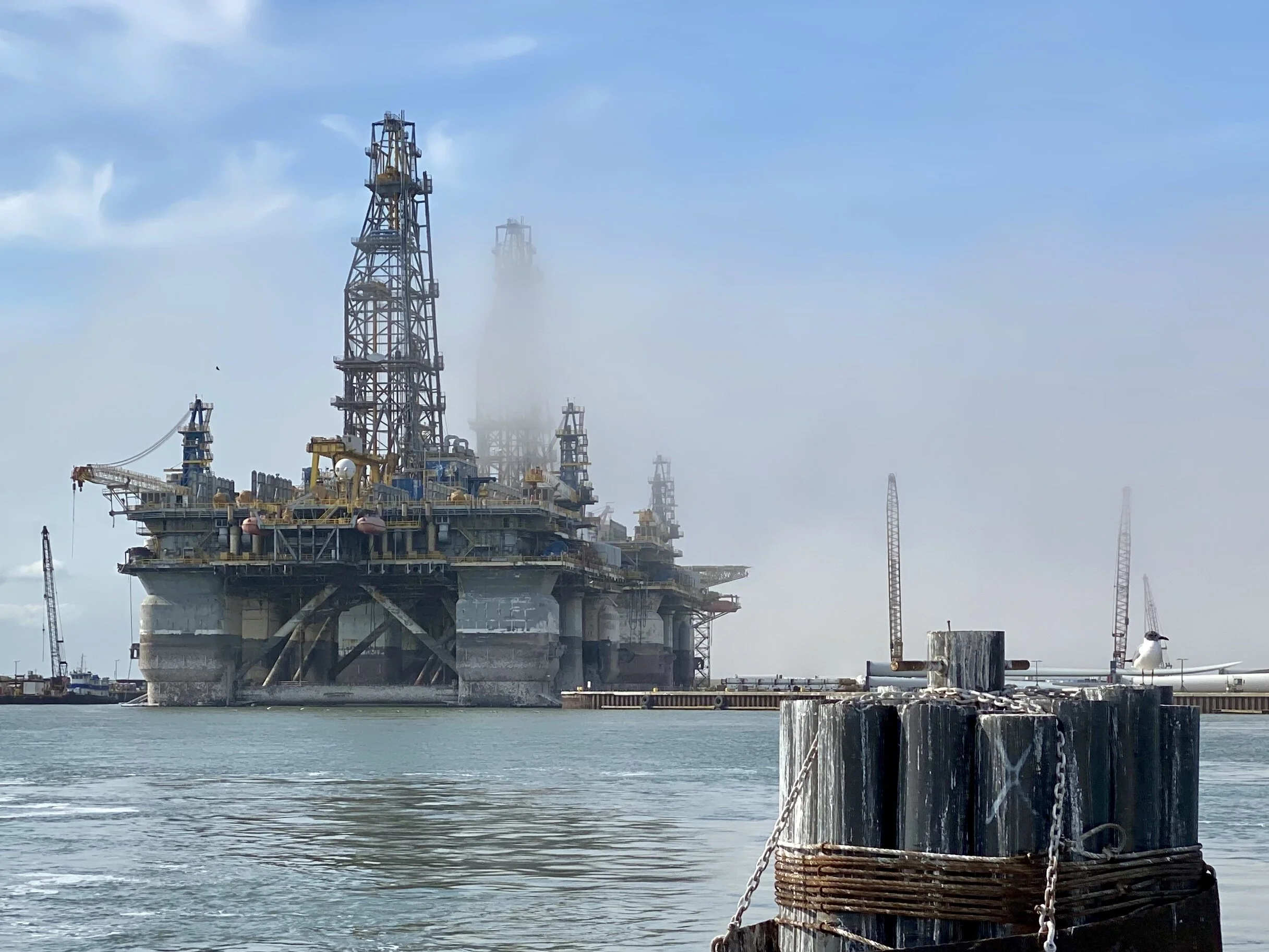
Temporary oil derricks next to the Corpus Christi shipping channel. The local community was told they would be there for six months, but are still there after almost 3 years. And it’s a big bone of contention in this community. Picture taken from the Port Aransas Ferry.
Yet, the nasty stuff used in so many of our industrial processes, plastics and household products has to be made somewhere (at least in our current economy), and some of those places are along the Louisiana and Texas coasts. And like all poor and moderately poor neighborhoods, when jobs are at stake the nature and consequences of those industries matter less than the jobs they bring.
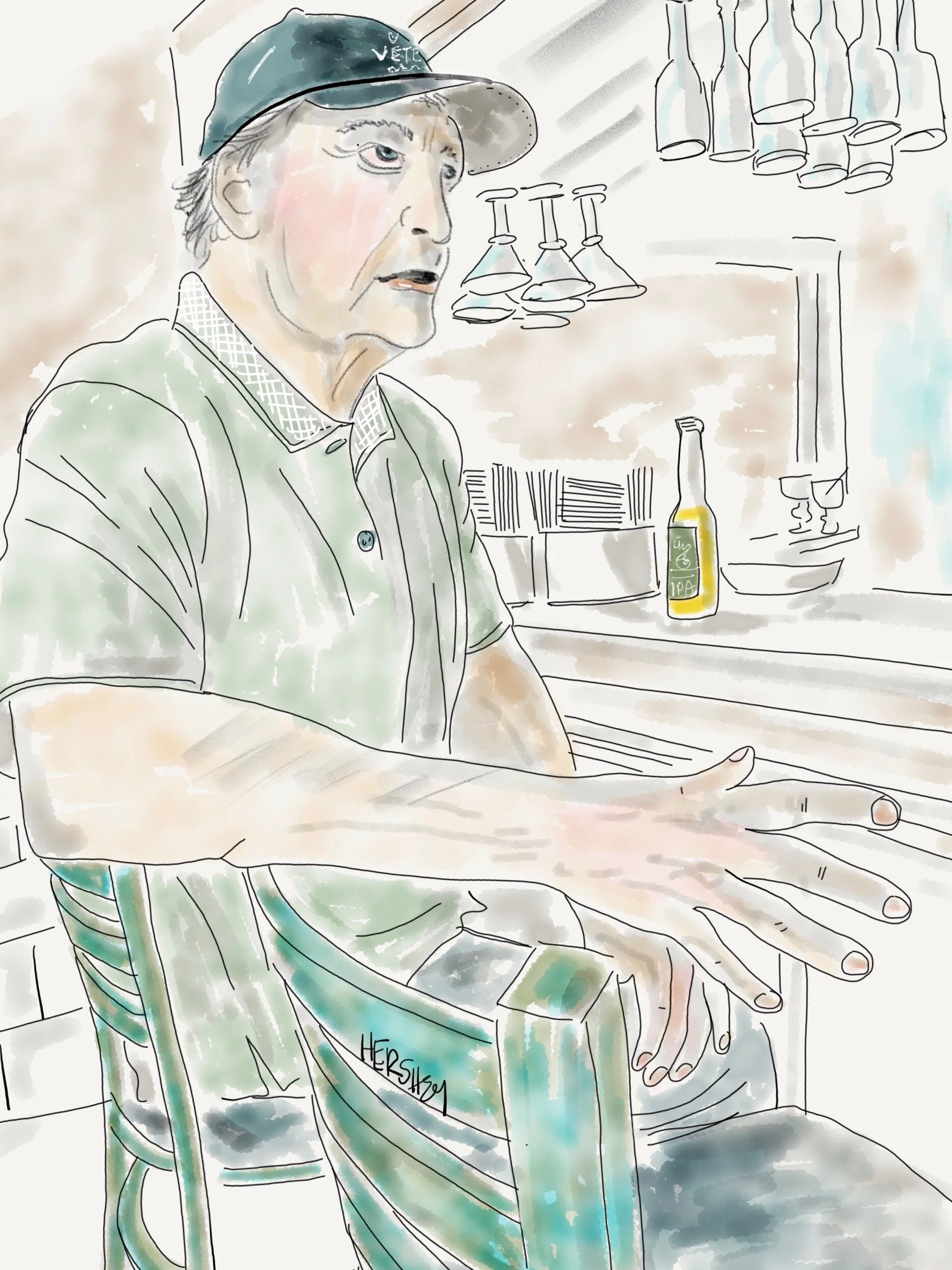
“Well I’ll tell you what—they got the best seafood right on that Seawall”. Drawing by Jennifer Hershey. Follow her on Instagram at deeofo.
Occasionally locals will resist. We met a local at a great Mexican restaurant in Freeport who had worked in most of the nearby plants over his decades long career (he was probably in his 60’s). He did a short stint at the nearby Dow Chemical plant, but didn’t stay long. The plant officials said it was safe, but he told us that it sure didn’t seem safe to him, so he moved on.
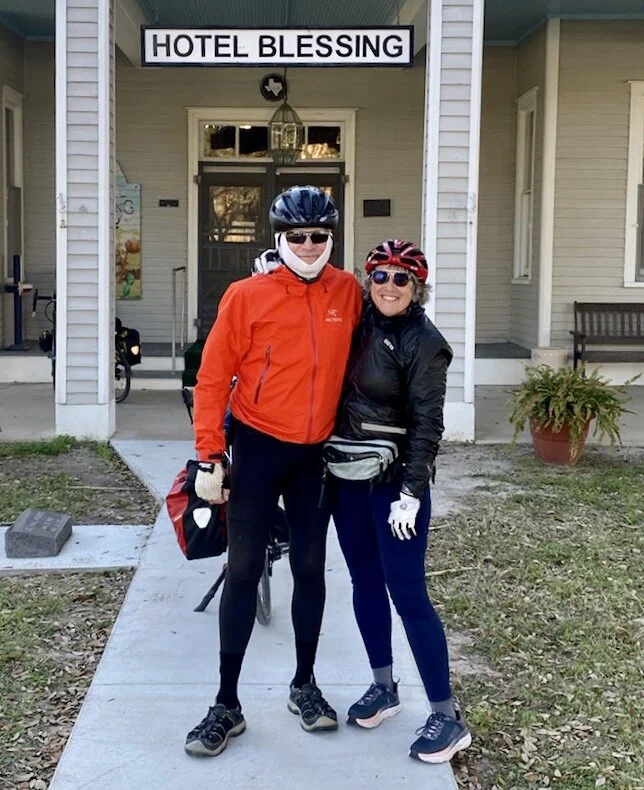
Jenny and I standing in front of the Hotel Blessing.
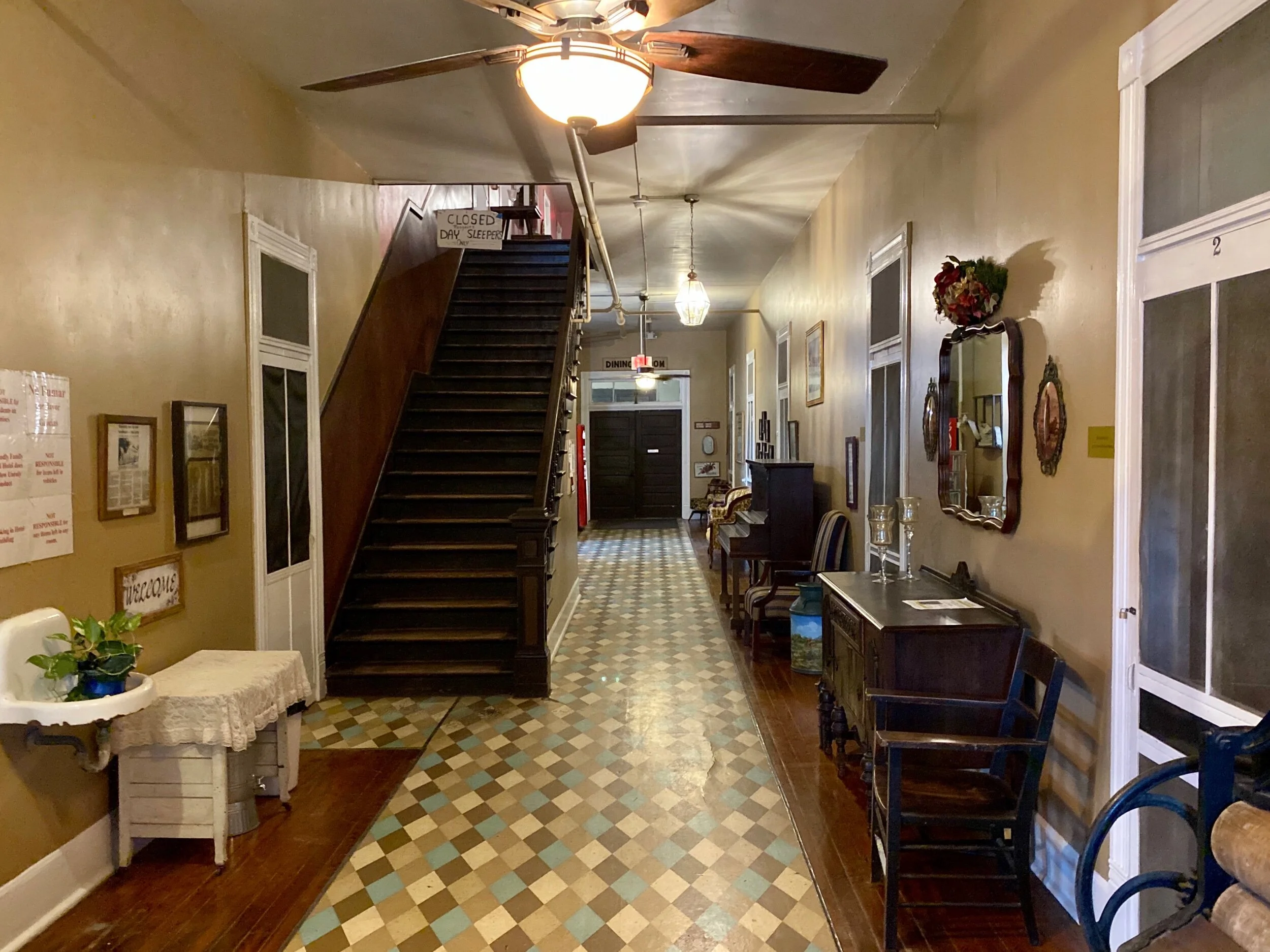
The downstairs interior of the Hotel Blessing in Blessing, Texas, population 861. Blessing was named in the early 1900’s out of the gratitude for local agriculture, railroad and coastal development.
Yet, lots of folks down here are glad for all that Texas has to offer. I’ve heard more than one person boast about being “Texas born and bred”. And even one town has named itself after its good fortune. By sheer coincidence, we found ourselves needing to stop at the one hotel about the right distance between Freeport and the Corpus Christi area (we couldn't stay on the coast because the old coast road was washed out by Hurricane Ike). It’s called Hotel Blessing, named after the town of Blessing.

“Oh I’ve been doing this for years. If they keep coming....I’ll be here”. Drawing of Helen Feldhousen by Jennifer Hershey. Follow her on Instagram at deeofo.
We didn’t know what we were in for at the time, but after a restless night at the Hotel (we could hear everything - yep, everything - going on during a busy Valentines Day evening) we went to breakfast at the Hotel Blessing Coffee Shop. We were greeted by the intrepid Helen Feldhousen and a cast of other folks - some of whom who show up in the Texas “Bucket List” broadcast below.
I am thinking quite a bit about the concept of “the tragedy of the commons”. This is a situation where individual users, acting independently according to their own self-interest, behave contrary to the common good of all users by depleting or spoiling the shared resource through their collective action. “Not in my Backyard” (NIMBY) actions are related conceptually. For example, my own life is made better by situating so many large petroleum chemical and oil and gas plants so far away from large cities on either the west or the east coasts. At the same time, the people of southeastern Texas gain through employment opportunities where the only other options would be tourism or agriculture. Yet, their very livelihoods are put at risk by the significant carbon pollution of the industrial activity here, because it contributes to the extreme weather that may ultimately destroy those plants, along with their jobs.
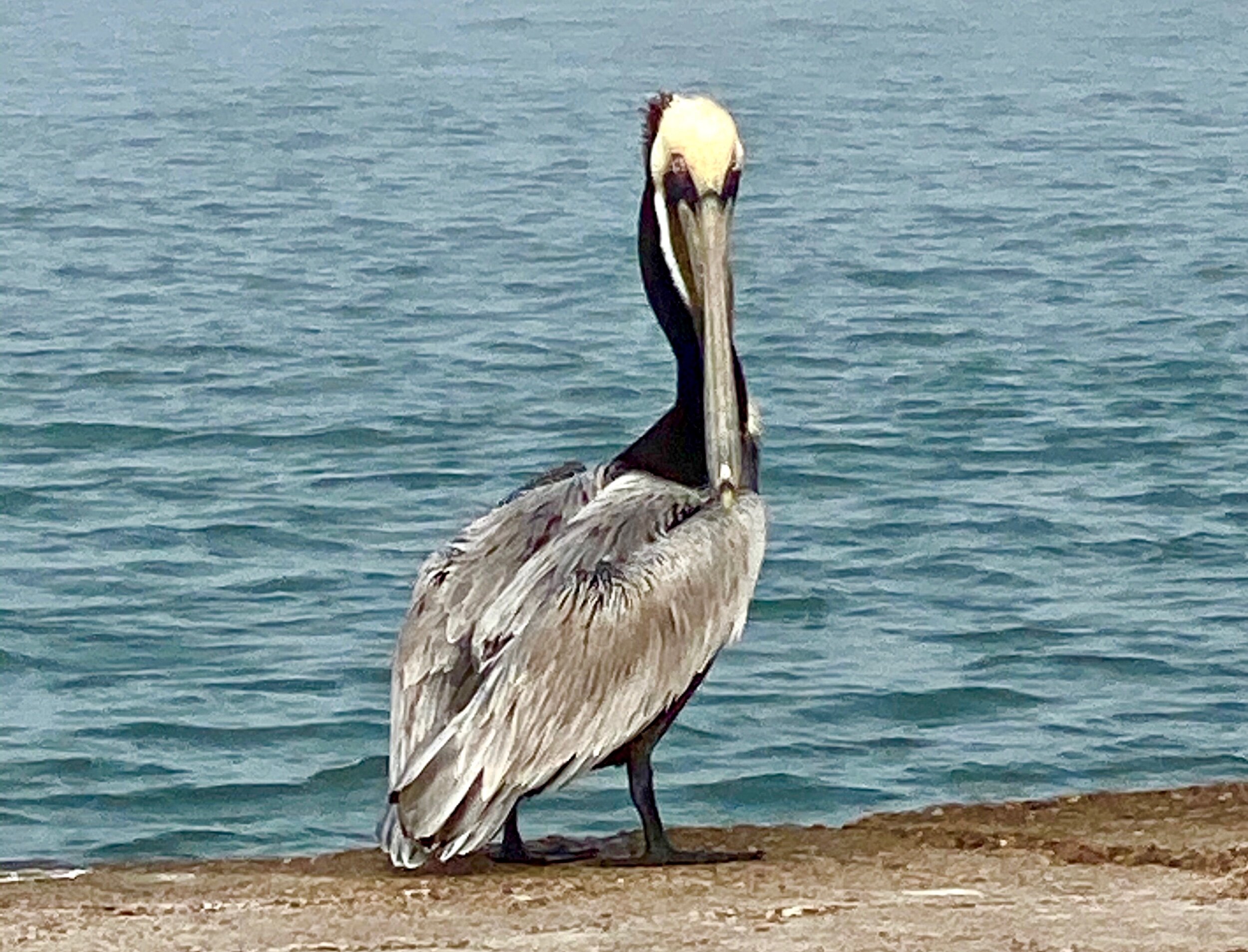
A very mellow Pelican stares us down on the beach at Port Aransas.
Additionally, citizens around the world gain nothing by the carbon these plants and their related industries have added to our atmosphere. It’s worth contemplating that although America contains 5% of the worlds population, we are responsible for 25% of the carbon put into the atmosphere since the dawn of the industrial revolution. And although China is now the world’s greatest carbon polluter, we remain the world’s greatest carbon emitter on a per capita and country basis combined. That fact alone suggests that our way of life is a big part of the tragedy of the commons that climate change is extracting. It's clear that staying with the status quo is the worst thing we can do. It’s time to step up to a different plate.
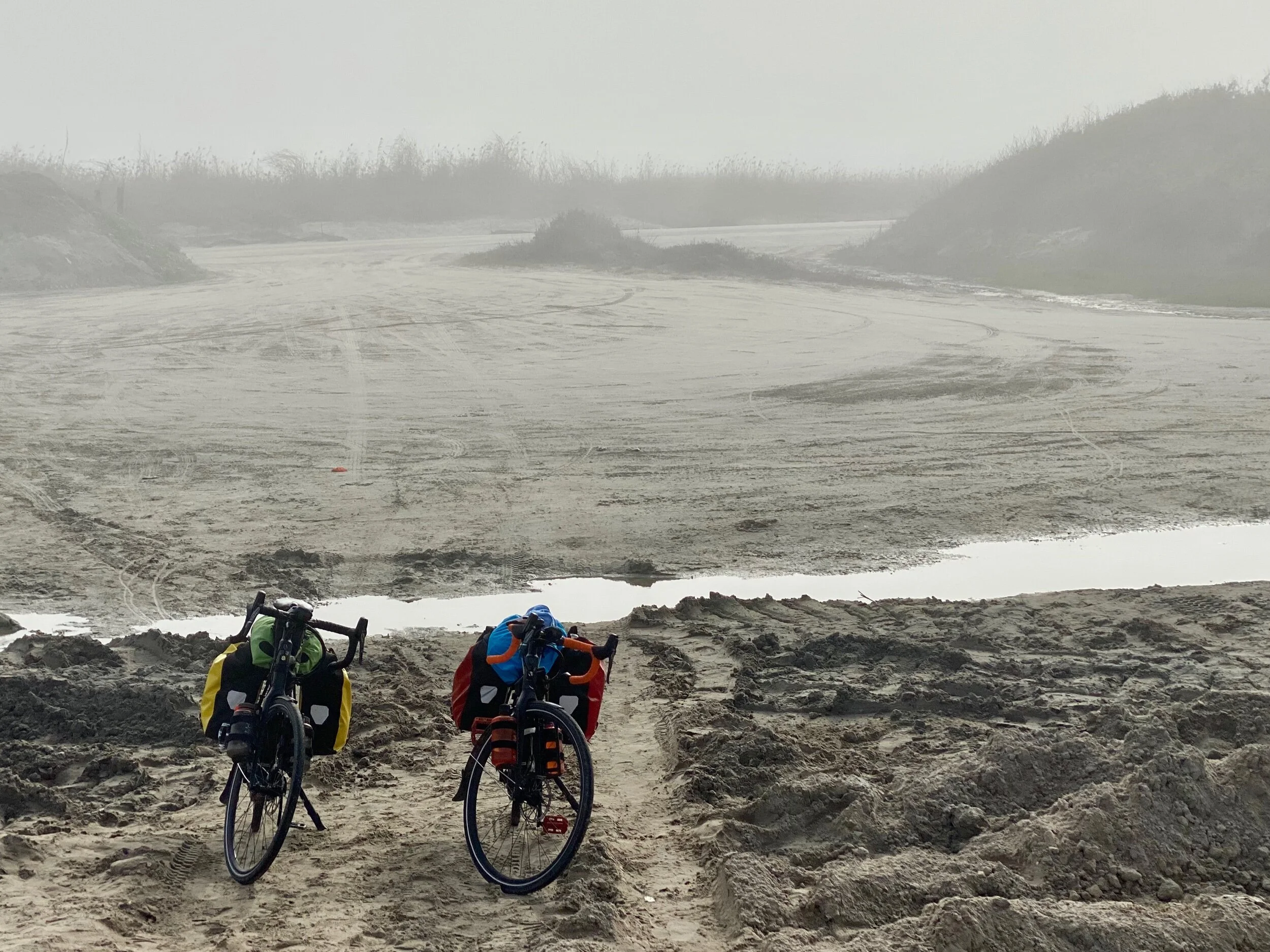
Our bikes in fog at the beach on Port Aransas Beach, Texas.
A few of you told me you missed the links to the Garmin maps showing our journey day by day, so I include links below to our entire trip to date. If you don’t have a Garmin account you will have to create one to see them (it's worth it if you're a biking geek or map lover).
1) New Orleans Road Cycling, 2) New Orleans Road Cycling, 3) Donaldsonville Road Cycling, 4) Morgan City Road Cycling, 5) St Mary Parish Road Cycling, 6) Abbeville Road Cycling, 7) Lake Arthur Road Cycling, 8) Cameron Parish Road Cycling, 9) Port Arthur Road Cycling, 10) Galveston Road Cycling, 11) Freeport Road Cycling, 12) Matagorda County Road Cycling, 13) Refugio Road Cycling, 14) Today we are in Port Aransas, Texas, just slightly southeast of Corpus Christi, Texas.
Thanks for reading! More to come…
All photos, unless credited or otherwise noted, are copyrighted property of the blog post author.
Louisiana/Texas, Post 2
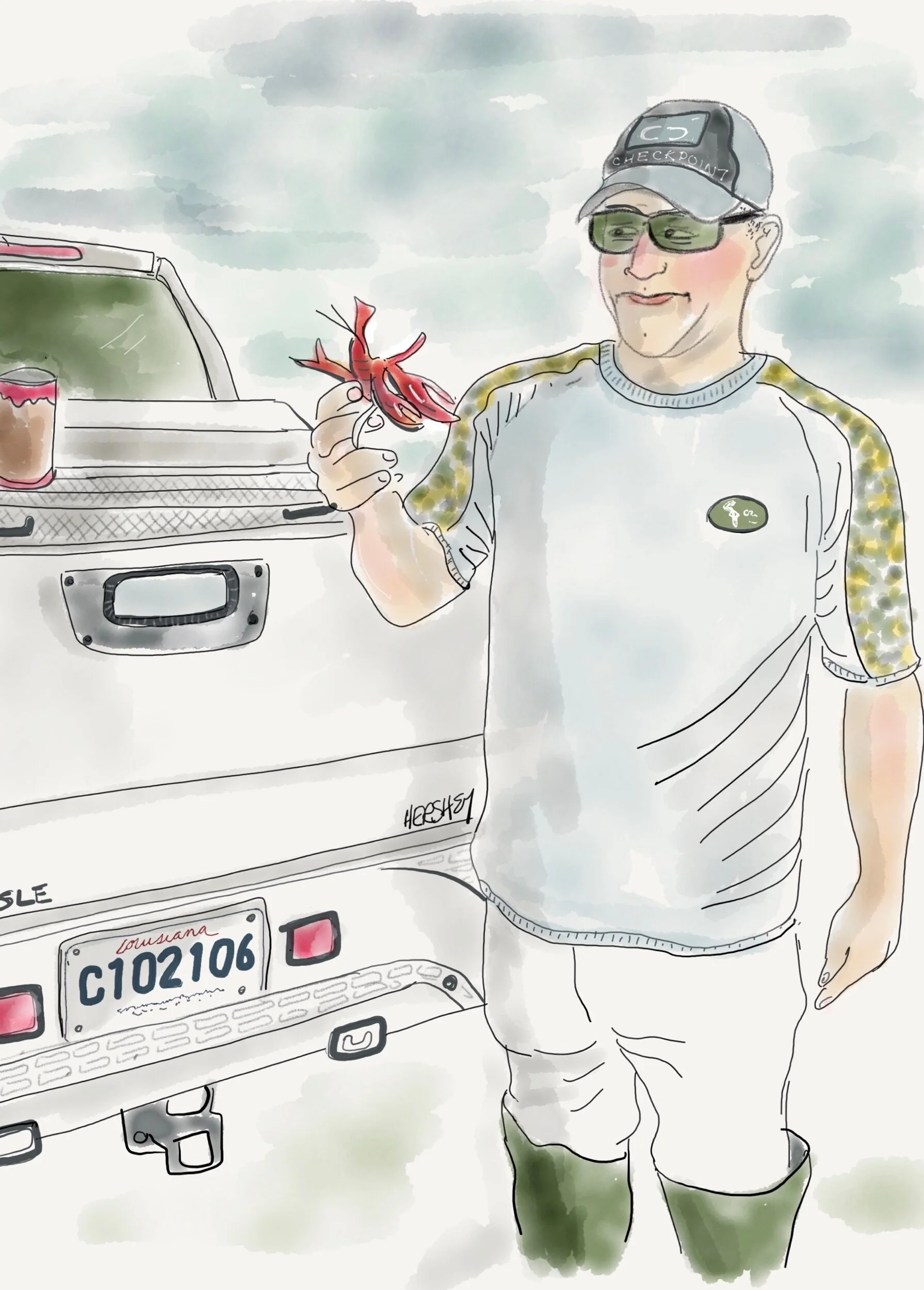
“Yes Ma’am...it’s alive. They be millions of them in pots out there in them rice fields”. Drawing by Jennifer Hershey. Follow her on Instagram at deeofo.
Welcome from Galveston, Texas, where we arrived from Louisiana by way of the coastal towns Cameron, Louisiana, and Port Arthur, Texas. Most of south central and southwestern Louisiana below the I-10 corridor from Houston to New Orleans is less than 20 feet above sea level. On both sides of the Intercoastal Waterway this land of marshy prairies, bayous, forests and intense wetlands supports many wildlife sanctuaries, cattle ranches, sugarcane and rice farms, and crawfish trapping. It was a pleasure to cycle through. People are friendly, and the inland towns are small and attractive.
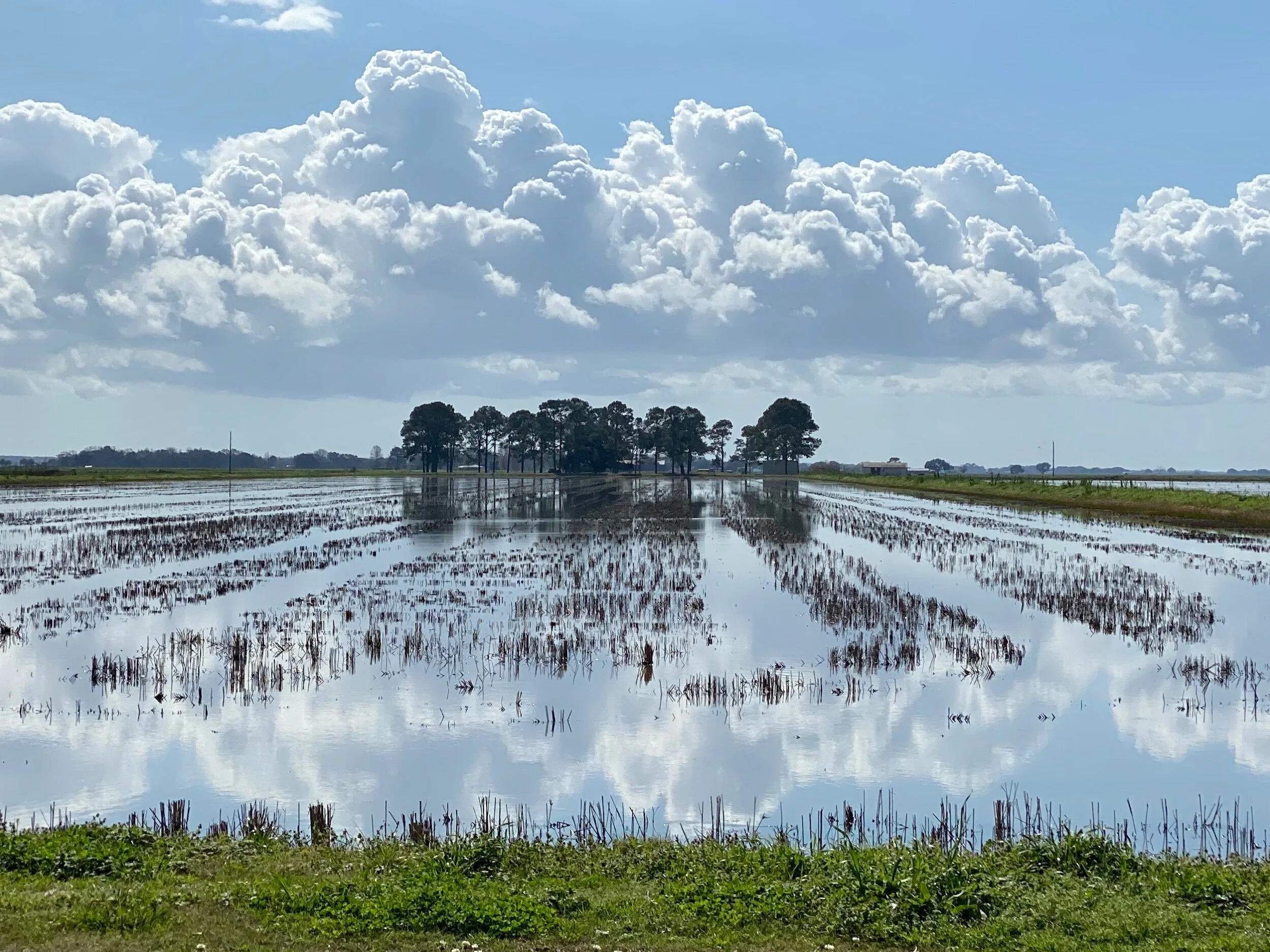
A rice field east of Lake Arthur, LA.
We had an interesting encounter with a very busy and successful woodworker named Mark near New Iberia, Louisiana, who showed us his shop, and introduced us to some of his workers. After we got settled into a motel in nearby Abbeville, he and his wife Dona picked us up and took us out for a sensational seafood dinner. We enjoyed Louisiana hospitality at its best, with good food and plenty of libation and conversation. Although we could sense we weren’t all likely to be on the same page politically (even though we shared a concern for rising sea level and the fate of the lowlands), a strong and jovial spirit of acceptance and friendship remained intact. Interestingly, the next day Mark read my recent blog post, and texted me “Great post. Observe more, judge less. Good way to live. Just remember, sometimes you have to step up to the plate”. Jenny drew his picture, and I thought about what exactly he meant.
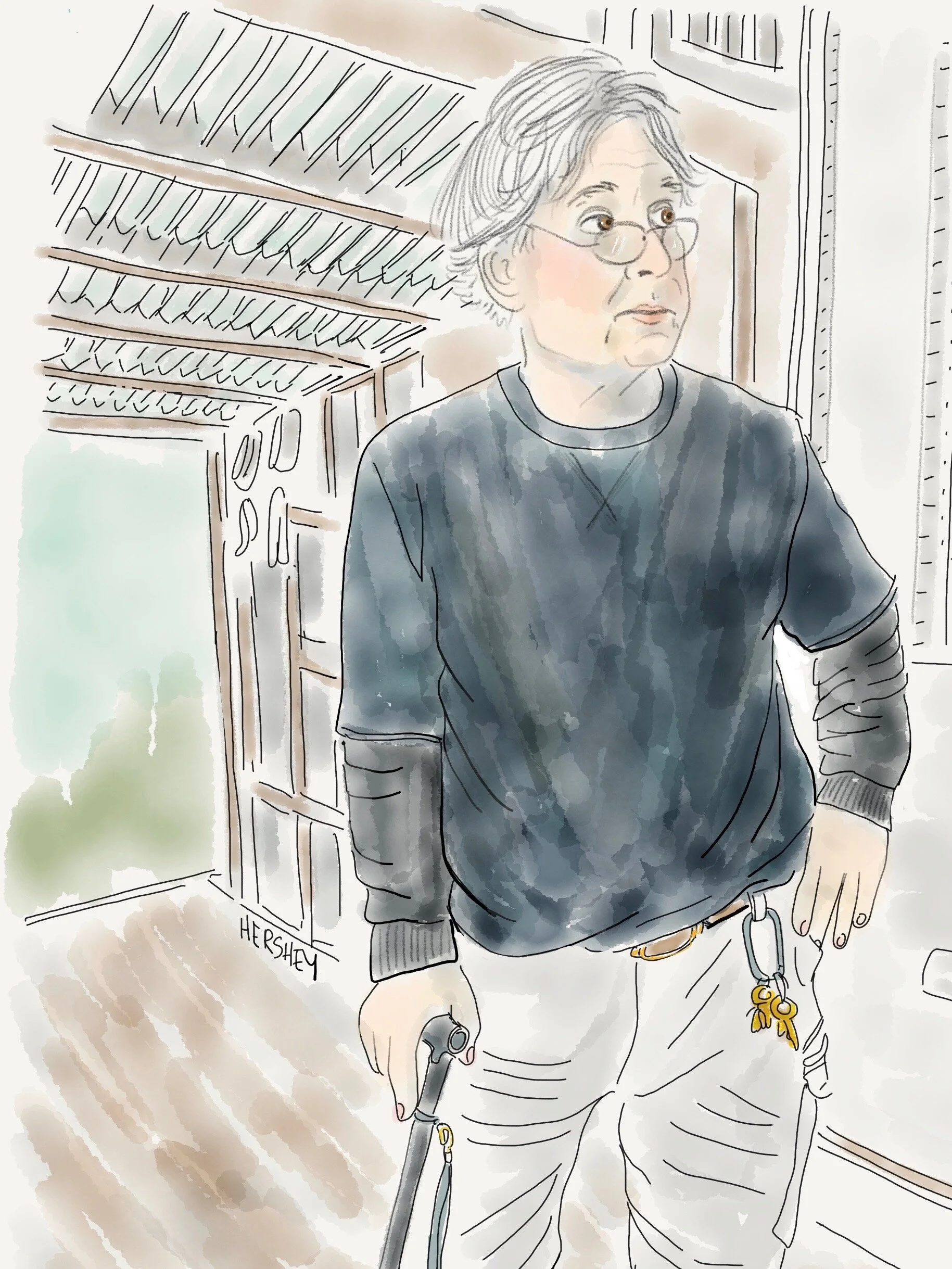
“I got three good sons in laws. I want my family to be healthy. But I worry that the land to the south of here is going to be under water”. Drawing by Jennifer Hershey. Follow her on Instagram at deeofo.
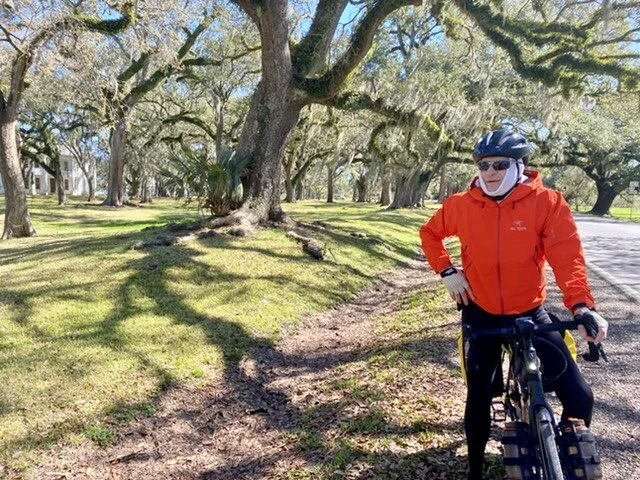
Michael biking through historic Jeanerette, LA.
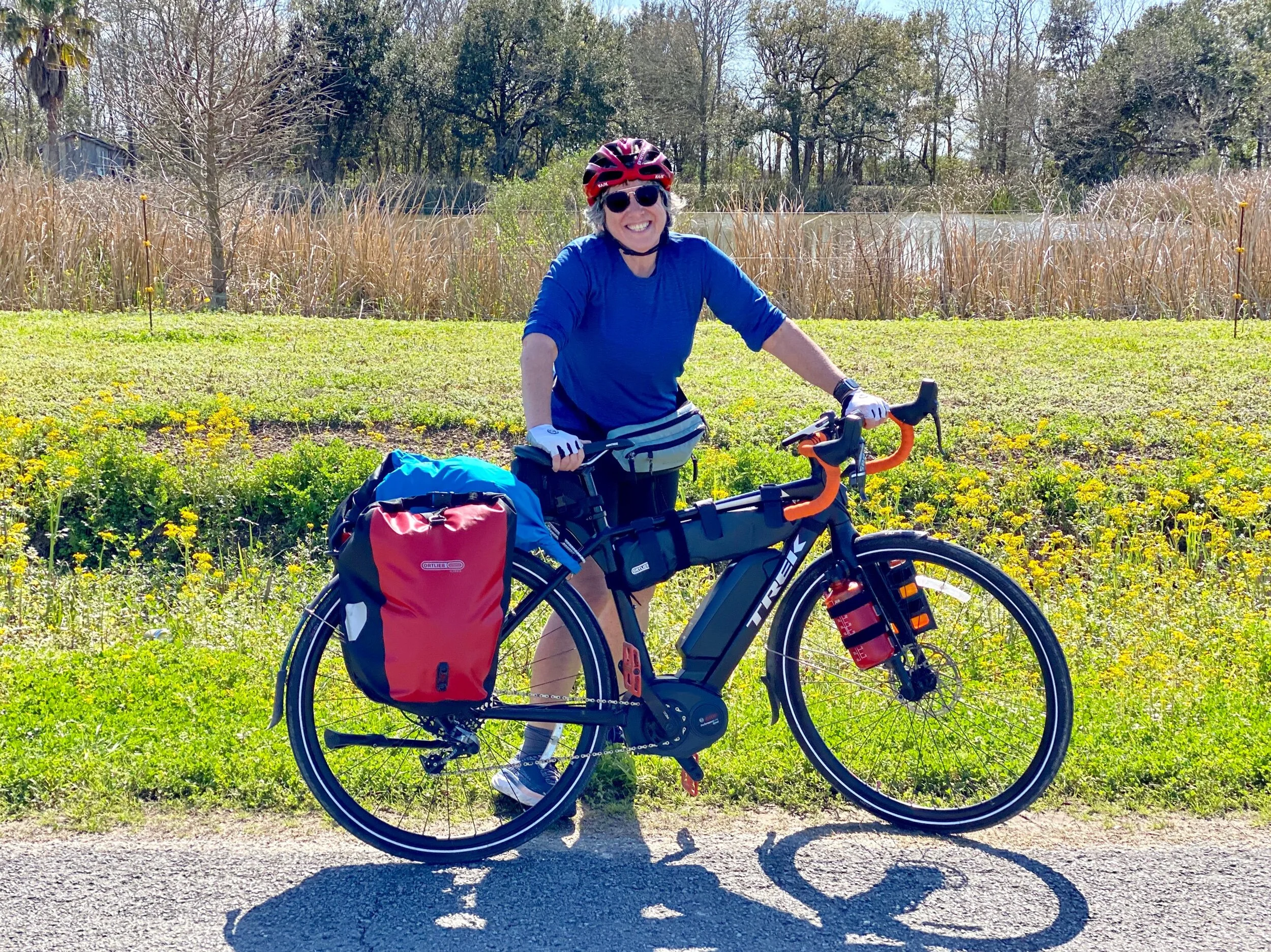
Jenny with her bike on the way to Lake Arthur, LA.
In addition to their beauty and the warmth of their inhabitants, southern Louisiana and Texas can also be disturbing places to bike through. This bucolic landscape is riddled with debris, machinery, abandoned oil wells and new fracked gas compressor stations. It’s crisscrossed by pipelines carrying oil and gas from conventional wells found underneath the marsh, and an abundance of fracked gas piped in from the north. Much of the fracked gas in western Louisiana originates from the nearby 9000 square mile Haynesville Shale, a large shale play in northwestern Louisiana.
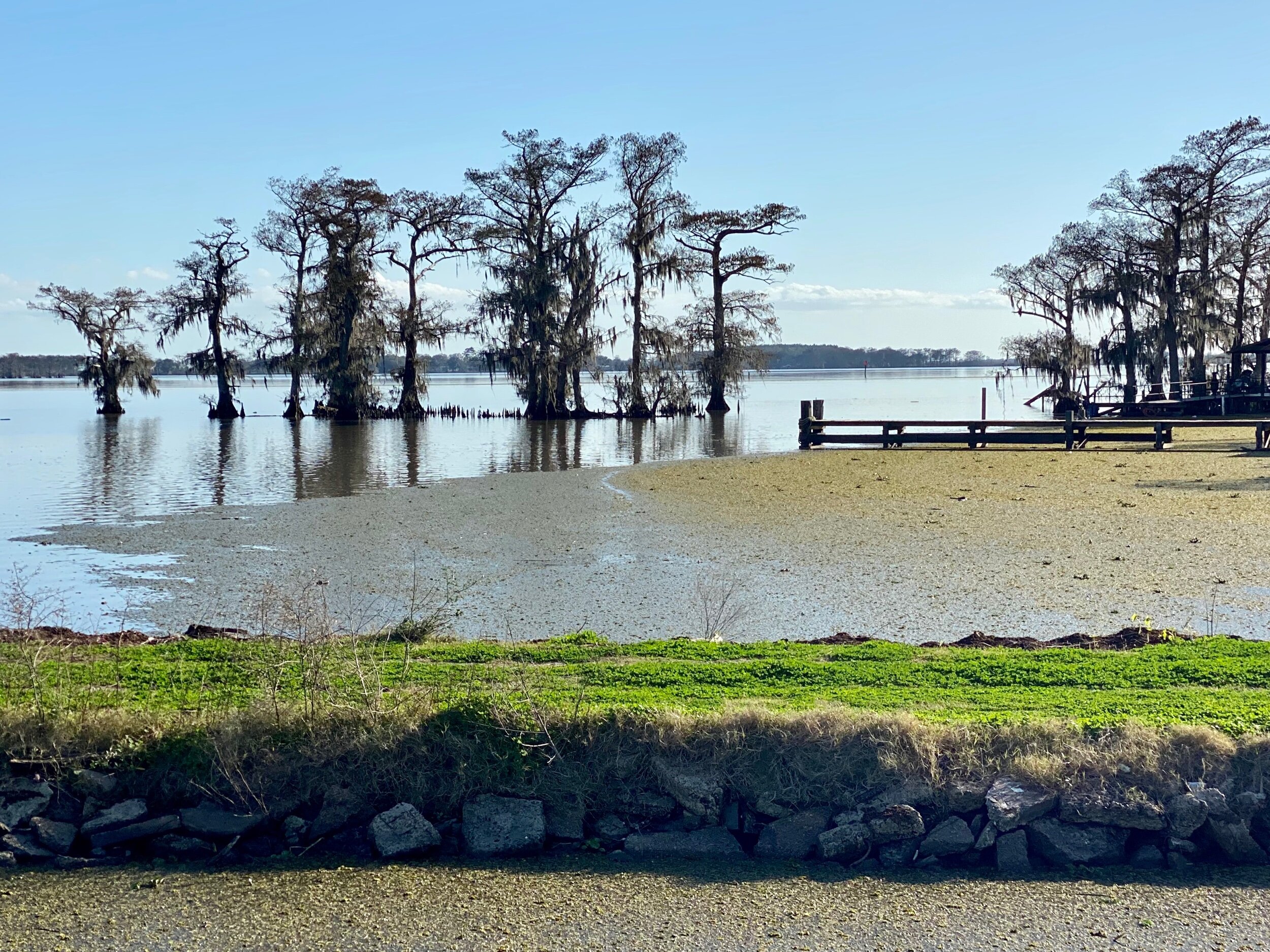
A view of Lake Arthur, LA.
Given the low elevation and the marshy characteristics of the land, it’s obvious that this area is very prone to coastal erosion, storm surges, tidal flooding, and extreme weather events such as hurricanes. A few days earlier, just west of New Orleans, we had contended with tornado warnings, which are quite unusual for the area. Locals agreed, although no one we spoke to suggested a changing climate as a possible cause.
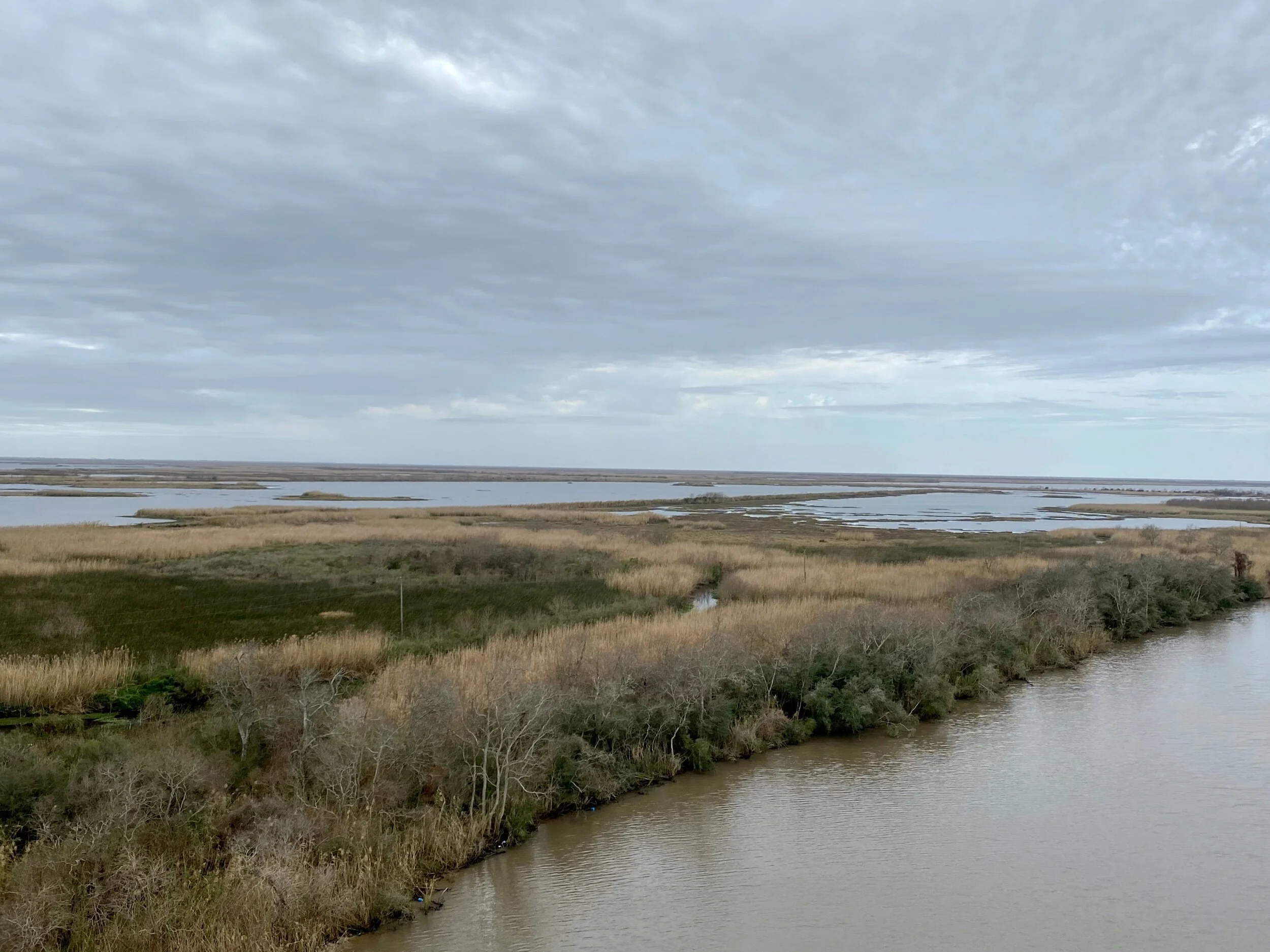
Just south of the Intercoastal Waterway on Highway 24 in southwestern Louisiana. Under these marshes lie a maze of pipelines carrying oil and gas from local deposits and the shale play in northwestern Louisiana.
The sheer vulnerability of the lowland coastal areas of the Gulf Coast seems hauntingly palpable. It’s clear to any thoughtful observer that Louisiana is deeply and complexly affected by our changing climate.
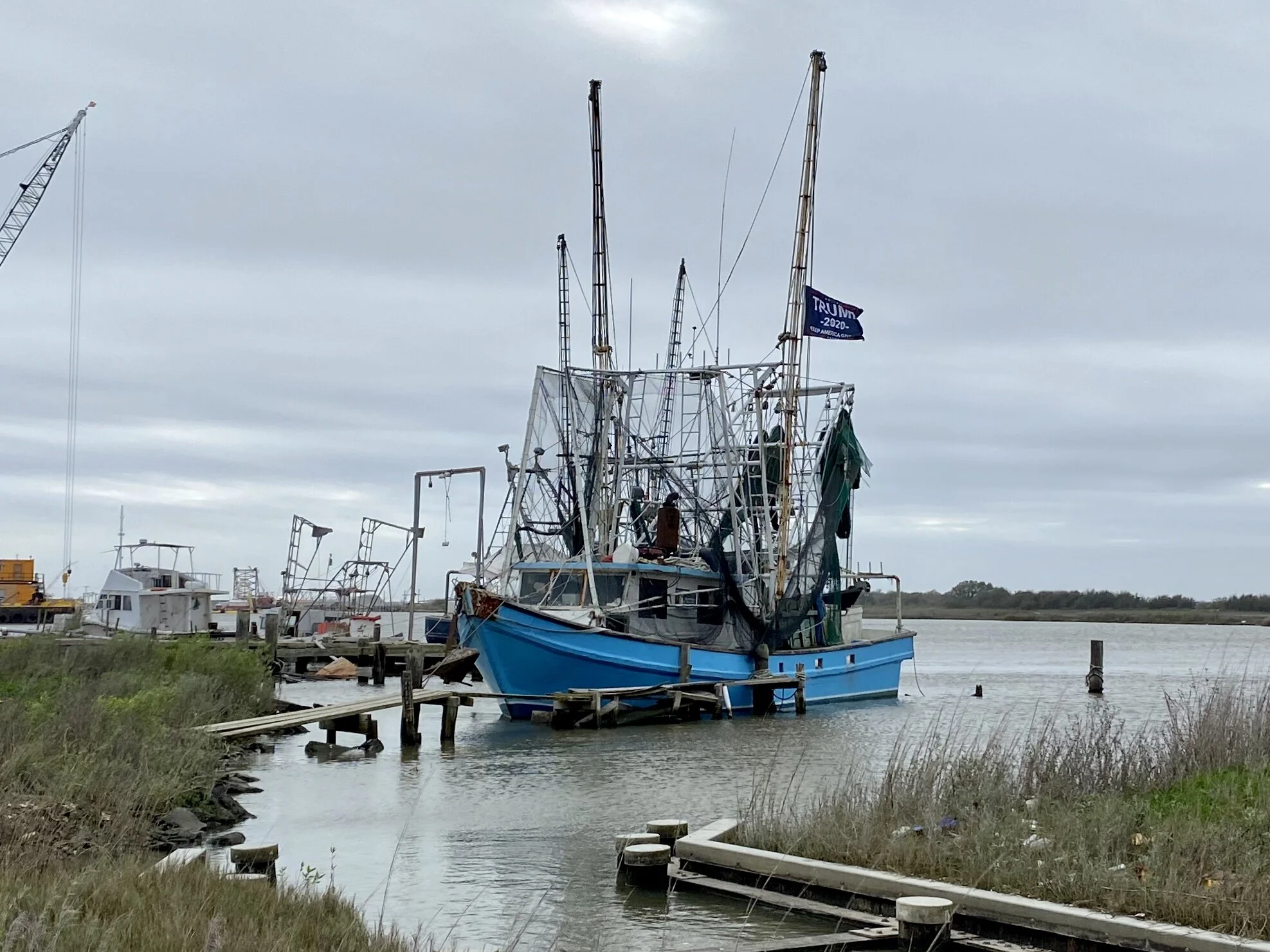
A fishing boat moored near the site of the new LNG global exporting plant at Cameron, LA. The flag on the boat says Trump/Pence 2020 . The entire port area just south of this boat (which used to be public land) is now privately owned by the company building the incoming plant. We weren’t allowed to see it.
The town of Cameron, LA, (once a bustling resort town of 3000 people that was devastated by Category 3 Hurricane Audrey about 60 years ago, and slammed again by Ike in 2008) now only has a few hundred permanent citizens. However, it is now a site for a large liquified natural gas (LNG) global exploring plant that will compete with an equally large LNG global exporting plant under construction in nearby Port Arthur, Texas. This much larger blue collar town lies just across Louisiana's southwestern border, where the Spindletop gusher was struck in 1901, setting off an oil rush that resulted in nearby Houston eclipsing Galveston as the primary port for southeastern Texas.
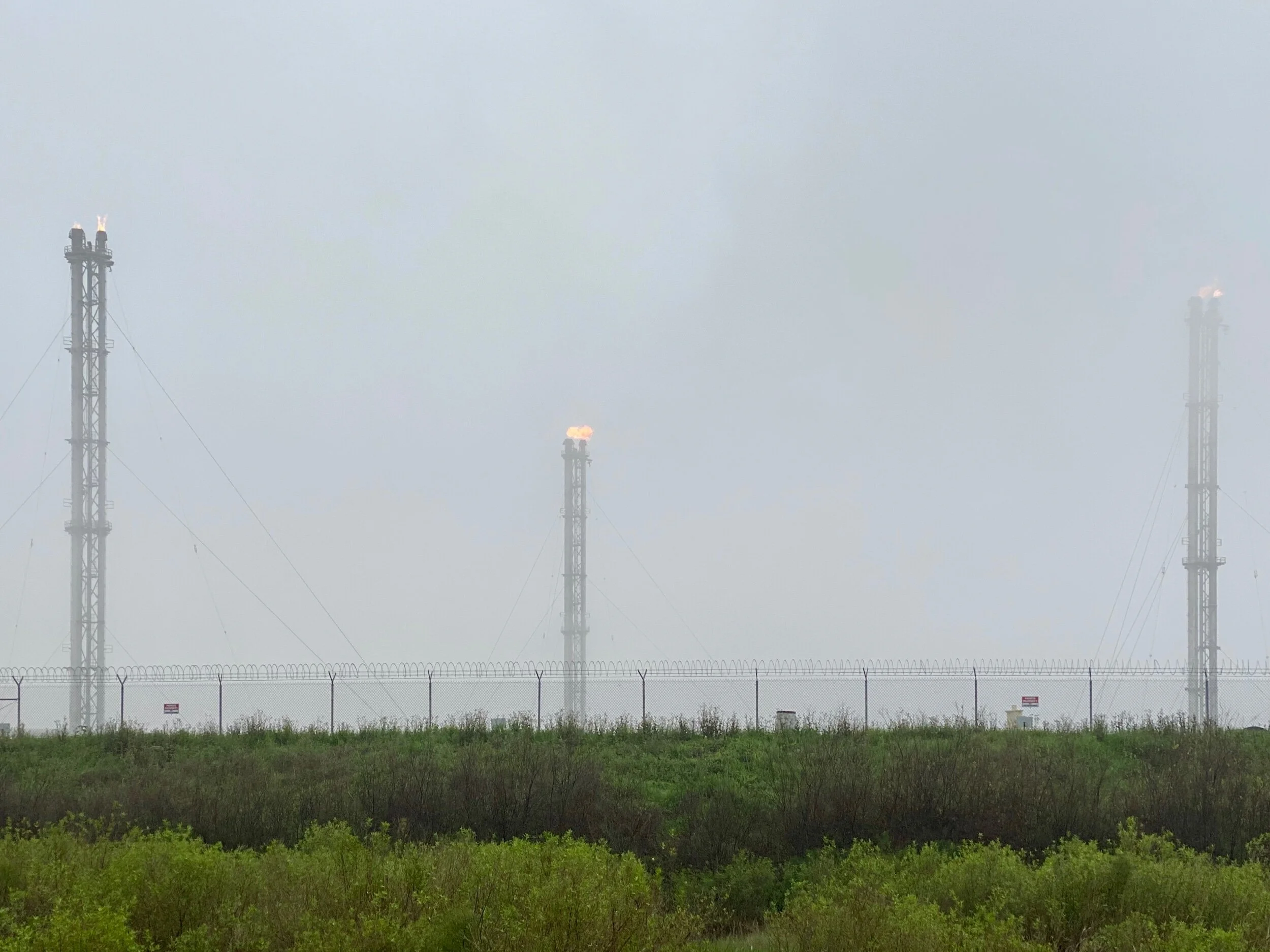
Gas flares in the marsh about a mile from the Liousiana Coast.
Each new plant currently employs about 3000 construction workers. When complete, the Cameron plant will support 160 permanent jobs, and the Port Arthur plant will support about 200 permanent jobs. That is, of course, unless a major hurricane hits this part of the Gulf Coast, in which case operations will either be temporarily or permanently interrupted.
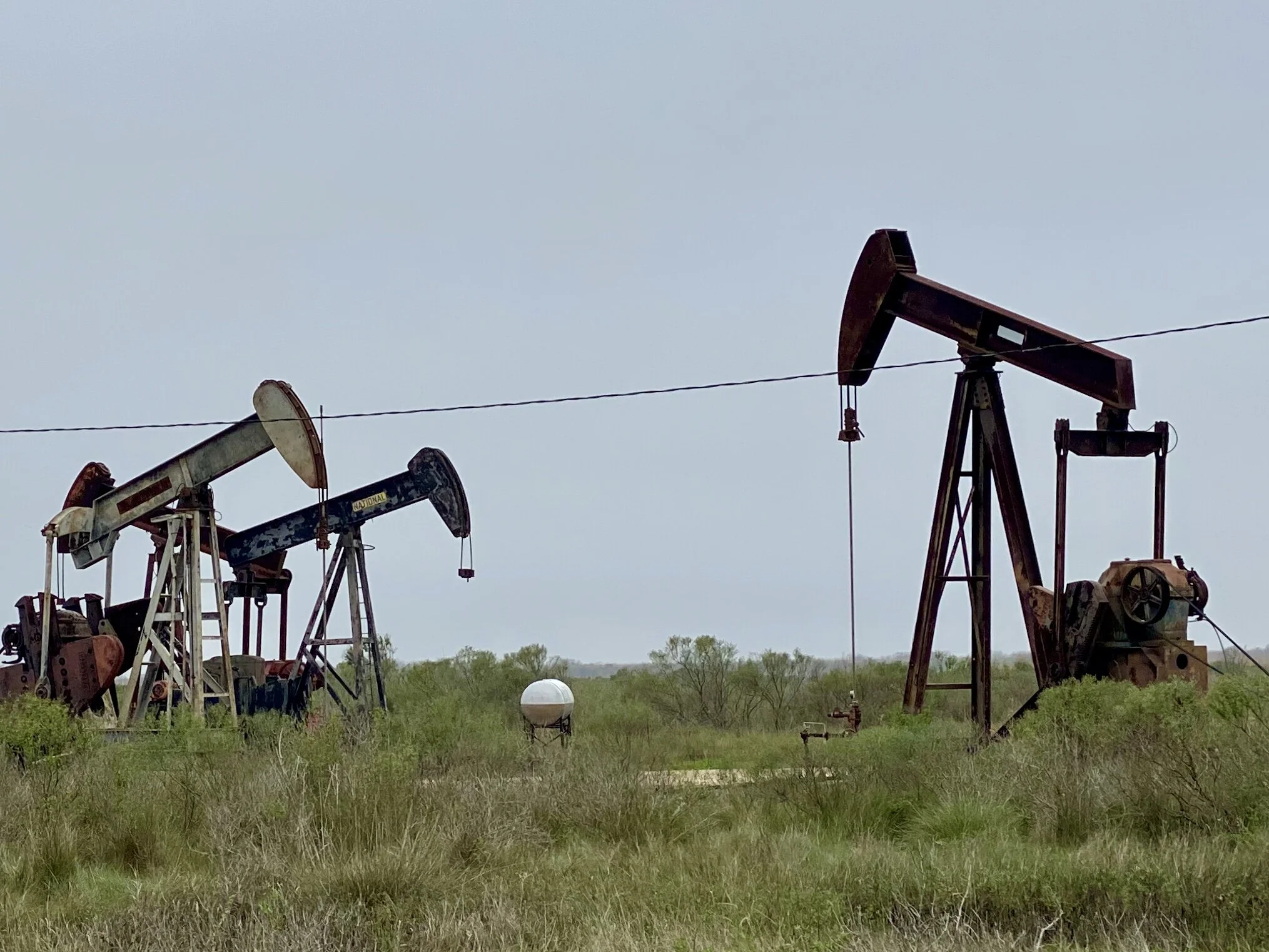
Abandoned oil wells in High Island, Texas, about a half mile from the Gulf Coast.
The reasons for this activity make economic sense in the short term. Cameron has been quite poor since Hurricane Audrey hit, and jobs are scarce. Consequently, the new plant is very popular among locals. Port Arthur is also poor, although it has more economic diversity than Cameron. However, the proximity of its site for a new receiving terminal will have additional benefit to Houston, so it’s popularity is even greater. Interestingly, in Houston, there is tacit, if not public, recognition among local officials that climate change is real. Based on a conversation we had with a local in Port Arthur, it seems there is hope that new sea walls east of Port Arthur across the Sabine River and further west across the Houston ship channel will mitigate storm surge issues for awhile, at least for southeastern Texas. …For how long, we wondered?
Jenny’s left arm marks the water line for Hurricane Ike in a bicycle shop we went to in Galveston. This 2008 hurricane holds the record for storm surge in Port Arthur, cresting at 22 feet.
So why do so many people in Louisiana and Texas embrace the very industry that may ultimately do them in? Isn't one definition of insanity, “doing the same thing over and over again and expecting different results?”
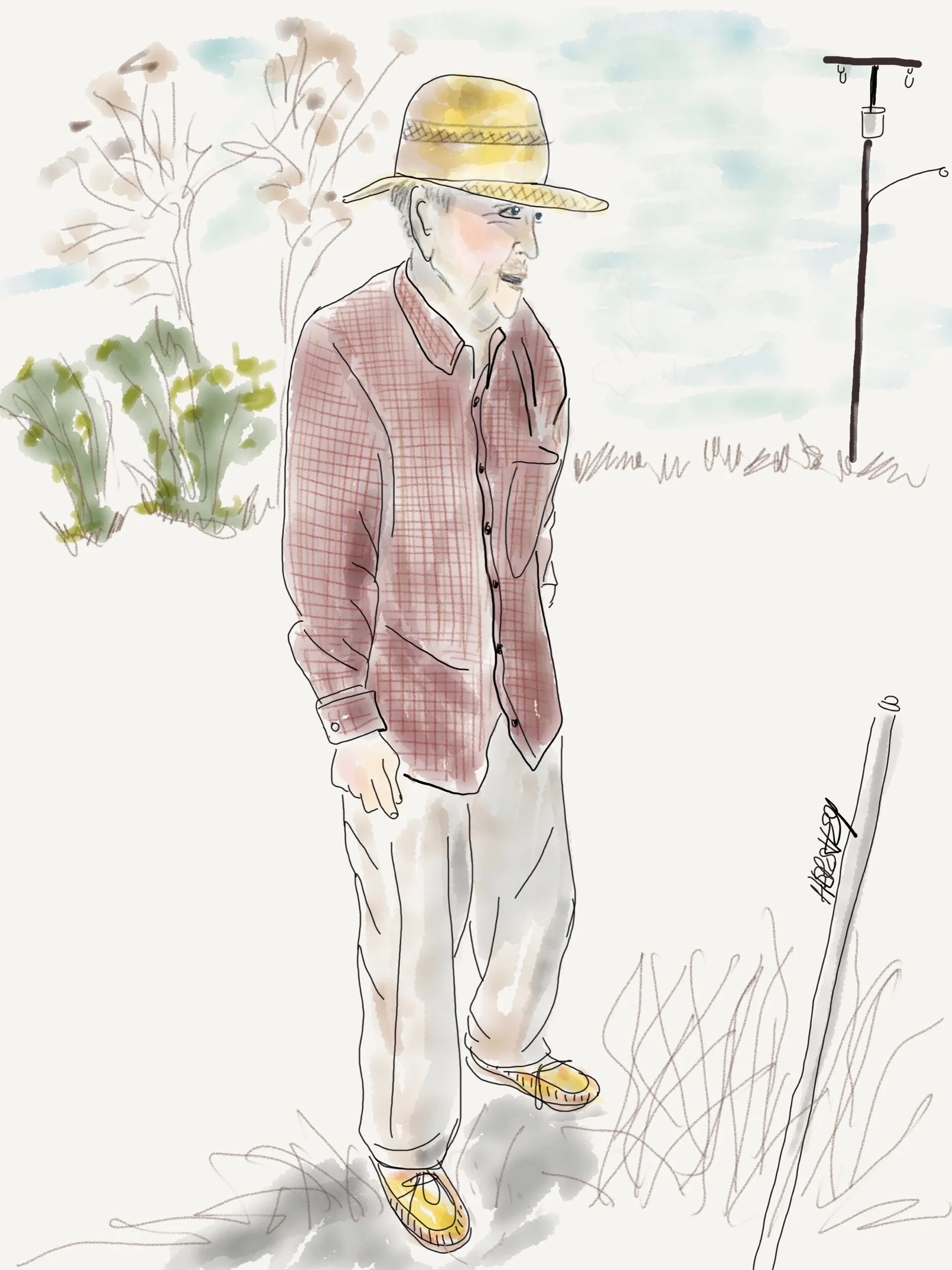
“I moved one time..in 1954...from next door to here.” Drawing by Jennifer Hershey. Follow her on Instagram at deeofo.
Jobs are important, and 460 permanent jobs might have lasting value for your communities. But at what cost? When your home is losing land to coastal erosion at alarming rates, when scientist are warning us that sea level rise is occurring faster than their previous conservative estimates indicated, when extreme weather events such as hurricanes and tornadoes are becoming more frequent with every passing year, when scientists are looking at establishing a Category 6 for hurricanes because they are growing so much more intense, …..when does that community cut its losses, and change its economic base?
Yes, life will be harder in the short term, but potentially much more livable and rewarding in the long term. Maybe that’s a plate that’s worth stepping up to…
For those of you who geek out on map routes, please email me and I will happily include links to the Garmin maps in this blog post. Frankly, I simply don’t know if they are very important to my readers. If I’m wrong, I’d love to know.
Thanks for reading! More to come…
All photos, unless credited or otherwise noted, are copyrighted property of the blog post author.
Louisiana/Texas, Post 1
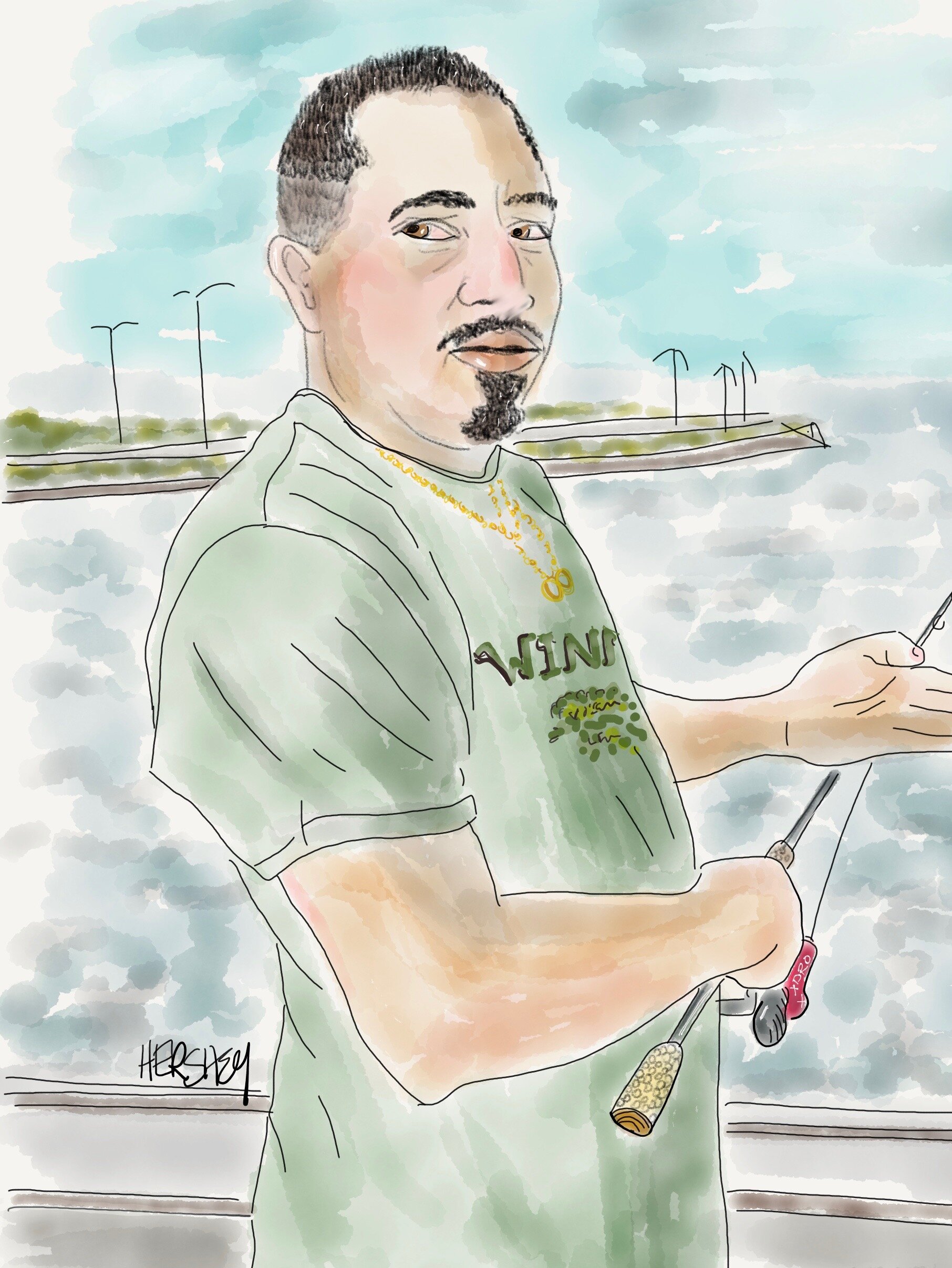
“I come after the grande hurricane...10 yrs ago.....from Guatemala . I fish for mi familia every day from aqui.” Drawing by Jennifer Hershey. Follow her on Instagram at deeofo.
The Amtrak Crescent from New York City to New Orleans is a small and somewhat understaffed train. Given their size and cultural stature, it seems like the Big Apple and the Big Easy deserve something more robust, if not all of America. Train travel is low carbon, pleasant, and offers so many other benefits to our transportation system. Apparently few people train between these cities (at least in the dead space of early February before Mardi Gras), so the train not only was small (9 cars total), it was challenging in its lack of basic amenities. Dining cars have been replaced by a limited option of previously prepared food that wears quite thin after a few meals. Bathrooms are few and poorly cleaned. There was no observation car. Yet - as always - I was appreciative of Amtrak’s efficient and inexpensive roll-on bike service. It is both easy and a joy to use. You roll your bike to a baggage car, remove your gear, and hand over your bike to an attendant. When you arrive at your destination, you do the same thing in reverse. Retrieving your bike takes minutes, and after restoring your gear, off you ride.
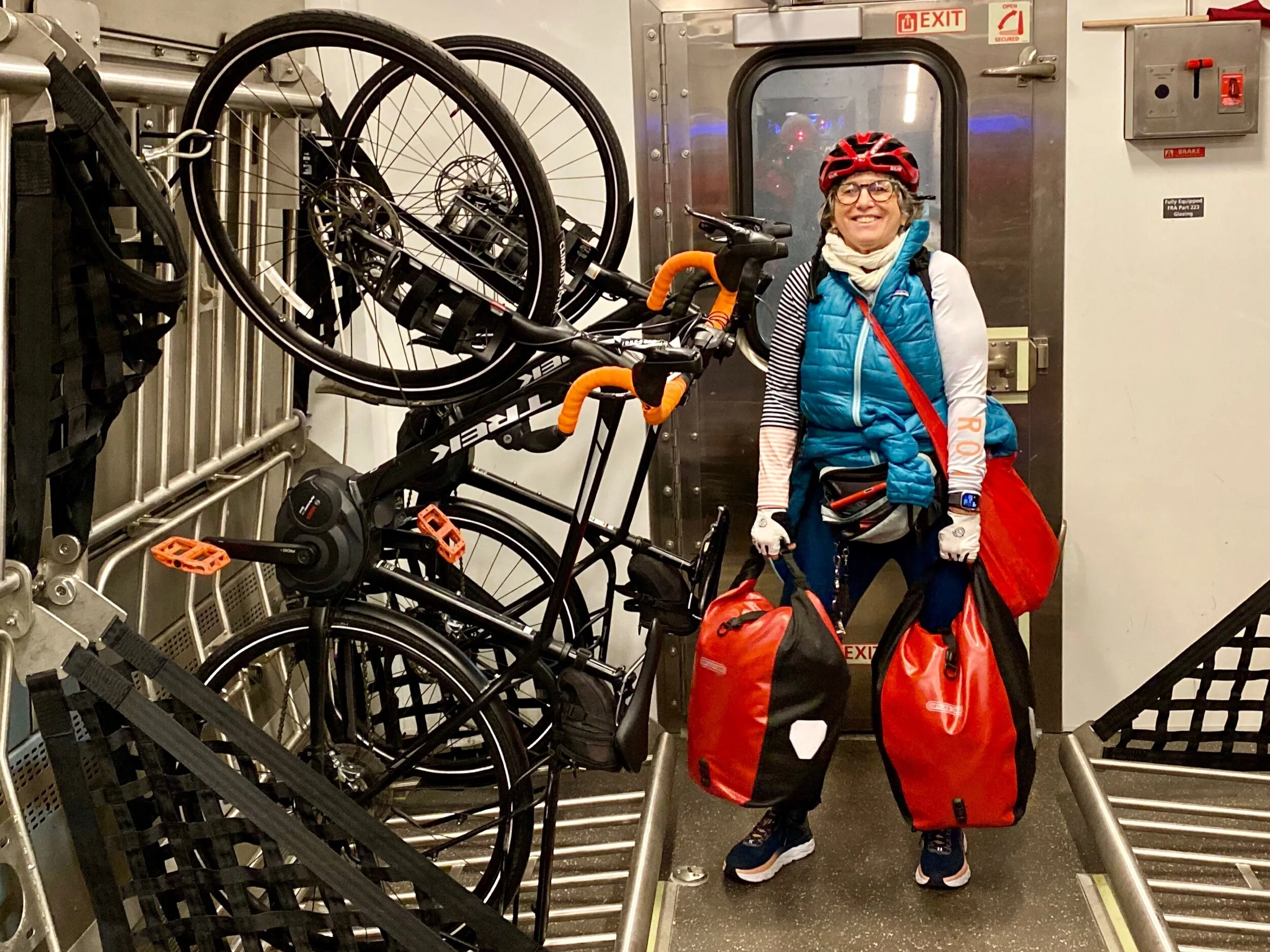
Jenny Hershey with her gear standing beside our bikes as we board in NYC.
I don't always make New Year’s resolutions, but this year I did: “Observe more, judge less”. It was simple once I said it out loud, although I had been struggling to articulate the thought to myself for quite a while. In addition to an unusual bout of self-reflection inspired by the quick and successive deaths of both my parents, I’d been reading the fascinating book “Why We Are Polarized” by Ezra Klein; a look behind the extreme politicized polarization plaguing America.
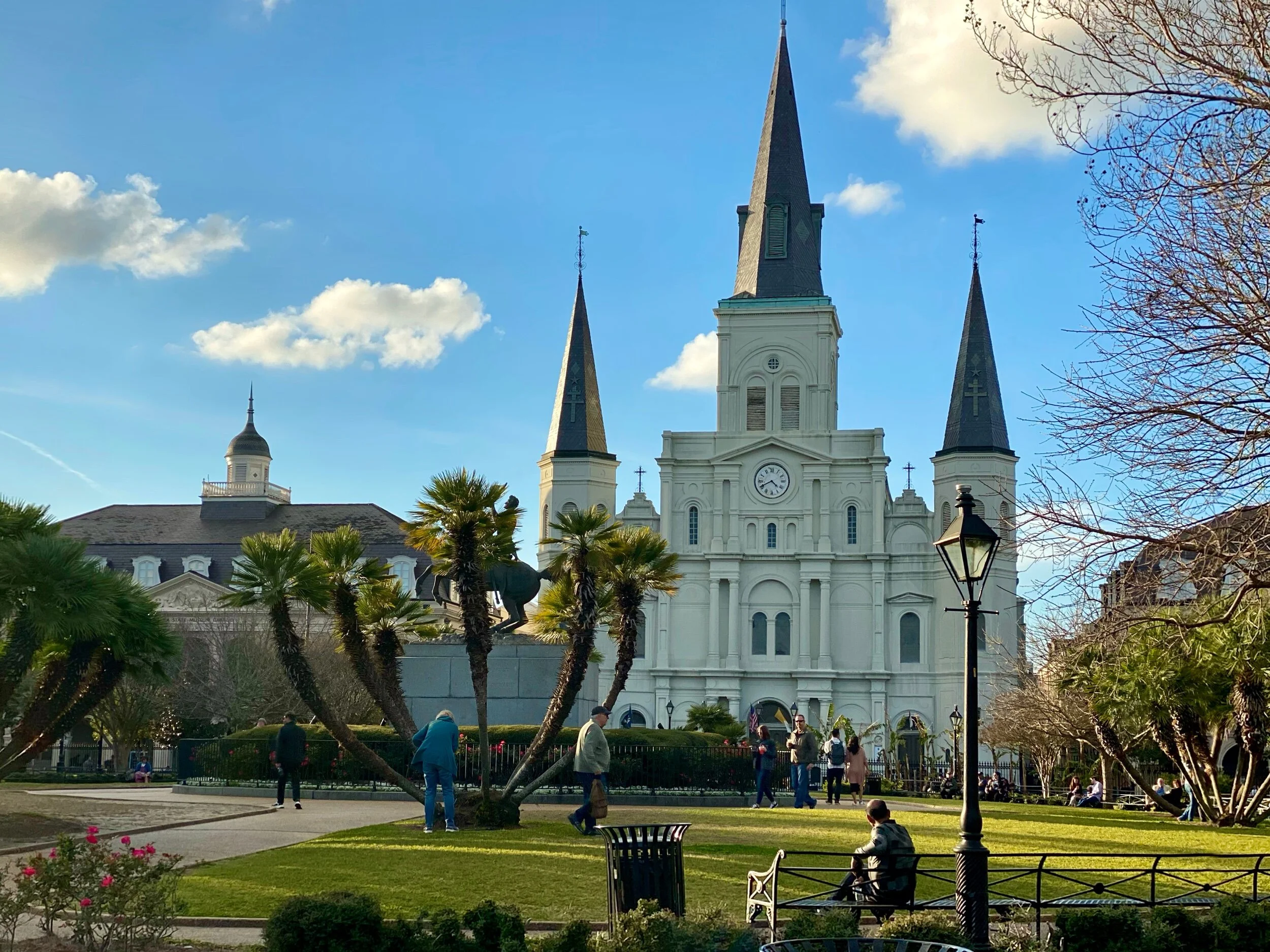
The Cathedral in Jackson Square, New Orleans, LA
I was coming to understand that just as we hide parts of ourselves from those we love, we are hidden from one another in a country we love, partly because we assume others should see the world as we do even if we cannot see the same world they do. I had been unsettled by several attacks on FaceBook about my apparent ignorance of the South based on a few inquisitive posts about life in North Carolina. Out of defensiveness, I found myself questioning how much conservative southerners understand, or care to understand, about my identity as a multicultural urban northern liberal. Conversely, I was forced to admit to myself that I knew, or cared, equally little about the identity of white rural southern conservatives.
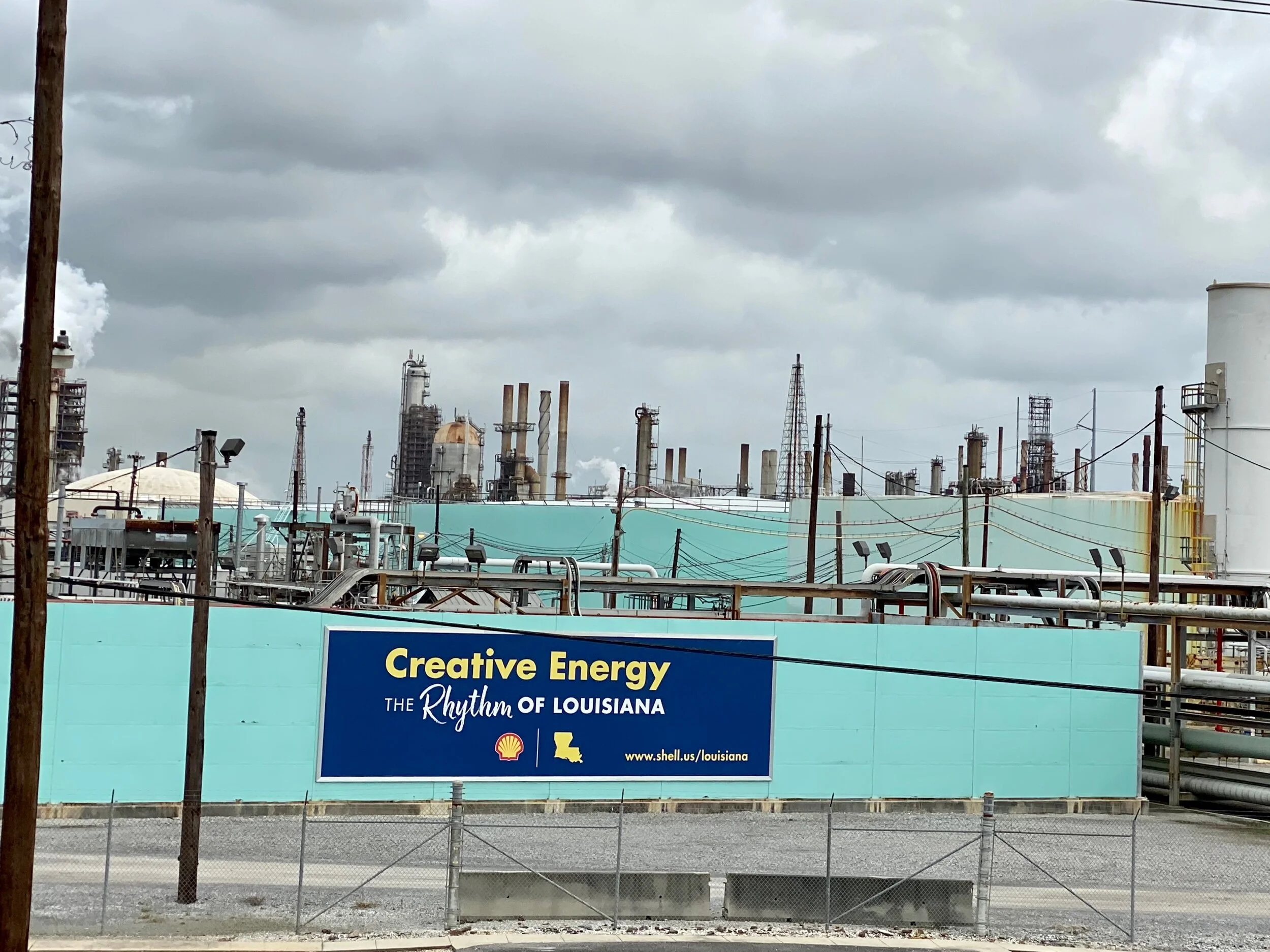
Oil plant just northeast of NOLA on the Mississippi River.
In anticipation of this trip, both my traveling partner Jenny and I felt trepidation about biking in the Deep South. I hoped Klein’s book would help me frame an approach that would go beyond my own self-perceived static and somewhat predictable liberal perspective. It has not disappointed me.
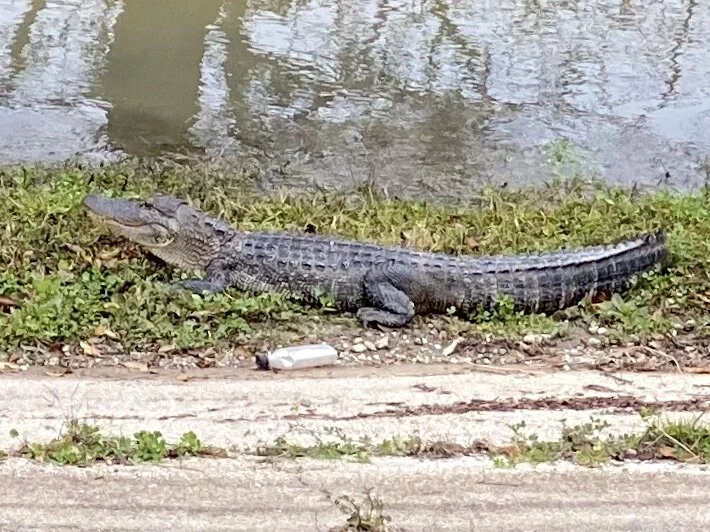
Just east of NOLA off the Mississippi River levee. Quite alive.
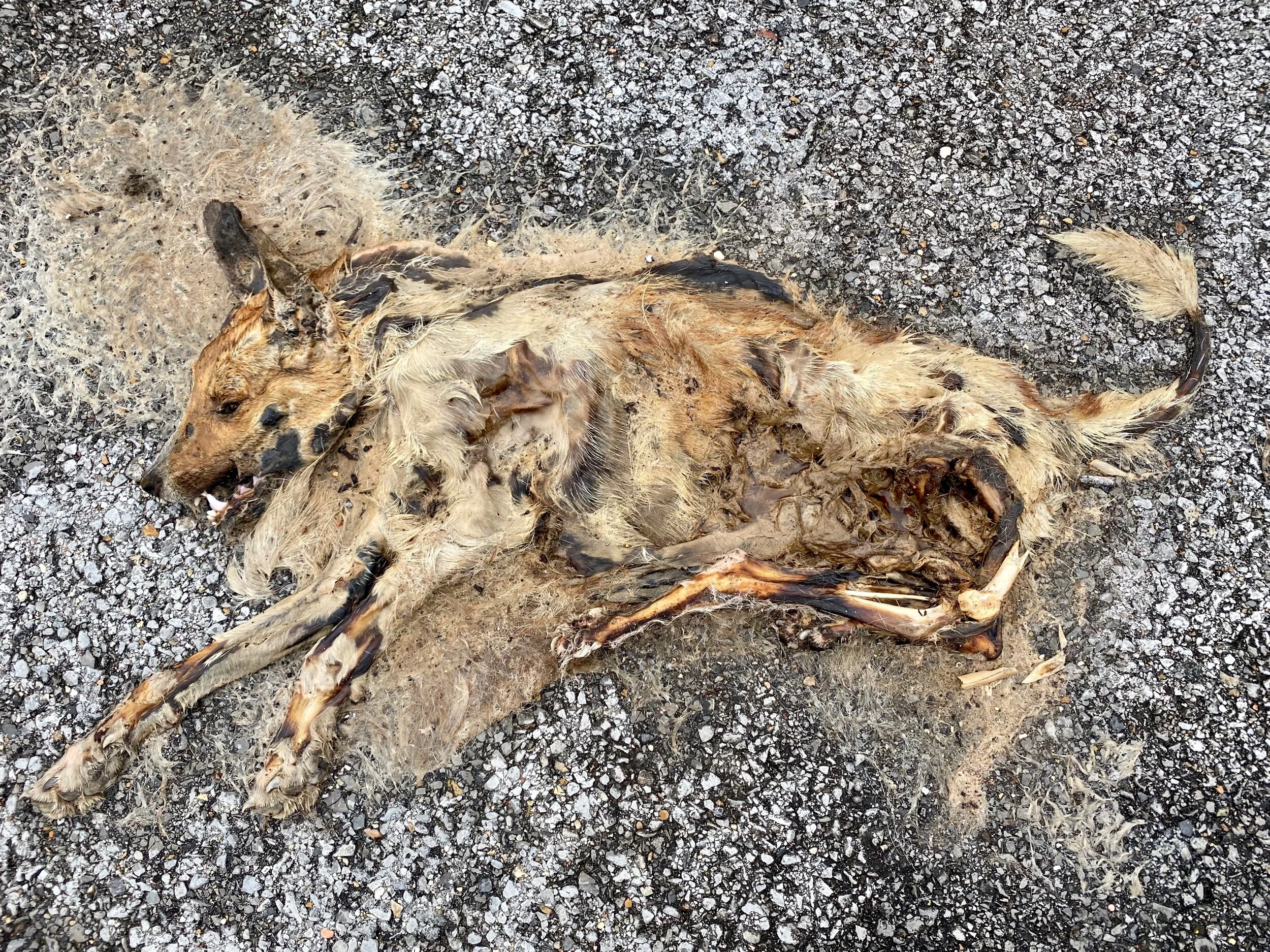
A dead fox. Roadkill.
I admit that we partly chose to explore Louisiana and Texas on bikes because it is a warm place to go in early February. In addition, it is accessible by train (we thought other choices would be more carbon intensive, and low carbon travel is part of our objective). But our country's current form of political polarization also begs for greater interaction between our vastly different political cultures. Interestingly, as a northerner, I often feel greater affinity with European countries and cultures than I do with the political and social cultures of the American south. But since the 2016 election, I’ve come to believe that America is in need of a giant reset (or “rebooting”) and that if I - and other people like me (i.e., members of my group) - don’t grapple with our entire American identity, we are very likely to misunderstand how we arrived at, and might get out of, such a highly polarized present moment.
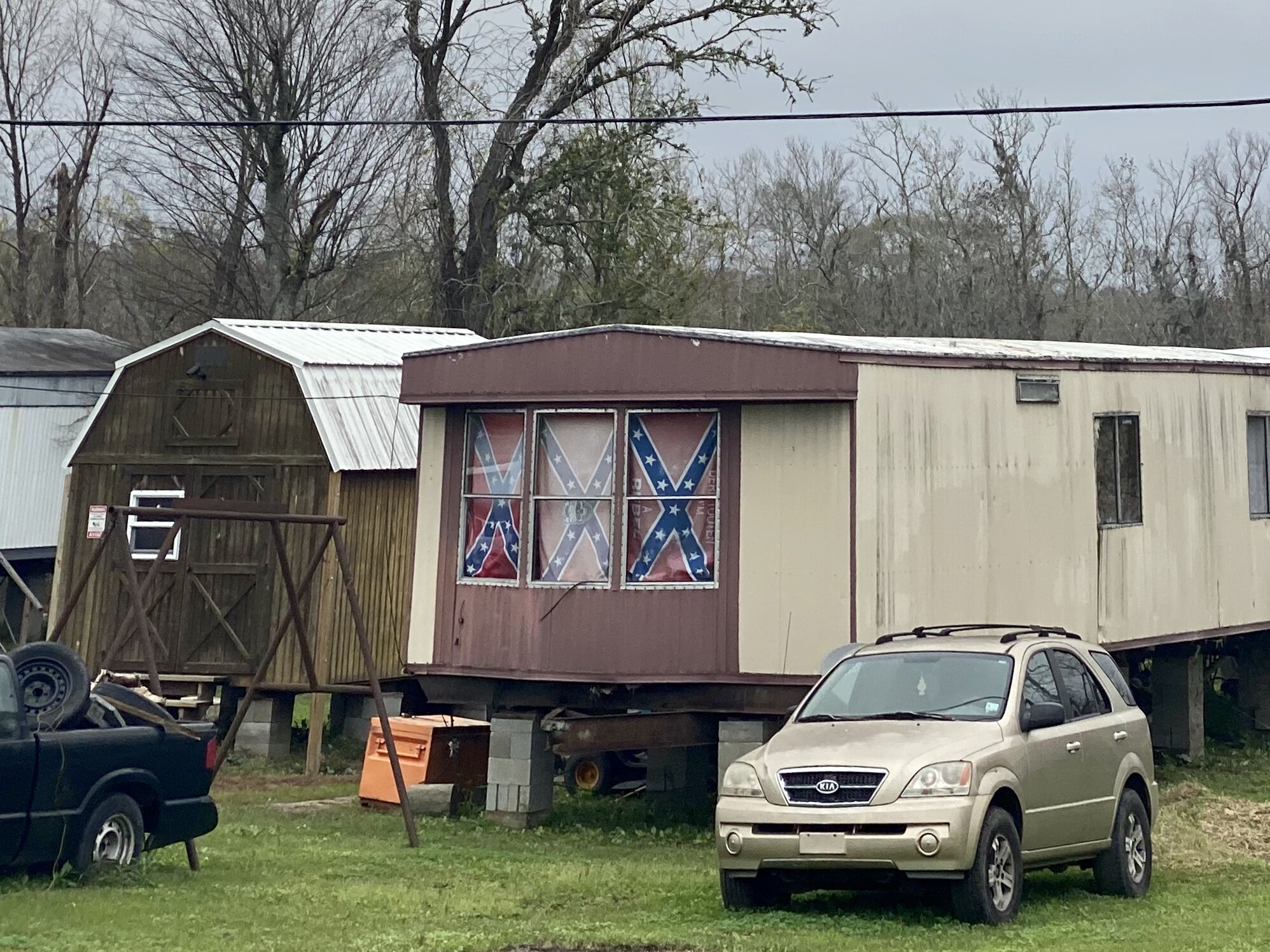
Near Donaldsville, LA.
My interest in climate change is a case in point. There’s so much about our changing climate that seems obvious to me that I simply cannot fathom the abyss in logic or understanding between me and climate deniers. While I’m very confident the science supports me, I’m learning that facts alone don’t change behavior. Even in an area devastated by Hurricane Katrina, and after numerous recent warnings that the sea level is especially troublesome on the Gulf Coast, plenty of locals remain willfully cavalier, if not downright defiant about taking action.

“I was 13....they took us out by boat. I slept on a bridge for a week with my Grandma. “ Drawing by Jennifer Hershey. Follow her on Instagram at deeofo.
Ezra Klein makes the same argument about rationalizing, or recasting, facts within political cultures. Essentially, his fundamental point is that identity is a far more important driver of political viewpoints than is logic or “facts”. In fact, logic may be the least important attribute of political identity - far less important than cultural, familial, socioeconomic and racial identity. I’m reminded of James Carville’s famous quip during the Clinton administration, “it’s the economy, stupid”. Maybe in the age of Trump, “it’s the tribe, stupid”.
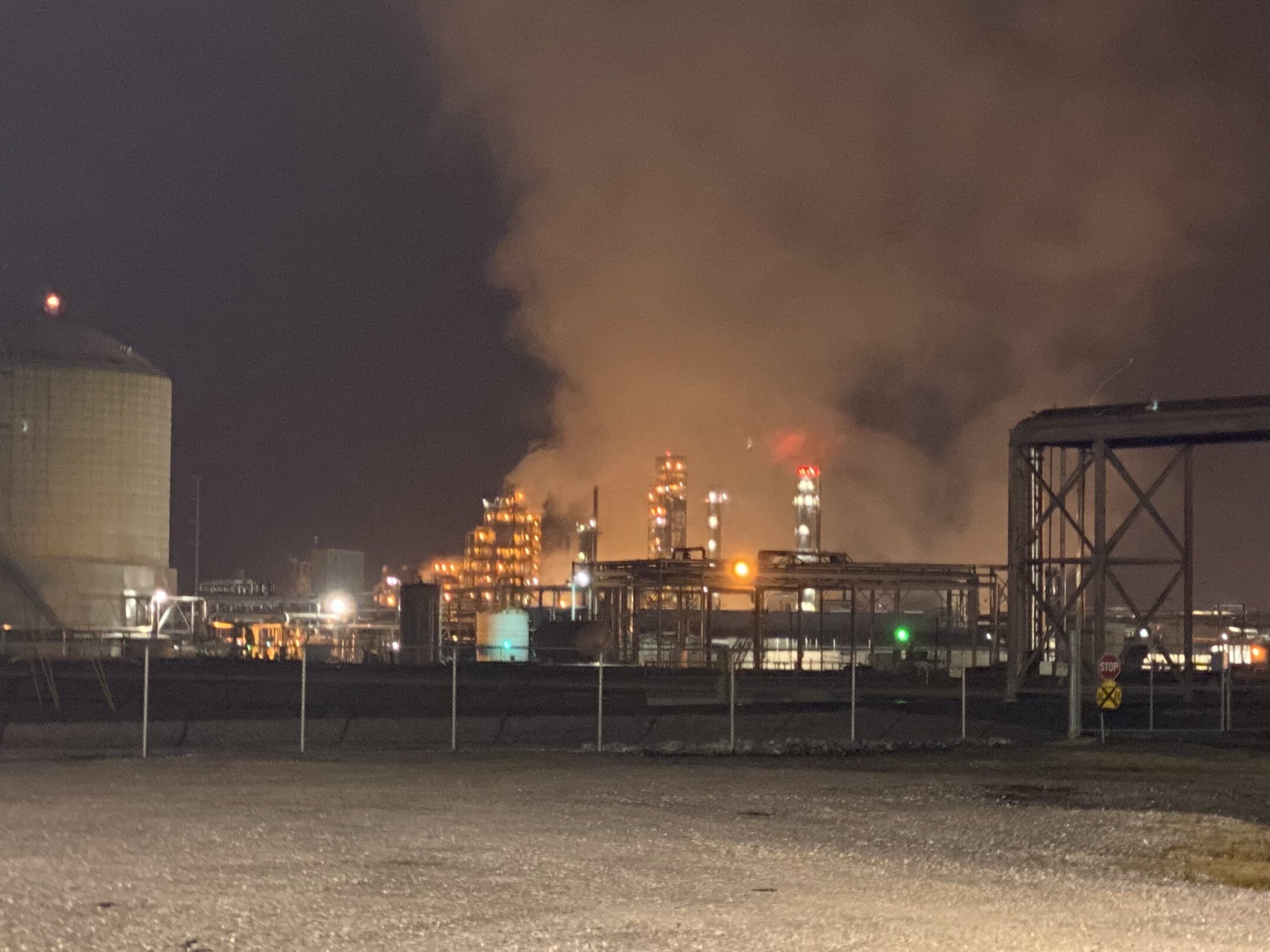
A petrochemical plant just outside the bayou town of Donaldsville, LA.
Stupid, perhaps, but true nonetheless. And so very, very human. So, I’ve decided - and Jenny agrees - that the most useful way to explore Louisiana and Texas right now is to observe more, and judge less. For readers who hope we will brightly burn the climate emergency torch with the message that the apocalypse is well upon us and our southern neighbors need to wake up lest they suffer sooner than their northern neighbors (even though we think that’s true), we may disappoint you. Our agenda right now is simply to understand.
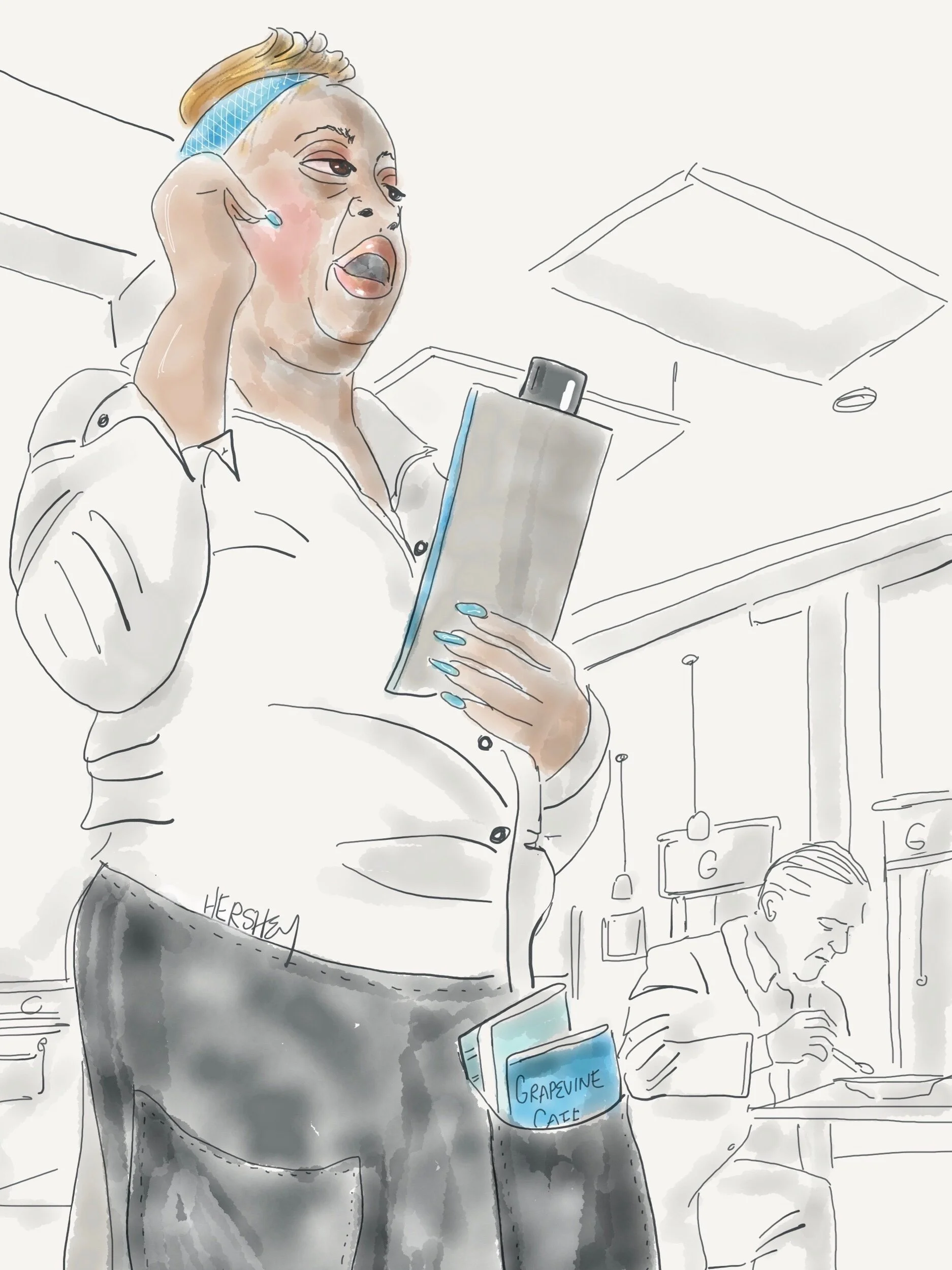
“Yes Ma’am...they got all kinds of plants here. Chemicals and oil and I don’t even know what they got. “ Drawing by Jennifer Hershey. Follow her on Instagram at deeofo.
Maybe a lot of folks just don’t believe that good jobs from a “green economy” will really show up when chemicals and oil companies have been the only big games in town for multiple generations. Or maybe they just don't feel like they can change anything anyway.
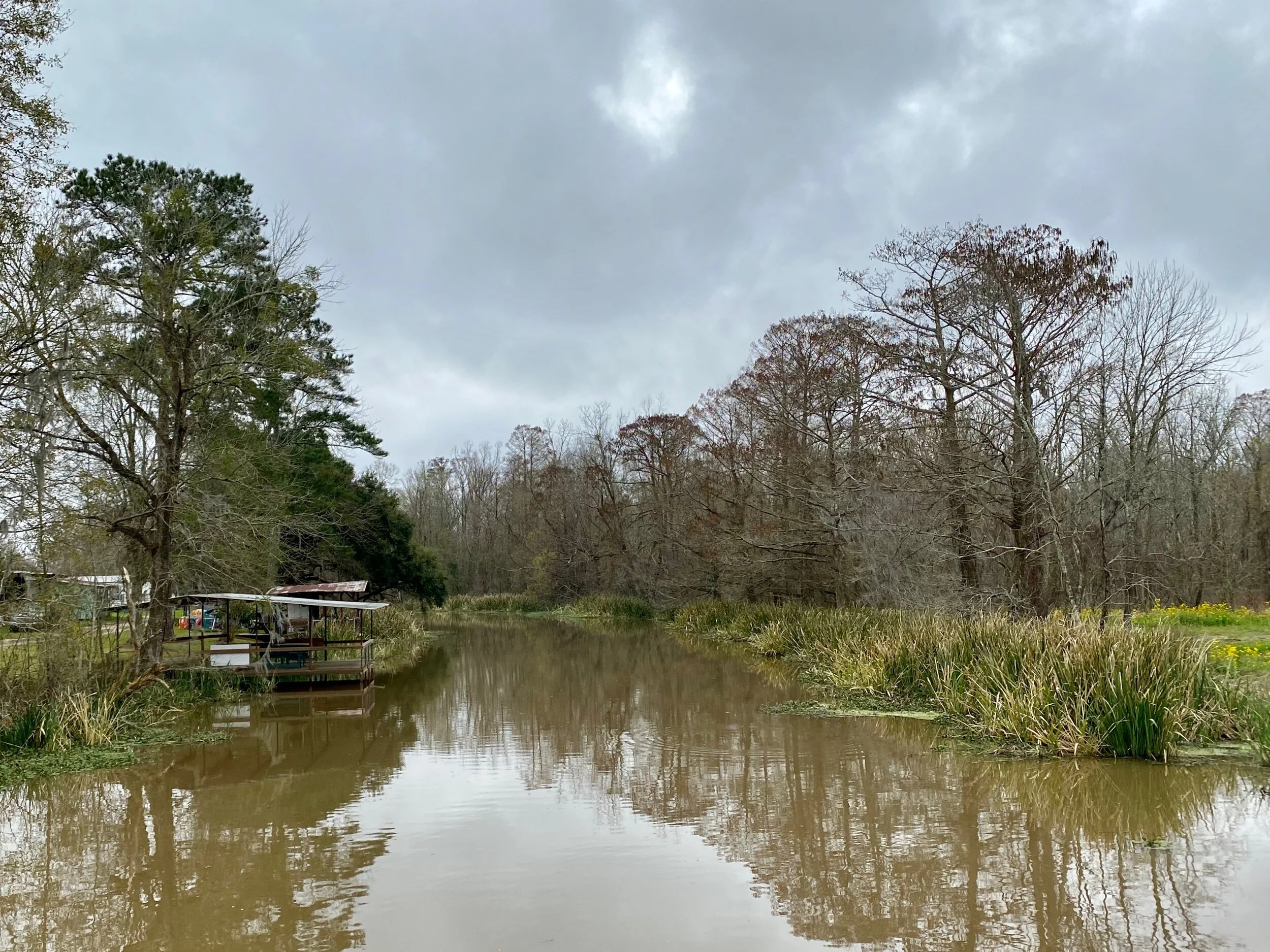
Bayou Country about 150 miles southwest of New Orleans.
We talked to a middle aged black man in White Castle, Louisiana, named Orville outside the local grocery store, who told us he had voted for Obama but didn't vote in 2016, and was probably not going to vote in the next election also, even though he thinks Trump is a crook. When we asked him why, he went silent. So we (thoughtful northerners that we are) explained “logically” why he should - since the federal voting power for a Democrat in Louisiana is arithmetically more powerful, given the Senate and the Electoral College, than a vote by a Democrat in New York. Orville looked dubious and replied, “them politician’s all gonna do what they want to anyway.” Jenny and I exchanged glances. We had failed to convince him. So, as we mounted our bikes and road off, Jenny yelled back at Orville, “If you don’t vote in the next election, I’ll come back here and kick your ass”! Orville laughed. Maybe he’ll remember that part of our conversation more then our logic.
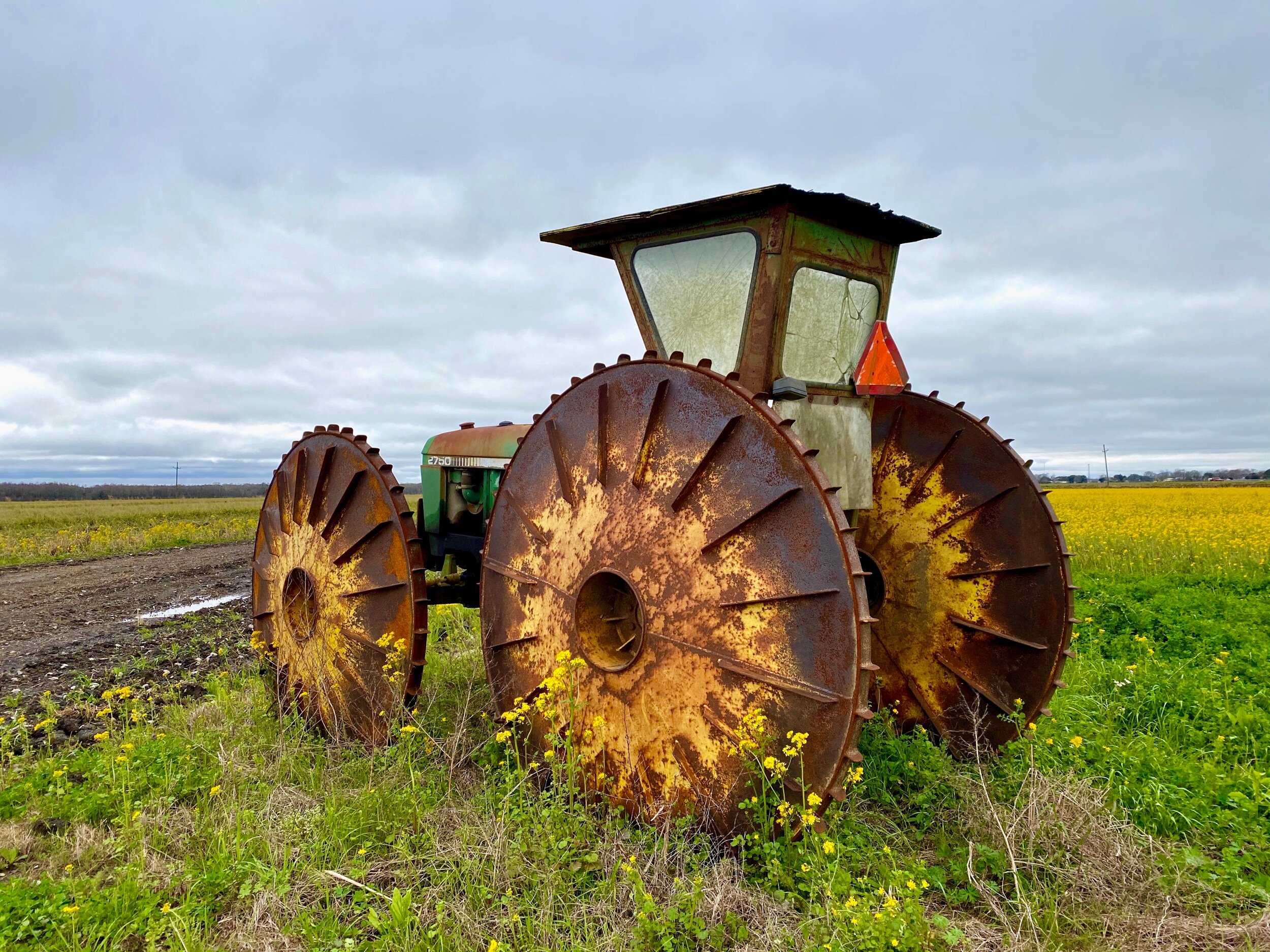
Tractor in a fallow sugar cane field near Baldwin , LA. Photo by Jennifer Hershey.
Maybe Orville is right. Yet, Congressional behavior during the impeachment proceedings teaches us that politicians will do just about anything they think the majority of their constituents want them to (with a few exceptions). And maybe that’s a good thing, especially if we want them to do what’s right. But more agreement on what “right” looks like among us constituents would be very helpful, especially when the prevailing view seems so very wrong. And how will we achieve that? I used to think I knew. Now I no longer do… so for myself, I'm trying out the follow idea: Observe more, judge less. And please know, dear reader, it's myself that I am encouraging.
For those of you who geek out on map routes, here are the last four days of our rides on Garmin: Day One, Day Two, Day Three, Day Four.
Thanks for reading! More to come…
All photos, unless credited or otherwise noted, are copyrighted property of the blog post author.
Illinois to New York City, Post 1
Soybeans wait for harvesting in Greenfield, Indiana.
Back in the Saddle Again
Greetings from my bicycle! My last blog post was in May, and I apologize to readers who may be curious about my disappearance in rough weather somewhere near Westgate, NV, on a cycling trip from Palo Alto to Salt Lake City.
If you’ve been wondering, you might be pleased to know that I did get back home to New York City. In fact, I spent a great summer there. While there, I wrote a blog about how I got home: backtracking to Reno, skipping my plans for Salt Lake, shipping my bike and flying back to New York City. But alas, I got distracted and never posted it. So much for the best laid plans of mice and men (and me).
Even so, I took a few more photographs in Nevada in May that I think are still worth sharing, even if the trip back to New York no longer seems relevant. I include these because I am fascinated by extreme weather events. They are increasingly part of our lives, and I think there is value in bearing witness to what we see around us. You may remember from my last blog that I was fighting my way through a very unusual rain and snow storm in a part of Nevada that is usually hot and dry in May. Along with many other folks I was surprised and challenged by the inclement weather I encountered. Below are a few more shots from that trip that I’m particularly proud of…
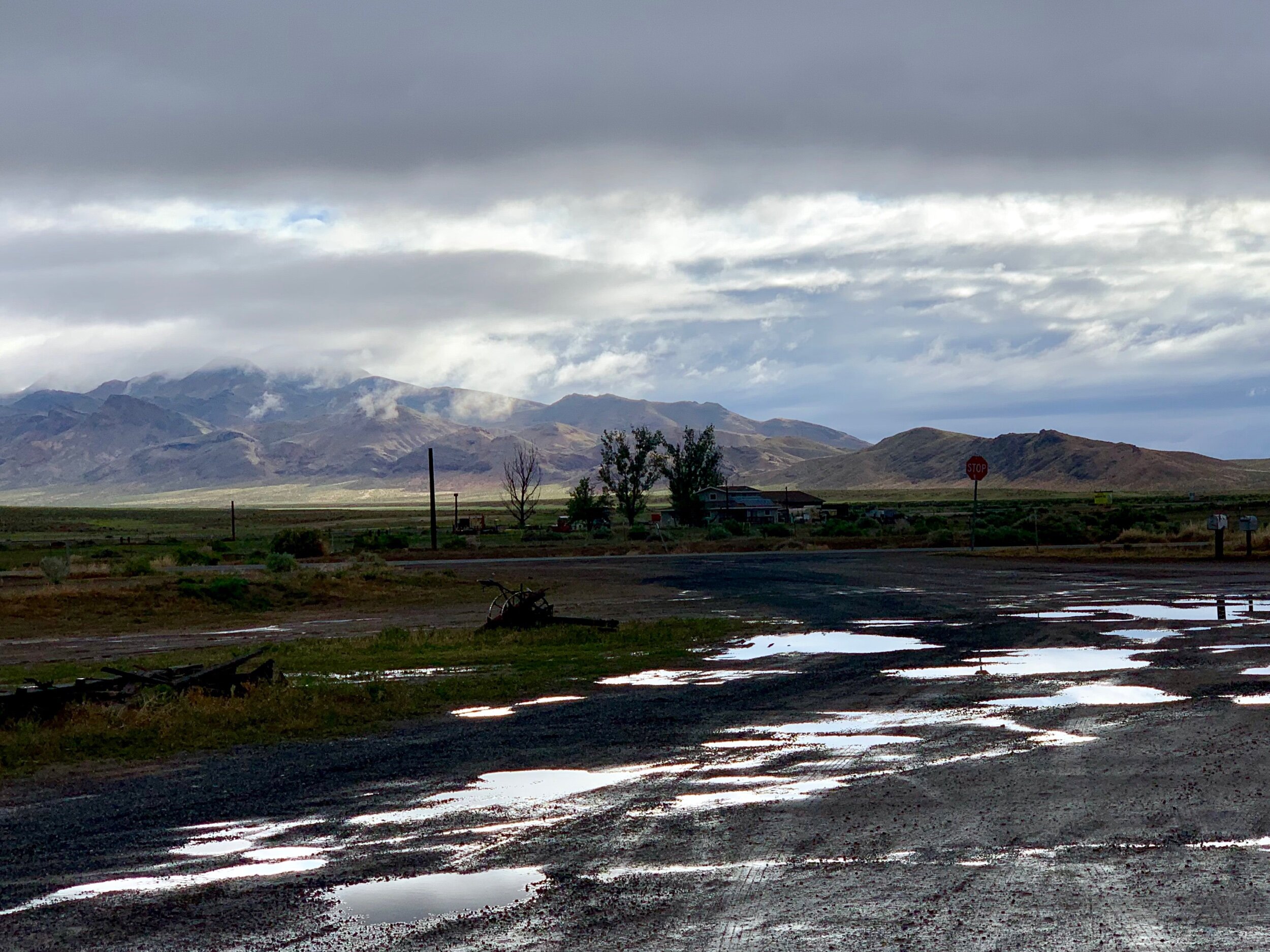
Water in the Westgate Bar parking lot on the day I left in late May, 2019.
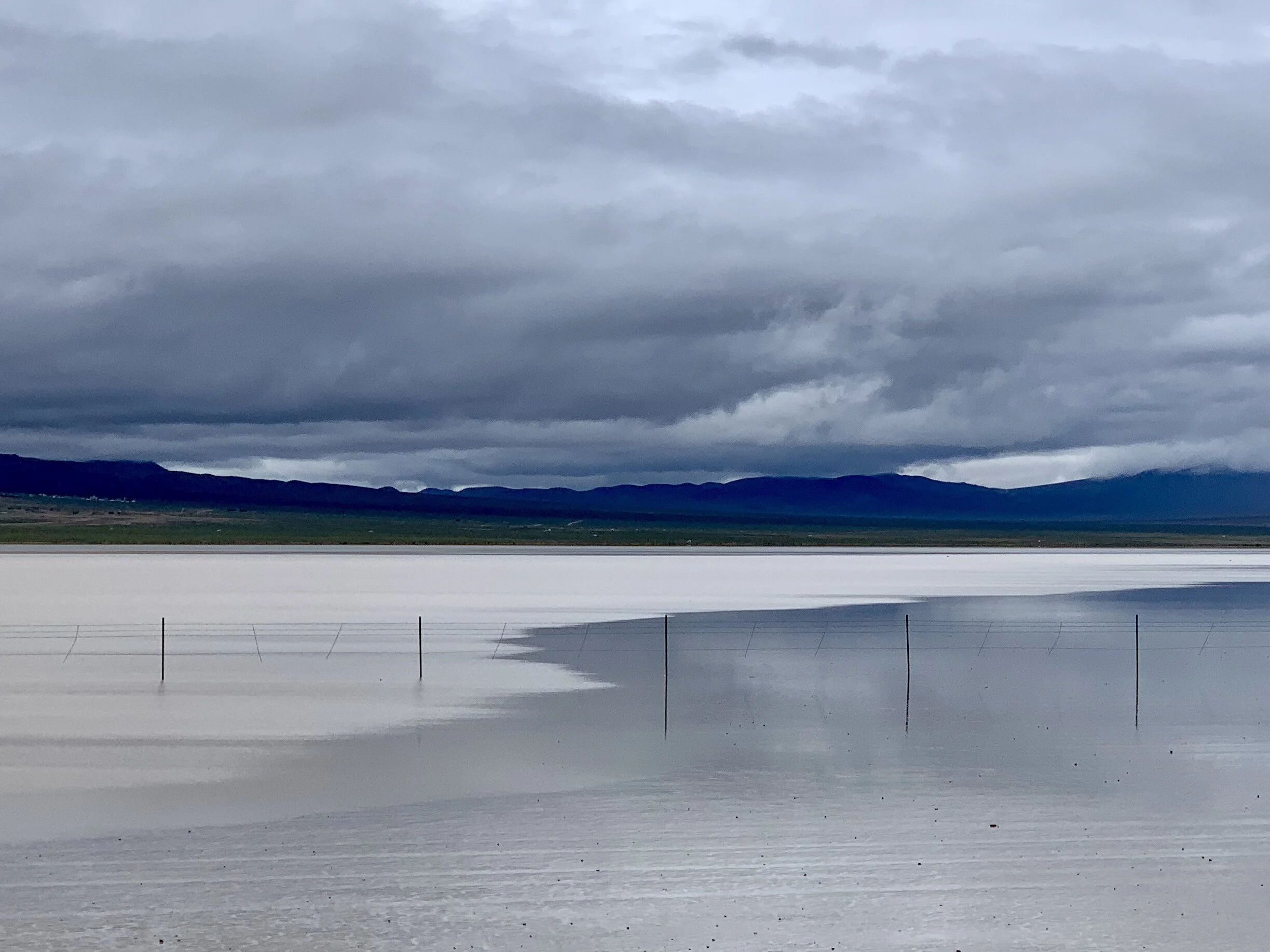
Flooded salt flats east of Reno.
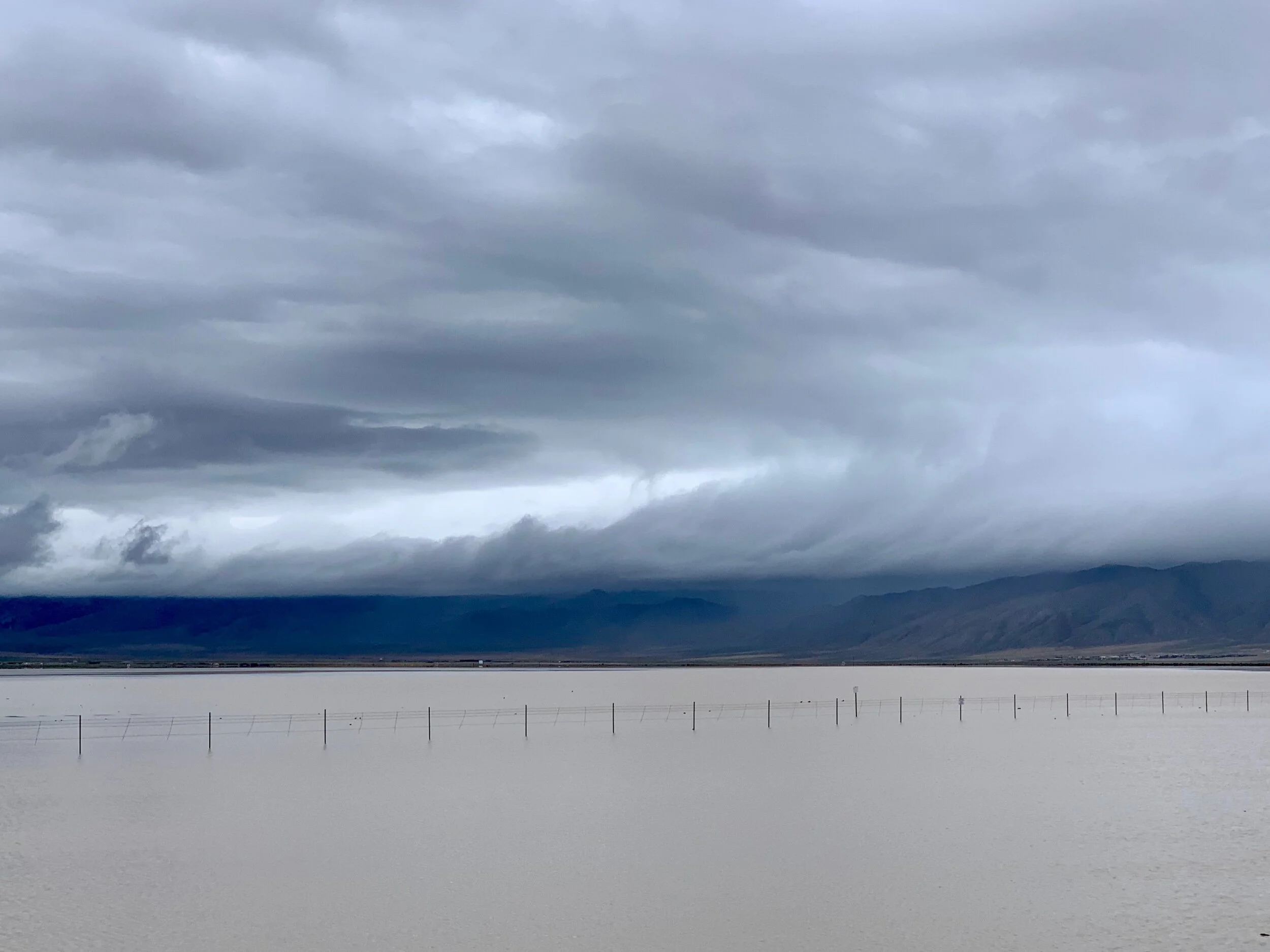
Rain clouds above the salt flats.
As the summer progressed, I made plans for future cycling with my friend Jenny Hershey, who had just retired from a 31-year career running building operations for Jujamcyn Theaters on Broadway. A founder of the Broadway Green Alliance, Jenny is both an environmentalist and an avid cyclist. To get our feet wet, we took a car camping/cycling starter trip to New Brunswick, the fabulous Cabot Trail in Cape Breton in Nova Scotia, Prince Edward Island (PEI), and explored traveling together on bikes for multiple days at a time. If you’ve never been there, I strongly recommend cycling in PEI. There are numerous rail to trail conversions that allow cyclists to get everywhere one could want to go. The shoreline is vast and beaches are beautiful. The islanders take great pride in their environment, and they enjoy rich local culture. Prices are reasonable, and the pace of life is remarkably comfortable. At the same time, internet services and other modern amenities are easy to come by. Don’t miss it!
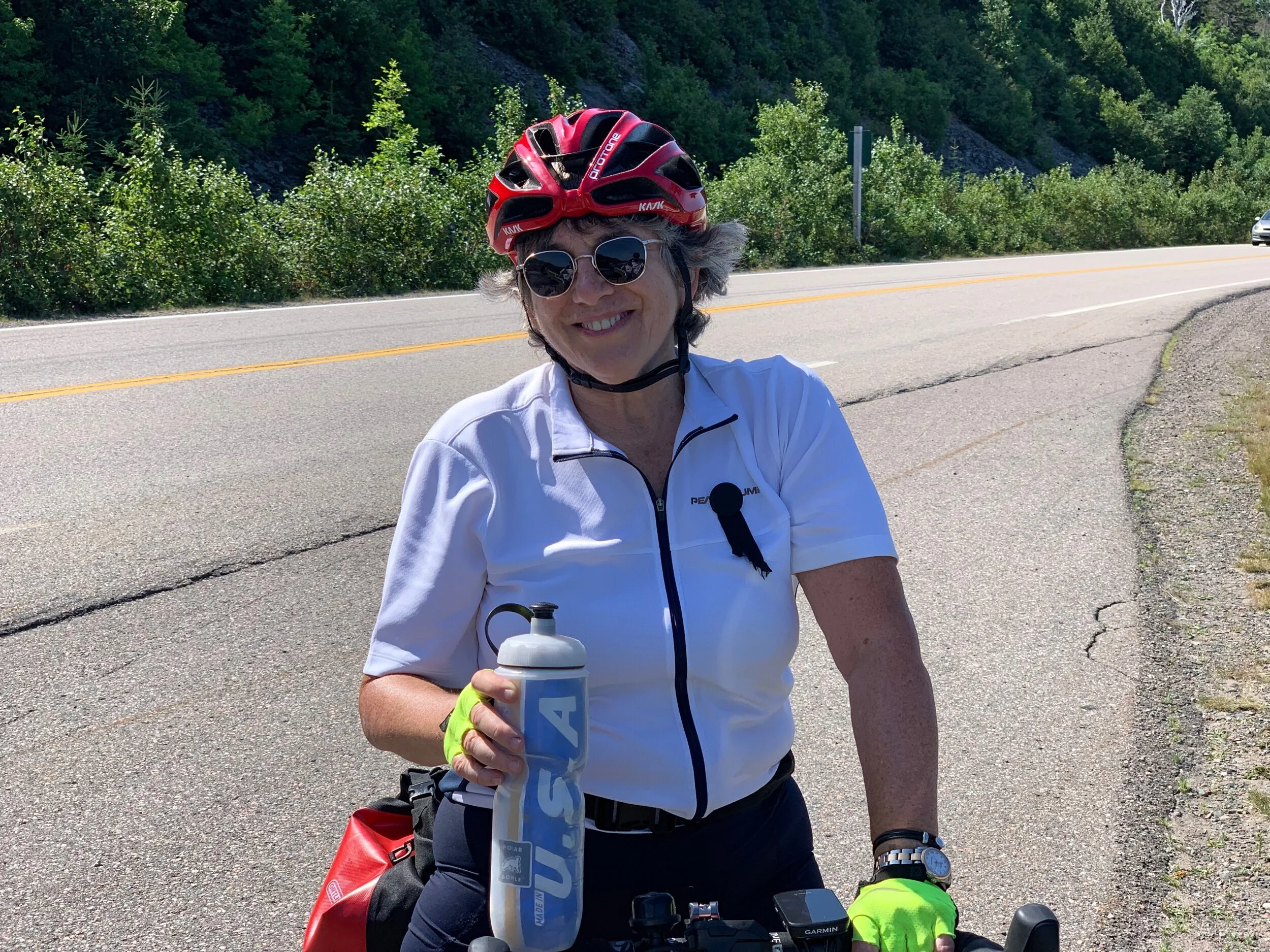
Jenny by the roadside in PEI. She is wearing a mourners ribbon signifying the period of shiva after the death of her mother Merle Weisman.
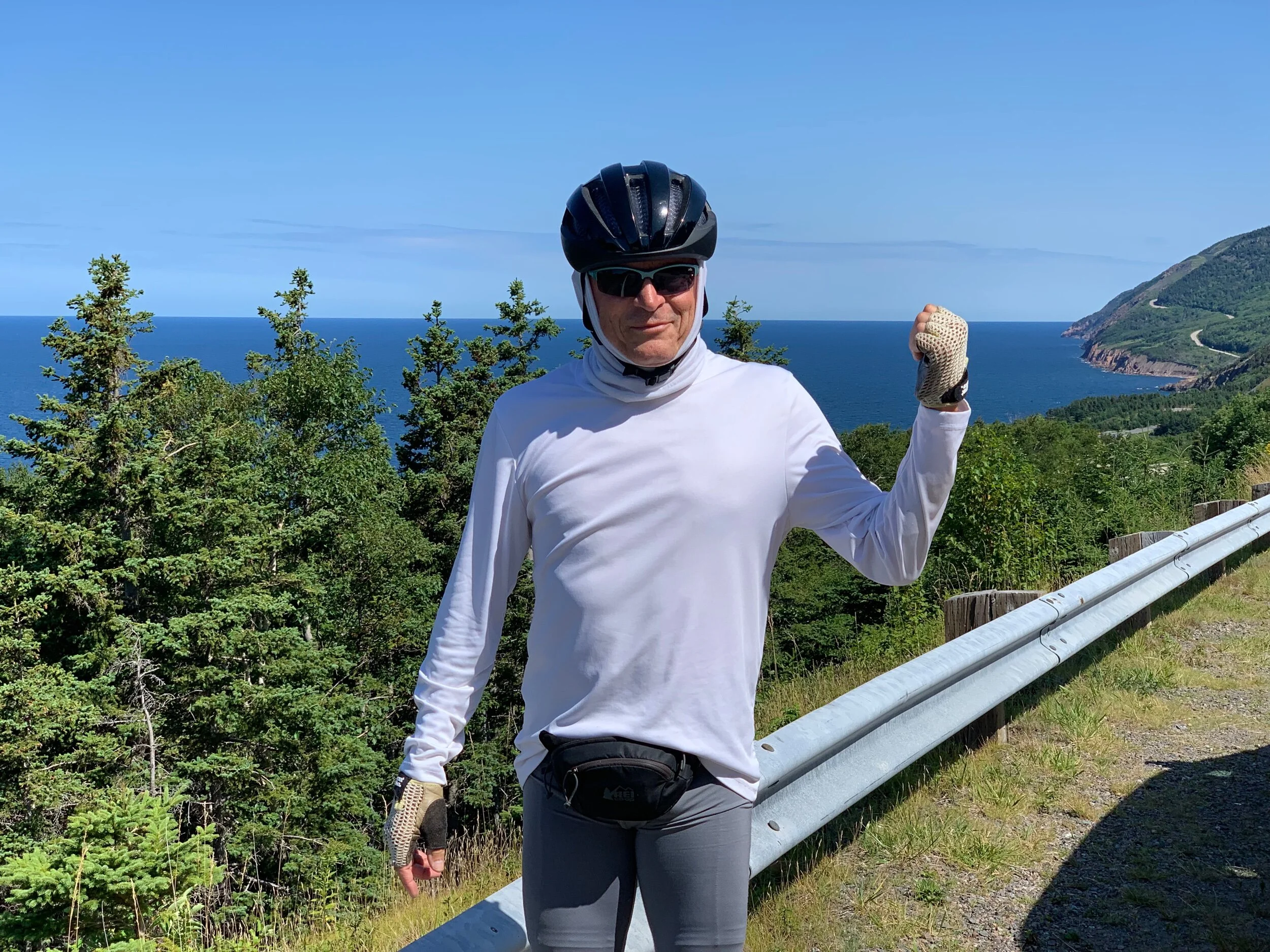
Michael gesturing toward the Northumberland Straight in Cape Breton.
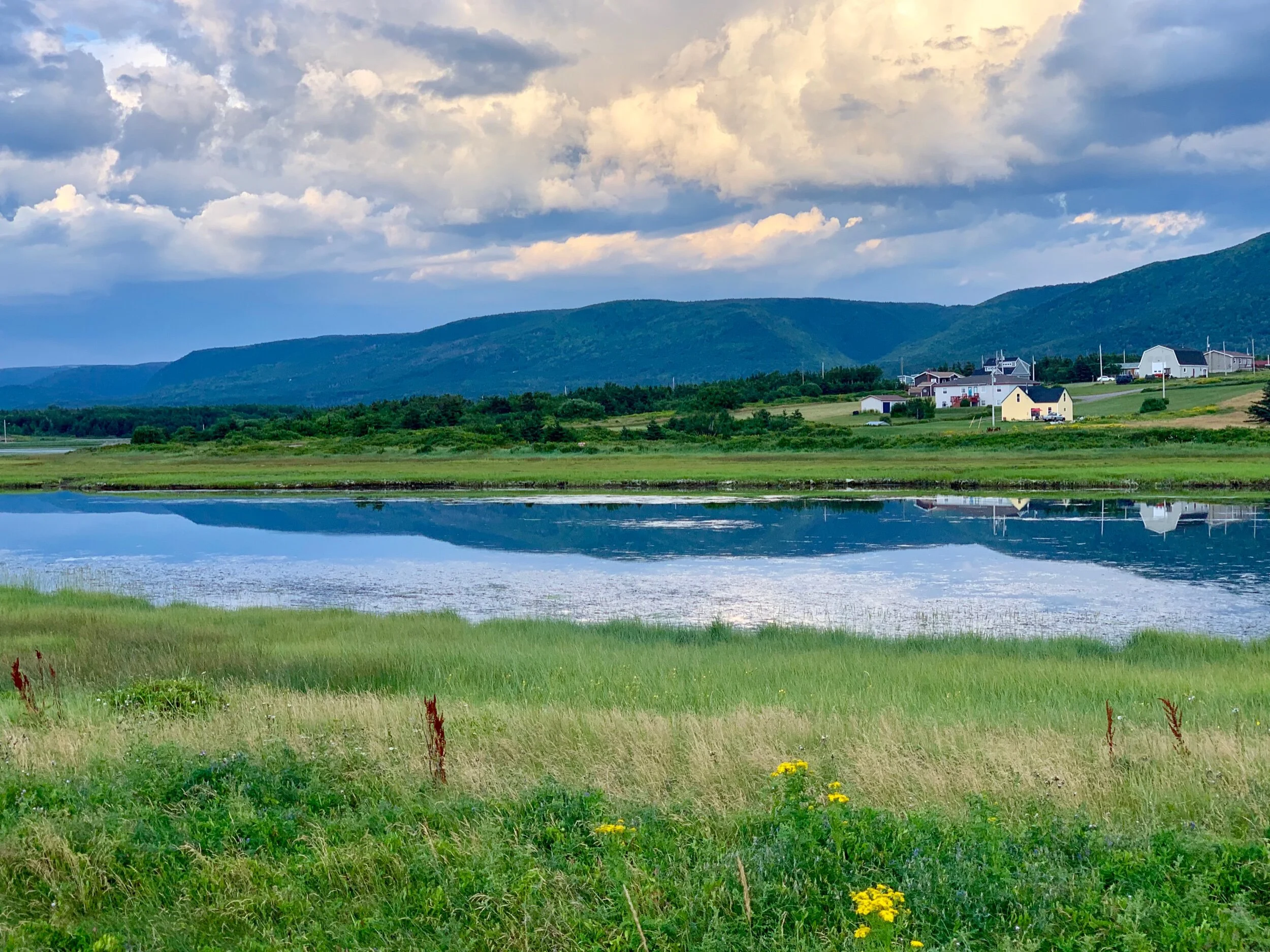
Near our campground in Chetticamp, Nova Scotia.
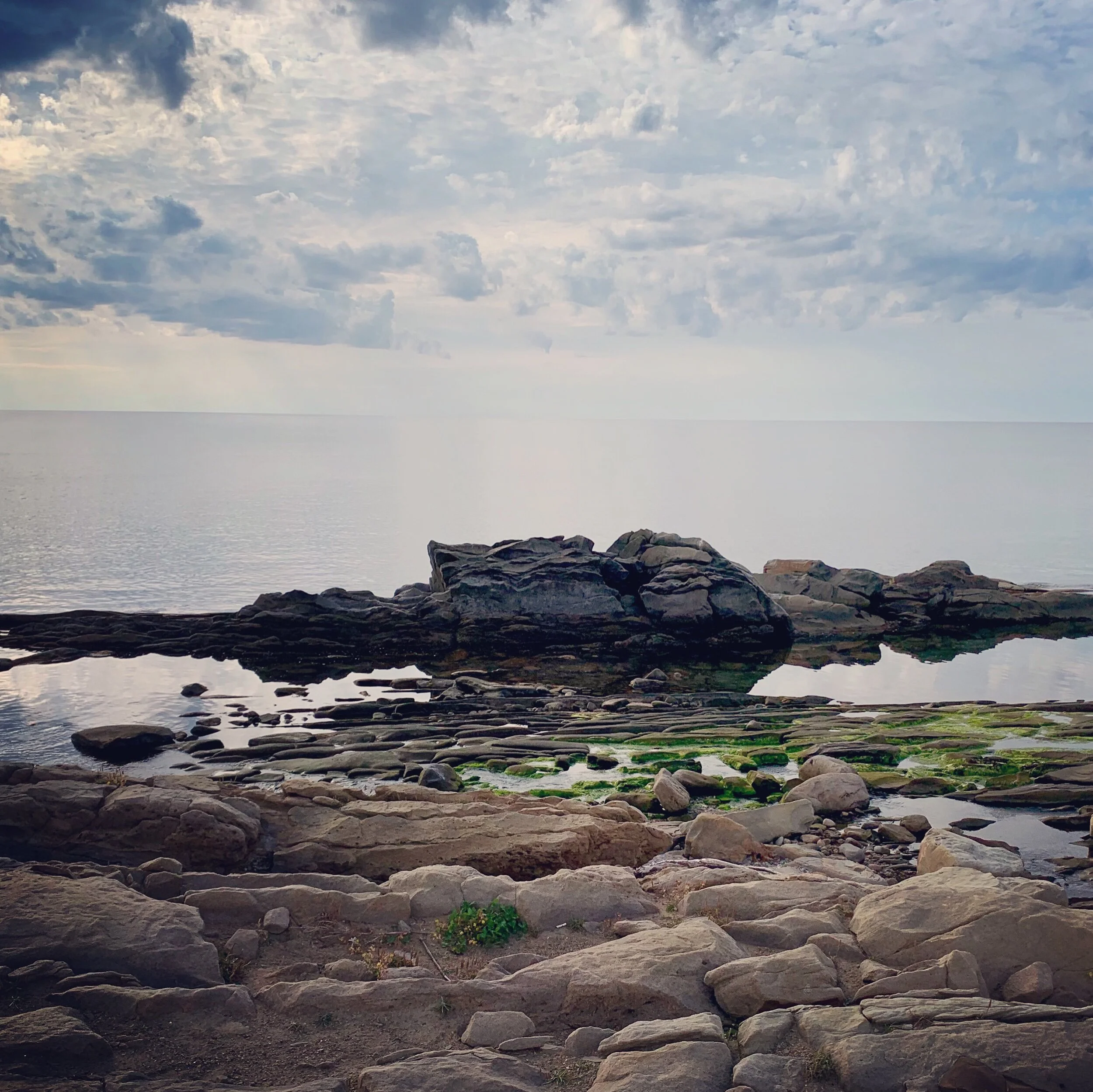
The coast near Chetticamp, Nova Scotia.
Moving On
In addition to being busy, last summer was emotionally eventful. In June and July, as my brothers and I recovered from my Dad’s recent death, we helped our Mom move from an assisted living facility to a nursing home in Galesburg, IL. She didn’t like losing her independence, but is gradually getting used to both the irritation and value of full-time long- term care. Like most older people, my Mom has good days and bad days. A good day occurred recently when Jenny and I arrived via train to meet up with my daughter Saren and her family from Wausau, Wisconsin. My Mom was able to meet her new great grandson Landon.
My Mom Sue Chase and her great grandson Landon Spire.
As I joyfully watched my Mom, my daughter and her son, I realized there were four generations of us in the same room sharing our love. And of course, I found myself wondering what life will be like for Landon when he is my Mom’s age (it will be 2106). Will civilization as we presently know it even exist? Will animal species other than humans and their pets and feedstock still exist? Or will our species be gone as well?
There is increasing scientific evidence that we are quickly running out of time, and we must significantly turn the tide on greenhouse gas emissions over the next decade. I am so pleased that all the Democratic candidates for President are acknowledging climate change as an existential threat, and are developing policy proposals for meaningful change. Personally, I cannot think of a more important way to address our climate emergency right now than to back whatever Democratic candidate is nominated, and to work my heart out for his or her election. And if we are lucky enough to have an administration that understands climate science, then we must put our shoulders to the wheel for national policy that supports carbon pricing and returns dividends to citizens to help bear the increased costs of fossil fuels. We will also need policies to help build the next great economic expansion in renewable energy, carbon sequestration through changing agriculture practices, and carbon technologies to include air-based and flu-based greenhouse gas capture and carbon recycling through manufacturing of inert products such as polymers, fuel and even food. These nascent, yet promising technologies are very hopeful. We only need the will to make them happen. For more information check out the Circular Carbon Network.
——————
Today I'm writing from a motel in Richmond, Indiana. Jenny and I began this cycling trip about a week ago from Galesburg, Illinois. As I’m sure you are aware, the fall has been unusually hot in the Midwest and the northeast. That changed suddenly last Friday, just as we left Bloomington, Illinois, for Gibson City (with the help of a local Samaritan who drove us 37 miles in his pickup to avoid rain as the temperature plunged to the high 30’s). The next day was even more inclement. By Saturday evening, after Jenny and I had biked 72 miles to Attica, Indiana, we were very cold, wet, miserable and tired.
But the joy of biking is often in the recovery phase. The last two days have been lovely, and today was exceptional. Our trip has become glorious again. Galesburg is about 400 miles west of us at this point. We’re tired and windblown, and enjoying the pleasant and peaceful endorphin rush that comes after several days of hard cycling. It’s nice to feel used up.
The rainy view outside our motel in Gibson City, IL.
Fossil fuels are like this as well! We enjoy now, our grandchildren pay later….
Thanks for reading! More to come…
All photos, unless credited or otherwise noted, are copyrighted property of the blog post author.
Phoenix to El Paso, ...no, Tucson, Post 3
Twilight behind a sugaro cactus in Tucson.
After a one day layover in Portal, AZ, where I hiked near Cave Creek Canyon, I woke to a very cold day. The wind was clocking about 24 miles an hour out of the southeast, so I decided to head northeast to Silver City, NM, thinking that I would then zag southeast the next day to Columbus NM, and then make my way eastward into El Paso.
The Chiricahua Mountains on the way to Lordsburg.
Life has a funny way of making us change our plans. The wind shifted to the east. Rain clouds gathered. The temperature dropped. After a very difficult slog of a ride directly into a punishing wind, I arrived in Lordsburg about 45 miles away from Silver City. I wasn't sure what the weather was up to, but I was worried. I found an inexpensive motel and downloaded another wind app for my cell phone, hoping it would give me better capacity to analyze and predict what the next few days were going to be like. I knew there was a raging storm in the Midwest (the Nebraska bomb cyclone) and I assumed its outer edges were the cause of the wind and cold weather coming out of Texas. So I sat in my motel room, finally warm again, thinking about what to do. Near as I could determine the winds were going to remain out of the east/southeast at approximately 15 mph for the next 4-5 days. Additionally, rain and some snow were forecast for the entire region for the next few days. I knew I could make it to El Paso one way or the other as planned, and I also knew the trip was likely to be difficult and miserable.
The wind stirs up dust on the way to Lordsburg.
I called my Dad in California, and my Mom in Illinois. I also called my kids. That might seem like a strange comment coming from a grown man in his 60's, But for those of you tracking older parents and grandkids, you'll recognize the behavior. I wanted to be certain my eastward direction under such conditions didn't make it difficult to get to either parent should the need arise. And I wanted to know if changing my itinerary and visiting my kids and grandkids a month or so later than previously planned would be ok.
I was improvising based on weather, just as humans have done for thousands of years. That is, before we insulated ourselves from it through our technology. Yet, our very attempts to tame it have only made it more foreboding. As the recent bomb cyclone in Nebraska - and the even more devastating cyclone in southeastern Africa - remind us, the weather will always humble us. We can't defy physics.
After discussions with various family members, I decided to return to Tucson where the weather was milder, and catch a train up to San Jose to my Dad's place. Right now I'm sitting in a lovely Landmarked train station in Tucson. I travel tonight on the Sunset Limited and will arrive into LA the morning in time to catch the Coast Starlight up to San Jose tomorrow. As usual, I will roll my bike up to the baggage car. For only $20 more a ticket there's no better way to get a bicycle somewhere (other than riding it, of course).
One of my intentions, for now, is to avoid an effigy in my honor. I came across this one on "A" Mountain east of Tucson.
Seen in western NM.
Seen in eastern Arizona.
Seen near Douglas, AZ
The new plan made me breathe easier, and sleep a bit more deeply. That said, I'm sorry to have missed exploring route 9 and the towns of Columbus, NM, where Pancho Via "invaded" the US at the battle of Columbus in 1917, and Antelope Wells, NM - which I am told is a hot spot for Border Patrol action. I'll be back.
The border near Nogales, AZ. Photo credited to USA Today.
I can't say that I've seen much near the border that suggests we have a crisis of "invasion". Where I've been it seems quiet, "normal" and only subtly militarized. As per the pictures I've already posted, the fences are ugly and the concertina wire is threatening. I've been reading an interesting book titled "Storming the Wall; Climate Change, Migration and Homeland Security" by Todd Martin. If the numbers of illegal immigrants on our southern border are actually increasing (recent reports suggest that is true) they are mostly immigrants from Guatemala, El Salvadore and Honduras. And, according to Todd Martin, these countries are experiencing devastating drought, and are climate refugee "canaries in the mine" for what lies ahead.
Apparently, migrants from these countries turn themselves into Border Patrol at their soonest opportunity with the intention of applying for asylum. Most are farmers who are no longer able to survive on their land. If they flee to nearby cities, they and their families are subject to horrific gang violence. So they come north, hoping they can gain asylum in the United States. If there is a crisis, it's a humanitarian one, and one that a wall might even exacerbate. Here's an article in "Scientific American" that explains the underlying issue more deeply.
One of hundreds of checkpoints on a north/south road just south of Interstate 10. They are intended to keep migrants from gaining access to our interstate system. I've passed through several. Each time I've asked the agents if it was busy that day, and each time the answer was no.
Fields of daisies are common here this time of year.
A view to the south about 50 miles east of Tucson.
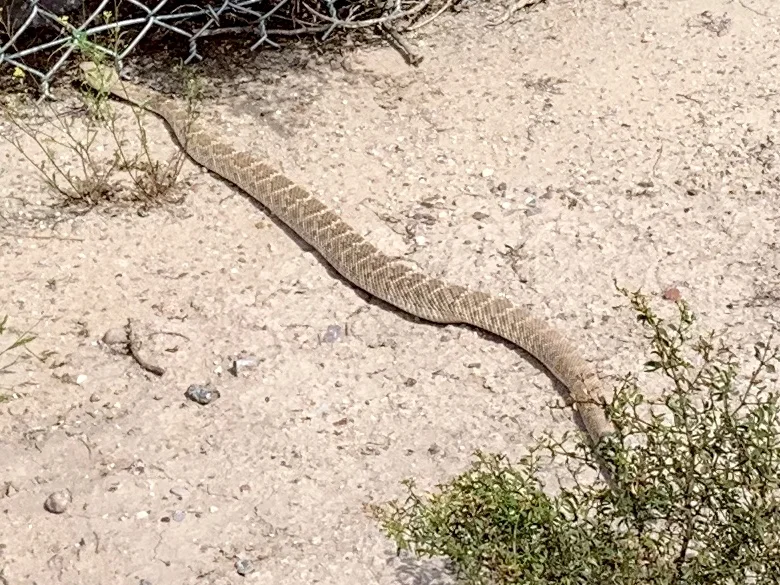
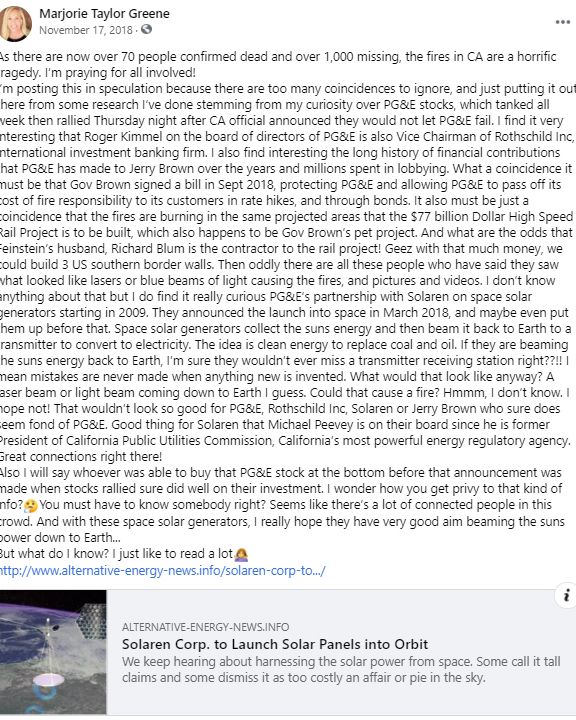
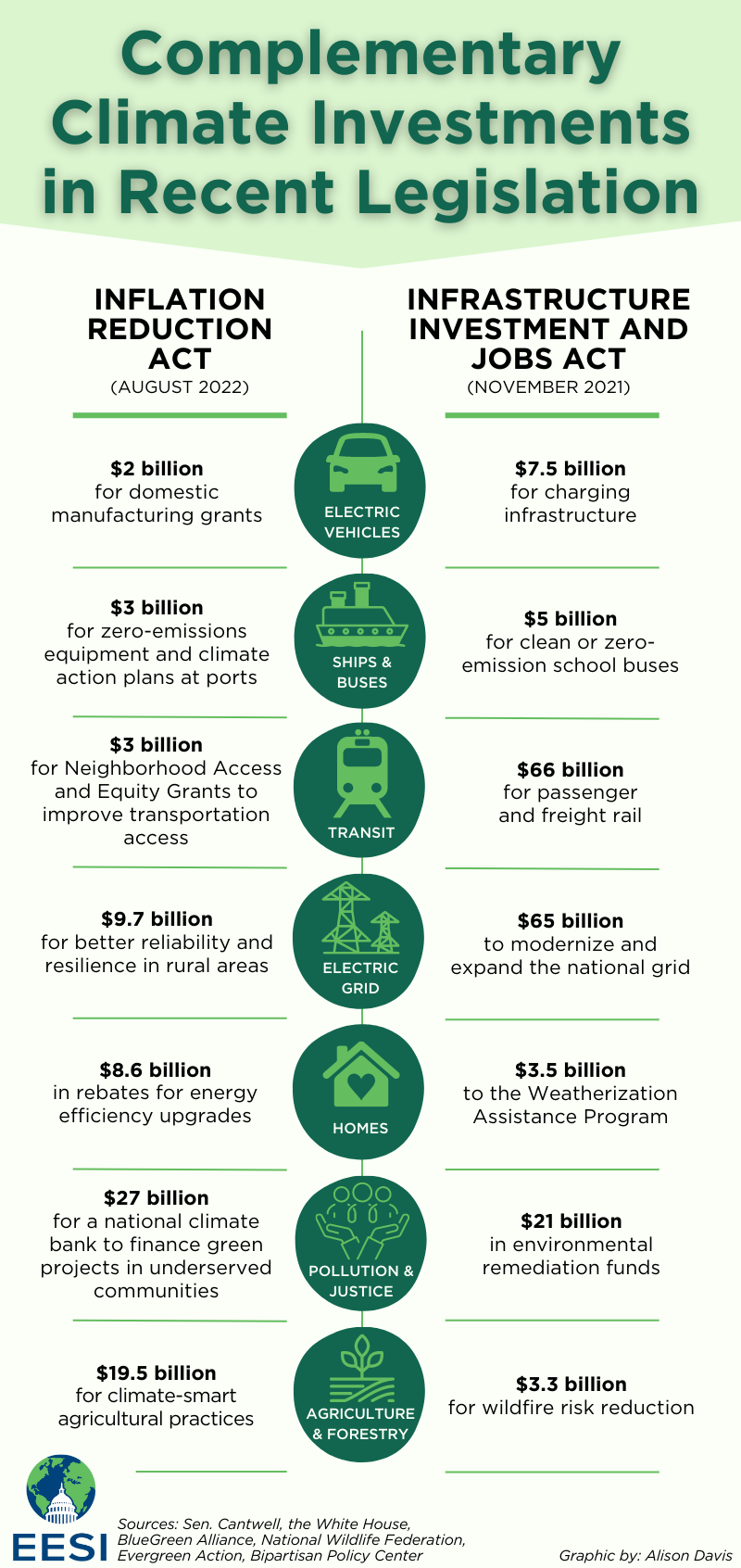
A rattlesnake seen on a bike trail near Tucson. As it gets hotter, they get more active.
Next week I fly back to New York. It will be another month or so before I start my next cycling adventure, so you'll notice a lag in my blog posts. But, as always, there's more to come.
All photos, unless credited or otherwise noted, are copyrighted property of the blog post author.